
Educating Engineers for the Near Tomorrow*
DIRK SCHAEFER
Woodruff School of Mechanical Engineering, Georgia Institute of Technology, 813 Ferst Drive, NW, Atlanta, GA 30322–0405, USA. E-mail: [email protected]
JITESH H. PANCHAL
School of Mechanical and Materials Engineering, Washington State University, Pullman, WA 99164, USA. E-mail: [email protected]
J. LANE THAMES
School of Electrical and Computer Engineering, Georgia Institute of Technology, Savannah, GA 31407–3039, USA. E-mail: [email protected]
SAMMY HAROON
The RBR Group, Chapel Hill, NC 27516. E-mail: [email protected]
FARROKH MISTREE
School of Aerospace & Mechanical Engineering, The University of Oklahoma, Norman, OK 73019, USA. E-mail: [email protected]
In this paper, we present an educational approach to facilitate Learning how to Learn, that is, to equip our students with competencies needed to become lifelong learners and succeed in the job market of the near tomorrow. Our approach is anchored in educational and instructional theory and closely tied to current professional practice. The approach is implemented in a graduate level engineering design course that is offered in a distributed collaborative distance learning setting.
Keywords: design education; distance learning; personalized learning; cooperative learning; competency-based learning; learning how to learn; sharing to gain, mass collaboration; crowd sourcing; globalization
1. Transforming design education—
rationale
The world of technology is becoming increasingly complex and dynamic. The skills that were consid-ered valuable yesterday are becoming the commod-ities of today and tomorrow [1, 2]. Realizing how much the world has changed over the past twenty years, it becomes apparent that this change needs to be better reflected in the way engineering designers are educated [3–6]. Complex social networks, con-sisting of millions of individuals, have formed over the Internet through emerging Web 2.0 technologies such as blogs, discussion boards, wikis, and colla-boration networks such as Facebook, video net-works such as YouTube, and countless others. Information is readily available to everyone through the Web, anytime and anywhere. Indivi-duals, who have never metphysically, i.e., in person, are already collaborating on the development of complex products and services for major compa-nies, solving challenging problems that are openly ‘crowd sourced’ to the community of interested engineers and scientists. For the next generation of engineers, this new paradigm will be the new norm. Their number one material to work with will be information, their final product(s) will be
intellec-tual property and innovation, and their generation is becoming known as thegeneration of knowledge workers.
Over the past two decades web-based technolo-gies have brought about revolutionary changes in the way organizations conduct business. Organiza-tions are increasingly transforming into decentra-lized supply and demand networks. According to Friedman [1], we have now reached the era of Globalization 3 (G3), in which individuals have the power to collaborate and compete globally. Globalization 3 has led to the emergence of various new paradigms related to breakthrough innovation that are characterized by the self-organization of individuals into loose networks of peers to produce goods and services in a very tangible and ongoing way. Examples of such paradigms include mass collaboration [7], collective innovation [8], collec-tive invention [9], user innovation [10], crowd sour-cing [11], open innovation [12], and community-based innovation [13].
New organizational structures based on self-organizing communities are emerging to comple-ment traditional hierarchies. According to Tapscott and Williams [7], the new principles for success in G3 are a) openness to external ideas, b) individuals as peers, c) sharing of intellectual property, and d)
global action. In such emerging organizations, indi-vidual success is defined by the recognition gained through contributions towards a common goal rather than by following the directions from top management. An organization’s success is deter-mined by its ability to integrate talents of dispersed individuals and other organizations. Hence, the skills and competencies required for success in the G3 world vary from the ones required for success in the Globalization 1 or Globalization 2 eras.
In addition to this, the overall workplace char-acteristics of the near future are expected to be very different from the current ones. According to Meis-ter and Willyerd [14], by the year 2020:
The workplace will be highly personalized and social.
Employers will need to adjust to the unprece-dented challenge of having up to five generations of individuals working together.
Employers can expect to manage employees with vastly different interests and life experiences from varied regional, ethnic, and cultural backgrounds.
Employers must provide fully individualized ben-efits and services.
Traditional offices and nine-to-five work sche-dules will be largely passe´.
Knowledge workers will dominate. Lifelong learning will be the rule.
Employees will expect and demand robust inter-nal and exterinter-nal online connections.
The future HR staff will include positions that do not yet exist, such as ‘talent developing agent’.
Similarly, Benko and Weisberg [15] describe an ongoing shift away from the traditional career laddermodel to acareer lattice. That is, a model to allow for customized and flexible career paths based on new organizational forms that better fit the workforce of near tomorrow. In summary, for our graduates to succeed in the world of near tomorrow, we must provide an opportunity for them to learn and play in a whole new game of design and engineering.
Given this complex and dynamic environment, the key question we pose is:
How can we better educate the engineering designers of near tomorrow?
While there is a broad agreement that engineering education needs to change based on the current dynamics of globalization, innovation-centric value creation, and such, there appears to be little tangible advice rooted in practical experience as to how exactly that change is best to occur. Many educators agree, that one step in the right direction is to anchor engineering education in a more holistic perspective [16–19]. There ought to be a better
symbiosis of societal needs, technologies, cross-disciplinary integration and associated educational activities. Our task at hand is to prepare engineers who are capable of identifying and solving problems that do not yet exist with tools and methods that have not yet been invented.
We are currently preparing students for jobs that don’t yet exist using technologies that haven’t been invented in order to solve problems we don’t even know are problems yet—Former Minister of Education Richard Riley.
This includes, what at a later point will be intro-duced as 21st century dilemma management. In essence, the big challenge boils down to educating students in the art oflearning how to learnand to empower them to take charge of their own educa-tion within the context of an ever-increasing amount of subject matter to be comprehended. We believe that the competitiveness of the next generation of engineers in general will no longer be defined solely by their knowledge and skills.
We can’t solve problems using the same kind of thinking we used when we created them—Albert Einstein.
A key differentiator of leaders and followers will be their ability to create their own knowledge and constantly improve and update their competencies in an ever changing world. Hence, they need to be provided an opportunity to learn how to learn.
We believe that, in light of the preceding, engi-neering education should be augmented with stu-dents learning how to create and implement ‘game changing’ strategies to better prepare students for the world of near tomorrow, in which distributed value creation in an interconnected world will be the new normal [20, 21]. Our ‘laboratory’ for experi-menting with innovative design education is a graduate level engineering design course offered at Georgia Institute of Technology every spring, namely,ME6102 Designing Open Engineering Sys-tems. We have jointly orchestrated this course for several years. An overview of the course context, content and structure, the way it is implemented, the underlying educational framework, and lessons learned are presented in the following sections.
design and design education in a distance learning setting. Finally, we provide closure in Section 7.
2. Educational frame of reference
ME6102 Designing Open Engineering Systems is a graduate level design course offered at Georgia Institute of Technology. It is taken by students with diverse backgrounds from a variety of engi-neering and science disciplines. The course is offered in both live and distance learning modes. The student body is comprised of participants from the Georgia Tech Atlanta, Savannah, and Lorraine (France) campuses as well as distance-learning students from across the US. In addition, we have participants from other countries, such as the Netherlands and even the Arabian Emirates. We expect students taking this course to have been introduced to an approach to systems design [22] and participated in a group design experience, for example, capstone.
In this section, we provide an overview of the educational framework for learning how to learn
upon which our approach to teaching engineering design in a disturbed collaborative setting is based. At the very heart of our learning how to learn
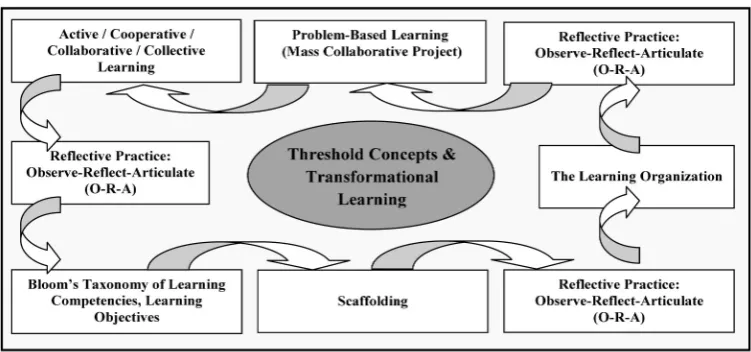
framework lies the theory of threshold concepts and transformational learning. It utilizes Bloom’s Taxonomy of Learning to motivate deep learning among students and is fostered through a number of scaffolded learning activities featuring instructional techniques, such as problem-based learning, coop-erative, collective and collaborative learning and involves the development of a learning organiza-tion. An important driver within this framework is the concept of reflective practice, which is called upon after every major step along the learning process. An overview of our Learning how to
Learnframework is depicted in Fig. 1, followed by a discussion of its key elements.
2.1 Threshold concepts and transformational learning
According to Meyer et al. [23]
A threshold concept can be considered as akin to a portal, opening up a new and previously inaccessible way of thinking about something. It represents a transformed way of understanding, or interpreting, or viewing some-thing without which the learner cannot progress. As a consequence of comprehending a threshold concept there may thus be a transformed internal view of subject matter, subject landscape, or even world view. This transformation may be sudden or it may be protracted over a considerable period of time, with the transition to understanding proving troublesome. Such a transformed view or landscape may represent how people ‘think’ in a particular discipline, or how they perceive, apprehend, or experience particular phenomena within that discipline (or more generally).
According to Meyer and Land [24]
a threshold concept is likely to be:
Transformative, in that, once understood, its potential effect on student learning and behavior is to occasion a significant shift in the perception of a subject, or part thereof.
Probably irreversible, in that the change of perspective occasioned by acquisition of a threshold concept is unlikely to be forgotten, or will be unlearned only by considerable effort.
Integrative; that is, it exposes the previously hidden interrelatedness of something.
Possibly often (though not necessarily always) bounded in that any conceptual space will have term-inal frontiers, bordering with thresholds into new conceptual areas
Potentially (and possibly inherently) troublesome.’
In ME6102, there are severalthreshold experiences
[image:3.595.109.485.78.254.2]for our students, who often are troubled and some-times even shocked the first time they experience them. Here are selected examples:
Instead of delving right into the subject matter of engineering design, students are asked to spec-ulate about the world of design and manufactur-ing of the year 2030, based on current literature and developments, before learning about the engineering design process as we know it. By speculating about the world of 2030 they get a new perspective on the potential requirements of future engineering design processes. Thus, they are creating knowledge beyond what they could learn from any given text book.
The students are required to take stock of their current competencies and compare what they already have to the competencies a successful designer may need in future. Thereby, students are empowered to take charge of their own learning by articulating their individual asso-ciated learning objectives within the broader context of this course. At first, they cannot believe that the Question for the Semester they are presented in the first lecture of the semester indeed is their take-home exam and that they even have the right to tweak this question in response to their personal learning objectives. That way, they are encouraged to start shaping their own learning.
Later on in the project phase, students are strate-gically guided to form a learning organization of self-organizing individuals that, collectively, leverage each other’s competencies to solve a common problem. For about a week, they wait for the orchestrators to tell them exactly what to do to get started with their group project. How-ever, we refuse to do so and shortly afterwards a natural response of emerging leadership forms and students start taking on team roles based on the competencies they wish to develop.
The threshold experiences are embodied in five constructs, namely, Bloom’s Taxonomy,
scaffold-ing, the learning organization, Collaborative, Collective, and Cooperative Learning, and Reflec-tive Practice through Observe-Reflect-Articulate
and Learning Essays. These are briefly described next.
2.2 Bloom’s taxonomy of learning
While there are many other taxonomies of learning we have chosen Bloom’s taxonomy [25] as a frame-work within which to orchestrate student’s learning. We decided to use Bloom’s traditional taxonomy because, based on our experience, engineering stu-dents find it natural and easy to grasp.
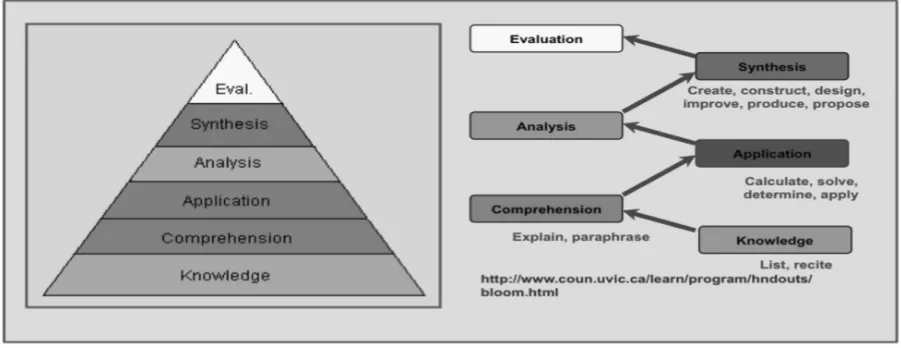
In 1956, Bloom [25] developed a classification of levels of intellectual behavior important in learning. Bloom identified six levels within the cognitive domain (see Fig. 2), from the simple recall or recognition of facts, as the lowest level, through increasingly more complex and abstract mental levels, to the highest order, which is classified as evaluation. These six levels are: (1) knowledge, (2) comprehension, (3) application, (4) analysis, (5) synthesis, and (6) evaluation. Traditionally, the first three levels mapped into the Undergraduate Curriculum and the three upper levels mapped into the Graduate Curriculum. Lately, this division has been vanishing as educators have realized the importance of addressing all levels of Bloom’s Taxonomy from early on in the curriculum.
[image:4.595.72.523.567.741.2]Bloom’s taxonomy provides a systematic way of describing how a learner’s performance grows in complexity when mastering academic tasks. It can thus be used to define curriculum objectives, which describe where a student should be operating. In addition, Bloom’s taxonomy provides a powerful means to assess students’ performance, justify asso-ciated grades, and at the same time provide students with feedback as to how to improve their perfor-mance. In a truly constructively aligned curriculum
it facilitates deep learning as the activities are designed for that purpose. At the beginning of ME6102 all students are introduced to Bloom’s taxonomy and it is emphasized that we expect our students to relate well to the domains of knowledge, understanding and application and our focus in this course is on providing them with the opportunity to learn through analysis, synthesis and evaluation.
2.3 Scaffolding
We facilitate our students learning how to learn through scaffolding. This involves three instruc-tional cornerstones: (1) reflective practice; (2) cus-tomization; and (3) collaboration. A combination of these utilizes a variety of educational approaches to foster deep learning among students. The scaf-folded part frames the content of the course with the
Question for the Semester(Q4S) and several asso-ciated assignments. The assignments are structured (scaffolded) and provide opportunity for individua-lization. This ensures that everybody in class works in the direction intended by the course orchestra-tors. The lectures are used to connect the assign-ments to the customized components of the course. The lectures are also used to convey core course content and also cover additional aspects that may help students with their assignments. The collective knowledge and experience of the students enrolled in our course is harnessed to create a collective solution to an open ended mass-collaborative design problem and the answer to the Question for the Semester that could not be accomplished by an individual.
2.4 The learning organization
We orchestrate the learning of an individual in a group setting through the formation of a learning community in a distributed distance learning set-ting. The blueprint for this is the model of the Learning Organization (LO) as introduced by Peter Senge in his famous 1990s book ‘The 5th Discipline’ [26]. According to Senge, a Learning Organization is
an organization that facilitates the learning of all its members and consciously transforms itself and its con-text.
A learning organization exhibits five main charac-teristics: (1) systems thinking, (2) personal mastery, (3) mental models, (4) a shared vision, and (5) team learning.
An obvious issue with introducing this paradigm of the Learning Organization into the classroom environment of ME6102 is that it was mainly developed for companies, based on the business models and practices of the 1990s. However, our graduate students, future engineers, are required to
form such a Learning Organization within their distributed learning environment. Hence, one of our key activities is to analyze the original model of the LO and augment it to better fit the needs of our educational setting and the characteristics of the G3 world of near tomorrow.
2.5 Collaborative, collective, and cooperative learning
We facilitate collaborative and cooperative learning in our ME6102 learning community. Today, the term collaborative learning stands for a variety of student-centered educational approaches that involve joint intellectual effort by learners and instructors. It refers to educational methodologies and learning environments in which learners engage in common tasks in which each individual depends on and is accountable to each other. Groups of students usually work together in order to under-stand something, grasp a meaning, or develop a solution to a problem. The theory of collaborative learning is tied together by a number of important assumptions about learners and learning processes. These include (a) that learning is an active, con-structive process in which learners create new knowledge by using, integrating and reorganizing their prior knowledge; (b) that learning depends on rich context, which influences the success of learning significantly; (c) that learners are diverse in terms of background, knowledge, experience and learning styles; and (d) that learning is inherently social, which makes student interaction an important part of education. All of these aspects of learning are supported by the means of collaborative learn-ing where students solve problems and create knowledge in a diverse group setting. The term collaborative learning also refers to a collection of tools, which learners can use to collaborate, assist, or be assisted by others like they are used in e-learning and distance e-learning environments. Such tools include virtual classrooms, chat rooms, dis-cussion threads, as well as application and docu-ment sharing.
According to Panitz [27], collaboration is a phi-losophy of interaction and personal lifestyle and cooperation is a structure of interaction designed to facilitate the accomplishment of an end product or goal. Cooperative learning [27–29] is more directive than student-centered collaborative learning and closely controlled by the course orchestrator. The approach presented in this paper features elements of both philosophies.
2.6 Reflective practice through observe-reflect-articulate and learning essays
It is critical that the individual learns from a colla-borative learning experience. In a mass-customized course [30] the articulation of individual learning is crucial since it is the prerequisite for the evaluation of an individual’s progress. Usually students are not used to this and have difficulties with the articulation of their learning. They are used to showing their learning during exams in a strictly predefined way. Here the students require a learn-ing construct that provides guidance through the entire learning process and helps them to identify and express their learning and new knowledge. Therefore, in ME6102, the Observe-Reflect-Articu-late (ORA) construct [31] is introduced to the students at the beginning of the semester. It consists of three phases:
1. Observation, in which existing knowledge is reviewed from different sources like lecture, literature, magazines or newspapers.
2. Reflection, in which the observed knowledge is synthesized by reflecting on given or self dis-covered questions.
3. Articulation, in which learning and new knowl-edge, gained from the first two phases, is expressed.
By following these steps during the submissions the students internalize the process of learning and deeply learn how to learn. This is one way of introducing students reflective practice, as intro-duced by Schon [32].
Learning essays are encouraged weekly submis-sions in which students review and explore topics from the lectures in context of their individual semester goals. To direct the students, at the end of each lecture guiding questions are suggested that may help them to better relate the lecture content to the big picture of the course. The students also have the freedom to choose other course-related themes for their learning essays. Since nothing in ME6102 is graded till the end of the semester (we provide formative assessment [33] throughout the semester), the students are more willing to take risks in choos-ing topics and developchoos-ing new thoughts in their essays. If the orchestrators realize that a student is
on a wrong track they express this in the individual feedback and provide corrective guidance.
A core aspect of the learning essays is that the students apply and internalize the Observe-Reflect-Articulate construct for reflective practice and thus learn how to create new knowledge and enhance their critical thinking skills. At the end of the semester the students reflect on their learning in a Semester Learning Essay by relating it to a non-engineering analogy or metaphor. Examples of metaphors used by the students include football, cooking, golfing and writing poems. Here, the students can show insight and demonstrate that they really proceeded in achieving their semester goals.
The students are expected to validate a part of their ‘answer to the Question for the Semester’ (see Section 4) through the group project. The validation is carried out using a construct called Validation Square [34, 35], which originally was developed for validating design methods. Validation is an impor-tant aspect of the course because it helps students to learn how to critically evaluate their proposed answer to the Question for the Semester.
3. Course framework
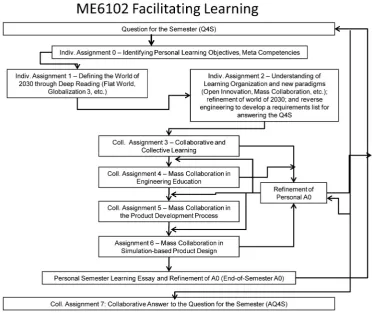
In this section, we present an overview of the learning activities of ME6102. An at-a-glance over-view of the way in which learning is facilitated in ME6102 through a number of scaffolded activities is presented in Fig. 2. Although we show the imple-mentation in Spring 2009, the overall framework is always identical. For a detailed discussion of these elements one should refer to [30, 31, 36].
3.1 Question for the semester (Q4S)
In personalizing a course, the challenge for the course orchestrators is to keep the students’ efforts aligned with the objectives and topics intended. In the educational approach implemented in ME6102, this is achieved through a scaffolded component. It consists of structured assignments in a predefined form with firm due dates. These submissions are created to challenge the students, arouse their curiosity and let them discover issues related to the course they are personally interested in. In ME6102 this is realized by posing the Question for the Semester (Q4S) and several associated assignments that are scaffolded towards the answer to this question. In the first lecture, the Q4S is presented. It is a take home exam that is due at the end of the semester. For example, the question for the semester in spring 2009 was:
are empowered to participate in the global value network. Your brief is to identify the characteristics of the IT infrastructure to support technical collaboration that furthers open innovation.
Every time we orchestrate the course, a similar question with a different focus is posed and serves as a foundation for the entire course. All learning activities are directed towards answering this ques-tion. To support the individual interests, the stu-dents are allowed to tweak and personalize this question according to their personal learning objec-tives (see Assignment 0). The changes a student is allowed to make to the Q4S are limited and have to be approved by the course orchestrators. In a mass customized course, this framing is particularly important to keep the students focused on their personal objectives. That way, the students can evaluate their work towards the answer of the Q4S and can prioritize their ideas.
3.2 Individual Assignment 0
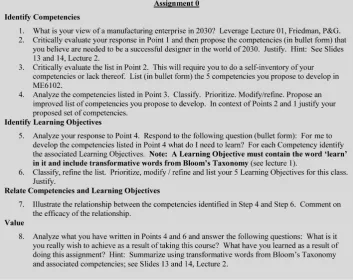
In Assignment 0 (see Fig. 3), students are required to identify the competencies and associated learning objectives they wish to develop in the context of ME6102, the Q4S, and the G3 world. Since the students’ knowledge and experience grow
through-out the semester, these initial competencies and learning objectives have to be revisited and refined accordingly several times.
3.3 Individual Assignment 1
In Assignment 1, the students take a closer look at defining their world of 2030 and their views on what a design and manufacturing enterprise may look like 20 years from today. Expected deliverables are a vision for the engineering world of 2030, a vision of product creation enterprises in the world of 2030, and a set of refined competencies and learning objectives for future design engineers to be success-ful in that world.
3.4 Individual Assignment 2
[image:7.595.111.484.426.739.2]In Assignment 2, the students build upon their previous assignments plus what has been covered in class over the first couple of weeks. Now their task is to identify what exactly it takes to answer the Q4S. In essence, answering the Q4S can be considered a design problem and the answer to this question can be considered an Open Engineering System they are required to build. The expected outcome of this assignment is a requirements list for an Answer to the Question for the Semester. To learn how to do
this, the students start with reverse engineering a requirements list for Open Engineering Systems [37]. Then, they reverse engineer a requirements list for their answer to the Q4S, perform a gap analysis between both lists and refine their require-ments list for the answer to the Q4S.
3.5 Collaborative Assignment 3
Assignment 3 is the first of a number of collabora-tive assignments. The students are required to experiment with a software suite for virtual colla-boration, in which they will interact from this point forth for the reminder of the semester. In addition to becoming familiar with the technical features of the provided collaboration suite, this includes forming a learning community in a distributed setting plus establishing policies regarding collaboration and behavior. In other words, they are required to build a small form of a learning organization [26].
3.6 Collaborative Assignment 4 (group project)
The topic for Assignment 4 is a brief of an open ended mass-collaborative design project. The stu-dents are introduced to a real-world project that has not yet been fully explored. We deliberately provide an abstract and general project brief, reassure the students that they, between them, do have what it takes to tackle the problem and encourage them to ‘figure out how to make it happen’. What we want
them to achieve in Assignment 4 is to thoroughly analyze the given problem, understand the crux of it, and determine what needs to be done to address it. This all is to happen in the virtual collaboration suite. As mentioned earlier, an important threshold concept for our students to experience here is that they need to take stock of their individual compe-tencies and determine how all their individual competencies and knowledge can be best leveraged to effectively and efficiently manage the project (sharing to gain). In short, we ‘crowd-source’ the project brief to the entire student body enrolled in our course and expect them to form a learning organization and a self-organizing team of distrib-uted collaborators.
3.7 Collaborative Assignments 5 and 6
Depending on the complexity of the given design project from Assignment 4, we may decide to subsequently break it up into two sub-projects of lower complexity to help students get started, if necessary.
3.8 Assignment 0—end-of-semester (A0-EOS) and self grading
[image:8.595.120.474.455.735.2]The final stage of the course is to close the loop with regard to what has been learned. The students are required to revisit their original Assignment 0 sub-missions and take stock of how much each of the
learning activities throughout the semester have actually helped them to attain their desired compe-tencies and corresponding learning objectives.
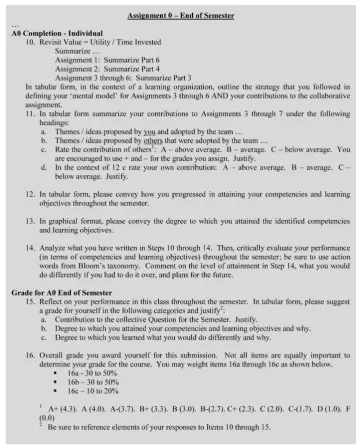
This process of reflective practice [32] is presented to the students by means of A0-EOS, an extended end-of-semester version of the original Assignment 0 (see Fig. 5). In addition to revisiting questions 1 through 8 of Assignment 0, the students are asked to reflect on their learning process, the quality of their contributions to the various assignments, the value gained with respect to attaining their individual learning objectives and competencies as well as the value added to the overall ME6102 Learning Orga-nization. Finally, based upon this self-reflection, the students are asked to propose a grading scheme for evaluating their own work as well as that of their peers. This includes developing a comprehensive assessment rubric [38] showing the categories of work to be assessed along with justifications for the various degrees of achievement, as well as the articulation of the specific grades they believed they had earned.
4. Design education ‘plus’: from invention
to innovation
In Section 2 we introduced the Question for the Semester (Q4S) as a topical anchor for the entire semester.
Imagine that you are operating a product creation enterprise in the era of Globalization 3 where individuals are empowered to participate in the global value network. Your brief is to identify the characteristics of the IT infrastructure to support technical collaboration that furthers open innovation.
Clearly, addressing this question requires knowl-edge and information beyond what is typically offered in an engineering design course. Our inten-tion is to provide our students with a holistic picture of product creation; and thus we believe that the core technical design-related content is best deliv-ered in combination with selected materials that aid the development of ancillary competencies. Some of these ancillary competencies include ideas of pro-duct marketing, associated theories of economics, techniques of intellectual-property-centric work-flows and innovation-awareness workwork-flows. In par-ticular and in our case, we add a sense of business integrationwithin the study of collaborative design principles. We introduce the students to two aspects from the business world, namelyInvention to Inno-vation (I2I)andAccelerated Business Commercia-lization (XBC) Method. Both methods were developed by The RBR Group and are briefly introduced below [39, 40].
The speed and agility of entrepreneurial and small businesses, results and best practices at government
funded organizations, collaboration of non-com-peting corporations, and academic research and development today are essential ingredients in the success of an organization’s Product Innovation Portfolio—a portfolio the engineering design stu-dents are expected to build and grow. The stustu-dents are required to collaborate across the above entities to extract value, and at times supplanting their own work in the market with the acquired innovation to gain competitive advantages for the fictive organi-zation they work for.
The I2I (Invention to Innovation) framework introduces the impact of emerging methodologies such as Open Innovation in the market place. In such an environment, speed to market to deliver a unique proposition (i.e., one without any competi-tion) is of far more value than a differentiated value (i.e., one competing against incumbents). See http:// globalcognition.blogspot.com/2011/02/unique-first-mover-vs-distinctive.html. While I2I enables the development of a Product Innovation Portfolio, the validation of the inventions, concepts, etc. captured within it occurs through the application of XBC (Accelerated Business Commercialization). XBC educates the students on a method to manage the three key dimensions of their engineering designs in industry, which include time to market, cost of doing business, and resource requirements. The elements of these dimensions are illustrated in Fig. 6.
XBC enables modeling of a business proposition into nine entities each with interdependencies with others. It helps our students to comprehend the complexity of realizing their engineering designs and this directly impacts their upstream design process. The result is a robust product to the market versus one that would have to go back to the drawing board. The impetus for XBC at RBR emerged from businessmodelgeneration.com’s approach to business design, which continues with this course’s theme of designing open engineering systems in the 21st century.
5. IT Infrastructure for distributed
collaborative design education
Fig. 5.Fragment of Assignment 0— End of Semester (A0-EOS).
[image:10.595.118.480.583.736.2]demand—and hence a growing market—for virtual education opportunities and more and more institu-tions are investing into the sector. Hence, we deem it to be appropriate to share information on our course-related IT infrastructure for others to repli-cate or even join us as collaborators on a number of research projects on Cloud-Computing based design and manufacture.
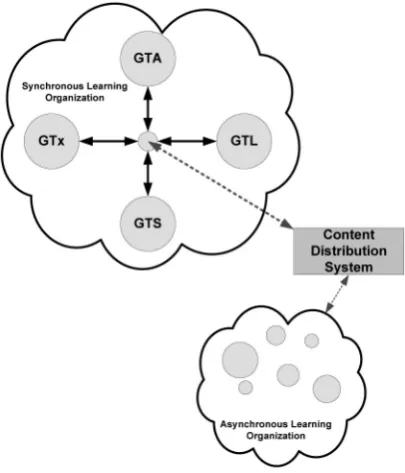
An educational entity needs appropriate technol-ogy and infrastructure to facilitate collaborative and collective learning in a distributed environment. Fig. 7 illustrates, at a high-level, certain aspects of the distance learning environment that has been established at the Georgia Institute of Technology. Georgia Tech has its primary facilities located in Atlanta, GA (GTA) with regional facilities located in Savannah, GA (GTS). Further, Georgia Tech has international facilities located in Lorraine, France (GTL) and Ireland as well as other micro-sites/ facilities both in the US and abroad. Two primary modes of education are in place: synchronous education and asynchronous education.
Synchronous operations refer to activities whereby members of the learning organization/ community (instructors, students, researchers, etc.) meet at scheduled times either in person or virtually. Virtual attendance in synchronous mode is provided by advanced video-telecollaboration (VTC) technologies whereby high-definition video and audio is transmitted over Internet Communica-tion technology (ICT). Some of these technologies include Tandberg/Polycom/Cisco video codec and telepresence systems. Classroom activities are vir-tually interconnected via these types of ICT systems
such that members of the geographically distributed learning organization can participate. Because ICT technologies are used for the delivery of real-time (synchronous) coursework, opportunities exist for content capture and archival, which is then re-distributed via asynchronous education channels. As such, new opportunities of online-education exist, as compared to its current form. Asynchro-nous learning allows students to retrieve all aspects of archived coursework such as digitally recorded lecture, tutorials, and any form of digitized materi-als.
In essence, a Content Distribution System (CDS) is utilized for the delivery and consumption of our synchronous and asynchronous constituents. The concepts illustrated in Fig. 8 depict how the geo-graphically separated entities in the ‘Synchronous Learning Organization’ (SLO) interconnect for the delivery of educational content. During the course of SLO delivery, content is captured, archived, and managed. Content is then accessed at a later time by entities of the ‘Asynchronous Learning Organiza-tion’ (ALO). ME6102 students consist of both synchronousandasynchronous students. We refer to coursework and teaching provided simulta-neously to both synchronous and asynchronous students as ‘blended-mode’ content delivery.
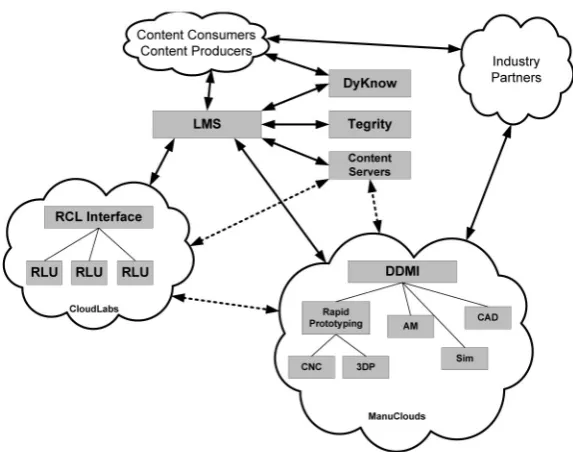
A Learning Management System (LMS) is a key ICT mechanism enabling efficient utilization of educational material (content). Further, we believe it is a fundamental component needed for the realiza-tion of advanced distance learning environments. LMS are used by many universities, especially those who provide online education programs. The most common utilization of LMS by educational insti-tutes of today is focused on the organization of coursework materials such as lecture notes, tutorials, audio, and video. However, we are working towards advanced LMS that provide a centralized interface into all aspects of the university’s learning and research environment. In Fig. 8 we show a concep-tual overview of our content delivery system.
Before continuing our discussion, we should clarify that some components in our Content Dis-tribution System, as shown in Fig. 8, are in produc-tion while others are in prototype states and have not been deployed on a large-scale content delivery basis at this time. In particular, the CloudLabs and ManuClouds systems are prototypes currently under investigation as part of a large-scale research endeavor. However, all other components in Fig. 8 are in production within our content delivery system.
[image:11.595.77.280.77.314.2]of the system, which comprise two primary groups being content producers and content consumers, have access to coursework content and are capable of building their own project-specific collaboration sites with just a few clicks of the mouse. The system’s Web 2.0 based interface, which is shown from one perspective in Fig. 9, contains numerous features and technologies such as text-audio-video chat, wikis, blogs, RSS feeds, scheduling applications, file archiving, email, and remote desktop sharing. Fig. 9 illustrates a particular view of the LMS.
Both synchronous and asynchronous students access course content via the LMS. Asynchronous students, further, access the archived video lectures via the LMS or, in certain cases, through a direct ICT link into the digital lecture archives. Both groups of students as well as all others involved in the learning organization use the LMS as one
particular centralized tool for distributed collabora-tion. Collaborative design tools used in our learning organization consist of, just to name a few, video chat sessions, multi-point remote desktop sharing (i.e., one desktop ‘controlled’ by many participants such as designing an artifact with CAD software), digital white boards for concept sketching, and interactive mind mapping tools. A nice feature provided by our LMS is that these interactive-at-a-distance collaboration sessions can be digitally recorded and archived for retrieval at a later time.
One feature of educational content creation in its various forms and simultaneous capture of it via digital recording is that the content can be archived for later reference by those who created it andby anyone else who needs it. In particular, anyone in the learning organization can be content producers
and/or content consumers. This aspect facilitates a very rich web of knowledge (content) creation, usage, and ‘cyclic re-usage’—that is to say, the continual reuse of content as time goes on, which has many benefits if used appropriately.
One simple example of cyclic reuse is the forma-tion of personalized or customized educaforma-tion with ‘content chunks’—the idea of ‘pull a lecture from here and a lecture from there and a book from here and a paper from there . . . and put them all together’. Mass-customization, which is yet another direct product of advanced ICT and strongly related to mass collaboration and collective learning, is generally a process of interconnecting the pieces of ‘something’ to produce ‘something else’. In the case of innovative education, mass-customization of education will consist of interconnecting pieces of educational material—content chunks of archived lecture and other digital materials along with non-archived educational artifacts—to produce a final product of personalized education.
[image:12.595.153.440.79.305.2]use of tools such as Google Docs, Google Groups, Google Sites, Wiggio, and Skype. Some have used the ‘Drupal Content Management System’ to build out their own web-based collaboration tools. In terms of using Skype, one group integrated a multi-point live video session that illustrated a tri-axial robotics demonstration to a group of geogra-phically separated design collaborators. The illus-tration of our LMS interface shown in Fig. 9 is actually a result where students learned how to use the site-building features of our Tsquare LMS to pull in data from other sources, such as Google Docs.
6. Closing remarks
In this paper, we suggest one answer to the question that we posed at the beginning of this paper:
How can we better educate the engineering designers of near tomorrow?
Reflecting on our experiences over the past five years, we make the following observations: In
[image:13.595.77.521.78.437.2]addition to ever evolving knowledge and technolo-gical progress, engineering education is impacted by significant changes in the business environment due to G3. These changes need to be addressed in our curricula. While technical (core) competencies still are the foundation for success, a number of meta-competencies are required to succeed in the new world of near tomorrow. These include an ability to learn how to learn, an ability to form learning communities, and an ability to collaborate in dis-tributed corporate settings, across countries, con-tinents and cultures. For this to come true, those engineers who wish to become leaders in the world of near tomorrow need to learn how to break with traditional 20th century business models and adjust to what is needed to become a value-adding factor in an interconnected world. In terms of paradigms, this may be considered a shift from ‘team to win’ to ‘share to gain’. The engineer of near tomorrow, the G3 knowledge worker needs to become a master in creating new knowledge based on a multitude of information and information sources [21].
We have adopted the approach presented in this paper five times between 2007 and 2011. At the end of the semester, approximately 30% of the students are very happy with this course. Approximately 50% have mixed feelings and the remaining 20% are either not willing or able to accept this approach. As explained before, at the end of the semesters the students are asked to develop a self-grading scheme and propose and justify their own grades. This activity was built into the course as a means toward achieving Level 6 in Bloom’s taxonomy (evaluation). We were pleased to see that the self-grading of approximately 80% of the students was very much in line with the grades the course orches-trators determined. Getting the students to accom-plish this requires significant preparatory effort on part of the faculty.
At the beginning of the course, many students dislike the idea of having to revisit a specific topic (for example, the Question for the Semester) again and again. They tend to ignore that they first have to fully understand and analyze the given problem, identify what they know and do not know, and what competencies they need to develop in order to successfully tackle the problem in a meaningful way. However, as the semester progresses and as the students begin to understand and appreciate the value of continuous formative assessment and reflective practice they get accustomed to this. Especially our high emphasis on reflective practice helps them internalize knowledge and experience and further develop their meta-cognitive skills. This process is depicted in Fig. 10.
As for the instructor, we acknowledge that this course initially demands a lot of time. A thorough and successful implementation of the approach described in this paper requires effort that goes beyond traditional lecturing along the lines of ‘the professor’s notes become the students’ notes’.
Having said that, and recognizing that research often times takes over our daily business, education still is at the heart of our profession and hence should be practiced with passion—just as our research. With time and experience though, the effort for offering this course decreases, especially if appropriate rubric sheets for feedback / assess-ment are used. In summary, we have observed an increase in both student engagement and learning. We are particularly pleased about positive feedback from former students who are now in industry and appreciate the value of what they experienced in this course. In particular, they value the experience they gain in a distributed collaborative setting without any boundaries whatsoever. Finally, the ME6102 end-of-semester presentation of spring 2011 is accessible on YouTube [43–47].
References
1. T. L. Friedman,The World Is Flat: A Brief History of the Twenty-first Century, New York, NY, USA: Farrar, Straus and Giroux, 2005.
2. T. L. Friedman,Hot, Flat, and Crowded: Why We Need a Green Revolution—And How It Can Renew America, Gale Cengage, 2008.
3. National Academy of Engineering,The Engineer of 2020: Visions of Engineering in the New Century, Washington DC: National Academies Press, 2004.
4. National Academy of Engineering,Educating the Engineer of 2020: Adapting Engineering Education to the New Century, Washington DC: National Academies Press, 2005. 5. G. H. Morgan,The Gathering Storm: Accreditation and the
Search for Accountability in American Higher Education, Cloverdale Corp., 2008.
6. L. E. Weber and J. J. Duderstadt,The Globalization of Higher Education, Economica, 2008.
7. D. Tapscott and A. D. Williams,Wikinomics: How Mass Collaboration Changes Everything, Penguin Group (USA), 2006.
8. A. Slawsby and V. Rivera, Collective Innovation, MBA Thesis, MIT Sloan School of Management, Massachusetts Institute of Technology, Cambridge, MA, 2007.
9. R. C. Allen, Collective Invention, Journal of Economic Behavior and Organization,4(1), 1983, pp. 1–24.
10. E. von Hippel, Users as Sources of Invention,Handbook of Economics of Technological Change, (B. H. Hall and N. Rosenberg, Editors), Elsevier B.V. Press: New York, 2008. 11. J. Howe,Crowdsourcing: Why the Power of the Crowd Is
Driving the Future of Business, Crown Business, 2008. 12. H. Chesbrough, Open Innovation: the new imperative for
creating and profiting from technology, New York, NY: Harvard Business School Press, 2003.
13. J. Fo¨ller, M. Bartl, H. Ernst and H. Mu¨hlbacher, Commu-nity Based Innovation: How to integrate members of virtual communities into new product development, Electronic Commerce Research,6(1), 2006, pp. 57–73.
14. J. C. Meister and K. Willyerd,The 2020 Workplace, Harper Business, 2010.
15. C. Benko and A. Weisberg,Mass Career Customization— Aligning the Workplace with Today’s Nontraditional Work-force, Harvard Business School Press, 2007.
16. D. Grasso and M. Brown Burkins, Holistic Engineering Education: Beyond Technology, Springer, 2009.
17. E. Crawley, J. Malmquist, S. Ostlund and D. Brodeur, Rethinking Engineering Education: The CDIO Approach, Springer, 2007.
[image:14.595.70.280.569.735.2]Sullivan,Educating Engineers: Designing for the Future of the Field, Jossey-Bass, 2009.
19. J. J. Duderstadt, Engineering for a changing world: A road-map to the future of engineering practice, research and education. Ann Arbor, MI: The Millennium Project, The University of Michigan, 2009.
20. D. Schaefer, J. H. Panchal, S. K. Choi and F. Mistree, Strategic Design of Engineering Education for the Flat World, International Journal of Engineering Education (IJEE),24(2), 2008, pp. 274–282.
21. F. Mistree, Visioning Engineering 2020: Exploring the New Normal for the Post-Recession, Culturally Diverse, Inter-connected World,The 90th Anniversary Conference Vision of Engineering, University of Zagreb, Faculty of Mechanical Engineering and Naval Architecture, Zagreb, Croatia, 2009, pp. 112–122.
22. G. Pahl, W. Beitz, J. Feldhusen and K.-H. Grote, Engineer-ing Design—A Systematic Approach.Springer, 2007. 23. J. H. F. Meyer, R. Land and C. Baillie (eds.), Threshold
Concepts and Transformational Learning, Sense Publishers, 2010.
24. J. H. F. Meyer and R. Land, Threshold Concepts and Troublesome Knowledge—Linkages to Ways of Thinking and Practicing inImproving Student Learning—Ten Years On. C.Rust (ed.), OCSLD, Oxford, 2003.
25. B. S. Bloom,Taxonomy of Educational Objectives, Handbook I: The Cognitive Domain, New York: David McKay Co Inc., 1956.
26. P. M. Senge,The Fifth Discipline: The Art & Practice of The Learning Organization, Broadway Business, 2006.
27. T. Panitz, A Definition of Collaborative vs. Cooperative Learning, 1996. http://www.londonmet.ac.uk/deliberations/ collaborative-learning/panitz-paper.cfm, accessed July 4, 2011.
28. R. M. Felder, R. Brent, Effective strategies for cooperative learning.Journal of Cooperation & Collaboration in College Teaching,10(2), 2001, pp. 69–75.
29. M. J. Prince, Does active learning work? A review of the research. Journal of Engineering Education, 93(3), 2004, pp. 223–231.
30. C. Williams and F. Mistree, Empowering Students To Learn How To Learn: Mass Customization Of A Graduate Engi-neering Design Course,International Journal of Engineering Education,22(6), 2006, pp. 1269–1280.
31. M. Rippel, J. H. Panchal, D. Schaefer and F. Mistree, Fostering Collaborative Learning and Educational Mass Customization in a Graduate Level Engineering Design Course, International Journal of Engineering Education (IJEE),25(4), 2009, pp. 729–744.
32. D. Schon, The Reflective Practitioner: How Professionals Think in Action, Ashgate Publishing, 1995.
33. D. J. Nicol and D. Macfarlane-Dick, Formative assessment and self-regulating learning: a model and seven principles of
good feedback practice.Studies in Higher Education,31(2), 2006, pp. 199–218.
34. K. Pedersen, J. Emblemsvag, R. Bailey, J. Allen, and F. Mistree, The ‘Validation Square’—Validating Design Meth-ods, inASME Design Theory and Methodology Conference, New York, 2000. Paper Number: ASME DETC2000/DTM-14579.
35. C. C. Seepersad, K. Pedersen, J. Emblemsvag, R. R. Bailey, J. K. Allen and F. Mistree, The Validation Square: How Does One Verify and Validate a Design Method?, in Decision-Based Design: Making Effective Decisions in Product and Systems Design, (W. Chen, K. Lewis, and L. Schmidt, Editors), ASME Press, New York, NY, 2005.
36. D. Schaefer, J. H. Panchal, S. Haroon and F. Mistree, Rethinking Design Education for the Globalization 3.0 Era,2011 ASEE Annual Conference & Exposition, Vancou-ver, B.C. Canada, June 26–29, 2011.
37. T. Simpson, U. Lautenschlager and F. Mistree, Mass Cus-tomization in the Age of Information: The Case for Open Engineering Systems,The Information Revolution Current and Future Consequences, (A.L. Porter and W.H. Read, Editors), Ablex Publishing Corporation: Greenwhich, CT, 1998, pp. 49–71.
38. H. G. Andrade, Understanding rubrics,Educational Leader-ship,54(4), 1997, pp. 14–17.
39. The RBR Group NA, LLC,Invention to Innovation—I2I, Chapel Hill, NC, 2011.
40. The RBR Group NA, LLC, XBC —Accelerated Business Commercialization Method, Chapel Hill, NC, 2011. 41. World Wide Web, Sakai—A community of educators
colla-borating to create open software that advances teaching, learning, and research, http://sakaiproject.org, accessed July 4, 2011.
42. K. M. Yusof, Problem-Based Learning (PBL), Plenary presentation at the 2011 ASEE Annual Conference and Exposition, Vancouver, B.C., Canada, June 2011, http:// www.it.uu.se/research/group/upcerg_new/events/ASEE2011_ resources accessed July 14, 2011.
43. YouTube, ME6102 Part 1 of 5, http://www.youtube.com/ watch?v=mbEkOiLJaSA, accessed July 4, 2011.
44. YouTube, ME6102 Part 2 of 5, http://www.youtube.com/ watch?v=Eb6e92u0Pm8&feature=related, accessed July 4, 2011.
45. YouTube, ME6102 Part 3 of 5, http://www.youtube.com/ watch?v=ZtHSm6JPcHI&feature=related, accessed July 4, 2011.
46. YouTube, ME6102 Part 4 of 5, http://www.youtube.com/ watch?v=iZh75yVVX2w&feature=related, accessed July 4, 2011.
47. YouTube, ME6102 Part 5 of 5, http://www.youtube.com/ watch?v=KU7QTzS6dmM&feature=related, accessed July 4, 2011.
Dirk Schaeferis an Assistant Professor at the George W. Woodruff School of Mechanical Engineering at Georgia Institute of Technology. Prior to joining Georgia Tech, Dr. Schaefer was a Lecturer in the School of Engineering at Durham University, UK. During his time at Durham, he earned a Postgraduate Certificate in ‘Teaching and Learning in Higher Education’ (PG-Cert). He joined Durham from a Senior Research Associate position at the University of Stuttgart, Germany, where he earned his Ph.D. in Computer Science. Over the past ten years, Dr. Schaefer has been conducting research on product modeling, variant design, product life-cycle management, design-with-manufacture integration, standardized product data exchange, and digital and virtual engineering. His current research focus concerns the highly topical area of cross-disciplinary integrated design of mechatronic systems. Dr. Schaefer has published approximately 100 technical papers in journals, books and conference proceedings on Computer-Aided Engineering and Design as well as Engineering Education. Dr. Schaefer is a registered professional European Engineer (Eur Ing), a Chartered Engineer (CEng), a Chartered IT-Professional (CITP), a Fellow of the Higher Education Academy (FHEA) in the UK, and a registered International Engineering Educator (Ing-Paed IGIP).
systems design. He is a recipient of National Science Foundation’s (NSF) CAREER award and Young Engineer Award from the American Society of Mechanical Engineers (ASME) Computers and Information in Engineering (CIE) division. Dr. Panchal is a member of American Society of Mechanical Engineers (ASME) and American Institute of Aeronautics and Astronautics (AIAA).
J. Lane Thamesis a PhD Candidate (ABD) in Electrical and Computer Engineering at the Georgia Institute of Technology. He obtained his B.S. in Computer Engineering with Highest Honors in December 2003 followed by his M.S. in Electrical and Computer Engineering in May 2006, both from Georgia Tech. His research interests include high-speed Internet Protocol networking, Internet security, computer communications and interfacing, hardware/software interfacing, enterprise server systems, engineering education, and large-scale computer-network systems integration. Lane currently holds a full-time staff position as Systems Analyst III for Georgia Tech while concurrently completing his PhD dissertation.
Sammy Haroonis the COO of Accurate Electronics, a wireless and antenna design services and manufacturing company. He leads AE’s product portfolio and growth strategies, and has delivered multiple Global 500 clients. Previously, Sammy was the Assoc. Director of Global Innovation at Procter & Gamble where he delivered technologies for acceleration of product development. He was Technology Program Leader at CheckFree Corporation on medium to large-scale designs and implementations of Electronic Bill Payment systems. At NCR-Human Interface Technology Center he led the development of a NIST funded collaboration and knowledge management solution. Sammy serves on the Board of Advisors for Saffron Technology, the School of Aerospace and Mechanical Engineering at University of Oklahoma, and The RBR Group. He holds copyrights on ‘Invention To Innovation’ (I2I#) and ‘Accelerated Business Commercialization’ (XBC#) methodologies used at global corporations for Open Innovation and business modeling. He received his Bachelors of Nuclear Engineering from Georgia Institute of Technology.

![Fig. 10. The Problem-Based Learning Process [43].](https://thumb-us.123doks.com/thumbv2/123dok_us/8058790.225439/14.595.70.280.569.735/fig-the-problem-based-learning-process.webp)
