The Australian National University Institute of the Arts
Canberra School of Art
MASTER OF PHILOSOPHY
Alison Munro
REPORT
PRESENTED IN PART FULFILMENT OF THE REQUIREMENTS OF THE MASTER OF PHILOSOPHY in VISUAL ARTS
Abstract
Producing and reproducing nature: research into synthetics, simulations, and representations of nature in popular and print-based visual culture. The presentation of the thesis comprises the Studio Practice component (80%), which takes the form of an exhibition of print-based works on paper and objects exhibited at the Australian National Capital Artists (ANCA) Gallery from 20-29 April, 2001, and the Studio Practice Report which documents the nature of the course of study undertaken, together with a written Sub-thesis (20%). The Studio Practice component of the thesis has been based in the Printmedia and Drawing Workshop and has examined the topic in relation to print-based and other objects. The Sub-thesis is presented as two papers. The first undertakes an analysis of Jean Baudrillard's conception of the 'code' and its relationship to representations of nature in Steven Spielberg's Jurassic Park. The second paper examines the relationship of prints to space in the work of four contemporary artists.
DECLARATION OF ORIGINALITY
I,
JSAM
— (Z^/4^/2001) hereby declare that the thesis here presented is the outcome of the research project I have undertaken during my candidacy, that I am the sole author unless otherwise indicated, and that I have fully documented the source of ideas, references, quotations or paraphrases attributable to other authors.Acknowledgements
Contents
List of illustrations 6
Introduction 7
Chapter 1: Natural Fakes 8
Simulation 10 Nature in miniature: miniaturised units and codes 13
Protecting our natural environment 13
Tropical Breeze 14 Genus Polystyrenus 18 Genus Polystyrenus II 20
Chapter 2: Encoding Nature 21
Connections to the Jurassic Park sub-thesis paper 25
Chapter 3: The Motel Project 27
Chapter 4: Twig Data 30
Collected Twig Data 35 Nature by the metre 37 Twig data: topiary set 38
Conclusion 40
Bibliography 42
Appendix 1: Approved study proposal 44
List of illustrations
page fig. 1.1 Pelican, from the series Protecting Our Natural Environment, 1998-2001 11 fig. 1.2 Figures from the series Protecting Our Natural Environment, 1998-2001 11
fig. 2 Tropical Breeze (detail), 1998 13 figs. 3.1, 3.2,3.3, 3.4 air-freshener cards 13 fig. 4 The Language of Nature (detail), 1999 15
5 untitled code, m^ 17
fig. 6 Genus Polystyrenus 1.1999 19 fig. 7 Genus Polystyrenus II, (installation view) 1999 19
fig. 8.1 Genus Polystyrenus II, (detail of installation) 1999 19 fig. 8.2 Genus Polystyrenus II, (detail of objects) 1999 19
figs. S-i and SA Genus Polystyrenus: works on paper (details), 1999 19
fig. 9 Genus Polystyrenus II. (detail of installation) 1999 20 figs. 10.1 and 10.2 Early explorations of forms leading to Encoding Nature, 1999 21
fig. 11 Encoding Nature (detail), 1999 22 fig. 12 Encoding Nature (installation in Photospace), 1999 23
fig. 13 Encoding Nature (detail), 1999 23 fig. 14 Encoding Nature (detail of installation in Photospace), 1999 23
fig. 15 A Taiwanese reading of Encoding Nature 24 fig. 16 A computer manipulated still of a velociraptor from a scene in Jurassic Park 25
fig. 17 from Motel (detail of framed worlds on motel room wall), 1999 28
fig. 18 from Motel (room detail), 1999 28 fig. 19 from Motel (coffee table), 1999 28 fig. 20 from Motel (detail of shower recess), 1999 29
fig. 21 from Motel (detail under desl<), 1999 29 fig, 22 The twig data set used to make the Twig Data series 30
fig. 23 The pair of coppiced hibiscus trees 30 fig. 24 The trees around Reid oval 30 fig. 26 early explorations of the tree forms, 2000 32
fig. 27 untitled trees (detail), 2000 32 fig. 28 from the series Collected Twig Data (detail), 2000-2001 32
fig. 28 Collected Twig Data (detail), 2000-2001 36 fig. 29 Collected Twig Data (detail of work in progress installation), 2000-2001 36
fig. 30 Twig Data: nature by the metre (work in progress), 2000-2001 36
Introduction
This report is a documentation of the studio practice component of my Master of Philosophy thesis. It provides illustration and discussion of my inquiries, giving consideration to the conceptual and theoretical issues as well as the processes, materials and objects which form the body of my research project. The report attempts to Till in the blanks' between the works exhibited publicly during the course of my study, to provide some background information on the processes of visual experimentation and research, questioning, sieving and sifting that have lead to the final body of work exhibited for my examination.
Despite the formal shifts between the early work and later pieces, the works have not come into existence as self-contained, separate pieces; their development has been more that of a continuum, of a set of concerns developing through experimentation in a number of media, viewed from a number of standpoints. It has been a cyclic process of consideration of a problem, letting it drop and returning to it later in a different form.
The tide for my research is "Producing and reproducing nature: synthetics, simulations, and representations of nature in popular and printed visual culture". My research has centred around an investigation of visual patterns, texts and codes with which we represent and 'construct' nature, and how this constructedness and artifice might relate to ideas of the 'namral'. The meanings of what we understand as namre has changed throughout history, meanings which remain elusive despite the continued efforts of science,
technology and art to find the definitive description.' I have been particularly interested in how popular versions of nature have been encoded, produced and reproduced —from the conventions and codes of natural history illustrations and prints, to the descriptions of the natural world presented by contemporary technologies such as genetic engineering which have produced DoUy the sheep and Jurassic Park's dinosaurs.
My project explores the relationship of printed objects to descriptions of the natural world, particularly focussing on the printed media of popular culture; the images of nature printed on supermarket packaging and household consumables, adhesive plastic film printed to mimic wood grain and stone, and even the new spaces of nature offered within the digital world of the Pokemon and Digimon.
The project comes from a long term interest in ordinary things and in particular 'ordinary' representations of nature. The supermarket, the hardware shop, the garden centre, my house and garden, the street trees in the suburb where I live and around the ovals where I
•I I have not been concerned with reaching an absoiute definition for the term 'nature'. Indeed i don't think that such a definition exists as the term has its basis in a fiux of reiationai or binary pairs which are constantiy being contested and renegotiated. For discussions of the changing, historicai basis of the term 'nature', see Seddon, G. 'The Nature of Nature" in Landprints: Reflections
on Place and Landscape, UK: Cambridge, 1997, and Evemden, N., The Social Construction of Nature, Baltimore: John Hopkins
University, 1992
spend many hours watching my ten year old son train with his football and cricket teams are the locations which act as a resource for my subject matter and materials. They are hardly remarkable, and that is what intrigues me; that within the everyday and the commonplace, can exist meanings and sub-texts which are quite extraordinary.
Much of my work has been influenced by the conditions imposed by family life. I don't offer this as an excuse; to the contrary, I recognise this as an essential part of my practice, and as much a positive factor informing my choice of materials and subject matter as that offered to artists who may seek to research the representation of nature by travelling to remote or 'natural' locations. Given that much of contemporary urban experience of nature is provided via the local park, the backyard, the supermarket and the television screen, I believe that to investigate representations of nature in these locations is an entirely appropriate source for interrogating contemporary understandings of the natural world.
During my Masters program I have attempted to reflect on the work of other artists dealing with similar issues as a component of my research. In the early stages of the research this took the form of short written pieces and journal entries reflecting on what I understood the artists' work to mean. In the later stages of my research, having completed a body of work myself, I was able to develop these reflections to include comparisons between what I was doing , or interested in doing, and the work of others.
Chapter One: Natural fakes
The aim of my studio research for the first eight months was to experiment widely with a variety of media, focussing on popular and printed representations of nature. I was particularly interested in locating representations of the natural world where nature may be seen in terms of simulation and artifice. "The reason for the journey" as Umberto Eco has written, "was in search of instances where the imagination demands the real thing and to attain it must fabricate the absolute fake"2. Of particular interest were representations where the fake appears more real than the real thing—the state which Jean BaudriUard and Umberto Eco have variously termed, hyperreality. More real than reality, more natural than nature.
At this stage of my research my aim was not to produce finished pieces, but to experiment widely with ideas. Many of the pieces I produced could have been extended into more resolved works, however, this was not really the objective. I had a head full of ideas and needed to give them material form so as to sort out what was of interest and what was a 'red herring'. Many of the works ended up being too illustrative or didactic for my liking. I had a sense that I was searching for a speculative way of working which would allow me to explore a set of ideas and possibly present questions to the viewer, rather than give them answers.
A hypothesis which has framed early examinations of the topic, but which I discarded on the grounds that it is too frivolous, was "That nature is stuffed!" ( I didn't ever come up with a less frivolous paraphrasing of this hypothesis). I examined a number of readings of this hypothesis: one reading positions nature as a construct, an idea which can be
manipulated, modelled and re-modeUed— stuffed in a manner similar to the techniques of taxidermy. My research uncovered a range of representations of nature, from the 'realistic' live and animatronic displays found in zoos and museums, to fake grass, fur, wood, and even the 'fresh air' of domestic air fresheners.
I was also interested in examining the hypothesis that nature is stuffed in terms of the degradation of the natural environment and possible relationships between the two readings. For example, the paradox of hygiene products which claim to be safe, and natural, and which do promote a domestic environment free from contagion, may also be causing damage to the fragile ecosystems on which the planet depends for its 'health' and 'safety'.
2 Eco, U Faith in Fat<es: Travels in Hyperreality, London: Minerva, 1995, p 8.
Simulation
Around this time I became interested in Jean Baudrillard's writings on simulation and how these might relate to contemporary representations and understandings of nature. In an essay tided the Precession of the Simulacra, Baudrillard examines the status of the 'real' in a postmodern world, and argues that the contemporary era is characterised by a reality which has been transformed into the 'hyperreal', a state which bears no relation to any reaUty whatsoever—^where reality has disappeared entirely into the process of simulation, a pure simulacrum. A simulacrum for Baudrillard is a copy without an original, copies which may be reproduced an infinite number of times according to a code or pattern, and which have no point of external reference. The signs of the real are substituted for the real itself: fakes are as real as originals.
Many of our experiences of nature occur through simulations; printed furnishings, zoos, TV wildlife documentaries, and even computer-based representations such as Nanosaur with digital renderings of natural environments which allow us to simulate movement and 'being there'. While I have not made use of computer-based imagery in my research', I have been interested in Patricia Piccinini's work, in which she has made use of animated and stiU digital images to explore contemporary interactions with nature. In her interactive computer installation called Plasticolog), Piccinini presents around 50 TV monitors displaying computer-generated, green foliage gentiy swaying in a breeze and a small parrot-Hke bird. A sound track of wind in the foliage accompanied the bird and forest images.
When I saw this work in the 1997 Perspecta, it seemed that when the grouping of monitors was approached by a viewer, the bird would take off from its resting place on a branch and fly over the tree tops. The bird would continue flying while the viewer moved around the exhibit. If the viewer stopped, the bird also would rest in a tree again.
For me, this alluded to the human function in the representation and understanding of nature. It is only through interacting with nature that we can 'know' it; as such we can never know nature unsullied, 'real' nature, 'pure' nature. As Jardine and Spary note: "No matter how determinedly we seek out the wild, we cannot hope to escape from our time and culture bound ways of seeing and interpreting, to encounter nature prior to aU perceptual ordering and judgment. Even so called 'nature reserves' contain not
untrammelled nature, but managed, culled, restricted nature, where access is controlled and where the observer is constantly guided so that the supposedly natural spaces are rendered
just as much 'hybrids' between the social and natural as those areas that ecologists deplore for the human destruction wrought in them. Even when ecologists and naturalists venture into 'virgin' territory, the object of their observations is not raw nature, but nature observed, measured and graded, classified and tagged, registered and simplified."''
In a work called Protein lattice , Piccinini makes use of digital technology to combine the images of a fashion model and the now famous laboratory rat which had cloned human skin cells grafted to its skin, and an ear shaped support inserted under its skin, allowing the rat to grow a large ear on its back. Using digital technologies of image manipulation Piccinini direcdy references the broader desire to manipulate nature via genetic sciences and plastic surgery, and while she does not moralise, implicates mass communication in the process of accustoming us to the normaKty, the 'naturalness' of such processes. It is as if she poses the question "Is this nature now?"
On a more everyday level, artificial fragrances and flavours designed in laboratories provide us with 'natural' experiences in a bottie or packet. Of the simulation of nature via the smeUs and flavours of consumer goods, Constance Classen writes:
"In the past essences were indicative of the intrinsic worth of the substances from which they emanated. Indeed to encounter a scent was to encounter proof of a material presence, a trail of existence which could be traced to its source. Today's synthetic scents however, are evocative of things which are not there, of presences which are absent: we have floral-scented perfumes which were never exhaled by a flower, fruit flavoured drinks with not a drop of fruit juice in them, and so on. These artificial odours are a sign without a referent, smoke without fire, pure olfactory image."'
At this stage I spent a great deal of time researching the aisles of the supermarket, looking for representations of nature. I had been interested in the writings of Roland Barthes, in particular his collection of essays called Mythologies in which he examines how seemingly ordinary images and objects can signify aU kinds of ideas about the world.'' I was also interested in Judith Williamson's analysis of the images of the natural world used in magazine advertising and product packaging^. Williamson's classic study of advertisements made use of semiotic theory to make apparent the constructedness of the systems of meaning within the advertising texts, meanings which may seems so ordinary they can pass as truths.
^ Nicholas Jardine and Emma Spaiy, "The natures of cultural history" in N. Jardine, J.A. Secord and E Spary, M u r e s of Natural
History, Cambridge: Cambridge University Press, 1996, p 12.
5 Classen, C et.al. Aroma: the Cultural History of Smell, London: Routledge, 1994, p 206. ® Barthes, R. Mythologies, London: Vintage, 1957
^Williamson, J., Decoding Advertisements: Ideology and Meaning in Advertising, London: Marion Boyers, 1978
r
b '1 1
-fig. 1.1 Pelican, from the series Protecting Our Natural Environment, 1998-2001, Yowie figurines, Chux deanirig cloths, each
figure appro* 3.5 x 4.5cm,
flg. 1.2 (bottom) figures from the series Protecting Our Natural Environment, 1998-2001, Yowie figurines, Chux cleaning cloths,
[image:11.406.13.395.36.498.2]The supermarket offered a rich source of 'everyday' representations of nature. The aisles containing hygiene products held the greatest interest: sponges made entirely from synthetic fibres nothing Uke their salty namesakes, air-fresheners with packaging showing landscapes as diverse as a Norwegian field and a tropical rainforest, lemon-scented this and rose-scented that. It was no surprise that the first works I played around with made use of these products as material constituents as well as subject matter.
Nature in miniature: miniaturised units and codes.
A new range of 'impulse buy' chocolates appeared in the supermarket at this time. Usually positioned in the narrow passage way attached to the checkout, each of these chocolates, 'Yowies', contained a miniature plastic figure of an endangered Australian animal. Regardless of the actual size of the animal, each was reduced to a size which would fit inside a capsule of about 4cm long, resulting in a new 'genus' of consumer product whose defining feature was not physical likeness but scale. Birds, amphibians, reptiles, marsupials all belonged to this genus, and all no more than 5cm long when assembled!
As the mother of a, then, seven year old, compliance during my many (research) trips to the supermarket could be assured by the promise of a Yowie at the end of our visit. So we started to develop something of a collection of these figurines. It occurred to me that it was rather ironic to be promoting conservation of native species by producing heavily packaged, plastic creatures. It paralleled the irony of cleaning products proclaiming their stams as safe and natural, but actually containing ingredients which pollute waterways.
Protecting Our Natural Environment
Intrigued with the idea of 'protecting nature' with and 'producing nature' from synthetic products, I began to experiment with making litde coverings for the Yowie animals {seefigs. 1.1 and 1.2). The most successful material proved to be Chux cleaning cloths which were made of incredibly strong fibres which could cope with being cut stretched and glued over the tiny plastic animals. The texts on the packaging of these products promised safety also, although this safety was from harmful dirt and bacteria, in this case nature as nasty.
The creatures I made were quite humorous, they looked as if they had been knitted little skins. I varied the colour of the cloth, but aU were covered in the same striped pattern. This, in combination which their constant size, had the effect of unifying the otherwise quite diverse range of creatures. They were a gentie attempt to raise some fairly important environmental issues: it pointed to the irony embodied in promoting conservation issues with plastic throw-away merchandise and that much of what passes as 'environmental
friendly' marketing is driven by commercial profits not concern for reducing human impact on various natural phenomena.
At the time I began making Protecting Our Natural Environment I had been reading John Berger's essay Whj Look at Animals, in which he discusses the development and function of zoos. Berger argues that despite zoos acting to collect, catalogue and conserve disappearing species, and despite the contact with the animal world that this promises, ultimately zoos act to distance humans and animals. He writes:
"The zoo cannot but disappoint. The public purpose of zoos is to offer visitors the opportunity of looking at animals. Yet nowhere in a zoo can a stranger encounter the look of an animal. At most, the animal's gaze flickers and passes on. They look sideways. They look blindly beyond..
I noticed that unintentionally in my covering up with cloth—my protecting— of the litde creatures in the Protecting series, I had actually covered over their eyes. Even the ones to which I had glued contrasting coloured eye shapes looked as if they were wearing eye patches and were sighdess. So not only was the original manufacture of the animals an act of placing distance between the animal and its representation, but my attempts to highlight this rendered the animals blind also.
Tropical Breeze
Another of the works I produced not long after starting the project was Tropical Breeze (see fig 2). This work too came from contemplation of the merchandise found in the 'impulse
buy' lanes immediately before the supermarket checkout, in this case the leaf shaped air-freshener cards I encountered {seefigs 3.1 to 3.4). Tropical Breei^e takes its name from an air freshener and depicts an idyllic tropical scene which is comprised entirely from leaf shaped cards, the same shape as the air freshener cards. The image of a tropical beach was a photocopy enlargement of a postcard I had been sent, but was similar to one which might appear on a truck stop cafe wallpaper mural. On each leaf-shape is printed part of the overall image, so that the entire image is built from a fragmented surface of overlapping cards.
When I made this I was thinking about constructing my own version of nature in a way which could be read from a distance or was recognisable at a glance but on closer inspection was fractured and disturbed and not a whole, stable image. The inclusion of threads used to hang the air freshener cards fiirther distarbed the surface of the image. The use of a leaf shape from a northern hemisphere temperate zone plant in a scene depicting a tropical beach was a further allusion to the artifice of many popular representations of
8 Berger, J., "Why Look at Animals?" in About Looking, New York: Pantheon, 1980, p. 26
nature. I was also interested in a phrase from BaudriUard's Precession of the Simulacra in which he writes "the real is produced from miniaturised units, from matrices, memory banks and command models— and from these it can be reproduced an infinite number of times".
Here what seemed to be the large and expansive natural world, was produced from tiny modules. I was interested in investigating the fictive states of nature that we purchase when we buy an air freshener called Tropical Brees^e, or Spring Fresh or whatever, and the
relationship printed images may have to the construction of these nostalgic or fictive natural spaces. Susan Stewart argues that in contemporary society, "the search for the authentic experience or authentic object has become critical. As experience is increasingly mediated and abstracted, the lived relation of the body to the phenomenological world is replaced by a nostalgic myth of contact and presence. 'Authentic' experience becomes elusive and allusive as it is placed beyond the horizon of lived experience, the beyond in which the antique, the pastoral, the exotic and other fictive domains are articulated.
The proliferation of representations of nature in the supermarket, be they printed packaging or chemical formulas, is serving this quest for authenticity/nature. It is an irony though that in using cleaning products called Nature Fresh, or air freshener cards in Spring Brees^e, we are actually removing or concealing the natural effects to which they allude.
[image:15.406.30.400.17.599.2]The idea of producing nature from miniamrised units, or from what Baudrillard has somewhat loosely termed 'the code' also influenced a work which, although it was never a finished, resolved, piece can go under the working tide of The Language of Nature (seeftg.4).
fig. 4 The Language of Nature (detail), 1999, foam shapes, each approx, 3 x 4cm.
For the first few months of my research I was a nature collector, although the version of nature I collected was the little symbols and pictures of rain drops, dolphins, snow flakes, flowers etc which were printed on cleaning products and their packaging. It struck me that the interchangeable, repeating imagery and names found on hygiene packaging formed a sort of code— a set of symbols which are interpreted as representing nature.
1 amassed quite a collection and in order to 'process' them somehow, to record and catalogue them, I used a photocopier to render then aU one size. I wanted the rhino's head, the pine tree and the rain drop to all be the same size. Scale would no longer refer to an external measure but to the other symbols in the work. Just Kke the representations of nature found in the supermarket, my encodings of nature were developing their own internal logic and reality, rather than one which referred to an 'outside' world.
The act of making consistent their size, regardless of their original dimensions was something I felt was already embodied in their use as advertising/decoration on the products (blue whales are printed in the same scale as raindrops, birds, trees and leaves). It also made me think of the role of scientists in collecting and quantifying natural data, via taxonomies, languages/symbols, and codes, in order to make comparisons, hypotheses, measurements and so on about the natural world.
1 reproduced my set of shapes as brighdy coloured foam cut-outs, each no bigger that 4 x 4 cm. I intended to produce a set of printing blocks or stamps from the shapes, from which 1 could repeat the single units an indefinite number of times. However, given my wide ranging experimentation at this stage I didn't get to do this, although I used the principle of repeated/printed units of code in later works. I used Blu-tack to attach these shapes to my smdio wall in a number of configurations; long lines of shapes in seemingly random placement as well as repeated patterns of the code, and finally arrangements which mimicked lines of text. The shapes were only ever fake codes, for some reason I shied away from ever using them to interpret a 'meaningful' set of words. I think the fact that people would spend time trying to figure out what the shapes said, trying to 'break' the code, appealed to me. Despite recognising patterns of letters, words, and other linguistic conventions, and despite recognising the symbols as images of nature, the coded message was always unsolvable. Some questions just don't have answers.
This work was quite pivotal in that it allowed me to begin to consider ideas which I would pursue in my first Sub-thesis paper, and also the later Encoding Nature and Tmg Data bodies of work. Although it was not clear in my thoughts at this stage I was playing around with the idea that regardless of the standardisation and control of natural phenomena via scientific or visual conventions, the data set can be reproduced with infinite variation, and may never be fully 'knowable'. Its 'message' or resulting form can never really be controlled
because of the slippages that occur in the act of transmission/communication/replication and also in the act of reception.
I decided to make a white version of the coloured luinguage of Nature piece, almost as if the colour had been bleached out . In this work, called Umilkd Code the symbols had been standardised in terms of colour as well as shape. I began to work with polystyrene because it was easy to cut but more importantly I chose it because of its dis-association with the natural world, for its links to manufacture and the synthetic. I continued to be interested in the idea of producing from absolutely artificial materials, images and objects which referred quite clearly to namre.
In a sense in producing the symbols from the 'raw' white polystyrene, the code had been pared back a layer, but at the same time I had a sense that I also wanted to obscure it, to have it grow or mutate. While Baudrillard may have positioned the code as passive and inert when he describe it as "a ... programmatic, perfect descriptive machine""', people's attempts to 'break' the code of the coloured shapes comprising the The language of Nature indicated that resistance was still possible. People would interpret the same set of coded shapes in different ways, each reading giving new life to the code. Hardly passive, this representation of nature was creating new readings.
[image:17.406.35.399.22.578.2]In order to obliterate the surface of the shapes in an additive way which paralleled the role of viewer/reader/decoder in constructing this work —and understandings of the namral world on a general level— I began pinning polystyrene baUs into the shapes. Reading the work from left to right, the code became increasingly covered with clusters on tiny white balls {seefig. 5). The final shapes were so encrusted with the growths that they were no longer recognisable as the original shapes. They did continue to refer to namre, although they had grown, mutated, to formed new genus, one which referred more to the Ufe of bacteria and process of growth than the version of nature portrayed on the hygiene products which were their source.
fig. 5 untitled code, 1999, cut polystyrene sheet, polystyrene beads, pins, wire, each approx. 3 x 4cm,
Genus Polystyrenus
During the second six months of my research I decided to get some of the work out of the studio and into the gallery in order to provide an opportunity for some non-Workshop feedback about the work. I held a 'work-in-progress' exhibition in the School's Foyer GaUer}' and showed a group of work called Gems Polystyrenus. These works were a continuation of my interest in the construction of nature from a cultural material and began as enlargements of some of the white code shapes, but soon began to suggest marine or bacterial life forms. These forms began to penetrate the viewer's space, with arm or tentacle attachments , polystyrene beads threaded onto wire or nylon thread.
A lot of my work prior to undertaking the Masters program had dealt with bacteria in one way or another and found I was still interested in it, I think because if its ambiguous status. Bacteria are often given a blanket label of 'dangerous' when in fact many forms of bacteria are essential to our health, living symbioticaUy on our skin and in our digestive system and other parts. They are difficult to place as either plant or animal, and even a description in terms of the binary pair of nature and culture is problematic given that we can now simulate bacterial growth and mutation on computers, there is no longer any need for a Petrie dish. It is not a case of nature or culture but rather nature as culture.
I exhibited three series of works in the exhibition: Genus Polystyrenus I, a series of polystyrene forms protruding to various degrees from the flat wall, highly ornamented with polystyrene balls, sequins etc and reminiscent of the detail present under microscopic magnification; Genus Pofys^renus II, in which the forms had emerged completely from the wall and were now 3D objects, and a series of works on paper (seefigs. 6-9). Both Genus Polystyrenus I and Genus Polystyrenus II, and the related works on paper made use of polystyrene beads assembled very closely together, and although sterile and inert in some respects, they also refer to growth, multiplication and movement.
All the works explored my interest in constructing namral forms from synthetic materials, and in allowing the process of manufacture to be quite obvious in the work (in this case most of the works were pinned or threaded). This interest in 'hand-crafting nature' is one which Louise Weaver has employed in many of her works. Weaver's works to which I respond most strongly are her crocheted forms. Works such as Venus 'Return, Cherry Blossom Slippers, and her beautiful "Red Fox are strange fragile works which simultaneously allude to natural growth and the act of human manufacture, plant and animal, external surface and internal structures, strength and the possibility of one thread unraveUing the entire form. It is these paradoxes and puzzlements that the works offer which intrigue me; I always find something unexpected in Weaver's interpretation of nature. It is also her acts of
transformation, augmentation, embellishment and 'embroidering' upon nature to create not techno-natural hybrid creatures, but neif forms or understandings of nature which I find entirely
fig. 6 (topjGenus Polystyrenus 1,1999, polystyrene, pins, wire, glass beads, sequins, mono-filament, dimensions variable, fig. 7 (2nd row, left) Genus Polystyrenus II, (installation view) 1999, polystyrene, pins, wire, glass beads, sequins, mono-filament,
dimensions variable.
fig. 8.1 (2nd row, right) Genus Polystyrenus II, (detail of installation) 1999, polystyrene, pins, wire, glass beads, sequins,
mono-filament, dimensions variable.
fig. 8.2 (3rd row, left) Genus Polystyrenus II, (detail of objects) 1999, polystyrene, pins, wire, glass beads, sequins,
mono-filament, dimensions variable.
figt. 8.3 and 8.4 Genus Polystyrenu: works on paper (details), 1999, polystyrene beads, impasto medium on paper, each 25 x
25cm.
[image:20.406.23.395.16.489.2]In the case of the works on paper (Jigs 9. / and 9.2), where the polystyrene was embedded into impasto medium rather than pinned, there were references to both macroscopic and microscopic viewpoints; the images oscillate between a reading as cells or bacteria under a microscope and a reading as a schematic or extremely distant rendering of some
geographic formation. They also had a sense of the electro-static charge which grouped the beads together in drifts when they were allowed to setde on a horizontal surface. It was these drifts on my studio floor which started me thinking about the paper works.
Genus Polystyrenus II
To push the forms further into 3-dimensional space I began to make the onion-shaped forms. While the previous genus were emerging from the 2-dimensional space of the wall, Genus Polystyrenus 11 emerged completely and became 3-dimensional objects. However it is the ones which engage more consciously with the wall that I like the best—the ones which creep around a corner or sag over the edge of a wall or plinth.
[image:21.406.25.401.11.597.2]The objects in the Genus II series also defy a stable reading in some respects—they could be mutant or diseased vegetables or some much enlarged germ; and the attractiveness of their smooth, almost pearly surface is disturbed by the pins which hold them together, but could be a massing of eyes or eggs.
Chapter 2: Encoding Nature
Following the Genus exhibition, 1 began to experiment with the surface colour of the objects. While buying polystyrene for the objects from Clark Rubber, I had also bought some matte grey foam sheeting, about 3mm in thickness. It appealed to me greatly as a material which embodied absolute artifice and manufacture. It was a mid-tone, 'industrial' grey, the kind of grey that I imagined protot}'pe objects would be cast in, or the colour you always got when you mixed your leftover paint together on an ice cream lid palette as a child, regardless of the colours you started with. The foam also attracted me because, despite its almost
weighdessness, it looked like it would be extremely dense and weighty. Grey, 1 realised, is not a 'neutral' colour, it is loaded with meaning. 1 didn't end up making anything with the grey foam because of its smell — pure petro-chemical off-gas of migraine inducing proportions— I had to throw it away. However, its grey colour, with its industrial connotations, its
paradoxical illusion of mass, its ambiguity as neither light nor dark, its apparent neutrality and its synthedc-ness lead me to consider how it would alter the meaning of the white forms.
Although I had not included them in the Genus Polystyrenus exhibition, I had also made another series of polystyrene forms based on some sea cucumbers and other ocean-going curiosities I had seen in a 'behind the scenes' tour of the invertebrate collection of the Museum of Victoria, of which my brother-in-law is a curator. The sea cucumber was appealing because of its ambiguous status as an animal with a plant's name, and because despite its very ordinary name it can be very dangerous.
I tried a number of different colours on the Genus Polystyrenus forms as well as the sea cucumbers including flesh pink, day-glo yellow and the mid-tone matte grey (seefigs 10.1 and
10.2). The grey was still the one holding my interest: when applied to the lightweight
polystyrene forms it immediately gave them the appearance of mass and solidity they didn't have when white. It also made the actual form of the objects hard to determine: when attached to the wall they seemed to oscillate between sitting on the wall to receding into it, and there was something peculiar about organic shapes in industrial grey.
figs. 10.1 and 10.2 Early explorations of forms leading to those used in Encoding Nature, 1999, polystyrene, pins, wire, largest
object dimensions 10 x 35 cm.
#
fig. 11 Encoding Nature (detail), 1999, polystyrene, pins, wire, paper, overall dimensions variable.
I had also been drawing the objects, as a way of experimenting with colour and shape. Wanting the drawings to have a more 'object-like' quality, I made cut paper shapes and painted them grey, assembling them in rows with the grey objects (seefig I I ) . This was something of a break through. The paper objects looked like the shadows of the polystyrene objects, although they were disconnected from them— shadows without a source, shadows as forms in their own right. They also seemed to be recessed into the wall. The combination of paper and polystyrene objects were visually very intriguing. The grey, with obvious
connotations of manufacture paired with the lumpy, irregular forms referring to nature, although the specific natural form was ambiguous.
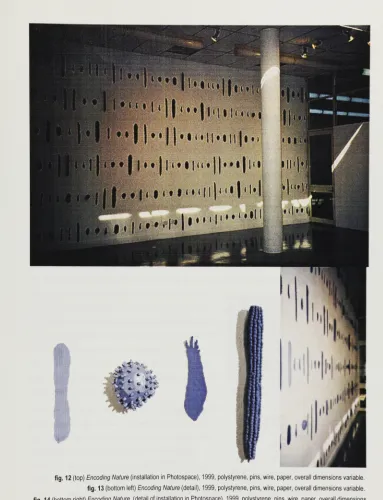
Still thinking about the reproduction of nature from miniaturised or coded units I arranged these objects in a row, like text (seefig 12). At this point I discarded the onion-shaped objects and began using only the sea cucumber shapes as these appeared to me to be like notations or tally marks. The first installation of these was on a wall panel which sat out from the main wall. In order to maintain the regular spacing of the objects I experimented with cutting the edges of the paper shapes straight to follow the edge of the wall. This made the sequence of shapes seem to allude to a continuation on either side of the panel, as if the section on the panel was but a detail of a larger sequence. The cropping of the shapes so that they sat flush with the edge of the wall rather than protruding over it or being contained within it also acknowledged the role of the gallery space in constructing the meaning of the piece.
1 decided to 'test' the work by once again showing it outside the workshop, this time in the School's Photospacc gallery (fig 13). To form longer sequences of text necessary for the scale of the Photospace installation, I began making multiples of the shapes, both in paper and polystyrene, and extended the range of greys to include a slighdy lighter and darker version. To mimic the lumpy surface of the polystyrene shapes I added varnish spots before painting them, or screen printed cell-like patterns taken from cleaning cloths in grey or transparent. These offered a visual shift in the surface of the paper objects as well as simulating the lumps.
fig. 12 (top) Encoding Nature (installation in Photospace), 1999, polystyrene, pins, wire, paper, overall dimensions variable.
fig. 13 (bottom left) Encoding Nature (detail), 1999, polystyrene, pins, wire, paper, overall dimensions variable, fig. 14 (bottom right) Encoding Nature (detail of installation in Ptiotospace), 1999, polystyrene, pins, v»ire, paper, overall dimensions variable.
[image:24.406.9.392.19.519.2]assembled objects en masse ironically looked like objects of mass production. The size of the objects was comfortable—not big and not small—the mid-ground scale of domestic objects or supermarket products. But even this mid-sizing was a litde bit odd in this context.. .it occurred to me that we have tradidons of appreciating nature as the immense spectacle of the sublime, or as microscopic worlds of the miniature. We are not so used to 'middle-sized' nature.
The work also set up a tension in its combination of 2D and 3D representations. The 3D objects took their place alongside the 2D objects in the horizontal rows used to assemble the work—there was no differentiation between flat and round, object and print, no hierarchy in the code. In a sense, aU elements were copies—the 3D objects were made to mimic the prints— and all were originals—each print and each object was hand-cut or hand-formed.
The objects were structured into horizontal rows, like text written in EngKsh (the only language I can read or write). There were other coding conventions borrowed from English—objects appeared at regular intervals and objects sometimes appeared in pairs, but never in triples.
This work was exhibited in Taiwan at the Y2K Print International Symposium. In the catalogue the image appeared with the lines of objects running vertically, despite instructions on the slide providing guidance to the top of the image. Obviously the publishers interpreted the visual code with a different set of conventions ^
to those I had intended, creating a new reading of ^ ^ ^ ^ the work. This was intriguing as it embodied an idea * # • — ^
that I had presented in my Jurassic Park Sub-thesis ^ ^ * paper relating to aberrant readings of coded • ^ g m ^
information and the potential for these slippages ^ ^ ^ • • J ^ and interpretations to create new understandings of — mmmr
a set of information. _ •
I did not assemble the objects with any specific text "" — ' „mmmr in mind, but only so that it appeared as if the ^ _ _ ^ —
information could interpreted as one would a code. ^ • ^ a simulated code. But of course the work does — *
» * * * j i embody a code,: it is a code framed and informed - —
fig. 15 a Taiwanese reading of Encoding Nature
by the rules of exhibiting in a gallery space, a
Connections to the Jurassic Park paper
During the time I was working on Encoding Nature, and on the various objects, prints and drawings which contributed to my thinking through the piece, I was writing the Jurassic Park paper. The idea which I was interested in exploring in the written work centred on an examination of the many codes used to represent nature in Steven Spielberg's movie Jurassic
Park, from the narrative premise of genetic engineering to the codes of digital animation used
to make nature look and sound 'natural'. In the paper I argue that Spielberg's use and interpretation of codes highlight shortcomings in Jean BaudrUlard's conception of the codes which make the simulation of nature possible. By undertaking an analysis of the codes in the movie it is possible to understand them, not as the passive, shadowy tools of a Sci-fi future, but as active, unpredictable agents in the creation of new ways of thinking about the natural world and its simulation.
[image:26.406.26.398.23.578.2]My studio explorations at this time focussed on investigations of the visual patterns, texts and codes with which we represent and 'construct' nature, and how this constructedness and artifice might relate to ideas of the 'natural'. I was also interested in exploring how we have produced, and reproduced, versions of nature from these codes—from the traditions of the picturesque landscape through to the descriptions of nature embodied in the codes of genetic engineering which have produced Dolly the sheep.
fig. 16 A computer manipulated still of a velociraptor from a scene in Jurassic Park.
I was interested in the idea of using print as an analogy for the act of replicating the stuff of nature with the codes of science and technology. I was also interested in the possibility that contemporary genetic representations are just another means of encoding and re-producing, or printing, the natural world. How have these codes influenced our conceptions of the natural world? I am interested in the question of whether it is possible—if it's ever been possible—to dis-embed ideas of the natural world from the codes which have mediated and represented them. Where does the code stop and namre begin? Where does nature stop and the code begin? Has the increasingly microscopic encoding of nature, made possible via technology such as super-computers for gene sequencing, digital scanning and imaging, made
possible a ckanr view into the spaces of nature, or a view into new spaces, different spaces?
Just as the codes of contemporary technology may provide new ways of thinking about the natural world, they provide new ways of thinking about the copy, and therefore, the print. Jean Baudrillard, in his essay "The Precession of the Simulacra", writes of the contemporary era as one in which the codes of technology allow the map to precede and even determine the territory. "No more mirror of being and appearances, of the real and its concept.. .The real is produced from matrices and command models—and with these it can be reproduced an indefmite number of times."" While Baudrillard does not allocate any space to the definition of his use of the term 'code', it becomes clear from the context of this essay of other later writingsthat he is referring to codes such those of as digital and generic technologies. Such technologies provide a space for questioning old but pervasive
dichotomies such as original and copy, real and fake, namre and culture.. .maybe it is even a space where such hierarchies no longer exist to be questioned.
I am interested in investigating the possibilities that the ways of thinking opened up by these codes might allow for a space where copies carry more information than that from which they have been generated, where copies can differ with an infinite variety, where copies can generate new series of copies. Rather than unquestioningly adopting new technologies as media for art-making, it is the potential for new technologies to inform understandings of more traditional print methods that interests me: I am interested in exploring the relationships, possibly parallels, which may exist between modes of thinking used in print making, and those 'new' modes of thinking presented by new technologies.
Chapter 3: The Motel project
In what may appear to be a complete break from the Encoding Nature installation, in November 1999 I was invited to participate in Motel, a series of installations curated by David Sequiera and Paul McGuiness for Canberra Contemporary Art Space. The project saw ten or eleven invited artists each take over a room in the Canberra Motor Lodge, in Kingston, for a weekend. The invitation to participate in this environment gave me the opportunity to return to consideration of less serious representations of the natural world. The fake wood and floral bedspreads of the 1970's motel decor also allowed me to extend my investigation of the role of printed materials in describing the namral world.
The motel room offered a site for the locating paradoxes in these representations; it was a place where the fake is natural. The rooms embody a 'culture of nature', where the patterning of the printed plastic wood veneers and the repetition of furnishings from room to room and from motel to motel offer reassurance by contrast to the strange, unknown world outside the motel door.
The installation consisted of adhesive plastic film, or Contact, printed with a variety of wood finishes, cut and coUaged to form the shape of butterflies and moths. These were placed in a number of locations throughout the motel room. The materials not only mimicked a variety of natural materials, but the method of construction simulated very intricate wood inlay.
A series of the collage insects were framed and hung on the motel wall, and really looked as if they belonged in the motel 'environment'. They also referenced scientific prints which have entered popular consumption at a variety of times. The framed works served as a form of 'key' or entry point for the other specimens around the room. The remainder of the faux wood, faux inlay insects were used to decorate furnimre around the room, and again they blended so well with the wood-look laminex coffee table and dressing table (their natural environment) that they looked as if they were meant to be there.
However, this harmony was disturbed by the positioning of some of the butterflies as if they were crawling off the edge of the table. Further consideration of the room found the plastic printed insects swarming in the comer behind the bed, crawling off the desk and up the wall, and even infesting the shower cubicle. The collaged insects were really quite beautiful and intriguing, but they also brought thoughts of plague and infestation.
I was interested in examining the idea that our conception of nature is not easily separated from the codes with which we describe it—the texts with which we 'write' nature, be they floral wallpaper, landscape paintings or nature documentaries, form a veil or framework through which nature is perceived. They embody a process which mediates and controls how nature is understood. In the motel room, nature is presented in a controlled
fig. 17 (top) from Motel (detail of framed works on motel room wall), 1999, Contact plastic adtiesive film, cut and collaged, faux
gilt frames, centre 30 x 40cm, left and rigtit 22 x 35 cm.
[image:29.406.7.397.21.535.2]jH
fig. 20 from Motel (detail of shower recess), 1999, Contact plastic adhesive film, cut and collaged, dimensions variable, fig. 21 from Motel (detail under desk), 1999, Contact plastic adhesive film, cut and collaged, dimensions variable.
simulated form, as sign of the 'teal' but without any of its inconsistencies or threatening irregularities. The repeating patterns of the fake wood and wallpaper present a predictable , safe version of the natural world. These patterns, in conjunction with the arrangement of furniture, which is that of any motel room in any Australian town (circa 1976), offer the traveller a familiar, repeated and repeatable experience.
But with the familiar comes the unfamiliar: these patterns from nature are used to conceal the traces of the other people who have used the room, and namral elements such as dirt and decay. The patterns on the furnishings, and also that formed by the furnishing's repeatedness from room to room, motel to motel, simultaneously deny the unknown-ness or contamination of the outside world while reminding the traveller that they are a long way from home. In the motel room dichotomies dissolve: the homely is the unhomely, that which is safe is a reminder of danger, the known hints at the unknown. Here the outside world is brought in-doors with printed wood, marble and flowers, here the fake is perfecdy natural.
Chapter 4: Twig Data
[image:31.406.16.399.0.600.2]The body of studio work being presented for examination of my Masters project is being exhibited under the title of Tmg Dala. Each of these works, despite its final format or size is composed from my 'twig data set', a set of about 14 twigs collected from under plane trees. The basic twig set is manipulated on the photocopier — multiplied, enlarged, reduced, stretched, and/or skewed— then cut out and reassembled to create new plants.
fig. 22 The twig dala set used to produce copies from which the Twig Data worlis were all made, Plane tree twigs of various sizes.
The twigs from which the new plants are formed are a basic set of units from which any number of coded representations can be made In this way the twig data set is similar to letters in an alphabet or the signifiers C, G, A and T attributed to the proteins forming the DNA of all living things. The twigs are basic descriptors from which I can print and collage an infinite variety of forms.
While I'm not much of a gardener, the work reflects the time I spend at home looking at my garden which contains some very old grafted fruit trees and a beautiful pair of coppiced hibiscus trees ( f i g 23). The work also reflects long periods spent at Reid and AinsUe Ovals watching my son at cricket and football training. These ovals are surrounded by tegular rows of trees, which repeat in a predictable pattern ( f i g 24).
fig. 23 (left) The pair of coppiced hibiscus trees in my front garden.
During one training session I noticed that one of the trees had been cut down, disturbing the pattern of trees around the perimeter of the oval. Clearly visible on the cut cross section of the trunk were the rings marking the tree's growth. Like a bar code, these lines could be read as a code describing the life of the tree. It was from this tree that my twig collection began.
Another precursor to the work was the proliferation of weather documentaries that appeared on the television at the time and for which I developed a liking. Shows with sensational tides such as When Good Weather Turns Bad! a.nA Nature's Fury ^Ksented footage of extreme weather conditions from tornadoes to snow storms, floods to fog. It occurred to me that these quasi-documentaries possibly portrayed contemporary versions of the sublime, and that the reason for their popularity was that they filled some nostalgic desire to 'connect' with nature. Given the largely urban existence of Western (television viewing) society, there is no longer a great deal of direct contact with extreme weather conditions. These 'over the top' television shows present a version of nature which can still fiU us with fear, albeit within the safe confines of the lounge room. This is the sublime made safe, the simulated sublime.
I was interested in the various devices used to record the weather and to measure natural phenomena. I began making a series of drawings using regular stripes such as those used on flood indicators. The vertical orientation of the coded stripes were a variation on the horizontal encoding of information used in the Encoding Nature installation, and the circular rings/stripes mapping the history of the tree which was cut down at Reid oval.
These initial drawings were cut out shapes, long thin strips with protrusions like thin trunks of trees with stubby branches. I was interested in overlaying irregular tree forms with the regular stripes. The colours I used were day-glo yellows, oranges and pinks, combined with stripes of the matte grey. This gave the stripes the appearance of a warning tape, or striped tape used to mark off spaces. Each tree was slighdy different and had a different set of stripes. I also began painting these colours onto short pieces of branch, which I had sawn and sanded to make a standard size of about 18cm. These I saw as units in a code which if presented in rows could be used to simulate text. These were quite interesting objects but I really felt I was repeating myself and the Encoding Nature installation.
The vertical encoding held more interest. I decided to make 3 dimensional versions of the striped trees from collected twigs and wooden dowel. The twigs formed the irregular branches, placed at regular intervals in the perfecdy straight dowel trunks: the namral grafted onto the artificial. Some of the trees had extra holes drilled into them, left empty these looked like the assembly systems of modular, do-it-yourself kit furniture and
shelving. I liked the idea of Ikea flat-pack nature, but also had a sense this was a bit of a diversion and possibly a bit of a visual 'one-Uner'.
Once again, something was not satisfactory about these objects, and I realised it was the fact that I could not fully control the twig branches—I could control the placement of the branches but each was stiU quite different. In order to fully control the twigs and trees, and to have them speak of the production and reproduction of nature via code I would have to produce them in a form which allowed multiples to be made. To continue the works as 3 dimensional forms I would need to cast the branches in order to reproduce them. This could have been done in resin (plaster and ceramic being too fragile) but the process would have been slow and would have limited the number of objects produced — I wanted thousands!
Another option for reproducing the forms was to produce the 'units' as prints. This would allow easy reproduction/multipUcation of the twig code and also, when using a computer or photocopier, allowed alterations to the size and shape of the twigs. I experimented with both techniques but the prints which resulted from the computer scans of the twigs were strangely unsatisfying; the dotted half-tone screen from which the printed images were formed was too literal.. .too obvious. I opted for the photcopied twigs as they offered speed and a high degree of room for control and manipulation, two characteristics closely aligned with my interest in reproducing nature from coded units. Working with prints I could control nature!
The use of photocopies had other benefits. Not only was it quick, but strangely this inexpensive, commercial process produced prints which looked a lot like engravings or lithographs. This brought references to fine art print making and also scientific prints and illustrations. It allowed for the relationship of prints to natural history to be an active part of the work, alluding to the role of printed information in constructing, controlling, and disseminating understandings of nature.
Relationship of studio work to the Dispersed Object paper
At the time I was experimenting with the early stages of the Twig Data series I was also writing tiie Dispersed Object Sub-thesis paper. This paper may appear to be a complete departure from the central ideas of my thesis, but it actually allowed me to explore some ideas relating to the contemporary theory and practice of print based art forms which are of direct relevance to my practice.
My studio work is often not what is conventionally understood as a print although I do make use of printed materials, and processes which are print-based. I have a very great interest in print-based art and despite my increasing use of three dimensional objects to
explore ideas, find myself constandy returning to printed and repeated forms in both the conceptual and material aspects of my work. My work has also leant towards installation and in order to better understand the context of my practice I made various journal notes about the work of other artists combining print and installation, such as Stephen HoUand, Neil Roberts, Matt MuUican, Barbara Kruger, Jenny Holzer, Felix Gonzalez-Torres and Xu Bing.
The Dispersed Object paper came directly from this research, and my reflections on some of the characteristics of installed prints. It also came from my belief that the history and meaning of prints is not based solely on work hanging on a gallery wall. We are surrounded by printed matter: Hke spiders, prints are never more than a metre away. I also Kked the parallel between arachnophobia and print-phobia, a phenomenon to which the paper was partially a reaction. Contrary to Robert Nelson's arguments in the essay "Why Printmakers Can't Talk", prints, from the fine art object to that of commercial ephemera, are very much connected to 'the rituals of daily life' and to the spaces in which we move and live". My interest in locating a linkage between print-based practice and space, was pardy in reaction to critical writings which position printed art as irrelevant and outmoded in the
contemporary era'''. The paper allowed reflection on one aspect of print-based art practice which had a direct relevance to my work with installed prints and use of ready-printed materials, but it also allowed me to make a case for the contemporary relevance of print-based art.
The paper also has some specific connections to my studio research. That the Twig Data works begin as photocopies may be seen to relate to the ideas of dispersal explored in the paper; photocopies have the potential to be produced in an unlimited edition and are usually produced for dispersal. However as an ironic inversion of these conventions, this is not how I treat the work. I use the photocopies to produce one-offs, each of the coUages is different to the others although it makes use of exacdy the same set of twigs in its production.
There is also a connection between the scientific references found in the twig data works, and the use of prints to disperse and communicate natural history texts throughout the world. Using formats reminiscent of botanical illustrations, the works in Collected Tmg Data and in the Topiary series refer to the role of printed objects in the classification and ordering of the natural world.
In the Encoding Nature series, my printed objects were assembled direcdy onto the wall to acknowledge the role of the gallery space in informing tiie reading and interpretation of the
•'^Robert Nelson "Why Printmakers Can't Talk" Art Monthly no. 54,1992, p11. In an frustrating irony, Nelson goes on to devote the bulk of his essay to arguments based on pedantic formal grounds thus managing to ignore the very issues and debates for v^hich he criticises print-based artists.
work. In Twig Data, I have cut the forms out but re-attached them to new paper supports, allowing the coUages to mimic the conventions of print which see a printed image placed within the white bounds of the sheet of paper and, again, making reference to natural history illustrations.
Collected Twig data
The first of the exhibited Twig Data series that on which I worked was Collected Tung Data. The process of making these small works allowed me to test out configurations of the data, accumulating as large a variety of examples of twig plants as I could. These collages were quite regular and neat; the branches protruding from the trunk at regular intervals, branches repeating in patterns or cut to form a certain shape. The twig plants in the
Collected series were quite flat looking,as if a cross section is represented, or the specimen
has been flattened out through a printing or botanical press, such as those used to create herbaria.
The collages in the Collected series included some photocopies of twigs which weren't cut completely away from their background, and include the paper and shadow of the photocopy. This is a kind of clue into the manufacture of the pieces, and also alludes to an existence other than the one I have engineered for the plants.
An artist whose work has dealt with collections and made use of collage to explore her ideas is EUzabeth Gower. In the series of collages called Chance or Design, Gower presents large oval forms made up of small cut and glued picmres of flora and fauna collected from magazines, encyclopedias and other books. Each of the works presents groupings of the images under broad taxonomic categories such as 'flower' or 'reptile'. Within these groupings Gower has arranged the individual images in patterns, the chance finding and accumulation of the images succumbing to Gower's overall design for their organisation.
Gower has described her attraction to collecting the images, to the "searching, accumulating, cutting-out and sorting of the images into categories (as) a sustaining methodology" in her practice, one which she relates to Susan Sontag's observation that "the true collector is in the grip not of what is collected but of collecting."
My work has concerned collecting nature also: from the early collection of symbols from hygiene packaging, to the strange arrangements of grey forms in Encoding Data, the framed butterfly 'prints' in the Afo/e/installation to the Collected Tmg Data series. Like Gower, the act of cutting and manipulating to make something new is a driving force in my work. However unlike Gower, who accumulates her the components of her collection prior to cutting them out, I create my collection through the act of cutting and coUaging.
15 Sontag, S., Volcano Lover, UK: Vintage, 1993, p23, quoted in E. Gower, Chance or Design, Melbourne: Monash, 1996
A point of comparison between Gower's Chance or Design series and my work exists in the use of repetition and/or uniqueness within our work. In Gower's collages, no image is repeated: the works are representative of a collector's desire to accumulate the diversity of examples rather than quantity. 'I'his is quite a crucial distinction to many of the ideas relating to collection in my works, as much of my practice hinges on some aspect of
fig. 28 (lop) Collected Twig Data (detail), 2000 (detail), photocopy collages, works range from 5 x 7cm to 35 x 40cm, overall
dimensions variable
fig. 29 (bottom, left) Collected Twig Data (installation of work in progress),2000, photocopy collages, works range from 5 x
7cm 10 35 X 40cm, overall dimensions variable
[image:37.406.20.396.19.520.2]repetition or potential repetition. While the Collected Tivig Data series explores variation and diversity within a collection, it does so by making use of a repeated set of visual data. The uniqueness of each twig plant example is founded on repetition, each piece activating the interplay of sameness and variation .
Of the play between variety and sameness within the curatorial parameters of a collection Gower has observed: "In the category of flower, for example, there are hundreds of variations within each group, yet all conform to the defmition of 'flower'. DNA and genetic codes present limits to the degree of diversity within a species.""' This is contrary to much of my work and its exploration of the idea that the encoding of nature via taxonomies, collections or genetic technologies may not present the limits of natural diversity, but may suggest the infmite potential of collected data. This is the main suggestion of my Jurassic
Park paper, and also the various Tmg Data works. It is also related to the premise of the Dispersed paper in that this paper argues for an understanding of printed/repeated
units, not as a closed or static set, but as a set which is able to activate space and move in unpredictable and aleatory paths.
Twig data: by the metre
Another reference made by the Twig Data work, specifically the Nature bj the Metre series is the printed patterning found on interior furnishing such as wallpapers. The Nature by the
Metre works are mostiy made on roUs or lengths of paper and have collages which appear
to continue off the top and bottom of each paper roll or sheet. Some of these twig plants are repeating patterns of branches and trunks, like an endless roll of plant. On others the plant does not repeat on the paper, but its top and bottom continue to the edge of the paper as if the image continues on and that this is a detail of a larger work.
In making Nature by the Metre works I was also thinking about gardening materials such as instant mrf and rolls of seed tape, rolls of paper strip with seeds attached at regular intervals which when buried in die garden bed allow perfectiy spaced plantings. The work connects these everyday objects with the potential for the natural world to be produced in an endless continuum via genetic and other technologies. It also refers to our desire to 'have' nature in a 'ready-to-use' form , from designated urban green spaces and nature reserves to nature in a can of air-freshener.
16 Gower, E, Chance a!Des\gn, Melbourne: Monash, 1996, p17
Twig Data: Topiary set
The third scries of Twig Data collages. Twig Data (topiary), are like the ornamental plants, masses of chaotic branches are cut and arranged to fit predetermined shapes or
arrangements. They make reference to horticultural techniques of grafting and espalier)' to control natural forms and make them conform to some predetermined standard. In considering the process of their making I realised that with these works I would commence with an idea of a shape and then collage the paper twigs to suit this shape, trimming ends and reshaping as 1 went. It was somewhat like having a theory or hypothesis and then collecting the data to suit it, or making existing data fit to a preconceived ideal. Once again the work connected the process of ever)'day life, in this case garden maintenance practices with the scientific or technological.
[image:39.406.19.400.25.582.2]The colour in the works was introduced by photocopying onto coloured paper, initially beiges, greys and creams, the colours of the twig set. While making some of the later works in the Collected series I began to use paper which was pastel coloured: blue, pink, yellow and green. These colours, when cut and collaged, gave the work the look of hand-coloured lithographs, once again refering to natural history prints. In the larger Topiary works I was able to use the scale of the work in combination with the coloured units to build patterns within the 'chaos' of the twigs. Here I was using colour as an additional process, or layer, of encoding applied to the twig data set.
fig. 31 (left)rw;g Data (topiary), 2000 (installation view of four works), photocopy collages, each 115 x 76crr.
fig. 33.1,33.2 and 33.3 works from the Twig Data (topiary) series, 2000, photocopy collages, each 115 x 76cm.