promoting access to White Rose research papers
White Rose Research Online
Universities of Leeds, Sheffield and York
http://eprints.whiterose.ac.uk/
White Rose Research Online URL for this paper: http://eprints.whiterose.ac.uk/4708/
Research Report
Joho, H., Sanderson, M. and Beaulieu, M. (2003) Concept-based Interactive Query Expansion Support Tool (CIQUEST). Library and Information Commission Research Report 149. ISBN 1-902394-79-8.
Concept-based Interactive Query Expansion
Support Tool (CIQUEST)
by
Micheline Beaulieu, Mark Sanderson, and Hideo Joho
Resource: The Council for Museums, Archives and Libraries 2003
The opinions expressed in this report are those of the authors and not necessarily those of Resource: The Council for Museums, Archives and Libraries.
Library and Information Commission Research Report 149 RE/090
ISBN 1-902394-79-8 ISSN 1466-2949
This report is available from http://ciquest.shef.ac.uk/Licrr149.pdf.
Library and Information Commission Research Reports are published by Resource: The Council for Museums, Archives and Libraries and may be purchased as photocopies or microfiche from the British Thesis Service, British Library Document Supply Centre, Boston Spa, Wetherby, West Yorkshire LS23 7BQ, UK.
Abstract
This report describes a three-year project (2000-03) undertaken in the Information Studies Department at The University of Sheffield and funded by Resource, The Council for Museums, Archives and Libraries. The overall aim of the research was to provide user support for query formulation and reformulation in searching large-scale textual resources including those of the World Wide Web. More specifically the objectives were: to investigate and evaluate methods for the automatic generation and organisation of concepts derived from retrieved document sets, based on statistical methods for term weighting; and to conduct user-based evaluations on the understanding, presentation and retrieval effectiveness of concept structures in selecting candidate terms for interactive query expansion.
The TREC test collection formed the basis for the seven evaluative experiments conducted in the course of the project. These formed four distinct phases in the project plan. In the first phase, a series of experiments was conducted to investigate further techniques for concept derivation and hierarchical organisation and structure. The second phase was concerned with user-based validation of the concept structures. Results of phases 1 and 2 informed on the design of the test system and the user interface was developed in phase 3. The final phase entailed a user-based summative evaluation of the CiQuest system.
The main findings demonstrate that concept hierarchies can effectively be generated from sets of retrieved documents and displayed to searchers in a meaningful way. The approach provides the searcher with an overview of the contents of the retrieved documents, which in turn facilitates the viewing of documents and selection of the most relevant ones. Concept hierarchies are a good source of terms for query expansion and can improve precision. The extraction of descriptive phrases as an alternative source of terms was also effective. With respect to presentation, cascading menus were easy to browse for selecting terms and for viewing documents. In conclusion the project dissemination programme and future work are outlined.
Authors
Micheline Beaulieu is a Professor of Information Science and leads the Information Retrieval Research Group in the Department of Information Studies at the University of Sheffield. Prior to taking up her current post in 1998, she was co-director of the Interactive Systems Research Centre at City University for over ten years working principally on the evaluation and development of the Okapi probabilistic retrieval system. Both departments have been rated as 5* centres of excellence in IR research. Professor Beaulieu has published widely in the following areas: the design and evaluation of interactive information retrieval systems, information seeking behaviour, information retrieval and HCI and the application of IT in the Humanities.
Dr. Mark Sanderson is a senior lecturer within the Department of Information Studies at the University of Sheffield. He is co-editor of ACM SIGIR Forum, and is on the editorial board of ACM TOIS (Transactions On Information Systems), JASIST (Journal of the American Society of Information Science and Technology), IP&M (Information Processing and Management), and IR (Information Retrieval). Prior to his current post, he was a research assistant for four years, working first at the University of Glasgow and then at the Center for Intelligent Information Retrieval in the University of Massachusetts, USA. His PhD on Word Sense Disambiguation was carried out at the University of Glasgow. Since arriving at Sheffield, he joint coordinator of the IST 2000 project Clarity, developing Cross language information retrieval tools. He is also a principal investigator on the MIND, SPIRIT and Eurovision projects.
Mr. Hideo Joho is a research assistant at the Department of Information Studies at the University of Sheffield. He received an MSc in Information Management from the Department in 1999. He is currently involved in the SPIRIT project, developing a spatially-aware search engine. He is also doing his PhD in information retrieval.
Concept-based Interactive Query Expansion Support Tool (CIQUEST)
Project report to
Re:source The Council for Museums, Archives and Libraries
Micheline Beaulieu , Mark Sanderson, and Hideo Joho
Department of Information Studies The University of Sheffield. m.beaulieu/[email protected]
Acknowledgment
CONTENTS
1. Introduction
2. Aims and Objectives
3. Methodology
4. Experimental Phases and Results
5. Summary and Conclusions
6. Dissemination and Future Work
7. References
1. Introduction
This report describes a three-year project ( 2000-2003) undertaken in the Information Studies Department at The University of Sheffield and funded by Re:Source, the Council for Museums, Archives and Libraries. The Computational Informatics Research Group successfully responded to a call for proposals for research in Information Retrieval (IR) by the Library and Information Commission, the predecessor of Re:Source.
An ongoing debate in IR has been concerned with determining the relative merits of keyword versus concept-based retrieval approaches. Although the latter based on manually constructed thesauri or subject classification schemes have primarily served as indexing tools, more recently these have also been explored as search tools to support user query formulation (Kristensen 1993, Jones et al 1995). Both approaches are evident on the World Wide Web (WWW). Search engines such as AltaVista and Excite rely on basic Boolean keyword retrieval, although additional techniques such as term weighting and relevance ranking are also commonly applied as in Google for example. Retrieval in Yahoo however is primarily dependent on metadata or manually constructed subject hierarchies. The limitations of both approaches as experienced by Web searchers are well documented (Jansen et al 1998). Moreover the human
assignment of subject categories inherently lack the specificity of concepts that searchers often require for effective retrieval. On the other hand work on generating thesauri automatically from document collections (Evans & Lefferty 1994,
Grefenstette 1994) indicates that searchers are reluctant to explore such concept-based tools for query formulation.
An alternative line of research, which has proven to be more productive in supporting user query formulation, has been automatic or interactive query expansion (AQE, IQE) based on relevance feedback (Robertson et al 1997). However this approach also has limitations. Its success depends on three factors: the user identifying good relevant documents, the relevant documents containing appropriate terms to add to the query and in the case of IQE, the effective display of candidate terms for user selection.
The current project aimed to address some of these issues by introducing an
innovative concept-based approach to query expansion. The project investigated and evaluated the automatic generation and hierarchical organisation of concepts derived from retrieved documents to supporting user query formulation and reformulation. The objective was to provide users with an overview of retrieved documents to assist them in finding relevant documents and to display potential query terms in a
meaningful context.
The next sections of the report present the aims and objectives of the project,
methodology adopted and a discussion of the issues addressed and outcomes of each of the four project phases. The concluding section assesses the impact of the work, dissemination plans and describes continuing research.
2. Aims and Objectives
Given that users generate broad and brief queries and then encounter difficulties in refining their initial query on the basis of items retrieved, the overall research aim was to provide user support for query formulation and reformulation in searching large-scale textual resources including those on the WWW. The specific objectives were:
• To investigate methods for the automatic generation and organisation of concepts derived from retrieved documents;
• To explore the presentation of document derived concept structures for incorporation into a user interface;
• To evaluate the retrieval effectiveness of document derived concept structures for selecting relevant documents in a retrieved document set;
• To evaluate the retrieval effectiveness of incorporating concept structures to assist users in selecting candidate terms for interactive query expansion;
• To assess how searchers make use of concept structures to bridge the gap between the query space and the document space in interactive searching
3. Methodology
The overall methodological approach was to address the interdependent research issues related to the five stated project objectives in a progressive and integrated fashion and to incorporate an evaluative component in each of the project phases. A special emphasis was put on user participation in the different elements of the investigation and to take full account of user searching behaviour and the interactive searching process as well as retrieval effectiveness testing in the approach to
evaluation.
The TREC test collection formed the basis for different aspects of the various evaluative experiments conducted and included ad-hoc topics from TREC 6,7 and 8. In addition two large-scale retrieval tests were conducted using test data retrieved directly from the WWW by search engines including Google, WebTop and DirectHit. This was deemed to be a more realistic approach than using the TREC Web Track dataset. The user-based experiments adopted the general task orientated design approach established by the TREC Interactive Track.
Seven experiments were conducted in the course of the project encompassing four distinct phases, which addressed specific research issues related to the project aim and objectives. The research context, methodological approach and outcomes for each phase will be discussed below.
4. Experimental phases and results
The project work plan was divided into four phases over a period of 32 months. In the first phase a series of experiments was conducted to investigate further techniques for concept derivation and hierarchical organisation and structure. The second phase was concerned with user-based validation of the concept structures. Results of phases 1 and 2 informed on the design of the test system and user interface developed in phase 3. Phase 4 was a user-based summative evaluation of the CiQuest system.
4.1 Phase 1: Concept derivation and structure
As outlined above the project built on previous work on the creation of concept hierarchies using co-occurrence information (Sanderson and Croft 1999). Initial results from a user study had shown that approximately half of the hierarchy’s concept relationships had been sensibly arranged. Having established that co-occurrence was a relatively simple but successful method for creating concept hierarchies, the next step was to examine other ways of increasing the number of meaningful relationships. Two aspects were investigated. The first aimed to improve concept derivation by using a simple pattern matching descriptive phrase finder for proper nouns. The second sought to validate the structure or organization of the concept relationships by
comparing text pairs of related concepts (i.e. parent/child relationships) created by the simple statistical approach with those incorporated in the WordNet thesaurus. The underlying assumptions were that simple techniques are likely to be much faster than those that require natural language processing techniques such as parsing and that simple but accurate methods are likely to be most beneficial in dealing with very large corpora.
4.1.1 Descriptive phrase finder experiments
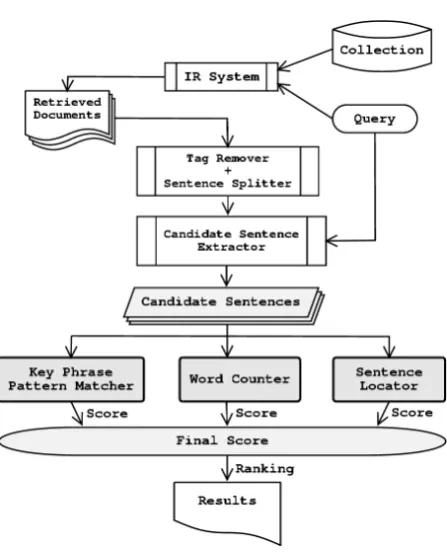
A descriptive phrase finder (DPF) system was developed and tested in a series of three experiments. The main feature of the system is that it uses simple pattern matching to identify key proper noun phrases. However a ranking algorithm based on accuracy, sentence position and frequency occurrence across documents enhances the pattern matching.
First experiment: TREC LA Times test collection
The first experiment focused on two aspects of the effectiveness of the DPF: the accuracy of the system output and an initial investigation of the impact of size of collection on accuracy. Although the TREC LA Times test collection was used as a data set, 50 queries were generated by the experimenters to ensure that the proper noun phrases covered the time frame of the documents. Relevance judgements were based on full sentences and not just on extracted descriptions. The results showed that the system was able to rank a description-bearing sentence within the top ten for 94% of the queries. However as expected the effectiveness of the system was reduced as the collection size got smaller in line with results obtained in the Trec VLC collection. The experiment was reported in:
Joho, H. and Sanderson. Retrieving descriptive phrases from large amounts of free text. In: Agah, A. Callan, J & Rundenstenier, E. (eds). Proceeding of the 9th
International Conference on Information and Knowledge Management, McLean,
Virginia, 2000. New York: Association for Computing Machinery, 2000, 180-186. See Appendix 1.
Second experiment: Web using Google
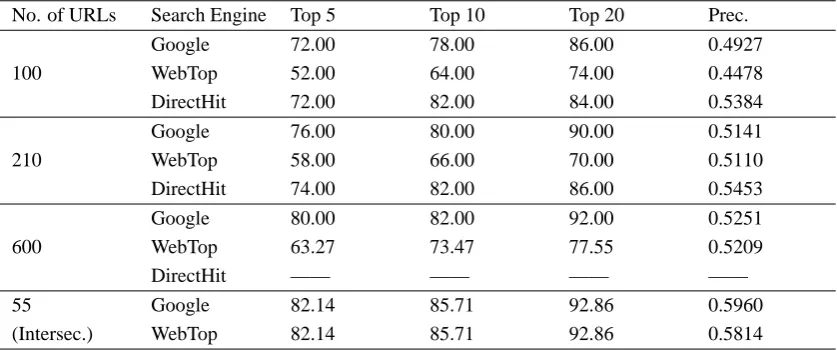
Having established the feasibility of the simple approach for locating descriptive phrases from free-text, in the second experiment the approach was tested on the Web using the Google retrieval engine. The retrieved web documents were fetched from a maximum of 600 URLs returned by Google for each query. Two criteria for relevance were used. Strict relevance was based on clearly defined descriptive phrases and
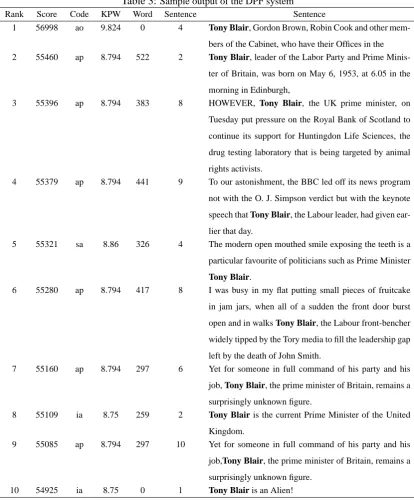
lenient relevance accepted variant phrases. For example the key answer for the query Tony Blair, `Tony Blair is the current Prime Minister of the United Kingdom’ was regarded as strictly relevant but `Tony Blair is a political leader’ would be a lenient relevance judgement.
The results for successfully answered queries in the top 5, 10 and 20 sentences using 50 queries based on strict relevance was 66%, 82% and 88% respectively. On the other hand the results using the lenient relevance definition was 100% for the top 5 and 10, a distinct improvement on the first experiment using the LA times clearly indicating that the size of the collection does impact on the effectiveness of the system. It would appear that there is a better chance of locating a relevant descriptive phrase in a larger collection and that cross document term occurrence statistics contribute to improving performance. The experiment was reported in: Joho, H., Liu, Y.K. and Sanderson, M. Large scale testing of a descriptive phrase finder. In: Allen, J. (ed). Proceedings of the 1st Human Language Technology Conference, San Diego, California, 2001. Morgan Kaufmann, 2001, 219-221. See Appendix 2.
Third experiment: Impact of search engine ranking and number of URLs
In the third experiment attention was focused on two aspects: firstly to what extent the Google’s PageRank system impacted on the effectiveness of the DPF system, and secondly to what extent the different number of retrieved URLs could affect
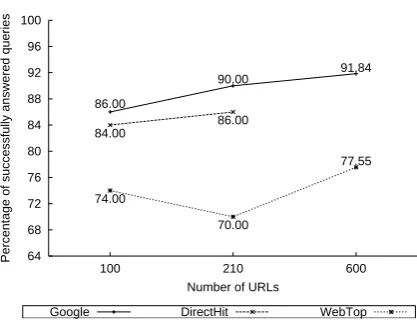
performance. The ranking techniques of DPF were further tested by examining how three search engines ranked a common set of web pages for each query. Intersection sets from Google, WebTop and DirectHit were created by retrieving 1000 URLs per engine, noting the common URLs and their rank position and extracting the top 55 ranked URLs from each engine. The same queries as in experiment 2 were used but because of the lack of intersections, only 28 were used for the analysis. Comparisons at 100, 210 and 600 URLs generally indicate that the percentage of successfully answered queries and the precision in the top 20 sentences improves with the increase in the number of URLs. With regard to the ranking method of the different search engines, WebTop and Google performed equally well at the top 20 sentences but Google achieved higher precision. It would thus appear that different search engine ranking methods does also affect the performance of the DPF system. However further analysis would be required on a larger overlapping collection. This experiment is reported in a draft paper, Joho, H, Liu, T. T., Liu, Y. K., Sanderson, M, and
Beaulieu, M. Descriptive phrase finder: a free-text mining tool for descriptive information about proper nouns. To be submitted to the Journal of the American Society for Information Science and Technology. See Appendix 3.
4.1.2 Concept relationships experiments
The second part of phase 1 compared the simple statistical approach for creating parent/child relationships with the linguistic approach of the WordNet thesaurus. In particular we examined the relationship between document frequency and term specificity for creating topic hierarchies. The question to be addressed was, given a pair of term/concepts that have been found to be related, how does one determine which is the more specific?
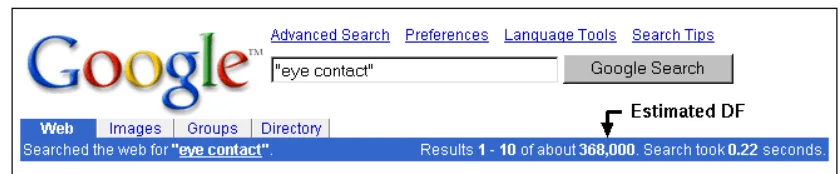
The aim was to measure on a large scale the accuracy of document frequency for ordering word pairs taken from WordNet. Some 45,000 noun words and phrases in WordNet were submitted as queries in Google. Document frequency for a synset was then estimated by averaging the number of documents retrieved for each member term. In the experimental design, it was assumed that the commonest sense of a term accounts for the great majority of that term’s occurrences and that this would
correspond to the definition of commonest sense in WordNet. Among the semantic relations in WordNet, hypernymy (superordinate) orders words by their specificity. Thus disambiguated hypernym chains were used as the basic data for three heuristic experiments.
First experiment: Average document frequency
The average document frequency of synsets was calculated for each level of a set of hypernym chains that were the same length. Although it was expected that there would be a monotonically decreasing line between the most general level and the most specific level, it was found that the middle level had the second highest average. It is not entirely clear why that should be the case but it is speculated that the terms at such a level belong to a basic level category, the most common level of detail in categorisation. Shapes of hypernym chains become more complicated as their length increases, with shorter chains forming a monotonically decreasing line (e.g. length 3 and 4), middle chains (e.g. 5,6,7) having a peak in the middle, and longer chains (e.g. 8 to 15) having more than one peak.
Second experiment: Parent-child pairs
The second experiment investigated the number of cases where parent synsets held a higher document frequency than their children. It was also anticipated that this experiment would reveal the naïve performance of document frequency to identify a parent term for a given pair. The results of the analysis show that document frequency was most reliable to identify more general terms from given pairs if both terms were very specific. The overall performance for 26,678 distinct pairs in WordNet was 76%, which is a significant result.
Third experiment: Effect of co-occurrence information
The third experiment examined the impact of the co-occurrence of terms in sets of documents when considering term specificity. The assumption here is that the more documents a given pair of terms share, the more the two terms are related. 100 queries from TREC-6 and TREC-7 were used to retrieve 500 top ranked documents from each
of the Financial Times, LA Times and the Wall Street Journal TREC collections. Each retrieved set was analysed to identify the occurrence of WordNet synsets, as well as those pairs which were found to collocate in the documents. For each recorded pair the numbers of cases where parent terms held a higher document frequency than the child were also recorded. Document frequency with and without co-occurrence
information was thus measured in three corpora: the 500 top documents, a super-set of TREC newspaper collection and Web pages indexed by Google. The results show that the Web based larger size corpora was more accurate at determining specificity. It was also easier to determine specificity from co-occurring term pairs and the impact was more significant in the smaller corpora. Although the corpora were different, the usage of commonest sense as defined by WordNet was similar across all the corpora. However, the coverage of the WordNet vocabulary differed, with Google including 99%, whereas the TREC collections covered just over 50%.
The three experiments are reported in a draft paper, Joho, H, Sanderson, M and Beaulieu, M. Large scale testing of document frequency’s relatedness to term specificity. To submitted to Information Retrieval. See Appendix 4.
4.2 Phase 2: User validation of concept labels and relationships
The second phase of the project was concerned with evaluating the adequacy and performance of the concept structures for searching and retrieval from a user perspective. The object was twofold: firstly to test how users interpreted concept labels in a query expansion task, and secondly to test to what extent concept structures provided an overview of the retrieved document set. The formative user test thus compared two methods of presenting candidate expansion terms, a hierarchical
presentation and a conventional list. For the experimental system candidate expansion terms were first extracted in advance from the top 500 documents retrieved by the INQUIRY retrieval engine, in response to a query compiled from terms in the title of 45 TREC6 topic descriptions, then organised by the subsumption process, and finally visualised by the cascade menus. Lists were also generated using the identical set of terms included in the menus and ordered alphabetically. Twenty-four test subjects were asked to select terms they deemed appropriate to expand nine given queries. The experimental group was presented with an interface containing menus and the control group was presented with lists. Following the completion of the expansion tasks by all the participants, selected expansion terms were added to the initial query for each topic and the search was re-run and results compared.
Results show that the unexpanded queries retrieved documents at a higher precision for lower recall whilst the expanded queries produced higher precision for higher recall. Although queries expanded by the concept menus performed slightly better than the lists, the difference was not statistically significant. Nevertheless both approaches led to new relevant documents to be retrieved in the top 20. Additional measures were also considered, namely the number of expansion terms selected by subjects and time taken to complete the expansion task. The Menu group completed the task in less time and with over four terms fewer than the List group on average and both performance measures were statistically significant. Moreover 80% of subjects in the Menu group indicated that they had a better idea of the contents of the retrieved documents through the concept hierarchies. Thus the approach seemed to provide an adequate summarisation of documents retrieved in response to a query and
the subsumption hierarchies were meaningful. A further analysis to determine the semantic and/or topic relations between initial query terms and expansion terms also showed that more than half of the expansion terms selected by subjects were
conceptually related and were broader than related terms normally found in a
thesaurus. The evaluation study was reported in. Joho, H, Coverson, C, Sanderson, M. and Beaulieu, M. Hierarchical presentation of expansion terms. In: Proceedings of the 17th ACM Symposium on Applied Computing, Madrid Spain, 2002. New York: Association for Computing Machinery, 2002, 645-649. See Appendix 5.
4.3 Phase 3: Test system configuration
The third phase of the project concentrated on the development of the system. Two major tasks were undertaken: the design of the interface to integrate the concept visualisation tools, i.e. subsumption hierarchy and the keyphrase hierarchy, and the implementation of the back end retrieval system
4.3.1 Integration of the concept visualisation tools into a user interface
Although it was anticipated in the original proposal that a stand-alone front-end would be built using Java GUI components, it was decided that a web-based implementation of the system would be more appropriate. This is largely because most people access search engines through web-browsers. In addition the results of the formative
evaluation of cascading menus also confirmed that this approach was effective. Hence Directed Acyclic Graph tools were not considered as a viable approach to pursue as had been anticipated at the outset of the project.
In implementing the concept hierarchies two main design issues had to be considered, namely the size of hierarchy to be displayed and how users will interact with the display. In theory a hierarchy can be very deep (or long) covering all the identified parent-child relationships. The width and depth of menus generated from a query can be seen as a characteristic of the set of retrieved documents. However the hierarchy containing too many terms could be confusing to users. Informal discussions with different users to consider the size of menus did not lead to any obvious solution and it was thus decided to limit the length to 20 layers in the actual test system and to 5 for demonstration purposes as illustrated below.
With regard to designing the interaction with the hierarchies, a major change was made following the formative evaluation conducted in phase 2. In the initial system, a term was simply added to a list when a user clicked a term from the menus. In the integrated system, a cascaded menu was shown along with the hitlist generated in response to a query. When a user clicks a term in the menu, a subset of documents in which the term occurs is shown.
The following are screenshots of the demo system, which was demonstrated at the SIGIR 2002 conference in Tampere Finland. This offered another opportunity to obtain input from users and resulted in some very positive feedback. Further details are found in: Joho, H, Sanderson, M and Beaulieu, M. Hierarchical approach to term suggestion device. In: Proceedings of the 25th Annual ACM SIGIR Conference on Research and Development in Information Retrieval, Tampere, Finland. 2002. New York: Association for Computing Machinery, 2002, p.454. See Appendix 6.
Main Window
Query Box (Query: international organized crime)
Hitlist with the top level of a concept hierarchy
Select a term from the hierarchy (e.g. “yakuza”)
A set of documents in which “yakuza” occurs was shown as a focused set of documents.
In the full test system two different approaches were tested to generate a concept hierarchy. Both approaches used the top 200 documents retrieved by a retrieval system in response to a query. Words and noun phrases were extracted from the documents using an internally developed part-of-speech tagger. The next two subsections will describe the two techniques for generating concept hierarchies. The example hierarchies are based on the query “Hubble Telescope Achievements”.
Subsumption hierarchy
This type of hierarchy is based on statistical properties of terms, and called a
subsumption hierarchy. The subsumption hierarchy determines which is more general
for a given pair of terms by analysing their document frequency and co-occurrence information. More specifically, a term X is said to subsume term Y when the following condition is held:
1) p(X|Y) >= 0.8; and 2) p(Y|X) < 1
In other words, when the majority of a set of documents in which term Y occurs is found to be a subset of documents in which term X occurs, term X is located in a parental position of term Y in a hierarchy. Since they co-occur in a reasonable amount of documents, they can be seen as related terms. Since term X occurs more frequently than term Y and term X’s document sets subsumes term Y’s, the former can be regarded more general than the latter.
Query: Hubble Telescope Achievements
Keyphrase hierarchy
The second type of hierarchy is based on linguistic attributes of terms, and called a keyphrase hierarchy. The keyphrase hierarchy attempts to extract a parent-child pair from texts using a set of text patterns (referred as trigger phrase in this report). Some examples of the trigger phrases and the fragments of matched sentences are shown as follows.
1) NPa SUCH AS NPx, NPy, and NPz
“… international organisations such as NATO, WHO, and UNESCO are …” 2) NPx, NPy, NPz AND OTHER NPa
“… Google, Altavista, Yahoo and other search engines are …” 3) NPa, ESPECIALLY NPx, NPy, and NPz
where NP stands for a noun phrase.
As can be seen the trigger phrases are designed to find a sentence that have a noun phrase (i.e. NPa) and its instance or member (i.e. NPx, NPy, and NPz). When such a pattern is found, NPa is located in a parental position of NPx in a hierarchy. Also the decomposition of head nouns (e.g. organisations of “international organisations”) is applied so that a head noun becomes a parent of its noun phrases.
Query: Hubble Telescope Achievements
Selected Terms
In addition information about the terms selected from a menu was added to the full test system. When a box besides a term is ticked, the term is added to the query box. When a term itself is clicked, a list of documents linked to the term is shown.
Other minor changes
A couple of slight changes were made on the interface after the demo-system. For example, a box that contained some system parameters was removed from the final system. Also the general colour scheme was changed to a mono-tone style so that every keyword was well highlighted with a different colour set. In addition the name of the hierarchy was changed to “Phrase Browser” as we felt this would be more meaningful.
The screenshot of the final system is found below.
4.3.2 Back-end system
In the demo, an internally developed IR system was used as a back-end of the CiQuest system. However in the final implementation, the Okapi system was adapted since the previous system did not have a best-passage function. The best passage was displayed for each record in the hitlists.
A session manager component was also added to the system to record users’ search activities. Information such as a time stamp, submitted queries, selected terms, displayed and/or saved documents, and paging information were logged by the session manager.
4.4. Phase 4: Summative user evaluation of the test system
The last phase of the project was to undertake a summative evaluation of the system to ascertain the retrieval effectiveness and usability of concept structures and the keyphrase finder in supporting interactive query expansion. The interactive tools incorporated into the CiQuest system adopted two different approaches. On the one hand the generation of concept hierarchies derived from term subsumption provided a form of summary and a way of visualising a retrieved document set. On the other hand, the Keyphrase finder extracted useful keywords from the retrieved documents that could be presented to the user as useful suggestions for modifying and improving their original queries. Although both tools were very different in the way each
functioned, their purpose was the same, i.e. to enhance query formulation and interactive searching.
The experiment was based on the CiQuest system as described above but three different versions were devised for the test. The first was a baseline system which offered no query expansion tools. The second and third versions each incorporated the subsumption tool and the Keyphrase Finder respectively. Although the underlying functionality was different, subjects were not made aware of this as they searched through a common web-based interface. Twelve test subjects were recruited to undertake searches on three TREC-8 topics, one on each of the system test versions. Participants were briefed to undertake two tasks. The first was an `instance’ finding tasks as developed by the TREC Interactive Track which entailed finding as many different answers to a topic or question as possible with the object of saving at least one document for each of the different aspects or answers of the topic. The second task, query optimising, required searchers to generate a so-called optimal or best query based on their search experience of the topic. The optimising task made it possible to compare the effectiveness of the optimal query with that of the initial query based on precision and recall for document relevance rather than instance relevance. Subjects filled questionnaires at the beginning of the test session, after each search, and on completing the whole experiment. The procedure took 60 to 90
minutes for each subject.
The main results indicate that optimised queries performed better than initial queries, that is the number of relevant documents retrieved was statistically significant. Although overall changes to initial queries were small, these nevertheless lead to improved effectiveness. The keyphrase finder led to higher precision followed by the baseline system and the subsumption tool but this was not statistically significant. Whilst automatic query expansion normally works better when the initial query performs well, in the present study retrieval effectiveness improved regardless of the performance of the initial query.
With respect to searching efficiency and searching behaviour, the subsumption and keyphrase tools led to subjects viewing fewer documents than the baseline but saving more documents. The number of query iterations for the two menu based systems was also lower than the baseline. The subsumption tool was used more and led to more saved documents. It would appear that it allowed searchers to focus on a smaller set of documents. With regard to user perceptions, the subsumption tool was considered easier to use than the keyphrase finder and the size of menus for each could be handled equally well. Both tools were also considered to be equally useful in
predicting the `aboutness’ of documents linked to menu options, in focusing on useful new terms, and in helping in the assessment of relevance. However the subsumption tool was deemed to be better for gaining an overview of the contents of individual documents as well as a document set.
The study also provided insight into browsing behaviour. When a subject found a reasonable amount of relevant documents in the first page of results, they tended to go on to the next page. But the subsumption and keyphrase tools were accessed more frequently when the first page of results was less satisfactory. The concept and phrase browsers were typically used in two ways. One approach and the most popular was to focus on a subset of documents of interest. Another approach was to quickly and repeatedly iterate between menu terms and the title and best paragraph of the linked documents. Finally browsing menus tended to be a very quick operation. There was no evidence that semantic connections between a parent and child term significantly
influenced browsing. This may explain why most subjects did not realise the difference between the two types of menus. Another observation was that the occurrence of query terms at the top level of the menu seems an important factor in encouraging subjects to use the term browsers and subjects tended to go back to a parent term when one of its children was found to be useful and try another child term. The evaluation study is reported in: Joho, H., Sanderson, M., and Beaulieu, M. (2004) “A Study of User Interaction with a Concept-based Interactive Query
Expansion Support Tool” In: Proceedings of the 26th European Conference on Information Retrieval, Sanderland, UK: Springer. See Appendix 7.
5. Summary and conclusions
The CiQuest project successfully met the stated aims and objectives set out in the original proposal as well as achieved some additional outcomes as summarised below:
• The main findings demonstrate that concept hierarchies can effectively be generated from sets of retrieved documents and displayed to searchers in a meaningful way.
• The approach provides the searcher with an overview of the contents of retrieved documents which in turn facilitates the viewing of documents and selection of the most relevant ones.
• Concept hierarchies derived from retrieved documents are a good source of terms for query expansion.
• Query expansion based on concept hierarchies can improve precision as opposed to query expansion based on relevance feedback which tends to improve recall
• Cascading menus make it easy for searchers to browse concept hierarchies quickly not only for selecting terms for query expansion but also for viewing clusters of documents within a retrieved set in a more focused way.
• The extraction of descriptive phrases as a source of terms for query expansion is also effective in improving retrieval performance. The comparable results obtained in using concept hierarchies as well as key descriptive phrases indicate that both approaches are equally useful.
• The project demonstrated the value of different approaches to test collections in conducting both small and large-scale retrieval tests based on TREC data as well as Web generated data.
• The project provided further insight into interactive searching behaviour and demonstrated the importance of user-based experiments in the development of interactive tools.
6. Dissemination and future work
The project has had an extensive dissemination programme with four contributions to major conferences being made in the course of the project. The next stage is to submit papers in refereed journals. Two papers have already been drafted and a third is being planned. The CiQuest system is also being made available to the IR research
community through the Information Retrieval Research Group Website at Sheffield available at: http://ciquest.shef.ac.uk/~hideo/system/ (Access upon request).
CiQuest has had an impact on other work undertaken within the group. For example concept hierarchies have been incorporated in a cross-language retrieval system and experiments have been undertaken with cascaded menus for displaying terms in multiple languages.
A number of MSc projects have been carried in relation to CiQuest and it is envisaged that the system will form the basis for other studies. In particular there is scope to develop the system to incorporate different query expansion tools, i.e. concept hierarchies, descriptive phrases and relevance feedback. In addition larger scale user studies would be beneficial as well as more in-depth usability studies.
References
Evans, D A and Lafferty, R G. (1994). Design and evaluation of the CLARIT – TREC 2 system. In: D K Harman (ed). The Second TREC Retrieval Conference (TREC-2),
NIST, 137-150.
Greffenstette, G. (1994). Explorations in automatic thesaurus discovery. Kluwer Academic Publishers.
Jensen, B J, Spink, A, Bateman, J and Saracevic, T. (1998). Searchers, the subjects they search and sufficiency: a study of a large sample of EXCITE searches.
Proceedings of WebNet’98, Orlando Florida, 1998.
Jones, S, Gatford, M, Hancock-Beaulieu, M, Robertson, S E, Walker, S and Secker, J. (1995). Interactive thesaurus navigation: intelligence rules OK? Journal of the American Society of Information Science, 46(1) 52-59.
Kristensen, J. (1993). Expanding end-users’query statements for free text searching with a search-aid thesaurus. Information Processing and Management, 29(6), 733-744.
Robertson, S E, Walker, S and Beaulieu, M. (1997). Laboratory experiments with Okapi: participation in TREC. Journal of Documentation, 53(1), 20-34.
Sanderson, M. and Croft, B. (1999). Deriving Concept Hierarchies from Texts.
Proceedings of the 22nd Annual International ACM SIGIR Conference on Research and Development in Information Retrieval, 206-213, Berkeley, CA, ACM.
Appendices
• Appendix 1: Joho, H. and Sanderson. Retrieving descriptive phrases from large amounts of free text. In: Agah, A. Callan, J & Rundenstenier, E. (eds). Proceeding of the 9th International Conference on Information and Knowledge Management, McLean, Virginia, 2000. New York: Association for
Computing Machinery, 2000, 180-186.
• Appendix 2: Joho, H., Liu, Y.K. and Sanderson, M. Large scale testing of a descriptive phrase finder. In: Allen, J. (ed). Proceedings of the 1st Human Language Technology Conference, San Diego, California, 2001. Morgan Kaufmann, 2001, 219-221.
• Appendix 3: Joho, H, Liu, T. T., Liu, Y. K., Sanderson, M, and Beaulieu, M. Descriptive phrase finder: a free-text mining tool for descriptive information about proper nouns. To be submitted to the Journal of the American Society for Information Science and Technology.
• Appendix 4: Joho, H, Sanderson, M and Beaulieu, M. Large scale testing of document frequency’s relatedness to term specificity. To be submitted to
Information Retrieval.
• Appendix 5: Joho, H, Coverson, C, Sanderson, M. and Beaulieu, M.
Hierarchical presentation of expansion terms. In: Proceedings of the 17th ACM Symposium on Applied Computing, Madrid Spain, 2002. New York:
Association for Computing Machinery, 2002, 645-649.
• Appendix 6: Joho, H, Sanderson, M and Beaulieu, M. Hierarchical approach to term suggestion device. In: Proceedings of the 25th Annual ACM SIGIR Conference on Research and Development in Information Retrieval, Tampere, Finland. 2002. New York: Association for Computing Machinery, 2002, p.454.
• Appendix 7: Joho, H, Sanderson, M and Beaulieu, M. A study of user
interaction with a concept-based interactive query expansion support tool. In: Proceedings of the 26th European Conference on Information Retrieval,
Appendix 1
Joho, H. and Sanderson. Retrieving descriptive phrases from large amounts of free text. In: Agah, A. Callan, J & Rundenstenier, E. (eds). Proceeding of the 9th
Retrieving Descriptive Phrases from Large
Amounts of Free Text
Hideo Joho University of Sheffield Western Bank, Sheffield
S10 2TN, UK +44 (0)114 222 2675
Mark Sanderson University of Sheffield Western Bank, Sheffield
S10 2TN, UK +44 (0)114 222 2630
ABSTRACT
This paper presents a system that retrieves descriptive phrases of proper nouns from free text. Sentences holding the specified noun are ranked using a technique based on pattern matching, word counting, and sentence location. No domain specific knowledge is used. Experiments show the system able to rank highly those sentences that contain phrases describing or defining the query noun. In contrast to existing methods, this system does not use parsing techniques but still achieves high levels of accuracy. From the results of a large-scale experiment, it is speculated that the success of this simpler method is due to the high quantities of free text being searched. Parallels between this work and recent findings in the very large corpus track of TREC are drawn.
Keywords
Information retrieval, descriptive phrase, large corpora.
1. INTRODUCTION
The opportunities to use online text databases for the mining of valuable information are great. As these stores increase in size, the possibility of accurately extracting that information using increasingly simpler techniques seems to also increase. This principle was demonstrated in the results of the Very Large Collection (VLC) track of TREC-6 [4]. In the track the same topics as those used in the ad hoc task were applied to a 20Gb collection, which is a superset of the standard collection (2Gb). When comparing the effectiveness of systems retrieving on the two collections, it was noted that precision measured at rank position twenty was consistently higher for the systems searching the larger VLC. The reason for this was not explained by differences in retrieval techniques between the two runs, but that in the VLC, there were simply more relevant documents that held a high percentage of the specified query terms. In other words, because the collection was larger, users had a better chance of
finding relevant documents that used the same combination of words and phrases as found in their query1. This effect only occurs with high precision measures: when considering all relevant documents in the VLC, the retrieval systems were not performing better, just a greater fraction of relevant documents were appearing in the top ranked positions.
The result from VLC implies that for retrieval tasks where finding a small fraction of relevant items is more important than finding them all, use of large corpora and simplistic matching techniques is likely to be a promising approach. Retrieving the descriptive or defining phrases of a proper noun is one such task.
Discovering the meaning of a particular word or phrase can be vital to the understanding a text. The conventional source of such a meaning (a dictionary) is often inadequate when the word in question is a proper noun. Other locations of reference information such as encyclopædia or online services, may be not easily accessible, have wide enough coverage, or be sufficiently up to date. Locating definitions within free text documents is an alternative approach2.
A noun phrase defining or describing another noun within the same sentence is known as an apposition. For example in the paragraph above, "encyclopædia" is described in the same sentence by the phrase "locations of reference information". While not a perfect or complete definition, it nevertheless provides some information on the meaning of the term. Finding this information within free text may at first seem to be a hard problem, however, work in a related area has shown that descriptions worded in a certain way can be located.
Hearst studied the problem of locating the IS-A lexical relationship within corpora [6]3 (taking an example from her paper, a broken bone is an injury). She showed that a word and its hypernym (the more general term) were often found together in sentences linked by common phrases; she manually and then semi-automatically located patterns that were reliable indicators of
1
This will only work if the query does not match well to non-relevant documents.
2
Motivation for this work came after one of the authors moved to the US and encountered a large number of references, in documents or in conversations, to proper nouns specific to US culture, which were not easily found in reference works. 3
the IS-A relation. These key phrases were "such as", "and other", "or other", "especially", and "including". Hearst looked for these phrases in the following patterns.
• (dp such | such dp) as qn
• e.g. "...injuries such as broken bones" • qn (and | or) other dp
• e.g. " broken bones and other injuries..." • dp especially qn
• e.g. "... injuries especially broken bones" • dp including qn
Here, qn (a noun later referred to as the query noun) is the hyponym, and dp (a noun phrase later referred to as the
descriptive phrase) is the hypernym.
Hearst reported on the accuracy of the phrases and discussed using the large number of "IS-A" relations listed in WordNet [8] to try to find other such indicative phrases. However, she was unable to find a fully automatic method for locating them.
Hearst stated that her technique "…is meant to be useful as an … aid to lexicographers…". Her work, however, has a broader applicability: the hypernym of a word appearing in the same sentence of that word is an apposition. Therefore, the key phrase method can be used as a starting point for building a system to locate descriptions of nouns. The coverage of such a method is likely to be poor, as the key phrases are relatively rare. Users of such a system are unlikely to want to see all descriptions (preferring high precision to high recall), as long as a few are found relatively accurately, most will be satisfied. Similar to the VLC track of TREC, as long as the corpus being searched is large enough, the likelihood of locating a description of the query noun in a "key phrase form" will hopefully be high.
It is with a strategy based in part on Hearst's lexical relation method that a descriptive phrase retrieval system was created. Starting with a review of previous work in the area, the rest of this paper describes the system's design, building, and testing. This is followed by speculation on possible future work and the paper closes with conclusions.
2. Previous work
The descriptive phrase retrieval system has similarities to some of the MUC (Message Understanding Conference) tasks and to the field of Question Answering (QA).
The annual MUC conferences of the 1990s tested research groups' abilities at various Information Extraction techniques [2]. The basic task was to fill a template with information extracted from a stream of documents. One of the slots in the template was used to hold any extracted description information of the entities identified in the texts. This task has clear similarities to the problem described in this paper. However, the methods used to process the documents in MUC were usually specialised to a particular domain making use of parsing technologies. Therefore, the solutions proposed were of less use as the aim of the work in this paper was to have a system as widely applicable as possible.
Interest in QA has long been active. Cooper described what he called a "fact retrieval system", which would search for text fragments in a small document collection which confirmed or denied a query statement [3]. Using a hand built parser working over a small set of sentences, Cooper reported some experimental success on his limited domain system. With a more general approach, Kupiec described a system that searched an online encyclopædia for answers to a set of closed class questions (in this work only "Who..." and "What..." questions were fully implemented, e.g. "Who's won the most Oscars for costume design?") [7]. The system used a parser to locate and type the important phrases within a question. From this information Boolean queries were constructed to search for sentences in the encyclopædia. These sentences were themselves parsed to try to find potential answer phrases. Secondary queries were then constructed to try to confirm which, if any, of these identified phrases was a valid answer. For example, "Who..." questions were expected to have a person's name as an answer, for these, the secondary queries were used to confirm a potential answer was actually a name. Kupiec tested his system on seventy questions taken from the board game Trivial Pursuit. The highest ranked sentence returned by the QA system for each query was correct 53% of the time. Within the top five sentences, the correct answer was found in 74% of the questions. More recently, there has been a growth of interest in QA with the Question Answering track of TREC. According to [13], two of the better performing systems in the TREC-8 evaluation were from [9] and [12], both of who made extensive use of parsers, existing knowledge bases and pre-calculated question templates. The differences between the work of this paper and QA are described in the next Section (2.1).
Work on explicitly extracting descriptive phrases was recently conducted by Radev [11]. His system was presented with a user specified query noun and it would locate and return a list of descriptive phrases of that noun extracted from a database of news web sites. Although it is not described in detail, it would appear that the system used an grammar to locate one of two basic syntactic patterns and their variants:
• dp qn
• "Politician Tony Blair ..." • qn, dp, or dp, qn
• "Tony Blair, politician, ..."
The system was also capable of typing the descriptive phrases, deciding for example if the phrase was a location, an occupation, an age, etc. After manually examining 611 descriptions identified by the system, Radev found that they were correct 90% of the time. No results on the accuracy of the typing of descriptions were reported.
2.1 Design of the system
expected to operate in a wide range of domains with little or no adjustment. The second advantage stems from the answers expected for these particular problems. In the wider QA task, one cannot assume how often the answer will occur in the collection to be searched. When searching for the descriptive phrases of a query noun, however, it is believed that there is a greater likelihood of the descriptions appearing many times across many documents and, as will be seen, this abundance of answers can be exploited in ways perhaps less used in QA.
The design of the system was as follows, given a query noun (qn), all documents holding it were retrieved and from them all sentences containing qn were extracted. These were ranked based on a series of criteria described below. We evaluated the top five and top ten highest ranked sentences for relevance. The system was judged successful for a particular query if at least one sentence in the ranked list contained information answering, at least in part, the who or what question. It may seem that this is a rather low measure of success, however, it is believed that in this task, users will be more than capable of locating the real description and ignoring the other non-relevant sentences.
Three criteria were used to rank the sentences:
• presence of a key phrase in the sentence, • a high number of common terms,
• and the position of the sentence as found in the document. Each of these features is now described, followed by the means of their combination.
2.2 Key phrases
Key phrases were used as the basis of the detection system. Using the phrases already listed in Section 1, three more were added: one to find acronyms, one to find "is a" type descriptions and another to locate appositions parenthesised by commas (similar to [11]). The patterns were defined as follows
• qn (dp) or (dp) qn
• e.g. "MP (Member of Parliament)" • qn (is | was | are | were) (a | an | the) dp
• e.g. "Tony Blair is a politician..." • qn, (a | an | the) dp
• e.g. "Tony Blair, the politician, ..." • qn, which (is | was | are | were) dp, • qn, (a | an | the) dp (. | ? | !) • qn, dp, (is | was | are | were)
The system to match these patterns required approximately seventy lines of Perl script. In contrast, both [6] and [11] used parsers to process candidate sentences. In this work, however, it was decided to avoid the use of these more complex tools so as to examine how successful a technique based on simple pattern matching would be. If it proved to be just as effective, this approach would in all likelihood be preferable to a parser based method because of its speed, simplicity, and potential applicability to a wide domain.
In the system for this paper, it was judged that a set of ranked sentences should always be returned to the user regardless of the success of the pattern matching. It was quite possible that descriptions of the query noun were present but had not been found through a mistake or lack of coverage in the patterns being matched. Therefore two additional more general criteria were included. It was anticipated that they would act as both a fallback when no patterns matched and as a way of ranking sentences found to match a pattern hopefully ranking better descriptions higher. The criteria were based on the information retrieval (IR) related techniques of location within a document and cross-document term weighting and are now described.
2.3 Sentence position
It seemed reasonable to expect that if a noun was used a number of times within a document, then any accompanying description of it was going to be found nearer the start than the end. Therefore the ordinal position of sentences containing the query noun (e.g. 1st, 2nd, 3rd, etc) was noted and used in the ranking calculation. The earlier sentences were given a higher score.
2.4 Word counting method
If a query noun was described in one document, it was assumed that it was likely to be described in others. It was anticipated that this repetition of the same or similar descriptions across documents could be exploited. A simple word counting technique was devised to examine all sentences retrieved in response to a query noun and to find words co-occurring with the noun that commonly co-occurred across documents. A number of methods were tried, the one found to be most successful (evaluated on a test collection described below) involved examining in each document (containing qn) only the first sentence that qn occurred in. The case of the words in these sentences was normalised, stop words were removed, and a stemmer was applied [10]. The frequency of occurrence of all remaining terms in the sentences was calculated and the twenty most frequent were noted. When ranking all matching sentences, each was assigned a score based on the number of the top twenty terms present. Those containing more of these common terms were given a higher score.
2.5 Tuning and combining the criteria
Before any evaluation of the system could take place, it was necessary to tune it to try to get an optimal performance from the three sentence ranking criteria. Therefore, a descriptive phrase test collection was created half of which (the training set) was used for tuning the system, the other half (the test set) used later for evaluation. This section describing the building of the collection and its use in system tuning.
2.5.1 Building the collection
occurred a small number of times (<20). These final sixteen were removed, as it was felt that there was little challenge in finding those sentences that described them as a user would probably be willing to read through all the sentences retrieved by those queries. The remaining fifty queries were used in the test collection. They occurred in 16,111 sentences; each of these was assessed for relevance. As stated above, a sentence was judged relevant to a query if it contained information that would help a user understand more about the noun they queried on. As with all relevance judgements there were some sentences that were hard to decide on. For example in one sentence containing the query "Adolf Hitler", he is described as a person.
"...not only for Kraft but for people such as Adolf Hitler and Adolf Eichmann..."
Although this is a valid description the sentence was judged to be not relevant. It is hard to imagine someone not knowing that a person's name refers to a person. This type of problem was, however, the exception and for most sentences it was clear if it contained a description or not.
Note that judging relevance was on sentences and not on extracted descriptions or some other unit of text smaller than a sentence. This made it possible to automatically process the results of the descriptive phrase system in a similar manner to traditional IR evaluation. This contrasts with the evaluation method used in the QA track of TREC, where judges had to examine each individual answer from each run of each participating system [13].
Evaluation was measured using TREC-like measures concentrating on the rank-based ones: precision at ranks 1, 5, and 10. In addition the number of queries for which at least one correct answer was found within those rank positions was also calculated.
2.5.2 Tuning key phrases
While writing the key phrase pattern matcher, it was clear that some of the patterns were going to be better at locating descriptive phrases than others. Therefore, the training set was examined to measure the accuracy of the patterns. Table 1 shows this along with their coverage.
As can be seen, all the patterns are relatively rare (compare with numbers for no patterns), though the comma parenthesised apposition and "such as" were the most used, "and other" proved to be most accurate. These figures were used in the ranking of sentences with those containing the more accurate key phrases getting a higher score.
2.5.3 Combining the criteria
A series of tests were run on different combinations of the scores gained from the key phrases, the sentence location, and co-occurring word counts. A weighted sum of the scores was found to work best
aKPW + bWC + c(d - SN)
where KPW is the key phrase accuracy weight taken from above,
WC is the co-occurring word count, SN is the sentence number (1st, 2nd, etc sentences occurring earlier in documents got a higher score). The values of a, b, c, d (tuning constants) were set to 2000, 1, 75, and 500 respectively after a series of trials on the training set. In the trials, different combinations of the constants
were examined, each time measuring the effectiveness of the system using the performance measures outlined in Section 4.
3. The system in action
Working with the training set seemed to show that the system was producing reasonable results. To illustrate the following are the manually extracted descriptions taken from a few high ranking relevant sentences selected at random from the query set.
• John Lennon - '60s rock artist
• Tofu - [no phrase found in top 10]
• Hitachi - top manufacturer
• NEC - established portable computer company
• Nintendo - a 99-year-old Japanese firm
• Star Wars - defence program
As with the Hitachi query, sometimes the description is too general. But for the most part, these descriptions seem to be reasonable. If someone knew nothing about these query nouns, the descriptions here would give that person more information than they had before.
The type of description found within a corpus clearly depends on the audience that the corpus was written for and how much it is thought that they already know. The documents used in this work were ten-year old US newspaper articles. Unless the queries being searched have an American or international significance, it is unlikely they will be found in the corpus.
The shortest description found was one word describing Bob Dylan as an "artist", one of the longest was of US TV news presenter Diane Sawyer described as "the Grace Kelly of television - the perfectly groomed Ice Queen whose every gesture seems scripted".
Table 1. Accuracy of key phrase pattern matcher
Not rel Rel Total Accuracy
No pattern 6424 872 7296 12.0%
especially 0 0 0 0.0%
qn, dp, 89 63 152 41.4%
is a 23 18 41 43.9%
including 20 17 37 45.9%
or other 1 1 2 50.0%
such as 59 59 118 50.0%
acronym 14 23 37 62.2%
4. Evaluation
Now that the system had been tuned, it was evaluated on the test set. Two experiments were conducted, the first was a test of the effect of collection size on the key phrase matching system, the second was a full evaluation of the system.
4.1 Collection size
In this experiment random samples of the test set were taken and the effectiveness of the key phrase criteria was measured for each of these samples. Results from this experiment are shown in Table 2. Samples taken were for 10%, 25%, 50%, 75% and 100% of the test set.
The results of this test show that as the collection got smaller, the
effectiveness of the system reduced. This is of course because the likelihood of the system finding a sentence holding one of the key phrases reduced as the collection got smaller, therefore, the precision of the system in the top ranked sentences fell. This result echoes that obtained on the VLC collection described in Section 1.
4.2 Testing the system
The effectiveness of each of the individual sentence ranking criteria was tested along with combination formula derived above. Unlike most IR test collections, the ratio of relevant to non-relevant was relatively high. Therefore, it was important to establish a random baseline as well. To achieve this, for each of the fifty queries, 100 random orderings of the sentence collection
(in the test set) were generated and the average effectiveness of these cumulative runs was measured.
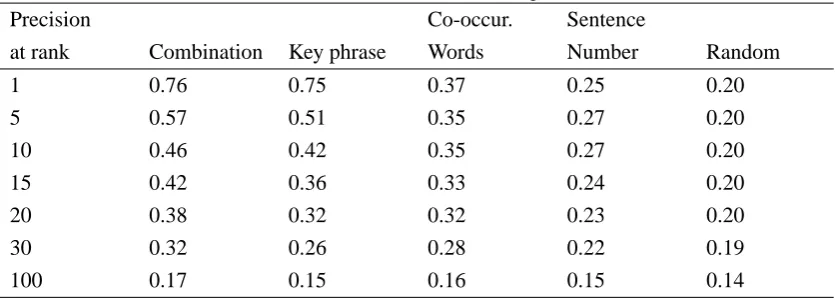
A precision-recall graph was plotted showing the effectiveness of the four strategies plus random retrieval (see Figure 1). As can be seen, the three criteria and their combination do better than random retrieval4. A sentence ranking based purely on the key phrase weights was extremely effective, except for high recall situations where the co-occurring word counting method was better. The most effective technique for finding descriptive phrases, however, was the combination formula, which, through a t-test, was found to be significantly better than any of the other methods, including key phrases. The difference between the combination and key phrase methods was found to be significant at p<0.05 for recall levels 0.1 and 0.2 and significant at p<0.01 for all higher values of recall. When evaluated with precision oriented measures a similar picture emerged. Table 3 shows precision
4
The monotonically decreasing line of the random system is an artefact of the standard interpolation used when measuring precision at fixed recall levels. Although the relevant documents along the ranking are evenly (randomly) distributed, when precision is measured on this distribution the line shown in the figure is the result.
Table 2. Precision (Key phrase) and collection size
P. at
rank 100% 75% 50% 25% 10%
1 0.75 0.78 0.69 0.63 0.62
5 0.51 0.51 0.46 0.38 0.32
10 0.42 0.40 0.35 0.28 0.24
Table 3. Precision of each strategy
P. at rank Comb. Key phr. Co-occ. Words Sent. No. Rand.
1 0.76 0.75 0.37 0.25 0.20
5 0.57 0.51 0.35 0.27 0.20
10 0.46 0.42 0.35 0.27 0.20
15 0.42 0.36 0.33 0.24 0.20
20 0.38 0.32 0.32 0.23 0.20
30 0.32 0.26 0.28 0.22 0.19
[image:30.612.190.457.66.267.2]100 0.17 0.15 0.16 0.15 0.14
Figure 1. P-R graph of four strategies
0 0.1 0.2 0.3 0.4 0.5 0.6 0.7 0.8 0.9 1