by Michael Honey
This sub-thesis is submitted as a partial requirement for the degree of Master of Letters at the Australian National University.
Subjunctive Realism
An inquiry into the metaphysics of time, personal identity and multiple worlds
by Michael Honey
ABSTRACT
Subjunctive Realism
Introduction
This thesis presents a metaphysical theory which I call subjunctive realism. Its premise is simple. The world as we know it is but one of the many nomologically possible worlds: the other ones exist too. It is a philosophical formulation of the Everett-Wheeler “many-worlds” interpretation of quantum mechanics, which says that whenever the laws of quantum mechanics give probabilities for different outcomes of measurements, each probability is realised: the universe, including the observer, “splits”, with one branch for each possibility. Such an interpretation implies that the future for any observer is subject to the probabilities experienced in quantum-mechanical observations, and is therefore open, while the “multiverse” as a whole is described by the deterministic Schrödinger equations.
I begin by examining the philosophical basis for thinking that our future may be open. I discuss briefly the impact of relativity and quantum theory on classical notions of causation, and make a distinction between subjective probability and genuine chance. I indicate that any system where chance plays a part is indeterministic, and give reasons for supposing that our world is such a system. I adopt Everett’s approach to the indeterminism apparent in quantum-mechanical observations, and outline the many-worlds interpretation of quantum mechanics. Three metaphysical pictures of the world are then explored: the “naive” model, in the formulation given by Storrs McCall, the four-dimensional or timeless model, and finally, subjunctive realism, reconciling problems which cause conflict between the other two models. I also compare subjunctive realism with the modal realism of David Lewis, a theory which proposes a still greater number of logically (as opposed to nomologically) possible worlds.
required. The approach is along the lines of Parfit and Lewis, with an emphasis on psychological contiguity. Two important results arise from these accounts. The first is that the theory provides an explanation for the apparent anisotropy of time without recourse to the postulation of ontological differences to account for the asymmetry between the past and the future. The second, more provocative result is that, given an appropriate understanding of trans-world identity, we may be considered to be concurrently inhabiting multiple subjectively indis-tinguishable worlds. 9
This is what my thesis does say. There are many other things which it does not
say. It should be emphasised that this is not a work of physics: I do not present any new experimental data or interpret it in a novel fashion. This is, however, in part a work about physics: I am examining the philosophical implications of a physical theory which I leave intact. I do not claim that the Everett-Wheeler interpretation of quantum mechanics is correct. I am not qualified to do so and it is outside the scope of this thesis: nor is it possible to argue for or against it on empirical grounds, since it receives no experimental support which is not also enjoyed by the prevailing Copenhagen interpretation. I do argue, however, that the Everett-Wheeler interpretation, if true, clears up some metaphysical difficulties to which the Copenhagen interpretation is susceptible, and provides a much more interesting universe in the bargain. If it has a drawback, it is that it involves a multiplication of entities which would make Occam turn in his grave.
Nor do I make any claims about free will. Perhaps an enthusiast might discern in a many-worlds metaphysics more opportunity for the exercise of free will, but I do not think that the removal of determinism at the world-level makes one any less subject to the laws of physics. Hypothetical but extremely unlikely alterations in the operation of the brain by quantum events would if anything decrease one’s role in making decisions. Neither am I interested here in exploring causation or the nature of time itself.
The end of classical physics
At the end of the nineteenth century, the project of physics was nearing completion. Gravity, motion, electromagnetism, and the atom were all, it seemed, understood; a complete description of a mechanistic universe, in terms of the theories of Euclid, Newton, Maxwell, Rutherford and others, seemed imminent. For the philosopher, whose traditional job has been to rush in where scientists fear to tread, there was little to do: physics would soon explain everything, and speculative philosophy —metaphysics in particular— seemed not only pointless but intellectually suspect, given the spectacular success of the physical sciences in comparison with the embarrassingly slow and frequently retrograde meanderings of philosophers. The retreat of philosophers from worldly matters towards logical and linguistic analysis is perhaps indicative of this apprehension, reaching its apogee in the “elimination of metaphysics” by the logical positivists:
In the domain of metaphysics, including all philosophy of value and normative theory, logical analysis yields the negative result that the alleged statements in this domain are entirely meaningless.1
Within a generation, however, classical physics had been swept away, replaced by a new physics, based on the general theory of relativity and the quantum theory. Together, the two theories effectively destroyed the premise upon which empirical science had been predicated: the idea that the world, independent of ourselves, was made up of determinate and measurable phenomena, whose interactions could be understood in terms of equations describing the positions and momenta of the fundamental “world-stuff”. The theory of relativity makes it impossible in some instances to decide whether one event occurs before another: quantum theory makes untenable the idea of “world-stuff” even having
determinate positions or momenta.2
Relativity, it seems, has become part of the mainstream of thought, and little troubles us: in any case we are unlikely to have to deal with its effects in our everyday lives, unless public transport becomes very much faster. Quantum theory, on the other hand, is still quite obscure, due in part perhaps to the horribly complicated mathematics involved: in greater part, however, because it undermines our intuitive ideas about causation and reality. Our intuitions about
1Carnap (1932), pp 61-62.
the world are similar to those held in classical physics: we believe that the world is made up of matter, which is pushed around by other matter in certain ways, subject to determinate laws which say which bit of matter will go where. Unless we are dualists, we think that such a description pretty well sums up what happens in the world, and, save for a problematic area within the skull, mechanistic explanations are adequate. These intuitions serve us well in our day-to-day existence: we do not have to worry about quantum effects when we go shopping or take the dog for a walk. Classical physics suffices for most phenomena on the human scale. Yet this matter of which we are all made is, at the lowest level of description, not subject to the determinate laws which hold at other levels. The fundamental “particles”3 which compose our bodies –there are some ten thousand billion billion– obey the laws of quantum mechanics.
The laws of quantum mechanics are statistical: although they are extremely accurate when dealing with huge numbers of particles, such as make up the familiar objects of experience, they are unable to make predictions when dealing with the individual particles themselves.
The principle of local causation
Most of our talk about causation refers to macroscopic objects. Consider a paradigmatic case: the game of billiards. We say that the cue ball causes the object ball to move in a certain way, depending on its angle and speed at the moment of impact. The balls, however, are not indivisible entities: they are composed of a great many smaller objects standing in certain relations. Any description of the movements of the balls is shorthand for a description of the movements of the smaller particles of which the balls are made. There are several possible levels of explanation, from the mechanical to the quantum-mechanical. Every instance of causation takes place on the lowest, sub-microscopic level, and this micro-causation occurs locally, between objects which are spatially and temporally adjacent: there is no “action-at-a-distance”. Where instances of apparent non-adjacent causation are investigated they are found to involve intermediate events which form causal chains. An event can only be affected by, or itself affect, entities within its past or future “light-cones”: an event taking place one million kilometres distant, for example, cannot affect events here until
at least 3.34 seconds have elapsed, as this is the minimum amount of time that the fastest of all causal phenomena—electromagnetic radiation—will take to traverse the distance.4
Is the universe deterministic?
Each state of the world occurs as a result of states immediately preceding it. There are physical laws which describe this evolution, and in so far as these laws are determinate, the universe proceeds in a determinate fashion. Given a complete description of the positions and momenta of all particles within a closed system5, and the determinate laws which apply to those particles one could in principle predict the future of that system with complete accuracy. This is of course the Laplacian apotheosis of Newtonian physics: a mighty intelligence, with a complete knowledge of the laws of nature and a complete catalogue of the positions and velocities of everything in the universe in any given instant6, could extrapolate all future events: a trick different only in degree from the prediction of eclipses or the conjunctions of celestial bodies.7
Such prediction is subject to two practical difficulties (apart from the sheer quantity of empirical data which would need to be acquired). The first comes from the increasingly popular field known as chaos theory. One of the central results of the theory is that there are systems within the world which are highly sensitive to their initial conditions. In such systems, such as economies, animal populations, weather systems, and executive toys, arbitrarily close initial
4There are exceptions to the principle of local causation: the so-called “EPR paradox”, for
example. I shall suggest an interpretation of this and other related phenomena which preserves local causation.
5A closed system, as the name implies, is one which is not subject to causal influence from outside forces. In the real world, any system (with the possible exception of the entire universe) will of necessity be open: the earth, for example, is affected by gravitational, electromagnetic and physical phenomena, coming from the rest of the Solar System and the universe at large. The first two sources of influence are particularly troublesome, because their effects propagate at the speed of light. Even a quite modest attempt at prediction—one hour into the future, for example—would require the hapless clairvoyant to take account of a sphere with a radius of approximately 1,079,022,150 kilometres: this would include the Solar System as far out as Neptune. Fortunately, most efforts at predictions do not require knowledge of the position of every particle: higher-level abstractions suffice in many areas. Nevertheless, some real-world phenomena remain intractable: meteorology and economics, for example.
conditions can result in completely different –typically, exponentially diverging– states at a later time. Even in a deterministic universe, with a one-to-one correlation of initial conditions and resultant states, initial conditions must be specified to an infinite degree of precision8.
The second difficulty is that quantum mechanics makes such specification impossible. Heisenberg’s uncertainty principle makes it clear that we are unable to know with unlimited accuracy the position and momentum of any particle. There is a minimum amount of indeterminacy which can never be eliminated from measurements of any quantum system, and, in so far as such indeterminacies may contribute to future states of any system, that system cannot be accurately predicted.9
Of course, the impossibility of predicting the future does not mean that the future of the universe is not determined. We should here distinguish between probability
and chance. If physical laws are determinate, we may assign a subjective
probability to our observing an event, based on our incomplete knowledge of the system before us, knowing that if we were in possession of all the facts, we could make a completely accurate prediction. In this case, the future is determinate (or, to put it another way, all particles have definite positions and momenta); it is only our knowledge of the future which is hazy.
It may be, on the other hand, that even the possession of all the relevant facts would make it impossible to predict the future, because there are some (microphysical) interactions which are not subject to determinate laws - where an event may or may not occur as a matter of chance. If there were such chance phenomena, then we could not even in principle predict the future, because it is indeterminate to the extent that some microphysical events are not unambiguously determined by antecedent phenomena.
8If the universe exhibits a quantal character , then an infinite degree of precision will be unnecessary, since below a certain threshold –that of the quantum-physical “grain”–, any further specification will be unnecessary.
There are apparent instances of objective chance in physical phenomena. The decay of a particular atom of a radioactive element, for example, seems to occur at random, although the decay of many atoms is amenable to statistical analysis. Quantum-mechanical formulae give probabilities for the outcomes of measurements, probabilities which are indicative of genuine chance:
Quantum mechanics is a theory that attempts to describe in mathematical language a world in which chance is not a measure of our ignorance but is absolute.... precisely because quantum-mechanical chance is not a measure of our ignorance, we ought not to tamper with the state vector merely because we acquire new information as a result of a measurement.10
If there are occasions where there is an objective chance (not merely a subjective probability) that some event will or will not occur, then it follows that there will be instances where the future state of the world will be indeterminate. In most cases, this indeterminacy will not trouble us, because it only occurs at the microphysical level: the macroscopic objects of our everyday experience are composed of huge numbers of microphysical systems, and any indeterminacy is in general statistically swamped.
There are some macrophysical systems, however, whose states are dependent upon individual microphysical events, the most obvious being the measurement apparatus of the physicist: cloud chambers, Geiger counters, photovoltaic cells and the like all detect events which can be the result of quantum effects. Recent advances in technology also provide ways for the microworld to affect the macroworld. There are computer chips currently on the market which have switches less that a micron across, using extremely small voltage differences to represent information. Such systems are vulnerable to the effects of cosmic rays and stray electrons: users are advised to re-install vital software periodically to avoid corruption of data. A recently developed switch which uses a single atom of xenon could conceivably be altered in its operation by quantum events.
One area of spacetime where quantum events have almost certainly given rise to macroscopic effects was the very early universe. Fluctuations caused by quantum events during the period of very high density postulated by big-bang theorists would result in large-scale effects through the amplificatory effects of gravity.
Multiple probabilities, one result
The probability that a measurement on a quantum-mechanical system (say, a particle) will return a given value is given by the wave-function11
y
which evolves continuously and deterministically according to the time-independent Schrödinger equation. The square of the absolute value ofy
(x,y,z) (or “amplitude” at that point) gives the probability of measuring the presence of the particle in the volume dxdydz at that point, with limits at zero (impossibility) and one (certainty).Before the measurement is made, many points may have a non-zero amplitude: there is a non-non-zero possibility that the particle will be found at these points.When a measurement is made the wave-function “collapses”: the probabilities for all values save one collapse to zero, and one value acquires a probability of 1. This eigenstate is that of the position of the particle as measured. Before the measurement, when multiple possible locations for the particle are given by the wave function, the system in said to be in a superposition of states. The wave-function is thought to fully describe the system at hand both before and after the measurement is made.
Everett (1957, 1973) argues that the dual nature of the wave-function –continuous and deterministic for an isolated system, but discontinuous and probabilistic for an observed system– leads to inconsistencies if more than one observer is postulated. He considers a system S, measured by an observer A.12 Before the observation, S evolves deterministically. Upon observation, yS “collapses”
probabilistically, and a measurement is made, which A duly records in a notebook. During all this, a second observer, B has been outside the room where A’s experiments take place. B is in possession of the wave-function yA+S of the
entire room, including both the system measured by A and A himself, just prior to A’s measurement.13 Because the system A+S is isolated from B (he has not yet performed a measurement upon it) he can deterministically compute the evolution of the state-vector of the room for, say, one week into the future. After a week, B is still in possession of the wave function for the room. The wave-equation as calculated by B contains non-zero amplitudes over at least two of A’s notebook entries: otherwise, A’s measurement would have not been indeterminate.
11Also known as the state vector.
B now opens the door and looks at A’s notebook. At this moment, the wave-function calculated by B collapses probabilistically. Until that moment, however, from B’s point of view, the wave-function had non-zero amplitudes over several outcomes of A’s experiment; in other words, A was mistaken in thinking that he had made an objective measurement and was in fact in a superposition of states for the last week!
In short, B implies that A owes his present objective existence to B’s generous nature which compelled him to intervene on his behalf. However, to B’s consternation, A does not react with anything like the respect and gratitude he should exhibit towards B, and at the end of a somewhat heated reply, in which A conveys in a colourful manner his opinion of B and his beliefs, he rudely punctures B’s ego by observing that if B’s view is correct, then he has no reason to feel complacent, since the whole present situation may have no objective existence, but may depend upon the future actions of yet another observer.14
Everett notes that this drama is “amusing, but highly hypothetical”. B would have to be almost omniscient in order to know the full wave-function of an entire room, and the prospect of calculating it forward for one week (with the calculation itself presumably taking less than seven days to perform) beggars the imagination. Nevertheless, it illustrates graphically the difficulty of reconciling the dual aspect of the state vector.
Everett considers six ways of avoiding the paradox, of which only the last two are deemed viable:
(1) By denying the existence of more than one observer. The solipsist position is, as always, unassailable but pointless, and unrewarding for the holder since there is no one else to appreciate it.
(2) By denying the possibility of the possession of the wave-functions of composite systems such as A+S on the grounds that quantum-mechanical descriptions cannot apply to observers or measuring apparatuses, or macroscopic objects themselves. This alternative fails on two grounds: (a) there is the difficulty of defining a size above which a device is too big for quantum-mechanical description, particularly since any large object (such as a person) can be considered as a conglomeration of smaller entities (cells, for example), which in turn are made of molecules, and so on; and (b) if it is only
human or animal observers which are excluded, there is the difficulty of positing a relevant difference between them and mechanical devices which perform the same function. Dualists will of course have an answer to this difficulty.15
(3) By denying that B might be able to possess the state function yA+S because
such a determination would result in A’s ceasing to function as an observer. One problem (apart from A’s insistence that he really is an observer, whatever B thinks) is that it is not important for B to actually know the state function yA+S, any more than it is necessary for A to know the state vector of system S
prior to measurement. If B believes that yA+S (whatever it is) is an accurate
description of the system, and that it evolves continuously and deterministically prior to B’s measurement, (as A did in his similar situation) then a conflict still arises with A’s apparently probabilistic observation. It is any case hard to see how “being an observer” should make any difference to how a thing behaves.
(4) By denying that the wave function is a complete representation of an isolated system. The apparent discontinuity between the pre-observed evolution of the state vector and the probabilistic outcome of the measurement could be due to unknown factors which the original calculated wave function did not take into account. Everett does not have an answer to this appealing alternative, except to say that it lacks the simplicity of his own interpretation; later developments however, such as Bell’s theorem, seem to have made it infeasible.16
(C) By denying that the wave-function actually describes the hypothetical quantum system itself: rather it is a mathematical device whose only function is to provide probabilities for measurements using classically described apparatus. This is the “Copenhagen interpretation” due to Bohr: or more exactly a non-interpretation, since it explicitly rules out the “possibility of a
15But would it be an answer? Presumably one would have to postulate an interactionist dualism, since epiphenomenalism leaves the problem untouched. Yet an interactionist would have to explain how the action of the soul frees the body from the rules of quantum physics. Mere postulation of a spooky entelechy is hardly explanatorily satisfactory.
16In 1957, when Everett wrote his original paper, the question of locally realistic
conceptual model applicable to the quantum realm”17. Instead, the interpretation divides the world into quantum-mechanical systems and observer systems; the latter are considered classically, and the former is considered as statistical fictions only, useful for prediction but otherwise devoid of meaning. Everett finds (as do I) that this prevailing interpretation is unsatisfactory. Firstly, it is overly conservative; because it does not assign an interpretation to the formalism, it lacks explanatory power. In essence, it postulates the probability rules for quantum-mechanics as a phenomena-saving artifice. Because it presupposes a classical realm, it is unable to provide an explanation of that realm in terms of quantum-mechanical phenomena, which is surely the whole point of the exercise.
(5) By abandoning the notion of the probabilistic “collapse of the wave-function”, asserting that the deterministic wave-mechanical equations hold for all systems, at all times. This is Everett’s position. As he says, it has “the virtue of simplicity and it is complete in the sense that it is applicable to the entire universe”18: that is, it does not depend on arbitrary restrictions as to its validity (observers and measuring apparatus are treated in the same way as the systems they observe), and no extra assumptions have to be made to free it from paradoxes such as the one outlined above.
Everett’s many-worlds interpretation
Everett’s position can be stated quite simply. He assumes the validity of the formalism of wave mechanics for all systems: the deterministic equations accurately describe the evolution of the entire universe. The empirical results of quantum-mechanical observations, with their discontinuous and probabilistic nature, are re-interpreted in a novel fashion. Typically a state vector is given by an equation which represents a superposition of possible measurement-results.19 Ordinarily, the state-vector is assumed to “collapse” under observation such that one value is reified; the different values of the initial equation are considered as giving probabilities (proportionate to the amplitude of the equation at that value) that a particular measurement-result will eventuate.
17Everett (1973), 110. The Copenhagen interpretation is denoted “(C)” because Everett considers it at a separate stage to the other five theories. Proponents of the Copenhagen interpretation will of course insist that there is an interpretation, but I would contend that giving up the notion that the formalism actually describes or models anything leaves us with syntax without semantics, a mathematical trick, a sort of black box from which emerges the correct answers, but which might as well contain Ptolemaic epicycles as anything else.
18Everett (1973), p.8.
Everett gives a more literal interpretation to the formalism, and asserts that each of the superposed elements in the state-vector corresponds to a different state of the observer.20 The state of the observer “branches” with each observation into a superposition of states, one for each eigenstate of the original state-vector. Since Everett does not privilege observer systems, the foregoing applies to all systems in general and to all interactions governed by quantum mechanics. The universe is constantly splitting into superpositions of states, including the observers of that universe themselves!
“I still recall vividly the shock”, says De Witt21, “I experienced on first encountering this multiworld concept. The idea of 10100+ slightly imperfect copies of oneself all constantly splitting into further copies, which ultimately become unrecognisable, is not easy to reconcile with common sense.” Indeed, there are those who seem unable to do so; both Penrose and Healey have suggested that this is not what Everett intends, and give alternative explanations of Everett’s work22. But Everett himself seems quite categorical:
From the viewpoint of the theory, all elements of a superposition (all “branches”) are “actual,” none any more “real” than the rest. It is unnecessary to suppose that all but one are somehow destroyed, since all the separate elements of a superposition obey the wave equation with complete indifference to the presence or absence (“actuality” or not) of any other elements. This total lack of effect of one branch upon another also implies that no observer will ever be aware of the “splitting” process.23
According to the theory, the totality of the branching worlds, which I shall term the “multiverse”, is at all times subject to, and evolves in accordance with, the deterministic Schrödinger equations. From the point of view of the observers, however, confined to their branches of the multiverse, the state vector appears to
20Everett (1957), pp 146-147. 21De Witt,(1970), p.161.
22Penrose (1979), p. 594; Healey (1989), pp 211-216. Penrose suggests that if Everett’s theory is meant to replace conventional quantum-mechanical interpretations, then there should be “backwards” branching as well as forward. But how do we know there are not such branches? Healey states (correctly) that Everett’s theory postulates different observer states rather than different observers. I do not know how one could tell the difference, if there is one, between one world in several states and several worlds, each in one state. It is also unclear what one might mean by one observer “simultaneously” being in several states; since a “state” is presumably a complete configuration of the mass-energy which composes the observer, it would seem that a more natural explanation would be that there are different (by Leibniz’ law) observers, each in one state. On the other hand, see “To whom does ‘I’ refer”, below, for an exposition of just such a situation.
collapse. “We are then led to the novel situation in which the formal theory is objectively continuous and causal, while subjectively discontinuous and probabilistic.”24 The theory is entirely in accordance with experience, and one must decide between Everett’s model and others on other than empirical grounds.
The difficulty that most people have when coming to terms with a many-worlds metaphysics is that the simplicity of the theory is balanced by a tremendous ontological cost: one must admit into one’s previously austere cosmos a very large –perhaps infinite– number of universes, each as real as the one which we experience. Indeed, Wheeler himself, Everett’s doctoral supervisor, is said to have abandoned the many-worlds interpretation on the grounds that it carried “too much metaphysical baggage”. The first task of the remainder of this thesis is to examine that baggage and show that it is worth lugging around. I shall explore some different metaphysical views of the universe and time which might be contrasted with Everett’s interpretation, and show how the latter is of explanatory utility in clearing up some difficulties to which the other theories are prone.
The second task will be to provide the theory with an adequate theory of personal identity. There are two reasons for this. One is due to a rather misguided comment from Penrose, referring to the Everett picture as a “‘zombie’ theory of the world” populated (except for here) by unconscious automata, which suggests that Penrose is either wilfully misunderstanding Everett or that he is a crypto-dualist. The second reason is more serious. It will be clear that any statements regarding a quantum system under the Everett interpretation will be assigned a truth-value according to the observer who makes those statements: if I say “system S is in state T”, then the truth of that statement depends quite literally on who I am: for the statement to be true I must be on that “branch” where system S did in fact attain state T. Since Everett’s interpretation applies to the entire physical universe, it follows that any empirical propositions are, inter alia,
propositions about the position of the speaker within the “multiverse”. Contingent truth25 is therefore an indexical notion: a proposition such as “ p is the case” must be translated as “there is a world where p is the case, and this is that world”. Since people appear to persist though time, there will be many, many branchings of the universe to which any person belongs. An adequate theory of personal identity must be able to account for the multiple branchings which will take
24Everett (1973), p.9
place, particularly when dealing with statements in the past or future tense, when it is not at all clear where one “world” ends and another begins. In parallel with the concept of personal identity, a criterion of “world identity” will also be provided.
Naive time
Let us characterise what I take to be the “naive” view of time. This is the view that the present, a period of indeterminate and perhaps zero length in time during which our immediate experience occurs, is in a constant state of movement (at the rate, as it were, of one second per second) towards a future which is as yet undefined. The past, having already happened, is fixed: there are facts-of-the-matter which exist about the past, which do not yet exist about the future, but which will exist when those as-yet-undetermined future moments become present and then past. Thus while it a fact that I was born at a certain date, while I am still alive there is no fact that pertains to the moment of my death. There will be a specific time at which I will die, however: the future, while it is future, may be open, but as the present overtakes it –as potentialities are “actualised” or not– the apparent possibilities of “what might happen” collapse into “what did happen”.
At time t0, a,b, and g w ere al l pos s ibl e futures: as the moving " n o w " a d v a n c e s , p ot e n t i a l i t i e s a r e actualized (or not), and by time t4, a has "panned out" as the actual state of the world.
Fig.1 "Now", at time t0
"Now", at time t4
t3 t4
t2
t1
t0
a
b
The asymmetry between the past and the future –one is fixed, immutable, and the other open, indeterminate– is either epistemological or ontological; either the world just subjectively appears that way due to the limitations of our knowledge, or there is some objective reason for it. The view described above suggests the latter. The future really is open: perhaps because it “hasn’t happened yet” and cannot therefore have any properties, or because there are yet-to-occur factors, such as the free decisions by human agents, or chance occurrences, which the present does not determine. In the diagram above,
g
might have occurred, but a factor at t1 (such as a decision not to fight a certain sea-battle) causeda
to occur instead.On the other hand, the apparent openness of the future might be simply because we don’t know enough about the present to be able to know the future. It’s easy to know what “happens” in the past: we remember seeing it, or we’ve heard about it. Even if we don’t know anything else about the past, we know that it’s already happened, so it won’t change on us. The future is another matter: we can extrapolate somewhat, but there could always be factors about which we don’t know. We don’t have be determinists to believe that the future is closed: it could be, for example, that an omniscient God knows exactly what free choices each of us will make in our lifetimes: to God, our future is just as real as our past. We don’t even need to invoke a deity: the theory of timeless truth26 is enough. If “there was a sea-fight today” is true, then surely yesterday’s prognostication “there will be a sea fight tomorrow” was also true?27
Four-dimensionalism
If this is the case, then perhaps we shouldn’t talk about the present as if “when now is” were ontologically decisive, since (at least as far as God is concerned), all moments are “simultaneously” available. Perhaps the passage of time is an artifact of our experience:
...we seem to think that we sit in a boat, and are carried down the stream of time, and that on the banks there is a row of houses with numbers on the doors. And we get out of the boat, and knock at the door of number 19, and, re-entering the boat, then suddenly find ourselves opposite 20, and having done the same, we go to 21. And all the while, the firm fixed row of the past and future stretches in a block behind us and before us.28
26For a short exposition of timeless truth, see the section on McCall’s “Temporal Flux”. 27This sentence is somewhat misleading. From the point of view of yesterday, (the opponents of timeless truth would say), the protasis “there was a sea-fight today” is not yet assigned a truth-value.
This, then, is the “block” universe. One can quite literally assume that time is a fourth dimension in addition to the three spatial dimensions, and draw a Minkowskian four-dimensional “map” of any system. Our experience of the passage of time is analogous to spatial movement, albeit in one direction only, and individuals are depicted as space-time “worms”, like the familiar time-lines from history books.
One can distinguish two sorts of four-dimensionalism, based on differing understandings of the role of the present within the block universe. In the first, and the present moves, like the boat in Bradley’s somewhat Stygian metaphor, borne ceaselessly into the future at a constant rate.29 On this view, there is a fact about when now is: future moments objectively acquire the quality of being the present and later the past. The second view is I think the more usual and indeed the more robust form of four-dimensionalism. That a moment is first future, later present and then past30 is not so much because of an ontological spotlight of presentness which moves over the block universe as a reflection of the temporal location of the speaker. All moments in time are “the present” to themselves, just as all spatial points are “here” from those points.
Normally, dimensionalism is accompanied by determinism: to draw a four-dimensional space-time diagram, one merely extrapolates from an arbitrary time-slice of the system in question, forwards or backwards, using determinate physical laws. As mentioned above, however, one need not necessarily be a determinist: a Laplacian intelligence could have, in addition to full knowledge of the mass-energy distribution of the system and its physical laws, a list of all the exceptions to those laws (incidences of free-will, quantum indeterminacies, and the like), when, where and with what effect they occur.31 In either case, the future is unknown to us, but nevertheless it will occur, and it will occur in a certain way. The difference between the future and the past is simple: we remember the past, and we can only speculate more or less successfully about the future. There is, however, no logical difference between the past and future: like left and right, the
29The time-dilation experienced by highly accelerated observers due to the theory of relativity does not change the rate that the “present”, for that observer, moves: it only changes in relation to an observer in a different inertial frame.
30There is of course the problem that this sort of explanation —” first future ... later past”— seems to require a second-order temporality.
31This would in my opinion be tantamount to indeterministic fatalism, a metaphysically
distinction is subjective only. The subjectivity of the distinction is guaranteed by general relativity: observers in different inertial frames will report events at different times, and what may be “future” for one observer is “past” for another.
McCall’s “Temporal Flux”
Four-dimensionalism, while in accord with our scientific world-view and logically coherent, is to some unpalatable, probably because it conflicts with some deeply held convictions about ourselves. We do not like to think that we are helplessly propelled towards an inevitable future. Rather, we like to think that the future will be as it will be as a result of our decisions32: we like to think that we can steer our destiny towards our goals and away from our fears. Even if we don’t believe in free will, the future seems indeterminate. Attempts have been made to save these phenomena. One such attempt is due to McCall (1966). He rejects the four-dimensional “block” universe, reasserting an objective “now” and leaving the future open. I examine McCall’s theory because it presents a plausible alternative to the four-dimensionalists’ view which has some of the features of subjunctive realism.
An aspect of four-dimensionalism is what McCall calls the theory of timeless truth. As I write this sentence, I am wearing a hat. There is therefore a true present-tense proposition “Michael is wearing a hat”: true, of course, because at present Michael is in fact wearing a hat. This proposition is not very specific about when Michael’s hat-wearing occurs, so perhaps it might be better to say “Michael is wearing a hat at time t0”. Later, at time t1, we will be able to say “Michael was wearing a hat at time t0”, and the truth-value will be unchanged. Furthermore, if we are four-dimensionalists, it will be legitimate at time t -1 to say “Michael will wear a hat at time t0”, again preserving the truth of the statement, which is guaranteed by the fact that “Michael is wearing a hat at time t0” is true at t0. Indeed for the sake of simplicity we might cover all three forms by the “tenseless” locution (following the custom of italicising tenseless verbs and copulae) “Michael wears a hat at time t0”.
Of course, we are not normally in a position to make predictive statements about the future with the desired degree of accuracy, but this inability (so the four-dimensionalists say) is due to epistemic inadequacy rather than any deep logical fact about the universe. The time of utterance of a tenseless proposition is
irrelevant in determining its truth-value: I do not now know whether the statement “Michael dies on 25 August 2020” is true (and I hope that is not), but if I am a four-dimensionalist, then the statement is as true (or false) now as it will be in 2020, in the same way that “Mount Everest is over eight thousand metres high” is true even if I’ve never been there.
McCall finds that this theory of timeless truth is in conflict with our normal ways of speaking about the future. He has three objections. Firstly, when we make guesses about the future, we are not inclined to think that our guesses (if correct) were true from the moment that we made the guess: rather, they “turn out to be true”, or even, that it turned out (when the guess was shown to be correct) that it
was true. Secondly, McCall cites cases where we bring about future events. He uses the example of a doctor, having given a patient a pill, says “There, now he’ll get better”, which is translated as “it is now true to say that the patient will get better” - now true, of course, because the curative pill has been administered: the doctor is “bringing about the future” introducing a new factor, which is why he says “There, now he’ll get better” after the pill has been given, and not before. This, McCall says, “contradicts the timeless truth theory, since on that view if the patient gets better, it would have been true to say that he would before the administration of the pill.”33 Thirdly, McCall thinks that the theory of timeless truth may be in conflict with the nature of the adjective “true”: rather than inhering in a thing from beginning to end, like the sweetness and whiteness of sugar, “ ‘[t]rue’ may be an adjective resembling ‘deceased’ or ‘extinct’ ”.34
With these difficulties in mind, McCall rejects the theory of timeless truth, and in doing so rejects the Minkowskian block universe. McCall posits a new theory of truth, which, like the theory of timeless truth, deals with tenseless dated propositions of the form
(a) the space-time point (x,y,z,t0) is characterised by the property P or
(b)the date of event E is t0.
McCall distinguishes between the time of reference of such statements and the
time of assertion.35 Obviously, when tenseless dated propositions are “translated”
33McCall (1966), p.274
34ibid. “True”, it seems to me, is neither like “sweetness”, nor “extinct”, since both of these adjectives are descriptive of things, whereas “true” or “false” are only predicated of propositions. The question then is whether propositions exist eternally.
35Respectively denoted here as t
into the present tense, the two times will coincide (ta= tr): for future and past tense sentences , ta<tr and ta> tr respectively. In the theory of timeless truth, the time of assertion of a proposition is irrelevant to its truth-value. For McCall, however, the time of assertion is vital to determining the truth or otherwise of any statement. The conditions for the truth of a proposition are:
(i) Proposition p(t0)is true at assertion time t0 if p(t0)36
(ii)Proposition p(t0) is true at t < t0 if there exists at t some condition sufficient to make p(t0) true at t0
(iii) If proposition p(t0) is true at t then p(t0) is true at all subsequent times
(iv) Under no other conditions (ie. unless its truth follows from (i)-(iii) above) is p(t0) true.
In parallel with these conditions, there are conditions for falsehood, which are of the same form with “false” substituted for “true” throughout (and a negation symbol before the last occurrence of “p(t0)” in rule (i)). From these two sets of rules it will be seen that there are future tense propositions (ie. those where ta <
tr) which are unburdened by either truth or falsity. These are those which fail to
fulfil criterion (ii): where there are at ta insufficient conditions to make true (or
false) the proposition p(t0).
The theory therefore violates the principle of bivalence37 - that every proposition is either true or false. Statements such as “Michael will become a member of the Royal Society in 2028” are currently of indeterminate truth value (unless there sufficient conditions now to guarantee their truth or otherwise). And this is what constitutes the difference between the past and the future: simply put, future statements are not subject to the law of bivalence, whereas those of the past (and present) are, by virtue of rules (i) and (iii) and their falsehood-counterparts.
The metaphysical picture elicited is one where an indeterminate future is continually being “reeled in”, subjected to the law of bivalence and assigned a truth value. The past, equivalent to the set of true propositions about the world, is similar to the Minkowskian block universe. The future is composed contains a great number of maps, each one of which depicts a possible future. Any future facts which by rule (ii) are already true will appear on every map: the other
36McCall, p. 276
possibilia will be “fuzzy” due the “superposition of possible maps upon one another”.38
First, it must be noted that if the universe is deterministic, then by rule (ii) the picture will be almost identical to the four-dimensionalists’. The only difference is that there is an “objective” present, and that true propositions about the future are not subject the law of bivalence, despite fulfilling it.
An obvious objection, anticipated by McCall, is that general relativity requires that observers in different inertial frames will order phenomena differently: their “presents” do not coincide. Observer a, for example, might experience event a before event b, while for observer b, the experience of b precedes a. For observer a at t1, the proposition “a happens at t1” will be true, while “b happens
at t2” is still indeterminate. Observer b has the opposite experience. McCall is quite happy to admit that different observers will see the truth differently. “Just as in Einstein’s theory the results of measuring certain intervals of space and time are relativised to the frame of reference or the observer, so in this theory the truth or falsehood of certain propositions is relativised to the time of their assertion.”39 Each observer must have their own “set of maps” of the future, according to the propositions which are now true or merely possibly so for them.
Another potential difficulty is illustrated by the following. At t0, excluding prior sufficient conditions, there is no fact-of-the-matter about a possible sea-battle at t1: “there is a sea-battle at t1” is nether true nor false. If, at t1, the battle has not eventuated, then it seems that one can say that at t0 the proposition “there is a
38McCall, p. 280
battle at t1” is false: after all, it is false at t1, and by t1, the possible “map” featuring the sea-battle has been discarded.
Not so. The fact that t1 is sea-battle-less does not change the fact that at time t0,
there was a possible future sea-battle. Rule (iii) states that the truth of a proposition at time t ensures the truth of that proposition at subsequent times, but explicitly (by rule (iv)), not vice versa. According to McCall, possibilia, not just
actualia, are facts about the world and should be temporally relativised. This is in accordance with our normal way of thinking. As a child (assuming free will, indeterminism, or what have you) I might have wished to become a fireman, and there was no reason why it was impossible, so one could say, at t0: “Michael is a fireman at t1”. This proposition , at t0, lacks a truth-value. At t1, having fallen from the righteous path of firefighting and dabbled in the black arts of philosophy, the proposition is false. On the strength of the proposition’s falsity at t1, we do feel justified in claiming that it was false at t0, however. At the most, we might say that, from the point of view of t1, the assertion at t0 was false. From the point of view of t0, however, it is (was?) still indeterminate.
One’s acceptance of McCall’s theory depends on whether one is prepared to countenance a “tensed” theory of truth. It certainly has some advantages: one is freed from the usual fatalistic arguments, and the problem of future contingents, normally the sticking-point between the human “naive” view and the four-dimensional view from eternity, is resolved.
Subjunctive realism
Subjunctive realism is so called because “unactualised” possibilities –“the way things might have been”– are considered to be as real as the actualised possibilities which we experience. In McCall’s metaphysics, future possibilities are either fulfilled, in which case they become “real”, or they are not fulfilled, and are discarded. In subjunctive realism, all possibilities are real: the possibility which we observe is the one which we call “actual”. There is no “ontological spotlight” on the actual world: in the manner of Lewis, actuality is defined as an indexical term, like “here” or “yesterday”. A diagram analogous to those provided for the four-dimensional and McCall worlds is shown below.
Every time an interaction occurs for which multiple results are possible (where the wave-functions have non-zero amplitudes over several results), the “multiverse” branches. In the diagram on the left, only two branches are shown at each juncture, but typically there will be many more. A world can be defined as any path through the multiversal tree; one can simply denote worlds by specifying beginning and end points on a diagram such as the one above. (ab), (ag) and (ad) are worlds.
In Figure 3, (ab), (a d) and (ae) share world-parts: the worlds diverge when branchings occur. (ab) and (ae) diverge later than (ab) and (ad): before then, they are identical, “sharing” the world (ak). Indeed, before two worlds branch, they are the same world. The identity of (partially) indiscernible worlds is not a view held by Lewis: I will discuss my reasons for favouring “branching” over “divergence” below.
One can consider the multiversal “tree” as a tree in phase space. Each point in the phase space represents a state of the universe. The tree represents different evolutionary paths through the space. In a deterministic world there would only be one path through the space from a given point. If a Minkowskian deterministic metaphysics is called “four-dimensionalism”, then subjunctive realism is “five-dimensionalism”. Indeed, just as the other four dimensions admit of quantitative comparisons (such as “a is to the left of b”, or “c is closer in time to d than f”), so does the fifth: one can say that b and e are more closely related than d and g by virtue of the fewer branchings between them on the tree of possibility. Similarly, the location of junctures in the tree determines which points are “accessible” from
k
Fig. 3
a
b
g
d
other points: b is accessible from a, but not from g, while from k one can access d,b, and e but not g or a.
McCall’s tensed-truth world might depict the future in a similar way to that above, with branches “dropping off” as they are reached by the Absolute Becoming for a given observer and resembling the four-dimensionalists’ world: hence the “acid-rain” version of subjunctive realism.
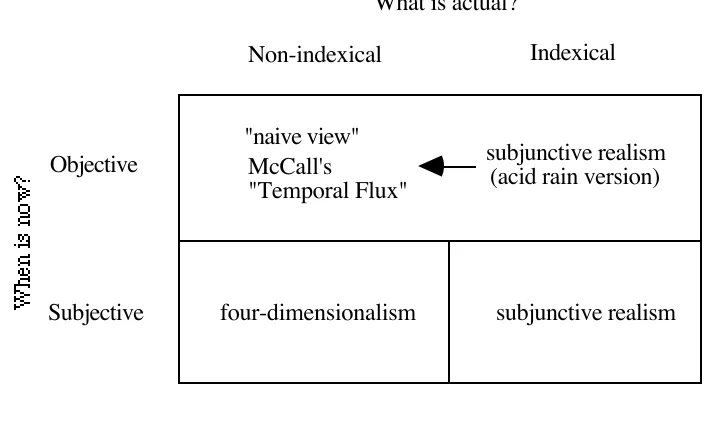
We may assign places to the various metaphysical positions in a table such as the one below:
subjunctive realism "naive view"
four-dimensionalism Objective
Subjective
Non-indexical Indexical
What is actual?
When is now?
subjunctive realism (acid rain version) McCall's
"Temporal Flux"
Fig. 4
[image:25.595.149.503.281.492.2]we hesitate to call the future actual. This temporal asymmetry is discussed further in “The open future”, below.
Nevertheless, we feel that there are logical, if not empirical truths about the future. If p = “there will be a sea-battle tomorrow” then “p ⁄ ~p” simply describes the fact that all future branches from our vantage point contain either a sea battle or a lack thereof.
How many worlds?
Since each branching occurs as a result of a quantum-mechanical interaction which gives a number of possibilities, it is clear there will be very many such junctures. Furthermore, since every branch will typically have many possible outcomes, the multiversal tree will be huge to say the least. It is not necessary that it be infinite, however. True, if the universe contains any degrees of freedom which can be specified arbitrarily closely (and where it will make a difference if they are) then there will be an infinite number of possible states of the matter within that universe, but the very cause of the branching –quantum mechanics– may preclude this.40
In the classical world, particles have energies and momenta which vary continuously. The units of measurement are conventional: a particle may possess such properties in an integral quantity or anywhere in between. The “quanta” to which quantum theory refers are discrete units which represent the minima of any changes to properties such as energy, spin, angular momentum and so on. As such, properties like those described are quantized, and it follows that a list of possible states which a particle may attain (assuming that those properties are not themselves infinite) is limited. If all properties of particles were quantised, then the possible combinations of those particles –and hence of macroscopic phenomena, made up of combinations of integral quantities of particles– would also be only finite in number.
There are some properties, however, particularly extrinsic, relational properties, which appear to be continuously variable. The spatio-temporal position which a particle occupies relative to another particle, for example, or its velocity, are not
quantized41. An attometre here or there can make a difference in, say, two atoms coupling in a chemical bond, or a free neutron impacting on a uranium nucleus in a chain reaction. Surely, if position and velocity are continuously variable, there are an infinite number of possible particle interactions, irrespective of any other, quantized properties which those particles possess?
On the other hand, it is not clear that we should, or even meaningfully can, make distinctions between systems which are arbitrarily and indetectably alike. There may be cases where we can conceive of differences between two systems which are nonetheless indistinguishable because the two systems are even in principle experimentally and hence causally identical. Suppose we have a magical machine42 which can vary the position of a target particle continuously. We bounce other particles off it, note the diffraction as they impact on a screen, and thereby establish its location. As we twiddle the knob on the target-moving machine, the diffraction pattern changes, and by noting the movements of the diffraction pattern on the screen, we deduce the movements of the target. Since our machine can vary the position of the target continuously, we can twiddle the knob as small an amount as we like, and the movements of the diffraction patterns will be corresponding less pronounced. Eventually, we will move the knob small enough that we cannot detect any difference in the diffracted particles: perhaps the movements on the screen are smaller than the wavelengths of visible light, so, rather than simply looking at the screen, we switch to ultraviolet, then to x-rays and gamma rays: still we may twiddle the knob an smaller amount, requiring smaller wavelengths, themselves requiring ever-greater amounts of energy for their production. Eventually there will be an insufficient amount of energy in the universe to make particles of sufficient energy (or, if you like, waves of sufficiently high frequency) capable of resolving the difference in diffraction patterns. This is quite apart from the insuperable difficulties in observation (due to Heisenberg’s uncertainty principle) caused by using such high-energy particles.
If there is a level below which differences between systems are causally insignificant, then there are only a finite number of non-trivially distinguishable
41I am here speaking of distances between particles which do not form part of the same atom or molecule: the distance between (say) two nuclei in a hydrogen gas might vary continuously until they approach each other closely.
worlds composed of different arrangements of a finite amount of mass-energy43. In other words, there are only so many meaningfully different positions in phase-space. I have described the multiversal tree of Figure 3 as a tree of paths through phase space: although there might be an infinite number of theoretically distinct branches on the tree, the “scale of resolution” of causal differences makes them indistinguishable.44
A higher threshold of indistinguishability, that of the limits of human perception, will be discussed later in the section “Living in Multiple Worlds”.
When do worlds diverge?
Since the effects of any event cannot propagate faster than light, it follows that two worlds which are distinguished by that event may not diverge before the relevant parts of the world enter the event’s future light-cone. Suppose that a quantum-mechanical event in World X might eventuate in a star going nova45.
The hypothetical inhabitants of a planet orbiting at ten light-minutes distance from the star cannot be said, at the instant when the event does (or doesn’t)
43Obviously, an universe of infinite size has an infinite number of combinations: our universe does not appear to be infinite however.
44cf. Born (1954), p.377: “According to the heuristic principle used by Einstein in the theory of relativity, and by Heisenberg in the quantum theory, concepts which corrrespond to no conceivable observation should be eliminated from physics.”
happen, to be inhabiting either the “fried” world (World A) or the “safe” one (World B). It is not until the planet enters the future light cone of the event ten minutes later that the worlds diverge for that planet.46
This is not mere conceptual economy (since one is postulating billions of worlds, one might as well economise somewhere); the fact that World X is “parent” of two separate worlds does not make it necessary to assume that there are two “World X’s”, any more than it is necessary to distinguish the father of Laertes from that of Ophelia. Those parts of World X which are as yet untouched by the consequences of the event at t0 cannot be considered as part of either World A or World B, even though every part of World X which lies within the future light-cone of the event will eventually become part of World A or World B.
Such considerations give credence to McCall’s temporal theory of truth. The question is whether the X’s in the worlds (XA) and (XB) are identical. For the two world-segments to be identical –for there to be one, not two, segments– they must be indiscernible: nothing can be predicable of one that is not also predicable of the other. If truth were timeless, then we could at time t0 (or at any time previous to that) distinguish two planets: one where “The wavefront of the sun’s explosion will reach us in ten minutes” is true at t0 (the planet which will be part of World A) and one where it is false (the planet which will be part of World B). If we adopt McCall’s theory, on the other hand, and modify it according to the relativistic concerns given above, then the proposition is neither true nor false until t10 minutes, when the worlds diverge. The truth of the proposition “the sun
explodes at t0” is equivalent, and is similarly undetermined until t10, when that part of the universe “finds out” whether it is true or not.
One might object that McCall’s original formulation of the truth-conditions for a proposition are adequate, in particular rule (ii), since at t0 there are sufficient conditions for the truth (or falsity) of the proposition “The wavefront of the sun’s explosion will reach us in ten minutes”: the condition in question is the fact that the sun has exploded (or not). Rule (ii) simply states that “Proposition p(t0) is
true at t < t0 if there exists at t some condition sufficient to make p(t0) true at t0”
but is not clear in which sense the sufficient condition is supposed to exist. I would contend that we cannot meaningfully say that a condition is in existence
now when there is no possible way, even in principle, for us to know whether that
condition obtains. We will know at t10 whether the condition did obtain at a distant location at t0, but in the relativistic world, spatial and temporal distance are equivalent in that they both preclude causal interactions where cause and effect do not lie respectively within each other’s future and past light cones.
We should therefore introduce a modification to McCall’s first two truth-conditions, requiring that the truth of a given proposition be established, in addition to the time of assertion, at the place of assertion as well:
(i) Proposition p(t0) is true at assertion space-time t0,x,y,z if p(t0,x,y,z) (ii)Proposition p(t0) is true at t < t0 if there exists at t,x,y,z some
condition sufficient to make p(t0) true at t0,x,y,z
These conditions (along with the appropriate parallel rules for falsity) allow us to assert the identity of world-segments which predate branchings.
Rehabilitating timeless truth
The diagram on the right shows world (ad) branching at time t1 in two worlds, (ab) and (ag). The first branch-world (ab) contains a sea-battle at time t2, while the other does not. The timeless proposition “there is a sea-battle at time t2” has three possible truth-values, depending on where and when it is asserted. As asserted by an inhabitant of world (ab), it is true, by an inhabitant of (ag), false, and at world (ad) (and hence before time t1) it is
indeterminate. In each case, the propositions possess their truth-values timelessly: because a world can be considered a path through phase-space, and hence as a group of successive arrangements of mass-energy, it follows that the definition of any world will include (among other things) the very fact to which the proposition in question refers. In other words, the proposition “the proposition ‘there is a sea-battle at t2’ is true at world (ab)” is true.47
What about the other worlds?
A natural interpretation of the branching which accounts for the indeterminacy of future propositions is to think of each of the branches as a possibility which may or may not be “actualised”. McCall’s metaphysical picture (Fig.2) is an illustration of this, and may be considered as a person’s-eye view of a single world. From the point of view of that particular world, past possibilities are no longer actualisable, and are inaccessible. They are not actual, unlike the world of our experience. Future possibilities may or may not become actual; in other words, they will become part of our world (or not).
The assertion that only one of the many possible worlds is actual seems to conflict with the original reasons for postulating the different possibilities in the first place. Everett’s formulation of the laws of quantum mechanics allows for many different states of a given system, none of which has any greater claim to the “ontological spotlight” than any other. The solution to this conflict, as indicated, is to treat actuality as an indexical term. Every world is actual, but only at that world: such a proposition is not different in form to “every place is ‘here’,
47It might be objected that this is tautological, since the fact that world (ab) is (ab) and not some other world is due to the fact that (ab) is the world where the sea-battle (among other things) occurs. This is, I think, quite true but not undesirable.
d
a
b
g
sea-battle
no battle
Fig. 6
t2
t1
but only at that place”. All nomologically possible worlds are real, however: none of the branches on the multiversal tree are imaginary, and furthermore, every place that there could be a branch, there is one.
Some may cavil at the distinction between “actual” and “real”; those who believe in only one world will conflate the two. The distinction can be reaffirmed in modal terms: those things which are “real” (in the sense I give) are possible, and those which are unreal are not. Actuality is merely instantiated possibility. Thus horses are actual (and a fortiori real), unicorns are not actual, yet real —at least in this world— and square circles are neither actual nor real: they do not exist in any logically possible world.
Lewis’ modal realism
Having said that there is a branch everywhere where there could be one, it still remains to be seen where those branches might sprout. Let us consider the two extremes. The first is that there are no places where branches could sprout at all. If the cosmos is deterministic, then there are no occasions where there are chances for the world to turn out one way or the other. Rather than a multiversal tree we have a universal stick. Of course, there is no reason why some branches of the multiverse might lack subsequent branches. If the laws of physics were not “multiversally immutable” –if, for example, they came into being at some very early stage of a big-bang type universe– then there is no reason not to suppose that there are worlds where the laws of physics are deterministic; perhaps even this world. At the other extreme, we have David Lewis’ modal realism, where “absolutely every way that a world could possibly be is a way that some world
is.”48 There is, on Lewis’ view, (at least) one world for every logically possible arrangement of world-stuff.
In the case of subjunctive realism, there are worlds for every nomologically
possible arrangement of world-stuff: the possibilities are subject to the laws of nature as well as the laws of logic. I think that it is safe to say that the set of nomologically possible worlds is a possibly maximal subset of that of the logically possible worlds. I do not know whether the laws of nature are more restrictive than those of logic. If the laws of nature were deterministic, for example, then the set of nomologically permissible circumstances following from any given initial conditions would be a very small subset of the logically