Rochester Institute of Technology
RIT Scholar Works
Theses Thesis/Dissertation Collections
3-1-1996
Recursive analysis and estimation for the discrete
Boolean random set model
John Handley
Follow this and additional works at:http://scholarworks.rit.edu/theses
This Dissertation is brought to you for free and open access by the Thesis/Dissertation Collections at RIT Scholar Works. It has been accepted for inclusion in Theses by an authorized administrator of RIT Scholar Works. For more information, please [email protected]. Recommended Citation
Recursive analysis and estimation for the discrete Boolean
random set model
by
John C. Handley
B.S., The Ohio State University (1978) M.S., The Ohio State University (1981)
Submitted to the College of Science
in partial fulfillment of the requirements for the degree of
Doctor of Philosophy
at the
ROCHESTER INSTITUTE OF TECHNOLOGY
March 1996
©
John C. HandleySignature of Author.
Center for Imaging Science May 14, 1996
Center for Imaging Science Rochester Institute of Technology
Rochester, New York
Ph.D. THESIS
CERTIFICATE OF APPROVAL
The Ph.D. Degree Thesis of John C. Handley has been examined and approved by the thesis
committee as satisfactory for the degree requirement of Ph.D. in Imaging Science
Approved by .
Edward R. Dougherty, Ph.D. - Thesis Supervisor Professor, RIT
Approved by .
Peter G. Anderson, Ph.D. - Committee Member Professor, RIT
Approved by .
Ronald Jodoin, Ph.D. Committee Member Professor, RIT
Approved by .
Francis Sand, Ph.D. Committee Member Professor, Fairleigh Dickenson University
Center for Imaging Science Rochester Institute of Technology
Rochester, New York
Ph.D. THESIS RELEASE PERMISSION
Title of Thesis: Recursive analysis and estimation for the discrete Boolean
random set model
I, John C. Handley, hereby grant permission to the Wallace Memorial Library of
the Rochester Institute of Technology to reproduce my thesis in whole or in part. Any
reproduction will not be for commercial use or profit.
John C. Handley
Recursive analysis and estimation for the discrete Boolean random set
model
by
John C. Handley
Submitted tothe Center forImagingScience
on22 March 1996, inpartial fulfillment ofthe
requirementsfor thedegreeof
DoctorofPhilosophy
Abstract
Randomsetsprovide a powerfulclass of modelsfor images containing randomly placed objects
ofrandomshapesandorientation. Thosepixels withintheforegroundare membersofa random
set realization. The discrete Boolean model is the simplest general random set model in which
a Bernoulli point process (called a germ process) is coupled with an independent shape or
grain process. A typical realization consists ofmany overlapping shapes. Estimation in these
modelsis difficult owingto thefactthatmanyoutcomes oftheprocess obscure other outcomes.
The directional one-dimensional (ID) model, in which random-length line segments emanate tothe rightfrom germs ontheline,is analyzed viarecursive expressions to provide a complete characterization ofthesediscretemodels in termsofthedistributionsof their black and white
runlengths. An analytic representationis given for the optimal windowed filter for the
signal-union-noiseprocess,wherebothsignaland noise areBooleanmodels. Severaloftheseresults are
extendedto thenondirectional case where segments can emanateto theleft and right. Sufficient
conditions are presented for a two-dimensional (2D) discrete Boolean model to induce a one dimensional Booleanmodel on an intersectingline. When inducement holds, the likelihood of
runlength observations of the two-dimensional model is used to provide maximum-likelihood
estimation of parameters of the 2D model. The ID directional discrete Boolean model is
equivalentto thediscrete-timeinfinite-serverqueue. Analysis fortheBooleanmodelisextended
Contents
1 Introduction 1
1.1 Background 4
1.1.1 Firstcontactdistribution 7
1.1.2 Steiner formula 8
1.2 Organization 8
2 Analysis ofthe ID Boolean model 10
2.1 Fundamental events 13
2.2 Maximum-likelihoodestimation 18
2.3 Runlength analysis 23
2.4 Optimal filter 28
3 Two-dimensional estimation with linear samples 42
3.1 Motivating example 43
3.2 Inducement 46
3.3 Union ofBooleanmodels 55
3.4 Maximum-likelihoodestimationfor random rectangles . . 56
3.4.1 Vacancy 58
3.4.2 Likelihoodfunction forrandom rectangles 59
3.4.3 Unionof rectangle processes 61
3.5 Estimation for theunion ofBooleanmodels 62
3.5.1 Randomtriangle process 62
3.6 Tonerparticle example 65
4 Estimationwith multi-dimensional linear samples 69
4.1 Cross-windowed likelihood function 71
4.2 Estimation forrandom-rectangle model 74
4.3 The Boolean randomfunction 79
4.4 PyramidBooleanrandom function 85
5 Queueing interpretationofthe ID Boolean model 90
5.1 Busytimedensities 91
5.2 Depletion time 92
5.3 Busy time fora specified number of arrivals 96
5.4 Number ofcustomers 100
5.5 Nonhomogeneous arrival and serviceprocesses 103
5.6 Occupation time 105
5.7 Service timesdependingon order of arrival 106
5.8 Batch arrivals 109
5.9 Optimal estimator 112
6 Analysis ofthe nondirectional ID Boolean model 114
6.1 Themodel 115
6.2 Fundamentalnondirectional events 116
6.3 Likelihood function 123
6.4 Optimalfilter forthe signal-union-noise model 125
7 Conclusion 133
8 Bibliography 134
9 Appendix 140
9.1 Fundamental events and probabilities 140
List
ofFigures
2-1 Examplecovering 12
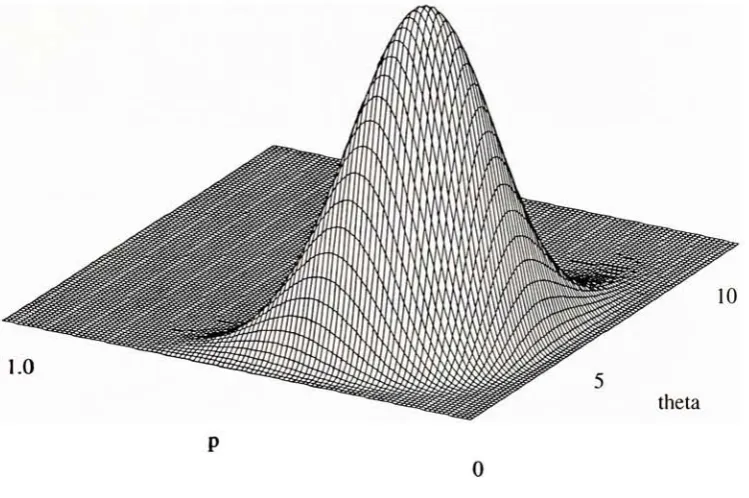
2-2 Likelihood function forobservation (1,5,1) fora uniform segment length density.
p=0.19, 0=5. Max prob. = 0.016 20
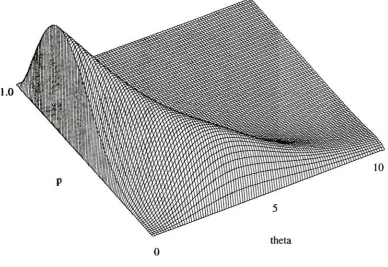
2-3 Likelihood function assuming the segment lengths arePoisson distributed, p =
0.69, 6=0.12. Max prob= 0.015 21
2-4 Likelihood function for observation (0,4,2,2,2,6,9,7,0) for a uniform segment
length density, p=0.21, 0=6 23
2-5 Likelihood function for observation (0,4,2, 2, 2, 6, 9, 7,0) assuming the segment
lengths arePoisson distributed, p=0.23, 9=2.4 24
2-6 Samplerealizations forp=0.3 and 9=
0.0,0.5,...,4.0 25
2-7 Samplerealizations for 6=2 and
p=0.1,...,0.9 25
2-8 E(l,m;fc) 33
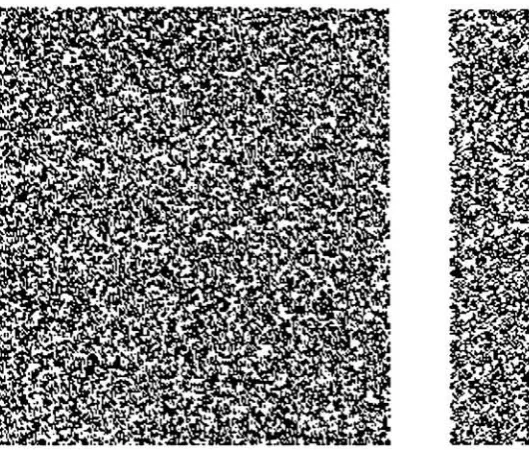
3-1 Realizations of model 1 (left) and model2 (right) 44
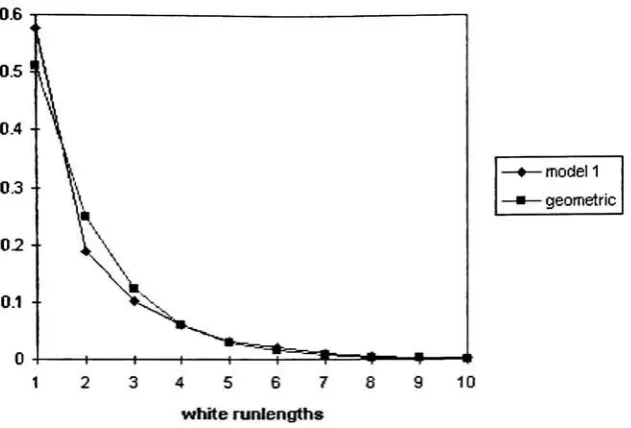
3-2 Whiterunlength and geometric densitiesfor model 1 45
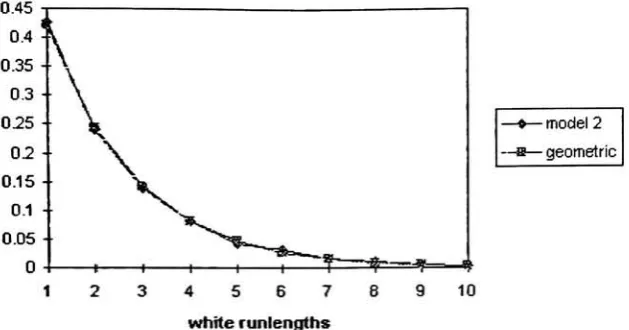
3-3 White runlengthand geometricdensities for model 2 46
3-4 Diagram ofestimation viainducement . 47
3-5 Events contributingto Booleanmodel onthe line 57
3-6 Realization of 2D Boolean model of rectangles with independent widths and
heightswith meanlengths3and6,respectively. Intensityis p=0.1 and
vacancy
is 16.5 60
3-7 A righttriangle induces a segmentlength 62
3-9 Horizontallyand verticallyconvex connectedcomponents found in toner micro
graph 65
3-10 Actual (left) versus simulated (right) toner image 68
4-1 Cross sample of ablack blob (left, right, up, down) =
(K^,K^,Ky,Ky) 72
4-2 Realizationof a random rectangleprocess 75
4-3 Estimated bias forp, themarking probabilityestimator 75
4-4 Estimated biasfor0, themean rectangle width estimator 76
4-5 Estimatedbias for/x, the meanrectangle height estimator 76 4-6 Estimatedcoefficient ofvariation forp,estimate ofthe marking probability. ... 77 4-7 Estimated coefficientof variation for9, themean width estimator. . '. 78 4-8 Estimated coefficientofvariationfor/x,themean height estimator 78
4-9 Resultsoffittinga random-rectangleBooleanmodelto thegravel image. See text. 80 4-10 Cross-windowedobservation withgray-levelinformation 83
4-11 Samplerandom-pyramidimageswithpincreasingclockwisefrom p= 0.04 inthe
upperleft-handcornerto0.08 88
5-1 Busy-time densitiesfor shifted-Poissonservice times with mean 6 93
5-2 Depletion-timedensities forshifted-Poisson servicetimes with mean6 95
5-3 Densitiesfor Nwhen theservice-timedensityisshifted Poisson with mean 6. . . 102 5-4 Densities for N given H() when the service-time densities are shifted Poisson
withmean 6 . 103
5-5 Nonstationarybusy-time probabilities 104
5-6 Occupation-time densities for shifted-Poissonservicetimes withmean 6 106 5-7 Busy-time densitieswhen service-timesdependon order ofarrival 109
5-8 Busy-time densitiesforbatch arrivals 110
5-9 Densitiesofthenumberofcustomersinthesystemwithbatcharrivals atapoint
in time giventhat thesystem is busy 113
6-1 Event W(l,2) 116
6-2 Event {2>4}(1,6) 118
List
ofTables
2.1 Statistics for0; 1000 trials; 9=2 19
2.2 Statistics forp; 1000trials; p=0.3 22
2.3 Statistics for 6 asp varies; 0=2 22
2.4 Statistics forp aspvaries; 0=2 22
2.5 Statistics for 0 as 0varies;p=0.3 22
2.6 Statistics forp as 0varies;p=0.3
. 22
2.7 Optimal filter for Example 15 40
2.8 Optimal filter forExample 16 41
3.1 Statistics ofMLE from 50 realizations of the rectangle process for a range of
markingprobabilities. 0=3,
p=6 61
3.2 StatisticsofMLEfrom50realizations ofunion ofrectangle andtriangle processes. 65
4.1 Estimatedbias 89
4.2 Estimated cv 89
5.1 Probabilities xlO3
of abusyperiod oflengthm and n arrivals 99 5.2 Conditionalprobabilities xlO3
of n customersserved given busy period lengthm.100
6.1 Sixoutcomescomprisingevent E[!
2](1,2) 118
Chapter
1
Introduction
Binaryimages can be modeled as sets where objects in a image are considered sets of pixels.
These models are attractive inthat they arise from first principles: random shapes placed at
random positions. The Boolean model plays an important role in the theory of random sets
because it represents the simplest general such process. The one-dimensional (ID) case has
applicationsinsignalprocessingandqueueingsystems [5], [51], [52]. Thetwo-dimensional (2D)
model is used in geostatistics and image processing, among other applications [3], [31], [39],
[40]. ThecontinuousBooleanmodelconsistsoftwoindependent processes,a shape process and
aPoisson point process. The outcomes ofthe shape process aretranslated to outcomes ofthe
point process. A typical realization consists ofmany overlappingshapes.
Ourconcerniswith theID and2D discrete cases and our results willultimatelybe applied
to processing images. Ourlanguage willreflect our application so that points are synonymous
withpixels,pointsina random set realization are called blackwhilepoints notintherealization
are called white. In the ID case, realizations will be alternating sequences ofblack and white
pixels, thelengthsofwhichare called black and white runlengths.
A discrete random set is a measurable mapping from an abstract probability space to
subsets of the digital plane. Put simply, a discrete random set is a collection of point sets
and theirprobabilities. It is convenient to model arandom set as two independent processes:
a shape process and a point process. The shape process is a particular type of random set
whoseoutcomes areboundedsubsets. Inimage processing, theshape process modelsobjectsof
ofthegrain process arecalled grains or primitives. The point processisused tomodel random
placement oftheshapes. Thepointprocess isalsocalled agerm process and the outcomes are called germs. ABernoulliprocessisapoint processinwhichthenumber of points marked in a
boundedsubset ofthedigitalplaneisarandomvariablehavingabinomial density. Therandom
variablescorrespondingtodisjointsubsets areindependent. Theprobabilitypof asingle point being markediscalled the marking probability or rate. The outcome ofa Bernoulli process is
a set of pointseach selectedwith probabilityp. A discrete Boolean model is a discrete grain
process alongwith aBernoulligerm process.
Leta grain processS haveoutcomes{si,S2,. .
}andlettheoutcomesofthegermprocessbe
{ii2,- --}- Oftenit isconvenienttoincludethenullevent0as apossible outcomeforadiscrete
grain sothat the class of grain realizations istaken to be {0,s\,S2,- - .}. With this convention,
we omit the germ process notation and view theBoolean model realization as arising from a
sequence oftrials, one at each point in the digital plane. The event 0 denotes the event that
no shape occurs, that is the point is unmarked, and has probability F(0) =
q = I p. This
allows us to denote the entire model as alist of shapes (including the null shape) and their probabilities.
We make adistinctionbetweenthe discreteBoolean model, whoseoutcomes arecollections
of sets and theobserved random set whichisthe union of outcomes oftheBoolean model. For
us, theoutcomeofthe Booleanmodelisthecollection {s\+i,2+2, } What is observed, however, is the set Uj(si + &)- The random set formed by taking the union ofthe outcomes
of the Boolean model is called the germ-grain model. This distinction is made because we will compute probabilities of observations viatheBooleanmodel. Since many events from the Boolean model can producethe sameobservation, we need language to discriminate between
thefundamentaland simplereventsoftheBooleanmodel and the observed process.
Estimation in the continuous theory is guided by formulas linking probability statements
aboutthegerm-grain process withprobabilitystatementsregardingthegerm and grain process
separately. Germ-grain realizations are what areobserved, someasurements ofthe germ-grain observations can be directly related to the germ and grain processes. Statements about the
grain process involve Minkowski functionals ofthe shapes, often in terms of mean area and
quite generaleven without introducing randomness. Most applications assume shapes regular enough sothat theserandom variables areeasilyparameterized.
Insteadofdrawinguponthecontinuoustheory,our approach is to attack the discrete case
directly. We first show that the ID Boolean model and thegerm-grain process are equivalent
formulationsofthesamerandom process. In particular, the distributionofthe Boolean model is completelydeterminedbythegerm-grain process. Theconsequence ofthis result isthat the IDBooleanmodelisobservable: theBooleanmodelisdeterminedbyits sampling distribution. Moreover,givenanydistribution forthesegment lengthsoftheBoolean model, it is a straigh-forward matter to write downthe governing distributions of the germ-grain process. This is in contrast to the continuous case where the relationship is in terms of an integral equation involvingthe Laplace transformofthe segment length distribution (Hall [23], page 102).
Therecursiveformulasand eventstructuresneededtoshowthisequivalence are generalized
to computethe optimalfilter or point estimatorfor one Boolean model unioned with another.
Specifically, given a windowedobservation ofthe union oftwo Boolean models (or germ-grain
models), what is the best estimate ofwhether a point is covered by one process but not the
other. Atypicalscenario iswhen one Boolean model represents signal and the other noise. If apixelis black inthe union,whatisthebestguessas towhether it is reallywhiteandcovered bynoise?
Theseresults are quitegeneral and go beyondimage processing applications. One dimen
sionalBoolean models also model queueing systems where a line represents discrete time and
a point is marked if a particle enters the system at that time. The segment length is the timeinterval (or service time) that the particle occupies the system. Multiple arrivals cause
overlapping occupancy times. A reasonable question is what is the service time distribution given the busy-time distribution? Or conversely, given the service time distribution, what is
thebusy-time distribution? Thesequestions are answered bythe result linking the germ-grain
model (busy times) and the Boolean model (for service times). If two types of particles can
enterthesystem, what isthebest estimatethat one type ofparticle is in the system and the otheris not, giventhatwe observetheoccupancyofthesystemforawhile? This is answeredby
the optimal filter. Densities ofseveral other random variables ofinterest are given in Chapter
Once the ID problem is solved, the solution is leveraged to estimate parameters of 2D
processes. A fullrecursivesolutionin the2Dsettingappearsbeyondreachdue tocombinatorial
explosion, but progress is made by looking at the ID processes produced by 2D processes intersecting with fines. Likelihood functions for 2D models are expressed via horizontal and
vertical runlengths, assumingindependence ofthe perpendicular processes. While practical in many instances, this methodcan be improved bycomputingthejoint distributions ofvertical andhorizontal blackand whiterunlengths, respectively. The joint distribution is computedby
analyzing how 2D grains intersecta "'cross.'"
Theoriginalformulation requiresthe segments toemanate froman endpoint, which serves
as the "center'1 of the grain. This restriction can be relaxed to provide a description of the germ-grain model given any Boolean model formulation where the centers of the grains are
within thegrain.
1.1 Background
Inthis section,wereviewthebasicpropertiesofBooleanmodelsandshowhowtheyare usedfor
estimation. The Booleanmodel is a random closed set which is composed of two independent
random processes: a germ process and a primarygrain. The germ process is a Poisson point
process while the primary grain is a random closed set. Often the primary grain is required tobe convex. Throughoutthis work wedeal exclusivelywithstationary processes. Let {&};<=/ be a realization ofthegerm process and let {5j}ie/ be realizations ofthe grain process. The
germ-grain model realization is S = Uie/(&+Si), the random set that isobserved. The most
important property ofBooleanmodels isdue to Matheron [35]: for anycompact set K,
P(SnK^) =
l-exp{-\E
||Sb
if||}
(l.i)where5b istheprimarygrain, K denotesthe reflection ofK about the origin, E is expectation
and A is the intensity ofthe Poisson process. The quantity on the left is called the capacity functional or hitting distribution. This fundamental equation relates thegerm-grain model to
thegerm and grain processes. Thecapacity functional completelydescribes
A fundamental quantity ofthe Boolean model is the volume fraction or mean fraction of
the area covered by 5, per unit area: p= P(0 S). Intuitively, this quantity describes how
densethe realizationsaie on average. The complement 1 p ofthe volume fraction is called
theporosity. A consistent estimator ofthe volume fraction is simply the ratio of covered area
to sampled area in arealization.
Sometimesit ispossibletomakeuseofhigherorder statisticsforestimation. Thecovariance
of pores is definedtobe
CP(z) =aw(0i S,zi S) =exp{-AE||(z+S0)USb||} - (1 ~
pf (1-2)
It turns out that forthecaseof aBooleanmodelwhere theprimarygrain is a diskof random
radius, the covariance of pores and the porosity completely determine the intensity of the
Poisson process and the radius distribution of the disks, and vice-versa. This relationship
follows from explicit formulas linking (Cp,p) and (A,F), where F is the radius distribution
(Hall [23], pp. 299-300). Onecouldconceivably estimate Cp andp from data and solve for A
andF. But, therelationship involvesanintegralequation andisthusnot suitedforestimation.
Aconsistent estimatorfor Cp is
1 Cp(z) =
\\l(ui,Vj both white) n .
=i
1 n
^2
{I(ui white) +I(vi white)} i=l(1.3)
for a sample of points"Ui,Vi, i =
1,. . .
,n and z =
Ui V{. Note that z is a vector and that a
realization should be sampled in many directions and distances. Consistency is with respect
to n > oo withthe samples rangingover an unbounded subset of the plane. This estimator
was used by Diggle [9] (see also Hall[23]) to fit a random disk model to ecological data not
resembling disks in any way. However, the method is of interest because it demonstrates a common estimation technique. The covariance function was estimated from a realization and
fitted in the least-squares sense, with a theoretical covariance function where the disk radius
had a three-parameter distribution. Thus minimization was carried out over four variables
(includingA). Whilethefittedmodelbearsnoresemblanceto theoriginaldata,suchatechnique
might be usefulfor discrimination among Booleanprocesses.
in Dupac [18]. Inthis method, thediskradii are assumedto benormally distributed: N(p,a2)
with 3a > p, sothat theprobabilityof a negativeradius issmall. Using Eq. 1.1,
l-p=exp{-A(/>2
+<72)}. (1-4)
The method proceeds by sampling circular clumps, i.e. those connected components in a
realization which aredisks. Circular clumps could have been formed by isolated disks, disks
fallingcompletely insideotherdisksordiskscoveringotherdisks butnothittinganyother. The
radiiofcircularclumps areobservable, buttheradii oftheconstituentdiskscannotbeobserved. By computing the probabilitythat a circularclump occurs given that adisk ofa given radius
occurs, one can use Bayes' theorem to compute the radius density of circular clumps. This density is approximately normal whose mean and variance are functions ofp and a and can
be estimatedfrom a realization. Then A, p and a1
can besolved for in termsofthe estimated mean,estimatedvariance, and estimated porosity. The resulting threeequationsarenonlinear.
Thismethoddemonstratesa method of moments approach. Namely,iftheoreticalvaluesfor
parametersof an observable process are relatedfunctionallyto theparameters oftheunderlying
Boolean model, one can replace the theoretical parameter values of the observed process by
estimates and solveforthe parameters inthe underlying process. One must be careful in this approach to not have an underdetermined systemof equations. The system of equations are, as inthis case, often nonlinear. Also, the statisticalproperties ofsuch estimates are unknown
ingeneral and often must be determined viacomputer simulations. On the other hand, these
estimatorsare often theonly ones availablefor random sets.
Ayala et al. [1] went beyond Dupac and sought to investigate the statistical properties
ofthis method. They made several modifications, however. First, there is no advantage to
assumingnormaldistributed diskradiisincethedensityof circularclumpradii canbecomputed numerically whatever the disk radius distribution. Ayala et al. chose to model the radius
distribution as uniform on [0,p]. This has the advantages of being nonnegative and having
intensity A and radiusparameterpcould be formed:
(A,p) =
argmaxTT/(r;;\p).
x,P XA
1.1.1 First contact distribution
Thefirstcontactdistributionis animportanttoolfortheanalysis of a random set and Boolean
modelsin particular. It isdefined to betheprobabilitythat, giventhat a point is not covered bytherandom set,ahomotheticofsomestructuringelement Bintersects the random set: for
r >0,
HB(r) = l-P(SnrB^$)/(l-p). (1.5)
Thechoice ofBgivesdifferent probesintotherandom set and elicitsdifferentproperties. This
issimilar inspirit togranulometries. Fora2D Boolean model withconvex primary grain and
convex set B,
Hs(r) = 1
-exp
^E
(2,]rkE[Wk(So)}W2.k(B)
(1.6)whereu>2 =ttisthevolumeofatwo-dimensionalunitsphere,andWkareMinkowskifunctionals:
W0(K)= \\K\\
, the area ofK
Wi(K)
-\\dK\\/2, one-halftheperimeter ofK (1.7)
W2(*0=ca
usingthese definitions, equation 1.6 can besimplified to
HB(r) =1
-exp
j-A
]^E
\\dS0\\ \\dB\\ +r2||fl||]
}
. (1.8)The structuringelementistypicallyaline or aball.
Ayala et at [2] use thederivative ofEq. 1.8 to form a maximum likelihood estimate of a
Boolean model. The first contact distribution is observable from the germ-grain model. For
a realization, a (widely scattered) sample of points are taken and of those not covered, the distance to the closest covered point is measured (assuming B is a ball). The approximate
et aL do this for therandom disk model and provide simulation results for the coefficient of
variation ofthe estimator forvarious values ofPoissonintensity and mean radius.
1.1.2 Steiner formula
Oneofthemostuseful expressionsrelatingtheBooleanmodelandthe germ-grain modelis the
generalized Steiner formula [53]. It generalizes the expression Eq. 1.1. For So convex and K
compact and convex,
XE\s0k = Y^{2}\E[W2(SQ))W2-k(K) (1.9)
where the Minkowski functionals in thesummand are defined in Eq. 1.7. Note the similarity
with Eq. 1.6. The quantityon the left is tp(K) = ln(P(KC S)) and can beestimated from
realizations:
(sek) nw
*>
|snH,, (1.W)
for convex, compact structuringelementsKand observation windowW. In the case of regular
geometricfigures, theprimarygrain canbeparameterized andthe Minkowski functionals (and
theirexpectedvalues) obtained. TheRHS ofEq. 1.6 isthen expressedin terms ofdistribution
parameters andMinkowskifunctionals ofthestructuringelement K. By suitablechoices of K
and scalings olK (linesanddisks,typically),one can obtain randomfunctionsonthe left tobe
fittedwith parameterizedfunctionsontheright. Theparametersprovidingthe best fit serve as
estimatesoftheBooleanprocess parameters. CressieandLaslett [8] use a least-squares fitting
approach along with scalings of disks to estimate a Boolean model with randomly oriented
quadrangle primary grain. Such techniques depend on the grain having tractable Minkowski
functionals and expectations. As inthe other cases, the statistical properties of the estimates
are determined throughcomputer simulations.
1.2 Organization
This thesis is organized as follows. Chapter2 contains results specific to the basic ID model,
process. The firstpartreviewsthefundamentalevents pertaining to theBooleanmodel onthe line. Amoredetailedexpositionisfound inDoughertyandHandley [12],which establishes the foundation uponwhichthisentire thesisrests. Nextwe lookat how these fundamental events
are usedtodomaximum-likelihoodestimationforthemarkingprobabilityand parameters ofthe segment length distribution. The likelihood function can reformulated in terms ofrunlengths instead ofBoolean model events. It is first shown that the distributions of black and white
runlengths can beexpressed intermsofthesegment lengthdistribution ofthe Boolean model
andvice versa. Thesequence ofblackandwhite runlengths are showntobeindependentrandom
variables. Thesetworesults establishexplicitlytheequivalencebetween ID germ-grainmodels andtheirBooleanmodels. Fromrunlengthdistributions,wecan expressthelikelihoodfunction of a Boolean model observation as a function of the segment length distribution parameters,
average whiterunlength andhistogramoftheblackrunlengths inthesample. Anoptimal filter forthe union oftwoBoolean models (one signal, one noise) given a windowed observation of
theunion processisexpressed astheconditional expectation ofthe signal at a point given the lengthand position oftheblackunion runlength withinthewindow. Suchafilter iswell-known
tobeoptimal intheminimum mean-absolute-error sense. To derivesuch aresult requiresthat
the fundamental events be generalized to account for all the events where the noise covers a
point but thesignaldoesnot.
Chapter 3 coverstheproblem ofinducementofID models onlines intersecting2D models.
Estimation using linearsamplesisexploredforseveralsynthetic modelsas well as anapplication
involving tonerparticles.
In Chapter4,weextendthenotion oflinearsamplestomulti-dimensionalorcross-windowed
samples. These statistics provide better estimators than the linear samples as our examples show. We also apply the sampling procedure to the Boolean random function model and we
supplysimulationstoexploreitsperformance.
Chapter 5 returnsto the ID Boolean model and applies recursive event decomposition to
analyzingthediscrete infinite-server queue. Manydensities ofinterest in queueing theory are givenas recursive expressions. Numericalexamples followeach derivation.
Finally, in Chapter 6 we generalizemany ofthe results of Chapter 2 and [12] to the case
Chapter
2
Analysis
ofthe
ID
Boolean
modelInonedimension, shapes arelinesegmentshavingrandom lengths. Forthepurposes of model ing, one must choosetheposition ofthe ''center"
of a segment length. Here, we choose the left end-point so that thesegments are said to emanate to theright on the line. Thegrain process S has integer-interval outcomes [0,k 1] of length k, where k is a random variable taking
positive values. Ifp denotes themarking probability andC(k), k =
1,2,. . . thesegment length distribution, then theprobabilityof alinesegment oflength lessthan or equalto k emanating
from a point is q +pC(k), q = 1 p. This probability captures both the probability that a
segment doesnot appearandtheprobabilitythat if it does appear, its lengthis no longerthan
k. Alternatively, in the ID case, the Boolean model is fully described by a sequence ofi.i.d.
random variables representing segmentlengthswith distribution
F(k)=
q +pC(k), k=0, 1,. . . (2.1)
(whereC(0)= 0). Ateachpointiontheline,Xi =0 ifthepoint is notmarked. If
A", =k > 0,
then thelinesegment [0,A; 1] isplaced theresothat theoutcome is [i,k+ i l\. Thisway, the
marking probability p= 1 F(0) isfoldedintothesegment length distribution
providing more
elegant expressions. Points onthe linewill beeither covered or left uncovered by the process. Anobservation consists ofalternatingsequences of covered and not-covered points.
A Booleanmodelis arandom setconsistingoftwoindependent processes: a point process
processwhere points on the discrete fineare marked with probabilityp. The shape process is
a linesegment of randomlengthstartingat theorigin.
The pointprocess isalso calledthegermprocess and outcome are called germs. Theshape
process iscalledthe grainprocess whose outcomes are called grains. AnoutcomeofaBoolean
model is a collection of sets. If {;i E 1} are thepoints marked by the Bernoulli process and
{[0,Xj l];i G /} are the random-length line segments, then the outcome is the collection of
intervals {[fi,Xj+& l];i G /}. Corresponding to the Boolean model is a germ-grain model (germs aremarked points andgrainsare sets). Thegerm-grainmodel is formed by takingthe
union ofthesets output fromthe Booleanmodel: Uig/[j,:rj +& 1]. Thusthe outcome ofa
Boolean model is acollection of setswhile theoutcome ofits germ-grainmodel is a set. The
indicator functionofthegerm-grain modelis abinaryrandom process that is observed. Since a segment at the origin is completely determined by its length, the shape process
can beidentifiedwith a random variabletakingpositive values. Moreover, whether a segment
appears atapointor notisgovernedbyabinaryrandom variable. Thesegment lengthrandom variableandthegermrandom variablescanbecombinedforma single sequenceofi.i.d. random variablestodescribethe entire process: a onedimensional discrete Booleanmodel is identified
with asequence ofindependentidentically distributeddiscreterandom variables A", > 0 where theevent (Xi =0) means that the point i is not marked andthe event (Xi =
k) where k > 0
meansthat theset [i,i+k 1] isa member oftheoutcomeoftheBooleanmodel, i.e., the point
i is marked andthe linesegment [0,A: 1] is movedto i. Let F denote the distribution ofXi
sothat the entire Booleanmodelisspecified by F. In particular, the marking probability is p
= 1-F(0).
Theoutcome (Xi =k) issaidtocoverapointjifk >0 andi <j < k. Apoint i iscovered
ifsome outcome among {(Xj =
hf) :j <i} covers i. It isoften convenient to speak of point i
covering point j bywhich wemeanthe outcome of arandom variable at i covering j. Figure
2-1 depictspoint 1 coveringitself, and points 4and 5covering 7.
ABoolean modelwillbe denotedbyXandits corresponding binaryrandom processbyYx
ifwe need tospecifywhichBoolean model or simplybyY if its correspondingBoolean model
is clear from the context. The event (Y(i) =
xi x.A x
Figure 2-1: Example covering.
binaryrandom variableY(i)isafunctionof{.. .
,Xi-i,X{} andcertainlytheY(i)'s are highly
dependent as asingle segment length can cover many points. In Fig. 2-1 the segment length
random variable outcomes are {X\ = 1, X2 = 0, A3 = 0, X4 = 5, X5 =
4, Xq = 0, X7 = 0,
Xg =
0) while the corresponding binary random process outcome is (1,0,0,1,1,1,1,1). The
lengthof a contiguoussequence ofpoints wherethebinaryrandom process is 0is called a white
runlength while thelength a contiguoussequence of l's iscalled a black runlength.
We will show that for the one-dimensional discrete case, the Boolean model and Y are
equivalentinthesensethatF completely determines Y andfromthejointdensity ofYwe can
computeF. Moreover, the density ofY is expressible interms of the densities ofthe lengths
of contiguous sequences of covered and uncovered points (black and white runlengths, respec
tively). This allows us to do what we call runlength analysis ofBoolean models. Indeed, Y
isan alternatingsequence {.. .
,u)j,(3j,Vj+ii0j+i,. .
.} ofdiscretepositive independent random
variableswhereUjcorrespondstowhiterunlengths and(3j toblackrunlengths. Expressingthe joint density of a windowed observation ofY in terms ofF is the major result ofDougherty
[12] but nowwegofurther anddescribetheentire process in terms of F. Theconverse means
thateven though thesegments ofX overlap and obscureeach other causing many events ofX
to yieldthe same event ofY, the length distribution F is fully determined by the runlength
densitiesofY.
Firstwe will review severalfundamentalevents ofXandtheir probabilities. We thenshow
how these are related to the indicator function Y and establish that X and Y are equivalent.
runlengths.
2.1 Fundamental events
Consider an interval of points 1 torn. Events will be discussed for this particular interval
simplytomakenotation convenient. OwingtostationarityoftheBoolean model (the random
variablesXi arei.i.d.),probabilities oftheseeventsdependonthelengthoftheintervalbutnot
on the position. Events will be denoted by reference to particular points. In [12], the events
were denoted by thelength ofthe interval onwhich they occurred rather than the particular
interval. We need to adopt a more explicit notation here in order to compute the optimal
filter. Ifthe event notation here were altered to reflect only the interval length, all notation
wouldreduce to thatfoundin [12]. Oftentheevents will appear inrecursive expressions,so we
establish the followingconventions. Let A(i,j) denote some unspecified event on the interval
[i,j]. If i =j, denotetheevent
by A(i) andifj <i,denotetheevent byA(0). Note thatA(0)
maynot represent anyactualevent, butoften serves as a placeholder to start a recursion.
LetE'(l,m) betheeventthatpoint miswhite, i.e.,none ofX\,. . .
,Xm coverm. (E (i) is
theeventthat idoesnot coveritself, namely (Xi=
0) andfor technical reasonstobe apparent
later wedefine E (0)astheentire event space). Thiseventis easilyseentobe decomposed into
independent events:
E'(l,m) = (Ii<m-l)nE'(2,m).
(2.2)
Byinduction andindependence,
m
P(E'(l,m)) =HF(i-l).
(2.3)
i=l
Let E(l,m) be the event that segments emanating from points in the interval cover the
interval and no segment extends beyond. That is, (X\,...,Xm) is exactly self-covering. Note
that, since the segment length random variables are independent at each point, E(l,m) does
occur arelisted below:
X\ X2 A3
1 1 2 2 1 2 2 0 1 2 2 0 0 1 1 1 2 2 2 2 3 3 3 3 3 3
Thefollowingproposition showshow an E-even
(2.4)
can berecursively decomposedinto inde
pendent, disjointeventsenabling its probabilityto becomputed.
Proposition 1 E(l,m) has decomposition
m k
E(l,m) =
1J U
KX- =fc)nE'(2,i)nE(j +l,m)] k=lj=l
(2.5)
where the union is disjoint and has probability
i-i
F(E(l,m)) =
(F(m)
-F(j-1))
J]
^-l)P(E(j + l,m)) (2.6)
t=i
urtereP(E(0)) = 1
andP(E(i)) =
F(l) - F(0).
Proof. This proofis substantially different from the one in [12] and is more consistent with
the event structure used in this work. In this proof we make explicit how to decompose any
Let u) G RHS ofEq. 2.5. Then X\ = k for some 1 < k < m, i.e. X\ covers [1,/c] and [k+1,m] iscovered by E(j+1,m),j < /-. Therefore, a;GE(l,m).
Conversely,let u;GE(l,m). ThenX\ =kforsome 1 < k< m since 1 must cover itselfbut
cannot extendbeyond to bydefinition. Let
j=max{1,max{Z : [2,
1] doesnot coverI and I < m}} (2.7)
Itmust be thatj <fcelsejisuncovered in [1,m] and u E(l,m). We distinguish two cases. First,if j =1,thenno pointintheinterval beyond 1 isuncovered. Thatis,u> E E(2,m). Inthis
case u) GE'(2,1) =
E'(0) =
theentireeventspace. Therefore,u E (Xx =
k) flE'(0)nE(2,m),
as required. Ifj > 1, then j is not covered by any points in [2, j] so that to E (2,j) by definition. Nowa*
GEfj
4-1,m) forifthereissomepoint I not covered by [j+1,/] thenone of
twocontradictions willbereached. IfI< k,thenI is not coveredby [2, /] sincej is not covered
by [2,j]. But thisimplies thatj was notthe largest index in Eq. 2.7. If / > fc, then I is not
coveredbyT norby [2TZ], henceit isnotcoveredat all intheinterval. Therefore,
uE(X1 = k)nE'(2,
j)nE(j+1,m) (2.8)
forsomej in [1,fc]. Aswasshown, itmust bethatj <k < m. Whenj= k=mthe firstpoint
covers theentireinterval but [2, j] doesnot cover m. Inthis case,
u> g(X1 =
to)nE(2,m)nE(m +1,m) = (Xi =
m)DE'(2,m) nE(0). (2.9)
which motivatesthedefinitionofE(0) asthe entire event space and P(E(0)) =1. As for disjointedness,consider
S = (Xi = fc)nE,(2,j)n
Efj"
+l,m)n(Xx = k')nE'(2,/) nE(f+1,m).
(2.10)
It must be that k = if, elseE = 0. Without loss ofgenerality, let j < j' and suppose there
Theevents(Xi = fc),E'(2,.7'), and
E(j+l,m) are allindependentsincetheyare outcomes of
disjointcollections ofindependent random variables {X\}, {X2,. ,Xj}, and {Xj+\,... ,Xm},
respectively (except inthe case wheretheE'-eventorE-event is the entire spacein which case
the disjoint collectionsare {Xi} and {X2,.. .
,Xm}, respectively).
The probabilityexpression inEq. 2.6 follows bydisjointedness, independence andEq. 2.3:
F(E(1,m)) =
EfcLi E?=i P[(Xi =
fc)nE'(2,j)nE(j+1,m)], by disjointedness =
EtLi E*=iP&i =k)P(E'(2,j))P(E(j+l,m)), byindependence
= E
1E2L;^P(Xi =k)P(E'(2,j))P(E(j+l,m)), by reordering =
Y?=ilF(rn)
-F(j
-1)]Y\>r\Hi ~
l)P(E(j+Lm)), using Eq. 2.3.
How is a point i not covered? First, it cannot cover itself: Xi = 0. Second,
any segment
emanatingfrompointsto theleftmustbetooshorttocoverit. Ifwedenote by W(z) theevent
that a point i isnot covered, it is theevent
TV
W(z)= lim C](Xi^<j) N>oo ! '
j=0
and has probability
N N
F(W(t))=
P(W(0))= lim
I]
P(X-j <j) = limJ]
F(j). (2.11)In [12] it is shownthat the limit exists for probabilitydistributions with finite means defined
onnonnegative integers.
Related to E(l,m) are the events D(l,m) and G(l,m). The event D(l,m) is the event
thatthem points cover themselvesbut thesegmentlengths emanatingfromwithinmayextend
beyondthelastpoint. Forexample,a sample member ofD(l,2,3)is (Xi =5)n(A"2 =
3)n(A~3 =
0). Note that D(l,m) depends only on outcomes ofthe random variables X\,...,Xm. It is
shown in [12] that D(l,m) has probability
m j1
P(D(1,m))= 1
-F(m)+
YsiFim)
~F(j
-1))
J]
F(i-l)P(D(j +1,m)) (2.12)
where P(D(0)) = 1 and P(D(i)) = 1
-F(0) since D(i) = (Xi > 0). Equation 2.12 has a
simpler form asseemby thefollowingmanipulation. Let dk = P(D(1 +i,k + i)).
dm =1
-F(m)+TT=i(F(m) -F(j
-1))UUF(i
-l)dm_j
= 1~
F(m)+F(m) xUtlF(i- l)^-
-=1F(j
-1)Flti F(i
-l)dm^
Now,
E=inti F(i
-Vdm-j =
E^iP(E'(2, j))P(D(j+1,to)), by definition
=
P{U2E'(2,i)nD(i +l,m)
UD(2,m)}
=P(allevents on [2, m])
=1
sinceanyevent on [2,to] iseitherin D(2,to) orcanbe decomposed into E'
(2,j)C\D(j+l,m)
for some j = 2,.--,to, wherej is the right-most point not covered (if any). Equation 2.12
takes theform
m j 1
PCD(l,TO)) =l-^F(j-l))I]^-l)^(D(j +
l,m)) (2.13)
J=l i=l
The importofthisrepresentationisthatP(D(1,m)) dependson F(0),. . .
,F(m 1) and F(0),
. . .
,F(m 1) canbecomputedfromd\,. . . ,dm.
G(l,to) istheevent that the to pointsintheinterval [1,m] are covered bysegments ema
natingfrompoints within andtotheleftofthempoints, butnotextendingbeyondtheinterval.
Thatis, G(l,m) Cf\<m(Xi < m i +1) andeverypoint in [1,m] is coveredbysome random
variableinthecoimtably infinitecollection {.. -,X_i,A"o,X\,...
,Xm}. Provided that F isnot
"heavy-tailed"
(see [12] for definition anddiscussion) the event G(l,m) has probability
P(G(l,m+1)) =P(G(2,to +
1))- P(W(l))P(E(2,m
+ 1)) (2.14)
wherethe recursionis initiated by P(G(0)) = P(W(z))/F(0).
Let H(1,to) denote the event that [l,m] is covered, whether by internally or externally
segmentsextendfrompointstotheleftoftheintervaltocover pointsto theright oftheinterval. For example, (A"o =to+
1) C H(l,m). It isshownin [12] that
P(H(1,m+ l)) =
P(H(1,to))
-P(D(1,m))P(W(0)) (2.15)
whereP(H(1)) = 1-P(W(0)). TheeventH(l,m) iscalled totalcoverage ofthe interval [l,m] [52].
2.2 Maximum-likelihood estimation
Wefirstconsidertheestimationproblem whenthesegmentlength distribution isparameretized. Given windowed observations C =
c, we would like to estimate the underlying parameters of theBooleanprocess. Inparticular,we wouldliketoestimate theintensitypandthe parameter 0ofthe segmentdensity (0 maybeavector) byfindingthevaluesthat maximizethelikelihood
function; inourcase, it isthedensity P(C) fromTheorem 1of[12] evaluated attheobservation c (see Theorem 40 in the Appendix). In keeping with the usual notation for the likelihood
function, we will henceforth denote the window density as P(C;p,9) to emphasize that the density is a function of several variables when the parameters are unknown. The maximum likelihoodestimator is
(p,9) =
argmaxP(c;p,0) (2.16)
Thegeneralproperties ofthemaximum-likelihoodestimator(mle) areunknowninthiscasedue
to thecomplexityand recursive natureofP(C). Weareparticularlyinterested in unbiasedness and thevariance oftheestimator. The properties cannot bedetermined analyticallyand must beelicitedthroughsimulations and numerical evaluations. Givenanobservationand parameter
values, the likelihood function is evaluated by simply implementing the recursive formulas in Theorem 40in theAppendix.
For demonstration purposes, we use two models for the segment lengths. The first model
i windowsize 8 16 32 64 128
mean
variance
coefficient of variation
6.60 57.60 1.15 3.31 22.3 1.46 2.21 3.48 0.84 2.08 0.89 0.45 2.00 0.30 0.27
Table2.1: Statistics for 0; 1000 trials; 0=2
Poissondensity; that is,
P(H=h)=e-9h-1/(h
-1)!, h=l,... (2.17)
The mean length in this case is 0
-1-1. This case will be referred to as simply the Poisson
model, keeping in mind that the expected segment length is one more than the parameter
value. Figures 2-2 and 2-3 show likelihood functions for the uniform and Poisson models of
the observation (1,5,1), respectively. Both show the trade-off between p and 9 in trying to "explain"
asingle black run-length. Theoutcome could be the result of a sequence ofhighly
probable short segments orthe resultofrarer but longersegments.
A more realistic example is given in Figures 2-4 and 2-5. Here, with a window size of 32
observing (0,4,2,2,2,6,9,7,0) from thePoisson model with 0 = 2 and
p =
0.3, the likelihood functions show more definitive peaks. In both cases, maximum-likelihood estimation yields
similarestimatesfrom a single observation, E(H) =3.5 andp= 0.21 inthe uniform case and
E(H) =3.4and
p=0.23 in thePoissoncase.
How does the window size affect the estimation? From a practical statistical point of
view, thewindowmust be large enough tocapture several black to white and white to black
transitions: all white (Z/m,oo) or allblack(Hm) observations carrylittle information. Indeed, it
canbe easilyseenfromtheexpressionfor(Lm,oo)intheAppendixand2.15thatp=0maximizes
P(Lm,oo) to 1 and p = 1 maximizes
P(Hm)to 1, regardless ofthe length distribution, {Ck}.
Estimationresultsforvarious window sizes areshown inTables 2.1 and 2.2 for a process with
segmentlengthsusingthePoissonmodel. Asthewindowsizeincreases, thevariancesdecrease
and the averages approachthe truevalue. In Table 2.1 the coefficient of variation for 9 with
a window size of8issmaller than thevariance for awindow size of16. This is because when
thewindow size is small, thereis agreater likelihood ofobserving allblack or all white pixels
Figure 2-2: Likelihood function for observation (1,5,1) for a uniform segment length density.
p=0.19, 0 =5. Max prob. = 0.016
or 1, respectively, and thevalue of0is irrelevant.
Togainfurther insight intothebehavioroftheMLE,we lookatthestatistics ofan example
wheretheparameters 0andpvary. Intuitively, iftheprocess resultsin outcomesthat are "too
white" or "too
black,"
one expects the estimates to be biased or have high variance because
there will be fewer black and white runs observed. The outcomes were generated according
to aPoisson model with 0 = 2. A window size of32 was used again to observe the process.
Figures2-6and2-7showsamplerealizationsastheparametersvary. In Fig. 2-6,theparameter
0varies from 0 to4.0 whilepremains fixed at0.3andinFig. 2-7, theparameterp varies from
Figure 2-3: LikelihoodfunctionassumingthesegmentlengthsarePoissondistributed, p= 0.69, 0= 0.12. Maxprob=0.015.
For values ofp= 0.1 through
p=
0.9,MLE 9andp where obtained from 100 observations
ofthePoissonmodelusing a windowsize of32. Theresults are summarized in Tables 2.3and
2.4. Alternatively,whenpremainsfixed at 0.3and thevalue of0 varies, the statistics ofthe
estimates are summarized in Tables2.5 and2.6.
Inall casesit isclearthatiftheobservations areeithertoowhite ortooblack dueeitherto
a small windoworextremeparametervalues intheprocess, the maximum-likelihood estimates will have highvariancesor bias.
The previous analysis required that the segment length distribution be parameterized in
window size 8 16 32 64 128
mean
variance
coefficientofvariation 0.45 0.08 0.61 0.37 0.06 0.63 0.33 0.02 0.46 0.31 0.01 0.33 0.31 0.004 0.21
Table 2.2: Statistics forp; 1000 trials;p=0.3
p 0.1 0.2 0.3 0.4 0.5 0.6 0.7 0.8 0.9
mean
variance
coefficient of variation
3.10 13.92 1.20 2.10 1.54 0.59 2.08 1.62 0.61 2.16 5.44 1.08 3.60 28.56 1.48 4.53 40.18 1.40 7.48 56.88 1.01 10.89 53.46 0.67 12.82 39.49 0.50
Table 2.3: Statistics for 0 asp varies; 0= 2.
p 0.1 0.2 0.3 0.4 0.5 0.6 0.7 0.8 0.9
mean
variance
coeffient of variation
0.11 0.01 0.73 0.22 0.01 0.50 0.31 0.02 0.45 0.46 0.046 0.47 0.59 0.06 0.41 0.67 0.05 0.35 0.73 0.03 0.24 0.79 0.02 0.17 0.79 0.01 0.13
Table 2.4: Statistics forpaspvaries; 9=2.
9 0.0 0.5 1.0 1.5 2.0 2.5 3.0 3.5 4.0
mean
variance
coefficient of variation
0.10 0.03 1.70 0.52 0.13 0.71 1.05 0.67 0.78 1.69 2.17 0.87 2.24 5.61 1.06 2.83 4.15 0.72 3.10 7.92 0.91 3.33 10.50 0.97 4.51 21.64 1.03
Table 2.5: Statistics for 0as 0varies; p=0.3.
0 0.0 0.5 1.0 1.5 2.0 2.5 3.0 3.5 4.0
mean
variance
coefficient of variation
0.29 0.01 0.26 0.31 0.01 0.31 0.31 0.01 0.39 0.32 0.02 0.44 0.32 0.02 0.42 0.34 0.04 0.56 0.35 0.04 0.54 0.41 0.04 0.51 0.45 0.06 0.54
Figure 2-4: Likelihood function for observation (0,4,2,2,2,6,9,7,0) for a uniform segment length density, p=0.21, 0 =6
sincethere is a one-to-one correspondence between thesegment length distribution ofthe ID Booleanmodel and therunlength distributionsofits germ-grain model.
2.3 Runlength analysis
To describe theevent of a blackrun havinglength m, we must condition the black runlength
event on the event that a runlength actually occurs. For (Xq,. . .
,Xm+1) to produce a black
runlength of length to, it must commence with a W(0) event followed by an E(l,m) event
and tenninated by a (ATm+i =
Figure 2-5: Likelihood function for observation (0,4,2,2,2,6,9,7,0) assuming the segment
lengths arePoisson distributed, p=0.23, 0= 2.4.
dependson all eventsto theleft (providedthesegmentlength distribution has infinitesupport),
but the length ofthe blackrunlength,onceit occurs, is independent ofall events to the left of
the runlength. A black runlength starting at 1 is precipitated by a white to black transition,
i.e. a point not covered point followed by a covered point, which is the intersection of two
independent events: W(0)DD(l). These twoevents are independent because W(0) depends
on {Xj}j<o andD(l) dependsonlyon {Xi}, twoindependent collectionsofrandom variables.
Theprobabilityofsuch aneventis P(W(0))P(D(1)).Theeventofmblackpoints precededby
awhite point andfollowedbyawhitepointisW(0)nE(l,m)nW(m + l). However, thelatter
twoevents are not independentas E(l,m) depends on {A"i,. . .
Figure 2-6: Samplerealizationsforp=0.3 and9=0.0, 0.5, ...,4.0.
Figure 2-7: Samplerealizations for 0=2 and
p=
0.1,...,0.9.
on {Xi}i<m+i which contains {Xi,...,Xm}. The probability of the event can be computed
conditionally:
P(W(0)nE(l,m)nW(m +l)) =P(W(0))P(W(TO +l)|W(0)nE(l,m))P(E(l,m)).
(2.18)
The middle quantity is theprobability that awhite point follows an E(l,m)-event. Since no
segmentlengthextendsbeyond to,thismustbetheprobabilityof nosegmentlength appearing
at m+1, namely P(0). We can now write down the probability that a runlength has length
factthat E(l,m) CD(l),wehave for m= 1, 2,. . .
,
P(K=
to) =P(W(0) nE(l,m)nW(m +
1)| W(0)DD(1))
=P(w(0)nE(i,
m)nw(m+1)nd(i))/p(w(o)nd(i))
=P(W(0))P(E(l,m))P(W(m+l)|E(l,m))/[P(W(0))(l
-F(0))]
=P(E(l,m))F(0)/(l-F(0))
Notethat P(K=
to) is just P(E(l,m)) scaled byF(0)/(1
-F(0)) and soEq. (2.6) holds for P(K=
to) with therecursioninitiatedbyP(K=
0) =F(0)/(1- F(0)).
Theeventthata white runlengthhas lengthmistheeventthata sequence of m white points isprecededbyablackpointandsucceededbyablackpointgiventhata black-to-whitetransition
has occurred. On the interval [0,m+1] the conditioningeventis G(0) DW(l). These events
are not independent as G(0) depends on the random variables {Xi}i<o and W(l) depends the collection {X,-},<i. However, the probability can be computed conditionally: P(G(0) fl
W(l)) = P(G(0))P(W(1)|G(0)). The latter probability is the probability, given the point
0 is covered and no segment extends beyond 0, that 1 is white. Since 0 is covered, the only
way for 1 not to be covered is for no segment to emanate from 1 and this has probability F(0). The event that the points [l,m] are white preceded and followed by black points is G(0) flW(l) n. .. nW(m)nD(m + 1). The last event is independent from the others but therest all depend on {Xi}i<o. Once again we computetheprobabilities using a conditioning argument. Theoccurrenceof a white point at icauses all coverageevents at i + 1 andbeyond to be independent ofevents at i and beforesince if is white, no segment at i or before can
reachi + 1 orbeyond. Now,
P(W(i +i)|W(i)n.. . nw(*)) =P(w( +i)|W()) (2.20)
istheprobabilitythat apoint iswhitegiven that the pointbefore it is white, which is simply
ofwhite runs. Forto=1,2,...
,
p(v=
m) =P(G(0)n
n^i w(i)nD(m+ i)|G(0)nw(i)) =
P(G(0)P(W(1)|G(0))
xIIS1-P(W(i+ l)|W(i))P(D(m + 1))/ [P(G(0))P(W(1)|G(0))] (2.21)
=P(G(0))F(0)m(l
-F(0))/P(G(0))F(0)
= (l-F(0))F(0)m-1.
ThusV hasageometricdensity with 1 F(0) asprobabilityof "success."
Thelengthsofadjacentblackand white runlengths areindependent. First consider ablack
runlength oflength to followed by a white runlength oflength n. As before, an initial black
runlengthstartingat 1 isinitiatedbyawhitetoblacktransition: W(0)PlD(l). Ontheinterval [0,1,. . .
,m4-n
4-1],theeventofaninitialwhite point,followed bymblack points, followedby n whitepointsterminatingwithablackpointisW(0)DE(1,to)nf]"=m+iW(t)nD(m+n + l). Thelasteventintheintersection is independentoftheothersbut therest aredependent. Using
a conditioningargument asbefore,
P(K=myV=
n) =P(W(o)nE(i,TO)nnr=r+iw(OnD(TO+n+ i)|W(o)nD(i))
=
P(C&iW(i)|W(0)nE(l,m))P(W(0)nE(l,m)) xP(D(m+n+1))/[P(W(0))P(D(1))]
= p(E(i,m))p(n-r+i1
w(* + !)lw( + 1)nW(0)nE(l,to)) xP(W(m+1)|W(0)nE(l,to))
=P(E(1,to))P(W(to+
1)|W(0) nE(l,m))
xnss+i'pcwci+ijiww)
=P(E(l,m))F(0)m
=P(E(1,
to)) [F(0)/(1
-F(0))]F(0)"l"1(l
-F(0))
=P(K=m)P(V= n).
(2.22)
Nowconsiderawhiterunlength oflengthtofollowedby ablack runlength oflengthn. On the
interval [0,to-f-n
blackrunlengthends with a whitepoint.
P(V=m,K= n) =
P(G(0)nfliW()nE(m + 1,m+ n)nW(ro +n+ 1)|G(0)DW(l))
=
P(G(0))P(W(1)|G(0)) UZYP(W(t + l)|W(i))P(E(m + 1,m+ n)|W(m))
xP(W(m+n+ l)|E(m +1,m+ n))/[P(G(0))P(W(1)|G(0))]
= F(0)mP(E(m+l,m + n))
=P(V=m)P(K= n).
By induction, one can show P(Ki =
mi,V= n,K2 =
TO2) = P(.Ki = mi)P(F = n)P(K2 =
m.2), P(Vi = ni,/ir=
m,V2 =
TI2) = P(Vi =n{)P(K =m)P(V2 =
",2), and so on. Any finite
sequence oflengthsofblack and white runs areindependentfor the Boolean model.
Equations2.6,2.19and2.21showhowtheblackand white runlengthdistributionsaredeter
mined bythe segmentlength distributionoftheBoolean model. Combining these expressions,
thesegment length distributioncanbeexpressed interms ofthe runlength distributions:
P(K=
to) +Y.7=iF(j~
1)nCi F(i
-1)P(K=
m-j)
2Z?=iY]iZlF(i-l)P(K=
m-j)
F(m) =
---/^rj=r;j-r//v:r/r;
, (2.23)where F(0) = 1 P(V = 1). The one-dimensional discrete Boolean model
is completely
described by the runlength distributions. In other words, the Boolean model is equivalent
to a random process ofalternating independent black and white runlengths where the white
runlengths have a geometric distribution. Here, the Boolean model is completely observable.
This allows one to estimate the marking probability and segment length distributions from
therunlengths. Runlengthobservationscan beusedformaximum-likelihood estimation ofthe
parametersof adiscrete Booleanmodel (Chapter3 and [24]).
2.4 Optimal filter
Ourmaininterest inthischapteristherole oftheBooleanmodel relativetodesignoftheoptimal
nonlinear filter inthe signal-union-noise (signal-union-clutter) model. To form the model, we
assumetheexistenceoftworandomclosed setsSandA/",thefirstbeingtheprimarysignalgrain
by S= UiSi+Xi and N =
UjNj+ *,-, respectively, where Si is identicallydistributed with 5,
Nj isidenticallydistributed withM, and Xi andyj are random points. The observed image is
SUN. To filterthenoise and restorethesignal, wedesirea translation-invariant filter $ such
that 17(SUN)provides abestestimate ofS. Specifically,wedesire \I> to minimizetheexpected value ofthesymmetricdifference \I>(SUN)ASat an arbitrarypoint, where [*(5UN)AS] (2) defines a binary-valued random function at each point z. Owing to stationarity, translation
invarianceimposesno constraint onoptimization; however,selectionof\P is typicallyrestricted
to some familyoffilters and constraints are placed upon randomness in the signal and noise processes. Analytic formulationofthe optimization problem has been addressed successfully
forr-openingsandgranulometricbandpassfilterswhengrains areassumedtobeeitherdisjoint ortheirintersectionsare constrained accordingtosomestatistical model [10], [11], [13], [28].
Ifwe now considerthediscrete Booleanmodel, thepointprocess is aBernoulli processand
the primary grain is a discrete random set [20]. Ifwe again require the optimal filter to be translation invariant, but now restrict it only to be windowed with window W, then at each point 2, ty(SUN)(z) dependsonly on thepoints in the translated window W + z. Assuming
Wfinite, ^(SUN)(z)=
\P(fi,2,
---,m),wherei,2,--
-,m arethe randombinaryvariables definingSUNatthepixelsin W +z and *f> is interpretedas a windowfunction. Filtererror is givenby E[\S(z) *(i,2,
---,Cm)|] and isminimized by letting \17 be the binary conditional
expectation:
*(&,&, ,)={
1 ifP(S(2) =
016,6,...,^) < 1/2
fnn^ (2.24) 0 ifP(S(z) =0|i,6,...,m)>l/2
Hence,theoptimalfilterisdefinedbyalook-uptable: observethebinaryvalues 1,2, ,min the translatedwindow anddefine ty(Sl)N)(z)=
*(fi,2,---,m) according to the inequality P(S"(.z) =
0|i,f2,---,m) < 1/2- The filter $ possesses minimum error over all possible
windowed operators. ^ is usually called the optimal nonincreasingfilter because there is no
constraintrequiring^tobeincreasing (however, $canbeincreasingifminimum errorhappens to result from an increasing filter). Optimal nonincreasing translation-invariant filters have
beenemployedinbinarydigital imageprocessing, in particular, to digital document processing
design has been realization-based, meaning that image-noise models have been employed to
simulate realizations and optimal (suboptimal) filtershave beenestimated viatherealizations.
Our intent here is very different. Weshall theoretically derive the optimal filter for the
one-dimensional discrete Boolean model when the primary grain is directional. This means that
P(S(z) = 0|i,f2,---,m) must be expressed analytically. To do so we shall extend some
fundamental resultsderivedin [12] formaximum-likelihood estimation in the one-dimensional
discreteBooleanmodel. Whereasithasprovendifficulttoobtainverygeneral resultsinthe
two-dimensional Euclideanmodelforeither statisticalestimationor optimal filtering, the recursive
approachintroduced in [12] fortheone-dimensionaldiscrete model has proven useful for both
one-andtwo-dimensional
process estimation[12] and nowforanalyticderivationoftheoptimal
clutterfilter inone dimension.
Before derivingthe optimal windowed filter, we first discussthe unionof Boolean models.
If X denotesa binarydiscrete Booleanmodel with segment length distribution F, let {X'; i =
1,...,JV} denote a set of independent processes with segment length distributions {Fl;i =
1,. ..,JV}. The union of Boolean models is obtained by defining the union at each point.
Consider without loss of generality the point 0. Let Xq =
ki, i = 1,...,N. The segment
length of random variable Xq ofthe union is defined by taking the union of segment lengths
emanating from 0 so that Xq = maxjfcj. In particular,
(A^o <