Reda A. Ammar1,Sameerah I. Al-Saeedi2,3 and Abdel-Nasser M. A. Alaghaz4
1
Department of Chemistry, College of Science, Al-Imam Mohammad Ibn Saud Islamic University (IMSIU), Riyadh, Saudi Arabia
2
Department of Chemistry, College of Science, Princess Nourah bint Abdul Rahman University
3
Deanship of Scientific Research, Princess Nourah bint Abdul Rahman University, Saudi Arabi
4
Department of Chemistry, College of Science, Jazan University, Jazan, Saudi Arabia
*
E-mail: [email protected]
Received: 21 November 2016 / Accepted: 8 May 2017 / Published: 6 March 2018
The new synthesized compounds were characterized using; spectral (mass, IR, UV–Vis, XRD) and analytical (elemental, molar conductance and magnetic moment measurements) tools. The geometrical structures of Co(II) complexes were found to be in tetrahedral configuration. SEM/EDX/TEM images showed nano-sized particles and identical distribution over the complex surface. The catalytic activities of the divalent cobalt complexes have been studied in the oxidation of cyclohexane, using environmental friendly oxidant, hydrogen peroxide. Complex with rough surface has shown higher catalytic activity compared to the other complexes. The antibacterial activity of these complexes has been evaluated. P otentiometri c t itrati on technique has been used to det ermin ati on of stabilit y cons tants of Co (II) with girard T (GT) and gl yci ne ol i gopeptides ( L) com pl exes in aqueous solutions at 25 °C and 0.1M ionic strength. The ternary complexes of Co(II) are formed by stepwise mechanism and the concentration distribution of the complexes is evaluated.
Keywords: Synthesis, Characterization, pH-titration, Ternary complexes, Girard T, antimicrobial activity
1. INTRODUCTION
frequently, tridentate[5-8] character has been assigned mostly on the basis of spectral data. Girard-T complexes of divalent metal ions M(II) have been reported in solid state[9], but it's in aqueous solutions are very few . Such complexes are very interesting from both the chemical and biological point of view[10]. In this study we report the synthesis, characterization and biological activity of the ternary complexes involving Co(II), Girard T (GT) and oligopeptides (L). Solution equilibria of the systems [Co(II)–GT–L] have been studied pH-metrically at (I = 0.1M NaClO4 -25°C). GT ligand and
its complexes were characterized by several techniques. The antibacterial activity of the investigated complexes was tested against E. coli, K. pneumonia, P. fluorescence as (Gram -ve), and B. subtilis,S. pyogenes, S. aureus as (Gram +ve).
2. EXPERIMENTAL 2.1. Materials and reagent
All chemicals used were of guaranteed grade and used without further purification. Girard-T (GT) and CoCl2. 6H2O were provided by Aldrich Chem. The ligands used were diglycine, triglycine,
tetraglycine, glycinamide and glutamine. These materials were obtained from Sigma Chemicals. The ionic strength (/) of the sample solutions was adjusted to 0.1 M with NaClO4. Carbonate-free NaOH
(titrant) was prepared and standardized against potassium hydrogen phthalate solution. All solutions were prepared in deionized water.
2.2. Synthesis
The binary complex of Co(II) with GT was prepared in a molar ratio 1:1 by adding (5 mmole) of CoCl2 · 6H2O dissolved in ethanol (~ 20 ml) to (10mmole) of Gt dissolved in (20 ml ethanol + 10
ml water). The reaction mixture was refluxed on a water bath for 2 hrs. The precipitate was obtained by filtration followed by washing with 50% ethanol-water (v/v) to remove any traces of the unreacted starting materials. Finally, the complex was washed with diethylether and then dried in oven at 100 C for 2hrs. The ternary complexes of Co(II) with GT and oligopeptides (L)were prepared in two steps. The first step was prepared by adding (5 mmole) of [Co(II)-Gt] complex dissolved in water (~ 25ml) to (10 mmole) of oligopeptides namely (diglycine, triglycine and tetraglycine) in a molar ratio 1:2. The reaction mixture was refluxed for 2hrs. The isolated solid complexes were obtained by filtration and washed with 50% (v/v) ethanol-water. The second step was prepared in a molar ratio 1:1:1 using the same above procedure. The dried complexes were subjected to elemental and spectroscopic analysis.
Analytical data
Complex 1: [C9H20CoN5O4]: Yield-55%, dark blue, m.p. above 300ºC, Calc. C, 33.65; H,
6.28; Co, 18.35; N, 21.80; Found C, 33.65; H, 6.28; Co, 18.32; N, 21.76; Molecular Weight: 321.22[molecular ion peak m/z =321]; ^M = 6.28, μeff = 5.02 B.M.
Complex 2: [C11H23CoN6O5]: Yield-62%, dark blue, m.p. above 300ºC, Calc. C, 34.93; H,
2.3. Physical Measurements
The percentage of the element contents were estimate as given in the book [11]. IR spectra (KBr) were recorded on a FTIR Spectrum BX-II spectrophotometer. A Shimadzu GV-5050 mass spectrometer was used to measure the electron ionization mass spectra (EI-MS) of all compounds by Electron Spray Ionization (ESI) technique. The electronic spectra of the complexes in UV–Vis region were obtained in DMSO solutions using a Shimadzu UV-1601 spectrophotometer in the range of 200– 800 nm. Magnetic susceptibility measurements were computed on a modified HertzSG8-5HJ model Gouy magnetic balance using CuSO4.5H2O as the calibrant. Molar conductance was measure on
ELICO (CM82T) conductivity bridge. XRD were recorded on XPERT PRO PAN analytical X-ray powder diffraction. Scanning electron microscopy (SEM) images were taken in Quanta FEG 250 equipment. Using Joel JSM-6390 equipment, transmittance electron microscopy (TEM) pictures were taken. Oxidative addition reactions were measure on Hewlett–Packard gas chromatography (HP 6890) having FID detector. The antimicrobial activity was carried out at Bab-Al-Sheria University Hospital at Al-Azhar Microbiology Laboratory University.
2.4. Potentiometric Procedure and Measurements
The pH-measurements were performed with a Metrohm 686 titroprocessor equipped with a 665 Dosimat (Switzerland-Herisau). The electrode was calibrated with standard buffer solutions prepared according to NBS specifications[12]. The pH meter readings were converted in to hydrogen ion concentration by titrating a standard acid solution (0.1M), the ionic strength of which was adjusted to 0.1 M (NaClO4) with a standard base solution (0.1 M) at 25°C.
The acid dissociation constants of the ligands were determined potentiometrically by titrating the ligand (40 ml) solution (1.25×10⁻³ M) of constant ionic strength 0.1 M, adjusted with NaClO4.
Stability constants were calculated by the computer program HYPERQUAD [13]. Trial values of the log β’s of the ternary complexes were refined while the constants pertaining the ligand protonation and binary Co(II) complexation were held constant. For each system, the data from different titrations were treated together. Distribution diagrams for the various systems were calculated and plotted by the program HYSS[13], the computed result is more precise and reliable.
The general four component equilibrium can be written as follows (charges are omitted for simplicity).
l(M) + p(GT) + q(L) + r (H) (M) l (GT)p (L)q (H)r(1)
l p q r
r q p l
H L GT M
L GT M
l
] H [
=
pqr
(2)
M, GT, L, and H denote Co(II), Girard T, oligopeptides and proton, respectively.
3. RESULTS AND DISCUSSION
Gerard T (GT) reacted with Co(II) in ethanol at room temperature to form a solid complexes with a characteristic color of the ligand. The complex formation of Co(II) complexes synthesized is M: GT: L=1:1:1 [L=diglycine, triglycine, tetraglycine, glycinamide and glutamine] which was indicated from the results of the chemical analysis. The molar conductivities Λm (Ω-1 cm2 mol-1) values of
Gerard T and metal complexes (DMSO-d6) with standard reference using 1x10⁻³ mol concentration
solutions were found at 6.28- 17.26 Ω-1 cm2 mol-1 which showed that all complexes are non-conductive in nature [15].
3.1. Spectroscopic studies 3.1.1. IR absorption spectra
Figure 1. Infrared spectra of (1) [Co GT-(diglycine)]; (2) [Co GT-(triglycine)] and (3) [CoGT-(tetraglycine)] complexes 1–3.
Scheme 1. The coordination mode of Co(II) complexes (1-5).
The observed band at 1722 cm-1 corresponding to ν(C=O)car is disappeared in all Co(II)
[image:5.596.87.512.319.686.2]
exhibit Δν values above 200 cm-1 [Δν=ν
as(COO-)–νs(COO-)] [16-20]. The observed Δν.is observed
between 255-215 cm-1, suggesting a monodentate interaction of COO- group. The band at 1622 cm
-1 responsible for ν(C=O)
pyr in Gerard T is observed between 1595 and 1525 cm-1 in case of Co(II)
complexes[21-23]. On the other hands, the observed medium bands between 630 – 469cm-1 correspond to ν(M-O), ν(M-N), respectively.
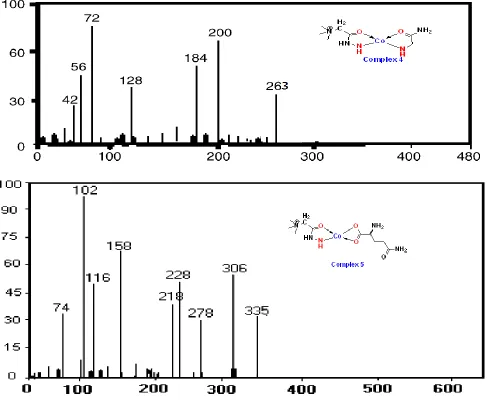
Figure 2. Electron-impact mass spectra of the complexes (1-5).
The mass spectra of Co(II) complexes (Fig. 2) have been recorded. The mass spectra give m/z at 321 for [Co-GT-diglycine] (1), m/z at 378 for [Co-GT-triglycine] (2), m/z at 435 [Co-GT-tetraglycine] (3), m/z at 263 [Co-GT-glycinamide] (4) and m/z at 335 [Cu-GT-glutamine] (5). These data in good guide with the molecular formula for these prepared GT complexes.
3.1.3. Magnetic moments and electronic spectra
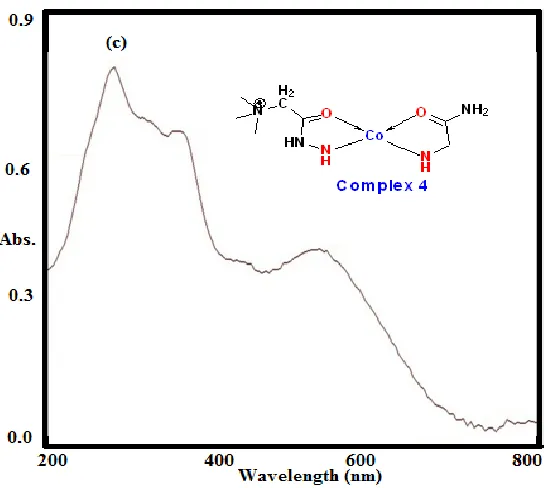
The magnetic moments for the cobalt(II) complexes are shown in experimental part. The magnetic moments of the cobalt(II) complexes at 5.12-5.02 μB, which suggest tetrahedral geometry for cobalt(II) complexes [24,25]. For tetrahedral cobalt(II) complexes, the state acquires orbital angular momentum only indirectly through the mixing of the 4T2 state by a spin–orbit coupling perturbation.
Figure 3. Electronic reflection spectra of (a) GT-diglycine], (b) GT-triglycine] and (d) [Co-GT- glycinamide] complexes.
Table 1. UV-Vis. Spectra of Gerard T ligand and its Co(II) complexes (1-5).
Assignments (cm-1) GT GT complexes
Complex 1 Complex 2 Complex 3 Complex 4 Complex 5
π- π* transitions 47,169 47,348 49,454 35,697 33,558 41,259
n- π* transitions 2,9673 32,467 29,476 25,587 30,308 28,287
Ligand-metal charge transfer
- 23,419,
18,747
21,478 17,730
23,009, 17,030
23,204, 17,775
22,978, 17,989
3.1.4. X-ray diffraction and TEM micrographs
[image:9.596.27.571.415.530.2]
[image:10.596.61.533.71.700.2]
c(°) 16.02300 16.1052 7. 301454
α(°) 90 90 90
β(°) 90 90 90
γ(°) 90 90 90
Volume (Å3) 1010.54 5187.25 758.69
(Calc.) density (g/cm−3) 1.92575 1.23 1.94
2θ range Limiting indices
Z Rf
Temperature (K)
13.47–55.84 0≤h≤2, 0≤k≤2, 1≤2≤8
3 0.0000824
298
16.24–63.96 3≤h≤12, 1≤k≤7, 3≤l≤12
8 0.000038
298
12.98–67.84 3≤h≤7, 2≤k≤7, 0≤l≤3
7 0.0000689
298
[image:11.596.30.581.119.723.2]
Although, the amorphous attitude reflects the infinite small size for the aggregates which may be found comfortably in nanometer range this verified through TEM analysis. TEM is a broad implemented method used to discuss the particle shape and size for solid matrix. High settlements images were observed (Fig. 5). The micrographs introduce diverse particle shapes in nano-crystalline matrixes. The rocky shape is the main feature for free ligand and complex (5). This attitude proposes the adaptable accumulation for the particles. Micrographs of complexes (3 and 4) represent their nanometer features by a clear cubic like crystal shapes. Micrographs of complexes (1and 2) display clear homogenous matrixes with a distinct isolation for spherical particles in nanometer range. This attitude point to essential rule for the presence of metal ions on yielding nanometer particles [31]. The highly symmetric spherical anions occluded in complexation sphere may lead to the spherical feature appeared in images. Also, may be expressed by the distinct accumulation of several individual particles in polycrystalline nature. The dark areas in micrographs, may point to the aggregation of condensed fine particles. The nanometer sizes may enhance the biological activity with regard to bulk analogue. This property may simplify the permeability through infected cell membrane.
Figure 6. SEM and EDX spectrum of [Co-GT-diglycine] complex.
A representative scanning electron microscopy (SEM) and energy dispersive x-ray analysis (EDX) analysis results of the residue obtained from thermal decomposition of Co(II) complexes (1-5) are shown in Fig. 6. The [Co-GT-diglycine] complex shows bar like structure. The EDX spectra show that the residues majorly consist of metal (cobalt) and oxygen with some traces of sulfur.
3.1.6. Catalytic activity
The catalytic activity of cyclohexane oxidation was performed over the five synthesized complexes at room temperature (RT) and 70 ºC for 8 and 12 h. The complexes have not showed any conversion of cyclohexane to cyclohexanol and cyclohexanone at RT. Though all synthesized complexes have not yielded any product at RT, cyclohexane conversion can be achieved at particular temperature which is almost close to the boiling point of the reactant. The cyclohexane boiling point is ~79 ºC and thus the reaction temperature fixed at 70 ºC.
3.2. pH titrations
the prevailing experimental conditions as those utilized for determining the stability constants of the mixed-ligand complexes. In Table 3 and 4 are tabulated the values of the stability constants for the ternary species, together with the proton-association constants of the ligands and the stability constants of the binary complexes, most of which are taken from the formation and decay process of the 110 species.
The calculated acid dissociation constants expressed as pKa values are amounting to 9.71 and
2.80. The highest pKa value might be due to the dissociation of the proton in the methylene group
located between a carbonyl and a quaternary ammonium group in view of the electron attracting effect of the quaternary ammonium group [33]. On the other hand, the lowest pKa value may plausibly
correspond to the protonated amino group.
The potentiometric data of the Co(II)-GT system provide a good fit assuming the formation of the species 110, 120 and 11-1 species. The stability constants of their complexes are given in Table 3. Previous studies[33] on related systems favoured the occurrence of structure (I) for 110 complex and reported the following scheme for acid dissociation from 110 complex yielding structure (II) which is referred to as 11-1 (Scheme 2).
Scheme 2. Binary complex of the Girard-T
The potentiometric data of the [Co(GT)]-L system were fitted by various models. The most acceptable model was found to be consistent with the formation of the complexes with stoichiometric coefficients 110 and 11-1according to eq. (3) and (4).
Co(GT) + L [Co(GT) (L)] (3) [Co(GT) L] [Co(GT) L H-1] + H+ (4)
Charges are omitted for simplicity
In the 110 case, the peptide is bound through the amino and carbonyl oxygen groups. On increasing the pH, the coordination sites should switch from the carbonyl oxygen to the amide nitrogen. Such a change in coordination centres is now well documented [34,35].The pKa values are
calculated by the following equation: pKa = log β110 - log β11-1 (3)
1 1 2 1 0 -1 14.92(0.05) 1.94(0.05)
Diglycine 0
0 1 1 1 1 1 1 1 1 1 2 0 -1 -2 3.21(0.05) 8.13(0.03) 5.70(0.02) 0.65(0.03) - 4.66(0.03)
Triglycine 0
0 1 1 1 1 1 1 1 1 1 2 0 -1 -2 3.27 (0.03) 7.96 (0.02) ( 0.00 ) 2.55 ( 0.00 ) 0..2 ( 0.00 ) 2.05
-Tetraglycine 0
0 1 1 1 1 1 1 1 1 1 2 0 -1 -2 3.24 (0.03) 7.97 (0.01) 5.33(0.04) -1.32(0.02) - 7.32(0.01)
Glutamine 0
1 1 1 1 1 1 0 -1 8.95(0.01) 8.50(0.01) -1.58(0.02)
Glycinamide 0
1 1 1 1 1 1 1 1 0 -1 -2 7.61(0.01) 4.89(0.01) -2.22(0.02) -6.50(0.01) a
[image:15.596.105.496.162.656.2]
Figure 7. Concentration distribution of various species as a function of pH in the Co(GT)-glycylglycine system.
[image:16.596.131.468.70.223.2]The distribution diagram of the diglycine complex is given in Fig. 7. The mixed ligand species 110 starts to form at pH 1.4 and, with increasing pH, its concentration increases reaching a maximum of 93% at pH = 4.8. A further increase of pH is accompanied by a decrease in the 110 complex concentration and an increase in [Cu(GT)LH−1] (111-1) complex formation.
Table 4. Stability constants of the ternary species in the Co(GT)-glycine oligopeptides systems at 25◦C and 0.1 M ionic strength.
System l p qa logВ b pKa
Diglycine 1
1 1 1 0 -1 4.50(0.01) 2.52(0.02) 1.98
Triglycine 1
1 1 1 0 -1 4.31(0.01) 1.89(0.02) 2.42
Tetraglycine 1
1 1 1 0 -1 4.23(0.04) 2.02(0.03) 2.21
Glutamin 1
1 1 1 0 -1 7.52(0.01) 2.66(0.03) 4.86
Glycinamide 1
1 1 1 0 -1 3.78(0.02) 1.98(0.03) 1.80 a
l, p and q are the stoichiometric coefficient corresponding to Co(II), GT, peptides (L) and H+, respectively .b standard deviations are given in parentheses.
3.3. Antibacterial activities
[image:16.596.44.510.421.612.2]enzymes of microorganisms [38].
Table 5. Size of inhibition zone (mm) formed at different concentrations (12.5, 25, 50 and 100 μg/ml in DMSO solvent) against various Bacteria and fungi
Compounds Microbial Bacteria species
E. coli K. pneumoniae P. fluorescence
B. subtilis S. pyogenes
S. aureus
GT ligand 12.1
± 0.8 14.4 ± 0.2 13.7 ± 0.5 14.2 ±0.4 19.6 ±0.3 17.3 ±0.7 [Co(GT)diglycine] 15.1
±0.04 18.4+1 ±0.03 16.7+1 ±0.03 26.1+2 ±0.01
23.2 +1 ±0.05
19.9+1 ±0.05 [Co(GT)triglycine] 19.4+1
±0.05 19.2+1 ±0.01 20.4+2 ±0.07 28.1+2 ±0.01 25.4+1 ±0.03 23.8+1 ±0.1 [Co(GT)tetraglycine] 13.6NS
±0.03
15.4NS ±0.08
15.6 +1 ±0.1
22.2+1 ±0.08
20.2 +1 ±0.04
19.3+1 ±0.09 [Co(GT)glutamine] 22.0+2
±0.3
21.4+2 ±0.09
NA 30.1+3
±0.09
29,4+3 ±0.09
27.3+2 ±0.2 [Co(GT)glycinamide] 15.1
±0.04 16.2 ±0.09 21.4+2 ±0.09 30.1+3 ±0.09 29,4+3 ±0.09 27.3+2 ±0.2 CoCl2.6H2O
Control (DMSO) 0 0 0 0 0 0 0 0 0 0 0 0 Penicillin G 15.1
±0.07 16.2 ±0.09 17.0 ±0.05 21.5 ±0.06 20.3 ±0.2 19.4 ±0.08 Streptomycin 16.6
4. CONCLUSION
The present investigation describes the formation equilibria of Co(II) complexes involving Girard-T (GT) as primary ligand and glycine oligopeptides as secondary ligands in aqueous media by using potentiometric titration method at (I = 0.1M NaClO4 -25°C). The complexation behavior of
Co)II) with (GT) and oligopeptides shows the formation of ternary complexes in a stepwise manner in aqueous media. Co(II) complexes with Girard-T (GT) derived from glycine oligopeptides have been synthesized and characterized on the basis of elemental analysis, molar conductance, magnetic moment and spectral data. All complexes show tetrahedral geometry. Antimicrobial studies of the ligand and complexes have also been evaluated which indicate that activity increases on chelation. On considering the structural formula of the compounds that exhibited antimicrobial activity, it can be concluded that substituted ligands and cobalt moiety may play a role in the antimicrobial activity. ACKNOWLEDGEMENT
The authors would like to thank the Deanship of Scientific Research at Princess Nourah bint Abdulrahman University for funding this research.
References
1. A. Girard, G. Sandulesco, Helv. Chim. Acta, 19 (1936) 1095-1107.
2. M.E.M. Emam, M.A.H. Hafez, M.N.H. Moussa, J. Therm. Anal., 37 (1991) 1005-1011. 3. M.M. Mostafa, M.A. Khattab, K.M. Ibrahim, Transition Met. Chem., 8 (1983)212-214. 4. M.M. Mostafa, S.M. Hassan, G.M. Ibrahim, J. Inorg. Nucl. Chem., 42 (1980) 285-291. 5. S.M. Al-Ashqar, M.M. Mostafa, Spectrochim. Acta Part A 71 (2008) 1321-1326. 6. R.M. AbouSekkina, R.M. Salem, J. Therm. Anal. 48 (1997) 841-849.
7. R.M. El-Bahnasawy, J. Therm. Anal., 45 (1995)1547-1556.
8. Leovac, V.M. Mészáros-Szécsényi, K. Vojinović-Ješić, L. j. S. Češjević, V. I. Markov, S. Wadsten, T. J. Therm. Anal. Calorim., 86 (2006) 379-403.
9. M. Masui, H. Ohmori, J. Chem. Soc. A (1969) 153-156
10.A. M. A. El-Sokkary, M. M. El-Naggar, A. F. Abdel-Aziz, Appl. Organomet. Chem., 24 (2010) 439- 445.
11.Vogel: Text book of Quantitative Chemical Analysis, 5th Edition, Chapter 15(1989) 555, Longman, UK.
12.P. Gans, A. Sabatini, A. Vacca, Investigation of equilibria in solution. Determination of equilibrium constants with the HYPERQUAD suite of programs, Talant, , 43 (1996) 1739–1753. 13.P. Gans P, A. Ienco, D. Peters, A. Sabatini, A. Vacca,,Hyperquad simulation and speciation
(HySS): a utility program for the investigation of equilibria involving soluble and partially soluble species, Coordination Chemistry Reviews, 184 (1999) 311–318.
14.D.J. Beecher, A.C. Wong, Appl. Environ. Microbiol. 60 (1994) 1646-1651. 15.W.J. Geary, Coord. Chem. Rev. 7 (1971) 81–122.
16. S.A. Sadeek, S.M. Abd El-Hamid, M.M. El-Aasser, Monatsh Chem. 146 (2015)1967-1982. 17. N. Sultana, M.S. Arayne, S.B.S. Rizvi, U. Haroon, M.A. Mesaik, Med. Chem.
Res. 22(2012)1371-1377.
18.I. Turel, Coord. Chem. Rev. 232 (2002) 27-47.
19.G. Pasomas, J. Inorg. Biochem. 102 (2008)1798-1811.
20.G. Pasomas, A. Tarushi, E.K. Efthimiadou, Polyhedron 27 (2008) 133-138. 21.S.A. Sadeek, S.M. Abd El-Hamid, J. Therm. Anal. Calorim. 124 (2016) 547-562.
32.I. Savago, A. Kiss, E. Farkas, D.Sanna, P.Marras, G.Micerain, J. Inorg. Biochem.65 (1997)103-108.
33.P.G. Daniele, O. Zerbinati, V. Zelano, , G. Ostacoli, J. Chem. Soc., Dalton Trans. 10 (1991)2711-2715.
34.W. Rehman, M.K. Baloch, A. Badshah, J. Med. Chem. 43 (2008) 2380-2385. 35.M. Tumer, H. Koksal, M.K. Sener, Trans. Met. Chem. 24 (1999) 414-420. 36.I. Muhammad, I. Javed, I. Shahid, Nazia, I. Turk. J. Biol. 31 (2007) 67-72.
37. N. Raman, A. Kulandaisamy, A. Shunmugasundaram, and K. Jeyasubramanian, Transition Metal Chemistry, 26 (2001) 131–135.
38. R. S. Srivastava, Inorganica Chimica Acta, 56 (1981) 65–67.
![Figure 1. Infrared spectra of (1) [Co GT-(diglycine)]; (2) [Co GT-(triglycine)] and (3) [CoGT-(tetraglycine)] complexes 1–3](https://thumb-us.123doks.com/thumbv2/123dok_us/1785208.132752/5.596.87.512.319.686/figure-infrared-spectra-diglycine-triglycine-cogt-tetraglycine-complexes.webp)
![Figure 4. Powder XRD spectra of (a) [Co-GT-diglycine], (b) [Co-GT-triglycine] and (c) [Co-GT-tetraglycine] complexes (1-3)](https://thumb-us.123doks.com/thumbv2/123dok_us/1785208.132752/10.596.61.533.71.700/figure-powder-xrd-spectra-diglycine-triglycine-tetraglycine-complexes.webp)
![Table 2. Crystallographic data for the Schiff base complexes [Co-GT-diglycine], [Co-GT-triglycine] and [Co-GT-tetraglycine]](https://thumb-us.123doks.com/thumbv2/123dok_us/1785208.132752/11.596.30.581.119.723/table-crystallographic-data-schiff-complexes-diglycine-triglycine-tetraglycine.webp)
![Figure 6. SEM and EDX spectrum of [Co-GT-diglycine] complex.](https://thumb-us.123doks.com/thumbv2/123dok_us/1785208.132752/13.596.53.509.75.390/figure-sem-edx-spectrum-gt-diglycine-complex.webp)