DOI: 10.1051/epjconf/20158201066
C
Owned by the authors, published by EDP Sciences, 2015
Liquid fuel film ignition delay times on the substrate heated
up to high temperatures
D.V. Antonov, M.V. Piskunov and O.V. Vysokomornayaa
National Research Tomsk Polytechnic University, 634050 Tomsk, Russia
Abstract.Heat and mass transfer processes under the conditions of unsteady evaporation and boiling of the liquid fuel film in coordination with the substrate heated up to high temperatures were investigated. The film thickness values and the substrate temperature (whereby the ignition conditions are not implemented) were determined. The film thickness values and the substrate temperature (whereby as low as practicable ignition delay times are provided) were found. The differences of liquid fuel film ignition condition under the local heating and the interoperating with the massive heating source were analyzed.
1. Introduction
The interoperating processes of combustible (fuel) and inflammable (solvent, varnishes, paints) liquids with the various heating sources are characterized by high fire and explosion hazard. The numerical [1–3] and experimental [4] investigation results obtained over the last years showed that the ignition probability of large massifs and films of liquids is high even under the condition of interoperating with typical local sources of limited energy capacity (metallic and nonmetallic small-sized particles (with various physical nature) heated up to high temperatures). At the same time, the flood of different installations and equipment working areas by the combustible liquids can take place during the seal failure of storage reservoirs and pipelines. The estimation of liquid fuel film ignition possibility on the surfaces of massive bodies heated up to high temperatures is of interest.
The purpose of this article is the numerical investigation of macroscopic interoperating regularities of typical liquid fuel film with the metallic substrate heated up to high temperatures.
2. Statement problem
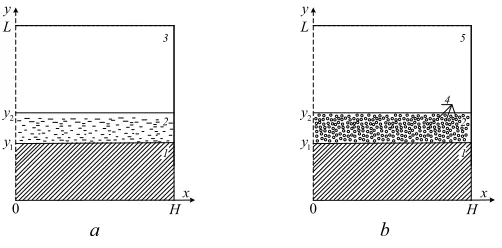
The analysis [5] shows that the surfaces of massive bodies heated up to high temperatures can be simulated as the uniformly heated substrate with the constant heat content. Therefore, the theoretical investigations were carried out for “liquid fuel film – massive metallic substrate – oxidizing agent” system presented in Fig. 1. It was expected that the typical liquid fuel (kerosene) film is uniformly poured on the surface of metallic (steel) substrate heated up to high temperaturesTbm. The film of liquid
aCorresponding author:
y
3
1
x H L
0
1 y 2
y 2
y
5
1
x H L
0
1 y 2
y 4 2
a b
Figure 1. The schematic illustration of the problem solution att=0 (a) and 0< t < td(b): 1 – metal substrate,
2 – combustible liquid film, 3 – air, 4 – bubbles of liquid vapors, 5 – oxidizing agent-liquid vapor mixture.
matter is warmed up by the substrate heat (the substrate temperature was constant). The evaporation takes place on “liquid – substrate” boundary under the condition of the phase transformation conditions achievement. The phase transformation conditions are also implemented in the wall layer of liquid under the intense heat removal from the substrate (the evaporation takes place under the liquid warming-up to the boiling temperatureTbl). The bubbles of matter vapors are separated away the substrate surface and levitated by the action of buoyancy force. The injection of fuel vapors occurs on “liquid film – oxidizing agent” boundary. The liquid vapors are blended with “cold” oxidizing agent by means of diffusion and convective mass transfer. The vapor-gas mixture is formed. A mixture is heated up by means of the vapor energy supplied from the boiling matter film. The oxidation reaction can acquire the irreversible (drastically exponential) character when achieving the limit values of concentration (for constituents) and vapor-gas mixture temperature. The mixture ignition is possible under such conditions.
The following suppositions unapplied significant restrictions to the problem statement were accepted:
1. The thermal and physical characteristics of reacting agents do not depend on temperature. It is found [6] that the dependences of thermal and physical parameters on temperature influence slightly on the integral characteristics of evaporation and ignition processes of combustible and inflammable liquids.
2. The one matter with the known characteristics is formed in consequence of the combustible liquid evaporation. The “effective” values of activation energyEand preexponential factork0are generally defined when determining (experimentally) of kinetic oxidation reaction parameters of liquid matter vapors. Therefore, the implementation of one “effective” reaction, wherein one combustible liquid takes part, is expected.
3. The liquid boiling does not lead to the film thickness variation (loss in fuel weight in consequence of the vapor formation is balanced out by its inflow at a constant speed).
4. The possible liquid burning-out processes were not taken into account. It was thought that the liquid condensed matter film poured on the solid body surface occupies significantly large area. The following ignition conditions [5] were accepted during the numerical simulation:
1. The heat released in consequence of the chemical oxidation reaction of fuel vapors in the air is more than the heat transmitted from the substrate to the boiling liquid.
3. Mathematical model and solution method
The mathematical model corresponding to the accepted problem statement (Fig. 1) includes the following system of nonlinear nonstationary partial differential equations (0< t < td) [7]:
0< x < H, 0< y < y1
C11*T1 *t =1
*2T1
*x2 + *2T1
*y2
;
0< x < H, y1< y < y2 *Cf
*t + *Cf
*x + *Cf
*y =D4 *2
Cf *x2 +
*2Cf *y2
,
C22*T2 *t =2
*2 T2 *x2 +
*2T2 *y2
atT < Tbl,
C22*T2 *t =2
*2T
2 *x2 +
*2T 2 *y2
+C44Vvm*T2
*y atT ≥Tbl; 0< x < H, y2< y < L
*2 *x2 +
*2 *y2 =,
* *t +u
* *x +w
* *y =5
*2 *x2 +
*2 *y2
+gy*
T5 *y ,
5
*C
f *t +u
*Cf *x +w
*Cf *y =5D5 *2 Cf *x2 +
*2C f *y2
−Wo,
Cf+Co=1,
5C5 *T5
*t +u *T5
*x +w *T5 *y =5 *2 T5 *x2 +
*2T5 *y2
+QoWo.
Here t – time, s;td – ignition delay time, s; x, y – Cartesian coordinates; H, L – solution region dimensions, m; C – specific heat capacity, J/(kg·K); – density, kg/m3; – thermal conductivity coefficient, W/(m·K);T – temperature, K;Cf– liquid fuel vapor concentration;D– diffusion coefficient of fuel vapors in the air, m2/s; Vvm – bubble-rise velocity, m/s; – flow function, m2/s; – vortex velocity vector, s−1;u,w– convection velocity components of fuel vapors-oxidizing agent mixture in projections onxandyaxes, correspondingly, m/s;– kinematic viscosity, m2/s;– thermal-expansion coefficient, K−1; g
y – gravitational acceleration in projection on y axis, m/s2; Wo – mass oxidation
velocity of fuel vapors in the air, kg/(m3·s);Co– concentration of oxidizing agent;Q
o – heat effect
of oxidation reaction of fuel vapors in the air, MJ/kg; 1, 2, 3, 4, 5 indexes correspond metal substrate, liquid fuel, oxidizing agent, fuel vapors, vapor-gas mixture (Fig.1).
The boundary conditions (Fig.1b): the conjugating boundary conditions for the equations of energy and thermal conductivity taking into account the vapor formation were prescribed on “substrate – liquid” boundary (y =y1, 0< x < H), Newmann’s boundary conditions taking into account the injection of fuel vapors were prescribed for the diffusion equation; the conjugating boundary conditions were prescribed for all equations on “liquid – vapor-gas mixture” boundary (y =y2, 0< x < H); zero equality condition of corresponding functions gradients was accepted for all equations on the symmetry axis and the boundaries (x=H, 0< y < L;y =0,y =L, 0< x < H).
The formula was used to calculate the mass oxidation velocity of fuel vapors: Wo =k0Cfm1C
m2 o 5exp
− E
RtT5
,
where k0 – pre-exponential factor of the oxidation reaction, s−1; m1,m2 – constants (the first-order m1=m2=1 reaction for a binary mixture was considered); E – activation energy of the oxidation reaction, kJ/mole;Rt– absolute gas constant, J/(mole·K).
The vapor bubble-rise velocityVvmduring the boiling depends on the mode of flow and the bubble dimensionsRvm. The bubble-rise detached from the bottom is determined by the turbulent flow motion. Since the most part of bubbles in the films is formed nearby the heated substrate, then the formula characterizing the turbulent rise can be used to determine the velocityVvm:
Vvm=
8Rvmgy
3 ·
The analysis shows that the characteristic bubble dimension for the films less than 10 mm in thickness under the condition of intense evaporation is variable in the range of 0, 05< Rvm<1 mm. Therefore, the average bubble-rise velocity is 0, 035< Vvm<0, 15 m/s.
The [8,9] models were used to describe the macroscopic regularities of diffusive and convective mass transfer of fuel vapors in the oxidizing agent area in “flow function – vortex velocity vector” variables. The numerical simulation algorithms and the result adequacy estimation procedure (based on the conservation checking of being used difference scheme) of theoretical investigations carried out are similar to the ones being used in [1–3].
4. Results and discussion
The numerical investigations were carried out at the following values of parameters [10–12]: liquid and air film temperatures areT0=300 K, metal substrate temperature isTbm=600÷1100 K; liquid boiling temperature is Tbl=470 K; heat effect of fuel vapor oxidation reaction in the air isQo= 43, 8 MJ/kg; heat effect of liquid evaporation isQe=25 kJ/kg; activation energy of oxidation reaction is E=193, 7 kJ/mole; pre-exponential factor of oxidation reaction isk0=7·107 s−1; substrate thickness isLbm=10 mm; liquid film thickness isLfl=1÷10 mm; solution region dimensions areH =10 mm, L=20 mm; rise velocity and dimension of the bubbles are Vvm=0, 05 m/s, Rvm=0, 1 mm. The thermal and physical characteristics of corresponding matters are presented in [10–12].
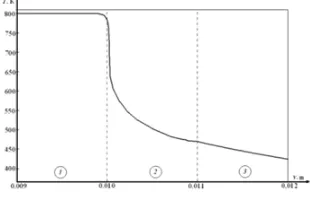
Figure 2. The temperature field at t=4, 626 s time point at Tbm=800 K, Lfl=1 mm: 1 – metal substrate,
2 – combustible liquid film with vapor bubbles, 3 – oxidizing agent-liquid vapor mixture.
Figure 3. The dependence of liquid fuel film heating time before the implementation of boiling conditions across the thickness on the massive substrate temperature.
temperature is decreased (Fig.2) by the boiling under the condition of approach to “liquid – oxidizing agent” boundary.
The condensed matter vapors significantly cool down under the condition of passage through the liquid film. At that, the temperature of the vapors is larger decreased with the increase of the matter film thickness. Consequently, the mixture (which is formed above the film surface) of liquid matter vapors with an oxidizing agent has the temperature which is significantly lower thanTbl (Fig.2). The oxidation reaction is carried out very slow at such temperatures. The velocity of chemical reacting does not achieve values sufficient for the ignition despite the growth of mix ingredient concentration above the liquid matter film. So, the ignition probability is not large even under the condition of continuous heating of liquid film up to the boiling temperatures without the postheating of reactive (with sufficient concentrations of constituents) mixture which is formed.
The matter heat times across the thickness up toTbltemperatures significantly grow when increasing
of the liquid film thicknessLf l and decreasing of the substrate temperature Tbm (Fig.3). This result allows deduce that the liquid fuel film ignition on the massive substrate is possible only at the significantly high (Tbm >1100 K) temperatures and the thin (Lfl=1÷5 mm) fuel films. The point to be emphasized is that the high (Tbm >1100 K) temperatures of the working areas of different equipment are rare at the places of production. Moreover, the average fire temperatures, for example, do not exceed 1100 K. Therefore, the model under consideration (Fig. 1) contains the considerable part of the production processes and the potential extremal situations at the places of production using combustible and flammable liquids in bulk. First of all, it should be noted chemical, petrochemical, oil-and-gas and oil processing industries.
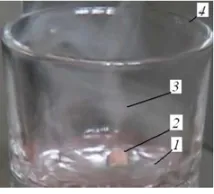
Figure 4. The videogram frame of experiment under the condition of kerosene ignition by the single steel particle (hp=3 mm,lp=3 mm,Tp=1000 K): 1 – combustible liquid, 2 – deep metallic particle, 3 – liquid matter vapors,
4 – glass vessel.
[1–3]. Consequently, the heating probability of boundary layer up to the temperatures sufficient for the boiling is not large. The intense matter evaporation takes place nearby “liquid – particle” boundary. The vapor gaps are formed during the dipping of heated particle into the liquid matter nearby its lower and side faces (Fig.4) [1–3]. The matter vapors in the gap area are additionally heated up by the particle heat and blown into the oxidizing agent area. It leads to the mixing of “hot” vapors of liquid matter with the oxidizing agent, which is also heated up by the heat of source. Consequently, the temperatures sufficient for the ignition [1–4]. The oxidizing agent and the matter vapors contact directly with a heating surface. Therefore, we can conclude that the ignition probability is much higher for the models [1–3] than in the system under consideration despite the limited heat content.
The results of numerical investigations carried out show that the phase transformation (the boiling) conditions in a liquid can be implemented only under the condition of continuous input of energy from the massive source. Only very thin boundary liquid layer is heated up when interacting with a local source [1–3]. Therefore, the conditions of the phase transformation (intense evaporation) nearby “liquid – heating source” boundary and the vapor gap formation between a “hot” source and a liquid matter are implemented. The conditions for the vapor gap formation between the massive source and the matter film (excluding the boiling and the evaporation) are provided on the substrate surface at the massive substrate temperatures higher than 1100 K, which is rare in many industries. Consequently, the rise velocities and the bubble concentrations in the films significantly grow compared to the conditions under consideration (Fig.1). It can be assumed that heat and mass transfer processes, phase transformations and chemical transformations preceding the ignition of the matter vapors – oxidizing agent mixture will be implemented during the times far lesser thanthpresented in Fig.2. It is significant that numerical and experimental investigations of such processes are quite difficult and require the participation of large physical and time resources.
The analysis of Fig.2,3carries interference that the input of additional energy to the oxidizing agent-liquid matter vapors mixture is necessary to implement the combustible or flammable agent-liquid film ignition conditions on the heated substrate (Fig. 1) at Tbm <1100 K. Such conditions can be provided, for example, where there are various irregularities and cavities in the liquid film structure. The zones with the oxidizing agent heated up to high temperatures and the fuel vapors (being blown) high concentrated will be formed in close proximity to these areas (sufficient conditions for the vapor-gas mixture ignition are formed). At the same time, it is significant that the reactive mixture formation probability of spilled liquid vapors with oxidizing agent can be significantly decreased by the forced ventilation and cooling of air masses nearby the working surfaces of different equipment and devices.
5. Conclusion
irregularities) of liquid fuel film. The input of additional energy to the liquid matter vapors-oxidizing agent mixture is necessary to implement ignition conditions. In particular, the ignition under the film spilling on the “hot” surface is possible. But this problem with the edge effect is quite difficult because the one includes the interface of four areas (vapor, liquid, oxidizing agent and substrate) and requires the particular consideration.
The investigation was performed by Russian Science Foundation grant (project 14-39-00003).
References
[1] D.O. Glushkov, G.V. Kuznetsov, and P.A. Strizhak, Adv. in Mech. Eng. 2014 (2014) [2] D.O. Glushkov, G.V. Kuznetsov, and P.A. Strizhak, Math. Probl. in Eng. 2014 (2014)
[3] O.V. Vysokomornaya, G.V. Kuznetsov, and P.A. Strizhak, Russ. Journ. of Phys. Chem. B. 4 (2011) [4] A.V. Zakharevich and P.A. Strizhak, Journ. of Eng. Thermophys., 2, 22 (2013)
[5] V.N. Vilyunov and V.E. Zarko, Ignition of Solids (Elsevier Science Publishers, Amsterdam, 1989) [6] P. Dagaut and M. Cathonnet, Progr. in Energ. and Comb. Scien., 32 (2006)
[7] O.V. Vysokomornaya, G.V. Kuznetsov, and P.A. Strizhak, Math. Probl. in Eng. 2014 (2014) [8] G.V. Kuznetsov and M.A. Sheremet, Intern. Journ. of Heat and Mass Transf. 9-10, 52 (2009) [9] G.V. Kuznetsov and M.A. Sheremet, Thermophys. and Aeromech. 1, 16 (2009)
[10] N.B. Vargaftik, L.P. Filipov, A.A. Tarzimanov, and E.E. Totskii, Handbook of Thermal Conductivity of Liquids and Gases (CRC Press, Inc., Boca Raton, 1994)