This is a repository copy of
Land expropriation compensation among multiple stakeholders
in a mining area: explaining “skeleton house” compensation
.
White Rose Research Online URL for this paper:
http://eprints.whiterose.ac.uk/121072/
Version: Accepted Version
Article:
Cao, Y, Dallimer, M orcid.org/0000-0001-8120-3309, Stringer, LC
orcid.org/0000-0003-0017-1654 et al. (2 more authors) (2018) Land expropriation
compensation among multiple stakeholders in a mining area: explaining “skeleton house”
compensation. Land Use Policy, 74. pp. 97-110. ISSN 0264-8377
https://doi.org/10.1016/j.landusepol.2017.09.003
(c) 2017 Elsevier Ltd. Licensed under the Creative Commons Attribution-Non Commercial
No Derivatives 4.0 International License
(https://creativecommons.org/licenses/by-nc-nd/4.0/).
[email protected] https://eprints.whiterose.ac.uk/ Reuse
Items deposited in White Rose Research Online are protected by copyright, with all rights reserved unless indicated otherwise. They may be downloaded and/or printed for private study, or other acts as permitted by national copyright laws. The publisher or other rights holders may allow further reproduction and re-use of the full text version. This is indicated by the licence information on the White Rose Research Online record for the item.
Takedown
If you consider content in White Rose Research Online to be in breach of UK law, please notify us by
Land expropriation compensation among multiple stakeholders in a
mining area: explaining
“
skeleton house
”
compensation
Abstract: House demolition compensation in mining areas in China is determined by house size.
This has led farmers to engage in “skeleton house” construction, namely, building simple
structures that can increase the compensation obtained following land expropriation. While
compensation standards and social security for land-expropriated farmers has received some
research attention, investigations are yet to consider this challenge from different stakeholder
perspectives. Clearly identifying the interests and interactive relationships of each group offers
potential to deliver positive outcomes for all stakeholders and for the environment. This paper
targets this gap using document analysis alongside semi-structured interviews with the Pingshou
China Coal Corporation (PCCC), Pinglu District Government (PDG) and land-expropriated
farmers in Shanxi Province in Northwest China, identifying reasons for and potential solutions to,
the phenomenon of skeleton house construction. Novel application of the DPSIR (driving
forces-pressures-statuses-impacts-responses) framework as a structuring tool for our analysis
provides important insight into how the emerging situation has arisen and helps to identify
potential countermeasures. There are many differences among the perspectives of the three
stakeholder groups, and all are responsible for the phenomenon of skeleton houses. PCCC should
follow different production routes to reduce their costs and the impacts on farmers. District
Government should shift from a coping position (dealing with negative impacts from the coal
industry) towards actively shaping coal industry development, thus reducing its negative impacts
on wider society. Land-expropriated farmers should actively participate in meaningful discussions
to assist PCCC and PDG to make reasonable and considerate compensation standards and social
security policies.
Key words: Land use; Land expropriation; Rural settlement; DPSIR; Stakeholder; Social security;
1 Introduction
Land expropriation has led to concerns about adverse impacts on populations whose lands are
lost (Mahalingam and Vyas, 2011; Ty et al., 2013). While much research has focused on issues
concerning compensation for land-expropriated people, few researchers have examined the
perspectives of the different stakeholders involved in the land acquisition and compensation
process. This paper addresses this gap through focus on land expropriated for mining by central
government mining company in China.
What is considered adequate compensation for those who have their land expropriated differs
markedly between countries, and between developed and developing countries. For instance,
people in Bangladesh face severely diminished and highly uncertain livelihoods as a result of land
expropriation (Feldman and Geisler, 2012). Pakistan adopts fixed rates of compensation in order
to prevent speculation through which land-expropriated people acquire more land in order to get
more compensation (Hull, 2008). The land acquisition process in India is neither consultative nor
transparent, and compensation, resettlement and rehabilitation packages offered to former
landowners are often outdated, inadequate or based on artificially low land values and are keenly
contested (Mahalingam and Vyas, 2011). There is a big gap between policy and practice of
compensation and resettlement policy in Vietnam (Dao, 2010), with procedures followed
inadequately and little attention to due process. The law in Malaysia requires the state to pay
adequate compensation, however, this is not defined (Alias and Daud, 2015). Together, these
examples from Asia show a wide variety of contentious issues surrounding the reasonable
payment of compensation.
Laws and policies are adhered to more strictly in the developed world. For example, in the
United States, the market value of the subject property is generally held as just compensation for
the dispossessed owner (Eaton, 1995; Sun, 2013). In the UK, compensation is based on the
principle of value to the owner, comprising the market value together with other losses suffered by
the claimant (Denver-Green, 1994; DCLG, 2010). Other developed countries follow the “land for
land” compensation method, where, land is given to the land-losers so they can continue with
Current compensation practices in China differ from those in other countries because of the
forms of land ownership and the political-economic structure (Zhang and Qiu, 2013; Sun, 2013).
In China, the state (or local government) pays farmers a fee which takes four elements into
account: (1) compensation for the land, (2) resettlement allowance for displaced people, (3)
compensation for ground attachments, and (4) compensation for lost or un-harvested crops (Lin
and Ho, 2005). A multiple output method has been adopted to calculate compensation, considering
the value of the land’s average output over the previous three years (Sun, 2013). The total
compensation payable cannot be higher than 30 times the value of the land’s average output over
the previous three years (Tan et al., 2009).
When provided, compensation is usually monetary and generally considered insufficient
(Bao and Peng, 2016). Income (to the local governments) from leasing land to developers is
substantially more than the compensation for the expropriation, and the land-expropriated farmers
do not benefit from this value gap (Du et al., 2016), partly because they lack the rights to
challenge the amounts they receive (Hui et al., 2013).
The impact on the farmers themselves is multifaceted. Following the loss of their land,
without the security provided through the ownership of cultivated land, land-expropriated farmers
who are moved into cities both encounter financial difficulties and lack the same rights as other
citizens who have a longer history of residence in an urban area. They are therefore marginalized
in terms of employment opportunities and social security (Hui et al., 2013), with the literature
suggesting that land-expropriated farmers are more likely to be surviving on low income and
unemployed (Gan and Sun, 2015). Land-expropriated farmers become vulnerable because
compensation standards do not match their losses and social security for their future livelihoods
are inadequate (Sargeson, 2013). This causes discontentment among land-expropriated farmers,
who resist using violence and appeals (Sargeson, 2013; Lian et al., 2016).
Moreover, in China, there is no set regulation for compensation related to the demolition of
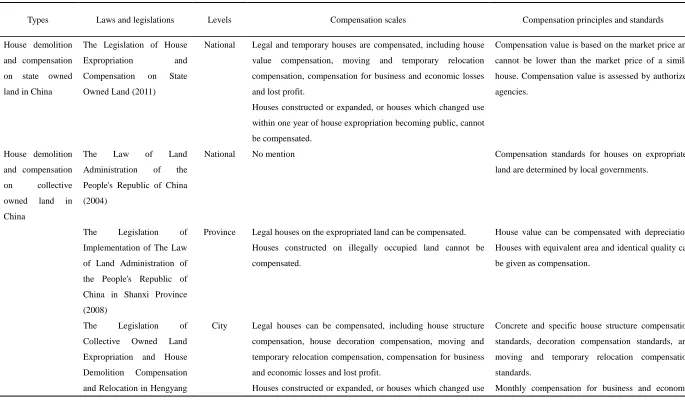
houses in rural areas (Table 1). Only some local governments pay this type of compensation,
leading to confusion amongst both home owners and those liable to pay compensation (Lu, 2015).
Although research has supported the idea of compensation standards being legally established (Lu,
2015; Liu, 2015), there remain major differences in the amounts of money actually paid,
being demolished on state-or collective-owned land (Liu, 2015). In China’s urban areas, the house
compensation value can be determined by the market price and assessed by authorized agencies
according to The Legislation of House Expropriation and Compensation on State Owned Land
(2011) (Table 1). In mining areas, which are mainly rural, compensation principles and standards
are generally decided through negotiation between mining enterprises and farmers due to the
absence of legislation or compensation standards (Li, 2014; Wang, 2016).
Comparing China with other countries (Table 1), similarities include, firstly, that legally
constructed houses which were built before land expropriation became public knowledge, are
compensated-this applies to skeleton houses too. Secondly, the compensation principles and
standards in other countries are legislated at the national level, such as in Vietnam, the UK and the
USA, and the house compensation value is determined by the market price or the equivalent
reinstatement value. However, national-level legislation in China indicates that only houses on
state-owned land can be compensated according to the market price. Although there are concrete
and specific compensation principles and standards for house demolition and compensation on
collective owned land in some cities, compensation principles and standards in most cities are still
Table 1 House demolition and compensation in China compared with that in other countries
Types Laws and legislations Levels Compensation scales Compensation principles and standards House demolition
and compensation on state owned land in China
The Legislation of House Expropriation and Compensation on State Owned Land (2011)
National Legal and temporary houses are compensated, including house value compensation, moving and temporary relocation compensation, compensation for business and economic losses and lost profit.
Houses constructed or expanded, or houses which changed use within one year of house expropriation becoming public, cannot be compensated.
Compensation value is based on the market price and cannot be lower than the market price of a similar house. Compensation value is assessed by authorized agencies.
House demolition and compensation on collective owned land in China
The Law of Land Administration of the People's Republic of China (2004)
National No mention Compensation standards for houses on expropriated land are determined by local governments.
The Legislation of Implementation of The Law of Land Administration of the People's Republic of China in Shanxi Province (2008)
Province Legal houses on the expropriated land can be compensated. Houses constructed on illegally occupied land cannot be compensated.
House value can be compensated with depreciation. Houses with equivalent area and identical quality can be given as compensation.
The Legislation of Collective Owned Land Expropriation and House Demolition Compensation and Relocation in Hengyang
City Legal houses can be compensated, including house structure compensation, house decoration compensation, moving and temporary relocation compensation, compensation for business and economic losses and lost profit.
Houses constructed or expanded, or houses which changed use
Concrete and specific house structure compensation standards, decoration compensation standards, and moving and temporary relocation compensation standards.
City, Hu’nan Province (2015)
within one year of house expropriation becoming public, cannot be compensated. House construction area exceeding 100 m2 per
capita cannot be compensated.
losses and lost profit is 14% of the value of dismantled houses, and lasts 6 months.
House demolition and compensation in Vietnam
The Land Law (2003) National Houses built consistent with planning laws, and constructed before land expropriation became publically known can be compensated.
Houses built before land expropriation became publically known, but which were built on land intended for other uses cannot be compensated.
Compensation value is based on the market price, or modified according to the market price.
House demolition and compensation in the UK
Land Compensation Acts (1973)
National Houses are compensated together with the expropriated land. Houses must be legal and constructed before the land expropriation publicity. Compensation includes moving and temporary relocation compensation, compensation for business and economic losses and lost profit.
Compensation value is based on the market price. Compensation value may be assessed by considering the cost of providing an equivalent reinstatement of the houses if there is no general market.
House demolition and compensation in the USA
Federal Land Policy and Management Act (1976)
National Houses are compensated together with the expropriated land and the houses must be legal and constructed before the land expropriation publicity. Compensation includes moving and temporary relocation compensation, compensation for business and economic losses and lost profit.
Just compensation value is determined by looking at the fair market value of the houses.
Compensation value may be increased by some percentages of market value according to the owners’ emotion.
Skeleton houses (the minimum infrastructure for a particular building to be considered
eligible for compensation, developed as an explicit tactic to increase the amount of compensation
that residents and land-expropriated farmers receive) are also subject to demolition and can
receive compensation. Mining areas are characterized by large numbers of skeleton houses,
especially coal mining areas managed by central government enterprises. Although skeleton
houses also exist in public industries and urban construction industries, they are quickly
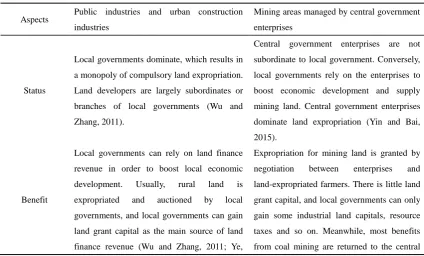
dismantled with compensation. Table 1 indicates that one reason for such skeleton house
construction may be related to the absence of laws and legislation, not least because there are
known differences in how land expropriation in mining areas and house demolition for urban
construction are managed (Table 2). Nevertheless, few studies have attempted to consider the
interests and interactive relationships among multiple stakeholders (e.g. central government
mining enterprises, local governments and land-expropriated farmers) and how these shape
skeleton house construction. Existing research focuses largely on the interests of land-expropriated
farmers, standards of land expropriation, and the social securities in place. This paper targets this
gap using the DPSIR framework as an analytical tool, to investigate why skeleton house
construction is taking place, identifying stakeholders’ understandings of current trends in
[image:8.595.84.509.514.770.2]compensation, and how the problem could be addressed.
Table 2 Primary differences between local governments in land expropriation and house demolition Aspects Public industries and urban construction
industries
Mining areas managed by central government enterprises
Status
Local governments dominate, which results in a monopoly of compulsory land expropriation. Land developers are largely subordinates or branches of local governments (Wu and Zhang, 2011).
Central government enterprises are not subordinate to local government. Conversely, local governments rely on the enterprises to boost economic development and supply mining land. Central government enterprises dominate land expropriation (Yin and Bai, 2015).
Benefit
Local governments can rely on land finance revenue in order to boost local economic development. Usually, rural land is expropriated and auctioned by local governments, and local governments can gain land grant capital as the main source of land finance revenue (Wu and Zhang, 2011; Ye,
2014). government (Wang, 2016).
Effect
The local economy will grow and the urban environment will be improved. Land-expropriated farmers have better employment prospects and social security, all of which are sought by the local government (Zhao et al., 2014).
Although the local economy and employment can be improved by the resource industries, local governments have to bear enormous pressures from employment and social security of land-expropriated farmers and transformations to the economy. Problems are particularly severe after coal reserves become exhausted (Wang, 2015).
2 Methodology
2.1 Study area
Pinglu District, lies in the west of Shuozhou City, and Shuozhou City lies in the northwest of
Shanxi Province, China in the semi-arid, warm temperate, continental monsoon climate zone
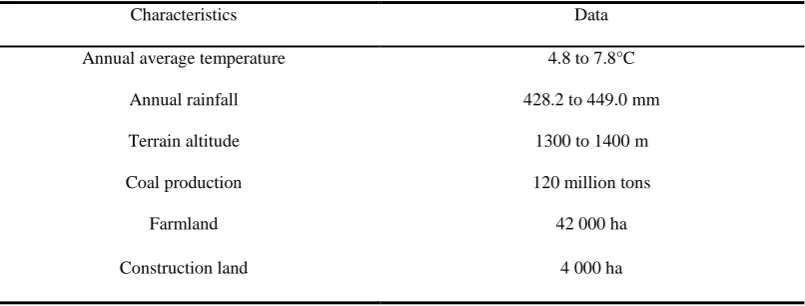
(Table 3) and is a mixed mining-rural-settlement area (Cao and Bai, 2015). The area of Pinglu
District is 2,314 km2 and constitutes 21.6% of the Shuozhou City. The study area is a part of
Pinglu District, and it includes Jingping Town, Xiangyangbao Township, Baitang Township,
Yuling Township, Taocun Township and Xiamiangao Township. The majority (90%) of coal
production in the area comes from three surface (Antaibao, Anjialing, Donglutian) and three
underground (No.1, No.2, No.3) mines operated by Pingshuo China Coal Corporation (PCCC),
with the remainder from smaller, local underground mines. The mined area accounts for 70% of
the study area (517 km2). The study area offers a useful case as it faces land expropriation issues
[image:9.595.99.502.603.756.2]similar to those experienced in other regions of China in recent years.
Table 3 Physical characteristics of Pinglu District, Shanxi Province, China
Characteristics Data
Annual average temperature 4.8 to 7.8°C Annual rainfall 428.2 to 449.0 mm Terrain altitude 1300 to 1400 m Coal production 120 million tons
Farmland 42 000 ha
Destruction land 6 000 ha
Destruction land includes any degraded land cover, such as excavated sites, subsidised land and contaminated land (MLR, 2013).
2.2 DPSIR model
The DPSIR (Driving forces, Pressures, Statuses, Impacts and Responses) framework is a
conceptual model for understanding complex interactions between human and environmental
systems (Svarstad et al., 2008). Increasingly, researchers use the framework in environmental
management, to assess and monitor environmental trends (Zhou et al., 2015). DPSIR’s focus on
linkages encourages trans-disciplinary research, connects policy makers and stakeholders, and
allows the framework to act as a heuristic tool for complex systems analysis. However, it has been
critiqued for encompassing biophysical factors or socio-cultural dimensions rather than fully
integrating both types of information. Further, it cannot quantitatively consider the dynamics of
the system it models, handle cause-consequence relationships, suggests linear unidirectional
causal chains, and ignores key non-human drivers of environmental change (Rekolainen et al.,
2003; Lewison et al., 2016). Despite these issues, it provides a useful framework for analysis in
this research. We apply it in a novel situation not only to reveal the complex interactions between
environmental impacts from coal mining and human dependency on the coal economy, but also to
frame our analysis of the interests and interactive relationships among the multiple stakeholders in
land expropriation and compensation. Such a novel application is justified because this research
spans multiple disciplines including mining, ecology, environmental management and
environmental social sciences and takes a systems approach, qualitatively analysing the
interactions and relationships between stakeholders and the environment.
A general DPSIR model has a broad scope. It contains different types of information about
the environmental and human system (Zhou et al., 2015). In this study, DPSIR is used as a
structuring tool as follows:
D (driving force) indicators reflect management policies and the human activities that
affect the environment and society.
P (pressure) indicators reflect the environmental and social stress exerted by human
S (status) indicators reflect the current physical, biological and chemical statuses of the
environment and the developmental statuses of the society.
I (impact) indicators reflect influences on the human social system due to status
changes.
R (responses) indicators reflect social responses to the human social system impacts.
In our study area, both environmental and human systems are severely disturbed by coal
mining, with few obvious areas of agreement among the coal enterprises, local governments and
land-expropriated farmers (Yin and Bai, 2015). For instance, land-expropriated farmers expand
skeleton house construction or occupy land for their construction simply to obtain more
compensation, which therefore acts against the interests of the coal enterprises. However, this
phenomenon has largely been a result of policy drivers outside the control of the other main
stakeholders. The result is a deterioration in both the environment and human systems. By
analysing the driving forces, pressures, statuses, impacts we can reveal a more nuanced
understanding of the processes at play, as well as the perspectives of different stakeholders, and
develop ways forward to better control the issue.
2.3 Data collection
We used a mixed method approach to data collection, including semi-structured interviews,
literature and document analysis (Table 4). Semi-structured interviews were conducted in May
2016 with three staff from PCCC responsible for land expropriation; three staff from Pinglu
District Government responsible for land use management; and sixty land-expropriated farmers.
Land-expropriated farmers were interviewed with focus on the main labourers and dominant
family members, and included thirty-six land-expropriated farmers yet to be relocated. There were
forty-six men and fourteen women interviewed, and thirty-four interviewees aged from
twenty-five to fifty-five. Twenty-six interviewees were above the age of fifty-five. Questions
asked are summarised in Appendix 1.
Table 4 Methodological approach, data types and information sources used to inform the development of the DPSIR model for land expropriation in Pinglu District, Shanxi Province, China. Questions are given in
Methods Data and information themes Semi-structured
interviews (Staff of Pingshuo
PCCC)
- Dust pollution compensation fees - Skeleton house compensation costs
- Length of time before land compensation schemes are publicised that skeleton houses must be constructed
- Water supply around mining area
- Expropriated farmers struggles for more compensation - Methods for helping land-expropriated farmers Semi-structured
interviews (Staff of Pinglu District Government)
- Approaches taken to increase urbanisation rates and reduce income gaps - Residential urban land supply
- Social security available for land-expropriated farmers - Attitudes towards skeleton houses
Semi-structured interviews (Land-expropriated
farmers)
- Changes in compensation and relocation standards through time - Cost of skeleton house construction
- Benefits gained from dismantling skeleton houses - Impacts of coal mining
- Level of satisfaction with compensation and relocation standards - Importance and types of available social security
Literature and document analysis
(References and statistical year books)
- Coal production, sale and income for PCCC (Cao and Bai, 2015; Cao et al., 2016) - When relocations occurred, which villages were moved and how many people were involved (Yin, 2013)
- Economic situation in Pinglu District (Pinglu Statistics Yearbooks 1986, 1995, 2004, 2013)
- Areas of land use types (Cao and Bai, 2015) - Mining land supply (Yin and Bai, 2015)
- When coal reserves became/will become exhausted (Cao and Bai, 2015)
- Land-expropriated farmers’ ideas about after land expropriation (Yin and Bai, 2015)
- Pension and unemployment benefits (Shuozhou News Website, 2014) - Cost and time of land expropriation (Yin and Bai, 2015)
Data were qualitatively and quantitatively analysed using the DPSIR framework as an
organising tool, summarising key findings and assigning them to the relevant element of the
framework. Traits and changes to the system over time were subjected to quantitative analysis. For
example, trend analysis and ratio analysis were adopted to discover the dynamics of coal
production, sale and income in PCCC and economic development in Pinglu District. Qualitative
analysis was also used, e.g. increases in land expropriation costs were summarized from changes
in compensation and relocation standards, and dust pollution compensation fees, and the pressures
of Pinglu District Government were comprehensively analyzed from residential urban land supply
data, information on social security available for land-expropriated farmers, and so on.
3 Results and discussions
3.1 DPSIR model construction
Semi-structured interviews were summarized, and the themes of responses of different
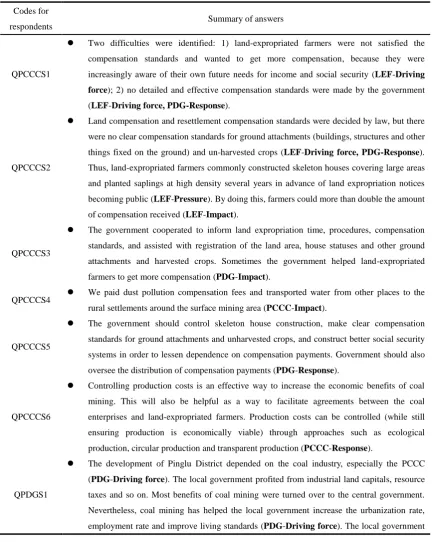
stakeholders were tabulated according to the DPSIR framework categories (Table 5). Findings
presented in relation to the DPSIR model (Table 6).
Table 5 Summary of answers given in semi-structured interviews with multiple stakeholder groups (PCCC: Pinghuo China Coal Corporation; PDG: Pinglu District Government; LEF: Land-expropriated farmer) in Pinglu District, Shanxi Province, China. Text in bold indicates how answers relate to the DPSIR framework, according to whether they can be considered a driving force, pressure, status, impact or response (QPCCS: Question for PCCC staff. QPDGS: Question for Pinglu District Government staff. QEF: Question for land-expropriated farmer) is given in Supplementary Material/Appendix 1.
Codes for
respondents Summary of answers
QPCCCS1
Two difficulties were identified: 1) land-expropriated farmers were not satisfied the compensation standards and wanted to get more compensation, because they were increasingly aware of their own future needs for income and social security (LEF-Driving
force); 2) no detailed and effective compensation standards were made by the government
(LEF-Driving force, PDG-Response).
QPCCCS2
Land compensation and resettlement compensation standards were decided by law, but there were no clear compensation standards for ground attachments (buildings, structures and other things fixed on the ground) and un-harvested crops (LEF-Driving force, PDG-Response). Thus, land-expropriated farmers commonly constructed skeleton houses covering large areas and planted saplings at high density several years in advance of land expropriation notices becoming public (LEF-Pressure). By doing this, farmers could more than double the amount of compensation received (LEF-Impact).
QPCCCS3
The government cooperated to inform land expropriation time, procedures, compensation standards, and assisted with registration of the land area, house statuses and other ground attachments and harvested crops. Sometimes the government helped land-expropriated farmers to get more compensation (PDG-Impact).
QPCCCS4 We paid dust pollution compensation fees and transported water from other places to the rural settlements around the surface mining area (PCCC-Impact).
QPCCCS5
The government should control skeleton house construction, make clear compensation standards for ground attachments and unharvested crops, and construct better social security systems in order to lessen dependence on compensation payments. Government should also oversee the distribution of compensation payments (PDG-Response).
QPCCCS6
Controlling production costs is an effective way to increase the economic benefits of coal mining. This will also be helpful as a way to facilitate agreements between the coal enterprises and land-expropriated farmers. Production costs can be controlled (while still ensuring production is economically viable) through approaches such as ecological production, circular production and transparent production (PCCC-Response).
QPDGS1
[image:13.595.82.515.219.762.2]also worried about the income gap between land-expropriated farmers and urban people (PDG-Pressure), which increased the burden on local government (PDG-Impact). The local government must also consider urban land supply and social security provision for land-expropriated farmers (PDG-Status).
QPDGS2
We have tried different compensation approaches, including the land use method, or changing land expropriation to land rent, but it was difficult to roll out widely. We have also researched other methods to reduce land expropriation costs (PDG-Response).
QPDGS3
We found lots of skeleton houses constructed around surface mining areas (LEF-Impact). It was unnecessary for farmers to get local government’s permission if they built skeleton houses on farmers’ original residence bases. If constructed skeleton houses occupied other land, they would get local government’s permission. Local government couldn’t limit the construction areas and styles as long as they constructed on the permitted residence bases (PDG-Impact).
QPDGS4
If the skeleton houses had been built before land expropriation notices were made public then the houses are legal. Any built after the publicity notices were built illegally and their owners did not receive compensation (PDG-Response).
QLEF1 Most farmers knew about coal mining activity, but were not aware of specific planning or land expropriation notices (PCCC-Response).
QLEF2
Impacts of surface coal mining included land destruction, house cracks because of blast vibrations, decreases in groundwater levels, and crop yield declines because of dust pollution (PCCC-Pressure, PCCC-Statue, PCCC-Impact).
QLEF3:
More than 60% of farmers who had had their land expropriated were trying to relocate to other reclaimed land parcels, if that land was of high quality (PDG-Response). They were looking forward to reaching agreement and moving as soon as possible. Some were anxious about moving (LEF-Impact).
QLEF4:
All land-expropriated farmers need sufficient compensation, good employment and high quality housing (PCCC-Impact). The compensation standards for land and resettlement are following in table 7. The compensation standard of skeleton houses was 600 CNY per m2
(PCCC-Impact). Land-expropriated farmers had the opportunity to discuss the compensation standards and social securities (LEF-Response).
QLEF5
Some land-expropriated farmers built skeleton houses using their savings, while some farmers borrowed money from others or from banks (LEF-Status). They did not take into account opportunity costs or risks. They also did not realise that their actions would increase the land expropriation cost and delay moving (LEF-Response).
QLEF6
Most land-expropriated farmers saved their money in banks and bought commercial houses in towns and cities. There were no other reliable ways to invest money open to them (PDG-Response). In contrast, a few began to gamble or spend money on luxury goods (LEF-Response).
QLEF7:
Table 6 Driving forces, pressures, statuses and impacts from different stakeholders Stakeholders Driving forces
(D) Pressures (P) Statuses (S) Impacts (I) PCCC D1:
Expanding coal production capacity and increasing coal output to maximize economic benefits
P1: Destruction
of land by mining activities
P2: Dust
emission
P3: Blast
vibration
S1: Increasing
areas of land expropriated and destroyed
S2: Severe dust
pollution
S3: Severe
damage to housing
S4: Lower levels
of groundwater
S5: Reduced crop
yields
I1: Land near
mining areas is unsuitable for living or farming;
I2: Rural
settlements are moved or compensatio n is paid for environment al destruction
I3: Costs of
coal production increase Pinglu District
Government
D2:
Promoting local economic development through the coal economy
D3: Meeting
urbanization targets by relying on land-expropr iated farmers relocating to towns and cities
P4: Coal
resources transferring to coal enterprises
P5: Mining land
supply
P6: Urban land,
infrastructures and securities becoming scarce due to over-consumpti on
S6: Coal resources
exhaustion accelerated due to over production
S7: Mining land
supply increasing
S8: Increments of
urban land supply for residing, health insurance premium, etc
I4: Burden
on local government increasing due to land-expropri ated farmers moving to towns and cities
I5:
Government acquiescence in
Land-expropriated farmers
D4:
Ambiguous compensatio n standards
D5: Poor
social security system
P7: Expanding
skeleton houses or occupying land in order to build skeleton houses
S9: Lots of money
and land used for constructing skeleton houses
I6: Area of
land receiving compensatio n due to the presence of housing rapidly increasing
I7: Land
expropriation costs increasing;
I8: Slower
rural settlement relocation rates
3.2 Driving forces
The market is an important driver of coal production. Indeed, the fundamental purpose of
coal enterprises is to supply the market with coal to maximise economic benefits (Zhang, 2014). In
meeting this goal, several PCCC mines have met and exceeded their designed production capacity
(Cao et al., 2017). Between 2002 and 2011, coal production increased to 110 million tons,
commercial coal sales were 85 million tons and income increased to 347 million CNY (Fig.1).
While coal production was stable after 2010, sales were increasing, but income decreased slightly
because of declining coal prices (Cao and Bai, 2015) (Fig.2).
0.00 0.20 0.40 0.60 0.80 1.00 1.20
2002 2003 2004 2005 2006 2007 2008 2009 2010 2011 2012 2013
Year P ro d u c ti o n a n d S a le (1 0 0 m il li o n t ) 0 50 100 150 200 250 300 350 400 In c o m e (1 0 0 m il li o n CN Y )
Fig. 1 Coal production, sale and income in PCCC
Pinglu District Government is dependent on the coal industry to meet its economic
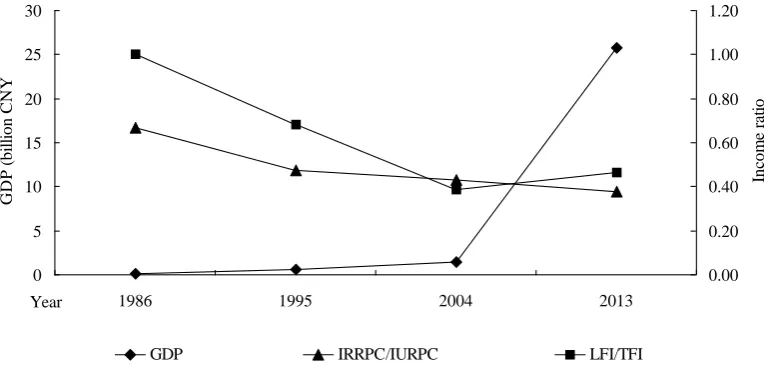
development targets. The Gross Domestic Product (GDP) of the district increased by 25.66 billion
CNY from 1986 to 2013, especially after 2004 (Fig. 2). Although the Local Financial Income (LFI)
gradually increased, the ratio between LFI and Total Financial Income (TFI) gradually decreased
(Fig. 2). While both Income of Urban Residents Per Capita (IURPC) and Income of Rural
Residents Per Capita (IRRPC) increased, the ratio between IURPC and IRRPC decreased (Fig. 3),
indicating that the income gap gradually expanded. Representatives of Pinglu District Government
reflected that it was the very important for local government to reduce the income gap when
land-expropriated farmers moved to urban areas, otherwise it was likely that in the longer term,
the costs for local governments would be higher.
0 5 10 15 20 25 30
1986 1995 2004 2013
Year
G
D
P
(
bi
ll
ion C
N
Y
)
0.00 0.20 0.40 0.60 0.80 1.00 1.20
Inc
om
e r
at
io
GDP IRRPC/IURPC LFI/TFI
Fig. 2 Economic development in Pinglu District (Pinglu Statistics Yearbooks 1986, 1995, 2004, 2013). 1986: construction of Antaibao surface mine; 1995: primary production capacity of Antaibao surface mine; 2004: designed production capacity of Antaibao surface mine and Anjialing surface mine; 2013: over production capacity of Antaibao surface mine and Anjialing surface mine, and designed production capacity of Donglutian surface mine.
Urbanization rates in the research area were 16.25% in 1996, increasing to 45.88% in 2013
(PLSB, 1996; PLSB, 2013). The PCCC organized the relocation of land-expropriated farmers and
now the majority live in towns and cities (Table 7). In 2012, The Pinglu District Government
introduced a policy to increase the urbanization rate to 70% over the next few years (Cao and Bai,
2015). Government representatives reflected during interviews that the government encouraged
[image:17.595.121.507.341.525.2]Compensation covers the cost of the land, ground attachments, un-harvested crops and a fee
for resettlement (The Law of Land Administration of the People's Republic of China, 2004). For
land and resettlement costs, compensation was paid at the highest rates available within the
regulations (Yin and Bai, 2015). There are no clear standards for the compensation fee for ground
attachments or for un-harvested crops. However, although it is stipulated that construction and
crop planting after the land expropriation notice becomes public are not eligible for compensation,
many farmers constructed skeleton houses in the previous five to ten years. This indicates that
ambiguities in the compensation standards give land-expropriated farmers the chance to receive
more compensation (Zhu and Dong, 2015), albeit at their own risk. The higher compensation for
those with skeleton houses is an important driver of their construction.
Land and housing represent farmers’ source of income and security in China (Sargeson,
2013). Following relocation, farmers said their living conditions and incomes improved, but many
(especially those between forty and fifty years old) feared the future once the coal had been
exhausted. They therefore hoped to demand more compensation. The opinions of
land-expropriated farmers varied: 30.22% wanted to enjoy their old age in peace, 34.53%
expected to depend on their children, 25.90% hoped to continue to work, and 9.35% wanted to
have their own business (Yin and Bai, 2015). The land-expropriated farmers said they demanded
sufficient compensation capitals, good employment positions and satisfactory houses in order to
meet their basic needs. In China, most land-expropriated farmers own no technologies, lack
education, and rely on social security (Xiong, 2016).
3.3 Pressures
Pressures on the environment from mining include land destruction, dust emission and blast
vibration, all of which increase as more coal production takes place. Increases in coal production
(and the associated transfer of land and resources to the mining sector) are driven by the
requirements of the local economy to meet economic and urbanisation targets, both of which are
dependent on the coal industry in this region of China. As more land is given over to mining, more
farmers have their land expropriated. The Pinglu District Government was concerned about the
income gap between the land-expropriated farmers and urban residents. The land-expropriated
inadequate, and maximising their compensation rates to address this is the reason behind the
construction of skeleton houses up to ten years before land is actually expropriated for mining.
3.4 Statuses
Overproduction in the coal mining sector has led to an accelerated rate of reserve exhaustion.
Indeed, it is now thought that mines in PCCC will be closed within forty years; some forty years
earlier than their designed lifespan (Cao and Bai, 2015). As coal was mined more rapidly, more
land was needed to supply the industry, resulting in ever greater areas of land being expropriated
from farmers. For instance, the annual supply of land for mining for Antaibao and Anjialing
surface coal mines was <330 ha before 2010. This doubled (to 660 ha) with the opening of the
Donglutian surface coal mine (Yin and Bai, 2015).
Land use types altered from cultivated land, woodland, grassland and rural settlements to coal
mining land after expropriation. In the process of surface coal mining, the damaged land area
increased from zero in 1986 to 6000 ha in 2013 (Cao et al., 2015). 10220 ha of cultivated land was
destroyed by coal mining, mostly from 1986 to 2013, meanwhile other land uses saw losses too:
woodland (2335 ha), grassland (4690 ha) and rural settlement (614 ha). The average damaged
areas of cultivated land, woodland, grassland, rural settlement per 100 million tons of coal
production were 1910 ha, 436 ha, 877 ha and 115 ha respectively.
Dust pollution from surface coal mining can be severe and stems from blasting, loading,
transporting and dumping (Mandal et al., 2012). The impacts of dust pollution include reduced crop
growth and yields. Dust covered crop leaves in the study area for a long time because of the dry,
low rainfall climate. Expropriated farmers reflected that crops within 3 km of the surface mining
area were polluted by the dust, and yields reduced by 50%. Houses within 2 km of the opencast
area were damaged with severe deformation and cracks by the blast vibration. Expropriated
farmers said they were worried about the damage to their houses, but despite having their land
expropriated, often still did not know when they would be moved to new properties. The water
system was also affected (Manna and Maiti, 2016). The confluence of ground water changed
because of landform changes, obstructing stream flow and altering water availability in the lower
parts of small catchment basins (Manna and Maiti, 2016). Furthermore, underground water levels
farmers said the quantity of water in rivers downstream from mines had reduced, and some of
them had become permanently dry. Expropriated farmers said that they could get underground
water with wells around 10 m deep prior to the start of mining, but that subsequently even wells
100 m deep were dry.
Representatives of Pinglu District Government reflected that they must consider the amount
of urban land required for rehousing land-expropriated farmers alongside their needs for
employment. For instance, there were three communities (total area 59 ha) where
land-expropriated farmers could live (Cao and Bai, 2015). Around 30% of land-expropriated
farmers were subsequently employed by PCCC, 34% of them worked locally, around 25% were
looking for work and 11% were recuperating from illness at home (Yin and Bai, 2015). Pinglu
District Government promised that all of the land-expropriated farmers (whether they worked or
not) should receive social security. 15,588 land-expropriated farmers paid a small premium and
joined the social security system in 2014. In addition, 2893 land-expropriated farmers have started
to receive pensions (totalling 19 million CNY) or unemployment benefits (SNW, 2014).
Land-expropriated farmers focussed on how to attain more compensation. To do this they
invested money, land and cultivated areas to construct skeleton houses. Their motivation is clearly
seen from the compensation rates available to them. The land-expropriated farmers said cultivated
land was compensated at 40 CNY m2, but houses received 600 CNY m2. Given it was possible to
build a skeleton house for 300 CNY m2 financial gains were substantial. Scaling up, compensation
per ha of cultivated land was 300,000 CNY. Converting this into skeleton houses, which are
typically two-storeys, results in 2 ha of house area, delivering a net income of 6 million CNY after
expropriation, some 20 times more than if the land had been left as cultivated land. In order to
build this housing, land-expropriated farmers said they borrowed money or obtained loans. There
was 484.46 ha of cultivated land occupied by rural settlements between 1986 and 2013, some of
them consisting of skeleton houses. In China, house construction is forbidden on cultivated land
except when land use planning permission has been granted. Although planning permission may
be given, the house construction should be approved for cultivated land transformation by the
county (district) governments (The Law of Land Administration of the People's Republic of China,
2004). The highest rates of construction took place between 2000 and 2004, when 137.68 ha
3.5 Impacts
Living and farming within 3 km of the surface mining area was deemed impossible by
expropriated farmers. Four periods of relocation took place between 1986 and 2013 (Table 7).
There were obvious differences and inconsistent compensation standards associated with
relocation.
In addition to expropriation costs, representatives of PCCC said that the enterprise pays an
annual dust pollution compensation fee of 1720 CNY per capita to expropriated farmers who had
not moved. Meanwhile, the enterprise must transport domestic water from other places to the coal
mining area because of coal mining induced water scarcity. All of these factors increased the
production costs of PCCC.
The enterprise hoped land-expropriated farmers would move as soon as possible.
Representatives of PCCC reflected that expropriated farmers wanted more compensation and
better relocation packages because of rising costs of living and increased awareness of social
security. Interviewees said that farmers had expanded or constructed skeleton houses five to ten
years earlier, so they existed before the land compensation notices were made public. As such,
they were legally entitled to compensation, resulting in an increased cost of expropriation for the
[image:21.595.90.504.536.757.2]coal enterprise.
Table 7 Numbers of people relocated and villages moved during four phases of mining in Pingshou District, China. Information on the types of compensation paid was taken from interviews with land-expropriated farmers
Time
period Moved villages
Relocated
people Compensations 1985-1995 Antaibao,
Cuijialing, Nansi, Dongsuanci, Yingziwa, Xisuanci
1900 Land compensation fee and un-harvested crop compensation fee were 3 CNY per m2;
One worker in each family was given work in PCCC;
Compensation fee for relocation was 8000 CNY per capita;
Each family could get 2000 CNY to buy one relocation house of 150 m2 (3000 CNY);
Men above 60 years old and women above 50 years old could get monthly pension of 200 CNY per capita 1998-2002 Baixinyao, Shang
yao, Maanshan
1500 Land compensation fee was 16 CNY per m2; Crop compensation fee was 7000 CNY per capita;
employed by PCCC;
Compensation fee for relocation was 10000 CNY per capita;
Each family can buy one relocation house of 160 m2 in
Qinyi Community in Jingping Town (80000 CNY);
Residents under 18 years old could get a monthly living subsidy of 160 CNY per capita, residents between 18-22 years old could get a monthly unemployment subsidy of 360 CNY per capita, residents between 60-85 years old could get a monthly pension of 560 CNY per capita
2007-2010 Qian’anjialing, Houdong, Houxi, Baishiya, Yangquan
4900 Land compensation fee and un-harvested crop compensation fee were 31 CNY per m2;
Those 18-35 years old in each family were arranged work in the PCCC;
Compensation fee for relocation was 80000 CNY per family;
Each family can buy a relocation apartment in Wenyuan Community in Jingping Town, and the price was 960 CNY per m2 if the apartment area per capita
was less than 30 m2, otherwise, the price was 1260
CNY per m2;
Residents under 18 years old could get a monthly living subsidy of 160 CNY per capita, residents between 18-22 years old could get a monthly unemployment subsidy of 360 CNY per capita, residents between 60-85 years old could get a monthly pension of 560 CNY per capita
2011-2013 (in process at the time of
data collection)
Qiaoqian, Qiaohou, Nanwa, Zhuanjing, Yuling, Xuejiagang, Louzigou
7400 Land compensation fee and un-harvested crop compensation fee were 37 CNY per m2;
Compensation fee for relocation was under discussion;
Each family can buy a relocation apartment in Shanxue Community in Jingping Town, and the price was under discussion;
The house rental costs of moved farms in Jingping Town was paid by PCCC;
Residents under 18 years old could get a monthly living subsidy of 160 CNY per capita, residents between 18-22 years old could get a monthly unemployment subsidy of 360 CNY per capita, residents between 60-85 years old could get a monthly pension of 560 CNY per capita
Pinglu District Government said sometimes they lacked influence on decisions around land
expropriation and could not decide the scale, timing or standards of compensation standards.
Pinglu District Government and land-expropriated farmers both felt that the land-expropriated
farmers should be entitled to greater access to social security payments (Yin and Bai, 2015). The
representatives of PCCC said that Pinglu District Government helped the land-expropriated
farmers to achieve higher levels of compensation through policy deregulation in rural housing
sites and house extensions. Government representatives said that they knew the actions of
land-expropriated farmers, but it was very difficult to manage and control the house construction
areas and the styles. As a result, the cost of land expropriation increased as a greater area of land
was taken up by housing. Representatives of PCCC said the house construction area requiring
compensation also doubled due to skeleton house construction. Meanwhile, land-expropriated
farmers felt they should receive even higher levels of compensation for the skeleton houses to
cover the opportunity costs of the time, money and land. Thus, land expropriation costs increased,
making it harder to reach agreements on compensation standards, especially when the demand for
coal started to fall. This resulted in a delay in when expropriated famers could actually relocate
away from mines.
3.6 Responses
The driving forces, pressures, statuses and impacts of multiple stakeholders relating to
skeleton houses construction have been analyzed in the previous sections. Responses are proposed
here according to the elements under the driving forces, pressures, statuses and impacts categories
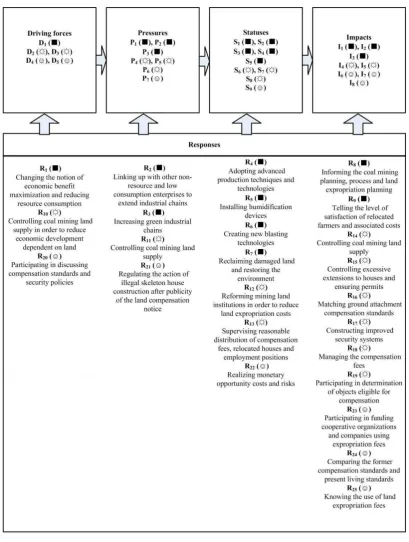
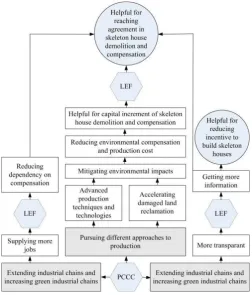
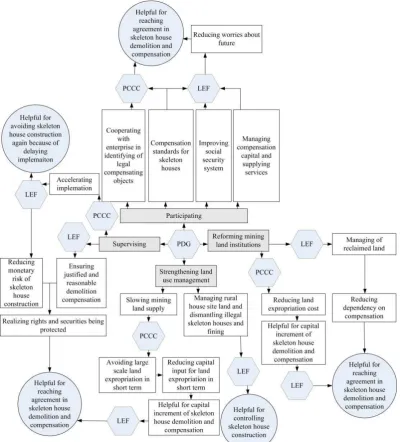
(Fig. 3). Some responses directly relate to skeleton houses; others are indirectly related,
meanwhile, the response processes of different stakeholders for skeleton house issues are
demonstrated (Fig. 4, Fig. 5 and Fig. 6). The existence of and compensation for skeleton house
demolition is not only related to the land expropriation institution; it also relates to the
relationships between the stakeholders. For instance, skeleton house construction is a response
undertaken by farmers who are dissatisfied with the compensation they receive for their loss of
livelihood options. Most responses carried out by stakeholders are therefore, based on their own
Fig. 3 Possible responses of the three stakeholder groups ( : PCCC, : Pinglu District Government, : Land-expropriated farmers) to the driving forces, pressures, statuses and impacts of the expanding coal mining
sector in Pinglu District, Shanxi Province, China.
(1) Responses of PCCC
approach to production that takes into account land compensation and destruction. Doing this
would likely decrease the cost of production and therefore improve profitability (Fig. 3 and Fig. 4)
(Fan et al., 2015). It is thus essential that PCCC adopts advanced production techniques and
technologies to reduce the environmental impacts from surface coal mining (Fig. 3 and Fig. 4).
For example, methods of avoidance, containment, suppression, and collection were used in
Australia to control dust emission (DECCW, 2010). Dust and weather monitoring equipment, air
humidity devices and hopper trucks were used to reduce dust (DECCW, 2010; Liu et al., 2016),
and new explosives can be adopted for reducing blasting impacts (Wang et al., 2016). Meanwhile,
the ecological environment in the mining area can be improved by limiting exposed areas,
accelerating damaged land reclamation and optimizing land reclamation quality (DECCW, 2010;
Zhou and Zhou, 2013). Ecological production will increase the production cost, but it will reduce
the environmental impacts from coal mining and the dust pollution compensation fee, and will be
helpful for gaining capital and reaching agreements on skeleton house demolition and
compensation.
In the process of relocation, PCCC needs to be responsible for the employment of
land-expropriated farmers in order to reduce the relocation cost. It would be helpful for PCCC to
link up with more non-resource, low consumption enterprises to extend industrial chains and
increase green industrial chains, creating new jobs (Fig. 3 and Fig. 4). The coal industry relying on
industrial chain extension creates jobs in industries that support coal mining, and by providing
reliable and low cost electricity that stimulates growth across the entire economy, especially in
manufacturing (NCC, 2015). Experiences from around the word support this. There were 25,000
new jobs provided after coal in Kentucky (US) dependent on new industrial chains related to
energy efficiency, forest products tourism and environmental remediation (Ackerman and
Comings, 2015). PCCC focuses on coal production, coal sale and electricity generation. Lots of
jobs are associated with this industry, in coal mining, coal sale, coal transportation and electricity
generation. Developing a cleaner coal chemical industry is an important method for extending coal
industrial chains. Ecological agriculture and installation agriculture can be implemented on the
reclaimed land, meanwhile, ecological tourism can be developed with the advantage of industrial
landscape, restored area, ecological agriculture and installation agriculture. All of these are
benefit from industrial chain extensions and increases, while improved economic development and
employment rates will be welcomed by the local government and local residents. Importantly,
land-expropriated farmers could profit from extending and increasing industrial chains because
more job opportunities help the land-expropriated farmers to reduce their dependence on land
expropriation and skeleton house compensation which will therefore also facilitate agreement on
the issue of skeleton house demolition and compensation.
Land expropriation processes should be more transparent (Fig. 3 and Fig. 4). The
land-expropriated farmers should be kept informed and PCCC should take into account that
farmers would like to know how expropriation decisions are taken and the implications for them.
Involving farmers in these processes is likely to increase satisfaction with land expropriation
compensation. Thus, PCCC should keep farmers fully informed of plans for mines and subsequent
land expropriation. Farmers should also be made aware of opportunities and benefits associated
with relocation. Providing more complete information could reduce the incentive for farmers to
rush to build skeleton houses (Fu, 2014; He and Asami, 2014). The land-expropriated farmers said
they did not know the concrete coal mining plans and thought their skeleton houses would be
dismantled and compensated at most, five years after construction. They failed to realize that their
skeleton houses might not have been dismantled ten years later. Similarly, if farmers can fully
participate in the land expropriation process, effective feedback (e.g. through hearings and
meetings) should ensure that expropriation can proceed more efficiently for the farmers
themselves (Hong, 2016). Increased transparency is likely to be welcomed by farmers and
although the coal enterprise may not initially see many benefits from being more open about their
plans, in the longer term they are likely to see a reduction in costs and fewer delays when they
Fig. 4 Response process of PCCC to skeleton houses
(2) Responses of Pinglu District Government
Local governments should play an important role in land expropriation, especially in skeleton
house management, not least because they put together land expropriation policies, approve land
use management plans and protect the rights of farmers who have their land expropriated.
It is necessary to focus on the interests of PCCC, Pinglu District Government and
land-expropriated farmers in the approval of land supplies (Fig. 3 and Fig. 5). The coal enterprises
would like to increase the demand for land for mining in order to increase profits. The
land-expropriated farmers want to receive higher levels of compensation (as demonstrated by the
construction of skeleton houses). A strong land use management system is required to
simultaneously address these issues. In Australia, state and local government strategic land use
planning across coal rich regions was strictly abided by to create huge potential for sustained coal
mining (Glowacz and Abnet, 2011). Thus, Pinglu District Government should supply coal mining
land according to a land use plan, rather than via an ad hoc process. The representatives of Pinglu
District Government said if the coal mining land is controlled, the speed of local economic
development and urbanization of land-expropriated farmers will also be controlled. They also said
system of fines for illegal skeleton house construction. Although strengthening the role of the local
government might impose constraints on the expansion of the coal sector, it will also reduce
skeleton house construction, lower compensation payments for other land expropriation in the
short term and concentrate capital for skeleton house demolition and compensation, and speed up
the relocation of expropriated farmers.
There is no effective supervising mechanism for land expropriation in China (Li, 2015). The
representatives of Pinglu District Government thought that establishing a land expropriation office
to supervise land expropriation and compensation would be an effective mechanism (Fig. 4 and
Fig. 6). This would (i) accelerate the implementation of land expropriation and skeleton
demolition and reduce the time farmers must wait for compensation, and avoid skeleton house
construction again because of delayed implementation; and (ii) ensure that any compensation is
justified and reasonable. It is very important to let land-expropriated farmers know that their
proper rights and social securities are protected by the government. Bao and Peng (2016) indicated
that when land-expropriated farmers thought their rights and securities were protected, their
uncertainty about the future decreases, and they no longer carry out other activities to increase
compensation. Overall, it gives them encouragement to reach agreement in skeleton house
demolition and compensation.
Pinglu District Government can also reform mining land institutions in order to reduce the
land expropriation costs for PCCC (Fig. 3 and Fig. 5). The representatives of PCCC said that land
expropriation costs were too high, and they hoped Pinglu District Government would reform
mining land institutions. In other opencast mining areas, reforms have already been implemented.
For example, land for an opencast area and dump site can be rented for five to ten years from the
rural collective, and then returned to the rural collective after reclamation. The land for industrial
sites can be expropriated and transferred to the enterprise for fifty years (Li, 2011). The cost of
land rent is less than that of land expropriation (Kang and Liu, 2015). The reclaimed land is
managed by PCCC, and there is no effective method for the enterprise to retire the reclaimed land
management in order to reduce its cost. The representatives of PCCC also said Pinglu District
Government should make policies to help the enterprise retire from the management of reclaimed
land and encourage land-expropriated farmers to take it on. Thus, both the coal enterprise and the
coal enterprise to decrease land use costs and give the opportunity to increase skeleton house
demolition and compensation, meanwhile, it will help the land-expropriated farmers to reduce
their dependency on compensation.
Pinglu District Government should actively participate in land expropriation compensation
and relocation (Fig. 3 and Fig. 5). The government firstly should ensure that ground attachment
(including skeleton houses) compensation standards meet The Law of Land Administration of the
People's Republic of China (2004), and these standards must be considerate, feasible, quantitative
and uncontested (Mei, 2007). The government secondly must develop an improved social security
system for land-expropriated farmers in terms of employment, education, health and provision for
their old age, and avoid them being marginalized on moving to towns and cities (Hui et al., 2013).
The government thirdly should help land-expropriated farmers to manage the compensation
capital and supply information and technology services to ensure their employment and future
livelihoods (Bao and Peng, 2016). Finally, the government should participate in the land
expropriation, especially cooperate with the enterprise in the identification, discussion and
registration of legal compensating objects after the publicity of the land expropriation notice (Liu
et al, 2016). The representatives of PCCC also said that the ground attachment compensation
standards were helpful as they clearly implemented compensation for skeleton house demolition.
Meanwhile, the land-expropriated farmers reflected that help from the government can reduce
their worries about their future incomes. Thus, all of these will be helpful for reaching agreement
Fig. 5 Response process of Pinglu District Government (PDG) to skeleton houses
(3) Responses to land-expropriated farmers
Given that farmers are most impacted by the expansion of coal mining, they should play a
role in shaping both how compensation is distributed, and the appropriate levels of compensation.
The land-expropriated farmers should discuss the compensation standards and social security
policies in the hearing meetings with the enterprise and the government (Fig. 3 and Fig. 6).
Generally, if the land-expropriated farmers participate in making the compensation standards, they
will feel more satisfied with the resulting schemes (Liu et al, 2012), thus ensuring the process
awards reasonable levels of compensation. In addition, land-expropriated farmers should
expropriation capital and the information and technology supplied by the government, and be paid
interest according to their stocks (Bao and Peng, 2016). This will assist the land-expropriated
farmers to have confidence that they will gain more benefits as a result of their own actions, rather
than focusing entirely on getting more compensation from skeleton house demolition. Both of
them will be helpful for PCCC to reach agreement in skeleton house demolition and
compensation.
It is necessary for land-expropriated farmers to compare the current compensation standards
with the former compensation standards, while also comparing present living standards of the
former land-expropriated farmers with the original living standards (Fig. 3 and Fig. 6). This will
help to allay farmers’ concerns but also help PCCC and Pinglu District Government to make
reasonable and considerate compensation standards and social security policies (Kang and Liu,
2015), helping to reach agreement on skeleton house demolition and compensation. The monetary
opportunity cost and risk should be realized by the land-expropriated farmers who plan to
construct skeleton houses five to ten years before land expropriation. The land-expropriated
farmers said that they had not taken into account these costs and risks when they constructed
skeleton houses. Farmers should not only be made more aware of their legal obligation not to
construct skeleton houses after land compensation notices become public, but also avoid
constructing them in the first place. Qin et al. (2015) indicated that skeleton house construction
increases land expropriation costs and slows down farmer relocation. If they understood both of
these things, it would reduce the incentive to build skeleton houses. Finally, farmers should also be
made aware that compensation capital represent only one aspect of their future livelihood security