Economic Instruments of Pollution Control in
an Imperfect World: Theory, and Implications
for Carbon Dioxide Emissions Control in China
Tingsong Jiang
A thesis submitted for the degree
of Doctor of Philosophy of The Australian National University
Declaration
This thesis contains no material which has been accepted for the award of any other degree or diploma in any university. To the best of the author’s knowledge and belief, it contains no material previously published or written by another person, except where due reference is made in the text.
Acknowledgement
It would not have been possible to complete this thesis without the generous assis tance and unfailing support of many individuals and institutions. I would like to express my sincere gratitude to them all.
I have been particularly fortunate with my advisory panel of Professor Warwick McKibbin, Mr. Ben Smith and Dr. Yiping Huang. Warwick has been a wonderful encouraging supervisor, combining acute attention to detail with a breadth of vision and penetrating insight. I benefited greatly from all our discussions. I have also benefited from discussions with Ben, and his feedback was prompt and helpful. Yiping, a long time friend, suggested I apply for PhD study at the Australian National University, and was usually the first person from whom 1 sought help during the early days of my PhD course.
My time at the Division of Economics in the Research School of Pacific and Asian Studies and the Asia Pacific School of Economics and Management at the Australian National University has been the happiest and most intellectually stimulating of my life. I would like to thank all the Division staff, especially Drs. George Fane, Prema- Chandra Athukorala, Mei Wen, Chris Manning, Ross McLeod, Xin Meng and Mardi Dungey for their helpful comments, suggestions and friendship. Discussions, and even sometimes arguments, with my fellow students Alexandra Sidorenko, Kanhaiya Singh, Qun Shi, Chia-Hung Sun and Yuyu Chen were also fruitful and helpful. I am in debt to the Economics Divisional Administrator, Ms Carol Kavanagh, for her help with both administrative issues and editing.
as well as at a number of conferences: the 6th Biennial Meeting of the International Society for Ecological Economics, the 29th Annual Conference of the Economic Society of Australia, the 2000 PhD Conference in Economics and Business. I would like to thank all the participants at these seminars and conferences for their valuable comments and suggestions. Special thanks go to Professor Peter Dixon from Monash University and Dr. David Stern from ANU’s Centre for Resource and Environmental Studies for providing valuable discussion on my work.
I also benefited from the comments received when some findings from this thesis were submitted to various journals. Chapter 2 has been accepted for publication in The Australian Journal of Agricultural and Resource Economics, a part of Chapter 4 in Environmental and Development Economics, and Chapter 5 is to be included in the book Dilemmas of China Economic Growth in the Twenty First Century (edited by Ross Garnaut and Ligang Song, Asia Pacific Press, 2001). The valuable suggestions and comments from the editors and anonymous referees often inspired a reexamination of the issues from new directions.
I would like to thank Professors Jeremy Warford and Stein Hansen from the Environmental Economics Working Group of the China Council for International Cooperation on Environment and Development for helping me set the tone and structure of the thesis and for suggesting sources of information. I would also like to thank Dr. Prodipto Ghosh from the Asian Development Bank for providing me with the background information of China’s CO2 emissions, and the Institute of Environmental Studies, Japan, for allowing me to use their database for CO2 emission projections.
with academic and financial support.
According to an ancient Chinese maxim, a dutiful son should not leave his parents for a long journey. Therefore I am sincerely grateful to my parents, Sun Xingben and Jiang Guiying, for their understanding and encouragement to leave and pursue PhD study overseas. My younger brother, Tingyou, and sister, Fenghua, took over my responsibility for supporting the family. W ithout their support, I would not have been able to focus on my studies.
Finally, but not least, my love and thanks go to my wife, Qiwen Lin, and daugh ter, Shufan, for their love and support.
Abstract
Using analytical and empirical general equilibrium models, this thesis discusses the economic instruments of pollution control, e.g. emission taxes and tradable permits, with special reference to CO2 emissions control in China. In addition to
the introduction and conclusion chapters, it consists of two parts: discussions on the choice of economic instruments for general environmental problems (Chapters 2-3) together with the evaluation of China’s environmental policies (Chapter 4); and specific discussions on climate change policies (Chapters 5-8).
implication is that the “double-dividend” hypothesis is weakened if the earmark ing of pollution charge revenues for environmental spending is justified by a higher marginal benefit of environmental spending.
Economic instruments, i.e. emission taxes and tradable permits, may also differ if there are uncertainties about the costs and benefits of pollution and pollution abatement. This issue is examined in a general equilibrium setting. It is found that Weitzman’s rule, i.e., choosing instruments based on the relative slopes of marginal benefit and cost curves, is not applicable in a general equilibrium setting, except when restrictions are imposed on consumers’ preference. Such restrictions include risk neutrality and utility separability. Introducing risk aversion and environmen tal spending changes the relative advantage of one instrument over the other. A tradable permit system is more likely favourable in these two situations, ceteris paribus.
Applying the theory of equilibrium pollution, China’s environmental policies, especially the pollution levy system, are examined by the use of an econometrically estimated pollution demand and supply system. Contrary to the usual criticism, it is found that China’s pollution control policies have been effective because firms respond well to emission taxes in the demand function. However, the pollution supply functions are not well-behaved, suggesting th at the government sets envi ronmental controls without reference to the preference of households. In that sense, the policies may not be efficient and could be improved.
individual countries. On the other hand, emission permit trading could improve welfare because income transfers occur along with the trade of permits. However, the allocation of permits among countries is a sensitive and debatable issue. The thesis discusses several allocation arrangements, i.e., allocations based on the prin ciple of equal per capita permits, or the principle of equal proportional reduction in emissions, and finds th at these arrangements are usually in the bargaining set.
To examine some of these findings, a dynamic general equilibrium model, G- Cubed-T, is developed, using China’s newest input-output information and allowing feedback effects of climate change on production. Based on the understanding of China’s population, economic and technological growth, several scenarios of baseline projections about China’s future CO2 emissions are made. The projections show that, given the currently available information, it is not likely for China to have lower emissions than the current level. It is also shown that, in most scenarios, China will become the number one CO2 emitter in the world during the first half of the 21st century, although per capita emissions will still be quite low.
Acronym and Abbreviation
2xC 0 2 ADB AEEI AGE AIM ASF BAU BTU CAC CDM CES CET CETA CGE COD COP CRTM DGE DICE El EMF EPA ESAM FAO FUND FSU FSU /EE GCM G-Cubed GDP GEF GFDL
Doubling of atmospheric C 0 2 concentration Asian Development Bank
Autonomous Energy Efficiency Index Applied General Equilibrium
Asian Pacific Integrated Model
Atmospheric Stabilization Framework Model Business As Usual
British Thermal Unit-Command And Control
Clean Development Mechanism Constant Elasticity of Substitution Constant Elasticity of Transformation
Carbon Emissions Trajectory Assessment model Computable General Equilibrium
Chemical Oxygen Demand Conference Of Parties Carbon Rights Trade Model Dynamic General Equilibrium
the Dynamic Integrated model of Climate and the Economy Economic Instrument
Energy Modeling Forum
Environmental Protection Agency (of the United States) Extended Social Accounting Matrix
Food and Agriculture Organization of the United Nations
climate Framework for Uncertainty, Negotiation and Distribution Former Soviet Union
Former Soviet Union and East Europe General Circulation Model
Global General Equilibrium Growth Model Gross Domestic Product
Global Environmental Facility
GHG GISS GNP GREEN IEA IEW IIASA IMAGE I/O IPCC IS92 JI LATC MAPSS MARIA MBI MESSAGE MiniCAM MPI NEPA OSU PNNL RFF RICE ROW SAR SEPA SEPC SOE SRES SSB TFP TVE TVM UKMO UKMOH UNDP UNEP UNFCCC WB WG
GreenHouse Gas
Goddard Institute for Space Studies Gross National Product
GeneRal Equilibrium ENvironment model International Energy Agency
International Energy Workshop
International Institute of Applied Systems Analysis Integrated Model to Assess the Greenhouse Effect Input-O utput
Intergovernmental Panel on Climate Change IPCC Scenarios 1992
Joint Implementation
Labour Augmented Technical Change Mapped Atmosphere-Plant-Soil System
Multiregional Approach for Resource and Industry Allocation Market-Based Instrument
Model for Energy Supply Strategy Alternatives and their General Environmental Impact
Mini Climate Assessment Model Max-Planck Institut für Meteorologie
National Environmental Protection Agency of China Oregon State University
Pacific Northwest National Laboratory Resource For the Future
Regional Integrated model of Climate and the Economy Rest Of the World
Second Assessment Report (of IPCC Working Groups) State Environmental Protection Administration of China State Environmental Protection Commission of China State-Owned Enterprise
Special Report on Emission Scenaios State Statistical Bureau of China Total Factor Productivity
Township and Village Enterprise Terrestrial Vegetation Model
United Kingdom Meteorological Office High-Resolution UKMO Model
United Nations Development Programme United Nations Environmental Programme
United Nations Framework Convention on Climate Change World Bank
Contents
Acknowledgement i
Abstract iv
Acronym and Abbreviation vii
1 Economic Instruments of Pollution Control: An Introduction 1
1.1 Research Q uestions... 1
1.2 Economic Instruments for Pollution C o n tro l... 4
1.2.1 A Textbook Interpretation of Economic In s tru m e n ts ... 4
1.2.2 Factors Limiting the Success of Economic Instruments . . . . 7
1.2.3 Categories of Economic In s tru m e n ts ... 8
1.3 Application of Economic Instrum ents... 10
1.3.1 Economic Instruments for Environmental Policy in China . . 11
1.3.2 Economic Instruments for Global Warming P o l i c y ... 15
1.4 Selection of Economic In s tru m e n ts ... 19
1.4.1 Information Requirement and U ncertainty... 19
1.4.2 Pre-existing Distortions and Use of Pollution Charges . . . . 21
1.4.3 International C oo p eratio n ... 21
1.5 The Structure of the T h e s is ... 22
2 Earmarking of Pollution Charges and the Sub-Optimality of the Pigouvian Tax 25 2.1 Introduction... 25
2.2 Static Partial Equilibrium Analysis ... 27
2.2.1 Pollution tax/levy imposed on p ro d u c t... 27
2.2.2 Pollution tax/levy imposed on em issions... 32
2.3 Static General Equilibrium A n a ly s is ... 34
2.3.1 The model ... 34
2.3.2 The optimal pollution tax/bounty s c h e m e ... 37
2.3.3 Pollution tax versus emission p e r m i t ... 43
2.4 Dynamic General Equilibrium Analysis... 48
2.4.1 The Model ... 48
2.4.2 Analytical R e s u l t s ... 50
2.5 Conclusion ... 53
Appendix to Chapter 2 ... 55
2. A Decentralised versus Centralised Models ... 55
3 Stochastic General Equilibrium and Environmental Policy Choice 62 3.1 Introduction... 62
3.2 The Model ... 65
3.3 The Policy O p tio n s... 66
3.3.1 The First Best O utcom e... 66
3.3.2 Shocks and consequences ... 68
3.3.3 Is Weitzman’s rule valid in a general equilibrium setting? . . 72
3.4 A Revised M o d e l... 74
3.4.1 Weitzman’s Rule R e v i s ite d ... 75
3.4.2 Risk A version... 76
3.4.3 Environmental Investm ent... 78
3.5 Concluding R e m a rk s ... 82
Appendix to Chapter 3 ... 83
3. A Derivation of Weitzman’s Rule in General Equilibrium . . . . 83
3.B Derivation of Policy Rule in General Equilibrium when the Household is Risk A v e r s e ... 86
3.C Derivation of Policy Rule in General Equilibrium when Envi ronmental Spending is Included... 89
4 Effectiveness and Efficiency: An Assessment of China's Environmental Protec tion Policy 93 4.1 Introduction to China’s Pollution Control Policies ... 93
4.1.1 Pollution Levy S y ste m ... 95
4.1.2 Environmental Impact A ssessm en t... 96
4.1.3 Three-Synchronisation P o lic y ... 96
4.1.4 Other Policy I n s tru m e n ts ... 97
4.2 The D a t a ... 98
4.2.1 Data so u rc e ... 98
4.2.2 A first look at the d a t a ... 99
4.3 Factors contributing to the fall in pollution d e n s ity ...108
4.4 Theory of Equilibrium Pollution ...117
4.4.2 The environmental s u p p ly ... 120
4.5 Specification of F u n c tio n s ... 122
4.5.1 Environmental demand function ...122
4.5.2 Environmental supply f u n c tio n ... 124
4.6 Econometric R e s u lts ... 125
4.6.1 Water Pollution... 126
4.6.2 Air P o llu tio n ...128
4.6.3 Solid Wastes ... 129
4.6.4 Other R e g u la tio n s ... 130
4.6.5 Economic S t r u c t u r e ... 138
4.6.6 Other f a c to r s ... 138
4.7 Conclusion ...139
Appendix to Chapter 4 ...140
4.A Variable D efinition...140
5 Policy Choices of International CO2 Emissions Control 143 5.1 Introduction... 143
5.2 The Theoretical M o d el... 153
5.2.1 Competitive Equilibrium Prior to Environmental Control . . 154
5.2.2 Welfare Optimum ... 155
5.2.3 Instruments to Achieve Welfare Optimum in a Decentralised E c o n o m y ...156
5.2.4 The Second Best P o l i c y ... 159
5.3 Numerical Simulation ... 162
5.3.1 The Climate Model ... 163
5.3.2 The Utility F u n c tio n ... 163
5.3.3 The Production F u n c tio n ... 164
5.3.4 Numerical R e s u l t s ... 166
5.3.5 Sensitivity Analysis ... 172
5.4 Conclusion ... 175
6 A Dynamic General Equilibrium Model of China's Economy 177 6.1 Introduction... 177
6.2 The Structure of G-Cubed-T Model ... 180
6.2.1 F i r m s ...181
6.2.2 H ousehold...186
6.2.3 G overnm ent...188
6.2.4 International t r a d e ... 189
6.2.6 Money d e m a n d ... 190
6.2.7 Energy use and carbon em issions... 190
6.2.8 Climate change and im pacts... 191
6.2.9 Emission taxes and p e r m its ... 194
6.2.10 Price l i n k a g e ... 194
6.3 Parameters Estimation and Calibration ... 198
6.3.1 Elasticities ... 200
6.3.2 Shares and w eights... 201
6.3.3 Impact of climate c h a n g e ...201
Appendix to Chapter 6 ... 209
6.A Variable and Parameter D e fin itio n ... 209
6. B Equations of the China p a r t ... 215
7 Projections of China’s CO2 Emissions 225 7.1 Introduction...226
7.1.1 Energy Consumption and CO2 Emissions in C h i n a ... 226
7.1.2 Existing Projections of CO2 Emissions in China ... 229
7.2 Scenario Driving F o r c e s ... 236
7.2.1 Population ... 236
7.2.2 Economic D e v elo p m e n t... 239
7.2.3 Technology and Energy Efficiency ... 242
7.3 Scenarios and Results ... 244
7.3.1 S c e n a r io s ... 244
7.3.2 Results ... 247
7.4 Concluding R e m a rk s ... 254
Appendix to Chapter 7 ... 255
7. A Estimation of Elasticity and A E E I ...255
7.B Impact of Linking Climate Change to P ro d u ctio n ... 258
8 Policy Options of CO2 Emissions Control in China 262 8.1 Policy T arg ets... 263
8.2 Uniform Taxes vs Differential T a x e s ... 270
8.2.1 Impact of a Uniform International Carbon T a x ... 271
8.2.2 How About a Tax on a Particular S e c to r? ...274
8.3 Emission Permit Trading ... 276
9 Conclusion 285
9.1 Major F in d in g s ... 285 9.2 The Direction for Future W o r k ...289
List of Tables
1.1 Economic Instruments for Environmental Protection and Natural Re
source Management ... 9
1.2 Economic Instruments for Environmental Policy in C h i n a ... 12
1.3 Number of Firms Charged of Pollution L ev y ... 13
1.4 Pollution Levy Revenues from Different Media ... 13
1.5 Pollution Levy Revenues from Different S e c to rs ... 14
2.1 Application of Conditions for E a rm a rk in g ... 41
2.2 First Order Conditions for Dynamic P r o b le m ... 51
2.3 Steady State of General Tax/Income S c h e m e ... 52
2.A Centralised versus Decentralised M o d e ls ... 60
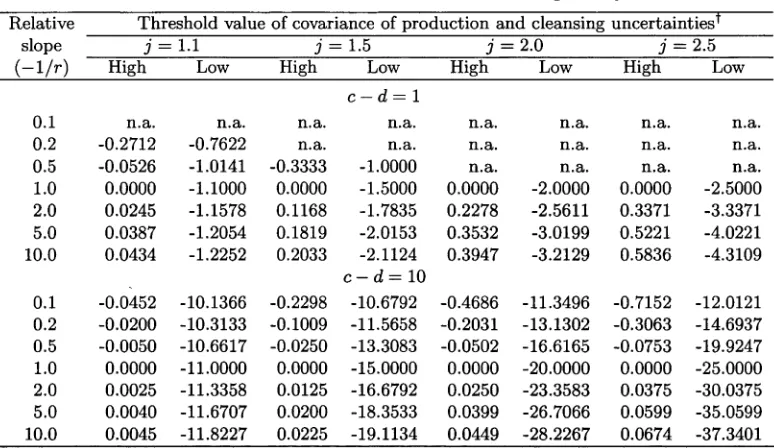
3.1 Threshold Value of Covariance Reversing Policy Choice ... 81
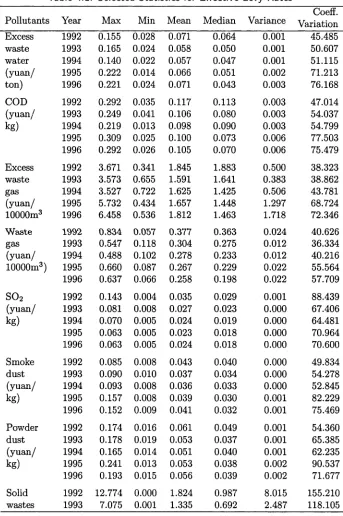
4.1 Selected Statistics for Effective Levy Rates ...100
4.2 Selected Statistics for Regulation Indices... 104
4.3 Selected Statistics for Pollution Intensities... 105
4.4 Decomposition of Change in Emission: Three E ffe c ts ... 109
4.5 Decomposition Methods of Emission C h a n g e s ...115
4.6 Decomposition of Changes in Emissions: Four Effects ... 116
4.7 Demand and Supply: Excess Wastewater ... 127
4.8 Demand and Supply: Excess Waste G a s ... 128
4.9 Demand and Supply: Solid W a s te s ... 129
4.10 Demand and Supply: Excess Wastewater, Excess Waste Gas and Solid Wastes (including H E A V Y )... 130
4.11 Demand and Supply: Excess Wastewater and Waste G a s ...130
4.12 Demand and Supply: Excess Wastewater, Excess Waste Gas and Solid Wastes (including LSTATE) ... 131
4.13 Demand for and Supply of Excess Wastewater, Excess Waste Gas and Solid Wastes (including LLA RG E)... 132
4.15 Testing E d u c a tio n ... 139
4.A Variable D e fin itio n ... 140
5.1 Greenhouse Gas Emissions, tg of C 0 2 -eq u iv alen t... 145
5.2 Carbon Dioxide Emissions and Energy E fficiency... 148
5.3 Numerical Assumptions (before environmental c o n tro l)... 164
5.4 Non-Cooperative v.s. Competitive E q u ilib riu m ...167
5.5 Outcome of Energy Tax with Equal Bargaining P o w e r ... 168
5.6 Tradable Permit with Equal Bargaining Power ... 170
5.7 Sensitivity Analysis of Preference A ssum ption...172
5.8 Sensitivity Analysis of Thecnology A ssu m p tio n ... 173
5.9 Numerical A ssu m p tio n s... 174
5.10 Simulation Result for Three Country G r o u p s ...174
6.1 Elasticities in G -C u b e d -T ... 199
6.2 Elasticities Used in Other China M o d els...200
6.3 Sector C lassificatio n ... 201
6.4 Shares of Individual Inputs in G-Cubed-T Sectors for C h in a ...202
6.5 Selected Estimations of Climate Change Impact on Agricultural Yield 204 6.6 Selected Estimations of Impacts on Forestry of Climate and Land Use C h a n g e ...207
6.8 Damage Parameters Used in the Model ...207
6.7 Selected Estimation of Global Warming D am ag es... 208
6.A Codes for Sector, Region and Variable T y p e ... 209
6.B Definition of V a ria b le s... 209
6.C Parameter D efinition... 213
7.1 China’s Energy C o n su m p tio n ... 227
7.2 Scenario Statistics of China’s CO2 Emissions P rojections...232
7.3 Percentage of Aging P o p u latio n ... 240
7.4 Selected Estimations of China TFP G ro w th ...243
7.5 AEEI Assumption for China in Selected S tu d ies... 244
7.6 Estimated Elasticity of Substitution and A E E I ... 245
7.7 Scenario A ss u m p tio n s ... 247
7.8 Projected Carbon Emissions ( M t c ) ... 249
7.9 Projected GDP (2000 US$ b il l i o n ) ...250
7.10 Projected Per Capita Carbon Emission (ton) ... 250
7.11 Projected Per Capita GDP (2000 U S $ )...251
7.A Evolution of Sector Classification in Chinese Statistics 256 8.1 CO2 Emission Target under Kyoto Protocol and Per Capita Emissions265
8.2 Target Options for China’s CO2 Emission Control ...267
8.3 Effects of a Uniform Carbon Tax of $ 1 0 /tc e ...271
8.4 Emission Trading E x p e rim e n ts ... 277
8.5 Emission Permit Prices and Tax Rates ( U S $ ) ... 277
List of Figures
1.1 Private Cost, External Cost and Social C o s t... 5
1.2 Economic Instruments of Pollution C o n t r o l ... 5
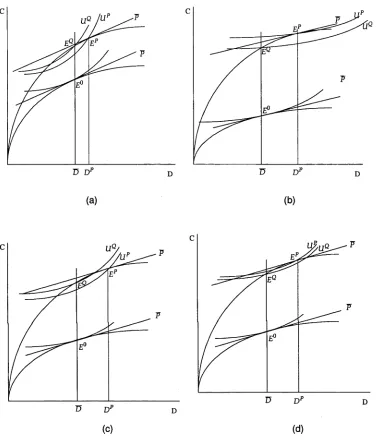
3.1 Price- and Quantity-Control after Positive S h o c k ... 71
4.1 Effective Pollution Levy Rates, 1996 ... 102
4.2 Average and Variance of Effective Levy R a t e s ...103
4.3 Pollution Intensities, 1996 ... 106
4.4 Pollution Intensities vs Effective Levy R a te s ...107
4.5 Decomposition of Pollution Changes: Three E ffe cts... 112
4.6 Decomposition of Pollution Changes: Four Effects ... 117
5.1 Composition of World Carbon Dioxide Emission ... 146
5.2 Per Capita Carbon Dioxide Emissions, 1996 (metric t o n s ) ...149
5.3 Bargaining Set with Differentiated T a x ... 169
5.4 Uniform Tax versus Differentiated T a x ... 169
5.5 Tradable Permit with Endogenous No. Permits, Varying Initial Al location ... 171
5.6 Tradable Permit with Fixed No. Permits and Varying Initial Allocationl71 6.1 Production N estin g ...181
6.2 Price Links in the Model ... 195
6.3 Curvature and Position of Production F ro n tie rs...198
7.1 CO2 Emissions Projections in L ite ra tu re ...230
7.2 Projections of China’s CO2 Emissions in L ite ra tu re ... 233
7.3 Frequency Distribution of China’s CO2 Em issions... 234
7.4 Frequency Distribution of China’s Non-Intervention CO2 Emissions . 235 7.5 World Population P ro jec tio n s... 237
7.6 Population and Population Growth Rate in C h i n a ... 238
7.7 China Population P ro je c tio n s... 238
7.9 Productivity Growth A ssu m p tio n s...246
7.10 China’s Demand for C o a l ... 248
7.11 China’s Demand for Crude Oil and Natural Gas E x tr a c tio n ...248
7.12 Projections of Carbon Emissions in C h i n a ...249
7.A Agricultural Output Relative to “Without Feedback” L e v e l ...259
7.B Total Output Relative to “Without Feedback” L e v e l ... 260
7.C Carbon Emissions ( G t c ) ... 260
8.1 Change to China’s Output L e v e l ... 267
8.2 Reduction in China’s Emissions from Baseline L e v e l ... 268
8.3 Required Carbon Tax Rates for China (US$) ... 268
8.4 Emissions Reduction Caused by a Uniform Tax; of $10 per tee . . . . 272
8.5 O utput Reduction Caused by a Uniform Tax of $10 per t e e ...272
8.6 Wealth Changes Caused by a Uniform Tax of $10 per t e e ...273
8.7 Consumption Changes Caused by a Uniform Tax of $10 per tee . . . 273
8.8 Emissions Reduction of 10% Increase in Coal T a x ... 275
8.9 Carbon Tax to Achieve Emissions Reduction of 10% Increase in Coal Tax ...275
8.10 O utput Deviation from Baseline ... 276
8.11 Effects of Different Policy Instruments on China ... 279
8.12 Share of Permit Sales Revenue in China’s G D P ... 281
Chapter 1
Economic Instruments of Pollution Control:
An Introduction
This chapter gives a brief introduction to the economic instruments and related problems and sets the scope of the thesis. It is organised as follows. The first sec tion raises the questions this thesis tries to answer. Section 1.2 gives a textbook description of economic instruments and identifies some factors affecting their suc cess. Section 1.3 introduces El practices in China and their applications in the area of global warming policy. It is followed by the discussion of choosing economic in struments in certain circumstances. Finally the structure of this thesis is described and a brief conclusion of the findings is given.
1.1
Research Questions
Environmental policies usually consist of two components: setting a goal and choos ing instruments to achieve that goal. Policy instruments in turn take two forms:
“command and control” (CAC) and economic (or market-based) instruments.1
ventionally, authorities tend to set specific standards for firms in order to achieve certain environmental goals. These standards are either technology-based, i.e., spec ifying methods or even equipment that firms should employ; or performance-based, i.e., setting specific control targets for firms while allowing them to decide how to achieve these targets (Stavins 2000a, 2000b). As these instruments allow very little flexibility in the means of achieving environmental goals, they are often referred to as “command and control” instruments.
On the contrary, economic instruments (El) provide firms and/or individuals higher flexibility of compliance. If properly designed and implemented, they can achieve the environmental objectives with least cost and provide incentives for firms and/or individuals to comply with environmental regulations based on their self in terest. Because of these advantages, recent years have witnessed growing popularity for economic instruments.
However, the use of Els does face some limitations in institutional and organi sational capacity and information availability, etc. Moreover, different types of Els may have different consequences under certain circumstances, i.e., uncertainty, pre existing distortion, and income transfers across agents. So choosing an appropriate instrument is an important issue of policy design. This thesis analyses the instru ment choices under imperfections, with special references to China’s environmental policy instruments and to the climate change policies. More specifically, it attempts to answer the following questions:
What are the consequences if the possibility of earmarking pollution charges for en
vironmental activities is considered? Many economic instruments, e.g., emission taxes and auctioned emission permits, generate revenues to the government. However, the existing literature overlooks the use of such revenues, except the “double-dividend hypothesis” th at suggests using such revenues to replace existing distortional taxes. This thesis suggests another use of such revenues: earmarking them for
mental activities. It analyses the impact of earmarking on optimal emission tax rates and compares this arrangement with the “double-dividend hypothesis” .
What is the appropriate policy instrument in a stochastic general equilibrium setting?
The existing literature develops the rule of choosing instruments under uncertainty in a partial equilibrium setting, i.e., the so called Weitzman’s rule. This thesis analyses this issue in a general equilibrium setting and asks: Is Weitzman’s rule applicable in a general equilibrium setting? If not, what restrictions should be imposed to validate it?
Are China's environmental policies, especially the pollution levy system, effective
and efficient? China’s environmental policies have been criticised as being ineffec tive and inefficient. This thesis presents a quantitative analysis on this issue and concludes th at China’s pollution levy system has been effective in the sense that firms respond well to effective levy rates, but not efficient because the government sets environmental controls without reference to the preferences of households.
What are the appropriate economic instruments for global warming policy? One complication of choosing economic instruments emerges in the arena of interna tional cooperation like global warming policy because there may exist huge income transfers across different countries. This has not been paid due attention in the existing literature. This thesis examines several instruments, i.e., a tradable permit system, an international uniform emission tax and a differential emission tax, in this context.
What will be China’s future CO2 emissions? Despite the fact th at there have been many projections about China’s future CO2 emissions, this thesis revisits the issue by formulating scenarios about China’s economic, demographic and technological development based on new data set and a new economic model of China.
Before answering the above questions, it is useful to give a brief introduction to economic instruments.
1.2
Economic Instruments for Pollution Control
1.2.1 A Textbook Interpretation of Economic Instruments
Economic instruments are regulations that encourage behaviour through market signals rather than explicit directives regarding pollution control levels or methods (Stavins 2000a, 2000b). The idea of economic instruments is closely related to the theory of externality. An economic instrument tries to internalise the externality into private decision procedure.
As shown in the upper panel of Figure 1.1, the benefits of emitting pollutants could be depicted by a downward sloping marginal benefit schedule.2 Discharging pollutants may incur private cost to firms, e.g. transportation costs of wastes, costs of building and operating pipelines, etc. In addition, pollution causes environmental damage. Therefore, the full cost of pollution, the marginal social cost (MSC), is the sum of marginal private cost (MPC) and marginal external cost (MEC).3 W ithout governmental intervention, firms would operate at a situation with over-polluting, Q°. Taking account of full costs, the socially optimal pollution would be Q*.
The same idea is shown in the lower panel of Figure 1.1, where the marginal external cost is depicted against firms’ marginal net benefit (MNB) or marginal ibatement cost (MAC). MNB is the difference between MB and MPC depicted n the upper panel. If MNB incorporates behaviour adjustments by firms as the pollution level changes, the schedules of MNB and MAC are identical (Perman, Ma,
2This is mainly determined by two factors: diminishing marginal product at firm level and lownward sloping demand curve at market level.
Figure 1.1: Private Cost, External Cost and Social Cost
MPC*'
MNB, MAC
Figure 1.2: Economic Instruments o f Pollution Control
.MAC\
and McGilvray 1996, p.204).4 Again, firms would emit pollution of Q° without
[image:26.520.64.455.105.627.2] [image:26.520.110.390.114.398.2]governmental intervention, while the socially optimal pollution level is Q*. A well- designed economic instrument would let market forces induce firms to emit the socially optimal level Q*.
To that end, a tax or charge at the rate of t* = M EC * could be imposed on emissions. Figure 1.2 illustrates this idea. Two firms, with individual marginal abatement costs M A C \ and M A C2, respectively, operate in the economy. Without
any intervention, firm one would emit pollution up to and firm two q®. The socially optimal pollution is Q* which is less than the sum of emissions from the two firms. W ith the tax, firms will determine their emissions (or abatement level in other direction) based on the marginal condition: M A C * = t*. At the margin, a firm has two options: paying tax t* = M E C * without further abatement, or abating emissions at the cost of MAC* to save tax. If the MAC is lower than the tax rate, the firm would abate pollution. On the other hand, if the MAC is higher than the tax rate, the firm would be willing to pay the tax for an additional unit of emission. Eventually, all firms will have an identical marginal abatement cost which is equal to the tax rate, although their pollution or abatement level may be different. Figure 1.2 shows that this leads to the lowest total abatement cost, while CAC arrangements, e.g. equal pollution cap, usually incur higher abatement costs (the shaded triangle).
Alternatively, permits totaled Q* could be issued and a market created to allow firms to trade their permits. Suppose each firm is allocated with half the optimal number of pollution permits in a two-firm economy as shown in Figure 1.2. Initially, firm 2’s marginal abatement cost is higher than firm l ’s, therefore it pays for firm 2 to buy the additional permit from firm 1 at a cost no higher than M AC2 (^ ), and
firm 1 is willing to sell the permit at a price no less than M A C \{^p). Eventually, if trade costs are negligible, the same optima q{ and q% are reached. Furthermore, Coase’s (1960) Theorem says that if trade is allowed and costs of trade are negligible
profit m axim isation firm would operate to m eet th e condition B' ( Q) — C'(Q) — AC' (Q — Q) = 0,
and in the absence of significant income effects, the optima q\ and will be achieved no m atter how the permits are initially allocated.
The above discussion illustrates two important characteristics of Els. First, eco nomic instruments are efficient in the sense that they can achieve particular envi ronmental goals with least cost. They not only reduce compliance costs of firms, but also administrative burdens (Huber, Ruitenbeek, and Seröa da M otta 1998).5 Sec ond, Els provide powerful incentives for firms to develop and employ better and cheaper pollution-control technologies because to do so can increase their profits. The experience of economic instruments in many countries has demonstrated these characteristics (for example, see Panayotou 1994, 1995; Industry Commission 1997; James 1997; OECD and NEPA 1997; Huber, Ruitenbeek, and Seröa da M otta 1998; Stavins 2000a, 2000b).
1.2.2 Factors Limiting the Success of Economic Instruments
Although economic theory assures the cost-effectiveness and incentives of economic instruments, there are counter-arguments. The use of Els will not automatically re sult in least cost solutions, and there are evidences that poorly designed Els can cost as much as CACs (Hufschmidt et al. 1983). As regards to incentives, if environmen tal control costs do not represent a large proportion of total cost, there may be little incentive for firms to respond to price signals (James 1997). Moreover, Els have been criticised as resulting in little environmental gain, weaker regulatory controls, and legitimising pollution by providing a license to pollute, especially when the pollution charge is not high enough or permits are grandfathered. Although these criticisms may be a misconception about Els, they do represent one of the major factors limiting their successful implementation (Industry Commission 1997).
Even a well-designed instrument may not guarantee its success. One important
cause is that firms are simply not well equipped internally to make the decisions necessary to fully utilise Els. Since Els have only been used on a limited basis, and firms are not certain about their endurance, most have chosen not to reorganise their internal structure to fully exploit the cost savings these instruments offer (Stavins 2000a).
Els may be information demanding and result in higher administrative costs. The design of Els needs to identify and value environmental damage costs, and sometimes, firms’ abatement costs. These tasks are usually complex and surrounded by uncertainty, and impossible in some cases. Some critics argue that administrative costs will be increased because of an additional outlay of regulation, and also direct regulations required to support the use of Els (James 1997).6
Economic instruments are also facing constraints due to limited institutional capacity to oversee them. Experience in many countries has shown th at local au thorities and strong institutional support play an important role in the success of economic instruments (Huber, Ruitenbeek, and Seroa da M otta 1998). This is es pecially important for developing countries and transitional economies which may adopt Els designed in developed countries with different institutional arrangement (Panayotou 1995).
Some of these limitations will be explored later in the discussion of difference between price-based and quantity-based instruments and their selection.
1.2.3 Categories of Economic Instruments
Economic instruments can take many forms, for example, OECD (1989) identifies more than 100 different types of economic instruments. These instruments can be di vided into two broad categories: price instruments and market creation (Table 1.1),
Table 1.1: Economic Instruments for Environmental Protection and Natural Resource Management^
Category Sub-category Instruments
Price Charge Systems Pollution charges; User charges; Betterment charges; Instru- Impact fees; Access fees; Road tolls; Administrative
merits charges
Fiscal Instruments Pollution taxes (effluent taxes, emission taxes); In put taxes; Product taxes; Export taxes; Import tar iffs; Tax differentiation; Insurance premium taxes; Royalties and resource taxes; Land use taxes; Invest ment tax credits; Accelerated depreciation; Subsidies Financial Financial subsidies; Soft loans; Grants; Location/ re-Instruments location incentives; Subsidised interest rates; Hard
currency at below equilibrium exchange rate; Revolv ing funds; Sectoral funds; Ecofunds/Environmental funds; Green funds
Bond & Deposit- Environmental performance bonds; Land reclama-Refund Systems tion bonds; Waste delivery bonds; Environmental
accident bonds; Deposit-refund systems; Deposit- refund shares
Market Tradable Permit Tradable emission permits; tradable catch quo-Creation Systems tas; Tradable development quotas; Tradable wa ter shares; tradable resource shares; Tradable land permits; Tradable offsets/credits; Credit programs; Cap-and-trade programs
Property Rights Ownership rights (land titles, water rights, mining rights); Use rights (stewardship, licensing, conces sion/bidding, turfs); Development rights
Reducing Market Liability rules; Information programs (product label-Barriers ing, reporting)
tßased on Panayotou (1995), Huber, Ruitenbeek, and Seroa da M otta (1998) and Stavins (2000a)
or roughly equivalent, price-based and quantity-based instrum ents.7
O riginated from Pigou’s (1920) idea of taxing or subsidising externality-gene- rating activities, economic instrum ents in the first category directly change price signals. These instrum ents include pollution charges, levies, fees or taxes, subsidies,
[image:30.520.60.450.106.491.2]tax differentiation, etc. Financial instruments, e.g. soft loans, grants, and subsidised interest rates, are also in this category because they provide incentives for firms to take on environmental-friendly activities through changing the price of financial goods.
A special case of pollution charges is a deposit-refund system, whereby con sumers pay a surcharge when purchasing potentially polluting products and receive a refund when returning them for recycling and disposal. A parallel instrument for firms is an environmental performance bond system. Another important variant of pollution charges is a “presumptive tax”. A firm is compelled to pay the tax based on a presumed level of pollution, and no specific monitoring is conducted. If the firm wishes to reduce its tax burden, it must conduct monitoring at its own expense to demonstrate that its actual pollution loads are less than the presumed level (Huber, Ruitenbeek, and Seröa da Motta 1998).
The most notable instrument in the market creation category is the tradable permit or quota system. It can be traced to Coase’s (1960) discussion of negotiated solutions to externalities. The example in Figure 1.2 has shown how it operates. Another im portant instrument of market creation is defining and assigning property rights. It is used to address the excessive resource depletion and environmental degradation resulting from the absence (or thinness) of markets in resource and environmental assets (Panayotou 1995). Tradable permit can also be viewed as a special type of property rights. Market creation also includes measures reducing market barriers, for example, liability rules that encourage firms to consider the potential environmental damage of their decisions; and information programs such as product labeling (Stavins 2000a).
1.3
Application of Economic Instruments
effectiveness. The main motivation behind many economic instruments has been to raise revenue for environmental management rather than to achieve environmental quality goals, and to reduce environmental impacts, or improve the cost-effectiveness of existing regulations (Huber, Ruitenbeek, and Seroa da M otta 1998). Rather than discussing broad application of economic instruments worldwide, this section focuses on El practices in China and their application in the field of global warming policy.
1.3.1 Economic Instruments for Environmental Policy in China
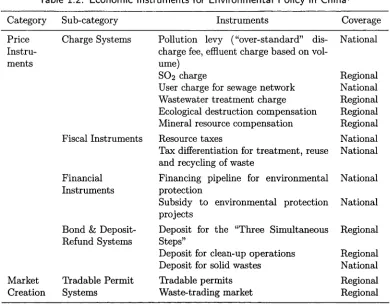
Almost every category of Els can be found in China (Table 1.2), but the most notable economic instrument for environmental policy is the pollution levy sys tem which is administered by the State Environmental Protection Administration (SEPA).8 It aims to achieve two objectives: (1) provide firms with incentives to economically use energy and resources and reduce pollutant discharges; (2) collect funds for pollution treatment and disposal (Yang, Wang, and et al 1998).
China’s pollution levy system dates from the late 1970s. Clause 15 of China’s Environmental Protection Law (Provisional) promulgated in 1979 specifies that “in a case where the discharge of pollutants exceeds the limit set by the state, a pollution levy shall be charged according to the quantities and concentration of pollutants released.”9 The nationwide implementation of this system began in 1982 when the “Provisional Regulations for Collection of Compensation Fees for Pollutant Dis charge” was issued by the State Council. In the beginning, only over-standard discharge of wastewater, waste gas and solid wastes were subject to the levy. Af ter several amendments, with the most significant in 1991, the system now covers 113 pollutants in five media, i.e., wastewater (both over-standard and total volume), waste gas, solid wastes, noise, and radiation. Several regions have also collected fees
8SEPA, with the ministerial authority in the central government, was restructured in 1998 from the National Environmental Protection Agency (NEPA), signalling China’s serious concern about environmental issues.
Table 1.2: Economic Instruments for Environmental Policy in China^
Category Sub-category Instruments Coverage
Price Charge Systems Pollution levy (“over-standard” dis- National Instru- charge fee, effluent charge based on
vol-ments ume)
SO2 charge Regional
User charge for sewage network National Wastewater treatment charge Regional Ecological destruction compensation Regional Mineral resource compensation Regional
Fiscal Instruments Resource taxes National
Tax differentiation for treatment, reuse and recycling of waste
National Financial Financing pipeline for environmental National Instruments protection
Subsidy to environmental protection projects
National Bond & Deposit- Deposit for the “Three Simultaneous Regional Refund Systems Steps”
Deposit for clean-up operations Regional Deposit for solid wastes National
Market Tradable Permit Tradable permits Regional
Creation Systems Waste-trading market Regional
tReconstructed based on Wang and Lu (1997, Table 1, page 17).
for SO2 discharged from industrial coal burning since 1992. Approximately 650,000 factories have been charged for their emissions, and about 5 billion RMB yuan of levies were collected per year in recent years (Tables 1.3-1.5). A bout 80 percent of the funds have been used to finance industrial pollution prevention and control, accounting for about 15 percent of total investment in these activities (NEPA 1994, 1997).
C hina’s pollution levy system has its peculiar characteristics. On the collection side, the government sets an emission standard for the firm and the firm is subject to an emission levy if its emission violates the stan d ard .10 The system uses a “m arkup” based on the percentage deviations from discharge standards for effluent
[image:33.520.61.451.99.403.2]Table 1.3: Number of Firms Charged of Pollution Levy
Year Total Metall. Chem. Light Textile Power Coal TVEt Other
1985 89246 2425 4928 13397 3913 831 1707 15945 45982
1986 108645 4557 5674 14955 4534 845 2039 24377 51064
1987 135837 3400 6013 16507 4547 880 1977 34217 68296
1988 160383 3546 6480 17375 4731 880 2034 46840 78497
1989 183256 4070 6838 17501 4872 866 2447 58197 88465
1990 188142 3890 6687 18132 4687 940 2838 58934 92034
1991 205892 3971 6882 19112 4563 1054 3116 63690 103080
1992 223655 4886 7994 19443 4853 1081 3438 72098 109862
1993 254274 1994 300437
1995 368213 6134 11143 24497 4959 1345 5024 119662 195449 1996 496324
1997 563488 1998 652863
t Township and village enterprise
Source: Yang, Wang, and et al (1998); China Environmental Yearbook, various issues.
Table 1.4: Pollution Levy from Different Media (RMB million yuan) Year Total Water Over-Standard ChargesGas Solid Noise Radiation WasteWater OtheR
1984 756 504 224 15 4 1 1 7
1985 929 594 251 23 11 1 50
1986 1190 711 329 25 19 1 8 97
1987 1428 821 380 34 24 1 21 147
1988 1610 869 441 33 31 1 29 206
1989 1674 858 453 33 36 1 32 261
1990 1753 900 448 31 34 1 52 287
1991 2006 996 494 40 41 1 62 372
1992 2381 1181 510 33 87 1 83 486
1993 2681 1228 561 38 119 1 126 608
1994 3098 1319 647 33 155 1 201 742
1995 3713 1504 743 48 190 2 254 972
1996 4096 1551 818 37 214 2 288 1185
1997 4543 1642 902 50 244 2 305 1398
1998 4902 1637 1170 44 264 1 283 1503
^The so-called “four small items”, including revenue from (1) raising levy rates for firms who failed to meet the discharge standard within three years after the collection of pollution levy; (2) doubling levy rates for newly established firms who failed to meet the standard; (3) overdue fine; and (4) fines for firms violating standards and causing damages.
Source: Yang, Wang, and et al (1998); China Environmental Yearbook, various issues.
[image:34.520.82.430.353.580.2]Table 1.5: Pollution Levy from Different Sectors (RMB million yuan)
Year T o tal M etall. Chem . Light Textile Power C oal TVE* O th er
1985 931 172 184 175 79 38 22 35 226
1986 1190 217 231 216 101 55 25 60 281
1987 1427 233 285 277 112 64 31 72 353
1988 1610 252 326 312 119 77 35 102 387
1989 1675 256 346 309 115 79 42 117 411
1990 1752 212 370 311 116 83 42 132 425
1991 2006 308 407 345 120 96 51 169 510
1992 2379 353 446 418 129 105 55 231 642
1993 2680 890 389 330 106 89 46 252 580
1994 3098 634 412 387 112 117 466 343 627
t Township and village enterprise Source: Yang, Wang, and et al (1998).
is cleaned up, the levy will shift to the next pollutant in order of levies.
On the outlay side, the revenue collected is earmarked for environmental pro tection. Initially 80 percent of the fee was freely returned to individual contributing enterprises to finance pollution abatement activities. The authority moves to col lectively subsidise some “important” projects, and gradually turns the subsidy into a loan, although it is exempt of repayment in certain circumstances.
1.3.2 Economic Instruments for Global Warming Policy
Before discussing economic instruments for greenhouse policy, several characteris tics of the global warming problem should be mentioned. The first is th at “it is a global problem” ; and the second is that “both the extent of any climate change and the nature of its effects are uncertain” (Fisher et al. 1996). In addition, it is a dynamic process and has very long time horizons. These features have important implications for global warming policy. Because global warming policy can be clas sified as national, regional and global policies, almost all the economic instruments mentioned in Table 1.1 can be candidates to address the issue. However, only those frequently discussed instruments is introduced in this subsection.
International Carbon Tax
Two types of carbon taxes have been proposed to tackle the global warming prob lem. First, an international agency would be established to collect taxes from nation states according to an international agreement. For the reason of cost-effectiveness in achieving CO2 emissions target, the tax rate should be equal across countries
Tradable Emission Permit
CO2 emission permit trading is a well ploughed area of global warming policy, for example, see Tietenberg and et al (1998) for a collection of literature on this issue. Article 17 of the Kyoto Protocol explicitly states th at parties from Annex B countries could “participate in emissions trading for the purpose of fulfilling their commitments under Article 3.” It is also proposed that non-Annex B countries could participate in the trading if they agree to cap their emissions to a certain level.
Simulations show that CO2 emission trading could effectively reduce the costs of abatement, especially when more countries, including developing countries, par ticipate in the trading (McKibbin and Wilcoxen 1994; Zhang 2001). However, there are at least two practical questions related to the implementation of CO2 emission trading.
First, emission trading would cause large cash flows between countries, thus heavily affecting international trade and financial markets (McKibbin and Wilcoxen 1997). Second, because a tradable permit system could have huge distributional effects on countries, how to allocate the permit is a heavily debated issue and little consensus has been achieved, especially when the developing countries are in cluded.11 While scholars from developing countries argue th at such permits should be allocated on the basis of equal per capita emissions (Gupta and Bhandari 2000), this is objected to by developed countries. Moreover, the Protocol does not de fine how to allocate permits at the sub-national level. Zhang (1999) argues that individual governments should be free to devise their own methods of allocating the permits due to concerns about international competitiveness. McKibbin and Wilcoxen (2000) also suggest that it should be up to individual governments to de termine how to allocate permits (in their proposal, such permits are termed emission
endowments).
Joint Implementation and Clean Development Mechanism
Although joint implementation (JI) is not specifically defined by the United Nations Framework Convention on Climate Change, its Article 4.2(a) is often referred to as the provision of JI: “• • • developed country Parties and other Parties included in Annex I • • • may implement such policies and measures jointly with other Parties and may assist other Parties in contributing to the achievement of the objective of the Convention • • • ”
In the Kyoto Protocol, the concept of JI was narrowed down to refer to joint activities carried out among Annex I countries (Article 6), while the activities involv ing both Annex I and non-Annex I countries were referred to as clean development mechanism (CDM, Article 12).
Joint implementation and clean development mechanism can be broadly defined as an attem pt to reduce the overall cost of achieving a given level of global green house gas emission abatement. There are three possible ways to implement JI or CDM. First, countries could pool their resources in a fund, from which investment would then be made. Second, investment arrangements could be made directly between countries on a bilateral or multilateral basis. Third, investment could be made by private sectors to meet emission targets set by national governments (Jones 1994). In some sense, JI and CDM can be viewed as a barter trade of CO2 reduction
credits, with countries making investment in exchange for credits of net emission reduction in host countries.
permits or taxation.
However, because of asymmetric information, participants (both investing and host countries) in JI or CDM projects have an incentive to misreport emission re ductions. As a result, hypothetical reductions may be large while actual reductions are most likely to be small (Wirl, Huber, and Walker 1998). In addition, although CDM seems a win-win-win instrument for developed and developing countries and the environment, developing countries are concerned about (1) lack of capacity to negotiate fair contracts with CDM investors from Annex I countries; (2) using up all low-cost abatement options while leaving them only high-cost options when they are required to reduce their own emissions; (3) offsetting reductions in current devel opment aid budgets; and (4) affects on national sovereignty as developed countries may use CDM to interfere in their internal affairs (Zhang 2000a). In addition, as CDM involves searching out partners, negotiating terms and getting approval from certain international agencies, it may incur high transaction costs.
medium term costs in these economies.
1.4
Selection of Economic Instruments
Theoretically, price-based instruments (represented by the emission tax system) and quantity-based instruments (represented by the tradable permit system) could achieve exactly the same results. As illustrated in Figure 1.2, if the government imposes a pollution tax at the rate of t*, firms will discharge the optimal pollution q\ and q and total optimal pollution Q* can be achieved. Alternatively, if the gov ernment issues emission permits totaled Q* and allows firms to trade their permits, firms will end with pollution levels of q\ and q%, and the permit price p* will be the same as the tax rate t*. However, in reality, these two types of instruments may have different requirements and result in different consequences. As a result, choos ing appropriate instruments is an important issue in environmental policymaking. Moreover, the first-best outcome, i.e. welfare maximisation, is usually not attain able because of uncertainty, pre-existing distortions and etc. Some such factors are discussed as follows.
1.4.1 Information Requirement and Uncertainty
The first difference between price- and quantity-based instruments is their require ment for information. Environmental policies are often specified by a set of quanti tative requirements, e.g. reduction in emissions. To design a quantity-based instru ment, a government need only transform the environmental goal into operational quantitative rules,12 i.e. total permits and initial allocation of permits, and let the market do the rest. On the other hand, designing a price-based instrument requires information on firms’ behaviour in order to establish the relationship between tax
or charge and the required quantity target, which is often costly.13
Although designing quantity-based instruments seems to require less informa tion, in many cases there are high uncertainties regarding the appropriate quantity target. In the case of global warming, opinions about the future trend and impact of CO2 emissions and climate change have been very diversified.14 Because of these
uncertanties, the CO2 emission control target is a highly debatable issue.
Uncertainties about the benefits and costs of reducing CO2 emissions bring about
different outcomes under these two types of instruments. A tradable permit system could maintain the benefit within a certain range by controlling the total amount of permits while leaving the cost of achieving the target very uncertain. On the other hand, an emission tax may give a clear signal of abatement costs to firms, but leave the resultant emissions uncertain. Weitzman (1974) and Fishelson (1976) find that the relative advantage of instruments depends on the curvature of marginal cost and marginal benefit of reducing emissions. If the marginal benefit curve is steeper than the marginal cost curve, a quantity-based instrument is preferred because de viation from the desired quantity could result in huge damage; by contrast a steeper marginal cost curve favours a price-based instrument because fixing quantity could cause very uncertain abatement costs. This result is termed Weitzman’s Rule. If only the benefits of abatement are subject to uncertainty, both instruments would
13Another closely related factor is transaction costs, or administrative costs, among which the cost of obtaining information is one item. Obviously the two types of instruments have different transaction costs and their incidence on governments and firms. It seems that governments bear more administrative costs under an emission tax system, while firms bear more costs from a trad able emission permit system. Stavins (1995) and Conrad and Kohn (1996) find that transaction costs tend to lower the trading volume. Contrary to Coase’s Theorem, Stavins (1995) finds that the equilibrium will be affected by the initial allocation of permits because of transaction costs. Concerning the impact of transaction costs and market power on the efficiency of permit market, Bertram (1992) argues that a tradable permit regime to combat atmospheric pollution is likely to work better at global than at national level, whereas carbon taxes are likely to succeed at national level. Schmutzler and Goulder (1997) show that the first-best can be achieved with a pure emissions tax only if perfect monitoring can be conducted. However, given the fact that perfect monitoring is very costly, a pure emission tax is not optimal if monitoring cost is an increasing function of the output level.
14The diversified CO2 emission projections and impact estimations can be found in Chapter 7 of
be identical. However, if uncertainties to marginal benefit and cost are related, Stavins (1996) finds that uncertainty of benefits also matters. Specifically, a pos itive (negative) correlation tends to favour the quantity (price) instruments and, theoretically, these effects can overwhelm the recommendation based on relative- slopes. However, these findings are based on partial equilibrium settings, thus they need to be examined in a general equilibrium framework, which will be the task of Chapter 3.
1.4.2 Pre-existing Distortions and Use of Pollution Charges
Difference also arises from the revenues generated from both types of instruments and their uses. From the aspect of revenue-generation, only a permit trading sys tem with initial permits auctioned could be equivalent to a tax system. Because revenues from emission taxes can be used to replace existing distorting taxes, they can obtain “double dividend” , i.e., less distortion and less environmental damages (Pearce 1991). By contrast, a permit trading system, except for auctioned permit trading, usually does not have revenue to generate such effects. This issue will be explored in Chapter 2 more broadly, i.e. considering the possibility of earmarking pollution charges.
Moreover, tax and permit trading systems have different distributional effects. Different allocation of initial permits may bring about different cost burdens on firms. In the case of an emission tax, the revenues can be used in different ways which leads to different consequences for various players in an economy. This will be more obvious in the case of international cooperation like global warming policy where income flows across country borders, which will be discussed for more details in Chapter 5.
1.4.3 International Cooperation
field of environmental protection. From this aspect, a more decentralised instru ment such as the harmonised domestic tax or even differential domestic tax and the decentralised permit trading scheme proposed by McKibbin and Wilcoxen (2000) might be superior to those centralised instruments such as international tradable permits or the first type of international emission tax;, as will be seen in Chapters 5 and 8. It should be borne in mind that “Policy instruments th at appear impeccable from the vantage point of research institutions, but consistently prove infeasible in real-world political institutions, can hardly be considered ‘optimal’ ” (Stavins 2000a).
1.5
The Structure of the Thesis
This study aims at refining the theory of environmental policy choice and develop ing feasible and efficient instruments to control carbon dioxide emissions in China, taking account of some imperfections, especially the uncertain world environment. It consists of two parts: a general analysis of economic instruments, and the appli cation in CO2 emission control.
The first part presents the discussion of pollution control policies in general equilibrium settings. The focus of this part is on the comparison of pollution taxes and tradable permits in certain kind of circumstances with imperfections. It consists of three chapters—Chapters 2 to 4.
Chapter 2 systematically discusses the consequences of different uses of pollution charges. In addition to examining the “double-dividend” hypothesis, the possibil ity of earmarking pollution charges (and permit sales revenues) for environmental projects and its implication on the optimal tax rate are also considered. Conditions of justifying different uses of pollution charges are developed.
compli-cations, i.e. risk aversion and earmarking, are also considered.
Chapter 4 reviews China’s environmental policy, especially the pollution levy system. Two questions are asked: Are China’s environmental policies effective in the sense of giving incentives for firms to reduce their emissions? Are they efficient in the sense that they are formulated according to welfare maximisation principles? To answer these questions, two methods are employed. First, the changes in pollutant discharges are decomposed to find the possible causes of such changes. Second, using a panel data model, a system of demand and supply functions of pollution rights based on the theory of equilibrium pollution is estimated to capture the behaviour of firms and governments.
The second part of the thesis brings the discussion into the area of global warm ing policies. It consists of four chapters—Chapters 5 to 8.
Chapter 5 discusses a number of schemes of global warming policies. Tradable permits, harmonised domestic tax and differential tax are discussed in a theoretical general equilibrium model, and simulated with a simplified numerical model.
Chapter 6 develops a dynamic general equilibrium model, G-Cubed-T, for the purpose of analysing proper policy choices of CO2 emissions control in China, and
describes its structure and parameter estimation and calibration. The model is composed of three regions: China, the United States and rest of the World. It is based on a reduced version of the G-Cubed model of (McKibbin and Wilcoxen 1999). For this thesis, a new database for China is used, and more importantly, a feedback from climate change to real economic activity is included in the model.
Using the model, Chapter 7 develops several scenarios about China’s future CO2 emissions based on different assumptions about China’s future economic, de
mographic and technological paths.
Chapter 8 investigates two issues. First, what is the appropriate target of CO2
emission control for China? Second, How to achieve this target? Different policy alternatives for China are simulated using the G-Cubed-T model.
for future work.
To conclude this introduction, a summary of the main results of this thesis is provided as follows. This thesis argues that the use of pollution charges is an integral part of environmental policy-making. Earmarking such revenues for environmental activities could be a better choice if marginal utility of the environment is high and the amount of revenues small. It is found that the conventional interpretation of Pigouvian tax is not correct if the possibility of earmarking is taken into account. An optimal tax rate is not necessarily equal to the marginal damage cost of pollution. It is also found that Weitzman’s rule is not directly applicable in a general equilibrium setting unless under strong assumptions, i.e. risk neutrality and utility separability. Contrary to the usual criticism, the empirical result in this thesis shows that China’s environmental policy has been effective.