Int. J. Electrochem. Sci., 9 (2014) 659 - 669
International Journal of
ELECTROCHEMICAL
SCIENCE
www.electrochemsci.org
AB
5-type Hydrogen Storage Alloy Modified with Carbon Used
as Anodic Materials in Borohydride Fuel Cells
Grzegorz Lota1,2*, Agnieszka Sierczynska1, Ilona Acznik1, Katarzyna Lota1
1
Institute of Non-Ferrous Metals Division in Poznan, Central Laboratory of Batteries and Cells, Forteczna 12, 61-362 Poznan, Poland
2
Institute of Chemistry and Technical Electrochemistry, Poznan University of Technology, 60-965 Poznan, ul. Piotrowo 3, Poland
*
E-mail: [email protected]
Received: 7 October 2013 / Accepted: 22 November 2013 / Published: 8 December 2013
This paper describes anodic materials for fuel cells using borohydride as a fuel (DBFC). A fuel cell is an electrochemical device which converts chemical energy stored in borohydride ion and in an oxidant, directly into electricity by redox processes. In this work the electrochemical properties of multicomponent hydrogen storage alloy of the AB5-type: LaMmNi3.55Al0.30Mn0.40Co0.75 modified with carbon used as anodic materials in a borohydride fuel half-cell are discussed. Composites with a small amount of carbon were obtained by pyrolysis directly on a hydrogen storage alloy or by carbonization of conducting polymers. It was done in order to improve the hydrogen electrosorption properties of anode material. The electrochemical properties were examined in 6 M KOH solution with the addition of a different amount of KBH4, using cyclic voltammetry and galvanostatic methods. It has been proved that only particular forms of carbon are able to promote the electrocatalytic activity of an AB5 alloy type anode and remarkably enlarge the surface area of the working electrode. Additionally, tubular morphology of nanocarbons makes fuel diffusion easier, in comparison to pores in a carbon layer obtained by carbonization of conducting polymers composites.
Keywords: Direct borohydride fuel cell • anode material • AB5 alloy • carbon modification
1. INTRODUCTION
could be successfully applied especially in portable applications such as miniaturized or micro-power systems with short operational time spans. Borohydrides of Na+, K+ or Li+ are attractive hydrogen sources or fuel for DBFC, due to their high hydrogen content, e.g., NaBH4 contains 10.6 wt. % of hydrogen [1,2]. In such a fuel cell, H− in BH4− is oxidized into H+ directly on the anode, which provides eight electrons. The oxidant used in DBFC is usually oxygen, air or hydrogen peroxide. The fuel cell has been developed, and the operational principle is based on the following equation, referring to the anode [1-4]:
BH4- + 8 OH- BO2- + 6 H2O + 8 e- Ea0 = -1.24 V (1)
The principal reaction which occurs on the cathode:
2 O2 + 4 H2O + 8 e- + 8 OH- Ec0 = 0.4 V (2)
Accordingly, the total reaction, in which oxygen is used as an oxidant is as follows: BH4- + 2O2 BO2- + 2 H2O Etotal= 1.64 V (3)
The standard potentials are given at 298 K. Electromotive force (Etotal ) can reach up to 1.64 V, that is 1.33 times higher when compared to the PEMFC and 1.35 times higher than Etotal for DMFC. Additionally, DBFCs do not require noble catalysts such as platinum. The advantage of such systems is the fact that Ni-based catalysts can be used in order to replace expensive noble metals. Multicomponent alloys such as AB2 or AB5-type are used as electrode materials for nickel/metal hydride batteries with alkaline electrolytes. Rare earth metal based AB5-type alloys are characterized by high electrochemical catalytic activity for the oxidation of hydrogen, therefore, they can be used as anode materials in borohydride fuel cells [3-5]. The alloys work both as a catalyst and as a hydrogen storage medium; they can absorb the evaluated hydrogen directly from the fuel. Hydrogen is stored in a hydrogen storage alloy anode as a metal hydride, just to provide the hydrogen fuel, as described by the reversible reaction [6]:
M + x H ↔ MHx + Q (cal) (4)
where M is a hydrogen storage alloy and MHx represents a metal hydride. Higher power densities are achieved with AB5-type alloys rather than AB2-type ones [7], probably due to their higher capacities at high discharge rates. Different kind of modifications have been done to improve the process of fuel utilization such as doping by Au or Si to AB5-type hydrogen storage alloys [8,9]. Such a modification decreases the rate of hydrogen generation and increases the fuel utilization efficiency. An appropriate choice of electrolyte parameters plays also very important role. It is advantageous to work with a MOH (K+, Na+) concentration in the range of 10-40 wt. % and MBH4 concentration in the range of 10-30 wt. %. The sodium compounds are cheaper and have a lower molar mass, though the potassium solutions have a higher conductivity that impacts the performance of membrane [10]. One way to improve parameters of DBFC is to add thiourea to the fuel [11].
[12,13]. On the one hand, an increase of the temperature improves the anode reaction rate and the cell conductivity; on the other hand, promotion of higher degrees of crossover and hydrolysis of fuel influences the process of cathode polarization [14]. The main problem of DBFC is the hydrolysis of borohydride ions supplying hydrogen causing a decrease of the energy efficiency and power density [15]. The major disadvantage of DBFC continue to be a high cost. The voltage decay is caused mainly due to the degradation of the cathode [16,17]. However, it is possible to commercialize DBFC by reducing its costs, e.g. using a Ni-based anode and replacing Nafion® with a chitosan membrane and binder [18,19]. In this work the electrochemical properties of the hydrogen storage alloy LaMmNi3.55Al0.30Mn0.40Co0.75 modified with carbon used as anodic material in DBFC was investigated, in order to improve the hydrogen electrosorption properties.
2. EXPERIMENTAL
3. RESULTS AND DISCUSSION
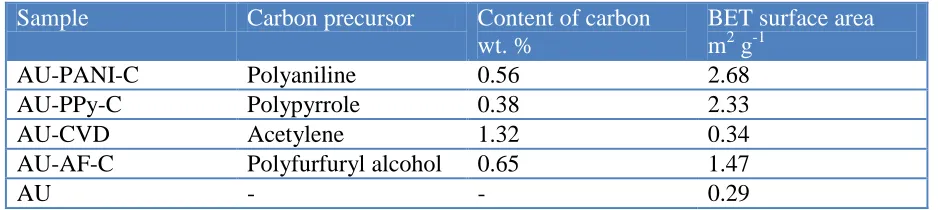
[image:4.596.65.534.227.332.2]Table 1 presents sample names with physicochemical data. AU is the abbreviation for AB5 -type alloy and C stands for samples after carbonization process. Composites contain a small amount of carbon, in the range between 0.38 and 1.32 wt. %. The process of precipitation and carbonization of conducting polymers leads to an increase in the BET surface area.
Table 1. Elemental analysis and surface area data for metal/carbon composites.
Sample Carbon precursor Content of carbon
wt. %
BET surface area m2 g-1
AU-PANI-C Polyaniline 0.56 2.68
AU-PPy-C Polypyrrole 0.38 2.33
AU-CVD Acetylene 1.32 0.34
AU-AF-C Polyfurfuryl alcohol 0.65 1.47
AU - - 0.29
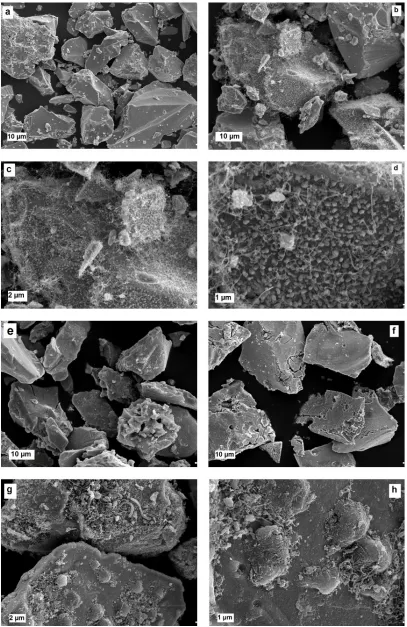
The SEM images of composites with different kinds of carbon deposits are presented in Fig. 1. SEM images present the AB5-type alloy after reduction H2 and composites obtained by chemical vapour deposition (CVD) of acetylene directly on grains of alloy.
During vapour deposition carbon forms nanofibrous structures. Fig. 1 also presents SEM of the carbon composites which were obtained by polymerization of polyaniline (PANI), polypyrrole (PPy) and polyfurfuryl alcohol on the alloy material. After polymerization composites were carbonized in nitrogen. The composites which were obtained by carbonization of conducting polymers (PANI, PPy) demonstrated homogenous carbon layers with visible pores, while the images of composite with polyfurfuryl alcohol clearly showed some fibrous structures.
[image:5.596.95.502.68.695.2]
-1.2
-1.0
-0.8
-0.6
-0.4
-0.2
0.0
0 50 100 150 200
E
/
V
v
s
H
g
/H
g
O
I / mA g-1
[image:6.596.110.475.101.346.2]0.05 M 0.10 M 0.25 M 0.50 M
Figure 2. Polarization characteristics for different concentrations of KBH4.
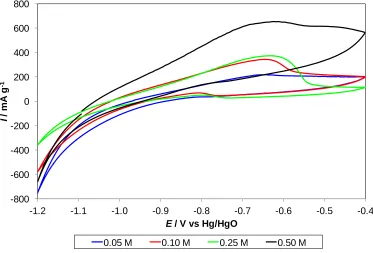
The electrochemical performance of the electrode based on AB5 alloy for BH4- oxidation in different KBH4 concentrations was also characterized by cyclic votammograms tests at 5 mV s-1 within the potential window: OCP -0.4 V -1.2 V OCP are shown in fig. 3.
-800 -600 -400 -200 0 200 400 600 800
-1.2 -1.1 -1.0 -0.9 -0.8 -0.7 -0.6 -0.5 -0.4
I
/
m
A
g
-1
E/ V vs Hg/HgO
0.05 M 0.10 M 0.25 M 0.50 M
[image:6.596.113.486.489.742.2]
As it is shown, the oxidation current increases with the positive scan process, indicating the presence of the electrochemical reaction. The AB5 alloy has excellent electrocatalytic activity for the oxidation of BH4- ions. The highest increase of the anodic current is observed for the 0.5 M KBH4 concentration. The anodic peak around -0.6 V could be attributed to the charge-transfer mechanisms and desorption of hydrogen species from the surface of the AB5 alloy [21]. During the measurements the hydrogen evolution was observed. The hydrogen generated when negative values current and potential were applied might be attributed to the reduction of water:
2H+ + 2e- → H2↑ (5)
while in potential range from -1.0 to -0.6 V could be ascribed to the hydrolysis of KBH4 : BH4- + H2O ↔ BH3OH- /BO2- + H2↑ (6)
and reactions connected with hydrogen storage alloy presence, which are observed for Ni-MH batteries [3]:
BH4- + H2O+ M→MHx,adsorbed + BO2- (7) MHx,adsorbed↔ MHx, (8)
MHx,adsorbed → M + H2↑ (9)
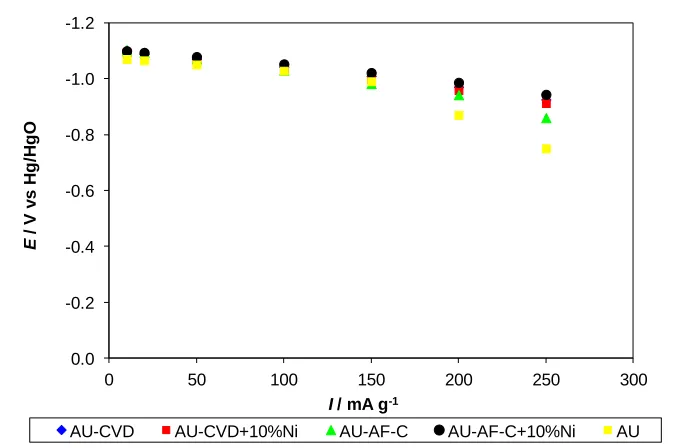
For further measurements 0.5 M KBH4 concentration was selected. After choosing the most efficient concentration of KBH4, polarization characteristics were performed for composite materials. It was proven that the activity of the catalysts for fuel cells increased with rising their electrochemically active surface area. Therefore, carbons in different forms are used as catalyst’s supports in low temperature fuel cells. Carbon materials, especially carbon nanotubes or nanofibers, make easy electron transfer resulting in better fuel cell performance due to their high surface area, good crystallinity and chemical stability [22]. Figs. 4-6 show polarization characteristics for composites with polyfurfuryl alcohol after carbonization and carbon from CVD method, for composites with PANI and for composites with PPy, respectively.
-1.2
-1.0
-0.8
-0.6
-0.4
-0.2
0.0
0 50 100 150 200 250 300
E
/
V
v
s
H
g
/H
g
O
I/ mA g-1
[image:7.596.128.468.499.723.2]AU-CVD AU-CVD+10%Ni AU-AF-C AU-AF-C+10%Ni AU
All characteristics are shown in comparison to AB5-type alloy anode. The most promising characteristic was observed for composite materials with polyfurfuryl alcohol after carbonization and nanocarbon obtained by CVD method.
-1.2
-1.0
-0.8
-0.6
-0.4
-0.2
0.0
0 50 100 150 200 250 300
E
/
V
v
s
H
g
/H
g
O
I / mA g-1
[image:8.596.101.512.131.402.2]AU-PANI AU-PANI+10%Ni AU-PANI-C AU-PANI-C+10%Ni AU
Figure 5. Polarization characteristics for composites with PANI.
-1.2
-1.0
-0.8
-0.6
-0.4
-0.2
0.0
0 50 100 150 200 250 300
E
/
V
v
s
H
g
/H
g
O
I / mA g-1
AU-PPy AU-PPy+10%Ni AU-PPy-C AU-PPy-C+10%Ni AU
[image:8.596.100.490.458.730.2]
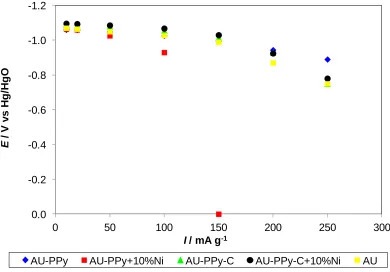
The lowest efficiency of oxidation was observed for AU-PANI composite, which might be attributed to low activity of polymer in alkaline solution. The use of Ni as a major component of hydrogen storage alloy and as a supplement influences on obtaining more negative potentials for borohydride oxidation [10]. In all cases the addition 10 % of Ni improved BH4- oxidation process. The open-circuit potentials (OCP) of composite materials are higher in comparison to AB5-type alloy electrode. The highest values of the electrode potential vs. Hg/HgO were obtained for composite materials after carbonization with 10% addition of nickel, although the process of carbonization (temperature treatment) destroys the structure LaNi5 of alloys and aggravates its electrochemical behaviour. The most remarkable decrease of a potential electrode with the increase of the current load is for AB5-type alloy electrode. When the electrode is composed of hydrogen storage alloy, nanocarbons in suitable form and additionally of nickel, the polarization curves are more linear, which can indicate that ohmic polarization is lesser.
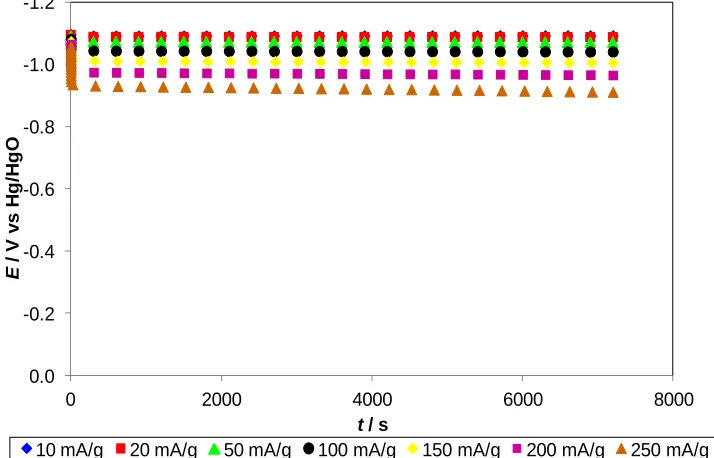
Fig. 7 presents the discharge curves of AU-CVD composite under different current loads. With the increase of the current load a negligible electrode potential fade was observed. In the first minutes, the electrode potential decreased due to a loss of fuel concentration on the surface of the composite, and then, a dynamic equilibrium was reached. As it was proved in [23], where hydrogen storage alloy was physically mixed with carbon nanotubes, particular forms of carbon as e.g. carbon nanotubes with tubular morphology, could affect on relatively good short-term performance stability.
-1.2
-1.0
-0.8
-0.6
-0.4
-0.2
0.0
0 2000 4000 6000 8000
E
/
V
v
s
H
g
/H
g
O
t / s
[image:9.596.119.476.409.638.2]10 mA/g 20 mA/g 50 mA/g 100 mA/g 150 mA/g 200 mA/g 250 mA/g
Figure 7. The discharge curves of AU-CVD composite.
4. CONCLUSION
carbon (0.4-1.3 %) were obtained by direct pyrolysis on hydrogen storage alloy or carbonization of conducting polymers. The highest values of the electrode potential vs. Hg/HgO were obtained for composite materials containing nanocarbons in suitable form, after carbonization, with 10% addition of nickel, although the temperature treatment destroys the structure LaNi5 of alloys. For these materials smaller ohmic polarization is observed. The most promising characteristic has been recorded for composite materials with polyfurfuryl alcohol after carbonization and nanocarbon obtained by CVD method. It indicates that only particular forms of carbon are able to promote the electrocatalytic activity of the AB5 alloy-type anode and improve the conductivity of the electrode. In both cases, carbon formed nanofibrous structures. Additionally, tubular morphology of nanocarbons makes fuel diffusion easier, especially in comparison to randomly organized pores in the carbon layer, obtained after carbonization of conducting polymers composites [23]. The addition 10 % of Ni improves BH4 -oxidation process. The lowest efficiency of -oxidation was observed for AU-PANI composite, which might be attributed to a low activity of polymer in alkaline solution. The most remarkable decrease of a potential electrode with the increase of the current load is observed for AB5-type alloy electrode, therefore composite electrode materials containing hydrogen storage alloy, nanocarbons and metallic nickel should be considered as an anode materials for direct borohydride fuel cells.
ACKNOWLEDGEMENTS
The authors acknowledge the financial support from the European Fund of Regional Development within the frameworks of the operating program "Innovative Economy 2007–2013", under Project No. POIG.01.03.01-00-086/09.
References
1. Z.P. Li, B.H. Liu, K. Arai, S. Suda J Alloys Compd., 404-406(2005) 648 2. J.H. Wee J Power Sources, 161 (2006)1
3. L. Wang, C. Ma, X. Mao, J. Sheng, F. Bai, F. Tang Electrochem. Commun.,7 (2005) 1477 4. L. Wang, C. Ma, Y. Sun, S. Suda J Alloys Compd., 391 (2005)318
5. B. Liu, S. Suda J Alloys Compd., 454 (2008) 280
6. S. Lee, J. Kim, H. Lee, P. Lee, J. Lee J Electrochem. Soc., 149 (2002) A603
7. N.A. Choudhury, R.K. Raman, S. Sampath, A.K. Shukla J Power Sources, 143 (2005)1 8. Z Yang, L. Wang, Y. Gao, X. Mao, C Ma J Power Sources, 184 (2008) 260
9. L. Wang, C. Ma, X. Mao J Alloys Compd. 397 (2005) 313
10.C. Ponce de Leon, F.C. Walsh, D. Pletcher, D.J. Browning, J.B. Lakeman J Power Sources, 155(2006) 172
11.C. Celik, F. Gul Boyaci San, H.I. Sarac Int. J Hydrogen Energy, 35 (2010) 8678 12.C. Celik, F. Gul Boyaci San, H.I. Sarac J Power Sources, 195 (2010) 2599 13.Z.P. Li, B.H. Liu, K. Arai, K. Asaba, S. Suda J Power Sources, 126 (2004) 28 14.H. Cheng, K. Scott J Power Sources, 160 (2006) 407
15.I. Marino-Jimenez, C. Ponce de Leon, A.A. Shah, F.C. Walsh J Power Sources, 219 (2012) 339 16.Y. Sahai, J. Ma Energy Procedia, 14 (2012) 358
17.R. Jamard, J. Salomon, A. Martinent-Beaumont, C. Coutanceau J Power Sources, 193 (2009) 779 18.J. Ma, N.A. Choudhury, Y. Sahai Renew. Suitain. Energy Reviews, 14 (2010) 183
21.S.A. Gamboa, P.J. Sebastian, F. Feng, M. Geng, D.O. Northwood J Electrochem. Soc., 149 (2002) A137
22.E. Antolini Appl. Catal. B, 88 (2009) 1