White Rose Research Online URL for this paper:
http://eprints.whiterose.ac.uk/112814/
Version: Published Version
Book Section:
Albarella, U. orcid.org/0000-0001-5092-0532 (2010) Wild boar. In: O'Connor, T. and Sykes,
N., (eds.) Extinctions and Invasions: A Social History of British Fauna. Oxbow Books ,
Oxford , pp. 59-67.
[email protected] https://eprints.whiterose.ac.uk/ Reuse
Unless indicated otherwise, fulltext items are protected by copyright with all rights reserved. The copyright exception in section 29 of the Copyright, Designs and Patents Act 1988 allows the making of a single copy solely for the purpose of non-commercial research or private study within the limits of fair dealing. The publisher or other rights-holder may allow further reproduction and re-use of this version - refer to the White Rose Research Online record for this item. Where records identify the publisher as the copyright holder, users can verify any specific terms of use on the publisher’s website.
Takedown
If you consider content in White Rose Research Online to be in breach of UK law, please notify us by
he Wild Boar
Umberto Albarella
Introduction
On 7 January 2004 the British Broadcasting Corporation (BBC) reported the news that a wild boar had been spotted in a supermarket in a Gloucestershire town. Apparently the animal had already knocked over an elderly lady and eluded the attention of the supermarket staf. Anybody who spotted it was supposed to alert the police.
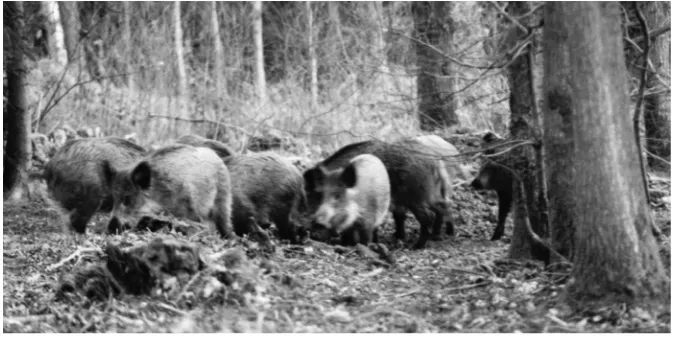
Sightings of wild animals in unusual places are not particularly rare – foxes are regularly spotted in human environments, including shops. he interesting aspect of this particular story is, however, that the wild boar had been extinct in Britain – as a free-living species – for centuries. his news, one among many of this sort (Goulding and Roper 2002), was indicative of the fact that the wild boar was back and had once again become a regular feature of British life (Figure 13). Animals escaped from wild boar farms established in the 1980s and 1990s had eventually led to the re-establishment of viable free wild boar populations in the south of the country and were obviously not especially afraid of direct exposure to the human species.
[image:2.524.146.483.474.642.2]he interest that the return of the wild boar has generated (no less than 107 media articles in six years; Goulding and Roper 2002) justiies our curiosity regarding the past life of this species and how eventually it came to be lost to the British countryside. In this chapter I will briely report on what is known
figure 13. A small group of wild boar recently re-established in Britain
about the archaeology and history of the British wild boar, its origins, heyday, decline, demise and eventual return.
Origins
According to yalden (1999, 15) the earliest known occurrence of the wild boar (Sus scrofa) in Britain dates back to the Cromerian interglacial (lower pleistocene, 600,000–450,000 Bp). Remains of the species were found at the site of West Runton (norfolk), which typiies the period in Britain. Evidence of the presence of wild swine is again found in the hoxnian and Ipswichian interglacials (yalden 1999, 17–18), and then in the late Glacial, when it was never particularly common (yalden 1999, 60–1). he role played by the wild boar in the life of palaeolithic hunters in Britain is by and large unknown.
In the Mesolithic the wild boar was – with red deer (Cervus elaphus) and aurochs (Bos primigenius) – one of the three most common game species. It is relatively uncommon at Star Carr (legge and Rowly-Conwy 1988) but abundant at the other early Mesolithic site of hatcham (King 1962). It is the predominant species at Faraday Road (Ellis et al. 2003), a possibly slightly later site. here is no chronological pattern to the variation in abundance of the wild boar in the British Mesolithic (Albarella and pirnie in prep.) and its relative frequency is therefore likely to be related to local environmental conditions and hunting preferences.
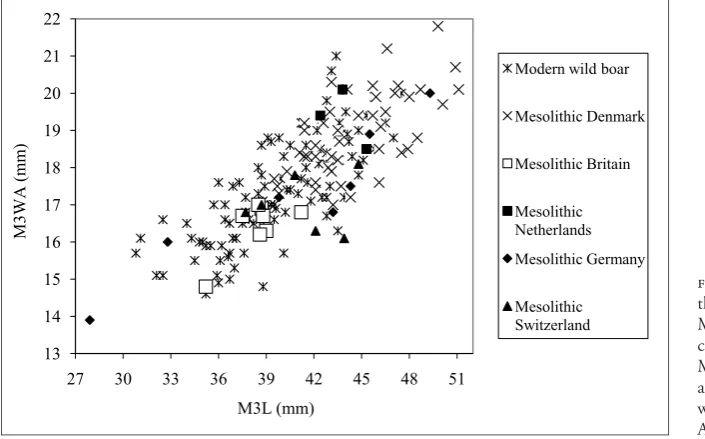
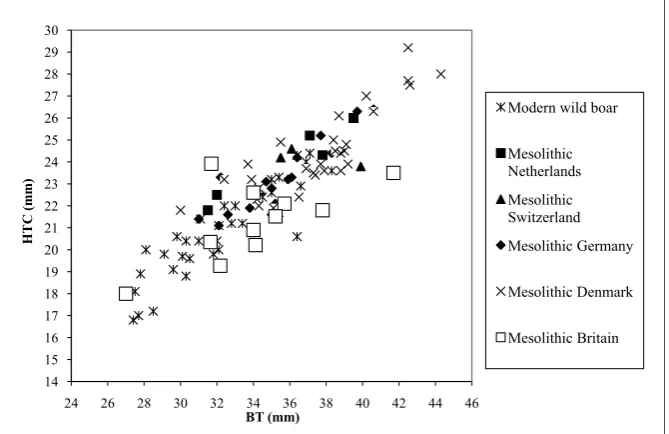
In the British Mesolithic the wild boar seems to have been relatively small. In Figures 14 and 15 the size of these animals is compared with that of Mesolithic wild boar from other European areas and to modern wild boar (data from Albarella et al. 2009). Both tooth and postcranial bone measurements indicate that British wild boar were smaller than their danish and, to some extent,
13 14 15 16 17 18 19 20 21 22
27 30 33 36 39 42 45 48 51
M 3 W A ( m m ) M3L (mm)
[image:3.524.42.395.423.642.2]Modern wild boar Mesolithic Denmark Mesolithic Britain Mesolithic Netherlands Mesolithic Germany Mesolithic Switzerland
central European counterparts. hey also tend to plot towards the lower half of the distribution of modern European wild boar.
Wild boar hunting in farming societies
With the beginning of the neolithic and the introduction of the domestic pig, the archaeological record for the British wild boar becomes elusive. It is diicult to say to what extent this is due to a genuine rarity of the wild species, the diiculty in distinguishing wild and domesticated forms or the frequent interbreeding between the two populations. A combination of these factors may well represent the best possible explanation.
he domestication of the pig is known to have brought about – at least in the long term – a reduction in the size of the animals. he size of the wild boar cannot, however, be assumed to have remained stable, as a post-Mesolithic size increase has been proved for some other European areas (see Albarella
et al. 2006a and Albarella et al. 2006b, where possible explanations for this phenomenon are discussed). here is some evidence that this occurred in Britain too but the situation for the neolithic is not particularly clear, due to the scanty biometrical record.
he presence of the wild boar in the early neolithic is claimed at a few sites. Some large humeri are present at hambledon hill (legge 2008) but the claimed wild boar from Ascott-under-Wychwood (Mulville and Grigson 2007) are of a size that could also be compatible with domesticated forms. he main evidence for the late neolithic comes from durrington Walls, where a detailed biometrical analysis of a large pig dataset has revealed that the wild boar was – if at all present – exceedingly rare (Albarella and payne 2005). Other late neolithic sites provide evidence that is consistent with durrington Walls (e.g. the West
14 15 16 17 18 19 20 21 22 23 24 25 26 27 28 29 30
24 26 28 30 32 34 36 38 40 42 44 46
H T C ( m m ) BT (mm)
[image:4.524.149.484.423.640.2]Modern wild boar Mesolithic Netherlands Mesolithic Switzerland Mesolithic Germany Mesolithic Denmark Mesolithic Britain
Kennet Enclosure; Edwards and horne 1997). A lower third molar from the late neolithic levels at Windmill hill is larger than any found at durrington and may well belong to a wild boar, but at this site too the species seems to be far from common. Wild boar is also claimed at late neolithic Fengate (harman 1978) and puddlehill (Grigson 1976) but the evidence is not entirely unambiguous (Albarella and pirnie in prep.). he most interesting inds are from Mount pleasant (harcourt 1979b), where a huge Sus astragalus and canine were discovered. his suggests that large wild boar – morphometrically distinct from domestic pigs – did indeed exist in the neolithic of Britain, but were rare or rarely hunted. Such large specimens also suggest that, as elsewhere in Europe, neolithic wild boar were larger than their Mesolithic counterparts.
In later prehistoric times the evidence for the occurrence of the wild boar becomes even thinner. he possible presence of the species is mentioned for the Beaker site of poors heath (Cornwall 1976) and at late Bronze Age Runnymede, where Serjeantson (1996) mentions the occurrence of some very large, though not measurable, Sus specimens. In late Bronze Age levels at Welland Bank Quarry an almost complete skull of large size and typical wild boar proile was found (Albarella et al. in prep.) (Figure 16). he presence of the wild boar is also mentioned at the lakeside settlement of Glastonbury (yalden 1999, 104), among a few other Iron Age sites.
he wild boar in historic times
[image:5.524.88.330.64.202.2]Studies of large animal bone assemblages from Roman times reveal either no sign of the presence of the wild boar, such as at Colchester (luf 1993), or the occasional large specimen found among a multitude of smaller pig bones, such as at Exeter (Maltby 1979). Most interesting is the evidence from Wroxeter (hammon 2005) and Chedworth Villa (A. hammon, unpublished data), where some specimens are of an exceptionally large size and clearly stand out from the rest of the Sus measurements. Considering the propensity of the Romans to export exotica it could be argued that these may represent imported animals from the European continent. he occurrence, however, of large wild boar in
figure 16. A wild boar skull from the late Bronze Age site of Welland Bank Quarry, lincolnshire
prehistoric times in Britain indicates that the post-Mesolithic size increase of this species is more likely to represent an indigenous phenomenon. In Roman times large wild pigs could have therefore still been found naturally in the British countryside.
Analysis of the mitochondrial dnA of the specimens from Wroxeter and Chedworth, indicates that the British wild boar was genetically indistinguishable from that present in central Europe, but diferent from the animals living in Italy and outside Europe (larson et al. 2007).
From Anglo-Saxon times onwards the archaeological evidence can be integrated with that deriving from written sources. his is the period when pig breeding reached its hallmark, with most animals kept free range (Albarella 2006). Such abundance of free pasturing domestic pigs must have increased the probability of interbreeding with wild boar, a phenomenon historically documented by later sources (Goulding 2003, 26). nonetheless, the Anglo-Saxons made a clear distinction between the domestic pig and the wild boar, using diferent terms for the two forms (Rackham 1997, 36; yalden 1999, 131). hat the wild boar still existed in the Anglo-Saxon countryside of Britain is made further clear by the fact that soon after the norman Conquest William I made a deliberate efort to protect the species, together with other wild game (Goulding 2003, 16). he existence of the wild boar in this period in the British Isles is also documented by Welsh (Rackham 1997, 36) and Irish (Kelly 2000, 281) written sources.
Archaeologically, the occurrence of the wild boar in the second half of the irst millennium Ad is suggested at a few sites, but not all of them provide conclusive evidence. perhaps most remarkable is the apparent complete absence of the wild boar in the very large early Saxon animal bone assemblage of West Stow (Crabtree 1989). he occurrence of the wild boar is suggested for york (Coppergate and Fishergate; O’Connor 1989 and 1991b), lincoln (Flaxengate; O’Connor 1982), Aylesbury (Walton; noddle 1976) and Southampton (Melbourne Street; Bourdillon and Coy 1980). he stray ind of a Middle Saxon (ninth century) isolated pig skeleton, interpreted as a wild boar on the basis of its size, at Stanstead Abbots (Ashdown 1982) is backed up by more detailed biometrical evidence. his is a truly large pig, in the range of the wild boar from the Roman sites mentioned above.
Extinction
here is general agreement that ‘by the Middle Ages wild swine were very rare’ (Rackham 1997, 36), which perhaps explains why their hunting did not receive the status or popularity that it had in other European countries such as Germany, Spain (Cummins 1988, 97) or France, where the famous hunting treatise of Gaston de phoebus provides plenty of descriptions and illustrations of the wild boar hunt.
he inal demise of the native British wild boar probably occurred in the second half of the thirteenth century. he best record of this gradual disappearance comes from the Forest of dean. here wild boar were still chased for henry III between 1251 and 1257, but Rackham (1997, 36) believes that ‘the dozen which henry III ordered killed for a friend in the Forest of dean in 1260 were the last free-living wild swine in England’.
his is probably not far from the truth but it may not be entirely accurate as a few more populations may have managed to linger on until the end of the century. Woolgar (1999, 115–6) reports the hunting of wild boar between the end of the twelfth and the beginning of the thirteenth century in the western part of Essex, where they had by then become rare. he has, however, also two records for the very end of the thirteenth century, though one of them was a gift and it could have conceivably come from the Continent.
Goulding (2003, 19) has a later record than Rackham’s for the Forest of dean (1282), but he also mentions that a request by Edward II (reigned 1307–1327) for wild boar from the Forest of dean could not be fulilled, suggesting thus that by that time the species had disappeared.
In Scotland the wild boar may have become extinct at a later date (Goulding 2003, 25), but it was already suiciently rare in the latter part of the thirteenth century to require management and deliberate feeding (Smith 2000, 706). In Ireland it was, according to Giraldus Cambrensis, still common in the twelfth century but it did not survive for much longer (Kelly 2000, 281–2).
he archaeological evidence relects the rarity of the species as portrayed by the documentary sources. he best diachronic evidence derives from dudley Castle (homas 2005). horough biometrical analysis carried out on Sus teeth from this high status site demonstrates the occurrence of a single large outlier (a probable wild boar) in phase 5 (dated 1262–1321), but none are present in the four following phases (dating up to 1750). postcranial bones show no obvious large outliers, but in phase 5 there is a certain degree of bimodality in the distribution of the measurements, possibly indicating a mixed population with domestic pigs integrated by a wild component. his evidence is remarkably consistent with the historical data as it shows that throughout the medieval sequence wild boar were always rare, and completely absent by the fourteenth century onwards.
produced large samples, which were subject to careful biometrical analysis. In addition both assemblages contain a substantial amount of remains of wild species, particularly deer and wild birds. here are occasional other claims of the presence of the wild boar in the medieval archaeological record, such as at Bewell house, hereford (noddle 1985b) and at a few other urban sites (Sykes 2001, 158) but these add little to the story.
Sykes (2001, 158 and 2006, 166) suggests that wild boar specimens identiied from British medieval sites may represent imported animals. his cannot be ruled out and it is likely to be the case for the later Middle Ages. In earlier times, however, it does not need to have been so, as large wild boar survived in Britain, though in small numbers, until the thirteenth century. hese, as we have seen, can be tracked down throughout the whole prehistoric and historic archaeological sequence.
It is likely that the wild boar disappeared from Britain as a consequence of a combination of habitat depletion (mainly woodland), over-hunting and eventually inter-breeding of the inal relict populations with free ranging domestic pigs. Britain sufered woodland loss more than the rest of Europe (Rackham 1997, 37) and, being an island, could not easily be replenished with animals moving in from other areas. Wild boars are strong swimmers (nowak 1999b) but the Channel was probably too wide and treacherous to be negotiated easily. loss of habitat alone is unlikely to represent a suicient explanation for the extinction of the British wild boar, as in Scandinavia, despite the abundance of forest, the species encountered a similar fate, having become extinct by the later Middle Ages (t. tyrberg pers. comm.). he Scandinavian wild pig populations, however, shared with those of Britain their relative isolation. Although Scandinavia is not an island, a reduction in wild boar numbers in that region could only be compensated with animals coming from the far north. But this area is located outside the natural distribution of the species, which is notoriously vulnerable to deep snow conditions (nowak 1999b).
Reintroduction and further disappearance
he British countryside did not remain devoid of wild boar for very long, because soon after its disappearance the aristocracy tried to reintroduce the species by using continental stock. It is possible that the park of Cornbury, Oxfordshire had wild boar as early as 1339 (yalden 1999, 157), though it is diicult to establish whether these were part of a relict population of native animals or they rather represented introduced stock.
of views suggests that in this period the status of the wild boar in Britain was dubious. he most likely explanation is that the species had indeed become extinct but had eventually been reintroduced for hunting purposes.
In the earlier part of the sixteenth century henry VIII received from Francishenry VIII received from Francis I some live wild boar, but also with instructions on how to maintain and breed them (Williams 1998, 86–7). he introduction of these animals in the sixteenth century is also documented for the Savernake Forest (Wiltshire), Chartley park (Stafordshire) (Rackham 1997, 37) and the palace of James V in Scotland (Smith 2000, 706).
In the irst half of the seventeenth century James I and Charles I introduced wild boar to Windsor and the new Forest from France and Germany (Goulding 2003, 25; Rackham 1997, 37; yalden 1999, 168). Further reintroductions from Germany are documented until the end of the seventeenth century, but were met with little enthusiasm by local people, who persecuted the animals and eventually contributed to the inal disappearance of the species by the end of the century (Goulding 2003, 26).
By the eighteenth century the wild boar – either native or introduced – could no longer be found in the country, and its meat had disappeared from the British tables. two of the classic British cookery books of the nineteenth and twentieth century (Beeton 1982; hartley 1954) make no mention of wild boar venison in their recipes.
Archaeologically, the presence of the wild boar is claimed in late ifteenth-mid sixteenth century levels from Worcester (Chaplin 1968–9) and, more tentatively, for the early sixteenth-eighteenth century from Great linford village, Milton Keynes (Burnett 1992). Since both inds are not backed up by any biometrical evidence they cannot be relied on. he partial skeleton from Great linford may even belong to a relatively modern improved animal, which would explain its large size. In the absence of any substantiated identiication, we must thus assume that the archaeological record conirms the disappearance of the native wild boar in this period. If any bones of this species will in the future be found in late medieval or post-medieval contexts, they will probably turn up at high status, rather than urban or village, sites.
Conclusions
of the species in prehistory might partly be attributed to hunting preferences, by post-Roman times documentary evidence clearly indicates that the species was genuinely rare in the countryside. his eventually led to its complete disappearance by the end of the thirteenth century. he following four centuries saw various attempts at reintroduction with the aid of continental stock (mainly from France and Germany), but these eventually run out of steam by the end of the seventeenth century, when the species can be regarded to have become inally extinct. his was, at least, the case until the 1980s, when escaped animals from wild boar farms led to the establishment of viable free living populations in the South of Britain. he return of the wild boar has not always been met with great favour by local farmers (Goulding and Roper 2002) and the animals have genetic characteristics which are mixed and of rather uncertain origins (Goulding 2001). hey cannot replace what we have sadly and irremediably lost, but they still remain an interesting and rather majestic addition to our countryside.
Acknowledgements
Social History of British Fauna
belongs to the publishers
Oxbow Books and it is their copyright.
A Social history of British Fauna
Edited by
Oxbow Books, Oxford
© Windgather press and the individual authors 2010
All rights reserved. No part of this publication may be reproduced, stored in a retrieval system, or transmitted in any form or by an means (whether electronic, mechanical, photocopying or recording) or otherwise without the written permission of both the publisher and the copyright holder
ISBN 978-1-905119-31-8
A CIP record for this book is available from the British Library
his book is available direct from
Oxbow Books, Oxford, UK (Phone: 01865-241249; Fax: 01865-794449)
and
he David Brown Book Company PO Box 511, Oakville, CT 06779, USA (Phone: 860-945-9329; Fax: 860-945-9468
or from our website
www.oxbowbooks.com
Preface v
Contributors vi
List of Figures vii
List of Tables ix
1. Introduction –he British Fauna in a Changing World 1
Terry O’Connor
2. he Horse 10
Robin Bendrey
3. Donkeys and Mules 17
Cluny Johnstone
4. he Aurochs and Domestic Cattle 26
Anthony J. Legge
5. he Elk 36
Andrew C. Kitchener
6. Red Deer on Scottish Islands 43
Jacqui Mulville
7. European Fallow Deer 51
Naomi Sykes
8. he Wild Boar 59
Umberto Albarella
9. he Wolf 68
Aleksander G. Pluskowski
10. he Lynx 75
David Hetherington
11. Wildcats, Domestic and Feral Cats 83
Andrew C. Kitchener and Terry O’Connor
12. he Brown Bear 95
Andy Hammon
13. he European Beaver 104
14. he Rabbit 116
Naomi Sykes and Julie Curl
15. he House Mouse 127
Terry O’Connor
16. he Black Rat 134
Kevin Rielly
17. Extinct Birds 146
Dale Serjeantson
18. Bird Introductions 156
Kristopher Poole
19. Freshwater Fish 166
Alison Locker
20. Land and Freshwater Molluscs 175
Paul Davies
21. Insects 181
Harry Kenward and Nicki Whitehouse
22. Conclusion 190
Derek W. Yalden
Bibliography 197
All books are a labour of love, and this one has been particularly protracted. It has taken longer than usual to bring to press, thanks in part to the usual exigencies of competing demands (and childbirth on the part of at least two contributors), and in part to the developments and new inds that are constantly being made in the ield. Even at the time of writing, we are aware of new discoveries that (fortunately) strengthen the arguments made in this volume. Studies of wildlife are becoming more aware of, and informed by, the long-term record provided by historical and archaeological sources, and we hope that this volume will be seen as a timely addition.
Umberto Albarella Department of Archaeology, University of Sheield, S1 4ET
Robin Bendrey Muséum national d’Histoire naturelle, F-75231 Paris cedex 05
Bryony Coles Department of Archaeology, University of Exeter, EX4 4QE
Julie Curl NAU Archaeology, Scandic House, 85 Mountergate, Norwich, NR1 1PY
Paul Davies Quaternary Research Centre, Bath Spa University, Bath, BA2 9BN
Andy Hammon English Heritage, 37 Tanner Row, York, YO1 6WP, UK
David Hetherington Cairngorms National Park Authority, 14 he Square, Grantown on Spey, Highland PH26 3HG
Cluny Johnstone Department of Archaeology, University of York, YO1 7EP
Harry Kenward Department of Archaeology, University of York, YO1 7EP
Andrew C. Kitchener Department of Naural Sciences, National Museums Scotland, Chambers Street, Edinburgh, EH1 1JF and Institute of Geography, School of GeoSciences, University of Edinburgh, Drummond Street, Edinburgh EH8 9XP
Anthony J. Legge McDonald Institute for Archaeological Research, Cambridge, CB2 3ER.
Alison Locker Editici L’Ingla, Atic 1a, 58 Avenguda del Pessebre, Escaldes-Engordany, AD 700, Andorra
Jacqui Mulville School of History and Archaeology, Cardif University, CF10 3XU
Terry O’Connor Department of Archaeology, University of York, YO1 7EP
Aleksander G. Pluskowski Department of Archaeology, University of Reading, RG6 6AB
Kristopher Poole Department of Archaeology, University of Nottingham, NG7 2RD
Kevin Rielly Pre-Construct Archaeology, 96 Endwell Road, Brockley, London, SE4 2PD
Dale Serjeantson Archaeology, School of Humanities, University of Southampton, SO17 1BJ
Naomi Sykes Department of Archaeology, University of Nottingham, NG7 2RD
Nicki Whitehouse Palaeoecology Centre, Queen’s University Belfast, Belfast BT7 1NN
1. Konik ponies from a breeding population in an enclosure at Canterbury, 11 Kent. Photo courtesy of Dr A. E. Bendrey.
2. Histograms showing the number of identiied horse bones. 13 3. Mule. Photo by Barbara Noddle. 18 4. Scatter plot showing the results of discriminant function analysis on the 20
mule and donkey metatarsals from Iron Age and Roman Britain.
5. Scatter plot showing the results of discriminant function analysis on the 21 mule and donkey metacarpals from Iron Age and Roman Britain.
6. Scatter plot showing the results of discriminant function analysis on the 21 mule and donkey femora from Iron Age and Roman Britain.
7. Metacarpal measurements showing sexual dimorphism in, and separation 29 between, domestic and wild cattle.
8. Inter-period variation in the size of cattle metacarpals from three 30 archaeological sites.
9. Aurochs skull with Neolithic axe, recovered from Burwell Fen 33 (Sedgwick Museum, Cambridge, acc. No. D33, 665a,b).
10. Red deer stag. Photo © Richard Ford, Digital Wildlife. 44 11. Fallow deer buck. Photo © Richard Ford, Digital Wildlife. 51 12. Shed antler from Roman Scole Dickleburgh, Norfolk. 54
Photo courtesy of Norfolk Museum Service.
13. A small group of wild boar recently re-established in Britain. 59 Photo by Martin Goulding.
14. Size of lower third molar in British Mesolithic wild boar compared 60 to other Mesolithic specimens and to modern European wild boar.
15. Size of distal humerus in British Mesolithic wild boar compared to other 61 Mesolithic specimens and to modern European wild boar.
16. A wild boar skull from the late Bronze Age site of Welland Bank 62 Quarry, Lincolnshire. Photo by Shane Eales.
17. Wolf. Photo by Tom Hartman. 69 18. Distribution of caves sites in Britain where lynx bones have been recovered. 76 19. Hunting scene from the late 9th century Kildonnan cross-slab, 79
Island of Eigg. Crown Copyright: RCAHMS.
24. he distribution of beaver evidence in Britain from late in the last Ice Age 105 to recent times. Drawn by Mike Rouillard for Beavers in Britain’s Past.
25. Map of Europe showing how beavers could have spread overland. 106 Drawn by Mike Rouillard for Beavers in Britain’s Past.
26. An adult European Beaver (Castor iber) in the southeast of France, 107 photographed by René Nozerand.
27. he Neolithic Baker Platform in the Somerset Levels. 110 Baker Platform photos Somerset Levels Project.
28. Two Breton beaver ponds. Photos Beaver Works Project. 111 29. An indication of the resources that a human predator might take 114
from a beaver. Drawn by Mike Rouillard for Beavers in Britain’s Past.
30. Rabbit © Richard Ford, Digital Wildlife. 118 31. Reconstruction of the Lynford rabbit and its associated pottery. 120
Drawing by Julie Curl.
32. he so-called �rabbit’ depicted on a corbel from Kilpeck Church, 122 Herefordshire. Photo by Richard Jones.
33. House mouse © Richard Ford, Digital Wildlife. 128 34. Medieval black rat skull (centre) compared with modern black rat (left) 134
and brown rat (right).
35. Inter-period variation in the number of sites which rat are represented, 135 separating London from the rest of England.
36. he distribution of Roman sites with rat bones. 137 37. he distribution of Saxon period sites with rat bones. 141 38. he distribution of medieval period sites with rat bones. 142 39. Mid-nineteenth century illustration of a great auk. 148 40. White-tailed sea eagle over an Anglo-Saxon village. Drawing by Julie Curl. 153 41. Origins and route of bird introductions. 157
42. Helix pomatia. 179
1. Key inds of directly radiocarbon dated horse bone. 11 2. Details of British mule and donkey bones identiied using discriminant 22
function analysis.
3. Withers height estimates and metapodial slenderness indices for 23 donkeys and mules from Britain.
4. A comparison of the potential food yield (kg) and biomass (kg/km2) 39
from large ungulates found at the Mesolithic site of Star Carr.
5. Archaeological representation of red deer on the Scottish islands. 46–47 6. Early representation of fallow deer in the archaeological record. 53 7. Neolithic to medieval brown bear specimens recovered since the 98
publication of Yalden’s �he history of British mammals’ in 1999.
8. Inter-period variation in the number of sites on which rat are represented. 135 9. Relative abundance of samples with rat bones from the General Accident 140
Site (GA) and Coppergate (CG), York and a combination of sites from London.
10. Results of literature survey for sites where peafowl have been identiied. 162–163 11. Results of literature survey for sites where turkey have been identiied. 164–165 12. Introduced terrestrial species. Data from Kerney (1999). 176 13. Introduced freshwater species. Data from Kerney (1999). 177 14. Terrestrial and freshwater species becoming extinct from the UK 178
during the Holocene. Data from Kerney (1999) unless otherwise stated.