R E S E A R C H
Open Access
Triatominae: does the shape change of
non-viable eggs compromise species
recognition?
Soledad Santillán-Guayasamín
1, Anita G. Villacís
1*, Mario J. Grijalva
1,2and Jean-Pierre Dujardin
1,3Abstract
Background:Eggs have epidemiological and taxonomic importance in the subfamily Triatominae, which contains Chagas disease vectors. The metric properties (size and shape) of eggs are useful for distinguishing between close species, or different geographical populations of the same species.
Methods:We examined the effects of egg viability on its metric properties, and the possible consequences on species recognition. Four species were considered:Panstrongylus chinai,P. howardiandTriatoma carrioni(tribe Triatomini), and Rhodnius ecuadoriensis(tribe Rhodniini). Digitization was performed on pictures taken when the viability of the egg could not clearly be predicted by visual inspection. We then followed development to separate viable from non-viable eggs, and the metric changes associated with viability status of the eggs were tested for species discrimination (interspecific difference).
Results:The shape of the complete contour of the egg provided satisfactory species classification (95% of correct assignments, on average), with improved scores (98%) when discarding non-viable eggs from the comparisons. Using only non-viable eggs, the scores dropped to 90%. The morphometric differences between viable and non-viable eggs were also explored (intraspecific comparison). A constant metric change observed was a larger variance of size and shape in viable eggs. For all species, larger eggs, or eggs with larger operculum, were more frequently non-viable. However, these differences did not allow for an accurate prediction regarding egg viability.
Conclusions:The strong taxonomic signal present in egg morphology was affected by the level of viability of the eggs. The metric properties as modified in non-viable eggs presented some general trends which could suggest the existence of an optimum phenotype for size and for shape. Globally, viable eggs tended to have intermediate or small sizes, and presented a less globular shape in the Triatomini, or a relatively wider neck inRhodnius ecuadoriensis.
Keywords:Ecuador, Egg contour, Egg viability, Operculum landmarks, Triatominae
Background
The species of the subfamily Triatominae (Hemiptera:
Reduviidae) are blood-sucking vectors of Trypanosoma
cruzi, the causative agent of Chagas disease. Currently, more than 150 species have been recognized as potential vectors of the parasite to mammals; however, only a few have significant importance in transmission to humans [1–3]. In Ecuador, 16 species of the Triatominae have been reported, distributed in 20 of the 24 provinces [4,5]. The
infestation index in this country is variable among prov-inces, ranging between 0.2–29%, with a national average of 2.6% according to the complete analysis of records from the Ministry of Public Health from 2004–2014 [6].
Rhod-nius ecuadoriensis (Lent & León, 1958) and Triatoma
dimidiata (Latreille, 1811) are considered the main vec-tors in this country. However, other species belonging to the genera Triatoma and Panstrongylus are increasingly reported as secondary vectors [4].
Triatoma carrioni (Larrousse, 1926) is distributed in
the southern Andean region of Ecuador (Loja and El Oro) and northern Peru. It occupies a wide range of eco-logical zones, either arid or humid areas, between 800
* Correspondence:[email protected]
1Center for Research on Health in Latin America (CISeAL), School of Biological Sciences, Pontifical Catholic University of Ecuador, Calle Pambahacienda s/n y San Pedro del Valle, Campus Nayón, Quito, Ecuador Full list of author information is available at the end of the article
and 2242 m above sea level (masl). It is the only species in Ecuador that has been found up to 2242 masl [7]. It may infest human dwellings, primarily in bedrooms as well as peridomestic environments such as chicken nests, guinea pig pens, dog houses, piles of wood, bricks, and firewood [7]. Thus far, the species has not been re-ported in sylvatic environment (Padilla et al., unpub-lished data).
Panstrongylus chinai(Del Ponte, 1929) is more widely
distributed in Ecuador and Peru [4,8]. In Peru, this spe-cies is reported to be the primary household vector in the Department of Piura [9]. In Ecuador, it is reported at altitudes ranging from 175 to 2003 masl, in peridomestic environments (chicken nests, guinea pig pens) as well as in human dwellings (bedrooms) in the southern prov-inces of Loja and El Oro [4,7,10]. Despite considerable sampling efforts, there are no reports of sylvatic popula-tions ofP. chinaiin Ecuador [11].
Panstrongylus howardi (Neiva, 1911) is an endemic
species restricted to Ecuador in the Manabí Province (central coast region) [12]. It has been associated with rodent nests located between brick piles. Abundant col-onies of this species can be found also in wood piles, as
well as in the “piñuelas” plant Aechmea magdalenae,
again in association with nesting places of rodents or of marsupials [13]. Sylvatic specimens have also been re-ported [14].
Populations of R. ecuadoriensis are widely distributed in the southern Andean regions (Loja and el Oro prov-inces) of Ecuador, and in the central coast, Santo Do-mingo de los Tsáchilas and Manabí provinces [7, 15].
The species is found also in northern Peru [16]. In
Ecuador it occupies domestic, peridomestic and sylvatic habitats [14, 15]. In both countries, abundant sylvatic populations can be found in nests of the Guayaquil squirrel (Sciurus stramineus) and the fasciated wren bird (Campylorhynchus fasciatus) [5,14,17,18].
The taxonomic classification of the Triatominae was historically based on qualitative morphological descrip-tions. To introduce more quantitative data and open the field more widely to the study of biological diversity, spe-cies in the Triatominae have been studied using quantita-tive, morphometric techniques. During the last two decades, the geometric approach to morphometrics has become a popular and useful tool in quantifying shape and size variation [19, 20]. This approach has been put into practice in various fields of ecology, evolution, and medicine [21,22].
Triatomine eggs are oval, elliptical, cylindrical or spher-ical, slightly asymmetrical forms, and present a smooth convex or ornamented operculum [23, 24]. Egg morph-ology has been examined mainly on the basis of qualitative characters such as color pattern and structural traits (shape, texture of shell and operculum, exochorial architecture).
The quantitative traits of eggs usually were based on trad-itional morphometric techniques [25–30], while geometric techniques have only recently been introduced [31,32]. In dwellings, eggs could be found in the cracks of walls, boards of the beds, clothes, chicken nests, and any mater-ial accumulated in the domicile and peridomicile [10,33]. In general, eggs are important to consider because the presence of eggs of some species of the Triatominae in the domicile could be related to its capacity to colonize hu-man dwellings [34], suggesting its importance as a vector. It is therefore relevant to develop egg-based species identi-fication techniques [32].
Many factors could cause artefactual morphometric dif-ferences between groups [35]; for the eggs it is important to consider the impact of position, developmental stage, and some other parameters related to the mother and/or the environment [32]. The physiological status of females could influence indeed some traits of their eggs. This pos-sible effect was hereby taken into account by comparing eggs coming from newly-molted females.
The primary justification of our study was to explore the possible interference of egg viability in species dis-tinction. It is a relevant issue because, in some cases, only eggs are collected in the field and some of them could be non-viable eggs. The causes of non-viability are many: eggs could be unfertilized, or even if they are fer-tilized, they could fail to develop into viable nymph be-cause of unknown genetic or environmental reasons.
As previously shown, geometric techniques of morpho-metrics applied to viable eggs allow for a very accurate rec-ognition of species or even geographical populations within-species [32,36]. In four species of Ecuadorian Tria-tominae, we verified whether the egg-based species mor-phometric discrimination was affected by the viability of the eggs. We then examined within each species the metric differences between viable (V) and non-viable (NV) eggs.
Methods
Insect collection
Specimens were collected in two separate provinces of Ecuador: Loja and Manabí (Fig. 1). In Loja, the houses have roofs of clay tiles, dusty floors, and adobe walls, which provide hiding places and breeding sites for bugs [37]. The houses of Manabí are elevated by wooden stilts and the walls and floors are made of guadúa cane (Gua-dua angustifolia), which allows passage by insects but does not offer hiding places for the bugs [38]. Therefore, in Manabí Province, bugs are usually found in the peri-domestic environment.
the sylvatic environment in Manabí Province, an abun-dance of Phytelephas aequatorialis is typical, which is cultivated for its nuts used in manufacturing and its leaves for the construction of roofs [38].
The four Ecuadorian species were chosen because of their epidemiological importance for the country.
Rhod-nius ecuadoriensisis one of the most important vectors
of Chagas disease in Ecuador, whileT. carrioni,P. chinai andP. howardiare considered secondary vectors in their respective provinces [4,11,12].
Panstrongylus chinaiand T. carrioni were collected in
Loja Province, while P. howardi and R. ecuadoriensis
were collected in the Manabi Province (Table 1). The
eggs were obtained from females that had spent various generations (from 4 to 10) in the laboratory. In the case ofT. carrioni, the eggs were obtained directly from field females collected from domestic habitat. The colonies of
Panstrongylusspp. andR. ecuadoriensiswere maintained
in the insectary of the Center for Research on Health in Latin America (CISeAL), Pontifical Catholic University
[image:3.595.60.540.88.563.2]of Ecuador (PUCE), under controlled conditions of 25 ± 6 °C, 70 ± 5% relative humidity (RH) for Loja specimens, 27 ± 5 °C, 75 ± 5% RH for Manabí specimens, and a photoperiod of 12:12 h (L:D) for specimens of both provinces. Blood meals were offered every 15 days for 30 min, using immobilized pigeon (Columba livia).
For P. chinai, P. howardi and R. ecuadoriensis, four
crosses were conducted and inspected everyday (looking for eggs). Each cross was composed of two females and
three males. The eggs of T. carrioni came from two
field-collected females; they were laid in the collection vials during the transportation of females from the field to the insectary of the center at Quito. Therefore, the eggs came from eight females per species, except for T. car-rioni. A total of 244 eggs were analyzed: 56P. chinai, 122
P. howardi, 33 T. carrioni and 33 R. ecuadoriensis
(Table1). For each species, the bugs used as genitors came from a single collection (i.e. one house in one locality).
Egg viability
The eggs were considered as non-viable (NV) if no hatching occurred after 45 days of development. Egg via-bility (%) was assessed for each species as the ratio of total hatched eggs over total laid eggs. We also estimated the average number of eggs obtained by female per day, and the development time of the four species.
Morphometric analyses of eggs
As described in Santillán-Guayasamín et al. [32], the eggs were photographed one by one at the same devel-opmental stage and exactly the same position using a
MiScope-MIP (www.zarbeco.com) on a platform. The
developmental stage was identified by (i) the number of days of embryonic development at photography day and (ii) the presence of visible, darker eye-spots in the anter-ior operculum zone. The photography day is different between species because of the genus-specific develop-ment time.Panstrongyluseggs were photographed at the
25 days of development,Triatoma eggs at 20–23 days, andRhodniuseggs at 10 days of development [32].
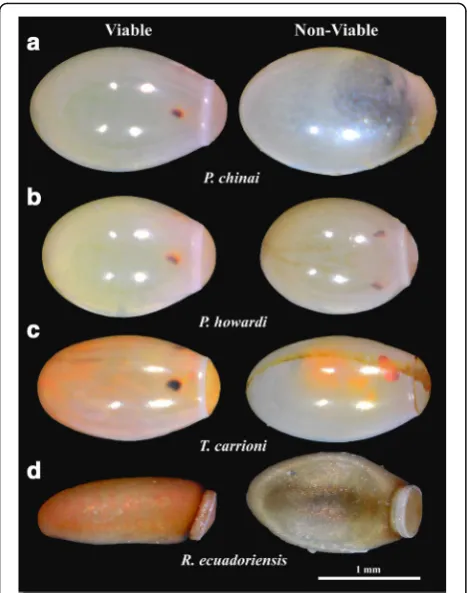
Eggs of the Triatomini tribe were photographed in ven-tral position while those of the Rhodniini tribe were photographed in lateral position [32]. The viability status of the eggs was checked after the photographs were taken (days 20–25 for Triatomini, or day 10 for Rhodniini). After this step the NV eggs could be observed developing a pro-gressive deflation-like deformation and/or lacking some obvious development signals (i.e. eye-spots) (Fig.2).
Morphometric approaches
We applied two different geometric approaches: the outline-based morphometrics for the complete contour of the egg, and the landmark/semilandmark-based morphometrics for the contour of the operculum (Additional file 1: Table S1) [32]. Both approaches in-cluded two main steps: (i) extraction of size and shape variables, which is specific to the technique used, and (ii) discrimination using final shape variables.
Egg contour
[image:4.595.56.541.98.224.2]For shape variable definition, we exclusively used the el-liptic Fourier analysis (EFA) [39]. Briefly, the observed contour is decomposed in terms of sine and cosine curves of successive frequencies called harmonics, and each har-monic is described by four coefficients. With this method, the first harmonic ellipse parameters are used to normalize the elliptic Fourier (NEF) coefficients so that they are in-variant to size, rotation, and the starting position of the out-line trace. By doing this, the three first coefficients become constant (1, 0 and 0) and are not used in the remaining analyses. The fourth coefficient, the one related to the width-on-length ratio of the outline, has been used in our study. The EFA algorithm does not require the points to be equidistant, nor does it require them to be in the same number [40]. The square root of the internal area of the contour (sqrA) and the perimeter of the contour (Per) were computed to estimate the size of the complete egg. For Table 1Geographical location and year of collection in communities from which parents were used for egg production
Spp. Province, community E Latitude Longitude Altitude Year Parents’origina Group n
P. c. Loja, Vega del Carmen P -4.1137 -79.5928 1086 2009 Laboratory colony (6th generation) V 34
NV 22
T. c. Loja, Yunga I -4.1225 -79.4284 1622 2015 Field colony (1st generation) V 21
NV 12
P. h. Manabí, Bejuco P -0.99007 -80.3475 134 2007 Laboratory colony (8th generation) V 67
NV 55
R. e. Manabí, Cruz Alta S -1.00149 -80.2705 971 2013 Laboratory colony (4th generation) V 19
NV 14
Abbreviations:P.c. Panstrongylus chinai,P.h. P. howardi,T.c. Triatoma carrioni,R.e. Rhodnius ecuadoriensis,Eecotopes,Pperidomicile,Iintradomicile,Ssylvatic,
Vviable eggs,NVnon-viable eggs,nnumber of eggs analyzed by group per species. A total of 244 eggs were analyzed a
each species, the linear correlation coefficient (r) was com-puted between these two estimates of size (sqrA and Per).
To accurately represent a closed curve, many har-monics are needed, each one with four coefficients, so that the number of variables would be too numerous relative to the number of individuals. The normalized coefficients (NEF) were thus submitted to a principal component analysis (PCA), and the principal compo-nents (PC) or a reduced set of first PC were the final shape variables. This procedure allows for reducing the number of input variables (PC) where necessary.
Operculum shape
We used 2 unambiguous landmarks for the Triatomini
eggs and 4 unambiguous landmarks for the Rhodnius
eggs. Between landmarks, we additionally used 8 semi-landmarks to capture the external, curved line of the operculum, and 4 to trace the curved boundary between egg and operculum in both types of eggs.
All landmarks and semilandmarks were submitted to par-tial Procrustes superimposition [41] and semilandmarks
then subjected to a sliding procedure [42,43]. The tangent space orthogonal projections [44] of the aligned configura-tions were used as input for a principal components ana-lysis (PCA), and the principal components (PC) or a set of first PC were retained as final shape variables. The centroid size (CS) was estimated as the square root of the sum of the squared distances between the center of the landmarks configuration and each individual landmark [45].
Statistical comparisons
We compared the different species using either the V eggs, NV eggs, or both, and within each species we also compared V and NV eggs. All statistical comparisons con-sidered separately the metric properties (size and shape) of the complete egg and those of the operculum only.
Size comparisons
Statistical comparisons of sizes were based on
non-parametric, permutation-based tests (1000 cycles) with statistical significance estimated after Bonferroni correction. Using estimates of size, a validated classifica-tion procedure was applied based on the maximum like-lihood method [36] between either different species or between V eggs and NV eggs.
Shape-based discrimination
For the egg contour, each pairwise Mahalanobis distance between groups was computed using the first 32 principal components (PC) of the normalized elliptic Fourier coeffi-cients. For the operculum, Mahalanobis distance was computed using the PC of the tangent space variables. Statistical significance was based on non-parametric, permutation-based tests (1000 cycles), and submitted to the Bonferroni correction. The validated reclassification derived from shape was based on the Mahalanobis dis-tances using PC as input. The latter were used to build an unweighted pair-group method with arithmetic average (UPGMA) tree, using as operating taxonomic units (OTUs) the four species subdivided according to V eggs and NV eggs.
We compared the variance of shape (also called metric disparity, MD) between species as well as between V eggs and NV eggs. It was computed as the trace of the variance-covariance matrix of the final shape variables of each group. Statistical significance of comparisons be-tween MD was based on bootstrap tests (5000 runs) as described by Zelditch et al. [20].
Contribution of size to shape-based discrimination
The contribution of size variation to shape variation was estimated through the determination coefficient between the estimator of size and the first shape-derived discrim-inant factor.
[image:5.595.57.291.87.384.2]Software
Collection of landmarks/semilandmarks and pseudoland-marks on eggs, as well as image digitalization and statistical methods (EFA, Procrustes superposition, multivariate ana-lyses) were performed using the CLIC package (http:// xyom-clic.eu/). The UPGMA tree was constructed using theapeR package (http://ape-package.ird.fr/).
Results
The primary aim of our study was to evaluate the pos-sible effects of egg viability on the morphometric dis-crimination between species. The results of this study were divided into: (i) interspecific discriminations, where we checked the influence of NV eggs on species discrim-ination; and (ii) intraspecific comparison, where we ex-plored possible morphometric differences between viable (V) and non-viable (NV) eggs of the four species.
Egg viability
The highest developmental time of the eggs was ob-served inP. chinai(30.15 ± 1.13 days), while the lowest time was scored forR. ecuadoriensis(18.22 ± 0.94 days). The eggs laid per female varied from 83 (P. howardi) to 144 (P. chinai) depending on the species. The percentage of V eggs from females reared in the laboratory was lower (from 42 to 79%) than for the field collected eggs (88% forT. carrioni) (Table2).
Interspecific discrimination by size
Since the contour of the egg is smooth, the estimations of size such as the perimeter and the square root of area were correlated with generally high scores (r= 92%,r= 88% and r= 75% forPanstrongylusspp.,T carrioniandR. ecuador-iensis, respectively;P < 0.001), we thus restricted our size estimator to the square root of the egg area (sqrA).
For all comparisons (V, NV and both),R. ecuadoriensis was the species with smallest eggs, while P. chinai har-bored the largest ones. The size of the operculum did not show a strict parallelism with the whole egg, since the largest operculum was observed for P. howardi, not for P. chinai (Table 3, Fig. 3). Almost all the pairwise comparisons of size between species were found to be significant (P< 0.001).
For the complete egg contour, the variance of size did not show any significant difference between species (P ranging between 0.994–0.100). However, for the oper-culum, in three pairwise comparisons the variance of size showed significant interspecific difference: (i) be-tweenP. chinaiandP. howardifor the total sample and for the NV eggs (P= 0.004 andP= 0.007, respectively);
(ii) between V eggs of P. chinai and T. carrioni (P =
0.002); and (iii) between NV eggs ofP. howardi andT. carrioni(P= 0.015) (Table4).
On average, mixing V eggs and NV eggs, species were weakly separated by the size of the egg contour (72%) or by the size of the operculum (65%). Opposite trends between the egg contour and the operculum could be observed when taking into account egg viability to dis-tinguish species (Table5).
Interspecific discrimination by shape
All pairwise interspecific comparisons of shape (of ei-ther eggs or operculum) were highly significant (per-mutation test, 1000 cycles, P < 0.001). For the egg contour, the values of Mahalanobis distances between V eggs were higher than between NV eggs, with an increase going from 42 up to 85%. An opposite trend was observed for the distances derived from the oper-culum shape. When considering the total sample mix-ing V eggs and NV eggs, the Mahalanobis distances showed intermediate values.
For all the interspecific comparisons (using V, NV or both kinds of eggs), the reclassification scores obtained from the contour of the whole egg (95%, on average) were better than those obtained from the operculum (71%, on average) (Table5).
As for size, opposite results between egg contour and operculum shape were observed when distinguishing species using either V eggs or NV eggs. For the egg con-tour, reclassification scores and Mahalanobis distances were negatively affected when we included the NV eggs in the analysis; for the operculum, however, the reclassi-fication improved when we included NV eggs (Table5).
[image:6.595.57.539.646.715.2]The UPGMA tree based on the external contour of the eggs showed (i) complete separation between tribes (Rhodniini and Triatomini); (ii) notable differ-ence between genera of the tribe Triatomini (Panstrongylus
Table 2For each species: time of development in days, average number of eggs per female per day, number of hatched eggs per female per month, and percentage of viable eggs
Species Developmental time (days) Eggs laid/female/daya Eggs hatched % Viability
P. c. 30.15 ± 1.13 4.79 (144) 114 79.17
P. h. 28.99 ± 1.38 2.78 (83) 35 42.17
T. c. 25.00 ± 0.79 3.77 (113) 99 87.61
R. e. 18.22 ± 0.94 3.71 (111) 81 72.97
Abbreviations:P.c. Panstrongylus chinai,P.h. P. howardi,T.c. Triatoma carrioni,R.e.Rhodnius ecuadoriensis
a
and Triatoma); (iii) distinction between species, either for V eggs or NV eggs; and (iv) a constant clustering of V eggs and NV eggs together. On the other hand, the UPGMA tree based on the operculum shape could not produce interspecific relationships in accordance with known phylogenetic relationships when NV eggs were included. For the operculum, the viability status of eggs could affect the representation of interspecific relatedness (Fig.4).
Comparisons of size between viable (V) and non-viable (NV) eggs
The sqrA for NV eggs of P. chinai or T. carrioni
showed larger values than observed for V eggs, while
no such difference was observed for the eggs of P.
[image:7.595.304.539.109.361.2]howardi or R. ecuadoriensis. These differences in size
Table 3Mean values of size and standard deviation of the complete egg contour (square root of the area within the egg boundary) and of its operculum (centroid size of the operculum) for viable eggs (V), non-viable eggs (NV) and both
Species V NV P-value* V + NV
P. c. Egg 1.34 ± 0.04a 1.36 ± 0.05a 0.089 1.35 ± 0.04a
Operculum 0.74 ± 0.03e 0.74 ± 0.03d 0.834 0.74 ± 0.03d
P. h. Egg 1.27 ± 0.03b 1.27 ± 0.04b 0.722 1.26 ± 0.04b
Operculum 0.77 ± 0.03f 0.80 ± 0.05e <0.001 0.78 ± 0.04e
T. c. Egg 1.21 ± 0.03c 1.26 ± 0.04b 0.000 1.22 ± 0.04c
Operculum 0.70 ± 0.02g 0.71 ± 0.03f 0.219 0.70 ± 0.02f
R. e. Egg 1.09 ± 0.03d 1.09 ± 0.04c 0.605 1.09 ± 0.04d
Operculum 0.74 ± 0.02h 0.73 ± 0.03 0.678 –
Abbreviations:P. c. Panstrongylus chinai,P. h. P. howardi,T. c. Triatoma carrioni,
R. e. Rhodnius ecuadoriensis
*
P-values, statistical significance for the comparison of mean sizes between V eggs and NV eggs. If means are different between species, the superscripts (a-h) show different letters. These letters must be read within each column, not between columns. Mean and standard deviation are expressed in millimeters
Fig. 3Size variation of egg and operculum.aDifferences betweenPanstrongylus chinai,P. howardi,Triatoma carrioniandRhodnius ecuadoriensis.
bDifferences in operculum size between V eggs and NV eggs ofR. ecuadoriensis. All values are expressed in millimeters.Abbreviations:P, Panstrongylus;T,Triatoma;R. ecuad.,Rhodnius ecuadoriensis; V, viable; NV, non-viable
Table 4Variance of size and variance of shape for the egg contour and for the operculum
Species Viability Egg, variance Operculum, variance
Size Shape Size Shape
P. c. V 0.0015a 0.00017a,b 0.0010a 0.0016a
NV 0.0022b 0.00062d 0.0008c 0.0040c
P* 0.4360 0.00000 0.427 0.0000
V + NV 0.0018c 0.00035f 0.0009e 0.0026e
P. h. V 0.0008a 0.00017a 0.0012a 0.0025a
NV 0.0019b 0.00026e 0.0023d 0.0024d
P* 0.0010 0.02900 0.046 0.4160
V + NV 0.0013c 0.00021e 0.0019f 0.0025f
T. c. V 0.0008a 0.00012b 0.0004b 0.0010b
NV 0.0019b 0.00029e 0.0007c 0.0028c,d
P* 0.1480 0.00200 0.157 0.0000
V + NV 0.0017c 0.00019e 0.0005e 0.0022g
R. e. V 0.0011a 0.00034c 0.0004 0.0009
NV 0.0014b 0.00045d 0.0008 0.0011
P* 0.6120 0.03800 0.2370 0.1430
V + NV 0.0012c 0.00037f
Abbreviations:P. c. Panstrongylus chinai,P. h. P. howardi,T. c. Triatoma carrioni,
R. e. Rhodnius ecuadoriensis,Vviable,NVnon-viable
[image:7.595.56.292.133.257.2] [image:7.595.59.540.533.696.2]between V eggs and NV eggs were generally not sta-tistically significant, except for T. carrioni (P < 0.001). Considering the operculum only, the size did not signifi-cantly vary between groups, except forP. howardiwhere the NV eggs showed larger values (P < 0.001) (Table3). Thus, larger eggs, or eggs with larger operculum, were found more frequently in NV groups, although this trend was not systematically significant.
On the other hand, the variance of egg size showed larger values in NV eggs, although it was significant only for P. howardi (P = 0.001) (Table 4). Looking at the distribution of sizes (Fig. 3), NV eggs tended to have extreme sizes, either very small or very large, a
pattern particularly obvious for P. howardi. Similar
trends (excepting P. chinai, Table 4) which were not
significant and less apparent, were observed also for the operculum (Fig. 3).
The validated reclassification of V eggs and NV eggs, based on egg or operculum size, showed
rela-tively low scores on average (between 42–76% and
39–64%, respectively) (Table 6).
Comparisons of shape between viable (V) and non-viable (NV) eggs
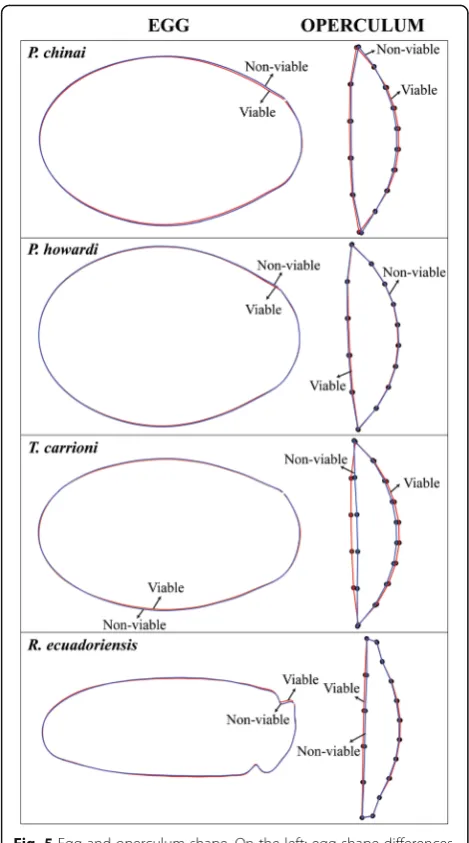
In Triatomini (“neck-less eggs”), the V eggs tended to be more slender (Fig.5); this trend was statistically significant only inP. howardi(P= 0.008). ForR. ecuadoriensis, the V eggs did not necessarily present a narrower form, but they showed a relatively wider neck than NV eggs (Fig.5).
The operculum exhibited significant shape difference between V eggs and NV eggs. The shape change was lo-cated at the curved limit between the egg and the opercu-lum (Fig.5). It was statistically significant inP. chinai,P.
howardi and T. carrioni (P = 0.012, P = 0.014 and P =
0.013, respectively); however, it was not significant for the Rhodniini (P= 0.165).
The reclassification scores between V eggs and NV eggs based on the contour of the whole eggs were
lower (between 45–67%) than the ones based on the
operculum (between 59–73%) (Table 6). In all species, the metric disparity (MD, variance of shape) of the NV egg contour was significantly larger (1.5 to 3.7
[image:8.595.57.539.111.276.2]times larger) than the one of V eggs (P ranging
Table 5Percentages of correctly assigned species (ratios between parentheses) for viable eggs (V), non-viable eggs (NV) and both, using either size or shape, egg contour or operculum
Species Egg Operculum
% V % NV % V + NV % V % NV % V + NV
P. c. Si 82 (28/34) 95 (21/22) 87 (49/56) 35 (12/34) 59 (13/22) 45 (25/56)
Sh 100 (34/34) 73 (16/22) 87 (49/56) 56 (19/34) 64 (14/22) 62 (35/56)
P. h. Si 72 (48/67) 38 (21/55) 61 (74/122) 64 (43/67) 84 (46/55) 71 (87/122)
Sh 96 (64/67) 93 (51/55) 98 (119/122) 66 (44/67) 80 (44/55) 75 (92/122)
T. c. Si 81 (17/21) 50 (6/12) 70 (23/33) 76 (16/21) 75 (9/12) 76 (25/33)
Sh 100 (21/21) 100 (12/12) 97 (32/33) 76 (16/21) 42 (5/12) 70 (23/33)
R. e. Si 95 (18/19) 93 (13/14) 91 (30/33) – – –
Sh 100 (19/19) 100 (14/14) 100 (33/33) – – –
Global Si 79 (111/141) 59 (61/103) 72 (176/244) 58 (71/122) 76 (68/89) 65 (137/211)
Sh 98 (138/141) 90 (93/103) 95 (233/244) 65 (79/122) 71 (63/89) 71 (150/211)
Abbreviations:P. c. Panstrongylus chinai,P. h. P. howardi,T. c. Triatoma carrioni,R. e. Rhodnius ecuadoriensis,Sisize,Shshape,Globaltotal scores across species
[image:8.595.59.539.571.693.2]between 0.038– < 0.001). For the operculum, the MD of NV eggs was larger, although statistically significant only in P. chinai and T. carrioni (P < 0.001 for both species) (Table 4).
Except for the operculum ofP. howardi(20%), the in-fluence of size variation on shape distinction was low, both for the egg and the operculum (from 0.3 to 6.9%).
Discussion
This study is motivated by the need for a more precise taxonomic identification of some potential vectors what-ever the stage of development available, either adult, nymph or egg. We focused here on the taxonomic inter-est of eggs according to their viability. The use of eggs is relevant because, in some cases, only eggs (and nymphs) are found in human dwellings [46], and eggs were re-cently shown to be highly discriminant between species and populations [32,36].
The diversification of egg morphology among species of the Triatominae is likely to be primarily under genetic determinism. However, various environmental and arte-factual causes could interfere with species divergence. Among them, in addition to the developmental stages and the position of the egg [32], we could cite the sam-pling conditions (time and place of collection), the mother age, the source of blood of the genitors and their feeding frequency, and the origin of the colonies (par-ents from laboratory colonies or from the field) [47–52]. These factors primarily affect the size of organisms; for this reason the morphometric distinction between taxa was based on shape variation, not on size variation, even if shape distinction was not completely free of some re-sidual size influence (allometric residue). Moreover, these confusing factors were tentatively ruled out here by selecting controlled laboratory conditions (except for T. carrioni) and, for each species, by selecting
new-molted genitors coming not only from the same locality, but also from the same house.
In these conditions, we could focus better on another possible interference: egg viability. At the time of devel-opment as selected by Santillán-Guayasamín et al. [32] to capture egg morphometric data in the best condi-tions, it is not possible to predict the future of each egg: viable (V) and non-viable (NV) eggs are mixed. Our study tries to estimate the effect of egg viability on its metric properties. Even with a relatively low number of female genitors (eight per species), it was possible to de-tect some trends.
We observed the highest percentage of viability for the eggs laid by field females (seeT. carrioni, Table2). The eggs of females that spent a few generations in the laboratory showed lower viability scores, especially for the females transported from a very different nat-ural environment (see P. howardi, Table 2).
The hatching success scores used in this study pro-vided only a partial indication of fitness. However, our study was not designed to understand the causes of egg viability, rather its protocol was set up to de-scribe, and possibly to understand, any association with modified metric properties. Our main question was: could the viability status of the egg affect its morphology to such an extent that species distinction was compromised? We also checked whether there was any typical difference in the size and in the shape of V eggs and NV eggs.
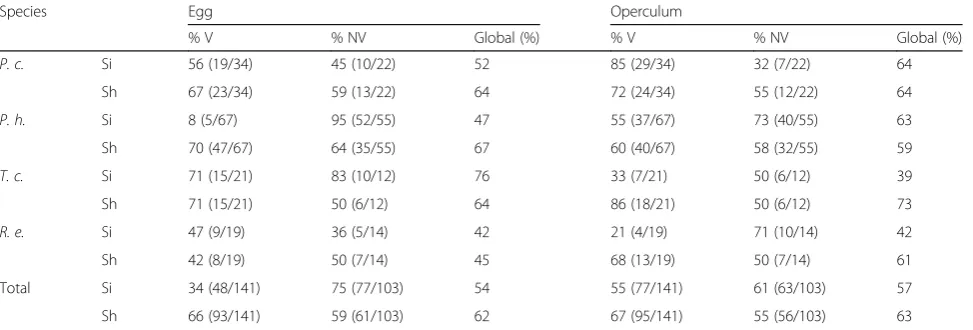
[image:9.595.57.544.100.265.2]Using V eggs only, the shape of the complete contour could recognize almost perfectly (98%) the four species, while the interspecific comparisons limited to NV eggs or mixing both kinds of eggs reached a consistently lower score (90 and 95%, respectively). For the opercu-lum, the shape was not highly discriminant between spe-cies. Unexpectedly, the inclusion of NV eggs in the Table 6For each species, validated reclassification scores between viable (V) and non-viable eggs (NV)
Species Egg Operculum
% V % NV Global (%) % V % NV Global (%)
P. c. Si 56 (19/34) 45 (10/22) 52 85 (29/34) 32 (7/22) 64
Sh 67 (23/34) 59 (13/22) 64 72 (24/34) 55 (12/22) 64
P. h. Si 8 (5/67) 95 (52/55) 47 55 (37/67) 73 (40/55) 63
Sh 70 (47/67) 64 (35/55) 67 60 (40/67) 58 (32/55) 59
T. c. Si 71 (15/21) 83 (10/12) 76 33 (7/21) 50 (6/12) 39
Sh 71 (15/21) 50 (6/12) 64 86 (18/21) 50 (6/12) 73
R. e. Si 47 (9/19) 36 (5/14) 42 21 (4/19) 71 (10/14) 42
Sh 42 (8/19) 50 (7/14) 45 68 (13/19) 50 (7/14) 61
Total Si 34 (48/141) 75 (77/103) 54 55 (77/141) 61 (63/103) 57
Sh 66 (93/141) 59 (61/103) 62 67 (95/141) 55 (56/103) 63
The reclassification method was based on either size (Si) or shape (Sh), separately. Validated classification, i.e. the percent of correctly assigned individuals (ratio in parentheses)
discrimination increased the classification scores be-tween species.
Thus, in spite of variation according to species, our data suggest that the viability of eggs could modify the interspecific discrimination. Although there were differ-ences in egg shape and size between V eggs and NV eggs, it was not possible to accurately recognize them. When based on shape, the operculum or the complete egg contour produced similar but low reclassification scores between V and NV eggs (62 and 63%, respectively; see Table 6). When based on size, the reclassification
scores were lower than those based on shape (54 and 57%, respectively, on average).
The difference in size between V eggs and NV eggs could be related to the consumption of yolk during
the development [53, 54], or to an insufficient
amount of yolk provided by the mother [49]. In that
case, size modification would be the consequence of pathological changes in the egg development. How-ever, physical properties of eggs may also influence their viability by altering resistance to tensile stresses
and thus to breakage [55], or by modifying gas
ex-change (O2, CO2 and water vapor) between the envir-onment and the developing embryo [56].
The variation in egg size probably reflects adaptive processes for each species in response to environmental heterogeneity [57, 58]. In this regard, our observations could suggest that there is an optimal phenotype for the size. Indeed, the distribution of operculum and egg size between V eggs and NV eggs supported the idea that the eggs of P. chinai, T. carrioni and R. ecuadoriensis could be subject to directional selection in which smaller individuals had a higher probability of surviving than
larger ones. However, the eggs of P. howardiwere
ap-parently subject to stabilizing selection, where either large or small eggs suffered a higher risk of death than eggs of intermediate size [59, 60]. If confirmed, these features would represent another distinction
be-tween the very close species P. chinai and P. howardi
(Villacís et al., in prep.).
Conclusions
To distinguish between species, size did not prove to be a good discriminant character for either the oper-culum or complete egg. Regarding shape, using either V eggs or NV eggs, the operculum did not appear to be a reliable source for interspecific recognition (65 and 71% of correct assignments, respectively). The complete contour of the egg provided much more satisfactory species classification (95% of correct as-signments, on average), with better scores comparing V (98%) than NV (90%) eggs. Thus, species recogni-tion by the complete contour of the egg was very high. We showed that it was affected by the viability status of the egg. A constant metric change from V to NV eggs observed for all species was a larger vari-ance of size and shape in the NV group. For all spe-cies, larger eggs, or eggs with larger operculum, were found more frequently in the NV group, suggesting that an optimum phenotype could be found preferably among intermediate or small sizes, presenting a less globular shape in the Triatomini, or a relatively wider neck in R. ecuadoriensis. However, it was not possible to use the metric properties to perform an accurate prediction about egg viability.
[image:10.595.56.291.86.508.2]Additional file
Additional file 1:Table S1.Database. Coordinates of the complete contour of the eggs (outline-based method) and of the operculum (landmark/semilandmark-based approach). (XLSX 558 kb)
Abbreviations
CS:Centroid size; EFA: Elliptic Fourier analysis; MD: Metric disparity; NEF: Normalized elliptic Fourier; NV: Non-viable; OTUs: Operating taxonomic units; PC: Principal component; PCA: Principal components analysis; sqrA: Square root of the internal area of the contour; UPGMA: Unweighted pair-group method with arithmetic average; V: Viable
Acknowledgments
Special thanks to the inhabitants of the visited communities and the personnel of the National Chagas Control Program from the Ministry of Health of Ecuador who participated in the collection of the triatomines. Technical assistance was provided by Julio Sánchez-Otero and César Yumiseva from the Pontifical Catholic University of Ecuador (PUCE). English editing was provided by Lori Lammert.
Funding
Financial support was received from the Pontifical Catholic University of Ecuador (E13037, G13042, J13066, L13254 and M13480), the National Institutes of Health, Fogarty International Center, Global Infectious Disease Training Grant (1D43TW008261-01A1), and the National Institute of Allergy and Infectious Diseases, Division of Microbiology and Infectious Diseases, Academic Research Enhancement Award (1R15AI077896-01).
Availability of data and materials
All data generated or analyzed during this study are included within the article and its additional file.
Authors’contributions
SSG participated in the conception and design of the study, the collection of field specimens in 2015, the acquisition and digitization of pictures, the making and design of the figures, the analysis and interpretation of data and the writing of the paper. AGV participated in the conception and design of the study, the collection of field specimens between 2005 and 2015, and the writing of the manuscript. MJG participated in the collection of field specimens between 2005 and 2015, and the revision of the manuscript. JPD participated in the design of the study, the development of the computer software, the analysis and interpretation of data and the writing of the paper. All authors read and approved the final manuscript.
Ethics approval and consent to participate
This study was performed within the guidelines established by the American Association for Laboratory Animal Science (IACUC), using protocol 15-H-034-IACUC, title“Life cycle, feeding and defecation patterns of kissing bugs (Hemiptera: Reduviidae: Triatominae) under laboratory conditions”, approved by the Ohio University Institutional Animal Care and Use Committee. Triatomines were collected under Ecuadorian collections permit No. 002-07-IC-FAU-DNBAPVS/MA, 008- RM-DPM-MA and 011-2015 IC-INF-VS-DPL-MA. This study did not include human participants.
Consent for publication
Not applicable.
Competing interests
The authors declare that they have no competing interests.
Publisher’s Note
Springer Nature remains neutral with regard to jurisdictional claims in published maps and institutional affiliations.
Author details 1
Center for Research on Health in Latin America (CISeAL), School of Biological Sciences, Pontifical Catholic University of Ecuador, Calle Pambahacienda s/n y San Pedro del Valle, Campus Nayón, Quito, Ecuador. 2Infectious and Tropical Disease Institute, Department of Biomedical
Sciences, Heritage College of Osteopathic Medicine, Ohio University, Athens, OH 45701, USA.3IRD, UMR 177 IRD-CIRAD INTERTRYP, Campus international de Baillarguet, Montpellier, France.
Received: 21 May 2018 Accepted: 10 September 2018
References
1. Mendonça VJ, Alevi KCC, Pinotti H, Gurgel-Gonçalves R, Pita S, Guerra AL, et al. Revalidation ofTriatoma bahiensisSherlock & Serafim, 1967 (Hemiptera: Reduviidae) and phylogeny of theT. brasiliensisspecies complex. Zootaxa. 2016;4107:239–54.
2. Souza dos SE, Von Atzingen NCB, Furtado MB, de Oliveira J, Nascimento JD, Vendrami DP, et al. Description ofRhodnius marabaensissp. n. (Hemiptera, Reduviidade, Triatominae) from Pará State, Brazil. ZooKeys. 2016;621:45–62. 3. de Oliveira J, Ayala JM, Justi SA, de Rosa JA, Galvão C. Description of a new
species ofNesotriatomaUsinger, 1944 from Cuba and revalidation of synonymy betweenNesotriatoma bruneri(Usinger, 1944) andN. flavida (Neiva, 1911). J Vector Ecol. 2018;43:148–57.
4. Abad-Franch F, Paucar A, Carpio C, Cuba CA, Aguilar HM, Miles MA. Biogeography of Triatominae (Hemiptera: Reduviidae) in Ecuador: Implications for the design of control strategies. Mem Inst Oswaldo Cruz. 2001;96:611–20.
5. Grijalva MJ, Villacís AG. Presence ofRhodnius ecuadoriensisin sylvatic habitats in the southern highlands (Loja Province) of Ecuador. J Med Entomol. 2009;46:708–11.
6. Quinde-Calderón L, Rios-Quituizaca P, Solorzano L, Dumonteil E. Ten years (2004–2014) of Chagas disease surveillance and vector control in Ecuador: successes and challenges. Trop Med Int Health. 2016;21:84–92.
7. Grijalva MJ, Villacís AG, Ocaña-Mayorga S, Yumiseva CA, Moncayo AL, Baus EG. Comprehensive survey of domiciliary triatomine species capable of transmitting Chagas disease in southern Ecuador. PLoS Negl Trop Dis. 2015; 9:e0004142.
8. Patterson JS, Barbosa SE, Feliciangeli MD. On the genusPanstrongylusBerg 1879: evolution, ecology and epidemiological significance. Acta Trop. 2009; 110:187–99.
9. Barrett TV. Advances in triatomine bug ecology in relation to Chagas disease. In: Harris KF, editor. Advances in Disease Vector Research. New York: Springer-Verlag; 1991. p. 143–76.
10. Grijalva MJ, Palomeque-Rodríguez F, Costales JA, Davila S, Arcos-Teran L. High household infestation rates by synanthropic vectors of Chagas disease in southern Ecuador. J Med Entomol. 2005;42:68–74.
11. Mosquera KD, Villacís AG, Grijalva MJ. Life cycle, feeding, and defecation patterns ofPanstrongylus chinai(Hemiptera: Reduviidae: Triatominae) under laboratory conditions. J Med Entomol. 2016;53:776–81.
12. Villacís AG, Ocaña-Mayorga S, Lascano MS, Yumiseva CA, Baus EG, Grijalva MJ. Abundance, natural infection with trypanosomes, and food source of an endemic species of triatomine,Panstrongylus howardi(Neiva 1911), on the Ecuadorian Central Coast. Am J Trop Med Hyg. 2015;92:187–92. 13. Pinto CM, Ocaña-Mayorga S, Lascano MS, Grijalva MJ. Infection by
trypanosomes in marsupials and rodents associated with human dwellings in Ecuador. J Parasitol. 2006;92:1251–5.
14. Suarez-Davalos V, Dangles O, Villacís AG, Grijalva MJ. Microdistribution of sylvatic triatomine populations in central-coastal Ecuador. J Med Entomol. 2010;47:80–8.
15. Villacís AG, Grijalva MJ, Catalá SS. Phenotypic variability ofRhodnius ecuadoriensispopulations at the ecuadorian central and southern Andean region. J Med Entomol. 2010;47:1034–43.
16. Cuba CA, Abad-Franch F, Roldán Rodríguez J, Vargas Vásquez F, Pollack Velasquez L, Miles MA. The triatomines of northern Peru, with emphasis on the ecology and infection by trypanosomes ofRhodnius ecuadoriensis (Triatominae). Mem Inst Oswaldo Cruz. 2002;97:175–83.
17. Grijalva MJ, Palomeque-Rodríguez F, Villacís AG, Black CL, Arcos-Teran L. Absence of domestic triatomine colonies in an area of the coastal region of Ecuador where Chagas disease is endemic. Mem Inst Oswaldo Cruz. 2010; 105:677–81.
18. Grijalva MJ, Suarez-Davalos V, Villacís AG, Ocaña-Mayorga S, Dangles O. Ecological factors related to the widespread distribution of sylvaticRhodnius ecuadoriensispopulations in southern Ecuador. Parasit Vectors. 2012;5:17. 19. Bookstein FL. A hundred years of morphometrics. Acta Zool Acad Sci Hung.
20. Adams DC, Rohlf FJ, Slice DE. Geometric morphometrics: ten years of progress following the“revolution”. Ital J Zool. 2004;71:5–16.
21. Zelditch ML, Swiderski DL, Sheets HD, Fink WL. Geometric Morphometrics for Biologists: A Primer. New York: Elsevier Academic Press; 2004. 22. Murray CM, Piller KR, Merchant M, Cooper A, Easter ME. Salinity and egg shape
variation: a geometric morphometric analysis. J Herpetol. 2013;47:15–23. 23. Lent H, Wygodzinsky P. Revision of the Triatominae (Hemiptera, Reduviidae),
and their significance as vectors of Chagas’disease. Bull Am Mus Nat Hist. 1979;163:123–520.
24. Galvão C. Vectors of Chagas’disease in Brazil. Curitiba: Sociedade Brasileira de Zoologia; 2014.
25. Barata JMS. Aspectos morfológicos de ovos de Triatominae. Rev Saude Publica. 1981;15:490–542.
26. Monte Gonçalves TC, Jurberg J, Costa J, de Souza W. Estudio morfológico comparativo de ovos e ninfas deTriatoma maculata(Erichson, 1848) e Triatoma pseudomaculataCorrea & Espinola, 1964 (Hemiptera, Reduviidae, Triatominae). Mem Inst Oswaldo Cruz. 1985;80:263–76.
27. Costa J, Barth OM, Marchon-Silva V, de Almeida CE, Freitas-Sibajev MGR, Panzera F. Morphological studies on theTriatoma brasiliensisNeiva, 1911 (Hemiptera, Reduviidae, Triatominae) genital structures and eggs of different chromatic forms. Mem Inst Oswaldo Cruz. 1997;92:493–8.
28. Barbosa SE, Dujardin J-P, Soares RP, Pires HH, Margonari C, Romanha AJ, et al. Interpopulation variability amongPanstrongylus megistus(Hemiptera: Reduviidae) from Brazil. J Med Entomol. 2003;40:411–20.
29. Obara MT, Barata JMS, da Silva NN, Ceretti Júnior W, Urbinatti PR, da Rosa JA, et al. Morphologic, morphometrical, and histological aspects of the eggs of four species of the generaMeccus(Hemiptera, Reduviidae, Triatominae). Mem Inst Oswaldo Cruz. 2007;102:13–9.
30. Obara MT, da Rosa JA, da Silva N, Ceretti Júnior W, Urbinatti PR, Barata JMS, et al. Morphological and histological study of eggs of six species of the Triatomagenus (Hemiptera: Reduviidae). Neotrop Entomol. 2007;36:798–806. 31. Páez-Colasante X, Aldana E. Geometric morphometrics of the chorial rim
and the collar of the eggs of five species of theRhodniusgenus (Heteroptera, Reduviidae, Triatominae). EntomoBrasilis. 2008;1:57–61. 32. Santillán-Guayasamín S, Villacís AG, Grijalva MJ, Dujardin J. The modern
morphometric approach to identify eggs of Triatominae. Parasit Vectors. 2017;10:55.
33. Evangelista-Martínez Z, Imbert-Palafox JL, Becerril-Flores MA, Gómez-Gómez JV. Análisis morfológico de huevos deTriatoma barberiUsinger (Hemiptera: Reduviidae). Neotrop Entomol. 2010;39:207–13.
34. Forattini OP, Ferreira OA, da Rocha e Silva E, Rabello EX. Ecological aspects of trypanosomiasis americana. VIII. The domicile ofPanstrongylus megitus and itsextradomiciliary presence. Rev Saude Publica. 1977;11:73–86. 35. Dujardin J-P, Slice DE. Contributions of morphometrics to medical
entomology. In: Tibayrenc M, editor. Encyclopedia of Infectious Diseases: Modern Methodologies. New Jersey: Wiley & Sons, Inc.; 2007. p. 435–47. 36. Dujardin J-P, Dujardin S, Kaba D, Santillán-Guayasamín S, Villacís AG,
Piyaselakul S, et al. The maximum likelihood identification method applied to insect morphometric data. Zool Syst. 2017;42:46–58.
37. Black CL, Ocaña-Mayorga S, Riner D, Costales JA, Lascano MS, Davila S, et al. Household risk factors forTrypanosoma cruziseropositivity in two geographic regions of Ecuador. J Parasitol. 2007;93:12–6.
38. Grijalva MJ, Villacís AG, Ocaña-Mayorga S, Yumiseva CA, Baus EG. Limitations of selective deltamethrin application for triatomine control in central coastal Ecuador. Parasit Vectors. 2011;4:20.
39. Kuhl FP, Giardina CR. Elliptic Fourier features of a closed contour. Comput Graphics Image Process. 1982;18:236–58.
40. Rohlf FJ, Archie JW. A comparison of Fourier methods for the desciption of wing shape in mosquitoes (Diptera: Culicidae). Syst Zool. 1984;33:302–17. 41. Rohlf FJ, Slice DE. Extensions of the Procrustes method for the optimal
superimposition of landmarks. Syst Zool. 1990;39:40–59. 42. Bookstein FL. Landmark methods for forms without landmarks:
morphometrics of group differences in outline shape. Med Image Anal. 1997;1:225–43.
43. Gunz P, Mitteroecker P. Semilandmarks: a method for quantifying curves and surfaces. Hystrix, Ital J Mammal. 2013;24:103–9.
44. Rohlf FJ. Rotational fit (Procrustes) methods. In: Rohlf F, Bookstein F, editors. Proceedings of the Michigan Morphometrics Workshop. Ann Arbor: The University of Michigan Museum of Zoology; 1990. p. 227–36. 45. Bookstein FL. Morphometric Tools for Landmark Data: Geometry and
Biology. 1st ed. New York: Cambridge University Press; 1991.
46. dos Santos CM, Jurberg J, Galvão C, da Rosa JA, Júnior WC, Barata JMS, et al. Comparative descriptions of eggs from three species ofRhodnius(Hemiptera: Reduviidae: Triatominae). Mem Inst Oswaldo Cruz. 2009;104:1012–8. 47. Rabinovich JE. Vital statistics of Triatominae (Hemiptera: Reduviidae) under
laboratory conditions. I.Triatoma infestansKlug. J Med Entomol. 1972;9:351–70. 48. Karlsson B, Wiklund C. Egg weight variation in relation to egg mortality and
starvation endurance of newly hatched larvae in some satyrid butterflies. Ecol Entomol. 1985;10:205–11.
49. Begon M, Parker GA. Should egg size and clutch size decrease with age? Oikos. 1986;47:293–302.
50. Crailsheim K. Trophallactic interactions in the adult honeybee (Apis melliferaL.). Apidologie. 1998;29:97–112.
51. Pirk CW, Neumann P, Hepburn R, Moritz RFA, Tautz J. Egg viability and worker policing in honey bees. Proc Natl Acad Sci USA. 2004;101:8649–51. 52. da Rosa JA, Justino HHG, Barata JMS. Differences in the size of eggshells
among threePangstrongylus megistuscolonies. Rev Saude Publica. 2003;37: 528–30.
53. Atella GC, Gondim KC, Machado EA, Medeiros MN, Silva-Neto MA, Masuda H. Oogenesis and egg development in triatomines: a biochemical approach. An Acad Bras Cienc. 2005;77:405–23.
54. Santos R, Rosas-Oliveira R, Saraiva FB, Majerowicz D, Gondim KC. Lipid accumulation and utilization by oocytes and eggs ofRhodnius prolixus. Arch Insect Biochem Physiol. 2011;77:1–16.
55. Srivastava DP, Yu EJ, Kennedy K, Chatwin H, Reale V, Hamon M, et al. Rapid, nongenomic responses to ecdysteroids and catecholamines mediated by a novelDrosophilaG-protein-coupled receptor. J Neurosci. 2005;25:6145–55. 56. Van Schalkwyk SJ, Brown CR, Cloete SWP. Gas exchange of the ostrich
embryo during peak metabolism in relation to incubator design. South African J Anim Sci. 2002;32:122–9.
57. Einum S, Fleming IA. Maternal effects of egg size in brown trout (Salmo trutta): norms of reaction to environmental quality. Proc R Soc B. 1999;266: 2095–100.
58. Einum S, Fleming IA. Does within-population variation in fish egg size reflect maternal influences on optimal values? Am Nat. 2002;160:756–65. 59. Johnston RF, Niles DM, Rohwer SA. Hermon bumpus and natural selection
in the house sparrowPasser domesticus. Evolution. 1972;26:20–31. 60. Bumpus HC. The elimination of the unfit as illustrated by the introduced