Rochester Institute of Technology
RIT Scholar Works
Theses Thesis/Dissertation Collections
2008
Recollection
Erika Tada
Follow this and additional works at:http://scholarworks.rit.edu/theses
This Thesis is brought to you for free and open access by the Thesis/Dissertation Collections at RIT Scholar Works. It has been accepted for inclusion in Theses by an authorized administrator of RIT Scholar Works. For more information, please [email protected].
Recommended Citation
Rochester Institute of Technology
A Thesis Submitted to the Faculty of
The College of Imaging Arts and Sciences
In Candidacy for the Degree of
Master of Fine Arts
Recollection
Approvals
Chief Advisor: ______________________________ Date:______________ Michael Rogers
Associate Advisor: ______________________________ Date:______________ Luvon Sheppard
Associate Advisor: ______________________________ Date:______________ Robin Cass
Permission Statement
I, Erika Tada, hereby grant permission to the RIT Library of the Rochester Institute of Technology to reproduce my thesis in whole or in part. Any reproduction will not be for commercial use or profit.
Date: ____________ Signature of Author: ___________________ __ ________
Rochester Institute of Technology
This volume is property of the Institute, but the literary rights of the author must be respected. Please refer to Permission Statement in this volume for denial or permission by author to reproduce. In addition, if the reader obtains any assistance from this volume, he must give proper credit in his own work.
This thesis has been used by the following persons, whose signatures attest to their acceptance of the above conditions.
Acknowledgements
I would like to express my appreciation to my professors, colleagues and family who
supported me while I was finishing this dissertation.
The members of my thesis committee, Michael Rogers (Chair), Robin Cass, and Luvon
Sheppard, have been invaluable throughout the completion of this thesis investigation. My
special thanks to go Professor Michael Rogers and Robin Cass for their creative insights,
innovative ideas and productive criticism of my artistic direction. Most importantly, they helped
me develop my narrative and sculptural aspects. They have been an essential source of
inspiration for my art career.
I would like to express heartfelt appreciation to my parents, Sekiyoshi Tada and
Masako Tada, who supported me my entire life, and my husband, Hweawon Chung. This thesis
is dedicated to them.
List of Tables
Approvals ⅱ
Permission Statement ⅱ
Acknowledgements ⅲ
List of Tables ⅳ
List of Figures ⅴ
Ⅰ. Original thesis statement 1
Statement of the basic premises 2
Statement of goals and objectives of the thesis investigation 3
Ⅱ. Critical discussion of the body of work in relation to the issues presented in the Introduction, Section I
1. Memories, present and future ・・・・・・・・・・・・・・・・・・・・・・・・・・・・・・・・・・・・・・・・・・・ 4 2. Nature ・・・・・・・・・・・・・・・・・・・・・・・・・・・・・・・・・・・・・・・・・・・・・・・・・・・・・・・・・・・・・・・・・・・・・・ 6 3. Glass characteristics and historical resources ・・・・・・・・・・・・・・・・・・・・・・・・・ 7 4. Contents and contexts ・・・・・・・・・・・・・・・・・・・・・・・・・・・・・・・・・・・・・・・・・・・・・・・・・・・・ 12 5. Artistic influences ・・・・・・・・・・・・・・・・・・・・・・・・・・・・・・・・・・・・・・・・・・・・・・・・・・・・・・・・・ 16 6. Thesis work: Letter ・・・・・・・・・・・・・・・・・・・・・・・・・・・・・・・・・・・・・・・・・・・・・・・・・・・・・・・ 21 7. Thesis work: Branches and Socks ・・・・・・・・・・・・・・・・・・・・・・・・・・・・・・・・・・・・・・ 23 8. Thesis work: Mailbox ・・・・・・・・・・・・・・・・・・・・・・・・・・・・・・・・・・・・・・・・・・・・・・・・・・・・ 25 9. Extension of thesis work: Leaf ・・・・・・・・・・・・・・・・・・・・・・・・・・・・・・・・・・・・・・・・・・ 27 10. Extension of thesis work: Bird and Stones ・・・・・・・・・・・・・・・・・・・・・・・・・・・・ 29
Ⅲ. Critical discussion of the results of the thesis work, in relation, to the issue presented in the Introduction, Section I
31
Works Cited 33
List of Figures
Figure.1 Botanical Museum of Harvard University, Coffea Arabica L ・・・・・・ 10
Figure.2 George-Louis Leclerc, Comte de Buffon, Cabinet du Roy ・・・・・・・・・・ 15
Figure.3 Joseph Beuys, Double Objects ・・・・・・・・・・・・・・・・・・・・・・・・・・・・・・・・・・・・・・・・・・ 18
Figure.4 Joseph Cornell, Untitled (Dovecote) ・・・・・・・・・・・・・・・・・・・・・・・・・・・・・・・・・・・ 20
Figure.5 Letter ・・・・・・・・・・・・・・・・・・・・・・・・・・・・・・・・・・・・・・・・・・・・・・・・・・・・・・・・・・・・・・・・・・・・・・・ 22
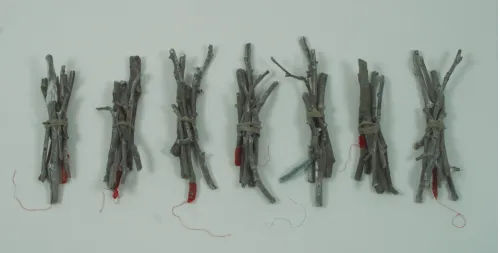
Figure.6 Branches and Socks ・・・・・・・・・・・・・・・・・・・・・・・・・・・・・・・・・・・・・・・・・・・・・・・・・・・・・・ 24
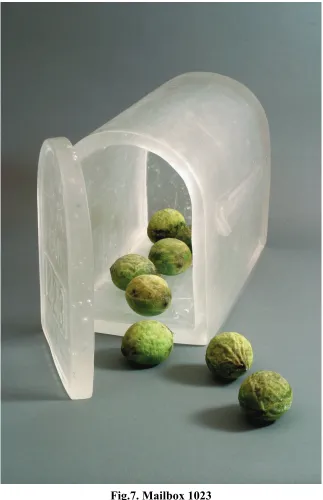
Figure.7 Mailbox 1023 ・・・・・・・・・・・・・・・・・・・・・・・・・・・・・・・・・・・・・・・・・・・・・・・・・・・・・・・・・・・・・ 26
Figure.8 Leaf Ⅰ ・・・・・・・・・・・・・・・・・・・・・・・・・・・・・・・・・・・・・・・・・・・・・・・・・・・・・・・・・・・・・・・・・・・・ 28
Figure.9 Bird and Stones ・・・・・・・・・・・・・・・・・・・・・・・・・・・・・・・・・・・・・・・・・・・・・・・・・・・・・・・・・・・ 30
Figure.10 Vegetables ・・・・・・・・・・・・・・・・・・・・・・・・・・・・・・・・・・・・・・・・・・・・・・・・・・・・・・・・・・・・・・・・・ 34
Figure.11 Mailbox 1223 ・・・・・・・・・・・・・・・・・・・・・・・・・・・・・・・・・・・・・・・・・・・・・・・・・・・・・・・・・・・・・ 35
Figure.12 Mail of Love ・・・・・・・・・・・・・・・・・・・・・・・・・・・・・・・・・・・・・・・・・・・・・・・・・・・・・・・・・・・・・・ 36
Figure.13 Mail of Dad ・・・・・・・・・・・・・・・・・・・・・・・・・・・・・・・・・・・・・・・・・・・・・・・・・・・・・・・・・・・・・・・・ 37
Figure.14 Leaf Ⅱ ・・・・・・・・・・・・・・・・・・・・・・・・・・・・・・・・・・・・・・・・・・・・・・・・・・・・・・・・・・・・・・・・・・・・ 38
Figure.15 Leaf Ⅲ ・・・・・・・・・・・・・・・・・・・・・・・・・・・・・・・・・・・・・・・・・・・・・・・・・・・・・・・・・・・・・・・・・・・・ 39
Figure.16 Leaf Ⅳ・・・・・・・・・・・・・・・・・・・・・・・・・・・・・・・・・・・・・・・・・・・・・・・・・・・・・・・・・・・・・・・・・・・・・・ 40
Original thesis statement
I try to retain memories of my family and express the emotions I feel at the time I receive
precious things, such as letters, pictures and small objects. These memories and objects of mine
are protected and kept secretly and importantly in containers. I can look into these objects and be
reminded of the places and time of my childhood experiences and travels.
After I came to the United States of America, I began to realize the importance of my
family. I place special significance on anything that my parents send me or that reminds me of
my native country. I keep my family and friends close by creating kiln cast glass sculpture that
reflects the time we have spent together. My glass containers protect and keep these special
objects.
Through my glass pieces, I hope to communicate with others. The viewers have their own
personal memories and experiences, and I hope my pieces cause nostalgia in the viewer for what
they have seen and experienced in their own lives.
Statement of the basic premises of the thesis
My current work is about my life, important events and special moments of happiness I
have experienced. By having a dialogue with my emotions and expressing my pleasure in
working with the glass, I can reflect upon my relationship with my family and friends, and look
back upon my history and myself. Moreover, this process helps me adjust to my life here in the
United States.
It is important to me to attach special meaning to even ordinary things which I see
everyday. Having different sense-making abilities, I can find fascinating objects that have great
details, colors, and shapes in both humans and nature. This relationship with the natural beauty
of these objects helps me to feel happiness and emotional serenity; I may keep those in a jewel
box. Moreover, when I take these objects in my hand and hold them, they take me back to places
and moments in my past as far back as I can remember, giving me the remembrance of a
pleasurable time. I also feel more intimacy with nature and commonplace objects that are related
to my personal experiences, such as travel, memories, and my everyday life because I can
conserve my special home and time.
Abstract
My central thesis meaning is seeking to recollect my authentic experiences and memories,
and to encapsulate my emotions and any "small happiness" I encounter. For the concept of
preservation of my memories, I intend to document important times and places by recalling my
childhood and family history, and to make my memories eternal. During the process of creating
my glass art, I can signify my personal experience in relation to my inner life. I am working with
my feelings, and I make objects important and of great reverence in my life. Moreover, this
process helps me assimilate a new culture and people here in the United States. Also, solitary
feelings of isolation are consoled, and even the sense of distance from home is lightened. I try to
represent the best of myself and my most personal and intimate feelings. Glass objects are
Critical discussion of the body of work in relation to the issues presented in the
Introduction, Section I
1. Memories, present and future
As a transplant from Tokyo, Japan, I keep my family and friends close by creating glass
sculpture that reflects the time I have spent with them. My family, my experiences, and my
Japanese culture have mostly influenced my art work.
My early family experiences play a large part in my artistic direction. I was brought up
very rigidly as a second child by my father and mother in a traditional family. They have always
been supportive of my education. My family also includes my brother and my sister. My father
is a strict and persistent worker. My relationship with my father could not be described as close.
I didn’t understand his strict education, and I barely have memories of the times that he played
with me. My mother, who is so much more warm and tender, has the capacity and space to
sympathize with us. I unconsciously look for pleasant moments from my past, and I am seeking
to be immersed in warmth, like within my mother’s arms, before I know it consciously. One of
the reasons for creating my glass work is the recollection of thoughts of the relationship between
my parents and myself.
I was urged to study glass in the United States. I moved to Nebraska State to enter in
2001 with much enthusiasm for my future. In 2003, I began my graduate study in the Department
of Glass and Sculpture at Rochester Institute of Technology (RIT.) After I moved away from my
home town, I straddled two very different cultures. I have tried to assimilate a new culture and
incorporate my own cultural history. At the same time, I realized my family’s importance. My art
I traveled to many places and countries over the past several years for my studies. I have
visited galleries, museums, artists’ studios, and schools. The dialogue, which I have had with the
other artists and people, gave me the opportunities to expand my aesthetic thoughts and other
technical knowledge. Through those experiences in the United States, my interest in American
culture/art and its uniqueness has grown, and my travel and everyday life have become
significant. Also, I think that being raised in a traditional Japanese family has contributed to my
affinity with those outside the cultural mainstream.
My work has evolved greatly, just as I have grown as a person and artist. My current
work has matured as my vision has gradually developed by my immersion in the American
culture and especially from the direction of my professors. To point out specific
visual/conceptual changes is difficult to verbalize, so suffice it to say that I have grown through
my experiences, both intellectually and technically. These changes in my work are sometimes
easy to view and at other times are more subtle. I look forward to each day that I am creating, so
I can discover my own artistic directions.
Growing as an artist and person, I plan to pursue my artistic goals by studying and
visiting new places. I get a feeling of happiness and accomplishment when I create art, share, and
communicate my ideas with others. The personal encounters, past, present and in my imagined
future life, along with American culture, are all influential to my aesthetic imaginations. I want
to enhance new ways of insight, perception, and awareness through my future experiences. I will
2. Nature
All my life, I have been influenced by my surroundings, Japanese heritage, culture,
society, nature and art. I have often been amazed and thrilled by my environment; this is what
inspired me to become an artist and shaped the way I look at the world.
As traditional Japanese, I feel at ease to live as a part of nature and to appreciate the
simple natural qualities of things, which is a Japanese aesthetic ideal. In the customary Japanese
way of life, we deeply associate with nature and spiritual objects as one would with a friend by
mutual affection and communication. The abundance of cloth, paper, wood, bamboo and clay,
natural elements in our natural surroundings has been used in our daily lives since ancient times.
These materials, effectively used, retain original qualities and become a symbol of nature in
daily life in Japan.
I believe that I have great sensibility to see the aesthetic value in nature. I attach meaning
to even the most diminutive and commonplace flower that people might pass without notice.
Having extensive sense-making abilities, I can find fascination in objects that have complex
details, colors, textures, and shapes from nature. Fascination might also be found in the
recollection of wonderful natural sceneries from my extensive travels in the unique geography of
Japan and other countries. In my travels, I have seen different conditions, climates, and nature
adapt differently. I am interested in the nature of the four seasons in various parts of the world.
There are familiar plants from back home that look the same everywhere, but they are different.
I became interested in plants and botany which has stayed with me all my life. By
duplicating these objects in glass, I can observe such entities and constructs. It is the primary
way for me to attach special meaning to everyday objects, which then become a symbol of the
with nature, it soothes me to have a pastime that alleviates the sense of distance from my home
country. I can reflect upon my relationship with my family and look back upon myself. These are
constantly my artistic resources that expand my imagination further. The series of nature works,
my life and the natural world are interwoven. I can see the wholeness of life and feel a deep
reverence for the beauty of it all.
3. Glass characteristics and historical resources
I am attracted to glass as my art making material for many reasons. I was first drawn to
glass because of all the artistic possibilities that glass presents. Glass as material is attractive
itself, it is transparent, reflects the light, is smooth, attenuated, and abundant with rich colors. It
is beautiful and synchronously intractable, its subtle and fragile. All its characteristics are the
nature and strength of glass, which makes me attempt to control it. Glass articulates my intimate
experiences and stops the time and freezes my memories as eternal.
When I began glass making, I used glass because of the interior space and its
transparency, which present great potentials to me for my ideas. I took advantage of the interior
to create new worlds. This space might be different from our lives and a seemingly endless and
fascinating world. It reminds us what we have seen and experienced, something dear, a natural
feeling, scenery into the past. We can imagine the world so that there may be something we
identify with in the glass space, a space far from ours. At the same time, this world feels
nostalgic in our minds.
Afterward, I started to utilize the glass transparency to create containment. Currently, I
as letters, pictures and small objects. The inherent transparent quality of glass allows me to look
into the enclosed objects through the glass.
I combine many glass-forming techniques such as glass blowing, kilncasting, fusing,
enameling, and various cold glass working methods. My principle technique is kilncasting, a
method of kiln firing that uses color chunks of glass. I am interested in the relationships of
blowing glass and kilncasting glass, mostly Pâte de verre. The most important reason for me to
use glass blowing was to make containers, and kilncasting was to make the substances inside. It
is visually interesting and possible to create reality in pieces that have the opposite characteristics
of transparency and opaqueness, naturally forming the well-detailed object. Especially when I
"handle" molten glass, I often feel that glass has a will of its own. I am always fascinated by the
beauty of its movement. Working with made cast glass parts together with blown glass at the hot
shop is technically difficult, and as result it gives me motivation and excitement.
My principle glass technique, Pâte de Verre, allows me the most possibility for my
creative expression, conveying my thoughts, feelings, and unrestricted designs in detail. Pâte de
Verre describes a technique of glass making, a method of kiln firing that uses color powder or
crushed glass combined with binding agents. It means literally “paste of glass,” and originated in
France at the end of the 19th century. The early stages of Pâte de Verre began in ancient Egypt.
After the technique was lost with the invention of the glass blowing technique, which lent much
better to mass-production, it was rediscovered by the French artist Henri Cros (1840-1907) in the
end of the 19th century.
Also, Amalric Walter (1859-1942), Albert Dammouse (1848-1926), Francois
Decorchemont (1880-1971), Georger Despret (1862-1952), and Argy Rousesau (1885-1953)
significant historical resources. Because these French artists kept the technique secret, it
disappeared with the death of these artists. Currently, there is a lack of distinction between the
term Pâte de Verre and casting technique even though the term Pâte de Verre is used universally
by glass artists to categorize their cast glass works. However, I would say that there is distinction
between Pâte de Verre and casting technique. Pâte de Verre is able to be discriminated from
kilncasting according to the use of varied granule glass and possibility of color placement.
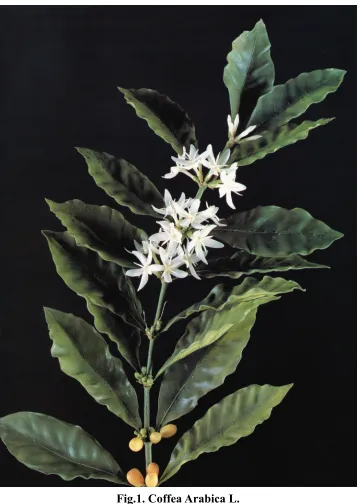
My technical, aesthetic and historical significance is the Ware Collection of Blaschka
Glass Models of Plants-at the Harvard Museum of Natural History in Cambridge, Massachusetts,
which is described below.
First, there is the triumph of all artistic naturalism, the successful deception of senses: these glass
models are more lifelike than the most painstaking Dutch still life. Second, there is the triumph
of enduring art over the ephemeral nature: it is the essence of the beauty of flowers to be fleeting,
but the blue delphinium blossom, even the half-yellowed leaf, are frozen in time, like an insect in
amber. Finally, there is the triumph of form over matter, of artistry over the resistance of natural
materials: the sheer unsuitability of hard, brittle glass to mimic the delicate fronds, soft petals
veined leaves, fleshy fruits, and thready roots of plants turns these models into wonders. What
would be ordinary in nature become extraordinary in art.1
Although Blaschka Glass was made by flameworking, I feel that it is connected to Pâte de Verre
because of their delicate and time-consuming processes. The process of applying multiple
colored powder glass to the mold is quite similar to the medium of still life painting, which
Fig.1. Coffea Arabica L.
make glass leaves, branches, vegetables, nuts, stones and shells from nature objects. The
potentialities of varied colors make me try to duplicate natural features as close as possible. In
order to capture the qualities of original nature, forms, colors, textures, and compositions, I
closely examine the composition of every single piece of the natural object while packing the
glass. According to Kent H, Gerge, as in nature, no two flowers or leaves of a single plant are
exactly the same, so in the glass reproduction every minute variation is followed with the
greatest fidelity.2
The results of kiln firing or Pâte de Verre are not exactly the same as I attempt. At times, it
comes up with unexpected results of the color and flow of the glass and relies on various
occasions to meet better natural appearance. An object which has been cast by this method
characteristically exhibits rich and subtle colors and well-detailed soft translucent or opaque
appeal which is significantly different from the appearance of blown glass. The surface of
varying degree of matteness is directly related to the size of the glass granular fragments chosen
and whether the glass that was added to the mold was transparent or opaque when it was applied.
After annealing the mold with glass, it is taken out from the kiln and the glass is then removed
from the refractory mold. Finally, the glass surface is treated by grinding, polishing, sandblasting,
carving, acid-etching or artificial treatment.
The glass characteristic of tenderness, fragility and complexity help me to express my
intimate experiences and capture the moment of the special time. Though the process requires
extreme ability of sensitively and patience, my creative mind is put to work. The process of
observation and painting the glass powder look like traces of my memories. It provides a method
my creative expression as an essential glass method. My technique is developed for duplicating
the wonders of nature. The glass medium is the best vehicle to tell my personal history because
of its unique characteristics. There is so much possibility to be found for my art.
4. Contents and contexts
In my career of creating art, there is one area that fascinates me. That is the relationship
between artists and their works and the people who appreciate them. I seek to communicate with
others through my glass. My work is open enough to engage with viewers while still being
personal. It has the ability to elicit empathy from others; there is a quality in something that is
experienced that arouses a feeling of pathos and pity, or love and happiness. I don't intend for the
viewer to extract an exact meaning, but to experience some nostalgia or to relive his or her own
experiences. In the end, only an impression from the visual dialogue will remain in the viewer’s
mind.
How I communicate with my work is a language of metaphors in which I use symbols to
define specific meanings in a specific context. Rabbits or birds represent people or an idea of
“self”, multiple kinds of containers are “treasure boxes” or “nests” of memories and history, a
place to store treasures. These symbols have the ability to bring one’s awareness out
unconsciously and make each piece more intimate, adding poetic and narrative essences. The
item of collection in the past is the evidence of specific time and place that we were there. The
form can be an object, a photograph, or a diary with written words. These are “memory traces,”
an indirect bridge to connect past and present across the transient gap. The idea of “memory
Throughout my life the rabbit, as a symbol, has been an emotional attraction and one of
the objects that reminds me of my past. Whenever and wherever I see the moon, it reminds me of
childhood and it relieves insecure feelings. “Rabbit! What can you see when you jump? You
must see a full moon…” I hummed the song when I was a child. I thought that the dusky shadow
of the moon was the figure of a rabbit pounding the rice cake in the moon.
The phases identifying the markings of the moon as a rabbit pounding a rice cake is based
on the traditional psychological phenomenon involving a vague stimulus being perceived as
significant. There are many legends of the moon that express our culture, and are as old as
human consciousness. The image of the phases of the moon was thought to be related to birth,
growth, decay, death, and rebirth, and serves as many different symbols. In Japan, the rabbit is
thought of a symbol of the moon, originating from the story, “Rabbit in the Moon”. It is included
in “Story of Konjyaku” volume 5, and it indicates the Buddhist idea that the Buddha’s original
former life was as a Buddhist saint even though his transmigrations of the soul were into a rabbit,
monkey and the king of the country as well. The story tells the heart of the rabbit, desperation
and mercy. This is the story:
A group of animals came upon a beggar who asks them for help. Each animal left and returned
with something for the beggar. One brought him sticks for a fire, another some eggs, and another
some fruit, and so on. But, the rabbit was unable to find anything and came back empty handed.
The rabbit was very sad that he could not give something to the beggar. He said to the beggar,
“since I could not find anything for you to eat, you may eat me.” With that, he jumped into the
harmed. For being so generous, the beggar put the rabbit on the moon as a reward, so that
everyone could see and honor him.3
Birds are another symbol involved in my work. Birds have played prominent and diverse
roles in culture, religion, folklore, art and design in human society. The bird is thought to have
been the symbol of spirituality symbolizing a spiritual awareness and feelings of empowerment,
hope, peace, and exhilaration. Soaring high in the sky, birds in flight may symbolize carrying
messages from person to person. It may be a herald, bringing news about something that may
soon come into being in our life. It also has a sense of freedom and hope. Singing, chattering,
with an emphasis on the ability of the bird to correspond, it represents communication among
people. Diligently nurturing and protecting their young and nests, birds are also typify love, care,
resembling motherhood.
It is inspiring for me to be active and to pursue my art in this symbolic way since I had a
close relationship with the rabbit and bird as metaphors in my work. This way of working helped
me experience nature in a more intimate way. In my art, the rabbit and bird indicates self the
relationships among people, and these can produce a viewer’s intimacy and affection because of
its ephemeral nature.
In everyday life, containers have general use as repositories for collections, conveyance,
and preservation. I observe the beauty of everyday objects and place special value to these forms
as interpretations of my artistic purpose. The various containers are significant components to
add particular contexts. These containers offer an idea of what they are and what they mean in
my art. Multiple kinds of containers are “treasure boxes” or “nests” to preserve recollection of
are functionally essential. In addition, the containers elicit a sense of wonder and curiosity. The
status of the containment is that of a relay or a place of transit through which the eye must pass
to reach its goal. The objects communicate to us through containers heightening our emotion of
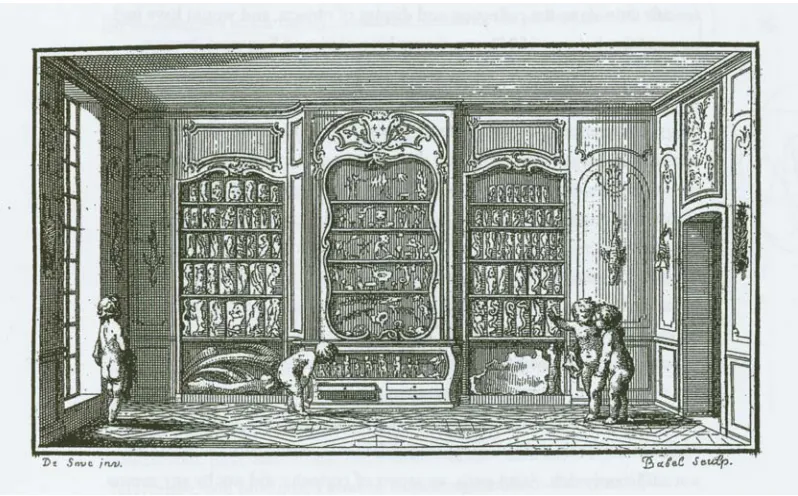
curiosity. In the 16th and 17th centuries, rooms and cabinets built to display collections of
precious objects were amazingly elaborate and were called “Cabinets of Curiosity”. These
cabinets can be small but still encompass the whole world in their collections of illustrated texts,
maps, coins, scientific devices, seashells, other natural specimens, as well as man-made objects.
According to Lynne Cooke and Peter Wollen,
[image:21.612.108.507.319.567.2]
Fig.2. George-Louis Leclerc, Comte de Buffon, Cabinet du Roy, 1749
Curiosity, therefore, is a term that indicates historically and culturally a specific attitude to the
collection and display of objects, and would have had no meaning before 1550. To use the
phenomenon, it “enjoyed a temporary spell in power, while, at the same time, it is tempting to
look more deeply into the precise position curiosity occupied between “theology” and “science.
“4
These are the genealogical connections between contemporary visual display and historical art
cabinets, “Cabinets of Curiosity,” which both elicit an air of mystery. The interior is filled with
rows of objects and side compartments and recalls the display cases of museums or department
stores. “Cabinets of Curiosity” contributes to the concept of “memory traces”.
In my work, I consider using objects that tell poetic stories. I create glass components
that are transformations of self, person, place and time, which reminds the viewers of
introspective emotions. It is important for me to consider how the objects themselves
communicate to the viewers. What role do the visual and the technical conditions of display
fulfill in the viewers’ experiences? I would like to explore these ideas, as well as to keep
pursuing the ultimate question: “Why do I make art?”
5. Artistic influences
I express my history using glass representing containers and commonplace objects as
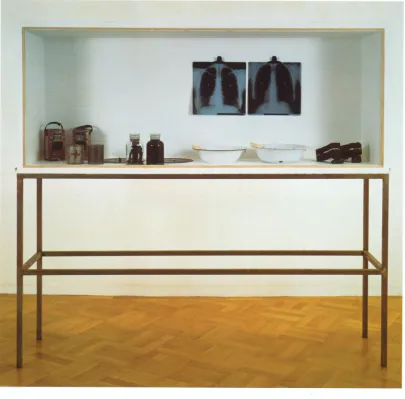
vehicles of expression of everyday life. There are two significant contemporary artists, Joseph
Beuys and Joseph Cornell, who are influentional artists to my aesthetic thoughts. These artists
created sculpture responding their immediate recognition and expressed their messages into their
works across to large number of people using common forms. They used the metaphor to
Joseph Beuys was a German artist who made social sculpture. He considered art as a
medium for affecting social and political change. He envisioned the society using his mysterious
and unfathomable objects such as the commonplace, unusual materials and objects, and animals,
which became a vivid metaphor. He manipulated and transformed these objects, and gave them
new meaning by altering and placing them in new contexts. The process of change inherent in
Beuys’s art is also one of important metaphors for the transitory states of existence and
ephemerality of the human condition. His objects, which often exist as the residue of
action/event, are meant to provoke a discussion of larger social and political issues; however, he
does not force anything to each viewer. Kazuhiro Yamamoto said,
His material is always a common object easily found in our everyday life…I am not referring to
the mere function in everyday use where these objects are consumed and disposed of. Their
original use as a tool, which is the ultimate purpose of their function that is, the materialization
of efforts to lead better life is attempted in each one of Beuys’s works. However, or perhaps I
should say naturally, it is not as if his works incorporate messages full of such preaching. He is
trying to provide human beings, who are burying their talents in the use and consumption of the
function of the tools they are given, an opportunity to switch on their dormant energy. By
showing the viewers the sight of reality, each viewer has to extract the <counterimage> on his
own account. All Beuys’s actions, installations, objects, sculptures, and lectures are a means of
communicate onto evoke this counterimage. The materialization of this <counterimage>, which
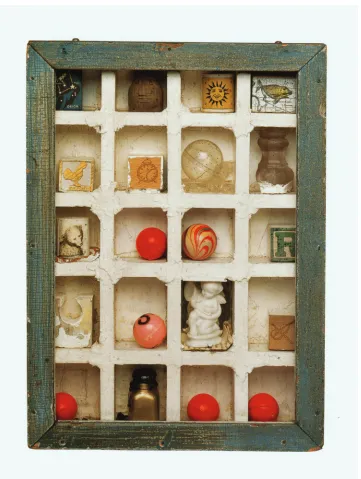
The other influential artist is Joseph Cornell. His most characteristic art works were
sculpture of simple boxed assemblages created from surprising collections of found objects,
photographs and beautiful and precious objects. He transformed these diverse objects from their
original state into extraordinary and magical items. According to Hartigan, Lynda Roscoeb,
Cornell assembled elements in matrix of metaphors designed to incite wonder, curiosity, and
contemplation about the physical and spiritual interrelationship of man and nature.6
His box construction allows to tell the poetic stories within visual languages, controls the
direction the viewer’s eye, and guides it around the surface of the box to four corners of the
construction. He was also an archivist of expressing the time, which he juxtaposed old and new,
combined past and present tense. These essential ingredients come through in his dusky
retrospective of childhood, nature, fantasy, science and space. His elements were symbolized to
specific meaning, and associated to his personal memories and experiences. His life was as work
itself and archive of storyteller.
Bob Verschueren is a natural sculptor concentrating on his plant installation. His works
influenced my aspect of the presentation. His choice of materials, artistic approach, and
resonated provoking messages are most similar examples to my work. He uses common
materials such as twigs, leaves and fruits, presents them as repetition, arranges precise, rigid
geometric forms. His work gains strength and intrigue as a result of careful observation and
instinctive response to the physical structure, shape, texture, and colors of nature within solid
6. Thesis work: Letter
After I moved away from my family and struggled with new culture and people in
America, I became introverted because of my loneliness. One day, my father sent me a letter
with a small piece of beautiful coral inside. It was a most memorable gift from my father, and I
strived to remember the moment of happiness of the time when I received his letter. I made
thirty-five envelopes, one month letters from my father. The presentation of format is systematic
repetition and setting envelops in an array of seven envelops by five lines, which indicate by a
calendar, with individually dated labels. The cast substances of inside envelops are unique to
another, mostly composing of corals, shells and other remnants of the beach brought in from the
shore. To create these pieces, I combine different techniques, glass blowing, which was to make
the envelopes, and kilncasting which was to make the shells. The transparency of glass envelops
are blended with white shelves. Highly colorful and opaque cast objects are obviously a focal
point, and these create realism to each feature. It is all my affinity for the transient of my life, its
passing special moments and consequently my memories with my family. I hope that my work
Fig.5. Letter
7. Thesis work: Branches and Socks
One day I was walking on campus, and I found a small surprise when I saw many broken
branches sticking out from under the snow. I started to collect those pieces of branches; they
were so cold. It was a similar feeling as I had when I collected stones and leaves as a child. There
was a very special attachment and meaning to those branches because they only existed in that
time and place. I duplicated in great detail, colors and forms from nature by using glass. I made
seven bundles of branches for a week and the red and blue socks to each bundle. The small
details of knitted twine draw attention to one area of the branch. The process of knitting socks
took me back to some early moments in my life. It is like the caring of a mother for her children
during the winter. I attempted to express my affection to those branches. Hence, I incorporated
the other materials, red color twine, to reflect my fond and tender feelings. The favorite color I
use was red because it is the essence of passion and beauty. The red attracts more viewers
because red immediately makes the strongest notice of all the colors. The bundle with the blue
sock is included a different shape of the branch to another and recognized a special day of a
week. The tread hanging from the socks symbolized my continuing care. This piece let me
expect the possibility to the interdisciplinary approach to my creative activity. I would explore
with other sculptural materials, such as fabrics, quilts, and other raw materials to new medium.
By expressing my intimate feeling to nature with my glass art, I can signify the times and places
8. Thesis work: Mailbox
My idea, mailbox, came from my travel in Tasmania, Australia with my friend. The
island appeared so artistic and imaginative and totally different from the city where I grew up. I
felt a very special feeling when I saw many different characteristic mailboxes in front of each
house. The mailbox is expressing each house with diverse colors and shapes. Some were old
because people do not care for them, and a twig, a leaf, and a rag cloth unexpectedly appear in
the shadow of mailbox. It is an entrance and an exit of people’s communication and the place of
receiving and giving things among family and friends. Therefore, I attempted to express the
mailbox, which is transfer of the information by glass. It is the primary way for me to everyday
objects and a symbol of the powerful ways we communicate. Sometimes we may be surprised by
special mails or gifts from others, through real letters and gifts are more special rather than any
kind of electric communication. The surprising gifts and letters are more intimate and special
among people. My intension of this series was to express the relationship between families and
people in various situations. I turn my viewpoint to the daily objects, and it is the one of the
works which I take account of personal special meaning on it. I take pride in my certain
Fig.7. Mailbox 1023
9. Extension of thesis work: Leaf
More recently I began making wall-based boxed construction by assembling multiple
diverse elements. It is the experimentation of the altered presentation format. The boxed
structure increases viewer’s emotion of curiosity. The box, the repository of my recollection,
encloses all of my dreams past, present, and future; my past and present are interwoven. The
items that I chose are natural objects that I collected from my recent travel in Seattle,
Washington and features, birds, as a metaphor of "self" in the past. When I enter the innermost
depths of a forest in Seattle, I found the extremely large leaf that I have never seen before. It is
called "Devil’s Walking Stick", and I was fascinated by its size, great details, colors, and shapes,
and its unique name made me more interested in it. When I hold these nature objects, they take
me back to places where I visited in the past. Each memorable item establishes new mutual
relationship and builds new context. It is one of my purposes is that my art work provides a
trigger, visual language, to communicate with viewers, which reminds their introspective
Fig.8. LeafⅠ
10. Extension of thesis work: Bird and Stones
This piece is focusing on two symmetrical introspective memories of my childhood.
Throughout my life, I have collected objects that have an emotional fascination, some objects
remind me of happiness and some recall my sorrowful experiences. I used the shopping bag
shape as a container with glass stones and a bird. The presentation as long horizontal display of
seven shopping bags symbolizes the passage of the time. I lined up seven bags and the number
indicates a week. The cast objects, stones and a bird, are placed inside of the bags or on the floor.
I intentionally install the pieces on the floor to produce the enough atmospheres around them.
The shopping bags, although all relatively similar dimensions to one another, all have unique
shapes. The color symbolizes my diverse emotions. The multiple clear bags express the positive
feeling to collect beautiful natural stones, and one black bag expresses the negative feeling to
collect a dead bird, faced the other way. The use of appropriate color is also a visually significant
Fig.9. Bird and Stones
Critical discussion of the results of the thesis work, in relation,
to the issue presented in the Introduction, Section I
My several installation works occupied entire atmosphere and time as a cohesive work at
the gallery. My Master Fine Arts (MFA) Thesis Exhibition, “Recollection”, was started at NTID
Dyer Arts Center from 9 January to 13 February 2006. In the entire show, my body of works
presented remembrances of my life, which I composed the poetical imaginative short stories,
world of imagination. Hence, these narrative works accomplished operating to the viewer’s
mind and communicating with spectators. There were significant visual textures, such as
presentation, space, size and color practices. My works’ setting formats had the keys,
consistency and repetition, to produce sense of the collection of the memories. As a strong
strategy, I used various presentations and the boxed structure elicits curiosity and the shadow
and various sizes cause undulation impressions. Moreover, the pieces were set individually or as
a group on the pedestal, wall or shelves, narrated to their specific contexts. The height of each
piece was an effective part of the composition of the gallery because it directed the eyes of the
viewers walking through and guided them to the next piece. The “Letter” was the central piece
installed on the wall in the back of the gallery. It was the largest size and number of items
installed among all of the works. The “Mailbox” series were separately composed on the
pedestal as a single piece. The “Branches and Socks” was set on a lower pedestal as if they
picked branches up from the ground. I attached the labels, which indicated the date or words; it
leads the observer’s imagination to specific direction. Although I attempted adding the specific
meaning, I believe that the viewer cannot totally grasp it but within their experiential. The color
glass transparency, and some kilncasting glass-colored objects. There was a bit of use of red
color as sweetness and warmth in every other piece. The addition of materials such as wood
work, fabric, twine stated further the delicate aesthetic values and emotion.
The glass elements with multiple kinds of containers expressed my collection of my
diverse events. The elements of leaves, branches, seeds, shells, stones, and the symbols of
rabbits and birds are my treasures of my life, which I chose to represent in my work. The bowls
signified the customary times the meal, the socks were the affection of mother, and the
mailboxes were the relationships among people. These features function as trigger associates,
metaphors of the language. The content is sometimes too specific or personal such as rabbit or
bird, so often the subtlety of visual reference helps to engage with others refer to the context.
The technical characteristics of Pâte de Verre cooperated with my aesthetic expression,
capturing the reality of the nature and expressing all my intimacy with its characteristic of subtly.
Certainly, my memories were all frozen. Glass transparency made it possible to look into the
features through the containers, create a state of curiosity.
My life was enriched by the way I appreciate to the beauty of nature, and signify the
existence of my family through completing this show. I conceived the best of myself and
sequentially my works were resulted as transformation of my delicate feelings. Coming future, I
Works Cited
[1] Daston, Lorraine. “Things that talk: object lessons from art and science”,
Cambridge, MA: New York Zoon Books, 2004, p. 224.
[2] Schultes, Richard Evans. “The Glass Flowers at Harvard”,
Cambridge, MA: Botanical Museum of Harvard University, 1992, p.103. Figure.1.
[3] Kent H, Gerge. “The Ware Collection of Blaschka Glass Flower Models”,
Cambridge, MA: Gerge H. Kent University Bookstore, 1908, p. 10.
[4] Moon Myths 510 Ver 3.09, 4 October 1999
<http://www.curriculum.spps.org/extended/PDFs/Gr5PDFs/510Myths.pdfe>.
[5] Cooke. Lynne and Wollen. Peter, “Visual Display: Culture Beyond Appearances”,
Bay Press, Incorporated Bay Press, 1995, p. 23. Figure.2.
[6] Cooke. Lynne and Wollen. Peter, “Visual Display: Culture Beyond Appearances”,
Bay Press, Incorporated Bay Press, 1995, p. 24.
[7] Mizusawa, Tsutomu. “Joseph Beuys with Fat and Felt”,
Tokyo, Japan: Fuji Television Gallery Co., Ltd, 1993, p. 48
[8] Rosenthal, Mark. “Joseph Beuys Actions, Vitrines, Environments”,
Houston, TX: Menil Foundation, Inc, 2004, p.69. Plate 61. Figure.3.
[9] Hartigan, Lynda Roscoeb. “Joseph Cornell Navigating the Imagination”,
Salem, MA: Peabody Essex Museum, 2007, p.145.
[10] Hartigan, Lynda Roscoeb. “Joseph Cornell Navigating the Imagination”,
Fig.10. Vegetables
Fig.14. Leaf Ⅱ
Fig.15. Leaf Ⅲ
Fig.16. Leaf Ⅳ
Fig.17. Colanders