THE CALL OF THE WHOLE IN UNDERSTANDING THE
DEVELOPMENT OF SUSTAINABLE VENTURES
Pablo MUÑOZ Business School Universidad Adolfo Ibáñez Diagonal Las Torres 2700, Peñalolén
Santiago, Chile [email protected]
Dimo DIMOV School of Management
University of Bath Bath, BA2 7AY, UK [email protected]
THE CALL OF THE WHOLE IN UNDERSTANDING THE
DEVELOPMENT OF SUSTAINABLE VENTURES
ABSTRACT
This paper examines the development process of sustainable ventures by focusing on
three substantive markers, namely the ideas, actions, and exchange relationships articulated
and instigated by the entrepreneurs in question. Based on data from 45 sustainability-oriented
new ventures, it examines the causal configurations behind the manifestations of these
markers using Fuzzy-Set Qualitative Comparison Analysis (fsQCA). The analysis also reveals
two distinct opportunity development paths. The first, conformist, operates in an enabling supporting context as sustainability conveyor. The second, insurgent, path operates as a change agent against an establishment that is not conducive to sustainability ideals.
*4. Manuscript (*WITHOUT Author details)
1. Introduction
In recent years, entrepreneurship has been seen as a catalyst for solutions to
sustainability problems (York and Venkataraman 2010) and a central force in the
development of an ecologically and socially sustainable economy (Pacheco et al. 2010). The
existence of commercially viable ventures that advance the causes of environmental
protection and social justice has captured scholarly attention (Hall et al. 2010) and spurred a
burgeoning field of sustainable entrepreneurship (Shepherd and Patzelt 2011). This paper
seeks to join this literature in search of substantive understanding of this phenomenon.
Taking stock of this literature, there are two conceptual challenges that need to be
resolved towards such understanding. First, the literature makes a clear separation between
opportunities and entrepreneurs (Shepherd and Patzelt 2011), representing two distinct levels
of analysis, and tracing its intellectual roots to the notion of nexus of individual and
opportunity as a unit of analysis (Venkataraman 1997). From a macro perspective,
opportunities for sustainable entrepreneurship represent systemic imperfections (Cohen and
Winn 2007; Dean and McMullen 2007) or conditions (Pacheco et al. 2010) that make
entrepreneurial endeavors possible or desirable. From a micro perspective, individual
entrepreneurs exhibit cognitions or behaviors such as opportunity recognition (Patzelt and
Shepherd, 2010), opportunity assessment (Shepherd et al. 2012), entrepreneurial intention
(Kuckertz and Wagner, 2010), and entrepreneurial action (Meek et al. 2010).
Such separation has been counter-productive for empirical research, which has
struggled to operationalize the phrase ‘pursuit of opportunities’ that is implicit in it. While
this phrase works as a metaphor in macro descriptions of the entrepreneurial system (Kirzner
2009; Klein, 2008), it is inoperable at the level of individual actors since whether what one
currently pursues is an opportunity can be revealed only retrospectively (Dimov 2011). And
to account for what it is that they are trying to do.
The second challenge pertains to aligning the factors that drive entrepreneurial behavior
for sustainable development. In this regard, the literature has discussed a number of different
factors. Some of these are related to the individual entrepreneur, such as prior knowledge
(Patzelt and Shepherd 2010), sustainability intention (Schaltegger 2002; Linnanen 2002;
Schlange 2006; Schaltegger and Wagner 2011) and sustainability orientation (Gibbs 2009;
Kuckertz and Wagner 2010). Others reflect the context in which the behavior occurs, such as
social norms (O’Neill 2009;; Meek et al. 2010) and the openness of the business context to
sustainability practices (Clemens, 2006; Spence et al. 2010; Pacheco et al. 2010; De Clercq
and Voronov 2011). Yet others discuss the nature of the value creation goals that define
sustainable entrepreneurship (Young and Tilley, 2006; Cohen et al. 2008; Tilley and Young,
2009). To the extent that all these matter individually, any analysis that omits some of them
provides insufficient explanation. In this regard, it is necessary to operate with them
collectively as configurations rather than piecemeal predictors. At the same time, the
dominant analytical methods in the field are built on linear model assumptions that presume
decomposability of the overall effect into discrete partitions for each predictor and are limited
in the degree of interaction they can accommodate. This calls for a shift in perspective from
discrete variables to holistic configurations of conditions as well as for complementary
methods that can analyze such configurations.
In this paper, we address these challenges in order to develop an empirical
understanding of the process of sustainable entrepreneurship. First, we view this process as
one of venture development, in which what can be empirically observed are the ideas, actions,
and exchange relationships of the focal entrepreneur (Dimov 2011). We thus ask the
following questions: (1) what factors explain the emergence of ideas, formulation of actions,
how are ideas, actions, and exchange relationships linked in this process. Second, we present
a conceptual configuration of the cognitive infrastructure of entrepreneurial behavior for
sustainable development. It combines a set of nested individual factors (knowledge,
orientation, intention), with the underlying goals of venturing and the perceived support from
the context in which it occurs. We seek to identify their causal conjunctions both within and
across the three process markers by conducting Fuzzy-set Qualitative Comparative Analysis
(fsQCA) (Ragin 1987) of the development process of 45 sustainability-oriented new ventures.
The data come from a survey, documentary data, and semi-structured interviews of
participants in twelve sustainability-oriented business competitions taking place over the
2009-2011 period.
By means of systematic comparison of causal and outcome conditions, the analysis
yielded six empirically relevant combinations of conditions, two each for ideas, actions, and
exchange relationships. Within each combination, we distinguish core and peripheral
conditions. More importantly, the ways the entrepreneurs in our sample tend to use these
combinations mark two distinct venture development paths. The first, conformist, operates in an enabling supporting context. It is characterized by dominance of supporting social context
in the formulation of ideas, of value creation and an enabling business context in the
deliberation of actions, and of intention and enabling business context in the pursuit of
exchange relationships. In contrast, the second, insurgent, path operates against an establishment that is not conducive to sustainability ideals. It is characterized by lack of
explicit consideration of sustainability ideas and dominated by absence of supportive social
context in the deliberation of actions, and by intention and absence of supporting context in
the pursuit of exchange relationships. This distinction enables a deeper understanding of the
complexity and diversity of the phenomenon; in particular of how and when sustainability
results paint a picture of a shifting mosaic in the development of sustainable ventures.
This study aims to make two main contributions to the literatures on sustainable
entrepreneurship and entrepreneurship more broadly. First, the identification of two distinct
developmental paths helps open up the black box of the process that connects initial ideas for
sustainable development and their ultimate entrepreneurial enactment. Each path emerges
from distinct social context and dictates specific logics of action and market interaction.
Second, our work highlights the conjunctural and equifinal nature of causal relationships in
the development process of sustainable ventures. Our work shows that factors that are
normally attributed piecemeal importance are in fact intertwined with others and not sufficient
conditions by themselves in explaining given outcomes. Such configurational logic
complements currently dominant thinking organized around linear models and
decomposability. More broadly, our work highlights the trade-off between complexity and
generality as a major challenge for the empirical utility of current theories of entrepreneurship
and offers a middle path. By being tuned to holistic configurations rather than discrete
variables, our approach enables the identification of more complex, conjunctural causal
patterns.
2. Theoretical Background
2.1 Explaining venture development
If we took a venture of interest to this paper, i.e. a commercially viable venture that
advances the causes of environmental protection and social justice (Hall et al. 2010), how
could we explain its emergence? One option would be to compare it against a counterfactual
non-emergence and look for differential antecedent conditions in its past, i.e. factors
impossibility) of accessing such counterfactuals empirically, determining the ways in which
this venture is unique would in fact retrace its history. Thus, a second option for explaining
the venture’s emergence is to focus on its developmental path, its unfolding process
(McMullen and Dimov 2013).
The entrepreneur (founder) is a main driving force behind the venture and perhaps one
of the few factors present all along the venture’s developmental path. Indeed, we could easily
imagine the developmental path as consisting of continuous snapshots of the entrepreneur
“doing” something. In fact, it is this “doing” that warrants ascribing the label “entrepreneur”
to the person. But a sequence of behaviors can appear meaningless to an external observer
without accounting for their underlying purpose. At this point, it is tempting to describe this
purpose as “pursuing an opportunity”. This stems from the broader notion that
environmentally relevant market failure creates opportunities for entrepreneurial action –
achieving profitability while reducing environmentally degrading behaviors (Dean and
McMullen 2007). But other than being a useful metaphor, this description says nothing
substantive about what the entrepreneur does (Kirzner 2009).
A venture is but a set of active exchange relationships and thus lies at the tail end of a
development process that begins with an initial venture idea and is continuously shaped by
action, social interaction, and learning (Dimov 2007). The path in between is marked by
actions and interactions driven by some underlying, evolving purpose (Venkataraman et al.
2012). As such, to study the venturing process in a substantive sense, one needs to focus on
its observable markers, namely the venture ideas at its onset, the actions through which these
ideas are expressed to set or keep the process in motion, and the interactions through which
the ultimate exchange relationships are instituted (Dimov 2011). But rather than simply
enlisting what these markers are, we aim to account for the evolving symbolic blueprint
way. To use the metaphor of driving a vehicle off road, in addition to simply describing the
twists and turns of its path, it is also useful to try to capture the forging of the path through the
eyes of the driver.
The flow of time in a venture development process is irreversible, i.e. we cannot
presume that what happens at different junctions can be known before it does, and thus
incorporated in the action deliberations beforehand. What happens is a subset of what is
possible, and the latter represents an unbounded set (Kauffman 2008). Thus, there is always
an element of novelty as the path unfolds. The implication of this is that there is an empirical
asymmetry to the explanation of particular ideas, actions, and exchange relationships: we can
observe only the articulated ideas and undertaken actions and interactions but not the set of
possibilities from which they were derived (Dimov 2011). Explaining them, therefore, entails
an account of the considerations behind them, rather than a comparison to inaccessible
counterfactuals.
2.2 The development of sustainable ventures
The central idea behind the development of sustainable ventures is that the activities
performed by entrepreneurs in the pursuit of gains must not undermine the ecological and
social environments in which they operate; and when necessary, they must restore or nurture
such environments towards recovering the balance between nature, society and economic
activity (Parrish, 2010; Shepherd and Patzelt, 2011). In Young and Tilley’s view (2006)
sustainable entrepreneurship is embodied by someone “who holistically integrates the goals of
economic, social and environmental entrepreneurship into an organization that is sustainable
in its goal and sustainable in its form of wealth generation” (p.88). This and other definitions
of sustainable entrepreneurship (e.g. Dean and McMullen 2007; Hockerts and Wüstenhagen
2010; Pacheco et al. 2010) resonate with mainstream sustainability ideas. Ultimately, its
economic development (Dresner 2008), emphasizing economic, ecological and social goals in
equal degrees (Sharma and Ruud 2003).
Understanding how these elements are related requires an examination of how the
different dimensions of sustainability are enacted in the development of new sustainable
ventures. In view of the opening discussion, our focus is on how sustainability is embedded in
the three markers of the venture development process: (1) the generation of venture ideas; (2)
the elaboration of venture ideas in actionable terms, i.e. as a set of immediate goals and
actions; and (3) the discourse through which entrepreneurs seek to establish market exchange
relationships. As we strive to understand these through the worldview of the entrepreneur, we
turn next to the literature to identify a set of personal factors and relevant considerations that
are instrumental in this process.
2.3 Integrating sustainability in entrepreneurial action
Scholars have drawn from different perspectives to answer the question of why some
individuals and not others decide to pursue opportunities with social, environmental and
intergenerational components (i.e. sustainable outcomes) concurrent with pursuing economic
viability (Dean and McMullen 2007; Tilley and Young, 2009; Hall et al. 2010; Shepherd and
Patzelt, 2011). Implicit in this question is a comparison among a set of individuals in order to
determine the distinguishing characteristics of those who step forward. By implication, the
answer draws a crude line between entrepreneurs and non-entrepreneurs, which can help find
a common denominator to sustainable entrepreneurs. Thus, we can say that they have prior
knowledge of ecological and social environments and the perceived threats to such
environments (Patzelt and Shepherd 2010), underlying attitudes and convictions towards
environmental protection and social responsibility (Kuckertz and Wagner, 2010), and the
intention to contribute to solving societal and environmental problems through
While the above logic can help explain who might become a sustainable entrepreneur, it
offers no insight into how this is done, i.e. how sustainable entrepreneurs, having stepped
forward, develop their ventures. There is thus a need to move our explanations beyond
invoking efficient causes – i.e. whether something such as idea, action, or interaction occurs –
towards elaborating the material, formal, and final causes of what specifically happens
(McKelvey, 2004). This implies a focus not on whether individual factors are present or
absent, but on their combinations behind the outcome of interest.
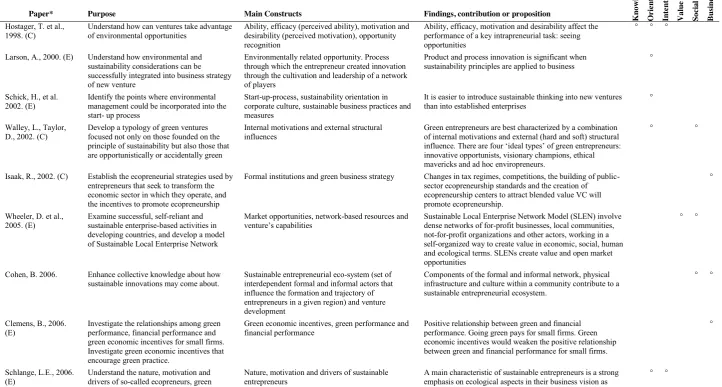
Our review of the literature on sustainable entrepreneurship reveals a range of
individual and contextual factors used to conceptualize or explain their behavior. We
summarize this literature in Table 1, listing the purpose, explanatory constructs and summary
of findings of each paper.
-- Insert Table 1 about here --
As is evident from the table, there is inconsistent terminology across studies and
conceptual overlap among the constructs used in them. In order to synthesize this work, we
examined the substantive meaning of each listed construct and mapped it onto an appropriate
archetype, as shown in the table. Four archetypal constructs pertain to the individual
entrepreneurs and two pertain to the context in which the entrepreneur operates.
We present the derived archetypal constructs in Figure 1, which also seeks to elicit the
interrelationships among the factors. Thus, Figure 1 presents a set of concentric circles that
capture the nested nature of the factors in question based on their proximity to the
entrepreneurial action. Closest to the action are the immediate goals of the entrepreneur, i.e.
the value he or she wishes to create. In turn, this is nested in an entrepreneurial intention,
which represents a general inclination to employ entrepreneurial means but offers no
which represents attitude and convictions about environmental protection and social
responsibility, but offers no suggestion of how these are to be enacted. Furthest away is prior
knowledge of ecological and social environments and threats to them, which offers no
suggestion of how such knowledge is to be used or if it is to be acted upon at all. These four
individual factors are in turn interlinked with the perceived social and business support for
engaging in sustainability-oriented behaviors. We discuss each of these factors in detail.
-- Insert Figure 1 about here --
Prior knowledge. This factor reflects the entrepreneur’s extant knowledge of ecological
and social environments and the perceived threats to such environments (Patzelt and Shepherd
2010). Because individuals vary in the knowledge that they possess – reflecting their
idiosyncratic personal, educational, and work experience – the recognition of opportunities
for sustainable development stems from relevant prior knowledge. This reflects the broader
argument that entrepreneurs discover opportunities that are related to the knowledge and
information they already posses (Shane 2000). Thus, Patzelt and Shepherd (2010) argue that
individuals who attend to the social or ecological environments are more likely to recognize
changes in that environment and eventually the opportunities that arise from social or
environmental market imperfections. Therefore, compared to individuals whose attention is
more focused on the business environment, those individuals are more likely to form beliefs
about opportunities for sustainable development even if they show no intention to personally
pursue such opportunities (Shepherd et al. 2011).
Sustainability orientation. Kuckertz and Wagner (2010) define sustainability orientation as underlying attitudes and convictions towards environmental protection and social
responsibility and show that it is instrumental for the intention to start a
sustainability-oriented new business. Similarly, Walley and Taylor (2002) argue that sustainable
ecological and social-ethical sustainability. In the same vein, Parrish (2010) indicates that
maintaining the balance between social, environmental and economic dimensions requires a
specific orientation for guiding the venture design process. He suggests that the values and
motives that give rise to sustainable entrepreneurship, based on equanimity between self,
other people, and nature, result in specific organizing tensions that have the potential to
challenge the viability of enterprises that embody these values. This approach highlights
essential values and beliefs of sustainable entrepreneurs (Shepherd et al. 2009).
Entrepreneurial intention for sustainability. Entrepreneurial intention pertains to the intention to create a new venture or create new value in existing ventures (Bird, 1988). As
such, it is seen as a major pillar of the decision to become an entrepreneur (Boyd and Vozikis,
1994). Thus, the pursuit of sustainability ideals through entrepreneurial means depends on the
strength of the individual’s intention to contribute to solving societal and environmental
problems through the realization of a successful business (Schaltegger and Wagner 2011).
Entrepreneurial intentions depend on the perceived desirability and feasibility of the venture
opportunity (Fitzsimmons and Douglas 2011). As such, they are intertwined (as Figure 1
suggests) with the entrepreneur’s prior knowledge and sustainability orientation, channeling
them towards an entrepreneurial approach. Sustainable entrepreneurs desire to change the
world (Walley and Taylor 2002; Linnanen 2002) as well as to make money through the
pursuit of entrepreneurial opportunities (Schaltegger and Wagner 2011; Schlange 2006). In
other words, their main goal is to promote sustainable development through the realization of
a successful business.
Desired value creation. With the intention to create new value (through a new venture), there is no indication of what that value would be. In this regard, desired value creation
pertains to the value that sustainable entrepreneurs aim to create both for their business and
intertwined social, economic, ecological and inter-generational value (O’Neill et al. 2009),
sustainable entrepreneurs have proven capable of reconciling the dual goals of sustainable
development and wealth accumulation (Tilley and Parrish 2009) and, therefore, of resolving
the dualistic divide between opportunistic business and altruistic charity (Parrish 2007). In
this regard, Cohen et al. (2008) propose seven elements of sustainable value creation:
economic performance, promise, perpetuity, socio-efficiency, stewardship, eco-efficiency and
sustainability. These values are consistent with the notion of the triple bottom line, developed
by Elkington (1997), which sets the standard to identify a form of business value that delivers
simultaneously economic, social and environmental benefits. The pursuit of such desired
outcomes prompt the elaboration of business strategies and practices capable of tackling
pressing challenges such as inequality, pollution, unfair trade, deforestation and poverty (Hart
and Milstein 2003)..
Perceived social support. In pursuing sustainability opportunities, social context and culture operate as an enabling environment for sustainable value creation and capture (O’Neill
et al. 2009). Social norms capable of fostering or nurturing the creation of socially and
environmentally responsible economic activity are thus needed to promote the emergence of
sustainable new ventures (Meek et al. 2010). Some scholars have used insights from
institutional theory and sociology to study how social norms, i.e. unwritten rules of conduct,
and centralized institutions (e.g. state-sponsored incentives) impact the creation of
environmentally oriented new ventures (Meek et al. 2010). These studies have demonstrated
that decentralized, socially determined institutions, such as consumption patterns, norms of
conformity and of family interdependence, not only affect the individual-level
decision-making of entrepreneurs towards pursuing environmentally responsible opportunities, but also
mediate the effect of government incentives on sustainable firm foundings. O’Neill et al.
profit and market penetration. Similarly, Pacheco et al. (2010) point out that only appropriate
conditions may lead to producing social, environmental and economic wealth. If the
appropriate conditions do not prevail, unproductive or destructive forms of entrepreneurship
can take hold instead (Harbi and Anderson 2010).
Perceived business support. Sustainable ventures need to exhibit, ultimately, financial viability in order to survive. In this sense, they need to be embedded in an enabling business
context, i.e. where the commitment to solving societal and environmental problems gives a
competitive edge of the business and thus helps improve its long-term prospects (DeSimmone
and Popoff, 2000; Mitchell et al. 2010). This is well illustrated by the question ‘Does it pay to be green?’ (Orlitzky et al. 2003). In a meta-analysis of 29 studies dealing with returns over sustainability, Dixon-Fowler et al. (2011) demonstrate a positive relationship between the
development of proactive environmental initiatives and financial performance. In a supportive
business context, sustainability practices have proven relevant to accessing markets, obtaining
investment, recruiting employees, building acceptance, reducing cost of material, energy, and
services and differentiating products (Ambec and Lanoie 2008). Sustainability initiatives such
as ISO 14001 certification, fair-trade agreements or having eco-labeled products, can be an
effective means for obtaining competitive advantage (Orsato 2006). In this regard, the
receptivity of the business context can affect the perception of aspiring entrepreneurs
regarding the feasibility an opportunity that both sustains and develops (Shepherd and Patzelt
2011).
3. Method
As discussed above, sustainable entrepreneurship involves a complex interrelationship
of various factors. The developmental paths of particular sustainable entrepreneurs never
hinge on a single factor; they highlight multiple factors at play. The complexity of each path
Therefore, explaining the development of sustainability oriented ventures places the focus on
those interrelationships rather than on the individual factors contained in them. In this sense,
the associated causal relationships have a conjunctural rather than discrete nature. To capture
these relationships, it is necessary to go beyond the logic of decomposability associated with
linear modeling, in which an outcome of interest is explained as the sum of the effects of the
individual predictors. Instead, outcomes need to be represented as configuration of causes,
some necessary and others sufficient (Ragin 1987). This requires a different analytical
approach.
We employ Fuzzy-Set Qualitative Comparative Analysis (fsQCA), a set-theoretic
method that uses counterfactual analysis and logical minimization to analyze causal
complexity (Ragin 2000). Instead of looking at individual predictors, this approach operates
at the level of observed cases and treats each case as a holistic configuration of factors
(Rihoux and Lobe 2009). In this sense, the causal conditions for analysis are the
configurations of factors rather than the individual factors themselves. Through the
comparison of causal conditions across outcomes, fsQCA extracts simplified causal recipes
that collectively explain the outcomes under examination and offers formal tests for necessity
and sufficiency of conditions or combination of conditions.
Unlike traditional approaches to causal explanations that focus on cases displaying a
specific outcome and search for antecedent common conditions shared by all instances of the
outcome, fsQCA focuses on and allows for the possibility that the same outcome can follow
from different combinations of conditions. Rather than establishing relationships between
variables, the purpose of this analytic technique is to enable comparing and contrasting
possible configurations of conditions (Ragin 2008b). QCA was conceived as a small-N
approach (Ragin 1999) and it works robustly with smaller numbers of cases, i.e. between 15
3.1 Case selection and data collection
We identified and sent a survey invitation to 289 new ventures that had taken part in 12
sustainability-related business plan competitions in the USA and the UK over the period
2009-2011. Of these, 67 entrepreneurs responded to the survey, 45 of which met three
specific criteria: the survey must have been completed by the founder, he or she identifies
him/herself as a sustainable entrepreneur, and the venture aims to balance environmental,
social and economic objectives and allocates the relevant resources to accomplishing these
objectives. Our analysis is based on these 45 cases. They represent a diverse group of new
ventures. They belong to 17 different sectors in 5 countries. 34% of the cases have been
trading for more than 4 years and 66% of them for 3 years or less, with a median of 3 years of
trading for the entire sample1, and 59% of the cases reported having started measuring their
sustainability impacts and developing targets and actions to reduce those impacts. Appendix
A provides a summary of the 45 cases.
In order to maintain close connection to the cases, we complemented the survey data
with qualitative evidence from a number of follow-up activities comprising semi-structured
interviews, non-participant observation and a comprehensive review of documents (e.g.
business plans, organizational records, marketing material, press releases, media articles promotional videos, third-party audio and video interviews, and personal writings). The data from these follow-up activities serve to validate our survey measures and corroborate the
results of the configurational analysis by illustrating how different configurations of
conditions produce the outcomes of interest.
Despite their effectiveness in capturing abstract concepts (Babbie 1995), survey
questionnaires on topics related to sustainability might present methodological issues
1 This is in line with the research framework used by the Global Entrepreneurship Monitor (Bosma et al. 2012),
associated with social desirability bias. In order to reduce this risk, we followed Roxas and
Lindsay’s (2012) guidelines for self-administered survey questionnaire on sustainability
topics and implemented three methodological techniques. First, at the pre-survey stage, we
conducted a thoughtful development of new measures and adaptations of existing measures,
and then pilot tested them to ensure their validity and reliability. Second, at the survey
administration stage, we triangulated data sources by making use of the information from the
interviews and secondary data. Such procedure is key for reducing and detecting response
biases. Finally, at the post-survey stage, we assessed the validity of survey data by comparing
the responses with data from the follow-up interviews.
3.2 Measures
As our data pertain to recently developed ventures, the focus of our analysis is on how
their development has occurred, i.e. we seek to explain how the sustainable ventures in
question came to be such. As the venture development process is marked by the ideas, actions,
and interactions (exchange relationships) along the way, our outcomes of interest pertain to
the degree to which sustainability was integrated in these markers. In turn, as the process is
driven by the entrepreneur’s mental blueprint for the venture, our causal conditions capture
the entrepreneurs’ knowledge, orientation, and perceptions that help define the blueprint. The
development of the measures was assisted by information collected from five semi-structured
interviews conducted in an exploratory study2. We then engaged four experts from academia
to assess the content validity, readability and optimal flow of the instrument. The instrument
was refined based on their feedback and the experts further assessed its construct and criterion
validity by evaluating (1) the conceptual relation between constructs and measures, and (2)
the extent to which the measures are useful in explaining the different constructs (Hardy et al.
2011). The details of all our measures are provided in Appendix B.
Outcomes. To measure the articulation of sustainability-oriented venture ideas (IDEA),
we asked about the entrepreneurs’ awareness and attention at the time they had been
exploring possible ideas for the business. The measures is based on an 8-item Likert scale
(=.90) and was adapted from Tang et al. (2012) to refer to sustainability issues. It captures
the degree to which the entrepreneur was driven by sustainability considerations when
scanning the environment, searching for alternatives and making associations and connection
between relevant pieces of information regarding the idea under formation.
Our measure of the organization of sustainability-oriented entrepreneurial actions
(ACTION) focused on the extent to which the entrepreneurs aimed to solve sustainability
problems in setting up immediate objectives in the course of developing their ventures. We
used an 8-item Likert scale (=.84). For the individual items, we used dimensions developed
by Dyllick and Hockerts (2002), Schlange (2006), and Cohen et al. (2008) to represent eight
traditional sustainability objectives.
The measure of the formation of sustainability-driven exchange relationships
(EXCHANGE) focuses on the extent to which the entrepreneur integrates
sustainability-related elements in his or her discourse with potential customers, suppliers and investors. It is
based on a 7-item Likert scale (=.92). The evaluation of the cases was done by two
independent raters, based on information provided in a collection of 45 files, each
summarized on a standard form that contained nine different categories: (1) mission, vision,
values or/and principles, (2) business opportunity or/and challenge, (3) description, value
proposition or/and selling pitch, (4) sustainability orientation, (5) impact, (6) business model,
products or/and services, (7) founders’ profile, (8) story of the venture, and (9) awards,
achievements or/and recognitions. These forms organized information from different sources
but did not alter the character of the included texts. To aid the evaluation, the raters were
articles, interviews, videos, photos, and the ventures’ profile provided by their respective
competitions. There was a high degree of agreement between the raters (.82).
Causal conditions. We measure prior knowledge (KNOWLEDGE) by asking about the
extent to which entrepreneurs understood the economic, social, environmental problems of
society. We used a 5-item Likert scale (=.71). The items are not separable aspects of the
concept, but rather intertwined components that respond to the systemic nature of
sustainability problems (Dresner 2008).
To measure sustainability orientation (ORIENTATION), we asked about the
entrepreneurs’ attitudes and convictions about sustainability as reflected in their perceptions
of the venture they were creating. We used a 6-item Likert scale (=.71) adapted from
Kuckertz and Wagner (2010), to reflect the fact that we were referring to a specific venture
(rather than entrepreneurship in general).
Our measure entrepreneurial intention for sustainability (INTENTION) assesses the
respondent’s inclination to engage in entrepreneurial activities as the means to solve societal
and environmental problems at hand. We used a 5-item Likert scale (=.8) based on the
dimensions of the ideal type of sustainable entrepreneurship developed by Schaltegger and
Wagner (2011). The measure captures the entrepreneur’s core motivation to contribute to
solving societal and ecological problems through the realization of a successful business.
We measure desired value creation (VALUE CREATION) by the extent to which the
entrepreneur considered the four dimensions of sustainability – social, economic,
environmental, and inter-generational – in articulating the venture’s value proposition.
Because each dimensions is assessed independently and not necessarily in sync with the other,
the 4-item scale is formative rather than reflective (Coltman et al. 2008). As such, this
We measured the perceived social support (SOCIAL SUPPORT) by the perceived support from the community where the venture was created. We use a 4-item Likert scale
(=0.94), based on Meek et al. (2010) and O’Neill et al. (2009), which refers to the social
norms and culture of the community in the promotion of sustainable behaviors and the
development of new businesses.
Finally, we measured perceived business support (BUSINESS SUPPORT) by the extent
to which the entrepreneurs perceive that the sustainability focus of the business would give
them an advantage in conducting their business. We used a 9-item Likert scale (=.89), which
covers different areas of impact such as competitive advantage, and attracting customers,
employees, suppliers, and investors.
Calibration. Once measures have been collected, they need to be calibrated. Calibration is an essential process in fsQCA in that researchers need to ensure that their measurements
match or conform to dependably known standards (Ragin, 2008b) in order to make the
measurements directly interpretable (Byrne 2002). Since comparison across cases is based on
the degree of membership of each case in a theoretical set of interest, this degree of
membership needs to be established a priori. In this regard, the need for calibration is based on the notion that not all variation in a measure is theoretically relevant: beyond certain
qualitative thresholds changing values may not make material difference. For instance, if 20
years signifies extensive experience, then having 25 versus 50 years of experience is
theoretically irrelevant even though the two (non-calibrated) values vary by a factor of 2.
Calibration converts a raw score into one that reflects degree of membership in a set, rescaling
the original measure into scores ranging from 0.0 to 1.0 (Ragin 2008b), the two ends
signifying the qualitative thresholds of full membership and full non-membership. Appendix
C provides further details of our calibration method; the calibrated scores for all 45 cases on
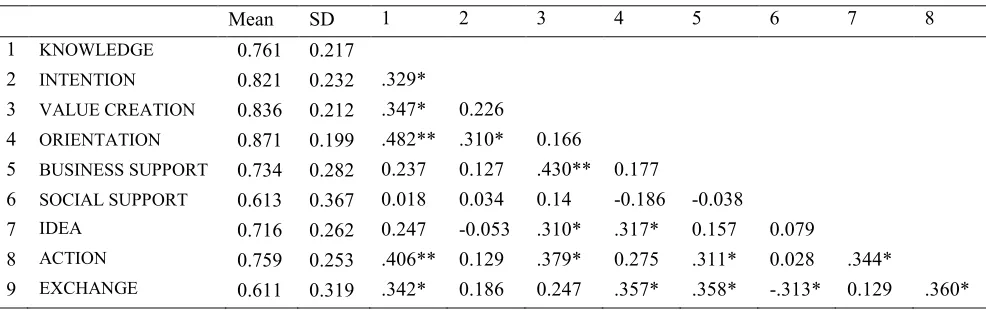
provides the descriptive statistics and correlations for the calibrated scores. The low
correlation values do not raise concerns with divergent validity among the conditions used in
the analysis.
--Insert Table 2 about here --
3.3 Configuration analysis
The next stage in QCA is the construction of a truth table listing the different logically
possible combinations of causal conditions along with the cases conforming to each
combination. A truth table is thus a data matrix with 26 rows, where 6 is the number of
conditions used in the analysis (Fiss 2011). There are two characteristics of truth tables that
require careful consideration by the researcher in reducing them to simplified combinations
for analysis. First, not all of the combinations of conditions are observed empirically and the
observed combinations have different frequencies. Therefore, we set a frequency threshold
that specifies the minimum amount of cases that will be considered in the analysis. We use
one observation, which is recommendable when the aim is to build theory from a relatively
small sample (Ragin 2006; Crilly et al. 2012). Second, not all of the observations of a
particular combination yield the same outcome. The proportion of observations that yield the
dominant outcome is referred to as the consistency of the particular solution. We set a
consistency threshold that specifies the minimum acceptable level to which a combination of
causal conditions is considered reliably associated with each of the outcomes. We set
consistency thresholds at 0.92, 0.92 and 0.84 for our analyses of ideas, actions, and exchange
relationships respectively3. Consistent with prior studies (e.g. Schneider et al. 2010), we use
thresholds that correspond to a gap observed in the distribution of consistency scores.
Based on frequency and consistency thresholds, fsQCA applies a Boolean algorithm
using counterfactual analysis and logical minimization to reduce the truth table rows to a
solution table comprising simplified combinations of conditions (Ragin et al. 2006; 2008a),
which can be understood as different solution paths or recipes for the outcome. Solution
tables distinguish core and peripheral conditions. The distinction between conditions is based
on how causal components are connected to a specific outcome. In any solution term there are
decisive causal ingredients (core) that distinguish configurations, and complementary
ingredients (peripheral) that only make sense as contributing factors (Ragin 2008b). Their role
is to reinforce the central features of the core conditions (Grandori and Furnari 2008).
4. Results
We conducted and present the results of the configurational analysis in two stages. In
the first, we focus on the three outcomes that signify the empirical markers of the venture
development process – i.e. ideas, actions and exchange relationships – and identify the
configurations that characterize each. In the second stage, mindful that each empirical case
consists of a particular combination of idea, actions, and exchange relationships, we examined
whether the configurations identified in the first stage occurred in particular combinations
across the cases.
4.1 Configurations within ideas, actions, and exchange relationships
Because we used a minimum frequency threshold of one observation, the analysis
yielded a large number of solutions that varied in their coverage, i.e. the degree to which a
solution is present across the observed cases. There were seven solutions for ideas, four
solutions for actions, and six solutions for exchange relationships (the truth tables full
solution tables are available from the authors upon request). Many of these solutions had low
nevertheless pointed to viable paths to the outcome of interest4.
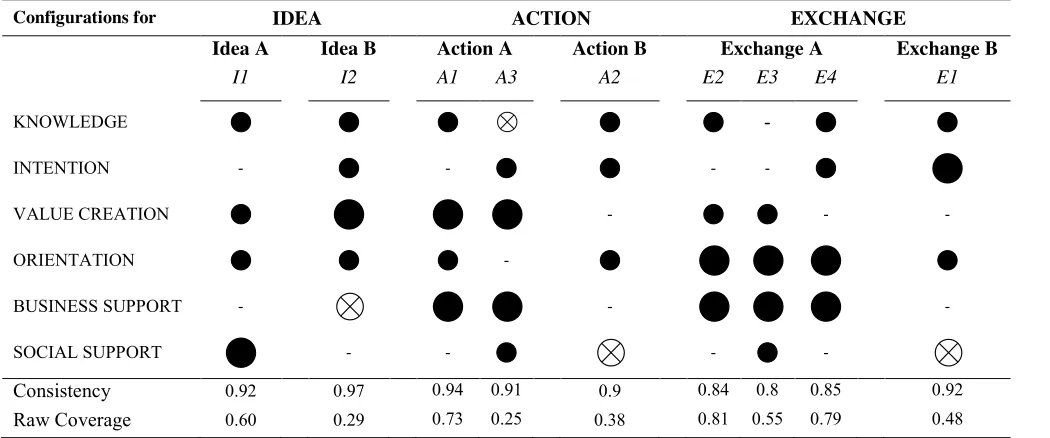
In summarizing our results, we sought to facilitate intuitive understanding and thus set
the stage for the subsequent analysis. Therefore, in our summary Table 3, we selected only the
high-coverage solutions, i.e. solutions with raw coverage over 0.25. The full solutions and
associated truth tables are available from the first author upon request. Set-theoretic coverage
evaluates the degree to which a causal combination accounts for instances of an outcome. It
therefore provides a more detailed assessment of the empirical importance of each
configuration of conditions (Ragin, 2006). While raw coverage refers to the portion of the
outcome set that is overlapped by the causal configuration, unique coverage controls for
overlapping explanations by partitioning the raw coverage (Schneider et al. 2010). In
analyzing the results, we consequently focus on those solution terms with the highest
explanatory power within their solution table. In addition, we combined solution terms with
overlapping core conditions into super-sets. For example, the union of sets A1 and A3 yields
the super-set Action A, which in Boolean notation reads: A=V*B*(K+~K+I+S), or Action is the result of a combination of desired value creation and perceived business support with either knowledge, absence of knowledge, entrepreneurial intention or perceived social support. The combination of sets with overlapping core conditions allows for greater parsimony (Rihoux and Ragin, 2008) while maintaining the integrity of each solution term.
This is in line with current practice: for example, Fiss (2011) uses this approach to resolve the
issue of neutral permutation or within-type equifinality.
-- Insert Table 3 around here --
There were two solutions for ideas. The first (Idea A) consist of social context as a core
condition and prior knowledge, desired value creation, and sustainability orientation as
peripheral conditions; entrepreneurial intention and perceived business support are irrelevant
in this solution. The second solution (Idea B) consists of desired value creation and absence
of perceived business support as core conditions and of prior knowledge, entrepreneurial
intention, and sustainability orientation as peripheral conditions. Thus, in some cases the ideas
for sustainable entrepreneurship are driven by the perception of social support (Idea A), while
in others by the creation of value (Idea B).
There were two solutions for actions. The first (Actions A) is a superset combination of
solutions 1 and 3 in the full solution table. It consists of value creation and business support
as core conditions, of sustainability orientation as a peripheral condition, and of presence and
absence of prior knowledge, entrepreneurial intention, and social support as interchangeable
peripheral conditions. The second solution (Action B) consists of lack of social support as
core condition and of prior knowledge, sustainability orientation, and entrepreneurial
intention as peripheral conditions. These solutions outline two qualitatively different logics
for action. The first is driven by value creation and business support (Action A), while the
second is motivated by the lack of supportive social context (Action B).
There were two solutions for exchange relationships. The first (Exchange A) is a
superset combination of solutions 2, 3, and 4 in the full solution table. It consists of
sustainability orientation and business context as core conditions and of prior knowledge,
entrepreneurial intention, desired value creation, and perceived social support as
interchangeable peripheral conditions. The second solution (Exchange B) consists of lack of
supportive social context and entrepreneurial intention as core conditions and of prior
knowledge and sustainability orientation as peripheral conditions. Again, these solutions
outline two qualitatively different logics for discourse with potential exchange partners. The
first emphasizes sustainability values and is oriented towards the business context (Exchange
strong entrepreneurial intention for sustainability (Exchange B).
4.2 Configurations within cases
The above analysis focused on the configurations of conditions behind ideas, actions,
and exchange relationships. Since these represent the stepping-stones of an overarching
venture development process (Dimov 2011), the next step in our analysis is to explore the
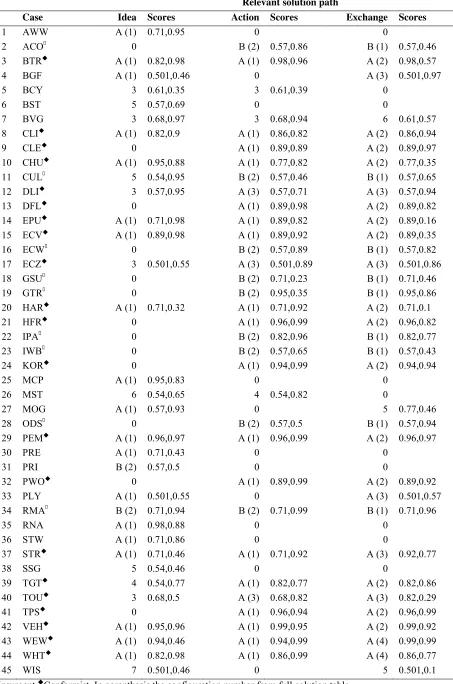
grouping of these configurations within each case. To do so, we listed the cases according to
their membership in empirically relevant solution terms for idea, action, and exchange
relationships, as presented in Table 4 below.
-- Insert Table 4 around here --
A careful look at the table reveals two remarkable patterns. First, in 21 cases, solution
Action A is combined with solution Exchange A. In 11 of these cases, solution Idea A is
present; 6 cases are associated with no particular idea; 4 cases are associated with
counterintuitive, low-coverage idea solutions. This pattern points to a distinct
idea-action-exchange path that we label conformist. It is characterized by strong influence of perceived social support in the formulation of venture ideas, strong emphasis on value creation and the
perception of an enabling business context in the deliberation of actions, and strong emphasis
on sustainability orientation and an enabling business context in the formation of exchange
relationships.
The story of HFR provides a narrative illustration of this path. HFR is a global impact
digital media company that delivers content, social networking and other web-based products
and services that focus on sustainability issues. At the time the founder was formalizing the
venture idea, there were some other similar initiatives starting up that he recognized as part of
an emerging ‘impact infrastructure’ (perceived social support). In his view, it signified true
consequently sought to create and support companies that were rigorously certified
triple-bottom line. This infrastructure consisted of like-minded people who believed that, in order to
achieve a sustainable world, one needed to read the vital signs of the planet and to tweak
business as usual. In line with supporting social context and a strong search for holistic value
creation, HFR was structured as a triple-bottom line certified B Corporation5. In this sense, its
founder indicates:
Becoming one of the first B Corps, and really embracing the best of this new infrastructure (rating system, mission markets and impact investing platforms) as it came out, actually added significantly to our value proposition, as an initiative.
HFR’s founder was convinced about the relevance of the B Corp movement, and most
importantly about the fact that, by means of building new, sustainable businesses, he and the
people around him would be capable of improving and taking mainstream the supporting
impact infrastructure. While doing so, he decided to integrate the principles of sustainability
in a systemic way through the practice of blended value. In the founder’s account, HFR was
indeed one of the first companies to actually start with that principle:
That is actually how we are doing it. We created ourselves as a company to model, to try to model the emerging, best thinking around triple-bottom line. Yeah, what it means for HFR again is setting ourselves up to operate as a triple-bottom line company.
The conformist aspect of HFR is also evident in building exchange relationships
(ORIENTATION*BUSINESS SUPPORT). Referring to a recent dialogue with an angel
investor, the founder reflects:
Wait a second. You do not make any mention of this (relevance of social or environmental values and the need for paradigm change of business), and I really think that for entrepreneurs like me this is not a direction we would spend time
going in because we need conscious and patient capital (…) Conscious and
patient capital means not sitting down and in the first five minutes starting to talk about three-to-five year exit strategies. It means talking about ten-to-twenty year
dividend returns with heavy reinvestment of profits in not only the company but also in the triple-bottom line economy.
In regard to the second pattern, in nine cases, solution Action B is combined with
solution Exchange B. In seven of these cases, there is no particular idea for sustainable
development as part of the process; only one case was associated with solution Idea B. We
label this path insurgent. There are no explicit ideas for sustainable development that drive it
or, in the two cases where ideas are present, they evidently lack focus on value creation or an
enabling business context. In regard to the deliberation of actions, the lack of supportive
social context dominates, indicating that the actions are defined mainly in terms of their
anti-establishment nature. In the formation of exchange relationships, the lack of supportive social
context is now combined with strong intention for using business methods to enable
sustainable development.
ODS exemplifies this path. This is a technology venture that designs, manufactures, and
distributes solar energy products in Kenya, Africa. It provides portable energy to help
improve health care, education, household productivity and commerce. ODS began after its
founder spent years working in Liberia and Kenya leading energy and technology initiatives
for the health sector. While doing so, he realized that over 90% of the clinics in the area had
no electricity and were forced to close at sundown. In his view, there was a critical need for
community-based care. In responding to the opportunity behind the lack of electricity, he
developed a solution for clean and affordable hands-free lighting and phone charging for use
by community health workers, small businesses and families. While working on the idea for
ODS there was a deep understanding of the sustainability problems the community was facing
and he showed a strong intention to create sustainable value and contribute to their solution.
However, there was no explicit consideration of sustainability in the development of the
continues in the way he formalizes the venture idea. For ODS’s founder, sustainability is not
about being socially responsible, reducing waste or meeting carbon targets; in his view,
sustainability is part of the organic evolution of the business, which needs to be translated into
improving the well being of communities:
Business sustainability is one of our lower priorities. Sustainability (in the ideological sense) is what we do; it is part of the organic evolution of the business. Although our operations have an impact on the reduction of kerosene
consumption and health systems, I do not look at what we do as ‘ok, we are reducing carbon emissions’, I look at that as ‘ok, this family is better, they are
saving money and sending their kids to school’. It depends on how you look at it,
but that is for me sustainability.
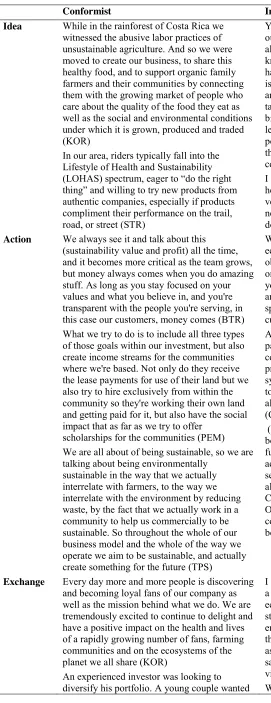
With the aim of contrasting the two paths, conformist and insurgent, we provide in Table 5 representative quotations reflecting actions, events and circumstances involved in the
development of sustainability-oriented venture ideas; initial actions after specifying the
venture idea; and the discourse whereby entrepreneurs position their ventures. These
quotations illustrate the conjunctural nature of the represented solutions, i.e. it is their
combination that leads to the integration of sustainability in the venture development process.
-- Insert Table 5 around here --
5. Discussion
In the midst of much excitement about the recent phenomenon of sustainable
entrepreneurship, in this paper we sought to provide a substantive account of its underlying
process. We focused on three observable markers of this process – the ideas, actions, and
exchange relationships articulated and instigated by the entrepreneurs in question – and
examined the factors that account for their emergence. We explored the configurations of
these factors behind the manifestations of ideas, actions, and exchange relationships using
Fuzzy-Set Qualitative Comparison Analysis (fsQCA).
back to the cases in which these configurations were embedded, we identified two distinct
venture development paths. The first, conformist, pertains to the inspiration of ideas from the perception of a supportive social context, deliberation of action based on the creation of
holistic value, the perception of an enabling business context, and conveying strong
orientation towards sustainability and an enabling business context in the formation of
exchange relationship. In contrast, the second, insurgent, path is characterized by lack of explicit ideas for sustainable development, action deliberation against a lack of perceived
social support, and exchange discourse that echoes a lack of contextual support and strong
intention to deliver business solutions to sustainability problems.
5.1 Theoretical contribution
Our work makes two main contributions to the literatures on sustainable
entrepreneurship and entrepreneurship more broadly. First, by staying tuned to the notion of
entrepreneurship as an unfolding process (McMullen and Dimov, 2013; Van de Ven and
Engelman, 2004), it helps open up the black box of the process that unfolds from initial
business ideas to their ultimate realization. Our results show that the importance of different
factors shifts across the actions and market interactions that comprise the process. This helps
us understand the different ways in which sustainable ventures can be developed, as
represented by the two distinct paths we identify. Along the conformist path, a supportive
social context that inspire ideas gives way to value creation and an enabling business context
returns in the deliberation of actions, which in turn give way to sustainability orientation in
the discourse behind seeking to establish market relationships. Along the insurgent path, the
lack of perceived social support persists at the action and exchange stages, but is backed by
strong intention to solve sustainability problems by means of a new business in the formation
of exchange relationships.
entrepreneurship and appreciate its diversity. In supportive communities with shared norms
around sustainability, potential entrepreneurs find ready sources of ideas and a receptive
audience for market relationships that can create returns for the nascent venture. In contrast,
where the social context does not support sustainability behaviors, potential entrepreneurs
find inspiration in the desire to create sustainable value, albeit with no visible prospects for
returns, and have to persevere against the established norms, driven by strong intention. In
addition, our findings help theorizing move away from the restrictive assumption of fixed
entities over time that is necessary for the application of linear models (Abbott, 1988) and
appreciate the shifting landscape within each entrepreneurial journey in response to its
emerging challenges.
Second, our work highlights the conjunctural and equifinal nature of causal
relationships in the development process of (sustainability) ventures. Against traditional focus
on piecemeal importance that can simply be added to the cumulative explained variance, our
results indicate that factors that are commonly seen as important are in fact intertwined with
others and not sufficient conditions by themselves in explaining given outcomes. In fact, their
importance may vary over time or be altogether peripheral in nature. Prior knowledge is a
particularly potent example in this regard. While it is seen as fundamental for the
identification of entrepreneurial opportunities (Shane 2000; Patzelt and Shepherd 2010), our
results show that it is peripheral in effect and a necessary condition at best. It is present in all
solutions but does not dominate them. This means that it needs to be complemented by other
(perhaps more important) factors in driving the entrepreneurial process forward. The point
here is not that prior knowledge is not important, but that it represents just a piece of a large
puzzle of factors. By elucidating the conditions under which entrepreneurs pursue sustainable
ventures, we respond to a central question posed by Hall, Daneke and Lenox (2010), who
Our work also enables the drawing of a more meaningful distinction among
entrepreneurs based on the considerations that drive them, whether simple economics or more
complex constellations of economic returns, social justice, environmental protection and
intergenerational equity. Insurgents and conformists exhibit distinct features arising from the way conditions consistently combine to produce the outcomes and shape the paths. Insurgents
are primarily change agents. Facing lack of support from their social context, they embark in
venture development as a way of inducing socio-economic shifts. They exhibit capacity and
willingness to create sustainable value as part of the business proposition, yet this only
emerges in the final stretch, being merely peripheral in early stages. Unlike traditional
entrepreneurship, where the promise of rewards has an effect on the ability to recognize
opportunities (e.g. Shepherd and DeTienne, 2005), the potential strategic return of
sustainability (i.e. supportive business context) is irrelevant for insurgents. Even more, in most of the insurgent cases the belief in future benefit is absent from the development of venture ideas, where what matters is the comprehensiveness of the value that can potentially
prompt change.
Conformists, on the other hand, are sustainability conveyers. Sustainability business ideas emerge as a response to and expression of collective sustainability concerns. In building
sustainable ventures, holistic value and expected rewards derived from a supportive business
context shape and channel concern and ideas. The cognitive resources of the entrepreneur
focus more on increasing the comprehensiveness of the value of the pursued venture rather
than on the obligations of the business towards society. This changes when connecting to
exchange partners. The search for holistic value moves to the periphery and the entrepreneur’s
vision regarding sustainability and the obligations of the business toward society come into
play to reflect and channel personal values. This is relevant for theorizing about the
motivation to act entrepreneurially on opportunities that both sustain and develop, as
Shepherd and Patzelt (2011) suggest. They rather emerge and become instrumental when
facing market structures, and as a way of channeling collective sustainability concerns turned
into ideas.
Conformists invite a rethinking of the “what, where and when” of entrepreneurial action.
The development of new means–ends relationships (Kirzner 1997) is not meant to produce
economic value for the entrepreneur and its shareholders. It rather conveys supporting social
norms, holistic thinking and an intertwined set of personal principles (Leiserowitz et al. 2006)
to create economic value for relevant stakeholders, while achieving social justice,
environmental protection and intergenerational equity.
In a broader sense, our work highlights the trade-off between complexity and generality
in theories of entrepreneurship. Although our phenomena of interest involve distinct entities
such as entrepreneur or venture, current theories tend to reduce them to a set of variables and
seek general relational patterns between these variables that both exist independent of context
and occur in the absence of time flow (Abbott 1988). The implication of this is that if we add
all the ingredients together, we would derive the desired entrepreneur or venture. But just as
simply adding egg yolk and vegetable oil does not produce mayonnaise – a lot of intensive
stirring and gradual pouring is needed – so it is important not to ignore how the ingredients
mix together. Thus, while the search for generality distils the essential ingredients,
appreciation of complexity reveals how they interact. Our work provides a counterweight to
exclusive focus on generality at the expense of contextualization, whereby it stresses the
importance of particular configurations and sequences. By being tuned to holistic
configurations rather than discrete variables, our approach enabling the identification of more
5.2 Limitations
There are, inevitably, limitations to our study. One concern relates to the use of
retrospective self-reports as source of primary data relates to possible common-method and
retrospective biases. We sought to mitigate this concern through careful case selection and
data and method triangulation (Jick 1979), comparing the entrepreneurs’ recollections with
data from venture documents. Entrepreneurial events typically occur only once, early in the
life of the firm, thus the use of contemporaneous records is beneficial for reducing this threat
to validity (Schjoedt and Shaver 2005). Nevertheless, our data did not allow us to establish
proper temporal sequence of the factors in question.
A second concern relates to the use of sustainable business competitions as the
sampling frame for the study. Although participants of sustainable business competitions may
have a favorable inclination towards sustainability or particular in other ways, this is not
necessarily an issue in diversity-oriented comparative studies (Collier 1995). As with other
QCA studies (e.g. organization research, Fiss 2011), the central focus of this research is not
on entrepreneurs in general, but on a theoretically defined population of entrepreneurs with a
clear orientation towards sustainability. The substantive variation within our data points to
achieving maximum heterogeneity over the minimum number of cases within the defined
conceptual domain (Rihoux and Ragin 2008). Nevertheless, generalization of our results
beyond the population of entrepreneurs explicitly oriented towards sustainability should be
done with care.
The fact that most of the cases are based in the United States may limit the
generalizability of the results. There are, however, some elements in the sample strategy that
minimizes this risk. The cases belong to 17 different sectors and are spread out across the
country (i.e. 15 different states), in regions that it has been demonstrated present significant