This is a repository copy of
Modelling multiphase chemistry in deliquescent aerosols and
clouds using CAPRAM3.0i
.
White Rose Research Online URL for this paper:
http://eprints.whiterose.ac.uk/106202/
Version: Published Version
Article:
Tilgner, A., Bräuer, P. orcid.org/0000-0002-3815-7631, Wolke, R. et al. (1 more author)
(2013) Modelling multiphase chemistry in deliquescent aerosols and clouds using
CAPRAM3.0i. Journal of Atmospheric Chemistry. pp. 221-256. ISSN 0167-7764
https://doi.org/10.1007/s10874-013-9267-4
[email protected] https://eprints.whiterose.ac.uk/
Reuse
Items deposited in White Rose Research Online are protected by copyright, with all rights reserved unless indicated otherwise. They may be downloaded and/or printed for private study, or other acts as permitted by national copyright laws. The publisher or other rights holders may allow further reproduction and re-use of the full text version. This is indicated by the licence information on the White Rose Research Online record for the item.
Takedown
If you consider content in White Rose Research Online to be in breach of UK law, please notify us by
Modelling multiphase chemistry in deliquescent aerosols
and clouds using CAPRAM3.0i
A. Tilgner&P. Bräuer&R. Wolke&H. Herrmann
Received: 12 December 2012 / Accepted: 5 August 2013 / Published online: 1 September 2013
#Springer Science+Business Media Dordrecht 2013
Abstract Modelling studies were performed with the multiphase mechanism RACM-MIM2ext/CAPRAM 3.0i to investigate the tropospheric multiphase chemistry in deli-quesced particles and non-precipitating clouds using the SPACCIM model framework. Simulations using a non-permanent cloud scenario were carried out for two different environmental conditions focusing on the multiphase chemistry of oxidants and other linked chemical subsystems. Model results were analysed by time-resolved reaction flux analyses allowing advanced interpretations. The model shows significant effects of multiphase chemical interactions on the tropospheric budget of gas-phase oxidants and organic com-pounds. In-cloud gas-phase OH radical concentration reductions of about 90 % and 75 % were modelled for urban and remote conditions, respectively. The reduced in-cloud gas-phase oxidation budget increases the tropospheric residence time of organic trace gases by up to about 30 %. Aqueous-phase oxidations of methylglyoxal and 1,4-butenedial were identified as important OH radical sinks under polluted conditions. The model revealed that the organic C3 and C4chemistry contributes with about 38 %/48 % and 8 %/9 %
consid-erably to the urban and remote cloud / aqueous particle OH sinks. Furthermore, the simulations clearly implicate the potential role of deliquescent particles to operate as a reactive chemical medium due to an efficient TMI/HOx,y chemical processing including
e.g. an effective in-situ formation of OH radicals. Considerable chemical differences be-tween deliquescent particles and cloud droplets, e.g. a circa 2 times more efficient daytime iron processing in the urban deliquescent particles, were identified. The in-cloud oxidation of methylglyoxal and its oxidation products is identified as efficient sink for NO3radicals in
the aqueous phase.
Keywords CAPRAM . Multiphase chemistry . Cloud processing . Multiphase oxidants . Deliquescent particles
DOI 10.1007/s10874-013-9267-4
Electronic supplementary material The online version of this article (doi:10.1007/s10874-013-9267-4) contains supplementary material, which is available to authorized users.
A. Tilgner
:
P. Bräuer:
R. Wolke:
H. Herrmann (*)Chemistry Department, Leibniz Institute for Tropospheric Research (TROPOS), Permoserstr. 15, 04318 Leipzig, Germany
1 Introduction
Tropospheric clouds and aerosol particles have global and regional impact e.g. on weather (Rosenfeld 1999, 2000), climate (Charlson et al. 1992; Lohmann and Feichter 2005), ecosystems (Adriano and Johnson1989), air pollution (Gong et al.2006) and human health (Holgate1999; Brunekreef and Holgate2002). Tropospheric clouds are a complex multi-phase and multi-component environment, in which a variety of physical and chemical processes take place. They can potentially alter the physical and chemical composition of the troposphere on a global scale (Ravishankara1997). Moreover, so-called“twilight zones”
(see Koren et al. 2007) might also provide appropriate conditions for aqueous chemical aerosol processing.
Contrary to the quite established microphysical in-cloud processes and gas-phase chem-istry (Finlayson-Pitts and Pitts 2000), multiphase chemical interactions of tropospheric aqueous aerosols, including both cloud droplets and deliquescent particles, are still poorly understood. Their investigation is challenging because of the complexity of the interacting physical and chemical processes as well as the variety of chemical compounds and their interactions. Gas-phase photochemistry is directly and indirectly affected by physico-chemical processes involving cloud droplets and deliquescent particles. Clouds and deli-quescent particles play an important role in controlling the tropospheric gas-phase chemistry by changing photolysis rates (Madronich and Flocke1999; Tie et al.2003) and by influenc-ing the atmospheric gas-phase composition e.g. though the uptake of soluble gases (see e.g. Saxena and Hildemann 1996), deposition (sedimentation) of dissolved gases and micro-physical redistribution (Grègoire and Chaumerliac 1994) and aqueous-phase chemical reactions (see e.g. Ervens et al.2003).
While aqueous-phase chemistry of main inorganic species such as sulphur (Warneck
1999) have long been recognized as important, the role of clouds and especially deliquescent particles for the multiphase budget of radical and non-radical oxidants, the aqueous redox-cycling of transition metal ions (TMIs) and also for the oxidation of organic constituents were investigated to a much smaller extend. Hence, there are still numerous issues, which require further detailed investigations, which, therefore, are in the focus of the current study: (1) What effects do chemical interactions in clouds and in aqueous particles have on the budget of multiphase oxidants and organic trace gases? (2) How important are chemical radical processes in aqueous particles compared to cloud droplets? (3) Which role do TMIs play for the chemical processing of oxidants and the organic chemistry under both aqueous particle and cloud conditions? (4) For which chemical key subsystems is the treatment of a complex organic chemistry required because of their close chemical interactions? (5) Do complex multiphase chemistry models applying a non-permanent cloud scenario provide similar model results than former model studies using unrealistic permanent cloud conditions?
In the following the state of the art related to the above-mentioned issues is briefly outlined. Over the last two decades, aqueous-phase interactions of both tropospheric radical and non-radical oxidants have been shown to be quite important for atmospheric chemistry. Whereas, several investigations have been mainly focused on cloud effects on the tropo-spheric ozone (e.g. Acker et al.1995; Liang and Jacob1997; Walcek et al.1997), only few field experiments (e.g. Mauldin et al. 1997; Commane et al.2010) and modelling studies (e.g. Jacob1986; Frost et al.1999; Jacob2000; Ervens et al.2003; Tilgner et al.2005) were performed to elucidate the effect of multiphase cloud interactions on important radical oxidants such as OH and HO2. Modelling studies (see e.g. Kreidenweis et al. 2003;
of its heterogeneous and multiphase chemistry removal pathways of HO2 by aerosol
particles have been addressed (see e.g. Jacob 2000; Morita et al. 2004; Thornton et al.
2008; Taketani et al.2008; Mao et al.2013). Model studies with simple parameterisations have revealed the potential relevance of these removal processes to significantly affect the HOxbudget. However, there are still many uncertainties in the findings of such studies (see
Thornton et al.2008), i.e. with regard to the importance of particulate organics for the HO2 budget. Compared to clouds, the multiphase chemical processing of oxidants in
deliquescent particles has been investigated to a much smaller extent. Chemical processes in deliquescent particles have mostly been investigated in the context of the tropospheric halogen chemistry (von Glasow and Crutzen2007; Bräuer et al.2013) but less for continental aerosols, where organic compounds and transition metal ions (TMIs) play a more crucial role.
So far, only few studies (see e.g. Herrmann et al.2000; Williams et al.2002; Ervens et al.
2003; Herrmann et al. 2005) attempted to characterise higher organic oxidations in the tropospheric aqueous systems and their close interaction with other chemical subsystems such as the HOxand TMI chemistry. The latter has found to affect the oxidising capacity (see
Deguillaume et al. 2005 and references therein). The aqueous redox-cycling of TMIs is supposed to be responsible for many chemical interactions such as the HOx/HOyprocessing
and the organic chemistry by OH. But, large uncertainties about TMI chemistry in clouds still exist (Deguillaume et al. 2005) and their processing in deliquescent particles is unknown.
Advanced chemical mechanisms, with a comprehensive description of both gas-and aqueous-phase chemistry, and sophisticated box models have shown to be a convenient means to gain better insight into remaining issues of chemical aerosol-cloud interactions. Model studies considering a complex multiphase chemistry have been carried out in the past mainly by using permanent cloud conditions, which are expedient to investigate in-cloud modifications only (e.g. Herrmann et al.2000,2005; Leriche et al.2000). Investigations on multiphase chemical aerosol-cloud interactions are not feasible with such cloud chemistry models. Most past model studies of chemical aerosol-cloud interactions only considered simplified inorganic aqueous-phase chemistry representations (see Herrmann2003), which partly neglect important interactions between different chemical subsystems (see Lelieveld and Crutzen 1991; Kreidenweis et al. 2003; Barth2006). Just a few model studies were performed in the past emphasising both microphysics and multiphase organic and inorganic chemistry with the same complexity in order to comprehensively study multiphase aerosol-cloud interactions (see e.g. Tilgner et al.2005; Leriche et al.2007). However, such model studies were applied for single cloud events and have not addressed the chemistry of deliquescent particles. For the sake of completeness, it is noted that recently also higher scale models are reported in the literature treating aqueous phase chemical processes in clouds in somewhat more detail (see e.g. Myriokefalitakis et al.2011).
2 Model and multiphase chemistry mechanism description
2.1 SPACCIM
The adiabatic air parcel model SPACCIM combines a complex size-resolved multiphase chem-istry model and a model with a description of cloud microphysics. The SPACCIM model treats the aqueous phase chemistry in both deliquesced particles and cloud droplets, which can alter the chemical aerosol composition throughout the simulation time. The microphysical model applied in SPACCIM model framework is mainly based on Simmel and Wurzler (2006) and Simmel et al. (2005). The cloud droplet formation, evolution and evaporation are implemented using a one-dimensional sectional microphysics considering deliquesced particles and droplets, respectively. All microphysical parameters required by the multiphase chemistry model are transferred from the microphysical model after a coupling time step of 10 s model-time. In the present model studies, a moving bin version of SPACCIM was used. In the model, the growth and shrinking of aerosol particles by water vapour diffusion as well as nucleation and growth/evaporation of cloud droplets is considered. The dynamic growth rate in the condensation/evaporation process as well as the droplet activation is based on Köhler theory. Because of the focus of the present model studies on the complex multiphase chemistry, other microphysical processes such as impaction of aerosol particles and collision/coalescence of droplets and thus precipitation have not been taken into account. Furthermore, it should be noted that such an air parcel model is not able to assess the complexity of tropospheric mixing processes. The complex model framework enables detailed investigations of the multiphase chemical processing of gases, deliquescent particles and cloud droplets. Further details about the SPACCIM model are given elsewhere in the literature (see Wolke et al.2005; Sehili et al.2005; Tilgner and Herrmann2010and references therein).
2.2 Non-permanent cloud simulations with SPACCIM
The SPACCIM model simulation was performed analogous to previous model applications (see Tilgner and Herrmann2010for details). Briefly, simulations have been carried out using a meteorological scenario, which is based on the global cloud calculations of Pruppacher and Jaenicke (1995). In the base case scenarios, an air parcel moves along a predefined trajectory passing eight cloud events (4 times at noon and 4 times at midnight) for about two hours each. The in-cloud residence time of the modelled air parcel of about 15 % reflects the global average of the volume filled by clouds in the lower half of the troposphere (Pruppacher and Jaenicke1995). For non-cloud periods, an intermediate aqueous aerosol state was consid-ered at 90 % RH. A schematic representation of the applied model scenario including modelled meteorological conditions along the trajectory is given in Fig. S1 in the Electronic Supplementary Material (ESM) of the present paper. Additionally, a brief de-scription and depiction of the liquid water content conditions along the model trajectory is given in the ESM (Fig. S2).
the same to allow a comparability of the model results. Moreover, the non-ideal behaviour of concentrated aqueous solutions was ignored in the present model calculations (AqChem) but will be considered in a forthcoming treatment. The SPACCIM model assumes deliquesced particles and well-diluted droplets with water as solvent. Activity coefficient models (see e.g., Zaveri et al.2005; Clegg and Seinfeld 2006; Zuend et al.2008), which provide the means for a more accurate description of the non-ideal behaviour of high concentrated solutions, were not applied in the present study. However, the present model runs have been only performed for relative humidity larger than 90 %, where deliquesced particles with a substantial amount of water can be assumed. Accordingly, the aqueous phase concentration of the non-volatile water-soluble particle phase compounds is determined by the modelled amount of aerosol water and the chemical particle composition. Aqueous concentrations of highly water-soluble compounds are additionally influenced by their phase transfer.
2.3 Multiphase chemistry mechanism: RACM-MIM2ext/CAPRAM3.0i
In the SPACCIM model framework, the complex multiphase chemistry mechanism RACM-MIM2ext (revised and extended Regional Atmospheric Chemistry Model + Mainz Isoprene Mechanism 2)/CAPRAM 3.0i (Chemical Aqueous Phase RAdical Mechanism) was used as in the former modelling studies by Tilgner and Herrmann (2010). With a total of 777 reactions, CAPRAM 3.0i contains a complex implementation of both aqueous-phase inorganic chemistry and a detailed reaction mechanism for atmospherically relevant organic compounds with up to mainly four carbon atoms. The radical-driven aqueous-phase chemistry of organic compounds in CAPRAM 3.0i is described in detail with more than 400 reactions (Herrmann et al. 2005; Tilgner and Herrmann2010). In the multiphase chemistry mechanism, the phase transfer of 52 soluble gas phase species is described using the resistance model of Schwartz (1986). All required and used values for the description of the phase transfer of soluble compounds including mass accommodation coefficients, gas phase diffusion coefficients and Henry’s law constants are available online on the corresponding CAPRAM website (http://projects.tropos.de/capram/). Due to the assumption of deliquesced particles, the phase transfer is treated in the same manner for both cloud droplets and aqueous particles. The applied Henry’s law constants were not corrected by activity coefficients. Moreover, no salt formation processes and no organic accretion reactions are considered in the current mechanism. Thus, potentially increased effective Henry’s law constants of organics in concentrated solutions (see e.g. Healy et al.2008) are not considered.
Despite the mentioned restrictions, non-permanent cloud modelling including both a more realistic in-cloud residence time and an up-to-date multiphase chemistry mechanism enables advanced investigations of aerosol cloud interaction compared to former cloud model studies. Throughout the present study, time-resolved reaction flux analysis was applied allowing im-proved interpretations of the obtained model results. Further details on the model setup, the chemical mechanism used and the model initialisation are given in Tilgner and Herrmann (2010) and can be found at the CAPRAM webpage (http://projects.tropos.de/capram/).
3 Results and discussion
3.1 Modelled pH conditions
the charge balance and afterwards dynamically calculated throughout the simulation time. Figure S3in the ESM shows the spectral evolution of the pH value as a function of the simulation time for remote and urban environmental conditions (AqChem). Significant temporal and spectral variations of the acidity become apparent from the 2-D plot. Both remote and urban conditions are characterised by a noticeable change of the colours during the cloud processing reflecting the successive acidification of the cloud condensation nuclei predominantly during cloud episodes and polluted conditions. Under remote and urban conditions, total pH values of about 4.8 and 2.9 have been modelled after 72 h of modelling time reflecting typical measured cloud water pH values in those environments (see e.g. Herrmann2003and references therein). Apparently, smaller processed particles tend to be more acidic than the larger ones, which is agreement with cloud measurements findings of more acidic smaller particles (see Collett et al.1994; Moore et al.2004).
For polluted conditions, a more significant acidification is observed even though with much smaller spectral differences in the acidity as there are enough acid precursors available for transfer into particles of all size classes. The modelled mean pH values of the deliques-cent CCNs are around 2.3 and 1.3 in the remote and urban case, respectively, which is significantly lower than their in-cloud pendants. The tendency to lower pH values implies that other chemical processes in deliquescent particles may probably be more important in this medium than in cloud droplets. Measurements of aerosol particle pH values in urban air masses (see e.g. Li et al.1997) show an average of pH=−1.2, which is even lower than the present results. However, the measurements have been performed mostly below 90 % relative humidity so that the deviations are presumably related to this difference. Size-resolved aerosol pH measurements have been performed in the past predominantly in maritime environments (see Keene et al.2004; Pszenny et al.2004; Yao et al.2007) and only few data are available for continental aerosol particles (e.g. Stelson and Seinfeld1981; Li et al. 1997). Therefore, further comparisons between modelled and measured pH size distributions have not been examined in this study. Moreover, for future investigations of particle acidity and its comparison with available field data, it is foreseen that the SPACCIM model should include a description of the non-ideal behaviour of concentrated solutions.
3.2 Multiphase chemistry of radical oxidants
3.2.1 Hydroxyl radical (OH)
This subsection is focused on (i) the effect of clouds and deliquescent particles on the OH gas phase radical concentrations, (ii) the chemical aqueous phase processing of OH radicals under deliquescent particle conditions and (iii) under cloud droplet conditions. For the sake of clarity and completeness, the discussion of the modelled aqueous phase OH concentration-time profiles is presented in the ESM.
(i) OH gas-phase concentration-time profiles and their interpretation
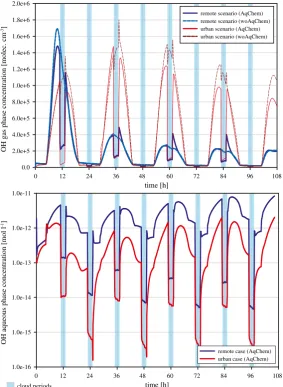
According to the importance of the photochemistry for the OH radical, the concentration profiles show a diurnal profile, which is significantly broken by the cloud periods (marked in blue in Fig. 1). Under daytime cloud conditions (2. day cloud event), the gas-phase concentration of OH (AqChem) is decreased by about 90 % and 75 % in the urban and remote scenario, respectively. Somewhat smaller in-cloud reductions of the OH gas-phase concentrations of about 25–73 % have been already modelled by other more simple models (Lelieveld and Crutzen1990and1991; Jacob1986; Monod and Carlier1999; Frost et al.
by a factor of 2-3 (see e.g. Mauldin et al.1997; Frost et al.1999). Within the limits of the present simulations, the modelled magnitude of the OH gas-phase decreases agrees with the few available observations.
The modelled OH reduction is mainly caused by the uptake of very soluble HO2and not
primarily by the direct OH phase transfer into the droplets. The efficient uptake of the gaseous HO2 radical causes an OH precursor separation between the two phases and a
remarkable decrease in the formation flux (Fig. S4in the ESM) up to about 90 % in the urban scenario in line with early model findings by Lelieveld and Crutzen (1991). In contrast to the remote case, in the urban case OH is mainly formed by the reaction pathway of HO2
and NO. Therefore, the decrease is most clearly identified in the urban case. It should be 1.0e-16
1.0e-15 1.0e-14 1.0e-13 1.0e-12 1.0e-11
remote case (AqChem) urban case (AqChem) time [h]
OH aqueous phase concentration [mol l
-1]
OH gas phase concentration [molec. cm
-3]
0.0 2.0e+5 4.0e+5 6.0e+5 8.0e+5 1.0e+6 1.2e+6 1.4e+6 1.6e+6 1.8e+6 2.0e+6
0 12 24 36 48 60 72 84 96 108
time [h]
0 12 24 36 48 60 72 84 96 108
remote scenario (AqChem) remote scenario (woAqChem) urban scenario (AqChem) urban scenario (woAqChem)
cloud periods
[image:8.439.78.362.54.442.2]noted that the regenerated NO2can form O3, which can subsequently be photolysed leading
to the OH formation via O(1D). Contrary to the urban scenario, the photolytic OH formation via the reaction of O(1D) with water acts as an important OH source under remote conditions besides the above-mentioned NOx based formation pathway (see Fig. S4 in the ESM).
Hence, the reduction of the gas-phase OH concentration is smaller in the remote scenario due to the smaller importance of the precursor separation effect.
Particularly under urban conditions, additional differences between the AqChem and the woAqChem case are recognisable during the non-cloud periods. The lowered concentration there is caused mainly by the chemical interaction of the OH precursor HO2 with the
deliquescent particles. The decreased HO2 gas-phase concentration budget leads to lower
OH concentration levels compared to the woAqChem case. It is noted, that the multiphase chemical interaction of the HO2radical is outlined in more detail in section3.2.5. Due to the
reduced gas-phase OH budget under cloud conditions, the oxidation of important organic trace gases is noticeably decreased under both urban and remote conditions. The OH oxidation reaction fluxes in the interstitial gas phase are much lower compared to non-cloud conditions. Thus, the tropospheric lifetimes of important organic trace gases are noticeably affected. This indirect chemical OH effect on organic trace gases is discussed in more detail in section3.3.
Moreover, Fig.1shows increased gas-phase OH concentrations (AqChem case) after the evaporation of remote daytime clouds. This modelled effect is related to higher OH production fluxes after the cloud evaporation caused by increased fluxes of NO with HO2
and organic peroxyl radicals (e.g. ISOP and MO2), which are less soluble than HO2. During
the cloud periods, the reaction of NO and HO2 is not acting as a source for OH (phase
separation of the reacting educts). On the other hand, the reaction of ISOP with NO acts still as a source for the OH precursor HO2 in the gas phase. The applied continuous emission
scheme leads to an increasing gas-phase NO concentration. In total, the NOx/HOxbudget is
affected right after the daytime cloud evaporation. As a consequence of the recovery of the HO2gas-phase concentration and the increased NO budget after the cloud evaporation, e.g.
during the descent period of the air parcel trajectory, the OH production and subsequently the OH concentration is raised for a short-time of about 1–2 hours. The reaction flux analysis shows an approximately two times higher gas-phase OH production flux in comparison to the fluxes before the cloud.
(ii) High aqueous-phase OH turnovers in the deliquescent particles: Chemical OH radical sources and sinks
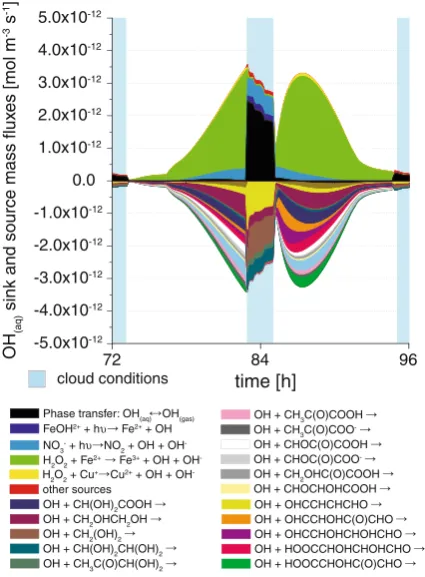
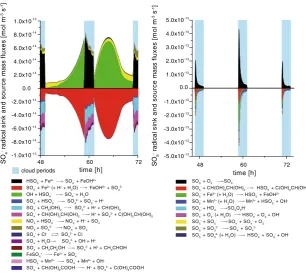
In Fig.2, the total sinks and sources of OH are plotted for a selected time interval of the modelling time (4. day) for urban conditions. The corresponding plot for the remote case is available in the ESM (see Fig. S5). The total OH fluxes show also a characteristic daytime-profile as modelled for the gas phase. The colour changes in the reaction flux plots show considerable differences in the sinks and sources between deliquescent aerosol conditions (non-cloud) and cloud conditions. In the deliquescent particles, OH formation is dominated by the Fenton reaction of Fe(II) with H2O2. Interestingly, the total source fluxes in the
particles are fully comparable with the ones in cloud droplets under urban conditions. This means that the in-situ formation of OH is more efficient in the aqueous particles leading to similar chemical turnovers as under cloud conditions. The model results imply that the in-situ OH production under deliquescent particle conditions strongly depends on the TMI concentration and especially on the H2O2 concentration. Contrary to the urban case, the
after the evaporation of the daytime cloud, so that OH production fluxes are reached similar those under cloud conditions (see Fig. S5in the ESM). The observed increase is mainly caused by the production of H2O2in the remote daytime clouds (see section3.3for further
details).
The above-mentioned results are in good agreement with measurements of Arakaki et al. (2006), who investigated aqueous extracts of aerosol particles with regard to the photo-chemical formation of OH in deliquescent particles. They found a direct correlation between the OH formation and the dissolved iron concentration. However, more experimental work has to be done to point out the importance of the different formation pathways including the Fenton reaction to act as potential OH in-situ source in the particle phase. Additionally, the OH formation rates, as reported by Shen and Anastasio (2011), show a similar tendency that more aqueous OH is formed in urban aerosols than in aerosols from a rural site. However, the provided OH formation rates of about 1-3 10−13 mol m−3 s−1 in fine urban particle samples are approximately 1 order of magnitude smaller than the model source fluxes in the present study.
In contrast to cloud conditions, where the reactions of highly water-soluble organic compounds taken up from the gas phase, e.g. glyoxal, methylglyoxal, formaldehyde, or 1,4-butenedial, represents the main OH sinks, reactions of their various less volatile oxida-tion products such as pyruvic acid (6 %) and glyoxylic acid (12 %) act as sinks for OH in the urban scenario in the deliquescent particles (Fig.2). The reactions of these species are less
time [h]
OH + CH3C(O)COO
OH + CHOC(O)COOH
OH + CHOC(O)COO
OH + CH2OHC(O)COOH
OH + CHOCHOHCOOH OH + OHCCHCHCHO OH + OHCCHOHC(O)CHO OH + OHCCHOHCHOHCHO OH + HOOCCHOHCHOHCHO OH + HOOCCHOHC(O)CHO
OH + CH3C(O)COOH
Phase transfer: OH(aq) OH(gas) FeOH2+ + hυ Fe2+ + OH
NO3- + hυ NO2 + OH + OH
H2O2 + Fe2+ Fe3+ + OH + OH
OH + CH(OH)2COOH
OH + CH2OHCH2OH
OH + CH2(OH)2
OH + CH(OH)2CH(OH)2
OH + CH3C(O)CH(OH)2
H2O2 + Cu+ Cu2+ + OH + OH
other sources
72 84 96
OH
(aq)
sink and source mass flux
es [mol m
-3 s -1]
5.0x10⁻¹²
-3.0x10⁻¹² -2.0x10⁻¹² -1.0x10⁻¹² 1.0x10⁻¹² 2.0x10⁻¹² 3.0x10⁻¹² 4.0x10⁻¹²
-4.0x10⁻¹²
-5.0x10⁻¹² 0.0
cloud conditions
Fig. 2 Modelled chemical sink and source mass fluxes of OH in aqueous phase (mol m−3
[image:10.439.113.326.54.343.2]important under cloud conditions due to the competitive reactants, which are effectively taken up into the cloud droplets such as formaldehyde. The integrated percentage contribu-tions of the most important OH sources and sinks are presented for the urban and remote scenario in Table S1and S2in the ESM.
In the remote case, the reactions with the less volatile oxidation products such as glyoxylic acid (8 %), glycolic acid (2 %) and pyruvic acid (8 %), act as sinks for OH in the deliquescent particles predominantly after the cloud evaporation (see Fig. S5in the ESM). However, it can be seen from the plot and Table S5, that the organic chemistry is much more important in the urban case compared to the remote case. The inorganic chemistry involving, e.g. Cl-, Br-and Fe2+and HSO4-, accounts on average for more than half of the OH sinks under remote deliquescent
particle conditions (cp. Table S1and S2in the ESM).
Finally, it has to be noted, that all results mentioned in the last 2 paragraphs above imply the relevance of deliquescent particles to act as a reactive medium within the tropospheric multiphase system. Radical conversions appear to be driven by OH very efficiently produced from the Fenton reaction. The availability of such OH radical source in deliquescent particles may also be important for the formation of atmospheric secondary organic matter. Particularly, the entrainment and detrainment areas of tropospheric clouds may be also quite reactive media for the chemical aerosol processing. Apparently, the abundance of liquid water in aerosol particles will enable a complex chemistry, which in some parts resemble the dilute aqueous solution chemistry as encountered in cloud droplets, but which might be considerable different with regard to other aspects.
(iii) Processing of OH radicals in cloud droplets: Chemical sources and sinks
As above-mentioned, the reaction flux plots reveal considerable changes in their colour patterns indicating huge differences in the sinks and sources fluxes under deliquescent particle (non-cloud) and cloud conditions. These differences are mainly caused by the increased phase transfer flux of soluble compounds into the droplets, which can act there as additional considerable sinks and sources in the cloud droplets.
Integrated over all cloud periods, the most important source of OH in the aqueous phase is the direct transfer from the gas phase with about 73 % in the urban case (64 % in the remote case). In addition, the aqueous-phase nitrate (NO3-) photolysis, FeOH2+photolysis
and the HO3decomposition contribute with about 7 %, 14 % and 4 %, respectively, to the
OH formation in the aqueous phase under urban cloud conditions. In the remote case, mainly the Fenton type reactions of Cu(I) and Fe(II), the HO3 decomposition as well as the
photolytic decay of H2O2 and FeOH2+ contribute with about 3 %, 16 %, 7 %, 7 % and
2 %, respectively, to the in-cloud sources of the OH radical besides the direct uptake from the gas phase. Former permanent cloud model studies using CAPRAM (Ervens et al.2003; Herrmann et al.2005) have revealed the same OH radical sources as important. However, their relative contribution to the OH sources fluxes differs from the obtained results here. This results mainly from the different meteorological scenarios using permanent and non-permanent cloud conditions, respectively. The permanent cloud modelling tend to underestimate the direct transfer from the gas phase.
humidity, and the chemical composition of the gas and aqueous phase. Thus, the above-mentioned contributions can be quite different under different environmental conditions.
Compared to the reaction flux pattern of the OH sources, a much more complex pattern can be obtained for the OH sinks. The most important sinks under cloud conditions (urban case) are the reaction with hydrated glyoxal (13 %), methylglyoxal (5 %), formaldehyde (29 %), ethylene glycol (11 %), and 1,4-butenedial (31 %). In comparison to the urban case, the most important OH sinks under remote in-cloud conditions represents the reactions with formate, hydrated formaldehyde, glycolaldehyde and methylglyoxal with about 42 %, 37 %, 2 % and 7 %, respectively. The modelled contributions of the different OH sinks under remote cloud conditions are in a good agreement with the former permanent cloud model studies of Herrmann et al. (2005), where similar values were obtained. In comparison to former CAPRAM studies (Herrmann et al.2000; Ervens et al.2003), which have revealed hydrated formaldehyde and formic acid as major sinks under both urban and remote conditions, the present study shows that also higher functionalised organic compounds can be considerable OH sinks in the urban case. However, it is noted that currently OH oxidations of other potential reactants particularly higher organic compounds are neglected in the present multiphase chemistry mechanism due to restricted knowledge. Finally, it is noted that a detailed description of the modelled aqueous phase OH radical concentration-time profiles is given in the ESM
3.2.2 Nitrate radical (NO3)
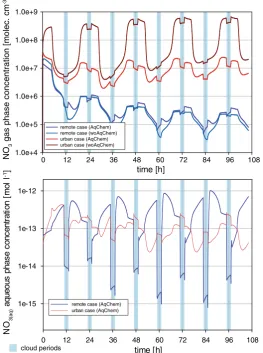
The modelled gas-and aqueous phase concentrations of NO3are presented in Fig.3for the
urban and remote scenario simulations. Due to the fact that the NO3radical is only of minor
importance under remote conditions, the present section focuses mainly on the model results of the urban scenario. Figure3reveals significantly reduced NO3gas phase concentrations
under polluted conditions (AqChem case) compared to the woAqChem case. This is caused mainly by the effective aqueous-phase uptake and conversion of the NO3reservoir species
N2O5. A negative correlation of measured NO3 radical concentrations with the relative
humidity, due to the indirect removal of the reservoir species N2O5on aqueous particles,
has been also observed in field studies (see e.g. Vrekoussis et al.2007; Geyer et al.2001). The modelled urban concentration profile (red line in Fig. 3) displays also distinctive decreases in the gaseous NO3concentration level after the cloud evaporation. The lowered
concentration levels compared to the levels before the cloud formation indicate effective in-cloud oxidations.
The aqueous NO3radical concentrations (AqChem case) show also differences between
the two scenarios (see Fig.3). Interestingly, the aqueous-phase concentration profiles do not reflect the distinctive night-time concentration cycles of the gas phase. The aqueous-phase NO3concentrations are additionally affected by their sinks and sources in the aqueous phase
(see discussion below). The modelled urban concentrations show just a small variability because of the significant continuous uptake flux into the droplets particularly during the night-time clouds. The urban night-time in-cloud concentrations of NO3 are with
2.0 10−13 mol L−1 approximately 1 order of magnitude higher than the corresponding daytime in-cloud OH concentration. Simulated aqueous NO3 radical concentrations are
similar to those obtained in Ervens et al. (2003).
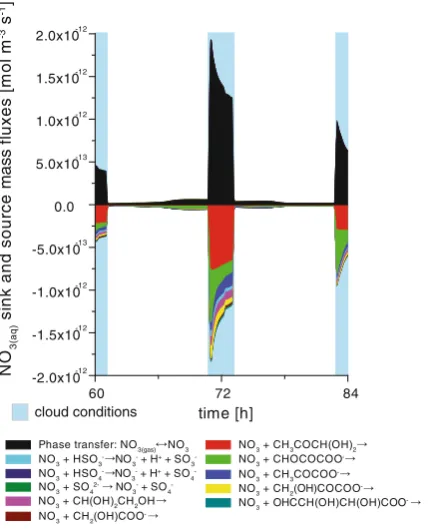
The urban NO3radical concentrations in the deliquescent particles are about one order of
(see Fig.4), which agrees with findings of former studies (Herrmann et al.2000; Ervens et al.
2003). In-situ sources, i.e. internal aqueous-phase productions pathways, are just of minor importance apart from the first day of the simulation, where they act as both considerable sinks and sources for NO3 radical in the deliquescent particles. Particularly, the radical
inter-conversion reactions with chloride and bromide leading to the formation of Cl and Br atoms and radical anions act as important NO3sink as well as source in the deliquescent particles. The
radical inter-conversion reaction between the NO3-and Cl/Br radicals act as source for NO3
during daytime conditions.
The total in-cloud oxidation fluxes of the two main radical oxidants OH and NO3(max. day
and night-time flux, respectively) are with about (2-3)×10-12mol m-3s-1the same order of magnitude under polluted conditions. Furthermore, Fig.4shows that the in-cloud oxidation of methylglyoxal and its oxidation products such as pyruvic acid seems to be an efficient sinks for the NO3radical in the aqueous phase particularly under urban conditions. Comparable results
are also obtained for remote conditions. The most important urban NO3 sinks and sources
time [h]
0 12 24 36 48 60 72 84 96 108
1.0e+4 1.0e+5 1.0e+6 1.0e+7 1.0e+8 1.0e+9
remote case (AqChem) remote case (woAqChem) urban case (AqChem) urban case (woAqChem)
time [h]
0 12 24 36 48 60 72 84 96 108
NO
3
g
a
s
phase
concentration
[m
o
lec.
cm
-3]
NO
3
(aq)
aq
u
e
o
u
s
p
h
a
s
e
c
o
n
c
e
n
tr
at
io
n
[m
o
l
l
-1]
1e-15 1e-14 1e-13 1e-12
remote case (AqChem) urban case (AqChem)
cloud periods
[image:13.439.88.352.57.411.2]including their relative contributions are summarised in Table S3in the ESM. In contrast to the OH radical budget, which is significantly influenced by C1-C4organic compounds, the NO3
budget is almost exclusively affected by C3organic species due to their considerable reactivity
with the NO3radical compared to OH (see also Fig.5). Moreover, the reaction mass fluxes in
the deliquescent aerosol particles are mostly more than 1 order of magnitude smaller for the NO3due to the less efficient in-situ sources. Different from the OH radical, the NO3radical
budget is determined by its gas-phase budget at least under highly polluted conditions and NO3
reactions appear to be therefore only of less importance in the deliquescent particles. A comparison of the NO3radical importance for oxidations of organic compounds among
the performed non-permanent and the former permanent cloud chemistry model studies (e.g. Ervens et al.2003; Herrmann et al.2005) reveals considerable differences. The relevance of the NO3radical for tropospheric oxidations in the aqueous phase appears to be substantially
under-determined using permanent cloud chemistry model conditions. Due to the almost permanent transfer of gas-phase NOyspecies into the aqueous phase under cloud conditions,
the gas-phase NOx/NOybudget becomes artificially decreased. This effect clearly increases
with the simulation time and then leads to low NOxas well as low NO3radical gas-phase
conditions. Since the phase transfer of gas-phase NO3 radical is the main source for the
aqueous-phase budget, even the non-permanent cloud studies performed in this study might probably still underestimate the NO3radical importance due to the selected microphysical
scenario and the long lifetime of the droplets. Substantial deviations between the estimated CAPRAM values and the recently measured constants (see Herrmann et al. 2010 and references therein) can be obtained only for the rate constants of organic acid anions such
NO
3(
aq)
s
ink
and
s
o
ur
c
e
m
a
s
s
f
lux
es
[m
ol
m
-3
s
-1]
-2.0x10⁻¹² -1.5x10⁻¹² -1.0x10⁻¹² -5.0x10⁻¹³ 0.0 5.0x10⁻¹³ 1.0x10⁻¹² 1.5x10⁻¹² 2.0x10⁻¹²
60 72 84
time [h]
Phase transfer: NO3(gas) NO3
NO3+ HSO3 - NO
3 - + H+ + SO
3
-NO3+ HSO4- NO 3
- + H+ + SO 4
-NO3+ SO42- NO 3
- + SO 4
-NO3+ CH(OH)2CH2OH
NO3+ CH2(OH)COO-
NO3+ CH3COCH(OH)2
NO3+ CHOCOCOO
-NO3+ CH3COCOO
-NO3+ CH2(OH)COCOO
-NO3+ OHCCH(OH)CH(OH)COO-
cloud conditions
[image:14.439.115.332.54.319.2]as lactate. Thus, future mechanism developments should consider these measured data and, when needed, evaluated reaction rate prediction methods derived from them (see Herrmann et al.2010for further details).
3.2.3 Comparison of organic oxidation turnovers of OH and NO3
The previous subsections have shown that organic compounds represent a crucial sink for aqueous-phase radical oxidants such as OH and NO3. However, the previous sections have
NO3 flux [mol m-3s-1]
1e-22 1e-21 1e-20 1e-19 1e-18 1e-17 1e-16 1e-15 1e-14 1e-13 1e-12
OH flux [mol
m -3 s -1] 1e-18 1e-17 1e-16 1e-15 1e-14 1e-13
1e-12 1000:1 100:1 10:1 1:1
1:10
CH2(OH)SO3 -CH
3OOH CH3OH CH
2(OH)2 HCOOH/HCOO -CH3CHO/CH3CH(OH)2 HC2O4
-/C 2O4
2-CH(OH)2COOH/CH(OH)2CO O -CH
2(OH)COOH/CH2(OH)COO -HO2CH2COOH/HO2CH2COO
-CH2(OH)CH2OH CHOCH2OH/CH(OH)2CH2OH CH3CH2OH
CH(OH) 2CH(OH)2 CH3COOH/CH3COO
-CH
3CH2CH2OH CH3CH2COOH/CH3CH2COO
-CH3CH(OH)CH3 CH3C(O)CH2OH CH3C(O)CH(OH)2 HOOCCH
2COOH/HOOCCH2COO -/OOCCH
2COO 2-CH3C(O)COOH/CH3C(O)COO
-CH(OH)
2CH2COOH/CH(OH)2CH2COO -CH3CH(OH)COOH/CH
3CH(OH)COO
-CH
2(OH)C(O)COOH/CH2(OH)C(O)COO -CH(O)C(O)COOH/CH(O)C(O)CO O -CH(O)CH(OH)COOH/CH(O)CH(OH)COO -HOOCCH(OH)COOH/HOOCCH(OH)COO -CH3CH2OCHO
CH
3CH2CHO/CH3CH2CH(OH)2 CH3C(O)CH3
HOOCCH2CH2COOH/HOOCCH2CH2CO O -/OOCCH
2CH2CO O 2-CH
3CH2CH2CHO/CH3CH2CH2CH(OH)2 CH3CH2CH2COOH/CH3CH2CH2COO
-CH3CH2CH(OH)CH3
CH3C(O)CH2CH3 CH3C(O)C(O)CH3 OHCCH(OH)C(O)CHO
HOOCCH(OH)C(O)CHO/OHCCH(OH)C(O)COO -OHCCH(OH)CH(OH)CHO
HOOCCH(OH)CH(OH)CHO/OHCCH(OH)CH(OH)COO -HOOCCH(OH)CH2COOH/HOOCCH(OH)CH2COO
-HOOCC(O)CH
2COOH/HOOCC(O)CH2COO -CH3CH2CH2CH2OH
CH
3C(O)CH2CH(CH3)2 CH2CH2CH2C(O)NCH3 CH2CH2C(O)NCH3C(O) CH2CH2C(O)NHCH2
[image:15.439.64.377.57.477.2]not compared the in-cloud turnovers of the different radicals for the oxidation of various dissolved organic compounds. A comprehensive comparison of the organic oxidation turnovers of OH and NO3 radicals have been also not yet done in other available model
studies.
For the comparison, the aqueous-phase OH and NO3 organic oxidation fluxes were
analysed for the cloud and non-cloud periods of the simulation. In Fig.5, a comparison of the averaged reaction fluxes caused by the two radicals is presented for the in-cloud degradation of organic compounds under polluted cloud conditions. The calculated average reaction fluxes consider all data during both day- and night-time cloud periods in order to reflect the different diurnal relevance of the two radical oxidants. The plot shows that for a number of organic compounds the NO3radical oxidation flux can be equivalent with or even
more important than the corresponding OH reaction pendant. Nevertheless, for the majority of the organic compounds, the major aqueous-phase radical oxidant is OH despite the high NOxconcentrations under polluted conditions. In addition, Fig.5indicates that the in-cloud
degradation of methylglyoxal and its oxidation products like pyruvic acid might be an efficient aqueous-phase sink for NO3 particularly under urban, but also under remote
conditions. Similar comparisons considering the non-cloud periods only (fluxes in the deliquescent particles) reveal that NO3radical plays a crucial role only for cloud conditions,
whereas OH chemistry clearly dominates under deliquescent particle conditions due to the effective in-situ sources of the OH radical, see section3.2.1.
Based on those findings, the results of the CAPRAM runs were scanned through coherences between the NO3 importance and the number of carbon atoms (Cx with x=1,
2, 3, 4), the functional group (aldehydes, diacids, dialdehydes, etc.) and the oxidation degree of the respective organic compounds (represented by the O/C atom ratio). The results are given in the ESM. In summary, the study showed no direct coherences between the OH/NO3
flux ratio and the number of carbon atoms and the functional group, respectively. However, the study showed that the NO3/OH flux ratio tends to increase with the polarity of the
organic species.
Overall, the results of the present study indicate that necessarily more NO3 radical
oxidations of oxidised organic aerosol components should be investigated in the laboratory and afterwards considered in upcoming aqueous mechanisms due to the potential importance of NO3oxidation for such compounds. Additionally, the present model studies indicate that
other mechanisms (e.g. Ervens et al.2008) might underestimate the degradation of certain organic compounds in polluted environments by ignoring aqueous-phase NO3 radical
oxidations.
3.2.4 Sulphur containing radicals (SOx-)
Besides OH and NO3, CAPRAM 3.0 contains also organic reactions (C1–C2chemistry)
of other radicals and radical anions (see Herrmann et al.2005; Ervens et al.2003), which were found to be only of minor importance in former permanent cloud model studies. The present study shows that primarily the sulphate radical anion (SO4-) and the
peroxymonosulphate radical anion (SO5-) can contribute to the in-cloud oxidation of
organic compounds. The relative contributions of the SO4- and the SO5- radical anion
for the oxidation of C1–C2organic compounds under remote and urban cloud conditions
in comparison to the OH radical are summarised in Table1. It should be noted that the NO3 radical contributions is not given in Table 1, because the NO3 represents not a
The sulphate radical contributions are in the range of few percent of the total degradation flux with somewhat higher values in the polluted case. The only exception is acetic acid with modelled contribution ratios up to 24 %. Moreover, the reaction flux analysis (see in Fig.6) reveals that oxidations of organic compounds represent a significant chemical in-cloud sink for the SO4- radical. Particularly, the reactions with hydrated formaldehyde and glyoxal
contributing with more than 50 % significantly to the total in-cloud SO4-degradation fluxes
(see Fig. 6). The SO4- radical sink and source fluxes show a similar diurnal pattern as
obtained for the OH radical. Figure6reveals, a cycling of the SO4-radical in the
deliques-cent particles including the SO4-formation via S(VI) reactions with OH and NO3as well as
the SO4-consumption in the reaction of SO4-with Fe2+.
The CAPRAM mechanism contains also oxidation reactions of glyoxal and oxalate with the SO5-radical. For glyoxal, the modelled oxidation fluxes of the SO5-radical are almost
comparable to that of OH (see Table1). Contrary to the SO4-, the SO5- radical reveals a
characteristic cloud profile only (Fig.6). This behaviour can be explained by the inefficient uptake of S(IV) into the acidic aqueous particles and the hence restricted aqueous source for SOX-radicals. Figure6shows that organic oxidations might also be considerable sinks for
SO5- radicals besides the known inorganic pathways. The obtained results are consistent
with model results obtained in the real cloud passage modelling (see Tilgner et al.2005), where the importance of the SO5-radical for the in-cloud oxidation of glyoxal has already
been pointed out for low OH radical conditions. However, it is noted that the relevance of the SO5-for the glyoxal oxidation is probably overestimated by the present model due to the
largely missing SO5- kinetic constants for other organic compounds (see review by
Herrmann2003). For that reason, further laboratory studies and the subsequent development of reactivity estimations are needed to develop improved mechanisms and to assure the present findings of the SO5-radical importance. Finally, it should be noted that due to the
mitigation of the anthropogenic SO2emissions in many parts of the world, the importance of
[image:17.439.50.393.78.229.2]the chemistry of sulphur containing radicals might decrease.
Table 1 Relative contributions of the SO4-and the SO5-radical anion to the oxidation of C1- C2organic compounds under remote and urban cloud conditions in comparison to the OH radical
Organic reactant Remote scenario Urban scenario
SO4- SO5- OH SO4- SO5- OH
CH(OH)2CH(OH)2(hydrated glyoxal) 1 % 44 % 55 % 5 % 35 % 59 %
CH3OH (methanol) 0 % – 100 % 3 % – 97 %
CH3CH2OH (ethanol) 1 % – 99 % 6 % – 85 %
CH2(OH)2(hydrated formaldehyde) 1 % – 99 % 5 % – 93 %
CH3CHO / CH3CH(OH)2(acetaldehyde) 1 % – 99 % 2 % – 97 %
HCOOH /HCOO-(formic acid/ formate) 1 %
– 97 % 1 % – 26 %
CH3COOH / CH3COO-(acetic acid/ acetate) 24 %
– 76 % 20 % – 72 %
CH(OH)2COOH / CH(OH)2COO
-(hydrated glyoxalic acid / glyoxalate)
0 % – 100 % 6 % – 92 %
The relative contributions represent an average over all day-and night-time clouds during the model
simula-tion. Therefore, also even higher contributions of the SO4- and the SO5-radical anion are feasible during the
simulation time (e.g. the SO4-radical anion contributes with about 32 % to the degradation of glyoxalic acid
3.2.5 Hydroperoxyl radical/superoxide anion (HO2/O2-)
As proposed by several model studies (e.g. Lelieveld and Crutzen1991; Tilgner et al.2005; Thornton et al.2008) and shown in recent aircraft measurements (Commane et al.2010), the aqueous phase can act as considerable sink for the gaseous hydroperoxyl radical HO2.
In-cloud reductions of the gas-phase HO2 concentration are also simulated by the present
simulations (AqChem cases). Figure 7 reveals that the HO2 gas-phase concentration is
drastically decreased under cloud conditions and often by more than one order of magnitude. These results agree with simulations of Lelieveld and Crutzen (1991), which showed similar reductions. The present model results reveal that reductions are more substantial particularly during the daytime cloud conditions. Observations of Commane et al. (2010) above the humid forest of West Africa have shown in-cloud reductions in the gaseous HO2
concen-tration down to approximately one third of the non-cloud value. As the LWC of the modelled clouds is slightly higher than the LWC during the aircraft measurements of Commane et al. (2010) and due to the specific environment, the more significant reductions in the present study might presumably relate to these facts.
In contrast to the OH and NO3radical, the aqueous HO2/O2-concentrations reveal just
small variations throughout the simulation time. The concentration level in the deliquescent particles is mostly just one order of magnitude smaller than the corresponding in-cloud level. Moreover, the diurnal HO2 gas-phase profile is also reflected in the aqueous phase. The
modelled maximum HO2/O2-concentrations of about 1.0 10−8and 2.5 10−9mol L−1in the
urban and remote scenario (AqChem case), respectively, are about 5 orders of magnitude -1.0x10⁻¹³ -8.0x10⁻¹⁴ -6.0x10⁻¹⁴ -4.0x10⁻¹⁴ -2.0x10⁻¹⁴ 0.0 2.0x10⁻¹⁴ 4.0x10⁻¹⁴ 6.0x10⁻¹⁴ 8.0x10⁻¹⁴ 1.0x10⁻¹³
48 60 72
time [h]
SO
4
- radical s
in k a n d s o u rc e mass fl u x e s [m o l m
-3 s -1]
HSO5
- + Fe2+ SO
4
- + FeOH2+
SO4
- + Fe2+ (+ H+ + H
2O) FeOH
2+ + SO
4
OH + HSO4
- SO
4 - + H
2O
SO4
- + HSO
3
- SO
4
2- + SO
3 - + H+
SO4
- + CH
2(OH)2 SO4
2- + H+ + CH(OH)
2
SO4
- + CH(OH)
2CH(OH)2 H
+ + SO
4
2- + C(OH)
2CH(OH)2
NO3 + HSO4
- NO
3
- + H+ + SO
4
NO3 + SO4
2- NO
3
- + SO
4
SO4
- + Cl- SO
4
2- + Cl
SO4
- + H
2O SO4
2- + OH + H+
SO4
- + CH
3CH2OH SO4
2- + H+ + CH
3CHOH
FeSO4
+ Fe2+ + SO
4
HSO5
- + Mn2+ SO
4
- + Mn3+ + OH
SO4
- + CH(OH)
2COOH H
+ + SO
4
2- + C(OH)
2COOH → ← → → → → → → → → → → → → → -5.0x10⁻¹³ -4.0x10⁻¹³ -3.0x10⁻¹³ -2.0x10⁻¹³ -1.0x10⁻¹³ 0.0 1.0x10⁻¹³ 2.0x10⁻¹³ 3.0x10⁻¹³ 4.0x10⁻¹³ 5.0x10⁻¹³
48 60 72
time [h]
SO
5
- radical s
in k a n d s o u rc e mass fl u x e s [ m o l m
-3 s -1]
SO3
- + O
2 SO5
SO5
- + CH(OH)
2CH(OH)2 HSO5
- + C(OH)
2CH(OH)2
SO5
- + Fe2+ (+ H
2O) HSO5
- + FeOH2+
SO5
- + Mn2+ (+ H
2O) Mn
3+ + HSO
5
- + OH
SO5- + HO2 SO5O2H
SO5- + O2- (+ H2O) HSO5- + O2 + OH
SO5- + SO5- SO4- + SO4- + O2
SO5
- + SO
3
2- SO
4
- + SO
4
SO5
- + SO
3
2- (+ H
2O) HSO5
- + SO
3
- + OH
-→ → → → → → → → → cloud periods
Fig. 6 Modelled aqueous chemical sink and source mass fluxes (mol m−3
(air)s−1) of the SO4-radical (urban
[image:18.439.64.371.51.325.2]higher than the respective OH concentrations. In comparison, the concentration difference in the gas phase accounts only for 2–3 orders of magnitude. This results from the very effective reactive uptake of gaseous HO2and the efficient in-situ sources. Particularly in the aqueous
particles, the uptake is the dominating source besides in-situ sources. Figure S8in the ESM shows the total sink and source fluxes including the net effect of the HO2/O2-cycling with
copper and its backward reaction. The latter processes together with the other TMI reactions lead to a net HO2/O2-destruction in the aqueous phase. Although the reactivity of iron with
HO2/O2-is considerably smaller than the copper pendants, the iron reactions contribute with
about 10 % to the HO2/O2-loss fluxes.
Another interesting fact seen in Fig. S8is the importance of the unimolecular decay of the acetyl peroxyl radical (hydrated form) for the in-situ formation of HO2in the aqueous phase.
time [h]
0 1e+8 2e+8 3e+8 4e+8 5e+8 6e+8 7e+8
urban case (Aq Chem) urban case (woAqChem) remote case (AqChem) remote case (woAqChem)
0 12 24 36 48 60 72 84 96 108
cloud conditions
HO
2
gas phase concentration [molec. cm
-3]
HO
2
/O
2
-aqueous
p
hase
concentration
[m
o
l
L
-1]
2.0e-9 4.0e-9 6.0e-9 8.0e-9 1.0e-8
remote case (AqChem) urban case (woAqChem)
0.0
0 12 24 36 48 60 72 84 96 108
[image:19.439.79.362.57.449.2]This pathway represents the main in-cloud HO2source with an overall relative contribution of
about 24 % in the urban case. Besides the acetyl peroxyl radical, other organic peroxyl radicals can substantially add to the total in-situ formation of HO2/O2-. Additionally to the organic
peroxyl radicals depicted in Fig. S8, unimolecular decay reactions of other organic compounds contribute to the aqueous formation of HO2/O2. About 84 % of the other sources (marked in
dark green in Fig. S8) represent unimolecular decay reactions other organics. In total, the organic aqueous-phase chemistry contributes to about 47 % to the total HO2/O2-sources and
therefore constitutes a non-negligible source for the multiphase HO2/O2-budget. Furthermore,
the currently still incomplete organic aqueous-phase chemistry might still lead to a possible underestimation of the HO2formation in clouds and might therefore be also a reason for the
considerably higher modelled HO2 gas-phase reduction in comparison to the field data of
Commane et al. (2010). Moreover, it can be seen from Fig. S8that urban night-time cloud chemistry can lead to a release of HO2into the gas phase due to the efficient aqueous formation
pathways. This finding is different to the remote case, where the aqueous phase represents just a sink throughout the simulation time. However, this result cannot be compared with field measurements at present.
Another important scientific question concerning HO2represents the importance of its
heterogeneous and multiphasic removal pathways of HO2by clouds and aerosol particles
(see e.g. Morita et al.2004; Thornton et al.2008; Taketani et al.2008). Higher scale model studies have revealed the potential relevance of these removal processes to affect signifi-cantly the atmospheric HOxbudget. However, there are still quite a lot of uncertainties in the
model parameterisations as well as the resulting simulation findings (see Thornton et al.
2008). Moreover, studies of Thornton et al. (2008) and Taketani et al. (2008) have assessed the effects of the aerosol pH, temperature, particle radius, aqueous-phase diffusion and the copper chemistry for the overall HO2uptake coefficient (γHO2).
Thornton et al. (2008) have discussed the main issues, which restrict more precise parameterisations and outputs of higher scale models. One of the mentioned issues is related to the importance of the particulate organics for the HO2budget. The former model calculations of
Thornton et al. (2008) completely neglect the possibility of an in-situ aqueous-phase HO2
formation in aqueous particles even though the direct uptake from the gas phase would decrease. The obtained SPACCIM results (AqChem) including aqueous particles at 90 % relative humidity show considerable reduction in both scenarios in comparison to the woAqChem model run (see Fig.7). The noon concentrations at the end of the simulation time (108 h) show reductions of approximately 10 % in both cases. Moreover, the reaction flux analysis shows that also multiphase oxidations of organics such as glyoxalic acid are potentially important in-situ sources contributing to the aqueous-phase HO2source budget besides the direct phase transfer. Even if the
current CAPRAM mechanism contains only organics up to mainly C4, the current results
implicate that organic oxidation reactions probably have the potential to lower the direct uptake of HO2from the gas phase due to their contributions to the aqueous HO2/O2- concentration
budget. Thus, considering the processing of other higher organics in future condensed phase mechanisms, model results might show a lowered gas-phase removal of HO2due to the increased
aqueous-phase in-situ sources for HO2/O2-.
When, the modelled HO2particle uptake fluxes of several size-bins (remote/urban case)
are converted into a γHO2-value (see Jacob 2000), a value almost equal to the mass accommodation coefficient (10−2) applied in the current model results. The calculated values are smaller than values derived from field measurements (see Taketani et al.2012). This result means that the applied mass accommodation represents the limiting step for the HO2
3.3 Multiphase processing involving H2O2and O3as non-radical radical oxidant
Beside the radical oxidants, also concentrations of non-radical oxidants such as H2O2and O3can be
influenced by aqueous-phase chemistry interactions and have been therefore investigated in the present study. The model results for H2O2are presented below because of the various interesting
interactions of H2O2with other chemical subsystems such as the HOx and TMI chemistry in both
deliquesced particles and cloud droplets. The results for O3are given in the ESM.
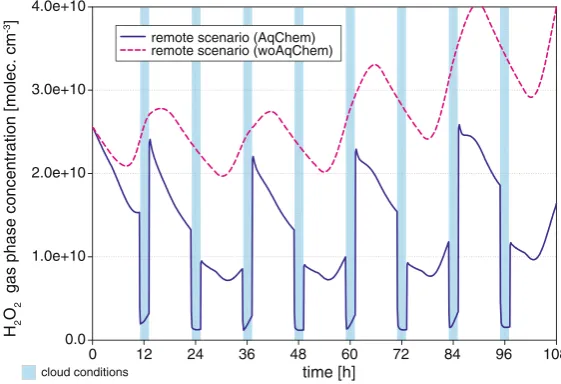
Figure8shows the modelled H2O2gas-phase concentrations vs. modelling time for the
remote scenario (AqChem/woAqChem case). The modelled H2O2gas-phase concentrations
(AqChem, blue line) are significantly reduced in comparison to the woAqChem model run. The red curve in Fig.8(woAqChem case) shows a typical diurnal concentration profile with an increase over the simulation time due to the not considered chemical sinks in the aqueous phase. In contrast, the blue concentration profile is characterised by significant decreases during cloud periods mainly due to the efficient partitioning of H2O2into the cloud droplets.
Moreover, a substantial increase of the gaseous H2O2concentration is obvious after daytime
cloud evaporation, e.g. during the descent period of the air parcel trajectory and a significant decrease can be obtained after night-time cloud evaporation. Additionally under deliques-cent particle conditions, the H2O2 is mostly lowered compared to the woAqChem case.
Overall, the reduction of the H2O2concentration is caused by both a decreased gas-phase
production in the cloud and effective aqueous-phase oxidations in the cloud droplets and deliquescent particles. The aqueous-phase oxidations mainly involve sulphur (IV) oxidation and the transition metal ion chemistry, which are discussed below in more detail. Figure S10
in the ESM depict the modelled chemical sink and source fluxes of H2O2under urban and
remote conditions, respectively. Under urban cloud conditions, the sulphur chemistry dom-inates the aqueous-phase H2O2chemistry leading to reduced H2O2gas-phase concentration
levels after the cloud evaporation (see Fig. S10). In the remote case, the TMI-chemistry (particularly reactions of Cu+/Fe2+with O2-) controls the multiphase H2O2budget during the
daytime clouds and the sulphur chemistry during the night-time clouds (see Fig. S10in the
time [h]
H
2
O2
gas phase concentration [molec. cm
-3]
0.0 1.0e+10 2.0e+10 3.0e+10 4.0e+10
0 12 24 36 48 60 72 84 96 108
cloud conditions
[image:21.439.77.358.398.590.2]ESM). The reaction flux analysis reveals negative net fluxes during the night clouds and positive values during the day clouds. Consequently, the cloud phase act as source for H2O2
in the gas phase and the concentration of H2O2is increased by more than 50 % after the
day-cloud evaporation, when the dissolved H2O2is transferred back to the gas phase (see Fig.8).
This result differs from many other former model studies, which usually pointed out clouds just as a sink for H2O2. However, the presently modelled direct chemical cloud effect on
H2O2confirms both laboratory investigations of Zuo and Holgne (1992), modelled in-cloud
H2O2productions by Liu et al. (1997) and conclusions of Anastasio et al. (1994). Zuo and
Holgne (1992) expected an effective generation of hydrogen peroxide in daytime clouds and consequently a feedback on the H2O2gas-phase budget. Anastasio et al. (1994) concluded
that aqueous photochemistry can be a significant and in some cases the dominant source of H2O2in cloud droplets. However, it should be noted that other studies, e.g. of Marinoni et al.
(2011), are not in agreement with the above findings showing that the photolysis is more important than in-situ photochemical production in the investigated cloud water solutions.
The above-mentioned result of Anastasio et al. (1994) is confirmed by the present model findings. The reaction flux plots (see Fig. S10) reveal that the uptake represents an important source for the aqueous H2O2 just at the beginning of the cloud episodes. Afterwards,
reactions of TMIs (Cu+/Fe2+) with HO2represent the main sources for H2O2 under cloud
conditions. It is noted that this chemical cloud effect on the gaseous H2O2and thus the HOx,y
budget might be of particular importance for processes in the evaporation zones of cloud droplets, e.g. the cloud edges and upper ice formation zones in the cloud. Moreover, the present model results confirm also findings of Arellanes et al. (2006) and Wang et al. (2010), which found that aqueous particles are capable of generating H2O2. The reaction flux plots
(see Fig. S10) show that particularly under urban particle conditions the TMI chemistry of Cu+and Fe2+with aqueous HO2 acts as source for H2O2. This model finding is in good
agreement with the studies of Wang et al. (2010), which found a strong correlation of the H2O2with soluble metal such as iron and copper.
3.4 Effects of multiphase chemistry interactions on organic trace gases
As briefly discussed in other multiphase chemistry studies (see e.g. Lelieveld and Crutzen
1991), changed oxidants budgets are expected to perturb the degradation of many organic trace gases. However, up to now, such chemical cloud effects have not been analysed in a systematic manner. Therefore, investigations have been performed on the influence of the changed gas-phase oxidants budget on the degradation of important organic trace gases.
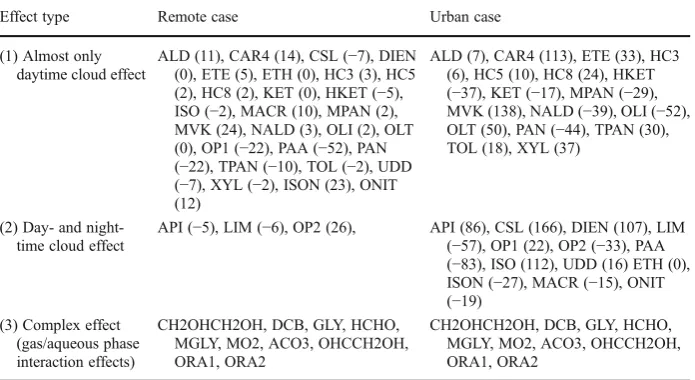
Present model results show that, due to the obtained multiphase chemical effects on oxidants, the concentration patterns of gas-phase trace gases can be considerably affected (see Fig. S12in the ESM). The observed effects of the organic RACM-MIM2ext gas-phase compounds are summarised in Table 2. Both daytime and/or night-time cloud effects as well as more complex multiphase cloud interaction effects are identified for organic trace gases. According to the observed cloud effects, the organic RACM-MIM2ext gas-phase species were classified into 3 different effect types (see Table2).
(i) Less water-soluble organics
the AqChem run, the concentrations are about 37 % higher for XYL compared to woAqChem run at the end of the simulation. For such trace gases, the most important oxidant in the gas phase is the OH radical. For species with high NO3reaction rates such as
isoprene (see Fig. S12in the ESM), the reduced NO3budget additionally leads to substantial
concentration pattern changes under polluted night-time conditions (type 2 see Table 2). Also, more oxidised compounds such as MACR and HKET reveal influenced concentration levels, which are caused by the reduced degradations of their precursors and their own affected degradation under cloud conditions. Depending on the characteristic chemical sinks and sources of each organic trace gas, both increased and decreased concentrations are modelled (see Table2).
(ii) Highly water-soluble organics
More complex concentration patterns can be obtained for highly water-soluble com-pounds, which are soluble enough to be taken up in considerable amounts into the aqueous phase such as ethylene glycol, glyoxal, glycolaldehyde and methylglyoxal (see Fig. S12in the ESM). For such compounds, the aqueous-phase can act as both a significant sink and source in parallel to the gas phase. Figure9shows that during the cloud occurrence their gas-phase concentration is clearly reduced due to the uptake of those species into the cloud droplets. Depending on the solubility and reactivity, the water-soluble compounds are taken up into the droplets to a different degree. For this reason, the concentration behaviour of these compounds can be somewhat different. For ethylene glycol, the chemical interaction with deliquescent particles and droplets leads to decreasing concentrations compared to the woAqChem case. Because of its high Henry solubility, ethylene glycol is transferred efficiently into the aqueous-phase of both wet particles and cloud droplets, and is effectively oxidised there particularly during the high OH daytime conditions (see Tilgner and Herrmann 2010 for further details). The aqueous-phase oxidation can even over-Table 2 Summary of the modelled chemical aqueous-phase interaction effects on RACM-MIM2ext gas-phase species for remote and urban environmental conditions
Effect type Remote case Urban case
(1) Almost only daytime cloud effect
ALD (11), CAR4 (14), CSL (−7), DIEN
(0), ETE (5), ETH (0), HC3 (3), HC5
(2), HC8 (2), KET (0), HKET (−5),
ISO (−2), MACR (10), MPAN (2),
MVK (24), NALD (3), OLI (2), OLT
(0), OP1 (−22), PAA (−52), PAN
(−22), TPAN (−10), TOL (−2), UDD
(−7), XYL (−2), ISON (23), ONIT
(12)
ALD (7), CAR4 (113), ETE (33), HC3 (6), HC5 (10), HC8 (24), HKET
(−37), KET (−17), MPAN (−29),
MVK (138), NALD (−39), OLI (−52),
OLT (50), PAN (−44), TPAN (30),
TOL (18), XYL (37)
(2) Day- and night-time cloud effect
API (−5), LIM (−6), OP2 (26), API (86), CSL (166), DIEN (107), LIM
(−57), OP1 (22), OP2 (−33), PAA
(−83), ISO (112), UDD (16) ETH (0),
ISON (−27), MACR (−15), ONIT
(−19)
(3) Complex effect (gas/aqueous phase interaction effects)
CH2OHCH2OH, DCB, GLY, HCHO, MGLY, MO2, ACO3, OHCCH2OH, ORA1, ORA2
CH2OHCH2OH, DCB, GLY, HCHO, MGLY, MO2, ACO3, OHCCH2OH, ORA1, ORA2
[image:23.439.47.395.79.269.2]compensate the reduced gas-phase oxidation and the coupling of both phases results in a lower concentration of ethylene glycol in the gas phase. A similar behaviour becomes apparent for glycolaldehyde. Figure 9 plots the multiphase sink and source flux analysis for this compound under remote conditions. It can be seen that the in-cloud daytime degradation fluxes are nearly three times larger than the gas-phase formation fluxes and much more important than other gas-phase sinks. Contrary, the behaviour of methylglyoxal (MGLY) is more complex. Besides MGLY itself, its sources in the gas phase are noticeably affected, as can be seen from the sink and source analysis in Fig. 9. Therefore, the concentration profile differences of MGLY result from both the affected precursors and the effects on MGLY in both phases. For MGLY, the aqueous-phase acts both as sink and as a protecting medium. Under cloud conditions, MGLY is transferred into the droplets and is oxidised there effectively, which becomes apparent with the deficit after the cloud evaporation. Additionally to the oxidative effect, the photolysis flux of MGLY in the gas phase is reduced under cloud conditions due to the reduced phase MGLY budget. The less effective
gas-66 72 -8.0x10⁻¹² -6.0x10⁻¹² -4.0x10⁻¹² -2.0x10⁻¹² 0.0 2.0x10⁻¹² 4.0x10⁻¹² 6.0x10⁻¹² 8.0x10⁻¹²
48 54 60
time [h]
MGLY (urban) multiphase
s in k a n d s o u rc e mass f lu x e s [ m o l m
-3 s -1]
MGLY + hv→
MVK + O3→
MACR + O3
→
DCB + OH→
CAR4 + O3
→
KETP + NO→ CSLP + NO→ XYLP + NO→ TOLP + NO→ HKET + OH→ MGLY + OH→
DCB + O3→
MACRP + NO→
MVKP + NO→
CH3C(O)CH(OH)2 + NO3(aq)→
CH3C(O)CH(OH)2 + OH(aq)→
-4.0x10⁻¹³ -3.0x10⁻¹³ -2.0x10⁻¹³ -1.0x10⁻¹³ 0.0 1.0x10⁻¹³ 2.0x10⁻¹³ 3.0x10⁻¹³ 4.0x10⁻¹³
24 30 36 42 48
time [h]
Glycolaldehyde (remote) multiphase
s in k a n d s o u rc e mass fluxes [ m o l m
-3 s -1]
OHCCH2OH + hv
ETEP + NO
OHCCH2OH + HO
OHCCH2OH + HO
MVKP + NO CHOHO2CH2OH(aq) HO(aq) + OHCCH2OH(aq)
HO(aq) + CH(OH)2CH2OH(aq)
→ → → → → → → → cloud conditions -1.0x10⁻¹² -5.0x10⁻¹³ 0.0 5.0x10⁻¹³ 1.0x10⁻¹² 1.5x10⁻¹² 2.0x10⁻¹² total MGLY f lu x [ m o l m
-3 s -1] -4.0x10⁻¹³ -2.0x10⁻¹³ 0.0 2.0x10⁻¹³ 4.0x10⁻¹³
total glycolaldehyde f
lux [
m
ol
m
-3 s -1]
Fig. 9 Modelled multiphase chemical sink and source mass fluxes (mol m−3
[image:24.439.67.375.52.393.2]