http://eprints.whiterose.ac.uk/81010/
Version: Accepted Version
Article:
Gawthrop, P., Wagg, D., Neild, S. et al. (1 more author) (2013) Power-constrained
intermittent control. International Journal of Control, 86, (3). 396 - 409. ISSN 0020-7179
https://doi.org/10.1080/00207179.2012.733888
[email protected] https://eprints.whiterose.ac.uk/ Reuse
Unless indicated otherwise, fulltext items are protected by copyright with all rights reserved. The copyright exception in section 29 of the Copyright, Designs and Patents Act 1988 allows the making of a single copy solely for the purpose of non-commercial research or private study within the limits of fair dealing. The publisher or other rights-holder may allow further reproduction and re-use of this version - refer to the White Rose Research Online record for this item. Where records identify the publisher as the copyright holder, users can verify any specific terms of use on the publisher’s website.
Takedown
If you consider content in White Rose Research Online to be in breach of UK law, please notify us by
International Journal of Control Vol. xx, No. xx, xxx xxxx, 1–24
RESEARCH ARTICLE
Power-constrained Intermittent Control
Peter Gawthrop1, David Wagg2, Simon Neild2 and Liuping Wang3 1 Dept. of Electrical and Electronic Engineering,
The University of Melbourne, VIC 3010, Australia.
e-mail:[email protected]
2 Department of Mechanical Engineering, University of Bristol, Bristol, BS8 1TR.
e-mail :David.Wagg,[email protected]
3Discipline of Electrical Energy and Control Systems, School of Electrical and Computer Engineering,
RMIT University, Melbourne, Victoria 3000, Australia. e-mail :[email protected]
(Received 00 Month 200x; final version received 00 Month 200x)
In this paper input power, as opposed to the usual input amplitude, constraints are introduced in the context of intermittent control. They are shown to result in a combination of quadratic optimisation and quadratic constraints. The main motivation for considering input power constraints is its similarity with semi-active control. Such methods are commonly used to provide damping in mechanical systems and structures. It is shown that semi-active control can be re-expressed and generalised as control with power constraints and can thus be implemented as power-constrained intermittent control. The method is illustrated using simulations of resonant mechanical systems and the constrained nature of the power flow is represented using power-phase-plane plots. We believe the approach we present will be useful for control design of both semi-active and low-power vibration suppression systems.
Keywords Intermittent control; hybrid control; vibration control; semi-active damping; power phase-plane.
ISSN: 0020-7179 print/ISSN 1366-5820 online c
xxxx Taylor & Francis
1 Introduction
Model-based predictive control (MPC) (Maciejowski 2002, Wang 2009) combines a quadratic
cost function with linear constraints to provide optimal control subject to (hard) constraints on
both state and control signal; this combination of quadratic cost andlinear constraints can be
solved using quadratic programming (QP) (Fletcher 1987, Boyd and Vandenberghe 2004). The
intermittent approach to MPC was introduced (Roncoet al. 1999) to reduce on-line
computa-tional demand whilst retaining continuous-time like behaviour (Gawthrop and Wang 2007, 2009,
Gawthropet al.2011). This paper considers intermittent control with (hard) constraints on
in-putpower flow. This combination of quadratic cost andquadratic constraints can be solved using
quadratically-constrained quadratic programming (QCQP) (Boyd and Vandenberghe 2004). Our
motivation for this extension of intermittent control in particular, and MPC in general, is the
application of intermittent control to semi-active control of vibration.
Semi-active control is an increasingly important control method which is used in a wide range
of structural and automotive control applications (Hrovat 1997, Fialho and Balas 2000,
Kitch-ing et al. 2000, Hong et al. 2002, Preumont 2002, Jalili 2002, Sammier et al. 2003, Spencer
and Nagarajaiah 2003, Verros et al. 2005, Shenet al. 2006, Giorgettiet al. 2006). The method
was introduced by Karnopp et al. (1974) and involves replacing a conventional actuator by a
modulated semi-active element, typically a damper of some type. Such devices are designed to
dissipate unwanted vibration energy without adding any additional energy to the system. One
of the most popular methods for implementing semi-active control is to use magneto-rheological
(MR) dampers (Jansen and Dyke 2000, Yanget al. 2004). As a result semi-active devices
typi-cally possess the mathematical property of passivity, as defined, for example, by Anderson and
Vongpanitlerd (2006). As discussed by Willems (1972), passive systems are a subset of
dissipa-tive systems. Because of this passivity constraint, the modulated damper cannot produce any
desired force but only those forces which, together with the corresponding power co-variable
(relative velocity) satisfy the passivity constraint. Thus, for example, a switching strategy could
be used so that the damping coefficient is set to zero when the passivity constraint is violated;
this leads to methods such as clipped optimal (Preumont 2002) and hybrid approaches based on
intermittent control (Gawthropet al. 2012).
In this paper we will exploit knowledge of existing active controllers to enhance the performance
of semi-active controllers. In particular, MPC is a standard design method with well established
theoretical properties (Mayne et al. 2000). It has been applied to a number of application
ar-eas including process control (Qin and Badgwell 2003) and mechanical systems (Giorgettiet al.
in discrete-time, continuous-time approaches are also possible (Wang 2001, 2009). As mentioned
previously, intermittent control provides an alternative approach which combines both
contin-uous and discrete-time aspects; again, some theoretical results are available (Gawthrop 2009,
Gawthrop and Wang 2011) and there are applications to mechanical systems (Gawthrop and
Wang 2006, 2009, Gawthropet al. 2012) and physiological systems (Gawthrop et al. 2011).
Another factor for semi-active control design is the current strong interest in low-energy
con-trol. For example, recent results are given by Cassidyet al.(2011) and Wang and Inman (2011).
This is closely related to the concept of energy harvesting to supply some or all of the semi-active
control system power requirements (Nakanoet al. 2003, Scruggset al. 2007a,b). The concept of
“energy harvesting” is closely related to that of “regeneration” (Seth and Flowers 1990, Tucker
and Fite 2010).
In contrast to conventional MPC which uses linear constraints to satisfy amplitude bounds
on control and state amplitude; this paper presents an approach to both semi-active damping
and low-energy control by re-expressing the power constraints associated with control signal as
quadratic optimisation constraints. Together with an intermittent implementation of MPC, this
leads to intermittent control with quadratic constraints. Quadratic optimisation with quadratic
constraints leads to the QCQP formulation mentioned previously; such problems can be solved
using second-order cone programming (Loboet al. 1998).
Bemporad and Morari (1999) show that robust model-predictive control with invariant
ellip-soidal terminal sets leads to a QCQP problem. Cannonet al.(2001) have shown that the
triple-mode triple-model-based predictive control leads to a QCQP problem which can be solved using an
active-set method. Solimanet al.(2011) show that certain problems in wind-turbine control lead
to a QCQP based MPC solution which can be approximated by QP with a polytopic constraint
approximation. Quadratic constraints in the context of linear-quadratic optimisation have been
considered by Yakubovich (1992) in the infinite horizon case and by Matveev and Yakubovich
(1997) in the finite horizon case. However, unlike this paper, they consider constraints based on
theintegral of quadratic functions over time. Quadratic optimisation with quadratic constraints
is considered in the context of power flow optimisation by Laveiet al.(2011) and in the context
of distributed control of positive systems by Rantzer (2011).
The contribution of this paper is to show that designing semi-active control systems using the
quadratic constraints approach allows the power flow into and out of the controlled systems to
be directly addressed. In addition, we make use of the power-phase-plane (PPP) of Seth and
Flowers (1990) which gives an immediate qualitative method for assessing the performance of
2 Unconstrained Intermittent Control
This section contains the background material needed for the rest of the paper; more details
and alternative algorithms are presented elsewhere (Gawthrop and Wang 2007, 2009, 2010). As
discussed by Gawthrop and Wang (2009), the simple version used here is similar to the “control
signal generator” of ˚Astr¨om (2008) and the “model” of Montestruque and Antsaklis (2003).
This paper considers single-input, single-output (SISO) systems given in state space form as:
d
dtx(t) =Ax(t) +Bu(t) +Bdd(t)
y(t) =Cx(t)
x(0) =x0
(1)
A is an n×n matrix, B and Bd are n×1 column vectors and C is a 1×n row vector. The
n×1 column vectorxis the system state. The output, control signal and disturbance,y,uandd
respectively are scalar functions of time andx0 is the system initial condition. In common with
other work relating to semi-active control, it is assumed that the statexis available.
It is also assumed that there are two power covariables u and v associated with the control
system actuator. For example, in mechanical systems, u could be the actuator force and v the
corresponding relative velocity and in electrical systemsucould be an applied voltage andvthe
corresponding current. It is assumed that these quantities are linear combinations of the state
variables contained inxand the control signal uand so may be written as:
u=Cux+Duu (2)
v=Cvx+Dvu (3)
Specific examples of (2) and (3) appear in Section 4. The linearity assumption of Equations (2)
and (3) imposes a restriction on the applicability of the approach of this paper. In the non-linear
case, Equations (2) and (3) would represent a linear approximation.
We now consider how the control signal is determined. The underlying design method of
intermittent control is the conventional continuous-time state-feedback controller with gain k
given by:
u(t) =−kx(t) (4)
However, as seen later, for intermittent control the state vector used is a modified generalised
system:
dxc
dt (t) =Acxc(t)
y(t) =Cxc(t)
xc(0) =x0
(5)
where Ac =A−Bk (6)
There are many ways to choosek. One is linear-quadratic regulator (LQR) design (Kwakernaak
and Sivan 1972, Goodwinet al.2001) which chooses the controluto minimise the infinite-horizon
linear-quadratic cost function:
JLQR=
Z ∞
0
(x(t)TQx(t) +u(t)Ru(t)) dt (7)
The solution to this optimisation is of the form of (4) where:
k=kLQR =R
−1
BTP (8)
andP is the positive-definite solution of the algebraic Riccati equation (ARE):
ATP+PA−PBR−1
BTP+Q= 0 (9)
Intermittent control makes use of three time frames:
(1) continuous-time, over which the controlled system (1) evolves, which is denoted byt.
(2) discrete-time points at which feedback occurs indexed by i. Thus, for example, the
discrete-time time instants are denotedtiand the corresponding system statexiis defined
as
xi =x(ti) (10)
The ith intermittent interval is defined as
∆i=ti+1−ti (11)
∆i will be assumed to have a constant value of ∆ol for the rest of this paper.
(3) intermittent-time is a continuous-time variable, denoted by τ, restarting at each
in-termittent interval. Thus, within the ith intermittent interval,τ =t−ti
intermittent control signalUi is defined at each discrete-time point ti by:
Ui =xi=x(ti) (12)
wherex(ti) is the value ofx(t) sampled at timet=ticorresponding to timeτ = 0. Equation (12)
does not hold in the constrained case considered below. This particular formulation where the
hold is initialised to the system state at timeti is related to both the “control signal generator”
of ˚Astr¨om (2008) and the “model” of Montestruque and Antsaklis (2003).
The vector Ui defines the trajectory generating the inter-sample control signal u(t). In
par-ticular, the control signal applied to the system (1),u(t), is generated using thegeneralised hold
given by
d
dτxh(τ) =Ahxh(τ)
xh(0) =Ui
u(ti+τ) =−kxh(τ)
(13)
wherexh is thendimensional state of the generalised hold andAh=Ac given by (6). The hold
statexh is initialised toUi . An important aim of this paper is to replace the linear intermittent
feedback controller (12) by an on-line optimisation procedure so that both state and input hard
constraints can be obeyed by the control law. This is considered in Section 3.
3 Power-Constrained Intermittent Control
In contrast to the unconstrained case represented by Equation (12), in the constrained case
Ui 6=x(ti). It is therefore useful to construct a set of equations describing the evolution of the
system statexand the generalised hold statexh that does not rely on equation (12). Following
the approach of Gawthrop and Wang (2009), combining (1) and (13) gives such a set of equations:
d
dτX(τ) =AxuX(τ)
X(0) =Xi
(14)
where
X=
x
xh
, Axu=
A −Bk
0n×n Ah
, Xi =
xi
Ui
The differential equation (14) has the explicit solution
X(τ) =E(τ)Xi (16)
whereE(τ) =eAxuτ
(17)
where τ is the intermittent continuous-time variable based on ti. Power constraints are based
on the system inputuand the corresponding power covariable v. To generate the constraints, u
andv must be expressed in terms of the composite state at timeti,Xi. Using equations (2), (3)
and (13), it follows that:
u(τ) =γuE(τ)Xi (18)
v(τ) =γvE(τ)Xi (19)
whereγu=hCu−Duk i
(20)
and γv=hCv−Dvk i
(21)
3.1 Power Constraints
The vectorX, defined in (15), contains the system state and the state of the generalised hold;
equation (16) explicitly givesX(τ) in terms of the initial valueXi at time ti.
Hence a constraint on the input power at timeτ can be expressed as:
p(τ) =uT(τ)v(τ) =XTi Γu(τ)ΓTv(τ)Xi ≤pmax (22)
whereΓu =γuE(τ) (23)
and Γv =γvE(τ) (24)
Following standard MPC practice, constraints beyond the intermittent interval can be included
by assuming that the the control strategy will be open-loop in the future; this constraint time
horizon is denotedτc.
3.2 Optimisation
Following, for example, Chen and Gawthrop (2006), a modified version of the infinite-horizon
LQR cost (7) is used to give a finite horizon expression of the form
Jic =x(τ1)TPx(τ1) +
Z τ1
0
where the weighting matricesQ andR are as used in (7) andPis the positive-definite solution
of the ARE (9). More discussion of this cost function is given by Gawthrop and Wang (2009).
We now prove the following Lemma.
Lemma 3.1 Power-constrained optimisation: The minimisation of the cost function Jic
of Equation 25 subject to the constraints (22) is equivalent to the solution of the following
quadratically-constrained quadratic program (QCQP):
min
Ui
UTi JU UUi+ 2xTiJU xUi+xTi Jxxxi (26)
subject to maxXTi Γu(τ)ΓTv(τ)Xi ≤pmax for all0≤τ ≤τc.
Proof UsingXfrom (15), (25) can be rewritten as
Jic=X(τ1)TPxuX(τ1) +
Z τ1
0
X(τ)TQxuX(τ)dτ (27)
where Qxu=
Q 0n×n
0n×nkTRk
(28)
and Pxu=
P 0n×n
0n×n0n×n
(29)
Using (16), equation (27) can be rewritten as:
Jic=XTiJXXXi (30)
whereJXX =J1+eA
T xuτ1P
xueAxuτ1 (31)
andJ1 = Z τ1
0
eATxuτQ
xueAxuτdτ (32)
Following Gawthrop and Wang (2009), the 2n×2n matrixJXX can be partitioned into four
n×n matrices as:
JXX =
Jxx JxU
JU xJU U
(33)
Using the constraint equation, (22), combining equations (25) – (33) and noting thatJXX is
symmetrical gives expression (26).
Remark 1 : The constraint depends on the current value Xi of the composite state; from
equation (15) it follows that the constraint inequality depends on the current statexi as well as
Remark 2 : In practice, a finite number,Nc, of values ofτ are chosen in the range 0≤τ ≤τc.
TheseNc values τ1, τ2, . . . , τi. . . , τNc are then used to precompute Nc vectors Γui=Γu(τi) and
Nc vectorsΓvi =Γv(τi).
Remark 3 : From equation (12), the unconstrained value of Ui isxi. It saves computation if
the constraints are checked before optimisation to see ifUi =xiactually satisfies the constraints.
4 Examples
The properties of power-constrained intermittent control are illustrated using two examples. The
first (Section 4.1) is a simple undamped oscillator which can be taken to represent a unit
mass-spring system. The control force u and disturbance forcedare collocated. The basic properties
are illustrated by the transient response of the system from a non-zero initial condition when
the disturbance is zero and by the steady-state response to a sinusoidal disturbance with zero
initial conditions. The second (Section 4.2) is a more realistic example of a quarter-car model
previously used by Preumont (2002) to compare and contrast vibration control algorithms.
Actuator dynamics are also included to illustrate the behaviour when the control signal is not
a power covariable. Following Preumont (2002), the behaviour is illustrated by responses to
sinusoidal disturbances at various frequencies. The power phase-plane approach of Seth and
Flowers (1990) is used to display the results where the power covariables u (2) and v (3) are
plotted against each other thus allowing the effect of power constraints to be easily visualised.
The examples were simulated within GNU octave (Eaton 2002) using the NLopt optimisation
algorithms (Johnson 2012). In particular, the COBYLA (Constrained Optimisation by Linear
Approximations) algorithm for derivative-free optimisation with nonlinear inequality and
equal-ity constraints (Powell 1998) was used. The use of such a general purpose algorithm was justified
by the experimental nature of the investigation.
4.1 Simple oscillator
This example considers the simple harmonic oscillator:
¨
y(t) +y(t) =u(t) +d(t) (34)
where y is the displacement, u(t) the force control signal and d(t) a disturbance force. This
differential equation may be rewritten in the state-space form of (1) where
x=
v
y
, A=
0−1
1 0
, B=Bd=
1
0
, C=
h 0 1
i
and the velocityv = ˙y. An ideal actuator is assumed and the power covariables are u =u and
v=v. It follows that
Cu= h
0 0 i
, Du= 1, Cv= h
1 0 i
, Dv= 0 (36)
An unconstrained intermittent controller was designed as in Section 2, equation (7), with the
following parameters:
Q=
0 0
0 100
, R= 1 (37)
Together with the system parameters of (35), these parameters give:
k=h4.25 9.05 i
, Ah=Ac=
−4.25−10.05
1 0
(38)
This gives closed-loop poles at:s=−2.13±j2.35, The open-loop intermittent interval (11) was
chosen as ∆i= ∆ol = 0.01s.
The power-constrained intermittent control was designed as in Section 3.2 and the effect of
[image:11.595.206.368.527.572.2]the two parameters of Lemma 3.1:pmax equation (22) andτc was examined.
Figures 1 and 2 correspond to the transient response of the closed-loop system to an initial
conditionx(0)
x(0) =
1
0
(39)
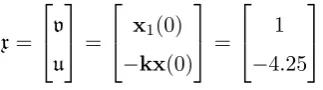
From equation (38), it follows that the initial state in the power phase-plane is:
x=
v
u
=
x1(0)
−kx(0)
=
1
−4.25
(40)
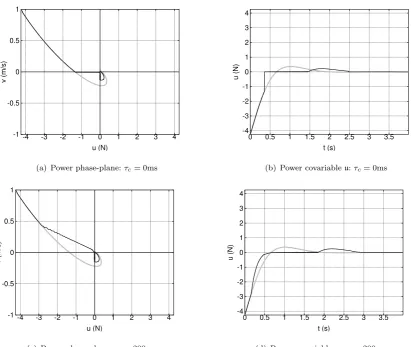
In each case, the black line corresponds to the power-constrained intermittent control, the light
grey line to the unconstrained intermittent control and the dark grey curves to the power
con-straints.
Figure 1 corresponds to pmax = 0; the input power flow must be negative, such that the
controller is semi-active, and the constraint boundaries are the axes of the power phase-plane.
Figure 1(a)&(b) correspond to a zero constraint horizonτc = 0. The unconstrained and
power-constrained trajectories are identical until the constraint boundary is reached; from this point,
-1 -0.5 0 0.5 1
-4 -3 -2 -1 0 1 2 3 4
v (m/s)
u (N)
(a) Power phase-plane:τc= 0ms
-4 -3 -2 -1 0 1 2 3 4
0 0.5 1 1.5 2 2.5 3 3.5
u (N)
t (s)
(b) Power covariableu:τc= 0ms
-1 -0.5 0 0.5 1
-4 -3 -2 -1 0 1 2 3 4
v (m/s)
u (N)
(c) Power phase-plane:τc= 200ms
-4 -3 -2 -1 0 1 2 3 4
0 0.5 1 1.5 2 2.5 3 3.5
u (N)
t (s)
(d) Power covariableu:τc= 200ms
Figure 1. Simple oscillator: transient response with initial conditionv = 1,y = 0 (39),u=−4.25 (40) andpmax = 0.
(a) With a zero constraint horizonτc= 0, the constrained, active control, trajectory (black) closely follows the unconstrained
trajectory (grey) or constraint boundarypmax= 0 as appropriate. (b) The corresponding control signaluhas a corresponding
“corner” not exhibited in the unconstrained control. (c) With a non-zero constraint horizonτc = 200ms, the constrained
trajectory (black) leaves the unconstrained trajectory before the constraint is reached thus anticipating the constraint. (d) The corresponding control signaluis smoother than that of (a)
unconstrained again. The power covariable u = u has a discontinuity when the boundary is
reached.
To investigate the effect of a non-zero constraint horizon Figure 1(c)&(d) show the effect of
a 200ms constraint horizonτc = 0.2. The unconstrained and power-constrained trajectories are
identical until the constraint boundary is approached; from this point, the power-constrained
trajectory diverges from the unconstrained trajectory and gives a smoother approach to the
constraint boundary than corresponding toτc = 0. The power covariable u=u no longer has a
discontinuity.
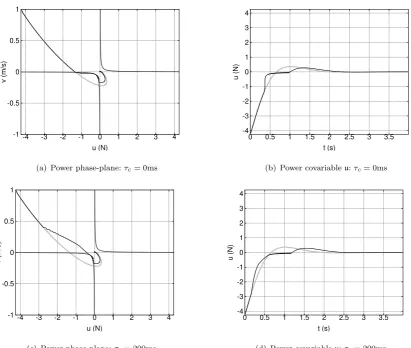
Figure 2 is similar to Figure 1 except that the power constraint is relaxed by settingpmax =
0.01. The constraint boundaries are now the rectangular hyperbolae shown in Figure 2(a)–(d)
but otherwise the behaviour is similar to that described by Figure 1. However, the smoother
[image:12.595.75.487.51.398.2]-1 -0.5 0 0.5 1
-4 -3 -2 -1 0 1 2 3 4
v (m/s)
u (N)
(a) Power phase-plane:τc= 0ms
-4 -3 -2 -1 0 1 2 3 4
0 0.5 1 1.5 2 2.5 3 3.5
u (N)
t (s)
(b) Power covariableu:τc= 0ms
-1 -0.5 0 0.5 1
-4 -3 -2 -1 0 1 2 3 4
v (m/s)
u (N)
(c) Power phase-plane:τc= 200ms
-4 -3 -2 -1 0 1 2 3 4
0 0.5 1 1.5 2 2.5 3 3.5
u (N)
t (s)
(d) Power covariableu:τc= 200ms
Figure 2. Simple oscillator: transient response with initial conditionv= 1,y= 0 (39),u=−4.25 (40) andpmax= 0.01.
In contrast to Figure 1 the non-zero maximum power leads to the hyperbolic constraints leaving the axes around the origin. (a) Again, the constrained trajectory (black) closely follows the unconstrained trajectory (grey) or constraint boundary. (b) The smoother constraint leads to a smoother control signal than that of Figure 1(b). (c) and (d), as in Figure 1 , the non-zero constraint horizonτc= 200ms gives smoother control.
Figures 1(b)&(d).
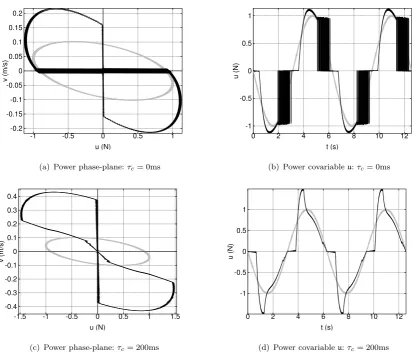
Figures 3&4 correspond to Figures 1&2 except that the initial condition is zero and the
disturbance d is a sinusoidal disturbance at the resonant frequency d = sinω0t where w0 =
1 rads−1
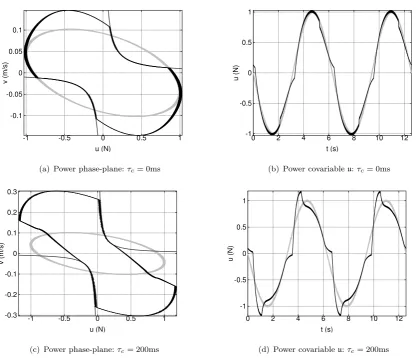
. The figures display two periods after a steady-state has been reached.
Figures 3(a)&(b) show that a zero constraint horizon τc = 0 and a zero power constraint
pmax= 0 once again lead to a discontinuous control signal and, once again, this disappears when
τc = 0.2. Figures 3(a)&(c) also show the increase in the amplitude of the system velocityv=v
due to the imposition of the power constraints. Figure 4 shows the effect of relaxing the power
constraint (pmax= 0.01) in the sinusoidal disturbance case. The smoother hyperbolic constraint
boundaries give a smoother shape to the trajectories and no discontinuities are observed in the
control signals shown in Figures 4(b)&(d). Moreover, Figures 4(a)&(c) show that the relaxed
[image:13.595.75.487.51.399.2]-0.2 -0.15 -0.1 -0.05 0 0.05 0.1 0.15 0.2
-1 -0.5 0 0.5 1
v (m/s)
u (N)
(a) Power phase-plane:τc= 0ms
-1 -0.5 0 0.5 1
0 2 4 6 8 10 12
u (N)
t (s)
(b) Power covariableu:τc= 0ms
-0.4 -0.3 -0.2 -0.1 0 0.1 0.2 0.3 0.4
-1.5 -1 -0.5 0 0.5 1 1.5
v (m/s)
u (N)
(c) Power phase-plane:τc= 200ms
-1 -0.5 0 0.5 1
0 2 4 6 8 10 12
u (N)
t (s)
(d) Power covariableu:τc= 200ms
Figure 3. Simple oscillator: steady-state sinusoidal response:pmax = 0. This figure corresponds to Figure 1 but with a
sinusoidal disturbance at the resonant frequencyd= sin 2πf0t. (a) With a zero constraint horizonτc= 0, the constrained
trajectory (black) lies within the negative power quadrants. (b) The corresponding control signaluexhibits a rapid switching, or chattering, phenomenon not exhibited in the unconstrained control. (c) With a non-zero constraint horizonτc= 200ms,
the constrained trajectory (black) anticipates the constraint. (d) The corresponding control signaluis smoother than that of (a) and does not exhibit chattering. In both cases, the control signal has a small high-frequency component which we attribute to deficiencies in the numerical optimisation.
3(a)&(c).
Each point on the power phase-plane trajectories of Figures 3(a), 3(c), 4(a) and 4(c)
corre-sponds to the instantaneous power p = uv associated with the control signal u and extracted
from the system. The corresponding power injected into the system by the disturbance d is
p0 =dvand is thus, throughv, dependent on the control strategy as well asditself; this injected power can itself be represented on the power phase-plane. The net power into the system pn,
and the corresponding accumulated energyen are given by
pn(t) =p(t) +p0(t) =v(t)[u(t) +d(t)] (41)
en(t) =
Z t
0
[image:14.595.72.492.52.407.2]-0.1 -0.05 0 0.05 0.1
-1 -0.5 0 0.5 1
v (m/s)
u (N)
(a) Power phase-plane:τc= 0ms
-1 -0.5 0 0.5 1
0 2 4 6 8 10 12
u (N)
t (s)
(b) Power covariableu:τc= 0ms
-0.3 -0.2 -0.1 0 0.1 0.2 0.3
-1 -0.5 0 0.5 1
v (m/s)
u (N)
(c) Power phase-plane:τc= 200ms
-1 -0.5 0 0.5 1
0 2 4 6 8 10 12
u (N)
t (s)
(d) Power covariableu:τc= 200ms
Figure 4. Simple oscillator: steady-state sinusoidal response:pmax= 0.01.This figure corresponds to Figure 2 but with a
sinusoidal disturbance at the resonant frequencyd= sin 2πf0t. In contrast to Figure 3 the non-zero maximum power leads
to the hyperbolic constraints leaving the axes around the origin. (a) The constrained trajectory (black) closely follows the unconstrained trajectory (grey) or constraint boundary. (b) The smoother constraint leads to a smoother control signal than that of Figure 3(b). (c) and (d) the trajectory no longer follows the constraints so closely.
In this particular example, the system does not, by itself, dissipate energy as there is no damping
term in Equation (34). Therefore, in the steady state, the net energy loss in the system over
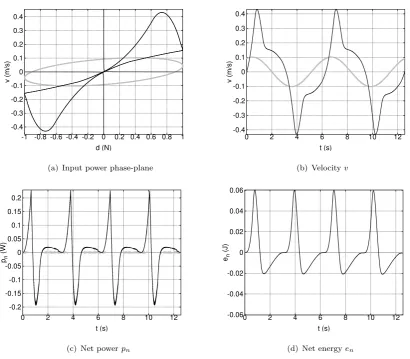
one period must be zero. Figure 5 examines these ideas with reference to the particular example
of Figures 3(c) and 3(d) (pmax = 0, τc = 200ms). Figure 5(a) gives the power phase-plane
corresponding todthus the disturbance powerp0; it corresponds to Figure 3(c) which shows the control power p; as p0 depends on velocity v (Figure 5(b)) it depends on the control strategy
as well as the disturbance d. Figure 5(c) shows the net power pn (41) as a function of time t
and Figure 5(d) shows the corresponding accumulated energyen. As predicted, the accumulated
energy is zero at the end of each period of the the disturbanced. Compared to the example in
Figures 3(a) and 3(b) (whereτc = 0), the velocities are larger and so the power injected by the
disturbance and extracted by the controller are larger. Similar results are obtained for the other
[image:15.595.72.492.50.408.2]-0.4 -0.3 -0.2 -0.1 0 0.1 0.2 0.3 0.4
-1 -0.8 -0.6 -0.4 -0.2 0 0.2 0.4 0.6 0.8 1
v (m/s)
d (N)
(a) Input power phase-plane
-0.4 -0.3 -0.2 -0.1 0 0.1 0.2 0.3 0.4
0 2 4 6 8 10 12
v (m/s)
t (s)
(b) Velocityv
-0.2 -0.15 -0.1 -0.05 0 0.05 0.1 0.15 0.2
0 2 4 6 8 10 12
pn
(W)
t (s)
(c) Net powerpn
-0.06 -0.04 -0.02 0 0.02 0.04 0.06
0 2 4 6 8 10 12
en
(J)
t (s)
(d) Net energyen
Figure 5. Power and energy:pmax = 0,τc= 200ms. This Figure corresponds to Figures 3(c) and 3(d); as before, black
corresponds to constrained and grey to unconstrained control. (a) shows the power phase-plane corresponding to the dis-turbanced; this lies within the first and third quadrants indicating power inflow. (b) shows the corresponding velocity. (c) Shows the net power flowpn =v(u+d) into the system whenτc= 0 corresponding to (d) shows the corresponding
accumulated energyen=
Rt
0pn(t′)dt′. Note that the accumulated energy returns to zero at the end of each period,
4.2 Quarter car model
The quarter-car model of Figure 6 is used by Preumont (2002) as an example for illustrating
passive, active and semi-active vibration control. The same example is used by Gawthropet al.
(2012) to illustrate semi-active control based on switched intermittent control.
To make the problem more realistic, and to illustrate the case where the power covariable
u6=u, the actuator is modelled by the low-pass filter with transfer function G(s) given by
G(s) = 1
1 + 0.01s (43)
The state-space equations are of the form of Equation (1) wherez3 is the filter state and:
x=hv2 z2 v1z1 z3 iT
[image:16.595.75.486.51.410.2]m
k
c
M
K
v
0v
1v
2f
z
1z
2Figure 6. Quarter car model.m= 240kg,M = 36kg,k= 16kN/m,K= 160kN/m,c= 980Nsec/m. z1 andz2 are the
spring extensions in m andv1 andv2are the mass velocities in m/s.f is an external applied force andu=−f whereuis the active control signal.
The matricesA,B,Bd andC are then given by:
A=
−mc −mk mc 0 m1
1 0 −1 0 0
c M k M − c M − K M − 1 M
0 0 1 0 0
0 0 0 0 −100
, B=
0 0 0 0 100
, Bd=
0 0 0 −1 0
, C=
1 0 0 0 0 T (45)
In this case, the power covariables are the actuator forceu=ζ and velocityv=v2−v1 hence:
Cu =
h
0 0 0 0 1 i
, Du= 0, Cv =
h
1 0−1 0 0 i
, Dv = 0 (46)
An unconstrained intermittent controller was designed as in Section 2, equation (7), with the
following parameters:
Q=hCCT i
, R= 1 (47)
Together with the system parameters of (45), these parameters give:
k=h0.43−0.26 0.0059−1.9 0.016 i
(48)
This gives closed-loop poles at: s =−2.57±j7.42, s =−13.92±j67.84 and s =−99.91. The
open-loop intermittent interval (11) was chosen as ∆i = ∆ol= 0.01s.
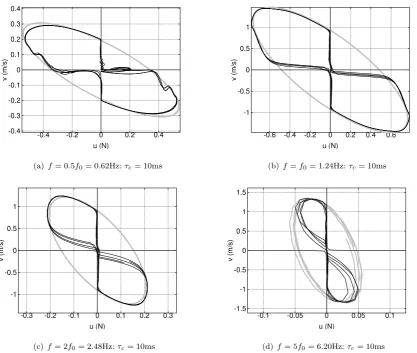
The power-constrained intermittent control was designed as in Section 3.2. Figure 7
gives the steady-state response of the system to the disturbance d = sinωt where ω =
[image:17.595.118.461.304.414.2]-0.4 -0.3 -0.2 -0.1 0 0.1 0.2 0.3 0.4
-0.4 -0.2 0 0.2 0.4
v (m/s)
u (N)
(a) f= 0.5f0= 0.62Hz:τc= 10ms
-1 -0.5 0 0.5 1
-0.6 -0.4 -0.2 0 0.2 0.4 0.6
v (m/s)
u (N)
(b)f=f0= 1.24Hz:τc= 10ms
-1 -0.5 0 0.5 1
-0.3 -0.2 -0.1 0 0.1 0.2 0.3
v (m/s)
u (N)
(c)f= 2f0= 2.48Hz:τc= 10ms
-1.5 -1 -0.5 0 0.5 1 1.5
-0.1 -0.05 0 0.05 0.1
v (m/s)
u (N)
(d)f= 5f0= 6.20Hz:τc= 10ms
Figure 7. Quarter-car model: steady-state sinusoidal response. (a)–(d) give the power-phase plane sinusoidal response at 4 frequencies including the two resonant frequencies. In each case, the constrained trajectory (black) lies within the constraint boundaries (grey hyperbolae) whereas the unconstrained trajectory lies outside the constraints in three of the four cases. The use of a non-zero constraint horizon (τc= 10ms) avoids the rapid switching, or chattering, phenomenon associated with
zero horizon (τc = 0ms) but means that the trajectory does not necessarily follow the constraints closely. The maximum
powerpmaxwas set to zero.
7(a)–(d) shows the power phase-plane at each of the four frequencies for four periods when
the simulation has reached a steady-state. In each case, the power-constrained intermittent
con-troller follows the unconstrained concon-troller when away from constraints and closely follows the
constraints when the unconstrained controller violates the constraints. As discussed in Section
4.1, the use of a non-zero constraint horizon of 10ms (τc = 0.01) avoids discontinuous control.
There are, however, two discrepancies to be explained. Firstly, the constraints are violated at
certain times; this is due to the combination of the disturbance and non-zero intermittent interval
∆ol. The constraint prediction equation (22) assumes d= 0 and so the predicted constraint is
in error; this effect increases with ∆ol. The effect could be reduced by using a disturbance
model within, for example, a disturbance observer. Secondly, the four displayed periods are not
identical. This is because the disturbance period is not an integer multiple of the intermittent
[image:18.595.74.492.53.406.2]-0.4 -0.3 -0.2 -0.1 0 0.1 0.2 0.3 0.4
-0.6 -0.4 -0.2 0 0.2 0.4 0.6
v (m/s)
u (N)
(a) f= 0.5f0= 0.62Hz:τc= 10ms
-1 -0.5 0 0.5 1
-0.8 -0.6 -0.4 -0.2 0 0.2 0.4 0.6 0.8
v (m/s)
u (N)
(b)f=f0= 1.24Hz:τc= 10ms
-1 -0.5 0 0.5 1
-0.4 -0.3 -0.2 -0.1 0 0.1 0.2 0.3 0.4
v (m/s)
u (N)
(c)f= 2f0= 2.48Hz:τc= 10ms
-1.5 -1 -0.5 0 0.5 1 1.5
-0.1 -0.05 0 0.05 0.1
v (m/s)
u (N)
(d)f= 5f0= 6.20Hz:τc= 10ms
Figure 8. Quarter-car model: sensitivity. This figure corresponds to Figure 7 except that the system has been multiplied by a gain of 1.2 (i.e. a 20% increase) without modifying the controller. The control system is robust to this perturbation insofar as the response is not greatly changed by this unmodelled gain.
the phase-plane statex is not periodic.
Figure 8 corresponds to Figure 7 except that the system has been multiplied by a gain of 1.2
without modifying the controller to take account of this change. The control system is robust to
this perturbation insofar as the response is not greatly changed by this unmodelled gain.
5 Conclusion
It has been shown that constraining the power flow into a dynamic system can be implemented
using quadratic constraints within a finite-horizon optimisation scheme to give power-constrained
intermittent control. Although using a zero-length constraint horizon and a strictly passive limit
on the power flow gives clipped-optimal like behaviour, a non-zero constraint horizon gives
a smoother anticipatory action. Moreover, relaxing the power limit to allow a small positive
power flow similarly gives a smoother control signal. We anticipate that the power-constrained
[image:19.595.77.485.54.401.2]vibration control and low-power control using energy harvesting or regeneration.
A general purpose non-linear optimisation algorithm was used in this work and, although
suitable for demonstrating the concepts using simulations, it is neither efficient nor suitable for
real-time use. It would be of interest to take advantage of the specific quadratically-constrained
quadratic programming (QCQP) form of the optimisation and use the corresponding efficient
algorithms (Boyd and Vandenberghe 2004, Lobo et al. 1998). The high-frequency component
of the control signal visible in Figures 3 and 4 is also believed to be due to deficiencies in the
optimisation algorithm. It would therefore be of interest to investigate the exact source of this
phenomenon. The example of Section 4.2 illustrated that the method is robust to a quite large
change in system gain. Future work will provide a theoretical analysis of robustness to system
variation.
As illustrated in Section 4, there are a number of design parameters to be chosen including
the constraint horizonτc and the maximum powerpmax. In this paper, these two parameters are
chosen in anad hoc manner; future work will formulate design rules for such parameters.
Because the controller constrains the power injected into the system, the resulting constrained
controller has passivity properties even if the underlying unconstrained design does not. This is
a generalisation of the argument behind semi-active control and will be investigated to give new
generalisations of semi-active control.
Constrained control leads to considerations offeasibility. This topic has been investigated in the
context of model-based predictive control with linear constraints using quadratic programming
(Scokaertet al.1999, Mayneet al.2000) and needs to be applied to the QCQP based algorithms
discussed here.
The algorithm presented here has a fixed interval ∆i= ∆ol. However, as discussed by Gawthrop
and Wang (2009a), event-driven versions may be derived. This “control on demand” approach
may also have implications for low-energy control and will be further investigated.
The power phase-plane approach of Seth and Flowers (1990) has been shown in Section 4 to
provide a useful way of presenting the properties of the method. Future work will consider the
power phase-plane approach in more detail including the relation between the power phase-plane
of the control signal and that of the disturbance and the relative shapes of the constrained and
unconstrained cases.
Although this work was largely motivated by semi-active damping and its implementation
using modulated dampers, implementation issues are not discussed in this paper. In particular,
when the power constraint (22) is relaxed so thatpmax>0, the resultant controller can no longer
be implemented by a modulated damper. However, future work will investigate whether such a
for example, discussed by Potteret al. (2011).
This paper has been orientated towards the mechanical engineering application of semi-active
vibration control. However, it is applicable to any physical domain, or multiple physical domains,
where energy considerations are important.
Acknowledgements
Peter Gawthrop is a Visiting Research Fellow at the University of Bristol. He is also partially
supported by the linked EPSRC Grants EP/F068514/1, EP/F069022/1 and EP/F06974X/1
“Intermittent control of man and machine” and gratefully acknowledges the many discussions
about intermittent control with Henrik Gollee, Ian Loram and Martin Lakie. The authors wish
to thank Irina Lazar, University of Bristol, for her constructive comments on the draft of this
paper.
The authors gratefully acknowledge the many insightful comments of the referees which have
References
Anderson, B.D.O., and Vongpanitlerd, S., Network Analysis and Synthesis: A Modern Systems
Theory Approach, First published 1973 by Prentice-Hall, Dover (2006). ˚
Astr¨om , K.J. (2008), “Event Based Control,” in Analysis and Design of Nonlinear Control
Systemseds. A. Astolfi and L. Marconi, Heidelberg: Springer, pp. 127–147.
Bemporad, A., and Morari, M. (1999), “Robust model predictive control: A survey,” (Vol. 245,
eds. A. Garulli and A. Tesi, Springer, pp. 207–226.
Boyd, S., and Vandenberghe, L.,Convex optimization, Cambridge Univ Press (2004).
Cairano, S.D., Bemporad, A., Kolmanovsky, I.V., and Hrovat, D. (2007), “Model predictive
con-trol of magnetically actuated mass spring dampers for automotive applications,”International
Journal of Control, 80, 1701–1716.
Cannon, M., Kouvaritakis, B., and Rossiter, J. (2001), “Efficient active set optimization in triple
mode MPC,”Automatic Control, IEEE Transactions on, 46, 1307 –1312.
Cassidy, I.L., Scruggs, J.T., and Behrens, S. (2011), “Optimization of partial-state feedback for
vibratory energy harvesters subjected to broadband stochastic disturbances,”Smart Materials
and Structures, 20, 085019.
Chen, W.H., and Gawthrop, P.J. (2006), “Constrained predictive pole-placement control with
linear models,”Automatica, 42, 613–618.
Eaton, J.W.,GNU Octave Manual, Bristol: Network Theory Limited (2002).
Fialho, I.J., and Balas, G.J. (2000), “Design of nonlinear controllers for active vehicle suspensions
using parameter-varying control synthesis,”Vehicle System Dynamics, 33, 351–370.
Fletcher, R.,Practical Methods of Optimization. 2nd Edition, Chichester: Wiley (1987).
Gawthrop, P., Loram, I., Lakie, M., and Gollee, H. (2011), “Intermittent Control: A
Computa-tional Theory of Human Control,” Biological Cybernetics, 104, 31–51.
Gawthrop, P., and Wang, L. (2011), “The system-matched hold and the intermittent control
separation principle,”International Journal of Control, 84, 1965–1974.
Gawthrop, P.J. (2009), “Frequency Domain Analysis of Intermittent Control,” Proceedings of
the Institution of Mechanical Engineers Pt. I: Journal of Systems and Control Engineering,
223, 591–603.
Gawthrop, P.J., Neild, S.A., and Wagg, D.J. (2012), “Semi-active damping using a hybrid control
approach,”Journal of Intelligent Material Systems and Structures, Published online February
21, 2012.
Gawthrop, P.J., and Wang, L. (2006), “Intermittent predictive control of an inverted pendulum,”
Gawthrop, P.J., and Wang, L. (2007), “Intermittent Model Predictive Control,”Proceedings of
the Institution of Mechanical Engineers Pt. I: Journal of Systems and Control Engineering,
221, 1007–1018.
Gawthrop, P.J., and Wang, L. (2009), “Constrained intermittent model predictive control,”
International Journal of Control, 82, 1138–1147.
Gawthrop, P.J., and Wang, L. (2009a), “Event-driven Intermittent Control,”International
Jour-nal of Control, 82, 2235 – 2248.
Gawthrop, P.J., and Wang, L. (2010), “Intermittent redesign of continuous controllers,”
Inter-national Journal of Control, 83, 1581–1594.
Giorgetti, N., Bemporad, A., Tseng, H.E., and Hrovat, D. (2006), “Hybrid model predictive
control application towards optimal semi-active suspension,”International Journal of Control,
79, 521–533.
Goodwin, G., Graebe, S., and Salgado, M.,Control System Design, New Jersey: Prentice Hall
(2001).
Hong, K.S., Sohn, H.C., and Hedrick, J.K. (2002), “Modified skyhook control of semi-active
suspensions: A new model, gain scheduling, and hardware-in-the-loop tuning,” Journal of
Dynamic Systems Measurement and Control-Transactions of the ASME, 124, 158–167.
Hrovat, D. (1997), “Survey of advanced suspension developments and related optimal control
applications,” Automatica, 33, 1781–1817.
Jalili, N. (2002), “A comparative study and analysis of semi-active vibration-control systems,”
Journal of Vibration & Acoustics-Transactions of the ASME, 124, 593–605.
Jansen, L.M., and Dyke, S.J. (2000), “Semiactive control strategies for MR dampers:
Compar-ative study,”Journal of Engineering Mechanics—ASCE, 126, 795–803.
Johnson, S.G.,The NLopt nonlinear-optimization package, MIT, http://ab-initio.mit.edu/nlopt
(2012).
Karnopp, D., Crosby, M., and Harwood, R. (1974), “Vibration control using semi-active force
generators,”ASME Journal of Engineering for Industry, 96, 619–626.
Kitching, K.J., Cole, D.J., and Cebon, D. (2000), “Performance of a semi-active damper for
heavy vehicles,” Journal of Dynamic Systems Measurement & Control—Transactions of the
ASME, 122, 498–506.
Kwakernaak, H., and Sivan, R.,Linear Optimal Control Systems, New York: Wiley (1972).
Lavei, J., Rantzer, A., and Low, S. (2011), “Power flow optimization using positive quadratic
programming?,” in Proc. 18th IFAC World Congress, Milano, August.
Lobo, M.S., Vandenberghe, L., Boyd, S., and Lebret, H. (1998), “Applications of second-order
Maciejowski, J.,Predictive Control with Constraints, Prentice Hall (2002).
Matveev, A., and Yakubovich, V. (1997), “Nonconvex Problems of Global Optimization:
Linear-Quadratic Control Problems with Linear-Quadratic Constraints,”Dynamics and Control, 7, 99–134.
Mayne, D., Rawlings, J., Rao, C., and Scokaert, P. (2000), “Constrained model predictive control:
Stability and optimality,” Automatica, 36, 789–814.
Montestruque, L.A., and Antsaklis, P.J. (2003), “On the model-based control of networked
sys-tems,” Automatica, 39, 1837 – 1843.
Nakano, K., Suda, Y., and Nakadai, S. (2003), “Self-powered active vibration control using a
single electric actuator,”Journal of Sound and Vibration, 260, 213 – 235.
Potter, J.N., Neild, S.A., and Wagg, D.J. (2011), “Quasi-active suspension design using
mag-netorheological dampers,” Journal of Sound and Vibration, 330, 2201 – 2219, Dynamics of
Vibro-Impact Systems.
Powell, M.J.D. (1998), “Direct search algorithms for optimization calculations,”Acta Numerica,
7, 287–336.
Preumont, A.,Vibration control of active structures: an introduction, 2nd ed., Vol. 96 of Solid
Mechanics and its Applications, Dordrecht: Kluwer (2002).
Qin, S.J., and Badgwell, T.A. (2003), “A survey of industrial model predictive control
technol-ogy,” Control Engineering Practice, 11, 733 – 764.
Rantzer, A. (2011), “Distributed control using positive quadratic programming,” in Control
Conference (CCC), 2011 30th Chinese, Hefei, july, pp. 1 –4.
Ronco, E., Arsan, T., and Gawthrop, P.J. (1999), “Open-Loop Intermittent Feedback Control:
Practical Continuous-time GPC,”IEE Proceedings Part D: Control Theory and Applications,
146, 426–434.
Sammier, D., Sename, O., and Dugard, L. (2003), “Skyhook and H-infinity control of semi-active
suspensions: Some practical aspects,”Vehicle System Dynamics, 39, 279–308.
Scokaert, P.O.M., Mayne, D.Q., and Rawings, J.B. (1999), “Suboptimal model predictive control
(feasibility implies stability),” IEEE Trans. on Automatic Control, 44, 648–654.
Scruggs, J.T., Taflanidis, A.A., and Iwan, W.D. (2007a), “Non-linear stochastic controllers for
semiactive and regenerative systems with guaranteed quadratic performance boundsPart 1:
State feedback control,”Structural Control and Health Monitoring, 14, 1101–1120.
Scruggs, J.T., Taflanidis, A.A., and Iwan, W.D. (2007b), “Non-linear stochastic controllers for
semiactive and regenerative systems with guaranteed quadratic performance boundsPart 2:
Output feedback control,” Structural Control and Health Monitoring, 14, 1121–1137.
Seth, B., and Flowers, W.C. (1990), “Generalized Actuator Concept for the Study of the
233–238.
Shen, Y., Golnaraghi, M.F., and Heppler, G.R. (2006), “Semi-active vibration control schemes
for suspension systems using magnetorheological dampers,” Journal of Vibration & Control,
12, 3–24.
Soliman, M., Malik, O., and Westwick, D. (2011), “Ensuring Fault Ride Through for Wind
Turbines with Doubly Fed Induction Generator: a Model Predictive Control Approach,” in
18th IFAC World Congress, Milan, pp. 1710–1715.
Spencer, B.F., and Nagarajaiah, S. (2003), “State of the art of structural control,” Journal of
Structural Engineering-ASCE, 129, 845–856.
Tucker, M., and Fite, K. (2010), “Mechanical damping with electrical regeneration for a powered
transfemoral prosthesis,” in Advanced Intelligent Mechatronics (AIM), 2010 IEEE/ASME
International Conference on, Montreal, ON, july, pp. 13 –18.
Verros, G., Natsiavas, S., and Papadimitriou, C. (2005), “Design optimization of quarter-car
models with passive and semi-active suspensions under random road excitation,” Journal of
Vibration & Control, 11, 581–606.
Wang, L. (2001), “Continuous Time Model Predictive Control Using Orthonormal Functions,”
Int. J. Control, 74, 1588–1600.
Wang, L., Model Predictive Control System Design and Implementation Using MATLAB, 1st
ed., Springer (2009).
Wang, Y., and Inman, D.J. (2011), “Comparison of Control Laws for Vibration Suppression
Based on Energy Consumption,” Journal of Intelligent Material Systems and Structures, 22,
795–809.
Willems, J.C. (1972), “Dissipative Dynamical Systems, Part I: General Theory, Part II: Linear
System with Quadratic Supply Rates,”Arch. Rational Mechanics and Analysis, 45, 321–392.
Yakubovich, V.A. (1992), “Nonconvex optimization problem: The infinite-horizon
linear-quadratic control problem with linear-quadratic constraints,”Systems and Control Letters, 19, 13 –
22.
Yang, G.Q., Spencer, B.F., Jung, H.J., and Carlson, J.D. (2004), “Dynamic modeling of
large-scale magnetorheological damper systems for civil engineering applications,” Journal of