Abstract
Shifting from an emphasis on teaching to learning is a complex task for both teachers and students. This paper reports on a qualitative study of teachers in a nurse specialist edu-cation programme meeting this shift in a distance eduedu-cation course. The study aimed to gain a better understanding of the teacher-student relationship by addressing research questions in relation to the students’ role, the learning process, and the assessment pro-cess. A didactical design comprising three phases focusing on distinct learning outcomes for the course was adopted. Data were collected through in-depth interviews with teachers and were analysed using inductive thematic analysis. The results indicate a shift towards a problematising and holistic approach to teaching, learning, and assessment. This shift highlighted a teacher-student relationship with a shared responsibility in the orchestration of the learning experience. The overall picture outlines a distance education experience of process-based assessment characterised by the imposition of teachers’ rules and a lack of creativity due to the limited role of ICT merely as a container of content.
Keywords: Distance education; higher education; e-learning
Introduction
Shifting the emphasis from teaching to learning involves a complex process of changing structures in the education system (Barr & Tagg, 1995). One catalyst for changing struc-tures is the use of information and communication technologies (ICT) in education and society (Brown, 2006). In Sweden, ICT was introduced to the policy agenda in 1994, fol-lowing the political initiative from the USA in 1993 (Karlsson, 1996). The introduction of ICT was also a starting point for the increased use of ICT in education and particularly in
Peter Bergström
distance education. Previous studies in nurse distance education have investigated the im-pact of constructivist approaches to teaching and learning (Legg, Adelman, Mueller, & Lev-itt, 2009) as a theoretical framework for designing educational experiences (Peters, 2000; Twomey, 2004). In practice, constructivist learning is characterised as active and respon-sive to individual needs of the learner (Dalgarno, 2001). However, in constructivist studies, the teacher-student relationship is implicit through the interpretation of, for example, be-ing an active learner. Few studies have focused on the teacher-student relationship as such in distance education that involves a shifting emphasis from teaching to learning.
Bergström and Granberg (2007) argue that the use of process diaries is one response to the need to bridge the distance in relation to teaching, learning, and assessment in distance
education courses. Process diaries are used to support student reflection that is supported
by feedback for monitoring and guidance from teachers at regular intervals. Moreover,
pro-cess diaries illuminate the conflict for the tutors between their roles that on the one hand
are to support formative assessment and on the other to make judgements in relation to summative assessment. Hudson et al. (2009) regard process-based assessment as a forma-tive process that focuses on students’ learning over a period of time instead of simply on the product of learning. As a result of this move towards approaches that involve formative assessment and the regular use of feedback, the preconditions of the learning process in distance education are changing. These changing preconditions are considered in terms of Bernstein’s (2000) conceptual framework as a relationship between an instructional dis-course and a regulative disdis-course. The concept of disdis-course is perceived as the teachers’ or the students’ style of talking and understanding of their practice (Winther Jørgensen, 2000). The instructional discourse creates what Bernstein refers to as specialised skills (Bernstein, 2000, p. 32). From an interview study with in-service nurse students, Berg-ström (2010) reported on the diversity of skills when students start to focus on the learning process through process-based assessment. The diversity of skills was illuminated through the students’ shift of thinking from desk teaching to self-regulated learning, from
reproduc-tive learning to producreproduc-tive learning, and from norm-referenced marks to self-reflecreproduc-tive as -sessment. However, the regulative discourse is regarded as teachers’ rules of order, in other words what is tolerable or not in the teacher-student relationship. The regulative discourse is the dominant discourse in relation to the instructional discourse.
In this study, the focus is turned onto the teachers’ perspective as representative of the teacher-student relationship. Therefore, the aim was to understand the teacher-student relationship in the regulative discourse contextualised within a changing emphasis from teaching to learning in distance education. Thus, the following research questions were ad-dressed in relation to the expectations of and beliefs about teaching, learning, and assess-ment from the teachers’ perspective:
• How does the students’ role change in relation to traditional approaches to teaching and learning?
• How does the learning process change in relation to traditional approaches to teaching and learning?
• How does the assessment process change in relation to traditional approaches to teach-ing and learnteach-ing?
Background
At the time of this study in 2007, the teachers involved had experienced two significant turning points during a five-year period. The first turning point was the increased use of
ICT that became a catalyst for distance education, and the second was the Bologna reform of higher education.
The teachers in this study worked at a department for specialist nurse education in Sweden. In 2002, a strategic decision was taken at the department to move to distance education. This new approach to teaching and learning was regarded as a turning point in each of the teachers’ careers. The decision to adopt distance education as the main approach to teach-ing and learnteach-ing resulted in the integration of ICT into distance education courses. This created a bottom-up response (Richards, 2004) in the process of shifting the emphasis from teaching to learning. This prompted change in both the learning environment and the pedagogy, which was a result of limiting the regular face-to-face course meetings and shift-ing towards communications through e-mail and an online approach. The online learnshift-ing environment is based on a learning management system (LMS) that is used for archiving and displaying assignments and for communication between teachers and students. A web-based video conference tool was used for synchronous communication and collaboration in base groups amongst the students and the teachers. As a result, the students visited the university at the beginning and end of the semester. Through this approach, the number of face-to-face course meetings has decreased by 50%. Moreover, the increased use of ICT can be seen as an example of Richard’s (2004) notion of a changed rhetoric towards new ideas and models for developing this kind of practice and context. For these teachers, the
rheto-ric was characterised by increased demands for developing flexible courses every year and
also for alternative approaches to assessment. Recruitment has developed from enrolling students in the neighbouring counties of the university to recruiting students from other parts of Sweden. This development has created pedagogical demands in terms of meeting student needs without having them travel to the university. However, the changed rhetoric is also part of curriculum reforms towards outcome-based models of education.
In Europe, the Bologna process is considered as the most important reform (Eurydice, 2009), which was introduced in Sweden in 2007 (Ministry of Education and Science, 2006). Accordingly, the teachers rewrote the learning outcomes in the syllabus according to the Bologna model. Changing the curriculum has been part of the change in emphasis from teaching to learning (Karseth, 2006). The key challenges for higher education are still considered to be shifting from an instructional paradigm towards a learning paradigm by addressing diversity in learning (TRENDS, 2010) and by recognising the needs for greater
flexibility (TRENDS, 2005). A curriculum according to the Bologna model outlines the shift from content-based learning to outcome-based learning (Biggs & Tang, 2007). The
teach-ers chose three learning outcomes for the process-based assessment, which were to
1. identify children and young people who are not handled with care, and families in need of special support, and take necessary actions;
2. analyse lifestyles and risk of accidents among children and young people, and carry through and evaluate necessary actions; and
3. describe neuropsychiatric conditions and psychical health disease among children and young people.
The Didactical Design
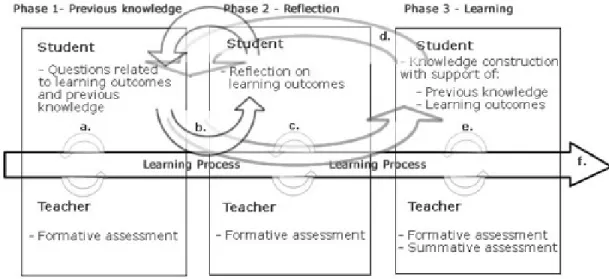
The figure below (Bergström, 2010) illustrates the didactical design of process-based as -sessment for a course of study. The didactical design takes its starting point from the three phases that aimed at covering and capturing the students’ learning process during the course.
Figure 1. The figure illustrates the didactical design of process-based assessment.
Phase 1 establishes the starting point of the course. In this phase, students describe previ-ous life, work, and study experiences upon which the teacher gives feedback (a). In the
middle of the course (phase 2), students reflect on their previous knowledge and the learn -ing outcomes (b), which are followed by teacher feedback (c). When students come to the
final phase of the course (phase 3), they summarise their learning in relation to previous
knowledge and learning outcomes (d). Then the teacher provides feedback on the students’
texts and makes a final judgement (e). Students focus on the documentation of their experi -ences, events, and concepts and over a period of time gain insight into self-awareness and
learning, which constitutes the learning process (f). Recordings of the students’ reflections and outcomes of process-based assessment were stored in document files in the LMS for
The teachers used a template developed in a teacher education programme, which was a 10-page document covering all of the phases. The students started by writing about them-selves, on topics such as experiences from higher education and work in relation to the
theme of the course, child health and school health service. In the first phase—based on previous knowledge—the students were asked to describe their previous knowledge in rela
-tion to each learning outcome. In the second phase, the students’ task was to reflect on the
learning outcomes in relation to the course assignments, the literature, and the lectures. In
the final phase, the teachers asked the students to analyse their learning in relation to the learning outcomes and reflections.
Theoretical Framework
In order to understand the regulative discourse, the material was analysed through the lens of the message system: curriculum, pedagogy, and evaluation (Bernstein, 1977, 1990). These three concepts are only used as analytical concepts. In this analysis, Bernstein’s key
concepts of classification and framing were applied. In order to understand the conditions
and reproduction of the teacher-student relationship, the message system was analysed from the perspective of educational codes, in other words elaborated code and restricted code (Bernstein, 1990).
Curriculum in Relation to Classification
Bernstein used the concept of curriculum with a theoretical and symbolic meaning similar to that of Stenhouse, cited in Ruddock and Hopkins (1985). Stenhouse explains the symbol-ic meaning of the currsymbol-iculum as having “a physsymbol-ical existence but also a meaning incarnate in words or pictures or sound or games or whatever” (Ruddock & Hopkins, 1985, p. 67). Accordingly, curriculum is interpreted with a broad understanding covering the teachers’
practice. In this analysis, curriculum is analysed through the concept of classification (Ber-nstein, 1977, 1990), which informs us about the relationship between categories. Classifica
-tion is a relative concept and is either strong or weak. However, classifica-tion can be applied
to an analysis at different levels, such as the relationship between the external and the
in-ternal value of classification. For example, the exin-ternal value of classification can consider an educational reform in relation to the internal value of classification, which considers
elements of content in a course’s syllabus. These values inform us about the power
relation-ship between categories. Strong classification signifies a hierarchical power relationrelation-ship, while the opposite pertains to weak classification. Bernstein (1990) argues that strong
clas-sifications reproduce relationships among categories.
Pedagogy in Relation to Framing
The concept of pedagogy highlights the pedagogical practice from a theoretical perspective, which is perceived through the relative concept of framing, creating the notion of a message (Bernstein, 1977, 1990). This message is derived from the relative nature of framing that informs us who is in control, for example in the teacher-student relationship. If the analysis has a purpose of understanding something external, for example a reform, in relation to
the internal pedagogical practice, two values need to be considered. An educational reform with a value of weak external framing carries a message of teacher control. In the pedagogi-cal practice, a study guide with low structure has a value of weak internal framing and the
students are in control, such that they could have, for example, influence on the learning
environment. Thus, understanding pedagogy through the concept of framing, Bernstein (1990) argues that the notion of control creates a message in the external-internal relation-ship.
Evaluation as a Function of Classification and Framing
According to Bernstein (1977), evaluation is a function of curriculum and pedagogy and is
understood as the relationship between classification and framing. In practice, evaluation
is understood as the teachers’ assessment. Accordingly, the assessment practice depends on the syllabus and the teachers’ approach to teaching and on how the learning environment is arranged.
Educational Codes
Bernstein (1990) explains an educational code as something tacitly received by taking part in education. The meaning of the code (its orientation) communicates two themes: an elab-orated code derived from the principle of keeping things apart or a restricted code derived from the principle of keeping things together. In this paper, the educational code is con-sidered to be the symbolic relationship between policy and practice. The analytical tool for investigating the code concerns the relationship between the internal and external values of
the relative concepts of classification and framing. For example, if a policy reform is man
-datory for the institution, external classification is strong. If the message of the reform aims
to tell the teachers how to teach and assess, external framing is strong. Depending on the
relationship between the external and internal values, the analysis points towards a specific
meaning as either an elaborated or a regulative code (Bernstein, 1990).
Methodology
A qualitative approach was adopted in order to understand the regulative discourse in the shift in emphasis from teaching to learning. The regulative discourse in the teacher-stu-dent relationship was studied from the teachers’ narratives of process-based assessment. A strategy for reading and analysing the texts is outlined, which addresses the trustworthi-ness of the interpretations of the empirical material.
The Qualitative Interviews
The two teachers (N = 2) who taught in the course were chosen for in-depth interviews. They are above the age of 50 and have worked with distance education for between four and
five years. Because the study was conducted over one semester, the model for interview -ing the teachers was through four semi-structured, in-depth, face-to-face interviews. The interviews followed the occasions for teacher-student interaction in the didactical design. Before they were interviewed, the interview themes were tested with two other teachers.
This process contributed to a modification of the interview themes and the follow-up ques
-tions. For the teachers in this study, the first interviews were conducted between June and
August 2007, focusing on the teachers’ background as teachers. The second interview took part three weeks after the course started in September, focusing on the work of the
stu-dents’ previous experiences. In December, a third interview focused on the stustu-dents’ reflec -tions. In January and February 2008, a fourth interview took place focusing on students’ learning. The interviews followed a structure of themes according to the didactical design and areas of teaching, learning, assessment, and use of ICT. The interviews were recorded digitally and transcribed, and notes were taken during the interviews. The recorded mate-rial from the interviews amounted to 11 hours and 35 minutes.
Ethics
At the outset, the teachers agreed to a statement of research ethics. This followed the
guide-lines from the Swedish Research Council (2001) and addressed the aspects of beneficence, non-malfeasance, informed consent, and confidentiality/anonymity.
Thematic Analysis
The empirical material was analysed through inductive thematic analysis influenced by
Boyatzis (1998) and Malterud’s (2009) approaches. The empirical material was read and re-read several times, ultimately interpreting what the interviewees were implicitly or ex-plicitly saying. In this process of understanding the essence of the interviews, a strategy was followed in which important signs (Malterud, 2009), episodes, comparisons, and contras-tive thinking (Coffey & Atkinson, 1996) were searched for in the written transcriptions. An analytical process of searching for a relationship in the captured essences of the empiri-cal material then followed. As a result of this process, three descriptive themes could be coded to a majority of the empirical material. The reliability and validity of the coding was considered in the subsequent reading of the material in light of the strategy for capturing the essence. Text of the chosen learning outcomes in the syllabus with regard to meaning-bearing concepts was analysed in relation to the interviews. However, as the purpose of my research was to better understand the teacher-student relationship in process-based assessment, taking the analysis a step further was necessary. This step moved from the descriptive level to a higher analytical level by integrating theory into the analysis in order to investigate what underpinned process-based assessment. The themes were interpreted through Bernstein’s (1977) message system of curriculum, pedagogy, and evaluation by
us-ing the relational concepts of classification and framus-ing. The results from the analysis of the
message system in the form of the educational code were outlined in order to understand the regulative discourse.
Results
The results are structured and presented in two stages, with the aim of understanding the teacher-student relationship in light of the research questions regarding the student role,
stage, the teachers’ practice was analysed. In this process of analysing the empirical
mate-rial, five descriptive categories were found: the organisation of the course, the confusion of working in the LMS, the teachers’ criteria for assessment, difficulties in assessing the students, and a contextualised learning process. The five categories were developed into
three themes covering most of the empirical material. The three themes are the teachers’ relationship with the students, the teachers’ interaction with the content, and the students’ interaction with the content. These results were analysed through Bernstein’s (1977) mes-sage system of curriculum, pedagogy, and evaluation. The teachers’ voices were frequently quoted from the interviews. Furthermore, in this study the teachers’ narratives about their feedback, actions, and ideas were important sources for understanding the themes ac-cording to the message system of curriculum, pedagogy, and evaluation. The names of the teachers are replaced with pseudonyms.
In the second stage of the analysis for understanding the teacher-student relationship, the focus turned to the relationship between policy and practice. By applying Bernstein’s (1990) educational codes through a theoretical lens, the social relationship from practice could be analysed in relation to educational reforms.
The Teachers’ Relationship with the Students
In the teachers’ relationship with the students, the relative concept of classification high -lighted the relationship between valid content from the learning outcomes and less valid content from the students’ process. Moreover, the relative concept of framing outlined the teachers’ mode for communication in the teacher-student relationship.
Curriculum.
In the students’ previous knowledge, a curriculum of weak classification was expressed. In practice, the weak classification was seen when the teachers encouraged the students to use
content outside of formal education, for example the students’ professions or lives. Ellen explained, “I ask . . . if they don’t think that they have learned somewhere else [in another
situation].” Moreover, a shift towards strengthened classification was highlighted in the
second phase of the process-based assessment by using the learning outcomes in the
syl-labus. Ellen reflected, “I repeated more of what they said [in Phase 1] . . . but [in Phase 2] I
use the learning outcomes, which I take as a starting point.” Overall, the teachers expressed
a curriculum in the process of change—from strong to weak classification with regard to the
students’ content. Changing the feedback involved another approach to the students’
con-tent in practice, which was a move from feedback of confirmation and summaries towards a
problematising approach. The wish for a changed approach in practice outlines a
strength-ened perspective of a curriculum of weak classification. Caryn said, “I will try to think more from a reflective and problematising approach.”
Pedagogy.
The teachers’ approach in practice highlighted the difficulties of bringing the students’ skills and experiences to a predefined course structure. The teachers’ approach highlighted tacit
communication with the students in the syllabus and in the instructions of the template but also explicit communication in the teachers’ feedback to the students. In the document
files, the template showed a method of strong framing through signals of non-negotiation
with the students in which the learning outcomes were chosen in advance. However, the format of the questions in the template indicated weak framing: the students had the free-dom to write about their skills and experiences in relation to the learning outcomes. The teachers’ approach to the students was not to take a standpoint. Ellen argued, “The students have what they have as previous knowledge.”
The teachers saw their own reflections and analyses about their feedback as repetitive, the majority of their comments as too general, and their questions not sufficiently open. Ellen
said, “By giving summaries of what has been said . . . and maybe an open question.” The teachers’ approach indicated weak framing because of the students’ right to create content.
In the students’ reflections (phase 2), framing became stronger when the teachers used the
learning outcome as a point of reference for validating the students’ element of content. Caryn explained, “Firstly, I encourage them . . . and then I give support or express if some-thing is missing.”
Evaluation
.
The function between the strengths of classification and framing reflected a shift in assess -ment. The teachers argued for a move towards a problematising approach through weak
classification and framing. Thus, the assessment condition did not highlight a question of
right or wrong in the student-teacher relationship. Instead, the teachers’ feedback outlined
encouragement by confirmation, as Caryn explained, “To confirm the students’ writing . . . they shall feel themselves confident in their creative process. I think this is very important,”
and by questions in which the students self-regulate their learning. Ellen said, “I thought
when the students got these questions back they should reflect a bit more without replying
to me.”
The Teachers’ Interaction with the Content
In this theme of the teachers’ relationship to the content, the learning outcomes were
explic-itly discussed and valued in relation to process-based assessment. Classification informs us
about the insulation of content in relation to the learning outcome. Framing, the issue of control in the teacher-student relationship, was derived from the teachers’ reasoning about the philosophy in the course design and for process-based assessment.
Curriculum.
For process-based assessment, the teachers chose three learning outcomes in the syllabus that raised different expectations of learning. The three learning outcomes contained the verbs “to analyse,” “to identify,” and “to describe.” In the students’ learning, they
encoun-tered content that yielded a variety of answers reflecting the nurse practice in clinic. The
teachers found that the learning outcome in the syllabus gave different categories of
content had strong borders in relation to other categories of content. The two verbs “to analyse” and “to identify” in the syllabus were open to different perspectives, indicating a
curriculum of weak classification. Caryn implicitly expressed the diverse nature of the verb “to identify”: “In the first learning outcome, [the students] have to think how they iden -tify those, which is some kind of process.” The verb “to describe” outlined a curriculum of
strong classification. This means that there are strong borders in relation to other catego -ries of content, for example informal content outside the context of study. Ellen explained, “I think to describe that is at a rather low level . . . just . . . describe what you have read in a book.”
Pedagogy.
Process-based assessment was considered as weak framing through the holistic approach. Ellen explained, “Not only to think about this assessment of a child’s development, but also take care of the whole situation . . . to understand it in a holistic way.” The only docu-ment that focused on and labelled the learning outcomes in relation to other activities, such as assignments, was the template for process-based assessment. The teachers’ philosophy for process-based assessment builds on weak framing with the learning outcomes as the
students’ pathfinder. Ellen explained, “The learning outcomes are not heavily commented
on in the assignments . . . but I want them to understand that what they do in clinic is the learning outcome. It is their tool at clinic.”
Evaluation.
The function of the strengths of classification and framing indicated a changed condition of assessment. Process-based assessment was a more difficult experience than traditional
forms of assessment. The boundaries became ambiguous with respect to time and content,
which affected the teachers’ practice of assessment. The weak classification communicated
in the learning outcomes indicated tolerance towards the students’ content. The teachers did not argue if the judgements were right or wrong but stressed to what extent the learning outcome was reached and issues with regard to resources in terms of time. Ellen explained that “in a home exam I follow a template, either right or wrong. That is much quicker than this assignment, where I need to return back to the students’ previous phases.” The
teach-ers were critical about the difficulty in failing students in the practice of process-based as -sessment as compared with home exams. Changing perspectives created doubts, as Caryn
reflected, “I can imagine that my assessment was not sharp enough.” Furthermore, in the
assessment process, Ellen’s narrative considered the shift from a strategy of comparing all
student answers to reviewing the reflection in relation to the learning outcomes. The weak
framing highlighted a different condition for the teachers’ assessment. By comparison, the
teachers found flexibility in the time frames for reflection in process-based assessment but
no tolerance for delays in sending in home exams.
The Students’ Interaction with the Content
In this theme, classification informs us of what the teachers expect of the students’ interac -tion with the content. The teachers outlined the tensions between strong and weak framing
in their understanding of the students’ approach.
Curriculum.
In the teachers’ narratives from practice, they argued for an informal syllabus with two implicit learning outcomes based on the verbs “to make,” that is “to make visual” and “to make aware of” These concepts indicate a wish for a curriculum in which process-based
assessment builds on weak classification of content. The informal syllabus indicated a tol -erance for diverse content with the purpose of integrating different experiences from dif-ferent contexts of learning. Ellen explained, “I think . . . you put yourself into this context, to see yourself in this. What is my role in this context?” Caryn added, “You store different experiences and then it would be very strange not to make the students aware of their previ-ous experiences.”
Pedagogy.
The teachers were forced to use a particular LMS that highlighted strong framing in which neither teachers nor students had enough control to change the space. A mistake in the set-ting with regard to the number of submissions of the document created a confusion of docu-ments on different computers, the need for cut and paste between docudocu-ments, and feedback sent through different channels of communication such as e-mail and instant messaging. Caryn explained,
It is not possible to submit them again . . . instead they send them through PIM [instant messaging] and e-mail . . . My thought was it is a little bit of a mess! Where was
that file stored?
The teachers aimed for a problematising approach in which the students had increased control over choosing content. Teachers can only estimate plausible sources of knowledge and consider how the students use a particular situation. These teachers described an ap-proach of weak framing in the students’ interaction with the content. Ellen said, “This kind of learning outcome such as “identify children . . . Several students have been working close to [the learning outcome], and several of them had met it in other circumstances, for example in school.” Ellen continued, “When [the students] have been at the clinic at practice and meet patients, which they refer to at several occasions [in the text] . . . then the
students have learned from the situation.” However, the teachers saw a conflict between the
approaches of weak framing in relation to strong framing. Caryn explained, “Some students
think it is more enjoyable to read a textbook with a predefined answer instead of problema -tising.”
Evaluation
.
In the relationship between the strengths of classification and framing, understandings of
stu-dents and what they believed about the stustu-dents’ approach to learning. Weak classification is by definition a weak insulation between what the teachers can expect of the students’
text in relation to the learning outcome. The students can decide what is and is not valid content. This creates a situation involving various responses among the students, which
Caryn had noted, finding that “the students’ answers were often diverse.” The diversity of
the students’ text became part of the nature of assessment.
The Institutional Level of the Analysis
The practice of the teacher-student relationship was highlighted by the three components of the message system: curriculum, pedagogy, and evaluation. The concepts of the message
system were derived from the relative concepts of classification and framing. Classification
and framing gave rise to diverse conditions of the social relationship through the concepts of power and control. For a better understanding of the teacher-student relationship at an institutional level, Bernstein’s (1990) educational codes were used in the analysis.
In the analysis at the institutional level, the use of the theory of elaborated code and re-stricted code (Bernstein, 1990) highlights the conditions and (re)production of the
teach-er-student relationship in a Swedish context. Two significant changes at the department
pointed to a particular meaning and interactional context (Bernstein, 1990). The Swedish higher education reform of 2007 made the Bologna reform mandatory for the higher
edu-cation institutions, indicating strong external classifiedu-cation. The guidance at the policy level is intended to promote student-centred learning and flexibility (TRENDS, 2005, 2010), indicating a message of weak external framing. The teachers’ adaptation of the Bologna
reform yielded a curriculum of weak classification. The interactional context in society has
changed in relation to the bottom-up effect of ICT (Richards, 2004). People’s daily use of the technology and the top-down effect of the Swedish ICT policy (Karlsson, 1996) indicates strong external framing. The department followed this transition by shifting the interac-tional context for teaching and learning towards distance education supported by the use of ICT. Process-based assessment is an isolated part in relation to the other parts, such as seminars and assignments, in this study. This is based on a design and approach with a preponderance of weak internal framing highlighted in the message system of pedagogy. In summary, the educational code informs us of the relationship between the decisions taken at a policy level and the teachers’ practice. This analysis outlines a framework of the regulative discourse of policy and practice. The educational code for this institution’s ap-proach to distance education indicates a restricted code. The reforms supported Bernstein’s notion of keeping things together, which created this particular teacher-student relation-ship in process-based assessment.
Discussion
This study aimed to create a better understanding of the teacher-student relationship in the shift from teaching to learning by studying the regulative discourse of process-based
as-sessment. The aim was reached by addressing the three research questions, which consid-ered the students’ role, the learning process, and the assessment process. In relation to the students’ role, process-based assessment gave them a voice, ultimately giving them power and control, particularly in the learning process. In relation to the learning process,
bring-ing different experiences together through reflections raised issues of a changed practice
that also affected the assessment process. Finally, in relation to the assessment process, a changed practice was highlighted through the relationship between curriculum and peda-gogy.
The student role in the restricted code outlined a specific practice building on preponder -ance towards a power relation in which the students have ownership. The students were meeting a changed approach for teaching, learning, and assessment through the problema-tising and holistic approach. The teachers’ indication of what the students expected (an elaborated code) was in contrast to the restricted code they faced in process-based assess-ment. The restricted code was found in the issue of power and control. The students were
expected to find relevant elements of content in relation to the learning outcomes. This ap
-proach was difficult for the students to internalise, which did not become easier due to the
teachers’ inexperience with the pedagogy. Moreover, a contradiction to this approach and
to the changed student role was the detailed structure of the document files showing the
teachers’ tacit power. However, the student role in this distance course was complex due to both a formal and an informal curriculum and to the pedagogy because the assignments
held strong framing (and probably strong classification). This will be considered in relation to the students’ responsibility for finding situations in practice and for reflecting holistically
on their roles as nurse students becoming specialist practitioners.
In the learning process from the perspective of a restricted code, the teachers were point-ing out the shift towards students’ texts with a problematispoint-ing approach. The instructional discourse outlined the problematising and holistic approach, which also indicates the regu-lative discourse in practice. The regulation was tacit and diverse in the curriculum, and the change in the mode of teaching would probably need to be strengthened in the instructions to the students, which is a question of both designing the curriculum and of ways of under-standing this distance education pedagogy. Clearly, in this distance education context the learning outcomes in the syllabus became an important tool in the learning process. The students faced both formal and informal learning outcomes that were also part of the com-plex picture. In order to take care of the learning process, there is probably a strong need for developing learning outcomes that address the process outcomes. Relevant examples of such outcomes are those derived from the voice of these teachers with regard to the verbs “to make visual” and “to make aware of.”
The teachers’ feedback was also part of the students’ learning process. For the teachers, one
of the difficulties was to give relevant feedback. The encouraging and confirmative feedback
was rather passive and kind in relation to the teachers’ wish for being more active through open questions. This is an issue that highlights the power relationship between the teacher and the student. When the teachers were passive, they did not use their power. The teach-ers used their power if the student had gaps in the learning outcomes in the syllabus. In
principle, the students were open-minded in their texts according to the holistic approach of bringing different experiences of learning together. The teachers expected the students to take care of their learning process without the teacher watching. In contrast, if students expect an elaborated code and they do not know what is expected of them, there is a tacit
conflict of different expectations in the student-teacher relationship.
The analysis of the results pointed to the teachers’ and students’ use and the purpose of using information and communication technologies (ICT). The use of ICT made it possible to conduct this course at a distance. Technology helped both the teachers and students
to interact at a distance through the storage of document files. However, the problem is
that ICT was used as nothing more than a container of content supporting interaction and storage, which the teachers cannot be blamed for. This use of ICT outlines a traditional approach to teaching and learning created by the LMS provider. As a container of content, ICT supported communication in the teacher-student relationship; however, none of the information is shared, tagged, or processed by the computer. This would probably provide a different dimension to the teacher-student relationship.
The assessment process from the perspective of the restrictive code indicated complexity
with regard to the teacher-student relationship. In practice, assessment was difficult due to
the detailed structure of the template because of issues related to the students’ self-esteem. This complexity highlighted the power relationship between the formal and informal learn-ing outcomes in relation to the personal nature of the students’ texts. The student texts were regarded as a source for developing and encouraging the students in their learning. Furthermore, the teachers’ action and thinking showed a humble attitude in relation to the
nature of the students’ texts with regard to ownership of their reflection and analysis.
The informal learning outcomes deserved to be expressed formally in the syllabus. This
would be a significant reform at the institutional level but also a strengthening of the re -strictive code. However, it is probably easy to fall into the trap of discussing summative assessment of facts in relation to process-based assessment of the students’ learning. This
is not a question of decreasing the specific facts nurse specialist students need to gain in order to get certification through summative assessment. This is a question of developing
the students’ previous knowledge and learning in order to make their distance learning experience richer.
In summary, this study shows an increased understanding of the teacher-student relation-ship from the perspective of the regulative discourse. This discourse highlights the shift in emphasis from teaching to learning through the research questions, which focused on the student role, the learning process, and the assessment process. With regard to the social re-lationships, this study highlights the complexity of this shift, which encompasses the three
aspects identified in the research questions. However, in relation to the student role, stu -dents need to perceive their teacher more as a critical friend than an assessor. For example, in the contrast between the formal learning outcomes and the informal learning outcomes, it is plausible to believe that the student role is a response to the formal learning outcomes. The problematising approach in practice shows a richer learning process but also
high-lights a difficult and complex shift in the teachers’ practice. The complexity is related to the
teacher-student relationship in which students’ power and control are increased by new and different expectations. The assessment process is also part of the relationship between power and control. In order to make the learning experience richer, students and teachers need to change their approach to assessment, which also relates to the student role and the learning process. The students need to assess themselves, and the teachers need to guide them through that process with learning outcomes that support diversity and build on per-sonal experience. Finally, the role of ICT, that is the LMS, provides a problematic picture of the social processes highlighted in this paper. The internal meaning of the LMS only sup-ported storage of content, nothing more. Accordingly, the use of this LMS reinforced the traditional roles in the teacher-student relationship.
References
Barr, R. B., & Tagg, J. (1995). From teaching to learning: A new paradigm for undergradu-ate education. Change, (Nov./Dec.), 13–25.
Bergström, P. (2010). Process-based assessment for professional learning in higher edu-cation: Perspectives on the student-teacher relationship. International Review of Research in Open and Distance Learning, 11(2).
Bergström, P., & Granberg, C. (2007). Process diaries: Formative and summative assess-ment in on-line courses. In N. Buzzetto-More (Ed.), Advanced principles of ef-fective online teaching: A handbook for educators developing e-Learning. Santa Rosa, CA: Information Science Press.
Bernstein, B. (1977). Class, codes and control: Towards a theory of educational transmis-sions (Vol. 3). London: Routledge & Kegan Paul.
Bernstein, B. (1990). Class, codes and control: The structuring of pedagogic discourse (Vol. 4). London and New York: Routledge.
Bernstein, B. (2000). Pedagogy, symbolic control and identity: Theory, research, critique
(Revised ed.). Lanham, MD: Rowman & Littlefield.
Biggs, J., & Tang, C. (2007). Teaching for quality learning at university: What the student does (3rd ed.). Glasgow: Open University Press.
Boyatzis, R. (1998). Thematic analysis and code development: Transforming qualitative information. London and New Delhi: Sage.
Brown, T. H. (2006). Beyond constructivism: Navigationism in the knowledge era. On the Horizon, 14(3), 108–120.
Coffey, A., & Atkinson, P. (1996). Making sense of qualitative data. London and New Dehli: Sage.
Dalgarno, B. (2001). Interpretations of constructivism and consequences for computer as-sisted learning. British Journal of Educational Technology, 32(2), 183–194.
Eurydice network. (2009). Higher education in Europe 2009: Developments in the Bolo-gna Process.
Hudson, B., Granberg, C., Österlund, D., Bodén, A., Scherp, H-Å., Scherp, G-B., Liljeqvist,
H., & Johansson, M. (2009). P@rable Project—Process based assessment through
blended learning. Retrieved from http://gupea.ub.gu.se/bitstream/2077/21543/1/ gupea_2077_21543_1.pdf
Karlsson, M. (1996). Surfing the wave of national IT initiatives – Sweden and international
policy diffusion. Information Infrastructure & Policy, 5(3), 191–205.
Karseth, B. (2006). Curriculum restructuring in higher education after the Bologna Pro-cess: A new pedagogic regime? Revista Española de Educación Comparada 2006, 12, 255–284.
Legg, T. J., Adelman, D., Mueller, D., & Levitt, C. (2009). Constructivist strategies in online distance education in nursing. Journal of Nursing Education, 48(2), 64–69.
Malterud, K. (2009). Kvalitativa metoder i medicinsk forskning (Vol. Andra upplagan). Lund: Studentlitteratur.
Ministry of Education and Science. (2006). Högskolereformen 2007 (Reform of Higher Education 2007; in Swedish). Retrieved from http://www.sweden.gov.se/sb/ d/5696/a/66504
Peters, M. (2000). Does constructivist epistemology have a place in nurse education? Jour-nal of Nursing Education, 39(4), 166–172.
Richards, C. (2004). From old to new learning: Global imperatives, exemplary Asian dilem-mas and ICT as a key to cultural change in education. Globalisation, Societies and Education, 2(3), 337–353.
Ruddock, J., & Hopkins, D. (1985). Research as a basis for teaching: Readings from the work of Lawrence Stenhouse. Oxford: Heineman.
Swedish Research Council. (2001). Ethical principles of research in humanistic and so-cialscience. Retrieved from http://www.vr.se
TRENDS. (2005). European universities implementing Bologna. European University As-sociation.
TRENDS. (2010). A decade of change in European Higher Education. European University Association.
Twomey, A. (2004). Web-based teaching in nursing lessons from the literature. Nurse Edu-cation Today, 24, 452–458.
Winther Jørgensen, M. (2000). Diskursanalys som teori och metod [Discourse analysis as theory and method; in Swedish].Lund: Studentlitteratur.