promoting access to White Rose research papers
White Rose Research Online
[email protected]
Universities of Leeds, Sheffield and York
http://eprints.whiterose.ac.uk/
This is an author produced version of a paper published in
Transportation
Research Part E: Logistics and Transportation Review.
White Rose Research Online URL for this paper:
http://eprints.whiterose.ac.uk/76889/
Paper:
Collins, A, Hess, S and Rose, JM (2013)
Choice Modelling with Search and Sort
Data from an Interactive Choice Experiment.
Transportation Research Part E:
Logistics and Transportation Review, 56, 36 - 45
.Choice modelling with search and sort data from an interactive choice
experiment
Andrew T. Collins
a, Stephane Hess
band John M. Rose
ca Andrew T. Collins (corresponding author) Institute of Transport and Logistics Studies, The University of Sydney Business School, The University of Sydney
NSW 2006, Australia Tel: +61 (0)2 9114 1832 [email protected]
b Stephane Hess
Institute for Transport Studies, University of Leeds
LS2 9JT Leeds United Kingdom +44 (0)113 34 36611 [email protected]
c John M. Rose
Institute of Transport and Logistics Studies, The University of Sydney Business School, The University of Sydney
Abstract
We present a highly structured, online, interactive choice environment containing a large number of alternatives, a search tool that eliminates alternatives that fail specified criteria, and a sort tool. A conceptual framework is developed that links tool usage and preference heterogeneity, and tested in the context of long-haul flight choice. Individuals who sort on price are more price sensitive;
individuals who search on certain attributes have a greater marginal (dis)utility for that attribute; and individuals who perform certain non-price searches have a lesser price disutility. The method shows promise as a means for providing a richer picture of preference heterogeneity.
1. Introduction
Online choice environments have the potential to provide a rich source of information on the processes that people employ prior to making a choice. The challenge to analysts is to integrate this information into existing choice models in a way that will improve behavioural insights. This paper utilises a highly structured online choice environment, with several mechanisms allowing users to modify the presentation and structure of the available information, to model not just choice, but also examine the choice processes that these users employ. Included are a sort tool, which changes the order of the alternatives, a search tool, which eliminates alternatives that do not meet user specified criteria, and a cloaking tool, which allows individual attributes to be hidden and shown upon request. Use of these mechanisms is likely to be a function of the composition of the choice alternatives presented within the choice task, the respondents’ preferences for the way the alternatives should be presented, and the respondents’ preferences for the attributes of the alternatives. Identifying the link between the latent attribute preferences and the observable search behaviour forms the basis for this paper. The paper seeks to exploit this hypothesised link to provide a greater understanding of the systematic distribution of preferences across a sample. The choice of airline ticket for a long haul flight forms the empirical setting, where data is collected from a hypothetical scenario to allow for a high degree of control over the experimental conditions.
Initially, an overview of the literature is provided, with a focus on attempts to observe or otherwise handle the processes employed prior to choice, as well as the bourgeoning literature on online choice. Next, a conceptual framework is developed that can handle process and choice within one type of online choice environment. The behavioural motivations for the use of the tools are examined, and several hypotheses are developed regarding the relationship between usage of the tools and the preferences of those that use them. Following this, the empirical setting is introduced, with a focus on the extent to which the tools are used. The analytical methods are introduced, before the hypotheses are operationalised and tested, and the findings discussed.
2. Literature review
Psychologists have employed a range of methods for uncovering the multitude of techniques that people can potentially employ when engaging in a choice task. One such technique is the information board (Ford et al., 1989), whereby participants have to uncover attributes on a computer screen prior to making a choice. Results from such studies have helped uncover and validate a wide variety of strategies that respondents might employ prior to making a choice, including compensatory, lexicographic, and elimination by aspects (EBA) strategies. However, the experimental conditions used in these studies are typically highly artificial, raising questions about the validity of the findings beyond the laboratory. For example, in many of these experiments, only one attribute can be viewed at a time. Further, such experimental conditions may induce demand effects, whereby the subject acts in accordance with what they believe is expected of them, resulting in processes being employed that would not be used in a more natural environment.
Whereas the psychology literature mostly focuses on what possible processes people might employ, the consideration set literature typically seeks to estimate econometric models that can explain the behaviour within a population. Such an attempt is challenging, because of the myriad of ways in which the choice task may be processed, and the difficulty the analyst has in observing these processes. Consequently, within the choice modelling literature, the earlier stages that precede choice are typically not handled by the analyst explicitly, although exceptions exist (Swait and Erdem, 2007). Nevertheless, for the most part, the earlier stages have either been ignored by modellers, or when considered, treated as latent constructs within discrete choice models.
This historical inability of the analyst to observe, in a realistic manner, the underlying choice processes that decision makers employ has recently changed, given the massive growth of online choice environments. These facilitate the purchase of a wide variety of goods and services, such as books, hotel accommodation, and airline tickets. The electronic nature of these choice environments provides the potential for data to be collected not just on what alternatives were chosen, but also on what alternatives and attributes were viewed by individual decision makers (Steckel et al., 2005). In addition, the interactions of the customer with the website can be recorded, including the actions that people perform to search for and compare alternatives. In many cases, these interactions are facilitated by tools on the website that assist the customer with the search, including tools for
searching on specific criteria, sorting the alternatives, and hiding certain attributes. By recording all of these interactions, vast tracts of process data can be collected.
Steckel et al. (2005) provide an overview of research into the impact of interactive choice environments on decision making. One stream of literature has examined whether individuals make better decisions by using the mechanisms provided in interactive environments, where there is some evidence that this is the case (Häubl and Trifts, 2000). Others have examined online market data using choice modelling methodologies. Smith et al. (2007) used revealed preference data from an online travel agent (OTA) to estimate choice models, but did not present empirical results, or suggest that process data was utilised in the models. In contrast, Moe (2006) exploited process data collected from the internet, estimating a two-stage choice model that utilised product view and purchase data to model both of these choices. Collins et al. (2012) estimated a choice model using both conventional stated preference (SP) data, and data collected from an interactive choice environment that mimicked an OTA, and found consistent results across the two datasets, however with less error variance associated with the OTA data.
3. Conceptual framework
Online choice environments may take many forms, each allowing for various degrees of search functionality. Consequently, the nature of the choice environment must be defined precisely when considering the potential use of search data that could be collected from that environment. This paper considers a choice environment in which a large number of alternatives are initially presented to respondents. The information is presented in a structured manner, as a list of alternatives, each consistently described by a set of attributes. At any point, one of the alternatives can be selected for consumption. Alternatively, the individual may wish to control the way that the alternatives are presented. A sort may be applied on one or more attributes to change the order that the alternatives are presented in. Search criteria may be specified on one or more attributes, such that the
alternatives that do not meet the criteria are removed from view. Finally, some control may be granted over which of the attributes describing the alternatives are visible, allowing for a more rapid
with the latter forming the empirical setting for the current paper. Herein, the choice environment described above is referred to as an interactive choice environment (ICE) rather than an online choice environment so as to avoid confusion between the two, as the empirical setting, whilst online, is hypothetical in nature and does not make use of real market data.
Figure 1: A framework for a reductive, search based online choice environment
Figure 1 presents a framework for ICE experiments. Rectangular terms are observable whilst those in ovals represent latent constructs. Initially, a choice task is presented to an individual. If specific search criteria are specified before this choice task is shown, as with Kaplan et al. (2009), then these criteria are likely to be chosen based on the individual’s expectation of what is available. Either way, the individual is likely to absorb at least some properties of the initial choice task as a whole, including the number of alternatives, the general composition of the attributes (range, frequency of each level, etc.) and of the alternatives (including presentation order), as well as potentially the correlation structure that exists between the attributes (Huber and Klein, 1991). The individual may then modify the initial choice task with the search, sort and cloaking tools. The properties of the initial choice task should in theory have an impact on the decision to use the tools, as well as on how they are used. For example, applying search criteria may only be warranted if there are more than a certain number of alternatives, as with a small number it may be easier to just examine each alternative closely. The preferences of the individual with respect to the choice task will also have an impact. For example, different individuals may be more or less tolerant of a large
number of alternatives. The individual’s attribute preferences will also play a role. For example, if they are very price sensitive, they may be driven to apply a sort on price, and refrain from applying any search criteria on other attributes for fear that cheap alternatives will be eliminated. Indeed, the interaction between search criteria and price sensitivity will be discussed in more detail later and be examined empirically.
Once the search, sort and cloaking tool settings have been applied, a modified choice task is presented to the individual. The tool settings may be subsequently changed subject again to the properties of the choice task, and to the attribute and choice task preferences of the individual. Finally, the choice alternatives are evaluated, and a choice is made based on the preferences of the remaining attributes and alternatives. As such, the preferences for various attributes impact both on the decision to use the tools and on the final choice. It is plausible therefore to assume that the decision to use the tools is reflective of some underlying preference for (or against) the corresponding attribute. The use of the tools is certainly not a definitive indication of the importance of the attribute, but it may be useful to the choice modeller nonetheless. Each of the three tools introduced will now be considered in detail.
3.1 Sort Tools
A sort tool assists in the ready comparison of alternatives, with the similarity of the alternatives on the sorted attribute determining their proximity. Price is commonly employed for sorting (Collins et al., 2012), but alternatives might also be sorted by rating, time, or any attribute which might be salient in the choice process. It seems plausible that an individual who sorts on an attribute may place greater importance on it than one who does not. This reasoning forms the basis for the first hypothesis.
H1: Individuals who explicitly sort on an attribute will have a greater marginal (dis)utility for that attribute than those who do not.
A search tool removes from view all alternatives that fail the specified criteria, potentially resulting in a decrease in choice set size. In effect it is a manifestation of the EBA heuristic. It is possible that the presence of a search tool encourages the removal of alternatives using this heuristic, as it reduces the effort of mentally having to do so oneself. It is also possible though that the
elimination would still be employed even if the search tool was not available. However, in the absence of tools, the search criteria may not be rigorously enforced and alternatives that fail the search criteria might catch the decision maker’s attention and subsequently be chosen. Even though alternatives may be eliminated, they can be reinstated if the search criteria are subsequently relaxed.
The use of an attribute for a search implies that it is important to the individual. Part of the justification for this statement comes from the potential elimination of other alternatives. The search signifies that the individual is prepared to remove other alternatives from consideration, even if on other attributes the eliminated alternatives perform very well. Not only might the attribute searched on have greater utility for the searchers than the non-searchers, for the searchers the attributes not searched on might have lesser utility than for the non-searchers. One potentially competing attribute is price, with a search potentially eliminating significantly cheaper alternatives. This suggests that the searcher might be less price sensitive. Thus, search data might be a useful mechanism not just for helping identify preference heterogeneity over the searchable attributes, but also heterogeneity of price sensitivity. Around these concepts, two hypotheses are formed.
H2: Individuals who search on an attribute will have a greater marginal (dis)utility for that attribute than those who do not.
H3: Individuals who perform non-price searches will have a lesser price disutility than those who do not.
3.3 Cloaking Tools
A cloaking tool allows the individual to only show those attributes that are important to them. This might be useful if there are many attributes that can describe the alternative. It might also justify making relatively obscure information available within the choice environment, as that information need not overwhelm those people who do not wish to see it. A literature has developed examining various attribute processing rules, where one such rule that the decision maker might employ is to ignore or not attend to certain attributes when making their choice (e.g. Rose et al., 2005). There is evidence to suggest that attribute attendance as stated by the respondent is not reliable, and that sounder methodologies include a stochastic treatment of attribute attendance (Hensher et al., 2007) or the use of other model outputs such as conditional parameter estimates (Hess and Hensher, 2010). Cloaking tools might not cover all attribute nonattendance, as revealed attributes might still be ignored, but attributes that are not revealed can be definitively considered as not attended to, and removed from the utility expressions of a choice model.
3.4 Further Considerations
Collection of process information allows for greater insight into the relationship between process, preferences, and choice; including a test of the above three hypotheses. However, the process information may have practical value as well. First, it provides another source of preference heterogeneity, and may complement other sources including random effects and the influence of socio-demographics. It may also provide the analyst with a greater understanding of marginal utilities and willingness to pay (WTP) measures. While this paper investigates the use of observable process data in a hypothetical situation, it may also have value in a market environment, where
markets, such as air travel, the company could employ price discrimination, changing the price of the product based on the observed search behaviour.
It is possible that the design of the choice environment and the various tools that it provides may influence the processes that people employ. This is not inherently problematic, as such
influences are impacting on market decisions. Indeed, it is an argument for the close examination of the process data, including consideration of ways in which it could be integrated into choice models, so that the behavioural outputs of the model better reflect the impact of the tools.
4. Empirical setting
The empirical setting for this study is an online survey that asked respondents to choose a ticket for travel from Sydney, Australia to either London or Paris, as part of a SP task. The scenario was framed as a leisure trip, hence avoiding any issues with business travellers having their tickets paid for by their employer. A long haul route was used as it was believed that travellers are more discerning of attributes such as in-flight entertainment and seat pitch on long journeys. In the interest of simplicity, respondents were only presented with economy ticket options, and a choice was only required for the departing flight, with the respondent asked to assume that the return flight would have similar service levels.
The number of alternatives available in each choice task varied across tasks and
respondents, ranging from 12 to 22. Figure 2 shows an example of the choice interface, including all of the attributes and their definitions. The choice tasks largely made use of information from real world flights, with an experimental design applied to select values for plane type, seat pitch, seat allocation, entertainment system and the cost of itinerary change. Real airline names were displayed, always with their logo visible (however they are masked in Figure 2). Two price components were shown: a carbon tax, and the ticket price excluding the carbon tax. All prices were displayed in Australian dollars. The average exchange rates for February 2008 (the time of the survey) were AUD1 = $US0.91 and AUD1 = €0.62. Four choice tasks were presented to the respondents, in addition to a practice task which contained four flights only. For full details on the experimental design, the reader is referred to Collins et al. (2012).
The top of the choice task screens contained a set of sort, search, and attribute cloaking tools. All attributes could be sorted on, with the best quality attribute shown first: lowest price, best entertainment system, etc. By default, the flights were sorted on price for the first choice task. Sort selections were preserved between tasks. At the time of choice, price was sorted on explicitly for 44 percent of the tasks, and by default for 34 percent of the tasks, while 22 percent of tasks were sorted by some other attribute.
All attributes except for departure and arrival time could be used to refine the search. All costs and most duration times could be searched on with a respondent specified maximum. Other attributes could be searched on by choosing a category. Any number of searches could be performed. By default, no search criteria were applied, although the final search criteria in each task were preserved for the next task. Common searches applied at the time of choice were entertainment (for 21 percent of tasks), seat allocation (11 percent), seat pitch (9 percent), and number of stops (8 percent).
Figure 2: Choice task (requires colour for printing)
Price, carbon tax, departure and arrival time, and airline name were always shown. All other attributes could be hidden and shown as desired via the cloaking tool. Attributes that could be hidden were not initially shown to respondents so as to force them to identify the attributes that were relevant to them. The optional attributes were shown on average for 39 percent of the tasks, while 37 percent of respondents did not show any of the additional attributes for any of their tasks.
models. Survey participants were recruited from an online sample of Sydney residents. To be eligible for the study, respondents were required to have travelled to Europe in the last three years, hence ensuring that the choice tasks have some degree of relevance. A final sample of 462 respondents and 1842 observations was obtained, with good coverage over age, work type, income and gender. Whilst all respondents provided responses to all four choice tasks faced, six observations were not retained as the chosen fares were several times higher than the average, where such outliers would have unduly affected model estimation. A panel length of four is shorter than is typical in SP studies, however each choice was potentially very complex. Additionally, four conventional SP tasks were completed by each respondent, as discussed in Collins et al. (2012), however these data are not analysed in this paper. The survey mean completion time was 16 minutes.
5. Methodological framework
The proposed hypotheses will be tested within a logit model framework. Conventional estimation of the standard errors in the multinomial logit model fails to account for the panel nature of the data, where there are multiple observations per individual. Estimation of a robust covariance matrix overcomes this problem (see e.g. Daly and Hess, 2011), and is utilised in all models presented herein. An extension to more complex models, such as the mixed multinomial logit (MMNL) model, will be reserved for future research.
The three proposed hypotheses need to be operationalised in the context of both a logit model, and the specific characteristics of the data from this study. Hypothesis one states that individuals who explicitly sort on an attribute will have a greater marginal (dis)utility associated with that attribute. To test for this, a dummy variable was created that was set to unity if the attribute was sorted on at any point during completion of the choice task. This dummy was then interacted with the appropriate attribute. If the parameter of the interaction term is significant and of the same sign as the main effect, individuals who sort on the attribute exhibit a greater sensitivity to the attribute. The dummy variable could be specified in several alternative ways, including unity if the attribute was sorted on at the time of choice, or if the attribute was ever sorted on across the multiple choice tasks. However, the selected specification proved the most significant. By default, the alternatives were sorted by price. This allows two price sort interactions to be generated; one for those who chose an alternative without changing the default price sort, and another for those who explicitly chose price as the sort attribute.
Hypothesis two states that individuals who search on an attribute will have a greater marginal (dis)utility for that attribute. To test this, a dummy was created that was set to unity if the attribute was searched on at the time of choice. For continuous attributes such as carbon tax and total flight duration, the dummy was simply multiplied by the level of the attribute. For categorical attributes such as the entertainment system, the dummy was multiplied by each of the attribute levels. This created a problem when the search eliminated alternatives such that the remaining alternatives only had one level, which made the attribute a constant for that respondent. For example, a search for seat pitch of 34 inches resulted in alternatives that did not vary by seat pitch. This is a broader problem, since the main effect estimated will not capture the marginal utility of the individuals that perform such a search. A search interaction term cannot be estimated in the above situation, but a difference in price
sensitivity can be captured through the test for hypothesis three.
The later approach provides a mechanism which can be employed in situations where the search criteria lead to attribute level invariance within a choice task.
It is possible that the preference heterogeneity associated with the search actions might simply be a proxy for underlying preference heterogeneity that can be systematically associated with socio-demographic characteristics. If so, then collection of socio-demographic information would probably be an easier path for the analyst to take. However, in many situations it is not possible to collect socio-demographic information, especially when using market data. Further, if search actions are not a proxy for socio-demographics, then they may provide an additional data source with which to uncover preference heterogeneity. To test for a proxy effect, a large number of interactions between the design attributes and socio-demographic variables were tested, with the following variables tested:
Gross income, in thousands of Australian dollars per year;
Gender;
Age in years;
Who they would be travelling with on the hypothetical trip: friends, a partner, family, or by themselves;
What class they typically fly in: economy, premium economy, business or first;
The number of different airlines they had flown with over the last three years. This variable might be a proxy for how open they are to flying with different airlines; and
The number of times they have flown domestically or internationally in the last three years. This provides a measure of how experienced a flyer they are.
Three models are presented. A base model with limited interaction terms (only frequent flyer effects) is presented as a reference against which the later models can be judged. The second model adds the search and sort (i.e. ICE) interactions, and tests the three postulated hypotheses. Model three uses model two as a starting point, and additionally contains any significant socio-demographic interactions. This model can be compared to model two to see if any of the search and sort interaction effects are altered in magnitude or significance.
In all models, only flights visible at the time of choice were included, so that the flights removed by the search tool did not enter the utility expressions. Similarly, only those attributes that were visible at the time of choice were included.
6. Results and Analysis
6.1 Base Model
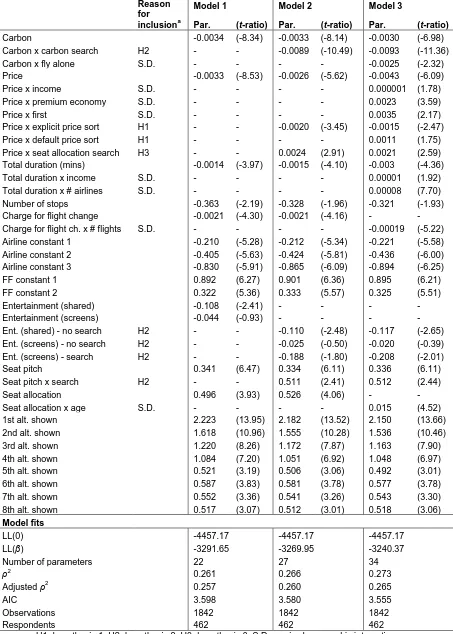
Table 1 contains the model results. The second column indicates whether the parameter is in support of one of the three hypotheses, or is a socio-demographic interaction introduced in model three. Model one is the base model, where all parameters reported (bar one) are significant and of expected sign. Seat assignment, entertainment and airline were all effects coded, to prevent the base level from being confounded with the alternative specific constants. For the entertainment attribute, video-on-demand (VOD) was treated as the base level, with parameters estimated for a shared screen (shared) and personal screens without VOD (screens). The screens parameter is the one insignificant parameter, and implies an indifference between personal screens with and without VOD.
Airlines were initially effects coded, however the parameters for five airlines were not
statistically different from each other. As such, these airlines were combined, with a single associated parameter, ‘Airline constant 1’, estimated. ‘Airline constant 2’ is a Middle East carrier with little market presence and ‘Airline constant 3’ is a Chinese carrier. The base level, ‘Airline constant 4’, is
associated with a flight for which the respondent has FF membership. As with the airlines, the FF parameters were combined when not statistically different. ‘FF constant 1’ represents two prominent Asian carriers, ‘FF constant 2’ comprises eight airlines, and the base level can be considered as having no membership for the FF program of the airline in question.
Additional dummy variables were created representing the order that an alternative appeared on the screen when the respondent made their choice. An option that appeared as one of the first eight alternatives shown had a higher likelihood of being chosen than those shown after eight, ceteris paribus, with diminishing impacts within the first eight as one moves from the first shown to the eighth shown. Only eight order dummies were estimated, as the remaining 13 dummies were not statistically significant.
6.2 Model with ICE Interactions
Model two adds the ICE interactions. While insignificant interactions have not been reported, marginally significant interactions have been retained. Consequently, while there is an overall improvement in log likelihood, the Akaike Information Criterion (AIC), which penalises additional parameters, is larger than model one, and so model fit is worse under this criterion. The focus here is on finding both strongly and marginally significant evidence for the proposed hypotheses, not overall model fit.
The interaction between price and explicit sorts on price is negative, highly significant, and nearly of the same magnitude as the main effect. This suggests that those who sort on price have a far greater price disutility, in support of hypothesis one. No other sort interaction was significant. While this might be in part because of the low rate of sorting on non-price attributes (22 percent of tasks at the time of choice), it also suggests that the sorting hypothesis only holds for price. As such, evidence supporting hypothesis one holds for the price attribute only.
Hypothesis two states that individuals who search on an attribute will have a greater marginal (dis)utility for that attribute. The results are mixed across the attributes. The seat pitch search
interaction is positive and significant at the 95 percent confidence level, suggesting that those who search by seat pitch obtain greater utility from each additional inch of seat space than those who do not search. The carbon search interaction is negative and strongly significant. There are two possible explanations for this. One is that those who search by carbon are less prepared to pay a carbon tax. Alternatively, respondents may be using the carbon tax as a proxy for carbon emissions, and so avoiding high carbon flights out of concern for the environment1. The entertainment attribute is handled differently in model two than in the base model. Separate parameters are estimated for those who don’t search by entertainment, and those who insist on at least having individual screens (as discussed earlier, a parameter can’t be estimated for those who required VOD, due to attribute level invariance). Effects coding prevents the VOD base level from being confounded. For those who didn’t search, the ‘screens’ parameter is not significant, suggesting that they are only drawing a distinction between shared screens and individual screens (that may or may not have VOD). For those that insist on at least an individual screen, there is a marked distinction between that screen having or not having VOD. Furthermore, the disutility for searchers of having individual screens instead of VOD is
greater than the disutility for non-searchers of having shared screens instead of VOD. The
insignificance of the individual screens in model one is deceptive, as it masks the significant effect for a subset of the sample. Failure to take into account the preference heterogeneity that is recovered by the search actions might lead to flawed inferences being made about the relative value of the three entertainment options. Overall, evidence for hypothesis two, whilst mixed, is largely supported as there is clear support over a number of attributes.
Hypothesis three links the search behaviour with the price parameter. The interaction of seat allocation and price is significant and positive, suggesting that those who search on these attributes are less price sensitive. Price interactions for other attribute searches are not significant, providing only one point of support for hypothesis three. What is notable about a seat allocation search is that it
1
removes half of the alternatives on average. Entertainment and seat pitch searches may only remove a third of the alternatives, so the effect might be linked to the effectiveness of the search in eliminating alternatives.
6.3 Model with ICE and Socio-demographic Interactions
Table 1: Model results
Reason for inclusiona
Model 1 Model 2 Model 3
Par. (t-ratio) Par. (t-ratio) Par. (t-ratio)
Carbon -0.0034 (-8.34) -0.0033 (-8.14) -0.0030 (-6.98) Carbon x carbon search H2 - - -0.0089 (-10.49) -0.0093 (-11.36)
Carbon x fly alone S.D. - - - - -0.0025 (-2.32)
Price -0.0033 (-8.53) -0.0026 (-5.62) -0.0043 (-6.09)
Price x income S.D. - - - - 0.000001 (1.78)
Price x premium economy S.D. - - - - 0.0023 (3.59)
Price x first S.D. - - - - 0.0035 (2.17)
Price x explicit price sort H1 - - -0.0020 (-3.45) -0.0015 (-2.47) Price x default price sort H1 - - - - 0.0011 (1.75) Price x seat allocation search H3 - - 0.0024 (2.91) 0.0021 (2.59) Total duration (mins) -0.0014 (-3.97) -0.0015 (-4.10) -0.003 (-4.36) Total duration x income S.D. - - - - 0.00001 (1.92) Total duration x # airlines S.D. - - - - 0.00008 (7.70) Number of stops -0.363 (-2.19) -0.328 (-1.96) -0.321 (-1.93) Charge for flight change -0.0021 (-4.30) -0.0021 (-4.16) - - Charge for flight ch. x # flights S.D. - - - - -0.00019 (-5.22) Airline constant 1 -0.210 (-5.28) -0.212 (-5.34) -0.221 (-5.58) Airline constant 2 -0.405 (-5.63) -0.424 (-5.81) -0.436 (-6.00) Airline constant 3 -0.830 (-5.91) -0.865 (-6.09) -0.894 (-6.25) FF constant 1 0.892 (6.27) 0.901 (6.36) 0.895 (6.21) FF constant 2 0.322 (5.36) 0.333 (5.57) 0.325 (5.51)
Entertainment (shared) -0.108 (-2.41) - - - -
Entertainment (screens) -0.044 (-0.93) - - - - Ent. (shared) - no search H2 - - -0.110 (-2.48) -0.117 (-2.65) Ent. (screens) - no search H2 - - -0.025 (-0.50) -0.020 (-0.39) Ent. (screens) - search H2 - - -0.188 (-1.80) -0.208 (-2.01) Seat pitch 0.341 (6.47) 0.334 (6.11) 0.336 (6.11) Seat pitch x search H2 - - 0.511 (2.41) 0.512 (2.44)
Seat allocation 0.496 (3.93) 0.526 (4.06) - -
Seat allocation x age S.D. - - - - 0.015 (4.52)
1st alt. shown 2.223 (13.95) 2.182 (13.52) 2.150 (13.66) 2nd alt. shown 1.618 (10.96) 1.555 (10.28) 1.536 (10.46) 3rd alt. shown 1.220 (8.26) 1.172 (7.87) 1.163 (7.90) 4th alt. shown 1.084 (7.20) 1.051 (6.92) 1.048 (6.97) 5th alt. shown 0.521 (3.19) 0.506 (3.06) 0.492 (3.01) 6th alt. shown 0.587 (3.83) 0.581 (3.78) 0.577 (3.78) 7th alt. shown 0.552 (3.36) 0.541 (3.26) 0.543 (3.30) 8th alt. shown 0.517 (3.07) 0.512 (3.01) 0.518 (3.06)
Model fits
LL(0) -4457.17 -4457.17 -4457.17
LL(β) -3291.65 -3269.95 -3240.37
Number of parameters 22 27 34
ρ2
0.261 0.266 0.273
Adjusted ρ2
0.257 0.260 0.265
AIC 3.598 3.580 3.555
Observations 1842 1842 1842
Respondents 462 462 462
7. Conclusions
The explosion of interactive online choice environments has brought with it a rich new stream of data. This paper investigates how this data might be used in one type of interactive choice
environment, where a large number of alternatives can be sorted, and eliminated with the use of a search tool. Three hypotheses are developed and tested in a hypothetical empirical setting. Price sort behaviour is found to have a systematic correlation with price sensitivity. For many attributes, a search on the attribute can indicate both a greater sensitivity to the attribute searched on, and a lesser price sensitivity.
This paper makes contributions to both the transportation and choice modelling literatures. The choice environment proposed is well suited to a range of transportation choices, including air travel, rail, coach, public transport, car hire and even route choice, for it mimics a growing array of market offerings. These choice environments have unique properties that provide the analyst with opportunities to gain a deeper understanding of choices processes, and preference heterogeneity. Whilst models have begun to be developed in the marketing literature for online choice environments that are well suited to marketing problems (e.g. Moe 2006), such endeavours have received scant attention in the transportation field. Within the broader choice modelling literature, much attention has been given in recent years to modelling unobserved preference heterogeneity, principally through the now ubiquitous mixed logit and latent class models. This represents a move away from the modelling of observed preference heterogeneity through the specification of interactions with socio-demographic variables. This paper has demonstrated that search and sort observations may be another way to retrieve and understand preference heterogeneity.
Future research could test the robustness of ICE interactions within models that handle heterogeneity in other ways, including MMNL and latent class models. Access to market data would allow the hypotheses to be tested in a real environment, and would address concerns about
hypothetical bias. Finally, the transferability of the ICE informed preference heterogeneity to other choice environments that the same individuals interact with may provide information on the extent to which the choice context is influencing the decisions made.
In the present paper, we have made use of what could be termed a confirmatory approach for establishing links between the use of the search and sort tools and the underlying preferences of individual respondents, through estimating additional parameters that capture these specific shifts in sensitivities. An alternative would be the use of an exploratory approach, where a model not explicitly making provision for these linkages would be estimated, and an a posteriori analysis would be used to explore relationships. As a brief aside, we undertook one possible such analysis, using Hierarchical Bayes (HB) estimation of a random coefficients logit model to produce individual level distributions for the various model parameters2. We specified this model in willingness-to-pay (WTP) space and ran regressions on the means from these conditional WTP distributions, using the individual specific search and sort strategies as explanators. Full details are available from the first author on request, but as an example, the results showed that for respondents who ever sorted on price, the WTP for reducing flight duration is lower, while for respondents who sorted on duration, the WTP is higher, as is the case for respondents who always search on seat booking (which might reduce price sensitivity and increase WTP, hypothesis three in the paper). It should be acknowledged that, as is always the case, a confirmatory modelling approach might lead to confounding effects3. Whilst this remains a risk, we anticipate that it is largely mitigated by the scope of the interactions tested. For example, hypothesis three proposes that a search on a given non-price attribute may signify a lesser price disutility. Simply testing an interaction between the search on that attribute and the sensitivity to that
2 We are grateful to an anonymous referee for this suggestion.
3
attribute directly might lead to a confounding effect. Testing an interaction with both the non-price attribute and price provides greater confidence that the correct behavioural insight is inferred.
A major limitation of the current study should also be noted. The utilisation of the interactive tools is in fact a choice itself that is in some respects inseparably linked to the final alternative chosen. In the current study, the use of information related to how these tools where used was treated in an exogenous manner, via the inclusion of dummy variables and interaction terms. In a strict sense, this approach fails to acknowledge the link between the two choices. However, ignoring this link in the current paper was a deliberate decision, as our aim was simply to investigate differences in
References
Collins, A.T., Rose, J.M., Hess, S., 2012. Interactive stated choice surveys: a study of air travel behaviour. Transportation 39(1), 55-79.
Daly, A.J., Hess, S. (2011), Simple Approaches for Random Utility Modelling with Panel Data, paper presented at the 90th Annual Meeting of the Transportation Research Board, Washington, D.C.
Ford, J.K., Schmitt, N., Schechtman, S.L., Hults, B.M., Doherty, M.L., 1989. Process tracing methods: Contributions, problems, and neglected research questions. Organizational Behavior and Human Decision Processes 43(1), 75-117.
Gensch, D.H., 1987. A Two-Stage Disaggregate Attribute Choice Model. Marketing Science 6(3), 223-239.
Häubl, G., Trifts, V., 2000. Consumer Decision Making in Online Shopping Environments: The Effects of Interactive Decision Aids. Marketing Science 19(1), 4-21.
Hauser, J.R., Wernerfelt, B., 1990. An Evaluation Cost Model of Consideration Sets. Journal of Consumer Research 16(4), 393-408.
Hensher, D.A., Rose, J.M., Bertoia, T., 2007. The implications on willingness to pay of a stochastic treatment of attribute processing in stated choice studies. Transportation Research Part E 43(2), 73-89.
Hess, S., Hensher, D.A., 2010. Using conditioning on observed choices to retrieve individual-specific attribute processing strategies. Transportation Research Part B 44(6), 781-790.
Huber, J., Klein, N., 1991. Adapting cutoffs to the choice environment: the effects of attribute correlation and reliability. Journal of Consumer Research 18(3), 346-357.
Kaplan, S., Bekhor, S., Shiftan, Y., 2009. Development and estimation of a semi-compensatory residential choice model based on explicit choice protocols. The Annals of Regional Science 47(1), 51-80.
Moe, W.M., 2006. An Empirical Two-Stage Choice Model with Varying Decision Rules Applied to Internet Clickstream Data. Journal of Marketing Research 43(4), 680-692.
Rose, J.M., Hensher, D.A., Greene, W.H., 2005. Recovering costs through price and service differentiation: Accounting for exogenous information on attribute processing strategies in airline choice. Journal of Air Transport Management 11(6), 400-407.
Smith, B.C., Darrow, R., Elieson, J., Guenther, D., Rao, B.V., Zouaoui, F., 2007. Travelocity becomes a travel retailer. Interfaces 37(1) 68-81.
Steckel, J.H., Winer, R.S., Bucklin, R.E., Dellaert, B.G.C., Dreze, X., Häubl, G., Jap, S.D., Little, J.D.C., Meyvis, T., Montgomery, A.L., Rangaswamy, A., 2005. Choice in Interactive Environments. Marketing Letters 16(3/4), 309-320.
Swait, J., Ben-Akiva, M., 1987. Incorporating random constraints in discrete models of choice set generation. Transportation Research Part B 21(2), 91-102.