Primary Modern Foreign
Languages
Longitudinal Survey of Implementation
of National Entitlement to Language
Learning at Key Stage 2
Final Report
Research Report DCSF-RR127
Pauline Wade and Helen Marshall
with Sharon O’Donnell
Research Report No
DCSF-RR127
Primary Modern Foreign Languages
Longitudinal Survey of Implementation
of National Entitlement to
Language Learning at Key Stage 2
Final Report
Pauline Wade and Helen Marshall
with Sharon O’Donnell
National Foundation for Educational Research
The views expressed in this report are the authors’ and do not necessarily reflect those of the Department for Children, Schools and Families.
© National Foundation for Educational Research 2009
Contents
Acknowledgements iii
Executive summary
1
1.
Introduction 6
1.1 Background 6
1.1.1 Languages Strategy 6
1.1.2 Review of the Languages Strategy 7
1.1.3 Primary curriculum review 8
1.1.4 Support for primary languages 8
1.1.5 Other research projects 9
1.2 Aims of the research 10
1.3 Methodology 10
1.3.1 Local authority survey 10
1.3.2 Survey of schools and the school sample 10
1.3.3 The target group 11
1.3.4 The questionnaires 12
1.4 Structure of the report 12
2.
Progress in provision
13
2.1 Language learning provision 13
2.1.1 Languages offered 17
2.1.2 Changes in languages offered between 2006 and 2008 19
2.1.3 Aims of language teaching 20
2.1.4 Policy on provision 21
2.2 Proportion of pupils receiving language teaching 22
2.3 Summary 23
3.
Delivery and resources
25
3.1 Teaching staff and training support 25
3.1.1 Who is teaching languages? 25
3.1.2 Support for language teaching and learning 27
3.1.2.1 Standards Fund support 30
3.1.2.2 External support for language learning 31
3.1.2.3 Language learning Pathfinders 33
3.1.3 Staff training 33
3.2 Staffing models and teaching time 35
3.2.1 Amount of time spent on languages 36
3.3 Advantages of current models of provision 38
3.4 Resources 39
4.
Assessment and transition
41
4.1 Assessment 41
4.2 Transition from KS2 to KS3 42
5.
Meeting the entitlement and preparation for the future
49
5.1 Progress on meeting the entitlement 49
5.1.1 Schools not providing the full entitlement 51
5.2 Sustainability 52
5.3 Planning for primary languages as a statutory subject 55
5.4 Summary 56
6.
Summary and conclusions
57
Acknowledgements
The research team would like to thank the school and local authority staff who responded to the surveys for this project. Without their assistance this study could not have been
completed.
Special thanks are due to our NFER colleagues, in particular to Vani Cardozo for her administrative support, Sally Bradshaw and Tom Benton for the statistical analysis, Claire Evans and all those who worked on this project in Research Data Services and those colleagues from the Research Department who worked on the two interim reports.
Executive summary
1. Introduction
The National Foundation for Educational Research (NFER) was commissioned by the Department for Children, Schools and Families (DCSF) to conduct this three-year longitudinal study of language learning at Key Stage 2 (KS2) to assess:
• the nature and extent of language learning provision at KS2 in schools in England, and
• progress towards implementation of the non-statutory target set in the National Languages Strategy (DfES, 2002) that all children should have an entitlement to language learning in class time in KS2 by 2010.
The research consisted of an annual survey of all local authorities (LAs) in England,
conducted in the autumn term of 2006, 2007 and 2008. At the same time points, surveys of primary schools were conducted, using a longitudinal sample (including a representative sub-sample of 500 schools selected to eliminate any possible bias).
This summary reports on key findings from the study and, where relevant, comparisons are made across the whole survey period, to show the development of provision and progress towards meeting the entitlement.
1.1 Key findings
• In 2008, 92 per cent of schools were offering pupils in KS2 the opportunity to learn a language within class time - a rise of eight percentage points from 2007 and a 22 percentage point increase from 2006.
• 69 per cent of schools in 2008 were fully meeting the entitlement for all year groups - a rise of 15 percentage points from 2007 and 35 percentage points from 2006.
• Of the schools that said they were not providing the entitlement in 2006, more than half were providing the entitlement in 2008 (37 per cent fully and 17 per cent partially).
• Almost nine out of ten schools that provided languages within class time in 2008 were very or quite confident that their current arrangements were sustainable - 35 per cent were very confident in 2008, compared to 26 per cent in 2006. However, it is estimated that a maximum of 18 per cent of all schools may not be able to offer the full entitlement by 2010.
• The majority of schools teaching languages felt that they would be ready to meet the requirement for statutory language teaching in KS2 by 2011. However, it is possible that up to a quarter of all schools may not be ready for the statutory requirement.
• French remained the most common language offered (in nine out of ten of those schools providing a language). Spanish was offered in 25 per cent of schools and German in 10 per cent of schools.
• Schools facing more difficult circumstances (with a higher number of pupils eligible for free school meals, a poorer level of performance at KS2, or a larger proportion of pupils with English as an additional language) were less likely to be offering languages, although the number of such schools doing so had increased over the three-year period.
• Provision and uptake of languages training had increased between 2006 and 2008 and, for the majority of schools, the KS2 Framework for Languages provided the basis of their school languages programme.
• Respondents’ views on the main challenges to current provision were: finding time to deliver languages within what they considered to be an overcrowded curriculum, lack of staff knowledge or expertise and budget restraints.
• The use of assessment tools had increased steadily over the three years, but those schools using assessment procedures were still in a minority.
• Transition in languages from KS2 to KS3 was still perceived by staff to be under-developed and, for many school respondents, language progression remained a cause for concern.
2. Methodology
Each year between 2006 and 2008, all local authorities (LAs) in England were sent a questionnaire, asking about the progress of schools in their area in teaching languages at Key Stage 2 (KS2).
Questionnaires were also sent to a nationally representative sample of maintained primary schools in England. A sample of schools was drawn in 2006 and the first questionnaire was sent to 7,899 schools in October 2006. In subsequent years, the questionnaires were sent to the schools that had responded in 2006 (4,047 schools in 2007 and 3,535 in 2008 - taking into account school closures and amalgamations).
To allow for comparison over a longer period of time, both the school and LA questionnaires in 2006 were based on those used in a baseline study of the provision of foreign language learning by Driscoll et al (research conducted in 2002/3, Driscoll et al., 2004).
In order to gain an indication of development over time across the three years of this
longitudinal study, some questions were repeated in all three survey questionnaires, or in the first and last years of the survey. Some new questions were also added to take account of policy developments and the need for more detailed responses. Questionnaire response rates ranged from 48 per cent for schools in 2006, to 69 per cent in 2007 and 67 per cent in 2008 and, for local authorities, from 70 per cent in 2006, to 72 per cent in 2007 and 74 per cent in 2008. There were 1,810 schools and 68 LAs that took part in the survey in all three years.
3. Main
findings
3.1 Progress in provision of primary languages
Ninety-two per cent of schools within the target group said that they offered pupils in KS2 the opportunity to learn a language within class time in 2008; this represented an increase of eight percentage points from 2007 and 22 percentage points from 2006.1 Compared with the baseline study carried out in 2002/3 (Driscoll et al., 2004), the proportion of schools offering the opportunity to learn a language within class time had more than doubled.
The majority of schools delivering languages within class time did so for the whole year group.
Across all the survey years, schools in the top 20 per cent for free school meals (FSM) eligibility, in the bottom 40 per cent for performance at KS2, or with more than six per cent of pupils with English as an additional language (EAL) tended to be less likely to offer
languages. The proportion of pupils with a statement of special educational needs appeared to have no significant impact on KS2 language provision.
French remained the most popular language (offered by 89 per cent of schools in 2008), followed by Spanish and German (25 per cent and ten per cent respectively), while a small number of schools (three per cent or under) offered Italian, Chinese, Japanese and Urdu.
3.2 Delivery, support and resources
In 2008 the median number of staff reported as teaching languages in a school was three, but there were wide variations in numbers (There was a range from one in the 25th quartile to five in the 75th.)
Although the level of language qualification of staff teaching primary languages varied widely, they had usually received training in language pedagogy or proficiency.
There had been an increase in all types of LA support for language teaching between 2006 and 2008, particularly specific funding for primary languages. The areas of support that schools still required most were staff training and assistance with linking with schools abroad.
Although schools were still keen to receive staff training, provision and uptake of training had increased between 2006 and 2008 and more than two-thirds of schools reported in 2008 that they had received free primary languages training.
Methods of language provision and teaching time changed little over the three-year survey period. Most schools provided discrete lessons across all year groups, with the most common pattern being one lesson of around 40 minutes per week.
For the majority of schools, the KS2 Framework for Languages provided the basis of their school language programme. The use of commercially available schemes of work increased, however, over the survey period and both locally-produced and school-produced schemes of work were also popular.
1
3.3 Assessment and transition
In 2008, 46 per cent of schools said they were monitoring and assessing progress in language learning, while 48 per cent said they were not (three per cent did not know and three per cent did not respond). This was an improvement from 2006, when around 20 per cent were using assessment materials, and more than 75 per cent of schools did not respond to a question on assessment. From this it was inferred that the use of assessment
procedures was very underdeveloped, although there had been an improvement since the time of the baseline study in 2002/3 (Driscoll et al., 2004), when only nine per cent of schools were involved in language monitoring and assessment.
The assessment tools used most frequently by schools were the Languages Ladder, the European Language Portfolio, their own school-produced materials and the KS2 Framework for Languages.
As reported in 2008, LAs were providing support for transition in languages, particularly through the use of advisory staff and specific joint language curriculum activities. School views on transition were less positive than those of LAs, with nearly half the schools saying that they were not using any of the arrangements set up by their LA. A third of schools had no internal arrangements in place to support transition and, although some school
respondents reported improved procedures for communication with KS3 colleagues on language transition, this was still an area of concern for many, as was the issue of language progression across KS2 and KS3.
3.4 Meeting the entitlement and preparation for the future
Schools were making good progress towards providing the entitlement to language learning within class time for all four years within KS2. Compared with 2006, the proportion of schools providing the full entitlement for all four years had more than doubled by 2008 to 69 per cent. A further 21 per cent of schools partially provided the entitlement in 2008, and the proportion of schools not teaching languages in class time had declined considerably, from 29 per cent in 2006 to eight per cent in 2008. From the data it was possible to estimate that a maximum of 18 per cent of all schools either felt that they would not, or were unsure of whether they would provide the full entitlement by 2010. This estimate is only approximate, as it depends on whether schools that currently meet the entitlement will continue to do so, and on school respondents having an accurate perception of their readiness to meet the entitlement in future.
Almost nine in ten schools that provided languages within class time said that they were very or quite confident that their current arrangements for the provision of language teaching at KS2 were sustainable in their school. However, these levels of confidence need to be considered in the context of variations in the extent of language provision, and with the recognition that only 58 per cent of primary schools reported having a written policy on language provision.
Respondents’ views on the challenges to schools’ arrangements for language provision were similar to the factors that were considered likely to affect sustainability and did not change a great deal over the three years. These challenges were: finding time to deliver languages within what they considered to be an overcrowded curriculum, lack of staff expertise and confidence, impact on budget and staff training needs.
From the data, it is possible to estimate that there could be around a quarter of all schools that felt that they would not, or are unsure of whether they would be ready for languages to be introduced as a statutory subject in 2011. However, this estimate needs to be considered in the context of respondents answering a question in 2008 when little was known about what the statutory requirement would mean.
4. Conclusions
The results of this three-year longitudinal study of language learning show a number of very positive developments in the progress being made by primary schools in England in
implementing the entitlement to language learning in class time in KS2 as set out in the National Languages Strategy (DfES, 2002). These include:
• a significant increase in the proportion of schools fully meeting the entitlement to language learning in class time in KS2
• increases in the provision and take-up of training for primary languages
• growing confidence in the sustainability of language provision at KS2
• an increase in the number of schools using monitoring and assessment procedures at this level.
Assessment is an area that still requires development and further progress is needed in transition arrangements and practices. Progression in languages between KS2 and KS3 remains an area of concern for many primary schools.
1. Introduction
In 2006, the National Foundation for Educational Research (NFER) was commissioned by the Department for Children, Schools and Families (DCSF) to conduct a three-year
longitudinal survey of language learning at Key Stage 2 (KS2). The study built on two previous evaluations: a baseline study of primary languages in KS2 conducted in 2002/03 (Driscoll et al., 2004), and the evaluation of KS2 ‘Pathfinders’ (see section 1.1.1 below), conducted in 2004/05 (Muijs et al., 2005). These evaluations identified issues to be addressed if primary language provision was to be extended and improved, including the need for:
• more training and support for primary language teachers in a variety of languages
• greater provision of resources
• primary language policies for all schools
• better transition arrangements from KS2 to KS3 to ensure continuity of provision
• differentiation strategies to cater for the needs of all pupils.
A synthesis of the areas investigated in these two evaluations, and extrapolation of issues for study from the findings, formed the conceptual basis for this longitudinal study of primary languages over three years.
Interim findings from the first and second years of the NFER survey were reported in 2007 (DfES Research Brief No: RBX02-07, Lines et al., 2007) and 2008 (Research Brief DCSF-RBX-09-08, Whitby et al., 2008). This final report looks at the situation as reflected in
responses to the 2008 survey, at trends in the provision of primary languages over the three years of the study and, where possible, provides comparisons between survey results across the three years. It also looks forward to the proposed introduction of primary languages as a compulsory part of the KS2 curriculum from 2011, and schools’ awareness of and
preparation for this.
1.1 Background
This longitudinal study was undertaken against a background of development and change in language provision in schools in England. This section provides some contextual background to the survey.
1.1.1 National Languages Strategy
The Government set out its commitment to change the languages capability of the nation in the National Languages Strategy, Languages for All: Languages for Life. A Strategy for England (DfES, 2002). The strategy had three overarching objectives:
• to improve the learning and teaching of languages at all levels
• to introduce a recognition system which would complement existing qualification frameworks and give credit for language skills across a wide range of competence
It also aimed to develop language learning skills which can be transferred to any language; to broaden linguistic awareness, extending literacy beyond English; to develop cultural knowledge and awareness; and to ensure an early start towards competence in a foreign language. A key element of the strategy was the commitment that all Key Stage 2 (KS2) pupils would have the opportunity to learn a language, at least in part in class time, by 2010.
The strategy was accompanied by a programme of support which included the KS2
Framework for Languages, the further development of the National Advisory Centre for Early Language Learning (NACELL), an extensive programme of training and networking
opportunities for new and existing primary teachers and teaching assistants (TAs), and the establishment of 19 ‘Pathfinder’ local authorities (which ran from September 2003 to July 2005), where approaches to teaching languages were trialled in 1,000 primary schools. The Training Zone, an online resource for primary teachers, was also established. This has now been combined with the NACELL website into a ‘one-stop shop’ for primary languages. The Languages Ladder was also developed to assist assessment. This voluntary national recognition scheme, designed to give learners credit for their language skills at any age and level, now has an associated accreditation scheme, Asset Languages.
1.1.2 Review of the National Languages Strategy
At the same time that there was a new focus on languages at primary level, there was concern about the declining interest in languages post-14; in 2004, languages had ceased to be mandatory at Key Stage 4 (KS4) (14-16) in maintained secondary schools in England. A review of the Languages Strategy, commissioned in 2006 and led by Lord Dearing
considered, in particular, a response to the decline in the number of pupils choosing a language option at KS4. The findings of the Review, published in 2007 (Dearing and King, 2007), noted that the ‘take up of languages in primary schools has gone very well’ (page 3), adding that there were indications that, at primary level, ‘languages are enjoyed by children across the ability range and …. there is no lack of enthusiasm, interest or keenness to learn’. The Review contrasted this progress with the secondary sector where, ‘the number taking languages has fallen sharply’. The Review did not recommend a return to the mandatory teaching of languages at KS4, however, but recommended a series of measures to increase the take-up of languages post-14 and beyond.
In relation to primary languages, the Review stated that ‘the ground work for a statutory languages curriculum is already largely in place. Against this background we recommend that languages become part of the statutory curriculum for Key Stage 2 in primary schools, when it is next reviewed’ (Dearing and King, 2007, page 9). There was also a
recommendation that provision for teacher support in primary schools should be continued and, where necessary, extended and that the range of languages on offer should be widened. In addition, the Review pointed out that ‘the full benefits of teaching languages in primary schools will not be realised unless there are good arrangements for transition to secondary schools’ (Dearing and King, 2007, page 10). This was followed by two further recommendations relating to transition:
• There should be informal classroom assessment of every child’s learning near the end of Key Stage 2 by reference to the Languages Ladder, so that the Key Stage 3 teacher is well informed about the pupil’s learning standard and needs.
• Wherever possible, with appropriate leadership from local authorities, clusters of primary and secondary schools in a local authority area should link up to seek to achieve
1.1.3 Primary curriculum review
There have been further developments since the recommendations of the Languages Review (Dearing and King, 2007). An independent review of the primary curriculum, led by Sir Jim Rose, was launched in January 2008 by the Secretary of State for Children, Schools and Families. The interim report of the Review, published on 8 December 2008 (Independent Review of the Primary Curriculum, 2008), recommended that languages should be a
statutory requirement at KS2 from 2011, with schools required to progressively introduce languages from September 2011 starting with Year 3. The final report, published on 30 April 2009 (Independent Review of the Primary Curriculum, 2009), proposed situating primary languages within a new area of learning entitled ‘Understanding English, communication and languages’. It also recommended that all children at KS2 should learn at least one foreign language, and that schools should focus on teaching one or two languages. The revised curriculum is expected to be introduced in schools in September 2011 and a consultation on the final report is running until 24 July 2009.
1.1.4 Support for primary languages
A support network, which focuses on teachers delivering languages from primary level upwards, and which provides training and career development opportunities, was also launched in April 2009. ‘Links into Languages’ operates on a regional level, with nine regional hubs based in universities in each of the Government Office Regions (GORs). The centres, overseen by a consortium of three agencies (the Association for Language
Learning; the Subject Centre for Languages, Linguistics and Area Studies; and the Specialist Schools and Academies Trust), and commissioned and funded by the Department for
Children, Schools and Families (DCSF), were based on the model of the ‘Routes into Languages’ programme, which aims to increase language participation at KS4 and beyond. Although provision is tailored to local needs, common training is offered by all the centres, which also encourage face-to-face and web-based networking and sharing of good practice between teachers. Links into Languages takes over the work of the Comenius Network, provided by the National Centre for Languages (CILT) on a regional basis since 1992.
The delivery of primary languages is also being assisted by further developments including:
• A new website that specifically supports language teaching in primary schools. The Primary Languages website (www.primarylanguages.org.uk) provides one easily
accessible resource for all involved in language teaching in primary schools and aims to assist progress towards the introduction of the statutory requirement in 2011.
• Revised schemes of work for French, German and Spanish, which are in line with the KS2 Framework for Languages.
• Funding for local authorities to build up capacity in primary languages,which can be spent on specialist teachers or resources.
Finally, in terms of context for the introduction of language learning at KS2, two other developments are relevant:
• The ‘Our Languages’ government-funded project, managed by CILT, which began in 2007. This is designed to raise awareness of the benefits of teaching a community language to children and young people, by bringing together the expertise that exists in community-run complementary schools with the mainstream school sector. It aims to raise the profile of community language teaching and learning through events and training sessions for teachers. The project began with nine schools in four cities and now involves 90 schools across England.
• A DCSF-commissioned project focusing on effective transition from KS2 to KS3 in languages. The key areas of work in the project, which began in April 2007 and is being led by CILT, are to research examples of good practice in transition and to produce successful models and new approaches to teaching and learning to support effective transfer and transition. The project also aims to identify national, regional and local needs influencing the different types of guidance that schools will be seeking in order to ensure progression in languages from KS2 to KS3. In the first year of the project, seven diverse LAs worked with at least one group of primary and secondary schools in on-going local projects. Another eight LA partners were recruited for the current phase, and are working with established partners and drawing on project work already established, as well as concentrating on the new areas of special educational needs, community languages, gender and intercultural understanding.
1.1.5 Other research projects
To further develop the evidence base on the provision of language teaching in England, the DCSF commissioned two other major research projects which began at the same time as the NFER longitudinal survey. The projects are a longitudinal qualitative study of languages at KS2 being conducted by the Open University, Southampton University and Canterbury Christ Church University (interim findings available in Cable et al., 2008), and a study of language learning at Key Stage 3 (KS3) (11- to 14-year-olds) recently completed by Cambridge University (Evans and Fisher, 2009).
The Open University longitudinal study, which is due to report in late 2009, is investigating the nature and quality of the provision of language learning at KS2 in a range of schools, and assessing its impact on pupils’ learning in languages and across the curriculum. It consists of a literature review, an examination of provision and practice in 40 schools currently teaching primary languages at KS2, and an examination of children’s attainment in primary languages in eight of these schools.
The research recently completed by the University of Cambridge sought to understand the impact of the KS3 Framework for Modern Foreign Languages and other initiatives, such as regulatory changes to language learning at KS2 and KS4, on provision and practice at KS3. The final report of this study is due to be published in summer 2009.
1.2 Aims of the research
The specific aims of this three-year longitudinal survey of language learning at Key Stage 2 (KS2) were to assess:
• the nature and extent of language learning provision at KS2 in schools in England, and
• progress towards implementation of the non-statutory target set in the National Languages Strategy (DfES, 2002) that all children should have an entitlement to language learning in class time in KS2 by 2010.
1.3 Methodology
There were two strands to the longitudinal survey - local authorities and schools.
1.3.1 Local authority survey
In the autumn term of 2006, 2007 and 2008, all local authorities (LAs) in England were sent a questionnaire which asked them about the progress of schools in their area in teaching languages at Key Stage 2, and about the support they were providing for schools to help them reach the full entitlement.
1.3.2 Survey of schools and the school sample
A questionnaire survey was also sent to a sample of schools in England in the three years from 2006 to 2008 (in the autumn term). Hard copies of the questionnaire were sent to all the schools in each year's sample, with an invitation to complete the questionnaire online, if this was preferred.
A sample of 8,000 schools was drawn in August 2006: the schools were randomly selected, using a set of stratifiers (KS2 achievement, percentage of pupils with English as an additional language, size, urban / rural location and school type), to ensure the sample was
representative. In October 2006, the first questionnaires were sent to 7,899 of the schools selected (the remainder could not be included because of school closures and
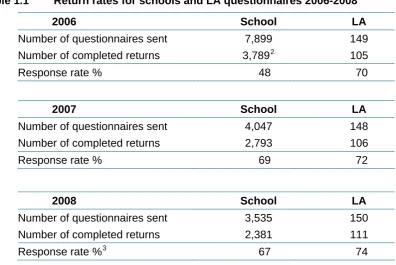
amalgamations). The school sample was large (constituting approximately half the schools teaching KS2 pupils) in order to achieve a robust rate of return by the third year of the survey. The respondents were usually headteachers or other senior managers, or language coordinators. The number of completed returns was 3,789, a response rate of 48 per cent (although some schools that sent late returns were added subsequently to make a total of 3,850). The second survey was sent in October 2007 to all the schools that had responded in 2006, and 2,793 completed returns were received (a response rate of 69 per cent). The 2008 survey was also sent to all the schools that had responded in 2006, except those schools that had closed or amalgamated since the beginning of the survey. All schools in the target group (see below) also received a questionnaire in all three years, regardless of whether they had responded in 2006.
Table 1.1 Return rates for schools and LA questionnaires 2006-2008
2006 School LA
Number of questionnaires sent 7,899 149
Number of completed returns 3,7892 105
Response rate % 48 70
2007 School LA
Number of questionnaires sent 4,047 148
Number of completed returns 2,793 106
Response rate % 69 72
2008 School LA
Number of questionnaires sent 3,535 150
Number of completed returns 2,381 111
Response rate %3 67 74
1.3.3 The target group
In order to monitor progress towards achieving the primary language targets, it was important to ensure accurate and unbiased estimates of the proportion of schools that were
implementing language teaching. It was recognised that schools interested in and teaching primary languages might be more likely to complete the questionnaire, and that consequently there could be bias in the responses. To counter-act any potential effect, a target group of 500 schools was identified from the original survey sample, and information on progress in teaching primary languages in all of these schools was obtained for each year of the research. These schools were selected to be a representative subset of the total sample of schools surveyed. The proportion of schools implementing primary language teaching within the subset provides, in statistical terms, an unbiased estimate of the proportion of such schools in the population, accurate to within plus or minus 4.5 per cent (95 per cent
confidence interval). Any of the target group schools that did not return questionnaires by the required date were contacted by telephone. If they were unable or unwilling to complete the questionnaire, they were asked to provide the essential information on whether they offered primary languages in class time.4 In 2006, only one school refused to answer this question; in 2007, one school closed during the survey period and no response was obtained; in 2008, all the target group responded.
As the target sample provided a national estimate of the proportion of schools teaching languages in class time, this was used to weight the responses to relevant questions throughout the report.
2
Although some schools that sent late returns were added subsequently to make a total of 3,850.
3
In 2008, 120 schools and 11 LAs returned questionnaires after the end of the survey period. These responses have not been included in the return rate tables, nor in the analysis, but comments in open-ended questions have been included in reporting where relevant.
4
1.3.4 The questionnaires
To allow for comparison to the baseline, the original (2006) questionnaires for both local authorities and schools were based on those used by Driscoll et al (2004) (see section 1.).
The 2006 questionnaire for schools was based on the headteacher questionnaire used in that study, but included some additions, and fewer open-ended questions. There was also one questionnaire for all schools, with routing that allowed for responses from those with or without primary language provision.
The questions asked in the 2006 and 2008 questionnaires for local authorities and schools were kept the same where relevant in order to compare results across the years, but the 2007 questionnaires were shorter and intended to provide an update on progress on key questions only. New questions were introduced in 2007 and 2008 in response to requests for specific information, or to clarify previous responses. Some of the questions asked in the 2006 questionnaires were not repeated later as they were no longer relevant.
The 2008 questionnaires were the longest of the questionnaires, to provide for comparison questions with 2006, to collect more data on assessment and transition, and to include questions on preparation for the proposed introduction of languages as a statutory subject at KS2 in 2011.
1.4 Structure of the report
This report discusses the findings from the three years of school and LA surveys in 2006, 2007 and 2008. The focus is on the situation as reported in the final survey of 2008, but whenever possible, these findings are compared with the 2006 and 2007 survey responses, in order to provide an indication of development over time. Each chapter reports findings from both the school and the LA surveys. The structure of the report is as follows:
Chapter 2 reports on progress in the provision of languages in class time at Key Stage 2 (KS2). It examines which languages are offered and why, any changes in provision, school policy on provision and the percentage of pupils receiving language teaching.
Chapter 3 discusses the delivery of languages at KS2, including who provides the teaching and the resources and support available to them, how languages are taught, and the amount of time devoted to them.
Chapter 4 examines developments in assessment procedures and LA and school practice on transition from KS2 to KS3 in relation to languages.
Chapter 5 considers progress towards meeting the entitlement to primary language learning, the sustainability of current practice, and awareness of, and planning for, the introduction of primary languages as a statutory subject.
Chapter 6 provides a summary of the report and of trends over the three years of the research, and draws conclusions on the implementation of the entitlement to date.
2. Progress in provision
This chapter considers the provision of language learning at KS2 in schools across England. Five issues are examined in this chapter: the extent to which schools are teaching languages within class time; the different languages offered; common aims of language teaching and learning; written policies on language learning within schools; and finally the proportion of pupils within schools receiving language teaching. Where possible, comparisons are made across the three years of the research. In addition, where appropriate, the results are explored by a variety of background characteristics such as region, socio-economic factors and school size.
2.1 Language learning provision
In all years of the study, schools were asked about the language learning opportunities they provide for pupils at KS2. More specifically, the focus has been on provision within class time.
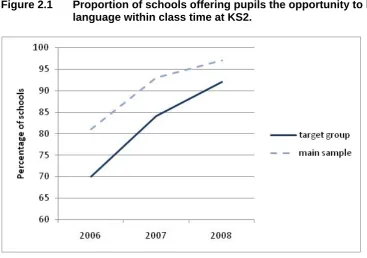
In 2008, the proportion of schools offering pupils the opportunity to learn a language in class time had increased for both the target sample5 and the main sample since the 2007 and 2006 surveys. It appears that most pupils across England now have the opportunity to learn a language within class time at KS2.
Indeed, in 2008, the proportion of schools offering languages in class time for the target group was 92 per cent. This shows a substantial (22 percentage point) increase in the proportion of schools offering languages within class time on 2006 (figure 2.1). Furthermore, compared with the baseline study carried out in 2002/03 by Driscoll et al (2004)6, the
proportion of schools offering the opportunity to study a language within class time had more than doubled. This increase in the proportion of target group schools providing languages within class time is particularly promising because this group provides a representative picture of primary schools in England.
In the main sample, almost all schools (97 per cent) said that they offered pupils the
opportunity to learn a language in class time. This is a four percentage point increase on the 2007 main sample and a 16 percentage point increase on the first year of the survey in 2006.
5
The target sample was selected to provide a more accurate representation of the national picture. See section 1.3.3 for more details.
6
Driscoll et al (2004) reported that ‘35 per cent of all schools teaching KS2 pupils are estimated to have
Figure 2.1 Proportion of schools offering pupils the opportunity to learn a language within class time at KS2.
Source: Survey of primary schools, 2006-2008
These results were echoed by the results from the local authority survey, which indicated that more schools provided some primary language teaching within class time in 2008 compared with 2006. The proportion of local authorities reporting that between 81 and 100 per cent of the schools in their area offered some primary language teaching within class time increased from 23 per cent in 2006 to 79 per cent in 2008 (see figure 2.2).
Figure 2.2 Proportion of local authorities (LAs) reporting that between 81%
and 100% of schools in their area provide some foreign language teaching within class time at KS2
[image:20.595.106.474.73.331.2] [image:20.595.105.476.459.705.2]In 2006, those schools that had not taught, and were not teaching, primary languages were asked for their main reasons for not doing so.7 These reasons included ‘other curriculum priorities’ (70 per cent), ‘no teachers available’ (66 per cent), ‘lack of funding or resources’ (45 per cent) and ‘lack of time’ (41 per cent).
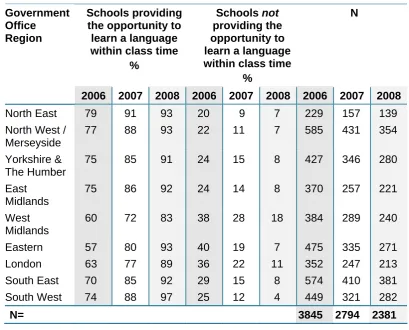
[image:21.595.102.512.250.580.2]The proportion of schools offering languages within class time8 had increased across all Government Office Regions since 2006 (see table 2.1). Of the nine regions, schools in the West Midlands appeared to be slightly less likely to offer the opportunity to learn a language within class time than schools in other regions, while almost all schools in the South West had language teaching provision within class time. Nonetheless, it should be noted that, in all regions, more than four in five schools provided timetabled language learning in 2008.
Table 2.1 Opportunity to learn a language/s within class time by GO Region
(weighted)
Schools providing the opportunity to learn a language within class time
%
Schools not providing the opportunity to learn a language within class time
%
N Government
Office Region
2006 2007 2008 2006 2007 2008 2006 2007 2008
North East 79 91 93 20 9 7 229 157 139
North West / Merseyside
77 88 93 22 11 7 585 431 354
Yorkshire & The Humber
75 85 91 24 15 8 427 346 280
East Midlands
75 86 92 24 14 8 370 257 221
West Midlands
60 72 83 38 28 18 384 289 240
Eastern 57 80 93 40 19 7 475 335 271
London 63 77 89 36 22 11 352 247 213
South East 70 85 92 29 15 8 574 410 381
South West 74 88 97 25 12 4 449 321 282
N= 3845 2794 2381
Source: Survey of primary schools, 2006-2008 A single response item
Non responses ranged between 0 and 4 per cent
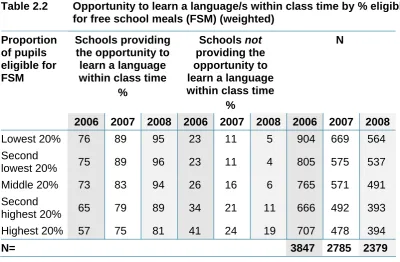
In all three surveys, schools9 facing more difficult circumstances (for example those in the top 20 per cent for free school meals (FSM) eligibility, or in the bottom 40 per cent
performance at KS2, see tables 2.2 and 2.3) tended to be less likely to offer a language within class time. Schools in the top three bands of KS2 attainment (middle, second highest and highest) were also significantly more likely to offer the opportunity to learn a language within class time than those schools in the lowest two bands. However, it should be noted that there was a considerable increase in the proportion of schools offering languages within class time for all groups across the three-year period.
for
7
Schools were not asked this in the 2007 nor the 2008 surveys. 8
Main sample weighted by the target sample to give a representative picture. 9
In all three years of the research, the levels of pupils with a statement of special educational needs (SEN) did not appear to have a significant impact on whether a school offered the opportunity to learn a language in class time.
Table 2.2 Opportunity to learn a language/s within class time by % eligible
for free school meals (FSM) (weighted)
Schools providing the opportunity to learn a language within class time
%
Schools not providing the opportunity to learn a language within class time
% N Proportion of pupils eligible for FSM
2006 2007 2008 2006 2007 2008 2006 2007 2008
Lowest 20% 76 89 95 23 11 5 904 669 564
Second
lowest 20% 75 89 96 23 11 4 805 575 537
Middle 20% 73 83 94 26 16 6 765 571 491
Second
highest 20% 65 79 89 34 21 11 666 492 393
Highest 20% 57 75 81 41 24 19 707 478 394
N= 3847 2785 2379
Source: Survey of primary schools, 2006-2008 A single response item
[image:22.595.100.521.446.700.2]Non responses ranged between 0 and 2 per cent
Table 2.3 Opportunity to learn a language/s within class time by attainment
(weighted)
Schools providing the opportunity to learn a language within class time
%
Schools not providing the opportunity to learn
a language within class time
%
N KS2 overall
performance
2006 2007 2008 2006 2007 2008 2006 2007 2008
Lowest band 56 72 84 43 27 16 634 421 348
Second
lowest band 66 80 87 32 20 13 664 479 385
Middle band 74 84 94 25 15 6 703 498 413
Second
highest band 74 87 96 25 13 4 690 527 466
Highest band 79 90 93 20 10 7 733 561 485
N= 3424 2485 2093
Source: Survey of primary schools, 2006-2008 A single response item
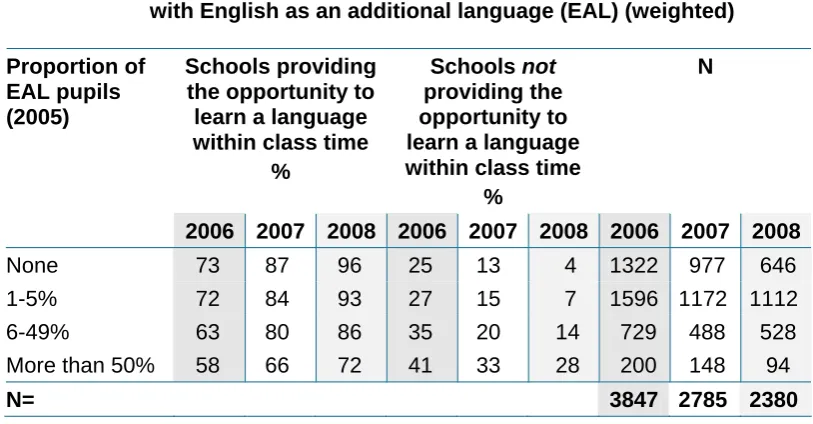
Schools10 with more than six per cent of pupils with English as an additional language (EAL) were less likely to offer pupils the opportunity to learn a language within class time. As illustrated in table 2.4, this was the case for all three years of the project. However, it should be noted that there was an increase in the proportion of schools providing the opportunity to learn a language across all bands between 2006 and 2008.
Table 2.4 Opportunity to learn a language/s within class time by % pupils
with English as an additional language (EAL) (weighted)
Schools providing the opportunity to learn a language within class time
%
Schools not providing the opportunity to learn a language within class time
%
N Proportion of
EAL pupils (2005)
2006 2007 2008 2006 2007 2008 2006 2007 2008
None 73 87 96 25 13 4 1322 977 646
1-5% 72 84 93 27 15 7 1596 1172 1112
6-49% 63 80 86 35 20 14 729 488 528
More than 50% 58 66 72 41 33 28 200 148 94
N= 3847 2785 2380
Source: Survey of primary schools, 2006-2008 A single response item
Non responses ranged between 0 and 2 per cent
2.1.1 Languages offered
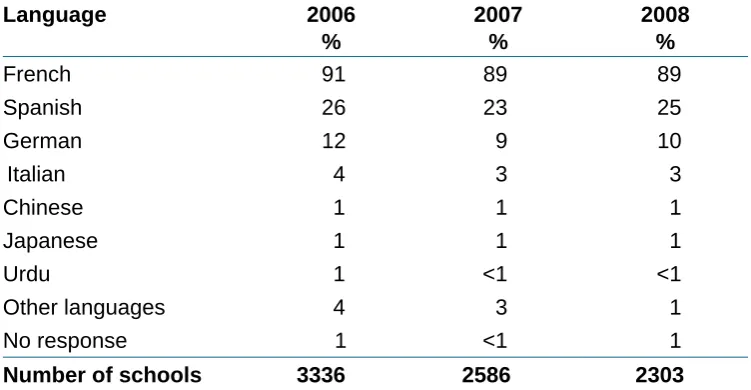
Schools were also asked about the range of languages they offered in class time in KS2 (see table 2.5). The languages on offer were very similar in all three years of the project; French was the most commonly offered language, available in around nine out of ten schools offering a language in class time at KS2. Spanish was also popular, offered by a quarter of schools teaching languages, while German was offered by 10 per cent of schools teaching languages A much smaller proportion of schools offered Italian, Chinese, Japanese and Urdu. In 2008, slightly fewer schools said that they offered languages other than those on the list provided, than in previous years. Other languages mentioned by a small number of schools in 2008 included Bengali, Latin, British Sign Language and Polish.
10
Table 2.5 Languages offered at KS2 in primary schools in England
Language 2006 %
2007 %
2008 %
French 91 89 89
Spanish 26 23 25
German 12 9 10
Italian 4 3 3
Chinese 1 1 1
Japanese 1 1 1
Urdu 1 <1 <1
Other languages 4 3 1
No response 1 <1 1
Number of schools 3336 2586 2303
Source: Survey of primary schools, 2006-2008 A multiple response item.
In 2008, three quarters of primary schools offered a single language within class time. Schools providing one language most commonly offered French (1,525, or 66 per cent), followed by Spanish (179 or eight per cent), German (18, or one per cent), and Italian (seven, or less than one per cent. A further 18 per cent offered two languages - the most common combination was French and Spanish. A minority of schools (six per cent) offered three or more languages.
As shown in table 2.6, in 2006, almost all responding local authorities were aware of French (99 per cent) and Spanish (98 per cent) being taught at KS2 in schools in their area.
German (82 per cent) and Italian (51 per cent) were also taught in many LAs, with Chinese taught in 24 per cent. Moving on two years, almost every local authority responding to the 2008 questionnaire said that they were aware of schools teaching French (99 per cent) or Spanish (96 per cent) at KS2, similar to 2006. However, the proportion of LAs aware of German, Italian, Japanese and Urdu being taught had decreased since 2006.11 In 2008, German was said to be taught in three quarters of local authorities, Italian in around two fifths (41 per cent) and Chinese in just under a quarter (24 per cent), indicating that while these languages were less commonly offered by schools (as shown in table 2.5 above), they were not confined to a few local authorities.
11
Table 2.6 Languages offered at KS2 in primary schools in England according to local authorities (LAs)
Language 2006 %
2008 %
French 99 99
Spanish 98 96
German 82 75
Italian 51 41
Chinese 24 24
Japanese 16 9
Urdu 14 7
No response 1 1
Number of local authorities 108 111
Source: Survey of local authorities, 2006 and 2008 A multiple response item.
The reasons why schools had chosen to offer a particular language were largely similar in 2006 and 2008, the two years of the study in which schools were asked about this. In 2008, teacher availability to deliver the chosen language was the most common reason why a particular language was offered by schools (83 per cent). Availability of resources for teaching that language (75 per cent) and consideration of the languages offered by local secondary and primary schools (72 per cent and 43 per cent respectively) also tended to influence primary schools’ choice of language. Support from the local authority for a particular language only influenced the choice of around a third of primary schools (32 per cent).
2.1.2 Changes in languages offered between 2006 and 2008
In 2008, schools were asked if they had stopped offering any languages, or introduced any languages since 2006 and about why there had been a change. Almost six in ten schools (59 per cent) had not made changes to the languages they offered since 2006, while around four in ten schools (38 per cent) said that they now offered different languages than in 2006.
Of the schools that said they offered different languages in 2008 than in 2006, eleven per cent had both introduced a new language and stopped offering a language. Eighty per cent had introduced a new language and nine per cent had stopped offering a language since 2006.
The most common reason for schools to stop offering languages was that the person that taught the language had left (32 per cent of schools that had stopped offering a language). Other reasons given typically included that the school had stopped offering that language as a club12 (10 per cent of schools that had stopped offering a language), although this might indicate that the language had previously been offered as a second language; that a language was dropped so that teachers could focus on delivering one (other) language; or that the support from the secondary school for this language was withdrawn (in both cases, eight per cent of schools that had stopped offering a language).
Meeting the entitlement for language provision at KS2 was the most common reason given by schools for the introduction of a new language (13 per cent of schools that had introduced a language). In these schools, it appears that they were not just introducing a ‘new’
language, but introducing taught languages where previously there were none. As one school explained: ‘It has only been introduced in the past two years to comply with government policy’.
Availability of staff able to teach a particular language, and increased staff expertise and confidence in teaching languages were also some of the reasons why some schools had introduced a new language (six per cent and four per cent of schools that had introduced a language respectively). Others said that they had introduced a new language as part of a club13 (six per cent of schools that had introduced a language), or to give children the opportunity to learn to speak a variety of languages (three per cent of schools that had introduced a language).
2.1.3 Aims of language teaching
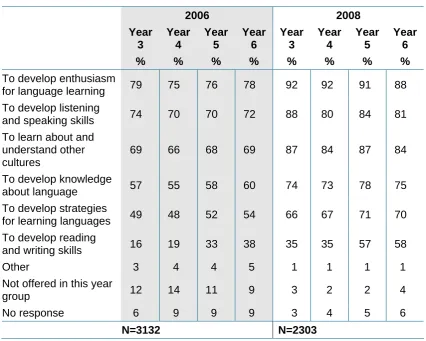
In 2008, it appeared that schools had more aims relating to language teaching than in 2006. As shown in table 2.7, the proportion of schools teaching languages that identified with each aim was higher in 2008 than in 2006. Developing an enthusiasm for learning languages remained the most common aim; ‘to develop listening and speaking skills’ and ‘to learn about and understand other cultures’ were also aims in many schools.
The study investigated whether schools might have different aims of language teaching and learning for different year groups. For most of the aims listed, schools14 did not differentiate between year groups; for example, in 2008, ‘to develop an enthusiasm for language learning’ was an aim for all four year groups in around nine in ten schools. However, in both 2006 and 2008, more schools reported that developing reading and writing skills was an aim for pupils in Years 5 and 6 than for pupils in Years 3 and 4. This was reflected in some schools’
comments about reasons for changes to their language teaching and learning aims since 2006; some of the schools said that there was more of a focus on reading and writing now, particularly for older year groups.
12
Although this reason was given by a number of schools, it should be noted that these clubs are likely to have been extra-curricular and not during class time.
13
Table 2.7 Main aims of primary language teaching and learning for KS2
2006 2008
Year 3
Year 4
Year 5
Year 6
Year 3
Year 4
Year 5
Year 6
% % % % % % % %
To develop enthusiasm
for language learning 79 75 76 78 92 92 91 88
To develop listening
and speaking skills 74 70 70 72 88 80 84 81
To learn about and understand other cultures
69 66 68 69 87 84 87 84
To develop knowledge
about language 57 55 58 60 74 73 78 75
To develop strategies
for learning languages 49 48 52 54 66 67 71 70
To develop reading
and writing skills 16 19 33 38 35 35 57 58
Other 3 4 4 5 1 1 1 1
Not offered in this year
group 12 14 11 9 3 2 2 4
No response 6 9 9 9 3 4 5 6
N=3132 N=2303
Source: Survey of primary schools, 2006 and 2008 A multiple response item
Data filtered to exclude schools that did not offer the opportunity to learn a language in class time in 2006
Most schools that had offered languages during class time for the duration of this research (from 2006 to 2008) said that their main aims of language teaching and learning had not changed since 2006 (76 per cent). Schools that did have different aims in 2008 gave a variety of reasons for the change. These included that some schools now used the
Department for Children, Schools and Families (DCSF) KS2 Framework for Languages, and that there was now more of a focus on cultural understanding.
2.1.4 Policy on provision
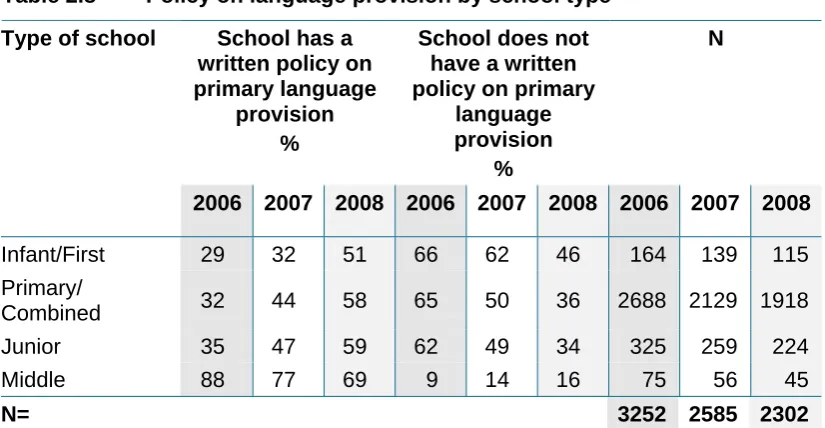
In 2008, almost three fifths of schools (58 per cent) said they had a written policy or
Table 2.8 Policy on language provision by school type
School has a written policy on primary language
provision %
School does not have a written policy on primary
language provision
%
N Type of school
2006 2007 2008 2006 2007 2008 2006 2007 2008
Infant/First 29 32 51 66 62 46 164 139 115
Primary/
Combined 32 44 58 65 50 36 2688 2129 1918
Junior 35 47 59 62 49 34 325 259 224
Middle 88 77 69 9 14 16 75 56 45
N= 3252 2585 2302
Source: Survey of primary schools, 2006-2008 A single response item
Between 1 and 7 per cent responded ‘don’t know’
Additional analysis revealed that those schools with a written policy on language provision were more confident of the sustainability of their current arrangements for teaching
languages than those schools without a written policy, and also that schools with a written policy were more likely to monitor and assess pupil progress in languages.
2.2 Proportion of pupils receiving language teaching
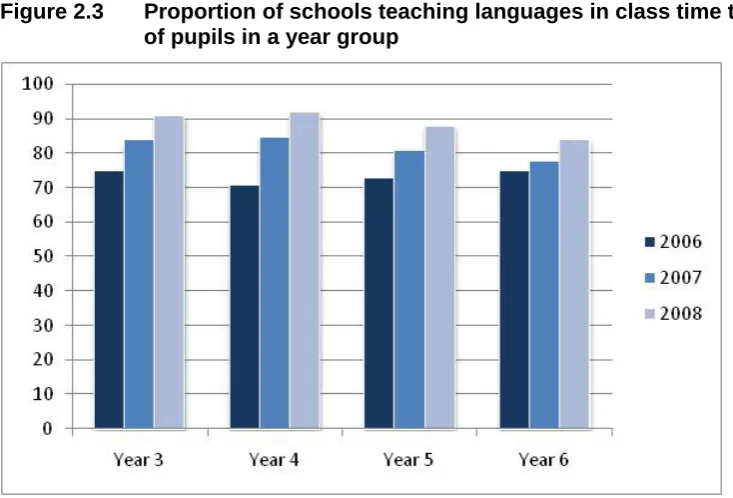
In all years of the project, schools were asked about the proportions of pupils that received some language teaching within class time for each year group. The baseline report (Driscoll et al., 2004) indicated that, in the 2002-03 academic year, the proportion of schools offering languages to all pupils in a year group ranged from 19 per cent for Year 3 pupils to 51 per cent for Year 6 pupils. By 2006, the first year of this study, around three quarters of schools that were teaching languages in class time did so for the whole year group and for all years in KS2 (see table 2.9). This indicates a considerable increase on the baseline study.
Table 2.9 Proportion of pupils taught languages within class time by year group
2006 2007 2008
Year 3 % Year 4 % Year 5 % Year 6 % Year 3 % Year 4 % Year 5 % Year 6 % Year 3 % Year 4 % Year 5 % Year 6 % Less than 100 %
10 11 10 8 7 7 8 8 4 3 4 5
100 % 75 71 73 75 84 85 81 78 91 92 88 84
Not
answered 15 17 17 17 9 8 12 14 6 5 8 11
N= 3132 2586 2303
Source: Survey of primary schools, 2006-2008 A single response item
Figure 2.3 Proportion of schools teaching languages in class time to 100%
of pupils in a year group
Source: Survey of primary schools, 2006-2008
2.3 Summary
The proportion of schools offering languages within class time increased for both the target sample and the main sample between 2006 and 2008, with more than nine in ten schools providing language teaching by 2008. Furthermore, the proportion of pupils within schools being taught languages increased from 2006 to 2008. In all three years of the research, factors such as the percentage of pupils eligible for free school meals, attainment at KS2 and the proportion of pupils with English as an additional language appeared to influence the likelihood of a school offering languages.
Schools appeared to have more aims associated with language teaching and learning in 2008 compared with 2006. The most common aims were around developing enthusiasm for language learning and learning about and understanding other cultures. Also, in 2008, more schools had a written policy on language provision than in 2006.
3. Delivery and resources
This chapter considers the delivery of primary languages at KS2, beginning with the current picture of which staff are teaching languages, their responsibilities and the support available to them. It then looks at the development over the survey period of class time provision and the amount of time available for language teaching, and considers school and LA
perceptions of their current arrangements. The final section examines the availability and use of resources.
3.1 Teaching staff and training support
3.1.1 Who is teaching languages?
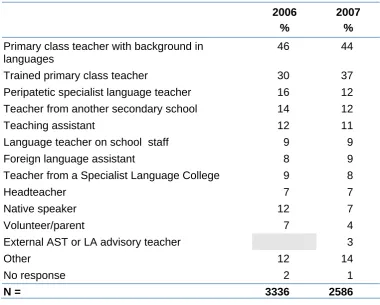
In the 2006 and 2007 school surveys, a question was asked to determine who was involved in teaching languages at KS2. The responses from the 2002-03 baseline survey (Driscoll et al., 2004) were used to develop a list of categories. The 2006 and 2007 responses showed that, most often, language teaching was undertaken by a class teacher with a background in languages (46 and 44 per cent respectively), or a class teacher who had received language training (30 and 37 per cent). Compared to the baseline data, which indicated that 41 per cent of language teaching was carried out by a class teacher, there had been an increase in the proportion of class teachers who were delivering languages.
[image:31.595.108.489.429.734.2]The 2006 and 2007 surveys also indicated the extent to which teachers and experts from outside the school were assisting language delivery. These included peripatetic specialist teachers (16 per cent in 2006 and 12 per cent in 2007); teachers from secondary schools (14 and 12 per cent respectively); teaching assistants (12 and 11 per cent respectively) and native speakers (12 per cent in 2006 and seven per cent in 2007) (see table 3.1).
Table 3.1 Who is currently providing language teaching?
2006 %
2007 %
Primary class teacher with background in languages
46 44
Trained primary class teacher 30 37
Peripatetic specialist language teacher 16 12
Teacher from another secondary school 14 12
Teaching assistant 12 11
Language teacher on school staff 9 9
Foreign language assistant 8 9
Teacher from a Specialist Language College 9 8
Headteacher 7 7
Native speaker 12 7
Volunteer/parent 7 4
External AST or LA advisory teacher 3
Other 12 14
No response 2 1
N = 3336 2586
Source: Survey of primary schools, 2006 and 2007 A multiple response item
However, it was not clear from the 2006 and 2007 surveys how many staff were involved in delivering languages in each school, or their language background. The 2008 survey
therefore included a new question which was intended to find out how many staff in a school were involved in delivering KS2 languages, and then to investigate the level of language qualification they had. Due to a high level of respondent error on this question, many of the responses were discounted. The question did, nevertheless, yield some useful information.
The median number of staff reported as teaching a language was three (there was a range from one in the 25th quartile to five in the 75th). Taking only those schools that answered the question correctly (1,594 schools), the following details (table 3.2) emerged on the nature of the language qualifications that these teachers had.
Table 3.2 Teacher language qualifications, 2008
% of schools with some staff in this category
% of schools with all staff in
this category
No language qualifications
No language qualification and no language training received
12 2
No language qualification, but training to develop pedagogy in languages
19 3
No language qualification, but training to develop language proficiency
16 3
No language qualification, but native speaker
14 3
Have language qualification
Language qualification below GCSE 4 <1
GCSE 38 5
A level/AS level 32 6
Degree 38 13
Postgraduate degree 5 <1
Newly qualified teacher (NQT) with specialism in primary languages
4 <1
Initial teacher training in primary languages* 4 <1
N = 1594
* Primary initial teacher training course with a specialism in primary languages
As the responses show, the proportion of schools where there were staff with training but no qualifications, or neither training nor qualifications, was quite high, but so was the proportion of schools where staff had a language degree. In fact, there were 13 per cent of schools reporting that all their staff teaching languages had a language degree.
In 2007, a question on whether schools had recruited staff who were graduates of a primary initial teacher training programme with a specialism in primary languages (not asked in 2006) had a largely negative response, with seven per cent answering yes.
School respondents in 2008 were also asked a new question on what the main
responsibilities of their language teachers were: 54 per cent were teaching their own class; 58 per cent were teaching other classes; 28 per cent were planning lessons for other classes; and 19 per cent were training colleagues (this was a multiple response item). Amongst the ‘other’ responses on responsibilities were references to releasing class teachers for planning, preparation and assessment (PPA) time (22 schools); acting as languages coordinator (nine schools); and being a specialist teacher taking all classes in KS2 (nine schools).
3.1.2 Support for language teaching and learning
In all three years of the study, local authorities and schools were asked about the type and extent of support provided for language teaching. Table 3.3 shows the LA responses from 2006 and 2008 to the same question on the support provided for language teaching in primary schools that was mostly funded by the LA.
Table 3.3 Support provided by LA for language teaching in primary schools
Mostly funded by LA 2006
%
2008
%
Primary languages adviser
Secondary languages adviser
Teachers from Specialist Language Colleges (SLCs)
Secondary teachers not from SLCs
60 32 27 35 64 24 31 32
Peripatetic teachers 5 12
Foreign language assistants
Native speakers
18
9
25
7
Pedagogical training 58 78
Linguistic training 50 71
Schemes of work 42 52
Website for LA support for primary language teaching
Other No response 29 19 9 55 46 6
N 108 111
Source:Survey of local authorities (LAs), 2006 and 2008 (the 2006 survey listed a range of other options in addition to a general ‘other’ category, whereas the 2008 survey simply asked for other support)
[image:33.595.112.513.414.712.2]There had been an increase in mostly-funded LA support in most of the areas listed, but particularly in pedagogical and linguistic training, and in website provision. There was a corresponding decline in partly-funded LA support (this has not been tabulated here as the numbers are small, but is available in the online appendix section).
Table 3.4 shows a comparison of responses for the two years in which LAs were asked about which primary languages they were able to support. Although French continued to have the highest level of support, Spanish was not far behind, while support for German had declined. The increase in support for Italian does not appear to be linked to any noticeable increase in the number of schools offering this language overall, but probably reflects local variations (as described below), while support for non-European languages had not changed a great deal. As in 2006, a minority of LAs in 2008 were providing support for other
[image:34.595.106.487.287.496.2]languages, ranging from European languages such as Polish and Greek, to world and community languages, such as Arabic, Bengali and Punjabi and minority British languages, such as Cornish.
Table 3.4 LA support for languages at primary school level
Language 2006
%
2008
%
French 100 98
German 82 69
Italian 22 30
Spanish 86 93
Chinese 12 11
Japanese 4 5
Urdu 6 4
Generic language teaching 49 41
N 108 111
Source: Survey of local authorities (LAs), 2006 and 2008
Support for languages, cross-tabulated by Government Office Region (based on the 2008 survey, table 3.5), revealed some interesting regional differences. For example, the East Midlands was the only region in which all local authorities offered support for German, while the lowest support for this language was in London (50 per cent of local authorities). The highest level of support for Italian (50 per cent) was in the Eastern region, but the lowest (11 per cent) was in the South East. In five regions, all local authorities provided support for Spanish and the lowest level was in the West Midlands, where 80 per cent of local authorities offered support. In terms of world and community languages, the Eastern region was the only one not providing any support for Chinese, while the East Midlands provided the highest level (33 per cent of local authorities), and more regions (five) provided support for Japanese than for Urdu (four regions), or Bengali (three regions).
Additional analysis was carried out to compare the proportions of schools in each GOR reporting that they teach each language, with the levels of support provided by LAs. This indicated that there appears to be little relationship between the languages offered by schools and the support available from their LAs. For example, only five per cent of schools in the East Midlands offered German, although there was 100 per cent LA support for
Spanish, only 16 per cent of the schools in that region offered it, whereas 33 per cent of the schools in the West Midlands did so, with an 80 per cent level of LA support.
Tables 3.5 and 3.6 show LA support for languages by GOR and proportions of schools offering the same languages by GOR.
Table 3.5 LA support for languages by GOR 2008
NE NW Y&H East Midlands
West Midlands
East London SE SW
% % % % % % % % %
French 100 100 100 100 90 100 96 100 100
German 80 71 83 100 60 88 50 78 62
Italian 20 41 17 17 40 50 31 11 31
Spanish 100 94 100 100 80 100 85 89 100
Chinese 10 12 8 33 20 8 11 8
Japanese 6 17 10 11 8
Urdu 5 8 4 11
Bengali 10 4 11
Other 12 22 8
No response
N 10 17 12 6 10 8 26 9 13
Source: Survey of local authorities (LAs), 2008 A multiple response item
[image:35.595.103.497.468.724.2]Blank cells indicate that there was no support provided for this language
Table 3.6 Schools offering each language by GOR 2008
NE NW Y&H East Midlands
West Midlands
East London SE SW
% % % % % % % % %
French 94 81 93 92 84 92 81 94 92
German 6 8 7 5 17 16 6 11 11
Italian 3 2 1 3 4 3 5 2 2
Spanish 16 31 23 18 33 27 30 20 23
Chinese 1 2 1 3 0 1 1 1
Japanese 1 1 1 2 0 1 2
Urdu 0 0 0 0 1
Bengali 1 0 11
Other 0 0 0 0 1 11 3 2
No
response 1 1 0 0 1 0 3 1 1
N 136 346 270 214 209 267 201 372 287
3.1.2.1 Standards Fund support
In 2007 and 2008, LAs were asked what proport