This is a repository copy of Exploring the Efficacy of Facebook Groups for Collective
Occupant Learning About Using Their Homes.
White Rose Research Online URL for this paper:
http://eprints.whiterose.ac.uk/120710/
Version: Accepted Version
Article:
Baborska-Narozny, M., Stirling, E. and Stevenson, F. orcid.org/0000-0002-8374-9687
(2017) Exploring the Efficacy of Facebook Groups for Collective Occupant Learning About
Using Their Homes. American Behavioral Scientist, 61 (7). pp. 757-773. ISSN 0002-7642
https://doi.org/10.1177/0002764217717566
[email protected]
https://eprints.whiterose.ac.uk/
Reuse
Unless indicated otherwise, fulltext items are protected by copyright with all rights reserved. The copyright
exception in section 29 of the Copyright, Designs and Patents Act 1988 allows the making of a single copy
solely for the purpose of non-commercial research or private study within the limits of fair dealing. The
publisher or other rights-holder may allow further reproduction and re-use of this version - refer to the White
Rose Research Online record for this item. Where records identify the publisher as the copyright holder,
users can verify any specific terms of use on the publisher’s website.
Takedown
If you consider content in White Rose Research Online to be in breach of UK law, please notify us by
Magdalena Baborska-Narozny
1, Eve Stirling
2and Fionn Stevenson
3 1 Faculty of Architecture, Wroclaw University of Science and Technology, Poland 2 Faculty of Arts, Computing, Engineering and Sciences, Sheffield Hallam University, UK 3 Sheffield School of Architecture, Sheffield University, UKExploring the efficacy of Facebook Groups for collective
occupant learning about using their homes.
in American Behavioural Scientist Vol 61, Issue 7, 2017
1.
INTRODUCTION
The need for quality learning about how to use a home has been an issue gradually emerging from building performance evaluation (BPE) studies carried out in occupied energy efficient homes (Brown & Cole, 2009;Day & Gunderson, 2014). The BPE gap between the internal environment control as intended by designers and the actual inhabitant practices is associated with unpredicted energy consumption and poor indoor air quality (Balvers et al., 2012). The key inhabitant related causes of the ‘performance gap’ are a discrepancy between user needs and design intentions, lack of user understanding and skills to interact with the available controls and insufficient maintenance. These findings indicate that modifying tacit home use practices, adjusting them to new, more technically advanced contexts, is still not sufficiently addressed by the current learning opportunities offered by the professional actors. This paper explores how self-organised closed Facebook Groups set up independently by the residents of two UK case study urban developments have become supportive environments for such learning. The efficacy of Facebook Groups in delivering quality learning in weak-tie communities is examined. Complex spatial, economic and social aspects of urban housing projects have generated extensive literature on the side-by-side rather than face-to-face character of urban interactions (Galster & Friedrichs, 2015) and the impact of the Internet and digital tools on community connectedness (Hampton & Wellman, 2003). There is however little research on how social media sites are deployed to overcome the difficulty in triggering connective action in such environments or examining whether social media are different from other digital tools. Facebook is a powerful digital organism with currently 1.18 billion daily active users (1.09 billion on mobile) average for September 2016 (Facebook, 2016).Two-thirds (65%) of online UK adults say they have a current social networking site profile with 95% of those using Facebook (Ofcom, 2016). A Facebook Group is usually a separate private, members’ only space within the interface of Facebook. A Facebook Group1 can be open (anyone can join, all posts shown in the Newsfeed), closed (anyone can ask to join but an administrator has
to accept them), or secret (members have to be invited and this will not show up in the Newsfeed) (Stirling, 2014).
The following section sets out the theoretical lens and key questions for the discussion, drawing upon collective efficacy theory, community of practice and home-use learning. Two case studies follow in sections three and four covering quantitative and qualitative analysis to understand the closed Facebook Groups activity and the emergent themes. Subsequent discussion under ‘power of the people’ and ‘power of the tool’ elaborates on the characteristics of each Group using the same digital tools but reaching varied level of collective efficacy. The article concludes with key insights and the challenges building industry actors would face when trying to deploy Facebook Group for enhanced home use learning.
2.
THEORETICAL CONTEXT
The following analysis ofFacebook Groups as collective learning environments in housing communities is underpinned by three key concepts: ‘Collective efficacy’, ‘community of practice’ and ‘best-practice home use’.
2.1 Collective efficacy
Collective efficacy refers to a form of human agency that acknowledges that achieving desired outcomes is only possible through the interdependent effort of engaged group members.
Sampson (2006) describes collective efficacy as moving the focus from the private realm to an ‘active’ neighbourhood. Collective efficacy describes a group capacity built on trust to collectively shape the reality they live in. In criminological research the term is applied neighbourhoods undertaking an effort to tackle crime (Sampson et al., 1997). It explains the resilient engagement of individuals in collective action but it is important to note that the engagement is situated and task specific. Support and cohesion are important in urban settings as they are about ‘repeated interactions’ (Sampson, 2006, p.153). Interestingly, social organization within neighbourhoods in urban environments does not require strong ties to be successful (Sampson, 2006), and thus weak-tie communities developing collective efficacy in relation to learning using Facebook are examined here.
The Internet is particularly useful for enhancing ‘information exchange’ between people in the same neighbourhood but only when used by heavy Internet users with ‘bridging ties’- i.e.: those individuals who have ‘weak ties across groups’ (Hampton, 2007). These people are the key actors in organizing collective action (Kavanaugh et al., 2005).
The use of email and web page interactions has been found to increase the size of the local weak-tie relationships with the Internet as the bridging tie (Hampton, 2007). The use of information and communications technology (ICT) as an organizing tool can also facilitate ‘community participation and collective action’ by mobilizing weak-tie networks (Hampton, 2003, p. 417). The theory of ‘critical mass’ compares chemical chain reactions with social processes. It focuses on the role of mobilising agents, and heterogeneity within the group in enabling them to develop positive responses towards the aims and challenges they face (Marwell & Oliver, 1993). The concept of ‘critical mass’ in collective action is useful when considering collective efficacy. When analysing a Facebook Group there is the need to consider such group dynamics understood as trends in the changes of its size, activity level and presence of ‘mobilising agents’ to understand if the group has reached the point when it is capable of achieving its collective goals.
2.2 Community of practice
When people repeatedly exchange information to develop collective action within a neighbourhood, this could be described as a ‘community of practice’. A community of practice is ‘a group of people who share a concern for something they do and learn how to do it better as they interact regularly’ (Wenger, 2015, p.1) with the key focus being on a conscious decision to develop shared resources relating to the practice. The learning how to do it better in the case of housing developments is situated (Lave, 1999) in the everyday lives of residents within their residential developments. The ‘shared concerns’ are mainly security, comfort and costs. In the UK residents generally move into same dwellings in a development in terms of fabric and technical systems. This creates an ideal context for knowledge sharing as all the residents have a comparable physical context which ‘prefigures practises’. These residents clearly have the potential to be members of a community of practice, however weak-ties often mean limited physical contact between them in their housing development. Fortunately, the use of Facebook can support a community of practice and facilitate ‘knowledge sharing and collaboration’ (Duncan & Barczyk, 2013, p.1). Facebook is thus a potential environment for a community of practice to emerge if collective efficacy is sought by the residents of weak-ties residential developments.
2.3 Best-practice in the home
Best-practice use of homes secures long term occupant comfort and health at the lowest economic and environmental cost. Defining best-practice for a specific physical and user context is a major challenge. Top-down efforts have been undertaken to disseminate best-best-practice advice in relation to the use of environmental controls in the home but their generic form means they are not context specific enough to be applicable. Home handover tours and user guides are intended to deliver bespoke information and skills yet these fail in many cases (Stevenson et al., 2013). Importantly, there is increasing use of portable devices such as smart phones and tablets in daily life (Stirling, 2015). Many people with high levels of social media use, come to depend on social media for information. These people may be described as having social media self-efficacy (Hocevar et al., 2014) and they find the opinions of those on social media to be trustworthy, and they relying on them when making decisions in their lives. However, the potential of a residential community of practice to develop collective learning using social media is not yet recognised within the building industry. Research into the influence of social interactions with others on social media is therefore important to understand how these can move beyond the digital to enable the learning capacity for improved home use.
Three research questions arise in relation to the case study Groups considering the above: 1. Does Facebook enable quality home use learning within weak-ties communities? 2. What are the characteristics of a Facebook Group that encourage the learning process?
3. How does the architecture of Facebook support Facebook Group efficacy as a learning environment?
3.
METHODS
A mixed methods case study approach was adopted (Yin, 2009) providing an overview of quantitative and in-depth qualitative data to understand the interactions and learning taking place within the two Facebook Groups. The Groups were studied from 2012 until 2016 (Baborska-Narozny et al., 2016). A transparent and ethical approach followed the AOIR current guidelines (Markham & Buchanan, 2012) with institutional ethical approval and access to the closed Groups facilitated through the Group administrators. The researchers explained to all Group members in both cases the aims, scope and methods of planned research actions for discussion and approval, before being invited to join the Group. All Group members were offered the chance to decline the researchers having access to the Groups - none did.
3.1 Case Study participants
3.2 Data collection
The first data download of Posts since inception was in September 2014 (n=2863 interactions (Posts) were downloaded for Group A and n=1312 for Group B from September 2012 to September 2014). The second data download took place in October 2016 following a three-month period for analysis (July 18th to October 18th). The download covered part of summer and autumn to pick up the thermal comfort issues, as these were expected to be a prominent theme in Group B. Downloads were carried out using NCapture in two formats: as .pdf files, as well as spreadsheet for analysis with NVivo. Quantitative content analysis was undertaken on the levels of activity, main actors and details of the postings. Qualitative content analysis of the posts was used to develop a coding framework which describes all Posts which had a subject of ‘home use learning’. Throughout the process the researchers shadowed Groups in a non-participatory way.
An in-depth building performance evaluation (BPE) carried out in the development B preceded and underpinned the scope of research. It enabled the authors access to Group B and subsequent identification and access to Group A driven by interest in the role Facebook might play in occupant learning about using their homes. The BPE provided a rich understanding of the home use issues experienced by the occupants as well as the performance characteristics of the fabric and systems (Baborska-Narozny et al., 2017). The research funded by the EU within Marie Curie Fellowship scheme (BuPESA project), involved design, construction, commissioning and handover stages audit followed by repeated meter readings (electricity and water) and physical monitoring of 18 occupied apartments: their internal temperatures, relative humidity and carbon dioxide over a period of one year. Home visits every seven weeks allowed downloading data from the monitoring sensors and carrying out questionnaires, interviews and walk through with detailed notes taken from each visit. The overall aim was to understand building in-use performance against design assumptions as well as occupant practises, satisfaction and skills to control the internal environment in their apartments. In case A, the information on home use issues was retrieved through interviews which focused on occupant satisfaction with their apartments complemented with an on-site visit with a walk through. All this information provided sufficient background for a qualitative evaluation of the reliability of answers delivered by each Group in respect to home use learning.
4.
DATA ANALYSIS AND FINDINGS
The quantitative data is first analysed in terms of the dynamics of the Groups over the three months of activity and the overall engagement in home use learning themes. This is then compared with initial Group dynamic data taken from the 2012-2014 data sample. Secondly, drawing on qualitative content analysis the home use issues present within the Facebook Group activity are analysed.
4.1
The Dynamics of the Groups
Quantitative information about the Group dynamics, level and spread of activity across each Group was retrieved to evaluate success indicators related to the concept of critical mass (Marwell & Oliver, 1993).
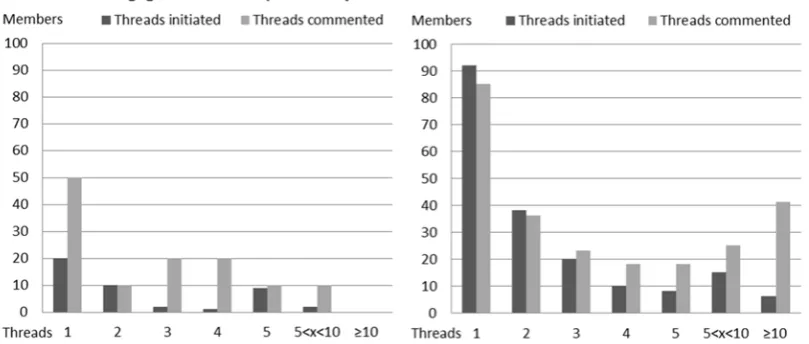
[image:4.595.44.454.520.715.2]In terms of size and activity level it was established that Group B, although only two and a half times bigger than Group A, generated almost ten times higher levels of activity (threads initiated). It also engaged a higher proportion of the Group members: overall 81% (B) compared to 65% (A) (Table 1). In Group B the ten most active members responded to more than twenty threads initiated by others with an outlier responding to 64 threads within the three month period considered. For the same timespan Group A’s most active member responded to eight threads. Significantly in both Groups well over 90% of threads got more than two replies and on average members commented on more threads than they initiated (Figure 1). This suggests that a member initiating a thread could expect to get an answer from the Group. In both Groups more than half of those who initiated threads had done it more than once and this suggests that they perceived this additional activity as worthwhile. In case ‘B’ the Group was repeatedly praised as a great asset for the development on various occasions by different members. One member advised someone weighing up the pros and cons of moving in: ‘It is well worth [it] for the Facebook Group alone’ (M1).
Table 1. Interaction dynamics across Group A & B over July 18th – October 18th 2016
July 18th – October 18th 2016 Group A Group B
Threads …initiated 109 972
…commented ( >2 replies) 102 912
…with images or videos (in theme - home use learning). 4 38
Members …total number (as for 18th Oct 2016) 184 466
…posting during the three months analysed 92 (51%) 286 (61%)
…posting beyond the three months analysed 132 (55%) 318 (66%)
…active at some point (during or beyond the analysed three months) 119 (65%) 377 (81%) Active
members …who initiated or commented on home use related threads (42% of active) 50 (68% of active)253
Mean no. of threads initiated 0.9 3.4
Mean no. of threads commented 2.7 4.4
Max. no. of threads initiated 6 13
Figure 1. Member posting engagement in Group A and B activity within three months period: 18th July-18th October 2016.
Longitudinal analysis indicates that Group A experienced a drop in the number of posts within a two year period 2014-2016 while Group B had an almost fourfold increase (Table 2). This could be only partially explained by 264 new members added to Group B within this period as Group A also grew, though only 60 new members joined (124 vs. 184). Crucially a qualitative analysis based on understanding of the context revealed the reliability and capacity of answers to solve issues raised in the home use related posts. In Group A, helpful but generic and superficial answers prevailed; for example, providing a link to a manual but without any further explanation. In Group B, bespoke answers were more common with pictures and even purpose made ‘DIY’ videos or offers of direct help. Seemingly, a vicious circle of lower engagement across Group A led to perceived lower collective efficacy of the Group which prevented more residents from turning to the Group to seek helpful information or devoting time to produce precise answers. However, as this is not an experimental study, this hypothesis remains unconfirmed. Another explaining factor could be a much lower turnover of residents in the development A as the majority of dwellings were privately owned. In Group B the vast majority of apartments were rented thus a lot of Group activity is related to members’ mobility. Indeed the decision of the initial leaders in Group B to devote a lot of their private time and social media efficacy in order to involve as many residents as possible was motivated by the will to protect their investment in the development and prevent the degradation they had started observing. In an interview they stated that weak ties and low rate of the residents’ involvement in tackling community issues increased the risk of anti-social behaviour that could potentially be counteracted by collective efficacy achieved through the Facebook Group. There is a more detailed analysis of Groups development in 2012-2014 in Baborska-Narozny et al., 2016.
Table 2: Longitudinal comparison of the average number of posts per year relating to: Home use issues Threads initiated
Group A Group Ba Group B
2012 2013 2014 2016* 2012 2013 2014 2016*
569 1019 640 436* 40 15 1054 3924* *No. of threads initiated extrapolated from data until 18th October 2016.
4.2
Home use learning themes
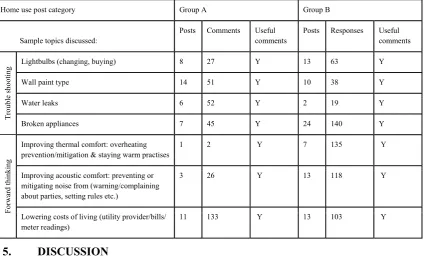
Two categories of ‘home use learning’ threads analysed from July- October 2016 were identified as a result of qualitative content analysis. Firstly, questions related to a specific issue with fabric, system, or appliance failure. These ‘troubleshooting’ threads sought advice on fixing, professional help contact, borrowing tools, etc. Another category, involving open questions seeking advice on best practise home use usually related to comfort or high cost issues experienced, was coded as ‘forward thinking’. It involved reciprocally sharing the experiences of tackling specific issues raised by others e.g. overheating mitigation or efficient heating, and evaluating their effectiveness (Table 3). The first category engaged a few answers on average that either:
indicated where to find the solution (link to a manual, web page, professional help) – most common in Group A
instructed how to solve the problem – common in Group B
offered direct help in solving the problem – common in Group B
The ‘troubleshooting’ threads were well handled by both Groups. In particular the advice and help offered in Group B actually solved the issues raised. Qualitative analysis of all the threads revealed that positive feedback, e.g. ‘All sorted, thanks’, was often posted in both Groups, reinforcing the perception of their collective efficacy. In many cases a conversation initiated as public switched to ‘private messaging’ level when members exchanged details like phone or apartment numbers to further cooperation initiated on Facebook. The ‘forward thinking’ category was strongly present in Group B with high engagement, often with over 20 comments in a single thread. This is where the community of practice can be best observed. These comments involved justifying one’s own practices by describing their perceived benefits
.
This allowed residents to better understand the different scenarios possible within a specific fabric and systems context. [image:6.595.50.475.274.539.2]It also helped the residents to grasp patterns of shared issues depending on the location of dwellings with the building. For example, a post ‘How do people keep the apartments warm without it costing a fortune? I don't want to spend £250 extra in electric bills like last year’ got 26 comments with some triggering ‘sub-comments’ involving 20 Group members. Such a discussion exposed a whole spectrum of practices. Unusually, one commenter replied, ‘We never use our heaters. We light a ton of candles instead. It makes you feel warmer’. There were many different heating solutions revealed in the comments (e.g. not using heating unless the temperature inside dropped below 13-14ºC), from advice to install curtains and keep them closed, to close air vents and door air gaps, put on lots of warm clothes, change electricity provider, get an oil heater as a more efficient heating option or even ‘Buy a friendly animal or hot water bottle’. The thread closed with a comment from the person who put the question forward: ‘Thanks for all your help - much appreciated’ indicating possible learning.
Table 3: Examples of types of Post content themed by troubleshooting or forward thinking behaviour
Home use post category Group A Group B
Sample topics discussed: Posts Comments Useful comments Posts Responses Useful comments
Tr
oubl
e
sh
oot
ing
Lightbulbs (changing, buying) 8 27 Y 13 63 Y
Wall paint type 14 51 Y 10 38 Y
Water leaks 6 52 Y 2 19 Y
Broken appliances 7 45 Y 24 140 Y
Forw
ar
d t
hi
nki
ng
Improving thermal comfort: overheating
prevention/mitigation & staying warm practises 1 2 Y 7 135 Y
Improving acoustic comfort: preventing or mitigating noise from (warning/complaining about parties, setting rules etc.)
3 26 Y 13 118 Y
Lowering costs of living (utility provider/bills/
meter readings) 11 133 Y 13 103 Y
5.
DISCUSSION
5.1
Facebook Group efficacy
Perhaps the greatest potential of a Facebook Group lies in its capacity to empower a small group through mass exposure to the interested others through the use of pre-existing communication platform. In case of home use learning this is of particular importance as the tacit flaws in one’s own practises are a major obstacle in triggering change towards ‘best practice’. The Group efficacy is revealed through an analysis covering the timing of Posts and Comments: for home use issues most answers came within an hour. The following sections discuss two particular success factors: the Group members’ engagement (the power of people) and the functionality of Facebook (the power of tool).
5.2
The power of people
had functioned without a focused engagement of any resident over two years and was relatively defunct, with only 40 members and as few as 15 posts per annum in 2013 (B1 in Table 2). After the three residents committed themselves to drive up participation in the Group tit started growing rapidly. Interestingly in case B a parallel dedicated open Facebook Group has been set up by the developer with all those who owned or rented apartments becoming members. The open activity was almost entirely driven by the developer with minimum involvement of the 400+ members, who rarely used it, and then only as a complaint board. This shows that the combination of a tool (Facebook) and the members themselves is not enough to stimulate activity. It took a lot of effort from the ‘mobilising agents’ (Marwell & Oliver, 1993) for the bottom up in Group B to reach those same 400 members, but as they were part of the Group intentionally they saw it as a genuine mutual support environment and not a marketing tool with a corporate agenda. This is a major challenge when considering Facebook as a tool for home use learning that could be embraced by the building industry. Members first need to feel safe and valued in their contribution to the Group. There was a reoccurring struggle in both Groups when aggressive comments were made. Interestingly in Group A members often private messaged the key member to complain about feeling offended. In Group B the discussions on tensions were open, with those defending Group environment as a positive space for support gradually taking over. This feeling of a hard won and valued environment is the underlying reason for a higher quality engagement from Group B members. These members delivered more supportive answers and so a virtuous cycle was created when more people were grateful and so engaged, while those observing saw it as a useful, supportive learning environment and came up with their own questions. When new members gradually joined in they adjusted to the positive attitude. If explicitly awkward comments were made members quickly reacted, e.g. ‘Grow up mate I had a genuine query and your comments are not very helpful. Keyboard warrior’. Group A had not built such a strong commitment to the Group and a lot of comments were of the ‘read the instructions’ type. However the frequent home use related posts suggest that members found the Group environment a primary reference point for troubleshooting. For example, the loss of TV signal during the 2013 Wimbledon international tennis tournament prompted 127 posts over a 10 day period.
A unique learning opportunity was created when many long threads involved consenting reciprocal insights into home use practices, otherwise always hidden by the privacy of homes. As the physical context of the dwellings was comparable the knowledge and skills of others’ were easily transferable across the development whenever the needs and expectations also matched. Also the array of experiences presented was much richer than a home user guide content, including coping with extreme weather events, system failure or user expectations considerably different than assumed at design stage.
The main risk of this learning environment is the risk of missing out on important factors that should be brought into discussion from health and safety point of view. This is exemplified by the poor indoor air quality in a dwelling with ‘tons of candles’ lit and all air inlets sealed and most likely the continuous mechanical ventilation switched off, as this was a common issue in development B (Baborska-Narozny & Stevenson, 2017). The risk involved in seeking advice within a non-expert Facebook Group as a home learning environment needs to be understood by the Group members as the advice shared there should be both:
trusted as it had been tested and worked for other Group members,
taken with caution as those sharing it can be wrong or forget to mention something important.
There is no equivalency between peoples’ perceived capacity to give good home use related advice based on own experience and the objective quality of such guidance evaluated against criteria such as design model assumptions, healthy indoor environment, etc. The safe way to tackle the risk of a mismatch between the two would be to have engaged members who have high level of understanding of the less pronounced but nevertheless important impacts of certain home use practices.
Where Groups on social media platforms are effective as learning environments they are likely to depend on knowledgeable members who are able to support the interactions of others during the process (Mao, 2014). In the case of home use learning a Group would certainly benefit from having a moderator (not necessarily the administrator) who could support the discussions and feedback to see that all members benefit from the interactions. The earlier mentioned risk of misinformation dissemination could also be minimised. Such a role was collectively covered in Group B to a certain extent through the high number of comments that sometimes clarified incorrect answers.
5.3
The power of the tool
65% members were active in Group A and 81% in Group B. The continued use of these Groups by a large number of residents indicates that this platform is useful to them. Facebook is an efficient platform for connecting and engaging at one’s own pace and preferred intensity, without the dynamics of face-to-face personal interaction, and is perceived by residents as a great advantage over traditional meetings. To facilitate this, the ‘tools’ of the Facebook Group consist of the Group interface, a ‘search bar’, ‘Wall’ and ‘listed members’. These spaces for interaction along with the Notification function (a ‘call to action’ that ensures members repeatedly return to the Group space) offer members the ability to search prior Posts, ask questions to others members and share experiences with their fellow neighbours switching to private messaging option if they choose. It is worth noting, posts made in Facebook Groups do not always show up in users’ Newsfeeds, rather they would be highlighted through the Group notification setting, of which members can opt out of if they desire. What Facebook appears to offer what other digital tools in the past (Hampton & Wellman, 2003) could not, is its ubiquitous nature in society as well as reach of use into the physical environment through smartphones and photos. Although somewhat limited, our analyses of the more detailed and supportive responses showed learning, within the Groups where Comments were supplemented by the use of photographs or videos. This use of visual tools for comparing problems provides a deeper learning opportunity when trying to understand challenging home issues like interacting with controls. These features enable good quality learning to take place and shared Comments help residents to learn from the experiences of others, thus growing the community of practice.
face-to-face situation. It is important to note that this ‘safe environment’ is monitored by the Group administrators and this ensures the self-regulation of the issues and behavioural norms (Öngün & Demirağ, 2014; Sampson, 2006). This Group ‘surveillance’ view can be exacerbated by the ‘always-on’ nature of Facebook (Stirling, 2015) and could be viewed as the Facebook Group shaping residents’ interactions and bringing self-regulation to the fore, in ways that would not happen in solely face-to-face communication.
There is a need for local communities to develop methods of communication that disseminate knowledge to others and thus help to empower them through learning and adopting new practices (Seyfang et al., 2013). The Facebook case study here is a good example. The dynamics of Facebook have also developed other interactions beyond the digital space and encouraged communication practices in the physical environment of the residential development.
The increased and longitudinal continued use of these two Groups, by the residents could be linked to the rise in popularity of the sharing economy (Harmari et al., 2015). There are similarities between the collective nature of learning and the sharing economy. The peer to peer activity approach which involves the sharing of services through ‘community-based online services’ (ibid., p.2047) can help to understand the popularity of collective action and learning that makes a difference to a local community and brings in the benefit of an increased ‘pool of knowledge’ and mutual support. The move from top down management to ‘bottom up’ collaborative exchange is a key function of a community of practice (Wenger, 2015). Internet facilitated sharing and collective learning are both possible within the parameters of a closed Facebook Group although this comes with a warning of ‘you are what you can access’ and ‘you are what you share’ (Belk, 2014, p.1599), privileging those within the residential development who can, or choose to engage within the digital Group over those who cannot.
6.
CONCLUSIONS
This longitudinal study of two Facebook Groups explored how their collective efficacy enabled home use learning among members. Both Groups members successfully engaged in solving home use issues. The respective Facebook threads were identified as falling into either ‘trouble shooting’ or ‘forward thinking’ categories. Environmental issues were brought into discussions but more members focused on the financial strains. The ‘power of the people’ shows that Facebook enables quality home use learning within weak-ties communities. The ‘forward thinking’ threads are examples of Facebook Group working as a community of practice (Wenger, 2015), where improvement is sought through sharing and discussing own home use experience. A comparison of each Group’s development and their dynamics revealed differences that were linked with more pronounced presence of the ‘forward thinking’ threads in Group B. The cases support an earlier finding that identity formation in Facebook serves as a social lubricant, encouraging individuals to convert latent to weak ties and enabling them to broadcast requests for support or information (Ellison et al., 2011). Each Group offered a structure for individuals to engage in collective action but it is important to note that the engagement was situated and task specific. Active members shared information but rarely moved towards stronger ties in face-to-face life. Facebook allowed its users to preserve a clear distinction between their Facebook identity and daily privacy. This meant that a weak ties community remained as such but was still enabled to collectively solve individual issues. In both Groups, initiatives and questions asked were not trivialised by others and from that trust has been built between the Groups’ members. This made the individual engagement worthwhile – showing tangible results from digital discussions. This form of collective efficacy supported the community through the repeated interactions (Sampson, 2006). The ‘power of the tool’ shows that the architecture of Facebook supports Facebook Group efficacy as a learning environment. Communication was facilitated through Facebook interface of ‘search bar’, Wall, listed members and private messaging option. These ‘tools’ scaffold the community of practice, within a private space and enable residents to share their experiences, learn and support one another when others’ experience similar situations in comparable physical context of their dwellings.
Facebook proved to work well for both developments as a digital collective home use learning environment. Crucially, key actors within each Group had high level of social media self-efficacy (Hocevar et al., 2014) and were known for transparent and tactful way of tackling issues affecting the community. Their dedicated voluntary engagement proved essential for shaping the Groups to become self-managing entities. The role of such mobilising agents in triggering Facebook activity seems to be a major challenge for professional attempts to efficiently deploy Facebook for enhanced home use learning. Tackling this challenge would be highly beneficial as current learning environments for home use learning (home handover tours or home users’ guides) prove to be insufficient to pass on the understanding and skills needed for best practice home use.
7.
ACKNOWLEDGMENTS
The authors gratefully acknowledge the generous time given by the occupants involved in these case studies. Previous version of this article was presented at the International Conference on Social Media and Society in London, UK 2016.
8.
REFERENCES
Baborska-Narozny, M., Stirling, E., & Stevenson, F. (2016). Exploring the relationship between a ‘Facebook group’and face-to-face interactions in ‘weak-tie’residential communities. In A. Gruzd, J. Jacobson, P. Mai, E. Ruppert, & D. Murthy (Eds.), SMSociety ‘16 Proceedings of the 7th International Conference on Social Media & Society, London (pp. 156-163). NY: ACM.
Baborska-Narozny, M., Stevenson, F. & Grudzinska M. (2017). Overheating in retrofitted flats: occupant practices, learning and interventions. Building Research & Information, 45(1-2), 40-59.
Baborska-Narozny, M. & Stevenson, F. (2017). Mechanical ventilation in housing: understanding in-use issues, Engineering Sustainability, 170(1), 33-46.
Balvers, J., Bogers, R., Jongeneel, R. et al. (2012). Mechanical ventilation in recently built Dutch homes: technical shortcomings, possibilities for improvement, perceived indoor environment and health effects. Architectural Science Review,55(1), 4-14.
Belk, R. (2014). You are what you can access: Sharing and collaborative consumption online. Journal of Business Research, 67(8),
1595-1600.
Information, 37(3), 227-245.
Day, J., Gunderson, D. (2014). Understanding high performance buildings: The link between occupant knowledge of passive design systems, corresponding behaviours, occupant comfort and environmental satistafaction. Building and Environment,84, 114-124 .
Duncan, D. G., & Barczyk, C. C. (2013). Facebook in the university classroom: do students perceive that it enhances community of practice and sense of community? International Journal of Business and Social Science, 4(3), 1-14.
Ellison, N. B., Steinfield, C., & Lampe, C. (2011). Connection strategies: Social capital implications of Facebook-enabled communication practices. New Media & Society,13(6), 873-892.
Facebook (2016) Stats Available from: http://newsroom.fb.com/company-info/).
Galster, G.C., Friedrichs, J. (2015). The Dialectic of Neighbourhood Social Mix: Editors' Introduction to the Special Issue. Housing Studies, 30(2), 175-191.
Granovetter, M.S. (1973). The Strength of Weak Ties. American Journal of Sociology, 78(6), 1360-1380.
Hamari, J., Sjöklint, M., & Ukkonen, A. (2015). The sharing economy: Why people participate in collaborative consumption. Journal of the Association for Information Science and Technology, 67(9), 2047-2059.
Hampton, K. N. (2007). Neighborhoods in the Network Society the e-Neighbors study. Information, Communication & Society, 10(5),
714-748.
Hampton, K. N. (2003). Grieving for a lost network: collective action in a wired suburb special issue: ICTs and community networking. The Information Society, 19(5), 417-428.
Hampton, K. and Wellman, B. (2003). Neighboring in Netville: How the Internet supports community and social capital in a wired suburb. City & Community, 2(4), 277-311.
Hocevar, K. P., Flanagin, A. J., & Metzger, M. J. (2014). Social media self-efficacy and information evaluation online. Computers in Human Behavior, 39, 254-262.
Kavanaugh, A. L., Reese, D. D., Carroll, J. M., & Rosson, M. B. (2005). Weak ties in networked communities. The Information Society, 21(2), 119-131.
Kraut, R.E., Fiore A.T. (2014). The role of founders in building online groups, Proceedings of the ACM Conference on Computer Supported Cooperative Work. NY: ACM. pp. 722-732.
Kim, Y.C., Ball-Rokeach, S.J. (2006). Civic engagement From a Communication Infrastructure Perspective. Communication Theory,16, 173-197.
Lave, J. (1991). Situating learning in communities of practice. Perspectives on Socially Shared Cognition, 2, 63-82.
Mao, J. (2014). Social media for learning: A mixed methods study on high school students’ technology affordances and perspectives. Computers in Human Behavior, 33, 213-223.
Marwell, G., & Oliver, P. (1993). The critical mass and the problem of collective action. Cambridge University Press, Cambridge, UK. Ofcom (2016). Adults Media Use and Attitudes. Available from:
https://www.ofcom.org.uk/__data/assets/pdf_file/0026/80828/2016-adults-media-use-and-attitudes.pdf?lang=uqovrjuc
Öngün, E. & Demirağ, A. (2014). Are We Digital Masters or Captives? A Critical Evaluation of Panoptic Versus Synoptic Effect of Surveillance in Social Media. Journal of Media Critiques, 1, 27-42.
Quiñones-García, C., & Korak-Kakabadse, N. (2014). Compulsive internet use in adults: A study of prevalence and drivers within the current economic climate in the UK. Computers in Human Behavior, 30, 171-180.
Sampson, R. J. (2006). Collective efficacy theory: Lessons learned and directions for future inquiry. In F.T. Cullen, J.P. Wright & K.R. Blevins (Eds.) Taking stock: The Status of Criminological Theory, Vol.15 (pp. 149-167), New Brunswick, NY: Transactions Publishers.
Sampson, R. J., Raudenbush, S. W., & Earls, F. (1997). Neighborhoods and violent crime: A multilevel study of collective efficacy. Science, 277(5328), 918-924.
Seyfang, G., Park, J., & Smith, A. (2013). A thousand flowers blooming? An examination of community energy in the UK. Energy Policy, 61, 977-989.
Stirling, E. (2014). ‘We use Facebook Chat in Lectures of course!’ Exploring the use of a Facebook Group by first-year undergraduate students for social and academic support. In M. Kent & T. Leaver (Eds.) An Education in Facebook? Higher Education and the World’s Largest Social Network (pp. 23-31). London, UK: Routledge.
Stirling, E. (2015). ‘I’m always on Facebook!’ Exploring Facebook as a mainstream research tool and ethnographic site. In H. Snee, C. Hine, Y. Morey, S. Roberts & H. Watson (Eds.) Digital Methods for Social Sciences: An Interdisciplinary guide to research innovation (pp.51-66). Basingstoke: Palgrave MacMillan.
Stevenson, F., Carmona-Andreu, I., & Hancock, M. (2013). The usability of control interfaces in low-carbon housing. Architectural Science Review, 56, 70-82.
Wenger-Trayner, E., & Wenger-Trayner B. (2015). Communities of practice: A brief introduction. Available at: http://wenger-trayner.com/introduction-to-communities-of-practice/ [last accessed 20.04.2017]