White Rose Research Online URL for this paper:
http://eprints.whiterose.ac.uk/103380/
Version: Accepted Version
Article:
Allsop, MJ orcid.org/0000-0002-7399-0194, Kite, S, McDermott, S et al. (3 more authors)
(2017) Electronic palliative care coordination systems: Devising and testing a methodology
for evaluating documentation. Palliative Medicine, 31 (5). pp. 475-482. ISSN 0269-2163
https://doi.org/10.1177/0269216316663881
© 2016, the Author(s). This is an author produced version of a paper accepted for
publication in Palliative Medicine. Uploaded in accordance with the publisher's
self-archiving policy.
[email protected] https://eprints.whiterose.ac.uk/ Reuse
Unless indicated otherwise, fulltext items are protected by copyright with all rights reserved. The copyright exception in section 29 of the Copyright, Designs and Patents Act 1988 allows the making of a single copy solely for the purpose of non-commercial research or private study within the limits of fair dealing. The publisher or other rights-holder may allow further reproduction and re-use of this version - refer to the White Rose Research Online record for this item. Where records identify the publisher as the copyright holder, users can verify any specific terms of use on the publisher’s website.
Takedown
If you consider content in White Rose Research Online to be in breach of UK law, please notify us by
Title: Electronic Palliative Care Co-Ordination Systems (EPaCCS): devising and testing a
methodology for evaluating documentation
Short title: Evaluation of Electronic Palliative Care Co-Ordination Systems
Matthew J Allsop*1, Suzanne Kite2, Sarah McDermott3, Naomi Penn4, Pablo Millares-Martin5, Michael
I Bennett1
Affiliations: 1 = Leeds Institute of Health Sciences, University of Leeds, UK; 2 = Leeds Teaching
Hospitals NHS Trust, Leeds, UK; 3 = Leeds Community Healthcare NHS Trust, Leeds, UK; 4 = Leeds
South and East Clinical Commissioning Group, Leeds, UK; 5 = Leeds West Clinical Commissioning
Group, Leeds, UK.
* = Corresponding author: Matthew Allsop, Leeds Institute of Health Sciences, University of Leeds,
Leeds, LS2 9LJ. Email: [email protected]. Telephone contact: 0044 113 3434 185
Abstract
Background: The need to improve co-ordination of care at end of life has driven Electronic Palliative
Care Coordination Systems (EPaCCS) implementation across the UK and internationally. No
approaches for evaluating EPaCCS use in practice have been developed.
Aim: This study outlines and applies an evaluation framework for examining how and when electronic
documentation of ACP is occurring in end of life care services.
Design: A pragmatic, formative process evaluation approach was adopted. The evaluation drew on
the Project Review and Objective Evaluation (PROBE) methodology to guide the evaluation
framework design, focusing on clinical processes.
Setting/participants: Data were extracted from EPaCCS for 82 of 108 general practices across a
large UK city. All deaths (n = 1,229) recorded on EPaCCS between April 2014 – March 2015 were
included to determine the proportion of all deaths recorded, median number of days prior to death that
key information was recorded and observations about routine data use.
Results: The evaluation identified 26.8% of all deaths recorded on EPaCCS. The median number of
days to death was calculated for initiation of an EPaCCS record (31 days), recording a patient’s
preferred place of death (8 days), and entry of DNACPR decisions (34 days). Where preferred and
actual place of death was documented, these were matching for 75% of patients. Anomalies were
identified in coding used during data entry on EPaCCS.
Conclusions: This study reports the first methodology for evaluating how and when EPaCCS
documentation is occurring. It raises questions about what can be drawn from routine data collected
through EPaCCS and outlines considerations for future evaluation. Future evaluations should
What is already known about the topic?
Government policy is promoting the use of electronic documentation of advance care
planning (ACP) discussions
Electronic Palliative Care Coordination Systems (EPaCCS) are being implemented
internationally to facilitate electronic ACP but no approaches to evaluating their use have
been developed
What this paper adds?
This paper presents an evaluation framework for EPaCCS which details methods for
assessing how and when electronic documentation of end of life care preferences are taking
place
Application of the presented EPaCCS evaluation framework can be used to explore system
use and inform service improvement strategies
Implications for practice, theory or policy?
Government policy in the UK and internationally outlines the need to enhance documentation
of end of life care preferences, with electronic systems facilitating storage and sharing of
these data
The presented framework can support appropriate evaluation of emerging electronic systems
for advance care planning documentation, supporting both implementation and subsequent
Keywords
Palliative care, electronic palliative care coordination systems, advance care planning, end of life care,
Introduction
Advance care planning (ACP) is the process of discussion with a person and their families or carers
about the wishes and preferences for the future of the person and the care to be received. Such
discussions may inform care at a time when the person is unable to make decisions for themselves.
Integrating ACP into end of life care communication and decision making has been associated with
higher quality of life for patients and their families, lower health care costs, less aggressive medical
care near death and earlier hospice referrals (1, 2). The United Kingdom (UK) is currently a leading
proponent for developing electronic systems that facilitate documentation and sharing of patient
preferences for end of life care (3). Arising from UK government policy outlining the need to improve
co-ordination of care at end of life (4), summaries of preferences are stored in patient electronic
medical records. They detail patient preferences from ACP discussions with the aim of being
accessible to all health professionals involved in a patient’s care (5). These summaries are referred to
as Electronic Palliative Care Coordination Systems (EPaCCS)(6, 7) in England and Wales, and
Electronic Palliative Care Summary (ePCS) (3) in Scotland and Northern Ireland. The approach is not
limited to the UK, with similar approaches documented in the US (8, 9) and Australia (10).
Adopting an approach to end of life care that includes an EPaCCS is designed to ensure people
receive appropriate treatment and care from any health and social care professional they encounter.
For health professionals, EPaCCS seeks to ensure effective handover of information between
professionals (without duplication), improve continuity of care, and prevent deaths in hospital where
this was not the person’s preferred place of death (11). Current UK policy continues to encourage the
use of electronic systems to improve coordination of care at end of life (12) and acknowledges the
potential value of an EPaCCS approach (13, 14). Reported benefits to health services from EPaCCS
use include more people being supported to die in their preferred place of death, decreases in deaths
in the hospital setting and increases in home, care home and hospice deaths, alongside potential
savings and increased efficiencies (15, 16). However, evidence of benefits stem from indirect
evaluation of EPaCCS through surveying of regional health authorities and commissioners (15) or
extracting basic locality data to inform cost estimates and performance (16).
With recent UK policy outlining an expectation that all electronic systems for sharing health related
EPaCCS approach is required. Evaluation can directly inform UK-wide approaches to electronic
documentation of ACP and has relevance for similar models emerging internationally. This study
outlines the first evaluation framework for examining how and when electronic documentation of ACP
is occurring in end of life care services.
Method
Context
The EPaCCS project in Leeds was initiated as part of a UK Department of Health funded pilot in 2009
– 2011. A dedicated local team subsequently continued with the roll-out of EPaCCS across Leeds
City with the additional support of project management from the Yorkshire and Humber
Commissioning Support (YHCS) from August 2013. EPaCCS development completed on 31st March
2015 and has been included on both electronic patient record systems used in Leeds; SystmOne and
EMIS Web. In Leeds, EPaCCS is designed to enable community-based palliative care providers to
enter and review end of life care preferences in a patient’s medical record. An EPaCCS record is
accessed through an 8-page template that can be found in a patient’s medical record. A template is a
structured form that dictates categories of information to include and, where information is not entered
in free text, will link responses to existing clinical codes. The template includes core content
recommended nationally for use in EPaCCS by the Information Standard Board for End of Life Care
Co-ordination (ISB 1580) (19). Data items included in the template are outlined in Figure 1. An
EPaCCS template can be initiated in a patient’s record by either the GP of a patient, a community
nurse, or a member of a community palliative care team. The record is then designed to be
continually updated following any ACP discussions with patients to ensure that wishes expressed on
the system are relevant and up-to-date for a patient. Components of the template are currently used
to inform clinical practice in Leeds. For example, prognostic estimates can be recorded via patient
templates to guide the management of patients at a practice level, focusing often on patients with a
short prognosis of <30 days to ensure that essential care and support is in place for a patient and
their family.
Approach
This evaluation falls within a period shortly after all practices in Leeds had been inducted with
EPaCCS through training, and after a year of all primary care practices in Leeds using EPaCCS.
Flexible evaluation designs and methodologies that can accommodate real world complexities are
essential for supporting policymakers and practitioners (20). They can be used to understand and
capture the realities of what is occurring in practice and enable response through effective
intervention. A pragmatic, formative process evaluation approach was adopted to explore EPaCCS
use in this study; shortly after system roll out into clinical practice. The evaluation used the PROBE
(Project Review and Objective Evaluation) methodology(21) to guide the design of a framework for
evaluating the EPaCCS system. PROBE was developed for use in IT projects and in particular those
involving electronic patient records and electronic health records projects. It has been used widely
across the UK, including as part of UK Department of Health electronic record development
programmes(22). It encourages adoption of an approach where evaluation is undertaken formatively
in parallel with system implementation, rather than in response to system issues. The PROBE
evaluation hierarchy comprises four levels, each level dependent upon the success of its predecessor.
An evaluation should seek to ensure that the realisation of each level is adequately met. The
EPaCCS team in Leeds reported that technical testing and usability work had occurred prior to the
evaluation; clinical processes were the focus of this study. The most elusive and complex challenge,
the evaluation of clinical outcomes, such as improved clinical decisions, will be a subsequent piece of
work.
Figure 2: The Leeds EPaCCS Programme Evaluation Hierarchy
Methodology
The project was approached as a formative evaluation, helping to detect problems and inform the
re-design of the EPaCCS programme in Leeds. Data that had been routinely collected in SystmOne and
EMIS via the EPaCCS template were exported by YHCS. For each patient, where recorded, the
following fields were extracted with a date that information was added to a record: age, sex, ethnicity,
preferred place of death, actual place of death, and prognosis grouping. For the following items, only
data on the date of entry into a record was exported, indicating inclusion of information into the field
medication record, Do Not Attempt Cardiopulmonary Resuscitation (DNACPR) decision, and a
summary record of carer data. Data were extracted for all patient records where the patient had died
from 1st April 2014 – 31st March 2015. Data were provided in four quarters across this time period,
aligned with quarterly reporting processes in Leeds that had been evolving during 2014 - 2015.
Summary data were also provided on the number of all deaths in Leeds during the same period.
Obtained data were anonymised, with a unique patient ID provided for use during analysis. Ethics
approval was granted from NHS ethics (15/SC/0325) through an application via the Integrated
Research Application System.
Analysis
The analysis adopted an approach that can be replicated by local EPaCCS teams, utilising data
captured by the system. We calculated the proportion of patients who had died with an EPaCCS
record from all patients who died during the study period, and the proportions of patients with
completed items within their EPaCCS record (preferred place of death, DNACPR, carer assessment
completion). This method was chosen to indicate the extent of EPaCCS use by health professionals
encountering patients with chronic conditions at end of life alongside how the EPaCCS template was
being used. We then calculated median time, from time of entry on EPaCCS of ACP activity to the
patient’s death for items contained on the EPaCCS record. This can be used to provide an indication
of when data were being entered on EPaCCS in relation to a patient’s death. Only Leeds practices
using SystmOne data (n = 82/108 practices) were included in the analysis. Analysis of training data
identified EMIS practices as being engaged with training at a late stage in the schedule (see Figure 3)
linked to delays with integrating an EPaCCS template into EMIS systems. At the time of the study,
data extraction for EMIS practices was being developed, so limited only to number of deaths at EMIS
practices and the number of patients with an EPaCCS record at death during the study year. All
analysis was carried out using SPSS 22 software.
Figure 3: Outline of training schedule across all Leeds practices, including pilot work in
January 2011. The shaded area outlines the period from which EPaCCS data was drawn for
Results
Patients who died in Leeds from April 2014 – March 2015 with an EPaCCS record in a SystmOne
practice were included in the analysis (n = 1,229). The median age at death for EPaCCS patients was
80 years old, with a range of 15 – 104 years. 639 (52%) records were female patients and 590 (48%)
male. Age-adjusted profiles of ethnicity identified 82.9% of patients aged between 15 – 64 years old
were registered on EPaCCS as “White British”or “British or mixed British”, with missing ethnicity data
for 4.7% of patients, and the remainder distributed across eight ethnic categories. For patients aged
65 years and older, 88.5% were coded as “White British”, there was missing ethnicity data for 6.0% of
patients, and the remainder were distributed across ten ethnic categories. Overall, the black, minority
and ethnic communities in Leeds account for 18.9% of the resident population (23).
Proportion of deaths recorded on EPaCCS
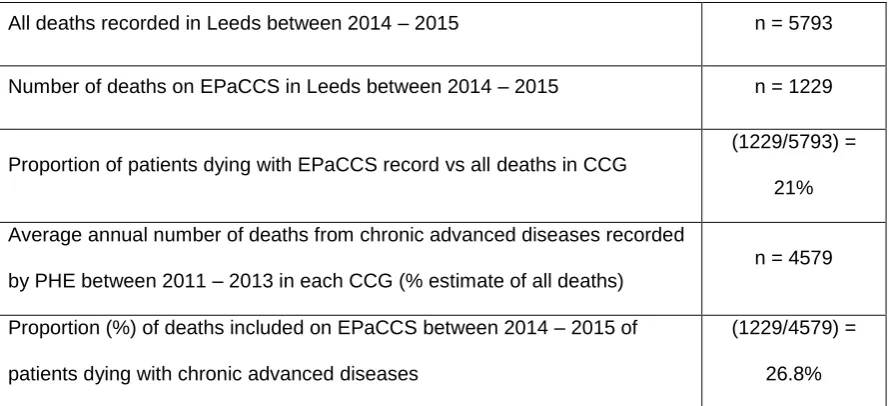
Across Leeds, 5,793 patients died during the study period. Of these, 21% (n = 1,229) had an
EPaCCS record in place at death. Data on all deaths in Leeds included all emergency and acute
cases, alongside deaths from chronic conditions. EPaCCS is designed for use in the management of
chronic advanced diseases; all deaths data are not an accurate benchmark to compare EPaCCS
performance against. We judged that Public Health England (PHE) data on average number of deaths
with underlying cause of cancer, circulatory, respiratory is a more appropriate metric for
understanding the proportion of patients who might be suitable for registration on EPaCCS. Across
Table 1: Proportion of patients with an EPaCCS template in place at death in Leeds
All deaths recorded in Leeds between 2014 – 2015 n = 5793
Number of deaths on EPaCCS in Leeds between 2014 – 2015 n = 1229
Proportion of patients dying with EPaCCS record vs all deaths in CCG
(1229/5793) =
21%
Average annual number of deaths from chronic advanced diseases recorded
by PHE between 2011 – 2013 in each CCG (% estimate of all deaths)
n = 4579
Proportion (%) of deaths included on EPaCCS between 2014 – 2015 of
patients dying with chronic advanced diseases
(1229/4579) =
26.8%
Figure 4 depicts the documentation of discussions occurring by median times across Leeds. Both
OOH forms and DNACPR records are reported prior to an EPaCCS record being created, and
preferred place of death is initially recorded on a patient’s record a median time of 8 days prior to
death. For all data there were instances of information being entered after a patient’s death.
Figure 4: Overview of median time to death of items added to an EPaCCS record in Leeds
Of the records where preferred place of death was recorded (n = 1,202), the largest proportion of
patients (n = 666, 55%) stated an initial preference to die at home. Other recorded preferences
included hospice (n = 305, 25%), care home (n = 225, 19%), and hospital (n = 6). For records where
preferred and actual place of death was recorded (n = 1,200), 896 (75%) patient records had
matching preferred and actual places of death, with 304 (25%) patients having a different preferred
and actual place of death recorded. The proportion of patients achieving their preferred place of death
varied where preference was for home (431/664 patients, 65%), hospice (253/305 patients, 83%),
care and residential homes (207/225 patients, 92%) and hospital (5/6 patients, 83%).
Additional data from EPaCCS records, where recorded, included carer assessments which were
completed a median of 47 days prior to death (n = 61; range -5 to 348 days) and the assignment of a
The analysis utilised routinely collected data entered into electronic medical records using UK READ
Codes Clinical Terms Version 3 (a coded thesaurus of clinical terms used for data entry in electronic
systems). Issues encountered with the data included crossover and ambiguity in categories for
ethnicity, registration of patients to a CCG being linked to where an EPaCCS was initiated and not
specifying where end of life care was received specific to a Leeds CCG, and duplication in the coding
available for small number of fields. Duplication occurred for recording preferred place of death (both
‘(XaJ3h) Preferred place of death: home’ and ‘(Y105f) Preferred place of death: home (first choice)’)
and actual place of death (‘9495 Patient died in hospital’ and ‘8HG.. Died in hospital’). Anomalies
were also present for coding of actual place of death, where a range of unspecified codes were
present in the data (‘(Xaafy) Patient died in usual place of residence’, ‘(XaEKH) Place of death’,
‘(XaJ2g) Patient died in community hospital’ and ‘(XE2xp) Patient died - to record place’). The use of
exported structured data limited narrative around processes of care, relating to items such as
recording of anticipatory medication prescribing and the extent of data recorded about carers.
Discussion
An evaluation framework was applied to data captured through an EPaCCS to explore how and when
electronic documentation of ACP occurs in a large UK city. The evaluation identified that just over one
quarter of patients dying of cancer, circulatory and respiratory diseases had an EPaCCS record in
place prior to death. This was often initiated within a month prior to death, with around three quarters
of all patients achieving a stated preference for place of death. There was wide variation in both the
number of data items completed as part of patient EPaCCS records and the number of days prior to
death that fields were completed. During pilot testing of EPaCCS, sites identified 12 months as an
appropriate length of time for patients to have a template established. This was not achieved for most
patients, highlighting a need to reconsider the expectations of EPaCCS and how these can be aligned
with clinical practice. Additionally, key information (DNACPR status and out-of-hours forms) was being
recorded on patient records prior to an EPaCCS template being initiated. There is a need for further
enquiry into the way in which health professionals are interacting with EPaCCS.
This is the first reported application of an evaluation framework on routinely captured EPaCCS data. It
development of end of life services where electronic ACP is occurring. The evaluation outlines a
process for identifying the extent of EPaCCS data entry and how broader datasets, such as those
from Public Health England, can be used to gauge the likely extent of patients requiring an EPaCCS
record. The approach also demonstrates how EPaCCS data can inform at what stage an EPaCCS is
being initiated for end of life care patients and how records reflect attainment of patient preferences
for care. Limitations to the study included the variation in completeness of data that were extracted
from electronic medical records, with exclusion of data from a small proportion of general practices
using EMIS in Leeds. Interpretation of findings should be mindful of concurrent initiatives that were
taking place alongside EPaCCS implementation that may have influenced data entered by community
practitioners. For example, two initiatives in 2010-12 involved training senior community nurses in
Leeds to complete DNACPR forms and the implementation of a single regional form for recording a
patient’s DNACPR wishes.
In England, there is an expectation at policy level for end of life care to involve communication and
information for patients and their families and carers to tailor support appropriate to their preferences
(14). Considered implementation of electronic systems to facilitate sharing of ACP outcomes can form
part of a system-wide commitment to patient-centred care and may be more likely to lead to
improvements than a reliance solely on specialist palliative care consultations (24). EPaCCS research
literature to date consists mostly of descriptions of the systems themselves, how they have been used,
and the experience of those implementing them (3, 25-27). However, despite the importance of
evaluation in implementation, no clear processes or guidance has been generated for use with
EPaCCS.
The framework adopted in this study has relevance both pre- and post-implementation, with a focus
on clinical processes leading to the identification of practical considerations for future evaluation and
interpretation of data captured via an EPaCCS. An EPaCCS record can only be assumed to hold the
most recently documented preference of a patient, but these may change in advanced disease and
may not always be updated on a patient’s record. While many patients were identified as achieving
their documented preferred place of death, the proportion who achieved their actual preference is
impossible to ascertain from data currently collected. In this study, while many patients likely had
each item evaluated. The composition of health professionals using EPaCCS should also be
considered in the interpretation of an EPaCCS evaluation. Just under half of all patients had a
preferred place of death recorded as hospice or care home. This may reflect greater use of EPaCCS
by hospice-based clinical nurse specialists or a disproportionate representation of general
practitioners and district nurses that visit care homes using EPaCCS. The inclusion of health
professional engagement in future evaluations is suggested to enhance understanding and
[image:14.595.69.530.245.772.2]interpretation of findings.
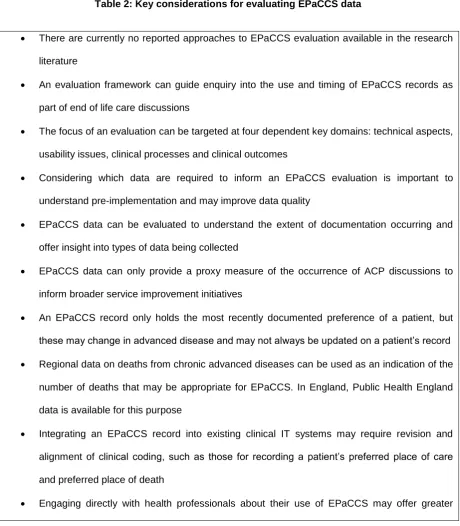
Table 2: Key considerations for evaluating EPaCCS data
There are currently no reported approaches to EPaCCS evaluation available in the research
literature
An evaluation framework can guide enquiry into the use and timing of EPaCCS records as
part of end of life care discussions
The focus of an evaluation can be targeted at four dependent key domains: technical aspects,
usability issues, clinical processes and clinical outcomes
Considering which data are required to inform an EPaCCS evaluation is important to
understand pre-implementation and may improve data quality
EPaCCS data can be evaluated to understand the extent of documentation occurring and
offer insight into types of data being collected
EPaCCS data can only provide a proxy measure of the occurrence of ACP discussions to
inform broader service improvement initiatives
An EPaCCS record only holds the most recently documented preference of a patient, but
these may change in advanced disease and may not always be updated on a patient’s record
Regional data on deaths from chronic advanced diseases can be used as an indication of the
number of deaths that may be appropriate for EPaCCS. In England, Public Health England
data is available for this purpose
Integrating an EPaCCS record into existing clinical IT systems may require revision and
alignment of clinical coding, such as those for recording a patient’s preferred place of care
and preferred place of death
insight into the role of electronic systems as part of ACP and documentation
EPaCCS is an emerging approach to documenting end of life care preferences;
understanding the patient and caregiver perspectives on consent and information sharing is
essential to ensure effective ACP supported by electronic systems
The development of electronic systems to support sharing of end of life care preferences continues to
be highlighted in national policy documentation. This study sets an important benchmark for what is
occurring at the level of a large UK city – such granular data has not been reported in detail to date. It
also raises a discussion about what can be drawn from routine data collected as part of an electronic
system to facilitate ACP. While there are caveats to consider when interpreting routinely collected
clinical data, the evaluation approach outlined in this study can be used to explore usage of EPaCCS
locally, supporting the construction of a national picture of practice around EPaCCS use. Future
EPaCCS development may benefit from considering the work processes surrounding EPaCCS use by
health professionals, and how such systems can be incorporated into complex and time pressured
clinical workflows (28). For example, recent qualitative work has highlighted insufficient time,
cumbersome technology, and a reluctance to label patients as ‘end of life’ as some of the barriers
influencing EPaCCS use by health professionals (29). Similarly, understanding how patients and
families can be supported to fully understand and participate in ACP could inform how their broader
priorities (aside from those relating to place of care and death) could, where appropriate, be reflected
in an EPaCCS record. These developments should occur while continuing to explore the most
Funding
This research was funded by NHS South and East Leeds Clinical Commissioning Group.
Acknowledgements
The authors acknowledge support of Yorkshire and Humber Commissioning Support (YHCS) who
provided data searches and extraction for the evaluation.
Conflict of interest
References