MORPHOLOGY AND GROWTH OF METHYL STEARATE AS A FUNCTION OF CRYSTALLISATION ENVIRONMENT
Diana M. Camachoa, Kevin J. Robertsa*, Frans Mullera, Danielle Thomasa, Iain Moreb Ken Lewtasb,c,
[a] Institute of Particle Science and Engineering, School of Chemical and Process
Engineering, University of Leeds, Leeds, LS2 9JT, UK
[b] Infineum UK Ltd, Milton Hill Business and Technology Centre, Abingdom, OX13 6BB,
UK
[c] Current address: Lewtas Science & Technologies Ltd., Oxford, OX2 , UK
Keywords: Biodiesel cold-flow behaviour, crystal growth kinetics and mechanism,
morphological indexing, methyl esters, solvent effect, phase contrast, in-situ microscopy
*Corresponding author
ABSTRACT
Additional and more detailed materials are provided as a supplement to the paper with the
above title. It includes:
1. Description of the methodology used to solve crystal morphology.
2. The complete set of planes delivered through the prediction of the BFDH morphology
for methyl stearate crystals using three different sets of unit cell parameters. These
planes are organised in groups and analysed using common zone axes methods to
identify the most rational crystal lattice and morphology.
3. Derivation of models expressions for the assessment of the dependence of single faces
growth rates on supersaturation .
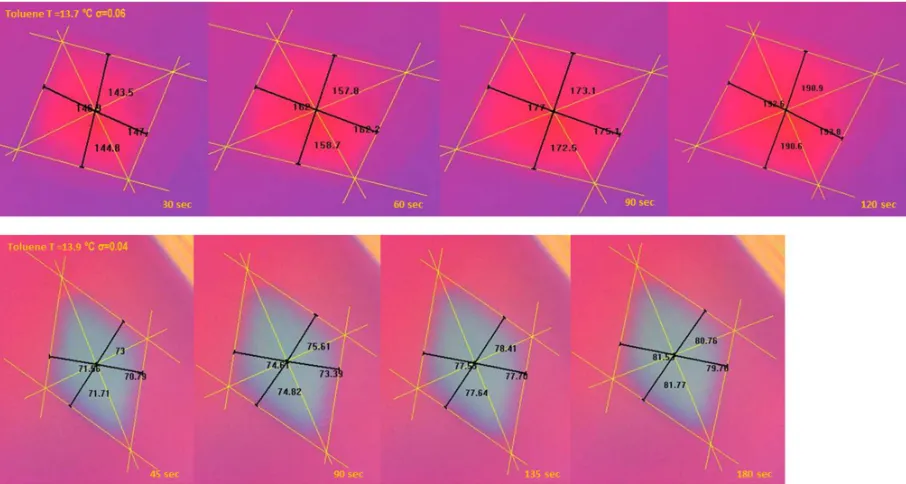
4. A sequence of images of methyl stearate crystals growing with time in three different
representative diesel type solvents.
1. Description of the methodology used to solve crystal morphology
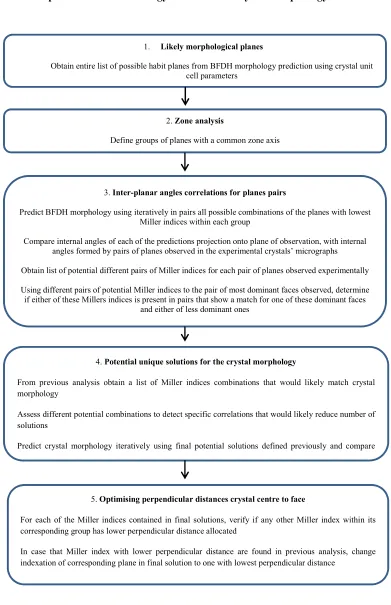
Fig. 1 Flow chart describing the procedure to follow for the morphology indexation of observed n-docosane crystals, using iterative predictions of the BFDH morphology “Reproduced from D.M. Camacho, K.J. Roberts, K. Lewtas, I. More. The crystal morphology and growth rates of triclinic n-docosane crystallising from n-dodecane solutions, Journal of Crystal Growth, 416 (2015) 47-56”.
4. Potential unique solutions for the crystal morphology
From previous analysis obtain a list of Miller indices combinations that would likely match crystal morphology
Assess different potential combinations to detect specific correlations that would likely reduce number of solutions
Predict crystal morphology iteratively using final potential solutions defined previously and compare 3. Inter-planar angles correlations for planes pairs
Predict BFDH morphology using iteratively in pairs all possible combinations of the planes with lowest Miller indices within each group
Compare internal angles of each of the predictions projection onto plane of observation, with internal angles formed by pairs of planes observed in the experimental crystals’ micrographs
Obtain list of potential different pairs of Miller indices for each pair of planes observed experimentally
Using different pairs of potential Miller indices to the pair of most dominant faces observed, determine if either of these Millers indices is present in pairs that show a match for one of these dominant faces
and either of less dominant ones 2. Zone analysis
Define groups of planes with a common zone axis
1. Likely morphological planes
Obtain entire list of possible habit planes from BFDH morphology prediction using crystal unit cell parameters
5. Optimising perpendicular distances crystal centre to face
For each of the Miller indices contained in final solutions, verify if any other Miller index within its corresponding group has lower perpendicular distance allocated
2. The complete set of planes delivered through the prediction of the BFDH morphology for methyl stearate crystals using three different sets of unit cell parameters
• Complete set of planes delivered by the prediction of the BFDH morphology for
orthorhombic methyl stearate crystals according to C.H. MacGillavry and M.
Wolthuis-Spuy, 1970. These planes are organised in nine different groups defined by
zone axis analysis.
Group 1/Zone axis [100]
hkl Mult dhkl Distance
{ 0 1 1} 4 7.33 13.64
{ 0 1 3} 4 7.16 13.96
{ 0 2 0} 2 3.68 27.20
{ 0 2 4} 4 3.63 27.52
{ 0 3 1} 4 2.45 40.81
{ 0 4 2} 4 1.84 54.43
{ 0 4 6} 4 1.83 54.76
{ 0 6 4} 4 1.22 81.70
Group 2/Zone axis [1-10]
hkl Mult dhkl Distance
{ 1 1 1} 8 4.46 22.44
{ 1 1 2} 8 4.44 22.51
{ 1 1 3} 8 4.42 22.63
{ 2 2 0} 4 2.23 44.82
{ 2 2 1} 8 2.23 44.84
{ 2 2 3} 8 2.23 44.94
{ 3 3 1} 8 1.49 67.24
{ 3 3 2} 8 1.49 67.27
Group 3/Zone axis [2-10]
hkl Mult dhkl Distance
{ 1 2 1} 8 3.07 32.53
{ 1 2 2} 8 3.07 32.58
{ 1 2 3} 8 3.06 32.66
Group 4/Zone axis [3-10]
hkl Mult dhkl Distance
{ 1 3 1} 8 2.25 44.53
{ 1 3 2} 8 2.24 44.56
{ 1 3 3} 8 2.24 44.63
{ 2 6 0} 4 1.12 89.03
Group 5/Zone axis [0-10]
hkl Mult dhkl Distance
{ 2 0 0} 2 2.81 35.63
{ 2 0 1} 4 2.81 35.65
{ 2 0 2} 4 2.80 35.69
{ 2 0 3} 4 2.80 35.77
{ 2 0 4} 4 2.79 35.88
{ 2 0 6} 4 2.76 36.19
{ 6 0 2} 4 0.94 106.92
{ 6 0 4} 4 0.93 106.98
Group 6/Zone axis [1-20]
hkl Mult dhkl Distance
{ 2 1 1} 8 2.62 38.15
{ 2 1 2} 8 2.62 38.20
{ 2 1 3} 8 2.61 38.27
{ 4 2 0} 4 1.31 76.28
Group 7/Zone axis [3-20]
hkl Mult dhkl Distance
{ 2 3 1} 8 1.85 54.17
{ 2 3 2} 8 1.84 54.21
{ 2 3 3} 8 1.84 54.26
{ 4 6 0} 4 0.92 108.33
hkl Mult dhkl Distance
{ 3 1 1} 8 1.81 55.16
{ 3 1 2} 8 1.81 55.19
{ 3 1 3} 8 1.81 55.24
{ 6 2 0} 4 0.91 110.30
Group 9/Zone axis [2-30]
hkl Mult dhkl Distance
{ 3 2 0} 4 1.67 59.97
{ 3 2 1} 8 1.67 59.98
{ 3 2 2} 8 1.67 60.01
{ 3 2 3} 8 1.67 60.05
• Complete set of planes delivered by the prediction of the BFDH morphology for
monoclinic 2/ methyl stearate crystals according to S. Aleby, E. von Sydow, 1960. These
planes are organised innine different groups defined by zone axis analysis.
Group 1/Zone axis [100]
hkl Mult dhkl Distance
{ 0 1 1} 4 7.31 13.68
{ 0 1 3} 4 7.14 14.00
{ 0 2 0} 2 3.67 27.29
{ 0 2 4} 4 3.62 27.61
{ 0 3 1} 4 2.44 40.94
{ 0 4 2} 4 1.83 54.61
{ 0 4 6} 4 1.82 54.93
{ 0 6 4} 4 1.22 81.96
Group 2/Zone axis [1-10]
hkl Mult dhkl Distance
{ 1 1 1} 4 4.07 24.59
{ 1 1 3} 4 3.92 25.52
{ 1 1 -1} 4 4.20 23.81
{ 1 1 -3} 4 4.31 23.20
{ 2 2 0} 4 2.07 48.37
{ 2 2 4} 4 2.00 50.08
{ 3 3 1} 4 1.37 72.95
{ 3 3 -1} 4 1.39 72.16
{ 4 4 2} 4 1.03 97.53
{ 4 4 6} 4 1.01 99.25
{ 4 4 -2} 4 1.04 95.97
{ 4 4 -6} 4 1.06 94.57
{ 6 6 4} 4 0.68 146.71
{ 6 6 -4} 4 0.70 143.58
Group 3/Zone axis [2-10]
hkl Mult dhkl Distance
{ 1 2 0} 4 2.96 33.81
{ 1 2 2} 4 2.90 34.43
{ 1 2 -2} 4 3.00 33.31
{ 2 4 2} 4 1.47 68.21
{ 2 4 6} 4 1.44 69.56
{ 2 4 -2} 4 1.49 67.09
{ 2 4 -6} 4 1.51 66.22
Group 4/Zone axis [3-10]
hkl Mult dhkl Distance
{ 1 3 1} 4 2.19 45.76
{ 1 3 3} 4 2.16 46.26
{ 1 3 -1} 4 2.21 45.34
{ 1 3 -3} 4 2.22 45.02
{ 2 6 0} 4 1.10 91.08
{ 2 6 4} 4 1.09 92.00
{ 2 6 -4} 4 1.11 90.34
Group 5/Zone axis [0-10]
hkl Mult dhkl Distance
{ 2 0 0} 2 2.50 39.93
{ 2 0 2} 2 2.44 40.92
{ 2 0 4} 2 2.38 42.00
{ 2 0 6} 2 2.32 43.14
{ 2 0 -2} 2 2.56 39.03
{ 2 0 -4} 2 2.62 38.22
{ 2 0 -6} 2 2.67 37.52
{ 4 0 2} 2 1.24 80.84
{ 4 0 -2} 2 1.27 78.94
{ 4 0 -6} 2 1.29 77.23
{ 6 0 2} 2 0.83 120.76
{ 6 0 4} 2 0.82 121.75
{ 6 0 -2} 2 0.84 118.87
{ 6 0 -4} 2 0.85 117.97
Group 6/Zone axis [1-20]
hkl Mult dhkl Distance
{ 2 1 1} 4 2.34 42.66
{ 2 1 3} 4 2.29 43.64
{ 2 1 -1} 4 2.39 41.76
{ 2 1 -3} 4 2.44 40.96
{ 4 2 0} 4 1.18 84.40
{ 4 2 4} 4 1.16 86.28
{ 4 2 -4} 4 1.21 82.70
Group 7/Zone axis [3-20]
hkl Mult dhkl Distance
{ 2 3 1} 4 1.74 57.52
{ 2 3 3} 4 1.72 58.25
{ 2 3 -1} 4 1.76 56.86
{ 2 3 -3} 4 1.78 56.27
{ 4 6 0} 4 0.87 114.36
{ 4 6 4} 4 0.86 115.76
{ 4 6 -4} 4 0.88 113.11
Group 8/Zone axis [1-30]
hkl Mult dhkl Distance
{ 3 1 1} 4 1.62 61.90
{ 3 1 3} 4 1.59 62.88
{ 3 1 -1} 4 1.64 60.98
{ 3 1 -3} 4 1.66 60.12
{ 6 2 0} 4 0.81 122.87
{ 6 2 4} 4 0.80 124.77
{ 6 2 -4} 4 0.83 121.08
hkl Mult dhkl Distance
{ 3 2 0} 4 1.52 65.82
{ 3 2 2} 4 1.50 66.71
{ 3 2 -2} 4 1.54 64.99
{ 6 4 2} 4 0.75 132.52
{ 6 4 6} 4 0.74 134.35
{ 6 4 -2} 4 0.76 130.80
{ 6 4 -6} 4 0.77 129.19
• Complete set of planes delivered by the prediction of the BFDH morphology for
monoclinic 2 methyl stearate crystals (I. More/Infineum UK, personal communication,
July 25, 2014). These planes are organised in nine different groups defined by zone axis
analysis.
Group 1/Zone axis [100]
hkl Mult dhkl Distance
{ 0 2 0} 1 3.70 27.03
{ 0 2 1} 2 3.69 27.13
{ 0 2 2} 2 3.65 27.43
{ 0 2 3} 2 3.58 27.92
{ 0 2 4} 2 3.50 28.60
{ 0 2 6} 2 3.28 30.44
{ 0 6 2} 2 1.23 81.22
{ 0 6 4} 2 1.23 81.62
Group 2/Zone axis [-100]
hkl Mult dhkl Distance
{ 0 -2 0} 1 3.70 27.03
{ 0 -2 1} 2 3.69 27.13
{ 0 -2 2} 2 3.65 27.43
{ 0 -2 3} 2 3.58 27.92
{ 0 -2 4} 2 3.50 28.60
{ 0 -2 6} 2 3.28 30.44
{ 0 -6 2} 2 1.23 81.22
{ 0 -6 4} 2 1.23 81.62
hkl Mult dhkl Distance
{ 1 1 -3} 2 4.45 22.48
{ 1 1 -2} 2 4.39 22.80
{ 1 1 -1} 2 4.28 23.36
{ 1 1 0} 2 4.14 24.13
{ 1 1 1} 2 3.98 25.10
{ 1 1 2} 2 3.81 26.24
{ 1 1 3} 2 3.63 27.53
{ 2 2 -3} 2 2.17 46.11
{ 2 2 -1} 2 2.11 47.44
{ 2 2 1} 2 2.03 49.18
{ 2 2 3} 2 1.95 51.29
{ 3 3 -2} 2 1.41 70.78
{ 3 3 -1} 2 1.40 71.56
{ 3 3 1} 2 1.36 73.30
{ 3 3 2} 2 1.35 74.27
Group 4/Zone axis [-1-10]
hkl Mult dhkl Distance
{ 1 -1 -3} 2 4.45 22.48
{ 1 -1 -2} 2 4.39 22.80
{ 1 -1 -1} 2 4.28 23.36
{ 1 -1 0} 2 4.14 24.13
{ 1 -1 1} 2 3.98 25.10
{ 1 -1 2} 2 3.81 26.24
{ 1 -1 3} 2 3.63 27.53
{ 2 -2 -3} 2 2.17 46.11
{ 2 -2 -1} 2 2.11 47.44
{ 2 -2 1} 2 2.03 49.18
{ 2 -2 3} 2 1.95 51.29
{ 3 -3 -2} 2 1.41 70.78
{ 3 -3 -1} 2 1.40 71.56
{ 3 -3 1} 2 1.36 73.30
{ 3 -3 2} 2 1.35 74.27
Group 5/Zone axis [3-10]
hkl Mult dhkl Distance
{ 1 3 -3} 2 2.26 44.34
{ 1 3 -2} 2 2.25 44.51
{ 1 3 -1} 2 2.23 44.80
{ 1 3 1} 2 2.19 45.73
{ 1 3 2} 2 2.16 46.36
{ 1 3 3} 2 2.12 47.10
Group 6/Zone axis [-3-10]
hkl Mult dhkl Distance
{ 1 -3 -3} 2 2.26 44.34
{ 1 -3 -2} 2 2.25 44.51
{ 1 -3 -1} 2 2.23 44.80
{ 1 -3 0} 2 2.21 45.20
{ 1 -3 1} 2 2.19 45.73
{ 1 -3 2} 2 2.16 46.36
{ 1 -3 3} 2 2.12 47.10
Group 7/Zone axis [0-10]
hkl Mult dhkl Distance
{ 2 0 -6} 2 2.78 35.92
{ 2 0 -4} 2 2.72 36.74
{ 2 0 -3} 2 2.68 37.36
{ 2 0 -2} 2 2.62 38.11
{ 2 0 -1} 2 2.56 38.99
{ 2 0 0} 2 2.50 39.99
{ 2 0 1} 2 2.43 41.09
{ 2 0 2} 2 2.36 42.30
{ 2 0 3} 2 2.29 43.59
{ 2 0 4} 2 2.22 44.98
{ 2 0 6} 2 2.09 47.96
{ 6 0 -4} 2 0.86 116.05
{ 6 0 -2} 2 0.85 117.93
{ 6 0 2} 2 0.82 122.14
{ 6 0 4} 2 0.80 124.45
Group 8/Zone axis [2-10]
hkl Mult dhkl Distance
{ 2 4 -6} 2 1.54 64.90
{ 2 4 -4} 2 1.53 65.36
{ 2 4 -2} 2 1.51 66.14
{ 2 4 0} 2 1.49 67.24
{ 2 4 2} 2 1.46 68.64
{ 2 4 6} 2 1.38 72.26
Group 9/Zone axis [-2-10]
hkl Mult dhkl Distance
{ 2 -4 -6} 2 1.54 64.90
{ 2 -4 -4} 2 1.53 65.36
{ 2 -4 -2} 2 1.51 66.14
{ 2 -4 0} 2 1.49 67.24
{ 2 -4 2} 2 1.46 68.64
{ 2 -4 4} 2 1.42 70.32
{ 2 -4 6} 2 1.38 72.26
Group 10/Zone axis [1-30]
hkl Mult dhkl Distance
{ 3 1 -3} 2 1.70 58.74
{ 3 1 -2} 2 1.68 59.58
{ 3 1 -1} 2 1.65 60.49
{ 3 1 0} 2 1.63 61.48
{ 3 1 1} 2 1.60 62.55
{ 3 1 2} 2 1.57 63.68
{ 3 1 3} 2 1.54 64.87
Group 11/Zone axis [-1-30]
hkl Mult dhkl Distance
{ 3 -1 -3} 2 1.70 58.74
{ 3 -1 -2} 2 1.68 59.58
{ 3 -1 -1} 2 1.65 60.49
{ 3 -1 0} 2 1.63 61.48
{ 3 -1 1} 2 1.60 62.55
{ 3 -1 2} 2 1.57 63.68
{ 3 -1 3} 2 1.54 64.87
Group 12/Zone axis [1-20]
hkl Mult dhkl Distance
{ 4 2 -6} 2 1.26 79.45
{ 4 2 -4} 2 1.24 80.87
{ 4 2 -2} 2 1.21 82.53
{ 4 2 2} 2 1.16 86.51
{ 4 2 4} 2 1.13 88.81
{ 4 2 6} 2 1.10 91.28
Group 13/Zone axis [-1-20]
hkl Mult dhkl Distance
{ 4 -2 -6} 2 1.26 79.45
{ 4 -2 -4} 2 1.24 80.87
{ 4 -2 -2} 2 1.21 82.53
{ 4 -2 0} 2 1.18 84.42
{ 4 -2 2} 2 1.16 86.51
{ 4 -2 4} 2 1.13 88.81
{ 4 -2 6} 2 1.10 91.28
Group 14/Zone axis [3-20]
hkl Mult dhkl Distance
{ 4 6 -6} 2 0.91 110.26
{ 4 6 -4} 2 0.90 111.28
{ 4 6 -2} 2 0.89 112.50
{ 4 6 0} 2 0.88 113.89
{ 4 6 2} 2 0.87 115.45
{ 4 6 4} 2 0.85 117.18
{ 4 6 6} 2 0.84 119.06
Group 15/Zone axis [-3-20]
hkl Mult dhkl Distance
{ 4 -6 -6} 2 0.91 110.26
{ 4 -6 -4} 2 0.90 111.28
{ 4 -6 -2} 2 0.89 112.50
{ 4 -6 0} 2 0.88 113.89
{ 4 -6 2} 2 0.87 115.45
{ 4 -6 4} 2 0.85 117.18
{ 4 -6 6} 2 0.84 119.06
Group 16/Zone axis [2-30]
hkl Mult dhkl Distance
{ 6 4 -6} 2 0.79 126.47
{ 6 4 -4} 2 0.78 128.02
{ 6 4 0} 2 0.76 131.58
{ 6 4 2} 2 0.75 133.56
{ 6 4 4} 2 0.74 135.68
{ 6 4 6} 2 0.73 137.93
Group 17/Zone axis [-2-30]
hkl Mult dhkl Distance
{ 6 -4 -6} 2 0.79 126.47
{ 6 -4 -4} 2 0.78 128.02
{ 6 -4 -2} 2 0.77 129.73
{ 6 -4 0} 2 0.76 131.58
{ 6 -4 2} 2 0.75 133.56
{ 6 -4 4} 2 0.74 135.68
3. Derivation of models expressions for the assessment of the dependence of single faces growth rates on supersaturation
Growth models have been developed which depend upon the nanostructure of the crystal
surfaces describing three distinct mechanism of crystal growth.
If a crystal face is molecularly rough, there are many kinks sites on the surface through which
the growth of the face will proceed. The growth / is then said to be continuous (or
normal) and can be described by the Rough Interface Growth (RIG) model [21]
given by
equation (1)
= (1)
where is the growth rate constant and the solution´s relative supersaturation at the
interface
A second possibility is that the crystal face is molecularly smooth and therefore growth is
then nucleation mediated. For faces molecularly smooth growth can proceed only after the
face roughens by nucleation of 2 clusters, with edges having enough growth sites on them.
The spreading of the 2 clusters is what fills a crystal monolayer and this leads to the growth
of the crystal face. This mechanism is described by the Birth and Spread (B&S) model given
by equation (2)
= /exp
where is given by
= −!"#$ #
3&# (3)
In this expression "#$is the interfacial tension of the 2 nucleus
And finally, in the presence of points of emergence of screw dislocations, the crystal face is
stepped and exhibits spirals (or screw dislocations). In this case the growth rate is limited by
the integration of a growth unit into the crystal, at a step generated by lattice defects on the
surface and the dependence of the growth rate on supersaturation can be described by the
Burton-Cabrera-Frank (BCF) model [20] given by equation (4)
= #'ℎ #
(4)
For all of the three models ∝ * where * is a kinetic coefficient that characterises the rate
with which the growth units are incorporated into the lattice at the step. This rate is limited
first of all, by de-solvation of the kinks and of the incorporating species and secondly, by the
formation of new kinks at the surface of the crystal.
A general formula for the face of a crystal growing with time is given by
This law clearly described the RIG model and also represents the two limiting cases of the
BCF equation , = 1 or 2. It can make a satisfactory approximation of the B&S model in a
limited range of high supersaturation [19].
Given the experimental method used to collect crystals´ growth rates, the measured growth
rates are not only influenced by the incorporation of growth units into the crystal surface, but
also by the diffusion of the growth units within the bulk of the solution. Thus, this effect
needs to be accounted for. In this case volume diffusion is followed by a “docking rate” that
includes the effect of any of the three mechanisms on the crystal surface described by
equations (1) to (4). As these two effects act consecutively, they have to share the driving
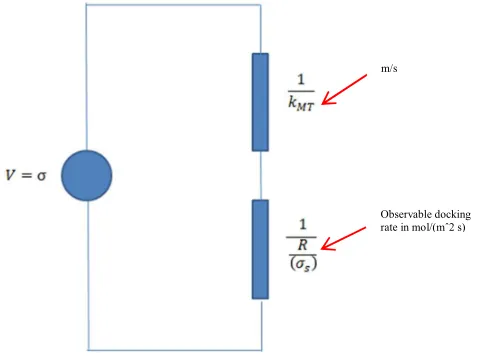
force and the slower one will be rate determining [18]. Making an analogy to a circuit in which the resistors are arranged in a chain, the process can be represented by Fig. 2. This shows that
the resistance to the diffusion of growth units in the bulk of the solution is given by the
inverse of the mass transfer coefficient 01 and the resistance to mass transfer on the surface
[image:17.612.223.462.458.638.2]of the crystal is given by the inverse of the “observable docking rate”.
Fig. 2 Representation of the mass transfer process for the growth of crystal ´s single faces by an analogy to a circuit in which resistors are in series according to V=IR. V represents the driving force, I the flow of molecules towards the surface and R the resistant to this flow
If mass transfer on the surface is taken as a first order process then the rate of transfer ,01 is
given by
,01= 2− 3 (6)
where 2 is the observed incorporation rate constant, the concentration at the crystal
solution interface and 3 is the concentration at equilibrium
Given that ,01 is related to the rate of growth of a single face by
,01= 3 (7)
Then
2=
(8)
where = 4556 7− 18
Similarly mass transfer 9& would be represented by
9&
= 01 − = 2− 3 (9)
9&
= 01 − = − 3 (10)
where 01 is the coefficient of mass transfer within the bulk of the solution, the solution
concentration and is the effective mass transfer area
Expressing all terms in equation (10) using absolute supersaturation it becomes
9&
= 01 − 3 =
:
9;33 (11)
where : is the solute density and 9; the solute molecular weight
Rearranging
− = 9&
013 (12)
and
= 9&
:
9;
(13)
Thus summing driving forces
9&
= 1 1
013+
1
:
9;
Multiplying the denominator by =>6 ?6
and making 01´ 4A
8 =
B=C57 0D6
E6 the growth of a
crystal face with time can be expressed as
4 8 = 1 1
01´ + 1
(15)
Specific models describing the kinetics on the crystal surface can be inserted into equation
(15) as would depend on the mechanism with which the growth units will be attached to the
crystal face. Thus using the power law given by equation (5) and additionally assuming
≈
4 8 = 1 1
01´ +
1
+G
(16)
Similarly for B&S crystal growth mechanism using equation (2)
4 8 = 1 1
01´ +
1
G/exp 4 8
(17)
And for the BCF crystal growth mechanism using equation (4)
4 8 = 1 1
01´ +
1
'ℎ 4 8#