Int. J. Electrochem. Sci., 7 (2012) 4362 - 4368
International Journal of
ELECTROCHEMICAL
SCIENCE
www.electrochemsci.orgShort Communication
Glycerol Electrooxidation on Au/Ni Core/shell
Three-dimensional Structure
Catalyst
Jian-Hua Song, Jie-Yi Yu, Man-Zhi Zhang, Ying-Jun Liang, Chang-Wei Xu*
School of Chemistry and Chemical Engineering, Guangzhou University, Guangzhou 510006, China
*
E-mail: [email protected]
Received: 11 March 2012 / Accepted: 5 April 2012 / Published: 1 May 2012
Polystyrene (PS) spheres have been prepared by emulsifier-free emulsion polymerization with a diameter about 700 nm. This study demonstrates the feasibility of applying Au/Ni/PS electrocatalysts with a very low gold loading as a replacement for pure gold for glycerol oxidation in alkaline medium. The Au/Ni/PS core/shell three-dimensional structure permits liquid alcohol to diffuse into the catalyst layer easily and forms larger three-phase interface, resulting in the reduction of liquid sealing effect. The Au/Ni supported on PS spheres in this paper possesses excellent electrocatalytic properties for glycerol electrooxidation in alkaline medium and may be of great potential in glycerol sensors and direct glycerol fuel cells.
Keywords: Fuel cell; Alcohol; Glycerol; Electrooxidation; Gold
1. INTRODUCTION
application of glycerol electrooxidation on DAFCs has attracted increased interests and the DAFCs show certain advantages such as low fuel cross-over and high power density [14,15].
A lot of work has been done to study the electrooxidation of glycerol on Pt and Pd based catalysts in alkaline medium [16-22]. However, a critical problem arises from Pd or Pt based catalysts is their prohibitive cost and limited supply in nature. The activity and stability of glycerol oxidation on Au electrode have been investigated by our group [23]. The glycerol shows a remarkable activity and better performance than methanol, ethanol, n-propanol, isopropanol and ethylene glycol on the Au electrode in alkaline medium. The activity and stability of glycerol oxidation on the Au electrode are higher than that of glycerol oxidation on Pd electrode. The stability of glycerol oxidation on the Au electrode is higher than that of methanol and glycerol oxidation on Pt electrode. The results show that glycerol is an excellent fuel applied in direct alcohol fuel cells with Au as anode catalyst. However, the price of gold is increasing quickly and expensive also, so gold loading must decrease. Here, we studied glycerol electrooxidation on Au/Ni core/shell support on polystyrene (PS) spheres, just to find out an excellent three-dimensional structure catalyst for glycerol electrooxidation. The gold loading is very low for Au-covered Ni core/shell and a synergistic effect exits between Au and Ni in the core/shell [24,25]. The PS is not a conducting material, so conducting polymers such as polypyrrole (Ppy), polyaniline (Pani) and poly(3,4-ethylenedioxythio-phene) are modified on the surface to form continuous conducting shell to support the catalyst [26-30]. Here, the Au/Ni core/shell with an enough thickness Ni core satisfies electric conduction and the conducting polymers don’t need to be modified on the surface of PS.
2. EXPERIMENTAL DETAILS
Styrene (St), potassium persulfate (KPS), poly(diallyldimethylammonium chloride) (PDDA) and HAuCl4 were of analytical grade purity and purchased from Sigma-Aldrich. Glycerol, NaOH,
KOH, H2SO4, HNO3, NiCl2 and NaCl were of analytical grade purity and purchased from Guangzhou
chemical reagent factory.
2.1. PS spheres polymerization procedure
2.2. Preparation au/ps
PS spheres were added into distilled water and stirred with ultrasound wave in the round bottomed flask. A mixture of 0.5 wt% PDDA and 0.5 wt% NaCl was added into the reactor. The PS spheres modified with PDDA were slowly added into 2.5×10⁻⁴ mol/L HAuCl4 solution, then 0.1 mol/L
NaBH4 was slowly added into the solution. The Au/PS samples were obtained.
2.3. Preparation ni/ps and au/ni/ps
PS spheres were added into 20 mL distilled water and stirred with ultrasound wave in the round bottomed flask. A 50 mL mixture of H2SO4, HNO3 with a ratio of 3:2 was added into the reactor, then
the temperature was raised to 45~50°C for 6 hours. The reactor was naturally cooled to room temperature and the PS spheres modified with nitryl (PNS) samples were collected from the flask. The PNS latex was slowly added into a 0.005 mol/L NiCl2 solution of ethylene glycol by stirred for 24
hours. The pH value of solution was adjusted to 8~11, then the temperature of solution was raised to boil for 3 hours. The reactor was naturally cooled to room temperature and the Ni/PS was obtained. A 2.5×10⁻⁴
mol/L HAuCl4 solution was slowly added into a Ni/PS by stirred 3 hours to obtain Au/Ni/PS.
2.4. Characterization
The morphologies and microstructures of the prepared products were characterized by field emission scanning electron microscopy (FE-SEM, JSM-6330F). The experiments were carried out in a temperature-controlled water-bath (Polyscience 9106, U.S.A.). All electrochemical measurements were carried out in a three-electrode cell using CHI 700C electrochemical workstation (CHI Instrument). Solutions were freshly prepared and purged with nitrogen (99.999%) before each experiment. The working electrodes were Au/PNS, Ni/PNS, Au/Ni/PNS with a geometrical area of 0.33 cm2 and a metal loading is 0.02 mg/cm2 on carbon rod. The working electrode was fabricated by casting polytetrafluoroethylene (PTFE)-impregnated catalyst ink onto the carbon rod electrode. The PTFE loading on electrode is 0.05 mg/cm2. A platinum foil (3.0 cm2) and a saturated calomel electrode (SCE, 0.241 V versus RHE) were used as counter and reference electrodes, respectively. A salt bridge was used between the cell and the reference electrode.
3. RESULTS AND DISCUSSION
Figs. 1a and b show the typical SEM micrographs of PS spheres. It can be observed that the diameter of PS spheres is about 700 nm. Fig. 1c shows the typical SEM micrograph of Ni particles immobilized on PS (Ni/PS). Fig. 1d shows the typical SEM micrographs of Au supported on Ni/PS after the Ni complete replacement reaction with 2.5×10⁻⁴ mol/L HAuCl4. The surface of Au/Ni/PS is
the HAuCl4. This indicates that only a monolayer or submonolayer of Au decorates Ni/PS without
forming individual Au particles, so the gold loading reduces to a extremity low value.
Figure 1. a, b) SEM micrographs of PS spheres, c) SEM micrograph of Ni, d) SEM micrograph of Au/Ni/PS
[image:4.596.129.467.133.425.2] [image:4.596.157.440.489.707.2][image:5.596.139.458.283.527.2]
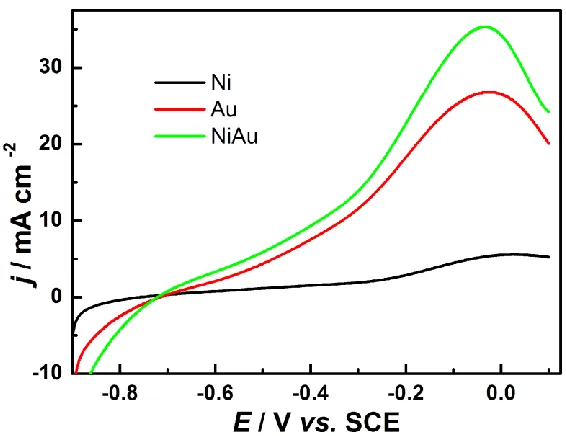
Fig. 2 shows the linear sweep voltammetry (LSV) curves of glycerol oxidation in 1.0 mol/L KOH solution containing 1.0 mol/L glycerol on the Ni/PS, Au/PS, Au/Ni/PS electrodes. The magnitude of oxidation current indicates the activity of electrode for alcohol oxidation. The peak current densities are 5.6 mA/cm2 (0.02 V) on the Ni/PS electrode, 26.8 mA/cm2 (-0.02 V) on the Au/PS electrode, 35.4 mA/cm2 (-0.04 V) on the Au/Ni/PS electrode for glycerol. The results show one synergistic effect of Au-Ni in Au-covered Ni/PS because the peak potential is -0.04 V on Au/Ni/PS electrode and 20 mV more negative compared with that on Au/PS electrode. The peak current density of glycerol oxidation on the Au/Ni/PS electrode is the highest and 1.3 times higher than that on the Au/PS electrode. The current densities at -0.2 V are 3.0 mA/cm2 on the Ni/PS electrode, 18.3 mA/cm2 on the Au/PS electrode, 22.9 mA/cm2 on the Au/Ni/PS electrode. The glycerol oxidation shows the highest activity on the Au/Ni/PS electrode and the lowest current on the Ni/PS electrode.
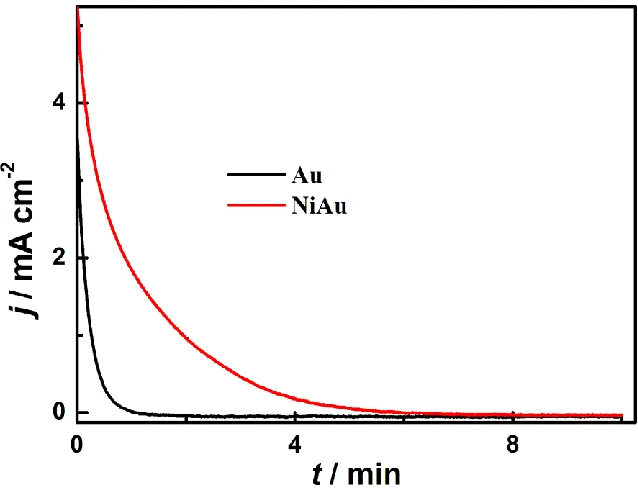
Figure 3. Chronoamperometric curves of glycerol oxidation in 1.0 mol/L KOH solution containing 1.0 mol/L glycerol on Ni/PS, Au/PS, Au/Ni/PS electrodes, 25°C.
4. CONCLUSIONS
This study demonstrates the feasibility of applying Au/Ni/PS electrocatalysts with a very low gold loading as a replacement for pure gold for glycerol oxidation in alkaline medium. The results show one synergistic effect of Au-Ni in Au-covered Ni/PS because the peak potential is -0.04 V on Au/Ni/PS electrode and 20 mV more negative compared with that on Au/PS electrode. The glycerol oxidation shows the highest activity on the Au/Ni/PS electrode and the lowest current on the Ni/PS electrode. The Au/Ni/PS core/shell three-dimensional structure permits liquid alcohol to diffuse into the catalyst layer easily and forms larger three-phase interface, resulting in the reduction of liquid sealing effect. The Au/Ni supported on PS spheres in this paper possesses excellent electrocatalytic properties for glycerol electrooxidation in alkaline medium and may be of great potential in glycerol sensors and direct glycerol fuel cells.
ACKNOWLEDGMENTS
This work is financially supported by the National Natural Science Foundations of China (20903028), Scientific Research Foundation for Returned Scholars from Ministry of Education of China (Xu Changwei), and Scientific Research Foundation for Yangcheng Scholar (10A041G).
References
1. H.L. Tang, S.L. Wang, M. Pan, S.P. Jiang and Y.Z. Ruan, Electrochim. Acta, 52 (2007) 3714 2. D. Morales-Acosta, D.L. Fuente, L.G. Arriaga1, G.V. Gutiérrez and F.J.R. Varela, Int. J.
Electrochem. Sci., 6 (2011) 1835
3. D.S. Yuan, S.Z. Tan, Y.L. Liu, J.H. Zeng, F.P. Hu, X. Wang and P.K. Shen, Carbon, 46 (2008) 531
4. F.F. Ren, F.X. Jiang, Y.K. Du, P. Yang, C.Y. Wang, J.K. Xu, Int. J. Electrochem. Sci., 6 (2011) 5701
5. C.C. Yang, T.Y. Wu, H.R. Chen, T.H. Hsieh, K.S. Ho and C.W. Kuo, Int. J. Electrochem. Sci., 6 (2011) 1642
6. C.W. Kuo, C.C. Yang and T.Y. Wu, Int. J. Electrochem. Sci., 6 (2011) 3196 7. M. Etesami and N. Mohamed, Int. J. Electrochem. Sci., 6 (2011) 4676
8. M.A. Dasari, P.P. Kiatsimkul, W.R. Sutterlin and G.J. Suppes, Appl. Catal. A, 281 (2005) 225 9. D.T. Johnson and K.A. Taconi, Environ. Prog., 26 (2007) 338
10.C. Saenge, B. Cheirsilp, T.T. Suksaroge and T. Bourtoom, Process Biochem., 46 (2011) 210 11.A. Falase, K Garcia, C. Lau and P. Atanassov, Electrochem. Commun., 13 (2011) 1488
12.A. Falase, M. Main, K. Garcia, A. Serov, C. Lau and P. Atanassov, Electrochim. Acta 66 (2012) 295
13.K. Matsuoka, M. Inaba, Y. Iriyama, T. Abe, Z. Ogumi and M. Matsuoka, Fuel Cells, 2 (2002) 35 14.Z.Y. Zhang, L. Xin and W.Z. Li, Appl. Catal. B, 119-120 (2012) 40
15.A. Ile, M. Simoes, S. Baranton, C. Coutanceau and S. Martemianov, J Power Sources, 196 (2011) 4965
16.M. Mougenot, A. Caillard, M. Simoes, S. Baranton, C. Coutanceau and P. Brault, Appl. Catal. B, 107 (2011) 372
17.M. Simões, S. Baranton and C. Coutanceau, Appl. Catal. B, 110 (2011) 40
18.E.C. Venancio, W.T. Napporn and A.J. Motheo, Electrochim. Acta, 47 (2002) 1495
101 (2011) 366
20.P.S. Fernández, M.E. Martins and G.A. Camara, Electrochim. Acta, 66 (2012) 180 21.A.N. Grace and K. Pandian, Electrochem. Commun., 8 (2006) 1340
22.S.W. Xie, S. Chen, Z.Q. Liu and C.W. Xu, Int. J. Electrochem. Sci., 6 (2011) 882
23.J.H. Zhang, Y.J. Liang, N. Li, Z.Y. Li, C.W. Xu and S.P. Jiang, Electrochim. Acta, 59 (2012) 156 24.F.L. Cheng, X.C. Dai, H. Wang, S.P. Jiang, M. Zhang and C.W. Xu, Electrochim. Acta, 55 (2010)
2295
25.C.W. Xu, Y.H. Hu, J.H Rong, S.P. Jiang and Y.L. Liu, Electrochem. Commun., 9 (2007) 2009 26.F.Y. Xie, Z.Q. Tian, H. Meng and P.K. Shen, J. Power Sources, 141 (2005) 211
27.C. Perruchot, M.M. Chehimi, M. Delamar, S.F. Lascelles and S.P. Armes, Langmuir, 12 (1996) 3245
28.C. Barthet, S.P. Armes, M.M. Chehimi, C. Bilem and M. Omastova, Langmuir, 14 (1998) 5032 29.M.A. Khan, S.P. Armes, C. Perruchot, H. Ouamara, M.M. Chehimi, S.J. Greaves and J.F. Watts,
Langmuir, 16 (2000) 4171
30.F.Y. Xie, H. Meng and P.K. Shen, Electrochim. Acta, 53 (2008) 5039 31.X.B. Wang and Z.C. Zhang, Radiat. Phys. Chem., 75 (2006) 1001