Program for the Study of Germany and Europe
Working Paper No. 06.1
Skill formation in Britain and Germany:
Recent developments in the context of traditional differences
by
Steffen Hillmert
Center
for
European
Studies
Department
of
Sociology
Harvard
University
Bamberg
University,
Germany
[email protected]
[email protected]
Abstract
1. Introduction
How similar or different are national skill systems and how do they change? The public and scientific dis-course about the modern “knowledge society” seems to imply that they will follow uniform trends rather than take specific pathways. On the other hand, views from inside and outside national contexts may not always be consistent. For example, the debate within Germany has emphasized problems and deficits in the qualification system, often referring to perceived international standards while, viewed from outside, the specificity of the “German model” of transitions between school, training and work has mostly been regarded as a success story (Lynch 1994; Ryan 1999). Sensitivity to problems is probably due not least to the respective importance that (initial) training has for the future careers of many individuals in a particular society. Still, the attractiveness of national “models” may change over time with varying success and the different demands put on them.
As a case study of contemporary changes in skill systems, this paper emerges from a historical comparison of the skill formation systems in Germany and Britain since World War II. As advanced and economically com-petitive societies, they face, in principle, comparable economic challenges. When looking at these two cases more closely, however, one may well find functionally equivalent solutions to similar problems, as well as more specific problems and different economic strategies. As it turns out, Germany and Britain have taken specific pathways in attempts to adapt to specific challenges regarding adequate skill provision. Changes in training systems, however, cannot be evaluated without a deeper understanding of the political functioning of the economies in which they are embedded. In this paper, special emphasis is drawn to different consequences on the individual level and their role in sustaining or transforming the systems of skill provision. Different trends in the skill systems of Germany and Britain have become visible, especially during the 1990s.
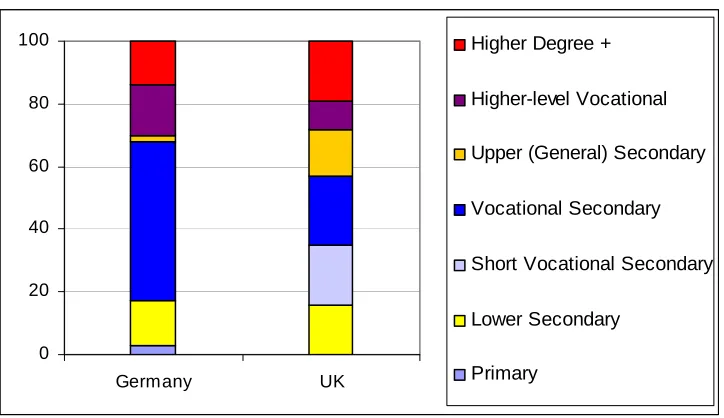
[image:2.612.126.488.432.641.2]A brief cross-sectional overview of present differences in the skill situation of Germany and the United King-dom may provide a starting point for a closer investigation of historical developments concerning training in the two societies. At first glance, the qualification distribution of the population at workforce age (cf. Figure 1) may confirm traditional perceptions of the skill situation in the two countries, with Germany being a case of a “high skills regime” and Britain more a case of a “low skills regime.”
Fig. 1: Composition of qualifications in the population aged 25-64 (in percent) in Germany and the UK (2003)
0 20 40 60 80 100
Germany UK
Higher Degree +
Higher-level Vocational
Upper (General) Secondary
Vocational Secondary
Short Vocational Secondary
Lower Secondary
Primary
Source: OECD 2005 (Data from German Microcensus/British Labor Force Survey)
In particular, what becomes once again apparent in the qualification distributions depicted here is the German economy’s broad reliance on intermediate vocational skills – which, in the majority of cases, have been
ac-quired in the dual system of combined employer- and school-based training and the institutions of further
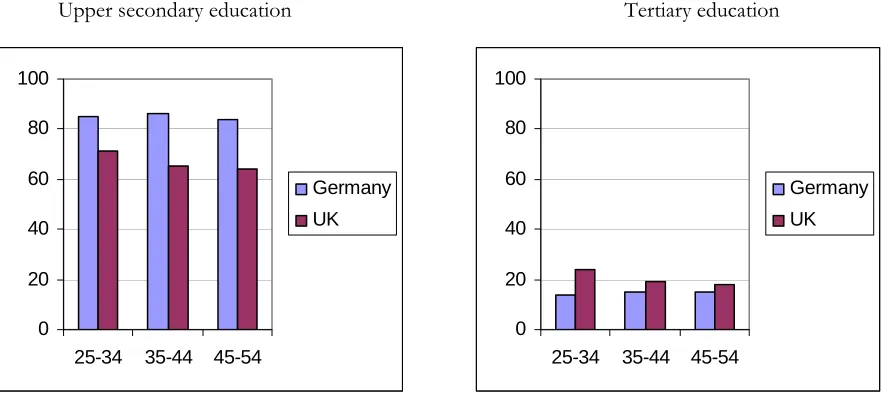
What is masked by such an aggregate analysis, however, is historical change, as a simple breakdown by age
group suggests (Figure 2).1 While the age groups in Germany are relatively similar with regard to educational
attainment, in Britain the younger age groups reflect a significantly higher proportion of completed upper sec-ondary and tertiary education than older age groups.
Recent graduation rates from tertiary (degree-level) education in Germany hover around 20 percent (data from 2002); roughly two-thirds of the graduates are from universities, with students enrolled in programs lasting five years or more. In the UK, graduation rates approach nearly 40 percent, with the vast majority of students
[image:3.612.77.518.206.404.2]completing shorter courses of study (OECD 2005).
Fig. 2: Proportion having completed upper secondary education and completed tertiary (degree-level) education, by age group, in Germany and the UK (2003)
Upper secondary education Tertiary education
0 20 40 60 80 100
25-34 35-44 45-54
Germany
UK
0 20 40 60 80 100
25-34 35-44 45-54
Germany
UK
Source: OECD 2005 (Data from German Microcensus/British Labor Force Survey)
These figures suggest that, in recent years, Britain has taken major steps in the direction of a collective up-grading of skill levels, especially in higher education, while there have been no comparable changes in Ger-many.
This paper investigates how these recent trends fit into developments over a longer period of time. It will turn out that the recent trends cannot be adequately described as a mere process of one country catching up in terms of its average qualification level. Rather, there is evidence for long-term consequences in the specific, historically evolved logic of skill formation in the two countries.
The following section outlines the conceptual framework of an international comparison of skill systems, which emphasizes links between the vocational training system and other institutions. Following these distinc-tions, the next section presents a historical account of training systems and school-to-work transitions in Brit-ain and the former West Germany after World War II, and until the late 1980s. While any clear-cut historical periodization is to some extent arbitrary, results from analyses of this phase may be used to explain the devel-opments in the following decade. Comparing the two countries, it becomes clear that fundamental differences in the institutions guiding the process of labor-market entry evolved in the postwar period. As consequences at the “micro level,” differences in the individual rationales of skill investment as well as different transition and life-course patterns can be observed. The subsequent section provides evidence that these differences have also been crucial for the recent developments of the 1990s. The final section concludes.
1This interpretation of age group comparisons as cohort change leaves aside some data problems with ‘censored’
2. A framework for international and historical comparisons
As major institutions (still) act on the level of the nation-state, there exists an increasing sensitivity in both
re-search and public debates about international institutional differences as possible sources of differences in
actors’ behavior. Along with questions about economic performance, this applies in particular to the conse-quences for education, training and the labor market. Institutional contexts, however, tend to be complex. To characterize particular national institutional systems, use can be made of ideal-type aggregate typologies that have gained some prominence, not least in the form of welfare-state regimes which differ in the degree of “de-commodifaction” of labor by welfare provision (Esping-Andersen 1990). Such typologies allow allocating vari-ous countries to a very limited number of types in a simple way and, hence, reducing analytical complexity considerably. More directly related to the field of labor-market-oriented skill formation are distinctions be-tween various forms of capitalism as they have been proposed by comparative political economy (Albert 1992; Hall & Soskice 2001). Political economies differ in the degrees and the forms of internal coherence, for exam-ple, between the financial sector, firm cooperation and production strategies due to typical features of social interaction such as the degree of trust in social relations. In particular, the Anglo-Saxon model of “liberal mar-ket economies” and the continental (or “Rhineland”) model of flexibly “coordinated marmar-ket economies” are distinguished, assuming a systemic nature of institutional configurations where various fields of institutional influence are necessarily associated with each other. As a consequence, it is often assumed that these configu-rations are relatively stable. This assumption can first be contested with respect to empirical variability. Sec-ond, it can be argued in theoretical terms that the creation and sustaining of institutions need to be supported by the activities of social actors. As a consequence, institutional changes are themselves a prominent topic for sociological explanation (see, for example, Streeck & Thelen 2005).
In order to explain specific developments in training systems one needs to look more closely at the (institu-tional) links with their major social contexts, allowing also for possible conflicts and dysfunctional relation-ships. Studies in political economy have often concentrated on the role of corporate actors in sustaining and changing these links. A complementary strategy, which is also pursued in this paper, is to look at typical individual-level situations involved in the process and the consequences of skill formation. This of course raises the question of how actually to relate the qualification process on the individual level to relevant insti-tutions. There is a wide gap between the explanation of macro-structures and the trajectory of individual beha-vior (see also Mayer 1997), and it can be assumed that many individual transitions are structured by a complex variety of historically changing institutions – not necessarily showing consistent effects.
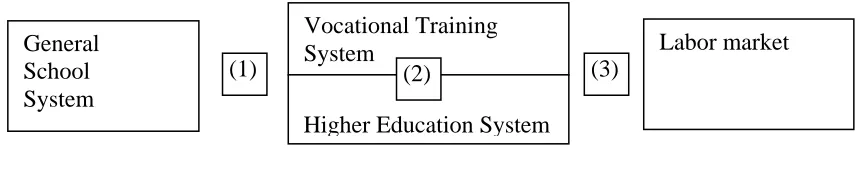
The following paragraphs intend to make some of these relationships more explicit in order to account for the typical configurations and specific developments of national skill systems. They look at links between the sys-tem of skill formation and other subsyssys-tems as they are reflected by both institutional regulations and specific market conditions. Both have implications for individual-level experiences and decisions (see Figure 3). The following paragraphs provide some further descriptions of these links.
(1) General schooling and further education and training
In the formal structure of educational systems, (labor-market-related) further education and training normally succeed general school education. One of the main relationships between these systems is that a pre-selection for various tracks of training has already taken place within the general school system. Direct institutional links are set by entry requirements and regulations regarding access to further training programs from general cation. In some instances, this also holds true for transitions in the reverse direction or forms of parallel edu-cation and training (“second chance eduedu-cation”).
Fig. 3: Skill production systems and selected links with other sub-systems within a society
(2) Vocational training and higher education
Forms of training vary in their accessibility, structure, content, and consequences. For reasons of simplicity, in this illustration just two broad forms of post-compulsory education are distinguished: vocational training and higher education.
On the micro level, vocational training and higher education are alternative or even competing pathways for the generation and employment of skills (by employers) and for the educational decisions made by individuals. Such choices will be at least partly based on relative returns to different training options in the labor market, be it due to their signaling capacity (Spence 1973) or the amount of actual general or firm-specific human capi-tal that they carry (cf. Mincer 1974).
While this relationship already points to links with the labor market, there are also more or less institutional-ized links between various parts of the training system itself. Variation in this regard concerns the degree to which courses and degrees in one path of the further training system provide access to an alternative path, hence defining the “permeability” of the system of skill production.
(3) Training and the labor market
Any modern economy faces the problems of providing sufficient qualifications to workers and allocating them efficiently. Therefore, national systems of education and training tend to be linked to the labor market. How-ever, the degree of coordination between educational and employment systems may vary considerably among societies (Hillmert 2001). Not only the intra-firm, but also the societal division of labor determines which qualifications are regarded as essential for particular jobs (cf. Windolf & Wood 1988). As training profiles often correspond to career paths, the structures of qualification systems remain relevant beyond the immediate point of entry into the labor market.
The links between the subsystems of employment and training are, on the one hand, affected by the degree to which information on the aggregate demand for necessary qualifications is successfully transmitted from the employment to the training system. In this regard, features of the institutional structure of the training system are important, such as whether training is provided directly by employers, who tend to have immediate infor-mation on their skill needs. In some cases, vocational training may even include an employment contract. Relevant information for individual choices made before entering training programs is also transmitted by the situation of preceding cohorts, e.g., by how many and what kinds of jobs they were offered upon completion of training.
On the other hand, when looking at the skill output from the employers’ point of view, the quantity and the quality of attained skills, as well as an efficient allocation, are of major importance. The balance between
aggre-Vocational Training
System
Labor market
General
School
System
(1)
Higher Education System
(2)
(3)
(4) Stratification order and individual life courses
gate skill supply and demand is a necessary, but not a sufficient condition for a close match at the level of the individual. One major allocative mechanism is that formal qualifications carry a high amount of information for potential employers and hence can serve as screening devices in recruitment procedures. These screening capacities are likely to be influenced by how educational systems are regulated and formally structured.
Educa-tional systems can be classified, for example, along the dimensions of stratification and standardization, as
proposed by Allmendinger (1989). However, as to the question of allocation, once again, the labor-market relevance of vocational training is even more important, inclusive of whether vocational training is provided at the workplace or in schools.
For individuals, of course, among the most important consequences of their qualifications are their conse-quences in the labor market. Segmentation theories and the theory of closed positions (Doeringer & Piore 1971; Sørensen & Kalleberg 1981) have made it clear that the labor market may be internally differentiated with a particular structure, which is not least defined by formal entry requirements into specific occupations and positions (most notably, public service). Hence, the concept of competition in the labor market cannot be reduced to competition about wages as a function of human capital. There may also be considerable competi-tion regarding posicompeti-tions and opportunities, and the type of aspired job will determine the level of required qualifications. In most cases, the level of entry positions is especially important with regard to the prospect of further careers.
(4) The social stratification order and life courses
In a sociological perspective, societal evaluation plays a major mediating role in any of these linking processes. Labor-market outcomes and other effects of qualifications cannot be understood in economic terms alone, but always have social implications in terms of social inequality.
The assumption here is not that economic outcomes per se, but socially evaluated outcomes, form the basic foundations for regulations and individual decisions. For example, what count as the “essential skills” that need to be taught is open to social definitions (Rainbird 1997). The same holds true for acceptable durations of transition periods, importance of income levels, job positioning and promotion chances that transform eco-nomic consequences into central aspects of the stratification order. In fact, it is the social evaluation of educa-tional consequences that defines unequal chances of access to (particular forms of) education and training as a sociological problem. With regard to an explanation of individual behavior, it is important to note this aspect when examining the impact that perceived consequences of formal qualifications might have on decisions taken regarding investment in particular forms of qualification.
Consequently, social stratification also has a direct influence in transmitting differences in qualification over the generations. Among the most prominent examples is the high degree to which early selection within the school system is influenced by social origin. According to the theory of Breen & Goldthorpe (1997), for exam-ple, the main rationale of schooling decisions by parents is to preserve their original social status, attainable only upon successfully completing particular educational tracks.
Yet another question is how to observe these links. While institutional regulations and the behavior of collec-tive actors are important sources, empirical information about individual situations may provide additional in-sights into the process and the consequences of skill formation, and the conditions that enter the decision ho-rizon of successive cohorts. Assuming a systemic nature of the institutions that are involved, international dif-ferences may be conceptualized in the form of life course regimes (Lessenich 1995; Mayer 2001).
It is important to study such effects over time: consequences of qualification may evolve over a longer period, and training decisions are often long-term decisions. Hence, one may look at the particular transitions people make among different parts of the education and training system and labor market, as well as longitudinal measures of stability (such as job duration). However, only in an ideal-typical sense, the general school system, vocational training and employment form a clear sequence that all individuals follow. In reality, one also finds reverse orders, multiple and parallel episodes of both training and work.
level are often the starting point for institutional adaptation and change, put forward by collective actors and implemented by state regulation.
The following sections present examples for such links between institutions and life courses. In order to enter into greater detail, this paper presents an historical comparison of two countries rather than a multi-country comparison (a type of research prevalent in many macroeconomic studies).
3. Training systems and their consequences in Britain and West Germany until the 1980s
3.1 Education and training
The system of education and training is probably the most important determinant for the process of transition to the labor market. Despite of some common, long-term historical traditions (in particular, apprenticeships for artisans), for most of the period after World War II, the national systems of general and vocational
educa-tion in Germany and Britain have shown important differences (see also Hillmert 2001; 2002).2 In a long-term
historical comparison of skill systems (Thelen 2004), it becomes clear that changes can be both sudden and incremental, and that the circumstances of the generation of these systems need to be distinguished from their present way of functioning. The following summary describes major differences after World War II through the 1980s.
Britain
For our focus period, the British system of education and training can be characterized by a relatively clear dis-tinction between general education and vocational training. General education has been stratified and charac-terized by a school system with cumulative qualifications, selective ability testing and a hierarchy of higher educational institutions. Important developments after World War II include successful attempts to standard-ize, and subsequently also to centralstandard-ize, general education by raising the minimum school-leaving age, by intro-ducing general school qualifications and, finally, a national curriculum and standardized testing at various stages of the schooling career.
Since the 1960s, most of the schools have become comprehensive schools, but the differentiation among vari-ous levels of (post-compulsory) school qualifications has, in many respects, taken the function of different school tracks and become an important means of selection also by employers. In addition, a small but influen-tial sector of high-status private schools has retained social relevance. Academic training in Britain has been rather general and has had a relatively high reputation, but there has been a clear hierarchy with regard to specific academic institutions. Vocational training has been heterogeneous and often very basic. Traditional forms such as apprenticeships have been limited to the manufacturing sector and have declined dramatically in number since the 1960s. Forms of school-based training have increased, and secondary school qualifications have gained growing importance as selection criteria in the labor market, especially in the service sector (Windolf 1984). For decades, governments have attempted to upgrade the general level of training. In the case
of the Youth Training Scheme or Youth Training (YTS/YT) programs, which have been introduced
pro-gressively since 1983, this has been closely associated with measures to thwart high rates of youth unemploy-ment. Under the title “New Vocationalism,” and as part of market-oriented reforms during the 1980s, efforts have been made to introduce standards for practical and transferable vocational skills, particularly in the form of [General] National Vocational Qualifications (NVQ/GMVQ), an integrated five-tiered classification sys-tem of general and vocational qualifications.
For young people an alternative to any kind of formalized vocational training has, however, always been prominent: leaving school relatively early and entering employment immediately. In fact, the majority of young people finishing school has entered the labor market without any formal vocational training, some acquiring qualifications on a part-time basis parallel with employment (Kerckhoff 1990). In fact, the normative standard has often been a fast transition to the labor market at any cost (cf. Bynner & Roberts 1991). Given the
2Though not explicitly mentioned in this paper, one should also be aware of important institutional and structural
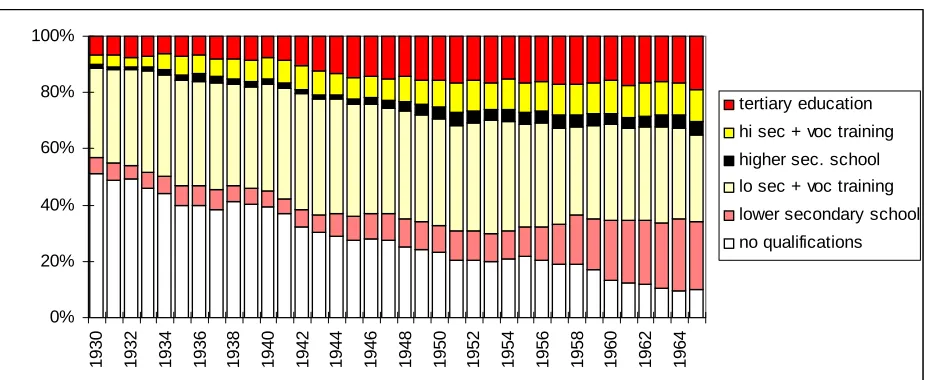
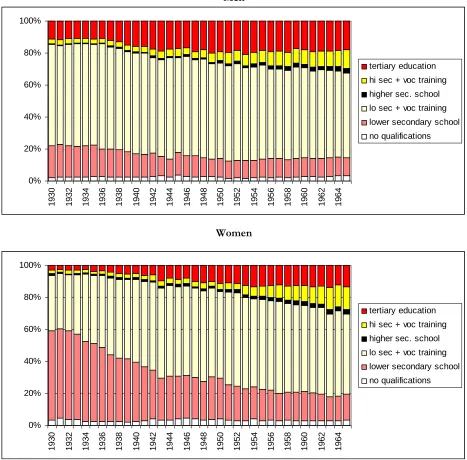
skill strategies of many British employers (and, formerly, also trade-union influence focused on pay, rather than qualification issues), they could expect to earn reasonable wages despite having received no or only re-stricted on-the-job training. The consequence of this has been that, despite overall educational expansion, there has been a considerable proportion of persons who have acquired only general school qualifications, if any (cf. Figure 4).
[image:8.612.75.539.435.625.2]When asking about underlying institutional configurations, one finds that Britain can serve as an example of a “deregulated liberal market economy” that relies more on individual bargaining than on coordination. British enterprises have acted under conditions of high-profit orientation, a lack of mutual trust and a relatively short-time perspective. Therefore, they have often been reluctant to invest in long-term training. Moreover, in a highly flexible labor market, there has been no particular requirement for training as a screening period for future long-term personnel. If one looks at the role corporate actors have played in the regulation of training after World War II, one of the main results is that the trade unions in Britain wanted to retain control over skill formation in the workplace. Therefore, training has been regarded as an issue of conflict in industrial rela-tions, with the employers looking for low-skill strategies where possible, preferring on-the-job training and continuing education, and relying on academically-trained personnel for higher positions. Trade unions had an interest in keeping vocational boundaries, but – even in collective institutions such as the Industrial Training Boards during the 1960s and 1970s (Dingeldey 1996) – showed little interest in a standardized, general supply of training. Not least as a result of such market failures, the UK has traditionally been regarded as having a skill deficit or a “low skills equilibrium” (Finegold & Soskice 1988; Layard et al. 1994). This has led to continu-ous efforts to reform the skill system, especially during the 1990s.
Fig. 4: Highest qualification of the British birth cohorts 1930-1965
Men
0% 20% 40% 60% 80% 100%
1
930
1
932
1
934
1
936
1
938
1
940
1
942
1
944
1
946
1
948
1
950
1
952
1
954
1
956
1
958
1
960
1
962
1
964
Women
0% 20% 40% 60% 80% 100%
19
30
19
32
19
34
19
36
19
38
19
40
19
42
19
44
19
46
19
48
19
50
19
52
19
54
19
56
19
58
19
60
19
62
19
64
tertiary education hi sec + voc training higher sec. school lo sec + voc training lower secondary school no qualifications
Data: British Household Panel Survey 1995 (birth cohorts combined in five-year moving averages)
West Germany
Compared with the United Kingdom, there appears to have been more continuity in the German educational system after World War II. Qualification paths have been clear and well-established, and this has allowed for individual planning with better information and a longer-time perspective than under the conditions of the more dynamic, market-oriented system in Britain (Greuling 1996).
Secondary school education has largely followed hierarchical tracks, and the early selection has gone along with a high degree of social selectivity. Higher education has in many cases been directed to specific occupat-ional fields – especially in technical studies – and relatively standardized. There has also been a hierarchy
be-tween the traditional universities and the lower-level institutions of tertiary education (Fachhochschulen) that
were introduced in the 1970s. While participation in tertiary education has increased, vocational training, in its
popular dual-system form, has remained the standard experience for most young people, an increasing
num-ber of trainees with higher secondary school education being included. Vocational training has been
common-ly accepted as necessary and has formed the basis for further skill acquisition. Apart from the dual system,
which accounts for the largest part of training, there have also been school-based forms of vocational training.
The German employment system has organized human capital in the form of vocations (Berufe), which allow
individuals to perform a broad range of related, rather complex tasks and incorporate the concept of a career with prospects on the basis of initial vocational training.
After World War II, Germany also experienced a major educational expansion which actually started before major structural changes were introduced in the educational systems. As Figure 5 indicates, educational expan-sion across birth cohorts (regarding vocational and higher qualifications) has been especially marked for wom-en who have attained a near equal share of participation in the dual system and whose numbers dominate school-based vocational training.
associations of both employers and workers have facilitated trust for investments in general skills and have allowed for a longer-time perspective in the actors’ decision making. This has been further enhanced by close inter-firm ties, a system of long-term finance and also a successful transfer of technology from the technical universities.
Vocational training has been regulated by legislation relatively late (especially the Vocational Training Act/
Berufsbildungsgesetz of 1969), but employers have a long tradition of a commitment to a high level of transferable skills, coordinated by intermediate institutions (such as chambers of commerce). The responsibility for training and certification has been shared among different institutions; instructors have been required to meet the standards; and formal qualifications are, therefore, widely recognized by employers. Aside from maintaining its responsibility for the vocational schools, the German state has never really been involved in the provision of, but has played a major role in regulating, vocational training. For the majority of young people finishing school, training in the dual system has been the standard route towards employment at an in-termediate level, including occupations in the service sector. Additionally, it is not only the informative (“signaling”) capacity of vocational credentials which offers a close connection to the labor market. Though not combined with an employment contract, apprenticeships can already be regarded as entry positions that grant employers a long screening period for future personnel.
3.2 School-to-work transitions and early careers
This brief overview (for details, see Hillmert 2001) may provide a basis for an interpretation of individual-level consequences. In Britain, criteria such as timing (referring especially to individual age) rather than (occupation-)specific formal qualifications, have ruled labor-market integration, though educational expansion and an increasingly difficult labor market have weakened their importance since the 1960s; the level of educa-tional credentials has always had importance for job allocation. Not least due to the influence of unions, occu-pational boundaries in many British industries were previously quite rigid. Over the past decades, they have in-creasingly become weaker, so that the role of specific qualifications is also likely to have further decreased. Le-gal requirements were traditionally low, and the youth labor market, in particular, was further deregulated dur-ing the 1980s (Ashton et al. 1990), so that both an internal labor market and a large “secondary” labor market in the low-wage sectors can be expected (cf. Brown 1990).
In contrast to this, Germany can be regarded as a model for a combination of a widespread skilled occupa-tional labor market with (higher-level) internal and lower-level labor markets (Blossfeld & Mayer 1988). Re-garding both education and labor-market policies, institutional change appears to have been much greater in Britain than in Germany, especially since the early 1980s. In Germany the level of education and substantive occupational skills have been major criteria of job allocation. In general, the standardized and (horizontally and vertically) differentiated education and training system in Germany as well as more cooperative industrial relations have allowed for a higher degree of coordination between skill production and employment than in Britain.
Fig. 5: Highest qualification of the West German birth cohorts 1930-1965 Men 0% 20% 40% 60% 80% 100% 19 30 19 32 19 34 19 36 19 38 19 40 19 42 19 44 19 46 19 48 19 50 19 52 19 54 19 56 19 58 19 60 19 62 19 64 tertiary education hi sec + voc training higher sec. school lo sec + voc training lower secondary school no qualifications Women 0% 20% 40% 60% 80% 100% 193 0 193 2 193 4 193 6 193 8 194 0 194 2 194 4 194 6 194 8 195 0 195 2 195 4 195 6 195 8 196 0 196 2 196 4 tertiary education hi sec + voc training higher sec. school lo sec + voc training lower secondary school no qualifications
Data: German Microcensus 2000
qualifications have been more important predictors of successful transitions to adequate jobs in Germany than in Britain. Additional analyses suggest that this reflects not only differences in the allocative capacity of formal credentials but also a better coordination of supply and demand for qualifications in Germany and “skill defi-cits” in Britain. On average, the level of stratification by qualifications appears to have decreased slightly across birth cohorts since the cohorts around 1940. In Germany, however, this process originated at a very high level. Moreover, there has been an increasing difference between the quality of (very) first jobs and first stable jobs, which form part of a longer career. This is visible especially for service-class positions; in many cases, these positions are obviously entered into after previous entry jobs.
The following analyses now look at individual employment subsequent to labor-market entry. Figure 6 dis-plays a cohort comparison of the stability of first employment as indicated by three dimensions: median tenure
with first employer, median tenure in entry occupation (2-digit ISCO) and median tenure in entry social class
position (11 EGP-categories as defined by Erikson & Goldthorpe 1992), all of them measured in years. These
median durations were calculated for a number of successive birth cohorts, whereby “entry conditions” were
[image:12.612.97.515.280.643.2]defined in two different ways: the very first job and the first stable job (with two years minimum duration).3
Fig. 6: Mean duration with first employer/in entry occupation/ in entry class: product-limit-estimates (medians, in years), by birth cohort
Britain
First job First stable job
0 2 4 6 8 10 12
1928-32
1938-42
1948-52
1958-62
1968-72
1928-32
1938-42
1948-52
1958-62
1968-72
Job Occupation Social class
West Germany
First job First stable job
0 2 4 6 8 10 12
1929-31
1939-41
1949-51
1959-61
1971
1929-31
1939-41
1949-51
1959-61 1971
Job Occupation Social class
Product-limit-estimations. Data: British Household Panel Study; German Life History Study (cf. Hillmert 2002)
3This “stronger” criterion shifts the point of labor-market entry beyond periods of exclusively short-term employment,
In our case, most interesting is a comparison of the various configurations formed by the three dimensions of
employment stability.4 In the United Kingdom, the median durations have always been closer together, that is,
people have been more likely to leave their occupation and social class when leaving their first employer. In contrast, in Germany, the median episodes of entry occupation (and social class) have been much longer than the equivalent entry jobs: on average, people have stayed in their occupation (and their class position) when leaving their first employer. This obviously means that that occupation-specific skills could be transferred be-tween different employers and that strong occupational labor markets do exist. In the British case, human capital has been more closely bound to particular firms.
As one can see, the stability of (very) first jobs has declined across the five birth cohorts that are presented in this chart. For the UK, the trend is similar when one looks at the very first or the first stable job: mobility has increased in all three dimensions, which reflects a major shift from a high proportion of protected employ-ment to an increasing flexibility of the further deregulated labor market. In West Germany, the pattern of the three median durations has been remarkably stable over time, especially regarding the first stable job. How-ever, also in Germany, the phase of entry into the labor market has become more extended and the difference between transitory and stable entry jobs has increased significantly for the younger cohorts. Apart from this period of “settling in,” however, the first position at labor-market entry has proved to be highly relevant for the quality of the further career, although this career is not necessarily bound to the first employer. This indi-cates that the impact of the level of formal qualifications and occupational labor markets has remained strong, as has institutional regulation. In separate analyses for men, who have more stable careers than women, these results become even clearer (Hillmert 2001). It can be seen that, compared to the time in their first job, most German men remained in their initial occupation for a very long time.
In sum, these empirical indicators suggest that the importance of formal qualifications at labor-market entry has only partly been similar in Britain and West Germany over the last decades. Formal (vocational) qualifica-tions have clearly been more relevant for successful entry and stable early careers in Germany. In Britain, this has been true to a much lower extent with the system of general and academic education being more impor-tant than that of vocational training.
3.3 Consequences for employers’ and individuals’ rationales
Decisions of skill investment made by both employers and young people can be regarded to be to a larger de-gree based on expectations concerning the consequences of qualifications in the labor market. Hence, succes-sive cohorts of labor-market entrants may be influenced in their behavior by the experiences of preceding co-horts. On the basis of the observed developments in the two skill systems between the World War II and the late 1980s, the actors’ situations concerning decisions about vocational education and training in the two sys-tems can be summarized in a stylized way.
In Britain, a comparatively low level of trust and a lack of coordination among employers have prevented long-term strategies of providing standardized vocational training that would be able to send clear signals to potential employers and successive cohorts of applicants. Given an increasingly flexible labor market and fur-ther promoted by the weakening of vocational boundaries that were traditionally supported by (occupation-based) trade unions, the time perspectives of individual actors for the investment in skills have been relatively short. Therefore, no thorough collective upgrading of vocational skills could be achieved. As a means of quali-fying for higher-level positions, staying in school (and maybe opting for higher education) was likely to be the preferred pathway for young people who met the demands and selection criteria of the schools. However, for many the desirability to stay in school remained limited as long as reasonable employment chances for pre-ceding cohorts of low-skilled workers signaled lower achieving youth that early dropout was an alternative for them.
In contrast to the British situation, in Germany coordination among employers and other social actors,
stan-dardized vocational qualifications and institutionalized occupational fields have secured a relatively high level of trust concerning the future value of vocational skill investments and allowed for the actors involved to have
4In contrast to the absolute level of mobility, the relative differences between the three dimensions are probably biased to
a long-term time perspective. This has provided incentives for both employers and trainees to invest in voca-tional training (Soskice 1994a). High average occupavoca-tional stability, observable for a number of successive co-horts, supported long-term investments by both individuals and employers in occupation-specific skills which, under such conditions, obviously had a good chance to pay off. Moreover, this helped to establish it also as a normative standard and permitted the organization of collective interests along these lines. The stratification by qualifications has also been supported by close institutionalized links with various levels of public service employment. Higher education has remained limited as a consequence of a limited expansion of upper secon-dary education, and the fact that the German production system has heavily relied on vocationally trained workers. While there have been no formal requirements to enter most of the vocational training programs, changes in the general school system have led also to a change in the qualification composition of young peo-ple entering vocational training. Training in the dual system has become a reasonable alternative also for higher secondary school graduates, somewhat blurring the established hierarchy between vocational and aca-demic training. This change was certainly enforced by popular pessimistic predictions about the future em-ployment perspectives of higher education graduates.
To sum up, by the end of the 1980s, fundamental differences in the situations that actors within the skill sys-tems of Britain and Germany faced when making their decisions had evolved, which led to the UK being seen as representing a “low skills equilibrium” and West Germany a “high skills equilibrium.” Since then, both sys-tems of skill formation have undergone a number of changes. As the following section intends to show, how-ever, the longer-term differences have still had significant consequences for the more recent developments in the two systems of skill formation.
4. Developments since the early 1990s
Britain
The widely recognized traditional British “skill deficit” (Layard et al. 1994) led to reforms on various levels of
training during the 1990s. Among the developments was, first, the spread of the NVQ/GNVQ System. While
this classification system had been already introduced in the mid-1980s, it was further extended during the
1990s. The basic principles of the NVQ/GNVQ System are modularization and competence-based certification.
The idea behind the latter concept is that certification be output-oriented rather than a credit for pure “time serving.” While this system was designed according to practical employers’ needs, critics have pointed to prob-lems of low acceptance and relatively low rates and long durations of completion. The system did not set stan-dards for training procedures (Deißinger 1994), and a further weakness appears to have been deficient exami-nation standards; moreover, a modular system may prevent young people from seeking broader transferable skills (Oulton & Steedman 1994). It seems to be still unclear whether young people are actually in a position to make the appropriate choices necessary and the extent to which this will result in distinguishable skill profiles.
A second reform was the introduction of (Advanced) Modern Apprenticeships in an attempt to establish
new relationships between collective actors. Introduced in 1995-1996, the number of apprenticeship entrants already amounted to approximately 90,000 (increasing) or nearly 14 percent of the youth population in 1998 (Ryan & Unwin 2001). Based mainly with larger employers and also supported by public subsidies, Modern Apprenticeships involve a regulation of competencies, but are also closely linked to employment. They were
organized first by the Training and Enterprise Councils (TECs) and later the Learning and Skills
Coun-cils (LSCs). Again, there were no process requirements such as regulations on duration or the methods of
A third part of the reforms had even more the character of a training scheme targeting youth unemployment.
This was the introduction of the New Deal for Young People (since 1998), a mandatory program directed
towards young people who were unemployed for more than half a year. Among others, education and training
has been one option that young people could choose within this welfare-to-work program. However,
em-ployability rather than skills attainment has been the major goal of this labor-market instrument.
When reviewing the various attempts to reform the system of vocational education and training in Britain, the general impression is that there have been many changes and experiments without finally tackling the deficit in intermediate vocational skills. From the viewpoint of the literature on varieties of capitalism (Hall & Soskice 2001) the major reason for this is that the institutional (context) structure has just not been adequate for this. As a result, young people in Britain were still facing two major alternatives: either staying on the academic route for higher secondary school qualifications and beyond, or getting to work immediately. However, the trend in economic structure towards services (which so far has been more pronounced in Britain than in Ger-many), and an associated decline in the demand for unskilled manual labor, have made this option less and less acceptable. When the increasing need for a higher skilled workforce became even more urgent in the 1990s, it seemed therefore to be consequential that the UK took an alternative pathway to further attempts of enhanc-ing vocational trainenhanc-ing: a trend towards mass higher education.
This change in strategy was certainly supported by common experiences of high levels of youth
unemploy-ment during the 1980s. Another important step was the introduction of National Targets for Education
and Training since the early 1990s, where benchmark proportions for particular skill levels were defined. This initiative was put forward by the government, but had actually been pushed by employers and one of
their major associations, the Confederation of British Industry (CBI). These targets were, in the first
in-stance, directed at secondary education (e.g., for the year 2000, a 60 percent proportion was set for A-levels or
GNVQ/NVQ level 3). However, there were important indirect consequences. Many graduates from upper
sec-ondary education were likely to make use of their skill investments, and they wanted to progress further to-wards qualifications at a higher level. As a consequence of this “supply-side pressure,” demand for higher edu-cation was rising. In fact, eduedu-cational expansion in Britain during the 1990s has been remarkable, with about 50 percent of young people born after 1970 holding an A-level degree or above (Smith 2000: 209). Also the quantitative expansion of tertiary education after 1990 was significant (cf. Figure 7).
With regard to academic education, there has clearly been an end to the traditionally elitist character of the higher education system (Halsey 2000). This is especially true for the time after 1992 when the distinction be-tween traditional universities and the polytechnics (established since the 1960s) was formally abolished. The expansion of higher education was not only, but especially due to the former polytechnics.
Fig. 7: Estimated gross enrolment rates in tertiary education,5 United Kingdom, 1970-1996
0 10 20 30 40 50 60
197
0
197
5
198
0
198
5
199
0
199
5
Men
All Women
Source: UNESCO (various years)
In sum, there is an indication of marked changes in skill supply in Britain during the 1990s. Given the further trend towards a service economy (and also a demographic decline in the number of youth), employers were beginning to change their skill strategies. Having experienced long-term problems with vocational training, they did not opt for the provision of intermediate skills but in favor of graduates from upper secondary school and from institutes of higher education. The ensuing decrease in the demand for young and unskilled workers sent a clear signal to potential school leavers who responded accordingly and now increasingly stayed in school after the end of compulsory schooling. The result was a fairly rapid upgrading in the formal qualification levels attained by young people even in the face of potential over-qualification (Brynin 2002; Roberts 2004). Still, in recent years, at least monetary returns to higher levels of education seem to have been relatively stable (cf. Figure 8). This again indicates that the expansion of higher education was associated with parallel changes in labor-market demand.
Germany
The situation in Germany in the 1990s has been different from the British situation. The foremost involve-ment of employers in the dual system of vocational training, a high level of institutionalized coordination be-tween collective actors, and deeply rooted occupational structures of the German labor market supported a strong emphasis on the creation of medium-level vocational skills as both a collective and an individual goal. The expansion of higher education has remained limited, not least to a limited expansion of the higher secon-dary school tracks that preselect university entrants. There have definitely been enormous challenges for firms as potential providers of training: increasing international competition with a need to reduce costs and to ac-celerate innovation, the trend towards services, declining coordination among employers and, moreover, the economic demands following German unification. However, these challenges were to be met within the con-ventional structures of the skill system. There have been a number of innovations (such as the introduction of new vocational profiles), but structural change in the German education and training system in general has been limited, and participation in higher education had remained relatively stable.
5Gross enrolment ratios are defined as: all students enrolled in tertiary education/population aged 19-23. This definition
Fig. 8: Relative earnings (before tax), by qualification level (1997-2003)
Germany United Kingdom
0 20 40 60 80 100 120 140 160 180 19 97 19 98 19 99 20 00 20 01 20 02 20 03 19 97 19 98 19 99 20 00 20 01 20 02 20 03
Below upper sec
Upper secondary
Tertiary
Index 100 = Mean earnings of workers holding upper secondary qualifications
Source: OECD 2005 (Data from Geman Microcensus/British Labor Force Survey)
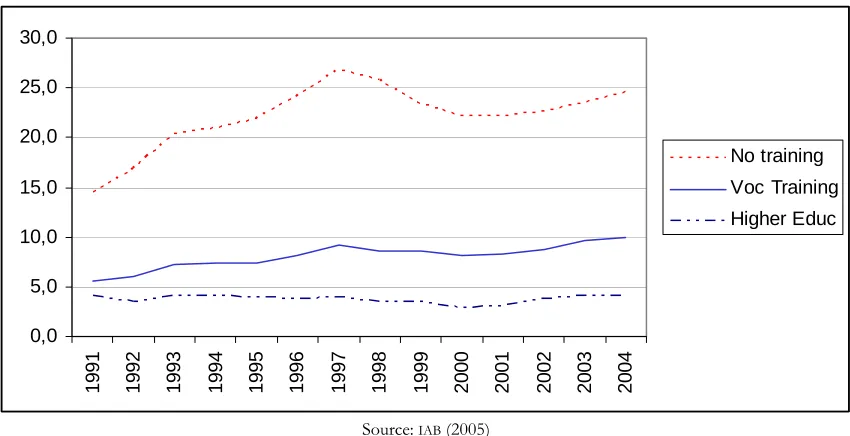
Over the last decades, the unemployment levels of unskilled workers have been relatively high, emphasizing the relative advantage of vocational training. However, after 1990, there has also been an increasing difference between the unemployment risk of graduates from higher education – whose unemployment rate remained fairly stable – and workers with medium-level vocational training – whose unemployment rate almost doubled (cf. Figure 9).
Fig. 9: Qualification-specific unemployment rates, West Germany, 1991-2004
0,0 5,0 10,0 15,0 20,0 25,0 30,0 19 91 19 92 19 93 19 94 19 95 19 96 19 97 19 98 19 99 20 00 20 01 20 02 20 03 20 04 No training Voc Training Higher Educ
Source: IAB (2005)
[image:17.612.93.518.424.642.2]transitions and the overall labor-market situation of German youth. In 2003, nearly one third of young people leaving the dual system experienced at least a short period of unemployment after having completed training
(BMBF 2005: 232).
These figures may reflect a worsening of the relative position of these skilled workers in the “labor queue” (in the sense of Thurow 1975) rather than absolute skill deficits. However, there are also other indicators more di-rectly related to the functional capability of the vocational training system. The overall number of training places within the dual system has declined over recent years. While in the 1980s and early 1990s, this was also demographically induced, since then there has obviously been a decreasing willingness of employers to pro-vide training. There has also been an increasing awareness of the heterogeneity among apprenticeships as re-flected by very different financial investment and individual employment chances after completion.
Long-term calculations of the number of employed and registered unemployed at various qualification levels
(IAB 2005) suggest that since the early 1990s, high skilled jobs were the only category that still expanded, while
intermediate skill levels stagnated (or people with intermediate skills were increasingly displaced) and demand for low-skilled jobs showed a moderate decline. Hence, higher education has become an increasingly attractive alternative for young people finishing school (even if the expected wage premium has been smaller than in many other countries). Additional pressure on the system of vocational training comes from the move towards
a system of BA/MA courses in higher education in accordance with the Bologna Process launched by the
European Union.
Open to debate is the extent to which the conditions for the “German model” to operate successfully still exist (Streeck 1997; Culpepper 1999). Some indicators like the fact that a larger number of school leavers from upper secondary tracks do enter apprenticeships seem to suggest that (higher levels of) apprenticeships have in fact remained attractive and capable of adapting. The reported problems of vocational training therefore do not necessarily imply a suggestion for Germany to follow the British way; given the variety of training systems (cf. Lauterbach 2000) and their dependencies on specific institutional contexts, an international transfer of particular elements of skill systems is often unrealistic. However, these problems indicate that the German vo-cational training system is in urgent need of adaptation.
Special problems for the dual system have arisen especially from the economic situation in East Germany where, as yet, no adequate structure of enterprises that may provide training has been established, and where a good deal of training is state-supported, out-of-firm training. Even when leaving the problems in East Ger-many aside, scientific observers have mentioned a number of current deficiencies of the German vocational training system. Among them are (Baethge 2003; Geißler 1991; Rothe 2001) the insufficient adaptation to the changing occupational structure (especially in the service sector) and the insufficient “permeability” between general and vocational education. While there is no early differentiation into “vocational tracks” within the school system, there is early selection among secondary school tracks within the general school system which, for many, entails clear restrictions for later stages of training.
The problematic situation of low-skilled youth is further intensified by the fact that an increasing proportion of graduates from higher secondary schools has entered the dual system of vocational training (often in com-bination with higher education: Hillmert & Jacob 2004; Jacob 2004). While this indicates that (higher-level) vocational training courses have successfully been adapted to contemporary demands, less educated school dropouts are in increasing danger of being displaced by the higher qualified. Measures of requalifying low-skilled and unemployed youth according to an idea of standardized “normal biographies,” as expected by the German skill system, have often proved to be ad hoc, protracting individual transitions (“measurement ca-reers”), and not leading to enduring labor-market integration (Solga 2005). The considerable volume of these measures has certainly masked rising youth unemployment. Moreover, an upgrading of training may cause structural problems of insufficient supply of apprenticeships, especially if small firms cannot meet the higher standards of (more theory-oriented) training within primarily firm-based training.
sys-tem would probably be a complement to the existing vocational training syssys-tem, but rising skill demands will probably also lead to a larger differentiation within the system of initial vocational education and training.
Recent reforms such as the amendment of the Vocational Training Act (Berufsbildungsgesetz) in 2005 may
have led to some improvements to the problems mentioned. For example, it facilitates crediting pre-qualificational phases in the course of acquiring vocational training certificates. Still, the development of links, as well as the competition between general and vocational education will be crucial for the future performance of the German vocational training system.
Britain vs. Germany
In sum, the 1990s made the different “strategies” to meet the skill demands in the two countries even more explicit.
Britain has experienced long-term difficulties with the provision of (intermediate) vocational training. There-fore, a strategy of a “gradual” upgrading of skills could not successfully be implemented when there was de-cline in the demand for low-skilled labor and the skill deficit became urgent. In effect, Britain took a more radical change in its skill policy with an emphasis on mass higher education. The “success” of upgrading skills has been mixed, if one takes forms of intermediate vocational training into account, but at least this combina-tion of deliberate political strategies and individual responses has changed the overall skill composicombina-tion con-siderably.
In contrast to this, the skill situation in Germany has, at least at first glance, been much more stable. Relying on long established practices and relationships involved in the training process, the German skill system has tried to adapt within the given skill strategy. This has, however, obviously led to rigidities and increasing prob-lems for skill provision and individual labor-market chances especially at the lower quality end of the voca-tional training system.
5. Conclusion and outlook
This paper has sought to provide a description of actual developments, but it has also tried to illustrate the specificity of an institution-oriented perspective on skill formation. What, therefore, does this perspective tell us more generally in this example?
First, far from reflecting uniform situations and trends in skill formation there is a high degree of dependency
on social contexts. The structure and the success of skill formation depend heavily on a variety of societal contexts, especially the structure of the labor market, and the effectiveness of the links that can be established between skill systems and these contexts. Since the relevance of skills can often not be assessed without examining long-term consequences, extended life-course developments (especially, employment careers) must come into focus.
Second, there are marked long-term historical changes in skill formation. In the British case this applies, in
particular, to labor-market related context factors such as the weakening of occupational boundaries and the decline of traditional sectors offering apprenticeships. In recent years, fundamental changes have affected the quantitative composition of various tracks of the educational systems, indicating a change in the dominant strategy of skill formation. At first glance, the very fact of historical change might be perceived as a contradic-tion of the salience of contexts in the sense of nacontradic-tional configuracontradic-tions of institucontradic-tions. Upon closer
examina-tion, however, it emerges that both aspects may be regarded as manifestations of system-specific historical
path dependencies. Path dependency in this sense is not to be equated with overall stability, but rather with specific developments that depend strongly on previous conditions.
fur-ther increase the pressure of adaptation on a training system like the German with a traditionally strong em-phasis on medium-level, occupation-specific vocational qualifications. This form of education and training can probably adapt to perceived rising skill demands only if it offers institutionalized links with forms of higher education and continuing education. However, and unlike many popular assumptions, also a collective upgrad-ing of skills will probably not be a sufficient solution to the persistent problem of (youth) unemployment (Crouch et al. 1999). One way or the other, all advanced societies take part in a positional competition of edu-cational expansion, and it is in particular the lower-skilled who will continue to be in need of better-targeted training and social policy.
References
Albert, Michael (1992): Kapitalismus contra Kapitalismus. Frankfurt/M.: Campus.
Allmendinger, Jutta (1989): Educational systems and labor market outcomes. European Sociological Review 5:
231-250.
Ashton, David N., Maguire, Malcom & Spilsbury, Mark (1990): Restructuring the labour market: the
im-plications for youth. London: Macmillan.
Baethge, Martin (2003): “Das berufliche Bildungswesen am Beginn des 21. Jahrhunderts,” in Cortina, Kai S.,
Baumert, Jürgen, Leschinsky, Achim, Mayer, Karl Ulrich, Trommer, Luitgard, eds., Das
Bildungs-wesen in der Bundesrepublik Deutschland. Strukturen und Entwicklungen im Überblick. Rein-bek: Rowohlt, pp. 525-580.
Blossfeld, Hans-Peter & Mayer, Karl Ulrich (1988): “Labor market segmentation in the Federal Republic of
Germany: an empirical study of segmentation theories from a life course perspective,” European
So-ciological Review 4: 123-140.
BMBF (Bundesministerium für Bildung und Forschung) (2005): Berufsbildungsbericht 2005. Bonn: BMBF.
Brauns, Hildegard, Müller, Walter & Steinmann, Susanne (1997): Educational expansion and returns to
education. A comparative study on Germany, France, the UK, and Hungary. MZES Working Paper I/23, University of Mannheim.
Breen, Richard & Goldthorpe, John H. (1997): “Explaining educational differentials. Towards a formal
ra-tional action theory,” Rationality and Society 9: 275-305.
Brown, Richard K. (1990): “A flexible future in Europe? Changing patterns of employment in the United
Kingdom,” British Journal of Sociology 41: 301-327.
Brynin, Malcolm (2002): “Overqualification in employment,” Work, Employment and Society 16: 637-654.
Bynner, John & Roberts, Ken, eds. (1991): Youth and work: transition to employment in England and
Germany. London: Anglo-German Foundation for the Study of Industrial Society.
Coffield, Frank (1995): “Always the trainee, never the employee? Increasingly protracted transitions in the
U.K.,” in Cavalli, Alessandro & Galland, Oliver, eds., Youth in Europe. London/New York: Pinter,
pp. 45-62.
Crouch, Colin, Finegold, David & Sako, Mari (1999): Are skills the answer? The political economy of
skill creation in advanced industrial countries. Oxford: Oxford University Press.
Culpepper, Pepper D. (1999): “The future of the high-skill equilibrium in Germany,” Oxford Review of
Eco-nomic Policy 15: 43-59.
Deißinger, Thomas (1994): “Das Reformkonzept der ‘Nationalen beruflichen Qualifikationen’. Eine
An-nährung der englischen Berufsbildungspolitik an das ‘Berufsprinzip’?” Bildung und Erziehung 47:
305-328.
Dingeldey, Irene (1996): “Wandel gewerkschaftlicher Strategien in der britischen Berufsbildungspolitik der
1980er und 1990er Jahre,” Politische Vierteljahresschrift 37: 687-712.
Doeringer, Peter B. & Piore, Michael J. (1971): International labor markets and manpower analysis.
Lex-ington MA: Heath Lexington Books.
Erikson, Robert & Goldthorpe, John H. (1992): The constant flux. A study of class mobility in
industri-al societies. Oxford: Clarendon Press.
Esping-Andersen, Gøsta (1990): The three worlds of welfare capitalism. Princeton NJ: Princeton University
Press.
Finegold, David (1988): “The failure of training in Britain: analysis and prescription,” Oxford Review of
Geißler, Karlheinz (1991): “Das Duale System der industriellen Berufsausbildung hat keine Zukunft,”
Levia-than 19: 68-77.
Greuling, Oliver (1996): Berufsvorbereitung und Berufswahl von britischen und deutschen Jugendlichen.
Frankfurt/M.: Peter Lang.
Hall, Peter A. & Soskice, David, eds. (2001): Varieties of capitalism: the institutional foundations of
com-parative advantage. Oxford, New York: Oxford University Press.
Halsey, Albert H. (2000): “Further and Higher Education,” in Halsey, Albert H. & Webb, Josephine, eds.,
Twentieth century British social trends. Basingstoke: Macmillan, pp. 221-253.
Hillmert, Steffen (2001): Ausbildungssysteme und Arbeitsmarkt. Lebensverläufe in Großbritannien und
Deutschland im Kohortenvergleich. Wiesbaden: Westdeutscher Verlag.
Hillmert, Steffen (2002): “Labour market integration and institutions: an Anglo-German comparison,” Work,
Employment and Society 19: 675-701.
Hillmert, Steffen & Jacob, Marita (2004): Multiple episodes: training careers in a learning society. GLO
-BALIFE Working Paper 64. Bamberg
IAB (Institut für Arbeitsmarkt- und Berufsforschung) (2005): IAB Zahlenfibel (http://www.iab.de/asp/fibel/
20.02.06)
Jacob, Marita (2004): Mehrfachausbildung in Deutschland: Karriere, Collage, Kompensation? Wiesbaden:
VS Verlag für Sozialwissenschaften.
Kerckhoff, Alan C. (1990): Getting started: transition to adulthood in Great Britain. Boulder, Oxford:
Westview Press.
Lauterbach, Uwe (2000): Internationales Handbuch der Berufsbildung. Baden-Baden: Nomos.
Layard, Richard, Mayhew, Ken & Owen, Geoffrey, eds. (1994): Britain’s training deficit. The Centre for
Economic Performance report. Aldershot: Avebury.
Lessenich, Stephan (1995): “Wohlfahrtsstaatliche Regulierung und die Strukturierung von Lebensläufen. Zur
Selektivität sozialpolitischer Interventionen,” Soziale Welt 46: 51-69.
Lynch, Linda M., ed. (1994): Training and the private sector: international comparisons. Chicago,
Lon-don: University of Chicago Press.
Mayer, Karl Ulrich (1997): “Notes on a comparative political economy of life courses,” Comparative Social
Research 16: 203-226.
Mayer, Karl Ulrich (2001): “The paradox of global social change and national path dependencies: life course
patterns in advanced societies,” in Woodward, Alison & Kohli, Martin, eds., Inclusions and
exclu-sions in European societies. London: Routledge, pp. 89-110.
Mayer, Karl Ulrich & Hillmert, Steffen (2003): “New ways of life or old rigidities? Recent changes in social structures and life courses in Germany and their political impacts,” in Kitschelt, Herbert & Streeck,
Wolfgang, eds., Germany: beyond the stable state. West European Politics 26,4 (2003 Special
Issue): 79-100.
Mincer, Jacob (1974): Schooling, experience and earnings. New York: Columbia University Press.
Müller, Walter & Shavit, Yossi (1998): “The institutional embeddedness of the stratification process: A com-parative study of qualifications and occupations in thirteen countries,” in Shavit, Yossi & Müller,
Wal-ter, eds., From school to work. A comparative study of educational qualifications and
occupa-tional destinations. Oxford: Clarendon Press, pp. 1-48.
OECD (2005): Education at a glance: OEC D indicators 2005. Paris: OECD.
Oulton, Nicholas & Steedman, Hilary (1994): “The British system of youth training: A comparison with
Ger-many,” in Lynch, Lisa M., ed., Training and the private sector. International comparisons.
Chi-cago, London: University of Chicago Press, pp. 61-76.
Rainbird, Helen (1997): “The social construction of skill,” in Jobert, Annette, Marry, Catherine, Tanguy, Lucie
& Rainbird, Helen, eds., Education and work in Great Britain, Germany and Italy. London/
New York: Routledge, pp. 177-191.
Roberts, Ken (1995): Youth and employment in modern Britain. Oxford: Oxford University Press.
Roberts, Ken (2004): “School-to-work transitions: why the United Kingdom’s educational ladders always fail
to connect,” International Studies in the Sociology of Education 14: 203-215.
Rothe, Georg (2001): Die Systeme beruflicher Qualifizierung Deutschlands, Österreichs und der
Ryan, Paul (1999): “The school-to-work transition twenty years on: issues, evidence and conundrums,” in
OECD, ed., Preparing youth for the 21st century: issues, evidence and conundrums. Paris: OECD,
pp. 437-458.
Ryan, Paul & Unwin, Lorna (2001): “Apprenticeship in the British ‘training market’,” National Institute
Economic Review 178: 99-114.
Smith, George (2000): “Schools,” in Halsey, Albert H. & Webb, Josephine, eds., Twentieth century British
social trends. Basingstoke: Macmillan, pp.179-220.
Sørensen, Aage B. & Kalleberg, Arne L. (1981): “Outline of a theory for the matching of persons to jobs,” in
Berg, Ivar, ed., Sociological perspectives on labor markets. New York: Academic Press, pp. 49-74.
Solga, Heike (2005): Ohne Abschluss in die Bildungsgesellschaft: die Erwerbschancen gering
quali-fizierter Personen aus soziologischer und ökonomischer Perspektive. Opladen: Budrich.
Soskice, David (1994a): “Reconciling markets and institutions: The German apprenticeship system,” in Lynch,
Linda M., ed. (1994), Training and the private sector: international comparisons. Chicago,
Lon-don: University of Chicago Press, pp. 25-60.
Soskice, David (1994b): “Social skills from mass higher education: lessons from the US,” in Layard, Richard et
al., Britain’s training deficit. The Centre for Economic Performance report. Aldershot: Avebury,
pp. 314-338.
Spence, Michael (1973): “Job market signalling,” Quarterly Journal of Economics 87: 355-374.
Streeck, Wolfgang (1989): “Skills and the limits of Neo-Liberalism: The enterprise of the future as a place of
learning,” Work, Employment and Society 3: 89-104.
Streeck, Wolfgang (1997): “The German model: Does it exist? Can it survive?” in Crouch, Colin & Streeck,
Wolfgang, eds., Political economy of modern capitalism: mapping convergence and diversity.
Lon-don: Sage, pp. 33-54.
Streeck, Wolfgang & Thelen, Kathleen, eds. (2005): Beyond continuity: institutional change in advanced
political economies. Oxford: Oxford University Press.
Thelen, Kathleen (2004): How institutions evolve. The political economy of skills in Germany, Britain,
the United States, and Japan. Cambridge: Cambridge University Press.
Thurow, Lester C. (1975): Generating inequality. Mechanisms of distribution in the US economy. New
York: Basic Books.
UNESCO (various years): Statistical Yearbook. Paris: UNESCO.
Windolf, Paul (1984): “Formale Bildungsabschlüsse als Selektionskriterium am Arbeitsmarkt. Eine
vergleich-ende Analyse zwischen Frankreich, der Bundesrepublik Deutschland und Großbritannien,” Kölner
Zeitschrift für Soziologie und Sozialpsychologie 36: 56-74.
Windolf, Paul & Wood, Stephen (1988): Recruitment and selection in the labor market. A comparative
Appendix
Fig. A1: Components of economic growth (1990/91-2000)
GDPgrowth Labor productivity growth
-0,5 0 0,5 1 1,5 2 2,5
Germany UK
employment/ Working age population
Working age population/ total population GDP/person employed
-1 -0,5 0 0,5 1 1,5 2 2,5
Germany UK
Human Capital
Hourly GDP/ efficient unit of labour
Hours worked
Source: OECD (2005)
Fig. A2: Tertiary (degree-level) graduates (2002) by subject
0,0 10,0 20,0 30,0 40,0 50,0 60,0 70,0 80,0 90,0 100,0
GER UK
Computing
Mathematics and statistics
Physical sciences
Life sciences
Health and welfare
Agriculture
Engineering, manufacturing and
construction Services
Social sciences, business and law
Humanities and arts
Education
[image:23.612.148.452.373.709.2]