Int. J. Electrochem. Sci., 11 (2016) 4724 – 4728, doi: 10.20964/2016.06.52
International Journal of
ELECTROCHEMICAL
SCIENCE
www.electrochemsci.org
Short Communication
On the Anomalous Behavior of Zn/Ni UPD at Pt(111) Single
Crystalline Electrode in Borate Containing Solution
Omar. A. Hazazi1,*, A.A. El-Shafei1,2
1
Department of Chemistry, College of Applied Sciences, Umm Al-Qura University, Makkah, Saudi Arabia
2
Department of Chemistry, Faculty of Science, Mansoura University, 35516 El-Mansoura, Egypt,
*
E-mail: [email protected]
Received: 13 March 2016 / Accepted: 5 April 2016 / Published: 4 May 2016
Underpotential deposition (UPD) of Zn2+ and/or Ni2+ ions at Pt(111) electrode was carried out in borate containing solution. The presence of borate in the solution was found to assist the appearance of sharp peak of Zn UPD at pH > 4, with consistency of our previous work. Zn UPD was found to occur at the so called butterfly wave potential range while Ni UPD occurs within the hydrogen adsorption/desorption region. In the case of electrolyte containing both Zn2+ and Ni 2+ ions, the UPD of Zn, occurs at the most positive potential value and leads to suppression of Ni UPD process.
Keywords: Zn UPD, Ni UPD, Borate, Pt(111), Simultaneous UPD
1. INTRODUCTION
The electrodeposition of zinc alloys with Iron group, in particular, Zn-Ni alloy, has recently attracted interest because of their high corrosion resistance compared to that of pure zinc [1-3].
Mostly, the electrolytic co-deposition of Zn-Ni alloys is anomalous in nature since the less noble metal zinc deposits preferentially and its percentage in the deposit is higher than that in the electrolyte. Anomalous behavior has been recognized in spite of the composition of the deposition bath [4-7]. Two different theories have been proposed. In the first one, the anomalous co-deposition is attributed to the adsorbed layer of Zn(OH)2 at the surface, which inhibits nickel discharge [8-11]. On
the other hand, the second one [12, 13] assumes that anomalous co-deposition is due to the underpotential deposition (upd) of zinc.
Boric acid is meanly used as an additive in electroplating baths. Although the role of H3BO3 is
to the electroplating bath as a buffering agent. Hence, specific adsorption of borate was first studied on Pt(111) by cyclic voltammetry (CV) under the conditions of changes of pH’s and borate concentrations, and we came to the conclusion that the specific adsorption of borate took place on Pt(111) by the release of H+ [16]. These findings let us conclude that the rule of boric acid is not limited just to act as a buffer [17]
According to Karwas and Hepel [18] boric acid inhibits zinc deposition shifting the nickel content in alloys toward Ni-rich phases. Increasing the boric acid concentration leads to the reducation of the anomalous co deposition [19].
We have recently reported the drastic change in Zn UPD at Pt(111) caused by borate adsorption/ desorption process [20] . In this work, we are going to give some insight on the role of both boric acid and UPD phenomena on the anomalous behavior during Ni-Zn alloy deposition.
2. EXPERIMENTAL
Experiments have been performed in a conventional three-electrode cell with a saturated calomel electrode (SCE) as the reference electrode and a platinum foil as the counter electrode [16]. The preparation of the Pt(111) electrode as well as cleaning of the electrode before each experiment has been done according to the Clavilier method [21]. The solutions were prepared from HClO4
(Merck, suprapur), KClO4 (Merck, pro-analysis), ZnO (Merck, suprapur), and H3BO3 (Merck,
suprapur) with Milli-Q-Water (> 18 MΩ). The pH was controlled by the change of the ratio of HClO4
and KClO4, where the value of pH was constant within experimental error before and after each
measurement.
The electrolytic solution was kept oxygen-free during measurements by continuous bubbling of ultrapure Ar over the solution. The solution came in contact with the working electrode by hanging meniscus technique. The CV measurements were carried out at ambient temperature with potentiostat (Toho 2000) and function generator (Toho FG-01) connected to a computer for data acquisition and processing.
3. RESULTS AND DISCUSSION
3.1. Comparison between Zn UPD and Ni UPD in borate solution
Fig. 1. Shows CV’s obtained at Pt(111) electrode in 10-2
M H3BO3 + 0.1 M XClO4, where X+ is
ions, small negative and positive current increases at - 0.35 V and - 0.28 V(SCE), respectively, are attributed to Ni UPD on Pt(111), as previously found in the case of phosphate solution [22]. Zn UPD occurrence at more positive potential (-0.18 V) compared to Ni UPD, indicates that the amount of Zn deposition is expected to be higher than that of Ni. Zn UPD is expected to significantly suppress hydrogen evolution reaction as hydrogen electrode reaction rate at Zn metal is 3 to 4 orders of magnitude lower than that at Ni metal [23] so that the smooth and defect-free electroplating will be promised at least with Zn UPD covered surface.
3.2. Simultaneous Zn and Ni UPD at Pt(111) in borate solution
As UPD can be considered the starting key point in electrodeposition process, we have attempted to give some insight about the role of UPD on the anomalous behavior during the electrodeposition of Ni/Zn alloys. As Zn UPD occurs at more positive potential compared to Ni (See above), we try to find out the influence of Zn upd on Ni upd process.
Figure 1. CV’s obtained at Pt(111) electrode in 10-2 M H3BO3 + 0.1 M XClO4, where X+ is H+ and/or
K+ in the absence (green curve) and presence of 1×10⁻⁴ M Zn2+ (red curve) and 1×10⁻⁴ M Ni2+ (black curve). pH =4.3, Sweep rate was 5 mV s-1.
[image:3.596.104.488.309.575.2]
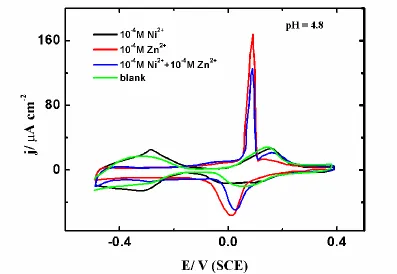
going sweep at 0.09 V for Zn desorption and a peak at 0.014 V in the reverse scan for Zn UPD. Both peaks coincident with the onset of borate adsorption desorption peak as described elsewhere [20]. In the presence of both ions, Zn2+ ions cause considerable suppression for peaks assigned to Ni UPD process. This indicates that in borate solution containing both ions, the main process occur is Zn UPD. This may be attributed to the formation of Zn UPD layer at more positive potential compared to Ni UPD.
It has been previously reported that, increasing the boric acid concentration leads to the shift of Zn UPD process to less positive potential [20]. This intern will leads to the decrease of Zn UPD process. This can explain the increase of Ni content in Ni-Zn alloy by raising the boric acid concentration in the deposition bath [19].
It is noteworthy to mention that the presence of Ni2+ ions in solution also decreases the Zn UPD peaks to some extent. This accompanied with the appearance of small shoulder for Ni adsorption in the negative going sweep at -0.3 V. This indicate that’s small amount of Ni is also contributed in the upd process.
Figure 2. CV’s obtained at Pt(111) electrode in 10-2 M H3BO3 + 0.1 M XClO4, where X+ is H+ and/or
K+ in the absence (green curve) and presence of 1×10⁻⁴ M Zn2+ (red curve), 1×10⁻⁴ M Ni2+ (black curve) and 1×10⁻⁴
M Zn 2+ + 1×10⁻⁴ M Ni2+ (blue curve). pH =4.8, Sweep rate was 50 mV s-1.
4. CONSLUSION
[image:4.596.101.498.331.605.2]
different potential range compared with their bulk deposition potentials. Zn upd occurs at more positive potential than Ni UPD. Accordingly, in the presence of both Zn2+ and Ni2+ ions, Zn UPD process is the predominant one and leads to suppression of both Ni UPD and hydrogen adsorption/desorption process. This can be the main reasons for the anomalous behaviour in Zn/Ni electroplating technology.
References
1. T. Byk, T.V. Gaevskava, L.S. Tsybulskaya, Surf. Coat. Tech., 202(2008)5817. 2. Z.F. Lin, X.B. Li, L.K. Xu, Int. J. Electrochem. Sci., 7(2012)12507.
3. M. Kwon, D.H. Jo, S.H. Cho, H.T .Kim, J.T. Park, J.M. Park, Surf. Coat. Tech., 288(2016)163. 4. H. Nakano, S. Arakawa, Y. Takada, S. Oue, S. Kobayashi, Materials Transactions, 53(2012) 1946. 5. F.H. Assaf, A.M.A. El-Seidy, M.M. Abou-Krisha, A.A. Eissa, International Journal of
Electrochemical Science, 10 (2015) 5465
6. M.M. Abou-Krisha, M.I. Attia, F.H. Assaf, A.A. Eissa, International Journal of Electrochemical Science, 10 (2015) 2972.
7. P.C. Tulio, S.E.B. Rodrigues, I.A. Carlos, Surface and Coatings Technology, 202 (2007) 91. 8. DE Hall, Plat. Surf. Finish. 71(1983) :59-65
9. H. Fukushima, T. Akiyama, R. Higashi, R. Kammel, M. Karimkhani, Metall., 42(1988)242. 10. H Dahms, JM Croll, J. Electrochem. Soc., 112(1965)771.
11. S.S. Abd El Rehim, E.E. Fouad, S.M. Abd El Wahab, H.H. Hassan, Electrochim. Acta, 41(1996)1413.
12. MI Nicol, HI Philip, J. Electroanal. Chem., 70(1976)233. 13. S. Swathirajan, J. Electroanal. Chem., 221(1987)211.
14. J. Stevanović, S. Gojković, A. Despić, M. Obradović, V. Nakić, Electrochim. Acta, 43(1998)705. 15. Z. Abdel-Hamid, Chem. Phys., 53(1998)235.
16. A.A. El-Shafei, A. Aramata, J. Solid. State Electrochem., 11(2007)430. 17. J.P. Hoare, J. Electrochem. Soc., 134(1987)3102.
18. C. Karwas, T. Hepel, J. Electrochem. Soc., 136(1989)1672. 19. Y. Addi, A. Khouider, ECS Transactions, 45(2013) 79.
20. A.A. El-Shafei, S. Taguchi, A. Aramata, Russ. J. Electrochem., 44(2008)690. 21. C. J. lavilier, R Faure, G Guinet, R Durand, J. Electroanal. Chem., 107(1980)205. 22. A.A. El-Shafei, J. Electroanal. Chem., 447(1998)81.
23. H. Kita, J. Electrochem. Soc., 113(1966)1095.