Int. J. Electrochem. Sci., 11 (2016) 2919 - 2926
International Journal of
ELECTROCHEMICAL
SCIENCE
www.electrochemsci.org
Short Communication
The Effect of Gas Diffusion Layer PTFE Content on The
Performance of High Temperature Proton Exchange Membrane
Fuel Cell
Huaneng Su*, Cordellia Sita, Sivakumar Pasupathi
HySA Systems Competence Centre, South African Institute for Advanced Materials Chemistry (SAIAMC), University of the Western Cape, Robert Sobukwe Road, Bellville 7535, Cape Town, South Africa
*
E-mail: [email protected]
Received: 14 October 2015 / Accepted: 10 January 2015 / Published: 1 March 2016
Gas diffusion layer (GDL) with different polytetrafluoroethylene (PTFE) contents in the carbon substrate and the micro-porous layer (MPL) were investigated for the application in poly(2,5-benzimidazole) (ABPBI)-based high temperature polymer electrolyte membrane fuel cell (HT-PEMFC). The physical properties of the GDLs were characterized by scanning electron microscopy (SEM) and pore size distribution. The electrochemical properties of the single cell based on these GDLs were evaluated and analyzed by I-V curve and electrochemistry impedance spectroscopy (EIS). The results showed the use of a minimal quantity of PTFE in the carbon substrate (~15 wt%) and the MPL (~5-10 wt%) are suggested for both good mechanical properties of the GDLs and the good fuel cell performance.
Keywords: High temperature proton exchange membrane fuel cell, Polybenzimidazole, Gas diffusion layer, Micro-porous layer, PTFE loading, Cell performance
1. INTRODUCTION
PBI-based HT-PEMFCs are composed by the classical Nafion-based PEMFC elements, i.e. gas diffusion layer (GDL), ionomeric membrane and catalytic layer (CL) [5,6]. It is believed that an optimum on all of these elements is important to attain the good cell performance. The membrane electrode assembly (MEA) is the most important component of PEMFC, which consists of a polymer electrolyte membrane with CLs on both sides and GDLs. The role of porous GDL is important to the PEMFC. For the GDL, the function is to remove the generated product (liquid water) out of the cell and to distribute the reactant gas over the catalyst layer. The GDL offers a conductive path between the bipolar plate (i.e. current collector) and the catalyst layer, and provides a support for the CL. The GDL consists of a macro porous substrate, named as the gas diffusion backing layer (GDBL), and a thin micro porous layer (MPL). Normally, carbon fiber based products are most promising candidates for being used as the GDBL in PEMFCs, such as woven clothes, felts and non-woven papers, due to their good electrical conductivity and high porosity. The MPL, which is composed of carbon powder and a hydrophobic agent, such as polytetrafluoroethylene (PTFE), is applied on one side of the GDBL.
Several properties are required for the GDL being used in HT-PEMFC systems [5,7-9]: (i) good diffusion properties for the exit of the water vapour and the reactant gases evenly distributed onto the electrode surfaces; (ii) physical durability for good electrical contact and gas tightness; (iii) low bulk resistance and contact resistance for conducting electrons between the flow field plate and the electrode. In Nafion-based low temperature PEMFC systems, one important aspect to obtain good cell performance is the management of water due to its liquid state, especially at high current densities. When PEMFC operating above 100 oC, this limitation is disappear because water is in the vapour state. However, good diffusion properties to permit the exit of water vapour is still crucial to improve fuel cell performance. It should be noted that an accumulation of water vapour would increase the vapour pressure, then resulting in a reduction in the partial pressure of the reactants. This latter problem is only present in the cathode, provided that pre-humidification is not used in the system—a situation that is typical of PBI-based PEMFC systems. Therefore, the role of GDL is very important for the improvement of the fuel cell performance, in both terms of water flooding and the access of and exit of the products and the reactant gases. The transport of electrons between the catalytic layer and the flow fields is also relied on the GDL. PTFE loadings, GDL thickness and different types of supporting materials have been studied for the improved cell performances [8,10,11].
On the basis of the information discussed above, this work aims to study the effect of the PTFE loading in the GDL (GDBL and MPL, dividedly) on the performance of PBI-based HT-PEMFC. The properties of the GDLs with different PTFE loadings in GDBL and MPL were fully evaluated by structure characterization, electrochemical analysis and single cell polarization. Special attention has been paid to the comparison of the fuel cell performances of the electrodes based on these GDLs.
2. EXPERIMENTAL
2.1 Preparation of the GDLs
[image:3.596.57.536.278.323.2]
30 min to obtain the GDBLs with different PTFE loadings. The MPLs were prepared as following steps. First, a slurry of carbon black and Teflon, with different weight ratio of carbon powder (Vulcan XC72, Cabot, USA) and PTFE (60%, Aldrich, USA), was sprayed onto the Teflon-pretreated GDBLs, followed by calcining at 350 oC for 30 min to form the MPLs. The details of these GDLs are shown in Table 1. For simplicity, these GDLs were denoted as GDL-1 to GDL-6. From GDL-1 to GDL-3, the PTFE loading in MPL is fixed while the PTFE loading in GDBL varies, to investigate the effect of GDBL PTFE content on the electrode performance. Contrarily, GDL-4, GDL-5 and GDL-6 possess same PTFE content in their GDBLs while varied loading in their MPLs to investigate the influence of MPL PTFE loading.
Table 1. Specifications of the GDLs created for this study
GDL# GDL-1 GDL-2 GDL-3 GDL-4 GDL-5 GDL-6
PTFE content in GDBL (wt.%) 0 15 30 15 15 15
PTFE content in MPL (wt.%) 15 15 15 5 10 30
2.2 Physical characterization of the GDLs
The GDBL and MPL were characterized by an ultrahigh resolution field-emission SEM (Carl Zeiss Auriga HRFEGSEM, Oberkochen, Germany). Porosity and pore size distribution was determined by using an Auto Pore IV 9500 Hg porometer (Micromeritics Instrument Corp., USA) applying pressures between 0.0145 and 4136.85 bar.
2.3 Preparation of the electrodes.
Hispec 4000 Pt/C catalyst (40 wt.% Pt, Johnson Matthey) was used in this study. The catalyst ink was prepared by dispersing catalyst power into a mixture of isopropanol and PTFE dispersion (60 wt.%, Aldrich). Before being used, the dispersion mixture was ultrasonicated for at least 1 h for homogeneity. All electrodes were prepared by our newly developed spraying method to achieve reproducible spraying patterns and CL properties [4,12-15]. The catalyst powders were deposited onto the MPLs of the as-prepared GDLs. Other details on the electrodes preparation can be found from our previous work [4, 12-15].
2.4 Preparation of the MEAs.
The membranes used in this study are ABPBI, which were supplied by FuMA-Tech. For doping with PA, the membranes were immersed in 85% acid solution for certain time at certain temperature until their acid doping level of about 3.7 molecules of H3PO4 per polymer repeating unit
made of fluorinated polymer, the MEA was assembled by sandwiching the doped membrane between two GDEs impregnated with PA in a single cell fixture (BalticFuel-Cells GmbH, Germany) without a preceding hot-pressing step. The active areas of all MEAs are 5 cm2.
2.5 Single Cell Test and Electrochemical Characterization.
The cells were operated at 160 oC and ~2 N mm−2 piston pressure in a FuelCon Evaluator C test station (FuelCon, Germany). Pure hydrogen was fed to the anode and air to the cathode respectively, with flow rates (unless otherwise stated) of 100 ml min−1 (hydrogen) and 250 ml min−1 (air), at ambient pressure. Both hydrogen and air were used as dry gases, directly from the compressed bottles with no external humidification. Electrochemical impedance spectroscopy (EIS) was performed using an Autolab PGSTAT 30 Potentiostat/Galvanostat (Metrohm). EIS measurements were carried out at a cell voltage of 0.6 V with amplitude of 5 mV, and in the frequency range of 100 mHz to 20 kHz. The impedance data were obtained by calculation and simulation with Autolab Nova software.
3. RESULTS AND DISCUSSION
[image:4.596.67.540.407.525.2]3.1 Structure characterization.
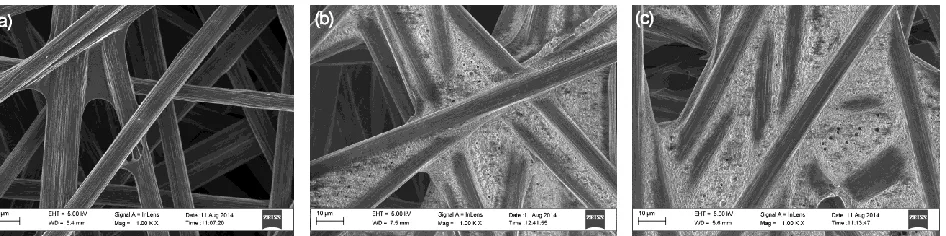
Figure 1. Surface morphology SEM images of the different PTFE loaded GDBLs: (a) 0 % PTFE; (b) 15% PTFE; (c) 30% PTFE.
The surface morphologies of the GDBL with different PTFE contents are presented in Fig. 1. It can be seen that the higher the PTFE content, the less open the surface structure, due to that PTFE particles tend to deposit onto the carbon fibres and this reduces the overall porosity of the GDBL. However, the GDBL is macroporous with mean pore radius on the order of 10 m, this should has no serious effect on the gases transport. On the contrary, GDBL with higher PTFE content can prevent the carbon powder from penetrating into the carbon fibre paper, and it is also believed that the mechanical properties of the carbon in its use as GDL improve with the PTFE loading.
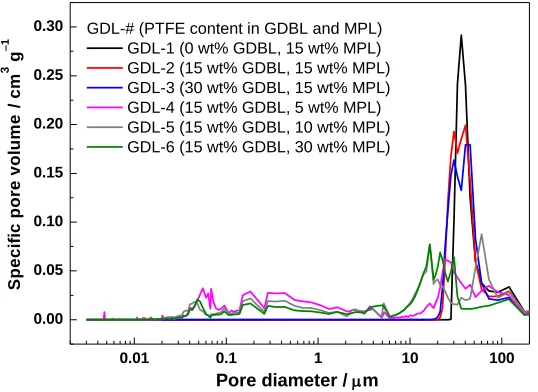
the catalyst sites, the main contribution to gas transport will be due to Knudsen diffusion in the micropores and a molecular diffusion mechanism in the macropores [16]. Better mass transport can be expected for the electrodes with larger volume of pores, especially at higher current densities.
0.01 0.1 1 10 100
0.00 0.05 0.10 0.15 0.20 0.25
0.30 GDL-# (PTFE content in GDBL and MPL) GDL-1 (0 wt% GDBL, 15 wt% MPL) GDL-2 (15 wt% GDBL, 15 wt% MPL) GDL-3 (30 wt% GDBL, 15 wt% MPL) GDL-4 (15 wt% GDBL, 5 wt% MPL) GDL-5 (15 wt% GDBL, 10 wt% MPL) GDL-6 (15 wt% GDBL, 30 wt% MPL)
Pore diameter / m
S p e c if ic p o re v o lu m e / c m
3 g
[image:5.596.155.424.148.344.2]1
Figure 2. Pore size distribution of the GDLs with different PTFE contents.
3.2 Single cell performance.
For practical application, the single cell performance is the most apparent criterion for evaluating different GDEs. Therefore, the polarization behaviors of the GDEs prepared with various GDLs were evaluated using the single cell with H2/air at normal working conditions, as shown in Fig.
Figure 3. Polarization curves of the GDEs based on different GDLs.
3.3 Electrochemical characterization.
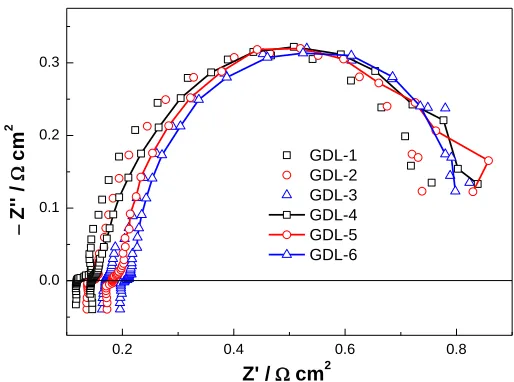
The charge transfer resistances (Rct) and the cell resistances (RΩ) can be calculated, through
simulation with Autolab software, the results are summarized in Table 2. It can be seen that there is no significant difference in charge transfer resistance for these GDEs, because they all have same CLs. However, the obtained cell ohmic resistance is different from each other. The lower the PTFE content, the lower the cell resistance, which is consistent with their performance behaviors presented in Fig. 3. This results shows non-teflonized GDBL is the best candidate for support layer. However, the mechanical integrity of this non-teflonized GDBL should be considered. Therefore, it is suggested that both carbon paper and MPL containing a minimal PTFE content (~10-15%) GDL could deliver a good performance, meanwhile maintaining a proper mechanical properties of the electrode [5].
0.2 0.4 0.6 0.8
0.0 0.1 0.2 0.3 GDL-1 GDL-2 GDL-3 GDL-4 GDL-5 GDL-6 Z '' / cm 2
Z' / cm2
Figure 4. In situ impedance curves of the single cell based on different GDLs.
0.0 0.2 0.4 0.6 0.8 1.0
0.2 0.4 0.6 0.8 1.0 GDL-4 GDL-5 GDL-6 Voltage / V
Current Density / A cm-2
(b)
0.0 0.2 0.4 0.6 0.8 1.0 0.2 0.4 0.6 0.8 1.0 GDL-1 GDL-2 GDL-3 Cell v oltage / V
Current density / A cm-2
[image:6.596.157.414.519.710.2]
Table 2. Resistances of the single cell based on different GDLs
GDL# GDL-1 GDL-2 GDL-3 GDL-4 GDL-5 GDL-6
RΩ (Ωcm2) 0.119 0.135 0.169 0.149 0.182 0.211
Rct (Ωcm2) 0.647 0.649 0.652 0.642 0.651 0.655
4. SUMMARY
The influence of PTFE content in GDL (macroporous carbon substrate and microporous MPL, separately) on the performance of PA doped ABPBI-based HT-PEMFC was investigated. The porosity and electrical resistance are found increasing with the increase of PTFE content in both carbon substrate and MPL. And the fuel cell test showed a superior performance for the GDL with lower PTFE content, which suggests that PTFE-free GDL is most suitable for HT-PEMFC. However, a proper PTFE content helps to maintain the good mechanical properties of the GDL. Therefore, the use of a minimally PTFE in carbon substrate (~15 wt%) and MPL (~5-10 wt%) is suggested for both the good mechanical properties of the GDLs and the good fuel cell performance.
ACKNOWLEDGEMENTS
This work is supported by Hydrogen and Fuel Cell Technologies RDI Programme (HySA), funded by the Department of Science and Technology in South Africa (Project KP1-S01).
References
1. J. Zhang, Z. Xie, J. Zhang, Y. Tang, C. Song, T. Navessin, Z. Shi, D. Song, H. Wang, D.P. Wilkinson, Z.-S. Liu, S. Holdcroft, J. Power Sources, 160 (2006) 872
2. K.L. Hsueh, E. Gonzalez, S. Srinivasan, D.T. Chin, J. Electrochem. Soc., 131 (1984) 823 3. H. Su, T.-C. Jao, O. Barron, B.G. Pollet, S. Pasupathi, J. Power Sources, 267 (2014) 155
4. H. Su, S. Pasupathi, B. Bladergroen, V. Linkov, B.G. Pollet, Int. J. Hydrogen Energy, 38 (2013) 11370
5. J. Lobato, P. Cañizares, M.A. Rodrigo, C. Ruiz-López, J.J. Linares, J. Appl. Electrochem., 38 (2008) 793
6. J.H. Chun, K.T. Park, D.H. Jo, J.Y. Lee, S.G. Kim, E.S. Lee, J.-Y. Jyoung, S.H. Kim, Int. J. Hydrogen Energy, 35 (2010) 11148
7. J.H. Chun, D.H. Jo, S.G. Kim, S.H. Park, C.H. Lee, S.H. Kim, Renewable Energy, 48 (2012) 35 8. L. Cindrella, A.M. Kannan, J.F. Lin, K. Saminathan, Y. Ho, C.W. Lin, J. Wertz, J. Power Sources,
194 (2009) 146
9. R.P. Ramasamy, E.C. Kumbur, M.M. Mench, W. Liu, D. Moore, M. Murthy, Int. J. Hydrogen Energy, 33 (2008) 3351
10.S. Park, J.-W. Lee, B.N. Popov, J. Power Sources, 163 (2006) 357 11.S. Park, J.-W. Lee, B.N. Popov, J. Power Sources, 177 (2008) 457
12.H. Su, S. Pasupathi, B.J. Bladergroen, V. Linkov, B.G. Pollet, J. Power Sources, 242 (2013) 510 13.H. Su, T.-C. Jao, S. Pasupathi, B.J. Bladergroen, V. Linkov, B.G. Pollet, J. Power Sources, 246
(2014) 63
14.H. Su, H. Liang, B.J. Bladergroen, V. Linkov, B.G. Pollet, S. Pasupathi, J. Electrochem. Soc., 161 (2014) F506
16.H.-K. Lee, J.-H. Park, D.-Y. Kim, T.-H. Lee, J. Power Sources, 131 (2004) 200 17.X.Z. Yuan, H.J. Wang, J.C. Sun, J.J. Zhang, Int. J. Hydrogen Energy, 32 (2007) 4365