This is a repository copy of Indifference based value of time measures for Random Regret Minimisation models.
White Rose Research Online URL for this paper: http://eprints.whiterose.ac.uk/82979/
Version: Accepted Version
Article:
Dekker, T (2014) Indifference based value of time measures for Random Regret Minimisation models. Journal of Choice Modelling, 12. 10 - 20. ISSN 1755-5345 https://doi.org/10.1016/j.jocm.2014.09.001
[email protected] https://eprints.whiterose.ac.uk/
Reuse
Unless indicated otherwise, fulltext items are protected by copyright with all rights reserved. The copyright exception in section 29 of the Copyright, Designs and Patents Act 1988 allows the making of a single copy solely for the purpose of non-commercial research or private study within the limits of fair dealing. The publisher or other rights-holder may allow further reproduction and re-use of this version - refer to the White Rose Research Online record for this item. Where records identify the publisher as the copyright holder, users can verify any specific terms of use on the publisher’s website.
Takedown
If you consider content in White Rose Research Online to be in breach of UK law, please notify us by
1
Indifference based Value of Time measures for Random
Regret Minimisation models
Abstract
The notion of Value of Time (VoT) is a cornerstone of discrete choice based economic appraisal in transportation. Its derivation and interpretation in the context of Random Utility Maximisation (RUM) models with linear-additive utility functions is straightforward and well known. The choice set-composition effects and semi-compensatory behaviour emphasized in the Random Regret Minimisation (RRM) model induces deviations from this basic VoT specification. This paper reviews and provides new insights into the RRM based VoT measure developed by Chorus (2012a). It defines the theoretical properties of the measure using the micro-economic notion of indifference, and provides insights into the limitations of the measure with respect to deriving individual and aggregate welfare measures. Additionally, the representative consumer approach is adopted to derive an alternative VoT measure, which is behaviourally more complete than the Chorus (2012a) measure. Although alleviating some of the restrictions, the measure has its own theoretical disadvantage. The main contribution of the paper can therefore be summarized as the generation of the necessary insights into the extent to which RRM-based VoT measures can be applied for the purpose of economic appraisal.
Keywords: Random Regret Minimisation; Value of Time; Economic appraisal; Welfare
measurement; Indifference; Marginal rate of substitution
Paper published as:
2 1. Introduction
Gonzalez (1997) discussed the theoretical background of the value of travel time savings as developed within time allocation models. In contrast to the cost saving approach, which approximates the opportunity cost of travel time using the gross wage rate, time allocation
models focus on an individual’s subjective value of time. These models take specific interest in the extent to which individuals are willing to make trade-offs between travel time and travel costs and hence implicitly assign a value to travel time savings. Gonzalez (1997, pp.
245) states the following: “The generally accepted method for estimating a subjective value of time consists in finding the marginal rate of substitution between travel time and travel cost,
typically from disaggregate models of discrete choice based on the random utility theory…”.1
This paper concerns the Marginal Rate of Substitution (MRS) between travel time and travel cost embodied within the Random Regret Minimisation (RRM) model. The RRM model (Chorus 2010, 2012a) represents an alternative decision rule in the discrete choice modelling literature where individuals are minimising their regret instead of maximising their utility. The extent to which individuals are willing to make trade-offs between travel time and travel costs are directly influenced by the modification of the decision rule and the specification of the regret function. The MRS and the implied subjective value of time are therefore not necessarily identical between the RUM and RRM model.
The difference between the Random Utility Maximisation (RUM) and RRM model arises in the way the attributes characterising the alternative, such as travel time and travel cost, translate into a measure of utility (regret). The utility of an alternative is defined as a function of the attribute levels of the considered alternative. In contrast, the regret of an alternative is defined by comparing the attribute levels of the considered alternative with those of all the other alternatives in the choice set. Regret only arises (in a non-linear fashion) when an alternative is outperformed by another alternative on a specific attribute. In short, the RRM model focuses solely on relative rather than on absolute attribute performance and thereby introduces a choice set dependency.2
Using the micro-economic notion of indifference, Chorus (2012a) derived the first RRM-based MRS (or value of time) measure. Since then limited attention has been paid to the properties, interpretation and usability of this particular measure. In this paper, I discuss how the measure differs from its RUM counterpart, relates to the behavioural intuition of the RRM model, derive its theoretical properties and show how the different parts of the measure should be interpreted. Specifically, I review the extent to which the measure can be used for welfare analysis of changes in the transport infrastructure. I will show that the measure has its merits, but is not (yet) a full-fledged alternative to its RUM counterpart for welfare analysis. As a first step, I develop an alternative RRM-based value of time measure based on the
1
Train and McFadden (1978) are generally acknowledged for establishing the connection between time allocation models and the random utility maximisation theory.
3
representative consumer approach (Anderson et al. 1988; Hau 1985), which is central to the welfare economic framework for discrete choice models developed by Small and Rosen (1981). It turns out this measure alleviates some of the restrictions, but has its own theoretical concerns. Finally, based on the developed insights I discuss a road map for building a welfare framework around the RRM model.
The remainder of the paper is structured as follows: section 2 briefly introduces the notion of Value of Time and how it can be derived within the RUM and RRM model. Section 3 provides a detailed account of the Chorus (2012a) VoT measure and its relation to economic welfare. Section 4 then adopts the perspective of the representative consumer and develops the associated VoT measure. Section 5 describes the challenges of conducting welfare analysis under context dependent preferences. Section 6 summarizes the review and presents suggestions for further research.
2. Indifference, marginal rate of substitution and the subjective value of time
The Marginal Rate of Substitution is closely related to the microeconomic notion of indifference (e.g. Katz and Rosen, 1998). In utility theory, an individual is assumed to be indifferent between two particular situations when they generate the same level of utility. The MRS emerges when studying the trade-off between two specific attributes characterising a particular alternative, in this case travel time Ti and travel costs Ci of alternative i. The increase in utility associated with a marginal decrease in travel time can be counteracted by a marginal increase in travel costs. The MRS measures the rate at which the individual is willing to trade one attribute for another in order to keep utility constant. Since travel cost are incorporated in the trade-off, the (negative of) the MRS can alternatively be interpreted as an
individual’s subjective willingness to pay for a reduction in travel time by one unit, or simply put the subjective Value of Time (VoT).
2.1VoT in the linear-additive RUM model
In the linear-additive RUM model, the traveller is assumed to choose the alternative i which generates the highest level of utility Ui of all J alternatives in the choice set D. Utility in (1) is composed of a random part i and a systematic part Vi. The assumed independence between i and the attributes included in Vi, such as travel time and cost, implies that only changes in deterministic utility influence the MRS between travel time and travel cost.
i i i
U V (1)
Equation (2) derives the RUM-based Value of Time, i.e. the negative of the MRS between travel time and travel cost. The RUM-based VoT reduces to the ratio of marginal utilities of the considered alternative i as a result of imposing independence between i and Vi. Moreover, equation (2) assumes changes in Ti and Ci only affect the utility of alternative i. The change in expected maximum utility is therefore solely determined by the changes in Vi. Accordingly, it makes no difference in the RUM model whether the `unconditional indirect utility function’,
4
measure. This distinction, however, becomes relevant for the RRM model and will be discussed in more detail in Section 2.2.
max , max , j iRUM RUM i i
i i
i j
i i
E U j D V
T T
VoT MRS
V
E U j D
C C (2)
In most empirical studies the ratio of marginal utilities reduces to the ratio of parameters
T/ C due to the adoption of a linear in the parameters and linear in the attributes utility function. This ratio is generic across alternatives when the same set of parameters is used across alternatives. An extensive literature exists regarding the effectiveness of using non-linear utility functions such that the VoT starts to vary with the characteristics of the trip. A prominent example in is the inclusion of a log-cost formulation to account for cost damping effects, which represent the notion that the value of time is increasing in trip length due to reducing cost sensitivities (e.g. Daly, 2010). Essential is that the functional form of the utility function determines the marginal utility of travel time and travel costs of a specific alternative and thereby sets the marginal rate of substitution. Similarly, the switch in decision rule from Random Utility Maximisation (RUM) to Random Regret Minimisation (RRM) translates into an alternative specific value of time measure which is choice set dependent.
2.2VoT in the RRM model
Chorus (2012a) already discussed the characteristics of the RRM model, therefore I will only discuss the functional form of the regret function presented in (3). Like the RUM model, the random regret function RRi for alternative i is assumed to be linear additive and consists of a deterministic and a stochastic component, respectively Ri and i. The systematic regret associated with alternative i equals the sum of the regrets associated with the bilateral
comparisons of i with each of its (J-1) competitors in the choice set: i i j
j i
R R
. Thecomparison of alternative i with alternative j is conducted at the level of the attributes. Regret on alternative i arises when it is outperformed by alternative j on attribute m. The bilateral regret between alternative i and alternative j is then the sum across the attribute level regrets,
i.e. m
i j i j m
R
R . The typical functional form imposed on Rimjis the following:
ln 1 exp
m
i j m jm im
R x x , where m denotes an estimable parameter, which takes the
same sign as m in the RUM model. Accordingly, an increase in travel time (cost) of alternative i will increase its associated regret.
ln 1 exp
i i i m jm im i
j i m
RR R x x
5
When inspecting (3), it is easy to observe that Ri incorporates attribute levels of the considered alternative (xim) and of all other alternatives in the choice set (xjm). The latter introduces a context or choice set dependency not present in RUM models. The performance of an alternative is evaluated at the attribute level by contrasting the attribute level relative to all competing alternatives. In fact, the non-linear regret function invokes that not only the absolute level of regret, but also marginal regret depends on an alternative’s relative performance. Outperforming the other alternatives on a particular attribute induces a lower level of marginal regret, while being outperformed implies a higher level of marginal regret. Note that marginal regret converges to zero when an alternative already has a very strong performance on a particular attribute. Under very poor performance the marginal regret on that attribute converges towards m(J-1). Small improvements in the respective attribute then lead to large decreases in regret. The direct connection between marginal regret and the MRS imply that the asymmetry and choice set dependency of the regret function have direct implications for the VoT. Note that the resulting variations in the VoT are inherently different from the variations introduced by the use of non-linear utility functions.
The RRM-based VoT measure presented in Chorus (2012a), and discussed in more detail in Section 3, draws upon the ‘conditional indirect regret function’. It represents the willingness-to-pay for reductions in travel time given that alternative i is selected. It informs the analyst how travel times and travel costs of i can be adjusted in order to keep the users of this alternative indifferent. The choice set dependency of the RRM model, however, implies that users of other alternatives are also affected by the change in Ti and Ci. Simply put, where users of alternative i win from a reduction in travel time of i, users of alternative j experience an increase in regret due to this particular change. The rate at which each user needs to be compensated differs across alternatives as a result of asymmetry in the regret function.
A direct implication is that within the RRM model, and in contrast to the RUM model, the MRS of the user of alternative i no longer coincides with the MRS of the representative consumer (see (4)). The MRS for the representative or average consumer can best be interpreted as an attempt to keep the expected regret (or utility) of an individual constant prior to knowing what alternative (s)he will select and is thereby based on the unconditional or expected regret function (Anderson et al. 1988).3 Inspired by the conditional marginal value of time derived by Hau (1985), I develop in Section 4 an alternative RRM-based VoT measure for the representative consumer which aims to keep the expected implications of the proposed substitution welfare neutral. Neglecting the changes in regret by users of other alternatives has also implications for the validity of the Chorus (2012a) VoT measure for economic appraisal. Section 3.2 addresses this particular limitation.
6
min , min , j iRRM RRM i i
i i
i j
i
i
E RR j D
R
T T
VoT MRS
R E RR j D
C C (4)
3. Alternative based VoT in the RRM model: the Chorus (2012a) measure
3.1.Specification, interpretation and a numerical example
Equation (5) defines the RRM-VoT according to the notion of indifference at the level of the alternative. No distributional assumptions are imposed on i apart from independence between i and the attributes included in Ri.
exp 1 exp exp 1 expT j i i
j i T j i RRM i T
i
i C C j i
i
j i C j i
T T
R
T T
T VoT
R C C
C C C
(5)Like in the linear-in-the-parameters-and-linear-in-the-attributes utility function, the ratio of parameters plays an important role in the derivation of the VoT in the RRM model. The interpretation of T/ C is, however, quite different from simply representing the ratio of marginal regrets. To see this, suppose only two alternatives i and j are included in the choice task, and regret of alternative i increases due to an increase in travel time. The context dependency in the RRM model implies that when Ri increases, Rj decreases by definition. Equation (6) points out that the difference in regret between the two alternatives increases by
T. It can be derived analytically, that for binary choice tasks T is identical to T, i.e. the marginal utility parameter in the RUM model. Thus where the ratio of parameters T/ C in the RUM model denotes the ratio of marginal utilities, the same ratio in the RRM model (in a binary choice context) is associated with the marginal rate of trade-off between time and cost that keeps regret differences between the two alternatives in the choice task constant. In terms of indifference, the latter only ensures that the relative preference for i over j is unaffected, but the level of regret that is associated with the alternatives and with the choice set as a whole may differ between the initial and new situation. Setting the VoT to T/ C may therefore constitute a violation of indifference. Appendix A provides a generalisation of this insight to multinomial choice sets with more than two alternatives.
exp 11 exp 1 exp
T j i j i
T T T
i T j i T j i
T T R R
T T T T T (6)
7
regret of travel time and cost increase at the same rate. As discussed in Section 2.2, within each binary comparison the contribution to the marginal regret depends highly on the relative performance of alternative i on the respective attribute.
The bounds on the levels of marginal regret also define the bounds of the Chorus (2012a) VoT measure. It has a lower bound at zero, which is nearly attained when alternative i is much faster than all other alternatives in the choice set. Accordingly, the VoT is strictly positive and confirms economic expectations. Moreover, the VoT is unbounded from above and approaches infinity when the marginal regret of travel costs approaches zero, i.e. when alternative i is by far the cheapest alternative within the choice set. In other words, individuals dislike (extremely) bad performances on attributes compared to competing alternatives, while the degree of outperforming another alternative is considered less important. Thereby, high (and low) VoT values are explicable from a behavioural perspective; individuals want to pay more to improve bad attribute levels.
In Figure 1, the Chorus (2012a) RRM-based VoT measure is displayed for a choice set with three alternatives [A,B,C] described by respectively travel time and travel cost, such that: A= {4,3}; B= {TB, CB}; C= {3,4}. The level of the attributes for alternative B are varied between two and five. Conditional on the parameter values T = C = -1, the RRM-VoT is derived and displayed. The horizontal pane displays the ratio of parameters. Figure 1 provides a hint on the two extreme cases where the VoT approaches zero and infinity, respectively. Appendix B proves there is a monotonic increase in the VoT when either the travel costs are decreased or travel time is increased.4 Therefore, there will be a range of points at which the RRM-VoT measure reduces to the ratio of parameters. Note that the combinations of attribute values along which the RRM-VoT reduces to the ratio of parameters does not necessarily need to form a linear relationship (as is the case in Figure 1); the only requirement is that the summations in the second numerator and denominator of (5) take exactly the same value.
INSERT FIGURE 1 ABOUT HERE
3.2. Limitations: lower bound on individual welfare effects and aggregation
Section 3.1 showed that the Chorus (2012a) RRM-based VoT measure is well-behaved and corresponds nicely to the notions of the MRS and indifference. It therefore comes at no surprise that several researchers have proceeded towards empirical implementation (e.g. Leong and Hensher 2014). I will, however, argue here that there are two limitations associated with this particular measure. First, it only represents a lower or upper bound on the true welfare effects. Second, when moving from individual willingness to pay to social welfare
8
effects aggregation issues arise. Both limitations are a result of the choice set dependency of the RRM model.
The VoT is derived assuming that alternative i is the chosen alternative, i.e. based upon the conditional indirect regret function. The measure only takes into account the impact of changes in Ti and Ci on Ri and thereby tells an incomplete story of the RRM model. It ignores the simultaneous change in Rj for all j i while the context dependency and asymmetry of the regret function typically imply that, although Ri is left unchanged, users of other alternatives are not left indifferent.
The regret function embodies an asymmetric treatment of gains (i.e. outperforming other alternatives) and losses (i.e. being outperformed by other alternatives) on a particular attribute. Consequently, the cross-marginal regrets are of a different sign and of a different
size than the marginal regrets of alternative i such that i j
i i
R R
T T
and
j i
i i
R R
C C
. A decrease
in Ti reduces Ri but simultaneously increases Rj. Instead of an income deduction, the price of alternative i can be increased to let the users of i pay for the experienced welfare improvement. The increase in Ci brings Ri back to its original level, but Rj is not restored to its old level. The situation may arise where some Rj falls below Ri and by switching the users of i may be better off before than after the change. This situation is most likely to occur when Ri is relatively cheap and increases in Ci hardly affect its level of regret but rapidly reduce Rj. When and whether switching behaviour arises remains an empirical matter. The main message is that since some Rj may fall below Ri, the users of i have an incentive to switch and thereby invalidate the conditional indirect regret function. Note that a switch will only make the individual better off than before the change (after accounting for differences in unobserved regret levels). If there would exist a marginal regret of income in the RRM model, the former users of i would be willing to sacrifice additional income in order to bring them back to their original regret level. Accordingly, the Chorus (2012a) measure constitutes a lower bound on the welfare effects of a reduction in travel time for the users of the chosen alternative i. Similarly, it provides an upper bound on the welfare effects for the users of the chosen alternative i when an increase in travel time is proposed. This situation most likely arises when alternative i is relatively fast such that the increase in Ti mainly reduces Rj.
The inequality between the marginal regrets of alternative i and the cross-marginal regrets invokes that not all individuals can be kept indifferent by adjusting a single price. Hence, within the RRM model the change in consumer surplus can no longer be calculated as the integral of VoTs for alternative i along the path of travel time reductions (e.g. Ben-Akiva and Lerman 1985). In fact, deriving aggregate welfare measures becomes problematic given that not all consumers are compensated for the experienced change in regret, i.e. they have a different WTP for the same change in travel time.
9
measures based on the Chorus (2012a) measure are, however, unable to quantify welfare increases (losses) experienced by users of other alternatives. Thereby its application is not as generic as its RUM counterpart.
A simple solution to the problem presented in the next section is to replace the conditional indirect regret function perspective by the unconditional indirect regret function, i.e. the representative consumer approach. By keeping the expected minimum regret of the choice set constant the approach acknowledges that users of one alternative will benefit from a reduction in travel time, while others will lose. Accordingly, the average welfare effects can be captured taking into account implications for all consumers.
4. Choice set based VoT in the RRM model: the representative consumer approach
The regret the representative consumer derives from a choice set is defined here as the expected minimum regret (Anderson et al. 1988). Its value depends on the distributional assumptions imposed on i. In discrete choice models, it is typically assumed that i belongs to the family of Multivariate Extreme Value distributions, or Multivariate Normal distributions respectively resulting in the well-known families of logit-type and probit-type models. Here, I adopt the conventional i.i.d. Type I Extreme Value distribution for the negative of i, such that the resulting RRM model specification is of multinomial logit form. This distributional assumption is used for illustrative purposes and does not take away the generality of the presented concept and behavioural processes at work in the RRM model.
For Generalized Extreme Value based RUM models, it is well known that the expected maximum utility of a choice set reduces to the LogSum plus Euler’s constant. Chorus (2012b) derives an analogue measure of the LogSum for the RRM model. Equation (7) highlights that changes in expected minimum regret depend on the initial performance of the alternatives, as reflected by Pj representing the choice probability alternative j, and the change in regret of the each alternative. More specifically, the derived VoT measure is equivalent to the ratio of probability weighted sum of marginal regrets across the alternatives in the choice set.5
ln exp
ln exp j
j j i j
j i j
j j i
RRM i i i i
LS
j i j
j i j
j
j i i j i i
j i
R
R R R
P P P
T T T
T VoT
R R R
P P P
R
C C C
C
(7)10
Unlike the measure proposed in Chorus (2012a), (7) incorporates changes in regret of all alternatives in the choice set. The behavioural completeness of this VoT measure, however, comes at a significant cost. There exist choice sets in which marginal changes in travel costs will not affect the expected minimum regret of the choice set and the RRM-LogSum then suggests there is no marginal value in price changes.
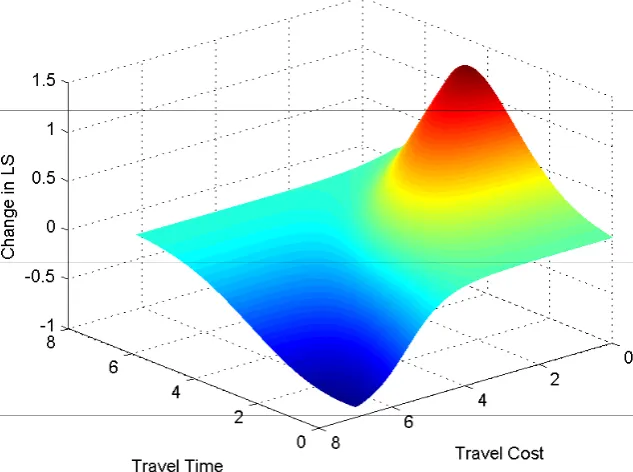
Chorus (2012b) already showed that the LogSum responds non-monotonically to changes in the levels of an attribute. That is, depending on the starting point a marginal increase in travel time or travel cost of alternative i may result in a positive, negative or no change in the LogSum (Appendix C provides more detail). The first-order derivative of the LogSum, however, exists at every point. Since both the numerator and denominator in (7) represent a marginal change in the LogSum positive, negative or zero VoTs may arise. The latter is consistent with what was discussed in Section 3.2, some respondents will gain and some will lose. More gravely, is that in the transition from positive to negative changes in the LogSum with respect to travel cost, the denominator crosses zero implying an undefined VoT value.6 Note that the distributional assumptions on i only affect the location where the change in expected minimum regret is zero after a change in travel costs.
In contrast to the literature on non-linear marginal utility of income effects, where the representative consumer approximation produces relative accurate approximations of the expected compensating variation (e.g. Tra 2013), the same approach turns out impractical in the context of VoT measures in the RRM model. The possible existence of an infinite marginal willingness-to-pay or VoT is too problematic. In particular because the situation does not arise on the edges of the attribute space, i.e. the choice probabilities and marginal regrets of all alternatives need to be sufficiently large for the opposing effects to balance out. I therefore conclude that using a representative consumer approach on indifference may include all relevant behavioural properties of the RRM model, but the resulting VoT measure has a major theoretical shortcoming and should therefore not be applied empirically.
5. Welfare economics under context dependent preferences
The two alternative VoT measures described in this paper highlight some of the important challenges of conducting welfare analysis under context dependent preferences. The RRM model is only one example, but alternative discrete choice models exist facing similar challenges (e.g. Chorus and Bierlaire 2013, Leong and Hensher 2014). Context dependent choice models are not necessarily transitive (e.g. Loomes and Sugden, 1982), as replacing alternative k by l in the choice set may influence the preference order between alternatives i and j. However, within a given choice set the preference relation described by the RRM model is complete such that inconsistencies (or preference reversals) in choice behaviour are not predicted. Within such a local setting changes in the attributes of existing alternatives translate into predictable changes in behaviour, which can be translated into welfare effects
11
given that individuals are willing to make implicit trade-offs between travel time and costs attributes.7
Even in this local setting, welfare economics based on the RRM models is challenging due to the inclusion of attribute levels of other alternatives in the regret function and the asymmetric treatment of outperforming (and being outperformed by) other alternatives. A change in one alternative changes the relative performance of all alternatives and these effects are of a different size and magnitude. Opaluch and Segerson (1988) argue in context of regret theory, i.e. choices under risk, that Hicksian welfare measures for context dependent preferences need to be derived while ensuring indifference across all alternatives in the choice set (relative to the initial situation). This is exactly what the two proposed VoT measures are struggling with. The Chorus (2012a) VoT measure only focuses on users of a single alternative whilst ignoring what happens to the regret of all other alternatives in the choice set (or users of other alternatives). The proposed representative consumer approach takes a step in the right direction, but encounters issues by averaging opposing effects across alternatives.
For deriving a RRM-based VoT measure applicable for calculating aggregate welfare effects, it seems necessary to step away from the notion of the marginal rate of substitution applied in this paper. Namely, ensuring indifference in the level of regret across all alternatives requires a simultaneous price change across all alternatives. Given that regret differences are merely defined by price differences, the price of one alternative needs to remain fixed. This introduces two new problems. First, a solution is not guaranteed given that (J-1) variables need to be changed to keep J regret levels constant. A clear example is the binary choice situation discussed in this paper, where a change in Ci is insufficient to bring both Ri and Rj back to their original level. Second, even if a solution exists the non-linearity of the regret function implies the solution is non-unique as it will vary with the alternative of which the price is kept fixed. Solutions go beyond the scope of the current paper, but combining absolute and relative attribute relative performance as respectively embodied in the RUM and RRM model seems to be a way forward. As noted by Opaluch and Segerson (1988), such extensions of the standard utility framework are, however, likely to encounter conceptual difficulties, as the links between demand curves and welfare are hard to establish as violations
of Roy’s identity need to be foreseen.
Alternatively, lessons can be learned from the literature on non-linear income effects in RUM models where switching behaviour and distortionary (income) compensation effects also play a central role (e.g. Morey and Karlström 2001). In fact, the Chorus (2012a) VoT measure may then be applied to describe the conditional compensating variation for those users that do not switch after the change in travel time has occurred. For these consumers, the conditional compensating variation is equivalent to the integral of VoTs along the path of proposed changes in travel time (e.g. Ben-Akiva and Lerman 1985). Capturing the welfare effects for
12
users that do switch, however, requires the definition of transition probabilities (de Palma and
Kilani, 2011) and appropriate levels of compensation (e.g. Morey and Karlström, 2001).
More general, context dependency limits the transferability of the established VoT measures to other policy contexts and behavioural economic welfare measures will introduce conflicts with standard utility theory at some stage in the analysis. However, the completeness of the preference relation described by the RRM model ensures that within a given choice setting individual behaviour implicitly reveals the welfare effects of a change to the transport infrastructure. The Chorus (2012a) measure is able to identify these effects for specific users, while the representative consumer approach identifies the challenge to capture the effects across all users.
6. Conclusions, implications, and directions for further research
The contribution of this paper lies in taking an important step towards enabling meaningful economic appraisal based upon the RRM model. This paper approaches the issue from the perspective of indifference and the related micro-economic notion of the marginal rate of substitution. The intuition behind this approach is relatively simple; individuals derive value from a change in attribute levels because they are willing to make trade-offs between monetary and non-monetary attributes. This paper centres around the implicit trade-off
between travel time and travel cost, frequently translated as an individual’s subjective
willingness to pay for a reduction in travel time, or simply put the Value of Time. The discussion, however, fits into a broader framework of marginal willingness-to-pay measures for other non-monetary attributes.
The VoT is typically estimated using observed decisions in either revealed or stated preference studies in combination with an imposed behavioural model. For the RUM model a connection has been established between the implicit trade-offs embodied in specific decisions and more aggregate measures of welfare, such as the consumer surplus and compensating variation. For the RRM model this connection is currently lacking, even though the model has proved itself to be a suitable behavioural alternative for the RUM model as it accounts for choice set composition effects. Differences in behaviour between the RUM and the RRM model primarily arise at the choice task level, which explains why the RRM model in general performs about equally well in terms of aggregate model fit measures (e.g. Chorus et al. 2014). Welfare effects are evaluated for specific (policy) situations, such that the welfare implications of changes to the transport infrastructure may differ significantly between the RUM and RRM model.
13
economic expectations. Furthermore, the measure is monotonically increasing (decreasing) in travel time (cost) of the considered alternative within a specific choice set. The measure, however, tells a behaviourally incomplete story. It ignores the impact of changes in a particular alternative on the regret of other alternatives in the choice set. The derived VoT therefore provides a lower (upper) bound on the welfare implications of the considered reduction (increase) in travel time. These bounds are a consequence of the individual potentially being better off by switching to another alternative generating a lower level of regret. A second consequence of ignoring the changes in regret of other alternatives is that the Chorus (2012a) VoT measure cannot yet be used for deriving aggregate welfare measures like the compensating variation, as users of different of alternatives have an alternative VoT for the same change in travel time.
Given the limitations of the Chorus (2012a) measure, I have attempted to derive an alternative VoT measure based on the representative consumer approach. Instead of keeping the regret of particular users constant it is attempted to keep the expected regret of a choice set constant. It takes into account choice set composition effects, asymmetric preference formation, and the impact of changes in the attributes of the chosen alternative on regret levels of competing alternatives; and thereby forms a behaviourally more complete RRM-based VoT measure. However, the non-monotonic changes in the denominator introduces a major theoretical shortcoming. The VoT is locally undefined when the marginal expected regret of changes in travel cost reduces to zero. I therefore do not recommend empirical use of this measure.
In Section 5, I’ve put the two alternative VoT measures in the broader perspective of welfare economics under context dependent preferences. The discussion points out that an alternative approach is needed in order to derive Hicksian welfare measures quantifying all relevant welfare implications across different users and alternatives. On the one hand, Opaluch and Segerson (1988) propose simultaneous changes in prices across alternatives such that switching is precluded across users and alternatives. On the other hand, parallels can be drawn with the derivation of compensating variation measures for RUM models with nonlinear income effects where switching behaviour and distortionary (income) compensation effects also play a central role (e.g. Morey and Karlström 2001). Both approaches constitute an interesting area in the process of the RRM model becoming a fully operational alternative for the RUM model, but fall outside the scope of the current paper.
The conclusions of this review also apply to alternative discrete choice models accounting for choice set dependency. Examples are the Contextual Concavity Model (e.g. Chorus and Bierlaire 2013) and the Relative Advantage Model (e.g. Leong and Hensher 2014). Like the RRM model, these models are characterised by including the attribute levels of other
alternatives into the ‘utility’ function. Consequently, these models suffer from the same type
14 Acknowledgements
The author gratefully acknowledges support from the Netherlands Organisation for Scientific Research (NWO), in the form of VIDI-grant 016-125-305. Comments by Caspar Chorus, the editor and two anonymous reviewers also helped in improving the paper.
References
Anderson, S.P., de Palma, A. and J.F. Thisse 1988. A representative consumer theory of the logit model. International Economics Review 29(3), 461-466.
Batley R. and Ibanez, N. 2013. Applied welfare economics with discrete choice models: implications for empirical specification. In: Choice modelling: the state of the art and the state of practice, Eds: Hess, S. and Daly, A., Edward Elgar, Cheltenham, UK.
Ben-Akiva, M., Lerman, S.R., 1985. Discrete choice analysis: theory and application to travel demand. The MIT Press, Cambridge, Massachusetts.
Bernheim, B.D. and A. Rangel 2007. Toward choice-theoretic foundations for behavioural welfare economics. American Economics Review, 97(2), 464-470.
Bernheim, B.D. and A. Rangel 2009. Beyond revealed preference: choice-theoretic foundations for behavioural welfare economics. Quarterly Journal of Economics, 124(1), 51-104.
Chorus, C.G., Arentze, T.A., Timmermans, H.J.P., 2008. A Random Regret Minimization model of travel choice. Transportation Research Part B, 42(1), 1-18.
Chorus, C.G., 2010. A new model of Random Regret Minimization. European Journal of Transport and Infrastructure Research, 10(2), 181-196.
Chorus, C.G. 2012a. Random Regret Minimization: An overview of model properties and empirical evidence. Transport Reviews, 32(1), 75-92.
Chorus, C.G., 2012b. Logsums for utility-maximizers and regret-minimizers, and their relation with desirability and satisfaction. Transportation Research Part A, 46(7), 1003-1012.
Chorus, C.G., Bierlaire, M., 2013. An empirical comparison of travel choice models that generate compromise effects. Transportation, 40(3), 549-562.
Chorus, C.G., van Cranenburgh, S. and Dekker, T. 2014. Random regret minimization for consumer choice modelling: assessment of empirical evidence. Journal of Business Research, in press.
15
Daly, A.J., Hess, S., Train, K.E. 2012, Assuring finite moments for willingness to pay in random coefficients models, Transportation, 39(1), 19-31.
de Palma, A., Kilani, K. 2011. Transition probabilities and welfare analysis in additive random utility models. Economic Theory, 46, 427-454.
Gonzalez, R.M. 1997. The value of time: a theoretical review. Transport Reviews, 17(3), 245-266.
Hau, T.D. 1985. A Hicksian approach to cost-benefit analysis with discrete-choice models. Economica 52, 479-490.
Herriges, J.A. and Kling, C.L. 1999. Nonlinear income effects in random utility models, The Review of Economics and Statistics, 81, 62-72.
Karlström, A. and Morey, E.R. 2001. Calculating the exact compensating variation in logit and nested-logit models with income effects: theory, intuition, implementation and application. Paper presented at the meeting of the American Economic Association, New Orleans, January 2001.
Katz, M.L. and Rosen. H.S. 1998. Microeconomics, 3rd edition, Irwin/McGraw-Hill, US.
Leong, W., Hensher, D.A. 2014. Contrasts of Relative Advantage Maximisation with Random Utility Maximisation and Regret Minimisation? Journal of Transport Economics and Policy, in press.
Loomes, G. and R. Sugden 1982. Regret theory: an alternative theory of rational choice under uncertainty. The Economic Journal, 92(368), 805-824.
McFadden, D. 1999. Computing willingness-to-pay in random utility models. In: Trade, theory and econometrics: essays in honour of John S. Chipman, Eds: Moore, J. Riezman, R. and Melvin, J., Routledge, London.
Morey, E. Rowe, E.D. and Watson M. 1993. A repeated nested-logit model of Atlantic salmon fishing. American Journal of Agricultural Economics, 75, 578-592.
Opaluch, J.J. and K. Segerson 1988. Hicksian welfare measures within a regret theory framework. American Journal of Agricultural Economics, 70(5), 1100-1106.
Small, K.A. and Rosen, H.S. 1981. Applied welfare economics with discrete choice models. Econometrica, 105-130.
Train, K.E. and McFadden D. 1978. The goods leisure trade-off and disaggregate work trip mode choice models. Transportation Research, 12, 349-353.
16 Appendix A: The ratio of RRM-parameters in multinomial choice sets: an IIA summary
The result established in Equation (6), where the ratio of parameters ensures regret differences between the two alternatives in a binary choice task remain constant, can be extended to multinomial choice sets. Then an increase in Ti implies that the regrets of all other alternatives j decrease. Equation (A1) highlights that the total or summed change in the regret differences
between the considered alternative and all its competitors will be of size T
J1
, where J is the total number of alternatives in the choice set.
1
exp1
1 exp 1 exp
j i
T j i j i
T T T
j i j i
i T j i T j i
R R
T T
J
T T T T T (A1)
The scalar (J-1) drops out when taking the ratio of the marginal change in travel time over a marginal change in travel cost. As a result, the time-and-cost-parameter ratio in the multinomial RRM model is associated with the marginal rate of trade-off between time and cost that keeps the sum of regret differences between an alternative and all its competitors in the choice task constant.
When inspecting (6) and (A1) jointly, it appears that there is yet another way to interpret the time-and-cost-parameter ratio in the multinomial RRM model: note that the term T (J-1) can be conceived as resulting from a sequence of (J-1) binary comparisons between alternative i and one of its competing alternatives j. Although attributes of other alternatives k eventually enter the total regrets associated with i and with j, they play no role in assessing differences in binary regrets between i and j. In these binary regrets T takes the same role as in (6). Accordingly, the ratio gives the marginal rate of substitution between Ti and Ci that keeps the relative preference of i over j constant, when the influence of attributes from other
17 Appendix B: Monotonicity of the Chorus (2012a) RRM-VoT measure
The RRM-VoT which is built upon the perspective of indifference at the level of the altered alternative is dependent on the attribute levels of all alternatives in the choice set. Equation (B1) points out that, when both T and C are associated with a negative value, an increase in the travel time of alternative i will have a strictly positive impact on the RRM-VoT derived by Chorus (2012a). The latter is a direct consequence that all fractions in (A.1) take a positive value by definition. The negative value for T therefore implies that the VoT for alternative i is monotonically increasing in Ti. Moreover, equation (B2) points out that the VoT for alternative i is monotonically decreasing in Tj. The effect of the latter change will be smaller since only a single binary comparison is included in this comparison. Similarly, the VoT is monotonically decreasing (increasing) in the travel costs of alternative i (j) as shown by equations (B3) and (B4), after applying the same logic as before.
2 exp 1 0 1 1 exp 1 expT i j i T
T j i
i C
T i j
j i C i j
T T
VoT
T T T
C C (B1)
2 exp 1 0 1 1 exp 1 expT i j i T
T
j C
T i j
j i TC i j
T T VoT
T T T
C C (B2)
2 2 exp 1 exp 1 0 1 exp 1 1 expC i j
j i
C i j
i T
j i
i T i j
j i C i j
C C
C C VoT
C T T
C C (B3)
2 2 exp 1 exp 1 0 1 exp 1 1 expC i j
C i j
i T
j i
j T i j
j i C i j
C C
C C VoT
C T T
C C
18 Appendix C: Marginal changes in the RRM based LogSum
Changes in the RRM based LogSum (see Chorus 2012b) are the result of changes in regret levels of all alternatives, and of their associated choice probabilities. One partial effect of an increase in Ti (or Ci) is that expected Regret of the choice set will increase due to an increase in Ri. When alternative i is (not) popular, the change in the LogSum is larger (smaller) due to the size of the corresponding choice probability. A counteracting effect arises due to the reduction in regret levels for all the other alternatives j i. Depending on their choice associated probabilities, this counteracting effect on the RRM-LogSum will be either large enough or too small to oppose the effect the change has on PiRi. Together, this translates into a delicate balance on whether a positive, negative or no change in the LogSum will be observed following a marginal change in Ti (or Ci).
Figure 2 considers the situation where an individual is faced with the same choice situation underlying Figure 1. It plots the marginal change in LogSum associated with a marginal increase in travel time of alternative B, initial values of its time and cost being varied between zero and seven. In other words, it plots the numerator of (7) for different values of Ti and Ci.
INSERT FIGURE A1 ABOUT HERE
Three things can be noted about the change in the LogSum. First, if alternative i is sufficiently rapid, there will be no change in the LogSum, since i) the marginal change regret for the alternative is (close to) zero; and ii) the choice probabilities of the other alternatives are so low (given their high regrets associated with the time-attribute) that any decrease in their regrets due to the increase in i’s travel time are scaled down by the very small probability weights. The effect is counteracted in Figure 2 when alternative B is also sufficiently expensive, such that the probability weights on the other alternatives remain important.
19
20 Figure 1: Value of Time based on the Chorus (2012a) measure under alternative choice set compositions
[image:21.595.133.450.368.604.2]