This is a repository copy of
Effects of Feedback latency on P300-based Brain-computer
Interface
.
White Rose Research Online URL for this paper:
http://eprints.whiterose.ac.uk/97431/
Version: Accepted Version
Proceedings Paper:
Arvaneh, M., Ward, T.E. and Robertson, I. (2015) Effects of Feedback latency on
P300-based Brain-computer Interface. In: 2015 37th Annual International Conference of
the IEEE Engineering in Medicine and Biology Society (EMBC). 37th International Conf. of
the IEEE Engineering in Medicine and Biology Society (EMBC), 25-29 Aug 2015, Milan,
Italy. IEEE .
https://doi.org/10.1109/EMBC.2015.7318856
© 2015 IEEE. Personal use of this material is permitted. Permission from IEEE must be
obtained for all other users, including reprinting/ republishing this material for advertising or
promotional purposes, creating new collective works for resale or redistribution to servers
or lists, or reuse of any copyrighted components of this work in other works
[email protected] https://eprints.whiterose.ac.uk/
Reuse
Unless indicated otherwise, fulltext items are protected by copyright with all rights reserved. The copyright exception in section 29 of the Copyright, Designs and Patents Act 1988 allows the making of a single copy solely for the purpose of non-commercial research or private study within the limits of fair dealing. The publisher or other rights-holder may allow further reproduction and re-use of this version - refer to the White Rose Research Online record for this item. Where records identify the publisher as the copyright holder, users can verify any specific terms of use on the publisher’s website.
Takedown
If you consider content in White Rose Research Online to be in breach of UK law, please notify us by
arXiv:1510.07262v1 [cs.HC] 25 Oct 2015
Effects of Feedback Latency on P300-based Brain-computer Interface
Mahnaz Arvaneh
1, Tomas E. Ward
2, and Ian H. Robertson
1Abstract— Feedback has been shown to affect performance
when using a Brain-Computer Interface (BCI) based on sen-sorimotor rhythms. In contrast, little is known about the influence of feedback on P300-based BCIs. There is still an open question whether feedback affects the regulation of P300 and consequently the operation of P300-based BCIs. In this paper, for the first time, the influence of feedback on the P300-based BCI speller task is systematically assessed. For this purpose, 24 healthy participants performed the classic P300-based BCI speller task, while only half of them received feedback. Im-portantly, the number of flashes per letter was reduced on a regular basis in order to increase the frequency of providing feedback. Experimental results showed that feedback could significantly improve the P300-based BCI speller performance, if it was provided in short time intervals (e.g. in sequences as short as 4 to 6 flashes per row/column). Moreover, our offline analysis showed that providing feedback remarkably enhanced the relevant ERP patterns and attenuated the irrelevant ERP patterns, such that the discrimination between target and non-target EEG trials increased.
I. INTRODUCTION
A brain-computer interface (BCI) provides a direct com-munication pathway between a human brain and an external device [1]. Using appropriate sensors and data processing algorithms, a BCI maps patterns of brain activity associ-ated with a volitional thought onto commands suitable for controlling a device [2]. Such technology can be potentially used as an assistive device, a rehabilitation tool or a brain training protocol [3]. In most BCI systems, brain signals are measured by electroencephalogram (EEG), due to its low cost and high temporal resolution [4]. Currently, majority of the EEG-based BCI systems are working based on either P300 [5] or sensorimotor rhythms [4].
A BCI is a closed-loop system relying on mutual learning efforts between the user who learns to generate robust EEG patterns, and the classification system that is trained to accurately identify the EEG patterns. The mutual learning between the user and the classifier is crucial for having an accurate and robust BCI system. However, most of the BCI studies have only focused on training of the classification system, and neglected the user learning part.
Typically, the user learning is mediated by feedback pro-vided from the classifier. Feedback is known to significantly increase the motivation of learning [6]. Although, several studies showed the effectiveness of feedback on high quality
*This work was supported by Science Foundation Ireland (SFI) under Grant No. 12/RC/2289.
1 M. Arvaneh and I. H. Robertson are with Trinity College Institute
of Neuroscience, and Insight Centre for Data Analytics, Dublin, Ireland (emails:arvanehm,[email protected])
2T. E. Ward is with Dept. of Electronic Engineering, National University
of Ireland, Maynooth, Ireland. (email: [email protected]).
learning [7], a poorly designed feedback mechanism may deteriorate the performance [6]. There are some interesting studies considering effects of different types of feedback on motor imagery-based BCIs. For example, McFarland et al. suggested that feedback facilitates initial learning of the BCI skill [8]. Neuper et al. showed that continuous feedback is more efficient than delayed discrete feedback [9]. Some au-thors explored multidimensional feedback (e.g. 3D or Virtual Reality feedback) [10], whereas some studies investigated the effects of biased feedback, negative feedback, and positive feedback on motor imagery-based BCIs [11], [12].
Despite all these studies, little is known about the in-fluence of feedback on P300-based BCIs. There is still an open question whether feedback affects the regulation of P300 and consequently the operation of P300-based BCIs. It seems logical to expect that feedback could positively influence the performance of P300-based BCIs, since, in addition to learning effects, feedback increases motivation, and motivation modulates the P300 amplitude during BCI use as shown in [14]. Nevertheless, in the study conducted by McFarland et al. providing feedback did not affect the P300-based BCI results [5]. There might be a number of reasons leading to this observation. Importantly, there is a substantial delay between the stimuli and the feedback, since the feedback is given after averaging a relatively high number of trials. Thus, the user cannot be certain in which trials he/she behaved incorrectly. Moreover, due to averaging over a large number of trials, the user usually achieves a high accuracy. It means negative feedback is rarely given. Alternatively, the processes involved in the generation of P300 may not be readily influenced by feedback.
This paper investigates the above-mentioned possibilities. In this paper, as the first study, we systematically assesses the influence of feedback on the P300-based BCI speller system. For this purpose, 24 healthy participants performed the classic P300-based BCI speller task, while only half of them received feedback. Importantly, to provide more frequent feedback the number of trials for averaging was reduced on a regular basis. Providing feedback based on fewer number of trials also increased the probability of having negative feedback. In addition to the online accuracy, the effects of feedback on the EEG patterns are also explored by considering the power of the target trials versus the power of the non-target trials.
II. MATERIALS AND METHODS
A. Participants
of neurological illness. They gave informed consent to the study which had been reviewed and approved by the ethical review board of the School of Psychology, Trinity College Dublin, in accordance with the Declaration of Helsinki.
Participants were randomly assigned to two groups, la-beled as “Feedback” and “No-feedback”. The Feedback group consisted of 5 females and 7 males with a mean age of 27.25 (SD±6.00). The No-feedback group consisted of 7 females and 5 males with a mean age of 24.83 (SD±3.09). 22 of the entire 24 participants had no previous experience of performing BCI sessions. There were no significant differ-ences between the two groups according to the demographic variables (age: t(22) = 1.22,p = 0.24; gender: χ2(1) = 0.67,p= 0.48; and BCI naivety:χ2(1)= 2.18,p= 0.14).
B. EEG data acquisition
EEG was acquired using a Biosemi ActiveTwo system from 8 electrodes located at positions Fz, C3, Cz, C4, P3, Pz, P4, and Oz following the International 10-20 system. Impedances were kept below 5kΩ, and the sampling rate was 512 Hz. The P300-based speller task was designed using the BCI2000 software [13]. In offline analysis, the continuous EEG data were filtered with a zero-phase low-pass 35 Hz Butterworth filter and a zero-phase high-low-pass 0.5 Hz Butterworth filter. The EEG data were segmented and baseline corrected relative to the interval -150 to 0 ms before the onset of the stimuli. Segments with amplitudes exceeding
+75µV, or voltage steps of more than 150µV within a window of 200 ms were rejected from further analysis.
C. P300-based BCI speller task
The P300-based speller task has been widely used in BCI community as an assistive device for communication [5]. Fig. 1 presents the interface of the P300-based speller task used in this study. A6×6matrix, containing the letters of the alphabet and other symbols, was displayed on a computer screen, while EEG was recorded. The text-to-spell was presented above the matrix. Directly next to the text-to-spell, the target letter-to-spell was displayed in the parenthesis. The rows and the columns of the matrix were flashed/intensified in a random order. Each flash lasted 55 ms followed by an inter stimulus interval of 117 ms. The participants were instructed to concentrate on the target letter and silently count how often it flashed. Basically, flashes of the row and the column containing the target letter (i.e. target stimuli) evoke P300 on the EEG signals, whereas flashes of the other rows and columns (i.e. non-target stimuli) correspond to neutral EEG signals. Thus, the target letter can be inferred by a classification algorithm that searches for the row and the column which evoked the largest P300 responses.
[image:3.612.354.535.55.194.2]After each sequence, the matrix stopped flashing for 6 seconds. During this interval, the next target letter was dis-played in the parentheses. Thus, the participant was allowed sufficient time to locate this new target in the matrix. This process was repeated over the entire target word.
Fig. 1. The interface of the P300-based BCI speller task
D. Procedure
The procedure of the present study is illustrated in Fig. 2. Participants engaged in a single session of around one hour duration including set up time. The data recording and task performance took place in a dark sound-attenuated closed room.
Fig. 2. A schematic illustration of the procedure in the present study
1) Questionnaire: At the beginning and at the end of the
session, the participants filled out a simple questionnaire which was used to record self-reported levels of alertness, boredom, tiredness of the mind, and tiredness of the eyes on a 10-point Likert scale.
2) Calibration: In this stage, the participants completed
two runs, in which the words “the” and “quick” were respec-tively spelled without providing feedback. The sequence of attending each letter consisted of 12 flashes per row/column. The EEG data collected from this stage were used to calibrate a subject-specific model identifying attended letters.
After completing the two calibration runs, the EEG re-sponses to each row/column was obtained by averaging over the 12 corresponding EEG trials. Thereafter, 800 ms segments starting immediately after the onset of the stimuli were extracted from the EEG responses. The segments were decimated to 20 Hz. Then, the resulting data arrays were concatenated to form the feature vector. The dimension of the feature vector wasNe×Nt, whereNedenotes the number
of electrodes andNtdenotes the number of temporal samples
[image:3.612.335.535.308.443.2]It should be noted that the specific P300 paradigm presented here has been demonstrated to yield reliable performance in several studies [14], [15].
3) Evaluation: In this stage, the participants were asked
to spell the word “dog” without receiving feedback. The EEG data collected from this stage were used to evaluate the model calibrated in the calibration stage. If at least two of the three letters of “dog” were identified correctly, the participant was ready to move to the training stage. Otherwise, the participant was removed from the study. It is noted that in this study all the participants were able to achieve a calibration model with satisfactory performance.
4) Training: In this stage, the participants were asked to
spell the word “beautiful” in 4 runs. The number of flashes per row/colum was set to 10, 8, 6, and 4 in the first, the second, the third and the fourth run respectively.
For the Feedback group, feedback was provided at the end of each sequence of flashes through presentation of the attended letter target as determined by the output of the clas-sifier. By reducing the number of flashes participants received feedback more frequently. Thus, this presents a means by which we can investigate the effects of feedback on BCI performance. Significantly reducing the number of flashes can increase the probability of receiving negative feedback as the decision of the classifier becomes more dependent on each individual P300 response. The participants in the No-feedback group underwent entirely similar process, but without receiving any feedback. They were not informed about the output of the classifier neither on the screen nor orally. This is not a situation which one encounters with a P300 BCI in normal operation but it is necessary here in order to isolate the effects of feedback explicitly.
5) Post-training: In this stage, the Feedback and the
No-feedback groups both spelled the word “dance”, without receiving feedback. Similar to the calibration stage, in this stage the number of flashes per row/colum was set to 12.
III. RESULTS AND DISCUSSION
A. Questionnaire
Analysis of the pre-scores and the post-scores suggested that both the groups (Feedback and No-feedback) were similar in terms of alertness, boredom, tiredness of the mind, and tiredness of the eyes. Furthermore, the within-group comparisons revealed no significant changes on any of the variables prior and following the test.
B. Effects of feedback on classification accuracy
Results obtained from the evaluation stage showed that both groups were very successful in performing the task, since they achieved similar average classification accuracies of 97.25±9.6 on spelling the word “fox”. Obtained from offline analysis, Fig. 3 shows the average classification accu-racies of the evaluation stage as a function of the number of flashes per column/row. A repeated ANOVA revealed a sig-nificant main effect for the number of flashes (F(11,242)= 39.72,p<0.001). Neither the group (F(1,22) = 0.03,p = 0.86) nor the interaction between the group and the number
of flashes (F(1,11)= 0.18,p= 0.99) had a significant effect. The statistical analysis confirms that the Feedback and the No-feedback groups were very similar in performing the P300-based speller task in the evaluation stage.
4 6 8 10 12
50 60 70 80 90 100
Number of flashes
Average accuracy
Evaluation Stage
[image:4.612.354.507.119.200.2]No−feedback Feedback
Fig. 3. Average classification accuracy as a function of number of flashes per row/column in the evaluation stage (no feedback was provided).
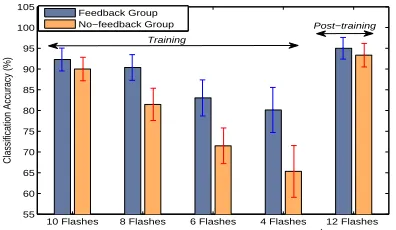
In the training stage, the word “beautiful” was spelled 4 times using different number of flashes per column/row. Fig. 4 presents the average classification results obtained from the training stage as well as the post-training stage where the word “dance” was spelled without providing feedback to both of the groups. As Fig. 4 shows the feedback group outperformed the No-feedback group in terms of the classi-fication accuracy. Interestingly, a smaller number of flashes yielded a larger difference between the performance of these two groups. A repeated ANOVA revealed significant main effects for the number of flashes (F(3,66)= 15.74,p<0.001) and the group (F(1,22) = 4.74,p = 0.04). However, the interaction between the group and the number of flashes
(F(1,11) = 2.08,p = 0.11) was not significant. Since the
Feedback and the No-feedback groups performed very sim-ilarly during the evaluation stage, the significant difference between these two groups during the training stage is most likely due to feedback provided to the Feedback group. Exploratory analysis using independent t-tests indicated that the Feedback group significantly performed better than the No-feedback group when the number of flashes was 4
(t(22) = 2.1,p = 0.04). The superior performance of the
Feedback group tended to be significant when the number of flashes was 6 (t(22) = 1.96,p = 0.06). However, no significant differences in performance was found for greater flash sequences (p = 0.10 and p = 0.53 for 8 and 10 flashes respectively). These results suggest that the effect of feedback is more pronounced when it is given in shorter time intervals (i.e. Feedback is more frequent).
10 Flashes 8 Flashes 6 Flashes 4 Flashes 12 Flashes 55
60 65 70 75 80 85 90 95 100 105
Classification Accuracy (%)
Feedback Group
No−feedback Group Post−training Training
[image:4.612.333.531.599.714.2]Importantly, in the post-training stage where both groups did not receive any types of feedback, again the classification results were similar (F(1,22) = 0.71,p = 0.41). Offline analysis of the classification results as a function of the number of flashes per column/row revealed a significant main effect for the number of flashes as expected (F(11,242)= 38.96,p<0.001). Neither the group (F(1,22) = 0.03,p = 0.95) nor the interaction between the group and the number of flashes (F(1,11)= 1.95,p= 0.13) had a significant effect.
C. Effects of feedback on EEG patterns
In addition to the classification accuracy, we conducted an offline re-analysis of the data to better understand the effects of feedback on EEG patterns. We speculated that by receiving feedback, subjects may consciously or uncon-sciously modify patterns of his/her brain activity throughout the experiment. To seek changes in EEG patterns, we defined a new criterion, called as signal to noise ratio (SNR). SNR was calculated by the average power of the target trials (i.e. signal) divided by the average power of the non-target trials (i.e. noise) over the centroparietal electrodes (namely C3, Cz, C4, P3, Pz, P4). Since N200 and P300 are both contributing in the classification of P300-based BCIs [15], 150 ms to 550 ms after the onset of the stimuli were used for calculating the energies.
Cal. & Eval. Training Cal. & Eval. Training 0
2 4 6 8
Comparing Signal to Noise Ratios
SNR
Feedback No−feedback
*
Fig. 5. Comparing the signal to noise ratios (SNR) between the calibration and evaluation stages vs. the training stage for Feedback and No-feedback groups. Asterisk indicates a tending to be significant difference (p= 0.07).
Fig. 5 compares the average SNR value obtained from the calibration and evaluation stages with the average SNR value obtained from the training stage. Indeed, neither the Feed-back group nor the No-feedFeed-back group received feedFeed-back in the calibration and evaluation stages, whereas the feedback was provided to the Feedback group during the training stage. There was no significant difference between the average SNR values of the two groups during the calibration and the eval-uation stages (F(1,22) = 0.33,p = 0.57). As Fig. 5 shows, on average both groups presented improvements on SNR, when they transferred to the training stage. This improvement might be due to learning to better attend the task as time passes regardless of providing feedback. Besides, reducing the number of flashes in the training stage leads to shorter sequences of flashes for spelling each word. Attending to shorter sequences might be less distracting than attending to longer sequences. Interestingly, the paired t-test revealed that the improvement in the SNR values of the feedback group tends to be significant (t(11)=−1.99,p= 0.07. However, the improvement in the SNR values of the No-feedback group
was not significant t(11) =−1.02,p= 0.33. Thus, we can conclude that there is an association between feedback and the improvement in SNR.
IV. CONCLUSIONS
With this study, we showed that feedback can positively in-fluence the performance of P300-based BCIs, if it is provided more often than what most P300-based BCI systems cur-rently provide. Our experiments revealed that when feedback was given after sequences of 4 flashes per row/column, the Feedback group significantly outperformed the No-feedback group (p = 0.04),whereas the superior performance of the Feedback group tended to be significant when the number of flashes was 6 (p= 0.06). However, the effect of feedback was not significant as the number of flashes increased. These findings are unsurprising, because when the feedback is provided after a large number of flashes the user cannot be certain in which trials he/she behaved incorrectly. Moreover, the user may not even get aware of failure in attention in some trials, since it can be compensated by averaging over many other trials. Reducing the number of flashes mitigates this problem by directing the user to better attend the task. Our study on the EEG patterns also showed that providing feedback remarkably contributed in improving SNR.
REFERENCES
[1] N. Birbaumer, ”Brain-computer-interface research: Coming of age,”
Clin. Neurophysiol., vol. 117, pp. 479- 483, 2006.
[2] J. R. Wolpaw et al., ”Brain-computer interfaces for communication and control,” Clin. Neurophysiol., vol. 113, pp. 767-91, 2002. [3] J.R. Wolpaw and E.W. Wolpaw, ”Something new under the sun,” in
Brain-Computer Interfaces: Principles and Practice Oxford University Press,Inc., 2012, pp. 3-14.
[4] G. Pfurtscheller, C. Neuper, D. Flotzinger, and M. Pregenzer, ”EEG-based discrimination between imagination of right and left hand movement,” Electroencephalogr. Clin. Neurophysiol., vol. 103, no. 6, pp. 642-51, 1997.
[5] D. J. McFarland et al., ”The P300-based brain-computer interface (BCI): Effects of stimulus rate,” Clin. Neurophysiol., vol. 122, pp. 731737, 2011.
[6] V. J. Shute, ”Focus on formative feedback,” Review of educational
research, vol. 78, no. 1, pp. 153-189, 2008.
[7] J. Hattie, and H. Timperley, ”The power of feedback,” Review of
educational research, vol. 77, no. 1, pp. 81-112, 2007.
[8] D. J. McFarland, L. M. McCane, and J. R. Wolpaw, ”EEG-based communication and control: Short-term role of feedback,” IEEE Trans.
Rehab. Eng., vol. 6, pp. 711, 1998.
[9] C. Neuper, A. Schl¨ogl, and G. Pfurtscheller, ”Enhancement of left-right sensorimotor EEG differences during feedback-regulated motor imagery,” J. Clin. Neurophysiol., vol. 16, pp. 373382, 1999. [10] F. Lotte et al., ”Combining BCI with virtual reality: Towards new
applications and improved BCI,” Towards Practical Brain-Computer
Interfaces, B. Allison et al., eds., Springer, 2013, pp. 197220.
[11] A. Barbero-Jimenez, and M Grosse-Wentrup. ”Biased feedback in brain-computer interfaces,” J. NeuroEng. Rehab., vol. 7, no. 34, pp. 14, 2010.
[12] A. Ramos-Murguialday et al., ”Proprioceptive feedback and brain computer interface (BCI) based neuroprostheses,” PLoS One, vol.7, no.10, 2012.
[13] G. Schalk et al., ”BCI2000: a general-purpose brain-computer interface (BCI) system,” IEEE Trans. Biomed. Eng., vol. 51, no. 6, pp. 1034-43, 2004.
[14] S. C. Kleih, F. Nijboer, S. Halder, and A. K ¨ubler, ”Motivation modulates the P300 amplitude during brain-computer interface use,”
Clin. Neurophysiol., vol. 121, pp. 102331, 2010.
[15] T. Kaufmann, E.M. Hammer, anf A. K ¨ubler, ”ERPs contributing to classification in the P300 BCI,” in the 5th International BCI
[image:5.612.73.280.364.461.2]