S T U D Y P R O T O C O L
Open Access
Improving outcomes in adults with
epilepsy and intellectual disability (EpAID)
using a nurse-led intervention: study
protocol for a cluster randomised
controlled trial
Howard Ring
1,2,3*, Nakita Gilbert
1, Roxanne Hook
1, Adam Platt
1, Christopher Smith
1, Fiona Irvine
4, Cam Donaldson
5,
Elizabeth Jones
1,2,3, Joanna Kelly
6, Adrian Mander
7, Caroline Murphy
6, Mark Pennington
8, Angela Pullen
9,10,
Marcus Redley
1,3, Simon Rowe
11and James Wason
6Abstract
Background:In adults with intellectual disability (ID) and epilepsy there are suggestions that improvements in management may follow introduction of epilepsy nurse-led care. However, this has not been tested in a definitive clinical trial and results cannot be generalised from general population studies as epilepsy tends to be more severe and to involve additional clinical comorbidities in adults with ID. This trial investigates whether nurses with
expertise in epilepsy and ID, working proactively to a clinically defined role, can improve clinical and quality of life outcomes in the management of epilepsy within this population, compared to treatment as usual. The trial also aims to establish whether any perceived benefits represent good value for money.
Methods/design:The EpAID clinical trial is a two-arm cluster randomised controlled trial of nurse-led epilepsy management versus treatment as usual. This trial aims to obtain follow-up data from 320 participants with ID and drug-resistant epilepsy. Participants are randomly assigned either to a‘treatment as usual’control or a‘defined epilepsy nurse role’active arm, according to the cluster site at which they are treated. The active intervention utilises the recently developed Learning Disability Epilepsy Specialist Nurse Competency Framework for adults with ID. Participants undergo 4 weeks of baseline data collection, followed by a minimum of 20 weeks intervention (novel treatment or treatment as usual), followed by 4 weeks of follow-up data collection. The primary outcome is seizure severity, including associated injuries and the level of distress manifest by the patient in the preceding 4 weeks. Secondary outcomes include cost-utility analysis, carer strain, seizure frequency and side effects.
Descriptive measures include demographic and clinical descriptors of participants and clinical services in which they receive their epilepsy management. Qualitative study of clinical interactions and semi-structured interviews with clinicians and participants’carers are also undertaken.
(Continued on next page)
* Correspondence:[email protected]
1Department of Psychiatry, University of Cambridge, Douglas House, 18d
Trumpington Road, Cambridge CB2 8AH, UK
2Cambridgeshire and Peterborough NHS Foundation Trust, Cambridge, UK
Full list of author information is available at the end of the article
(Continued from previous page)
Discussion:The EpAID clinical trial is the first cluster randomised controlled trial to test possible benefits of a nurse-led intervention in adults with epilepsy and ID. This research will have important implications for ID and epilepsy services. The challenges of undertaking such a trial in this population, and the approaches to meeting these are discussed.
Trial registration:International Standard Randomised Controlled Trial Number: ISRCTN96895428 version 1.1. Registered on 26 March 2013.
Keywords:Epilepsy, Intellectual disability, Epilepsy nurse, Treatment, Quality of life, Cost-effectiveness, Clinical trial, Treatment as usual, Randomised, Clinical trials unit, Controlled trial, Nurse-led intervention, Cluster trial, Pragmatic
Background
Introduction–rationale for the trial
In adults with an intellectual disability (ID) and epilepsy there are suggestions that improvements may follow introduction of epilepsy nurse-led care. However, this has not been tested in a definitive clinical trial and re-sults from previous studies within the general population cannot necessarily be generalised to adults with ID given the often relatively greater severity and complexity of epilepsy and associated morbidities in that group.
Epilepsy and intellectual disability
Nearly one million adults in England have an ID and epilepsy is the most common medical illness in this group; affecting around 26 %, with higher rates in those with more severe ID [1, 2]. Individuals with ID have a worse outcome than those with epilepsy in the general population with increased seizure frequency, higher fre-quency of multiple anti-epileptic drug use and side ef-fects, higher treatment costs, higher rates of mortality and greater incidence of behavioural problems [1, 3–5].
Reflecting these observations, it has been reported that between 2005 and 2009 the most common cause of avoidable acute hospital admissions for people with ID was seizures associated with poorly controlled epilepsy [6]. A survey by the Improving Health and Lives: Learn-ing Disabilities Observatory (IHAL) reported that the second most frequent potentially preventable cause of death in those with ID was epilepsy or convulsions (13 %) [7]. These observations highlight the need to im-prove outcomes for people with epilepsy and ID.
Currently in the UK, secondary care of epilepsy and ID is generally provided by community learning disabil-ity services, or hospital-based neurological services [8]. It is common for people with ID to be on multiple ther-apies and they are likely to have tried several anti-epileptic medications to reduce seizure severity and frequency [3]. Only around 30 % of this population will achieve seizure freedom compared to 70 % of the gen-eral population [1, 4]. Therefore, in most people with epilepsy and ID, the aim of anti-epileptic medication is to reduce seizure severity and frequency whilst keeping
associated side effects to a minimum [9]. Achieving this balance is often difficult in adults with ID due to the epi-lepsy’s severity and complex associated morbidities. Asso-ciated morbidities of epilepsy in adults with ID include difficulty understanding, mobility problems, communica-tion difficulties, attencommunica-tional deficits and a range of emo-tional, cognitive and behavioural problems [1]. Therefore identifying and differentiating presenting symptoms from the individuals’ ID, epilepsy and medication side effects can be problematic. There are often additional challenges for treating clinicians in communicating effectively with the individual with ID; putting them at ease and providing the most effective treatment and management [3], result-ing in the highest possible overall quality of life for the in-dividual. Unfortunately, epileptologists may be limited in being able to provide the necessary clinic time and often have limited training in ID [3]. Individuals with epilepsy and ID are also at greater risk of lacking capacity to under-stand and make decisions regarding their treatment, meaning that ‘best interest’ decisions may be required, often involving tripartite discussion between the individ-ual, their family or paid carer and treating clinician [10]. This suggests that a multidisciplinary, holistic approach, with judicious use of expert nurses may improve support and access to healthcare in this group, who are often ex-cluded from clinical research and overlooked by health services.
The aim of the trial described in this article is to test the hypothesis that an epilepsy nurse-led intervention is able to cost-effectively reduce seizure severity and im-prove overall quality of life for patients and those that provide care for them in the community.
Epilepsy Specialist Nurses (EN) role
patients [15] and may improve continuity of, and acces-sibility to care, with the potential to improve communi-cation between people with epilepsy and their primary healthcare services [16, 17]. Therefore, it is predicted that ENs would be ideally placed to champion the un-predictable, complex and long-term needs of people with epilepsy [18].
However, a Cochrane review [19] of five trials of epi-lepsy nurse specialists found no convincing evidence across the general population that ENs improve overall outcomes for people with epilepsy. Nevertheless, a recent open prospective survey, published after the Cochrane review, of the effects of introducing a paediat-ric EN, suggested ENs might reduce emergency admis-sions by as much as 50 % [20]. Thus a state of clinical equipoise may be considered to exist with respect to the question of whether it would be effective and cost-effective to systematically employ ENs to manage epi-lepsy in adults with ID.
In terms of financial costs, a trial reported by Meads et al. [21], in patients recruited from a hospital-based epilepsy service of whom just under 10 % had an ID, noted that the use of an epilepsy nurse cost less than standard care, with reduced numbers of outpatient clinic hospital attendances with doctors and a potential decrease in GP consultations after 6 months.
The great majority of previous research into the use of ENs has been in the general population, in studies that have completely or largely excluded adults with ID. However, it is known that people with ID have been sub-ject to a range of health inequalities. Advocacy organisa-tions and especially Mencap [22] have highlighted inequalities in healthcare noting that clinicians regularly fail people with ID - failing to consult with or involve parents and family members in care and treatment deci-sions. Despite these observations, a survey of epilepsy services for a community sample of adults with ID and epilepsy [23] found that just 34 % of respondents had seen an EN. This low exposure rate is despite the per-ception that ENs may enhance the care of people with ID and epilepsy [24–26].
The Epilepsy and Intellectual Disability (EpAID) Trial - aim
The EpAID Trial aims to address two specific objectives. The primary objective is to establish whether nurses with expertise in epilepsy and ID, working to a clinically defined role outlined by The Learning Disability Epilepsy Nurse Competency Framework [27], can reduce seizure severity in adults with ID compared to treatment as usual.
The secondary objectives are to establish whether any observed benefits of clinical and quality of life outcomes justify any additional resource requirements, from the perspective of Health and Social Services.
Methods/design
Primary objective
To establish whether nurses with expertise in epilepsy and intellectual disabilities (ID), working to a defined clinical role, can improve epilepsy-related clinical and quality of life outcomes in the management of epilepsy in adults with ID compared to treatment as usual.
Secondary objective
To establish whether any clinical benefits found justify the provision of additional resources associated with EN input after consideration of the costs associated with the intervention from the perspective of Health and Social Services. Additional secondary outcomes comprise mea-sures of carer strain and quality of life to examine how the use of the competency framework, compared to treatment as usual, impacts on relationships critical in delivering ongoing care for adults with ID and epilepsy.
Trial design
The study is a cluster randomised trial with two arms; a
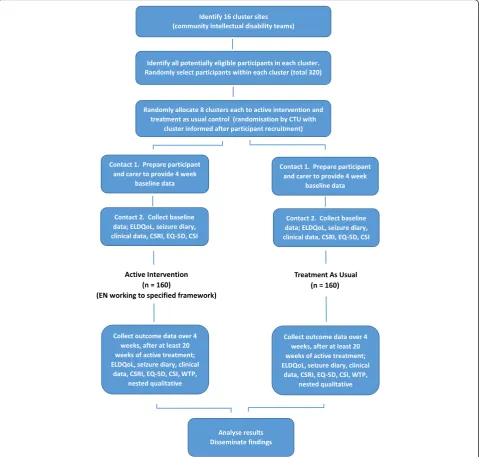
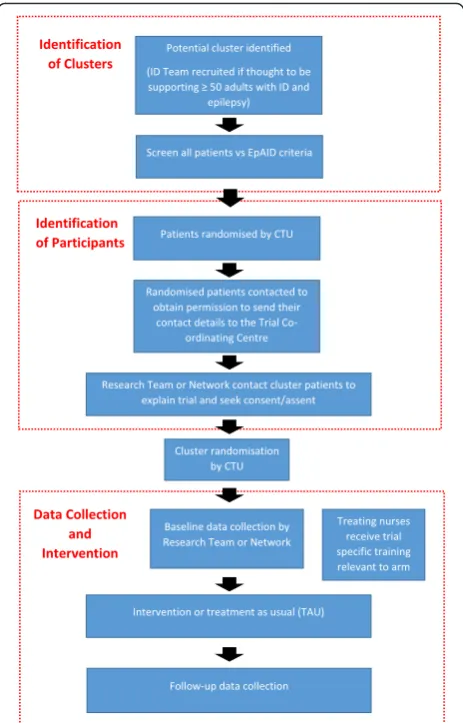
‘treatment as usual’control and a novel‘defined epilepsy nurse (EN) role’ trial arm, complying with CONSORT guidelines for cluster randomised trials [28]. The study also contains a nested qualitative component. The de-sign of the trial can be seen in Fig. 1 and the CONSORT diagram in Fig. 2. A SPIRIT flow diagram describing the order in which cluster and participant recruitment, clus-ter randomisation, data collection and inclus-tervention pro-cesses at each research cluster took place is provided in Fig. 3. A populated SPIRIT checklist is available as an Additional file 1.
Randomisation of the clusters is undertaken independ-ently by a Clinical Trials Unit (CTU) supporting the trial, using block randomisation with fixed block sizes (in pairs).
The trial is pragmatic in design and formal blinding around this intervention is not possible. However, steps have been taken to minimise risks of bias developing, as described in the appropriate section below.
Methods: participants, interventions, outcomes
What does the trial involve?
input by ID psychiatrists, neurologists, ID nurses and spe-cialist epilepsy nurses.
Each participant undergoes 4 weeks of baseline data collection, followed by a minimum of 20 weeks interven-tion (novel treatment or treatment as usual), followed by a 4-week period of follow-up data collection. Once the follow-up data has been obtained for all participants in a cluster, the study will end for that cluster. Patient re-cruitment for the first trial site commenced in October 2014.
In addition, a carer and a nurse treating a nested sub-sample of up to 30 participants from each arm undergo
a qualitative interview, held during the follow-up period. Six clusters from each arm are randomly selected by the CTU, in each of which up to five carers and five nurses are interviewed. These interviewees are not randomly se-lected but are a convenience sample.
Eligibility criteria
Inclusion criteria:
1. Age 18–65 years.
2. The presence of a developmental intellectual disability with IQ of 70 or less.
[image:4.595.59.540.89.546.2]3. A diagnosis of epilepsy with a history of at least one seizure in the 6 months preceding recruitment into the study (not considered by those managing the epilepsy to have been a non-epileptic seizure). 4. A nurse in the Community Intellectual Disability Team
has a current role in delivering some aspects of epilepsy management at the time of both screening and consent.
Exclusion criteria:
1. The presence of a rapidly progressive physical or neurological illness.
2. Alcohol or drug dependence.
Intervention
ENs in the intervention arm engage in the following activities [27]:
– Establish a relationship with patient and carers with
regular collection of clinical information including seizure frequency, side effects, behavioural symptoms and effects of seizures on daily life from patient and carers. ENs also assess the patient on a regular basis at a frequency determined by clinical need. This is achieved through home visits,
telephone clinics and visits to the local primary care or ID team base as appropriate. ENs also help
[image:5.595.59.541.86.529.2]manage the epilepsy of the participant and associated complications, as well as providing epilepsy education to patients and carers. ENs are the first point of contact for the service user/carer. The intervention takes place in the community, delivered face-to-face and by telephone with participants in their own homes and other community settings, such as day care facilities, as appropriate.
– Relationships with other clinicians are maintained by
ENs facilitating well-informed assessments by participants’primary care health service, local community ID health team and/or local neurology service as required.
The‘treatment as usual’comparator:
– Participants receive the same management as they
did prior to entering the study. This varies
throughout the country and includes various combinations of input by ID psychiatrists, neurologists, ID nurses and epilepsy nurses, often following locally developed care pathways. The nature of the‘treatment as usual’is described during the baseline phase of the trial by the use of a community ID team epilepsy service questionnaire (Community Intellectual Disability Epilepsy-Service Availability Questionnaire), and throughout the trial by use of the EN self-completion activity diary [29]. The ENs are responsible for completing the above questionnaire and the diary in both arms of the trial.
Training to be received by those delivering treatments
– All nurses receive training for diary completion by
experienced educationalists/epilepsy specialist nurses. All ENs also have their clinical practice during the trial monitored by completing the aforementioned diary on a daily basis. The EN self-completion diary provides a reliable account of EN practice at a relatively low cost [30] and has been used successfully as a data collection method in a number of EN studies [31–33]. It is anticipated (from previous studies) that diary entry should take ENs approximately 15 minutes each day.
Contextual information
– The level of therapist competence at each research
cluster is determined at baseline prior to the start of the trial according to the criteria described in the Learning Disability Epilepsy Nurse Competency Framework [27].
– The resources available locally at each cluster for
providing epilepsy treatment to adults with an ID are determined at baseline prior to the start of the trial using a Community Intellectual Disability Epilepsy-Service Availability Questionnaire.
– The work undertaken by ENs during baseline is
determined during the trial using an EN
self-completion activity diary, which is completed throughout the period that the trial lasts at each cluster.
Outcome measures
Primary outcome
– The primary outcome measure is the severity of
seizures following intervention compared to treatment as usual. Seizure severity is measured using the Seizure Severity Scale from the Epilepsy and Learning Disabilities Quality of Life instrument
(ELDQoL-SSS) [34]. The measure is completed at
the end of the 4-week baseline period and again after 24 weeks in the trial. The baseline period refers to the 4 weeks prior to treatment beginning (whether
[image:6.595.58.290.87.449.2]this be continuation of treatment as usual or the beginning of the nurse-led intervention). The ELDQoL-SSS is designed for use as a proxy measure; it is completed by carers and provides a detailed measure of the physical severity of seizures
experienced in the preceding 4 weeks, including any associated injuries and the level of distress manifest by the patient after a seizure.
Secondary outcomes
The secondary outcome measures include an economic evaluation of the EN intervention. This takes two forms: a cost-utility analysis based on utility data collected using the EQ-5D-5 L and a cost-benefit analysis in which benefit is assessed by contingent valuation of the service by carers. Differences in resource use are esti-mated using a modified Client Service Receipt Inventory [35], collected over the baseline period and again for 4 weeks after 24 weeks of intervention. The majority of the Client Service Receipt Inventory questionnaires are collected from paid carers and family carers, with occa-sional input from participants where a carer is not avail-able. Time diaries are completed by ENs.
Additional secondary outcome measures:
– A contingent valuation of current practice is
conducted. Maximum willingness-to-pay values for support from ENs (from carers in both arms) provides a measure of the strength of preference across the two service options, collected after at least 24 weeks in the trial. This instrument is only
employed when the participant’s main carer is a
family member, rather than a paid support worker.
– The effect of the intervention on carers and
patients, measured using the Carer Strain Index [36], which is collected in the baseline period and after at least 24 weeks in the trial.
– The EQ-5D-5L [37], which permits estimation of
changes in health-related quality of life attributable to the intervention and comparison with the primary outcome measure (ELDQoL-SSS) in terms of sensitivity to change.
– Seizure frequency is derived from entries by the
participant’s carer in a seizure diary. Carers are asked to update this diary on a daily basis, reporting all seizures experienced by participants during the baseline and follow-up periods. Seizure frequency data records the number of types of seizures alongside the numbers of each type of seizure.
– Occurrence of possible anti-epileptic drug (AED)
adverse effects is assessed using the ELDQoL questionnaire for the 4-week baseline period and again for 4 weeks after 24 weeks of intervention.
– Mood and behaviour outcomes are also assessed
using the relevant ELDQoL subscales.
– A series of qualitative semi-structured interviews
of samples of clinicians, family and paid carers are undertaken during the follow-up period. These examine how the competency framework, compared to treatment as usual, impacts on relationships between the EN and family/paid carers with respect to their reported perceptions of patient health and quality of life, the
involvement of patients in treatment decisions and the active engagement of carers with clinical epilepsy services.
Descriptive measures
Demographic and clinical descriptors of participants are collected from participants’ clinical notes at baseline. The descriptors include the level of ID, nature of accom-modation (also collected at follow-up), gender, age, current anti-epilepsy treatment (also collected at follow-up), and any additional ID syndrome, psychiatric and neurological diagnoses.
Sample size for quantitative data collection
Data from an earlier study (LD-ROME) examining the use of the ELDQoL in adults with an ID [8] were used to estimate the interclass correlation coefficient (ICC) and individual level standard deviation for the seizure severity subscale of the ELDQoL outcome (ELDQoL-SSS). The estimated ICC was near to 0, but with a wide confidence interval. The estimated stand-ard deviation of the change in ELDQoL-SSS outcome from that study was 6.55 [8]. It was chosen to power the study for the change between the baseline and follow-up of the ELDQoL-SSS outcome assuming an ICC of -0.05, which was above the estimated value in LD-ROME.
Assuming the difference in ELDQoL-SSS at baseline and after 24 weeks has a standard deviation of 6.55 in both treatment arms, and an ICC of 0.05, 16 clusters of 15 patients each would give 86 % power, at a one-sided 0.025 significance level, to detect a true mean intervention effect of 3.6. Recruiting 20 patients per cluster allows for the potential dropout rate of over 10 % (calculated based on the LD-ROME outcome), without impairing the statistical power of the data analysis.
Sample size for the qualitative data collection
Recruitment
Participants and recruitment
We aim to recruit 20 participants from each of 16 dif-ferent community ID services, each of which comprises a single research cluster, providing a total of 320 par-ticipants. The recruitment process is summarised in Fig. 3.
Initially, potential sites, identified by the trial research team or through local research networks, are contacted to enquire whether they are willing to participate in the trial if they meet the criteria of employing one or more nurses who delivers at least some aspects of epilepsy management to patients with ID and epilepsy and if they have at least 50 current patients with ID and epilepsy. Following recruitment of a site, members of the direct clinical care team supported, where appropriate permis-sions have been gained, by nurses from the local clinical research network, screen all potential participants. An anonymised list of eligible potential participants is sent to the clinical trials unit (CTU) supporting the trial, who provide the research team with a sequence in which to contact them. The first 34 potential participants are con-tacted in the first instance. If any potential recruit does not wish to participate then the next person in the se-quence is approached. Participant recruitment is com-pleted before site randomisation.
Methods: assignment of interventions
Group allocation
Sequence generation
Randomisation of the clusters is undertaken independ-ently by the CTU using block randomisation with fixed block sizes. A minimum of two sites are randomised at a time to preserve allocation concealment. Site details are submitted to the CTU after potential participants within the centre have been identified and the randomisation outcome is confirmed to relevant members of the study team. Cluster randomisation to treatment arm takes place close to the start of the intervention phase to min-imise the risk of clusters withdrawing between random-isation and the start of the trial.
Concealment mechanism
The nature of the active intervention, being a change in working protocols for the nurse, is such that the study cannot be fully blind. However, measures are taken to minimise the risk of bias being introduced. These are listed below:
– There is random selection of participants into the
trial at each cluster and random allocation of each cluster to treatment arm.
– Individual cluster sites are not informed of the
intervention they are to deliver until the month
prior to the intervention phase and only after participant recruitment at that site is completed.
– In order to minimise expectations of the
participants, their carers and families and the clinical staff at each cluster, they are not informed that there are two arms to the trial– ‘active’and ‘treatment as usual’. Nor are they informed which arm of the study they are in. They are told instead about the range of interventions included in the trial and that their treatment may or may not change.
– It is expected that the ongoing management
variability that is often a feature of management of drug-resistant epilepsy will blur perceived variations in management associated with the two arms of the study. Nevertheless, it is possible that some participants and their carers/paid support workers may notice differences in the management they receive during the trial.
– The people involved in the research informed of
which arm a cluster has been randomised to are staff at the CTU undertaking the randomisation, the academic nurse providing training to the ENs delivering the trial interventions, and the Chair of the Trial Data Monitoring and Ethics Committee (DMEC) if requested. All other members of the research team remain blind to which arm a cluster has been randomised into.
– Data collection by researchers is via telephone or at
participants’homes/day placements. The nurses
delivering the treatment interventions are not present at these assessments.
– The primary and the majority of the secondary
outcome measures take the form of structured questionnaires and respondents are asked to consider their responses to these questions before reporting them to the researchers collecting the data.
Methods: data collection, management, analysis
Data collection methods
in advance of the telephone call and then their answers are noted by the research assistant during the prearranged talk. Qualitative interviews are conducted and audio-recorded over the telephone for later transcription. A willingness-to-pay health economic questionnaire is also collected over the phone during the follow-up phase.
Data management
The trial employs an electronic case report form (eCRF) created using the InferMed Macro database system. Data is managed via this system. The eCRF is created in col-laboration with the trial statistician and the chief investi-gator and maintained by the CTU. It is hosted on a dedicated secure server within the CTU’s host academic institution. The system is regulatory compliant (good clinical practice (GCP), 21CRF11, EC Clinical Trial Dir-ective) with a full audit trail, data discrepancy function-ality, database lock functionfunction-ality, and supports real-time data cleaning and reporting.
The trial manager is responsible for requesting user-names and passwords via the CTU for permitted local study personnel. There are different permission levels given to the system by virtue of individual usernames. Only those authorised by the trial manager are able to use the system. Paper CRFs are available as a back-up.
Quality assurance
The study incorporates a range of data management quality assurance functions. The eCRF system contains a range of validations that alert sites to inconsistencies in the data being entered, which is monitored by the trial manager. The trial manager provides relevant staff train-ing, ongoing study support and monitors study data as it accumulates, checking source data for transcription er-rors. Any necessary alterations to entered data are date and time stamped within the eCRF.
The monitoring and data management plan are up-dated as the trial progresses, detailing the quality control and quality assurance checks to be undertaken.
All members of the research team who have direct contact with participants have received good clinical practice training and informed consent training. Further, questionnaires used in the study are validated and refer-ences can be found in the‘measures’section.
Statistical methods
Data analysis
Data is entered electronically into an online database on a secure server. No patient is identifiable from the infor-mation recorded about them. Paper copies of data collec-tion tools are kept in a locked filing system with restricted access at the University of Cambridge.
Clinical outcome analyses
The difference in treatment outcome between the com-petency framework arm and the treatment as usual arm is calculated as the difference between the baseline and follow-up ELDQoL-SSS measurement. A linear mixed-effects model is used with a random effect for cluster to account for the trial being cluster randomised. Baseline patient covariates to be included as fixed-effects are ELDQoL-SSS, age, level of intellectual disability (mild, moderate, severe or profound), mean number of seizures per month averaged over the 4 weeks preceding entry to the trial, and living circumstances (independent; with family; in group home). Cluster level covariates included as fixed-effects are the deprivation index of the cluster area, seniority level of the nurse (‘novice’,‘competent’ or
‘expert’) to investigate possible therapist effects, and overall caseload of the nurse (number of patients). Whether a nurse is a nurse-prescriber is also recorded. The seniority criteria are such that a nurse-prescriber is rated as‘expert’. However, preliminary data indicate that fewer than 10 % of nurses are prescribers and it is unlikely that prescriber status will be independently considered as a covariate. A Wald test for effect of intervention is used as the primary analysis.
Missing data on the ELDQoL-SSS are dealt with using a missing at random assumption. Where >3 % of data are missing, multiple imputation is used for the primary analysis. Five imputations are used unless the percentage missingness is greater than this. In this case the number of imputations is equal to the percentage missingness. Multiple imputation is also performed on missing covar-iate and outcome data for all secondary clinical analyses in a similar way to the primary analysis.
Secondary outcomes are analysed using a suitable mixed-effects model (linear mixed-effects model for continuous outcomes, and a Poisson generalised linear mixed-effects model for count data) or accounting for the clustering using robust HubWhite standard er-rors. Secondary clinical endpoints include the change in Carer Strain Index, the number of seizures and the other subscales of the ELDQoL measurement (side effects, mood and behaviour). The covariates used for the ana-lysis of the secondary outcomes are the same as those included in the primary outcome measure.
Economic analyses
horizon of each evaluation is 6 months and the primary perspective is Health and Social Services.
A sensitivity analysis will consider a broader societal perspective. Cost differences across the two arms of the trial are estimated from questionnaires assessing provision of health and social care at baseline and after 6 months, and from time diaries completed by ENs. QALY gains are estimated at 0.5* health-related quality of life (QoL) at 6 months after controlling for QoL at baseline, ELDQoL-SSS, age, level of ID, mean number of seizures per month (calculated as above), and living circum-stances (as above). Willingness-to-pay data are col-lected as open-ended responses with the use of prompt cards showing a range of values. Bootstrapping is used to estimate uncertainty in mean cost and outcomes, and to facilitate construction of cost-effectiveness ac-ceptability curves for the cost-utility analysis. Boot-strapping refers to a statistical technique to estimate uncertainty around a parameter without assuming a parametric distribution for the population distribution of that parameter.
Qualitative analysis
The semi-structured interviews are analysed using a sys-tematic process of indexing - thematic framework devel-opment; charting; mapping and interpretation. We will examine how the competency framework, compared to treatment as usual, impacts on relationships between the EN and family/paid carers with respect to (i) reported perceptions of patient health and quality of life, (ii) the involvement of patients in treatment decisions and (iii) the active engagement of carers with clinical epilepsy services.
Safety procedure
It is not expected that there are any major negative ef-fects on participants resulting from participating in this trial. No clinically indicated treatment is withheld in either arm of the trial. However, serious adverse events which might be expected include an increase in seizure frequency or severity, occurrence of uncontrolled sei-zures requiring paramedic support or hospital admission and emergence of anti-epileptic drug-related adverse effects.
The Principal Investigator (PI) at each cluster site is responsible for recording all serious adverse events and reporting them to the Chief Investigator (CI), via the Trial Coordinator, on trial serious adverse events forms. The Chief Investigator will then report all serious ad-verse events to the sponsor. Any serious adad-verse events classified as‘related’and‘unexpected’will be reported to the main Research Ethics Committee (REC) within 15 days of becoming aware.
Ethics, dissemination and patient and public involvement
Research ethics approval
This protocol has received ethical approval from the National Research Ethics Service (London Queen Square Committee) and, for Scotland, the Scotland A Research Ethics Committee. Amendments are reported to all study sites and the trial oversight committees. In order to enable inclusion of adults lacking capacity to decide whether to participate in research, appropriate approvals are sought from family or care providers, in line with ss. 30-34 of the Mental Capacity Act (England and Wales 2005) [39] or section 51 of the Adults with Incapacity Act (Scotland 2000) [40]. Those for whom consent/ assent is not obtained will not participate in the study and will continue to receive their standard management.
Consent/assent
All participants’ family carers or paid support workers and, where possible the participants themselves, are in-formed about the potential risks and benefits of the study. Study information is presented in terms of a writ-ten information sheet and also as an accessible ‘ easy-read’information sheet. Informed written consent is ob-tained for all participants. In England and Wales either the participant provides consent or if capacity to consent is absent, written assent is provided by a consultee. In Scotland informed consent is given either by the partici-pant or, if they lack capacity, their nearest relative, wel-fare attorney or welwel-fare guardian.
Confidentiality
The Chief Investigator acts as custodian for the trial data. The following guidelines are strictly adhered to:
– Patient data are anonymised on the eCRF and paper
CRF.
– All anonymised data are stored on a
password-protected computer
Patient and public involvement
TAG members include the mother of a young woman with a severe ID and complex epilepsy and a home manager with experience of care for people with ID and epilepsy. The advisory group also consists of a represen-tative from the charity Epilepsy Action who is able to consult through volunteer and adviser contacts and find family carers or members of the public to give views about specific questions as they arise. Joining the TAG are a Learning Disability Nurse with experience in the management of epilepsy, the trial CI, Co-ordinator, Research Assistants and other members of the research team as required.
The group address issues relevant to recruitment, retention and dissemination of findings. They advise on how to interact with participants and carers and help to make sure that important outcomes are not overlooked. Meetings happen at intervals of approximately 3 months but remain flexible to incorporate each stage of the re-search process. Advice gained through the TAG is acted upon and reported by the research team throughout the trial.
Discussion
The EpAID Trial investigates whether an EN-led epi-lepsy management programme is effective and repre-sents good value for money for people with an ID and epilepsy compared to current management (treatment as usual).
The trial methodology brings both strengths and weaknesses. Cluster randomisation protects against contamination [41]. Within each cluster the EN(s) will manage participants using just one approach. There are 16 individual cluster sites across England, Scotland and Wales, increasing the external validity of the trial. The inclusion of multiple different healthcare delivery organi-sations (NHS Trusts) within the trial increases the diver-sity of the population being studied, increasing the generalisability of the study.
However, the complex intervention to be trialled can-not be delivered and assessed in a double-blind manner [42]. Although participants will not be told which arm of the trial they are in, it is possible that they and their caregivers could notice a difference in their manage-ment. Moreover, the Hawthorne effect has the potential to influence this study, as clinicians in both arms may try to improve the management they provide for patients involved in the study [42], possibly overshadowing effects of the intervention.
Fidelity of delivery of the intervention is assessed by examination of activity diaries completed by the ENs. ENs could have large numbers of diaries to fill, so there is a chance that information could be omitted or forgot-ten. Previous studies have found this not to be the case [31, 32]. However, these studies did not have the volume
of participants included in the EpAID Trial and it is pos-sible that this could be detrimental to the accuracy and consistency of diary entries.
The following steps to minimise attrition are included as part of the trial design; (i) participation in the trial makes very few active demands on the participants, (ii) participants are eligible because they have ongoing sei-zures, meaning that they are likely to be agreeable to remaining in the trial, (iii) participation in the trial does not preclude receipt of any other clinically indicated treatment, (iv) the research team follows a flexible participant-led approach to gathering baseline and follow-up data– with contacts being at times and loca-tions suggested by participants and respondents, and with, as far as possible, contacts being either face-to-face, by telephone or by post as preferred by respon-dents. There are, however, issues that may arise when using telephone contact to complete questionnaires. Questionnaire interviews conducted over the phone may be more readily misunderstood than face-to-face inter-views, even if the participant has a copy of the relevant questionnaire in front of them (which may not always be possible). On the other hand, telephone calls may be more convenient for participants and carers as they can be scheduled around the needs of the participant, redu-cing the risks of failure or delay in obtaining baseline or follow-up measures.
There is a growing importance in evaluating the cost-effectiveness of clinical interventions alongside their efficacy [43]. This allows decision-makers to prioritise investment in a manner which reflects efficiency as well as equity concerns [44]. This importance is recognised by the EpAID Trial, which will involve two complemen-tary economic evaluations: a cost-utility analysis captur-ing gains in participant QoL and allowcaptur-ing comparison against accepted thresholds (£20,000 per QALY), and a cost-benefit analysis that has the scope to capture a broader range of benefits to participants and their carers. These evaluations will provide the necessary data for commissioners of health services to assess whether to implement an EN service given the constraints of a limited budget.
with the community teams who deliver care to this pa-tient group, and through them, aim to constructively in-volve carers, particularly family carers. The importance of this approach is illustrated in a previous qualitative study of parents of adults with ID and epilepsy, which observed that, in their role as gatekeepers for access by health services to their grown-up children, the extent to which parents facilitated their offspring’s participation in therapeutic activities depended on the parents’views, as opposed to clinicians’views, of those activities [10].
Further issues may be related to participants being in group homes. Informed consent can be more difficult to gauge when the participant is reliant on others. The par-ticipant’s choices may be limited –they may be used to saying ‘yes’ or ‘no’ to every option [45], which clouds their ability to make a judgement related to informed consent. Furthermore, the researcher may be seen as an authority figure, leading to acquiescence–the person in authority makes a decision and the participant simply goes along with it [46].
The EpAID research could have important implica-tions for ID and epilepsy services. If the intervention is found to be effective and cost-effective it will improve epilepsy outcomes for service users with ID, as they will receive more effective treatments. If on the other hand the intervention is found to be no more effective than current treatments, this knowledge will enable service commissioners and managers to deploy clinicians to other roles.
Trial status
The study began in October 2013, recruitment commenced in October 2014.
Trial protocol
Date 30 July 2015, Version 1.5.
Additional file
Additional file 1:EpAID Trial SPIRIT checklist. (XLSX 11 kb)
Abbreviations
CI, Chief Investigator; CTU, Clinical Trials Unit; DMEC, Data Monitoring and Ethics Committee; eCRF, Electronic case report form; ELDQoL-SSS, Epilepsy Learning Disability Quality of Life-Seizure Severity Scale; EN, Epilepsy Nurses; EpAID, Epilepsy And Intellectual Disability; GCP, Good clinical practice; ICC, Interclass correlation coefficient; ID, Intellectual disability; ISRCTN, International Standardised Randomised Controlled Trial Number; NHS, National Health Service; NIHR, National Institute of Health Research; PI, Principal Investigator; QALY, quality-adjusted life-year; QoL, Quality of life; REC, Research Ethics Committee; TAG, Trial Advisory Group
Acknowledgements
The research was supported by the National Institute for Health Research (NIHR) Collaboration for Leadership in Applied Health Research and Care (CLAHRC) East of England at Cambridgeshire and Peterborough NHS Foundation Trust. The views expressed are those of the author(s) and not necessarily those of the NHS, the NIHR or the Department of Health.
This study was further supported by the UK Clinical Research Collaboration (UKCRC)-registered King’s Clinical Trials Unit, which is part funded by the National Institute for Health Research (NIHR) Biomedical Research Centre for Mental Health at South London and Maudsley NHS Foundation Trust and King’s College London, and the NIHR Evaluation, Trials and Studies Coordinating Centre (NETSCC).
The EpAID research team acknowledges the support of the National Institute of Health Research Clinical Research Network (NIHR CRN).
Authors’contributions
All authors listed meet the ICMJE criteria for authorship, in that they have made substantial contributions to either conception and design, acquisition of data, or analysis and interpretation of data. HR led the conception and design of the trial protocol and drafted the manuscript. NG contributed to drafting the manuscript and acquisition of data. RH contributed to drafting the manuscript and acquisition of data. AP contributed to drafting the manuscript and acquisition of data. CS contributed to drafting the manuscript. FI contributed to the development of the trial protocol conception and design and the drafting of the manuscript. CD contributed to the development of the trial protocol conception and design and the drafting of the manuscript. EJ contributed to the development of the trial protocol conception and design and the drafting of the manuscript. JK contributed to the development of the trial protocol conception and design and the drafting of the manuscript. AM contributed to the development of the trial protocol conception and design and the drafting of the manuscript. CM contributed to the development of the trial protocol conception and design and the drafting of the manuscript. MP contributed to the development of the trial protocol conception and design, analysis and the drafting of the manuscript. AP contributed to the development of the trial protocol and the drafting of the manuscript. MR contributed to the development of trial protocol and the drafting of the manuscript. SR contributed to the development of trial protocol and the drafting of the manuscript. JW contributed to the development of the trial protocol conception and design, analysis and the drafting of the manuscript. All authors have read and approved the final manuscript.
Authors’information
HR–MBBS, MD, FRCPsych. NG–BA.
RH - BSc. AP - MSc, Bsc. CS–PhD. FI–PhD, MSc, RN. CD–PhD. EJ–RGN, RNLD. JK–BSc, PgDip, MSc. AM–PhD, MSc, BSc.
CM–MSc. DipHE (Adult Nursing), Dip Trop Nurs, PGDip Clinical Trials. MP–PhD, MSc.
AP–MPH, MSc, BA Hons. MR–PhD, MA, BA. SR–MSc. JW–PhD.
Competing interests
The authors declare that they have no competing interests.
Declaration of sources of funding
This project is funded by the NIHR Health Technology Assessment (HTA) Programme (project number 10/104/16).
Department of Health disclaimer
Trial co-sponsors
Cambridgeshire and Peterborough NHS Foundation Trust and the University of Cambridge, Research and Development Department, S4, Addenbrooke’s Hospital, Box 277, Hills Road, Cambridge CB2 0QQ.
Trial Steering Committee
Composition - one independent Chair, three independent members and one non-independent member.
Data Monitoring Committee
Composition - one independent Chair, one independent statistician and one independent clinician.
These committees were constituted and worked according to guidelines issued by the Medical Research Council and the NHS (UK) National Research Ethics Committee. http://www.hra.nhs.uk/documents/2013/10/data-monitoring-committees-in-clinical-trials.pdf, https://www.mrc.ac.uk/documents/ pdf/good-clinical-practice-in-clinical-trials/. (Accessed 21 June 2016).
Access to trial data and documents
The custodian for the data generated by the trial will be the Chief Investigator–Dr Howard Ring, Department of Psychiatry, University of Cambridge.
Participant information sheets and model trial consent forms are available from Dr Howard Ring ([email protected]).
Trial reporting
The fullest account of the trial will be in the form of the final trial report that will be submitted to the funder (NIHR HTA programme).
Author details
1Department of Psychiatry, University of Cambridge, Douglas House, 18d
Trumpington Road, Cambridge CB2 8AH, UK.2Cambridgeshire and
Peterborough NHS Foundation Trust, Cambridge, UK.3NIHR Collaboration for
Leadership in Applied Health Research and Care (CLAHRC) East of England, Cambridge, UK.4School of Health and Population Science, College of
Medical and Dental Sciences, University of Birmingham, Edgbaston, Birmingham B15 2TT, UK.5Yunus Centre for Social Business and Health,
Glasgow Caledonian University, Cowcaddens Road, Glasgow G4 0BA, UK.
6King’s Clinical Trials Unit, PO64 Institute of Psychiatry, King’s College London,
De Crespigny Park, London SE5 8AF, UK.7MRC Biostatistics Unit Hub for Trials
Methodology Research, Institute of Public Health, Robinson Way, Cambridge CB2 0SR, UK.8Kings Health Economics, PO24, David Goldberg Centre,
Institute of Psychiatry Psychology and Neuroscience, Kings College London, De Crespigny Park, London SE5 8AF, UK.9Epilepsy Action, New Antsey
House, Gate Way Drive, Yeadon, Leeds LS19 7XY, UK.10NHS Leeds West
Clinical Commissioning Group, Suites 2-4, Wira House, Wira Business Park, Leeds LS16 6EB, UK.11NHS Wakefield Clinical Commissioning Group, White
Rose House, West Parade, Wakefield, West Yorkshire WF1 1LT, UK.
Received: 17 October 2015 Accepted: 11 May 2016
References
1. McGrother CW, Bhaumik S, Thorp CF, Hauck A, Branford D, Watson JM. Epilepsy in adults with intellectual disabilities: prevalence, associations, and service implications. Seizure. 2006;15:376–86.
2. Goulden KJ, Shinnar S, Koller H, Katz M, Richardson SA. Epilepsy in children with mental retardation: a cohort study. Epilepsia. 1991;32:670–7. 3. Kerr M. Epilepsy and learning disability. In: Rugg-Gunn FJ, Sander JW, Smalls
JE, editors. Epilepsy 2011 from Science to Society. Chalfont: International League against epilepsy and Epilepsy Society; 2011. p. 407–17.
4. Bell GS, Sander JW. The epidemiology of epilepsy: the size of the problem. Seizure. 2001;10:306–16.
5. Forsgren L, Edvinsson SO, Nystrom L, Blomquist HK. Influence of epilepsy on mortality in mental retardation: an epidemiologic study. Epilepsia. 1996;37:956–63.
6. Glover G, Evison F. Hospital admissions that should not happen: admissions for ambulatory care sensitive conditions for people with learning disabilities in England. Learning Disabilities Observatory. 2013. https://www. improvinghealthandlives.org.uk/securefiles/160621_1416//IHAL-2013-02%20Hospital%20admissions%20that%20should%20not%20happen%20ii. pdf. Accessed 21 June 2016.
7. Glover G, Ayub M. How people with learning disabilities die. Learning Disabilities Observatory. 2010. https://www.improvinghealthandlives.org.uk/ uploads/doc/vid_9033_IHAL2010-06%20Mortality.pdf. Accessed 21 June 2016.
8. Pennington M, Prince E, Bateman N, Gray J, Croudace T, Redley M, Wood N, Ring H. Factors influencing the costs of epilepsy in adults with an intellectual disability. Seizure. 2012;21:205–10.
9. Bhaumik S, Branford D. Self-injurious behaviour. In: Bhaumik S, Branford D, editors. The Frith prescribing guidelines for adults with learning disability. London: Taylor & Francis; 2005. p. 9–25.
10. Redley M, Prince E, Bateman N, Pennington M, Wood N, Croudace T, Ring H. The involvement of parents in healthcare decisions where adult children are at risk of lacking decision-making capacity: a qualitative study of treatment decisions in epilepsy. J Intellect Disabil Res. 2013;57:531–8.
11. All Party Parliamentary Group on Epilepsy: the human and economic cost of epilepsy in England. https://www.epilepsy.org.uk/sites/epilepsy/files/images/ campaigns/arygrouponepilepsy_wasted_money_wasted_lives.pdf. Accessed 21 June 2016.
12. Hopkins J, Irvine F. Qualitative insights into the role and practice of Epilepsy Specialist Nurses in England: a focus group study. J Adv Nurs. 2012;68:2443–53.
13. Irvine F, Hopkins J. The true cost of care. Epilepsy Professional. 2010;16:32–5. 14. Yedidia J. Transforming doctor-patient relationships to promote
patient-centred care: lessons from palliative care. J Pain Symptom Manag. 2007;33:40–57.
15. Ridsdale L, Morgan M, O’Connor C. Promoting self-care in epilepsy: the views of patients on the advice they had received from specialists, family doctors and an epilepsy nurse. Patient Educ Couns. 1999;37:43–7. 16. Mills N, Bachmann MO, Harvey I, Hine I, McGowan M. Effect of a
primary-care-based epilepsy specialist nurse service on quality of care from the patients’perspective: quasi-experimental evaluation. Seizure. 1999;8:1–7. 17. Mills N, Campbell R, Bachmann MO. What do patients want and get from a
primary care epilepsy specialist nurse service? Seizure. 2002;11:176–83. 18. Beagan B, Ellis C. Values that matter, barriers that interfere: the struggle of
Canadian nurses to enact their values. Can J Nurs Res. 2009;41:86–107. 19. Bradley PM, Lindsay B. Care delivery and self-management strategies for
adults with epilepsy. Cochrane Database Syst Rev. 2008;1:1–28. 20. Johnson K, McGowan T, Dunkley C. A review of epilepsy specialist nurse’s
clinical activity and impact on paediatric admissions. British Paediatric Neurology Association. 2010. http://www.cewt.org.uk/CEWT/Research_files/ ESN%20BPNA%202010.pdf. Accessed 21 June 2016.
21. Meads C, Bradley P, Burls A. The effectiveness of specific epilepsy services. In: A West Midlands Health Technology Assessment Group Report. Department of Public Health and Epidemiology. 2001. http://www. birmingham.ac.uk/Documents/college-mds/haps/projects/WMHTAC/ REPreports/2001/Epilepsyservices.pdf. Accessed 8 Jan 2015.
22. Death by indifference. Following up the Treat Me Right! report. Mencap. 2007. http://www.pmldnetwork.org/resources/death_indifference_report_ easyread.pdf. Accessed 21 June 2016.
23. Reuber M, Gore J, Wolstenhome J, Jonas P, Frankson D, Murray C, Styring L. Examining a community model of epilepsy care for people with learning disabilities. Seizure. 2008;17:84–9.
24. Christodoulou M. Neurological nurse specialists: a vital resource under threat. Lancet Neurol. 2012;11:210–1.
25. Graydon M. Short communication: do learning disability services need epilepsy specialist nurses? Seizure. 2000;9:294–6.
26. Hannah JA, Brodie MJ. Epilepsy and learning disabilities-a challenge for the next millennium? Seizure. 1998;7:3–13.
27. Doherty C, Hughes D, Stafford B, Whitten E, Irvine F. The Learning Disability Epilepsy Specialist Nurse Competency Framework. ESNA. 2013. https://www. epilepsy.org.uk/sites/epilepsy/files/professionals/
ESN%20Competency%20Framework-12.pdf. Accessed 24 Sept 2014. 28. Campbell MK, Elbourne DR, Altman DG. CONSORT statement: extension to
cluster-randomised trials. Br Med J. 2004;328:702–8.
29. Goodwin M, Higgins S, Lanfear JH, Lewis S, Winterbottom J. The role of the clinical nurse specialist in epilepsy: A national survey. Seizure. 2004;13:87–94. 30. Corti L. Using diaries in social research. Social research update. University of
Surrey. 1993. http://sru.soc.surrey.ac.uk/SRU2.html. Accessed 09 Jan 2015. 31. Higgins S, Lanfear J, Goodwin M. Quantifying the role of nurse specialists in
32. Higgins S. Outlining and defining the role of the epilepsy specialist nurse. Br J Nurs. 2008;17:154–7.
33. Hopkins J, Irvine F. Identifying and monitoring the cost-effectiveness of the Epilepsy Specialist Nurse. Epilepsy Action. 2010. http://www.epilepsy.org.uk/ sites/epilepsy/files/images/campaigns/ss-of-epilepsy-specialist-nurse-final-report.pdf. Accessed 24 Sept 2014.
34. Buck D, Smith M, Appleton R, Baker GA, Jacoby A. The development and validation of the Epilepsy and Learning Disabilities Quality of Life (ELDQoL) scale. Epilepsy Behav. 2007;10:38–43.
35. Beecham J, Snell T, Perkins M, Knapp M. Health and social care costs for young adults with epilepsy in the UK. Health Soc Care Community. 2010;18:465–73.
36. Robinson B. Validation of a Caregiver Strain Index. J Gerontol. 1983;38:344–8. 37. Group EQ. EuroQoL - a new facility for the measurement of health-related
quality of life. Health Policy. 1990;16:199–208.
38. Rawlins MD, Culyer A. National Institute for Clinical Excellence and its value judgements. Br Med J. 2004;329:224–7.
39. Department of Health. Mental Capacity Act England and Wales. 2005. http://www.legislation.gov.uk/ukpga/2005/9/pdfs/ukpga_20050009_en. pdf. Accessed 21 June 2016.
40. The Scottish Government. Adults with Incapacity Act Scotland. 2000. http://www.legislation.gov.uk/asp/2000/4/pdfs/asp_20000004_en.pdf. Accessed 21 June 2016.
41. Campbell MK, Mollison J, Steen N, Grimshaw JM, Eccles M. Analysis of cluster randomized trials in primary care: a practical approach. Fam Pract. 2000;17:192–6.
42. Monteni L, de Waal E, Frank M, van Beest P, de Wit A, Kruitwagen C, Buhre W, Scheeren T. Influence of early goal-directed therapy using arterial waveform analysis on major complications after high-risk abdominal surgery: study protocol for a multicentre randomized controlled superiority trial. Trials. 2014;15:360.
43. Glick HA, Doshi JA, Sonnad SS, Polsky D. Economic evaluation in clinical trials. Oxford: Oxford University Press; 2007.
44. Whitehurst DGT, Bryan S. Trial-based clinical and economic analysis: the unhelpful quest for conformity. Trials. 2013;14:421.
45. Iacono T. Ethical challenges and complexities of including people with intellectual disability as participants in research. J Intellect Dev Disabil. 2006; 31:173–9.
46. Goldsmith L, Skirton H, Webb C. Informed consent to healthcare interventions in people with learning disabilities–an integrative review. J Adv Nurs. 2008;64:549–63.
• We accept pre-submission inquiries
• Our selector tool helps you to find the most relevant journal
• We provide round the clock customer support
• Convenient online submission
• Thorough peer review
• Inclusion in PubMed and all major indexing services
• Maximum visibility for your research
Submit your manuscript at www.biomedcentral.com/submit