Environmentally co-occurring mercury resistance
plasmids are genetically and phenotypically diverse
and confer variable context-dependent fitness effects
James P.J. Hall,1* Ellie Harrison,1Andrew K. Lilley,2 Steve Paterson,3Andrew J. Spiers4and
Michael A. Brockhurst1
1Department of Biology, Wentworth Way, University of York, York, UK.
2Pharmaceutical Science Research Division, King’s College London, London, UK.
3Institute of Integrative Biology, University of Liverpool, Liverpool, UK.
4The SIMBIOS Centre, School of Science, Engineering and Technology, Abertay University, Dundee, UK.
Summary
Plasmids are important mobile elements that can facilitate genetic exchange and local adaptation within microbial communities. We compared the sequences of four co-occurring pQBR family environ-mental mercury resistance plasmids and measured their effects on competitive fitness of aPseudomonas fluorescensSBW25 host, which was isolated at the same field site. Fitness effects of carriage differed between plasmids and were strongly context dependent, varying with medium, plasmid status of competitor and levels of environmental mercury. The plasmids also varied widely in their rates of con-jugation and segregational loss. We found that few of the plasmid-borne accessory genes could be ascribed functions, although we identified a putative chemotaxis operon, a type IV pilus-encoding cluster and a region encoding putative arylsulfatase enzymes, which were conserved across geographi-cally distant isolates. One plasmid, pQBR55, con-ferred the ability to catabolize sucrose. Transposons, including the mercury resistance Tn5042, appeared to have been acquired by different pQBR plasmids by recombination, indicating an important role for horizontal gene transfer in the recent evolution of pQBR plasmids. Our findings demonstrate extensive genetic and phenotypic diversity among co-occurring
members of a plasmid community and suggest a role for environmental heterogeneity in the maintenance of plasmid diversity.
Introduction
Horizontal gene transfer (HGT) is a central process in microbial evolution and ecology (Gogarten and Townsend, 2005). Conjugative plasmids are widespread agents of HGT (Normanet al., 2009). These genetic ele-ments are physically separated from the host chromo-some, control their own replication and encode DNA secretion systems enabling their transfer between bacte-rial hosts (Smillieet al., 2010). Rich plasmid communities have been isolated from a range of natural environments, including wastewater treatment plants, bovine rumen, fresh water, and soil (Lilleyet al., 1996; Brown Kavet al., 2012; Heuer and Smalla, 2012; Brown et al., 2013; Sentchiloet al., 2013). Plasmids have been implicated in the dissemination of ecologically important traits, such as resistance to toxins and metabolism of novel substrates, which underpins environmental adaptation and facilitates colonization of new habitats (Norman et al., 2009). Plasmids are hugely diverse in terms of their size (Smillie et al., 2010) and the genes that they contain; a large number of sequenced plasmid genes have no similarity to previously sequenced genes and a high proportion are of unknown function (e.g. Tett et al., 2007; Sentchiloet al., 2013; Xionget al., 2013). Plasmids represent a vast pool of genetic diversity on which bacterial communities can draw, and understanding plasmid biology is central to understanding microbial evolution and ecology.
Plasmids are part of a continuum of mobile genetic elements (MGE) that gain and lose functions by recombi-nation with the host chromosome and with one another, often resulting in a modular, mosaic genetic composition (Toussaint and Merlin, 2002). Plasmid-borne genes are often divided into ‘backbone’ genes and ‘accessory’ genes, with the former involved in vertical and horizontal transmission of the plasmid, and the latter encoding traits beneficial to the bacterial host (Norman et al., 2009). Because plasmids depend on host processes to survive and spread, the relationship between plasmid and host can be parasitic, with plasmids inflicting a net cost to their Received 19 December, 2014; revised 20 April, 2015; accepted 5
May, 2015. *For correspondence. E-mail [email protected]; Tel. (+44) 1904 32 8683; Fax (+44) 01904 32 8505.
Environmental Microbiology (2015)17(12), 5008–5022 doi:10.1111/1462-2920.12901
host through burdens such as plasmid DNA replication and expression of transfer-related genes (Baltrus, 2013). However, the benefits of expressing plasmid-borne traits might outweigh these costs, resulting in aligned fitness interests between plasmid and host.
The physical and chemical environment, known to affect symbioses in other ecological systems (Wolinska and King, 2009; Chamberlainet al., 2014), may determine the nature of the host–plasmid symbiosis and affect the fate of plasmids. Previous studies have shown that the costs and benefits of plasmid carriage to a host can be affected both by extrinsic factors such as availability of resources and exposure to antibiotics or toxic metals (Platt et al., 2012; Gullberg et al., 2014), and intrinsic factors such as gene expression and the specific combi-nation of plasmid and bacterium (Dahlberg and Chao, 2003; De Gelder et al., 2007; Morton et al., 2014). However, there have been relatively few studies measur-ing host–plasmid fitness directly, or how this relationship varies across environmental gradients (Elliset al., 2007; Gullberget al., 2014).
A collection of 136 ‘pQBR’ mercury resistance (HgR) plasmids, representing a naturally coexisting plasmid com-munity, were previously isolated from the sugar beet phytosphere of an uncontaminated pristine pasture at Wytham in Oxfordshire, UK (Lilleyet al., 1994; 1996; Lilley and Bailey, 1997a). Several of these plasmids have been the subject of extensive experiments characterizing repli-cation (Viegaset al., 1997; Turneret al., 2002),in planta colonization and persistence (Lilley and Bailey, 1997b), and survival in spatially structured or genetically mixed communities (Ellis et al., 2007; Slater et al., 2008). One plasmid, pQBR103, was previously sequenced and found to contain a large number of genes with no known function, hinting at the diversity of uncharacterized genetic informa-tion present in the phytosphere and soil (Tettet al., 2007). Furthermore, Raman spectral analysis can differentiate between pQBR103-containing and plasmid-free bacterial cells grown on leaf and plant-conditioned soil washes, suggesting that cell physiology and metabolism are affected by plasmid carriage (Udeet al., 2007).
The pQBR plasmids represent an environmentally rel-evant model system for understanding the ecology and evolution of natural conjugative plasmids. The aim of this study was to determine and compare the sequences of three pQBR plasmids, pQBR44, pQBR55, pQBR57, with pQBR103, and measure the effects of their carriage on the phenotype and fitness of a model pseudomonas host, P. fluorescens SBW25, under a range of conditions. These four plasmids were selected as representatives of the most common plasmid groups identified at Wytham using restriction fragment length polymorphism (RFLP) (Tett et al., 2007). P. fluorescens SBW25 was isolated independently, from sugar beet at the same site (Rainey and Bailey, 1996). To directly test the effects of plasmid carriage, we conjugated the plasmids intoP. fluorescens SBW25 and compared their phenotypes. Our results show variation among plasmids in their effects on host fitness, that plasmid acquisition is likely to impose a net cost under most circumstances, but that the bacterial– plasmid symbiosis is strongly influenced by environmental context.
Results
Genetic features of the four plasmids
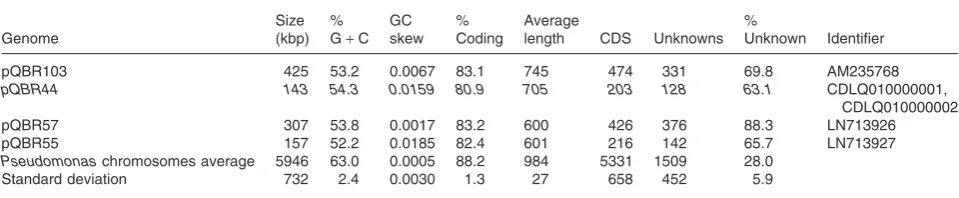
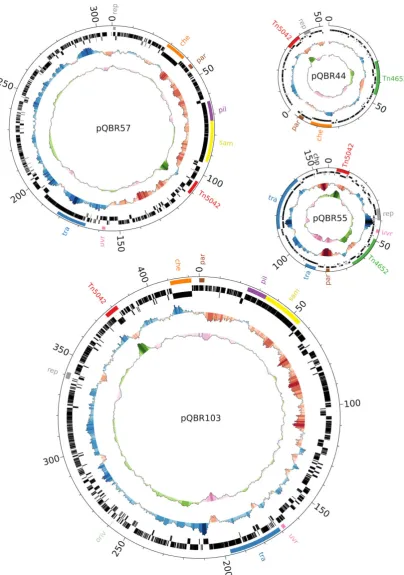
The salient genetic features of pQBR55, pQBR57 and pQBR44 are shown in Table 1 and Fig. 1. Like the previ-ously sequenced and co-occurring pQBR103 (Tett et al., 2007, ENA accession AM235768), pQBR57 was substantially larger than the ∼100 kb average size of other sequenced conjugative plasmids (Smillie et al., 2010), while pQBR55 was only slightly larger than average. The mean GC content of all four pQBR plasmids (52.1–53.8%) was markedly lower than the∼60% found for pseudomonad chromosomes (Winsoret al., 2011).
Comparative analysis of plasmid sequences
[image:2.595.56.536.586.685.2]Consistent with previous findings (Tett et al., 2007), pQBR44 was found to be highly similar to a ∼125 kbp
Table 1. Properties of the four-sequenced pQBR plasmids.
Genome
Size (kbp)
% G+C
GC skew
% Coding
Average
length CDS Unknowns %
Unknown Identifier
pQBR103 425 53.2 0.0067 83.1 745 474 331 69.8 AM235768
pQBR44 143 54.3 0.0159 80.9 705 203 128 63.1 CDLQ010000001,
CDLQ010000002
pQBR57 307 53.8 0.0017 83.2 600 426 376 88.3 LN713926
pQBR55 157 52.2 0.0185 82.4 601 216 142 65.7 LN713927
Pseudomonaschromosomes average 5946 63.0 0.0005 88.2 984 5331 1509 28.0
Standard deviation 732 2.4 0.0030 1.3 27 658 452 5.9
Note that pQBR44 is not fully assembled and is therefore shown in italics. Averages for pseudomonad chromosomes were calculated using the Pseudomonas Genome Database (Winsoret al., 2011).
Fig. 1. Ring images of each of the sequenced pQBR plasmids. From the middle of each image, concentric rings show (1) GC content (G+C)/(G+C+A+T). (2) GC skew (C−G)/(G+C). Bars pointing outwards indicate positions where the value was greater than average for that plasmid, and are coloured according to the degree of deviation, with the maximum and minimum indicating deviation of 0.1 from the mean. Values were calculated over sliding windows of 5 kb. (3, 4) Location of predicted coding DNA sequences (CDS) on the reverse (anticlockwise) and forward (clockwise) strands respectively. (5) Regions of interest as referred to in the text and Fig. 2. Image was drawn using Circos (Krzywinskiet al., 2009).
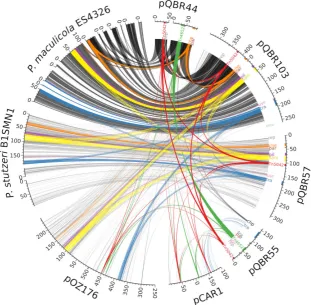
fragment of pQBR103 (303 500–4500 bp; Fig. 2). However, pQBR44 did not appear to be a simple deletion variant of pQBR103, for several reasons. First, the Tn5042 mercury resistance (HgR) transposons were located in different positions in the two plasmids. In pQBR103 Tn5042 was located∼30 kbp downstream of the putative minimal RepA replicon, in pQBR44 it was located ∼3 kbp upstream of the homologous RepA region. Second, pQBR44 appears to have acquired a copy of Tn4652, most likely fromP. putida UWC1 during the capture of plasmids from the rhizoplane (McClure et al., 1989; Lilleyet al., 1996; Weinelet al., 2002), and possibly another P. putida transposon encoding copper resistance (Supporting Information and Fig. S2). Third, despite high similarity between pQBR44 and pQBR103 sequences, a total of 783 single nucleotide variants (SNV) and 48 indels were identified. The greatest divergence was found between pQBR103_0387 and pQBR44_0073, hypothetical proteins with predicted phosphoadenosine phosphosulfate reductase domains which shared only 67% amino acid identity.
Despite having previously been categorized into differ-ent RFLP groups (Lilley and Bailey, 1997a), pQBR103 and pQBR57 were found to share distant but exten-sive similarity across a region of approximately 200 kb (pQBR57 ∼10 000–205 000 bp and pQBR103
∼365 000–220 000 bp, see Fig. 2 and Supporting
Infor-mation Fig. S3). In this region, similarity was greatest across clusters of genes with predicted functional activity, including a putative chemotaxis phosphorelay system, a type IV pilus, a number of predicted arylsulfatase/S-adenosyl methionine (‘radical SAM’) enzymes and genes encoding plasmid conjugative transfer machinery (Tett et al., 2007). However, synteny was incomplete as Tn5042 occupied different positions in the two sequences, and there was an internal region of reduced similarity (pQBR57 120 000–160 000 bp and pQBR103 75 000–180 000 bp). Analysis of the pQBR55 sequence showed that it diverged considerably from pQBR44, pQBR57 and pQBR103, with no extensive backbone simi-larity to the other pQBR plasmids analysed. However, like pQBR44, pQBR55 had also acquired a copy of Tn4652.
[image:4.595.57.369.65.370.2]The sequence of the Tn5042 HgRtransposon was iden-tical between the four plasmids, except for a 1 bp non-synonymous substitution in merR in pQBR103 and pQBR44. However, Tn5042 was located in different rela-tive positions in the different plasmids, suggesting that it had been horizontally transferred between plasmids at the Wytham site. This suggestion is supported by the fact that each of the Tn5042 sequences have markedly higher GC contents than average for each plasmid (Fig. 1), indicat-ing that they have not been subjected to the same biases in DNA replication as the rest of the plasmid sequences (Arakawa and Tomita, 2007).
Fig. 2. Regions of similarity between the pQBR plasmids and with previously sequenced genomes. Linear representations of the pQBR plasmids (right) and four previously sequenced plasmids/genomic islands (right) are shown around the edge of a circle, scaled according to their size (scale in kbp). Note that pQBR44,P. maculicola ES4326 andP. stutzeriB1SMN1 sequences each consist of multiple contigs as they have not been completely assembled.
Semi-transparent connections between the sequences indicate TBLASTX hits filtered by E-value<1e−1000, pairwise identity>50% and alignment length>50 bp. Regions of the sequences discussed in the text are coloured and labelled accordingly. Further information including separate images for each pQBR plasmid is provided in Supporting Information (Table S2, Fig. S3). Image was drawn using Circos (Krzywinskiet al., 2009).
The pQBR plasmids were similar to other MGEs isolated from pseudomonads in geographically distant locations (Fig. 2 and Supporting Information Fig. S3). For example, pQBR57 and pQBR103 had distant similar-ity to the P. aeruginosa pOZ176 antibiotic resistance megaplasmid isolated from a hospital in Guangzhou, China, in 2000 (ENA accession KC543497; Xionget al., 2013). However, pOZ176 uses differenttra,parand rep regions that are found in a region of relatively high GC content with no similarity to the pQBR plasmids. Plasmids pQBR57 and pQBR103 were also found to have high similarity to genomic islands found inP. stutzeriB1SMN1 isolated from a lagoon in Menorca in 1988 (ENA acces-sion AMVM00000000; Busquets et al., 2013) and P. cannabina pv. alisalensis (P. syringae pv. maculicola ES4326) isolated from a diseased radish in Wisconsin, USA, in 1965 (ENA accession AEAK00000000; Baltrus et al., 2011). Finally, parts of pQBR55 were similar to the backbone of the catabolic plasmid pCAR1 isolated in P. resinovoransfrom a sewage disposal plant in Japan in 1992 (ENA accession AB088420; Maedaet al., 2003).
Putative functional regions in the pQBR plasmids
Replication. Plasmid pQBR44 contains a region 98.5% similar at the nucleotide sequence level to the annotated pQBR103repregion. In contrast, no region similar to the pQBR103repAgene or its origin of replication (oriV) could be identified in pQBR57. However, a putative coding sequence (pQBR57_0001) with∼60% amino acid identity to previously annotated Pseudomonas TrfA/RepA pro-teins found 2.5 kbp downstream of a region containing a dnaAbox (TTATNCACA), 11 copies of a∼80 bp tandem repeat (305 301–306 433 bp), five copies of a 132 bp tandem repeat (306 799–131 bp) and an extreme of DNA asymmetry (GC skew, see Fig. 1) may represent the pQBR57replocus (Mackiewicz, 2004). The pQBR55rep region (ENA accession AJ421512; Turner et al., 2002) identified in otherPseudomonasandAzotobacterspecies was clearly identifiable in pQBR55, but not in pQBR44, pQBR57 or pQBR103.
Horizontal transmission. Plasmid pQBR44 appeared to lack the pQBR103tralocus (Fig. 2 and Tettet al., 2007) and did not possess any other candidate genes for con-jugative transfer. However, it is likely that pQBR44 has lost mobility since its original acquisition, as it was exog-enously isolated by conjugation and demonstrated to be transfer proficient in earlier work (Lilley et al., 1996). Therefore, pQBR44 may represent an example of plasmid laboratory adaptation occurring outside of a formal experi-mental evolution study. The pQBR103 tra locus (Tett et al., 2007) was part of the region of similarity shared with pQBR57, although the region as a whole (pQBR57
166 906–181 901 bp and pQBR103 170 292–197 117 bp) was only 55.4% similar at the nucleotide level. Candidates for the pQBR57 type-4 coupling protein (T4CP) and major ATPase were identified by comparison with genes from other mobile-genetic elements (pQBR57_0202 and pQBR57_0212; Smillie et al., 2010). Two regions of pQBR55 have similarity with the pCAR1 tra region, and putative T4CP and major ATPases were identified (pQBR55_0185 and 0173 respectively). For both pQBR57 and pQBR55, the genes best matching these candidates, by BLASTN analysis, were from Pseudomonasspecies.
Vertical transmission. The pQBR plasmids are probably maintained at low copy number, and are likely to encode mechanisms to promote their inheritance such as efficient partition of plasmids between daughter cells (pargenes) and post-segregational killing of plasmid-free daughters (pskor toxin-antitoxin TA genes). AparABlocus was iden-tified in pQBR44 that includes theparAandparB genes as well as the AT-rich parS repeat region, which was 99.2% similar to the par region of pQBR103 at the nucleotide level (Tettet al., 2007). In contrast, putativepar regions in pQBR55 and pQBR57 containing predicted parA and parB genes (pQBR55 78 217–80 003 bp, pQBR55_0121 and 0122; pQBR57 43 015–45 381 bp, pQBR57_0054 and 0055) were quite divergent from pQBR103 parAB, and associated parS sequences were not found. As with pQBR103, nopskor TA systems were identified on pQBR44 or pQBR57. However, pQBR55_0202 and 0203 constitute a likely ChpBS TA system due to their high amino acid identity with ChpBS systems previously identified in a number of other species, including pseudomonads (e.g. Feilet al., 2005). Finally, the divergence between the par regions and between therepregions (see previous section) suggests that plasmids pQBR57, pQBR103 and pQBR55 are com-patible (Novick, 1987), but a current lack of selectable markers prevents this question from being resolved experimentally.
Accessory functions. All four pQBR plasmids were found to have Tn5042-associated mercury resistance operons that could explain the HgRphenotype characteristic of this collection of plasmids. Plasmids pQBR55, pQBR57 and pQBR103 also carried putative UV resistance genes (pQBR55_0070 and 0071, pQBR57_0181 and 0182, and pQBR103_0157 and 0158), although the pQBR55 and pQBR57 systems may not be functional inP. fluorescens SBW25 (Zhang et al., 2004). pQBR57 shared several other regions identified in pQBR103. These included an arylsulfatase/SAM region consisting of 16 genes (73 111– 93 469 bp, pQBR57_0084–0099) predicted to encode a number of radical SAM enzymes and cognate regulators
that may be involved in biosynthetic processes (Sofia et al., 2001), and a putative type IV pilus region consisting of 10 genes (63 401–73 101 bp, pQBR57_0074–0083), and a chemotaxis operon of six genes (28 595– 38 795 bp, pQBR57_0044–0049), which might affect host motility. pQBR44 and pQBR55 also contained copies of Tn4652 that is closely related to the toluene degrading transposon Tn4651 (Tsuda and Iino, 1987). Although Tn4652 does not contain thetoloperon or any identifiable resistance determinants, it includes a putative diacylglycerol kinase and a sulfatase. A full list of putative gene functions identified in these regions is provided in Supporting Information Table S2.
pQBR55 confers ability to grow on sucrose
To understand how plasmid carriage affects the host phe-notype, pQBR55, pQBR57 and pQBR103 were conju-gated into marked strains of the well characterized soil- and plant-associated bacterium Pseudomonas fluorescens SBW25, which had been isolated from the same site at Wytham as the pQBR plasmids (Rainey and Bailey, 1996). Consistent with the genetic analyses, and in contrast with earlier work (Lilleyet al., 1996), pQBR44 did not transfer and as a result, phenotypic assays were not performed with this plasmid.
First, we tested whether any of the plasmids altered the metabolic ability of their host. Plasmid-carrying and plasmid-free strains were screened using BIOLOG plates and candidate substrates were verified by growth on minimal media containing just one carbon source. Using
this approach, P. fluorescens SBW25 carrying pQBR55 was found to have gained the ability to grow on sucrose, a potentially beneficial trait in the phytosphere. However, a re-examination of the pQBR55 sequence did not reveal any putative sucrase genes. Although P. fluorescens SBW25 is unable to grow on sucrose normally, it encodes a levansucrase (PFLU2294) and is able to catabolize sucrose when the cytoplasmic membrane is disrupted (Spiers and Rainey, 2005). Therefore, pQBR55 may allow sucrose catabolism by encoding a transporter (possibly pQBR55_0083) or by promoting processes that disrupt membrane function.
Rates of conjugative transfer and segregational loss
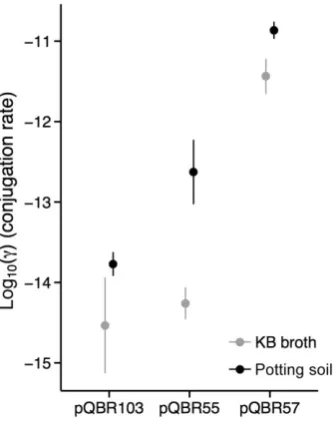
To understand the dynamics of plasmid acquisition and loss, we measured the conjugation rates of each of pQBR55, pQBR57 and pQBR103 betweenP. fluorescens SBW25 hosts in both shaken KB broth and soil micro-cosms (Fig. 3). Although pQBR55 and pQBR103 had comparatively low rates of conjugation (Simonsen et al., 1990; Gordon, 1992; Lilley and Bailey, 2002), pQBR57 showed an exceptionally high conjugation rate (effect of plasmid F2,14=47.633,P<0.001) and serial passage of pQBR57 conjugation mixtures in Hg(II)-free KB broth found that 100% of the tested recipient population was HgRafter 10 transfers (480 h). Rates of conjugation were found to be slightly higher for all plasmids in soil com-pared with KB broth (effect of medium F1,14=14.217, P=0.002), consistent with other findings showing an increased rate of transfer on surfaces (e.g. Fox et al., 2008).
Plasmid stability was studied by the serial passage of populations of plasmid carriers in Hg(II)-free KB broth and measuring the loss of HgR. Over 10 transfers, few plasmid-free clones were detectable in pQBR55 or pQBR57 cultures suggesting either low rates of segregational loss and/or high rates of horizontal transfer. In contrast, mercury-sensitive (HgS) colonies soon appeared in the pQBR103 populations, indicating that pQBR103 was readily lost by segregation. However, the frequency of pQBR103 carriage remained between 50 and 75%, suggesting that the plasmid was maintained through frequency-dependent selection and/or horizontal transmission (see Supporting Information Fig. S4).
Carriage of pQBR plasmids confers context-dependent fitness effects
[image:6.595.88.256.63.274.2]We quantified the effects of carriage on fitness for pQBR55, pQBR57 and pQBR103 by direct competition of plasmid-carrying P. fluorescens SBW25-GmR strains against a plasmid-freeP. fluorescensSBW25-lacZ refer-ence strain. These competitive fitness assays measure
Fig. 3. Conjugation rates betweenP. fluorescensSBW25 for each of the three plasmids in KB broth and soil microcosms, calculated according to Simonsenet al. (1990). Points show means of three (KB) or four (soil) replicates±SEM.
the fitness of a test strain relative to that of a reference strain, and therefore the extent to which the test strain is favoured or disfavoured in a given environment. To determine the conditions favouring plasmid bearers, we performed assays under different concentrations of Hg(II). Initially, at least three independently isolated transconjugants of each plasmid were tested to assess variation between clones (see Supporting Information Fig. S1); subsequent tests (presented below) were per-formed on one representative transconjugant strain for each plasmid. To account for any effects of the antibiotic resistance marker, we also performed control assays with plasmid-free P. fluorescens SBW25-GmR as the test strain.
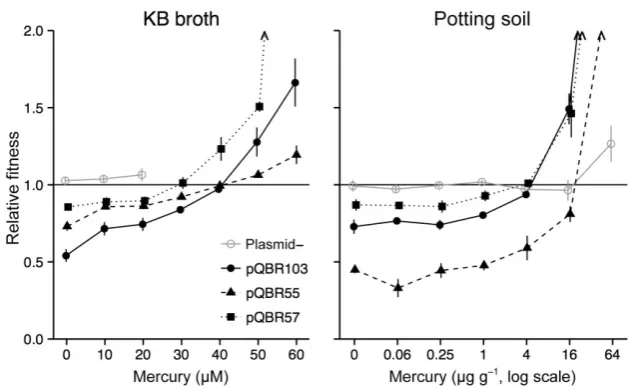
In the absence of Hg(II), all plasmids imposed fitness costs to their hosts, but costs varied between plasmids: pQBR103 was the most costly (fitness of plasmid-bearing strain relative to plasmid-free at 0μM Hg(II), 0.54±0.04; one-sample t-test t3= −11.0859, P=0.002), pQBR55 had intermediate cost (0.73±0.03; t3= −9.3409, P=0.003) and pQBR57 was the least costly (0.86±0.02, t3= −6.6832, P=0.007; main effect of plasmid F2,66=30.14, P<0.001). The fitness of plasmid bearers relative to plasmid-free cells increased with Hg(II) concen-tration (main effect of mercuryF1,66=230.90,P<0.001). At high levels of Hg(II) (>30μM), plasmid bearers outgrew plasmid-free bacteria, and in some cases, plasmid carriage was essential for growth. The slope of the reaction norm of plasmid-mediated fitness against Hg(II) concentration varied between different plasmids, with pQBR55 having a significantly shallower slope than either pQBR57 or pQBR103 (effect of mercury×plasmid interaction F2,66=10.36, P<0.001). At Hg(II) concentra-tions higher than 20μM, plasmid-free bacteria were unable to survive at detectable levels in the control assays (i.e. no plasmids in the populations). However,
plasmid-free bacteria (i.e. the reference strain) were able to survive in high Hg(II) where plasmid-containing bacteria were present, suggesting that plasmid-free cells were able to exploit the environmental decontamination by plasmid bearers (Ellis et al., 2007). The relationship between the bacterial host and its plasmid symbiont is therefore context dependent, with the plasmids acting as parasites at low Hg(II) concentrations, and mutualists at high Hg(II) concentrations.
Physically structured soil environments are expected to significantly differ from unstructured experimental liquid microcosms in several ways. For example, local concen-trations of toxins might be higher in soil, the physiological burden of plasmid carriage might be relatively greater in low-nutrient soil and the structuring of microbial commu-nities might affect the overall toxicity of Hg(II) (Schlüter, 1993; Harrisonet al., 2007; Plattet al., 2012). Therefore, we undertook additional competitive fitness assays in soil microcosms (after Gomez and Buckling, 2011), which pro-vides a physical structure and chemistry more similar to that of natural soil than liquid growth media.
[image:7.595.56.371.60.255.2]In soil microcosms, we observed similar context-dependent fitness effects of plasmid carriage where the fitness of plasmid bearers relative to plasmid-free strains increased with Hg(II) concentration (effect of mercury F1,65=68.075, P<0.001). In contrast to the patterns observed in KB microcosms, pQBR55 was substantially more costly in the soil microcosms in the absence of Hg(II) and at low concentrations (Welch two-sample t-test t5.66= −7.6928, P<0.001). Moreover, concentrations of Hg(II) are high enough to select for HgR plasmids (>4μg g−1, W≥1) in soil microcosms were non-lethal to the plasmid-free control assays, although the final densi-ties attained in control assays declined with increasing Hg(II) concentration (data not shown). This presumably reflects the non-uniform (patchy) distribution of Hg(II)
Fig. 4. Relative fitness of plasmid-bearing strains when grown in competition with plasmid-free strains in KB broth (left) and potting soil (right) microcosms. Points show means of four replicates±SEM and are slightly jittered on thex-axis to prevent overplotting. Arrowheads indicate mean fitness>2.
through the microcosm, resulting in regions where local concentrations were low enough for plasmid-free bacteria to survive and grow.
To test the relative fitness effects of the pQBR plasmids, we next measured competitive fitness of pQBR55, pQBR57 and pQBR103 plasmid-bearing P. fluorescens SBW25-GmR strains in direct competition against plasmid-bearing P. fluorescens SBW25-SmRlacZ strains in all pairwise combinations (three combinations of differ-ent competitors×two combinations of markers). Assays were performed in KB and soil microcosms (Fig. 5) in the absence of Hg(II), where the carriage of each plasmid is costly, and at high levels of Hg(II) where the plasmids are beneficial to the host.
In KB microcosms, the outcome of plasmid–plasmid competition assays involving pQBR57 was dependent on the presence of Hg(II) (Fig. 5a, plasmid×mercury inter-action F2,36=57.782, P<0.001). In particular, pQBR57 performed worse against pQBR55 and pQBR103 when Hg(II) was present compared with assays in Hg-free media. Environmental context therefore changed the fitness hierarchy of the plasmid-bearing bacteria: A mercury resistance plasmid that is more costly than another in the absence of Hg(II) can become more ben-eficial in Hg(II)-contaminated environments. In this experi-ment, we also detected a significant effect of the antibiotic markers on the outcome of the assay (main effect of markerF1,36=55.912,P<0.001, see Supporting Informa-tion Fig. S5). This effect was likely due to slight variaInforma-tions in fitness between transconjugants with different marker backgrounds (effect of competition×marker orientation F2,36=19.582, P<0.001), so precise values for relative fitness cannot be determined (see Supporting Information Fig. S5 for details).
In contrast, Hg(II) had no significant effect on the competitive fitness assay in soil microcosms (Fig. 5b,
plasmid×mercury interaction F2,33=1.154, P=0.33). Plasmids varied in competitive fitness (effect of plasmid F2,33=38.983,P<0.001) with pQBR55 carriers perform-ing poorly in the soil microcosms, while bacteria carryperform-ing pQBR57 and pQBR103 were not significantly different from one another, regardless of the presence or absence of Hg(II).
Discussion
Lilley and colleagues isolated a diverse collection of mobilizable mercury resistance plasmids from the same Wytham site over 4 years (Lilleyet al., 1996; Lilley and Bailey, 1997a). The four plasmids that we analysed here came from three RFLP groups, and the greater resolution provided by the full sequence of each has allowed a better determination of the relationships between pQBR103/ pQBR44 (Group I), pQBR55 (Group III) and pQBR57 (Group IV). Sequence conservation between these plasmids and other sequences suggests that the plasmid community at Wytham did not diversify independentlyin situ, and is consistent with the hypothesis that the plasmid diversity was ancestral. Locally diverse plasmid assem-blages are likely to come about instead by transport over long distances (i.e. immigration), for example, by mete-orological, hydrological or human-driven processes (Kellogg and Griffin, 2006; Wilkinson, 2010; Tayloret al., 2011).
[image:8.595.55.369.62.255.2]The high levels of sequence identity between the Tn5042 mercury resistance transposons present in each of the four pQBR plasmids, and the apparent recombina-tion events linking pQBR44 with pQBR103, and pQBR57 and pQBR103 with pOZ176, suggests that recombination may be central to the evolution of MGEs at different geo-graphical sites. Long-distance migration of MGEs might work in tandem with local recombination events, such as
Fig. 5. Relative fitness of test plasmid-bearing strains when grown in competition with reference plasmid-bearing strains in KB broth (left) and potting soil (right) microcosms. Points show least-square means for assays (n=8) averaged over experiments and antibiotic markers±SEM and are slightly jittered on thex-axis to prevent overplotting. Relative fitness for each combination of competitors is plotted for the first named competitor relative to the second.
transposition, to facilitate the spread of genes encoding adaptive traits (Frostet al., 2005). Like previous studies of plasmid communities (Sentchiloet al., 2013), the function of the majority of genes identified in the pQBR plasmids is unknown. The fact that many genes from pQBR57 and pQBR103 have also been identified in distantly isolated bacteria (Busquetset al., 2013; Xionget al., 2013) sug-gests that they are functional and confer at least occa-sional fitness advantages to their host bacteria.
The fitness effects of pQBR55, pQBR57 and pQBR103 carriage on theP. fluorescensSBW25 host in KB and soil microcosms were found to be dependent on environmen-tal context. As previously shown for pQBR103 (Slater et al., 2008), these plasmids were costly to their bacterial hosts when low levels of Hg(II) were present. However, changes to the environment altered the fitness of plasmid carriers relative to plasmid-free strains: the fitness of plasmid-carrying bacteria increased with Hg(II) levels. Although we performed these experiments with transfer-proficient plasmids, the frequency of transconjugants arising during the assay was relatively low compared with the numbers of competitors, and thus had a negligible effect on the fitness calculations. Similar fitness effects were found whenEscherichia colicarrying the multi-drug resistance plasmid pUUH239.2 were challenged with varying concentrations of antibiotics or toxic metals (Gullberget al., 2014). Fitness has long been known to be a function of genotype and environment, and environmen-tal context has been found to affect both the magnitude and the sign of symbiotic interactions (Wolinska and King, 2009; Chamberlainet al., 2014). Applying this knowledge to plasmid biology defines the symbiotic relationship between plasmids and hosts as a continuum ranging from parasitic to mutualistic depending on environmental chal-lenges and opportunities, with consequences for the eco-logical persistence and spread of plasmids and the trajectory of coevolution for both parties (Harrison and Brockhurst, 2012).
Mercury detoxification is an active process, causing a local decrease in the concentration of bioactive mercury and making the environment increasingly viable for plasmid-free bacteria (Barkayet al., 2010). At intermedi-ate Hg(II) levels, we found that plasmid-free bacteria often had a fitness advantage over plasmid-bearing bacteria in competitive growth assays, despite the fact that plasmid-free bacteria were unable to survive on their own. Where initial Hg(II) concentration is low enough and initial plasmid frequency is high enough, environmental detoxi-fication probably proceeds sufficiently quickly for plasmid-free bacteria to eventually outcompete plasmid bearers over the course of the competition. Selection for the plasmid is therefore presumably frequency dependent under such conditions (Ellis et al., 2007), and more complex fitness measurements may be required to
capture the precise dynamics of such a relationship (see, for example, Ribeck and Lenski, 2015). It is also interest-ing to note that unstructured microcosms containinterest-ing liquid growth medium have shown a greater role here for context dependency than the more structured soil micro-cosms. pQBR103-bearing strains are known to have an advantage in Hg(II) contaminated environments, but only when in the close vicinity of Hg(II) sources, with the switch from parasitism to mutualism occurring over just a few hundred micrometers (Slateret al., 2008). Such fine-scale spatial effects may have been missed here in our soil microcosm experiments because fitness was calculated by averaging across the whole microcosm population. In natural soils, Hg(II) distribution is likely to be highly het-erogeneous, with retention of Hg(II) affected by numerous physical, chemical and geological factors including pH, mineral composition and temperature (Schlüter, 1993). Such heterogeneity could offer varied microenvironments in which diverse bacteria, in concert with their mobile elements, can coexist.
The effect of Hg(II) concentration on the fitness of plasmid-bearing strains varied between pQBR55, pQBR57 and pQBR103 despite the fact that the mercury resistance operons were almost identical between plasmids. Such differences suggest that there is an unde-fined interaction between the mer operon and other plasmid genes. For example, plasmid-encoded mem-brane proteins such as conjugative apparatus or the puta-tive pQBR55-encoded sucrose transporter might interfere with Hg(II) import, making detoxification less efficient. Variation in Hg(II) response may help to explain plasmid coexistence at the Wytham site, where environmental het-erogeneity could favour different plasmids in different microenvironments. As many antibiotic resistance deter-minants are also located on and spread via transposons (Partridgeet al., 2009), it would be interesting to know the extent to which they share this epistasis.
The bulk concentration of mercury at the Wytham site at the time of plasmid isolation was just 0.05μg g−1, consist-ent with a lack of specific contamination and at the lower end of the range for UK rural soils (Morganet al., 2009). Concentrations of environmental mercury higher than 1μg g−1are rare beyond sites of heavy industry or geo-logical disruption (Morgan et al., 2009; Barkay et al., 2010). Our experiments found that far higher concentra-tions of Hg(II) were required for the pQBR plasmids to confer net fitness benefits to theP. fluorescens SBW25 host. Consequently, two outstanding questions remain.
First, if HgRis not a beneficial trait at the Wytham site, why are there so many mercury resistance plasmids? The relationship between plasmids and HgRtransposons may be quite dynamic, with transposons and plasmids being only transiently associatedin situ. The different locations of Tn5042 in pQBR44 and pQBR103 suggests that the
transposon was acquired independently by the two plasmids, rather than pQBR44 being a deletion derivative of a pQBR103 HgRancestor. Indeed, the accessory gene repertoire of a plasmid may not be constant (Senet al., 2011; Szczepanowski et al., 2011). Both pQBR44 and pQBR55 appear to have acquired mobile elements from theP. putida host used to isolate these plasmids during a relatively short period, and transposition can vary accessory genes between otherwise essentially identical plasmids (e.g. Eikmeyer et al., 2012; Norberg et al., 2014). Like other accessory genes, the genetic basis of mercury resistance is nested in a hierarchy of mobility: the mer operon is often associated with transposable ele-ments, which in turn are often on mobilizable and conju-gative elements such as plasmids (Norman et al., 2009; Partridge et al., 2009). The pQBR plasmid collection might represent a cross-sectional snapshot of those mobilizable elements that were associated with a HgR transposon at the Wytham site, and it is interesting to speculate what differences, if any, selection for a different transposon-borne trait might have revealed. The Tn5042 transposon is widespread and highly conserved among environmental isolates (Mindlinet al., 2005), and perhaps the diversity of pQBR plasmids speaks to the ability of this transposon to ‘infect’ a broad range of mobilizable and conjugative plasmid backbones, with the plasmids them-selves merely ‘hitch hiking’ when the transposon-borne genes are selected.
Second, if these plasmids are costly to their hosts under Hg(II) conditions approximating those of their natural habitat, how are they able to persist? As suggested earlier, bulk Hg(II) concentration may be unrepresentative of the local microenvironment experienced by bacteria. However, even if environmental context selected HgR, we have observed transposition of pQBR-based Tn5042 transposons to the host chromosome (unpublished data), suggesting that HgR plasmids can become redundant (Bergstrom et al., 2000). Furthermore, the decline of pQBR103 in serial cultures demonstrates that plasmids can be lost by segregation. Perhaps the high rate of conjugation of pQBR57 allows it to survive as an infec-tious agent (Sørensenet al., 2005), although the question of why it carries such a large number of accessory genes remains, as parasites tend to have streamlined genomes (e.g. Tamaset al., 2001).
The putative toxin–antitoxin system identified in pQBR55 may reduce its rate of loss by segregation, although antitoxin genes can also be acquired by bacterial chromosomes, rendering the original plasmid dispensable (Saavedra De Bast et al., 2008). Other plasmid genes might provide benefits to the host in other contexts, such as in close association with plants, or under environmen-tal conditions that fluctuate temporally or are spatially heterogeneous. For example, the pQBR55-conferred
ability to catabolize sucrose might be beneficial only during the growing season (Lilley and Bailey, 1997b), with the plasmid becoming costly and poorly maintained at other times, and pQBR103 carriage significantly alters cell physiology and metabolism when grown on different media (Udeet al., 2007).
Perhaps more importantly, plasmids and their hosts can co-evolve, with the costs of plasmid carriage markedly ameliorated by reduction in conjugation rates, loss of plasmid genes and down-regulation of transcription (Harrison and Brockhurst, 2012). Notably, the GC content of the pQBR plasmids is lower than the P. fluorescens SBW25 chromosome, indicating that the pQBR plasmids may be adapted to different hosts in which they are perhaps less costly. Recently, it was shown that a costly, unstable non-transmissible plasmid can be quickly stabi-lized by compensatory chromosomal mutations and transient positive selection for plasmid-encoded genes (San Millanet al., 2014). Moreover, compensation, rather than reversion, tends to be favoured for bacteria that have acquired costly antibiotic resistance mutations (Andersson and Hughes, 2010). Understanding the physi-ological and genetic mechanisms by which cost of car-riage is ameliorated, and the genomic constraints, environmental contexts and community structures that favour amelioration will help resolve the so-called plasmid paradox (Harrison and Brockhurst, 2012).
Experimental procedures
Strains and plasmids
Pseudomonas fluorescensSBW25 (Rainey and Bailey, 1996)
was labelled with mini-Tn7 gentamicin resistance (GmR)
and streptomycin resistance lacZ (SmRlacZ) cassettes
according to the method of Lambertsen and colleagues (2004) to produce P. fluorescens SBW25-GmR and
P. fluorescensSBW25-SmRlacZ. An SBW25-lacZstrain (from
Zhang and Rainey, 2007), which carries thelacZmarker, was also used. Plasmids originally isolated in P. putida UWC1 (pQBR55 and pQBR57; Lilleyet al., 1996) andP. fluorescens SBW25 (pQBR103; Lilley and Bailey, 1997a) were trans-ferred into the labelledP. fluorescensSBW25 lines by conju-gation, and were selected using mercury and the appropriate antibiotic.
Microcosms
Bacteria were grown in modified King’s B medium [KB: 10 g glycerol, 1.5 g MgSO4.7H2O, 1.5 g K2HPO4.3H2O, 20 g
Pro-teose peptone No. 3 (BD Company) l−1], supplemented with
antibiotics (30μg ml−1 gentamicin or 250μg ml−1
streptomy-cin), 10–60μM HgCl2 [Hg(II)] and 1.2% w/v agar, where
required. Inocula for experiments were provided by 18 h overnight shaken cultures incubated at 28°C. Loosely lidded Universal bottles (30 ml) were used for microcosms: KB microcosms contained 6 ml KB, soil microcosms contained
10 g of twice-autoclaved John Innes #2 potting soil with
∼25% w/v water content and were mixed with 800μl 0–4 mM Hg(II) and allowed to equilibrate for 1 h before use.
Competitive fitness assays
Competitive fitness assays were initiated with 1:1 mixtures of independent overnight cultures of test and reference strains. Plasmid-bearing GmRtest strains competed against
plasmid-free SBW25-lacZ, whereas for plasmid–plasmid assays plasmid-bearing SBW25-GmR competed against
plasmid-bearing SBW25-SmRlacZ. Viable numbers of bacteria were
estimated by spreading dilutions of culture on KB plates containing 50μg ml−1X-Gal. Relative fitness was calculated
from these data as the ratio of Malthusian parameters W=ln(teststart/testend)/ln(referencestart/referenceend) (Lenski
et al., 1991). Assays in KB microcosms were initiated with
60μl samples of the mixtures (approximately 1×10⁸cfu) and
incubated for 48 h shaking at 170 rpm at 28°C before assay. Fitness assays in soil were initiated with 200μl samples of 1:40 dilutions of the mixtures, mixed briefly by vortexing and incubated for 96 h at 28°C, 80% relative humidity (Gomez and Buckling, 2011). To recover bacteria from soil, 20 glass beads (5 mm in diameter) and 10 ml M9 salts (Sambrook
et al., 1989) were added to each microcosm and mixed well
by vortexing vigorously for 1 min to produce a supernatant that was then sampled for viable numbers as earlier. Prelimi-nary experiments showed that although this method probably underestimated the total number of bacteria present by approximately 50% (51.6±3%), there was no significant bias in the retrieval of plasmid-free bacteria when compared with bacteria carrying pQBR55, pQBR57 or pQBR103 (see Sup-porting Information Table S1).
Measurement of conjugation rate (γ) was according to Simonsen and colleagues (1990):γ = Ψln(1+(T/R)(N/D))(1/ (N−N0), whereΨis the population growth rate (h−1), N0the
starting cell density (ml−1) and T, R, D and N the end point
densities (ml−1) of transconjugants, recipients, donors and the
total population respectively. Conjugations were started with a 1:1 mixture of plasmid-bearingP. fluorescensSBW25-GmR
donor and plasmid-free P. fluorescens SBW25-SmRlacZ
recipient and grown under conditions similar to the competi-tive fitness assays. KB agar containing appropriate antibiotics and Hg(II) (20μM) were used to select plasmid-bearing recipients.
Plasmid sequencing and analysis
TruSeq libraries were prepared from 1μg of DNA per sample with approximately 500 bp insert sizes and sequenced on an Illumina MiSeq with 2×150 bp paired reads to gener-ate 750–1000 Mbp per sample (ENA project number PRJEB8054). Sequences were assembled using SPAdes v2.5.1 with kmers 21, 33, 55 and 77 (Bankevichet al., 2012) and closed by identifying overlaps between contigs and by PCR (see Supporting Information Document and Fig. S2 for details). Putative CDS were identified and annotated using RAST, InterProScan-5 and BLASTP 2.2.28+(Altschulet al., 1997; Zdobnov and Apweiler, 2001; Azizet al., 2008). Anno-tated sequences can be found at the European Nucleotide Archive with the following accession numbers: pQBR44,
CDLQ010000001-CDLQ010000002; pQBR55, LN713927; and pQBR57, LN713926. SNV and insertions/deletions (indels) were identified using NUCmer/dnadiff (Kurtz et al., 2004). Statistics of GC skew was calculated as (C−G)/ (C+G).
Metabolic profiling
Metabolic profiling was undertaken using Biolog GN2 MicroPlates as previously described (MacLeanet al., 2004). Optical density (OD 660 nm) measurements from duplicate plates were made after 48 h of incubation at 28°C, and com-pared with plasmid-free control strains to determine those carbon sources on which respiration occurred. Because pre-vious work has raised issues over the validity of Biolog assays for such analyses (Leiby and Marx, 2014), we verified candidate substrates as sufficient for growth by measuring the rate of growth (ΔOD600.second−1) of logarithmic-phase M9
minimal medium (Sambrooket al., 1989) cultures containing the test substrate as the sole carbon source at a concentra-tion of 1% w/v.
Statistics
For the analysis of conjugation rate, we fitted a linear model where plasmid, growth medium and their interactions were fixed effects. One pQBR103 replicate in soil yielded no transconjugants and was therefore excluded from the analy-sis and presentation. For the analyses of fitness under differ-ent concentrations of Hg(II), data from the highest concentration were not included due to high variance. For both KB and soil competitive fitness assays, the relative fitnesses of plasmid-free bacteria over increasing concentra-tions of Hg(II) were not found to be significantly different from 1 (KB: intercept=1.03±0.02,P=0.2; slope=0.001± 0.003, P=0.7. Soil: intercept=0.99±0.02, P=0.8; slope= −0.004, P=0.7), so comparisons for each of the plasmid-bearing bacteria were performed against 1. We fitted a linear model where plasmid, mercury and their interactions were fixed effects and relative fitness was the response vari-able. For soil experiments, we used a log transformation of Hg(II) concentration. For the analysis of plasmid–plasmid competitive fitness assays, we fitted a model where compe-tition, mercury, marker orientation and their interactions were fixed effects. Qualitatively similar results were obtained from a mixed effects model, with competition and mercury and their interaction fitted as fixed effects, and marker orientation, nested in competition, fitted as a random effect (not shown). In the soil competitive fitness assays, one pQBR55 replicate at 0.06μg g−1had a calculated fitness of zero (no plasmid
bearers were detectable), and two pQBR103 replicates at 64μg g−1had calculated fitness of infinite (no plasmid free
were detectable), and were therefore excluded from the analysis and presentation. Statistical analyses were per-formed using R (R Development Core Team, 2014). Plots were drawn using the ggplot package (Wickham, 2009).
Acknowledgements
We acknowledge the help provided by the staff at the NERC Biomolecular Analysis Facility, University of Liverpool, UK, for
their assistance with sample preparation and sequencing, as well as Peter Young and the Evolution Discussion Group at the University of York for helpful comments. This work was supported by NERC Standard Grant NE/H005080 and ERC Consolidator Grant Agreement no. 311490-COEVOCON to MAB.
References
Altschul, S.F., Madden, T.L., Schäffer, A.A., Zhang, J., Zhang, Z., Miller, W., and Lipman, D.J. (1997) Gapped BLAST and PSI-BLAST: A new generation of protein database search programs.Nucleic Acids Res25:3389–3402.
Andersson, D.I., and Hughes, D. (2010) Antibiotic resistance and its cost: Is it possible to reverse resistance?Nat Rev
Microbiol8:260–271.
Arakawa, K., and Tomita, M. (2007) The GC skew index: A measure of genomic compositional asymmetry and the degree of replicational selection.Evol Bioinform Online3:
159–168.
Aziz, R.K., Bartels, D., Best, A.A., DeJongh, M., Disz, T., Edwards, R.A., et al. (2008) The RAST Server: Rapid annotations using subsystems technology.BMC Genomics
9:75.
Baltrus, D.A. (2013) Exploring the costs of horizontal gene transfer.Trends Ecol Evol28:489–495.
Baltrus, D.A., Nishimura, M.T., Romanchuk, A., Chang, J.H., Mukhtar, M.S., Cherkis, K.,et al. (2011) Dynamic evolution of pathogenicity revealed by sequencing and comparative genomics of 19 pseudomonas syringae isolates. PLoS
Pathog7:e1002132.
Bankevich, A., Nurk, S., Antipov, D., Gurevich, A.A., Dvorkin, M., Kulikov, A.S., et al. (2012) SPAdes: A new genome assembly algorithm and its applications to single-cell sequencing.J Comput Biol19:455–477.
Barkay, T., Kritee, K., Boyd, E., and Geesey, G. (2010) A thermophilic bacterial origin and subsequent constraints by redox, light and salinity on the evolution of the microbial mercuric reductase.Environ Microbiol12:2904–2917. Bergstrom, C.T., Lipsitch, M., and Levin, B.R. (2000) Natural
selection, infectious transfer and the existence conditions for bacterial plasmids.Genetics155:1505–1519. Brown, C.J., Sen, D., Yano, H., Bauer, M.L., Rogers, L.M.,
Van der Auwera, G.A., and Top, E.M. (2013) Diverse broad-host-range plasmids from freshwater carry few accessory genes.Appl Environ Microbiol79:7684–7695.
Brown Kav, A., Sasson, G., Jami, E., Doron-Faigenboim, A., Benhar, I., and Mizrahi, I. (2012) Insights into the bovine rumen plasmidome.PNAS109:5452–5457.
Busquets, A., Pena, A., Gomila, M., Mayol, J., Bosch, R., Nogales, B., et al. (2013) Draft genome sequence of pseudomonas stutzeri strain B1SMN1, a nitrogen-fixing and naphthalene-degrading strain isolated from
wastewa-ter.Genome Announc1:e00584-13.
Chamberlain, S.A., Bronstein, J.L., and Rudgers, J.A. (2014) How context dependent are species interactions?Ecol Lett
17:881–890.
Dahlberg, C., and Chao, L. (2003) Amelioration of the cost of conjugative plasmid carriage in Escherichia coli K12.
Genetics165:1641–1649.
De Gelder, L., Ponciano, J.M., Joyce, P., and Top, E.M. (2007) Stability of a promiscuous plasmid in different hosts: No guarantee for a long-term relationship. Microbiology
153:452–463.
Eikmeyer, F., Hadiati, A., Szczepanowski, R., Wibberg, D., Schneiker-Bekel, S., Rogers, L.M.,et al. (2012) The com-plete genome sequences of four new IncN plasmids from wastewater treatment plant effluent provide new insights into IncN plasmid diversity and evolution. Plasmid 68:
13–24.
Ellis, R.J., Lilley, A.K., Lacey, S.J., Murrell, D., and Godfray, H.C.J. (2007) Frequency-dependent advantages of plasmid carriage byPseudomonas in homogeneous and spatially structured environments.ISME J1:92–95. Feil, H., Feil, W.S., Chain, P., Larimer, F., DiBartolo, G.,
Copeland, A., et al. (2005) Comparison of the complete genome sequences ofPseudomonas syringaepv. syringae B728a and pv. tomato DC3000.Proc Natl Acad Sci USA
102:11064–11069.
Fox, R.E., Zhong, X., Krone, S.M., and Top, E.M. (2008) Spatial structure and nutrients promote invasion of IncP-1 plasmids in bacterial populations.ISME J2:1024– 1039.
Frost, L.S., Leplae, R., Summers, A.O., and Toussaint, A. (2005) Mobile genetic elements: The agents of open source evolution.Nat Rev Microbiol3:722–732.
Gogarten, J.P., and Townsend, J.P. (2005) Horizontal gene transfer, genome innovation and evolution. Nat Rev
Microbiol3:679–687.
Gomez, P., and Buckling, A. (2011) Bacteria-phage antago-nistic coevolution in soil.Science332:106–109.
Gordon, D.M. (1992) Rate of plasmid transfer among
Escherichia colistrains isolated from natural populations.
Microbiology138:17–21.
Gullberg, E., Albrecht, L.M., Karlsson, C., Sandegren, L., and Andersson, D.I. (2014) Selection of a multidrug resistance plasmid by sublethal levels of antibiotics and heavy metals. MBio5:e01918-14.
Harrison, E., and Brockhurst, M.A. (2012) Plasmid-mediated horizontal gene transfer is a coevolutionary process.
Trends Microbiol20:262–267.
Harrison, J.J., Ceri, H., and Turner, R.J. (2007) Multimetal resistance and tolerance in microbial biofilms. Nat Rev
Microbiol5:928–938.
Heuer, H., and Smalla, K. (2012) Plasmids foster diversifica-tion and adaptadiversifica-tion of bacterial populadiversifica-tions in soil.FEMS
Microbiol Rev36:1083–1104.
Kellogg, C.A., and Griffin, D.W. (2006) Aerobiology and the global transport of desert dust.Trends Ecol Evol21:638– 644.
Krzywinski, M., Schein, J., Birol, I., Connors, J., Gascoyne, R., Horsman, D.,et al. (2009) Circos: An information aes-thetic for comparative genomics.Genome Res19:1639– 1645.
Kurtz, S., Phillippy, A., Delcher, A.L., Smoot, M., Shumway, M., Antonescu, C., and Salzberg, S.L. (2004) Versatile and open software for comparing large genomes.Genome Biol
5:R12.
Lambertsen, L., Sternberg, C., and Molin, S. (2004) Mini-Tn7 transposons for site-specific tagging of bacteria with fluo-rescent proteins.Environ Microbiol6:726–732.
Leiby, N., and Marx, C.J. (2014) Metabolic erosion primarily through mutation accumulation, and not tradeoffs, drives limited evolution of substrate specificity inEscherichia coli.
PLoS Biol12:e1001789.
Lenski, R.E., Rose, M.R., Simpson, S.C., and Tadler, S.C. (1991) Long-term experimental evolution in Escherichia coli. I. Adaptation and divergence during 2,000 genera-tions.Am Nat138:1315–1341.
Lilley, A.K., and Bailey, M.J. (1997a) The acquisition of indig-enous plasmids by a genetically marked pseudomonad population colonizing the sugar beet phytosphere is related to local environmental conditions.Appl Environ Microbiol
63:1577–1583.
Lilley, A.K., and Bailey, M.J. (1997b) Impact of plasmid pQBR103 acquisition and carriage on the phytosphere fitness of pseudomonas fluorescens SBW25: Burden and benefit.Appl Environ Microbiol63:1584–1587.
Lilley, A.K., and Bailey, M.J. (2002) The transfer dynamics of
Pseudomonas sp. plasmid pQBR11 in biofilms. FEMS
Microbiol Ecol42:243–250.
Lilley, A.K., Fry, J.C., Day, M.J., and Bailey, M.J. (1994) In situ transfer of an exogenously isolated plasmid between
Pseudomonasspp. in sugar beet rhizosphere.
Microbiol-ogy140:27–33.
Lilley, A.K., Bailey, M.J., Day, M.J., and Fry, J.C. (1996) Diversity of mercury resistance plasmids obtained by exog-enous isolation from the bacteria of sugar beet in three successive years.FEMS Microbiol Ecol20:211–227. McClure, N.C., Weightman, A.J., and Fry, J.C. (1989)
Sur-vival of Pseudomonas putida UWC1 containing cloned catabolic genes in a model activated-sludge unit. Appl
Environ Microbiol55:2627–2634.
Mackiewicz, P. (2004) Where does bacterial replication start? Rules for predicting the oriC region.Nucleic Acids Res32:
3781–3791.
MacLean, R.C., Bell, G., and Rainey, P.B. (2004) The evolu-tion of a pleiotropic fitness tradeoff in Pseudomonas
fluorescens.Proc Natl Acad Sci USA101:8072–8077.
Maeda, K., Nojiri, H., Shintani, M., Yoshida, T., Habe, H., and Omori, T. (2003) Complete nucleotide sequence of carbazole/dioxin-degrading plasmid pCAR1 in
Pseudomonas resinovorans strain CA10 indicates its
mosaicity and the presence of large catabolic transposon Tn4676.J Mol Biol326:21–33.
Mindlin, S., Minakhin, L., Petrova, M., Kholodii, G., Minakhina, S., Gorlenko, Z., and Nikiforov, V. (2005) Present-day mercury resistance transposons are common in bacteria preserved in permafrost grounds since the Upper Pleistocene.Res Microbiol156:994–1004. Morgan, H., De Búrca, R., Martin, I., and Jeffries, J. (2009)
Soil Guideline Values for Mercury in Soil, Environment
Agency Science Report SC050021. Bristol, UK:
Environ-ment Agency.
Morton, E.R., Platt, T.G., Fuqua, C., and Bever, J.D. (2014) Non-additive costs and interactions alter the competitive dynamics of co-occurring ecologically distinct plasmids.
Proc Biol Sci281:20132173.
Norberg, P., Bergström, M., and Hermansson, M. (2014) Complete nucleotide sequence and analysis of two conju-gative broad host range plasmids from a marine microbial biofilm.PLoS ONE9:e92321.
Norman, A., Hansen, L.H., and Sorensen, S.J. (2009) Con-jugative plasmids: vessels of the communal gene pool.
Philos Trans R Soc Lond B Biol Sci364:2275–2289.
Novick, R.P. (1987) Plasmid incompatibility. Microbiol Rev
51:381–395.
Partridge, S.R., Tsafnat, G., Coiera, E., and Iredell, J.R. (2009) Gene cassettes and cassette arrays in mobile resistance integrons.FEMS Microbiol Rev33:757–784. Platt, T.G., Bever, J.D., and Fuqua, C. (2012) A cooperative
virulence plasmid imposes a high fitness cost under con-ditions that induce pathogenesis.Proc Biol Sci279:1691– 1699.
R Development Core Team (2014)R: A language and envi-ronment for statistical computing. R Foundation for Statis-tical Computing, Vienna, Austria. http://www.R-project.org/. Rainey, P.B., and Bailey, M.J. (1996) Physical and genetic map of the Pseudomonas fluorescens SBW25 chromo-some.Mol Microbiol19:521biol.
Ramos-Gonzalez, M.I., Campos, M.J., Ramos, J.L., and Espinosa-Urgel, M. (2005) Characterization of the Pseudomonas putida Mobile Genetic Element ISPpu10: an occupant of repetitive extragenic palindromic sequences.Journal of Bacteriology188:37–44.
Ribeck, N., and Lenski, R.E. (2015) Modeling and quantifying frequency-dependent fitness in microbial populations with cross-feeding interactions. Evolution 69: 1313– 1320.
Saavedra De Bast, M., Mine, N., and Van Melderen, L. (2008) Chromosomal toxin-antitoxin systems may act as antiaddiction modules.J Bacteriol190:4603–4609. Sambrook, J., Fritsch, E.F., Maniatis, T. (1989) Molecular
Cloning: a Laboratory Manual, 2nd Edition. Cold Spring
Harbor Laboratory Press.
San Millan, A., Peña-Miller, R., Toll-Riera, M., Halbert, Z.V., McLean, A.R., Cooper, B.S., and MacLean, R.C. (2014) Positive selection and compensatory adaptation interact to stabilize non-transmissible plasmids. Nat Commun 5:
5208.
Schlüter, K. (1993)The Fate of Mercury in Soil. A Review of
Current Knowledge, Soil and Groundwater Research
Report IV Tech. Rep. EUR 14666 EN. Luxembourg:
Com-mission of the European Communities.
Sen, D., Van der Auwera, G.A., Rogers, L.M., Thomas, C.M., Brown, C.J., and Top, E.M. (2011) Broad-host-range plasmids from agricultural soils have IncP-1 backbones with diverse accessory genes.Appl Environ Microbiol77:
7975–7983.
Sentchilo, V., Mayer, A.P., Guy, L., Miyazaki, R., Tringe, S.G., Barry, K., et al. (2013) Community-wide plasmid gene mobilization and selection.ISME J7:1173–1186. Simonsen, L., Gordon, D.M., Stewart, F.M., and Levin, B.R.
(1990) Estimating the rate of plasmid transfer: an end-point method.J Gen Microbiol136:2319–2325.
Slater, F.R., Bruce, K.D., Ellis, R.J., Lilley, A.K., and Turner, S.L. (2008) Heterogeneous selection in a spatially struc-tured environment affects fitness tradeoffs of plasmid carriage in pseudomonads. Appl Environ Microbiol 74:
3189–3197.
Smillie, C., Garcillan-Barcia, M.P., Francia, M.V., Rocha, E.P.C., and de la Cruz, F. (2010) Mobility of plasmids.
Microbiol Mol Biol Rev74:434–452.
Sofia, H.J., Chen, G., Hetzler, B.G., Reyes-Spindola, J.F., and Miller, N.E. (2001) Radical SAM, a novel protein super-family linking unresolved steps in familiar biosynthetic pathways with radical mechanisms: Functional characteri-zation using new analysis and information visualicharacteri-zation methods.Nucleic Acids Res29:1097–1106.
Sørensen, S.J., Bailey, M., Hansen, L.H., Kroer, N., and Wuertz, S. (2005) Studying plasmid horizontal transfer in situ: A critical review.Nat Rev Microbiol3:700–710. Spiers, A.J., and Rainey, P.B. (2005) The Pseudomonas
fluorescens SBW25 wrinkly spreader biofilm requires
attachment factor, cellulose fibre and LPS interactions to maintain strength and integrity.J Gen Microbiol151:2829– 2839.
Szczepanowski, R., Eikmeyer, F., Harfmann, J., Blom, J., Rogers, L.M., Top, E.M., and Schlüter, A. (2011) Sequenc-ing and comparative analysis of IncP-1αantibiotic resist-ance plasmids reveal a highly conserved backbone and differences within accessory regions. J Biotechnol 155:
95–103.
Tamas, I., Klasson, L.M., Sandström, J.P., and Andersson, S.G. (2001) Mutualists and parasites: How to paint yourself into a (metabolic) corner.FEBS Lett498:135–139. Taylor, N.G.H., Verner-Jeffreys, D.W., and Baker-Austin, C.
(2011) Aquatic systems: Maintaining, mixing and mobilising antimicrobial resistance?Trends Ecol Evol26:278–284. Tett, A., Spiers, A.J., Crossman, L.C., Ager, D., Ciric, L., Dow,
J.M.,et al. (2007) Sequence-based analysis of pQBR103; a representative of a unique, transfer-proficient mega plasmid resident in the microbial community of sugar beet.
ISME J1:331–340.
Toussaint, A., and Merlin, C. (2002) Mobile elements as a combination of functional modules.Plasmid47:26–35. Tsuda, M., and Iino, T. (1987) Genetic analysis of a
transposon carrying toluene degrading genes on a TOL plasmid pWW0.Mol Gen Genet210:270–276.
Turner, S.L., Lilley, A.K., and Bailey, M.J. (2002) Two dnaB genes are associated with the origin of replication of pQBR55, an exogenously isolated plasmid from the rhizosphere of sugar beet.FEMS Microbiol Ecol42:209– 215.
Ude, S., Bailey, M.J., Huang, W.E., and Spiers, A.J. (2007) The environmental plasmid pQBR103 alters the single-cell Raman spectral profile of Pseudomonas fluorescens SBW25.Microb Ecol53:494–497.
Viegas, C.A., Lilley, A.K., Bruce, K., and Bailey, M.J. (1997) Description of a novel plasmid replicative origin from a genetically distinct family of conjugative plasmids associ-ated with phytosphere microflora. FEMS Microbiol Lett
149:121–127.
Weinel, C., Nelson, K.E., and Tümmler, B. (2002) Global features of the Pseudomonas putida KT2440 genome sequence.Environ Microbiol4:809–818.
Wickham, H. (2009)ggplot2: elegant graphics for data analy-sis. New York: Springer.
Wilkinson, D.M. (2010) Have we underestimated the impor-tance of humans in the biogeography of free-living terres-trial microorganisms?J Biogeogr37:393–397.
Winsor, G.L., Lam, D.K.W., Fleming, L., Lo, R., Whiteside, M.D., Yu, N.Y.,et al. (2011)Pseudomonasgenome data-base: Improved comparative analysis and population
genomics capability for Pseudomonas genomes. Nucleic
Acids Res39:D596–D600.
Wolinska, J., and King, K.C. (2009) Environment can alter selection in host–parasite interactions.Trends Parasitol25:
236–244.
Xiong, J., Alexander, D.C., Ma, J.H., Deraspe, M., Low, D.E., Jamieson, F.B., and Roy, P.H. (2013) Complete sequence of pOZ176, a 500-kilobase IncP-2 plasmid encoding IMP-9-mediated carbapenem resistance, from outbreak isolate pseudomonas aeruginosa 96. Antimicrob Agents
Chemother57:3775–3782.
Zdobnov, E.M., and Apweiler, R. (2001) InterProScan – an integration platform for the signature-recognition methods in InterPro.Bioinformatics17:847–848.
Zhang, X.-X., and Rainey, P.B. (2007) Construction and vali-dation of a neutrally-marked strain of Pseudomonas
fluorescensSBW25.J Microbiol Methods71:78–81.
Zhang, X.-X., Lilley, A.K., Bailey, M.J., and Rainey, P.B. (2004) The indigenous Pseudomonasplasmid pQBR103 encodes plant-inducible genes, including three putative helicases.FEMS Microbiol Ecol51:9–17.
Supporting information
Additional Supporting Information may be found in the online version of this article at the publisher’s web-site:
Fig. S1. Relative fitness of different plasmid-bearing transconjugants when grown in competition with plasmid free. Several GmR-labelled and SmR-labelled transconjugants
were tested under low, intermediate and high levels of mercury and relative fitness in KB was plotted as in Fig. 4. One randomly selected transconjugant (coloured in red) was chosen for subsequent experiments.
Fig. S2. (a) PCRs using DNA extracted from pQBR44-bearing bacteria as a template were performed with different primer combinations and were separated on a 1% agarose gel. Stylized diagrams describing the predicted topologies of the templates given a product are shown to the left of each gel. mus-9 is a positive control for template (Ramos-Gonzalez et al., 2005). (b) The predicted structure of pQBR44 given the PCR results.
Fig. S3. Regions of similarity between the pQBR plasmids and with previously sequenced genomes. As shown in Fig. 2, except the matches for each plasmid are shown separately for clarity. In a clockwise direction, the pQBR44 contigs are pQBR44.2, pQBR44.1; theP. stutzeri B1SMN1 contigs are 16 (reversed), 32 (reversed) and 9; and the P. maculicola ES4326 contigs are 6.12, 6.13, 6.14, 6.2, 6.3, 6.4, 6.5, 6.6, 6.8, 6.9, 6.10 and 6.11. Image was drawn using Circos (Krzywinskiet al., 2009).
Fig. S4. Loss of plasmids over time. Plasmid-bearing clones were used to inoculate KB microcosms without mercury. Every 48 h a sample of culture was diluted 1:100 into fresh KB. Plasmid frequency was regularly assessed by replica plating colonies onto KB agar+100μM HgCl2.
Fig. S5. Relative fitness of test plasmid bearers when grown in competition with reference plasmid bearers in KB broth. As the left-hand panel of Fig. 5 except plots are sepa-rated by marker orientation, and individual replicates are shown.
Fig. S6. Relative fitness of plasmid bearers when grown in competition with plasmid free in KB broth (left) and potting soil (right) microcosms. As Fig. 4 except fitness was calculated as the selection rate constant s=(log(teststart/
testend)−log(referencestart/referenceend).
Table S1. To calculate whether our method of retrieving bac-teria from soil was biased towards or against plasmid carri-ers, soil competitions (n=4) with no added Hg(II) for each plasmid were set up and recovered 1 h after inocula-tion. Selection rate constants {s=[log(teststart/testend)−
log(referencestart/referenceend)]/time} were calculated as a
measure of differential retention of bacterial genotypes by the soil, and one-sample t-tests performed. The selection rate
was not significantly different from zero for any of the plasmids tested, suggesting that the relative fitness of the plasmid bearers is more likely due to differential growth than biased retrieval.
Table S2. Putative functions of predicted CDS. (a) As defined by RAST (Azizet al., 2008). (b) Top BLASTP hit. Only hits that were in the RefSeq database and had an E-value of
>0.01 were considered. (c) Regions were determined by hand based on putative groups of functionally linked genes and comparisons with previously annotated regions.
Table S3. Primer sequences used in this study. Primers mus-9 (3+) and mus-9 (4−) were from Ramos-Gonzalezet al. (2005).