Open Access
R357 Vol 7 No 3
Research article
A case-control study of the
HER2
Ile655Val polymorphism in
relation to risk of invasive breast cancer
Stephanie E Nelson
1, Michael N Gould
1,2, John M Hampton
3and Amy Trentham-Dietz
3,41McArdle Laboratory for Cancer Research, University of Wisconsin, Madison, Wisconsin, USA 2Department of Oncology, University of Wisconsin, Madison, Wisconsin, USA
3University of Wisconsin Comprehensive Cancer Center, Madison, Wisconsin, USA
4Department of Population Health Sciences, University of Wisconsin, Madison, Wisconsin, USA
Corresponding author: Amy Trentham-Dietz, [email protected]
Received: 30 Jul 2004 Revisions requested: 1 Sep 2004 Revisions received: 14 Jan 2005 Accepted: 26 Jan 2005 Published: 11 Mar 2005
Breast Cancer Research 2005, 7:R357-R364 (DOI 10.1186/bcr1004) This article is online at: http://breast-cancer-research.com/content/7/3/R357 © 2005 Nelson et al.; licensee BioMed Central Ltd.
This is an Open Access article distributed under the terms of the Creative Commons Attribution License (http://creativecommons.org/licenses/by/ 2.0), which permits unrestricted use, distribution, and reproduction in any medium, provided the original work is properly cited.
Abstract
Background Overexpression of the HER2 proto-oncogene in
human cancer cells has been associated with a poor prognosis, and survival improves with therapy targeting the HER2 gene. Animal studies and protein modeling suggest that the Ile655Val polymorphism located in the transmembrane domain of the HER2 protein might influence breast cancer development by altering the efficiency of homodimerization.
Methods To investigate this genetic polymorphism, incident
cases of invasive breast cancer (N = 1,094) and population controls of a similar age (N = 976) were interviewed during 2001 to 2003 regarding their risk factors for breast cancer. By using DNA collected from buccal samples mailed by the participants, the HER2 Ile655Val polymorphism was evaluated with the Applied Biosystems allelic discrimination assay. Odds ratios (ORs) and 95% confidence intervals (95% CIs) were estimated by logistic regression adjusted for numerous breast cancer risk factors. Analysis was restricted to women with self-reported European descent.
Results Prevalence of the Val/Val genotype was 5.6% in cases
and 7.1% in controls. In comparison with the Ile/Ile genotype,
the Ile/Val genotype was not significantly associated with breast cancer risk (OR 0.97, 95% CI 0.79 to 1.18), whereas the Val/ Val genotype was associated with a reduced risk (OR 0.63, 95% CI 0.42 to 0.92). This inverse association seemed strongest in older women (OR 0.51, 95% CI 0.29 to 0.89 for women aged more than 55 years), women without a family history of breast cancer (OR 0.54, 95% CI 0.35 to 0.84), postmenopausal women with greater body mass index (OR 0.43, 95% CI 0.20 to 0.91 for a body mass index of 25.3 kg/m2
or more), and cases diagnosed with non-localized breast cancer (OR 0.49, 95% CI 0.26 to 0.90).
Conclusion Although results from our population-based
case-control study show an inverse association between the HER2
Ile655Val polymorphism and risk of invasive breast cancer, most other studies of this single-nucleotide polymorphism suggest an overall null association. Any further study of this polymorphism should involve sample populations with complete risk factor information and sufficient power to evaluate gene-environment interactions between the HER2 polymorphism and factors such as age and family history of breast cancer.
Introduction
The proto-oncogene human epidermal growth factor receptor 2 (HER2/neu, also called c-erbB-2) belongs to a family of receptors involved in the tyrosine kinase-mediated regulation of normal breast tissue growth and development [1]. HER2
amplification or overexpression is fairly common – present in 20 to 30% of human breast cancers – and is a significant pre-dictor of response to therapy, prognosis, and overall survival [1]. HER2 is also a target for therapy. Antibody therapy with
trastuzumab, which binds the extracellular portion of HER2, has been associated with improved patient outcomes includ-ing survival [2]. Because HER2 clearly has an important role in prognosis after a diagnosis of breast cancer, the gene encod-ing it is a natural target for investigation regardencod-ing polymor-phisms that might indicate resistance or susceptibility for breast cancer development.
One single-nucleotide polymorphism (SNP) at codon 655 indicates a guanine-to-adenine substitution (Ile655Val) in the transmembrane domain-coding region of the HER2 gene [3]. This SNP has been evaluated in a variety of populations; stud-ies show that the prevalence of the Val/Val genotype ranges from 3% to 7% in control women [4-6], although this genotype may be less common or unobserved in people with Asian or African descent [7-9].
Epidemiologic studies of the association between the Ile655Val polymorphism and breast cancer risk have generally shown null associations, with risk estimates below unity [4,5,10,11] and above unity [6,8,12-14]. Subgroup analysis in several studies suggested that, among women who were younger [7,8,14], physically inactive [7], had greater body mass [7], or had a positive family history of breast cancer [6,8], the Val/Val genotype was associated with an increased risk of breast cancer in comparison with the Ile/Ile genotype. Further study of this SNP has been supported because of the concern that subgroups of identifiable women might be especially sus-ceptible to breast cancer [6,10]. In the present study we eval-uated the association between the HER2 Ile655Val polymorphism and breast cancer risk in a population-based case-control study of midwestern United States women.
Materials and methods
Study subjects
As part of a continuing epidemiologic study, we recruited pop-ulation-based cases of incident invasive breast cancer as well as community controls across Wisconsin in accordance with a protocol approved by the University of Wisconsin Health Sciences Human Subjects Committee. Invasive breast cancer cases (excluding carcinoma in situ) aged 20 to 69 years were identified though the Wisconsin statewide tumor registry. Controls were randomly sampled from driver's license files (ages 20 to 64 years) and Medicare beneficiary lists (ages 65 to 69 years); controls were frequency-matched in 5-year inter-vals to have a similar age distribution to that of the cases. All participants were required to have an available telephone number, and controls who self-reported a personal history of breast cancer were not eligible. Before April 2003, when changes in federal law affected the willingness of physicians to acknowledge their care of our eligible participants, physi-cians (identified on the tumor registry reports) were contacted before case enrollment to obtain information that might con-traindicate study participation, such as dementia. All cases and controls were contacted by mail before receiving an inter-viewer's call. The 35-minute structured telephone interview elicited complete reproductive and menstrual histories, exoge-nous hormone use, smoking history, recent alcohol use and recreational physical activity, lifetime occupational and resi-dential history, and exposure to indoor and outdoor chemicals. Information regarding the women's personal and family history of cancer was obtained at the end of the interview to maintain interviewer blinding. During April 2001 to January 2004, 77%
of eligible cases (N = 1,884) and 70% of eligible controls (N
= 2,146) participated in the telephone interview. The major reasons for nonparticipation were refusal (15% of cases, 23% of controls), death before the interview (2% of cases, 1% of controls), and inability to locate (3% of cases, 6% of controls). Before April 2003, physicians refused participation for 2% of cases.
At the conclusion of the telephone interview, all cases and controls were asked to provide a mouthwash rinse. Those agreeing were mailed a kit containing a 44 ml bottle of Scope mouthwash, consent forms, prepaid return mailing supplies, and other all materials needed for producing the sample. Dur-ing April 2001 to January 2004, samples were obtained from 1,482 cases (79%) and 1,727 controls (81%). Genomic DNA was extracted by using the Gentra Systems DNA extraction reagents and protocol. DNA was resuspended in sterile water. Samples contained an average yield of 29.3 µg of DNA.
Genotyping
The laboratory staff were blinded to the identity and disease status of the subjects. Samples were genotyped for the HER2
Ile655Val polymorphism with the Applied Biosystems allelic discrimination assay-by-design (no. 185078430). The primers and labeled oligonucleotide probes for this reaction were as follows: forward, 5'-CCTGACCCTGGCTTCCG-3' ; reverse, 5'-ACCAGCAGAATGCCAACCA-3' ; VIC probe (detects T), ACGTCCATCATCTC-3' ; FAM probe (detects C), 5'-CCATCGTCTCTGCG-3'. Samples were cycled with condi-tions recommended by ABI. Fluorescence was detected with the ABI 7700 and genotypes were called manually with the detection software for this instrument. Genotyping failed for 45 subjects (2%). For quality control, DNA from 79 subjects who had submitted two independent samples were geno-typed; 100% (79 of 79) had identical genotypes for the two samples. HER2 genotype was obtained for the 1,098 invasive breast cancer cases and 991 controls with European descent who had mailed their mouthwash samples to study staff by 30 June 2003. Because of the small number of women with non-European descent (46 cases, 55 controls) and the low preva-lence of the HER2 Val/Val genotype in Asian and African pop-ulations, these women were not genotyped.
Statistical analysis
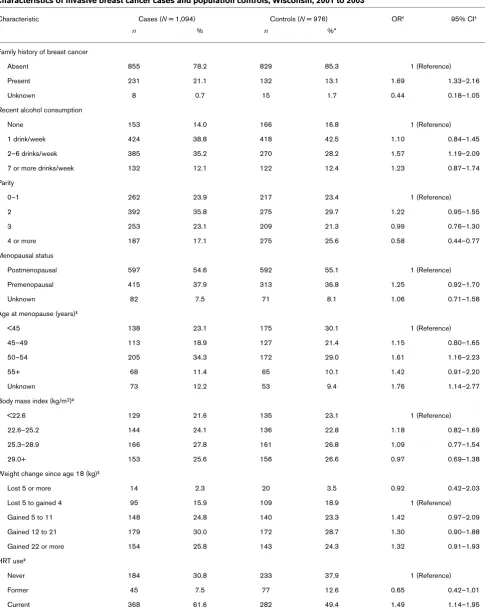
R359 Table 1
Characteristics of invasive breast cancer cases and population controls, Wisconsin, 2001 to 2003
Characteristic Cases (N = 1,094) Controls (N = 976) OR† 95% CI†
n % n %*
Family history of breast cancer
Absent 855 78.2 829 85.3 1 (Reference)
Present 231 21.1 132 13.1 1.69 1.33–2.16
Unknown 8 0.7 15 1.7 0.44 0.18–1.05
Recent alcohol consumption
None 153 14.0 166 16.8 1 (Reference)
1 drink/week 424 38.8 418 42.5 1.10 0.84–1.45
2–6 drinks/week 385 35.2 270 28.2 1.57 1.19–2.09
7 or more drinks/week 132 12.1 122 12.4 1.23 0.87–1.74
Parity
0–1 262 23.9 217 23.4 1 (Reference)
2 392 35.8 275 29.7 1.22 0.95–1.55
3 253 23.1 209 21.3 0.99 0.76–1.30
4 or more 187 17.1 275 25.6 0.58 0.44–0.77
Menopausal status
Postmenopausal 597 54.6 592 55.1 1 (Reference)
Premenopausal 415 37.9 313 36.8 1.25 0.92–1.70
Unknown 82 7.5 71 8.1 1.06 0.71–1.58
Age at menopause (years)‡
<45 138 23.1 175 30.1 1 (Reference)
45–49 113 18.9 127 21.4 1.15 0.80–1.65
50–54 205 34.3 172 29.0 1.61 1.16–2.23
55+ 68 11.4 65 10.1 1.42 0.91–2.20
Unknown 73 12.2 53 9.4 1.76 1.14–2.77
Body mass index (kg/m2)‡
<22.6 129 21.6 135 23.1 1 (Reference)
22.6–25.2 144 24.1 136 22.8 1.18 0.82–1.69
25.3–28.9 166 27.8 161 26.8 1.09 0.77–1.54
29.0+ 153 25.6 156 26.6 0.97 0.69–1.38
Weight change since age 18 (kg)‡
Lost 5 or more 14 2.3 20 3.5 0.92 0.42–2.03
Lost 5 to gained 4 95 15.9 109 18.9 1 (Reference)
Gained 5 to 11 148 24.8 140 23.3 1.42 0.97–2.09
Gained 12 to 21 179 30.0 172 28.7 1.30 0.90–1.88
Gained 22 or more 154 25.8 143 24.3 1.32 0.91–1.93
HRT use‡
Never 184 30.8 233 37.9 1 (Reference)
Former 45 7.5 77 12.6 0.65 0.42–1.01
Current 368 61.6 282 49.4 1.49 1.14–1.95
age at natural menopause for the control group (54 years for smokers and 56 years for nonsmokers). Menopausal status was considered to be unknown for women with hysterectomy without bilateral oophorectomy if their reference age was between 42 and 54 years (or 56 years for nonsmokers).
Adjusted odds ratios (ORs) and 95% confidence intervals (CIs) were obtained from multivariable conditional logistic regression models stratified on age. Covariates for the models were chosen by forward stepwise regression (Pentry = 0.20,
Premoval = 0.30). After forward stepwise regression had been performed, covariates remaining in the model were: family his-tory of breast cancer in a mother, daughter, or sister (yes, no, unknown), recent alcohol consumption (four categories), par-ity (four categories), menopausal status and age at meno-pause (four categories of age at menomeno-pause, premenopausal, unknown), hormone replacement therapy use (never, former, current), age at menarche (five categories of age, plus unknown), height at age 25 years (continuous), weight at age 18 years (continuous) and weight change since age 18 years (five categories). Covariates that did not remain in the final model included age at first birth, education, and income. Women with unknown recent alcohol consumption, hormone replacement therapy use, or height at age 25 years were not included in the analysis (4 cases, 15 controls), so that 1,094 cases and 976 controls remained in the analysis. Interactions with genotype in relation to breast cancer risk were evaluated by including a cross-product term in the regression model and measuring the change in the log-likelihood.
Results
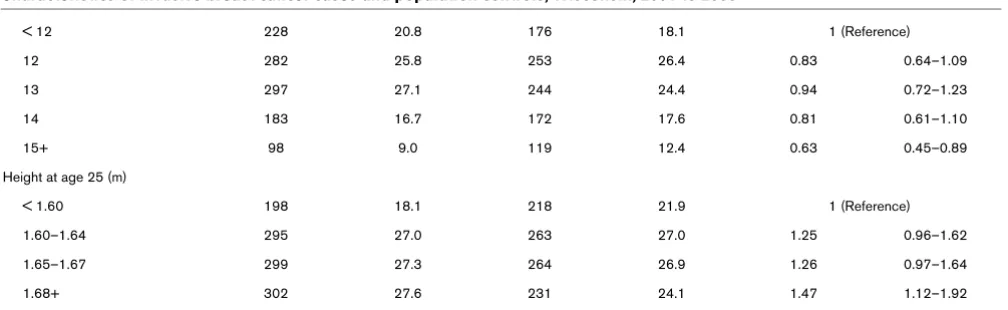
Breast cancer cases were more likely than controls to report a positive family history of breast cancer, to drink modest amounts of alcohol, to have lower parity, to report menopause at later ages, to have a younger age at menarche, and to report taller adult height (Table 1). Cases in this HER2 analysis were slightly less likely to have non-localized breast cancer at diag-nosis; 32% of cases who contributed buccal samples that
were included in the HER2 analysis had regional or distant-staged disease at diagnosis, whereas 37% of cases who refused to contribute a sample had non-localized disease (N = 356, P = 0.07 by Fisher's exact test). Participants in this anal-ysis were similar to nonparticipants in body mass index (P = 0.14 for cases, P = 0.29 for controls by t-test; N = 442 non-participant controls) and family history of breast cancer (P = 0.27 for cases, P = 0.36 for controls by Fisher's exact test), although control participants were somewhat older (55 versus 53 years, P = 0.02 by t-test) and more likely to have attended college than nonparticipant controls (56% versus 50%, P = 0.05 by Fisher's exact test). Among cases, participants in this analysis did not differ significantly from nonparticipants in age (54 versus 53 years, P = 0.73) but were slightly more likely to have attended college (57% versus 52%, P = 0.09).
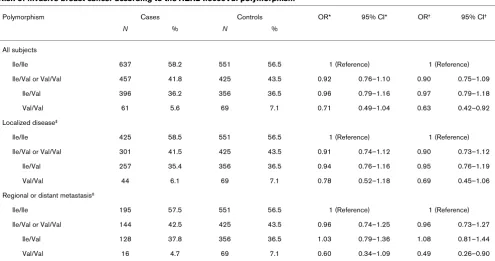
The Ile allele frequency was similar for cases and controls (cases 76.3%, 95% CI 74.5 to 78.1%; controls 74.7%, 95% CI 72.8 to 76.6%), and the Val allele frequency was about 25% (cases 23.7%, 95% CI 21.9 to 25.5%; controls 25.3%, 95% CI 23.4 to 27.2%); 58.2% of cases and 56.5% of con-trols were homozygous for the Ile allele, 36.2% of cases and 36.5% of controls were heterozygous, and 5.6% of cases and 7.1% of controls were homozygous for the Val allele (Table 2). Both the case group (P = 0.96) and the control group (P = 0.28) were consistent with Hardy-Weinberg equilibrium.
After multivariable adjustment, the combined Ile/Val and Val/ Val genotypes were not significantly associated with a risk of breast cancer relative to two copies of the Ile allele (OR 0.90, 95% CI 0.75 to 1.09; Table 2). The presence of two copies of the Val allele was associated with a 37% reduced risk of breast cancer compared with the Ile/Ile genotype (OR 0.63, 95% CI 0.42 to 0.92). Whereas this inverse association was suggested for cases diagnosed with localized breast cancer (OR 0.69, 95% CI 0.45 to 1.06), the OR was significantly reduced for cases diagnosed with regional or distant metasta-sis (OR 0.49, 95% CI 0.26 to 0.90).
< 12 228 20.8 176 18.1 1 (Reference)
12 282 25.8 253 26.4 0.83 0.64–1.09
13 297 27.1 244 24.4 0.94 0.72–1.23
14 183 16.7 172 17.6 0.81 0.61–1.10
15+ 98 9.0 119 12.4 0.63 0.45–0.89
Height at age 25 (m)
< 1.60 198 18.1 218 21.9 1 (Reference)
1.60–1.64 295 27.0 263 27.0 1.25 0.96–1.62
1.65–1.67 299 27.3 264 26.9 1.26 0.97–1.64
1.68+ 302 27.6 231 24.1 1.47 1.12–1.92
*Control percentages are age-adjusted to the distribution of cases; †logistic regression models conditional on age; ‡among postmenopausal women. CI, confidence interval; HRT, hormone replacement therapy; OR, odds ratio.
[image:4.612.56.560.110.265.2]R361
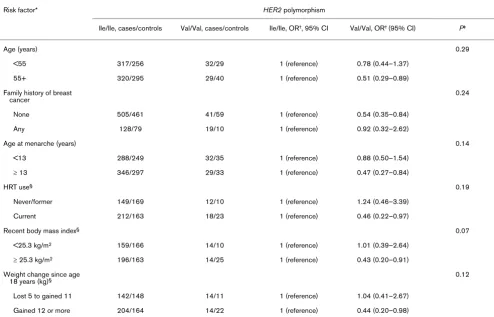
Although no interactions between the HER2 polymorphism and common risk factors were statistically significant, the inverse association with breast cancer risk was strongest in some subgroups (Table 3). In particular, ORs were signifi-cantly reduced for women at older ages (more than 55 years), without a family history of breast cancer, with older age at menarche, currently using postmenopausal hormones, with greater recent body mass index, and women with greater weight gain since age 18 years. In addition, we could not find evidence to support heterogeneity in the association between the HER2 Ile655Val polymorphism and breast cancer risk according to recent physical activity (P = 0.45), cigarette smoking status (P = 0.66), adult height (P = 0.78), recent alcohol intake (P = 0.83), parity (P = 0.81), or age at meno-pause (P = 0.41) (data not shown).
Discussion
We observed a 40 to 50% decreased risk of breast cancer associated with the inheritance of two HER2 valine alleles at codon 655 for some subgroups of women, including women older than 55 years of age and women without a family history of breast cancer. Three other studies – one study of Asian women [11] and two studies of women with European descent [4,5,10] – have also reported decreased risk esti-mates of breast cancer associated with inheritance of the
HER2 Val allele, although the estimates from these three other studies were not statistically significant.
Our null results for younger women and women with a positive family history of breast cancer do not concur with findings by Montgomery and colleagues [14], which showed a threefold increased risk among Australian women less than 40 years of age. Wang-Gohrke and Chang-Claude [6] reported a twofold increased risk among German Caucasians with a first-degree family history of breast cancer. Similarly, Millikan and col-leagues [8] reported a twofold increased risk of breast cancer associated with the Val/Val or Val/Ile genotype (compared with the Ile/Ile genotype) among women living in North Caro-lina (United States) who were both less than 45 years of age and reported a positive family history of breast cancer (OR 2.3, 95% CI 1.0 to 5.3). We were limited in our ability to examine the HER2 polymorphism in younger women because of small numbers. Only 4 controls and 12 cases in our study were 45 years of age or younger, reported a positive family history of breast cancer, and also had the Val/Val or Val/Ile genotype (OR 1.44, 95% CI 0.21 to 9.79, with Ile/Ile as the reference category; data not shown).
[image:5.612.58.553.109.370.2]The first study of the HER2 Ile655Val polymorphism in relation to breast cancer risk found a very high risk (OR 14.1, 95% CI 1.8 to 113.4) of the Val/Val versus Ile/Ile genotype [7]. In that study, the Val/Val genotype was detected in only 11 cases and 1 control. Risk estimates in subsequent studies have been much more modest, ranging from 0.3 to 2.8, and our results clearly fall within this (wide) range. Although risk estimates
Table 2
Risk of invasive breast cancer according to the HER2 Ile655Val polymorphism
Polymorphism Cases Controls OR* 95% CI* OR† 95% CI†
N % N %
All subjects
Ile/Ile 637 58.2 551 56.5 1 (Reference) 1 (Reference)
Ile/Val or Val/Val 457 41.8 425 43.5 0.92 0.76–1.10 0.90 0.75–1.09
Ile/Val 396 36.2 356 36.5 0.96 0.79–1.16 0.97 0.79–1.18
Val/Val 61 5.6 69 7.1 0.71 0.49–1.04 0.63 0.42–0.92
Localized disease‡
Ile/Ile 425 58.5 551 56.5 1 (Reference) 1 (Reference)
Ile/Val or Val/Val 301 41.5 425 43.5 0.91 0.74–1.12 0.90 0.73–1.12
Ile/Val 257 35.4 356 36.5 0.94 0.76–1.16 0.95 0.76–1.19
Val/Val 44 6.1 69 7.1 0.78 0.52–1.18 0.69 0.45–1.06
Regional or distant metastasis‡
Ile/Ile 195 57.5 551 56.5 1 (Reference) 1 (Reference)
Ile/Val or Val/Val 144 42.5 425 43.5 0.96 0.74–1.25 0.96 0.73–1.27
Ile/Val 128 37.8 356 36.5 1.03 0.79–1.36 1.08 0.81–1.44
Val/Val 16 4.7 69 7.1 0.60 0.34–1.09 0.49 0.26–0.90
have suggested both inverse and positive associations with breast cancer risk, prevalence of the Val/Val genotype has consistently been 3 to 8% in breast cancer cases and 3 to 7% in controls in women with European descent. Allele frequen-cies for case and control women corresponding to the Val/Val genotype in our study are very similar to frequencies reported in three other studies of white women in North Carolina, south-east England, and Germany – ranging from 23% to 25% – and slightly higher than frequencies for control women in two other studies conducted in Australia and New York City (18.7% and 16%, respectively) [5,6,8,13,14].
Most studies of the HER2 Ile655Val polymorphism have used a case-control design. Only one study population was a pro-spective cohort [12]. Two other published reports used a kin-cohort approach [15,16]. Using this novel design with a study of 1,560 volunteers living in Washington DC and Israel, Rutter and colleagues [16] reported that the HER2 valine allele might be associated with a twofold to eightfold increased risk of breast cancer. As with the Millikan study [8], these increased
risks were confined to younger women with a family history of breast cancer.
Many studies of the HER2 Ile655Val polymorphism had insuf-ficient power to evaluate interactions between the SNP and subgroups according to risk factors such as age and family history of breast cancer. Limited power is a common problem in studies of genetic polymorphisms. Sample size for only one other study was larger than the case and control enrollment in our own study [8]. Prevalence of the Ile655Val polymorphism clearly varies according to racial descent – it is rare or unobserved in Asian and African populations [9,17] – further limiting statistical power to evaluate the significance or rele-vance of this SNP in different populations. Stratified analysis of the HER2 Ile655Val genotype according to racial descent is warranted.
Potential limitations might have influenced our findings. Although participation in our study was excellent for a popula-tion-based case-control study, certain subgroups might have been under-represented because participation probably
Risk of invasive breast cancer according to the HER2 Ile655Val polymorphism and common risk factors
Risk factor* HER2 polymorphism
Ile/Ile, cases/controls Val/Val, cases/controls Ile/Ile, OR†, 95% CI Val/Val, OR† (95% CI) P‡
Age (years) 0.29
<55 317/256 32/29 1 (reference) 0.78 (0.44–1.37)
55+ 320/295 29/40 1 (reference) 0.51 (0.29–0.89)
Family history of breast cancer
0.24
None 505/461 41/59 1 (reference) 0.54 (0.35–0.84)
Any 128/79 19/10 1 (reference) 0.92 (0.32–2.62)
Age at menarche (years) 0.14
<13 288/249 32/35 1 (reference) 0.88 (0.50–1.54)
≥ 13 346/297 29/33 1 (reference) 0.47 (0.27–0.84)
HRT use§ 0.19
Never/former 149/169 12/10 1 (reference) 1.24 (0.46–3.39)
Current 212/163 18/23 1 (reference) 0.46 (0.22–0.97)
Recent body mass index§ 0.07
<25.3 kg/m2 159/166 14/10 1 (reference) 1.01 (0.39–2.64)
≥ 25.3 kg/m2 196/163 14/25 1 (reference) 0.43 (0.20–0.91)
Weight change since age
18 years (kg)§ 0.12
Lost 5 to gained 11 142/148 14/11 1 (reference) 1.04 (0.41–2.67)
Gained 12 or more 204/164 14/22 1 (reference) 0.44 (0.20–0.98)
[image:6.612.57.551.116.433.2]R363
declines with increasing age, decreasing attained education, and other factors. However, genetic inheritance with the
HER2 gene is probably not confounded with the variables that might influence a woman's participation in our epidemiologic study [18]. The distribution of the HER2 polymorphism in our case and control groups was consistent with Hardy-Weinberg equilibrium, which suggests that any genotyping errors were not substantial. Duplicate genotyping of 79 samples was also reassuring, achieving 100% concordance.
The mechanism through which this SNP might influence breast cancer risk is unclear, although studies in transgenic mice have demonstrated that activation or overexpression of the HER2 gene leads to the development of mammary adeno-carcinomas [19-21]. The transmembrane domain of the HER2 protein might be especially important, given the discovery of an activating mutation in codon 664 in the rat [22-25]. In humans, the Ile655Val amino acid substitution might alter the formation of active HER2 dimers, which would then alter the activity of the protein [26].
Conclusion
These data from our sample population of white women from the midwestern United States suggest that the Val/Val geno-type of the HER2 Ile655Val polymorphism is associated with a reduced risk of breast cancer in comparison with the Ile/Ile genotype for some women. Although the sample size in our study was relatively large compared with other studies pub-lished so far, the inconsistency of the findings across all stud-ies argues against a strong relation with breast cancer risk. Future large studies of the HER2 polymorphism might clarify this putative gene-environment interaction. However, given the promise of innovative and more comprehensive approaches to genomic and proteomic studies of breast cancer risk, focusing on this SNP without consideration of the role of other genes and polymorphisms may not be warranted.
Competing interests
The author(s) declare that they have no competing interests.
Authors' contributions
SEN performed the processing and genotyping of the samples and drafted the manuscript. MNG and ATD jointly conceived of and designed the study, obtained funding, and drafted the manuscript. JMH performed the statistical analysis and assisted with manuscript preparation. All authors read and approved the final manuscript.
Acknowledgements
We thank Dr Patrick Remington, Dr Henry Anderson, Dr Polly New-comb, and Dr Jane McElroy for support throughout this project; Laura Stephenson and the staff of the Wisconsin Cancer Reporting System; Katie Nelson, Jill Haag, Don Wigington, and Yu-Rong Wang for labora-tory assistance; Susan Carlson, Lisa Sieczkowski, Emogene Dods-worth, Betty Granda, Liz Mannering, Kathy Peck, Christina Kantor, and Jan Langdon for data collection; and Amy Sapp, Mary Pankratz, Jerry
Phipps, Jeff Pearson, and Lene Dotzler for technical support on this project. This project was supported in part by National Cancer Institute grants CA82004, CA28954, and CA77494, Department of Defense grant DAMD17-01-1-0459, and a gift from the Fraternal Order of Eagles Arie no. 1502 to the University of Wisconsin Comprehensive Cancer Center.
References
1. Cooke T, Reeves J, Lanigan A, Stanton P: HER2 as a prognostic and predictive marker for breast cancer. Ann Oncol 2001, 12(Suppl 1):S23-S28.
2. Ross JS, Fletcher JA, Linette GP, Stec J, Clark E, Ayers M, Sym-mans WF, Pusztai L, Bloom KJ: The Her-2/neu gene and protein in breast cancer 2003: biomarker and target of therapy. Oncol-ogist 2003, 8:307-325.
3. Papewalis J, Nikitin A, Rajewsky MF: G to A polymorphism at amino acid codon 655 of the human erbB-2/HER2 gene. Nucleic Acids Res 1991, 19:5452.
4. Zheng W, Kataoka N, Xie D, Young SR: Response: Re: Popula-tion-based, case-control study of HER2 genetic polymorphism and breast cancer risk.J Natl Cancer Inst 2001, 93:558-559. 5. Baxter SW, Campbell IG: Re: Population-based, case-control
study of HER2 genetic polymorphism and breast cancer risk.J Natl Cancer Inst 2001, 93:557-559.
6. Wang-Gohrke S, Chang-Claude J: Re: Population-based, case-control study of HER2 genetic polymorphism and breast can-cer risk.J Natl Cancer Inst 2001, 93:1657-1659.
7. Xie D, Shu XO, Deng Z, Wen WQ, Creek KE, Dai Q, Gao YT, Jin F, Zheng W: Population-based, case-control study of HER2 genetic polymorphism and breast cancer risk.J Natl Cancer Inst 2000, 92:412-417.
8. Millikan R, Eaton A, Worley K, Biscocho L, Hodgson E, Huang WY, Geradts J, Iacocca M, Cowan D, Conway K, et al.: HER2 codon 655 polymorphism and risk of breast cancer in African Ameri-cans and whites.Breast Cancer Res Treat 2003, 79:355-364. 9. Ameyaw MM, Thornton N, McLeod HL: Re: population-based,
case-control study of HER2 genetic polymorphism and breast cancer risk.J Natl Cancer Inst 2000, 92:1947.
10. Zheng W, Wen W-Q: Response: Re: Population-based, case-control study of HER2 genetic polymorphism and breast can-cer risk.J Natl Cancer Inst 2001, 93:1658-1659.
11. Hishida A, Hamajima N, Iwata H, Matsuo K, Hirose K, Emi N, Tajima K: Re: Population-based, case-control study of HER2 genetic polymorphism and breast cancer risk.J Natl Cancer Inst 2002, 94:1807-1808.
12. McKean-Cowdin R, Kolonel LN, Press MF, Pike MC, Henderson BE: Germ-line HER-2 variant and breast cancer risk by stage of disease.Cancer Res 2001, 61:8393-8394.
13. Keshava C, McCanlies EC, Keshava N, Wolff MS, Weston A: Dis-tribution of HER2(V655) genotypes in breast cancer cases and controls in the United States.Cancer Lett 2001, 173:37-41. 14. Montgomery KG, Gertig DM, Baxter SW, Milne RL, Dite GS,
McCredie MR, Giles GG, Southey MC, Hopper JL, Campbell IG: The HER2 I655V polymorphism and risk of breast cancer in women < age 40 years.Cancer Epidemiol Biomarkers Prev 2003, 12:1109-1111.
15. Hauptmann M, Sigurdson AJ, Chatterjee N, Rutter JL, Hill DA, Doody MM, Struewing JP: Re: Population-based, case-control study of HER2 genetic polymorphism and breast cancer risk.J Natl Cancer Inst 2003, 95:1251-1252.
16. Rutter JL, Chatterjee N, Wacholder S, Struewing J: The HER2 I655V polymorphism and breast cancer risk in Ashkenazim. Epidemiology 2003, 14:694-700.
17. Ameyaw MM, Tayeb M, Thornton N, Folayan G, Tariq M, Mobarek A, Evans DA, Ofori-Adjei D, McLead HL: Ethnic variation in the HER-2 codon 655 genetic polymorphism previously associ-ated with breast cancer.J Hum Genet 2002, 47:172-175. 18. Morimoto LM, White E, Newcomb PA: Selection bias in the
assessment of gene-environment interaction in case-control studies.Am J Epidemiol 2003, 158:259-263.
step induction of mammary adenocarcinoma in transgenic mice bearing the activated c-neu oncogene. Cell 1988, 54:105-115.
21. Bouchard L, Lamarre L, Tremblay PJ, Jolicoeur P: Stochastic appearance of mammary tumors in transgenic mice carrying the MMTV/c-neu oncogene.Cell 1989, 57:931-936.
22. Cao H, Bangalore L, Bormann BJ, Stern DF: A subdomain in the transmembrane domain is necessary for p185neu* activation. EMBO J 1992, 11:923-932.
23. Segatto O, King CR, Pierce JH, Di Fiore PP, Aaronson SA: Differ-ent structural alterations upregulate in vitro tyrosine kinase activity and transforming potency of the erbB-2 gene.Mol Cell Biol 1988, 8:5570-5574.
24. Sternberg MJ, Gullick WJ: Neu receptor dimerization.Nature 1989, 339:587.
25. Sternberg MJ, Gullick WJ: A sequence motif in the transmem-brane region of growth factor receptors with tyrosine kinase activity mediates dimerization.Protein Eng 1990, 3:245-248. 26. Fleishman SJ, Schlessinger J, Ben-Tal N: A putative