Structure models :: Vector Model
Model modelId :: Int chains :: Vector Chain 0..*
Chain chainId :: Char
residues :: Vector Residue
Residue resName :: String resSeq :: Int insCode :: Char Id :: Char
atoms :: Vector Atom
Atom atName :: String atSerial :: Int coord :: Vector3 bFactor :: Double occupancy :: Double element :: String segid :: String charge :: String hetatm :: Bool
0..* 0..* 0..*
hPDB – Haskell library for processing atomic
biomolecular structures in protein data bank
format
Gajda
T E C H N I C A L N O T E
Open Access
hPDB – Haskell library for processing atomic
biomolecular structures in protein data bank
format
Michał Jan Gajda
Abstract
Background: Protein DataBank file format is used for the majority of biomolecular data available today. Haskell is a lazy functional language that enjoys a high-level class-based type system, a growing collection of useful libraries and a reputation for efficiency.
Findings: I present a fast library for processing biomolecular data in the Protein Data Bank format. I present benchmarks indicating that this library is faster than other frequently used Protein Data Bank parsing programs. The proposed library also features a convenient iterator mechanism, and a simple API modeled after BioPython. Conclusion: I set a new standard for convenience and efficiency of Protein Data Bank processing in a Haskell library, and release it to open source.
Keywords: Structural biology, Protein DataBank file format, Parallel parser, Parser efficiency, Column-based parsing
Findings
Background
The Protein Data Bank (PDB) is a widely used data repository of atomic resolution, three-dimensional pro-tein and nucleic acid structures [1]. The rapid growth of structural data enables key endeavors to bring knowl-edge of genomes [2] to the structure and function of large biomolecules. In addition to sequence searches and genome assemblies, efficient and reliable structural data processing are one of the most important and common structural bioinformatics tasks [3].
Haskell is a modern, lazy, pure functional language [4,5] that enjoys fluid syntax, and clarity comparable to Python [6], as well as an efficient compiler that often gener-ates code approaching the speeds of industry standard languages such as C [7] or C++ [8].
Library interface
The library is a comprehensive solution for the parsing, rapid processing and writing of PDB files. I introduce the
Correspondence: [email protected]
NMR-2, Max Planck Institute for Biophysical Chemistry, Am Faßberg 11, Göttingen, Germany
library by providing examples and describing the underly-ing data structuresa, and finally, I present an evaluation of its efficiency.
Simple use example
A parser exampleb– a script that reads a structure con-taining multiple models and splits the structure into single models.
import Bio.PDB as PDB
import qualified Data.Vector as V
splitModels aStructure = map mkStructure . V.toList .
models $ aStructure
where mkStructure aModel = aStructure {models = V.singleton aModel}
Here, I extract a list of models from a Bio.PDB. Structure.Structurec object (V.toList . modelsd), and repackage each model as a separate structure. These structures are then written usingPDB.write.
I useData.Vector.Vectorto store all lists, including list of models, within the library.Data.Vector.Vector
GajdaBMC Research Notes2013,6:483 Page 2 of 6 http://www.biomedcentral.com/1756-0500/6/483
significantly reduces memory use after reading PDB files (see the benchmark section.)
To complete the program I include a command line interface:
import Data.ByteString.Char8 as BS
main = do [inpfname, outfname] <- getArgs Just structure <- PDB.parse inpfname
let splitted = zip [1..] $ splitModels structure forM splitted $ \(num, aStructure) ->
do let fname = outfname ++ show num ++ ".pdb" PDB.write aStructure fname
A simplePDB.parseaction returns a structure, to which I applysplitModelsand zip a list of results with model numbers. These results are used to generate names of out-put files, that are then written using the PDB.writeIO action.ByteStringis used rather than[Char]within the library for everything except file paths (FilePath), due to efficiency considerationse.
Data structure describing molecules
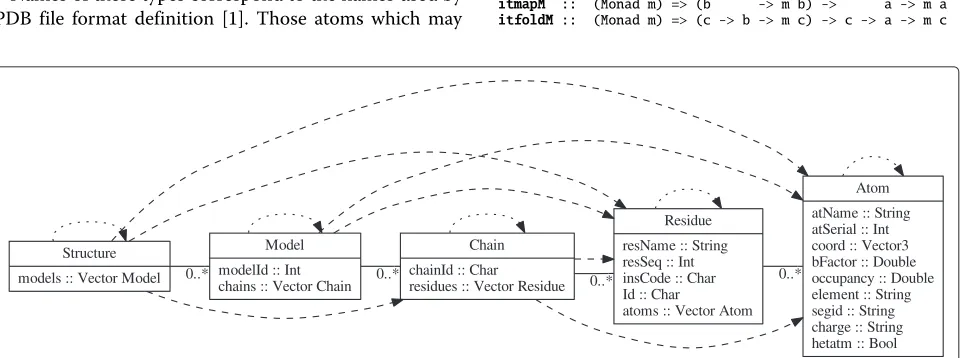
Different levels of collection hierarchy can be seen on Figure 1:
Structure that contains information about whole PDB entry;
Model that shows a single model of the molecule; Chain describing a single polymer chain;
Residue for a single monomer (aminoacid residue or nucleic acid base) within the polymer;
Atom for a single atom location.
Names of these types correspond to the names used by PDB file format definition [1]. Those atoms which may
have multiple locations within the model are described by several records, and those residues that have alternative mutants are also described by different records in accord with current practice of PDB [1].
Iterating withIterable
For the different types of objects, I devised a custom Iterable class that allows iteration over all objects of each of many types contained within an argument object. This class generalizes map, and foldriteration patterns used over lists, to hierarchical containers, and allows iter-ation over any type of contained objects, potentially in an indirect manner:
class Iterable a b where
itmap :: (b -> b) -> a -> a itfoldr :: (b -> c -> c) -> c -> a -> c itfoldl :: (c -> b -> c) -> c -> a -> c ...
Theitmapmethod allows mutation of any of the objects of a given typebcontained within typea. To compute a statistic over all contained objectsitfoldr oritfoldl can be used.
The classIterable a bmay thus be viewed as a gen-eralization of Functor,Foldable, and Traversableto
hierarchical collectionsthat may contain more than one class of objects. All Iterable instances, and method types are shown in Figure 1.
It is often convenient to use a monadic state when com-puting a statistic, or when renumbering residues. For this purpose, I use monadic variants of the following methods:
class Iterable a b where ...
itmapM :: (Monad m) => (b -> m b) -> a -> m a itfoldM :: (Monad m) => (c -> b -> m c) -> c -> a -> m c
Structure
models :: Vector Model
Model
modelId :: Int chains :: Vector Chain 0..*
Chain
chainId :: Char residues :: Vector Residue
Residue
resName :: String resSeq :: Int insCode :: Char Id :: Char
atoms :: Vector Atom
Atom
atName :: String atSerial :: Int coord :: Vector3 bFactor :: Double occupancy :: Double element :: String segid :: String charge :: String hetatm :: Bool 0..*
[image:3.595.59.539.505.684.2]0..* 0..*
For efficiency I introduce a rapid itlength method, and a strictitfoldlvariant:
itfoldl’ :: (c -> b -> c) -> c -> a -> c itlength :: b -> a -> Int
Note thatitlengthis the only method using adummy
first argument to indicate the type of contained object to be counted. As all other methods use a function argument, automatic type inference finds the proper class instance without requiring a type declaration, as shown in the examples belowf.
Structure analysis example
In the following examples I skip the command line interface, assuming that all functions input a parsed Structureobject.
The most convenient interface for a complex cascade of container types within a PDB structure is composition based onfold, andmapanalogs.
To compute the center of mass of allAtomobjects con-tained within a structure, I use a two pass algorithm:
center :: Structure -> Vector3 center s = avgVec
where
sumv = itfoldl’ addCoord 0 (s :: Structure) n = fromIntegral $ numAtoms s
addCoord v (Atom { coord = c }) = v+c avgVec = (1/realToFrac n) *| sumv
Here I useitfoldl’instantiated to the following type, automatically inferred from the types ofaddCoordands:
itfoldl’ :: (Vector3 -> Atom -> Vector3) -> Vector3 -> Structure -> Vector3
I will generalize this type to other types within the struc-ture, when showing classIterable. This generalization allows a function to have a type showing that it can take any object that containsAtomobjects within:
center :: (Iterable a Atom) => a -> Vector3
Then, I can subtract the computed center from all atomic coordinates with theitmapmethod, analogous to mapfor lists. In this example, mappingPDB.Atomobjects within aPDB.Structureg, is used:
shift v = itmap(\at -> at { coord= coord at - v })
This use ofitmap has an instantiated type, that is auto-matically inferred from its first argument:
itmap :: (Atom -> Atom) -> Structure -> Structure
Stateful modification
Simpleitmap, anditfoldl’methods are not sufficient to perform a complex stateful operation such as renum-bering residues starting from 1.
In this case, I use monadic analogs, such asitmapMh:
renumberChain =itmapM renumberAtom (ch :: Chain) where
renumberAtom :: Atom -> CounterM Atom renumberAtom elt = do v <- get
modify (+1)
return $ elt {atSerial = v }
Such a code requires separate application to each chain, because residue numbering begins anew with each chain:
renumberResidues = itmap (runCounterM . renumberChain)
Assigning consecutive serial numbers is handled by a state monad [9], as described below:
import Control.Monad.State(State, modify, get, RunState)
type CounterM a = State Int a
runCounterM :: CounterM a ->
a runCounterM = fst . (flip runState) 1
Renumbering atoms within each model is more involved, because the PDB data format [10] mandates that TERrecordsiare counted along with the atoms, and these records do not have direct representation inhPDB data structures.
renumberAtoms =itmap (\m -> runCounterM $ itmapM forEachChain (m :: Model)) where
forEachChain ::Chain -> CounterM Chain
forEachChain ch = do newCh <- itmapM forEachAtom ch modify (+1) -- for TER return newCh
forEachAtom ::Atom -> CounterM Atom forEachAtom at = do v <- get
modify (+1)
return $ at {atSerial = v }
In this examplerenumberAtomsmay be labelled with the monomorphic (and useful) type:
renumberAtoms :: Structure -> Structure
Although the automatically inferred type allows this func-tion to act not only on the entireStructurebut also on any singleModelthat contains theChainobjects.
Example applications
GajdaBMC Research Notes2013,6:483 Page 4 of 6 http://www.biomedcentral.com/1756-0500/6/483
Table 1 Total CPU time in seconds
PDB entry hPDB par. hPDB seq. BioJava1 BioRuby BioPython PyMol RasMol Jmol1
1CRN ≥0.01 ≥0.01 0.38 0.03 0.31 0.06 0.06 1.96
3JYV 0.27 0.26 1.31 0.89 1.26 0.28 0.28 3.52
1HTQ 5.08 4.63 6.66 16.52 23.41 3.94 4.90 25.82
1Jmol and BioJava use multiple threads, thus completion time is closer to half the CPU time than to the sum of CPU time and I/O time (as indicated in Table 3).
and the second longest cross-sectional dimension corre-sponds to the X axis (CanonicalAxesinhPDB-examples package), normalizing PDB files for use by applications restrictive with respect to file format (CleanPDB), and examining the sequence of main polymer chain or geo-metric parameters of small-angle scattering shape recon-structions (Rgexample) with minimal code.
Results and discussion Benchmarks
For the benchmark, hPDB was compiled in single-threaded and multi-single-threaded mode by GHC v7.6.2.
I benchmarked three other PDB parser libraries
BioJava[11] (v3.0.5-2), BioRuby [12] (v1.4.2 using stan-dard Ruby VM v1.9.3p194), and BioPython [13] (v1.60, using standard CPython 2.7.4 [6] implementation). I include time results for common molecular visualization programs (as these are required to show a complete struc-ture quickly): RasMol [14] (v2.7.5.2), known for a long history of optimization and written in C; PyMol [15] (v1.5.0.1), written in both C and Python; andJmol, written in Java [16] (v12.2.32). Each parser’s CPU time is reported in Table 1.
In the case of libraries, I used operating system calls or ps program to determine the upper bounds of memory used in Table 2 (including purely virtual allocations).
Haskell memory is reported for the current heap, in addition to the target space for copying garbage collector [17].
Note thatJmolandBioJavamay both use more than one thread, which significantly reduces time-to-completion when using a multicore machine as reported in Table 3.
The benchmarks were measured on a quad-core Intel® Core™ i7 2600 processor running at 3.4 GHzj, 16 GB of 1333 MHz memory, and a SAMSUNG 470 Series solid-state disk. The system was running a 64-bit Ubuntu 13.04 with a standard Linux kernel package 3.8.0-31.
WhilehPDB may be expected to stand out in runtime comparisons to the bytecode-based dynamic language librariesBioRubyandBioPython, surprisingly, serialhPDB
is faster than other parsers in compiled languages, with the exception ofPyMol. The parallel version of thehPDB
parser may be the fastest PDB parser on machines with at least 4 independent processing cores.
It was noted that memory use, even with a neces-sary overhead (2×) of Haskell’s copying garbage collector, compared favorably with memory used by other libraries. Parsing the entire PDB archive (as of January 6th 2013, compressed, 16 GB) takes approximately 14.5 minutes using 4 cores in parallel, with total CPU and I/O time reported to be 50 minutes. No crashes are reported, but 8k lines (mostly meta data) are reported as erroneousk because they are inconsistent with strict interpretation of PDB format [10].
Benchmarks show that in this specific application, the mildly optimized Haskell parser may provide speeds com-petitive with compiled languages such as Java and even lower level explicitly allocated languages such as C. Mem-ory usage is also less than any other aforementioned library.
There is another Haskell library parsing PDB files on Hackage [18] calledPDBtools, but it was not able to fully parse any of our example files because it does not handle errors in thereadroutine.
Conclusions
I have shown clear uses of a nice high-level interface for the analysis and modification of molecule descriptions encoded in the PDB file format [10].
While there are many similar parsers written in other languages, this is the first one I am aware of in Haskell, that parses entire coordinate contents within the PDB repository. It is also efficient both in runtime and memory use, and thus, the preferable choice for sophisticated, high volume analyses.
Table 2 Total allocated memory in megabytes
PDB entry Input size hPDB par. hPDB seq. BioRuby BioJava BioPython
1CRN 49 kB 3 1 8 240 206
3JYV 5 41 35 85 302 324
[image:5.595.60.543.675.735.2]Table 3 Completion time after parsing in seconds
PDB entry hPDB par. hPDB seq. BioJava BioRuby BioPython PyMol2 RasMol2 Jmol2
1CRN ≥0.01 ≥0.01 0.23 0.04 0.32 0.14 0.77 2.26
3JYV 0.09 0.28 0.71 0.94 1.43 0.38 0.86 2.81
1HTQ 1.39 4.79 3.24 17.14 24.01 4.22 5.73 12.86
2Includes the time needed for startup and closing the window.
While future work on analysis API extensions would likely further improve utility of this library, I believe that it is ready for production use, as indicated by the many code examples.
I conclude that in this specific application, Haskell has both ease of use and abstraction of high-level dynamic languages, along with a speed competitive with lower level explicit-allocation languages such as C.
Availability and requirements
Source code is available as Additional files 1, 2 and 3 attached to the manuscript or from GitHub repository https://github.com/mgajda/hPDB, and released on Hackage ashPDB. It has been tested with several GHC versions including 7.0.3, 7.2.2, 7.4.2, and the recently released 7.6.2. It has few dependencies, and all are available from Hackage [18].
Project name:hPDB Project home page:
http://hackage.haskell.org/package/hPDB Source repositories:
http://github.com/mgajda/hPDB
http://github.com/mgajda/hPDB-examples http://github.com/mgajda/iterable
Operating system(s):Platform independent Programming language:Haskell
Libraries:Haskell Platform, AC-Vector Other requirements:GHC≥ 7.0 License:BSD
Endnotes
a While this article contains only one figure showing
the most important types for the API, two additional diagrams elucidating the library’s internal structure are available in the Additional files 4 and 5.
b The command line interface for this function may be
found inexamples/SplitModels.hsin the
hPDB-examplespackage.
c Names defined in the hPDB package are emphasized
inboldfont for ease of reading. Other modules are the standard collection interfaceData.Vectorfrom thevectorpackage, the 3D vector interface
Data.Vector.V3from theAC-Vectorpackage, and Data.ByteString.Char8from thebytestringpackage.
d Note the use ofData.Vectorfor space efficient
storage of data.
e Most records in the PDB file format are ASCII-only;
therefore, Unicode encoding is not necessary. As non-ASCII characters can only occur in comments and metadata, they may be decoded after parsing.
fType parameterbin declaration foritlengthis a
dummy type argumentto specify the contained object types to be counted.
gThis declaration is less polymorphic than the actual
itmaptype, as demonstrated in the following section aboutIterableclass description.
h Extended examples are present in theCleanPDB.hs
example attached to the library.
iIndicating termination of polymer chain, rather than
an atom.
j With overclocking switched off.
kIt is known that, after six different official releases of
file format descriptions and many data remediation efforts, there is a small amount of data that does not entirely conform to the PDB archive format.
Additional files
Additional file 1: Source package archive.hPDB.tgzcontains full source distribution of the hPDB package. It is also available through the Hackage database at: http://hackage.haskell.org/package/hPDB. Additional file 2: Source package archive.hPDB-examples.tgz contains full source distribution of hPDB examples. It is also available through Hackage database at http://hackage.haskell.org/package/hPDB-examples.
Additional file 3: Source package archive.iterable.tgzcontains library definition ofIterableclass, and macros helping in its instantiation written in Template Haskell [20]. It is also available through Hackage database at: http://hackage.haskell.org/package/iterable.
Additional file 4: Data type hierarchy.Data type hierarchy showing all accessible types and data flow during parsing and printing. Hidden types are marked withdottedellipses. Data flow is shown withdashedlines. Types marked withsolid ellipsesare part of API, andsolid linesindicate direct type containment.
Additional file 5: Module diagram.graphmod.svgcontains a module diagram illustrating structure of hPDB.
Abbreviations
API: Application Programming Interface(function and data declarations); ASCII: American Standard Code of Information Interchange(7-bit text encoding); CPU: Central Processing Unit(processor); I/O: Input/Output; PDB: Protein DataBank (repository of biomolecular structural data); GHC: Glasgow Haskell Compiler; GWDG: Gesellschaft für Wissenschaftliche Datenverarbeitung mbH Göttingen – Göttingen Society for Scientific Data Processing.
Competing interests
GajdaBMC Research Notes2013,6:483 Page 6 of 6 http://www.biomedcentral.com/1756-0500/6/483
Acknowledgements
The author thanks his former PhD supervisor for fostering his interest in the field of Bioinformatics and for his insight into the deficiencies of many currently available bioinformatics tools. All diagrams were created with Graphviz, an open source graph layout and drawing tool [19]. The author thanks American Journal Experts for proofreading the manuscript.
Received: 6 June 2013 Accepted: 21 November 2013 Published: 23 November 2013
References
1. Berman HM, Westbrook J, Feng Z, Gilliland G, Bhat TN, Weissig H, Shindyalov IN, Bourne PE:The protein data bank.Nucleic Acids Res2000, 28:235–242.
2. Benson DA, Karsch-Mizrachi I, Lipman DJ, Ostell J, Sayers EW:GenBank. Nucleic Acids Res2011,39(suppl 1):D32–D37. [http://nar.oxfordjournals. org/content/39/suppl_1/D32.abstract]
3. Tramontano A:Introduction to Bioinformatics2006. http://www. amazon.com/Introduction-Bioinformatics-Chapman-Mathematical-Computational/dp/1584885696
4. Peyton Jones S (Ed):The Haskell 98 Language and Libraries: The Revised Report.J Funct Program2003,13:0–255. [http://www.haskell. org/definition/]
5. Haskell 2010 language report2010. [http://www.haskell.org/ onlinereport/haskell2010/]
6. Van Rossum G:Scripting the web with python.World Wide Web J1997, 2(2):97–120. [http://dl.acm.org/citation.cfm?id=275062.275072] 7. International Standards Organization:ISO/IEC 9899:2011 Information
technology — Programming languages — C2011. [http://www.iso.org/ iso/home/store/catalogue_tc/catalogue_detail.htm?csnumber=57853] 8. International Standards Organization:ISO/IEC 14882:2011 Information
technology — Programming languages — C++2012. [http://www.iso. org/iso/home/store/catalogue_tc/catalogue_detail.htm?csnumber= 50372]
9. Jones MP:Functional programming with overloading and
higher-order polymorphism.InAdvanced Functional Programming, First International Spring School on Advanced Functional Programming Techniques-Tutorial Text,London, UK , UK: Springer-Verlag; 1995:97–136. [http://dx.doi.org/10.1093%2Fbioinformatics%2Fbtn397]
10. Callaway J, Cummings M, Deroski B, Esposito P, Forman A, Langdon P, Libeson M, McCarthy J, Sikora J, Xue D, Abola E, Bernstein F, Manning N, Shea R, Stampf D, Sussman J:PDB File format – contents guide version 3.30.The Worldwide Protein Data Bank 2012. [http://www.wwpdb.org/ docs.html]
11. Holland RCG, Down TA, Pocock MR, Prlic A, Huen D, James K, Foisy S, Dräger A, Yates A, Heuer ML, Schreiber MJ:BioJava: an open-source framework for bioinformatics.Bioinformatics2008,24(18):2096–2097. [http://dblp.uni-trier.de/db/journals/bioinformatics/bioinformatics24. html#HollandDPPHJFDYHS08]
12. Goto N, Prins P, Nakao M, Bonnal R, Aerts J, Katayama T:BioRuby: bioinformatics software for the Ruby programming language. Bioinformatics2010,26(20):2617–2619. [http://bioinformatics. oxfordjournals.org/content/26/20/2617.abstract]
13. Hamelryck T, Manderick B:PDB file parser and structure class implemented in Python.Bioinformatics2003,19(17):2308–2310. [http://bioinformatics.oxfordjournals.org/content/19/17/2308.abstract] 14. Sayle RA, Milner-White JE:RASMOL: biomolecular graphics for all.
Trends Biochem Sci1995,20(9):374–376. [http://dx.doi.org/10.1016/ S0968-0004(00)89080-5]
15. Schrödinger LLC:The PyMOL molecular graphics system, version 1.3r12010. [http://www.pymol.org/citing]
16. Jmol: an open-source Java viewer for chemical structures in 3D. [http://www.jmol.org/]
17. Marlow S, Harris T, James RP, Peyton Jones S:Parallel
generational-copying garbage collection with a block-structured heap.InProceedings of the 7th international symposium on Memory management,ISMM ’08. New York, NY, USA: ACM; 2008:11–20. [http://research.microsoft.com/en-us/um/people/simonpj/papers/ parallel-gc/]
18. Jones I, Jones SP, Marlow S, Wallace M, Patterson R:The Haskell Cabal – a common architecture for building applications and tools 2005. [http://www.haskell.org/cabal/proposal/index.html]
19. Ellson J, Gansner ER, Koutsofios E, North SC, Woodhull G:Graphviz and Dynagraph – static and dynamic graph drawing tools.InGRAPH DRAWING SOFTWARE. Heidelberg: Springer-Verlag; 2003:127–148. 20. Sheard T, Jones SP:Template meta-programming for Haskell.SIGPLAN
Not2002,37(12):60–75. [http://research.microsoft.com/en-us/um/ people/simonpj/papers/meta-haskell/]
doi:10.1186/1756-0500-6-483
Cite this article as:Gajda:hPDB – Haskell library for processing atomic biomolecular structures in protein data bank format.BMC Research Notes
20136:483.
Submit your next manuscript to BioMed Central and take full advantage of:
• Convenient online submission
• Thorough peer review
• No space constraints or color figure charges
• Immediate publication on acceptance
• Inclusion in PubMed, CAS, Scopus and Google Scholar
• Research which is freely available for redistribution