Abstract: Yield estimation of pomegranate is an important aspect for planning many tasks such as storing, packaging and exporting. To measure the quantity of fruits on-tree manually is quite difficult and time consuming. The image processing based automated system is an influential technical competence to measure the quantity of pomegranate fruits. This paper consists two approach to detect and count pomegranate fruit using on-tree images i.e. first approach is based on color thresholding with circular Hough transform (CHT) & second approach based on K-means clustering with Circular Hough transform (CHT) and the performance of both method is evaluated by correlation co-efficient R2 i.e. 0.6888 & 0.7652 respectively.
Index Terms: Circle Hough transform, color thresholding, fruit counting, fruit detection, K-means clustering, pomegranate.
I. INTRODUCTION
Pomegranate (Punica granatum) is grown in tropical and subtropical regions of the world [1]. The total area under cultivation of pomegranate in India is 107.00 thousand ha and production is around 743.00 thousand tons [2]. Maharashtra is the leading producer of pomegranate followed by Karnataka, Andhra Pradesh, Gujarat and Tamil Nadu. Ganesh, Bhagwa, Ruby, Arakta and Mridula are the different varieties of pomegranates produced in Maharashtra. In India, pomegranate is commercially cultivated in Solapur, Sangli, Nasik, Ahmednagar, Pune, Dhule, Aurangabad, Satara, Osmanabad and Latur districts of Maharashtra; Bijapur, Belgaum and Bagalkot districts of Karnataka and to a smaller extent in Gujarat, Andhra Pradesh and Tamil Nadu [3]. Yield prediction in today’s environment is one of the onerous and demanding technical task to do through an automated system. Yield estimates provide valuable information about the quantity of fruits to be harvested. Manual counting of pomegranate fruit from tree is done in open eye by human is time consuming and cost effective.
Revised Manuscript Received on December 22, 2018.
Santi Kumari Behera is working as Assistant Professor in the Dept. of
Computer Science and Engineering, VSSUT, Burla.
(Email:[email protected])
Abhishek Pattanaik is an MTech student in Communication System
Engineering, SUIIT, Sambalpur University. (Email:
Amiya Kumar Rath is working as Professor and Head of Department Computer Science and Engineering, Veer Surendra Sai University of Technology, Burla. (email:[email protected]).
Dr. Nalini Kanta Barpanda is working as Reader in the Dept. of Electronics, Sambalpur University.
(Email: [email protected]).
Prabira Kumar Sethy is working as Assistant Professor in the Dept. of Electronics in Sambalpur University. (Email: [email protected]).
An intelligent segmentation and automated counting algorithm can estimate the number of pomegranate fruits using on-tree images based on image processing techniques by simulating through MATLAB 2016a. In this paper we propose two methodology to detect and count pomegranate fruits on-tree i.e. first is based on color thresholding with CHT and second one is K-means clustering with CHT. The main challenge in this research is proper counting of each fruit because (1) the fruit is occluded fully or partially by other parts of tree, (2) fruits appeared in blob. In recent years, many scholars including our research team have studied the algorithm/ methodology of detecting and counting of on-tree fruits based on image analysis, which is a hot research focus in recent years [4]-[11].
II. RELATEDWORK
Zeeshan Malik et al. [4] proposed a strategy to appraise citrus organic product yield from on-tree pictures. They use K-implies division for acknowledgment of natural product. The informational index contains 83 tree pictures of the citrus natural product. Right off the bat K-implies division calculation is utilized in on-tree pictures, at that point preprocess steps are performed. By utilizing a numerical connection, a picture is smoothened. The second step included the decrease of shadow, it limits shadow by changing over RGB into l*a*b picture. At that point expanding glow of picture results in diminished shadow impact. After that covering of organic product is isolated by following advances like convolution of the picture by change veil, at that point it's changed into a dim scale, at last edge is connected on the picture. K-implies calculation for an orange division is connected, with the goal that it decreases blunder work by iteratively perceiving bunches. In the wake of bunching, the limit is connected to extricate oranges from tree pictures. At finally solid natural product district is recognized to count. In this way, by a leading investigation by three datasets, it results in 91.3% of precision and 0.99 of R2 (coefficient of assurance) esteem. Cihan Akin et al. [5] proposed a technique for recognition and check no. of on tree pomegranate natural products by utilizing the close picture. Henceforth powerful identification technique will likewise need to join different properties of pomegranate than simply shading. The information contains a sum of 100 casings shading pictures in various climate conditions. In the first strategy, the items are extricated from foundation,
Yield Estimation of Pomegranate Using Image
Processing Techniques
at that point sub picture settings of pomegranate were assembled and RGB estimations of each class were obtained. RGB hues were changed into 2D point of view by applying to same lists or distinctive one, for example, HIS file, proportion list, standardization file, and adjusted contrast file is utilized. The pictures are then changed over into high contrast so as to get ready for limit following. On the off chance that the pixel or district doesn't have a place with the objects of intrigue are expelled. At that point shade of white/dark locales were changed over to inverse hues, assuming no. of pixels are not as much as picture reliable edge esteem. In this technique a versatile edge esteem connected to pictures as indicated by lightning condition. In this way, here 20 casings of test pictures picked arbitrarily from 100 pictures. No. of organic products identified by eye from physically tallied from source pictures and most extreme mistake rate registered as 91%. H.N. Patel et al. [6] proposed a programmed division and yield computation of natural product dependent on shape investigation. Here first info picture is connected to preprocessing venture of separating. Gaussian-low pass channel connected for averaging out varieties in lighting conditions. At that point, it's changed over from RGB shading space into l*a*b space. The distinguished pixel has spoken to by 1 &remaining by 0. After that morphological activity is done to enhance the parallel picture. Organic products were distinguished by including enhanced parallel cover for locale naming of pixels. Sobel administrator was connected than for each named locale. As the shape fundamentally for all organic products i.e. orange, pomegranate is round, so circle fitted calculation are utilized. The calculation comprises of 9 stages i.e. preprocessing of info picture, at that point division of organic product picture into 4 locales, at that point natural product picture is separated by utilizing MATLAB, after that sifted pictures changed over to twofold shape then morphological task utilized for enhancing parallel picture, at that point double commotion evacuated picture was marked to remove organic products. After that yield count is finished. At that point for each named area, recognized edge focuses utilized for a round shape. Ultimately yield is being determined by shape investigation strategy. Here being veil picture utilized iteratively for 3 tasks i.e. district marking, edge recognition, and fitting circle. In the wake of taking 100 pictures of various natural products and tested it 98 pictures were distinguished by calculation; precision is discovered to be 98%. Ankita Vaidya and Anant Bagode [7] presents PC vision and machine learning strategies for on-tree natural product recognition. Checking and arranging. On-tree pictures were taken from an online informational collection, which is in size of 852*480 in JPEG arrange by catching it with the help of CCD (Charge Couple Device). At that point, the picture is changed into reasonable shape and set of standards connected to the prepared &tested picture called picture handling. Dark scale picture preparing used to distinguish natural product on pictures. At that point in picture division part cutting of foundation, including and remove highlight examination of picture centered at detachment, input territory is finished. In this division, K-implies calculation used to section input picture. At that point in polygon fitting procedure overlying of circles is
performed to get required limits, of natural product locale. After that calculation is performed for location and tallying of natural products, by taking 'N' for no. of pictures 'W' as casing width,'H' as tallness 'LB' as lower bound and UB as upper bound. Along these lines, this created technique doesn't require any expansion or decline in edge esteems for each picture and this innovation will be extremely appreciative to ranchers. Ketki Tarale, Prof. Anil Bavaskar [8] proposed a strategy to distinguish organic products on tree utilizing picture handling method. In the first step, the test of a picture is first gathered which will choose no. of natural products on tree. At that point in the preprocessing part, it smothers undesirable contortions or upgrades some picture highlights. Two methodologies utilized for picture preparing are picture improvement and clamor evacuation. Picture upgrade is improved the situation enhancing the permeability of picture. For expelling commotion stage covering is utilized. After that in picture division part, parcel technique is utilized to part the information focuses into K-segment. At that point in surface component part, vigilant edge identification calculation is utilized for distinguishing brokenness of picture. After that in the morphological task, it forms parallel pictures which make another double picture in which pixel has non-zero esteem. Along these lines, picture handling dependent on MATLAB is adequately used to decide check of various items. After effective experimentation programmed checking of organic products utilizing picture preparing is done and along these lines, a separation between great foods grown from the ground natural products can be effortlessly discovered. A.Saranya,Dr. N.Sujatha [9] present a strategy to assess citrus organic product yield from tree pictures. The proposed framework comprises of bi-cubic introduction which utilizes weighted normal of 4 interpreted pixel esteems for each yield pixel esteems. This calculation comprises of steps like initially zero stage framework is input and changed over it by 0.5 pixels to right at that point yield network is made by supplanting each info pixel esteem. At that point, HSV (Hue, Saturation and Value) is decoupled from shading data from the picture. At that point in division part, Otsu strategy is the best technique for picture thresholding. It's a programmed limit choice based territorial division technique. Hereby performing experimentation on 3 unique informational indexes precision is discovered to be 95%. Xiao Changy et al. [10] proposed a machine vision to recognize no. of apple on tree. Initially, the organic product is caught through a Canon 400 D camera with goals 3888*2592. At that point, a calculation is utilized to distinguish and depend on-tree pictures of apple. Here RGB shading highlight calculation is utilized for examined and investigated. Considering intricacy of shading dispersion of various targets NN displaying was chosen to distinguish and dispense with apples and foundation at the same time. At that point a BP neural system of 3-layer structure with 6 hubs was manufactured and 3 autonomous layers i.e. R, G&B utilized as information highlights for info layer. At that point fit as a fiddle identifying model Circle Hough change was proposed to distinguish apple from tree
flawed examples of articles. Be that as it may, before utilizing Circle Hough change, edge discovery ought to be executed first. After that, a calculation dependent on apple identifying and checking is used. It comprises of 3 stages first the pictures of just apple pixel is acquired than in the second step, apple edge pictures get. Finally, it is executed by Circle Hough change calculation. In the wake of applying the experimentation, it is realized that this calculation had a solid strength in managing apple acknowledgment issue. S.Poorani et al. [11] proposed to decrease the work in natural product picking by utilizing the picture bunching calculation in a machine vision framework. Right off the bat in the division where picture is isolated into constituent districts. The calculation of division depends on 2 properties of shading, dim qualities or surface, brokenness and closeness. At that point in K-implies bunching a gathering of information focuses is apportioned into a little no. of bunches whose objective is to relegate a group to every datum point. After the grouping at that point natural product distinguishing proof is finished by utilizing Pom=imread(poma.png) for experimentation reproduction condition MATLAB was utilized. In this way, after the experimentation this acknowledgment approach connected in programmed picking gadgets. Adel Bakshipour et al. [12] proposed an automated gathering framework to perceive pomegranate fruits position on tree. A total of 110 images of two imaging condition were collected i.e. 55 of proper lighting and 50 of shadow/ cloudy lighting condition. Two CCD cameras with comparable particulars used to take pictures of pomegranate. At that point in picture investigation an appropriate calculation created to isolate pomegranate natural product from different articles. At that point RGB shading space is changed over into YCbCr by algorithmic condition. Red shading distinction prompts most valuable outcomes for the situation. By performing calculation it’s realized that light or shadow doesn't influence division results. The red shading contrast power histogram created to acquire ideal limit esteem. At that point resulting widening and disintegration activities were performed to overlook little protests misclassified as natural products. In the wake of expelling every undesired protest and filling undesirable loud openings inside organic products. After that calculation is designed to the point that it takes care of the issue of recognizing more than 1 natural product in 1 picture. The last advance is to figure the separation of organic product from watcher utilizing straightforward stereo vision approach geometric recipes. In the wake of directing the test by utilizing the calculation 3.7% of organic product tests were expelled from picture and area of natural products were not as expansive separation from cameras. Thus, remove estimation mistake of calculation was under 2.4 cm. which is in charge of picking arm of robot. Neetu Meena et al. [13] present a programmed recognition, checking and yield estimation calculation for natural products on the premise of shading and shape examination. Initially, picture preparing an examination is being performed utilizing MATLAB R 2013a programming. In picture catching some field, pictures were taken from some not the same as the web. A Gaussian channel connected for clamor evacuating, at that point RGB shading space is changed over to l*a*b space. After that utilizing Otsu strategy
twofold picture is being created. In area naming district of natural product is being removed, for distinguishing edges of named organic product Sobel administrator is utilized. At that point circle fitting is finished. After that finally, yield estimation is completed by b tree's sectional pictures and new tallying calculation. After effective experimentation, the exactness of various natural product is discovered like 88.73% for apple, 93.93% for orange, 81.36% for pomegranate and normal yield estimation mistake is 16.3%. S.K.Behera et al. [14] proposed an algorithm to detect and count on-tree apple using L*a*b color thresholding with CHT and achieved 97.7% accuracy. The author [15] also reported an approach to detect, categorize according to maturity & count on-tree five variety of oval shape fruits.
III. SUGGESTEDAPPROACH
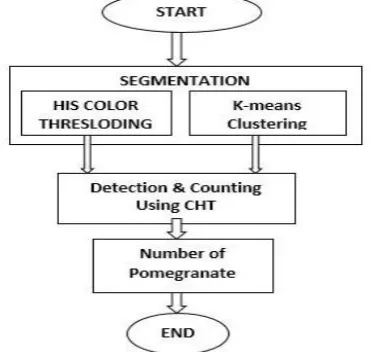
In this section we describe the complete pipeline for detection and counting of pomegranate fruits on-tree in two approach of segmentation i.e. first approach of segmentation is color thresholding where we use HIS color model and the second approach of segmentation is K-means clustering. After segmentation in both case CHT is applied for counting purpose. Here CHT is best way to detect and count the pomegranate fruit as its shape is approximately circular and the shape of other part of pomegranate tree are not approximated to a circle. The methodology consists of following steps and illustrated in Flow chart.1.
Flow Chart 1: Suggested Methodology
A.Image Collection
[image:3.595.335.521.407.583.2]B. Segmentation
Segmentation is process which separate the object from its background. Here we take two approach of segmentation: color thresholding and K-means clustering.
i. Color Thresholding
Thresholding is a key element is selecting object from background material in images. Here we are using HIS color model for segmentation purpose. Hue saturation value is a way to characterize a color. Hue (H) of a color refers to the pure color it resembles. This are described by a number that specifies the position of corresponding pure color as a fraction between 0 &1. Value 0 refers to red, 1/6 is yellow, and 1/3 is green and so forth around the color wheel. Saturation (s) of a color describes how white the color is. Pure red is fully saturated, with saturation of 1, tints of red have saturation less than 1 and white has saturation of 0. The value (V) of a color called its lightness. It describes how dark the color is. A value of 0 is black, with increasing lightness moving away from black.
ii. K-Means Clustering
It is a type of unsupervised learning, which is used when you have unlabeled data. The main aim of this algorithm is to find groups in the data, with the no. of groups represented by the variable K. This algorithm works iteratively to assign each data points to one of the K group based on the features that are provided. Data points are clustered based on feature similarity. Rather than defining groups before looking at the data, clustering allows to find and analyze groups that have formed organically. Each centroid of a cluster is a collection of feature values which defines resulting groups. Examining the centroid feature weights can be used to qualitative interpret what kind of group each cluster represents.
C. Circular Hough Transform
It is a feature extraction technique for detecting circles. This is a specialization of Hough transform. The purpose of the technique is to find circles in imperfect image inputs. The circle candidates are produced by voting in the Hough parameter space and then selecting the local maxima in a so-called accumulator matrix. The transform is also selective for circles and will generally ignored elongated ellipses. It effectively searches for objects with a high degree of radial symmetry, with each degree of symmetry receiving 1 “vote” in the search space, the transform can measure the centroid and radius of each circular object in an image.
(a)
[image:4.595.93.252.642.769.2](b)
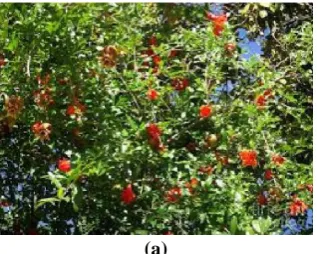
Fig 1. Detection of Pomegranate based on HIS color thresholding with CHT (a) Original image (b) Detected by
HIS and CHT
(a)
(b)
(d)
(e)
[image:5.595.301.555.46.490.2](f)
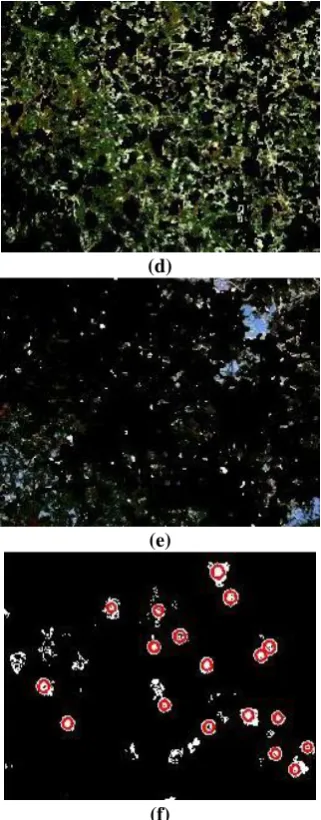
Fig.2 Detection of Pomegranate based on K-means clustering with CHT (a) original image (b) cluster 1 (c) cluster 2 (d)
cluster 3 (e) cluster 4.
IV. RESULTSANDDISCUSSIONS
[image:5.595.91.252.50.461.2]We have taken 20 number of on-tree images for experimental purposes. Here we implemented two approach of segmentation i.e. first one is HIS color thresholding and second one is K-means clustering. After segmentation CHT is applied for detecting and counting the pomegranate fruit. The performance of both methods is evaluated by linear regression, compute predicted score of estimated value with ground truth value.Here we notice that the equation for the regression line is different in Fig.3 and Fig.4.The regression line represents the 'true' relationship between manual value and estimated value. The regression line passes through the points in Fig. 4 is closer than the Fig.3 which confirmed by the R2 value. It is 0.7652 in Figure 4 compared to 0.6888 in Figure 3. Now, we can imply that Figure 4 represents a better representation of the relationship of manual value and estimated value.
Table 1: Performance analysis of suggested methodology Sl. No. Manual Count HIS color
thresholding with CHT
K-means clustering with CHT
1 23 20 18
2 10 10 9
3 13 10 13
4 12 10 11
5 11 10 11
6 13 11 13
7 8 4 6
8 12 4 9
9 18 6 10
10 6 4 2
11 6 2 3
12 10 10 10
13 7 7 7
14 5 4 4
15 3 2 3
16 4 2 3
17 12 9 10
18 6 5 5
19 20 18 11
20 12 5 9
Fig.3 Scatter plot of First Approach (HIS with CHT results R2=0.6888)
[image:5.595.308.538.446.698.2]V. CONCLUSION
In this paper, two special method for yield estimation of pomegranate is proposed based on image processing. The 1st method in which HIS color thresholding is used along with Circular Hough transform & in the 2nd method K-means clustering technique is used along with Circular Hough transform. Both the method shows that the algorithm helps to detect and count pomegranate fruits easily. Here also we compare the performance of both approach by regression analysis, which show that the second approach have R2 value 0.7652 compared to 0.6888 in first method and concluded that the second approach is the better one.
REFERENCES
1. Chandra R, Babu KD, Jadhav VT, Teixeira da Silva JA (2010) Origin,
History and Domestication of Pomegranate. In: Chandra R (Ed) Pomegranate. Fruit, Vegetable and Cereal Science and Biotechnology 4 (Special Issue 2), 1-6.
2. Abraham Verghese and M.A. Rashmi, “Netting in pomegranate to
protect from fruit sucking moth”, Insect Environment, Vol. 20(3).
3. http://agriexchange.apeda.gov.in
4. P.K. Sethy, S. Panda, S.K. Behera, et al., On tree detection, counting & post-harvest grading of fruits based on image processing and machine learning approach-a review. International Journal of Engineering & Technology 9(2), 649–663 (2017).
5. Sethy P.K., Panigrahi G.R., Barpanda N.K., Behera S.K., Rat h A.K. (2018) Application of Soft Computing in Crop Management. In: Bhateja V., Coello Coello C., Satapathy S., Pattnaik P. (eds) Intelligent Engineering Informatics. Advances in Intelligent Systems and Computing, vol 695. Springer, Singapore.
6. Jena J.J., Behera S.K., Sethy P.K., Rath A.K. (2019) Detection and Categorization of OnPlant Prunus Persica: A Novel Approach. In: Saini H., Sayal R., Govardhan A., Buyya R. (eds) Innovations in Computer Science and Engineering. Lecture Notes in Networks and Systems, vol 32. Springer, Singapore.
7. S. Lal, S. K. Behera, P. K. Sethy and A. K. Rath, "Identification and counting of mature apple fruit based on BP feed forward neural network," 2017 Third International Conference on Sensing, Signal Processing and Security (ICSSS), Chennai, 2017, pp. 361-368. doi: 10.1109/SSPS.2017.8071621.
8. Qureshi, W. S., et al. "Machine vision for counting fruit on mango tree canopies." Precision Agriculture 18.2 (2017): 224-244.
9. Prabira Kumar Sethy, Shwetapadma Panda and Nilamani Bhoi.
On-Tree Detection and Counting of Mature and Immature Fruit of Carica Papaya using Image Processing Technique. International Journal of Computer Applications 156(8):16-21, December 2016.
10.Raphael Linker, Oded Cohen , Amos Naor, Determination of the
number of green apples in RGB images recorded in orchards, ELSEVIER 2012.
11.Wei Ji, Dean Zhao,Fengyi Cheng, Bo xu, Ying Zhang & Wang,J,
‖Automatic recognition vision system guided for apple harvesting robot‖, ELSEVIER 2012.
12.Malik, Z.; Ziauddin, S.; Shahid, A.R.; Safi, A. Detection and Counting
of On-Tree Citrus Fruit for Crop Yield Estimation. IJACSA Int. J. Adv. Comput. Sci. Appl. 2016, 7.
13.C. Akin, M. Kirci, E. O. Gunes, and Y. Cakir. Detection of the pomegranate fruits on tree using image processing. First International Conference on Agro-Geoinformatics, Shanghai, August 2-4, 2012.
14.Hetal N Patel, Dr. R.K.Jain and Dr. M.V.Joshi. Fruit Detection using
Improved Multiple Features based Algorithm. International Journal of Computer Applications 13(2):1–5, January 2011.
15.Ankita Vaidya and Anant Bagade. Automatic Fruit Detection, Counting
and Sorting Using Computer Vision and Machine Learning Algorithms. International Journal of Computer Engineering and Applications, Volume XII, Special Issue, May 18, www.ijcea.com ISSN 2321-3469.
16.Ketki Tarale and Anil Bavaskar. Fruit Detection Using Morphological
Image Processing Technique. International Conference on Science and Engineering for Sustainable Development, January 2017. DOI: 10.24001/ijaems.icsesd2017.118.
17.A. Saranya and N. Sujatha. An Analysis of Fruit Detection and Yield
Estimation Using on Tree Image. International Journal of Scientific Research and Management (IJSRM). Vol.5 (7), (2017) pp. 6524-6530.
18.Changyi Xiao, Lihua Zheng, Minzan Li (2015) “Apple Detection From
Apple Tree Image Based on BP Neural Network and Hough Transform”, International Journal of Agricultural And Biological Engineering, 8(6), pp.46-53.
19.S. Poorani and P. G. Brindha, “Automatic detection of pomegranate fruits using K-mean clustering,” Int. J. Adv. Res. Sci. Eng., vol. 3, no. 8, pp. 198–202, 2014.
20.Bakhshipour, A., A. Jafari and A. Zomorodian (2012) Recognition of
Pomegranate on Tree and Stereoscopic Locating of the Fruit. American-Eurasian J. Agric. & Environ. Sci., 12 (10): 1288-1294. DOI: 10.5829/idosi.aejaes.2012.12.10.2435.
21.N. Meena et al.(2014) Development of Detection, Counting and Yield
estimation algorithm for agricultural products. International Journal of Engineering Research and Technology (IJRET). Vol. 3(6).pp.590-595. 22.S. K. Behera, N. Mishra, P. K. Sethy and A. K. Rath, "On-Tree Detection and Counting of Apple Using Color Thresholding and CHT," 2018 International Conference on Communication and Signal Processing (ICCSP), Chennai, 2018, pp. 0224-0228. doi: 10.1109/ICCSP.2018.8524363.
23.Behera S.K., Jena J.J., Rath A.K., Sethy P.K. (2019) Horticultural Approach for Detection, Categorization and Enumeration of On Plant Oval Shaped Fruits. In: Abraham A., Dutta P., Mandal J., Bhattacharya A., Dutta S. (eds) Emerging Technologies in Data Mining and Information Security. Advances in Intelligent Systems and Computing, vol 813. Springer, Singapore.
AUTHORSPROFILE
Santi Kumari Behera has received her Master of Technology degree in Computer Science & Engineering from NIT Rourkela. She is working as Assistant Professor in Veer Surendra Sai University of Technology, Odisha, India. Her research of interest in Computer Graphics and Image Processing.
Abhishek Pattanaik is an MTech student in the Dept. of Electronics and Communication Engineering, SUIIT, Sambalpur University. His research interest is Agricultural Image Processing.
Amiya Kumar Rath has already received Ph.D. in Computer Science from the Utkal University, Odisha, India. He is working as Professor at Veer Surendra Sai University of Technology, Odisha. He has published over 70 number of research articles in various areas of Computer Science, concentrating on Artificial Intelligence, Image Processing, and Embedded System.
Nalini Kanta Barpanda has already received Ph.D. in Engineering from the Sambalpur University. He is working as Associate Professor at SUIIT, Sambalpur University, Odisha. He has published over 22 number of research articles in various areas of Performance Analysis of Communication Interconnection N/W, Wireless Sensor N/W, Image Processing, and Internet of Things.