Instant Messaging
in Java
The Jabber Protocols
IAIN SHIGEOKA
M A N N I N G
For electronic information and ordering of this and other Manning books, go to www.manning.com. The publisher offers discounts on this book when ordered in quantity. For more information, please contact:
Special Sales Department Manning Publications Co.
209 Bruce Park Avenue Fax: (203) 661-9018 Greenwich, CT 06830 email: [email protected] ©2002 by Manning Publications Co. All rights reserved.
No part of this publication may be reproduced, stored in a retrieval system, or transmitted, in any form or by means electronic, mechanical, photocopying, or otherwise, without prior written permission of the publisher.
Many of the designations used by manufacturers and sellers to distinguish their products are claimed as trademarks. Where those designations appear in the book, and Manning Publications was aware of a trademark claim, the designations have been printed in initial caps or all caps.
Recognizing the importance of preserving what has been written, it is Manning’s policy to have the books they publish printed on acid-free paper, and we exert our best efforts to that end.
Manning Publications Co. Copyeditor: Lois Patterson 209 Bruce Park Avenue Typesetter: Shan Young Greenwich, CT 06830 Cover designer: Leslie Haimes
ISBN 1-930110-46-4
Printed in the United States of America
This book is dedicated to the Jabber community:
preface xiii about this book xv author online xxi acknowledgments xxii
about the cover illustration xxiii
P
ART
I
I
NSTANT
MESSAGING
PRIMER
. . . 1
1
Introduction to IM concepts
3
1.1 Background on messaging 4
A brief history of Jabber 11 ■ Goals of the Jabber project 12
1.2 What is Jabber? 13
Jabber’s XML-based data formats 14 ■ Jabber’s simple architecture 18 ■ Jabber’s four core concepts 21
1.3 Benefits of the Jabber protocols 27 1.4 Drawbacks of the Jabber protocols 28 1.5 Conclusion 29
viii contents
2
Jabber technical fundamentals
31
2.1 The Jabber messaging model 32
Benefits 35 ■ Drawbacks 36 ■ Relying on distributed servers 38 ■ How Jabber packet routing works 39 Step-by-step: a message’s path through Jabber 44
2.2 The core Jabber protocols 45
Message: Delivering data 45 ■ Presence: updating user online status 45 ■ Info/Query: handling everything else 45
2.3 Jabber session example 47 2.4 Conclusions 56
P
ART
II
P
ROTOCOLS
,
CODE
,
AND
ADVANCED
IM . . . 57
3
IM concepts and Jabber protocols
59
3.1 A basic Java Jabber server 60
Goals for our server 60 ■ Our server software 61 The basic server design 62
3.2 The session pool maintains client connections 63
The Session class represents a connection 64 The SessionIndex class provides session lookup 66
3.3 XML parsing subsystem 69
Representing Jabber packets 69 ■ The PacketQueue class as server focal point 77 ■ SAX parsing in Java 80
3.4 Packet handling and server threads 87
Packet handling in QueueThread 90 ■ Parsing XML in the ProcessThread 95 ■ The main application Server class 97
contents ix
4
The Jabber message protocols
101
4.1 Messaging is the heart of IM 102 4.2 The message protocol 103
Normal messages 104 ■ Chat messages 105 Groupchat messages 106 ■ Headline messages 108
Error messages 109 ■ Out-of-band messages 110 ■ Reality check: one message, many user interfaces 112
4.3 Java Jabber client 113
Goals 114 ■ The client design 115 ■ The client model 116 ■ Using the client model 123 ■ Results 131
4.4 Conclusions 132
5
The presence protocols
133
5.1 The need for presence 134
5.2 The presence protocol 134
5.3 Adding groupchat support 138
Groupchat protocols 138 ■ Server modifications 144 Client modifications 157
5.4 Shortcomings of our server and basic groupchat 161 5.5 Conclusions 162
6
Info/Query and client registration
163
6.1 Info/Query: the catch-all protocol 164
The IQ protocol 165 ■ IQ extensions 167
6.2 Registration creates and manages accounts 169
User accounts 170 ■ The register protocol 171
6.3 The Jabber server modifications 175
Adding user accounts 175 ■ Adding registration support 183
x contents
7
Client authentication
189
7.1 Authentication controls account access 190
The authentication protocol 191
7.2 The Jabber server modifications 199 7.3 The Jabber client modifications 205
Modifying the JabberModel 206 ■ The client IQ packet handlers 211
7.4 Conclusions 215
8
Roster and user presence
217
8.1 Roster protocol: presence’s missing piece 218
The roster protocol 221
8.2 The Jabber server modifications 224
Representing user presence 224 ■ Adding a roster subsystem 226 ■ The roster packet handlers 233
8.3 The Jabber client modifications 236
Adding minimal roster support 236 ■ Testing the server 238
8.4 Conclusions 241
9
Creating a complete Jabber system 243
9.1 Creating Jabber-compliant implementations 244
Setting standards: the Jabber Software Foundation 245 Enforcing standards: Jabber Powered applications 245 Organizing standards: Jabber environments 246 Today’s options for achieving server compliance 247
9.2 Server missing pieces 248
Server-to-server communications: federating Jabber domains 248 Dialback authentication: S2S security 250 ■ Transports:
integrating with other IM systems 257 ■ Deployment of Jabber servers and components 260 ■ Server security: creating protected Jabber services 262 ■ Jabber server management 264 ■ Adding reliability and availability 265
contents xi
9.4 User agent clients 266
Enhancing existing applications 268 ■ Chatbots: creating IM services 268
9.5 Conclusions 270
10
Enterprise Jabber
271
10.1 What is needed to support enterprise messaging 273
Enhancing Jabber security 273 ■ Guaranteed quality of service 278 ■ Creating system administration tools an techniques 279
10.2 The promise of MOM 280
Jabber as middleware 281 ■ Jabber and the J2EE Java Messaging Service 282 ■ Jabber, .NET, and SOAP 290
10.3 Examples of Jabber applications 292
Jabber groupware 292 ■ Jabber network
services 293 ■ Applications enhanced by Jabber 293
10.4 Distributed application alternatives to Jabbers 296
RPCs: oldies but goodies 296 ■ P2P systems: the new challenger 298 ■ Hybrid systems: a better compromise 299
10.5 Conclusions 300
xiii
preface
My original background is in robotics and computer-integrated manufacturing. In both, my interests centered on solving communication problems in mission-criti-cal systems. At the beginning, that meant assembly and C programming as well as direct participation in the lowest levels of networking protocols. Forget TCP/IP
and Ethernet—we were generating packets by hand on ArcNET networks.
Networks quickly evolved and the problem shifted to an increasing need to integrate the computerized factor y floor into large-scale enterprise systems. Unfortunately, manufacturing systems are horribly heterogeneous, with each machine running completely proprietary software (often with one of a kind oper-ating systems and programming languages). In addition, it is common for manu-facturing machines to be kept in ser vice for 20–30 years or longer. Long equipment life-spans result in a surprising number of shops still using tape drives, punch cards, and other ancient computer technology.
xiv preface
Unfortunately, J2SE isn’t everywhere. The J2SE requirement for Java Jini proves to be a significant obstacle on proprietary or limited platforms. We needed a lightweight, flexible communication system to extend into these environments.
Jabber first came to my attention in late 2000. Peer-to-peer frameworks like Gnutella and JXTA were hot but lacked the robustness and predictability needed. Instant Messaging (IM) seemed like a much more promising solution.
Despite strong developer interest in IM technologies, there really wasn’t much out there.1 The largest IM systems are highly proprietary and unusable for systems where you may need to implement, extend, or control the servers. After some searching, it looked like a dead end. It appeared simpler and less expensive to cre-ate our own lightweight communication protocol from scratch.
Then I came across Jabber. It is open source, and exploits the very best fea-tures of XML, another hot technology. I was familiar with XML and understood the fundamental benefits driving its hype but had yet to see a compelling reason to use XML in my software. Jabber appeared to be that application.
Digging deeper into Jabber revealed a design that was simple and flexible. I’m a firm believer in the KISS philosophy2 so the appeal only grew. I decided to start playing with the technology.
What finally converted me into a Jabber evangelist was the active and enthusi-astic Jabber development community. Jabber is a young technology being shaped on a daily basis by corporate, student, and hobbyist contributors. Although the core of Jabber is relatively stable, many important related technologies such as Jabber security are still under active development.
You have the opportunity to make crucial decisions that shape the future of Jabber IM technology even while Fortune 500 companies are using Jabber today for critical ser vices. In addition, the Microsoft-driven hype behind SOAP and other XML-related technologies has ignited interest from various parties in using Jabber as a way to plug into the web services world without having to become Microsoft shops. Developers like you and me are making decisions today that will determine how Jabber grows to meet tomorrow’s challenges. These challenges and their potential rewards are truly exciting. Come and join us!
1 Today there still aren’t many IM options available to developers. Jabber remains the strongest option
for people who wish to have complete access to the software and protocols, as well as control over deployment.
xv
about this book
This book leads the reader in building an IM system using the Java programming language. I believe that the best way of showing how something like instant mes-saging is done in general is to illustrate how it is done with a particular example. Our IM system uses the Jabber protocols and architecture and we’ll cover both in depth as we build our software. Once you understand how the Jabber protocols work to create an IM system, I hope that you will be able to extrapolate your expe-rience to build other IM systems based on Jabber or other protocols if necessary.
I am also a firm believer in code as a method of communication. You can describe an algorithm to people and there will as many different interpretations of that algorithm as there are people. However, a well-written, compliable, execut-able piece of code removes all doubt. As a consequence, this book contains a great deal of Java source code to explain concepts with detail and rigor not included in the text discussion.
Who should read this book
This book is targeted primarily at intermediate developers, Jabber enthusiasts, and technical managers. Non-technical people who need to know about IM in general or Jabber in particular will gain the most insight from the first part of the book. The latter parts of the book contain many technical details and Java source code that you may find of lesser use if you are not a programmer.
inter-xvi about this book
mediate Java programming features such as threading and sockets that may be unfamiliar to beginning programmers. These issues have been de-emphasized in the book but remain potential stumbling blocks to the unprepared.
In addition, I use several design patterns within the code examples. If you’re familiar with design patterns, these examples will be easy, allowing you to under-stand the basic solution and concentrate on the Jabber-specific aspects of the solution. If you are not familiar with design patterns, many code examples will simply appear more complex and require more work to understand. I highly sug-gest that developers familiarize themselves with design patterns starting with the seminal book on the topic: Design Patterns: Elements of Reusable Object-Oriented Soft-ware, by Erich Gamma, Richard Helm, Ralph Johnson, and John Vlissides (Addi-son-Wesley, 1994).
You don’t necessarily need to know Java in order to understand the code examples in this book. Java is a simple language similar enough to many other languages that even those unfamiliar with it can read the code and understand the basic operations being undertaken. However, Java developers will gain the most from the code examples.
Contents of this book
This book is split into three parts. Part 1 introduces IM and Jabber technologies and describes the basic architecture of all Jabber-based systems. In part 2, we dig into the gritty details of the core Jabber protocols and develop Java server and cli-ent software. Finally, in appendix A, I’ve included a condensed reference to the Jabber protocols as they stand at the time of this writing. The Jabber protocols are continuing to evolve so you should check the Jabber website (www.jabber.org) for announcements and the book’s website (www.manning.com/shigeoka) for updated versions of the reference section.
Part 1—Overview
Chapter 1—Introduction to IM concepts. A non-technical introduction to IM and Jabber technologies. This is a general overview that helps us to establish a com-mon vocabulary and introduce basic concepts. If you’re familiar with Jabber IM
about this book xvii Chapter 2—Jabber technical fundamentals. A technical overview of the Jabber architecture and protocols. We also examine the raw communication stream between the Jabber server and client to illustrate what “raw” Jabber looks like.
Part 2—Building Jabber
Chapter 3—IM concepts and Jabber protocols Examines the details of Jabber streams and packets. In addition, we write the basic Jabber ser ver that we’ll expand throughout the book. This chapter is essential for understanding the software we build in the book.
Chapter 4—The Jabber message protocols. Covers the Jabber message protocol and implements support for basic messaging in the ser ver. In addition, we develop a “test Jabber client” to test our evolving Jabber server.
Chapter 5—The presence protocols. Covers the Jabber presence protocols and shows how they are used in the Jabber groupchat messaging protocol. We imple-ment a groupchat manager as part of the Jabber server and expand the test client.
Chapter 6—Info/query and client registration. Covers the final core Jabber proto-col, info/query, used for all protocols not covered by messaging and presence. In this chapter, we examine its use in the account registration process.
Chapter 7—Client authentication. Covers the Jabber authentication info/query protocols. The discussion and software cover all aspects of standard Jabber authentication including the proposed zero-knowledge authentication protocol.
Chapter 8—Roster and user presence. With user accounts firmly established in chapters 6 and 7, we’re ready to discuss the roster info/query protocol and the user presence protocols. A user’s roster stores the “buddy list” of subscribers inter-ested in their presence status. The user presence protocols update the user’s pres-ence and subscribe users to other users’ rosters.
Chapter 9—Creating a complete Jabber system. Ties up the loose ends for part 2. There is no way to complete a fully featured or “production ready” server or client within the book. This chapter describes what remains to be done and suggests ways to tackle each problem.
xviii about this book
Appendix—Jabber reference
We end the book with the Jabber reference. The reference does not attempt to document every aspect of any particular protocol. Instead, I provide a condensed reference that will let you quickly look up the most important information about a protocol without wading through each standard. For example, you can use the reference to look up error codes for the <error> packet, or the suggested
sub-packets in a “normal” <message>.
How to use this book
I would suggest that you read chapters 1–3 in order to get a firm grasp of Jabber and the software that we build throughout the book. Chapters 4–8 build upon each other. If you are completely unfamiliar with the Jabber protocols it may be a good idea to read through them in the order presented. If you only want to learn the protocols, you can read the first section of each of those chapters as source code is presented at the end of the chapter.
If you want to know what you need to do to create a production-ready Jabber server or client, you may want to skip ahead to chapter 9. Considering that you are creating a significant server application, I don’t think the remaining tasks are exceptionally difficult. However, you may wish to judge for yourself before getting too deep into the book’s source code.
Finally, I imagine that many developers will like to skip ahead to chapter 10 for inspiration. I placed it at the end of the book so that you’d have the technical background to understand what would be involved in creating each system. How-ever, you may want to skim it first to let the big ideas sink in. You can then learn about Jabber in more detail by reading chapters 3–9, and return to chapter 10 to fully appreciate the potential of the technology.
Conventions
The following typographical conventions appear throughout the book:
■ Technical terms are introduced in italic font.
■ Code examples and fragments appear in a fixed-width font.
■ Method names are followed by two parentheses “()” to differentiate them from member variables.
about this book xix ■ XML elements are surrounded by angle brackets “<>”.
■ Sections of code that are of special significance appear in a bold
fixed-width font. Typically, these sections highlight changes made to code when
compared with a previous example.
■ Many sections of code have annotations which appear in the right margin.
■ Some advanced topics are discussed that will not be of interest to beginning programmers. These advanced discussions have a gray background and a black diamond in the margin. Beginners can skip these sections.
The source code
I have presented most but not all of the Java source code needed to build the Java server and client covered in this book. Most of the omitted source code repre-sents simple modifications of software covered earlier in the book. In addition, to make the source easier to read, I have omitted much of the error checking and prevention code that I would normally include in software. Keep this in mind when reviewing the code. If you decide to try and put this code into production, you’ll need to add the error checking code.
Getting the source code
The full source code for this book is available online from the Manning website at www.manning.com/shigeoka. The source is contained in a zip archive that includes instructions on building and running the included software. All of the source code is released under a modified Apache (BSD) license. This means that you’re free to do almost anything with the code, including selling it or building proprietary applications without any obligations.3
The online source differs slightly from the source shown in the book. The most visible difference is that the online source contains a logging class called Log and I have placed logging statements throughout the code to make it easier to fol-low what it is doing. To save space I have omitted these logging statements from the book. You can change the logging level of the Log class by changing the log-ging level constant set in the Log class (see source for more information).
Tools: a Java development environment
Building the Java software covered in this book requires four tools. I’ve tried to keep the requirements to a minimum. The following table shows you what tools
3 Technically, you do have some obligations. You can’t hold me responsible for anything the software does
xx about this book
you need and where to obtain them. You can learn more about each of these tools from their respective websites.
To set up your development environment, first obtain and install the JDK. There should be several examples included with your JDK and you should compile and run some of them to ensure that the JDK is properly installed.
The second step is to obtain the Ant build tool from the Jakarta Apache web-site. Unpack and install the Ant tool according to the Ant installation documenta-tion provided both on the Ant website and in the Ant binary distribudocumenta-tion. Make sure to also obtain the extra Ant task jar (optional.jar) provided as an optional part of the Ant distribution. My source code uses JUnit tests driven by an Ant task included in that jar file. Ant includes the Xerces XML parsing library
Finally, download and install the JUnit test tool. You will need to modify your Ant batch file or shell script to include the JUnit jar file in the Ant classpath. JUnit tests will be run as part of the Ant build process to ensure the software is built properly.
Building the source in this book
All of the source examples can be built using the appropriate Ant build file. To build a particular example:
■ Unpack the book’s source code (available at www.manning.com/shigeoka) ■ Open up a terminal window or console window
■ Change to the chapter directory
■ Type “ant” (If your Ant batch file or shell script is not your executable path you may need to specify its full name including path. See your Ant documentation.)
The completed jar files will be created in the out/dist directory. The required development tools.
Tool Source Description
JDK 1.3.1 http://java.sun.com or
3rd party vendor
The Java Development Kit
Ant 1.4.1 http://jakarta.apache.org A Java build tool
JUnit 3.7 http://www.junit.org A Java testing tool
xxi
author online
Free access to a private Internet forum, Author Online, is included with the pur-chase of this book. Visit the website for detailed rules about the forum, to sub-scribe to and access the forum, to retrieve the code for each chapter and section, and to view updates and corrections to the material in the book. Make comments, good or bad, about the book; ask technical questions, and receive help from the author and other Jabber programmers. The forum is available at the book’s web-site at www.manning.com/shigeoka.
Instant messaging, Java, and the Jabber protocols cover a lot of ground and I can’t claim expertise in too much of it. In addition, I am certainly a student when it comes to writing technical books. In order for me to continue to learn and grow I need your feedback! In addition to comments and criticisms, I would love to hear about your experience with the software and technology and how you’re using it. Or simply drop by to chat about Jabber, Java, IM, or just about anything else.
Manning’s commitment to readers is to provide a venue where a meaningful dialog among individual readers and among readers and the author can take place. It is not a commitment to any specific amount of participation on the part of the author, whose contribution remains voluntary (and unpaid).
xxii
acknowledgments
I’d like to first thank my parents, Clifford and Blanche, who have been extremely supportive in the production of this book. From room and board to pats on the back, they’ve been essential to the book’s completion. In addition, my brother Orin and sister Cassie have made sure to “encourage” me in their own unique ways. Thanks guys.
I’d also like to thank the Manning crew for their unflagging assistance and advice on this book. The schedule was tight but things went unexpectedly smoothly thanks to Susan Capparelle, Alex Garret, Ted Kennedy, Elizabeth Martin, Dottie Marsico, Mary Piergies, and Shan Young. I’d like to extend an especially warm thanks to Marjan Bace who was willing to take a chance on yet another book and who responded so enthusiastically to this one. In addition, Lois Patterson deserves special thanks for her help in turning my spotty writing into a professional quality manuscript and doing so under incredible time pressures.
The book also benefited from the reviews of several technical experts. Many of the best, most accurate, and most insightful bits are due to these reviewers. The remaining errors are entirely my fault. Thanks to Bill Abbas, Chris Chen, Ryan Eatmon, David Falck, Harold Gottschalk, Gregory Graham, Julian Missig, Jim Schultz, Max Metral, and Thomas Muldowney.
xxiii
about the cover illustration
The figure on the cover of this book is a “Gobenador de la Abisinia,” the governor of Abyssinia, today called Ethiopia. While the exact meaning of his office and responsibilities is for us lost in historical fog, there is no doubt that we are facing a man of authority and power. The illustration is taken from a Spanish compen-dium of regional dress customs first published in Madrid in 1799. The book’s title page states:
Coleccion general de los Trages que usan actualmente todas las Nacionas del Mundo desubierto, dibujados y grabados con la mayor exactitud por R.M.V.A.R. Obra muy util y en special para los que tienen la del viajero universal
Which we translate, as literally as possible, thus:
General collection of costumes currently used in the nations of the known world, designed and printed with great exactitude by R.M.V.A.R. This work is very useful especially for those who hold themselves to be universal travelers
xxiv about the cover illustration
belonging to one or the other. The collection brings to life a sense of isolation and distance of that period and of every other historic period except our own hyperkinetic present.
Dress codes have changed since then and the diversity by region, so rich at the time, has faded away. It is now often hard to tell the inhabitant of one continent from another. Perhaps, trying to view it optimistically, we have traded a cultural and visual diversity for a more varied personal life. Or a more varied and interest-ing intellectual and technical life.
Part I
Instant messaging primer
3
1
Introduction
to IM concepts
In this chapter
■ The benefits of instant messaging technology for Java developers
■ How the Jabber instant messaging protocols work
■ The core concepts of instant messaging in Jabber
4 CHAPTER 1
Introduction to IM concepts
Instant messaging (IM) systems using the Java programming language are poised to become a major part of both consumer and enterprise networking, and will play a core communication role similar to email.
Messaging of course has always been a core feature of the Internet. For exam-ple, one of the first and still most pervasive Internet technologies is email. It remains an Internet killer app. However, we all know that Internet communica-tion can be even more interesting and powerful than “plain old email.” We should be able to better exploit it as an inexpensive medium for transferring data almost instantaneously. And that is the aim of this book.
Most of the examples and IM issues discussed here are from the point of view of an enterprise developer interested in creating systems for medium or large businesses. This is primarily a bias on my part, as my projects tend to fall into this category. However, the same issues that face enterprises also will be important to any other developer who wants to create reliable, secure systems.
To make the discussion concrete, we’ll implement an IM system in Java that complies with the Jabber protocols (which you can find at www.jabber.org). By examining the Jabber protocols in particular, we’ll get a real sense for what makes a working IM system tick and why I think they may very well be the best ones to implement in the fragmented field of IM. Finally, the Jabber protocols have suf-fered from a lack of documentation that I hope this book begins to address.
In this chapter, we’ll examine IM systems in general and Jabber in particular. The discussion will be largely nontechnical so we can concentrate on why and where we need IM. Discussion of the technical aspects of the Jabber protocols will occupy the remainder of the book and explain the how of Jabber. We will develop a basic Jabber server and client in Java throughout chapters 3–8 to help make the concepts concrete. The chapter closes with a look at the benefits and drawbacks associated with Jabber IM.
1.1
Background on messaging
The idea of instant messaging has been around for a long time. All of the visible
IM features like one-on-one chat and group chats existed in other Internet appli-cations long before IM entered the scene. For example, the classic Unix talk
Background on messaging 5 The innovation in today’s IM systems is the packaging of these separate systems into a managed messaging platform. Jabber takes this further and establishes a
universal messaging address and the concept of presence that can be applied to that address for an even simpler communication experience. A common address and presence are relatively simple technologies that have existed in other forms. How-ever, it’s the packaging of the concepts into a single, easy to use, cohesive messag-ing system that has really caught on. The need for ease of use has increased as more people (many of whom have less technical knowledge or inclination than earlier Internet users) join the network community.
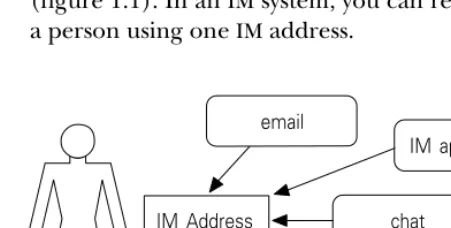
[image:30.612.102.328.295.409.2]IM addresses are an extension of the well-established email addresses almost ever yone has today. However, your email address can be used only to receive email. In contrast, IM ties many message types together using a single IM address (figure 1.1). In an IM system, you can receive a message, chat, or groupchat1 with a person using one IM address.
Figure 1.1 IM addresses serve as universal communication destinations. They aggregate many different messaging sources into a single user message endpoint.
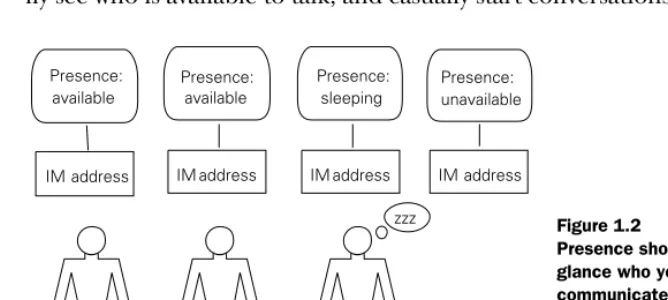
Chat and group chat are conversational, and require you to be online at the same time as the person you are chatting with. To make the online rendezvous simple, your IM presence will constantly inform other users when you are online and available for chatting (figure 1.2). IM presence makes communication through IM
1 IM messages are like memos or emails and tend to be complete like a letter. Chat and groupchat allows
you to quickly exchange short text messages in a conversation. Each individual chat or groupchat mes-sage is like a sentence taken out of a telephone conversation; it doesn’t make sense unless you know what has been said before. The difference between chat and groupchat is that chat is a one-on-one con-versation while groupchat is a chat among more than two people.
IM Address
IM application
chat
IMapplication
6 CHAPTER 1
Introduction to IM concepts
systems similar to striking up conversations around the water cooler. You can eas-ily see who is available to talk, and casually start conversations.
Older chat systems like Unix talk work similarly to the phone system in the sense that they lack presence. When attempting to chat, you have to make blind calls to the person with whom you want to converse, hoping he or she is available to answer the call. Unlike the phone system, though, most people are not available to talk online as much as they are with the phone so the chance of finding some-one “at home” online is greatly reduced.
The simplicity and integration of IM systems first caught on with the consumer market. The most successful of these consumer systems is AIM (AOL Instant Mes-senger) that introduced IM to the mainstream consumer and encouraged its large membership to embrace the technology. The consumer market for IM continues to grow and many opportunities exist for the enterprising developer.
Despite the large consumer market for IM, most of the development commu-nity is interested in the opportunities for applying IM technologies in the enter-prise (table 1.1). First, enterenter-prises live or die by their ability to communicate within the company and with partners and customers. IM provides new communi-cation channels that are well-suited to many messaging tasks.
IM address Presence: available
IM address Presence: available
IM address Presence: sleeping
IM address Presence: unavailable
zzz Figure 1.2
[image:31.612.91.425.132.282.2]Background on messaging 7 Table 1.1 An IDC report’s projections for IM usage in the enterprise and consumer markets.2
One of the most promising applications of IM in the enterprise is in the area of customer relationship management (CRM) or customer service. First, IM provides yet another way for a company to communicate with its customers. In addition, IM
allows you to plug in to the customer’s experience to provide better support. Imagine a computer customer whose software application has just crashed. They start the Help utility that came with the application. The utility is actually a customized IM client. The client joins a chat group dedicated to users of the appli-cation. The user can ask anyone online for help. If there is no one available, the client contacts an automated chatbot3 on the IM system. The chatbot can ask basic questions about the problem and use that information to route the user to the best technical support expert at the company.
Notice how the customer is instantly connected to support resources once a problem emerges. In addition, IM allows you to provide guided assistance starting with free online user groups. Automated chatbots can monitor the customer’s progress, make suggestions, and eventually lead them to a company employee that can help. The filtering of simple problems by the free user group can eliminate many customer service incidents that drain profits and reduce customer satisfac-tion. Since IM is worldwide, your user community has a global reach that is very handy when customers want help outside of your business hours.
In addition to the added communication capabilities, IM provides an enter-prise. It provides cost savings. Jabber Inc., a commercial vendor of Jabber software and services, reports significant savings when an IM system is properly integrated into the enterprise.4
2 Jennifer DiSabatino, “Win XP to Include Instant Messaging,” Computer World, June 11, 2001.
Year Enterprise IM
(messages/year)
Consumer IM (messages/year)
2001 145 262
2003 626 409
2005 1.2B 800
3 Chatbots are special IM client applications that are completely automated. They typically provide
ser-vices to IM users such as logging conversations, telling you the time, or providing online help. We’ll in-vestigate the full spectrum what you can do with chatbots in chapter 10.
8 CHAPTER 1
Introduction to IM concepts
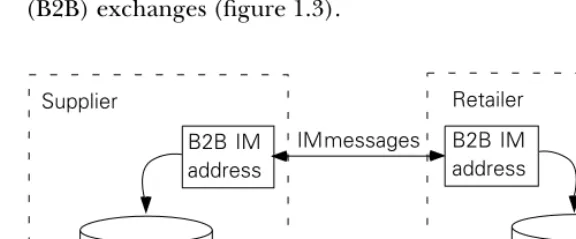
[image:33.612.91.379.186.305.2]Messaging between individuals is not the only benefit IM can provide to an enterprise. Businesses must also allow computers to communicate with each other. This is true whether the computers are internal to the company such as when accounting applications access customer service databases, or when the computer communication is between business partners in business-to-business (B2B) exchanges (figure 1.3).
Figure 1.3 IM systems are being used for B2B data exchange including the heavily hyped web services initiatives such as Microsoft .NET.
Using messaging frameworks for computer communication is not a new idea. Products like IBM MQSeries, Micosoft MSMQ, TIBCO Rendezvous, Open Horizon Ambrosia, and Modulus InterAgent have been in enterprise use for years. The benefits of messaging in the enterprise have been well-demonstrated.
In fact, the Java 2 Enterprise Edition (J2EE) includes the Java Message Ser-vice(JMS) standard libraries to provide a standard Java interface to messaging sys-tems for enterprise computing. The power and flexibility of Java and enterprise messaging-oriented middleware(MOM) have made the adoption of JMS happen quickly. Most enterprise messaging system vendors support JMS.
For example, imagine you are a telecom company providing local telephone ser-vices to residences. You want to create a computer system that will help you handle service problems. Let’s consider the scenario where a telephone line has been cut. An IM-based system can log the problem as an IM message and route it to a trouble desk. The trouble desk operator receives the message and knows that she must dis-patch a work crew to the site. She can check the IM presence of the work crews, find one that’s available, and send a trouble ticket to repair the line.
We can also add expert system functionality to the system by modifying an existing expert system so that it acts as an IM client and receives copies of incom-ing trouble desk IM messages. It recognizes that a “line down” problem activates
Supplier
B2B IM address
IM messages
Retailer
B2B IM address
Orders database
Background on messaging 9 several service level agreement (SLA) contracts. In addition, there are several alternate phone lines that service the same area, and traffic can be switched to these if the problem will last longer than a few hours. The expert system sends more trouble tickets to the trouble desk operator alerting her to other actions she needs to take and offering suggestions on solutions. In most cases, the suggestions are routine and she can simply approve the expert system’s suggestions allowing it to follow proper procedures.
This example is not far-fetched. Telecom companies spend millions every year developing and maintaining systems with these capabilities. A few innovative com-panies are experimenting with messaging technologies as the basis for next-gener-ation versions of these systems that are more capable, and less expensive to create and maintain.
If the industry’s predictions for the growth of IM in the enterprise prove true, it is obvious that IM systems will become a fundamental part of any enterprise sys-tem, just as web, database, and email servers are today. There are many opportu-nities for IM systems to expand out of simple messaging to meet enterprise needs, perhaps filling in the roles currently filled by JMS systems. Alternatively, existing enterprise messaging systems may wish to expand their capabilities to include IM. The question facing organizations that need to meet the IM needs of today and in the future is: What IM system should they use?
Jabber is a compelling IM solution that is well-suited to meet today’s and tomorrow’s IM needs. Jabber is not a particular piece of software. Instead, it is an open, freely available set of protocols for building IM systems. Existing messaging systems can implement the Jabber protocols to add IM to their list of features. Alternatively, new systems are being built from the ground up to support the Jab-ber protocols and prepare for the rapidly expanding responsibilities being assigned to IM systems.
Alternatively, you can use the existing Jabber network supported by standard Jabber servers as a foundation on which you can build specialized applications (figure 1.4). Jabber takes care of the details of messaging, leaving you free to con-centrate on your application. An excellent example of this is the next generation of file-sharing applications5 and games being built on top of existing IM systems.
5 One of the most popular, next-generation file sharing systems is Madster (www.madster.com) which
10 CHAPTER 1
Introduction to IM concepts
For example, imagine creating a massive online game where thousands of people participate in a single game universe. Ordinarily, you would create both game cli-ents and a game server. The game server would be hosted on an online game hosting service. All communications between the clients and the game server would be proprietary and would require you to design and implement the various parts from the ground up.
However, if you use an IM system, your game clients can create proprietary data, but wrap them inside normal IM messages. The game can send these mes-sages over existing IM networks like Jabber, to other players. Your game network can host an almost unlimited number of players because it is being hosted by the almost unlimited capacity of the underlying IM network. In addition, your game network avoids the expense and hassle of creating and maintaining cus-tom game servers.
Your server is now another special IM client called a chatbot that maintains the state of the game universe. You don’t have to worry about inventing a messaging or routing system, nor does your server have to do anything to support the mas-sive number of connections that IM systems give you for free. You can concentrate on writing your game, leaving the network issues to the IM system.
Sound like something you’re interested in? With all of the power that IM sys-tems give you, it may be hard to believe that Jabber is a free, open system, whose inventors want you to use it for your own purposes. Let’s take a look at how Jabber became the system it is today.
Jabber “Application”
IM address
IM messages data
IM message
data wrap
send
IM network
Jabber “Application”
IM address
data
IM message
data unwrap
receive
Figure 1.4
Background on messaging 11
1.1.1 A brief history of Jabber
The Jabber project began in early 1998 as the brainchild of Jeremie Miller. The project quickly grew and evolved. It garnered wide public attention when it was discussed on the popular developer discussion website Slashdot (www.Slashdot.org) in January 1999.
The core Jabber protocols matured and the 1.0 release of the open source ref-erence Jabber server was released in May 2000. The core Jabber protocols that were implemented in the 1.0 release of the reference server have remained rela-tively unchanged to this day.
From its beginnings, the Jabber development community has tried to create
IM standards and encourage interoperability between IM systems. These cooper-ative efforts are in direct contrast to the behavior of other popular IM providers that actively work to keep their systems proprietary and isolated from other IM
networks.
As part of the Jabber IM standards effort, in June 2000 the Jabber community submitted the Jabber protocols as a Request for Comments (RFC) to the Inter-net Engineering Task Force (IETF)6 as part of its Instant Messaging and Pres-ence Protocol (IMPP) standard. The IETF maintains some of the most important Internet standards including those for email and Internet addresses. Unfortu-nately, the IMPP effort bogged down and as of this writing appears to be going nowhere fast. Jabber has also tried to participate in other standardization efforts like IMUnified (www.imunified.org) and the Presence and Availability Manage-ment Forum (www.pamforum.org) with varying degrees of success.7
In May 2001 the Jabber community (www.jabber.org) and Jabber Inc. (www.jab-ber.com) created the Jabber Software Foundation (foundation.jabber.org).8 The Jabber Software Foundation is an organization similar to the successful Apache Foundation. Its charter clearly shows the Jabber community’s dedication to open standards and interoperability.
6 The IETF website is at www.ietf.org.
7 Jabber’s success at creating Internet standards for IM have mirrored that of the IM community in
12 CHAPTER 1
Introduction to IM concepts
JABBER SOFTWARE FOUNDATION CHARTER
The Jabber Software Foundation shall provide direct organizational assistance and indirect technical assistance to the Jabber Community in carrying out its mis-sion. Direct organizational assistance will include brand management, logistical support, legal assistance, press relations, and communication facilities. Indirect technical assistance will include project management, protocol specification, standards activities, documentation support, and site development. The Jabber Software Foundation will not make technical decisions for Jabber but will help the Jabber Community to make technical decisions more effectively. All activities and proceedings will be openly accessible and published. Jabber Software Foun-dation Announcement: http://jabber.org/?oid=1309.
The Jabber Software Foundation is still in its infancy but I have great expectations for it. I’m particularly interested in using the Foundation to clarify and formalize the existing Jabber standards into a form that will allow Jabber technology to be rapidly adopted by the wider development community. This book is an effort toward that goal. This book at least begins to address the need for better docu-mentation.
As Jabber moves forward, much work remains to be done. Further standard-ization work is still under way. In addition, new standards are being proposed to extend the Jabber protocols beyond simple IM to meet the wider needs for elec-tronic messaging of all forms. These changes include better security, and sup-port for enterprise requirements such as transactions, quality of ser vice, and delivery guarantees.
1.1.2 Goals of the Jabber project
In many ways, the Jabber project’s goal is simply to build a better IM system sup-porting real-time presence and messaging. From my discussions with other Jabber developers, the underlying goals seem to really be about defining what “better” means. For most Jabber developers, better means:
8 There is a tight link between the Jabber community and Jabber Inc. (usually called Jabber.com or jc).
Jabber Inc. employs most of the “core” members of the Jabber community and developers including Jeremie Miller, the creator of Jabber. However Jabber Inc. has been earnest in its efforts to keep the Jabber community and Jabber standards open. The Foundation is primarily an effort to formalize Jab-ber Inc.’s commitment to open JabJab-ber standards and provide a legal entity to represent the JabJab-ber com-munity’s interests (especially when they don’t necessarily match that of Jabber Inc.). Many of the board members of the Foundation are Jabber Inc. employees; however there are enough outsiders on the board to keep Jabber commercial interests balanced against that of the community.
What is Jabber? 13
■ A completely open system and standards—Unlike other systems, Jabber will be
completely open, thus allowing anyone to create Jabber implementations at no cost and with no strings attached.
■ Open, XML-based technology—Extensible Markup Language (XML is an
enabling technology with many benefits with respect to flexibility, availabil-ity, and ease of use. The use of XML helps to “future proof” the Jabber pro-tocols. At the same time, XML is a well-known technology that people are interested in using. There is also an extremely wide selection of tools for modeling, analyzing, programming, and authoring XML.
■ Interoperability with other IM systems—The value of a communication system
increases with the number of people with whom you can communicate. Optimally, a user of an IM system should be able to IM with any other user regardless of the underlying IM system. Jabber will maximize its value by working with as many other IM systems as possible.
■ Simple protocols—Simple protocols are easier to design and implement. In
addition, for most Jabber developers, simple things have an inherent appeal that we strive for constantly.
■ Simplifying the responsibilities of clients whenever possible—There will be many
clients and few servers in any Jabber system. It makes sense to design the Jabber system so that writing clients is as simple as possible. In addition, cli-ents may run on resource-constrained systems so reducing their needs increases the possible types of clients.
■ Control over the system—No organization, group, or service provider should
be able to control the system. Jabber’s design allows anyone to create a Jab-ber server and run their own JabJab-ber network as they see fit.
These unwritten goals seem to be commonly held among Jabber community members. They represent an open, self-reliant community that sees the benefits in sharing technology and knowledge whether you are an open-source or com-mercial developer. From these basic goals, the Jabber community has produced a feature-rich IM framework.
1.2
What is Jabber?
14 CHAPTER 1
Introduction to IM concepts
open source reference implementation of a Jabber server called jabberd9 for the Jabber protocols that it supports. For the purposes of this book, we’ll restrict the dis-cussion of Jabber IM to the Jabber protocols and messaging model.
One of Jabber’s most discussed advantages is its truly open nature. The ber protocols and data formats are all documented either directly in the Jab-ber standards documents or as source code in the freely available JabJab-ber reference server. This is in stark contrast to all other major IM systems that use proprietary standards.
Jabber’s advantages don’t end there. Its use of XML-based data formats exploits the popularity and extensibility of XML. In addition, Jabber uses a simple, distributed client/server architecture. The combination of the simplicity of the basic client/server communication model with the scalability of distributed serv-ers makes it well-suited to the dynamic environments that IM systems will be used in the future.
Let’s break down Jabber technology to get an overview of how it works.
1.2.1 Jabber’s XML-based data formats
If Jabber’s open standards are its primary political and business advantage, its use of XML as its standard data format is its crucial technical advantage. XML is a World Wide Web Consortium (W3C) standard that defines a standard, generic data format for documents. Its primary technical advantages are its simplicity, extensibility, and a compromise between easy human and machine readability.
All Jabber communications involve the exchange of Jabber packets, each being a well-formed XML fragment. These XML fragments can be considered XML sub-documents within the Jabber communication stream. For example, to send a mes-sage to [email protected], you would send a Jabber packet that looks like this:
<message to='[email protected]'> <subject>How are you today?</subject>
<body>Just thought I'd drop a line and see what you're up to.</body> </message>
Even if you don’t know anything about XML you can probably figure out what each part of this XML fragment does.10 If you are XML-savvy, Jabber defines all its packets in standard XML Document Type Definitions (DTD) and uses XML namespaces extensively to define both its own standard packets, and provide
9 The Jabberd reference server development is continuing along two separate paths. Jabberd will
What is Jabber? 15 mechanisms for you to easily extend Jabber to accommodate your own custom packets while staying Jabber-compliant.
XML NAMESPACES AND JABBER
XMLnamespaces are designed to isolate XML document tag definitions. As the name implies, a namespace defines a separate space where names are unique. Thus, I can create two namespaces like baking and money that use the same tag
<bread>.11 The tag <bread> means different things within the two XML
namespaces but there is no confusion between the reuse of the name because each is defined in the context of its namespace. You can fully qualify a particular name by prefixing the normal local tag name with the namespace. So we might use
<money:bread> to buy <baking:bread>.
In the hierarchical XML data model, you can create default namespaces that apply to all child elements by using the xmlns attribute. An XML document for our bread example may look like the following:
<MyStuff>
<item xmlns='money'> <bread>10</bread>
<currency>dollar</currency> </item>
<item xmlns='baking'> <bread>rye</bread> <size>loaf</size> </item>
</MyStuff>
As it is being parsed, the document creates a stream of data that can be loosely translated as:
■ You’ve got some stuff.
■ In your stuff, you’ve got an “item” entity. All its children will be in the money
namespace.
■ You have a “bread” entity. Its value is 10. Done with “currency.” ■ You’ve got a “currency” entity and its value is “dollar.”
■ Done with “item.” You have left the money namespace.
10 If you aren’t familiar with XML, I highly recommend getting a basic understanding of it. You don’t
need to know anything about XML in particular to program Jabber clients or servers. However, knowl-edge of XML and its basic vocabulary will make it easier to understand discussions of the Jabber packet formats. A good place to start is XML Family of Specifications by Danny Vint (Manning) or Java & XML
by Brett McLaughlin (O’Reilly).
11 Bread is a slang term for money.
16 CHAPTER 1
Introduction to IM concepts
■ You’ve got another “item” entity. Its children will be in the “baking” namespace. ■ You have a “bread” entity. Its value is “rye.” Done with “bread.”
■ You have a “size” entity and its value is “loaf.” Done with “size.” ■ Done with “item.”
■ That’s all the stuff you have.
Notice how namespaces avoid confusion between the uses of the <bread> tag. In addition, you can define the data format for <mystuff> as simply containing zero or more <item> entities. You don’t need to know anything about the item namespaces or what they will contain.
Jabber cleverly plays with namespaces to create an extremely flexible protocol. It defines the basics of the Jabber protocol in three namespaces (stream, jabber: cli-ent, and jabber:server) containing only a handful of standard entities. However each of the core entities are extended by defining new namespaces. This lets the foundations of the Jabber protocols remain stable and well-defined, yet allows the community to constantly add new namespace extensions including custom namespaces that don’t break the Jabber protocols.
In our example, we might define a “my stuff” standard that allows you to send me a list of your stuff. It will always start with <mystuff> and contain one or more
<item> packets. I know about the money and baking namespaces so I can under-stand what is inside of those items. However, we may decide to add a playstation2games namespace in the future. If I get such a packet and don’t know about the playstation2games namespace I just ignore whatever is inside of the <item> packet; nothing breaks. I know it is an <item>, but I don’t know what it is (other than it’s a playstation2games). However I can still properly handle it like an <item>.
This feature is especially important for Jabber servers who may relay packets with contents they don’t understand. Clients are free to invent their own protocols, protect them with custom namespaces, and still send them over generic Jabber net-works. XML namespaces also provide freedom to the Jabber community to improve the Jabber protocols while preserving the integrity of the Jabber network.
What is Jabber? 17 In the case of XML, the most touted XML buzzwords are:
■ Open—As a W3C standard, XML is on track to replace HTML on the web and
will be used extensively in future web standards such as messaging (SOAP— Simple Object Access Protocol), and graphics (SVG—Scalable Vector Graphics). The open XML standard meshes well with the open design and philosophy of Jabber.
■ Simple—One of XML’s primary design goals is to maximize the simplicity of
creating and reading (parsing) XML formatted data. This simplicity trans-lates into simpler software making it easier to build and support software that uses XML data formats. Jabber exploits XML’s simplicity to make it eas-ier to write Jabber software. XML also allows the Jabber protocols to target a wider variety of platforms such as embedded systems.
■ Flexible—XML is a generic data formatting language. It provides
mecha-nisms like schemas, DTDs, and namespaces to allow users to create custom-ized definitions of XML documents for their own uses. Jabber heavily exploits DTDs and namespaces to harness this flexibility as well as preserve flexibility so users can further extend Jabber while staying compliant.
■ Portable—XML documents are simple, marked-up text files that can be sent
over the network and read on pretty much any platform. XML support tran-scends programming languages and operating systems. Most common pro-gramming environments such as Java, C/C++, Delphi/Pascal, Perl, and so forth support XML with standard libraries.
This book focuses on Java Jabber programming. It is logical to ask if Java and XML
are a good combination. The answer is a resounding “Yes!” In fact, a common joke among Java enthusiasts is that “XML gives Java something to do,” referring to the fact that before XML many considered Java a solution in search of a problem.
Sun Microsystems (www.sun.com)is aware of the use of Java and XML and cre-ated a standard Java XML library package with all Java XML technologies pack-aged together for easy use. XML parsing support is being added to the standard Java libraries in the 1.4 release of the Java Development Kit (JDK).
18 CHAPTER 1
Introduction to IM concepts
The strong interest in XML and Java has created a huge market of tools, books, programming libraries, and third-party experts (consultants, contract program-ming firms, etc.). This market legitimizes both XML and Java, and helps to ensure that anything based on Java and XML will be compatible with future technologies. It appears that we’ll be using XML for all sorts of programming problems for a some time to come. However, even if it doesn’t work out that way, enough people are committed to XML that new technologies will almost certainly continue to offer XML support or conversion tools.
The use of XML in the Jabber protocols is an excellent start in creating an accessible, flexible IM system. However XML alone is not enough to make Jabber truly interesting. The complementary breakthrough with Jabber is its simple, scal-able architecture.
1.2.2 Jabber’s simple architecture
The Jabber messaging model follows the well-understood client/server architec-ture. Jabber clients only communicate with Jabber ser vers in their Jabber domain.12 Jabber domains break the entire IM universe into separate zones of control, each supported and managed by a separate Jabber server. This is in con-trast with most IM systems that use one centralized server for the whole IM sys-tem.13 In Jabber, messages pass from the sender’s client, to the sender’s server, to the recipient’s server,14 to the recipient’s client.
Jabber is client/server
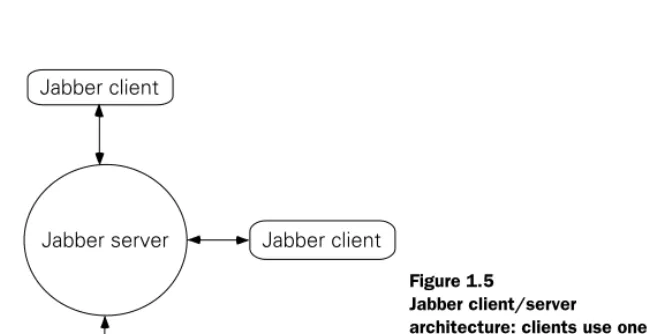
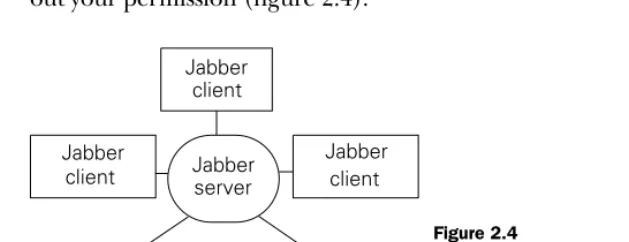
The basic Jabber communication model follows the simple and well-understood client/server architecture model. In client/server systems, the client displays information to the end user and handles user requests. Information is passed from the client to a server that offers well-defined services (figure 1.5).
12 This statement is an over-simplification. Normal Jabber messaging occurs through the server. However,
clients are always free to send data directly to each other through any means at their disposal. How to do so, though, is not covered by the Jabber standards. Jabber does provide an out-of-band packet to help clients arrange for these direct, client-to-client communications. However the client-to-client ex-change does not occur within the Jabber system.
13 A central server is the IM system architecture for services like AIM, Microsoft Messenger, and Yahoo!
Messenger.
What is Jabber? 19
In Jabber, the client/server model is heavily weighted to favor the creation of sim-ple clients. Most of the processing and IM logic is carried out on the server. Mini-mal Jabber client responsibilities give Jabber client developers the most flexibility in creating Jabber IM clients that fit the needs of users. Embedded and other lim-ited resource environments can support simple Jabber clients. Heavyweight Jab-ber clients can concentrate on the user interface and ease of use issues. Finally, the simplicity of creating Jabber clients encourages people to write more clients on different platforms using different programming languages, helping to spread Jabber access far and wide.
Unlike distributed systems, such as those based on peer-to-peer technology,15 the simple Jabber client/server architecture provides an excellent opportunity to implement centralized control of Jabber domains and provides opportunities for enforcing quality of service guarantees. This is especially important for enterprises that may need to enforce corporate communication policies. In addition, as IM sys-tems are used for mission-critical messaging beyond direct user communication, it will become increasingly important to ensure certain levels of quality of service can be met.
Jabber distributed servers build the Jabber network
Just as the current email system allows separate, distributed email servers to manage email domains, Jabber ser vers manage a Jabber domain. Like email, Jabber domains are defined by an Internet domain name. So a Jabber server that manages
15Peer-to-peer describes a family of technologies that allows network systems to be created without the
use of a central server.
Jabber server Jabber client
Jabber client
[image:44.612.106.431.90.257.2]Jabber client
Figure 1.5
20 CHAPTER 1
Introduction to IM concepts
the shigeoka.com Jabber domain will handle all outgoing and incoming messages for Jabber users in that domain. Jabber addresses, known as Jabber IDs, specify the user’s Jabber domain following an ‘@’ character just as email addresses do.
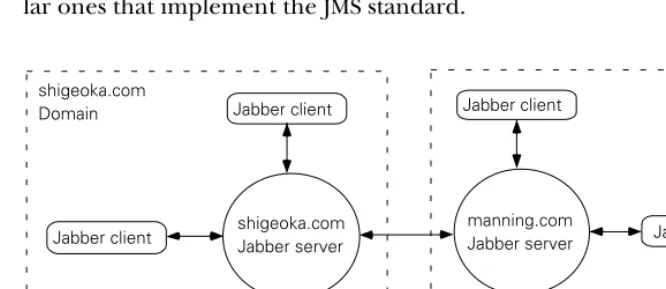
[image:45.612.92.425.202.346.2]This hub-and-spoke distributed server architecture (figure 1.6) is quite com-mon in messaging systems. Email systems use this architecture. In addition, this is a standard architecture for enterprise messaging servers including the most popu-lar ones that implement the JMS standard.
Figure 1.6 Distributed Jabber servers define and control Jabber domains in a hub and spoke architecture. Jabber servers that exchange messages with other Jabber servers create federated domains and expand their Jabber network. Here we see two Jabber servers (shigeoka.com and manning.com) federated to form a Jabber network encompassing both domains.
Creating a distributed Jabber server architecture limits a Jabber server’s responsi-bilities to only handling messaging with its own users and other Jabber servers. A small Jabber server can support a single user and consume minimal resources while large Jabber ser vers may support hundreds of thousands of users and require large data centers.
Breaking up the server responsibilities so that each server is only in charge of its own Jabber domain helps the Jabber network to grow without requiring mas-sive resources from any particular Jabber server or Jabber domain. As each Jabber domain adds more users, it is in charge of adding its own capacity for handling the increased traffic from those users. You can limit a Jabber server’s resource requirements simply by limiting the number of users in its Jabber domain.
This divide-and-conquer strategy helps to level the playing field for Jabber par-ticipants. You don’t need to be AOL or Microsoft to host your own Jabber system. In addition, it gives each Jabber domain control and autonomy over its own little corner of the Jabber IM network while encouraging interoperability so that your
manning.com Domain
manning.com Jabber server Jabber client
Jabber client
Jabber client shigeoka.com
Jabber server Jabber client
Jabber client Jabber client
What is Jabber? 21 users can communicate with other Jabber servers. These same advantages have been the primary reasons why the current Internet email system is so pervasive and maintains such a high degree of cohesiveness.
In many ways, Jabber’s simple, client/server architecture with distributed serv-ers is old technology. There is nothing really innovative about Jabber’s messaging model. In my opinion, this is a major strength rather than a weakness. IM’s major innovation is the addition of presence to communication systems. Jabber’s inno-vation is the use of an open XML data format for the data being sent in the com-munication system. Adding any more innovations at the same time would have probably resulted in a much less elegant and easy to build system.
1.2.3 Jabber’s four core concepts
Four central Jabber concepts form the basis for Jabber systems. Before we can look at the Jabber protocols, we must understand these concepts as they exist in Jabber. They’re straightforward but it is important for us all to be working with the same set of messaging concepts before setting off into Jabber’s details. These four central concepts are:
■ Jabber domains ■ Users and resources ■ Jabber IDs
■ Presence
Jabber systems organized into networks and domains
The Jabber universe is broken down into several logical sets and subsets of enti-ties. From the largest to the smallest, we have a Jabber:
■ Network—All Jabber domains that exchange messages. A network must
con-tain at least one domain.
■ Domain—A subset of the network containing all entities that handle or
belong to a domain. Jabber domains provide local control over parts of the Jabber network while still communicating with users outside of the Jabber domain. A domain is defined by:
■ A valid Internet domain name address.
■ The server that handles connections to that address. ■ Server—A logical entity that manages a Jabber domain.
■ User—An entity representing a logical message delivery endpoint. Jabber
22 CHAPTER 1
Introduction to IM concepts
■ Resource—An entity representing a particular message delivery endpoint for
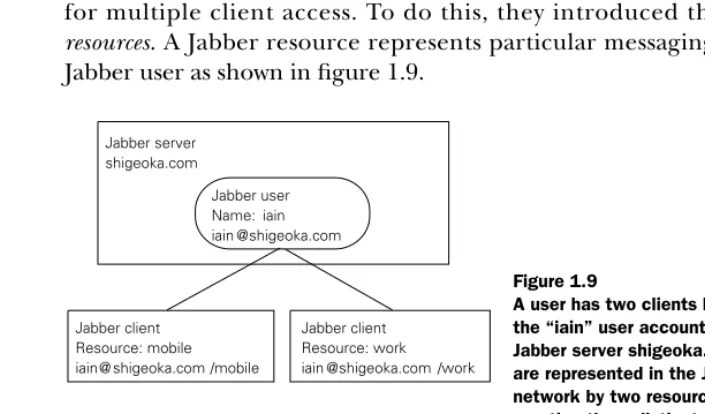
a user. All Jabber data packets are delivered to resources. Jabber clients play the role of Jabber resources.
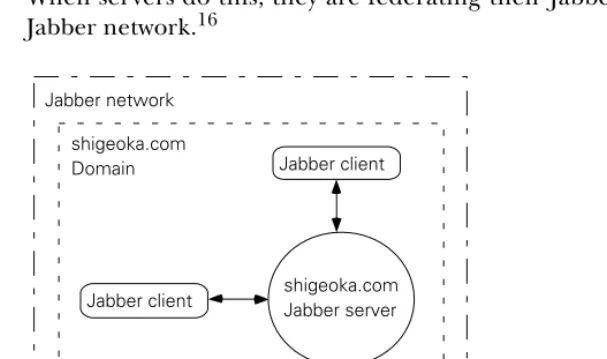
A minimal Jabber network is composed of a single Jabber server handling one Jabber domain, and the Jabber clients that use that server, as shown in figure 1.7. Jabber servers can exchange messages using the jabber:server protocols. When servers do this, they are federating their Jabber domains to expand the Jabber network.16
Server federations are the primary method for Jabber networks to grow. Many Jabber servers are configured to federate with any other Jabber server on Inter-net. This essentially creates a single Internet Jabber network containing thou-sands of users.
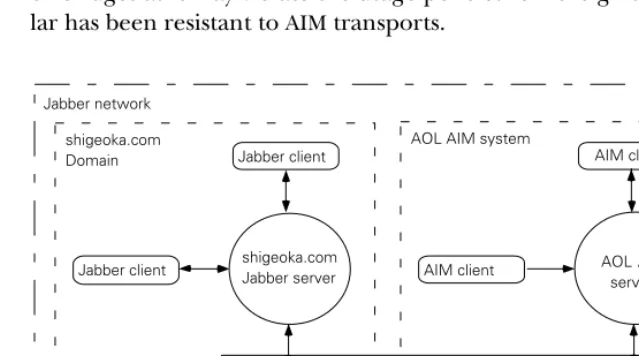
It is also possible to bridge Jabber systems by using the client protocols to exchange messages between domains as shown in figure 1.8. I’ll refer to this pro-cess as bridging to differentiate it from the privileged server-side access that server federation requires.
16 Jabber servers find each other by opening connections to the domain name address of other servers
(see chapter 9 for more details). Jabber server administrators can play some “DNS tricks” such as allow-ing multiple physical machines to act as the same logical Jabber server. This trick, commonly referred to as round-robin DNS, creates server farms in advanced Jabber installations. Jabber servers are also free to develop their own proprietary server-to-server connections in addition to (or as a replacement for) support for standard Jabber server-to-server connections if needs demand.
shigeoka.com Jabber server Jabber client
Jabber client Jabber client
[image:47.612.90.394.213.392.2]shigeoka.com Domain Jabber network
Figure 1.7