bstract: "The partial test of UTAUT Model to explain influence of the variables on intention to adopt the Mobile Learning in higher education at Chennai" is a descriptive study attends to investigate the UTAUT factors; Performance Expectancy, Effort Expectancy, Social Factors and Facilitating Conditions influence on the students intention towards Mobile learning (M Learning). The objective of the study is to identify factors which has more relations to the behavioral intention to the use of mobile learning. The students studying in the colleges in the city of Chennai were taken as sample to study the objective. Survey questionnaire were sent to the students of colleges in Chennai using the Google Form. The theoretical framework of the study relies on the Unified Theory of Acceptance and Use of Technology (UTAUT). This model had been widely used and accepted in the study of technology acceptance. The study sheds light on the influence of PE, EE, SF and FC influence on the M learning and adoption among the undergraduate and post graduate students. The interesting inference was that SL had more influence on the behavioural intention of adopting mobile learning.
Index Terms: Higher education and Technology , Mobile learning, UTAUT, Youth Adoption of Technology
I. INTRODUCTION
The education is one of the aspiration of positive attitude in all the society. Whether it is eastern or the western culture, education had always been preferred and aspirated in the society. Education had proliferated into all the societies without boundaries. Societies became civilized through education. So learning had always been an part of the nation building and an integrating factors of the nations. According to the theory of learning, human beings learning takes place through Cognitive, Observational and Experiential learning's. All these had been the active learning source of every individual. Also acquiring knowledge through these forms vary from individual to individual, especially among the students. Some prefer to learn through cognitive learning than other sources and vice versa. But the advent of internet and smart phone had brought lots of changes in the ways the learning had been taking place. Through this study we would descriptively learn about the learning among the students using Smartphone.
Advent of Internet and Smart phone Technologies The advent of computers, internet and smart phone in third industrial revolution during late 20 and early 21st century had driven the India into new growth in adoption of technology.
Revised Manuscript Received on June 05, 2019
Mr, Densingh Joshua Israel, SRM School of Management, SRM Institute of Science and Technology, Chennai, India.
Dr. Velu R , SRM School of Management, SRM Institute of Science and Technology, Chennai, India
Followed by the Industry 4.0 in the second decade of the 21st century, the notable technology revolution in artificial intelligence, robotics and others have changed the class rooms and the pedagogy of teachings in the educational institutions across the globally.
Anna Trofonova in 2003 have studied on the Mobile Learning (ML) in colleges and universities in various countries. That one of the study in the University of Helsinki, introduction of MMS and 3G internet had increased the M learning among the students and increased the interactions [1]. In another study with undergraduate students in Sheffield Hallam University, UK, studied about the SMS support to manage students learning activities was overwhelming positive. They perceived the SMS as 'immediate, convenient and personal'. Another study among the university students in Norway have shared that using of SMS to share the information about the lectures and classes were much effective and faster than using websites and email. The study concludes that M learning was best for the learning. Though there were few impediments those can be resolved by the best use of the device and technology[2].
The SMS and MMS were there in the early days of the M learning which also proved to be an accelerator for learning. Now almost all the impediments to use the mobile devices have been resolved. Now we are in an era of much advanced mobile functionalities and usage in learning. C. Lytridis* and A. Tsinakos in their study in 2017 on mobile learning have enlisted advantages of M learning to the students [3]. Mohammed Sarrab has said that "although M-Learning started to be used in supporting a wide range of learning activities there are not much of research done to know the students requirements or understand what types of mobile applications students need to use on their mobile devices and how an effective mobile educational software can be designed to support learning in an educational environments"[4]. The reviews reveals the gap for the research that there were lack of research in the area of Mobile Learning among the students, that is learning among the students smart phones. So this is an attempt to resolve the gap by studying the students intentions to adopt the m learning through UTAUT Model.
II. CONCEPT OF MLEARNING
M-learning or mobile learning is evolved from the e-learning. According to Lehner F study in 2002 m-learning is a service or a facility that provides a learner with general electronic information and educational
content that aids in acquisition of knowledge
The Partial Test of UTAUT Model to Explain the
Influence of Variables on the Intention to Adopt
the Mobile Learning in Higher Education
regardless of location and time [5].
Donnelly.K in his study in 2009 defines "M-learning as the capability to learn in a flexible way without any time or place constraints, through the use of different mobile devices, such as; smart phones, iPad and e-Book Reader". Mobile devices made compatible with technology can provide learners with the ability to retrieve bite-sized information such as; various learning materials (audio, text and video), online exams, web references, exam schedules, homework and assessments [6]. According to (Shahroury, December 2016) the M learning has more capability to provide necessary learning content to the learner at the right time and at right place. Whereas the E learning or the traditional learning didn't provide information as effective as the Mobile learning. Moreover, we live in an era, where everything was delivered at a greater speed. So M learning have been assisting in acquiring the knowledge at the move and also under the pressured situation. There are need for the continuous learning among the students and professionals, so M learning solve the problem of continuous learning. It is a common site that people on the move have been using smart phone to update their knowledge. Again among the students, It was a common observation of learning on the move especially during their exams. The penetration of the smartphone and internet had replaced the physical books and notes and the E learning with M learning [7].
Table 1:1 states 98.3% of the respondents of the study had used smartphones to study for their courses, where as only 1.7% not used for learning their subjects. Inferring that M learning had become a much preferred mode of learning among the students.
India and China are home to 39 per cent of the 830 million young people worldwide who use the Internet according to UN report 2017. India leads the mobile internet usage among G20 nations which infer that the young people in India are more acquainted with the internet and smart phone. Chennai is another major metropolitan city with large young human capital. The usage of mobile in the campuses have grown enormously in recent time. The Mlearning is advantageous to the students and professors to interact and share the knowledge. Beyond the facilitation of M learning by the educational institution, there were also many firms involve in developing mobile applications to cater to the needs of learning in the academia. According to the reports of space technologies, globally, number of students using smart mobile phones and carrying them to the class have increased unimaginably. Also the download of mobile application for learning's have also increased in great numbers. According to the Forbes, "Indian users, on an average, spend 3 hours and 18 minutes every day with their smartphones". The habit of smart phones usage and availability of internet at a cheaper price to a common man in India have changed the scope of smart phone and usage in acquiring knowledge. Shahroury says that
in 2016, there were about 16% of the global population had smart phones with them and in that 31% of the consumers had the internet connectivity[7]. Thus providing the path for the development of m learning at the global level. As the M learning takes places via Mobile website and the Mobile application, we have considered both the format of M learning among the students. M learning can be broadly classified in to Mobile site and Mobile application. Website built compatible to the smart phone is called Mobile Site. Mobile application is an application downloaded into the smartphone, it does carries information similar to mobile site with some limitation. It is an personalized mobile site of the consumer. Both are applicable for M learning.
III. LEARNING THEORIES
The learning has been mostly understood as like filling the empty mind, whereas, indeed it is not so. Biswajit Boity in his work "Mobile learning in India" has mentioned that "There has been a considerable shift in the ideas of learning from the transmission of knowledge to the active creation of knowledge in learners minds". And Piaget in 1929 had first said that young learners had complex cognitive structures for learning, and intellectual development happened through environmental stimulations. These understanding have paved the way for more learning models. Let's see the three theories relevant to our study [8].
A. Constructionism: On the idea of contructivist, Papert in 1980 had developed the theory of Constructionism. He suggested that students learn best when they were actively involved in constructing social objects[9]. Papert says that learning was a reconstruction of knowledge rather than a simple process of transmission. The theory suggests that students use the information and ideas they have to acquire more knowledge. It advocates learner centered, constructivist and discovery learning processes. According to the theory, the learners does posses knowledge, the efforts taken were to acquire more knowledge like building over the current knowledge rather than filling the empty mind. It is also clear that learning is not simple process of transmission is it acquired to build more knowledge upon knowledge. It was also known that students learn the difficult video games or application in a faster way than the other learning.
B. Socio-constructivist Learning: According to this theory, knowledge is co-constructed in the
interaction of individual with the social process. [10] [11]. The principle of the theory is that advancement of the knowledge or intelligence takes place effectively through group interactions i.e., better socializing practices gives more learning. It is evident from the functioning of the social networking sites like Facebook, Twitter, Instagram, also effectively through Whatsapp and snapchats, etc. . It is observed that students working in a group or individually can share information via photos, videos, animations, URL’s and hence create a community of learners in the process where the overall knowledge accumulated is a result of contribution of every individual in the platform of sharing. These learners have the wide choice and liberty to choose any learning content from their social interactions.
Have you ever used smartphone for learning your subjects Table 1.1
Frequen cy
Percent Valid Percent
Cumulativ e Percent
Vali d
Yes 114 98.3 98.3 98.3
No 2 1.7 1.7 100.0
Tota
Connectivism: It is much about the learning taking places intermittently through the connectivity with the people, society and happenings around the learners. Siemens argued that theories like Behaviorism, Connectivism and constructivism were developed in a time when learning wasn’t influenced by technology [12]. In time of Industry 4.0, the technology advancement has reduced the gap of connectivity and the sharing or construction of knowledge. Learning has become more evident without any hassle. Due to reduced gap in connectivity the sharing of information has become many fold. According to the American Society of Training and Documentation(ASTD), it is that mammoth of information is shared than the time before the technology advancement. It is reported in 2015 that amount of knowledge had been doubled in the last decade. ASTD argued that doubling of the knowledge taking place in 10 years would get reduced to 18 months. That is for every 18 months knowledge sharing would double because of the technology advancement smartphones. Thus proving that increased connectivity increase the learning proportion.
According to these theories, we can understand that there is a liberty in learning among the students with the new technology. Learning theories reveals the change in time have given advantage of access to the resources of learning at any time and any place and in any format (Video, Audio and text) thus making the connectivity a key aspects for adapting to the mobile based learning.
IV UTAUT MODEL
There were many models used in the marketing research to study the consumers intention to adopt a particular technology. The adoption of these technologies by the consumers have changed the way business had been functioning and also had brought more competitiveness in the business. So the researchers and academician have been using many models to probe of the factors influencing the intention to adopt the technologies. Of all the models of adoption and intention to adopt, Unified Theory of Acceptance and Use of Technology (UTAUT) model is a development from the other technology acceptance models.
Venkatesh and et al had developed UTAUT model in 2003 after reviewing the eight other models in the study of technology acceptance & adoption. Those models are Theory of Reasoned Action (TRA), Technology acceptance Model (TAM), Motivation Model (MM), Theory of Planned Behavior (TPB), Technology acceptance Model- 2 (TAM2), Diffusion of Innovation Theory (DOI), Social Cognitive Theory (SCT) and Model of Personal Computer Use[13]. This model had developed into new model then to study the adoption and continuance of Information System .
Rajesh sharma et al in their work on "A Review of Evolution of Theories and Models of Technology Adoption" have explained the UTAUT Model was developed as a comprehensive or complete model to study the technology adoption[14]. This single model can used to study the consumers adoption in a much precise manner than the other eight models. To develop this model the authors had tested all the eight models constructs in a systematic study to compile the four pertinent constructs that strongly reflects the consumers intentions to use the technology. The four constructs are Performance Expectancy, Effort Expectancy, Social Factors and Facilitating Conditions.
Ricardo de Sena Abrahão et al have studied intention to adopt mobile payment using UTAUT model in 2016 [15]. The study aimed at evaluate the intention of adopting a future mobile payment service from the perspective of current Brazilian consumers of mobile phones. The survey was carried out with mobile customers of a telecommunications company that operates in southeastern Brazil. The study had found perceived cost was not statistically significant at the level of 5%. This result serves as a guide to participants in the payments market to develop a service for mobile payments of good performance, easy to use, secure and promotes the action of the social circle of the individual at a fair price, in other words, that meets needs and expectations of today’s mobile phone users. Using UTAUT model Seok Kang had "Factors influencing intention of mobile application use" in 2014 [16]. Seok Kang had studied in US. The study had found Easiness has greater influencing on the continuance intention of mobile application use. moreover, the Seok study reveal that mobile application users consider human connection and social utility to be more important than entertainment in creating task performance, easiness, social influence, and use intention. Troy Devon Thomas et la have studied students adoption of mobile learning for their course in University of Guyana, Guyana [17]. UTAUT model was used to study their students intentions to adopt smart mobile for their learning. They have studied all the four constructs. UTAUT relationships were confirmed, but some were contradicted. The results suggested that culture and country level differences moderate the UTAUT effects, hence, a straightforward application of the model regardless of the context can lead to non-detection of important relationships and to suboptimal mobile learning promotion strategies. Research Framework and Hypotheses
Mobile learning composed of Mobile website and application, in the limitation of education makes the mlearning system an Information Technology, making it eligible to adopt the UTAUT model. The above review of literatures vindicate the use of UTAUT model to explain the behavioral intention of the consumers use of M learning. In addition there are thousands of study which advocates the use of the model to understand the factors influence the intention to use. In the study, UTAUT model has been partially adopted to infer on the factors that has been influencing the students to adopt and adapt to the mobile learning. The four variable that were taken for the study are Performance Expectancy, Effort Expectancy, Social Factors and Facilitating Conditions. According the model those independent variables have impacts on the formation of
learn for their course. As it is partially testing of the UTAUT Model, researchers have taken only the influence of the each variable on the dependent variable. Following definitions have been adopted from the previous studies done my venkatesh and et al on adoption [13]. Performance Expectancy: Performance expectancy is defined as the degree to which an individual believes that using the system will help him or her to attain gains in job performance
Effort Expectancy: Effort expectancy is defined as the degree of ease associated with the use of the system.
Social Influence: Social influence is defined as the degree to which an individual perceives that important others believe he or she should use the new system.
Gender - Table 1.2
Freque
ncy
Perce nt
Valid Perce nt
Cumulative Percent
Vali d
Femal
e 32 27.6 27.6 27.6
Male 84 72.4 72.4 100
Total 116 100 100
Facilitating conditions: Facilitating conditions are defined as the degree to which an individual believes that an organizational and technical infrastructure exists to support use of the system.
According to the model, it has been proved that above factors have measurable impact on the consumers decisions to adopt and not adopt any technology products or services rendered to them. The theory is applicable in an environment where the technology should not be enforced by have evolved has an alternative to other practices. The study satisfies the condition of mobile learning being an alternative for the students traditional learning methods of learning from the text book and study material in the format of soft and hard copies. There students have the options of learning using text book, from using computers and smart mobile phones. In the study, It is explored on the students switching to the mobile learning from traditional and computer based learning.
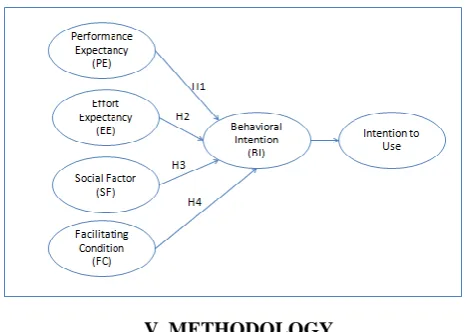
Following hypothesis were studied to analyze Mobile learning adoptions among the students,
H1 Performance Expectancy has no influence on the behavioral intention to adopt mobile learning among the students H2 Effort Expectancy has no influence on the behavioral intention to adopt mobile learning among the students H3 Social Influence has no influence on the behavioral intention to adopt mobile learning among the students H4 Facilitating conditions has no influence on the behavioral intention to adopt mobile learning among the students
[image:4.595.307.541.60.226.2]The analytical framework of the model is given below in figure 2 for the conceptual and analytical understanding of the study.
V. METHODOLOGY
The research was conducted systemically to study the hypotheses. It is a descriptive study, which based on the review of the former researches that had been conducted at various geographical locations across the globe. Review of literature gives an over view of the other studies. On those foundation, we have done a descriptive study to acquire more knowledge on the adoption of mobile learning among the students, studying undergraduate and post graduate in Chennai, Tamil Nadu, India.
Sample size was 116 students (Table 1) both male and female studying undergraduate and post graduate (Table 2) were taken into the studies and were residents of city of Chennai, (Tamil Nadu, India) during the time of receiving their response to the questionnaire.
Currently Studying - Table 2
Frequency Percent Valid
Percent
Cumulative Percent
V
al
id
Undergraduat
e 11 9.5 9.5 9.5
Post Graduate 10
4 89.7 89.7 99.1
Doctorate 1 0.9 0.9 100
Total
11
6 100 100
These samples have used mobile learning for their academic purpose. Their frequency of usage distribution is given in table 3. Among the respondent majority of them are the daily users of the smart phone their learning. For data collection both primary and secondary data methods were adopted. Secondary data were taken from the article of reputed, peer reviewed journals, online source of internationally renowned authentic sites known for their contribution in the domain of technology and management. Primary data was acquired using survey method with the tool of questionnaire.
Questionnaire had 34 items including the demographic variables. Under each constructs following items were asked,
How frequently have you used Smart phone for learning - Table 3
Frequency Percent Valid
Percent
Cumulat ive Percent
V
al
id Daily 49 42.2 42.2 42.2
[image:4.595.49.290.207.342.2]Only During Exams/
Test 37 31.9 31.9 100
Total 116 100 100
Table: 4 S
. No
Variable/ Construct
Items
1
Per
fo
rm
a
n
ce
Ex
p
ec
ta
n
cy
(PE)
Mobile Technologies are useful in education in general.
Using mobile technologies enable students to accomplish tasks more quickly.
Mobile technologies would improve students’ performance.
Mobile technologies would increase students’ productivity. 2
Effo
rt
Ex
p
ec
ta
n
cy
(EE)
Mobile technologies are easy to use.
Finding or using features in mobile technologies is easy.
Learning to operate mobile technologies is easy
3
S
o
cia
l
Fa
cto
r
(S
F)
People who influence my behaviour think that I should use mobile technologies
People who are important to me think that I should use mobile technologies for learning.
University teachers are supportive of the use of mobile technologies.
4 Facilitat ing Condition (FC)
In general, my University campus has support for mobile learning
In general, the country in which my university campus is located has support (infra-structure, policies etc.) for mobile learning.
I have the resources necessary to use m-Learning
I have the knowledge necessary to use m-Learning
Support from an individual or service is available when problems are encountered with m-Learning technologies.
5 Behavio ral Intention
I intend to use m-Learning technologies in the next semester.
I predict I will use m-Learning technologies in my courses in the next semester.
I have a plan to use m-Learning technologies in the near future.
The electronic questionnaire were administered to the students studying undergraduate and post graduate in Chennai using simple random sampling method. Questionnaires were sent to them using google form during the month of August 2018. Link to the questionnaire were sent using the whatapps to about 200 contacts. Out of 200 student responded 116 of them responded positively and completely.
VI. DATA ANALYSIS & FINDINGS
The data collected through questionnaire, were coded for the statistical analysis using SPSS. In SPSS the factor analysis, regression and model fit test were conducted. For the parametric test, data were normalized using data normalization for the symmetrical data distribution.
According to the Pearson's correlations test, each of the variables have significant correlations among themselves. Effort Expectancy and Facilitating conditions have higher correlations of .663 among each other. Follows by other variables which correlate significantly according to the test.
Correlations - Table 5
TotBI TotPE TotEE TotSF TotFC
P
ea
rso
n
Co
rre
latio
n
TotBI 1.000 .584 .536 .644 .561
TotPE .584 1.000 .645 .477 .481 TotEE .536 .645 1.000 .390 .663 TotSF .644 .477 .390 1.000 .593 TotFC .561 .481 .663 .593 1.000
The UTAUT model and its variables had been tested to understand the fitness of the model to study the objectives. According to Durbin -Watson, the R square value is .543 which vindicate the proportionate independence variables influence on the dependent variable. R square value ranging for 0-1 explains the percentage of variables influence on dependent variable. These variables has .543 R square value which is significant to study the variables and their influence. Thus proving model fit for the study.
Model Summaryb Table 6 Mode
l
R R Square Adjusted R Square
Std. Error of the Estimate
Durbin-Watson
1 .737a .543 .527 1.61784 2.130
ANOVAa Table 7
Model Sum of
Squares
df Mean Square
F Sig.
1
Regressio
n 345.356 4 86.339 32.987 .000
b
Residual 290.532 111 2.617 Total 635.888 115
According to the coefficient value of significance α < 0.05 refers to the significant relationship between independent variable and dependent variable. Following inference have been arrived on the hypotheses of the study.
Hypothesis (H1) is Performance Expectancy (PE) has no significant influence on the behavioral intention (BI) to adopt mobile learning among the students. Performance Expectancy has significant value was .008, which is well below the .05 conveying that the influence of the PE is significant. Thus disproving the hypothesis H1 as stated, Performance Expectancy has no significant influence on the behavioral intention to adopt mobile learning among the students. The students were well influenced by the performance of the mobile technology or the apps to adopt the mobile learning. As the mobile technology had already penetrated well into the market and performance had already been well realized by the consumers, it had been a positive factor to influence the behavioral intention of mobile learning. Thus the PE and BI relationship is significant.
Hypothesis (H2), Effort Expectancy (EE) has no influence on the behavioral intention (BI) to adopt mobile learning among the students. As per the coefficient value significance of EE was .128 which infer that EE and BI doesn't have relational impact on each other. Thus proving the H2. Also the standard coefficient was much lower than PE and SF reflecting its relationship with BI.
Hypothesis 3 (H3), Social Influence (SI) has no influence on the behavioral intention (BI) to adopt mobile learning among the students. The Coefficient significant value is .000 which infer there is a significant relationship between SI and BI. That SI influences the students to adopt and continues the intention to adopt the mobile learning for their studies. The Standard Coefficient was .408 which was having maximum influence on the students to use the mobile learning. The students have been widely influenced by the peers, family and society at a large. So SI influence on adopting the mobile learning was higher due to the student accustoming to their peers word of mouth or to please them through their activities or to gain their inclusiveness.
Hypothesis 4 (H4), Facilitating Conditions (FC) has no influence on the behavioral intention (BI) to adopt mobile learning among the students. This hypothesis was proved through the coefficient test. The significant value of FC is .308 inferring insignificant influence on the behavioral intention. Thus the influence of FI on the students to use the mobile learning were insignificant. The facilities provided by the college, other supports to use the smart phones and
internet had been proved to be insignificant contribution in influencing the intention to adopt mobile learning.
VII
.
DISCUSSIONThe authors after a strenuous study have able to conclude the factors influencing the behavioral intentional to adopt mobile learning using the model of UTAUT. As per the previous studies PE, EE, SF and FC were the major independent variable influenced the consumers to adopt any technology. Of this study, authors were able to identify only two variable have sumptuous impact on the adoption of mobile learning. The two variables were Social Factor and Performance Expectancy in the order of their influence on the students studying Undergraduate and Post graduate in Chennai. The application use of the study is, if the mobile application developer and firms involved in mobile learning may increase their concentration on creating a positive word of mouth, influence from the social group and other social factors. The social factors had been influencing the students in .427 for every quantifiable one unit of SF. Also the Performance expectancy was another variable having an incremental effect on the BI. By improving the mobile technology, adding more features and values of the service the PE can improve its impacts. An unit of PF can influence BI that is students intention to adopt the mobile learning can be increased at .189 according to the test of coefficient. Limitations and discussion for further research This research was within the city of Chennai, Tamil Nadu. The same research can be extented to the other cities and states. This study had its limitation to the undergraduate and post graduate students of the colleges in Chennai. The same can be tested with the students of various disciplines, school children and diploma and doctorates. As these were the millennial customers, the same can be study with the GENX and GENY for the more understanding of the previous generations attitude towards technology and technology based learning.
VIII CONCLUSION
The smart phones have disrupted the way the learning was taking place. It has changed the students preference of learning from text books to smart hand held devices like smart phones and Ipad. The era of paper and pen for the discussion and subject notes have also got much replaced in the today's context among the students studying in colleges in Chennai. Exams are the time students spent much time for learning. During exams, it is commonly observed that how students adopts to the mobile technology for learning. They prefer soft books and notes rather than studying from the physical copies are evidence of adoption. Learning using smart phone is more convenient to get to any study material from internet. Enhanced eco system to learn using smart phones have enabled the adoption of mobile learning. As smart phones with internet connections are becoming an effective tool for learning and as vouched by this study using UTAUT model, academic institutions and mobile phones company should pay attention to make use of this change in society and in technology adoption.
Coefficientsa Table 8 Model Unstandardized
Coefficients
Standardi zed Coefficien ts
t Sig.
B Std.
Error
Beta
1 (Const
ant) 1.190 1.005 1.184 .239
TotPE .189 .069 .242 2.722 .008
TotEE .163 .106 .154 1.533 .128
TotSF .427 .088 .408 4.866 .000
The academia may design curriculum learning using smart phones, including activities using mobile learning and encourage use of learning apps. They can also develop the apps for their schools and colleges to enhance the learning experience. Mobile company and app makers should study further the needs of the academic institutions and design online resources catering to the needs of different segments of students. There are much scope and business opportunity to explore in the education industry.
REFERENCE
1. Anna Trifonova , 2003, Mobile learning - Review of the Literature,University of Trento, March 2003 , Technical Report # DIT-03-009
2. Garner I., Francis J., Wales K.: An Evaluation of the Implementation of a Short Messaging System (SMS) to Support Undergraduate Students, Proceedings of the European Workshop on Mobile and Contextual Learning, (p. 15-18), Birmingham, UK, June 2002
3. Lytridis, C., Tsinakos, A., & Kazanidis, I. (2018). ARTutor—An Augmented Reality Platform for Interactive Distance Learning. Education Sciences, 8(1), 6.
4. Mohammed Sarrab, H. A. ( August 2012). M Learning and Educational Environment . International Journal of Parallel Emergent and Distributed Systems
5. Lehner F, N. H. ( 2002 Aug ). The role of mobile devices in e-learning first experiences with a wireless e-learning environment. IEEE International Workshop on Wireless and Mobile Technologies in Education.
6. Donnelly.K. (2009). Learning on the move: How m-learning could transform training and development. Development and Learning in Organizations, 8–11.
7. Shahroury, F. R. (2016). A Framework for Mobile Learning Adoption. Indian Journal of Science and Technology, 9, 48.
8. Piaget, J. (1929). The child’s conception of the world. New York: Harcourt, Brace Jovanovich.
9. Shahroury, F. R. (December 2016). A Framework for Mobile Learning Adoption. Indian Journal of Science and Technology,.
10. Papert, S. (1980). Mindstorms: Children, computers, and powerful ideas. Brighton, UK: Harvester Press.
11. Palincsar, A. S. (1998). Social constructivist perspectives on teaching and learning. Annual review of psychology, 49(1), 345-375. 12. Vygotsky, L. S. (1978). Mind in society (M. Cole, V. John-Steiner, S.
Scribner, & E. Souberman, Eds.).
13. Siemens, G. (2005). Connectivism: Learning as network-creation. ASTD Learning News, 10(1), 1-28.
14. Venkatesh, V., Morris, M. G., Davis, G. B., & Davis, F. D. (2003). User acceptance of information technology: Toward a unified view. MIS Quarterly, 27(3), 425-478
15. Sharma, R., & Mishra, R. (2014). A review of evolution of theories and models of technology adoption. Indore Management Journal, 6(2), 17-29.
16. Ricardo de SenaAbrahãoa, Stella NaomiMoriguchib, Darly FernandoAndradeb, (2016), Intention of adoption of mobile payment: An analysis in the light of the Unified Theory of Acceptance and Use of Technology (UTAUT), Science Direct
17. Kang, S. (2014). "Factors influencing intention of mobile application use", International Journal of Mobile Communications, 12 (4), 360-379.
18. Thomas, T., Lenandlar, S., & Kemuel, G. (2013). The utility of the UTAUT model in explaining mobile learning adoption in higher education in Guyana. International Journal of Education and Development Using Information and Communication Technology, 9(3), 72–87.
AUTHORS PROFILE
Mr. Densingh Joshua Israel, is an Assistant Professor and Research Scholoar in SRM School of Management, Chennai, India. He educational qualification; MA & M. Phil in Political Science and International Relations from Madras Christian College, Master of Business Administration in Marketing from University of Leicester, UK,
Masters in Biblical Studies from Asian Theological Seminary and pursing his doctorate in consumer behavior. He is an ardent Socio-Economic thinker and writer and theologian and delivers guest lecturers and speaker in colleges and in gatherings.