Abstract: Super resolution technique in digital image and video frame for enhancing the imaging system to acquire high resolution from low resolution image/frame. The challenges in super resolution are video/image registration, Denoising, light variation, blur identification, computation efficiency and performance limits. In order to overcome the problem of high frequency details lost during reconstruction and computational complexity due to iterative methods in the existing super resolution techniques, this paper propose a work of fiction algorithm named Super Interpolation(SI) to achieve the low complex upscaling of video frames with High Resolution(HR). SI method consists of two phases: Upscaling Phase and Training Phase. In the training phase, a large set of external training images/video frames undergoes edge orientation analysis. The primary, upscaling phase, the LR video frame is upsampled and interpolated by bicubic interpolation method. Then the interpolated frame is subjected to edge detection by canny edge detector for frame smoothing. Frame sharpening is by local laplacian filter with edge preservation technique to get the reconstructed HR video frame. The proposed method tested on two different data sets YT dataset and Real Time (RT) – India dataset. It is found from the experimental results that the proposed method performs better than existing FRESH algorithm from both subjective visual effect and objective measurements of PSNR and SSIM with less computational time.
Index Terms: edge orientation, gradient, image upsampling, resolution enhancement, super interpolation.
I. INTRODUCTION
Super-resolution (SR) is the technique which improves the resolution of an imaging system by generating a high resolution image from a low resolution input image/frame. Super Interpolation is the fast super resolution method of obtaining high resolution image/video.SR method not simply interpolating the unknown pixel intensity values but it find their accurate value based on the information in the input.SR uses the interpolation of the sub-pixel shifts that infer a more accurate object location with a sub-pixel resolution between multiple low resolution images/frames of the same continuous scene. Super-resolution (SR) technique aims to overcome the limitation of the image acquisition device and ill posed nature of the device to generate a higher resolution image.
Video super-resolution (VSR are systems that build a
Revised Manuscript Received on June 7, 2019
S. Muthuselvan, Department of CSE, Aarupadai Veedu Institute of Technology, Chennai, Tamil Nadu.
S. Rajaprakash, Department of CSE, Aarupadai Veedu Institute of Technology, Chennai, Tamil Nadu.
Byrapaneni Nikhil, Department of CSE, Aarupadai Veedu Institute of Technology, Chennai, Tamil Nadu.
J Hemanth Sai, Department of CSE, Aarupadai Veedu Institute of Technology, Chennai, Tamil Nadu.
solitary high-goals (HR) video outline from a few watched low-goals (LR) video outlines. video super-goals, which is characterized just as improving the goals of a given video and can possibly conquer the troubles of numerous significant errands, for example, breaking down observation camera film and improving low-quality phone videos. [11].
Video super-resolution residue a not easy problem and is a very vigorous area of do research. Algorithms of video super resolution are mainly based on spatial domain and wavelet transform methodology. In wavelet method, LR images are enhanced by the corresponding low pass filtered sub bands of Discrete Wavelet Transform (DWT) for HR images. In spatial domain shift add fusion makes the edges of video frames get sharp during image upsampling Super resolution algorithms are based on both spatial and wavelet domain and take the advantage of both.
Iterative back projection algorithm is to minimize the reconstruction error but leads to more complexity. To reduce the complexity, this paper proposes Super Interpolation (SI) algorithm with canny edge detector and laplacian filter which unifies together straightforwardness of exclamation and excellence enhancement of SR with the less computational time. The algorithm developed for suicide prediction made and identified reason of suicide and ranked them using the intuitionistic fuzzy set because it will give better output over impression information. [12]. The paper is prepared as follow: Section II outlines the associated work, section III discuss about the proposed methodology; section IV explains the implementation results and performance evaluation. Section V describes about the conclusion and future work.
II. RELATEDWORK
Xiaoyao Wei et al [11] proposed the single image super resolution which is based on FRI – Finite Rate of Innovation which is the classes of signals of finite degrees of freedom per unit of time. FRESH – FRI based SinglE Image Super Resolution Algorithm in the existing work uses wavelet transform technique for feature extraction along horizontal, vertical and diagonal edges of the image.
A hybrid reconstruction method proposed by L. Baboulaz et al [2] based on classical linear recovery of the smooth part and non-linear recovery of the piecewise polynomial part using FRI on the same set of samples. The method for sampling 1D of image scan-lines, is a piecewise smooth signal given as the sum of a piecewise polynomial as non -linear function and a globally smooth part as a linear function.
Image gap interpolation
method proposed by
Bahareh Langari et al [3] shows improvements in
Resolution Enhancement in Video Using Super
Interpolation Algorithm
image gap restoration by the merging of edge-based directional interpolation using multi-scale pyramid transforms. There are two types of image edges reconstructed namely (i) the local edges or textures obtained the gradients of the neighboring pixels and (ii) the global edges between image objects by a Canny detector.
Edge-aware image filters are based on the direct manipulation of Laplacian pyramids approach proposed by S.Dippel et al [4] produces high quality results of no degraded edges and halos, even at extreme settings. Laplacian filters builds upon standard image pyramids and enables a broad range of effects via simple point-wise non-linearity.
The Canny Edge detection (Gradient method) is also called First order derivative based edge detection method proposed by Mamta Juneja et al [8] the minimum and maximum edges will be detected from the image with first derivative. Sharpening the image patches results in the detection of fine details as well as enhancing blurred image patches. The magnitude of the gradient is the most powerful technique that forms the basis for various approaches to sharpening [8].
Though there are several super resolution methods available in the literature the super resolution in video stream demands robust in subjective visual qualities of fine texture details and sharp edges.
III. PROPOSED-RESOLUTIONENHANCEMENT
INVIDEOSINGSUPERINTERPOLATION ALGORITHM
[image:2.595.51.295.364.691.2]
Figure 1.Block diagram of Proposed Super Interpolation Method
Super Resolution is performed by Super Interpolation algorithm which is the fast super resolution technique of converting low resolution image/frame to high resolution one. Super Interpolation algorithm involves edge detection method by canny edge detector and resolution enhancement
by local laplacian filter that denoise the LR frame with edge preservation to generate HR frames of improved enhancement quality.
The LR video frame is upsampled and interpolated by bicubic interpolation method. The interpolated frame is subjected to edge preservation technique of laplacian and Gaussian pyramid method. Then it is denoised by local laplacian filter to get the final reconstructed video frame. Experimental results show that this method is superior to the traditional algorithms from both the visual effect and objective measurements of PSNR and SSIM with less computational time.
The steps involved are described below:
A. Upsampling
In Super Interpolation algorithm, Upscaling/Upsampling of video frame which resize the image/frame by increasing the no of pixels by the upscaling factor of 2.
LR image/frame L is denoted as
L = {Yi } (3)
Where,
Yi is i-th LR image patch
Ny is the total number of image patches in L. HR image/frame H is denoted as
H = {Xi} (4)
Where,
Xi is i-th HR image patch,
Nx is the total number of image patches in H.
B. Bicubic Interpolation
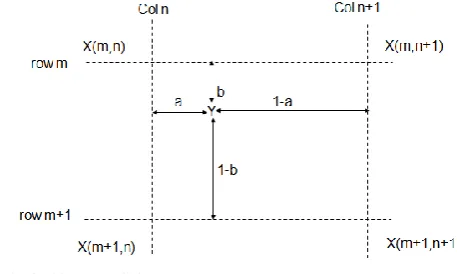
[image:2.595.313.542.556.693.2]In the upscaling phase, the LR video frame is first interpolated by bicubic interpolation methodwith upscaling factor of 2.Bicubic Interpolation is the process ofdetermining the values of a function at positions lying between its samples. It preserves high frequency and prevents aliasing. Bicubic considers the closest 4x4 neighborhood of known pixels for a total of 16 pixels.
Fig 2.Bicubic Interpolation
LR input frames
Denoising Upsampling
Bicubic Interpolation
Edge Orientation Analysis
Resolution Enhancement
Reconstructed HR Output Frames
N
y i=1Interpolated value of „Y‟ is calculated by the given Eqn (1-a)(1-b)x(m,n)+b(1-a)x(m+1,n)+bax(m+1,n+1)+a(1-b)x (m,n+1) (1)
C. Edge orientation analysis
Image gradients are used to extract the magnitude and direction of the images/frames. Every pixel of a gradient image measures the transform in intensity of that similar position in the unique image, in a known direction. Gradient images are computed beside x and y directions and pixels with large gradient values become possible edge pixels.
Edge Orientation analysis done by Canny Edge detector which was developed by John F. Canny. It is an optimal detector that aims to satisfy three main criteria: Low error rate: Good detector of only existent edges. Good localization: Minimizing the distance between edge pixels detected and real edge pixels. Minimal response: Only one detector response per edge.
To find edge orientations for LR image patches, employed two gradient operators
Sh= and Sv= (2)
Where,
Sh = Horizontal gradient operator. Sv = Vertical gradient operator.
Gradient magnitude: provides information about edge strength.
Gradient direction: perpendicular to the direction of the edge.
Gradient calculation:
38 66 65
14 35 64
12 15 42
x-1 x x+1
[image:3.595.311.551.285.340.2]
Figure 3.Gradient Calculation
Intensity derivatives f(x,y) horizontally and vertically
∇f(x, y) = G {f(x, y)} = = (5)
Size G and Angle θ
GR = (6)
θ = tan-1 (7)
fy= ((38-12)/2+ (66-15)/2+ (65-42)/2)/3= (13+25+11)/3 = 16
fx= ((65-38)/2+ (64-14)/2+ (42-12)/2)/3= (13+25+15)/3 = 18
θ = tan-1(16/18) =0.727 rad = 42 degrees & | (∇f)| = (162+182)1/2 = 24
D. Resolution Enhancement
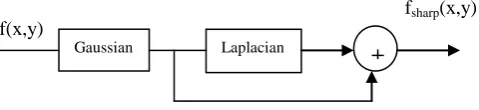
Resolution Enhancement of video frame by the laplacian, filter of Gaussian which make use of the second order operators. Laplacian Operator is used to find the edges in an
image which is a second order derivative mask that makes stronger response to fine details and double response is produced at step changes in gray level. Since derivative filters are very sensitive to noise, the image is first smoothened using a Gaussian filter before applying the Laplacian. Edges are extracted from the image after the edge sharpening.
Edges extracted from the first derivative mask of canny edge detector is subjected to the lapalcian filter of Gaussian to have second derivative mask which highlights the fine details with robust feature and texture matching.
The edges in the image can be obtained by these steps: 1) Laplacian of Gaussian is applied to the image/frame 2) Zero-crossings (point where the laplacian sign changes) are detected in the image
3) Zero-crossings above threshold value are the strong edge pixels.
4) Suppressing the weak zero-crossings most likely caused by noise.
Second derivatives for Resolution Enhancement
Figure 4.Laplacian of Gaussian
Background features can be recovered while still preserving the sharpening effect of Laplacian operation simply by adding the original and Laplacian image.
mask =
Figure 5. Laplacian Mask
fsharp(x, y) =f(x, y) - ∇2f(x, y) - if center coefficient of mask
is negative (9)
fsharp(x, y) =f(x, y)+ ∇2f(x,y) - if center coefficient of mask
is positive (10) Where,
f(x,y) = input image in two dimension x & y. ∇2
=Second order derivative of mask.
fsharp(x,y) = reconstructed sharpened image in two
dimension x & y Laplacian Pyramid
The Laplacian pyramid is used for decomposing images into multiple scales and is widely used for image analysis operations such as edge-preserving smoothing and tone mapping
-1 -1 -1
-1 8 -1
-1 -1 -1
Laplacian
f(x,y)
Gaussian
+
fsharp(x,y)
y+1 y y-1
θ fx
fy
∇f
Higher intensity values
Figure 6.Laplacian pyramid
Gaussian pyramid
[image:4.595.311.527.288.339.2]In a Gaussian pyramid, subsequent LR images/frames are downsampled using a Gaussian blur. Each pixel contains a minimum average of the intensity value which corresponds to a pixel neighborhood on a lower level of the gaussian pyramid. This technique is used especially in texture synthesis of the LR frames/images. Pyramid filters generate a set of downsampled versions of an image/frames.
Figure 7.Gaussian Pyramid
Frame smoothing is done by Gaussian filter, hence the laplacian and Gaussian functions are combined to obtain single equation
LoG(x,y)= (8)
Laplacian of Gaussian (LoG) filter is applied with Gaussian σ = 1.0, using a 3x3 kernel. The LoG administrator takes the second subsidiary of the picture. Where the picture is essentially uniform, the LoG will give zero. Wherever a change happens, the LoG will give a positive reaction on the darker side and a negative reaction on the lighter side. At a sharp edge between two locales, the reaction will be I) zero far from the edge ii)positive just to the other side iii)negative just to the opposite side iv)zero sooner or later in the middle of on the edge itself.
IV. IMPLEMENTATIONRESULTSAND
DISCUSSION
The proposed method is implemented in Pentium IV 2.66 GHz processor with 4GB RAM. The proposed work is coded in Mat lab using matlab2013a with Visual studio 2013 and the proposed method is tested with 2 different data sets:
1) YT dataset - 20 2) RT India dataset – 20
Each subject was trained individually using 20 sample frames from their respective video.
A. YT dataset :
The YT data base contains 3425 videos of 1595 different datasets. The proposed work is tested upon 20 subjects of surveillance, objects, face, nature, buildings from the dataset.
B. Real time (RT) - India dataset:
RT India database contains 400 frames of surveillance, objects, for training and testing phase.
[image:4.595.60.268.341.423.2]
Figure 8.Edge detected frames by canny edge detector from YT dataset
Figure 9.Edge detected frames by canny edge detector from RT -India dataset
C. Resolution Enhancement – Reconstructed video frames
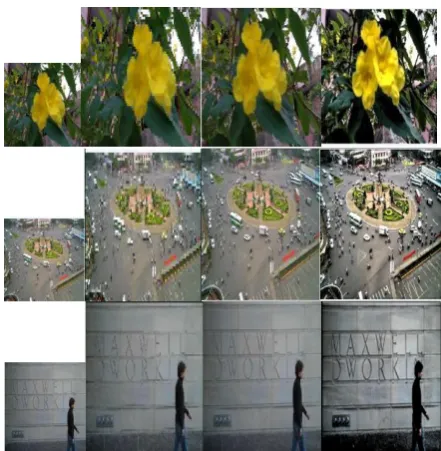
Reconstructed video frames after frame smoothing and frame sharpening from LR input is shown in figure 11 (d) of proposed super interpolation algorithm and it is compared with the other existing super resolution methods shown in figure 9 (b)- Bicubic interpolation and (c) - FRESH Algorithm from RT-India data set and YT Dataset.
D. Performance evaluation - PSNR
Peak signal to noise ratio (PSNR), the square of the peak value in the image is divided by the mean square error. Two
commonly used measures for image
compression/reconstruction quality are Mean-Squared Error (MSE) and Peak Signal to Noise Ratio (PSNR).MSE strongly depends on the image intensity scaling. PSNR avoids this problem by scaling the MSE according to the image range.
PSNR:
PSNR=-10log10eMSE/S2(11)
Where,
S is the maximum pixel value
eMSE=1/MN∑ ∑[ ĝ(n,m)-g(n,m)]2(12)
where,
M and N are the number of Performance
evaluation factors
Linear Reconstructio
n
FRESH Algorithm
Super Interpolatio n Algorithm
PSNR(dB) 29.85 34.55 40.21
SSIM 0.829 0.902 0.966 Elapsed
time(seconds) 290.42 160.23 95.45
M N
[image:4.595.309.525.360.417.2] [image:4.595.41.285.644.737.2]rows and
Columns in the input images g (n,m) = HR image
ĝ(n,m) = LRimage
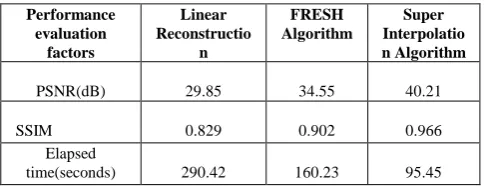
The PSNR comparison between existing and proposed Super Interpolation method upon RT-India and YT dataset is shown in Figure 10 and 13 respectively. The gain in PSNR over existing method is 3.66dB and SSIM score is improved by 0.053 obtained by averaging both datasets of YT and RT dataset. The existing methods taken into consideration for performance comparison are Linear Reconstruction [14], Bicubic Interpolation [9], FRESH Algorithm [14] and Super Interpolation [1].
[image:5.595.313.534.47.273.2]Table 1. The average PSNR (dB) for different resolution methods from YT dataset. Best results for each category (Linear Reconstruction, Bicubic Interpolation, FRESH Algorithm, Super Interpolation Algorithm are shown. There is substantial variance among the PSNRs of the projected technique and other procedures.
Figure 10.PSNR Response based on YT dataset
E. Performance evaluation -SSIM
2) SSIM: Structural similarity index (SSIM) is an image quality metric that assesses the visual impact of three characteristics of an image: luminance, contrast and structure.
SSIM(x,y)=[l(x,y)]α⋅[c(x,y)]β⋅[s(x,y)]γ(13) where,
l(x,y)=2μxμy+C1μ2x+μ2y+C1 c(x,y)=2σxσy+C2σ2x+σ2y+C2 s(x,y)=σxy+C3σxσy+C3
α = β = γ = 1(by default) , C3 = C2/2 ,C1 and C2 =1(by default)
𝞂 = standard deviation, μ=mean. The index simplifies to:
SSIM(x,y)=(2μxμy+C1)(2σxy+C2)(μ2x+μ2y+C1)(σ2x+
σ2y+C2) (14)
(a) LR input (b) Bicubicx2 (c) FRESH algorithm (d) SI algorithm
[image:5.595.51.293.316.480.2]Figure 11 Resolution enhancement –Reconstructed frames from YT and RT –India dataset for the upscaling factor of 2.
Figure 12. Average SSIM plot for 20 video clips of 20 frames each from YT Dataset.
Table 2. The mean PSNR (dB) for different resolution methods from RT
–India dataset. Best outcomes for every classification are appeared. There is critical distinction between the PSNRs of the proposed strategy and different techniques.
Performance evaluation
factors
Linear Reconstructio
n
FRESH Algorithm
Super Interpolatio n Algorithm
PSNR(dB) 28.14 33.50 38.83 SSIM 0.765 0.891 0.913 Elapsed
[image:5.595.315.540.349.485.2]Figure 13.PSNR Response based on RT-India dataset
Figure 14. Average SSIM plot for 20 video clips of 20 frames each from RT – India Database
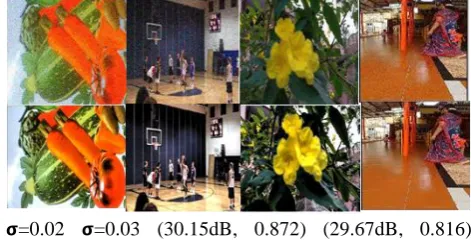
𝞂=0.02 𝞂=0.03 (30.15dB, 0.872) (29.67dB, 0.816) (28.43dB, 0.924) (29.67dB, 0.913)
Figure 15. Proposed video super interpolation system - robust to noise.
Figure 15 shows the Additive White Gaussian Noise (AWGN) is added to the input low-res order, with the noise level of 0.02 and 0.03 on videos from the database of YT and RT- India dataset. The super resolution outcomes are revealed in the figure above. The primary number in the parenthesis is PSNR score and the subsequent is SSIM score.
V. CONCLUSIONANDFUTUREWORK
A novel super-interpolation (SI) method, proposed in this work combines both the simplicity of interpolation and the quality enhancement of SR by using edge-orientation analysis and resolution enhancement technique. The proposed SI method can generate HR video frames of high resolution quality in terms of PSNR and SSIM with respect to computation complexity and yield comparable subjective visual qualities with fine texture details and sharp edges, compared to the other existing SR methods. SI is a hardware flexible scheme with one-step up-scaling that has no intermediate interpolated images, iterative computations
(IBP) and overlapping. In future, using 3D convolution the proposed work can be extended to super-resolve one frame from multiple neighboring frames.
REFERENCES
1. Jae-seok choi and Munchurl kim, “Super-interpolation with edge-orientation based on mapping kernels for low complex 2× upscaling,” ieee transactions on image processing, vol. 25, no.1, Jan.2016.
2. L. Baboulaz and P. L. Dragotti, “Exact feature extraction using finite rate of innovation principles with an application to image super-resolution,” IEEE Trans. Image Process., vol. 18, no. 2, pp. 281–298, Feb. 2009.
3. Bahareh Langari, Saeed Vaseghi, “Edge-Guided Image Gap Interpolation Using Multi-Scale Transformation,” IEEE Transactions on image processing, vol. 25, no.9, Sep.2016.
4. S.Dippel,M.Stahl,R.Wiemker,T.Blaffert“Multiscale contrast enhancement for radiographies: laplacian pyramid versus fast wavelet transform”,IEEE Transactions on Medical Imaging,vol.21,no.4,2002. 5. Hasan Demirel and Gholamreza Anbarjafari , “ Image resolution
enhancement by using discrete and stationary wavelet decomposition,” IEEE Trans. Image Process.,vol.20,no. 5,pp. 1458 – 1460, 2011. 6. C. Liu and w. t. freeman. “ A high-quality video denoising algorithm
based on reliable motion estimation”.in eccv, 2010
7. N.M. Lokhande, “A Matlab Based GUI for Multiframe Super Resolution Reconstruction of Different Gray Scale Images with and without Adaptive Filter” vol. 26-27 Feb. 2015
8. Mamta Juneja and Parvinder Singh Sandhu, “Performance evaluation of edge detection techniques for images in spatial domain,” International journal of computer theory and engineering, vol.5, Dec.2009. 9. Shamily Shaji, Angitha George, Shalin Elizabeth, “Super Resolution
and Denoising of Images via Dictionary Learning” IJSRD - International Journal for Scientific Research & Development, Vol. 3, Issue 09, 2015. 10. X.Wei , P. L. Dragotti, “FRESH - FRI based single image super resolution algorithm,” IEEE Transactions on Image Processing, vol. 25, no. 8, Aug.2016.
11. Alex Greaves and Hanna Winter, “Multi-Frame Video Super-Resolution Using Convolutional Neural Networks”,
http://cs231n.stanford.edu/reports/2016/pdfs/212_Report.pdf.
12. S. Rajaprakash, S. Muthuselvan, K. Karthik, K. Somasundaram, R. Jaichandaran, “Design of Suicide Prediction System Using Intuitionistic Fuzzy Set”, ISSN: 2277-3878, Volume-7, Issue-6, March 2019. 13. S. Muthuselvan, Praseeda Devi Tangatchi P S, Samundeeswari s &
Anjush Mahendra P M, “
AUTHORSPROFILE
Dr.S.Rajaprakashis M.sc, M.Phil M.E Ph.D. currently working as Associate professor of CSE in Aarupadai Veedu Institute of Technology an ambit institution of Vinayaka Missions Research Foundation (Deemed to be University), Tamil Nadu, India. He has 17 years of experience in academics, research, and development activities. Published 20 research papers in referred Journals and Conferences. His area of Interest Artificial Intelligence, Computational Intelligence, Discrete Mathematics and Automata theory. .Received grants from Tamil Nadu State Council for Science and Technology. He has peer Reviewed Manuscripts in reputed international Journals and Conferences. He is a member in following professional societies: CSI and ISTE and Ramajunam Mathematical Society.
Having 15 years of teaching experience with 4 years of research experience. He is a member in CSI and Life member of ISTE. He has peer Reviewed Manuscripts in reputed international Journals and Conferences.
Byrapaneni Nikhil, Final year CSE in Aarupadai Veedu Institute of Technology an ambit institution of Vinayaka Missions Research Foundation (Deemed to be University), Tamil Nadu, India. He is actively participated the events conducted in various colleges.