ISSN Online: 2164-2834 ISSN Print: 2164-2818
DOI: 10.4236/ojml.2019.93020 Jun. 30, 2019 215 Open Journal of Modern Linguistics
Spanish Language Grammatical
Context—Acknowledging Specific Language
Characteristics
Joel Laffita Rivera
Faculty of Applied Communication (FAC), Multimedia University, Selangor, Malaysia
Abstract
The current research article exposes a linguistic-outline-analysis about the use of Nouns-Object/Thing/Place, Definite and Indefinite Articles and De-scriptive Adjectives in the writing and speaking context of Spanish language communication. The teaching and learning of these Spanish grammar themes continue to be subject of interest among scholars due to the level of complex-ities that these syntaxes present in terms of Second Language Acquisition (SLA) (Bialystok, 1981). The article collected appropriate literature-materials from different sources and added new-contextual-insights into its frame to adhesive an analytical-database with emphasis on Spanish Language Grammat-ical Contexts that tap into the subject-matter-discussed. Being consecutive to this, the study aimed to provide valuable material as a reference to teach and study these Spanish grammar subjects in Spanish foreign language classes.
Keywords
Learning-Language-Retention, Translation, Grammar-Patterns, Communication-Insights, Methodology-Schemes
1. Introduction
The grammar of the Spanish language is by logical definition “the Spanish gram-mar”, redundant definition but denotes the “authenticity” of this discipline refer-ring to the Spanish language in particular. The following statement quotes that grammar is part of Linguistics which studies the elements of a language as well as the way in which these are organized and combined (Diccionario de la lengua es-pañola, 2015). The Spanish language possesses unique grammar shapes and grammatical structures that make this language exclusive and different from other How to cite this paper: Rivera, J. L. (2019).
Spanish Language Grammatical Context— Acknowledging Specific Language Charac-teristics. Open Journal of Modern Linguis-tics, 9, 215-228.
https://doi.org/10.4236/ojml.2019.93020
Received: April 19, 2019 Accepted: June 27, 2019 Published: June 30, 2019
Copyright © 2019 by author(s) and Scientific Research Publishing Inc. This work is licensed under the Creative Commons Attribution International License (CC BY 4.0).
http://creativecommons.org/licenses/by/4.0/
DOI: 10.4236/ojml.2019.93020 216 Open Journal of Modern Linguistics languages. For instance, in Spanish the nouns form a two-gender system and are marked for number. This is a fact that reflexes on nouns-object/thing/place.The definite articles, excluding the neuter “lo”, and indefinite articles are also marked for gender and number. All grouped “nine in total” and with unique gram-mar-shapes. Although the adjectives and descriptive adjectives do not have gender in Spanish; they are subjected to follow the same patterns (gender and number) when they adhered to these grammar themes (article/noun) (Batchelor, José, & Ángel, 2010). The way with which these syntaxes components are treated referring to the use of gender (masculine/feminine) and the number (singu-lar/plural) and the arrangement (words order) of nouns, articles and descriptive adjectives into the writing and speaking context of Spanish language communi-cation makes more challenging the teaching and learning of these grammar themes in Spanish FL classes, essentially when working with 2L learners whose native-language does not apply the “gender/number/words-order” as Spanish does. As a result, the acquisition and development of the linguistic and commu-nicative competences that involve the use of these Spanish grammar themes cannot produce successful language-outputs without acknowledging these dis-tinct-syntaxes-patterns-usages. Based on this overall respect, the research article is addressing its headings and sub-headings.
2. Learning Language Retention
DOI: 10.4236/ojml.2019.93020 217 Open Journal of Modern Linguistics and descriptive adjectives in Spanish if the learners do not acknowledge these distinct-syntaxes-patterns and their usage. Thus, understanding that the mind of the 2L learners does not conceived the acquisition of grammar and grammatical structures of the L2 without using the knowledge that it has already been con-ceived by the L1, it will lead us to emphasis on the significant of acknowledging the L2 own-grammar-patterns in translation by considering the fact that in Spanish nouns-object/thing/place and definite/indefinite articles are marked for gender and number; that the descriptive adjective are subjected to the gend-er-number-nature of nouns/articles; that it is necessary to know the words-order of nouns/articles/adjectives into the speaking and writing context of Spanish; that there are communication-linguistic-structures that require to be know-ledgeable about the use of these Spanish-syntaxes for applying them correctly in this specific field. Furthermore, that there are rules and exceptions related to the use of L2-grammar. In practice, failing in doing this could have adverse effects to the mind of 2L learners leading to distortion and inadequate Lan-guage-Learning-Retention.
3. Grammar Patterns-Nouns Object/Thing/Place
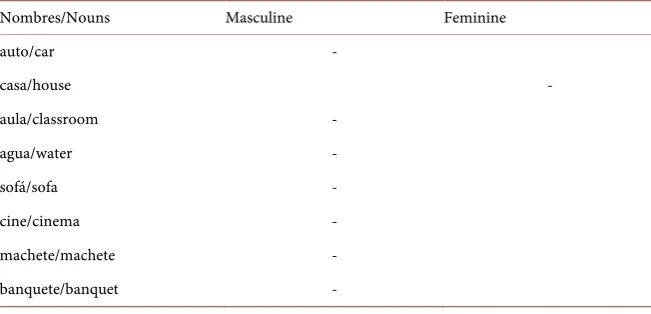
[image:3.595.210.536.570.727.2]One of the most questionable Spanish language topics in Spanish FL classes is the use of the gender, mostly referring to its application in nouns-object/thing/place. For 2L learners whose native-language does not apply the gender in nouns-object/ thing/pace in the way Spanish does. This often becomes a difficult Spanish lan-guage-issue to comprehend and digest. The main reason points to the inference of the L1-mind-subconscious which does not apprehend such irrational-view, I would say. However, from the point of view of language-learning-retention is clear that the keyword required is “acknowledging”. It might seem not logical classifying the nature of an object, thing or place in the same way that we do in the case of people or animals when we refer to their gender (male/female). Non-etheless, this is well-seen linguistic-phenomenon in the case of Spanish language own-linguistic-characteristics as well as in others European Languages such as French, Germany, Portuguese and Italian (see Table 1).
Table 1. Nouns object/thing/place gender.
Nombres/Nouns Masculine Feminine
auto/car -
casa/house -
aula/classroom -
agua/water -
sofá/sofa -
cine/cinema -
machete/machete -
DOI: 10.4236/ojml.2019.93020 218 Open Journal of Modern Linguistics
Continued
calle/street -
llave/key -
art/arte -
air/aire -
librería/bookshop -
universidad/university -
educación/education -
profesión/profession -
hospital/hospital -
libertad/liberty -
universo/universe - -
As can be observed from the above Table 1; it could be difficult to recognize a masculine or feminine noun in the case of objects/things/places. If we think for instance how variable and distinct they are, it could be also a real challenge to master this topic. I essentially say this because in Spanish all nouns referring to objects/things/places have their own-orthography/spelling which cannot be changed in terms of gender-application. In this respect it is necessary to ac-knowledge these specific-linguistic-traits. For this reason the study has outlined the statements below to provide a clear understanding regarding to the use of gender/number and singular/plural in Objects/Things/Places according to the writing system of Spanish language:
- Usually, the nouns that end in a vowel “o” are masculine (anillo/palacio/auto/libro) etc. Generally, nouns ending in a vowel “a” are feminine; excluding exceptions of nouns that end in a vowel “a” but are masculine (agua/mapa/alba/sofá) ext.
- Nouns that end in a vowel “e” can be masculine or feminine. However, by considering that the predominant way in terms of the use of gender in Span-ish is “masculine one” and that the number of masculine nouns ending in “e” is much greater than that of the feminine one, identifying the female between these kinds of nouns is a thing of going for the masculine one. Of course, learners need to count on the help of the Spanish teacher to do so: (cine/restaurante/machete/banquete/pacquete/panque/aceite/arete/calle/llave /clase) ext.
- Usually nouns ending in the vowel “i” are masculine (rubí/maní) ext. - The nouns beginning in a vowel “a” are usually masculine
(amanec-er/atardecer/ambiente/arte) ext.
Note: Nouns ending in “consonants” can be male or female. However, among these kinds of nouns are those that the following references (syllable) telling us the gender to which they belong.
DOI: 10.4236/ojml.2019.93020 219 Open Journal of Modern Linguistics - Nouns ending in “ad”/“zión”/“ción”/“xión” are female (universidad/popularidad/
amistad/profesión/educación/crucifixión) ext.
4. Grammar Patterns-Singular/Plural-Nouns
The singular and plural is generally applied to all nouns. It is easy to recognize the singular nouns since the vast majority of them do not have “s” at the end of the word that referred to them as such. So, the “s” at the end of these words will determine also the plural in all these cases: casa/casas/libro/libros/pueblo/pueblos ext. If the nouns end in a “vowel with tilde” the “es” is added, excluding some exceptions: rubí-rubíes/sofá-sofás/café-cafés ext. The “es” is added to nouns ending in consonants as well: proyectores/universidades. Nouns’ ending in “z” this letter is changed by the “c” and “es” is added: cruz/cruces/lápiz/lápices ext.
5. Grammar Patterns-Definite and Indefinite Articles
The acquisition and application of definite/indefinite articles in Spanish FL language classes is another complex issue to comprehend and digest for 2L learners whose native-language does not apply these syntaxes in the way Span-ish does. Nevertheless, knowing theses linguistic-application-views it will lead to certain analyzes and understanding: in Spanish the definite articles are used to determine and to give a connotation to the nouns they refer to. For exam-ple, saying “The white horse”. It is not the same as to say “A white horse”. In the first case we refer to a specific horse among many. In the second case we refer to any horse among many. The definite articles are also the grammatical components which determine the gender of nouns ending in “e”/“ista”El estu-diante./La estudiante./El dentista./La dentista. In the case of “neutrality and cognation” the article “lo” is used, but it followed by a masculine adjective Lo
Bueno./Lo malo. Lo intersante. On the other hand, the indefinite articles do
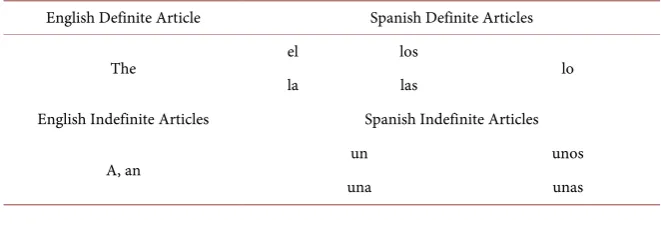
[image:5.595.208.539.623.736.2]not give the same connotation to the nouns they refer to as the definite articles do. However, when it comes to “determiners” they do as quantifiers (un/una instead of uno which means one). The definite articles are the English equiva-lent of “the”, while the indefinite articles are the English equivaequiva-lent of “a, an, some/few” (see Table 2). Despite the differences between these two grammar themes; both, definite and indefinite articles show agreement in gender and number (see Table 3).
Table 2. English/Spanish definite and indefinite articles.
English Definite Article Spanish Definite Articles
The el los lo
la las
English Indefinite Articles Spanish Indefinite Articles
A, an un unos
DOI: 10.4236/ojml.2019.93020 220 Open Journal of Modern Linguistics
Table 3. Definite and indefinite articles gender and number.
Articles Singular/Masculine Singular/Feminine Plural/Masculine Plural/Feminine
Definite el la los las
Indefinite un una unos unas
6. Grammar Patterns-Adjectives
When it comes to noun-description for instance, color, size, quality, etc., it is impossible to do without using adjectives. In this regard the function of these grammar themes in the writing and speaking context of Spanish language communication is similar to other languages. However, the application of ad-jectives and descriptive adad-jectives in Spanish is subjected to the characteristics (male/female/singular/plural) of the nouns they described. The same-patterns apply when the adjectives are preceded by definite/indefinite articles. So, once again the keyword to better understand the use of adjectives and descriptive ad-jectives is “acknowledging”. Generally, there are basic rules to apply adad-jectives in Spanish: the adjectives ending in “o” are masculine, to get the feminine therefore it matches the feminine-nature of the noun “o” is replaced by “a” (Hombre al-to./Mujer alta.). Adjectives ending in “consonant” are masculine, to get the fe-male therefore it matches the feminine-nature of the noun an “a” is added after the consonant (habador/habladora). This rule applies to living creatures only. Adjectives ending in “e” and “ista” are neuter; they do not have gender. These kinds of adjectives agree with the nouns they describe in singular and plural on-ly:
Auto grande. Casa grande./Autos grandes. Casas grandes.
Hombre optimista. Hombres optimistas./Mujer optimista./Mujeres optimistas.
7. Adjectives-Outstanding-Note
When it comes to noun-color/origin-description; it would be very useful to ac-knowledge that colors are adjectives and to define the origin of people, objects, things, and places we have to use adjectives of nationality. So, there are also basic rules to apply them into the writing and speaking context of Spanish language communication: colors ending in “o” are masculine, to get the feminine there-fore it matches the feminine-nature of the noun “o” is replaced by “a”. Colors ending in “e” “a” “consonant” are neuter, they agree with the nouns they de-scribe in singular and plural only. Adjective of nationality ending in “o” and “consonant” are masculine. To get the feminine therefore it matches the femi-nine-nature of the noun “o” is replaced by “a” and an “a” is added after those ending in consonant. The adjectives of nationality ending in “e” “i” “a” are neu-ter, they agree with the nouns they describe in singular and plural only. The ad-jective of nationality are not written with capital letters in Spanish:
Auto blanco. Casa blanca./Cinto verde. Camisa verde./Zapato azul. Pantufla azul.
DOI: 10.4236/ojml.2019.93020 221 Open Journal of Modern Linguistics Barco español./Música española.
8. Grammar Patterns-Agreement and Words-Order
In Spanish language there is something that we call “concordancia”, this is nothing else than linking many linguistic components into a mutual agreement, I would say. A true example of “concordancia” is the linguistic and lexical agreement between definite/indefinite articles, nouns and adjectives in the speaking and writing context of Spanish language communication (El auto
ro-jo./Un auto rojo.). I would personally name such extraordinary arrangement
“The three Musketeers of the Spanish language” due to the undoubted value in terms of gender and number usage. Apart from this insight, one thing to ponder is the position the adjectives in phrases/sentences. In Spanish adjectives are written after the nouns, although there are some exceptions in relation to this, it is a general rule. Even though some scholars recommend using the similarity that exists between Spanish and other languages to acquire and enhance the Spanish-lexical (Erichsen, 2015). Spanish second-language-learners have to ac-knowledge in their minds that each language uses the lexicon according to its own linguistic standards. One example of writing-context to cite is the composi-tion of adjective-phrases in English which translated to Spanish they become noun-phrases:
An easy language./Una lengua fácil. The White House./La Casa Blanca. A wonderful day./Un día bonito.
A big university./Una universidad grande. An interesting book./Un libro interesante. Anold friend./Un viejo amigo.
Along distance./Una distancia larga. The red dress./El vestido rojo. The blue sky./El cielo azul. The black cat./El gato negro. A small chair. Una silla pequeña. An ancient text. Un texto antiguo. The short girl. La chica baja. The handsome boy. El chico guapo. An excellent idea./Una idea excelente. A green apple./Una manzana verde.
9. Communication-Insights
DOI: 10.4236/ojml.2019.93020 222 Open Journal of Modern Linguistics command of Spanish grammar concerning the use of nouns-object/thing/place; definite/indefinite articles and descriptive adjectives will give an individual the advantage to organize the language in the writing and speaking context of Spanish language communication. To support this insight the study provides various exam-ples of Spanish language communication setting and subsequent-explanations:
Q & A
Transmitter: ¿Cómo está el café? Receiver: bueno, malo, caliente, frío. Transmitter: ¿Cómo está la pasta? Receiver: buena, mala, deliciosa. Referring to the title.
El señor./La señora. El doctor./La doctora./Quiero hablar con el/la señor-a. Responding to the reference pointed.
¿Qué es esto/eso/aquello?
Un libro/una pizarra/un lápiz/una goma Describing physical characteristics.
Yo tengo el pelo negro, corto y liso./Yo tengo los ojos negros./Yo tengo la piel morena.
Asking and responding the mode.
¿Cómo está el café?/¿Cómo está la leche?/¿Cómo están los pasteles/¿Cómo están las galletas?
Bueno, malo, amargo, dulce ext./Buenas, malas, saladas ext. Expressingpreferences and wishes.
Me gusta el café./Me gusta la leche./Me gustan los dulces./Me gustan las frutas./Quiero comerpollo frito./Quiero beber jugo de mango./Quiero tomar helado de chocolate./Quiero tomar sopa de pescado.
Asking and responding the opinion.
¿Qué tal el libro que te presté? ¿Qué tal la película de ayer? Interesante/bueno/interesante/buena
Expressing the existence.
Hay un auto en el garaje./Hay una casa en esa esquina. Expressing possessions.
Tengo un auto nuevo./Tengo una bicicleta nueva. Tengo unos libros muy interesantes. Tengo unas revistas de moda muy interesante. El mío./La mía./Los míos./Las mías.
Making comparisons.
El pescado es mejor que el huevo./La carne es mejor que las verduras./Los dulces son mejores que las frutas./Las frutas son mejores que las golosinas.
Expressing the superlative.
El mayor/la mayor/los mayores/las mayores/el más joven/la más joven/los más jóvenes/las más jóvenes.
DOI: 10.4236/ojml.2019.93020 223 Open Journal of Modern Linguistics and nouns agree in gender and number. So, the adjectives used in the answers respond to the gender and number of the nouns used in the questions. In the second example I referred to the title, in Spanish we use the definite articles in dependence to the male/female/singular/plural to refer to the title that a person holds. In the third example I referred to how to answer the reference pointed, in such case we use indefinite articles before the nouns. In the fourth example I re-ferred to how to ask and answer mode, something that is impossible to do with-out using nouns, definite articles and descriptive adjectives in such situation. In the fifth example I referred to express preferences, in such situations the definite articles always precede the nouns in the grammar construction of I like…/I don’t like… mainly referring to things. In case of expressing wishes; usually the defi-nite articles don’t precede the Spanish nouns “I want to eat…”/“I want to drink…” In the sixth example I referred to ask and answer the opinion, such situation requires the use of definite articles and adjectives. In the seventh exam-ple I referred to expressing the existence, something that requires the use of the indefinite articles “un/una” if it is wanted to quantify the existence of “a person, an object, a place”. In the eighth example I referred to express possession, in this situation is common to use indefinite articles to emphasize in Spanish. In the ninth example I referred to make comparisons, the use of definite articles is re-quired in these situations in Spanish. In the tenth and last example I referred to express the superlative, this grammar subject requires the use of definite articles in Spanish. As could be seen; using nouns-object/thing/place, definite/indefinite articles, and descriptive adjectives in Spanish language is a relevance subject-matter. The main reason regarding “language-difficulties” is due to the use of gender and number and the words-order with which they are treated in Spanish gram-mar (Gómez Torrego, 2006). This is nothing else than “own linguistic typolo-gies”, a Spanish-linguistic-fact that must be conscious to achieve it.
10. Methodology-Schemes
DOI: 10.4236/ojml.2019.93020 224 Open Journal of Modern Linguistics methods for teaching and learning the three Spanish grammar themes presented in this research article should be a matter of concern among Spanish Language Teachers. According to the outline of the common European framework for languages (Consejo de Europa, 2001) as well as the American Council on the Teaching of Foreign Languages (2012); the teaching and learning of nouns, defi-nite/indefinite articles and descriptive adjectives corresponds to the levels A1 and A2. This means that these linguistic themes are to be taught from the begin-ning of the teaching and learbegin-ning process of Spanish language. Thus, let us re-member as Spanish language teachers that the own-linguistic-characteristics of Spanish language will allow the introduction of these Spanish grammar themes from the very beginning too, particularly when it comes to nouns and adjectives. For instance, which Spanish teachers have not been questioned by students when they are taught something as simple as: Buenos días./Buenas tardes./Buenas noches. The usual question from the students: why buenos and buenas and bu-enas? What is the difference? This seems to be a simple thing, but if we analyze the grammatical and lexical components used in these phrases we would realize that they are “adjectives and nouns” in which the use of gender and number is presented. So, considering this reality, the first thing we should do is to give stu-dents the response based on what is said, which does not take long. Then, and not to lose the first chance in helping students to begin acknowledging this ne-cessary Spanish language-topic, giving to them as “a task” studying the didactic material that explains explicitly the use of gender and number in nouns-object/ thing/place, definite/indefinite articles, and descriptive adjectives. It is necessary explain to students about this use as it will be required in the class on the alpha-bet. The class of the alphabet is often taught after the introduction of greetings and farewells. Well, here we have another chance to deepen further in teaching and learning these syntaxes. Ask students to make up an alphabet of nouns-object/ thing/place, present it in class and then identify the gender of these words, this can be done through a game if desired, for which the new technologies (com-puter tools applications) can be used, for example, “Kahoot”. During the class- topic-discussion set an exercise which consists in writing nous-phrases. For ex-ample, if the letter A is said and written the word “auto”, with the use of defi-nite/indefinite articles and descriptive-adjectives one can say/write a phrase: “El auto blanco”./Un auto blanco. These examples of phrases show the concordance between the articles + noun + adjectives and they are addressed to empower the acquisition of the linguistic competence with regard to the use of (gender, num-ber, and word-order) in the writing and speaking context of Spanish language communication.
Example
Abecedario/Artículos D/I + Nombre + Adjetivo A. auto _______ auto ___________
11. Communicative Competence Approach
DOI: 10.4236/ojml.2019.93020 225 Open Journal of Modern Linguistics and appropriately in a given speech; and this demands from speakers to have a good command of the language (grammar, vocabulary, phonetics, semantics) ext. Hence, it is impossible to ignore the role of “linguistic competence” in “commu-nicative competence” if the speech requires the use of nouns-object/thing/place, definite/indefinite articles and descriptive adjectives. So, with emphasis on both, the linguistic/communicative-competences; we can provide to students a set of exercises based on Q/A that requires the obligatory use of these Spanish gram-mars themes:
Example
¿Qué es esto/eso/aquello?
Un libro/una pizarra/un lápiz/una goma ¿Cómo es el/la libro/goma?
Blanco-a./pequeño-a.
12. Objective of the Research
The core intention of this study has been to provide a valuable script as reference for teaching and learning Spanish grammar on the topics of Nouns Ob-ject/Thing/Place, Definite and Indefinite Articles and Descriptive Adjectives. In line with the main objective of the manuscript the research article has displaced throughout its headings and sub-headings significant among of collected and added data which can validate the research article-literature and prove its au-thenticity. In order to corroborate confidentiality in the finding of this re-search-article; the results; discussion and conclusion as follow.
13. Results and Discussion
DOI: 10.4236/ojml.2019.93020 226 Open Journal of Modern Linguistics grammar and the significant of the methodology provided in this research article as appropriate vehicle in teaching and learning the Spanish grammar-themes highlighted. This reference-method has already been used in Spanish language classes conducted at Multimedia University (Malaysia). To validate its efficacy a statistical analysis was carried out among a group of students from level A1 once they had finished the course. This analysis was carried out through a set of ques-tions. The questions were directed to investigate the level of understanding; acquisi-tion; application of the linguistic aspects of Spanish grammar discussing in this manuscript. According to the responds the results showed a significant improve-ment in the acquisition and develop of cognitive skills and language competences. Thus, this study discussed the significant of acknowledging specific language characteristics in order to acquire and develop the linguistic-competence that involves the use of nouns-object/thing/place, definite/indefinite articles and de-scriptive adjectives in the speaking and writing context of Spanish language com-munication. Generally, this is focused “Spanish-grammar-topic”, and although the degree of difficulty that Spanish grammar presents has led many to drop out from Spanish school-classes and also stacking many students with regard to the study of the grammar, this discipline continues to be the arbiter that regulates the writing and speaking context of this language, irrespective of pragmatic and socio-cultural factors that also determine its use. Even though it is not an easy task for Spanish 2L language learners retain in their minds the use of gender and number and the words-order with which these Spanish grammar themes pre-sented are treated in the writing and speaking context of Spanish language communication; the literature-content of this research-article-paper will allow these learners and Spanish language teachers managing the subject-matter dis-cussed accordingly.
14. Conclusion
DOI: 10.4236/ojml.2019.93020 227 Open Journal of Modern Linguistics readers and the specialized critics for its evaluation.
Acknowledgements
The author is very thankful to all the associated personnel in any reference that contributed in/for the purpose of this research.
Funding
The research is not funded through any source.
Conflicts of Interest
The research holds no conflict of interest.
References
(2015). Diccionario de la lengua española (23rd ed.). Madrid: Espasa. American Council on the Teaching of Foreign Languages (2012).
https://www.actfl.org/publications/guidelines-and-manuals/actfl-proficiency-guideline
s-2012
Batchelor, R. E., José, S., & Ángel, M. (2010). A Reference Grammar of Spanish. Cam-bridge: Cambridge University Press.
Bialystok, E. (1981). The Role of Linguistic Knowledge in Second Language Use. Studies in Second Language Acquisition, 4, 31-45.https://doi.org/10.1017/S0272263100004265
Castañeda, A. (1997). Aspectos cognitivos en el aprendizaje de una lengua extranjera. Granada: Lingüística y Método.
Consejo de Europa (2001). Marco Común Europeo de Referencia para las Lenguas: Aprendizaje, enseñanza, evaluación. http://cvc.cervantes.es/obref/marco
Erichsen, G. (2015). Grammatical Differences between Spanish and English.
Gómez Torrego, L. (2006). Hablar y escribir correctamente: Gramática normativa del español actual.
Prince, M. J., & Felder, R. M. (2006). Inductive Teaching and Learning Methods: Defini-tions, Comparisons, and Research Bases. Journal of Engineering Education, 95, 123-138.
https://doi.org/10.1002/j.2168-9830.2006.tb00884.x
Rivera, J. (2019). Applied Linguistic-Tú and Usted Spanish Personal Subject Pronouns.
Open Journal of Modern Linguistics, 9, 12-24.https://doi.org/10.4236/ojml.2019.91002
DOI: 10.4236/ojml.2019.93020 228 Open Journal of Modern Linguistics
Additional Biography
August, D., Calderón, M., & Carlo, M. (2002). The Transfer of Skills from Span-ish to EnglSpan-ish: A Study of Young Learners. Washington DC: Center for Ap-plied Linguistics.
Austin, J. L. (1962). Cómo hacer cosas con palabras. Barcelona: Paidós.
Azahares, F., & Miladys, T. (2011). Características del inglés cuyo conocimiento puedes ser útil al que se dispone a estudiarlo.
Bachman, L. (1990). Habilidad lingüística comunicativa (pp. 105-129).
Berlok, K. D. (2008). El proceso de la comunicación (introducción a la teoría y la práctica). El Ateneo.
Bertuccelli, M. (1993). Qué es la pragmática. Barcelona: Paidós.
Calderón, M., August, D., Durán, D., Madden, N., Slavin, R., & Gil, M. (2003). Spanish to English Transitional Reading: Teacher’s Manual. Baltimore, MD: The Success for All Foundation.
Canale, M., & Swain, M. (1980). Fundamentos teóricos de los enfoques comuni-cativos. Signos, 17, 56-61.
De Bruyne, J. (1996). A Comprehensive Spanish Grammar. Hoboken, NJ: Wi-ley-Blackwell.
Giovannini, A., Martín Peris, E., Rodríguez, M., & Simón, T. (1996). Profesor en acción 2. Madrid: Edelsa.
Gómez Torrego, L. (2006). Hablar y escribir correctamente: Gramática normativa del español actual.
Hymes, D. H. (1972). Acerca de la competencia comunicativa (pp. 27-47). Jiménez, M., Antonio, J., Muñoz Marquina, F., Mora, S., & Ángel, M. (2011).
Lenguaje y comunicación. Lengua Castellana y Literatura.
Ortega Olivares, J. (1990). Gramática, pragmática y enseñanza de lenguas. Granada: Actasdel I Congresode ASELE.
Pérez, Á., Sala, R., & Santamarina, M. (1994). Cassell’s Contemporary Spanish. London: MacMillan.
Vermunt, J. D., & Verloop, N. (1999). Congruence and Friction between Learn-ing and TeachLearn-ing. LearnLearn-ing and Instruction, 9, 257-280.