International Journal of Innovative Technology and Exploring Engineering (IJITEE) ISSN: 2278-3075, Volume-9 Issue-1, November 2019
Abstract— Solar Energy is the one of best renewable source of alternative energy. The efficiency of the solar panel can be improved more by tracking it in such way that it always faces perpendicular to the sun-rays throughout the day rather than it is kept fixed at an angle. At present, there are three methods for solar tracking, out of which refrigerant method is found to be more efficient as it is of a passive type and requires no external power source for its operation. In this project we have used R-134a [Tetrafluoroethene (CF3CH2F)] as the refrigerant medium for tracking the panel. To store the refrigerant, we have made use of two canisters and a copper conduit for connecting the canisters. The tracking system works on the principle of Differential Pressure Controlled system where high-pressure refrigerant from one canister to other flows and due to imbalance in the weight of canisters, the panel will tilt in the direction of the side where the weight is high due to gravity. Thus, our main objective is to harvest more solar energy at a much lower cost than the available trackers.
Index Terms: Passive tracking, Differential Pressure Controlled system, R-134a, Canister, Conduit.
I. INTRODUCTION
With the rapid increase in population of developed and developing countries in the world, the demand for electricity to meet the electricity requirements will continue to be in upstream in the upcoming years. In India, about 56.4 % of the power generated is from coal powered power plants as of 28th Feb 2019.Power generation through solar energy in India accounts for 26,025.97 MW (7.4%) of the total electricity produced and by 2022, it has planned to increase its capacity to 100GW.
While solar PV’s are widely in use now, the attempt to increase the efficiency of them is of major task now. The efficiency mainly depends upon the amount of incident solar radiations falling on it and the temperature of cells. Considering the first factor, the power output from the panel can be improved by keeping the panel surface always perpendicular to the solar rays and thus the need for tracking system arises.
Solar trackers work on the principle of Heliotropism, similar to the sunflower always facing the sun thorough out the sun from east to west whole day. The solar radiation from sun consists of two components, Beam radiation (which reaches
Revised Manuscript Received on November 05, 2019.
S.Krishnaraj, Mechanical Department, Sri Sairam Engineering College, Chennai, TamilNadu, India. Email: [email protected]
A.Ravinthiran, Mechanical Department, Sri Sairam Engineering College, Chennai, Tamil Nadu, India. Email: [email protected]
S.Ganapathy, Mechanical Department, Sri Sairam Engineering College, Chennai, Tamil Nadu, India. Email: [email protected]
A.G.S.Siddharth, Mechanical Department, Sri Sairam Engineering College, Chennai, Tamil Nadu, India. Email: [email protected]
K.Karan, Mechanical Department, Sri Sairam Engineering College, Chennai, Tamil Nadu, India. Email: [email protected]
the earth’s surface) and Diffused radiation (scattered in atmosphere) out of which maximum collection
of beam radiation on the panel should be achieved and this is why tracking system is needed.
Trackers are classified into two types based on the drive system: Active and Passive.Active trackers use motors, sensors, microcontrollers and PLC’s to track the sun’s path. This type of tracking system is commercially available in market now. One major drawback of this system is that external power source is need to actuate the motion but the passive trackers, which uses low boiling fluid or compressed gas to drive the system does not need any power source for its operation. The table 1 shows the comparison of types of tracking sources used [6]
Table-I: Comparison of various type of tracking systems.
There are two types of tracking modes: Single axis and dual axis trackers. Single axis trackers move throughout the day following the path of the sun across the horizon while two (Dual) axis tracking system not only follow the path of the sun throughout the day, but they also adjust their horizontal angle throughout the year in response to the position of the sun in the sky as it changes from season to season.
The basic ideology of a passive solar tracker employs a pivotal frame. This system consists of canister at each end which are interconnected at the lower ends of the canisters with Cu tube. A shadow bar covers the outer half of each canister to shade the near canister from direct sunlight when the sun is not directly above the collector surface [1-2]. A volatile fluid and its vapor is filled in the canisters, and as the sun moves from east to west, the east canister is heated more as compare to west canister, it forces the volatile fluid into the west canister, tilting the frame towards west to follow the sun. The frame is balanced when sunlight equal. [3-5]. Prabhakar. R.Holambe, D. B. Talange, V.B. Bhole investigated on motor less solar tracking system. In this work, he made use of two canisters filled with refrigerant (Freon or R134a) connected using a copper conduit. Out of two canisters, one is small and another has larger volume. The two canisters were placed at the sides of the panel to tilt the panel in the direction of sun. The panel is tilted by driven by differential pressure Controlled system. One condition is that the volume of fluid in small canister and the conduit put together should be less than the volume of large canister.
Also,another major condition is the “shadow bar” which
covers the outer half of each canister to shade the near canister from direct sunlight when the sun is not directly above the collector surface.[6-8]
This paper describes about design, construction and testing about a passive solar tracker using refrigerant as a working medium with an aim to bring the product at a lower cost than the trackers available in market.
II. COMPONENTS USED
The main components used in the solar panel tracking system are:
Solar panel (12 V,3W).
Refrigerant (R-134a).
Canisters (Aluminum).
Copper conduit with valves.
Shadow plate for differential heating of each canisters (Aluminum plate).
Shaft (mild steel) and bearings for supporting and rotating the panel and the canister setup in the frame(wood).
III. CALCULATIONS
The entire design of the model is based on the principle of differential pressure-controlled system where the uneven heat of each canisters will cause the refrigerant to vaporize and flow from high pressure to low pressure canister and the imbalance in weight created by transfer of fluid, gravity causes the panel to tilt where there is more weight.
The force generated by the refrigerant fluid must be greater than the inertial weight of the panel along with canisters setup in order to tilt the panel along the sun’s path[9-12].
Density of solar panel
Mass M=700g =0.7kg Panel Length L = 235 mm
Panel Area A = Width * Thickness = 0.192*0.017
= 0.003264 m2
Entire Volume of Panel V = A * L = 0.003264 * 0.235
= 0.00076704 m3 Density of Solar Panel ϼ = Mass/Volume
= ( 0.7/ 0.000767040) ϼ = 912.64 kg/m3
Canister design calculations
Diameter of Tank D = 60 mm Length of the Tank L = 170 mm
Volume of cylinder = Area * Length = 3.14 *d2 *L /4
= 3.14*(60^2) *170 /4 V = 480663.67 mm3
Total volume of the refrigerant tank: V= 480663.67 * 2 =961327.35 mm3 Volume of the conduit pipe
V = 3.14 *d2 *L /4 = 3.14*(6^2) *280 /4 V = 7916.81 mm3
Total Weight of the Top Body = W1 + W2 + W3 = 0.7 + 2.59+0.070
W = 3.36 kg
Solar panel tilt angle
Solar Panel Inclination (Initially) = 30⁰ Sun Degree Per Hour = 15⁰
If It Takes the Sun 34 Minutes to Travel 8.5 Degrees (Assuming) Speed
S = Distance / Time = 8.5 / 34 S = 0.25 Degrees Per Minutes
At the Rate, The Sun Will Travel (0.25 * 1440) ѳ = 360 Degrees in a Single Day.
Moment of inertia
The Mass Moment of Inertia of the mass “about the desired rotational axis”
Ixx = 665058347.60 mm4 Iyy = 1099847759.93 mm4 Izz = 680130050.0 mm4
The above inertia values are from Solidworks.
Centroid of solar panel
X cog =315.65 mm Ycog = -113.69 mm Z cog =313.50 mm
Calculations of inertial Force
We Know That,
1hr = 15⁰ = 859.43rad, [ Time Taken T = 30sec] 9hr = 135⁰ (up to day time degree)
Angular velocity (omega) = theta / time = 859.43 / 30 = 28.64 rad/s
Angular Acceleration (alpha) = omega / time = 28.64 / 30
= 1 rad/ 𝐬𝟐
Torque = Mass moment of inertia * Angular acceleration =1.099 * 1
T = 1.099 N-m Force = Torque / Radius [ radius = 0.15 m]
= 1.099 / 0.15 F = 7 N [ Inertia Force] Refrigerant Vapour Pressure P = 14 N/m2 [Taken by Properties at 27deg celsius] Entire Area of Both Tanks A = 2.57m2 Pressure = Force / Area
14= Force/ 2.57 Force F = 35.98 N [ Fluid Force] Inference:
The fluid force is of higher value as compared to inertia force.
The above values obtained satisfies the condition for tilting of tracker system.
The panel will move 150 degree / day hours from the given calculations.
Refrigerant fluid selection
Refrigerant Fluid = R-134a (Tetrafluoroethene CF3CH2F) 1) Properties:
International Journal of Innovative Technology and Exploring Engineering (IJITEE) ISSN: 2278-3075, Volume-9 Issue-1, November 2019
Auto- Ignition Temperature = 1418⁰F or 770⁰C Ozone Depletion Level = 0
Solubility in Water = 0.11% by weight at 77⁰F or 25⁰C Critical Temperature = 252⁰F or 122⁰C
Cylinder Colour Code = Light Blue Global Warming Potential (GWP) = 1200 2) Permissible pressure in refrigerant: Maximum pressure = 29.16 N/m2
Factor of safety = 4 [ Assuming Material of the tank] Working pressure = Maximum pressure / Factor of safety
= 29.92 * 10^6 / 4 = 7.48 * 10^6 N/m2
3)Hypothetical pressure generated by gas in reservoir: Gas constant
R = R/M
= 8314.5/ 102.03 = 81.49 Nm/KgK
and PV = MRT
P = MRT/V
If only 0.25Kg of the gas boils in the course of the day at an average temperature of 27 degree Celsius, the pressure generated will be
P = 0.25*81.49*300 / (9.613*10^-4) Pressure P = 6.3576*10^6 N/m2
Assumptions made in the calculation of net heat transfer to the fluid:
• The refrigerant inside the tracker was already at its boiling point.
• The thermodynamic values of the fluid remain constant.
• The Solar radiation incident on canister be 1000W/m2 [8].
Net Solar Radiation incident on Canister = (Radiation loss) + (Convection loss)
However, until the material reaches this equilibrium, the difference in energy is conducted through the bar.
Conduction = (Solar Radiation) - (Total Losses)
Total Heat= (Heat absorbed by liquid) + (Convection losses)+ (Radiation losses)
1000*0.038 = (Heat absorbed by liquid)+hcw*A*T+σeAT4 Heat absorbed by liquid=
38–(10*(0.038)*10) - ((5.678*10^-8)*1*0.038*308^4) Heat absorbed by liquid=22.39 W.
Net heat loss to the surroundings = 38 W-22.39 W=15.61W Heat transfer efficiency= ((38-22.39)/22.39)*100= 69.71%
IV – DESIGN OF THE MODEL
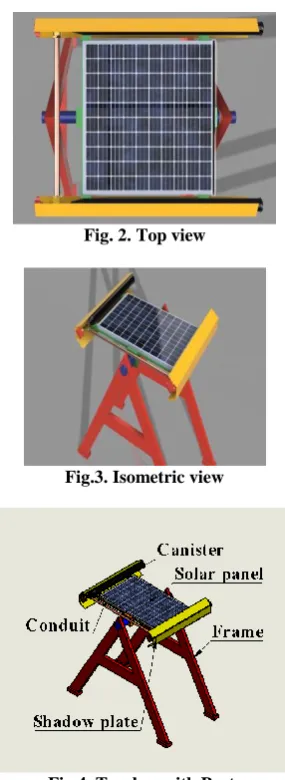
[image:3.595.354.497.56.447.2]The design of the model was carried out using Solidworks software and a number of iterations were carried out before the final design is obtained. Figure 1 to 4 shows the different views of the model.
[image:3.595.311.540.571.725.2]Fig.1. Front view
Fig. 2. Top view
Fig.3. Isometric view
Fig.4. Tracker with Parts
V - EXPERIMENTAL RESULTS
The model was successfully fabricated and the experiment was carried on 07th March 2019 to test the working.The table 2 shows the values taken for current,voltage and power for Tracking and Stationary solar panel of 12V and 3W respectively.[13-14]
A. Graphical Interpretation:
[image:3.595.105.233.676.781.2]Current Vs Time
Power Vs Time
The above graph shows the power produced in the tracking panel (blue line) Vsstationary panel (red line) on a sunny day from 7 A.M to 5:30 P.M. It reveals that the average power produced by the tracking panel (31.64 W) for a complete day is around 40% more than that of the stationary panel (22.69 W). Hence the purpose of improving the efficiency of the panel through tracking system is achieved.
Table-II: Experimental values taken on 07th March 2019
INCREASE IN EFFICIENCY =
(Total power of tracking solar panel -Total power of stationary solar panel) (Total power of stationary solar panel)
= ((31.64-22.69)/22.69)*100 = 0.3940
= 39.40%
VI. PHOTOS OF THE MODEL
The following photographs of the completed model were taken at various times during its testing and the corresponding altitude angles were shown in figure 5 to 9 [5].
Fig.5. Morning -9.00 am Fig.6. Morning -11.34 am
(Altitude angle = 45.20 deg) (Altitude angle = 69.35 deg)
International Journal of Innovative Technology and Exploring Engineering (IJITEE) ISSN: 2278-3075, Volume-9 Issue-1, November 2019
Fig.8. Afternoon 2.18 pm Fig.9. Evening 3.43 pm (Altitude angle=129.39 deg) (Altitude angle=148.68 deg)
VII. CONCLUSION
The conclusion from the study is that the performance of solar energy conversion system such as solar collector and solar PV system varies with respect to the direction of sunlight falling on its absorbing area. Without tracking the movements of sun, the utilization and conversion efficiency of conversion devices are very minimum in a fixed position due to continuous movement. The need to track the sun’s movement for extracting the solar energy and maximize the utilization also increases the conversion efficiency of the devices. In this study the tracking system is used with a refrigerant as the working medium to rotate the device with respect to sun’s rotation. Energy production of output power increases as a result of the continuous extraction and minimum utilization of light. While the conversion efficiency increases simultaneously. Use of double axis solar tracking system in the place of a single system can increases the overall efficiency.
VIII. RECOMMENDATIONS
The height and angle of the shadow plates could be adjusted according to the geographical location in order to achieve more sensitive tracking of the sun. The effect of crosswinds on the panel can be overcome by use of larger array of solar modules which has higher inertial value. The copper reservoirs must also first be vacuumed to relieve it of all air before charging with R-134a.The use of spring gas along with refrigerant in canisters can help in tilting the tracker in tilting the tracker back facing the east side the next day morning[15-20].
REFERENCES
1. Mostefa Ghassoul, “Single axis automatic tracking system based on
PILOT scheme to control the solar panel to optimize solar energy extraction”, Energy Reports, Volume 4, November 2018, Pages 520-527.
2. R.G. Vieira, F.K.O.M.V. Guerra, M.R.B.G. Vale, M.M. Araújo,
“Comparative performance analysis between static solar panels and single-axis tracking system on a hot climate region near to the equator”, Renewable and Sustainable Energy Reviews, Volume 64, October 2016, Pages 672-681.
3. S.A. Sharaf Eldin, M.S. Abd-Elhady, H.A. Kandil, “Feasibility of solar
tracking systems for PV panels in hot and cold regions”, Renewable Energy, Volume 85, January 2016, Pages 228-233.
4. Ali H. ALmukhtar, “Design of Phase Compensation for Solar Panel
Systems for Tracking Sun”, Energy Procedia, Volume 36, 2013, Pages 9-23.
5. H. Bentaher, H. Kaich, N. Ayadi, M. Ben Hmouda, A. Maalej, U.
Lemmer, “A simple tracking system to monitor solar PV panels”, Energy Conversion and Management, Volume 78, February 2014, Pages 872-875.
6. S. Aziz, S. Hassan, “On Improving the Efficiency of a Solar Panel Tracking System”, Procedia Manufacturing, Volume 7, 2017, Pages 218-224.
7. Hyuna Kang, Taehoon Hong, Seunghoon Jung, Minhyun Lee,
“Techno-economic performance analysis of the smart solar photovoltaic blinds considering the photovoltaic panel type and the solar tracking method”, Energy and Buildings, Volume 193, 15 June 2019, Pages 1-14.
8. M.A. Abdelghani-Idrissi, S. Khalfallaoui, D. Seguin, L.
Vernières-Hassimi, S. Leveneur, “Solar tracker for enhancement of the thermal efficiency of solar water heating system”, Renewable Energy, Volume 119, April 2018, Pages 79-94.
9. Kee-Hoon Kim, Sung-Bae Cho, “An efficient concentrative
photovoltaic solar system with Bayesian selection of optimal solar tracking algorithms”, Applied Soft Computing, Volume 83, October 2019, 105618.
10. Chao-Kai Yang, Tsung-Chieh Cheng, Chin-Hsiang Cheng, Chi-Chia
Wang, Chang-Chun Lee, “Open-loop altitude-azimuth concentrated solar tracking system for solar-thermal applications”, Solar Energy, Volume 147, 1 May 2017, Pages 52-60.
11. Nadia AL-Rousan, Nor Ashidi Mat Isa, Mohd Khairunaz Mat Desa,
“Advances in solar photovoltaic tracking systems: A review”, Renewable and Sustainable Energy Reviews, Volume 82, Part 3, February 2018, Pages 2548-2569.
12. Hao Zhong, Guihua Li, Runsheng Tang, Wenli Dong, “Optical
performance of inclined south–north axis three-positions tracked solar panels”, Energy, Volume 36, Issue 2, February 2011, Pages 1171-1179.
13. Wafa Batayneh, Ahmad Bataineh, Ibrahim Soliman, Saleh Abed
Hafees, “Investigation of a single-axis discrete solar tracking system for reduced actuations and maximum energy collection”, Automation in Construction, Volume 98, February 2019, Pages 102-109.
14. Junbin Zhang, Zhuojun Yin, Peng Jin, “Error analysis and auto
correction of hybrid solar tracking system using photo sensors and orientation algorithm”, Energy, Volume 182, 1 September 2019, Pages 585-593.
15. Zhengcao Hua, Chao Ma, Mancang Ma, Lingling Bin, Xiulan Pang,
“Operation characteristics of multiple solar trackers under typical weather conditions in a large-scale photovoltaic base”, Energy Procedia, Volume 158, February 2019, Pages 6242-6247.
16. Masoumeh Abdollahpour, Mahmood Reza Golzarian, Abbas Rohani,
Hossein Abootorabi Zarchi, “Development of a machine vision dual-axis solar tracking system”, Solar Energy, Volume 169, 15 July 2018, Pages 136-143.
17. A.Z. Hafez, A.M. Yousef, N.M. Harag, “Solar tracking systems:
Technologies and trackers drive types – A review”, Renewable and Sustainable Energy Reviews, Volume 91, August 2018, Pages 754-782.
18. Yasser M. Safan, S. Shaaban, Mohamed I. Abu El-Sebah, “Performance
evaluation of a multi-degree of freedom hybrid controlled dual axis solar tracking system”, Solar Energy, Volume 170, August 2018, Pages 576-585.
19. Jose A. Carballo, Javier Bonilla, Lidia Roca, Manuel Berenguel, “New
low-cost solar tracking system based on open source hardware for educational purposes”, Solar Energy, Volume 174, 1 November 2018, Pages 826-836.
20. Jerin Kuriakose Tharamuttam, Andrew Keong Ng, “Design and
Development of an Automatic Solar Tracker”, Energy Procedia, Volume 143, December 2017, Pages 629-634.
AUTHORS PROFILE
Mr.S.Krishnaraj, working as Assistant professor in Mechanical Department of Sri Sairam Engineering College, Chennai, Tamil Nadu, India. Having 10 years of experience in the field of Engineering Design and Analysis.
Mr. S.Ganapathy, working as an Assistant Professor in the Department of Mechanical Engineering, Sri Sairam Engineering College, Chennai, Tamil Nadu, India. Having 6 years of teaching experience in field of Design and Materials.
Mr. A.G.S. Siddharth, 6th University Rank holder in B.E. Mechanical Engineering, Sri Sairam Engineering College (Affiliated to Anna University), Chennai, India. Holds a Master Diploma in Automotive Design. Was the lead of the Design Team in National Solar Vehicle Championship (NSVC)’17 held at BHU IIT, Varanasi.