ARCHITECTURE AND PERFORMANCE
OF RUNTIME ENVIRONMENTS FOR
DATA INTENSIVE SCALABLE
COMPUTING
Jaliya Ekanayake
Submitted to the faculty of the University Graduate School
in partial fulfillment of the requirements
for the degree
Doctor of Philosophy
in the Department of Computer Science
Indiana University
ii
Accepted by the Graduate Faculty, Indiana University, in partial fulfillment of the
requirements for the degree of Doctor of Philosophy.
Doctoral Committee
____________________________
Geoffrey Fox, Ph.D.
(Principal Advisor)
____________________________
Dennis Gannon, Ph.D.
____________________________
Andrew Lumsdaine, Ph.D.
____________________________
David Leake, Ph.D.
iii
Copyright © 2010
Jaliya Ekanayake
Department of Computer Science
Indiana University
iv
v
ACKNOWLEDGEMENTS
I have been humbled by the guidance, encouragement, support that I have received from my advisors, colleagues, and my loved ones throughout this work. I owe them a great deal of gratitude and wish to express my sincere thanks.
I owe my deepest gratitude to my advisor, Prof. Geoffrey Fox. It has been his insightful research direction, invaluable guidance, constant encouragement, and generous support that has made everything possible for me to complete this degree. He was there with me for every hurdle and in every dead-end, and he helped me to navigate my path towards the Ph.D. I would like to express my deepest gratitude for all his help.
I would like to thank my entire committee: Dr. Dennis Gannon, Prof. Andrew Lumsdaine, and Prof. David Leake for their help and guidance throughout this research work. I am indebted to them for their valuable feedback and the help they have each given to me from the beginning of my research.
I am grateful to Dr. Sanjiva Weerawarana for encouraging me to undertake this challenging path of life, and also for being an inspiration and a mentor from the days of my undergraduate studies. I would like to express my deepest gratitude for all his help.
I would specially like to thank Dr. Judy Qiu for her guidance and support for my research. She has been a mentor, a colleague, and a friend to me. Together, we worked on several research projects, and her unprecedented support and dedication have served the crucial foundation of support that has made the Twister project a reality.
vi
During my stay at Pervasive Technology Institute (PTI), I was fortunate enough to work with many brilliant people. Dr. Shrideep Pallickara mentored me for the research and publications. His impeccable experience in software engineering contributed extensively to help shape the architecture of Twister, and I have benefited immensely from the numerous discussions we have had. I would also like to thank Dr. Marlon Pierce for providing me help and guidance throughout my stay in PTI. Whether it be a problem with user accounts or a research issue, he was always ready and willing to help.
Throughout this research, I was fortunate enough to work with many of my colleagues on research publications, demonstrations, and projects. This journey would not have been the same without their help, critique sessions, and friendship. I would like to express my sincere thanks to my lab mates: Seung-Hee Bea, Jong Choi, Thilina Gunarathne, Li Hui, Bingjing Zhang, Stephen Tak-lon-wu, and my brother Saliya Ekanayake.
vii
his Ph.D. work. I would also like to thank my brother Saliya and his wife Kalani for their sincere support and encouragements.
I would like to thank Grace Waitman for all her help on proof reading this thesis with her impeccable comments and suggestions on improving the clarity of the write-up.
viii
ABSTRACT
Architecture and Performance of Runtime Environments for
Data Intensive Scalable Computing
By
Jaliya Ekanayake
Doctor of Philosophy in Computer Science Indiana University, Bloomington
Prof. Geoffrey C. Fox, Chair
In a world of data deluge, considerable computational power is necessary to derive knowledge from the mountains of raw data which surround us. This trend mandates the use of various parallelization techniques and runtimes to perform such analyses in a meaningful period of time. The information retrieval community has introduced a programming model and associated runtime architecture under the name of MapReduce, and it has demonstrated its applicability to several major operations performed by and within this community. Our initial research demonstrated that, although the applicability of MapReduce is limited to applications with fairly simple parallel topologies, with a careful set of extensions, the programming model can be extended to support more classes of parallel applications; in particular, this holds true for the class of Composable Applications.
ix
x
TABLE OF CONTENTS
ACKNOWLEDGEMENTS ...V
ABSTRACT…… ... VIII
LIST OF FIGURES ... XVI
LIST OF TABLES ... XVIII
CHAPTER 1. INTRODUCTION ... 1
1.1. Introduction ... 1
1.2. The MapReduce Programming Model ... 4
1.3. Motivation ... 6
1.4. Problem Definition ... 11
1.5. Contributions ... 12
1.6. Thesis Outline ... 13
CHAPTER 2. PARALLEL RUNTIMES & PROGRAMMING MODELS ... 15
2.1. Taxonomy of Parallel/Distributed Runtimes ... 16
2.2. Cloud and Cloud Technologies ... 17
2.3. Existing MapReduce Architectures ... 17
2.3.1. Handling Input and Output Data ... 17
2.3.2. GFS and HDFS ... 18
2.3.3. Sector ... 20
2.3.4. DryadLINQ and the Concept of Partitioned Table ... 21
xi
2.3.6. Scheduling Tasks ... 23
2.3.7. Fault Tolerance ... 24
2.4. Batch Queues ... 24
2.5. Cycle Harvesting ... 26
2.6. Work Flow ... 27
2.7. Parallel Languages ... 28
2.7.1. Sawzall ... 29
2.7.2. DryadLINQ ... 30
2.7.3. PigLatin ... 30
2.8. Message Passing ... 31
2.9. Threads ... 33
2.10. Cloud ... 34
2.11. Summary of Features Supported by Different Runtimes ... 36
CHAPTER 3. APPLICATION CLASSES ... 37
3.1. Map-only Applications ... 40
3.2. MapReduce Applications ... 41
3.3. Iterative MapReduce Applications ... 42
CHAPTER 4. A PROGRAMMING MODEL FOR ITERATIVE MAPREDUCE COMPUTATIONS ... 45
4.1. Static vs. Variable Data ... 46
4.2. Long Running Map/Reduce Tasks... 47
4.3. Granularity of Tasks ... 48
4.4. Side-effect-free Programming... 48
xii
4.6. Programming Extensions ... 50
CHAPTER 5. TWISTER ARCHITECTURE ... 51
5.1. Handling Input and Output Data ... 53
5.2. Handling Intermediate Data ... 55
5.3. Use of Pub/Sub Messaging ... 57
5.4. Scheduling Tasks ... 57
5.5. Fault Tolerance ... 57
5.6. Twister Implementation ... 60
5.6.1. Software Requirements ... 60
5.6.2. Twister Daemon ... 60
5.6.3. Twister Driver... 61
5.6.4. Pub-sub Brokers ... 62
5.6.5. File Manipulation Tool ... 63
5.7. Twister API ... 64
CHAPTER 6. APPLICATIONS AND THEIR PERFORMANCES ... 66
6.1. Performance Measures and Calculations ... 67
6.1.1. Performance and Scalability ... 67
6.1.2. Speedup ... 68
6.1.3. Parallel Overhead ... 68
6.1.4. Parallel Efficiency ... 69
6.2. Hardware Software Environments ... 70
6.3. CAP3 Data Analysis ... 72
6.3.1. Hadoop Implementation ... 72
6.3.2. DryadLINQ Implementation ... 73
xiii
6.3.4. Performance Evaluation ... 75
6.3.5. Discussion ... 76
6.4. High Energy Physics (HEP) Data Analysis ... 77
6.4.1. Hadoop Implementation ... 78
6.4.2. DryadLINQ Implementation ... 79
6.4.3. Twister Implementation ... 80
6.4.4. Performance Evaluation ... 81
6.4.5. Discussion ... 81
6.5. Pairwise Similarity Calculation ... 82
6.5.1. Introduction to Smith-Waterman-Gotoh (SWG) ... 82
6.5.2. Hadoop Implementation ... 84
6.5.3. DryadLINQ Implementation ... 84
6.5.4. Twister Implementation ... 85
6.5.5. Performance Evaluations ... 85
6.5.6. Discussion ... 86
6.6. K-Means Clustering ... 87
6.6.1. Hadoop Implementation ... 89
6.6.2. DryadLINQ Implementation ... 89
6.6.3. Twister Implementation ... 90
6.6.4. MPI Implementation ... 90
6.6.5. Performance Evaluation ... 91
6.6.6. Discussion ... 91
6.7. PageRank ... 92
6.7.1. Hadoop Implementation ... 93
6.7.2. Twister Implementation ... 94
6.7.3. Performance Evaluation ... 94
xiv
6.8. Multi-Dimensional Scaling (MDS) Application ... 96
6.8.1. Twister Implementation ... 96
6.8.2. Performance Analysis ... 98
6.8.3. Discussion ... 98
6.9. Matrix Multiplication ... 99
6.9.1. Row-Column Decomposition Approach ... 99
6.9.2. Fox Algorithm for Matrix Multiplication ... 101
6.9.3. Fox Algorithm using Twister’s Extended MapReduce ... 102
6.9.4. Performance Evaluation ... 105
6.9.5. Discussion ... 109
6.10. Twister Benchmark Application and Micro Benchmarks ... 110
6.10.1. Structure of the Benchmark Application... 110
6.10.2. Micro Benchmarks ... 111
6.11. Conclusion ... 114
CHAPTER 7. RELATED WORK ... 116
7.1. Apache Mahout ... 116
7.2. Pregel ... 120
7.3. Other Runtimes ... 123
CHAPTER 8. CONCLUSIONS AND FUTURE WORK ... 125
8.1. Summary of Work ... 125
8.2. Conclusions ... 126
8.2.1. Applicability ... 128
8.2.2. Performance and Scalability ... 129
8.3. Contributions ... 131
xv
8.5. List of Publications Related to This Thesis ... 135
REFERENCES… ... 137
xvi
LIST OF FIGURES
Figure 1. Data Flow in MapReduce programming model ... 5
Figure 2. Composable applications in a workflow. ... 39
Figure 3. The iterative MapReduce programming model supported by Twister. ... 46
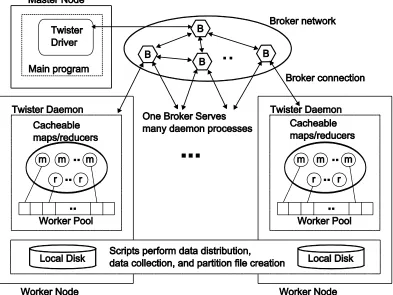
Figure 4. Architecture of Twister MapReduce runtime. ... 52
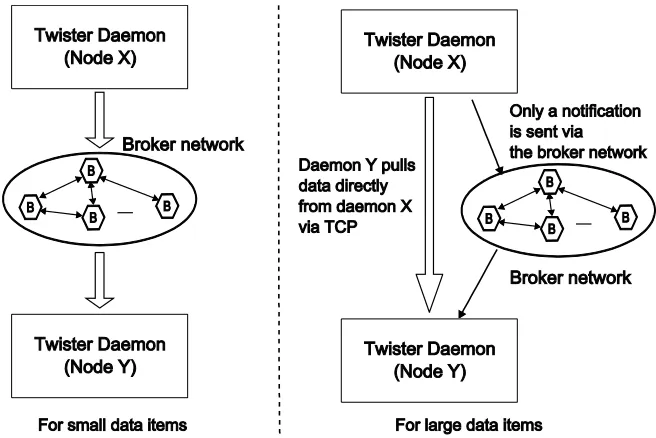
Figure 5. Two approaches used by the Twister to transfer intermediate data. ... 56
Figure 6. Components of Twister Daemon ... 60
Figure 7. Processing data as files using DryadLINQ. ... 74
Figure 8. Speedups of different implementations of CAP3 application measured using 256 CPU cores of Cluster-III (Hadoop and Twister) and Cluster-IV (DryadLINQ). ... 75
Figure 9. Scalability of different implementations of CAP3 application measured using 256 CPU cores of Cluster-III (Hadoop and Twister) and Cluster-IV (DryadLINQ). ... 76
Figure 10. MapReduce for the HEP data analysis. ... 78
Figure 11. Simulating MapReduce using DryadLINQ. ... 79
Figure 12. Performance of different implementations of HEP data analysis applications measured using 256 CPU cores of Cluster-III (Hadoop and Twister) and Cluster-IV (DryadLINQ). ... 81
Figure 13. MapReduce algorithm for SW-G distance calculation program ... 84
Figure 14. Parallel Efficiency of the different parallel runtimes for the SW-G program (Using 744 CPU cores in Cluster-I). ... 86
Figure 15. Performance of different implementations of K-Means clustering algorithm performed using 256 CPU cores of Cluster-III (Hadoop, Twister, and MPI) and Cluster-IV (DryadLINQ) ... 91
xvii
Figure 17. Efficiency of the MDS application (in Cluster–II). ... 98 Figure 18. Matrix multiplication Row-Column decomposition (top). Twister MapReduce
implementation (bottom). ... 100 Figure 19. 2D block decomposition in Fox algorithm and the process mesh. ... 101 Figure 20. Virtual topology of map and reduce tasks arranged in a square matrix of size qxq .... 103 Figure 21. Communication pattern of the second iteration of the Fox - MapReduce algorithm
shown using 3x3 processes mesh. Thick arrows between map and reduce tasks show the broadcast operation while dash arrows show the shift operation. ... 104 Figure 22. Sequential time for performing one block of matrix multiplication - Java vs. C++ ... 106 Figure 23. Performance of Row-Column and Fox algorithm based implementations by using 64
CPU cores of Cluster II. (Note: In this evaluation, we have not used Twister’s TCP based direct data transfers as explained in section 5.2). ... 107 Figure 24. Performance of Twister and MPI matrix multiplication (Fox Algorithm)
implementations by using 256 CPU cores of Cluster II. The figure also shows the projected compute-only time for both Java and C++. ... 108 Figure 25. Parallel overhead of three matrix multiplication implementations by using 256 CPU
xviii
LIST OF TABLES
Table 1. Comparison of features supported by different parallel programming runtimes ... 36
Table 2. Application classification ... 38
Table 3. Classes of MapReduce applications ... 44
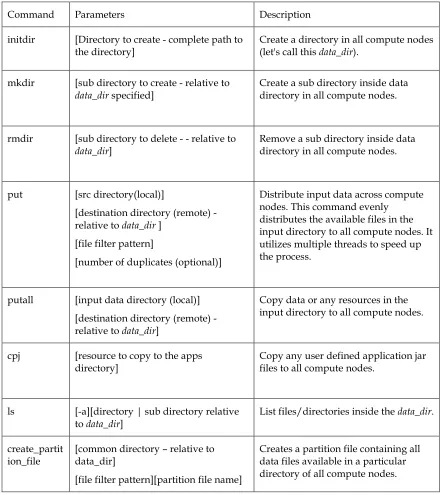
Table 4. Commands supported by the Twister’s file manipulation tool. ... 63
Table 5. The Application program interface of Twister. ... 64
Table 6. Details of the computation clusters used. ... 71
Table 7. Characteristics of data sets (B = Billions, AM = Adjacency Matrix) ... 94
Table 8. Breakdown of the amount of communication in various stages of the Row-column based matrix multiplication algorithm. ... 100
Table 9. Breakdown of the amount of communication in various stages of the Fox algorithm. ... 102
Chapter 1.
Introduction
1.1. Introduction
2
astronomy, instruments in biology, especially those related to genes and gnomes, produce millions of gene data ensuring biology a place among data intensive domains.
The increase in the volume of data also increases the amount of computing power necessary to transform the raw data into meaningful information. Although the relationship between the size of the data and the amount of computation can vary drastically depending on the type of the analysis performed, most data analysis functions with asymptotic time complexities beyond the simplest 𝑂(𝑛) can require considerable processing power. In many such situations, the required processing power far exceeds the processing capabilities of individual computers, and this reality mandates the use of efficient parallel and distributed computing strategies to meet the scalability and performance requirements inherent in such data analyses.
A careful analysis on applications performed on these large data sets revealed that most such applications are composed of pipelines of data/compute intensive stages or filters. For some applications such as converting a large collection of documents to another format, a single filter stage is sufficient, whereas an application such as pagerank [1] require iterative application of the pagerank computation stage until a convergence in results is obtained. Most of these applications can be parallelized by applying a high level parallel construct such as MapReduce[2] to the above mentioned stages. As the volume of data increases or the amount of computation performed at each such stage increases, the overhead in applying a higher level parallel constructs to these individual stages diminishes making the overall computation parallelizable using higher level parallel constructs. We named such applications “composable” and make the prime focus in this thesis.
3
processors by increasing the clock frequency has met its peak governed by the quantum physics. These powerful multi-core chips allow many programs otherwise executed in sequential fashion to exploit the benefits of parallelism and pack thousands of CPU cores into computation clusters and millions of cores into data centers[3]. Similarly, the advancements in communication technology have reduced the latencies involved in data transfers, which also favor distributed processing.
To support data intensive scalable computing, the information retrieval industry has introduced several new distributed runtimes and associated programming models to the spectrum of parallel and distributed processing runtimes. MapReduce[2] and Dryad[4] are two such prominent technologies. As many data analyses become more and more data intensive, the ratio of CPU instructions to I/O instruction becomes reduced. According to [5], in many of these applications, the CPU: I/O ratios are well below 10000:1. The above runtimes have adopted a more data centered approach: they support moving computation to data favoring local data reads, simple programming models, and various quality of services. Initial results from the information retrieval industry show that they can be deployed in large computation infrastructures built using commodity hardware and that they provide high-throughput computing capabilities amidst various types of failures in computation units.
4
applications by incorporating knowledge and experience from classical approaches to parallel processing such as MPI[6, 7]. The thesis also presents a detailed performance analysis of different MapReduce runtimes in terms of performance, scalability and quality of services.
1.2. The MapReduce Programming Model
MapReduce is a distributed programming technique proposed by Google for large-scale data processing in distributed computing environments. Jeffrey Dean and Sanjay Ghemawat describe the MapReduce programming model as follows:
• The computation takes a set of input (key,value) pairs, and produces a set of output (key,value) pairs. The user of the MapReduce library expresses the computation as two functions: Map and Reduce.
• Map, written by the user, takes an input pair and produces a set of intermediate (key,value) pairs. The MapReduce library groups together all intermediate values associated with the same intermediate key I and passes them to the Reduce function.
5
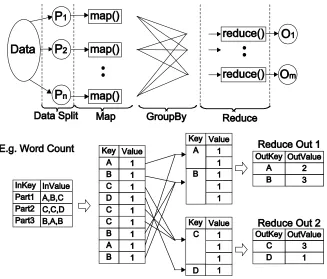
Figure 1. Data Flow in MapReduce programming model
Furthermore, because of its functional programming inheritance, MapReduce requires both map and reduce tasks to be “side-effect-free”. Typically, the map tasks start with a data partition and the reduce task performs such operations as “aggregation” or “summation”. To support these, MapReduce also requires that the operations being performed by the reduce task to be both “associative” and “commutative”. These are common requirements for general reductions. For example, in MPI the default operations or user defined operations in MPI_Reduce or MPI_Allreduce are also required to be associative and may be commutative.
6
by passing the list of values for a given key. The reduce function adds up all the values and produces a count for a particular key, which in this case is the number of occurrences of a particular word in the document set. Figure 1 shows the data flow and different phases of the MapReduce programming model.
1.3. Motivation
The increasing amount of data and the vast computing power they require to be transformed into knowledge have created a diverse set of problems in many domains. As a response to this growing need the information retrieval community has come up with new programming models and runtimes such as MapReduce and Dryad, that adopt more data centered approaches to parallel processing and provide simpler programming models. On the other hand, the parallel runtimes such as MPI and PVM used by the High Performance Computing (HPC) communities have accumulated years of experience of HPC communities into their programming models; thus their efficient runtimes are applicable to more classes of applications. This thesis is motivated by the following hypothesis:
With the diversity of the parallel applications and the need to process large volumes of data, we
argue that, by extending simpler, data centered programming model of MapReduce using the proven
architectures and programming models in HPC world, we will expand its usability to more classes of
parallel applications.
7
instructions to I/O instruction reduces. Amdahl’s IO law states that the programs complete one I/O per 50,000 instructions[8], and Jim Gray and Prashant Shenoy claim that, in many scientific applications, this rate drops well below one I/O per 10000 instructions[9]. As we build infrastructures to handle the data deluge, the above observations suggest that using new programming models such as MapReduce based on the concept of “moving computation to data” could be more efficient. Although the MapReduce was originated from the information retrieval industry, our initial evaluations show it can be applied to many Single Program Multiple Data (SPMD)[10] style problems in various scientific domains as well.
8
The emerging trend of performing data analysis on Cloud infrastructures also favors the MapReduce style of simple programming models. Cloud infrastructures are comprised of thousands of computers organized into data centers, that provide both data storage and computation services to the users. Most of these infrastructures are built using commodity hardware, and hence, the typical network bandwidth available between computation units is well below the typical network bandwidth available in high performance computation clusters. Apart from the above conditions, most cloud infrastructures utilize virtual machine technologies to maximize their resource utilization, and also, to isolate the user level applications (including the operating system) from the bare-metal systems. These characteristics introduce latencies into the communication medium, and are significantly higher than those of computation clusters. Programming models such as MapReduce rely on relaxed synchronization constraints; thus they operate with higher task granularities that have less susceptibility to latencies. These features make them an ideal match to operating on Clouds.
9
support such algorithms and expand the usability envelope of MapReduce effectively, we need several extensions to its programming model as well as an efficient implementation.
10
In contrast to the above characteristics of MapReduce, we noticed that the parallel processes in High Performance Computing (HPC) applications based on MPI, have long lifespans in the applications; most of the time, they utilize high performance communication infrastructures to communicate fine grain messages with higher efficiencies for computation dominated workloads. The use of long-running processes enables the MPI processes to store any static or dynamic data (state information) necessary for the computation throughout the application life cycle. On the other hand the use of stateful processes makes it harder to support fault tolerance. The use of low latency communication infrastructures makes the inter-process communications highly efficient, as compared to the “disk->wire->disk” approach to data transfer adopted by the MapReduce runtimes such as Hadoop. Furthermore, by supporting low-level communication constructs, MPI and similar parallel runtimes allow the user to create parallel algorithms with a wide variety of communication topologies. K. Asanovic et al. presents seven dwarfs capturing various computation and communication patterns of parallel applications into equivalence classes [17].
Although there are analyses like the one described above for the HPC applications, we could not find a detailed analysis which compares high level abstractions such as MapReduce and Dryad and the mapping of parallel applications to these abstractions. This knowledge would be crucial, and would be required in order to map parallel applications to the new programming runtimes so as to obtain the best possible performance and scalability for the applications. This is one of the areas that we will explore in this research.
11
1.4. Problem Definition
In a world deluged by data, high-level programming models and associated runtimes that adopt data centered approaches have shown promising results for data intensive computing. MapReduce is one such key technology that has been introduced to tackle large scale data analyses from the information retrieval community. However, we noticed the following gap in the current research concerning these high-level programming models and their architectures; this research strives to minimize this gap.
• First, the applicability of MapReduce to the diverse field of parallel computing is not well studied. We try to fill this gap by applying MapReduce to a selected set of applications to represent various classes of applications that MapReduce could be applied to; we intend to demonstrate the mapping of parallel algorithms to the MapReduce domain while comparing and contrasting the characteristics of few existing high level programming models.
12
• Finally, a detailed performance analysis of high level programming runtimes, which identify their strengths and weaknesses for different classes of applications while comparing them with solutions from the HPC world, has not yet been performed. Furthermore, identifying the behaviors of these runtimes in virtualized environments such as Clouds certainly exist as a goal worthy of further study and research.
1.5. Contributions
We envision the following contributions could emerge from this research:
• The architecture and the programming model of an efficient and scalable MapReduce runtime which could expand applicability of the MapReduce programming model to more classes of data intensive computations, especially for iterative MapReduce computations.
• A prototype implementation of the proposed architecture and the programming model that minimizes the overheads suffered by typical MapReduce runtimes.
• A classification of the problems that can be handled by MapReduce and algorithms for mapping these to the MapReduce model while minimizing overheads, followed by a detailed discussion of several scientific applications that could be developed using different runtimes including the proposed runtime.
13
1.6. Thesis Outline
This thesis is organized as follows:-
We present the current state of the parallel programming models and runtimes related to this thesis in Chapter 2. Here, we focus on several aspects of parallel computing such as scalability, throughput vs. efficiency, level of abstraction, fault tolerance, and support for handling data. The chapter also introduces some of the technologies that we used for our performance comparisons with the proposed runtime.
After classifying the MapReduce applications to several distinct classes in Chapter 3, we introduce the extended MapReduce programming model that we propose in this thesis in Chapter 4, along with an explanation of how it can be used to support different classes of applications. Furthermore, in this chapter, we compare the proposed programming model with some of the other parallel programming techniques that can be used to implement such applications, and we try to conclude with a set of equivalence classes of applications.
This is followed by a detailed explanation of the architecture and the implementation of the proposed runtime “Twister” in Chapter 5. Here we discuss the various architectural designs we used in the Twister runtime and compare and contrast it with other MapReduce and HPC runtimes; we also discuss the feasibility of our proposed architecture.
14
15
Chapter 2.
Parallel Runtimes & Programming Models
16
2.1. Taxonomy of Parallel/Distributed Runtimes
Parallel/Distributed Runtimes Batch Queues Cycle Harvesting Workflow Message Passing Cloud Technologies Special Frameworks TORQUE, Moab Condor/ DAGMan Composition Tools Script based runtimes XBaya, Taverna Swift, Falkon MapReduce DAG Based Hadoop, Twister Dryad, DryadLINQ Private Domain Public
Domain BOINC
Classic Cloud Amazon Queues
All-Pairs, SAGA Shared Memory Distributed Memory OpenMP CCR MPI PVM Threads Threading support in
languages
Parallel
Languages X10, Fortress, Chapel
Message Passing
Shared
Memory OpenMP CCR
Threads Threading support in languages
Parallel
17
2.2. Cloud and Cloud Technologies
Cloud and Cloud Technologies are two distinct terms that we use throughout this thesis; hence, the term deserves a clear definition. By “Cloud,” we refer to a collection of infrastructure services such as the Infrastructure-as-a-service (IaaS) and the Platform-as-a-Service (PaaS), etc., provided by various organizations where virtualization plays a key role. By “Cloud Technologies,” we refer to various technologies associated with clouds such as storage services like the S3[18], communication queues like the Simple Queue Service (SQS) in Amazon and the Azure Queues in Windows Azure[19]; most importantly, we also focus on the high level runtimes such as Hadoop[15] and Dryad [20].
2.3. Existing MapReduce Architectures
Along with the MapReduce programming model, Jeffrey Dean and Sanjay Ghemawat describe in their paper the architecture that they adopted at Google. Most of their decisions are based on the scale of the problems that they solved using MapReduce and the characteristics of the large computing infrastructure in which these applications were deployed. Apache Hadoop and several other MapReduce runtimes such as Disco [21] and Sector/Sphere also adopted most of these architectural decisions. Below, we will list some of the most important characteristics of these runtime, as it will be useful to explain and compare them with the architectural decisions we made in this thesis later.
2.3.1. Handling Input and Output Data
18
computing resources before processing as done by many classic distributed and parallel computing infrastructures is not feasible. To eliminate this costly (in terms of performance) data movement, MapReduce architectures have introduced the concept of the “data-compute node”, which represents a computer that is used as both a data storage device and a computation unit. (Note: Please note that following this point, we will simply use the term “node” to refer to a “data-compute node” when we discuss MapReduce related technologies).
The above approach allows MapReduce runtimes to utilize larger disk bandwidth produced by the local disks of the nodes. However, to manage data in these local disks and to obtain meta-data to move computation to meta-data, a higher level meta-data management infrastructure is necessary. To support these features, most MapReduce runtimes use distributed storage infrastructures built using local disks to read input data and store final output data. Both Google and Hadoop utilize distributed fault-tolerance file systems – GFS[22] and HDFS[15] in their MapReduce runtimes. Sphere MapReduce runtime utilizes a distributed file system named Sector that uses slightly different architecture than GFS or HDFS. Microsoft DryadLINQ[23] on the other hand, uses a simple meta-data construct named a “partitioned file” to process data from local disks of the compute nodes that are organized as Windows shared directories. With these features, most MapReduce runtimes use distributed storage infrastructures to read input data and store final output data. In the remainder of this section, we will discuss some of the above storage architectures.
2.3.2. GFS and HDFS
19
large data sets is either the initial file creation, file read, or file appends. Random updates or writes on large data files are rare. We also noticed similar characteristics on large scientific data products. Typically, most of these data sets are read from different applications (algorithms) for inferences and rarely modified. In both Google and Hadoop MapReduce runtimes, the distributed file system is used to read input data and store output data. This further simplifies the type of operations performed on the file system and makes it almost similar to the “write-once-read-many” access model.
The GFS architecture has two main components: (i) the GFS master and (ii) the GFS chunk server. The Hadoop Distributed File System (HDFS) is much closer to the GFS in design and in the HDFS; these entities are called (i) the Name Node and (ii) the Data Node respectively. The GFS master keeps track of the all the meta-data including the file system namespace, while the GFS chunk servers store data chunks assigned to them by the GFS master. Both the GFS and the HDFS store data as fixed size chunks or blocks within the distributed file system, and they use replications to recover from failures. Data which is read and is written directly to and from clients goes to the chunk servers (data nodes), which are located using the meta-data served by the master. Both file systems provide an interface with common file system operations to clients although they do not implement a standard file system API such as POSIX.
20
boundaries for parallel processing typically exist at the file level. If the files are fairly equal in size, one can group several files into a block (if the files are comparatively smaller than the typical best performance block sizes), or they can select an appropriately sized block to match the size of the files. Still, the blocks may need to be padded to match the differences in file sizes and the block boundaries. If the files are not similar in size, the padding will increase. Breaking a file into multiple blocks is an option, when the data in files are represented as records and the data parallelism exist at record level. For example, in text data (web pages, text documents etc..) a record can be a sentence, a line of text or a paragraph, and many operations performed on text data collections can be parallelized at this records level.
2.3.3. Sector
21
invoke CAP3 executable passing input file names in the command line. The data copying from the HDFS to the local file system is required, since the HDFS does not provide a standard file system interface such as POSIX. In contrast, the same application with Sector can directly execute the CAP3 program passing input files as command line arguments, since they exists as files (not as blocks) in the local file system. However, this approach leaves the task of partitioning data to the user, which we think could be supported by providing a tool to perform data partitioning using custom partitioning schemes.
2.3.4. DryadLINQ and the Concept of Partitioned Table
The academic release of Microsoft DryadLINQ [25] uses Windows shared directories to read input data and to store output data. Instead of providing a file system to keep track of the data partitions and their replications, DryadLINQ expects the user to provide a special file named the “Partitioned File” to the runtime, which contains the meta-data regarding the data partitions and their locations among the collection of local hard disks of the computations nodes. With this information, DryadLINQ tries to schedule data processing tasks on the nodes on which the data is available. It also supports replicas of data partitions so that, in the case of failure of a given node, the tasks could be rescheduled to run on a different node. DryadLINQ provides programming constructs to partition data based on the “hash” and “range” values. However, it does not provide a tool for the user to distribute data partitions across computation nodes, or to collect the results to a shared location, which we think, is very important for these types of distributed runtimes.
22
makes the overall distributed runtime more robust. However, with the capability of using directly accessible files as data partitions, the approach adopted by Sector is more flexible.
2.3.5. Handling Intermediate Data
In most MapReduce runtimes, the intermediate data produced after the map stage of the computation is handled using the following steps.
1. The map outputs are first buffered in memory and continuously pushed to a file(s) in the local disk of the nodes the map tasks are executed. The meta-data regarding these outputs are sent to the master process.
2. The master process assigns map outputs to appropriate reduce tasks based on some form of a “key selector” and it notifies the reducers, which then retrieve data via some communication protocol such as HTTP and store them in the local disks where they are being executed.
3. Once all the map outputs are received for a particular reduce task, the runtime performs a sorting operation on the reduce inputs (map outputs) based on the “key” and invoke the reduce function.
This scheme of handling intermediate data is both scalable and robust. Since the intermediate data is handled in files, the volume of intermediate data is limited only by the amount of local disk space available in all compute nodes. It is robust because it makes the fault tolerance functionality of the runtime simpler and straightforward. For example, if the map tasks do not store their outputs in the local disks first, a failed reduce task will require a re-execution of all the
map tasks to get its portion of reduce inputs. With the above scheme, a failed reduce task only needs to collect data from the nodes where the map tasks stored their outputs.
23
distributions. Since the data transfer can start immediately after a map task is completed, the effect of latency is less significant for MapReduce computation where the work load distribution at the map tasks is not uniform. In these type of computations, the data transfer continues along with the map stage, and, at the end of the map stage of the computation, the reduce tasks need to wait till the data is retrieved from the slow map tasks. However, for workloads with equal load distribution, all the data transfers start in a close time interval and the reduce tasks need to wait till all the data is transferred via disk->wire->disk transfer approach.
Classic parallel runtimes such as MPI uses in-memory communication mechanisms to transfer data between parallel processes, and hence, they operate with minimum latencies. On the other hand, the performance gain results in highly complex fault tolerance mechanisms in MPI. In our design, we try to incorporate the in-memory data communication approach with MapReduce.
2.3.6. Scheduling Tasks
24
randomization in task assignment so that tasks with different skewness are assigned to a given processing element.
2.3.7. Fault Tolerance
Failures are common in distributed runtimes that operates on thousands of computers, especially when the computation infrastructure is built using commodity hardware equipments. Although this is different from the experience we have in using high end computation clusters with better networking equipments, and also in using leased resources (virtual machines) from Cloud providers, we also identify the need for producing distributed runtimes with fault tolerance capabilities.
Handling failures is one of the key considerations of Google’s MapReduce architecture, and similarly, this is also the case in Hadoop as well. In both Google and Hadoop MapReduce, the distributed file systems handle the failures of the disks or nodes using data replication. Therefore, applications can process input data amidst node failures, provided that the number of replicas of data and the replica placement can effectively handle failures. Further, their approach of writing intermediate data products to persistent storage simplifies the failure handling logic.
In both Hadoop and the Google’s MapReduce, failures of map tasks are handled by rerunning them, while a failure of reduce tasks requires downloading the outputs of map tasks and re-execution of the reduce task. The master process that handles the scheduling and keeps track of the overall computation is assumed to run on a node that is less susceptible to failures. A failure in this node requires a total restart of the overall runtime.
2.4. Batch Queues
25
an application running on a single computer, or as complex as a parallel application that runs on thousands of computers. The main task of theses schedulers is to allocate resources to this wide variety of requirements in a fair manner while maximizing the resource utilization. Many parallel applications that resemble “embarrassingly parallel” characteristics, either as data parallel or task parallel, can be scheduled as a collection of independent tasks using job queues. These independent tasks typically do not require any form of inter task communication, and hence, they fit best with such a scheduling mechanism.
There are several ways one can access input data in the above types of applications, including network file system in a cluster, shared file systems, or even the option of moving data dynamically to the local disks using scripts. Typically, the data is moved to computation resources during the execution time. MapReduce programming model reduces to a “map-only” mode when no reduce phase is used in the computation which resembles an embarrassingly parallel application executed as a collection of map tasks. However, unlike the batch queues where the input data for applications are typically moved to computation resources, the data centered approach adopted in MapReduce allows for better data and computation affinity by minimizing the data movement costs. Several have suggested[27, 28] locality aware scheduling to minimize the data movement, as this is especially effective for data intensive applications.
26
the re-execution of task[29, 30]. Scheduling a large number of related parallel tasks using job queues can be required by some parallel applications to which runtimes such as SWARM[31] can be applied.
Thilina et al. showed that the same concept of batch queues can be used in Clouds to schedule parallel applications that are embarrassingly parallel[32]. In these settings, the schedulers are replaced by a user developed applications that simply monitors a message queue for task descriptions to execute on cloud resources.
2.5. Cycle Harvesting
27
(vertices). Although the DAG approach expands the applicability of Condor to more complex parallel processing algorithms, still, the expressiveness of a DAG is limited compared to a scripting language or a fully-fledged programming language that could be used to describe the problem. In addition, representing iterative computations is hard in DAG based systems. Condor supports task-level check pointing so that a task executing in a compute node can be stopped and migrated to another node for further execution in the case of the failure of the current hardware node.
2.6. Work Flow
Workflows schedule a set of related tasks to be tied up as an execution graph (workflow) on distributed computational resources where the tasks could be simple executables or fully-fledged parallel programs that use hundreds of processes. With Grid computing [26], the scientist use workflows to execute large scale scientific applications using many heterogeneous systems across the Grid. G. Fox and D. Gannon define the workflow in the context of Grid computing as follows.
“The automation of the processes, which involves the orchestration of a set of Grid services, agents
and actors that must be combined together to solve a problem or to define a new service” [35]
28
graphs: (i) linear workflows, (ii) acyclic graphs, (iii) cyclic graphs, and (iv) complex – too large and complex to effectively “program” as a graph.
The composition of workflows can range from simple scripts to widely used service composition languages to graphical interfaces such as those discussed here [37]. Supporting the quality of services such as fault tolerance and monitoring is an important consideration in workflow runtimes. J. Workflow runtimes support fault tolerance in two granularities :(i) task-level, and (ii) workflow-level. At the task level, individual services or tasks are supported with fault tolerance, whereas in the workflow level, the entire workflow graph is supported with fault tolerance. Yu and R. Buyya in their paper[38] present a list of major workflow runtimes and their support for fault tolerance. Workflow composition tools such as Xbia[39] provides graphical interface to compose workflows as well as to real time monitoring of running workflows.
2.7. Parallel Languages
Parallel languages try to minimize the complexity of programming parallel applications. There are a wide variety of parallel languages targeted for different styles of programming[40] However, as the applications become more and more data intensive, languages that supports coarse the grained SPMD style programming models on distributed memory architectures are proven to be more beneficial. In this respect, language extensions provided as libraries such as MPI (in various languages such as C, C++, and FORTRAN), PVM, Charm[41] provide more flexibility to program parallel algorithms on distributed memory infrastructures (We will discuss them in more detail in the next section). In contrast, as hardware resources become more and more multi/many core oriented, the applications can use parallel languages to exploit the fine grain parallelism available in programs.
29
abstractions to develop MapReduce style programs and other extensions using basic MapReduce constructs. These languages are discussed in the rest of this section.
2.7.1. Sawzall
Sawzall is an interpreted programming language for developing MapReduce like programs using Google's distributed infrastructure services such as GFS and MapReduce. R. Pike et al. present its semantics and its usability in their paper[42]. The language supports computations with two distinct phases. First, a “query” phase performs an analysis on a single data record and emits an output to an aggregator operation specified in the program. Unlike MapReduce, each parallel task in the query phase emits a single value and the aggregator, written in typical sequential languages (C++), collects the emitted results and produces another set of outputs. Finally, the outputs of the aggregators are collected to a single file and stored. The programming model bears a strong resemblance to MapReduce and, according to R. Pike et al., both phases of the Sawzall programs are executed using the MapReduce infrastructure itself. Sawzall provides high level abstractions to define the operations in the query phase and the program flow using predefined aggregators. The Sawzall interpreter schedules the computations across distributed computing infrastructure with the use of the MapReduce infrastructure.
30
2.7.2. DryadLINQ
DryadLINQ stems from the Language Integrated Query (LINQ)[44] extensions provided by Microsoft. LINQ provides a query interface to many data structures such as arrays and lists that typical programs operate on. DryadLINQ extends this concept to a distributed tables and lists using the underlying Microsoft Dryad[4] infrastructure. With DryadLINQ, the user can execute programming functions, executables on partitions of data defined via a construct named a “partitioned table”. The typical operation involves query operations such as “Select” and “SelectMany” and the aggregate operations such as “GroupBy” and “Apply”. However, unlike Sawzall which maps computations to MapReduce, the applications developed using DryadLINQ are compiled to Dryad executable DAGs, which provides more flexibility in expressing complex applications. Furthermore, with its coupling to PLINQ (Parallel LINQ), DryadLINQ applications can exploit parallelism at the machine level by using typical LINQ queries as well. For example, a collection of records that are assigned to a single machine in a distributed computation can be processed by using LINQ (underneath using PLINQ) in parallel. This is especially beneficial in multi-core computers.
2.7.3. PigLatin
31
2.8. Message Passing
MPI[6], the de-facto standard for parallel programming, is a language-independent communications protocol that uses a message-passing paradigm to share data and state among a set of cooperative processes. MPI specification defines a set of routines to support various parallel programming models such as point-to-point communication, collective communication, derived data types, and parallel I/O operations. There were many parallel programming efforts based on the general principle of message passing such as Chimp[45] and PVM[12] before the wide acceptance of MPI, and it captures the knowledge gained from most of its predecessors. The use of fully-fledged programming languages allows MPI programs to express both the parallel tasks and the overall program logic using all of the available language constructs without being restricted to a particular subset such as a graph language or a script. MPI runtimes are available for many programming languages such as C++, Fotran, Java and C# and hence, they have become the de-facto standard for parallel processing
Typical MPI deployments involve computation clusters with high-speed network connections between nodes. MPI processes have a direct mapping to the available processors or to the processor cores in the case of multi-core systems yielding a static scheduling. Applications can utilize these static sets of processes in various topologies such as 2D or 3D grids, graphs, and even no topologies using the MPI communication constructs in addition to dynamic processes groups.
32
send does not return until the matching receive is executed. These three modes are then coupled with two client side versions - blocking and non-blocking, and these various combinations provide the user with six configurations. The collective communication constructs such as broadcast, scatter, and gather all have two forms: (i) one-to-all and (ii) all-to-all; these options offer another six modes of communication between processes. These flexible communication routines allow programs to utilize various topologies as opposed to the limited programming topologies supported by the higher level programming models such as MapReduce and Dryad in which virtually no direct process-to-process communication is supported.
Fine-grained sub computations and small messages are characteristics common for typical MPI programs. By contrast, MapReduce uses coarse grained computations and messages. In MPI, the messages are routed in a highly efficiently manner by using the low latency communication channels between the computation nodes, whereas in MapReduce, the messages typically go through a high latency path of local disks->wire->local disk which is essential in providing robust runtimes.
33
The rich set of communication constructs available in MPI makes it highly desirable for implementing parallel applications. However, this feature also makes it harder to support fault tolerance in MPI as well. As the processes and messages both store state of the overall computation, complex fault tolerance strategies need to be incorporated to achieve a high degree of robustness. W. Gropp and E. Lusk in their survey paper[47] on fault tolerance in MPI suggest several approaches of establishing MPI programs fault tolerance. There are many ongoing research projects such as OpenMPI[48], FT-MPI[49] and MPICH-V[50], which address the fault tolerance in MPI as well.
2.9. Threads
Various thread libraries are used to exploit the parallelism in shared memory hardware, ranging from graphics processors to large scale SMP (Symmetric Multiprocessing) machines. Threads support fine grained task distributions and provide the first level of parallelism to programs in many applications. Implementations of the POSIX threads[51], boost[52], OpenMP[53], TPL[54] , and Intel TBB [55] are examples of these types of libraries. Furthermore, most languages support some form of threading support as well. Libraries such as CCR[56] provide more sophisticated parallelism based on message passing concepts while PLINQ[57] provides parallel querying capabilities to the .NET languages.
34
MapReduce runtime uses threads to execute a set of tasks, the performance depends on the data/compute intensive characteristics of the tasks. If they are highly compute intensive, then the threads will produce near liner performance with the number of processing elements. On the other hand, if the tasks are I/O bound, as in many cases of data intensive computing, the performance depends greatly on the memory and disk bandwidths of the underlying hardware platform.
The paper presented by Cheng-Tao et al. discusses their experience in developing a MapReduce implementation for multi-core machines[14]. Although their work is one of the key motivation of our research, our preliminary research revealed that the performance of such a runtime is lower than a solution developed using pure threads. However, it can provide a simple programming model for the user.
2.10. Cloud
35
The introduction of commercial cloud infrastructure services has allowed users to provision compute clusters fairly easily and quickly, by paying a monetary value for the duration of their usage of the resources. The provisioning of resources happens in minutes, as opposed to the hours and days required in the case of traditional queue-based job scheduling systems. In addition, the use of such virtualized resources allows the user to completely customize the Virtual Machine (VM) images, and use them with root/administrative privileges; this is another feature that is hard to achieve with traditional infrastructures. The possibility of dynamically provisioning additional resources by leasing them from commercial cloud infrastructures makes the use of private clouds more promising.
However, cloud infrastructures provide more services than renting virtual machines to the users. For example, Amazon cloud offerings include storage mechanisms such as Simple Storage Service (S3), Blob Storages – binary large objects stored in persistent manner, messaging services such as Simple Queue Service (SQS), and also computation runtimes such as Elastic MapReduce. Microsoft Azure provides a platform as services by offering basic requirements to develop applications on data centers as services. These services include blobs, queues, databases and also workers that are named as “roles”. All these services differ from the traditional view of computing in individual machines or computation clusters where the applications have access to a local disk, shared file systems, and fast network communications.
36
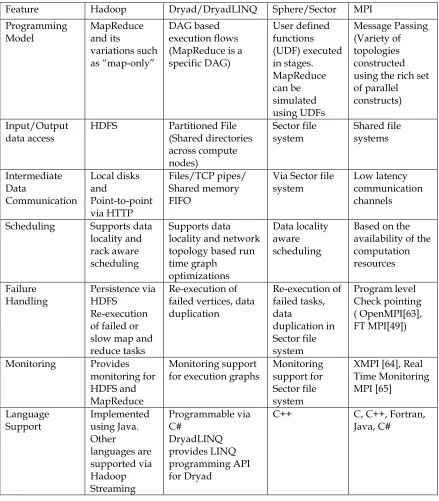
2.11. Summary of Features Supported by Different Runtimes
[image:54.612.108.547.158.659.2]The following table highlights the features supported by three Cloud Technologies and MPI.
Table 1. Comparison of features supported by different parallel programming runtimes
Feature Hadoop Dryad/DryadLINQ Sphere/Sector MPI Programming
Model MapReduce and its variations such as “map-only”
DAG based execution flows (MapReduce is a specific DAG) User defined functions (UDF) executed in stages. MapReduce can be simulated using UDFs Message Passing (Variety of topologies constructed using the rich set of parallel constructs) Input/Output
data access HDFS Partitioned File (Shared directories across compute nodes)
Sector file
system Shared file systems
Intermediate Data Communication Local disks and Point-to-point via HTTP Files/TCP pipes/ Shared memory FIFO
Via Sector file
system Low latency communication channels Scheduling Supports data
locality and rack aware scheduling
Supports data locality and network topology based run time graph
optimizations
Data locality aware scheduling
Based on the availability of the computation resources Failure
Handling Persistence via HDFS Re-execution of failed or slow map and reduce tasks
Re-execution of failed vertices, data duplication Re-execution of failed tasks, data duplication in Sector file system Program level Check pointing ( OpenMPI[63], FT MPI[49])
Monitoring Provides monitoring for HDFS and MapReduce
Monitoring support
for execution graphs Monitoring support for Sector file system
XMPI [64], Real Time Monitoring MPI [65]
Language
Support Implemented using Java. Other languages are supported via Hadoop Streaming Programmable via C# DryadLINQ provides LINQ programming API for Dryad
C++ C, C++, Fortran,
37
Chapter 3.
Application Classes
38
Parallel applications can be categorized according to their mapping to hardware and software systems. A broader classification based on Flynn’s taxonomy[66] uses Single Program Multiple Data (SPMD) and Multiple Program Multiple Data (MPMD) categories to classify parallel applications. Fox defined five classes of applications as follows[67].
Table 2. Application classification
1 Synchronous The problem can be implemented with instruction level Lockstep Operation as in SIMD architectures
2 Loosely Synchronous
These problems exhibit iterative Compute-Communication stages with independent compute (map) operations for each CPU that are synchronized with a communication step. This problem class covers many successful MPI applications including partial differential equation solution and particle dynamics applications.
3 Asynchronous Compute Chess and Integer Programming; Combinatorial Search often supported by dynamic threads. This is rarely important in scientific computing but it stands at the heart of operating systems and concurrency in consumer applications such as Microsoft Word.
4 Pleasingly Parallel
Each component is independent. In 1988, Fox estimated this at 20% of the total number of applications but that percentage has grown with the use of Grids and data analysis applications as seen here. For example, this phenomenon can be seen in the LHC analysis for particle physics [68].
39
Grids and is described by workflow.
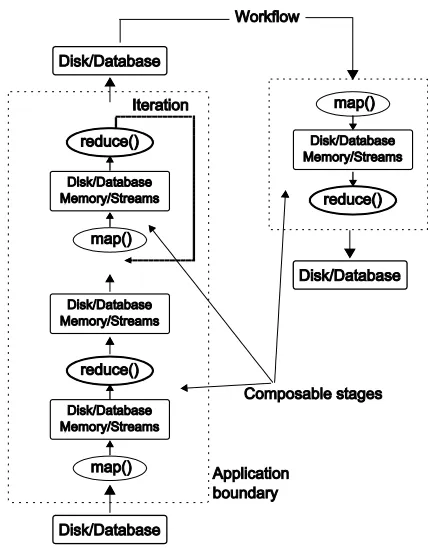
[image:57.612.216.430.384.658.2]The composable applications we discussed earlier contain features from classes 2, 4, and 5. Here, the applications are composed of one or more individually parallelizable stages. Parallel runtimes as Google MapReduce, Hadoop, and Dryad can be used to parallelize stages that perform “pleasingly parallel” operations such as calculating Smith Waterman or calculating histogram of events. As we will show in this thesis, with extended MapReduce capabilities, some stages that require MPI style parallel constructs can also be implemented using MapReduce. Multiple such applications can then be executed in workflows to achieve complex processing. With applications involving only the simple parallel operations such as applying a computation function to a collection of data files, the distinction between composability by using a runtime such as MapReduce vs. workflows gets blurred. Figure 2 shows the structure of composable applications.
40
One can classify MapReduce with its support for large scale data processing as a new addition to the above list of categorizations. The MapReduce programming model can support applications in classes 4 and 5, and with the extended programming model and the efficient runtime that we will propose in this thesis it can support some of the applications in class 2 as well. Therefore, the MapReduce class subsumes aspects of classes 2, 4, and 5.
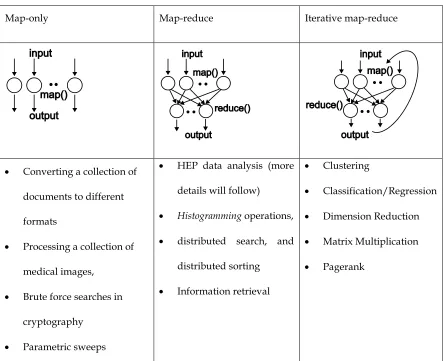
The types of applications that can be supported (some problems in 2, 4, and 5 above) in MapReduce can be categorized into four distinct sub classes: (i) map-only; (ii) map-reduce; (iii) iterative-map-reduce; and (iv) extended MapReduce applications. Complex applications can be built by combining the first three basic execution units under the MapReduce programming model and additional algorithms can be supported with further extensions. We will defer the discussion on further extensions to a later section (Chapter 6 section 6.9) and focus on the first three types of basic MapReduce classes in this chapter. Although this categorization applies to the MapReduce model, we can use the same sub categories to classify applications that can be supported by the high-level runtimes such as Microsoft Dryad as well.
3.1. Map-only Applications
41
batch queues, Condor[34], Falkon [69], classic cloud services such as Amazon Queues, and SWARM [31], all provide similar functionality by scheduling large numbers of individual maps/jobs.
3.2. MapReduce Applications
In MapReduce, the map and reduce phases perform the computations in parallel while the combination of intermediate keys and the shuffling strategies can be used to create different parallel topologies according to the parallel algorithm. For example, consider a word sorting application implemented in MapReduce. Here, the map tasks simply perform a scatter operation on the input words. The intermediate keys are the words themselves, and the shuffling is done so that the words that start with a given letter end up in the same reduce tasks. The reduce tasks then sort their inputs, and one can create the complete sorted output by taking the reduce outputs in the order of the letters assigned to the reduce tasks. In this application, the intermediate keys and the shuffling mechanisms are used to simulate a bucket sort[70] algorithm. Although not completely independent of the above, the runtime parameters such as (i) input data partitions, (ii) the number of maps, (ii) the number of reducer tasks can be used to fine tune the parallelism of MapReduce applications.
The applications described in the Google paper mainly use the map stage to distribute the intermediate <key,value> pairs putting less weight on the map stage of the computation while the
42
write a map task that takes a set of lines or a whole file as the input and which can then produce partial word counts. This will make map tasks coarser and reduce the amount of intermediate communications, as the map tasks can perform a local reduction by itself by accumulating counts of words it encounters. However, we also note that these characteristics are highly application dependent. For example, in an application that we will discuss in more detail later, the map tasks perform most of the computation and the reduce tasks simply combine results. On the other hand, in the matrix multiplication (“Fox algorithm using extended MapReduce”), we use map tasks to distribute matrix blocks while the reduce tasks perform the matrix multiplication operations.
Selecting an appropriate key selector function is also an impotent aspect that one should consider in mapping applications to MapReduce domain. A creative use of key selectors will produce elegant MapReduce algorithms. Applications that can be implemented using MPI collective operations can be implemented using MapReduce, but still this does not capture all the low-level messaging constructs offered by the runtimes, such as MPI.
3.3. Iterative MapReduce Applications
43
However, the “side effect free”-nature of the MapReduce programming model does not fit well for iterative MapReduce computations in which each map and reduce tasks are considered as atomic execution units with no state shared in between executions. In parallel runtimes such as those of the MPI, the parallel execution units live throughout the entire life of the program; hence, the state of a parallel execution unit can be shared across invocations. On the other hand, the side effect free nature of MapReduce is one of the key features that makes it easier to support fault tolerance. We propose two strategies to extend the MapReduce programming model to suit this class of applications: (i) an intermediate approach where the map/reduce tasks are still considered side effect-free, but the runtime allows for the configuring and the re-usage of the
map/reduce tasks. Once configured, the runtime caches the map/reduce tasks. In this way, both the
map and the reduce tasks can keep the static data in memory, and can be called iteratively without loading the static data repeatedly; (ii) allow map/reduce tasks to hold states (support computations with side effects) and adopt different fault tolerance strategies that suit iterative computations. These extensions are discussed in more detail in the next section.
44
Table 3. Classes of MapReduce applications
Map-only Map-reduce Iterative map-reduce
• Converting a collection of documents to different formats
• Processing a collection of medical images,
• Brute force searches in cryptography
• Parametric sweeps
• HEP data analysis (more details will follow)
• Histogramming operations,
• distributed search, and distributed sorting
• Information retrieval
• Clustering
• Classification/Regression
• Dimension Reduction
• Matrix Multiplication
45
Chapter 4.
A Programming Model for Iterative
MapReduce Computations
As discussed in the previous section, there are many iterative algorithms that can be parallelized by applying the SPMD model to the main computations that are executed inside the iterations. Once such algorithms are identified MapReduce can be used as a parallelization construct to implement the SPMD portions of the algorithms resulting iterative MapReduce computations. In this section, we will discuss an extended MapReduce programming model which can be used to support most such computations efficiently.
46
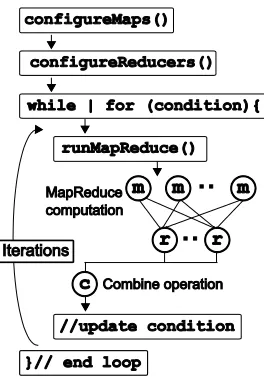
[image:64.612.258.390.298.491.2]as data products that change during the computations; many of them use iterations until convergence; many require the reduce output as a whole to make the decision to continue or stop iterations; and we also discovered that the iteration boundaries can be used as good fault tolerance checkpoints. To support such algorithms, we need an extended MapReduce programming model and an efficient runtime implementation, which we try to provide in Twister. (Note: Twister is the name given to the MapReduce runtime we developed as part of this research; hence, we will use it hereafter to refer to the new MapReduce runtime). Twister adopts a programming model that can support the above features of iterative algorithms. A high level view of the programming model is shown in Figure 3 followed by a detailed discussion.
Figure 3. The iterative MapReduce programming model supported by Twister.
4.1. Static vs. Variable Data
47
consider the K-means clustering algorithm[71], during the nth iteration the program uses the input data set and the cluster centers computed during the (n-1)th iteration to compute the next set of cluster centers. Similarly, in each iteration, the pagerank algorithm[73] accesses the static web graph and the current pageranks computed during the previous step. To support map/reduce
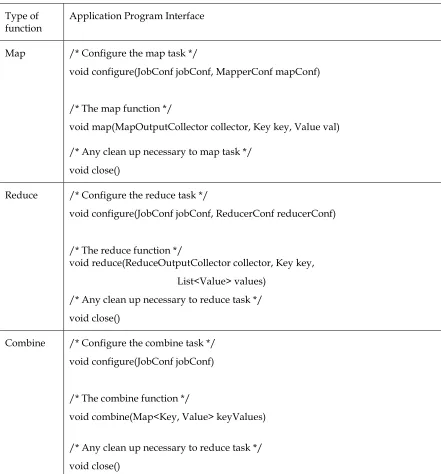
tasks operating with these two types of data items, we introduced a “configure” phase for map
and reduce tasks, which can be used to load (read) any static data to the map and reduce tasks. With this improvement, a typical map phase of the computation then consumes the variable data specified as (key, value) pairs as well as the static data loaded during the configuration phase. This is different from other MapReduce runtimes where only one input data set is accessible at the
map phase of the computation. At the same time, typical MapReduce applications (applications without iterative MapReduce computations), when developed using the Twister runtime, require the use of the configure phase to access any input data. For example, in a word-count application, the input data partitions are assigned to map tasks during the configure phase of the computation, whereas the actual word count operation happens during the map phase of the computation.
4.2. Long Running Map/Reduce Tasks
The above programming extension adds capabilities of handling both static and variable data in