Evaluation of the Early Age Condition of Concrete
Structures Using Impact Echo Method and
Ultra-sonic Pulse Velocity Method
Seonguk Hong, Sangki Yoon, Seunghun Kim, Changjong Lee, Yongtaeg Lee
Abstract The purpose of this study is to estimate the early age compressive strength of concrete members and the thickness of concrete column members using the ultrasonic pulse velocity method and impact echo method among nondestructive test methods. A nondestructive experiment was conducted by making 6 furniture-type specimens comprised of columns of different thickness and size and 90 specimens of 6 age variables. For con-crete specimens, the design parameters were set at 16, 20, 24, 48, 72 and 120 hours at the age of 24, 30 and 40 MPa. The possibility of using the early age compressive strength and size of the con-crete members as a quality control technique was confirmed based on the correlation between the compressive strength and pulse velocity in the ultrasonic pulse velocity method and impact echo method. Therefore, the validity of the nondestructive testing method as a quality control technique for concrete structures was confirmed.
Keywords: Concrete structures, Condition, Early age, Evaluation, Impact echo method, Ultrasonic pulse velocity method
I. INTRODUCTION
The nondestructive test method is becoming important with the increasing interest in precise diagnosis, which evaluates the degree of damage in building structures due to aging or natural disaster, and periodic inspection for maintenance. Quality improvement is inevitable, and evaluation of the condition of concrete members in the early age is especially important. To perform quick and accurate diagnosis of building structures, it is necessary to develop a complex nondestructive testing technology using the advantages of the nondestructive test method based on stress waves. Dam-age on human life caused by the destruction of a new park-ing lot buildpark-ing under construction in Tel Aviv, Israel that occurred in September 2016 demonstrates the importance of evaluating the early age compressive strength of concrete structures. Prior to the destruction, this construction site already had an accident in which concrete beams were col-lapsed in July. The later accident could not be prevented because the site did not accurately evaluate the early age condition such as compressive strength of concrete [1].
Revised Manuscript Received on May 06, 2019
Seonguk Hong,Department of Architectural Engineering, Hanbat
Unversity, 125 Dongdesero, Yuseong-gu, Daejeon, Republic of Korea
Sangki Yoon,Department of Architectural Engineering, Hanbat
Unversity, 125 Dongdesero, Yuseong-gu, Daejeon, Republic of Korea
Seunghun Kim, Department of Architectural Engineering, Hanbat
University, 125 Dongdesero, Yuseong-gu, Daejeon, Republic of Korea
Changjong Lee,Department of Architectural Engineering, Hanbat
University, 125 Dongdesero, Yuseong-gu, Daejeon, Republic of Korea
Yongtaeg Lee, Department of Architectural Engineering, Hanbat
Unversity, 125 Dongdesero, Yuseong-gu, Daejeon, Republic of Korea
The purpose of this study is to measure compressive strength of concrete and thickness of concrete column mem-bers by applying the ultrasonic pulse velocity method and impact echo method among various nondestructive test methods to evaluate the early age condition of concrete members. For the concrete member specimens, 90 simulated members are made by setting the age to 16, 20, 24, 48, 72 and 120 hours and the design strength to 24, 30 and 40 MPa. Experiments are carried out to estimate compressive strength of concrete and thickness of concrete column mem-bers in the early age.
By finding the correlation between ultrasonic velocity and compressive strength, it can be used to estimate the early age compressive strength of concrete structures at construc-tion sites by establishing a method of evaluating the early age condition of concrete members using the nondestructive test method. Also, the impact echo method can possibly be applied to control quality of concrete column members.
II. Review of previous research
III. Impact echo method
The impact echo method is based on the use of temporary stress waves generated by an elastic impact. When a me-chanical impact is applied to the surface, body waves (P, S waves) propagated inside the specimen with a spherical wave front and surface waves (R waves) propagated along the specimen surface with a cylindrical wave front are gen-erated. Here, the body waves are reflected and returned to the surface on which stress waves were formed if they en-counter a discontinuous body like crack and void or bound-ary between heterogeneous layers. Since surface displace-ment caused by P waves reflected off the discontinuous body like crack and void or boundary between heterogene-ous layers is much greater than surface displacement caused by S waves, the waveform detected on the surface can be seen as the waveform of reflected P waves. The impact echo method can be used to identify defects in a material and the position of the boundary. If dimensions of the specimen are known, defects in concrete can also be predicted. Also, if the propagation velocity of P waves is known, the position of the continuous surface inside the specimen can be found by measuring the arrival time of reflected waves. The time do-main acquired by collecting stress waves from the excitation source using an accelerometer is converted into the fre-quency domain through the Fast Fourier Transform (FFT). Resonance frequency from multiple reflections can be ob-tained easily of the peak amplitude frequency from fre-quency domain data. The velocity of compression waves can be found. The distance from the plate structure to the reflec-tion boundary is , the velocity of compression waves is and resonance frequency is . The approximation expression is as shown in Eq. (1). Eq. (2) can be used to calculate thickness of members using frequency measured. Sansalone [10] reported that the 5% difference between actual thick-ness and calculated thickthick-ness in general experimental results is because of a specific mode caused by vibration of mem-bers from multiple reflections of P waves.
(1)
This occurs from repetition of the same mode as the exag-gerated time-impulse function graph. This is known as the thickness mode. Eq. (2) is expressed using the shape factor (β) that consi ers the geometric shape.
β β (2)
Among different types of stress waves propagated along the material by an elastic impact, body waves are propagated inside the material by compression and tension of the mate-rial particles (P waves) and horizontal or vertical shear movement (S waves). Surface waves (R waves) occur when the material has a free surface like the ground surface. Com-pression waves (P waves) show forward and reverse particle movements parallel to the direction of waves, only causing volume change without shear change. Particles in shear waves (S waves) only cause shear change without volume change. If axial displacement is constrained, the velocity of compression waves ( ) is determined by elastic modulus and density of the material as expressed in Eq. (3).
(3)
Where, : constrained modulus, : Young's modulus, : density, : Poisson’s ratio
IV. ULTRASONIC PULSE VELOCITY METHOD
The ultrasonic pulse velocity method refers to velocity of an ultra-sonic pulse transmitted to hardened concrete, which is generally calculated based on the passage time between the source and re-ceiver. [11] Since density of concrete is heterogeneous and unspe-cific, the ultrasonic pulse is affected by various factor. There are difficulties in properly estimating the compressive strength of con-crete solely based on the ultrasonic pulse. However, if the primary conditions are similar, the strength can be estimated to some degree because there is a fixed correlation between the ultrasonic pulse and strength. Therefore, this test can be applied to the concrete strength test, which measures density of a material, elasticity, ho-mogeneity, existence of void or cavity, and degradation or carbona-tion caused by chemical damaging and aging. The test is done
us-ing pulses of 50∼60kHz, most appropriate for testing of a brittle
material. When trying to evaluate material characteristics by meas-uring velocity of the ultrasonic pulse, the precision of measurement needs to be extremely high. This means that it is necessary to use experimental instruments that can generate appropriate pulses and accurately measure the transit time of the material being tested. The pulse velocity can be calculated as expressed in Eq. (4) by measuring the path length of the pulses within the material. The velocity that appears on the measuring device is the velocity of the very first pulse. It is the velocity at which the pulse travels from the transmitting transducer (Tx) to the receiving transducer (Rx) when Tx and Rx are placed in appropriate positions on the material sur-face.
P se e ocit (4)
V. Experiments
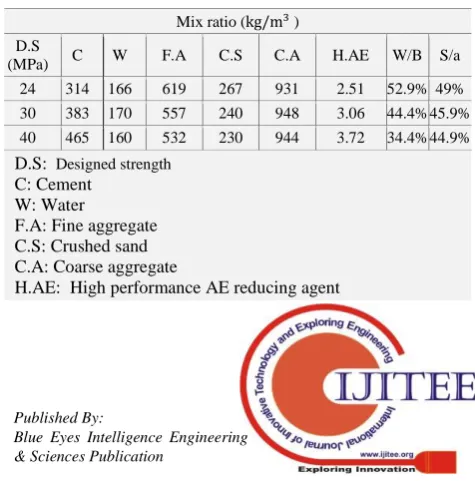
[image:2.595.308.546.597.838.2]The objective of this study is to measure the compressive strength of concrete and thickness of concrete column mem-bers using the ultrasonic pulse velocity method and impact echo method, which are nondestructive test methods of ex-amining the early age condition of concrete members. Ac-cordingly, 120 concrete member specimens were made by setting six age variables of 16, 20, 24, 48, 72 and 120 hours for design strengths of 24, 30 and 40 MPa. The thickness specimens were planned out as furniture type with length of 2,400mm, width of 2,400mm and height of 1,600mm as shown in Figure 1 and Photo 1. The specimens were made to have design strengths of 24, 30 or 40 MPa as presented in Table 1.
Table 1: Concrete mix ratio
Mix ratio ( )
D.S
(MPa) C W F.A C.S C.A H.AE W/B S/a
24 314 166 619 267 931 2.51 52.9% 49%
30 383 170 557 240 948 3.06 44.4% 45.9%
40 465 160 532 230 944 3.72 34.4% 44.9%
D.S: Designed strength C: Cement
W: Water
F.A: Fine aggregate C.S: Crushed sand C.A: Coarse aggregate
To calculate the average early age ultrasonic pulse velocity of concrete members, an ultrasonic pulse velocity measuring device of Olson, U.S was used according to the KS F 2730 and ACI 229-2R standards for the ages of 16, 20, 24, 48, 72 and 120 hours.
Fig. 1: Specimen plan (mm)
Photo 1: Form of conrete structures
(a)Ultrasonic pulse velocity method
(b)Compressive strength test (c)Impact echo method
Fig. 2: Experimental method
As shown in Figure 2(a), the ultrasonic pulse velocity was measured 20 times at the center of the specimen. The com-pressive strength of concrete was tested in accordance with KS F 2405 as shown in Figure 2(b), and a grinder was used to grind and flatten the top surface of the specimen for the compressive strength test.
The compressive strength was calculated using a digital UTM after measuring maximum load. The experiment was carried out in accordance with ASTM C 1384-04 to measure the thickness of the concrete column members using the impact echo method. For the thickness measurement, the thickness was measured 10 times at random points on the specimen as shown in Figure 2(c).
VI. RESULTS
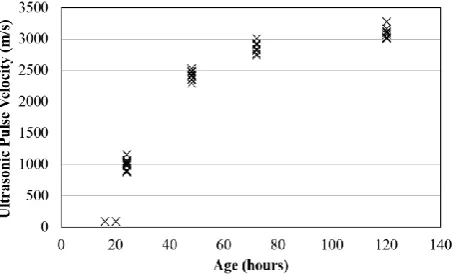
6.1. Estimation of compressive strength of concrete Among the experimental results for the specimen with the design strength of 24 MPa, the ultrasonic pulse velocity was 96.4 for the age of 16 hours, 709.8 for the age of 20 hours, 1,005.3 for the age of 24 hours, 2,300.1
for the age of 48 hours, 2,703.5 for the age of 72 hours and 2,988.8 for the age of 120 hours. As shown in Figure 3, the pulse velocity increased rapidly from the age of 16 hours to 72 hours and then increased slowly until the age of 120 hours.
Fig. 3: Ultrasonic pulse velocity by age of specimen(24MPa)
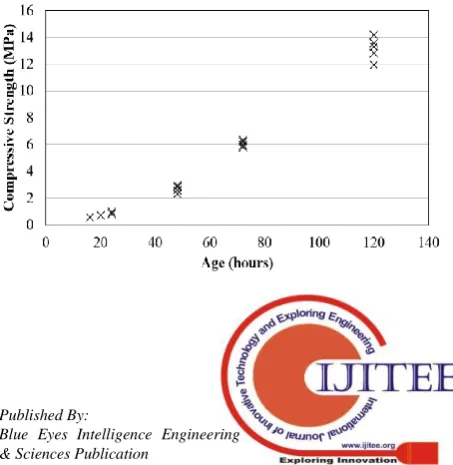
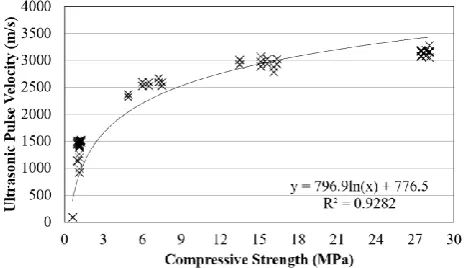
[image:3.595.52.290.265.742.2] [image:3.595.314.541.361.485.2] [image:3.595.317.544.599.832.2]Fig. 4: Compressive strength by age of specimen(24MPa) The relationship between the ultrasonic pulse velocity ac-quired through the nondestructive test and the compressive strength of the 30 specimens of 6 different ages is illustrated in Figure 5. Eq. (5) was derived by performing regression analysis of the relationship between the ultrasonic pulse velocity and compressive strength based on the acquired data. The ultrasonic pulse velocity and compressive strength have a non-linear correlation, where the compressive strength increases non-linearly according to increase of the velocity. This is because the development rate of the ultra-sonic pulse is faster than the curing rate of the compressive strength. The early age compressive strength can be esti-mated at a site with the concrete design strength of 24 MPa by using this equation.
Fig. 5: Correlation of ultrasonic pulse velocity and compressive strength
(5)
Among the experimental results for the specimen with the design strength of 30 MPa, the ultrasonic pulse velocity was 96.4 for the age of 16 hours, 96.0 for the age of 20 hours, 1,010.03 for the age of 24 hours, 2,451.8
for the age of 48 hours, 2,867.2 for the age of 72 hours and 3,118.3 for the age of 120 hours. As shown in Figure 6, the pulse velocity increased rapidly from the age of 16 hours to 72 hours and then increased slowly until the age of 120 hours.
Fig. 6: Ultrasonic pulse velocity by age of specimen(30MPa)
The compressive strength of the simulated concrete mem-bers was 2.07 % of the design strength for the age of 16 hours, 2.07 % of the design strength for the age of 20 hours, 3.73 % of the design strength for the age of 24 hours, 13.07 % of the design strength for the age of 48 hours, 30.67 % of the design strength for the age of 72 hours and 69.70 % of the design strength for the age of 120 hours. As shown in Figure 7, the compressive strength increased according to the age.
[image:4.595.311.542.206.346.2]Fig. 7: Compressive strength by age of specimen(30MPa)
Fig. 8: Correlation of ultrasonic pulse velocity and compressive strength
(6)
The relationship between the ultrasonic pulse velocity ac-quired through the nondestructive test and the compressive strength of the 30 specimens of 6 different ages is illustrated in Figure 8. Eq. (6) was derived by performing regression analysis of the relationship between the ultrasonic pulse velocity and compressive strength based on the acquired data. The ultrasonic pulse velocity and compressive strength have a non-linear correlation, where the compressive strength increases non-linearly according to increase of the velocity. This is because the development rate of the ultra-sonic pulse is faster than the curing rate of the compressive strength. The early age compressive strength can be esti-mated at a site with the concrete design strength of 30 MPa by using this equation.
Fig. 9: Ultrasonic pulse velocity by age of specimen(40MPa)
Among the experimental results for the specimen with the design strength of 40 MPa,
[image:4.595.53.287.231.364.2] [image:4.595.56.283.539.677.2] [image:4.595.312.542.569.705.2]age of 20 hours, 1,570.9 for the age of 24 hours, 2,543.5 for the age of 48 hours, 2,952.5 for the age of 72 hours and 3,157.6 for the age of 120 hours. As shown in Figure 9, the pulse velocity increased rapidly from the age of 16 hours to 72 hours and then increased slowly until the age of 120 hours.
Fig. 10: Compressive strength by age of specimen(40MPa)
[image:5.595.305.547.380.827.2]The compressive strength of the simulated concrete mem-bers was 1.55 % of the design strength for the age of 16 hours, 1.55 % of the design strength for the age of 20 hours, 2.80 % of the design strength for the age of 24 hours, 16.05 % of the design strength for the age of 48 hours, 38.33 % of the design strength for the age of 72 hours and 69.43 % of the design strength for the age of 120 hours. As shown in Figure 10, the compressive strength increased according to the age.
Fig. 11: Correlation of ultrasonic pulse velocity and compressive strength
(7)
The relationship between the ultrasonic pulse velocity ac-quired through the nondestructive test and the compressive strength of the 30 specimens of 6 different ages is illustrated in Figure 11. Eq. (7) was derived by performing regression analysis of the relationship between the ultrasonic pulse velocity and compressive strength based on the acquired data. The ultrasonic pulse velocity and compressive strength have a non-linear correlation, where the compressive strength increases non-linearly according to increase of the velocity. This is because the development rate of the ultra-sonic pulse is faster than the curing rate of the compressive strength. The early age compressive strength can be esti-mated at a site with the concrete design strength of 30 MPa by using this equation.
6.2. Estimation of size of concrete column
This experiment was carried out as a part of the experimen-tal study to confirm the possibility of quality control through the early age thickness measurement on the concrete column
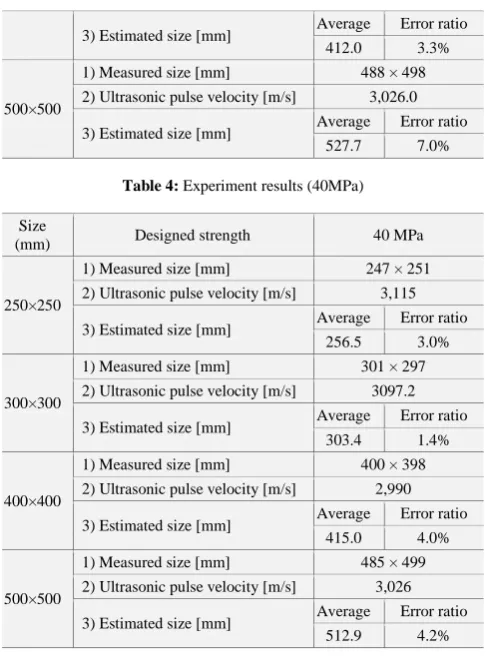
members. After removing the mold at the age of 120 hours at a random point on the column members, the concrete col-umn thickness estimation experiment was done using the impact echo method at the age of 144 hours. The thickness was measured 10 times at different position of the members to find the mean value, and the mean error rate of each col-umn member was found as well. The results of this estima-tion experiment are presented in Table 2 through Table 4. According to the results for the column members with the design strength of 24 MPa, the error rate was 3.5 % for the 250 mm column member, 1.1 % for the 300 mm column member, 3.1 % for the 400 mm column member, 0.6 % for the 500 mm column member, and 2.1 % for the mean as shown in Table 2.
For the column members with the design strength of 30 MPa, the error rate was 1.5 % for the 250 mm column member, 1.8 % for the 300 mm column member, 3.3 % for the 400 mm column member, 7.0 % for the 500 mm column mem-ber and 3.4 % for the mean as shown in Table 3.
For the column members with the design strength of 40 MPa, the error rate was 3.0 % for the 250 mm column member, 1.4 % for the 300mm column member, 4.0 % for the 400 mm column member, 4.2 % for the 500 mm column mem-ber and 3.2 % for the mean as shown in Table 4. The overall error rate for all column members of each strength and size was 2.9 %. The possibility of quality control through the measurement of the early age column member thickness using the nondestructive test methods was confirmed.
Table 2: Experiment results (24MPa) Size
(mm) Designed strength 24 MPa
250×250
1) Measured size [mm] 249 × 248
2) Ultrasonic pulse velocity [m/s] 2,848.0
3) Estimated size [mm] Average Error ratio
239.9 3.5%
300×300
1) Measured size [mm] 299 × 297
2) Ultrasonic pulse velocity [m/s] 2883.0
3) Estimated size [mm] Average Error ratio
301.3 1.1%
400×400
1) Measured size [mm] 390 × 395
2) Ultrasonic pulse velocity [m/s] 2,848.0
3) Estimated size [mm] Average Error ratio
404.6 3.1%
500×500
1) Measured size [mm] 495 × 498
2) Ultrasonic pulse velocity [m/s] 2,848.0
3) Estimated size [mm] Average Error ratio
499.3 0.6%
Table 3: Experiment results (30MPa) Size
(mm) Designed strength 30 MPa
250×250
1) Measured size [mm] 249 × 250
2) Ultrasonic pulse velocity [m/s] 2,937.0
3) Estimated size [mm] Average Error ratio
253.2 1.5%
300×300
1) Measured size [mm] 300 × 296
2) Ultrasonic pulse velocity [m/s] 2990.4
3) Estimated size [mm] Average Error ratio
303.4 1.8%
400×400 1) Measured size [mm] 398 × 400
[image:5.595.52.286.393.527.2]3) Estimated size [mm] Average Error ratio
412.0 3.3%
500×500
1) Measured size [mm] 488 × 498
2) Ultrasonic pulse velocity [m/s] 3,026.0
3) Estimated size [mm] Average Error ratio
[image:6.595.47.292.45.381.2]527.7 7.0%
Table 4: Experiment results (40MPa)
Size
(mm) Designed strength 40 MPa
250×250
1) Measured size [mm] 247 × 251
2) Ultrasonic pulse velocity [m/s] 3,115
3) Estimated size [mm] Average Error ratio
256.5 3.0%
300×300
1) Measured size [mm] 301 × 297
2) Ultrasonic pulse velocity [m/s] 3097.2
3) Estimated size [mm] Average Error ratio
303.4 1.4%
400×400
1) Measured size [mm] 400 × 398
2) Ultrasonic pulse velocity [m/s] 2,990
3) Estimated size [mm] Average Error ratio
415.0 4.0%
500×500
1) Measured size [mm] 485 × 499
2) Ultrasonic pulse velocity [m/s] 3,026
3) Estimated size [mm] Average Error ratio
512.9 4.2%
VII. CONCLUSION
The purpose of this study is to estimate the early age com-pressive strength of concrete members and the thickness of concrete column members using the ultrasonic pulse veloci-ty method and impact echo method among nondestructive test methods. A nondestructive experiment was conducted by making 6 furniture-type specimens comprised of columns of different thickness and size and 90 specimens of 6 age variables. The experimental results can be summarized as below.
The ultrasonic pulse velocity of the samples with the design strength of 24, 30 and 40 MPa was increased rapidly from the age of 16 hours to 72 hours and then increased slowly until the age of 120 hours. The mean compressive strength was 2.1 % of the design strength for the age of 16 hours, 2.3 % for the age of 20 hours, 3.5 % for the age of 24 hours, 13.6% for the age of 48 hours, 31.4% for the age of 72 hours and 64.7% for the age of 120 hours. These results verified that the early age compressive strength of concrete can be esti-mated using the nondestructive test methods. Based on the size of the concrete column members estimated using the impact echo method, the error rate was 2.1 %, 3.4 % and 3.2 % for each design strength. The overall error rate for all column members of each strength and size was 2.9 %. The possibility of quality control through the estimation of the early age member thickness using the nondestructive test methods was confirmed.
The possibility of using the early age compressive strength and size of the concrete members as a quality control tech-nique was confirmed based on the correlation between the compressive strength and pulse velocity in the ultrasonic pulse velocity method and impact echo method.
Ack
nowledgement
This research was supported by Basic Science Research Program through the National Research Foundation of Ko-rea (NRF) funded by the Ministry of Education (NRF-2017R1A2B2009743)
REFERENCES
1. Hong SU, Yoon SK, Kim SH, Lee CJ & Lee YT, “E a ation of the early age condition of concrete members using nondestructive test metho ” , International Journal of ICT-aided Architecture and Civil Engineering, Vol. 5, No. 1, (2018), pp.57-62, http://dx.doi.org/ 10.21742/ijiace.2018.5.1.10
2. Hong SU, LEE YT, Kim SH &Lee CS, “Estimation of Thickness of
Concrete Structures using the Impact Echo Method and Ultrasonic P se Ve ocit Metho ”, Architectural research. Vol.18, No.4 (2016), pp179-184, https://dx.doi.org/10.5659/AIKAR.2016.18.4.179
3. Lee YT, Hong SU & Na JH, “Estimation of Slab Depth, Column Size
and Rebar Location of Concrete Specimen Using Impact Echo Meth-od”, Magazine of the Korea Institute for Structural Maintenance and
Inspection. Vol.18, No. 1 (2014), pp.37-41,
http://db.koreascholar.com/article.aspx?code=283611
4. Hong SU, Cho YS, Kim SH & Lee YT, “Estimation of compressive
strength of concrete structures using the ultrasonic pulse velocity meth-od and spectral analysis of surface wave methmeth-od”, Materials Research
Innovations. Vol.19, No. s2, (2015), pp.1289-1294,
https://doi.org/10.1179/1432891714Z.0000000001296
5. Kim SB, Hong SU & Cho YS, “A St on the Estimation of the
Com-pressive Strength and Flaw of Concrete Structures using SASW and IE Metho base on Stress Wa es”, Journal of the Architectural Institute of Korea Structure & Construction. Vol.23, No.10, (2007), pp.35-42, http://www.dbpia.co.kr/Journal/ArticleDetail/NODE0090 5671
6. Kim DS, Park HC & Lee KM, “Nondestructive Evaluation of Concrete
Members Using Impact Echo Method”, Journal of the Korea Concrete
Institute. Vol.9, No.2 (1997), pp.109-119,
http://www.dbpia.co.kr/Journal/ArticleDetail/NODE02284619
7. HodaAzari, SoheilNazarian & DerenYuan, “Assessing sensiti it of
impact echo and ultrasonic surface waves methods for nondestructive e a ation of concrete str ct res”, Construction and Building Materials.
Vol.71 (2014), pp.384-391, https://doi.org/10.1016/j.con
buildmat.2014.08.056
8. OskarBaggens & NilsRyden, “S stematic errors in Impact-Echo
thick-ness estimation due to near field effects.”, NDT & E International. Vol. 69, (2015), pp.16-27, https://doi.org/10.1016/j.n dtein t.2014.09.003
9. Chung-YueWang, Chin-LungChiu, Kun-YiTsai, Pi-KuanChen,
Peng-ChiPeng & Hao-LinWang, “Inspecting the c rrent thickness of a re-fractory wall inside an operational blast furnace using the impact echo metho ”, NDT & E International. Vol.66, (2014), pp.43-51, https://doi.org/10.1016/j.ndteint.2014.04.001
10. Sansalone, M. & Carino, N. J., “Impact Echo: A Metho for F aw Detection in Concrete Using Transient Stress Wa es”, NBSIR 86-3452. National Technical Information Service, Springfield, Va. (1986), pp.130-173
11. Lee CJ, “An experimenta st on ear age con ition of concrete members with non estr cti e tests techniq e” Master Thesis of Hanbat National University, Daejeon, Republic of Korea. (2018)