Digitalization – quo vadis?
JuhoMäkiö1, Andrey Miroliubov2,and Valeria Zhgun2*
1 Emden/Leer University of Applied Sciences, 26723 Constantia pl. 4, Germany
2 Peter the Great Saint Petersburg Polytechnic University, 195251 Polytechnicheskaya st. 29, Russian Federation
Abstract. Digitalization is changing the global business ecosystem at an unimaginable speed. Although previous industrial revolutions took dozens of years to transform the existing markets, internet-based companies like Google, Amazon and Uber have done it in less than ten years. Business models in the nearest future – how will they look like? Where will the extensive process of the fourth industrial revolution take us? How will our role as entrepreneurs, managers or consumers change in the new business ecosystem? In this paper we consider the changes concerning the process of digitalization as the main prerequisites for transformation of business models. We combine them into three main aspects that influence modern business modeling approaches: technological, social and economic. This prospective gives insight into the way the future business models will look like and leads us to practical recommendations for companies to follow when digitizing their business.
1 Introduction
In context of digitalization, which has been penetrating the market with digital products, digital services and digital solutions, businesses of all industries are in front of a challenge: to adapt to the changes or to initiate the changes. In the new business ecosystem, the relations between companies (competition/cooperation) increasingly depend on this decision. According to McKinsey [1], in 2017 Europe was a net importer of US digital services, running a digital trade deficit amounting equal to nearly 5.6% of total services trade between the EU and the US. However, if its laggards double their digital intensity, EU
can add €2.5 trillion to GDP in 2025, boosting GDP growth by 1% a year over a decade. Can the process of digitalization be stopped? Probably, it cannot. The economic benefits are obvious. Despite this, 42.6% of businesses in the world do not recognize digitalization as a priority strategy [2]. Other companies realize the need to transform their business models in terms of integration and other processes that dictate the direction of digitalization, but they do not know what to start with.
The question of digitalization and its consequences was studied by various researchers. The economic role of software platforms was investigated by D. Evans, A. Hagiu and R. Schmalensee with a case-based analysis [3]. B. Jullien performs a theoretical analysis of double-sided markets, highlighting the role of business in online intermediation. The researcher looks at efficiency and price issues of monopoly intermediation and competition between the intermediary businesses [4]. E. Dinlersoz and P. Pereira discuss the viability of adoption of e-commerce by retailers and construct a theoretical model to explain these facts focusing on market characteristics (technology, consumer loyalty, and preferences) [5].
From practical point of view, different companies apply various approaches to digitize business:
–digitizing products;
–digitizing processes when implementing diverse business management systems/online platforms/applications;
–combining both approaches (using the products of data science, cognitive technology and processing power to create ‘intelligent enterprises’).
Amazon transformed its online paper bookseller’s model by launching the Kindle
e-book reader at the expense of its physical e-books sales (“how to cannibalize yourself”
strategy [6]). This way they digitized the content.
WhatsApp used a lean operating model approach in digitization of its business processes and achieved astonishing growth with just 35 employees (in 2014) [6].
Philips Healthcare is working with Salesforce on building a platform that will transform and optimize the way healthcare is delivered. They plan to create an ecosystem of developers with healthcare applications that will support collaboration between doctors and patients [6].
IP Soft elaborated a virtual agent Amelia (AI platform) that is capable to understand
customer’s questions and even emotions when they call or email [6].
Do these examples of new business models use a universal approach to innovation of the models? Probably, it is a more individual question. Can we come up with initial steps and key directions for the companies – this is another question. Even those that started the process and adapted their business to some extent need to change fundamentally the way they identify, develop and launch new business models. A company producing digital software embedded in cars that inform the user about the nearest services to pump a tire or change the color is to cooperate with those services not only in terms of communication, but also in terms of correspondence to the same technical standards. This is an example of a prerequisite to the model transformation.
2 Hypothesis
In this paper we discuss the future prospects of business modeling in context of digitization of business and, in this regard, we ask the question: is it possible to define a dominate business model, and to reveal the key directions for business model transformation in context of the fourth industrial revolution? To reach the goals, we will complete the following tasks:
–to clarify the process of digitalization;
–to observe the digitalization process as a milestone on the timeline of technological evolution (historical aspect);
–to consider the impact of digitalization on business modeling from three aspects: technological, social and economic.
The question of digitalization and its consequences was studied by various researchers. The economic role of software platforms was investigated by D. Evans, A. Hagiu and R. Schmalensee with a case-based analysis [3]. B. Jullien performs a theoretical analysis of double-sided markets, highlighting the role of business in online intermediation. The researcher looks at efficiency and price issues of monopoly intermediation and competition between the intermediary businesses [4]. E. Dinlersoz and P. Pereira discuss the viability of adoption of e-commerce by retailers and construct a theoretical model to explain these facts focusing on market characteristics (technology, consumer loyalty, and preferences) [5].
From practical point of view, different companies apply various approaches to digitize business:
–digitizing products;
–digitizing processes when implementing diverse business management systems/online platforms/applications;
–combining both approaches (using the products of data science, cognitive technology and processing power to create ‘intelligent enterprises’).
Amazon transformed its online paper bookseller’s model by launching the Kindle
e-book reader at the expense of its physical e-books sales (“how to cannibalize yourself”
strategy [6]). This way they digitized the content.
WhatsApp used a lean operating model approach in digitization of its business processes and achieved astonishing growth with just 35 employees (in 2014) [6].
Philips Healthcare is working with Salesforce on building a platform that will transform and optimize the way healthcare is delivered. They plan to create an ecosystem of developers with healthcare applications that will support collaboration between doctors and patients [6].
IP Soft elaborated a virtual agent Amelia (AI platform) that is capable to understand
customer’s questions and even emotions when they call or email [6].
Do these examples of new business models use a universal approach to innovation of the models? Probably, it is a more individual question. Can we come up with initial steps and key directions for the companies – this is another question. Even those that started the process and adapted their business to some extent need to change fundamentally the way they identify, develop and launch new business models. A company producing digital software embedded in cars that inform the user about the nearest services to pump a tire or change the color is to cooperate with those services not only in terms of communication, but also in terms of correspondence to the same technical standards. This is an example of a prerequisite to the model transformation.
2 Hypothesis
In this paper we discuss the future prospects of business modeling in context of digitization of business and, in this regard, we ask the question: is it possible to define a dominate business model, and to reveal the key directions for business model transformation in context of the fourth industrial revolution? To reach the goals, we will complete the following tasks:
–to clarify the process of digitalization;
–to observe the digitalization process as a milestone on the timeline of technological evolution (historical aspect);
–to consider the impact of digitalization on business modeling from three aspects: technological, social and economic.
The results of the discussion give a chance to set certain process metrics and indicators for companies to follow when digitalizing their businesses in the future. How well is it
possible to measure the success of digitalization in practice? Which leverages will we be able to use later to benefit more?
3 Digitalization or digitization?
When we say that businesses of all industries are increasingly involved in the process of digitalization, we mean different things. Some assume that it is connected with companies digitizing their products or implementing an online retail. Economists evaluate the share of the digital economy: in Russia it is equal to 2.1% of GDP [7]. “Business dictionary” defines
digitalization as an “integration of digital technologies into everyday life by the digitization
of everything that can be digitized” [8]. Three synonyms (an adjective, a verb, and a noun)
are used in this definition of the initial term on purpose. All of these realities (“digital technologies”, “digitization” and “digitized everything”) are to be integrated together to show that digitalization is a process that involves the economy on the whole, instead of just one business or a product or even a business process.
Digitalization is connected with the use of technologies, products and data in order to maximize revenue, improve business models, replace/change business processes. Digitalization creates an environment for digital business.
Digitization is connected with the digitized units, IOT (Internet of Things). It is the process of converting information into a digital form. As a result, we have the representation of an object, image, sound, document or signal by generating a series of digits that describe a discrete set of its points or samples.
Digitalization neither means preservation of business into a digital copy. The essence of digitalization is not concluded in maintaining business over a long period of time.
When we digitize an object, we convert it into a numerical format. When we digitize business ecosystem in general – we mean the same act. The result of digital camera creation
– is digital photos. What is a product of business digitalization?
4 From industry 1.0 to industry 4.0
The difference indicated between the terms “digitization” and “digitalization” leads to
understanding of the process of evolution of the industry 4.0. From the historical point of view, digitalization term appeared as a necessity to involve the whole economy in this process.
Industry 3.0, for instance, grew through the use of electronic and IT systems that automate production and other processes. It started as a result of appearance of the first programmable logic controller, development of computer technologies, and Internet. Automated solutions to the business problems allowed speeding up the operations management. Internet connected businesses of different industries and contributed significantly to international business development. We have technologies. We have communication. We have access to BIG data. Next step was adaptation (digitization) and creation of the products that would be able to process and function based on these processes.
have processes. We have a new business ecosystem. We need these processes connected that will allow the elements to function in a more effective way.
Industry 4.0 is initiated by the active use of cyber-physical systems. “Systems thinking”
approach is a key element essential for the success of such ecosystem. It is a holistic understanding of how it works, including the micro-perspective of any individual part of the system, as well as the macro-perspective of how all the individual parts work together as part of the whole. This became a prerequisite to creation of new business models.
5 Industry 4.0 business model transformation
What do we mean by a “business model”? Business model provides a simplified, conceptual view on business development and the mechanism of its operation (business logic), with its separate design elements (business system, business function) that can be modeled in various ways along with an operating enterprise. Business model covers the concept of building a company specific value proposition, key processes and mechanisms for the management, competitive strategy and ways to generate income. It defines the way to grow competitiveness and achieve higher effectiveness of business and characterizes flexibility and stability of business under different scenarios of economic and political trends. Finally yet importantly, the concept of business model includes the company's employees with the skills of system and strategic thinking.
Typical parameters, defining the business model characteristics include the following: a) business concept (value proposition of a product/service for the consumer); b) the focus on the client segment;
c) intra-procedure and qualification characteristics (competences) of staff; d) processes that provide the profit;
e) strategy for achieving competitiveness; f) company’s goals in the market [9].
Typically, business model is based in the present period of existence of an enterprise and covers the near future. In a number of requirements for a business model, the following should be highlighted: 1) adequately respond to changes in the external environment, 2) align the reaction of the business model on the environment with the approved strategic objectives of the company, and 3) match skills of personnel with strategic goals and ways of growth (or change) of these competences. Thus, the quality criteria of a business model should correspond to the factors of a company success in achieving its strategic objectives, and reflect changes in the external environment in the short term.
The key approach used in development of business models is a holistic thinking method. A business-processes analyst evaluates the relations between different internal elements of business and the relations that connect these elements with stakeholders. The analyst is to plan how to improve the way business elements function and interact based on this evaluation [10].
have processes. We have a new business ecosystem. We need these processes connected that will allow the elements to function in a more effective way.
Industry 4.0 is initiated by the active use of cyber-physical systems. “Systems thinking”
approach is a key element essential for the success of such ecosystem. It is a holistic understanding of how it works, including the micro-perspective of any individual part of the system, as well as the macro-perspective of how all the individual parts work together as part of the whole. This became a prerequisite to creation of new business models.
5 Industry 4.0 business model transformation
What do we mean by a “business model”? Business model provides a simplified, conceptual view on business development and the mechanism of its operation (business logic), with its separate design elements (business system, business function) that can be modeled in various ways along with an operating enterprise. Business model covers the concept of building a company specific value proposition, key processes and mechanisms for the management, competitive strategy and ways to generate income. It defines the way to grow competitiveness and achieve higher effectiveness of business and characterizes flexibility and stability of business under different scenarios of economic and political trends. Finally yet importantly, the concept of business model includes the company's employees with the skills of system and strategic thinking.
Typical parameters, defining the business model characteristics include the following: a) business concept (value proposition of a product/service for the consumer); b) the focus on the client segment;
c) intra-procedure and qualification characteristics (competences) of staff; d) processes that provide the profit;
e) strategy for achieving competitiveness; f) company’s goals in the market [9].
Typically, business model is based in the present period of existence of an enterprise and covers the near future. In a number of requirements for a business model, the following should be highlighted: 1) adequately respond to changes in the external environment, 2) align the reaction of the business model on the environment with the approved strategic objectives of the company, and 3) match skills of personnel with strategic goals and ways of growth (or change) of these competences. Thus, the quality criteria of a business model should correspond to the factors of a company success in achieving its strategic objectives, and reflect changes in the external environment in the short term.
The key approach used in development of business models is a holistic thinking method. A business-processes analyst evaluates the relations between different internal elements of business and the relations that connect these elements with stakeholders. The analyst is to plan how to improve the way business elements function and interact based on this evaluation [10].
In context of industry 4.0, the relevance of an approach analyzing the ecosystem of business is increasing. New business models will be built on stronger interdependence between the internal and external agents of business environment. The role of the analyst in the new conditions is to consider a more integrated approach. It may be fulfilled by the CDO (Chief digitalization officer) or CEO (Chief executive officer) that has to possess the certain skills to draw the new roadmap to convert the traditional business to digital one and sustain the new system. Digitalization process embraces the whole business system, it is not just a value-added service implemented in one of the business processes. Moreover, it provides valuable opportunities in terms of sustainable growth of business. With easier connection and access to the data of different departments, the roles of the key business model executives are changing. Where is the place of top-management, customer, supplier
[image:5.482.78.408.104.204.2]and product in the new firm infrastructure? Where is the place of digitalization between them? In fact, it is not between, it is in the basis of their relations (Fig. 1).
Fig. 1. The place of digitalization process in a value-creation system.
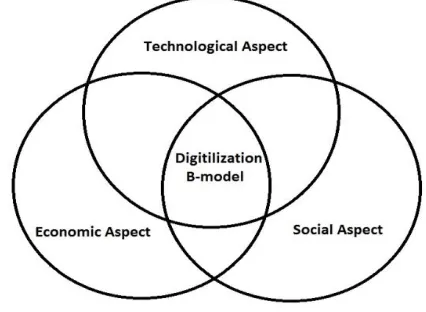
In terms of the listed transformations, it is essential to look at the changes in the future approaches to business modeling from the perspective of three angles (Fig. 2).
Fig. 2. Business model in context of digitalization process.
6 Technological aspect
From the technological point, we can find several novelties that course the transformation of business models.
First feature is the comprehensive nature of digitalization process. New technologies, used in businesses have to correspond technically to the environment’s capabilities. Mobile applications require access of the final user to the smartphone and Internet. They require smartphone companies to provide certain technical functions. Online CRM, CIS systems cannot function by themselves. Marketing of digital goods is fulfilled by internet social media channels because that is where the target customer is present most of the time. Someone has to adapt or lose.
[image:5.482.132.345.269.425.2]-environment, not only in terms of one business. If the manufacturer uses QR-coding, the retailers need the system that will be able to recognize the codes.
Previous business models revolved around the core of the product (responding the core need of the customer, answering the question why the customer wants to make a purchase) and plus IT -based service that was adding value to the product. If we think of traditional air conditioner and voice-/mobile phone controlled air conditioner – what would be the reason to purchase the first one and the second one? Service is turning to be the new core of the product. According to Chavez [11], smart functionalities for devices can be grouped into five categories: information storage, information collection, communication, information processing and performance of actions.
Finally, codification of knowledge makes communications carriers the cores in this new business model. The way business processes, production and distribution of the products is organized, depends on communication capabilities of the participating actors. In modern business ecosystem business-processes analyst does not have to be a person. The relations that new business models have to consider include people+people, people+machines, machines+machines types.
7 Economic aspect
From the economic perspective, digital processes embedded in business have a strong impact on the way cashflows are organized. Digitalization process has led to creation of digital money that speed up cashflow circulation in the business model. The cost of transaction is less, and the time is shorter. Venture capital, crowdsourcing and crowdfunding platforms are some of examples of the globalization influenced business modeling. It also concerns relation between customer and retailer. The latter must provide the opportunity for the first to pay right away.
One of the key benefits that digitalization provides to businesses is economy of resources. Various studies [12] have shown that conventional markets are less efficient than internet-based markets with respect to price levels and price elasticity. As the access to the information about the products is getting easier, the competitive environment is also changing. [13]
In fact, the value of the fourth production factor [information] is increasing. Economic growth does not come from people working harder now but rather from working smarter. That means using new technologies and new techniques of production to create more value without increasing the labor, capital, and other resources used [1].
As a result, the way the cost of the product (revenue) is formed is also to be reconsidered: indicators of rent/warehouses are replaced by the cost of installation of the service, CDO salary, etc. Digital services as new objects of intellectual capital and are to be also considered in the cost of the product.
8 Social aspect
Social impact consequences are analyzed from the point of structural changes in the labor market.
First of all, the digitalization strategy realization results in appearance of new professions (digitalization officer, information officer). There is a correlation between unemployment and structural changes in a new economy. One of consequences is the high unemployment rate in the countries that are the engines of this progress (China, USA).
environment, not only in terms of one business. If the manufacturer uses QR-coding, the retailers need the system that will be able to recognize the codes.
Previous business models revolved around the core of the product (responding the core need of the customer, answering the question why the customer wants to make a purchase) and plus IT -based service that was adding value to the product. If we think of traditional air conditioner and voice-/mobile phone controlled air conditioner – what would be the reason to purchase the first one and the second one? Service is turning to be the new core of the product. According to Chavez [11], smart functionalities for devices can be grouped into five categories: information storage, information collection, communication, information processing and performance of actions.
Finally, codification of knowledge makes communications carriers the cores in this new business model. The way business processes, production and distribution of the products is organized, depends on communication capabilities of the participating actors. In modern business ecosystem business-processes analyst does not have to be a person. The relations that new business models have to consider include people+people, people+machines, machines+machines types.
7 Economic aspect
From the economic perspective, digital processes embedded in business have a strong impact on the way cashflows are organized. Digitalization process has led to creation of digital money that speed up cashflow circulation in the business model. The cost of transaction is less, and the time is shorter. Venture capital, crowdsourcing and crowdfunding platforms are some of examples of the globalization influenced business modeling. It also concerns relation between customer and retailer. The latter must provide the opportunity for the first to pay right away.
One of the key benefits that digitalization provides to businesses is economy of resources. Various studies [12] have shown that conventional markets are less efficient than internet-based markets with respect to price levels and price elasticity. As the access to the information about the products is getting easier, the competitive environment is also changing. [13]
In fact, the value of the fourth production factor [information] is increasing. Economic growth does not come from people working harder now but rather from working smarter. That means using new technologies and new techniques of production to create more value without increasing the labor, capital, and other resources used [1].
As a result, the way the cost of the product (revenue) is formed is also to be reconsidered: indicators of rent/warehouses are replaced by the cost of installation of the service, CDO salary, etc. Digital services as new objects of intellectual capital and are to be also considered in the cost of the product.
8 Social aspect
Social impact consequences are analyzed from the point of structural changes in the labor market.
First of all, the digitalization strategy realization results in appearance of new professions (digitalization officer, information officer). There is a correlation between unemployment and structural changes in a new economy. One of consequences is the high unemployment rate in the countries that are the engines of this progress (China, USA).
From the employer’s prospective, there is a strong demand for the new professions. Current educational approaches do not provide the necessary skills required by the labor market.
The demand for IT skills and knowledge is constantly growing. These skills allow for larger contribution to income of the company and, consequently, to the income of the employee.
Undoubtedly, one of the strongest impacts of such business model transformation is connected with labor market changes. We can define two types of structural changes in terms of labor market demand: appearance of jobs that require collaboration with machines and disappearing of jobs that can be replaced by machines that match or exceed human capabilities. Thirty percent of new jobs created in the US in the past 25 years were types that did not exist, in areas including IT development, hardware manufacturing, application creation, and IT systems management.
According to ILO estimates, in 2019 the global unemployment rate is expected to remain essentially unchanged, but the number of unemployed is projected to grow by 1.3 million. Technological progress, capital accumulation, globalization, demographics and government policies will promote the tendency of reallocation of employment across sectors of production: increasing number of workers is projected to be employed in the service sector. The share of manufacturing employment is expected to continue its decline in upper middle-income and developed countries (“deindustrialization” trend).
Business managers need to consider the change in labor relations from three aspects: skills, time and place. According to McKinsey [1] research, 20% to 30% of the working age population in the US and the EU is engaged in independent work. 70% choose this type of work, 30% use it out of necessity because they cannot find a traditional job, or one that meets their income and flexibility needs.
From the social aspect we can derive a number of issues that businesses and the society face: digital divide, disability of conventional economy co-live with digital economy, security problems and others challenges.
Digitalization is also dramatically changing the social behaviors and interaction between business agents. As the point where customers and companies meet changes, it becomes a continuous interaction during the time a customer uses a product or service.
At the beginning of 2000s, neuro-marketing allowed to predict and analyze customer’s
behavior in order to plan product output. With the total digitalization of business environment, there will be no need to analyze when the signal will come directly from machine to machine (M2M relations). Uber systems capture and provide information on people behavior when choosing routes and schedule (route patterns) to logistics companies. This information is also a new product that has a value. M2M relations change the way such products are bought and sold.
The roles of business agents on a micro-environment level are also modified or even lose their relevance. The integration of digital processes in the business model may result in self-controlled organization – this is the level of management that just a couple of years ago did not seem real on the macro-level.
Another challenge for society is the necessity to adjust legislation to the changes. As in case of a sharing economy business model, many countries faced the problem of the existing tax policy that cannot be applied to the services. As an intermediary online business, online platform cannot be subject to taxation in certain countries.
9 Conclusion and future research
1. To consider the transformation of a business model by a holistic approach. Digitalization is not is not a process that connects supplier, manufacturer, distributor, retailer and customer. It lies at the basis of these relations.
2. To understand that digitalization concerns digitization of business in general (products and processes). The core of the product is digital service that allows it to function or supports the key value of the product.
3. To focus on processes: information storage, information collection, communication, information processing or performance of actions.
4. To remember that communication carriers (people/machines) are the cores in the new business model.
5. To apply digitization in organization of the cashflows in the business model: the transaction time will be shorter. Reconsider the cost of the final product. Analyze the new sources of revenue in the business model.
6. To perceive information derived in the process of value creation as another source of value.
7. To consider the new type of the relations in the new business model – P2M (people to machines), M2M (machines to machines).
8. To be ready for the social challenges: digital security, digital divide on the local and external business level.
The future research will concern the answer to the question based on the outcomes above, how to make a roadmap for the companies that need to digitize their business, what indices should be run to evaluate the results of a business model transformation when digitizing the business.
References
1. Report McKinsey Global Institute [online], Available at: https://www.mckinsey.com/~/media/McKinsey/Business%20Functions/McKinsey%2 0Digital/Our%20Insights/Digital%20Europe%20Pushing%20the%20frontier%20capt uring%20the%20benefits/Digital-Europe-Full-report-June-2016.ashx (2016)
2. Digital Vortex. How Digital Disruption Is Redefining Industries. Global Center for Digital Business Transformation [online], Available at: https://www.cisco.com/c/dam/en/us/solutions/collateral/industry-solutions/digital-vortex-report.pdf (2015)
3. D. S. Evans, A. Hagiu, R. Schmalensee, Invisible Engines: How Software Platforms (MIT Press, Cambridge, 2006)
4. C. Crampes, C. Haritchabalet, B. Jullien, Journal of Industrial Economics, 57 (1) (2009)
5. E. M. Dinlersoz, P.Pereira, International Journal of Industrial Organization, 25 (2007) 6. World Economic Forum White Paper. Digital Transformation of Industries: In
collaboration with Accenture [online], Available at: http://reports.weforum.org/digital-
transformation/wp-content/blogs.dir/94/mp/files/pages/files/digital-enterprise-narrative-final-january-2016.pdf (2016)
7. Regnum Information Agency: Digitalization of Russian economy: apply or postpone [online], Available at:https://regnum.ru/news/2305956.html (2017)
8. Business dictionary online, [online], Available at: http://www.businessdictionary.com/definition/digitalization.html (2017)
1. To consider the transformation of a business model by a holistic approach. Digitalization is not is not a process that connects supplier, manufacturer, distributor, retailer and customer. It lies at the basis of these relations.
2. To understand that digitalization concerns digitization of business in general (products and processes). The core of the product is digital service that allows it to function or supports the key value of the product.
3. To focus on processes: information storage, information collection, communication, information processing or performance of actions.
4. To remember that communication carriers (people/machines) are the cores in the new business model.
5. To apply digitization in organization of the cashflows in the business model: the transaction time will be shorter. Reconsider the cost of the final product. Analyze the new sources of revenue in the business model.
6. To perceive information derived in the process of value creation as another source of value.
7. To consider the new type of the relations in the new business model – P2M (people to machines), M2M (machines to machines).
8. To be ready for the social challenges: digital security, digital divide on the local and external business level.
The future research will concern the answer to the question based on the outcomes above, how to make a roadmap for the companies that need to digitize their business, what indices should be run to evaluate the results of a business model transformation when digitizing the business.
References
1. Report McKinsey Global Institute [online], Available at: https://www.mckinsey.com/~/media/McKinsey/Business%20Functions/McKinsey%2 0Digital/Our%20Insights/Digital%20Europe%20Pushing%20the%20frontier%20capt uring%20the%20benefits/Digital-Europe-Full-report-June-2016.ashx (2016)
2. Digital Vortex. How Digital Disruption Is Redefining Industries. Global Center for Digital Business Transformation [online], Available at: https://www.cisco.com/c/dam/en/us/solutions/collateral/industry-solutions/digital-vortex-report.pdf (2015)
3. D. S. Evans, A. Hagiu, R. Schmalensee, Invisible Engines: How Software Platforms (MIT Press, Cambridge, 2006)
4. C. Crampes, C. Haritchabalet, B. Jullien, Journal of Industrial Economics, 57 (1) (2009)
5. E. M. Dinlersoz, P.Pereira, International Journal of Industrial Organization, 25 (2007) 6. World Economic Forum White Paper. Digital Transformation of Industries: In
collaboration with Accenture [online], Available at: http://reports.weforum.org/digital-
transformation/wp-content/blogs.dir/94/mp/files/pages/files/digital-enterprise-narrative-final-january-2016.pdf (2016)
7. Regnum Information Agency: Digitalization of Russian economy: apply or postpone [online], Available at:https://regnum.ru/news/2305956.html (2017)
8. Business dictionary online, [online], Available at: http://www.businessdictionary.com/definition/digitalization.html (2017)
9. M. Morris, M. Shindehutte, J. Richardson, Journal of Business research, 58 (6), (2005) 10. Science-engineering, University of Houston [online], Available at: http://sce.uhcl.edu/helm/rationalunifiedprocess/process/workers/wk_bpan.htm (2017)
11. E. Chávez, S. Dobrev, E. Kranakis, J. Opatrny, L. Stacho, J. Urrutia, Latin American Symposium on Theoretical Informatics (2006)
12. M.D. Smith, J. Bailey, E. Brynjolfsson, Understanding Digital Markets: Review and Assessment (1999)