International Journal of Innovative Technology and Exploring Engineering (IJITEE) ISSN: 2278-3075, Volume-9 Issue-2, December 2019
Segmentation of An Indian Classical Dance Videos
using Different Segmentation Methods.
Bhavana.R.Maale,
Suvarna.Nandyal,
Abstract: Video to frame conversion features are retrieved to categorize the actions in an Indian classical dance video dataset. The goal is to design an automatic machine learning model that identifies the moves of a dancer in a video. A video is a collection of images of specific movements, hence, features representing shapes and color can be used to interpret the dance steps. Image segmentation based features are capable of representing the shape in varying background conditions. Segmentation has become an important objective in image analysis and computer vision. To segment the images, edge detection, thresholding and region of interest are taken for this study. The proposed system performance is analyzed for total number of 50 different
movements taken from Indian
classicaldances.Bharatanatyam,Kathak,Kuchipudi,Manipuri,Mo hiniytam Odissi,Kathakali and Satrriya in different background conditions.
Keywords: Segmentation, Edge detection, Thresholding, Region of Interest,Feature Extraction,K-Means clustering.
I. INTRODUCTION
India is known for its wealthy traditional legacy. The dance forms have also developed from different parts of India. These dances are historically regional, they all consists of song and performance in nearby language ,all the dances specific in styles, costumes and expression. The different types of dances developed in India are Bharatnatyam, Kathak, Kathakali, Kuchipudi, Manipuri, Mohiniattam and Odissi..
There are variety of specific poses and movements for each dances. Bharatnatyam, famous in Tamil Nadu and Karnataka,this dance is performed by female dancer.Kathak that express the dance in the form of tale developed from North.Kathakali from Kerala is perfomed by male dancers,they cover up the face with different colors. Kuchipudi developed from Andhra Pradesh usually it is performed in the fom of a drama. Manipuri is developed from, and it a mixture of all dances according to their location.Mohiniattam from Kerala it is performed by women dancer with rhythm moves..Odissi from Orissa is a dance of affection and pleasure..
Revised Manuscript Received on December 05, 2019.
Bhavana R.Maale, Computer Science & Engg,VTU,PG
centre,Kalaburagi,India
Dr.Suvarna Nandyal,Computer Science & Engg,VTU,PDA college of engg, Kalaburagi,India.
.
1.1 Related Work
Therefore, as reported in literature, the human action identification based on shape features can be used to classify the steps of any well-defined dance form such as Ballet dance. On similar lines, the technique is also applied for Indian classical dances and different segmentation methods are also presented.
II. METHODOLOGIES
2.1 Dance video collection
The dance videos are collected from youtbe and few dance videos are from Girijadevi sangeet-nrutya kala mandir ,kalaburagi.It consists videos of Bharatnatyam, Kathak, Kuchipudi, Mohiniyattam,Manipuri,Odissi, Kathakali and Sattriya.A total of 50 videos are used in this work. The dance is preformed in varying background conditions.
2.2 Video to frame conversion
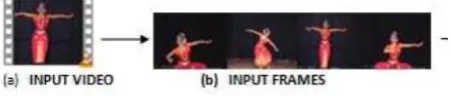
[image:2.595.320.533.231.361.2]The extraction of important frames from the video is done in order to process video data correctly and decreases the pressure on network, hence more prominent should be given to the video processing technology, the segmentation is one of the most famous technique in the reduction of information which is carried by the video signal together with the key frame extraction so the current researchers are focusing on the two techniques ,here we are using the background information and histogram as a key parameter for the frame conversion techniques. Here first the video is downloaded from youtube which is in MP4 file format then that video is converted into avi format, the function ‘aviread’ is used. Then the video is uploaded and converted it into frames, per second 10 frames are extracted even more frames can be extracted depending upon the size of the video. For Example, in the ‘Kathak.avi’ video the frame number 56th is converted into an image.
Fig 2.Video to Frame Conversion 2.3 Image enhancement
Image enhancement strategies are mathematical techniques the goal of enhancing an image is to obtain better quality of a given image. The end result is another frame that describes few parameters in a way that is good in some sense in comparison to their appearance in the original image.
It consists of strategies those are the frequency and spatial domains. It computes Fourier Transforms of an frame that is required to be modified and multiply the end result through a filter out and takes the inverse transform to get the processed image .The spatial domain is the number of pixels of which an frame is constructed. Spatial domain it works directly on the pixels. It is expressed as:
g(x, y) = T[ f (x, y)]
Wherein f(x, y) is the frame taken in and, g(x, y) is the frame where the pre-processing has been done, and the operation is
y).There are different types of enhancement strategies in the spatial domain They are histogram processing, enhancement using arithmetic, and logical operations and filters.
Wavelet Transform
The one-dimensional (1-D) wavelet transform is shown in Fig. 2.A waves are transferred to a frequency lower than a selected cut off frequency and highpass filter, h and g, then it is divides the element of two, comprising first degree of transform. Maximum amount of the wavelet transform are obtained by recursively filtering out and clearing on frequency lower than a selected cut off frequency and end results. Then it is taken for a maximum levels K and the output coefficients, di1(ni
{1,….,K} and dK0(n), are referred as wavelet coefficients.Bhratnatyam Kathakali Odissi Kathak
Kuchipudi Manipuri Mohiniyattam Sattriya
Fig 3: Pre-processed images Background subtraction
Creates a binary image from a background subtraction of the foreground using image processing methods. The binary frame returned a mask that should contain mostly foreground pixels. The background image should be the same background as the foreground image except not containing the object of interest. Images must be of the same size and type. If not, larger image will be taken and down sampled to smaller image size. If they are of different types, an error will occur and returns foreground mask.
Parameters
Foreground_image - RGB or grayscale image object Background_image - RGB or grayscale image object Context:
Used to extract object from foreground image containing it and background image without it.
2.4 Feature Extraction
In this work gray level co-occurrence matrix based parameters are used for segmentation of Indian classical dance images. Texture is considered as the most prominent defining characteristics of an image .The values of gray-level are taken to contribute the notion of texture, a 2 dimensional texture evaluation matrixare taken for texture .
Gray Level Co-occurrence Matrix(GLCM)
The GLCM is one of the best technique for feature extraction.
The co-occurrence matrix features : Max Probability: max(Pij)
[image:2.595.62.288.487.535.2]International Journal of Innovative Technology and Exploring Engineering (IJITEE) ISSN: 2278-3075, Volume-9 Issue-2, December 2019
Correlation=∑𝑖∑𝑗(i-µ𝑥)(j-µ𝑦)𝑃𝑖𝑗 /𝜎𝑥𝜎𝑦
Where µ𝑥 and µ𝑦 are means and 𝜎𝑥𝜎𝑦 are standard
deviation.
Entropy: ∑𝑖∑𝑗𝑃𝑖𝑗𝑙𝑜𝑔(𝑃𝑖𝑗) Energy: ∑𝑖∑𝑗𝑝𝑖2,j
Hence these different features are used in this work.
III. SEGMENTATION METHODS
3.1 ROI
While evaluating the performance of threshold and region of interest segmentation strategies. It is more prone to noise. It divides the frame into same locations of the related pixels based on the similarity norm. The pixels are connected together based on some parameters such as intensity, color, texture .It falls into two categories as: 1. Region Growing: .Initially it has a single seed point. It is compared with neighboring pixels with seed points and decides it should be included to the region or not. If the nearby pixels have a same grey level values then the seed pixels are added, the region size becomes large. This method gives good segmentation end results than thresholding.
2. Region Split and Merge: Depending upon the threshold value the splitting and merging of regions is done. If there is no mismatch between the threshold value then regions are combined into one single region. If there is a mismatch, then the region is divided into half.
K-Means Clustering
In region of interest method ,k-means clustering technique is applied it partitions the data into a number of regions. First it calculates the centroid and then it adds each point to the cluster which are nearest to the centroid. The distance of the centroid is calculated by using one of the method called Euclidean distance. The points are added to the clusters which are having a minimum Euclidean distance.
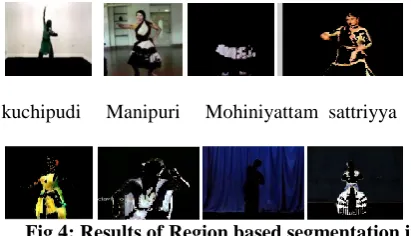
Bhratnatyam Odissi Kathakali kathak
kuchipudi Manipuri Mohiniyattam sattriyya
Fig 4: Results of Region based segmentation images 3.2 Otsu’s Threshold based Segmentation
In this work the Otsu's techniques is used because the threshold reduces the variance within the class, referred as a weighted addition of variances of the two classes. OTSU technique calculates the histogram and probabilities of each brightness level.
1. First the ωi(0)and μi(0) are used 2.It checks for all possible thresholds t=1. 1. Modify ωi and μi
2. Calculate 𝜎𝑏2(𝑡)
3.The threshold is the the maximum 𝜎𝑏2(𝑡)
4.It also compute two maxima . 𝜎𝑏12(𝑡) is the highest max and 𝜎𝑏22(𝑡) is the highest or same maximum
5.threshold = T1+T2/2
In this work ots’u with gray thresh count function is used that calculates a threshold that converts an frame to a binary frame .The gray thresh method calculates the threshold to decrease the variance within the class of the black and white pixels. Otsu's approach is employed by various image processing applications to generate histogram image thresholding or to transfer gray level frame to a binary frame .It concludes that the frame holds two way-modal histogram that is foreground and background pixels computes the best threshold, partitioning aforesaid two classes so that their joint spread is insignificant. The weighted addition of variances of the two classes:
𝜎𝜔 𝑡 2 =𝜔
0 𝑡 𝜎0 (𝑡) +2 𝜔1 𝑡 𝜎12 𝑡 eq(1)
The weights 𝜔0and𝜔1are the probabilities of the two classes each of which is divided by a t and 𝜎0 2and 𝜎1 2 𝑎re variances.
Otsu articulates the reduction of the class variances is correlative to maximization the class variance as:
𝜎𝑏2 𝑡 = 𝜎2− 𝜎𝜔2 𝑡 = 𝜔1 𝑡 𝜔2 𝑡 𝜇1 𝑡 − 𝜇2 𝑡 eq(2)
The class probability 𝜔1 𝑡 will then be computed directly from the histogram t as:
𝜔1 𝑡 = ∑ 𝑝(𝑖)𝑡0 eq(3)
The mean 𝜇1 𝑡 is given as
𝜇 𝑡 = ∑ 𝑝 𝑖 𝑡
0 𝑥(𝑖)
Bhratnatyam Kathakali Kuchipudi Kathak
[image:3.595.46.252.491.609.2]Odissi Manipuri Mohiniyattam Sattriya
Fig 5: Results of ots’u based threshold segmented
images
3.3 Edge based detection
In this work prewitt edge detection is used .It identifies two types of boundaries one is horizontal and vertical edges.Here the boundaries are computed by comparing the dissimilarity between corresponding brightness of pixels of an image. This technique provides two masks one for detecting edges in horizontal direction and another for vertical direction abd therefore this technique is relatively inexpensive in terms of computation.
Bhratnatyam kathakali odissi Kathak
Kuchipudi Manipuri Mohiniyattam Sattriya
Fig 6: Results of Edge based segmented images.
[image:4.595.311.533.81.255.2]IV. EXPERIMENTAL RESULTS
Table 1.Performance Evaluation of different segmentation methods
Dance types Test image Threshold Edge Region of Interest
Bharatnatyam 70.3 15.5 73.4
Satrriya 11.2 15.0 11.2
Manipuri 83.2 84.4 15.4
Mohiniyatam 15.6 15.7 17.8
Odissi 16.0 84.0 15.0
Kathak 16.9 15.0 16.9
Kuchipudi 16.4 59.2 16.4
Kathakali 61.5 61.5 62.4
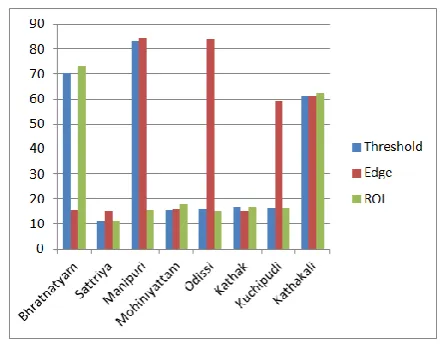
Here the different dance types of Indian classical dance images are used for the analysis. Then compare the results of threshold, edge detection and ROI as shown in fig 7. From the above results region of interest method gives better performance for bharanatyam and Manipuri dance and for Manipuri and kuchipudi the edge detection method gives better performance and for all dances the region of interest gives better results compared to threshold and edge detection methods.The dance kathakali gives better results
for all the three methods .For remaining dances the accuracy is low because of varying background conditions.
Fig 7:Accuracy graph of Threshold, Edge detection and ROI.
V.
CONCLUSIONIndian classical dance recognition system has been designed based on Human activity recognition.8 Indian classical dance videos are considered to extract 50 different dance steps .The Region of Image segmentation is affected by lots of factors, such as same action or poses of different dances of images, varying background conditions. In this work , different techniques of image segmentation has been described. This work can be further processed to include maximum difficult datasets, background variations, different actions, complicated background
and further classifying the movement of steps rather than a standalone step. Identification of difficult steps and automated removing of duplicate frames from video is challenge task in this area. According to the above comparison, the ROI method gives better performance than threshold and edge detection methods. All segmentation algorithms do not guarantee same kind of result for all type of images so we can choose segmentation techniques that give efficient and accurate performance according to our problem area.
REFRENCES
1. J. Lin, Y. Ding, A Temporal Hand Gesture Recognition System Using HOG And Motion Trajectory , Optik - International Journal for Light and Electron Optics Vol. 124, (24), pp. 6795-6798, 2013.
2. H. Hasan, S.Abdul-Kareem, Static Hand Gesture Recognition Using Neural Networks, Journal - Artificial Intelligence Review, Vol. 41, (2), pp 147–181, 2014.
3. Bharatanatyamdance: http://www.culturalindia.net
4. D. K. Vishwakarma , R. Kapoor , Unified Frame Work for Human Activity Recognition using Spatial Edge and R transform, 29th IEEE Conference on Pattern Recognition, pp 341-353, 2016.
5. A.J. Apiraksa, W. Pongstiensak, T. Konda, Simple Shaped Based Approach to Hand Gesture Recognition, Electronics Computer Telecommunication and Information Technology International Conference, pp 851-855, 2010.
6. S.Kake , N.J. Uke, Niraja Jain, Real Time Human Detection Using HOG Features as Human Descriptors and Variable Size Sliding Window, Advances in Computer Science and Information Technology, Vol. 1, pp. 27-29, 2014.
7. M. R. Amer, S. Todorovic, Sum Product Network for Activity Recognition, IEEE Conference
[image:4.595.43.291.332.651.2]International Journal of Innovative Technology and Exploring Engineering (IJITEE) ISSN: 2278-3075, Volume-9 Issue-2, December 2019
8. Xiaoyang Wang, Qiangji, Video Event Recognition with Deep Hierarchical Context Model , IEEE Conference on Computer Vision and Pattern Recognition, pp 4418-4427,2015..
9. Dr.S.Kannan,REVIEW ON IMAGE SEGMENTATION TECHNIQUES,International conference,pp 1-7,2015.
10. Matt Davis, FeratSahin, Hog feature human detection system- Systems Man Cybernetics (SMC), IEEE International Conference, pp 002878 – 002883, 2016.
11. XiaoyuWang ,Tony X .Han , Shuicheng Yan , An hog –LBP human detector with partial occlusion handling, IEEE 12th International conference on computer vision .
12. Uma Mageshwari ,sridevi,mala.An experimental study and analysis of
different image segmentation
methods,Elsevier,Sciencedirect,International conference on design and manufacturing,ICONDM,PP 36-45.2013.
13. Jadhav S, Sasikumar M, A Computational Model for Bharatanatyam Choreography, International Journal of Computer Science and Information Security, volume Vol.8,No. 7,page 231-233 ,October 2010.
AUTHORS PROFILE
Mrs.Bhavana R.Maale, has completed B.E and M.TECH from PDA college of engineering Kalaburagi and pursuing Ph.D at research centre PDA college of Engineering Kalaburagi.Presently working as a assistant professor in the department of computer science & Engg Kalaburagi, , Visvesvaraya Technological University, Postgraduate Centre, Kalaburagi, India.