International Journal of Innovative Technology and Exploring Engineering (IJITEE) ISSN: 2278-3075, Volume-8 Issue-12, October 2019
Abstract: The results of the study of birds nesting in Melitopol conducted in 2011-2019 are presented. The distribution and correlation of bird species in urban biotopes based on a raster map with squares of 1x1 km is provided. There are 170 bird species registered in the city throughout the year, including 104 nesting species; over the last 50 years their number has increased by 69 species. Nesting ornithocomplex of the areas of the city with multi-storey buildings include 16 species, areas with individual buildings – 23 species, industrial sites - 21 species, green areas - 51 species, reed thickets - 27 species, agricultural landscapes - 24 species, floodplains - 9 species, floodplain meadows - 9 species. Over the last decades, birds of Corvidae family - Garrulus glandarius, Pica pica, Corvus monedula, C. frugilegus, C. cornix, C. corax - have inhabited the city and formed urbanized populations. Of the birds of prey - Falco tinnunculus and Athene noctua. The taxonomic and ecological structure of ornithocomplexes of the city is considered. The basis of ornithocomplexes are widespread species of synthantropes and dendrophylles. Introduced species (Phasianus colchicus) and invasive species (Streptopelia decaocto, Dendrocopos syriacus, D. minor, Phoenicurus ochruros, etc.) also inhabited the city. Representatives of the dendrophylic group predominate in the ecological structure of onitocomplexes of the studied area, which includes 47 species (45.2%), lymphophyllous group is represented by 26 species (25.0%), sclerophyllous – by 14 species (13.5%), campophyllous – by 9 species (8.7%), the limnophyllous-dendrophyllous group is represented by 1 species (0.9%), dendrophyllous-sclerophyllous – by 6 species (5.8%) and limnophyllous-sclerophyllous – by 1 species (0.9%). Complementarity of urban ornithocomplexes is high due to the syntantropic species - dendrophylles and sclerophylles.
Keywords: ecological structure, Melitopol, nest biotopes, nesting ornithocomplexes, taxonomic structure, urban landscapes.
I. INTRODUCTION
Urban landscapes have become prevalent on the planet. The number of cities is increasing and the area they occupy is growing. Their infrastructure becomes more complex, the area of green space grows, the belt of suburban settlements is being created around cities, the attitude to plants and animals in cities becomes friendly, their protection is being improved. Cities are actively inhabited by various species of plants and animals [1]-[4]. In terms of the nature of their installing, “dressed”, “reduced” and “introduced” is traditionally
Revised Manuscript Received on October 05, 2019.
* Correspondence Author
Vasуly O. Koshelev*, Department of Environmental Safety and Environmental Management, Faculty of chemistry and biology, Bogdan Khmelnitsky Melitopol state pedagogical University, Melitopol, Ukraine. Email: [email protected]
distinguished. Birds that had previously not been typical of urban ornithofauna have penetrated. Many of them have been able to successfully adapt to urban life and have developed a number of adaptive mechanisms. Increasing the population of individual bird species in the city, and settling new territories is so intense that scientists have questions about its regulation. Therefore, it is necessary to study ornithfauna, especially in small and medium-sized cities, where this issue has not been previously considered, as opposed to large cities [1], [2], [4]-[7].
There were few publications on Melitopol birds until the end of the 20th century [8]. Special observations in some parts of the city began to be actively conducted since the beginning of the 21st century [9]-[13], the segregation of ornithocomplexes of the city and their structure have not been studied. Recently, the problems of urbanization and syntanthropization of birds are of particular interest to ornithologists, because as a result of these processes, specific urban ornithocomplexes are formed as opposed to natural landscapes [3], [6], [12], [14]-[20]. One of the problems that accompanies the development of small and large cities in the modern world is the decline of biological diversity, including the reduction of species diversity. The loss of several or even one biological species leads to disruption of integrity, and may even lead to the destruction of ecosystems. The task of conserving biodiversity in the city is the task of preserving natural communities that shape habitats and make them favorable to humans [5], [7]. One of the problems that accompanies the development of small and large cities in the modern world is the decline of biological diversity, including the reduction of species diversity. The loss of several or even one biological species leads to disruption of integrity, and may even lead to the destruction of ecosystems. The task of conserving biodiversity in the city is the task of preserving natural communities that form habitats and make them favourable to humans [5], [7].
II. MATERIALSANDMETHODS
The study of the nesting ornithofauna of Melitopol was conducted in 2001-2019. The city of Melitopol is the second largest in Zaporizhzhia region [21], its area is 51 km2. The city is located on the right bank of the Molochna River, the area is divided by the valleys of the Kyziiarskyi and Pishchanskyi streams. The Molochna River flows along the eastern boundary of the city, the second largest in the region. Its length within the city is 12 km.
Complementarity of Nesting Ornithocomplexes
in Urban Faunae (through the example of
Melitopol, Southern Ukraine)
Southern Ukraine)
Small ponds were built on the Molochna River and in the citypark. On the slopes along the river bank, in the area of the forest park, there are various forms of landslides, small ravines. The city has 315 streets and 3 avenues with a total length of more than 500 km. According to 2017 data, the number of residents is about 160,000 people. The city is characterized by the proximity of a large river floodplain, a large artificial Staroberdianskyi forest, large villages, agrocenoses. The climate of the region is moderately continental with mild winters and dry hot summers [21], [22]. The larger area of the city is occupied by private sector homes
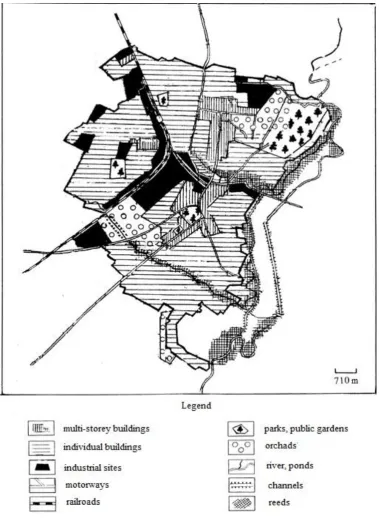
[image:2.595.104.484.196.715.2]with kitchen gardens and gardens. The blocks of multi-storey buildings bordering the orchards of the Irrigation Horticulture Research Institute are in the center of the city. An important part of the green zones of the city are parks and squares of various types and areas, as well as old cemeteries, the territory of which is covered with shrubs (Figure 1). Within the city, the banks of streams and rivers are covered by large bed of rushes that intersect with open water and sandy beaches. Motorways and railways pass through the territory of the city, with industrial enterprises located along.
Fig. 1. Biotopic distribution of the territory of Melitopol Within the framework of the project for making the Atlas of
Animals of the city, its territory was divided into raster squares of 1x1 km. Birds were registered during the nesting season in March - June on footpaths along riverbanks and
along streets adjacent to the boundaries of raster squares according to conventional
International Journal of Innovative Technology and Exploring Engineering (IJITEE) ISSN: 2278-3075, Volume-8 Issue-12, October 2019
In addition, the shuttle passage of squares was additionally carried out [1]. The territories of the park, squares, forest park, urban cemeteries were completely surveyed. Ecological groups of birds were distinguished according to the scheme proposed by M. P. Akimov [24].
Among the urbanized landscape of the study area, we have
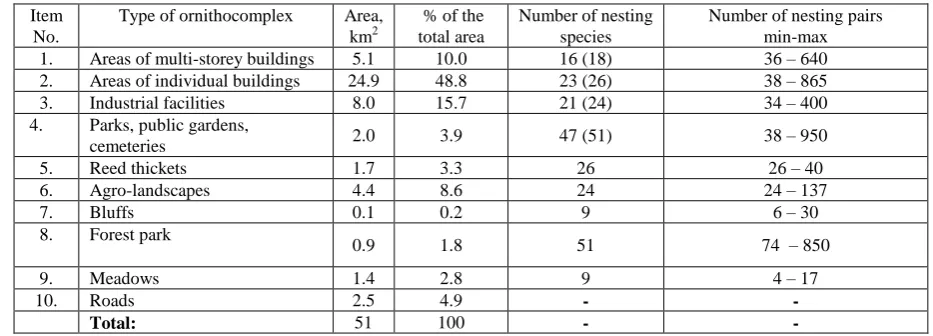
[image:3.595.62.529.158.326.2]identified nine bird habitats: areas with multi-storey buildings, areas with individual buidings, industrial enterprises, parks, public gardens and cemeteries, reeds, agro-landscapes, ravines, forest park and meadows with the corresponding ornithocomplexes. The ratio of different biotopes is shown in Table 1.
Table 1. The ratio of biotopes in Melitopol (specified data for 2019 are given in parentheses) Item
No.
Type of ornithocomplex Area, km2
% of the total area
Number of nesting species
Number of nesting pairs min-max 1. Areas of multi-storey buildings 5.1 10.0 16 (18) 36 – 640 2. Areas of individual buildings 24.9 48.8 23 (26) 38 – 865
3. Industrial facilities 8.0 15.7 21 (24) 34 – 400
4. Parks, public gardens,
cemeteries 2.0 3.9 47 (51) 38 – 950
5. Reed thickets 1.7 3.3 26 26 – 40
6. Agro-landscapes 4.4 8.6 24 24 – 137
7. Bluffs 0.1 0.2 9 6 – 30
8. Forest park
0.9 1.8 51 74 – 850
9. Meadows 1.4 2.8 9 4 – 17
10. Roads 2.5 4.9 - -
Total: 51 100 - -
Areas with multi-storey buildings are represented by residential complexes in the form of five-, nine- and fourteen-storey buildings, asphalt roads and squares, with woody vegetation planted in between, which is represented by: Populus, Robinia pseudoacacia, Acer platanoides, Fraxinus excelsior L., Tilia americana. The city has several parks, public gardens and boulevards, green spaces along the streets, as well as 5 cemeteries with various shrubs. The total area of green space is 2,000 hectares. There is a 90 hectare forest park in the north-eastern part of the city. It is a medieval artificial forest located on the upland of a river valley. There are different meadows covered with grassy vegetation in the forest plantations, and the terrace above the floodplain became overgrown somewhere with bushes.
III. RESULTSANDDISCUSSION
During the year in Melitopol, we recorded 170 bird species, 104 of which were nesting. Over the last 50 years, 69 new species have appeared on the nesting site [9], [10], [12].
The nesting ornithocomplex of multi-storey buildings includes 16-18 species of birds, namely: Falco tinnunculus,
Columba livia, Streptopelia decaocto, Asio otus, Athene
noctua, Apus apus, Delichon urbica, Motacilla alba,
Garrulus glandarius, Pica pica, Corvus corax, Oenanthe
oenanthe, Phoenicurus ochruros, Parus major, Passer
domesticus, P. montanus, Fringilla coelebs, Chloris chloris. Dominants in this biotope are Columba livia, Apus apus and
Passer domesticus.
Areas with individual buildings are a complex mosaic of small one- and two-storeyed houses with private plots that are occupied by kitchen gardens and orchards of fruit trees of different age: Prunus avium, Armeniaca vilgaris, Malus domestica, Prunus cerasus L., Juglans regia L., Prunus domestica, Ribes nigrum L., Rubus idaeu and others. The ornithocomplex of this type of urban landscape includes 23-26 bird species, namely: Ciconia ciconia, Streptopelia
decaocto, Asio otus, Athene noctua, Upupа epops, Hirundo
rustica, Motacilla alba, Lanius collurio, L. minor, Sturnus
vulgaris, Garrulus glandarius, Pica picа, Corvus frugilegus,
Corvus cornix, Sylvia borin, Muscicapa striata, Oenanthe
oenanthe, O. pleschanka, Phoenicurus ochruros, Parus
major, Passer domesticus, P. montanus, Fringilla coelebs,
Chloris chloris, Carduelis carduelis, Acanthis cannabina.
Dominants in this biotope are Sturnus vulgaris, Passer
domesticus, P. montanus, Hirundo rustica.
Industrial sites occupy 15.7% of the city area. Most of the large industrial enterprises are not currently operational. They occupy vast areas with asphalt and concrete surface and large man-made sites, some of which are gradually being destroyed. The structure of these sites is varied by areas with trees and shrubs that have grown there over the last 15 years. The ornithocomplex of industrial-residential type of urban landscape is represented by 24 bird species, namely:
Phasianus colchicus, Streptopelia decaocto, Asio otus,
Athene noctua, Upupа epops, Hirundo rustica, Delichon
urbica, Motacilla alba, Lanius collurio, Pica pica, Corvus
monedula, Corvus corax, Sylvia nisoria, S. communis,
Muscicapa striata, Oenanthe oenanthe, Phoenicurus
ochruros, Parus major, Passer domesticus, P. montanus,
Fringilla coelebs, Chloris chloris, Carduelis carduelis,
Acanthis cannabina.
Dominants in this biotope are Passer domesticus, P.
montanus, Delichon urbica.
A nesting ornithocomplex of green plantations of garden-park urban landscape type is represented by 47-51 species of birds, namely: Falco subbuteo, F. tinnunculus,
Phasianus colchicus, Columba palumbus, Streptopelia
decaocto, S. turtur, Asio otus, Otus scops, Athene noctua,
Jynx torquilla, Dendrocopos major, D. syriacus, D.minor,
Anthus trivialis, Motacilla alba, Lanius collurio, L. minor,
Oriolus oriolus, Sturnus vulgaris, Garrulus glandarius, Pica
pica, Corvus cornix, C. corax,
Southern Ukraine)
atricapilla, S. borin, S. communis, Phylloscopus collybitа, P.sibilatrix, Ficedula albicollis, Muscicapa striata, Oenanthe
oenanthe, Phoеnicurus phoenicurus, P. ochruros, Erithacus
rubecula, Luscinia luscinia, Turdus merula, T. philomelos,
Parus caeruleus, P. major, Passer domesticus, P. montanus,
Fringilla coelebs, Chloris chloris, Carduelis carduelis,
Acanthis cannabina, Coccothraustes coccothraustes,
Emberiza citrinella, E. hortulana. Dominants in this biotope
are Fringilla coelebs and Parus major.
The reeds in the study area cover an area of 1.7 km2 and are formed by dense thickets of Phragmites communis, with stems up to 2-3 m high, with a total projective coverage of 75-90%. Open water areas are small. Nesting of 27 bird species is noted in this biotope. The following species nest in the thickets of reeds: Podiceps ruficollis, Podiceps cristatus,
Botaurus stellaris, Ixobrychus minutus, Ardea cinerea, A.
purpurea, Anas platyrhynchos, A. guеrquedula, Aythya
ferina, Circus aeruginosus, Porzana parva, Gallinula
chloropus, Fulica atra), Cuculus canorus, Motacilla flava,
M. feldegg, M. citreola, Locustella luscinioides,
Acrocephalus schoenоbаenus, A. agricola, A. scirpaceus, A.
arundinaceus, Saxicola torquata, Panurus biarmicus, Remiz
pendulinus, Emberiza schoeniclus. Dominants in this biotope
are Acrocephalus agricola and A. arundinaceus.
There is an agricultural land in the city, represented by orchards of the Irrigation Horticulture Research Institute, where cherry trees, apricots, peaches of different age grow, their area is 440 hectares, which is equal to 8.6% of the study
area. The following species nest in agro-landscapes: Falco
vespertinus, Perdix perdix, Coturnix coturnix, Phasianus
colchicus, Upupа epops, Jynx torquilla, Dendrocopos
syriacus, Galerida cristata, Anthus campestris, Lanius
collurio, L. minor, Sturnus vulgaris, Pica pica, Sylvia borin,
Phoenicurus ochruros, Parus major, Passer domesticus, P.
montanus, Chloris chloris, Carduelis carduelis, Acanthis
cannabina, Coccothraustes coccothraustes, Emberiza
citrinella, E. hortulana. Dominants in this biotope are
Carduelis carduelis and Passer montanus.
The areas around the river bed in the south-eastern part of the city are occupied by floodplain meadows with Puccinellia distans and Halimione verrucifera with a coverage of 55-80%. Nesting ornithocomplexes of meadows are represented by 9 species of birds: Anas clypeata, Coturnix coturnix, Crex crex,
Vanellus vanellus, Tringa totanus, Alauda arvensis,
Motacilla feldegg, Saxicola rubetra, Emberiza calandra.
Alauda arvensis is dominating in this biotype.
There are various forms of quarries and landslides of the Molochna River’s indigenous shore, with 9 bird species nesting in these steeps: Athene noctua, Coracias garrulus,
Merops apiaster, Upupа epops, Riparia riparia, Sturnus
vulgaris, Corvus monedula, Passer domesticus, P. montanus.
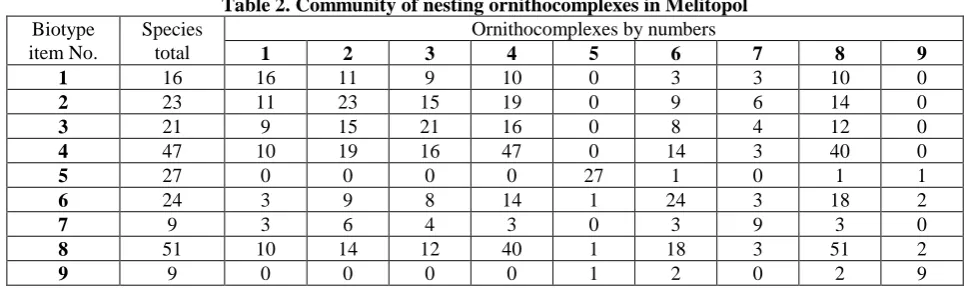
[image:4.595.55.540.412.556.2]Community of nesting ornithocomplexes in Melitopol is shown in Table 2.
Table 2. Community of nesting ornithocomplexes in Melitopol Biotype
item No.
Species total
Ornithocomplexes by numbers
1 2 3 4 5 6 7 8 9
1 16 16 11 9 10 0 3 3 10 0
2 23 11 23 15 19 0 9 6 14 0
3 21 9 15 21 16 0 8 4 12 0
4 47 10 19 16 47 0 14 3 40 0
5 27 0 0 0 0 27 1 0 1 1
6 24 3 9 8 14 1 24 3 18 2
7 9 3 6 4 3 0 3 9 3 0
8 51 10 14 12 40 1 18 3 51 2
9 9 0 0 0 0 1 2 0 2 9
Numbers of biotopes and ornithocomplexes: 1 – areas of multi-storey buildings; 2 – areas of individual buildings; 3 – industrial enterprises; 4 – parks, public gardens; 5 – thickets of reeds; 6 – agricultural landscapes; 7 – steeps, quarries; 8 – forest park; 9 – meadows.
Bird species are distributed unevenly throughout the city, depending on the availability and area of certain biotopes, the ecological plasticity of the species, and the ever-increasing anthropogenic pressure.
Thus, we observed nesting of 104 bird species belonging taxonomically to 32 families and 15 varieties in the territory of Melitopol for the period of the study in different biotopes; nesting of 5 more species is admitted.
The following taxons are represented by the largest species diversity in the area: Passeriformes – 62 species (59.6%),
Piciformes – 5 species (4.8%) and Ciconiiformes – 5 species
(4.8%) rank second. Falconiformes – 4 species (3.9%),
Anseriformes – 4 species (3.9%), Gruiformes – 4 species
(3.9%), Columbiformes – 4 species (3.9%).
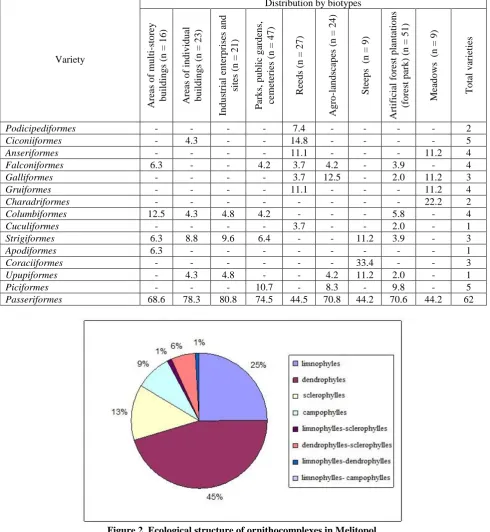
Other varieties comprise from 1 to 3 species and together represent 16 species or 15.2% of the ornithofauna of the study area (Table 3). Representatives of the dendrophyllic group, which includes 47 species (45.0%), dominate in the ecological structure of the onitocomplexes of the studied area during the nesting period (Figure 2).
The distribution of city landscapes determines the corresponding topomorphic structure of the nesting ornithocomplexes of Melitopol. According to the topomorphic distribution of birds in the biotopes during the nesting season, first-order topomorphes are represented by: drymyophylles – 51 species (49.0%), poyophylles – 16 species (15.0%), hydrophylles –
15 species (14.0%),
International Journal of Innovative Technology and Exploring Engineering (IJITEE) ISSN: 2278-3075, Volume-8 Issue-12, October 2019
(10.0%), hygrophylles – 8 species (8.0%),
drymyophylles-sclerophylles – 4 species (4.0%). Second-order topomorphes are represented by: hortobiontes – 34 species (32.0%), phylobiontes – 31 species (30.0%),
pedobiontes – 14 species (13.0%), cormobiontes – 11 species
(11.0%) edaphobiontes – 10 species (10.0%),
cormobiontes-edaphobiontes – 2 species (2.0%) and sclerophylles – 2 species (2.0%).
Table 3. The contribution of individual taxons to the nesting ornithocomplexes of Melitopol, %
Variety
Distribution by biotypes
Ar ea s o f m u lti -s to rey b u ild in g s (n = 1 6 ) Ar ea s o f in d iv id u al b u ild in g s (n = 2 3 ) In d u str ial en ter p ris es a n d sites ( n = 2 1 ) Par k s, p u b lic g ar d en s, ce m eter ies ( n = 4 7 ) R ee d s (n = 2 7 ) Ag ro -lan d sca p es ( n = 2 4 ) Steep s ( n = 9 ) Ar tific ial fo rest p lan tatio n s (f o rest p ar k ) (n = 5 1 ) Me ad o ws (n = 9 ) T o tal v ar ieties
Podicipediformes - - - - 7.4 - - - - 2
Ciconiiformes - 4.3 - - 14.8 - - - - 5
Anseriformes - - - - 11.1 - - - 11.2 4
Falconiformes 6.3 - - 4.2 3.7 4.2 - 3.9 - 4
Galliformes - - - - 3.7 12.5 - 2.0 11.2 3
Gruiformes - - - - 11.1 - - - 11.2 4
Charadriformes - - - 22.2 2
Columbiformes 12.5 4.3 4.8 4.2 - - - 5.8 - 4
Cuculiformes - - - - 3.7 - - 2.0 - 1
Strigiformes 6.3 8.8 9.6 6.4 - - 11.2 3.9 - 3
Apodiformes 6.3 - - - 1
Coraciiformes - - - 33.4 - - 3
Upupiformes - 4.3 4.8 - - 4.2 11.2 2.0 - 1
Piciformes - - - 10.7 - 8.3 - 9.8 - 5
[image:5.595.54.545.127.660.2]Passeriformes 68.6 78.3 80.8 74.5 44.5 70.8 44.2 70.6 44.2 62
Figure 2. Ecological structure of ornithocomplexes in Melitopol.
The trophomorphic structure of the ornithocomplexes of the studied area is represented by 7 groups. The dominant species are zoophages-hunters – 32 species (30.0%),
aoophages-observers – 23 species (22.0%),
zoophages-ransacks – 19 species (18.0%),
euryphages-ransacks – 11 species (11.0%),
euryphages-observers – 8 species (8.0%), phytophages – 6 species (6.0%) and euryphages-collectors – 5 species (5.0%).
IV. CONCLUSION
Ornithocomplexes of the city are formed after the anthropogenic transformation of urban landscapes, in accordance with the composition and structure of phytocenoses, hydrological regime
Southern Ukraine)
similar picture of their formation and structure is given forother cities [1], [6], [7], [14]-[16]. The community of various ornithocomplexes ranges from 0 to 40 species, the maximum being for the forest park and the central park (40 species, see Table 1). For areas with individual buildings and public gardens (19 species), areas of agricultural landscapes (gardens, kitchen gardens) and forest belts (18 species). Such high complementarity of the city’s ornithocomplexes is ensured by the synanthropic species of birds belonging to the ecological groups of dendrophylles and sclerophylles, and by the nature of the feeding - zoophages and euryphages.
Conservation of natural landscapes within the city (riverbeds and floodplains, steppe areas, reeds and shrubs) promotes the inclusion of bird species in ornithocomplexes not typical for the city. Thus, the ornithocomplexes of Melitopol included 104 species, which is 51.5% of the total number of species of nesting ornithofauna in the region.
The main negative anthropogenic factors that significantly affect the nesting ornithocomplexes of the city include the large-scale reconstruction of parks and public gardens, the destruction of old trees with hollows and undergrowth, a constant factor of concern is burning riverside vegetation along streams and rivers, ploughing-up the distances between rows, treatment of fruit trees with poisonous chemicals, nest destruction during harvesting.
REFERENCES
1. D. Numerov, P. D. Vengerov, O. G. Kiselev, D. A. Boriskin, E. V. Vetrov, A. V. Kireev, S. V. Smirnov, A. Yu. Sokolov, K. V. Uspensky, K. A. Shilov, and Yu. V. Yakovlev, Atlas of nesting birds of the city of Voronezh. Voronezh: Nauka, 2013.
2. D. Nankinov, “Bird on the city of Sofia,” in Ornithological newsletter, vol. 12, 1982, pp. 1-386.
3. A. P. Korzh, Environmental capacity: analysis of scientific data and concepts: monograph. Sumy: University book, 2017.
4. R. S. R. Fitter, London birds. London: Collins, 1949.
5. V. M. Khrabry, “Birds of St. Petersburg (fauna, accommodation, protection),” Proceedings of the Zoological Institute of the Academy of Sciences of the USSR, vol. 236, 1991, pp. 1-276.
6. S. A. Soloviev, Birds of Omsk and its environs. Novosibirsk: Nauka, 2005.
7. A. V. Baranovsky, and E. S. Ivanov, Nesting birds of Ryazan city. Ryazan: Pervopechatnyk, 2016.
8. K. P. Filonov, “About the avifauna of the city of Melitopol,” in Ornithology, vol. 8, 1967, pp. 389-390.
9. A. I. Koshelev, V. A. Koshelev, A. N. Nikolenko, and L. V. Peresadko, Birds of our city. Melitopol: MGT Publishing House, 2006. 10. A. I. Koshelev, V. A. Koshelev, A. A. Mikitenko, and V. A. Chaban,
“Seasonal aspects of the species diversity of birds in the forest park of the city of Melitopol,” in Proceedings X11 Mezinar. Vedecko-practica conference: Dny Vedy – 2016. Praha: Publ. House “Education and Science”, 2016, pp. 79-82.
11. A. I. Koshelev, V. A. Koshelev, E. V. Pyatina, O. A. Steblina-Babunich, D. V. Kovalenko, Yu. A. Kucherenko, D. V.Mirnenko, V. P. Politikova, and E. L. Chetvertak, “The population of urban cemeteries in Melitopol with vertebrates and the prospects for their protection,” in The modern world as a result of anthropogenic activity. Melitopol: MSU, 2017, pp. 185-188.
12. A. I. Koshelev, L. V. Peresad'ko, V. A. Koshelev, and E. L. Chetvertak, “The ways and rates of the introduction of birds and mammals into the urban landscapes (on the example of Melitopol),” in News of the Museum Fund named after A. A. Browner. Special Issue: Animals in the Modern World: Environmental and Social Aspects, vol. 14, no. 3-4, 2017, pp. 65-69.
13. O. I. Koshelev, V. A. Koshelev, N. V. Tarusova, T. V. Kopilova, D. V. Kovalenko, O. A. Steblin, E. V. Pyatina, and E. L. Chetvertak, “Urbanization, its ecological consequences and the state of wild animals (on the example of Melitopol),” in Materials IX International
Internet conference: Social and environmental technologies: current problems of theory and practice. Melitopol, 2017, pp. 60-62. 14. I. V. Skilsky, “Structure and features of formation of ornithocomplex
of plantations in Chernivtsi,” in Berkut, vol. 7, no. 1-2, 1998, pp. 3-11. 15. I. V. Skilsky, “Features of structure and formation of ornithocomplex of arrays of a new multi-storey building of the middle city (on the example of Chernivtsi),” in Berkut, vol. 8, no. 2, 1999, pp. 125-136. 16. I. V. Skilsky, “Structure and peculiarities of formation of
ornithocomplexes of arrays of individual building of an average city (on the example of Chernivtsi),” in Berkut, vol. 18, no. 3-4, 2010, pp. 150-165.
17. R. Gnielka, T. Spretke, H. Tauchnitz, and B. Reuter, Natur und Umwelt 1 - Avifauna von Halle und Umgebung. Isernhagen: Clivia Mueller, 1983.
18. R. Gnielka, K. Liedel, T. Spretke, A. Stiefel, H. Tauchnitz, and W. Wischof, “Avifauna von Halle und Umgebung,” in Natur und Umwelt, vol. 2, 1984, pp. 1-96.
19. U. Straka, “Bestandsentwicklung und Siedlungsstruktur einer Mehlschwalben - (Delichon urbica) - Population in der Stadt Stockerau (Niederosterreich) in den Jahren 1991-1996,” in Egretta, vol. 40, no. 2, 1997, 129-139.
20. E. V. Kate, P. William, and J. A. Fowler, “An investigation into the causes of population decline of the house sparrow (Passer domesticus) in urban Britain,” in Die Vogelwarte. Abstract. Vol. 4. Conference of the European Ornitologists Union, vol. 43, no. 1-2, 2003, pp. 9-10. 21. The Zaporizhzhia Region Atlas. Kyiv: State Customs Committee at the
CM of Ukraine, 1997.
22. B. D. Mikhailov, Melitopol: nature, archeology, history. Zaporozhye: Dyke pole, 2002.
23. G. A. Novikov, Field studies on the ecology of terrestrial vertebrates. Moscow: Soviet science, 1953.