Dissertations
2007
Development of an immersive game-based virtual
reality training program to teach fire safety skills to
children
Emily R. Ericson
Iowa State University
Follow this and additional works at:https://lib.dr.iastate.edu/rtd
Part of theInstructional Media Design Commons,Online and Distance Education Commons, Other Education Commons, and thePublic Health Education and Promotion Commons
This Thesis is brought to you for free and open access by the Iowa State University Capstones, Theses and Dissertations at Iowa State University Digital Repository. It has been accepted for inclusion in Retrospective Theses and Dissertations by an authorized administrator of Iowa State University Digital Repository. For more information, please [email protected].
Recommended Citation
Ericson, Emily R., "Development of an immersive game-based virtual reality training program to teach fire safety skills to children" (2007).Retrospective Theses and Dissertations. 14541.
safety skills to children
by
Emily R Ericson
A thesis submitted to the graduate faculty
in partial fulfillment of the requirements for the degree of
MASTER OF SCIENCE
Major: Human Computer Interaction
Program of Study Committee: Shana Smith (Major Professor)
Steven Herrnstadt Ann Thompson
Iowa State University
Ames, Iowa
2007
1443074
2007
UMI Microform
Copyright
All rights reserved. This microform edition is protected against unauthorized copying under Title 17, United States Code.
ProQuest Information and Learning Company 300 North Zeeb Road
P.O. Box 1346
Ann Arbor, MI 48106-1346
TABLE OF CONTENTS
ABSTRACT ... iii
CHAPTER 1. OVERVIEW ... 1
1.1 Fire Safety Training Programs ... 3
1.2 Virtual Reality Background ... 5
1.3 Games as Learning Tools ... 6
1.4 The Fire Safety Project ... 7
1.5 Thesis Organization ... 9
CHAPTER 2: USING IMMERSIVE VIRTUAL ENVIRONMENTS FOR REALISTIC LIFE-SIZE FIRE PREVENTION AND SAFETY TRAINING FOR CHILDREN ... 10
Abstract ... 10
1. Introduction ... 11
2. VR in Skill Training ... 13
3. System Design ... 15
4. Study Description ... 20
5. Evaluation Method ... 23
6. Discussion ... 27
7. Conclusion ... 29
CHAPTER 3. USING IMMERSIVE GAME-BASED VIRTUAL REALITY TO TEACH FIRE SAFETY SKILLS TO CHILDREN ... 30
Abstract ... 30
1 Introduction ... 31
2 Pilot Study ... 34
3 New Game-Based System Design ... 35
3.1 Basic System Components ... 35
3.2 Game Development ... 39
4. User Study ... 47
4.1 Participants ... 47
4.2 Training Procedure ... 48
4.3 Experimental Results ... 49
5 Discussion ... 51
5.1 Zapping Complications ... 54
5.2 User Experience Observations ... 54
6. Conclusions and Future Work ... 55
CHAPTER 4. SUMMARY AND DISCUSSION ... 57
4.1 Future Work ... 58
APPENDIX EVALUATION INSTRUMENTS ... 59
BIBILIOGRAPHY ... 64
ABSTRACT
Injuries from residential fires are often overlooked as a dangerous safety concern for
children. While lectures and classroom learning techniques can be effective in mitigating
this risk, studies have shown that kids retain information better if they are allowed to practice
escape techniques. Virtual Reality (VR) has been used both to simulate situations that are
too dangerous to practice in real life and as a tool to help children learn. This thesis presents
the two stage development of the Fire Safety Project, a game-based VR training environment
to increase children’s understanding of fire safety. In the first iteration students help
firefighters to identify home fire hazards and then practice escaping from a simulated fire in a
virtual environment. Surveys administered show that participants felt that they had learned
something during training. Many young participants also wanted to have active control over
the virtual environment. In response, the second iteration is more game-based and allows
children to explore the environment independently and “zap” fire hazards with the help of a
tracked 6DOF wand. A user study was carried out and results indicate that students enjoyed
the program; however there were no concrete learning gains from the use of the VR
CHAPTER 1. OVERVIEW
The United States has one of the worst fire death rates of any developed country
(Ahrens, 2004). On average in 2003 a person was killed by fire every 2 hours and someone
was injured every 29 minutes (Karter, 2004). Children in the United States are especially
vulnerable to fire danger. There are several factors that contribute to this risk, for example
children hear at different frequencies than adults and are not as likely to be disturbed by
standard fire alarms (Bruck, 2001). In addition, fire alarms can scare and confuse children;
many will panic and try to hide when they hear a fire alarm (United States Fire
Administration, 2002). This not only endangers their lives by prolonging their exposure to
the fire event but also makes it difficult for rescuers to find them. One of the best methods
for combating this problem is education. Programs that prepare children for fire emergencies
have been developed as a means to combat this risk. These programs are usually presented
during the school day; some examples of these programs are the NFPA Learn Not to Burn
program and Risk Watch, both of which are designed to be integrated into standard school
curricula (Kime, 2004).
To reduce fire injuries to children, most current fire prevention and safety instruction
programs are delivered using lectures, videos, or pictures (Kime, 2004). While these
programs are effective ways to expose children to fire safety ideas at an early age, studies
have shown that the most effective means of teaching students to escape from a fire is to
allow them to rehearse the actions necessary for escape (Holmes & Jones, 1996; Randall &
Jones, 1993; Jones & Randall, 1994). Additional studies suggest that in general trainees learn
better from hands-on exercises, rather than from traditional laboratory, classroom, or video
training (Katz, Lesgold, Eggan, & Greenburg, 1996; Tam, Badra, Marceau, Marin, &
Malowany, 1999; Wittenberg, 1995). It is impossible to use real fire environments for
obvious safety issues. Thus, using traditional training methods, many children still might not
be able to react properly when faced with a real fire emergency.
For critical situations like these, Virtual Reality (VR) has been successfully used to
simulate real scenes in several dangerous task training programs. For example, Sandia
National Laboratories used VR environments for training programs where classroom
instruction was insufficient, but hands-on practice would have been dangerous, expensive, or
logistically complex (Stansfield, Shawver, Rogers, & Hightower, 2005). One way to
immerse learners in a scene for training purpose is the use of a Cave Automatic Virtual
Environment or CAVE. A CAVE is a room that immerses users in a virtual environment by
projecting stereoscopic images on four, five, or six walls. Multiple users can be in the CAVE
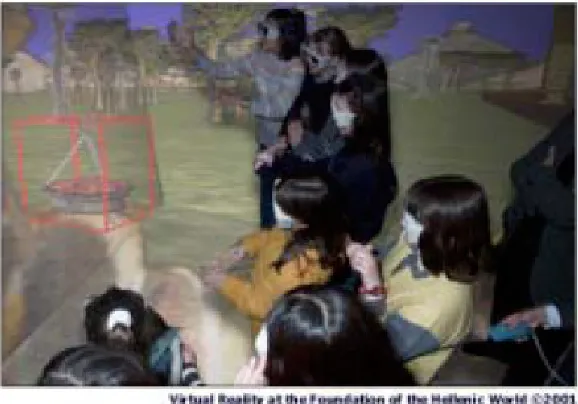
at one time allowing for a shared virtual experience. Figure 1 shows a group experiencing a
virtual tour in a four walled CAVE. This provides a fully immersive experience for users and
suggests a good solution for training children to respond to fire emergencies.
It is important the children stay motivated in the virtual environment. Most
participants will have had some kind of fire safety training in the past, and therefore we need
to engage them in the material in a new way. Part of this will be accomplished by the
newness of the technology that they will be experiencing. One highly motivating medium
that most children will be familiar with is video games. By combining a game-like
application with sophisticated VR technology this research will create an immersive
experience that users will find both motivating and exciting.
1.1 Fire Safety Training Programs
During the 1980’s fire education programs became popular in response to increasing
levels of fire incidents in residential structures that are not subject to the same fire
inspections as commercial buildings. One of the best ways to get information about fire
safety into the home was to communicate important information through schools (Kime,
2004). The classroom activities package, Learn Not to Burn, was introduced in 1979 and is
intended for use at 3 elementary school levels. There is also a pre-school and kindergarten
program that was developed to address the safety risk to children younger than six. Risk
Watch was introduced in 1998; it was designed to address other issues in addition to fire
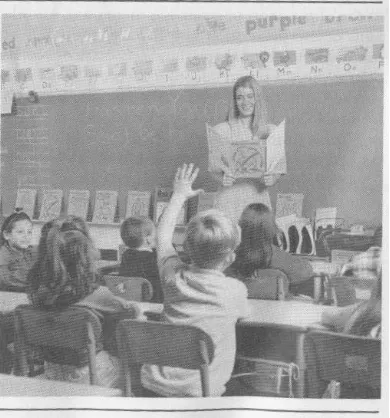
safety, such as seatbelt use among children. Figure 2 shows an elementary school class
participating in a Risk Watch session. Such programs have effectively communicated basic
fire safety principles to children, such as the “Stop, Drop and Roll” principle. Integrating
[image:8.612.213.408.469.678.2]these programs into certain grade levels helps to ensure that children get age appropriate
Figure 2: A teacher leads discussion using RiskWatch
instruction and that they refresh their fire safety knowledge during the years when they are
most vulnerable. Some research has gone in to developing better ways to teach children the
basic skills they need should they find themselves in a fire situation.
At Virginia Polytechnic Institute and State University researchers developed a
program to teach children fire safety skills and at the same time mitigate the fear that the
children felt about fire situations (Randall & Jones, 1993). Only children who reported that
they felt “some” or “a lot” of fear about fire were included in the study. All the children in
the study were first taught the appropriate procedures for escaping their bedroom during a
fire situation, through verbal instruction, modeling, and practice. They were then divided
into three groups, one group was given the reasons for each step, one was taught how to use
self-instruction to moderate their fire related fear, and the third was asked to repeat the steps
verbally in a group. There was no significant difference found in the fear levels among
groups, however the first two groups showed significantly higher levels of learning than the
group that merely repeated the steps. A second study by the same group concluded that
providing children with additional information about fire safety and escaping from fire helps
them retain the information better (Jones & Randall, 1994). A third study compared the
learning effectiveness of rehearsal, an animated computer graphic, still pictures, and a control
group. Results showed that both rehearsal and animated computer graphics showed
significantly higher learning levels when compared to still graphics, and no training. Pagett,
Strickland, and Coles (2006) developed a system for children who suffer from fetal alcohol
syndrome (FAS). These students often have attention problems that lead to low retention
rates and almost no generalization of skills. This makes them very difficult to teach and in
the case of fire safety skills can put them at great risk for fire injury. After allowing the
children to practice escaping from a fire in a video game, both with the help of an animated
character and without, they found that most of the children were able to replicate the
education is that children often hear the same information repeatedly, so often in fact, that it
becomes uninteresting and they stop paying attention. One way to add excitement to what is
otherwise an old message is to use a new medium to communicate the information. One
such medium that lends itself well to this training problem is VR.
1.2 Virtual Reality Background
Due to decreasing equipment costs and increasing processor speed, computer
simulations have become more common over the last decade. As their complexity grows the
applied uses of such technologies for education have become broader. A new area of
computer simulations that is rapidly growing is VR. VR is generally defined as consisting of
a multimodal, three dimensional, interactive, virtual environment. VR applications have
been used by researchers to visualize data or natural phenomenon, and for entertainment
purposes. For games, amusement park rides, and more recently exhibits in informal
educational institutions like museums (Roussou, 2004; Lepouras & Vassilakis, 2005). Figure
[image:10.612.150.439.459.661.2]3 shows an example of a VR exhibit at a museum in Greece. As interactivity in VR
Figure 3: VR exhibit at Foundation for the Hellenic World
applications has advanced it has become more feasible to apply the technology to sectors
other than visualization and entertainment. Recently we have seen the development of many
VR systems for training skills. It is widely accepted that people learn best by “doing”; VR
affords learners the opportunity to complete an activity at very little cost, and no risk to
themselves. In addition to these benefits some studies have shown that increased learner
interest inspired by the use of new technology, may increase learning performance.
1.3 Games as Learning Tools
Since video games entered the market, almost thirty years ago, they have gone from a
novelty item to a part of our everyday lives. Very young children learn through play
(Verenikina, Harris, & Lysaght, 2003), and even at the college and corporate level instructors
recognize the value of simulations and table top games in training specific skills (Cameron,
2002). Before they leave for college, today’s children will on average play 10,000 hours of
video games (Mungai, Jones, & Wong, 2002). It is because of this popularity that
researchers have begun to explore the potential applications of games for education. In
addition to the research done using games to teach children with FAS how to protect
themselves during a fire (Padgett, Strickland, & Coles, 2006), video games have also been
used to teach children between the ages of 7 and 11 safe road crossing behavior (Thomson,
Tolmie, Foot, Whelan, Sarvary, & Morrison, 2005). In this study children played a simple
desktop game that asked them to help virtual characters decide when to cross the road.
Children were guided by an adult facilitator, who framed the exercise and encouraged
conversation between participants about good road crossing strategies. The authors argue
that it is equally important to give children a conceptual understanding of how to complete
the task safely as to allow them an opportunity to practice. The game in this study allows
children to practice the conceptual skills necessary to safely cross roads with immediate
different strategies in a way that is only available through this type of game. Researchers at
Harvard are studying the impact of using multi-user virtual environments to help children
think about science in a new way. The River City Project (Ketelhut, Dede, Clarke, &
Nelson, 2006) allows children to interact in a virtual environment both with other students
and with computer controlled agents that can be mentors or colleagues, and promotes deep
thinking about science related topics. The promise of games for learning lies in the fact that
they are fun, they provide immediate feedback, and allow users to experiment in a realistic
environment with no real world consequences. From this background the goals of the fire
safety project were defined. There are two iterations of the fire safety project; the first
designed to operate as an immersive guided tour, and the second is an immersive VR game
that requires interaction from users.
1.4 The Fire Safety Project
In its initial implementation the fire safety project was designed to be integrated into a
fire safety program led by the Ames Fire Department. This project was an effort to make fire
safety fun to learn about, and help children remember the steps they need to take should they
ever find themselves in a fire emergency. Through collaboration with the fire department it
was determined that the most important information for children to gain from our program
was how quickly fire spreads and that crawling low can help you escape. This is both
because it will allow you to see where you are going under the heavy smoke, and also
because smoke is very hot. The most important goal of the program was to get children
thinking about fire emergencies before they actually find themselves a part of one.
The traditional home fire safety training session focuses on what to do if you wake up
to the smoke alarm. The appropriate steps in this example include, rolling out of bed,
out (Jones, Kazdin, & Haney, 1981). Performing these steps in a CAVE environment would
be difficult if not impossible. Crawling is an activity that translates from the real world well,
but rolling out of bed is not possible with a virtual bed, and feeling a virtual door to see if it is
hot is also a confusing idea. The simulated fire event was moved out of the bedroom and set
during the day, this allows the children practice in escaping without the complications of the
bedroom scenario. It was also necessary to ensure that users were comfortable with the
experience and that it would not be stressful for them. One of the major concerns early in
development was that young users might be scared in a simulated fire event. To address this
issue, children always experience the fire event in groups.
The first implementation of the fire safety system asked children to look for fire
hazards as they moved through a virtual environment with the help of a firefighter. They then
practiced escaping from a simulated kitchen. The virtual environment consists of a large
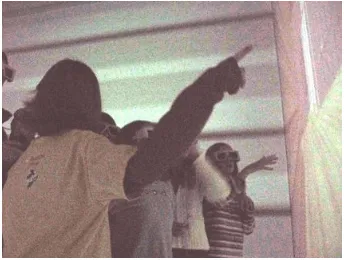
house that is full of fire hazards, such as overloaded outlets and unattended candles. Figure 4
shows children pointing to the fire hazards they see in the virtual environment. Navigation is
controlled by a researcher and children are passive observers of the technology. Many
children complained that they wanted to be able to explore the house independently; the new
game-based version of the fire safety program addresses this issue and in addition makes
[image:13.612.220.392.104.234.2]several improvements to the interface, including ambient sounds and a novel interaction
technique to further engage users. Children are encouraged as in the previous study to
identify as many home fire hazards as they can in the virtual environment and then practice
escaping from a simulated fire event. In this implementation children are free to explore the
environment on their own and have new way of interacting with the environment by
removing dangerous hazards instead of just talking about them. Through this simulation
children are able to gain firsthand experience in how quickly a fire can grow and spread and
what to do should they find themselves faced with a real-life fire emergency. This thesis
describes the development of both parts of the Fire Safety system and includes user testing to
judge the effectiveness of the implementation.
1.5 Thesis Organization
This thesis includes two papers written during the development and testing of the fire safety
program. The first paper, submitted to Fire Technology, describes completion of the initial
system and a pilot study that was carried out. The second paper, prepared for Virtual Reality,
describes the newest game-based version of the application which includes the addition of
CHAPTER 2: USING IMMERSIVE VIRTUAL
ENVIRONMENTS FOR REALISTIC LIFE-SIZE FIRE
PREVENTION AND SAFETY TRAINING FOR CHILDREN
A paper submitted to Fire Technology.
Emily Ericson1 and Shana Smith2
Human-Computer Interaction Graduate Program
Virtual Reality Applications Center
Iowa State University
Abstract
Injuries from residential fires are often overlooked as a dangerous safety
concern for children. While lectures and classroom learning techniques can be effective in
mitigating this risk, studies have shown that kids retain information better if they are allowed
to practice escape techniques. Virtual Reality has been used to simulate situations that are
too dangerous to practice in real life. This paper presents a fire safety program that combines
classroom activities and small group interaction with fire professionals with a virtual
simulation of an at-risk house. Students help firefighters to identify home fire hazards and
then practice escaping from a simulated fire in a virtual environment. A CAVE is used to
immerse participants in the fire scene.
1
Graduate student in Human Computer Interaction, Iowa State University and primary researcher and author
2
1. Introduction
The United States has one of the worst fire death rates of any developed country
(Ahrens, 2004). On average in 2003 a person was killed by fire every 2 hours and someone
was injured every 29 minutes (Karter, 2004). Especially vulnerable are the youngest of our
society who can be confused by fire alarms and are at twice the risk of fire death than the
general population (Ahrens, 2004). To mitigate this risk many programs have been developed
to increase awareness of fire dangers among young children. For the most part these
programs involve the use of instructional videos and lectures to raise awareness and prepare
children should they become involved in a fire.
Examples of these programs are the NFPA Learn Not to Burn program and Risk
Watch, both of which are designed to be integrated into standard school curricula (Kime,
2004). Studies have shown that the most effective means of teaching students to escape from
a fire is to allow them to rehearse the actions necessary for escape (Holmes & Jones, 1996;
Jones & Randall, 1994). However, it is impossible to use real fire environments for teaching
children how to escape and protect themselves during fire emergencies. To reduce fire
injuries to children, most current fire prevention and safety instruction programs are
delivered using lectures, videos, or pictures (Kime, 2004). Studies suggest that trainees learn
better from hands-on exercises, rather than from traditional laboratory, classroom, or video
training (Katz, Lesgold, et al., 1996; Tam, et al., 1999; Wittenberg, 1995). Thus, using
traditional training methods, many children still might not be able to react properly when
faced with a real fire emergency.
For safety reasons and to remedy the shortcomings of traditional training methods,
dangerous task training programs. For example, Sandia National Laboratories used VR
environments for training programs where classroom instruction was insufficient, but
hands-on practice would have been dangerous, expensive, or logistically complex (Stansfield,
Shawver, Rogers & Hightower, 1995). Programs also seem to carry more weight with
students if they are delivered by an authority figure in the community, often a firefighter or a
policeman (Warda, Tenenbein & Moffatt, 1999).
One way to immerse learners in a scene for training purpose is the use of a Cave
Automatic Virtual Environment or CAVE. A CAVE is a room that immerses users in a
virtual environment by projecting stereoscopic images on four, five, or six walls. Multiple
users can be in the CAVE at one time allowing for a shared virtual experience. At Iowa State
University, the C6 is a 10ft x 10ft x10ft room where all 6 sides are projection screens. This
provides a fully immersive experience for users.
This paper presents the design and implementation of a fire safety training program
for K-12 children, using immersive CAVE-based VR. Children were brought into safe but
realistic life-size fire environments to experience being in a fire environment and receive
“hands-on” fire training. Firefighters from the local fire department participated in program
delivery. By combining many proven techniques in fire safety training with a VR experience
it is possible to engage children in learning about fire safety in a new way.
The rest of this paper is organized as follows: first we present related work in training
using VR and novel approaches to teaching fire safety. Then we describe the design of our
VR system. This is followed by a discussion of the integration of the VR component into a
complete training program. We then discuss our pilot study and evaluation methods. Finally
2. VR in Skill Training
While many efforts have been made to expose children to fire safety for the first time
at an early age, and to continue to do so through classroom activities as they grow, retention
of information to the point of behavior modification and generalization to other scenarios is
most likely for children who have actively practiced safety skills including crawling low
under smoke and practicing an escape plan (Warda, Tenenbein & Moffatt, 1999). Training
programs have been developed to address groups other than school aged children. At college
campuses some interest has been taken recently in raising fire safety awareness due to the
growing number of fire injuries and deaths on college campuses. Some of these activities
include a simulated smoke filled hallway that students must crawl through and a mock dorm
room that is set on fire to demonstrate the intense heat and quick spread of fire (Comeau,
n.d).
VR has also been applied to firefighter training systems. The Navy has experimented
with using VR to train firefighters. Traditionally Naval firefighters trained on a retired
battleship. Instructors create various kinds of fires, and the trainees are asked to respond to
the situation. VR has been used to create a virtual model of a training ship; researchers then
created several sample missions and asked trainees to perform them both on the actual ship
and in the virtual environment. Trainees wore an HMD and used a joystick to navigate
through the virtual ship. Researchers found that the trainees demonstrated similar levels of
learning whether they were trained in the actual ship or in the virtual environment with
significantly less risk involved than traditional training methods (Tate, Silbert & King, 1997).
A slightly different system has been developed to help train firefighters to assume command
take control of several virtual firefighters at a fire scene. The trainee issues orders that are
carried out in the virtual scene, the program then simulates the fire’s response to the actions.
It not only simulates smoke and fire flow but can also simulate structural integrity adding a
level of complexity that is present in real world emergencies but not often in real-world
training exercises due to safety concerns.
VR has been recognized as a way to immerse participants in situations that might
otherwise be too dangerous to experience. At the University of Queensland in Australia,
researchers have developed a series of VR training tools for miners. Mining is a very
complex and dangerous occupation, and VR helps to train miners in accident prevention
(Kizil & Joy 2001). VR is also used to train miners for dangerous tasks such as driving a
truck into the mining pit. A similar system was developed to train refinery workers in
Austria (Haller, Kurka, Volkert & Wagner, 1999). The user wears a head mounted display
(HMD) and uses a wand for navigation and interaction. The instructor can initiate any of a
series of emergencies from a separate application on a desktop computer. The student is then
graded, losing points whenever s/he initiates an incorrect action that would lead to injuries in
a real world situation. This helps refinery workers to prepare for real life incidents.
A virtual training application has also been developed to handle high risk, low
frequency events such as terrorist attacks (Henderson, 2005). This system immerses a
learner in a virtual academy through a desktop system, s/he then goes through basic training,
then participates in a simulated event, which is then followed by a debriefing. Another
example of a system designed to prepare first responders for the possibility of terrorism is the
BioSimMER (Stansfield , Shawver, Sobel, Prasad & Tapia, 2000). This application allows
This system makes excellent use of VR to provide an experience that would otherwise be too
expensive or too dangerous to create realistically. However, this system is not a model of the
actual emergency only the aftermath, making environmental effects less important in this
system.
Another system that attempts to prepare users for emergency situations has been
developed that focuses on allowing the user to live through a stressful and sometime
dangerous scenarios (Ponder et. al., 2003). In this study the user faces a large projection
screen that helps provide a sense of immersion. They navigate through natural gestures and
interact with the environment through natural speech. A researcher interprets the user’s
movements and commands and passes them to the system. A “Virtual Assistant” then carries
out any commands issued by the trainee.
3. System Design
In this study a life-size fire prevention and safety training system was developed in a
CAVE-based VR environment. The VR environment allows the immersion of young
children in a realistic fire situation as a part of a fire safety training program. This allows the
student not only to rehearse evacuation skills but also to do so in a realistic fire environment.
In addition, firefighters were invited to be active participants in the training program, giving
the children a recognizable authority figure to learn from.
Working with the Ames Fire Department, a list of objectives was developed
for the VR fire safety training application. The first goal was to allow the children to
participate in some sort of “escape” from a fire situation. This should include the need for
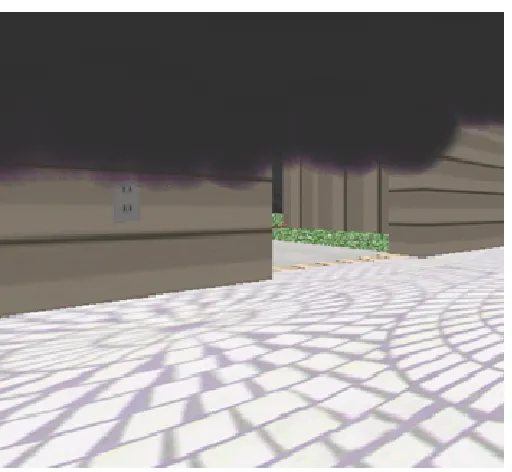
necessitated a realistic smoke simulation that would be thick enough to obstruct the view of
anyone standing in it, but controlled enough that it stayed a certain distance above the floor.
Figure 1 shows the final controlled smoke from a view close to the floor. The second goal of
this application was to communicate to the participants in the program that fire hazards are
very common and are often overlooked. People often do not recognize potentially dangerous
situations such as the fact that having toys on the stairs can be considered a fire hazard.
Figure 2 shows examples of this and other fire hazards.
An extensive list of common home fire hazards was developed in conjunction with
the fire department. From that list, food left on the stove was chosen as the one that would
ultimately cause the fire event in our simulated home. This was done for a variety of
reasons, the most influential being that cooking fires are the leading cause of residential fire
(a) Hat on a lamp. (b) Boxes near a water
heater.
[image:22.612.172.428.78.314.2] [image:22.612.48.551.394.624.2](c) Boxes on the stairs Figure 2: Three common home fire hazards.
Figure 1: Controlled smoke allows for visibility
This system was designed using VRJuggler, an open source VR library
(http://www.vrjuggler.org/), and SGI’s Performer scene graph
(http://www.sgi.com/products/software/performer/).
The next challenge was to simulate a fire situation so that the firefighters could
effectively demonstrate proper escape techniques. Several options were considered for
simulating smoke in the model including environmental fog and volumetric fog. After
testing these it was determined that the most realistic smoke simulation was provided by
(a) Cigarettes on sofa (b) Books in front of fire.
[image:23.612.138.536.86.432.2](c) Unattended candles. (d) Overloaded outlet.
Performer’s pfuSmoke utility library. This utility was used to create clouds of smoke that
[image:24.612.175.480.66.302.2]would envelop the upper portion of the room that contained the fire.
[image:24.612.176.487.336.569.2]This simulation was designed to run in a CAVE with six walls. This provides the
greatest sense of immersion for participants. With the help of an architecture student, a
house model was developed and populated with the hazards that had been discussed with the
firefighters. It is important that participants can see the smoke move over their heads as they
crawl from the simulated house. The finished model of the home is shown in Figure 4. The
house is very large compared to what most of our participants would be used to; however,
this somewhat exaggerated size improves navigation through the house in the CAVE.
4. Study Description
We invited several groups of girl scouts and boy scouts and their parents to
participate in our fire safety program. We divided each group into two smaller groups.
There were approximately seven students in each group. One group participated in
classroom activities while the other went through the virtual fire safety training; the groups
would then switch activities.
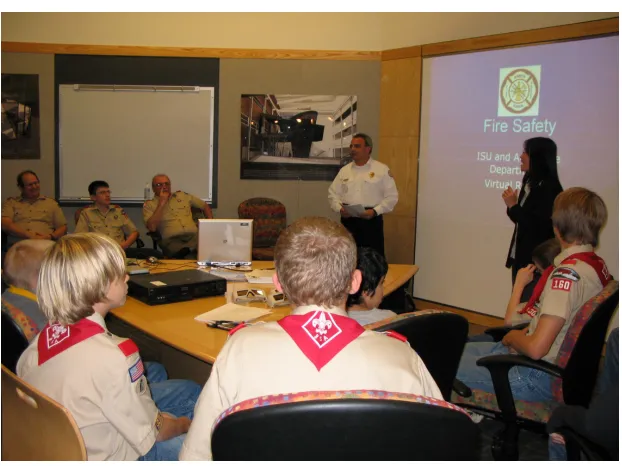
The classroom activities are dependant on the age of the group of students. Figure 5
shows a firefighter leading a classroom discussion for a group of boy scouts. For participants
older than 12 the activities consist of a presentation given by a firefighter explaining fire
hazards and important escape techniques, then the students watched a video demonstrating
how quickly a real fire can spread through a house. Younger participants are given a
shortened version of the lecture and then shown a longer; cartoon video that explains how
The VR simulation consists of two parts. In the first part the participants move
through the virtual home and point out possible fire hazards with the help of a firefighter. In
figure 6, a group of girl scouts identify hazards with the help of a firefighter.
Then participants move to the kitchen where they discover one of the most dangerous
hazards in the house: food left on the stove. The food is already producing some smoke
when participants enter the kitchen. When the fire is triggered the smoke begins to grow and
spread through the room very quickly, as shown in figure 7. The firefighter then triggers a
real fire alarm. As the simulated smoke fills the room, the firefighters demonstrated that
crawling low in a room full of smoke improves visibility. Figure 8 shows a fireman helping
participants to identify an exit in a room darkened by smoke. They were able to show how
[image:26.612.118.506.93.337.2]recognizing floor coverings can help you navigate through a house and landmarks like power
Figure 7: Fire caused by food left on the stove.
Figure 8: A firefighter helps participants identify an
[image:27.612.161.472.418.628.2]outlets (as shown in figure 1) can aid you in finding an escape route through heavy smoke.
The students then quickly “escape” from the fire and move to a meeting place in the yard of
the house.
5. Evaluation Method
An informal survey was developed and administered after both groups had completed
both the virtual training and the classroom lecture. The survey consists of ten questions: the
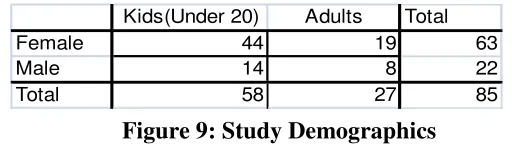
first two questions are demographic. Figure 9 shows the demographic breakdown of our
participants.
The third question dealt with how much the students felt they had learned during the
training session. Figure 10 shows responses to this question. Most students felt the level of
knowledge they had learned is high or very high. The fourth question asked whether
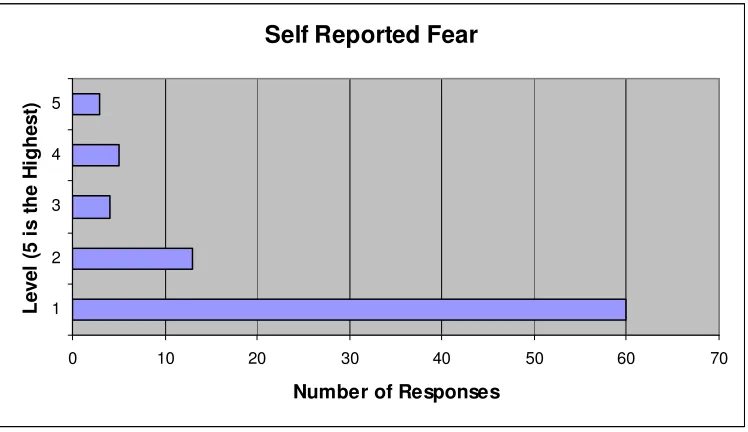
participants were afraid at any time during the training. One of the major concerns of this
project prior to implementation was to make sure that our simulation was as realistic as
possible but without scaring any of the children who participated. Figure 11 shows responses
from all of the people who participated in our simulation indicating how scared they felt
during the simulation. The survey results seem to indicate that most of the participants
definitely were not scared by the simulation with almost all of the participants indicating 1
for their level of fear during the experience. However, two of the younger participants in the
program were too scared to enter the CAVE at first. One of them did participate later and
enjoyed the experience very much.
Kids(Under 20) Adults Total
Female 44 19 63
Male 14 8 22
[image:28.612.202.458.652.724.2]Total 58 27 85
Self Reported Learning
0 5 10 15 20 25 30 35
1 2 3 4 5 L e v e l (5 i s t h e H ig h e s t)
[image:29.612.129.531.90.318.2]Number of Responses
Figure 10: How much have you learned about fire safety during this training
program?
Self Reported Fear
0 10 20 30 40 50 60 70
1 2 3 4 5 L e v e l (5 i s t h e H ig h e s t)
Number of Responses
Figure 11: Did you ever feel frightened while in the fire scenes in the
[image:29.612.138.512.415.631.2]Self Reported Feelings During Training
0 10 20 30 40 50 60 70
Sad Happy Nervous Interested Scared Excited Sick Dizzy Fun Awesome F e e li n g s
[image:30.612.147.506.85.390.2]Number of Responses
Figure 12: Choose the words that describe how you felt during the
training in the CAVE.
Previous Fire-Safety Training
0 10 20 30 40 50 60 70 80
Talk w/Pictures Video/TV Reading a book None T y p e o f T ra in in g
Number of Responses
[image:30.612.147.509.416.666.2]The fifth question in our survey asks the participants to describe how they felt during
the simulation by choosing one or more descriptive adjectives. Figure 12 shows the range of
responses for each descriptor. The descriptors were kept as simple as possible because some
of our participants were as young as eight. Most of the descriptors chosen were positive;
students were engaged by our system, in fact the top four descriptors chosen were
“Interested”, “Awesome”, “Fun”, and Excited”. They were excited to use a technology that
was new to them and found the whole experience enjoyable. We then asked participants to
tell us about their previous fire safety training experiences. Figure 13 shows the responses to
this question. Almost all the participants had participated in some form of fire safety
training, and a video or television show was the most popular form of training.
The next question asked which form of training they enjoyed the most; 75 of the 85
people surveyed listed virtual training as their favorite forms of training. The enthusiasm
Favorite Fire-Safety Training Approach
0 10 20 30 40 50 60 70 80
Talk w/Pictures Video/TV Reading a book VR CAVE None T y p e s o f T ra in in g
[image:31.612.140.504.441.654.2]Number of Responses
Figure 14: Which of these fire safety training approaches do you like
shown by the children who participated was especially encouraging, as they are the group
most in need of fire safety knowledge. Figure 14 shows the results of this question.
The final three questions in our study were open-ended questions. We first asked
participants to tell us the most important thing they learned during the program. In response
to this question participants mentioned specific fire hazards they had seen, how fast fires can
spread, and specific instructions the firefighters had provided such as how often to change
the smoke detector and the procedure in a fire emergency. We then asked what they liked
best about the simulation. Responses to this question focused on the technology being used
in the simulation. Participants mentioned the graphics, navigation, and dynamic smoke as
their favorite things. Finally we asked what they liked least about the experience; many
participants did not provide an answer to this question or wrote “nothing”. Those who did
provide an answer mostly wanted more freedom to move about the house or mentioned that
the refresh rate of our application was not high enough and that they felt dizzy. These
responses are more thoroughly discussed in the next section.
6. Discussion
The use of VR made a large impact on the young participants in the program.
Most were very excited when they first arrived; certainly more so than they generally are
before a fire safety lecture. While almost all of the participants had received some form of
fire safety training, most had never experienced VR before and were therefore able to look at
material that they had perhaps seen before in a different way. Part of the problem with
lectures and classroom training exercises is that children get bored and stop paying attention.
of technology through a hands-on exercise, but also to have small group interaction with
firefighters. This often leads to them asking questions they had not thought of before. For
example during our training sessions students asked about what pets do during fire
emergencies and why the fire trucks in this community are white instead of the traditional
red. Often parents who participate learn something too. Many of our parents expressed
surprise when they learned how often smoke detectors should be replaced.
Most participants indicated that they enjoyed their VR experience; however, there
were a few complaints that seemed to come up often. The first of these is the speed of our
simulation. The model we used is very detailed and producing realistic smoke is a memory
intensive operation so at times the program can be slow or jerky in the VR environment.
This upset the illusion of immersion for some of the participants and may in some cases have
added to any discomfort felt by the participants. In the last part of our survey participants
were asked what they liked least about the experience, 15% mentioned the slow speed as a
problem, 16% mentioned that they felt dizzy or uncomfortable during the session; this may
be related to the slow speed of the application. Another common complaint was the lack of
ambient noise in the simulation. With the exception of the sound of the fire alarm, sounds
had not been considered for the simulation. However, some participants mentioned that it
would be a more realistic experience with ambient sound. Despite these issues most
participants listed VR training as their favorite method of fire safety training, 88% selected it
as at least one of their favorite forms of training.
Measuring learning is one of the greatest challenges of a training program. In the
survey the children and adults who participated were asked to rate how much they learned
this is not a concrete measure of skills acquired, it suggests that participants at least felt that
they had gained a great deal of information during our program. In addition the concepts
covered during the program seemed to stick with our participants. After they completed the
training we asked them to tell us about the hazards they had discovered in the house. All of
the children were able to provide examples of the hazards they had found and even thought
of a few that had not been modeled in our simulation. This result reinforces Sulbaran’s and
Baker’s findings that learners usually enjoyed the VR training more and were able to retain
the knowledge longer (2000).
7. Conclusion
VR has the potential to become an invaluable method of training in situations
where actual hands-on training is too dangerous. VR seems to be an especially useful tool
when dealing with children as they are excited to use the technology involved. In this paper
we have described a program to enhance the understanding of fire safety techniques by
young children using an immersive CAVE-based VR. The program successfully engaged the
young participants and helped them gain demonstrable knowledge about fire hazards.
In the future we plan to add a school fire location to the current house
simulation. This will allow participants to practice escaping from a fire in a school setting.
We also hope to find a way to improve the efficiency of our program to increase speed and
hopefully make participants feel more comfortable in the environment and decrease the
CHAPTER 3. USING IMMERSIVE GAME-BASED VIRTUAL
REALITY TO TEACH FIRE SAFETY SKILLS TO CHILDREN
Prepared for submission to Virtual Reality
Emily Ericson3 Iowa State University
Shana Smith4 Iowa State University
Abstract
Virtual Reality has been used both to simulate situations that are too dangerous to
practice in real life and as a tool to help children learn. This paper presents an immersive
virtual reality application designed to help children learn about fire hazards and practice
escape techniques. Through a game-like interface and innovative interaction techniques,
students are motivated to explore the virtual world. A CAVE is used to immerse participants
in the fire scene. Rather than being a passive viewer, users are given full control to navigate
through the virtual environment and to interact with the virtual objects using a game pad and
a 6DOF wand. Students identify home fire hazards with a partner and then practice escaping
from a simulated fire in a virtual environment. A user study is carried out and results
indicate that while there was no significant change in learning outcomes due to the use of the
3
Graduate student in Human Computer Interaction, Iowa State University and primary researcher and author
4
immersive environment, students are engaged by the technology and find the experience fun
and engaging.
1 Introduction
Due to decreasing computer equipment costs and increasing processor speed,
computer simulations have become more common over the last decade. As their complexity
grows, the applied uses of such technologies for education become broader. A new area of
computer simulations that is rapidly growing is virtual reality (VR). Because VR allows for
full submersion into a virtual environment, it has many applications to training as dangerous
situations can be modeled with no risk to the user and many of the same benefits of
learning-by-doing are still noted (Stansfield, Shawver, Rogers, & Hightower, 2005).
VR systems can be used in situations where it would be too dangerous or logistically
impossible to have users participate in an actual event. For example, researchers have
developed a series of VR training tools for miners. Because of the danger mining presents, it
is important that miners are well trained. Using VR has helped prepare miners for dangerous
situations that cannot be addressed through traditional training methods (Kizil & Joy, 2001).
A similar system was developed to train refinery workers (Haller, Kurka, Volkert, &
Wagner, 1999). The user wears a head mounted display (HMD) and uses a 6DOF wand for
navigation and interaction. An instructor can initiate any of a series of emergencies from a
separate application on a desktop computer. The student is then graded, losing points
whenever s/he initiates an incorrect action that would lead to injuries in a real world
VR has also been applied to firefighter training systems. Traditionally Naval
firefighters train on a retired battleship. Instructors create various kinds of fires, and the
trainees are asked to respond to the situation. Using VR, trainees can perform missions in a
virtual environment. Researchers found that the trainees demonstrated similar levels of
learning, independent of whether they were trained in the actual ship or in the virtual
environment, with significantly less risk involved when using the virtual environment (Tate,
Silbert, & King, 1997). Another application that deals with fire in VR is the VRFire system
developed by Sherman et al. (2007). This system allows a user to visualize the growth and
spread of a wildfire in an immersive VR environment. The user may navigate the scene and
set the parameters before the start of the fire. VR has also been used to train both emergency
first responders and their commanders. As many as six first responders can participate in a
scenario while wearing HMD’s. They make decisions based on directions by a commander
who uses a large screen stereo display to view the whole scenario area (Li, Zhang, Xu, &
Liu, 2005).
Several VR systems have been developed specifically for children. Some focus on
communicating a key concept, while others are general “sandboxes” that allow children to
explore the environment. One example of the former was developed to teach children that the
earth is round. This concept can be hard for children to grasp because all of their day-to-day
experience with the earth conflicts with this fact (Ohlsson, Moher, & Johnson, 2000).
Children worked in teams of two to collect objects on a virtual asteroid. One child acted as
the astronaut on the face of the asteroid in a CAVE, the other acted as mission control,
helping their teammate navigate from an ImmersaDesk™. The children were able to translate
concept for children to understand is comparing fractions. Fractions with bigger numbers in
the denominator are actually smaller than those with smaller denominators which seems
counterintuitive to young children. Roussou and Slater (2005) developed a virtual playground
application to help children grasp this concept. Children were asked to help several animated
characters place playground equipment based on what fraction of the area of the whole
playground they occupy. While there was no evidence that any concrete learning took place,
students were given a new context in which to think about fractions (Roussou, Oliver, &
Slater, 2006). A VR learning application was designed for older students to help them grasp
difficult concepts in geometry (Kaufmann, Schmalstieg, & Wagner, 2000). In this study,
students wore a HMD to view the virtual world. They used a pen interface and buttons were
drawn on an actual notebook that the user held in his/her hands. All of the users in the pilot
study expressed positive feelings about the VR interface and their confidence with
geometrical concepts.
One system of the latter variety is the NICE project (Roussou, Johnson, Moher,
Leigh, Vasilakis, & Barnes, 1999). This system allows children to interact with a virtual
garden. Children can plant seeds, provide sunshine and water for their plants and watch them
grow. This system lets children experiment with different kinds of plants and giving the
plants varying levels of water and sunshine. Researchers found that this open ended style of
play engaged children and encouraged them to create narratives to go along with their
experience.
Games have also been shown to be an effective means of engaging children in
material that it would otherwise be difficult or boring for them to learn. For example a game
another has been designed to help children learn to cross the street more safely (Padgett,
Strickland, & Coles, 2006; Thomson, Tolmie, Foot, Whelan, Sarvary, & Morrison, 2005).
This paper presents the design of an innovative system to teach upper elementary
school children about fire safety, using game-based immersive VR. First, a pilot study for the
previous version of this system and the issues are addressed. Then, the design of the new
game-based system is introduced. This is followed by a discussion of the technical issues
encountered in the design of the new system and design and results of a user study. Finally, a
description of future work is given.
2 Pilot Study
The Fire Safety project is an effort to make fire safety fun to learn about, and help
children remember the steps they need to take should they ever find themselves in a fire
emergency. Through collaboration with the fire department it was decided that the most
important information for children to gain from our program was how quickly fire spreads
and that crawling low can help you escape. This is both because it will allow you to see
where you are going under the heavy smoke, and also because smoke is very hot. The most
important goal of the program is to get children thinking about fire emergencies before they
actually find themselves a part of one.
The first iteration of this system asked children to look for fire hazards as they moved
through a virtual environment with the help of a firefighter and a graduate student navigator.
They then practiced escaping from a simulated kitchen fire. The virtual environment
consisted of a large house that was filled with fire hazards, such as overloaded outlets and
with them to provide motivation and help them stay on task. The children are passive
observers of the technology. Many of the children complained that they wanted to be able to
actively explore the house. While they enjoyed the new technology they were frustrated that
they could not interact with it directly. With the prevalence of video games with today’s
youth, (Mungai, Jones, & Wong, 2002) they expect to be able to interact with technology,
simply viewing the virtual environment is not enough to keep them engaged (Roussou,
2004). This issue was addressed in the next version of the program. In addition, several
improvements were made to the interface, including ambient sounds and a novel interaction
technique that engages users in a more active way.
3 New Game-Based System Design
There were several special concerns in the development of a system such as this one
that aims to both entertain users and provide users with information about as important a
topic as fire safety. Without trivializing the message, it is important that the application still
remain fun and accessible to young children.
3.1 Basic System Components
There are three primary open source software libraries that are integrated into the Fire
Safety application. Using these libraries allows this research to focus on the educational
message and interaction as opposed to low level features of the application.
3.1.1 VRJuggler
The VR component of the application is built using VRJuggler
(http://www.vrjuggler.org/). This open source cross-platform VR library allows for
portability between VR systems, from desktop based to fully immersive CAVE systems
within it so that a developer may choose only those components which are necessary for their
application and ignore anything they do not need. Some examples include Sonix, a simple
sound library, Gadgeteer, an input device manager, and support for clustered applications.
By defining an ApplicationData variable, a developer can specify what information needs to
be shared across a cluster and the application framework will make sure the data is updated
each frame.
3.1.2 OpenSceneGraph
The graphics in the Fire Safety application utilize OpenSceneGraph (OSG;
http://www.openscenegraph.com/index.php). This open source 3D graphics library that
implements a full featured scene graph containing support for graphical switches, level of
detail and support for loading many different types of files. It is written in C++ using
OpenGL and has been used for a variety of applications including flight simulators, games,
VR and scientific visualizations.
3.1.3 Open Physics Abstraction Layer (OPAL)
OPAL (http://ox.slug.louisville.edu/~o0lozi01/opal_wiki/index.php/Main_Page) is an
open source physics engine that provides a wrapper around lower level physics interfaces.
The two main goals of this project are “to provide a high level physics interface” and “to
provide an abstract interface that is independent of the underlying physics engine.” The
project has focused mostly on the first objective; the ultimate goal being to abstract the
underlying physics engine to the point where engines can be swapped without any changes
being made to an applications code. Currently OPAL only supports Open Dynamics Engine
3.1.4 Realistic Smoke
One of the biggest challenges in the implementation of the fire safety project was a
requirement defined not by the intended users, but by the Ames Fire Department who
provided consultation in the development of this system. In order for the application to carry
the weight that was desired for fire safety training, it had to effectively mimic a real fire
situation.
There are a few important implications of this requirement. First of all, this means
that the smoke must be generated in a realistic way from the starting point of the fire.
Secondly the smoke must continue to fill the room in layers from the ceiling as it does in
reality. In addition the whole process must happen very quickly, as smoke can often fill an
entire room in a matter of seconds (Pehrson, 2004). Finally, the smoke needs to be dense
enough to obstruct the view of anyone who is standing in the middle of it so that the
[image:42.612.151.464.108.300.2]participants are forced to crawl if they want to see where they are going. Figure 1 shows
layers of smoke descending from the ceiling. To handle this requirement a particle system
would have to be used to simulate smoke in the virtual environment.
In addition this particle system would have to be thread safe to work on a clustered
system. OSG’s particle system is not thread safe and in addition does not work well inside
VRJuggler. As a solution, the Particle System API (www.cs.unc.edu/~davemc/Particle) was
integrated into the application. This open source particle system is thread safe and features an
API similar to that of OpenGL (McAllister, 2000). In general smoke behaves according to
the laws of fluid dynamics, this can be very hard to simulate properly and when implemented
requires a great deal of processing power. In this case it is less important that the smoke
behave like real smoke than that it look like real smoke.
With this in mind, a separate class was created to handle particle systems. The main
application creates each system and defines position and movement variables for each
system. It then tells the particle system handler to create a particle system with the
previously defined variables. The Particle Systems API allows for the creation of action lists,
which define a series of behavior action calls that are optimized to run as a group on a given
particle system. In much the same way an OpenGL display list can be used to quickly draw
complicated figures, these action lists make simulating each particle system more efficient
and reduce the computational load on the system. Once each particle system has been
defined they are ready to begin simulating. The main application checks to see which
particle systems are on at the beginning of each frame, an update call is sent to all active
particle systems.
Particle systems are represented internally by an array of points. To draw the
particles as puffs of smoke a function was added to the particle handler class to draw each
point in a given particle system as an OpenGL quad. The smoke texture is then mapped to
3.2 Game Development
The “game” is defined in two distinct parts here, a timed hazard search and an
evacuation from a simulated fire event. The evacuation is the most important part of the
experience as it represents the actual physical practice that users get during this training
exercise. Physically acting out a procedure often makes it easier to remember (Randall &
Jones, 1993), therefore forcing users to act out an actual physical escape, while crawling,
from the fire scene was very important. The difficulty with this goal in the context of a game
is that, if done correctly, escaping from the fire will take less than a minute. This does not
lend itself well to an interactive VR experience that the user will remember in the future or to
any sort of entertainment value. Therefore we added a separate task to the VR game, a search
for fire hazards.
Identification of fire hazards is something that fire departments like to stress with
children, it keeps them away from dangerous items, such as candles that may hurt them, and
it can stop a fire before it starts. Both the NFPA and the USFA maintain a version of a home
hazard search on their children’s sites, the hazard search was modeled based on these
applications and on input from firefighters. The hazard search game was developed from a
list of common home fire hazards provided by the Ames Fire Department. The following
[image:44.612.236.377.543.668.2]sections describe the details of the development of the game.
3.2.1 Navigation
This system needed to appeal to a demographic whose experiences with technology
frequently include video game systems with high-end graphics ability. Prior research with
games designed for education shows that the intended user often expects a great deal from an
application this is referred to as a “game” and is then disappointed by the application that is
presented (Elliott, Adams, & Bruckman, 2002). With this in mind, the game-based version
of the fire safety application was designed to be as interactive as possible. This includes
allowing the users to navigate their environment dynamically, necessitating some form of
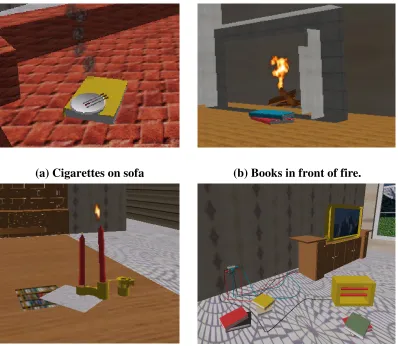
(a) Cigarettes on the sofa. (b) Books in front of the fire.
[image:45.612.100.520.264.640.2](c) Unattendedcandles. (d) Overloaded outlet.
collision detection that would prevent users from passing through objects in the virtual
environment.
OPAL was integrated into the visual simulation by creating physical representations of all the
important objects in the virtual environment. The user is represented by an invisible sphere,
subject to the effects of gravity, and their movement is powered by an OPAL motor. The
terrain of the Fire Safety environment is composed of a single model. This includes the
ground, the house and most of the furniture. As a result this is a very complicated model that
cannot be easily represented by the primitives provided by OPAL. In cases like this OPAL
provides for the definition of a mesh object. Mesh objects are defined by an array of vertices
and a second array that defines which vertices represent which triangles. The more vertices
that are defined, the more complicated the final mesh, and the more computational resources
it requires to compute collisions each frame. To keep the amount of work to a minimum the
visible model was simplified in a modeling application so that complicated objects like a
dining table were represented by cubes whenever possible, and some small objects that
would not impact player movement, such as ashtrays on tables, were removed from the
physics model entirely. This allowed for a much simpler and less computationally expensive
physical representation of the virtual space without losing any interactivity.
Players control their motion using a gamepad, like the one shown in Figure 2, the
right analog stick is used to rotate the players view and the left analog stick is used to move
forward, backward, side to side and any combination there-of. Forward is defined by the
direction the player is facing when they move the analog stick. This allows the user to face
any wall of the immersive environment without having to adjust the way they are using the
gamepad. The gamepad is an intuitive choice for navigation because this kind of navigation
3.2.2 Hazard Search
Hazard removal presented a unique challenge in terms of information sharing. Each hazard
hust be represented by a visual model, to be removed when the hazard is discovered by the
Figure 5: Completed house model viewed from outside.
user; this is not complicated as most scene graphs provide some functionality for switching a
node on and off. However, each of our hazards must also be physically represented so that
the user cannot pass through a hazard until it has been removed from the environment.
Therefore, both the visual simulation and the physical simulation must maintain a
synchronized list of hazards and update this list as hazards are removed. The scene graph
passes the positions and sizes of the hazard models that load to the physics simulation at
runtime. The physics simulation constructs a physical representation for each hazard, this is
in most cases a sphere, and then indexes them so that they are aligned with the list in the
scene graph. When the user attempts to identify a hazard by indicating it in the application,
the scene graph queries the physics simulation, which checks for successful identification
and passes an index back to the scene graph of the hazard model that needs to be removed, if
any. Figure 4 shows the information flow that occurs to support this function.
In order to have a fun way to indicate hazards in the virtual environment an interface
was developed using a six degree of freedom wand. The user points the wand at whatever
item they wish to remove. The wand includes a tracker that reports it’s orientation in the
CAVE, this orientation information is passed to the physics simulation which fires a ray in
the direction the wand is pointing. If a hazard model was hit, meaning the first thing the ray
encounters is a viable hazard model, the hazard is marked as found and the physics
simulation reports the index of the discovered hazard back to the visible simulation. The
hazard model is then removed and a sound is played to indicate the successful identification
of the hazard. Examples of the hazards implemented in this application are shown in Figure
3.
3.2.3 Fire Evacuation
Much current fire safety training focuses on a bedroom scenario because many of