
Population and development. The Courier No. 144, March/April 1994
138
0
0
Full text
(2) Angola Antigua & Barbuda. Belgium Denmark. Bahamas Barbados Belize Benin Botswana Burkina Faso Burundi Cameroon Cape Verde. France Germany (Federal Rep.) Greece Ireland Italy Luxembourg Netherlands Portugal Spain United K i n g d o m. Central African Republic Chad Comoros Congo Côte d'Ivoire Djibouti Dominica D o m i n i c a n Republic Equatorial Guinea Eritrea Ethiopia Fiji Gabon Gambia Ghana Grenada Guinea Guinea Bissau Guyana Haiti Jamaica Kenya Kiribati Lesotho Liberia Madagascar Malawi. France ( T e r r i t o r i a l collect i v i l i » ) M a yol te Si Pierre and M i u u c l t i n (O. terrilo rie»). New Caledonia and dependencies Trench Polynesia rench Southern and Antarctic Territories Wallis and Futuna Islands. Netherlands (Overseas countries) Netherlands Antilles {Bonaire. Curaçao, St M a r t i n , Saba, St Eustachc) Amba. (Country having special relations w i t h Denmark). United. Kingdom. (Overseas countries and territories) AnKUilIa British Antarctic T e r r i t o r y. Mali Mauritania Mauritius Mozambique Namibia Niger Nigeria Papua N e w Guinea Rwanda. British Indian Ocean T e r r i t o r y British V i r g i n islands Cayman Islands Falkland Islands Southern Sandwich Islands. Λ. __ Papua New Guinea. and dependencies Montserrat. Γ\. 1. Y ^ » .. Islands". «Tuvalu. Pitcairn Island St Helen. anil dependencies. Turks. nd Caicos Islands. Western Samoa V Vanuatu * ty. ¿»Fiji Tonga Î *. St Kitts and Nevis St Lucia St Vincent St Kitts and Nevis es? ·λΙ — A n t ' 9 u a _ominican ""·"„ & B arbuda Republic * _ . F TÈ»—· Dominica St L u c i a ^ 9 „ . . St Vincent and the Grenadines-ƒ öamaaos Grenada " " „ « ^ T r i n i d a d & Tobago. Generili Secretariat o f the A C P C r o u p of Staici A v e n u e Georges H c i 1200 B russels. This list does not prejudice. Belgium. the status o f these countries and territories. Tel.: 733 96 00. n o w o r i n the future. The Courier uses maps f r o m a variety o f sources. Their use docs not imply recognition of any particular boundaries c-child family in Harare, Zimbabv nor prejudice the status o f any state η John flc Penny Hubley. LX'). and t h e Grenadines Sao T o m e & Principe Senegal Seychelles Sierra Leone S o l o m o n Islands Somalia Sudan Suriname Swaziland Tanzania Togo Tonga Trinidad & T o b a g o Tuvalu Uganda Western Samoa Vanuatu Zaïre Zambia Zimbabwe.
(3) no 144 marchapril 1994 the Courier AttkaCaribbearvPacrfk European Union. COUNTRY. REPORT. meeting. point. 2. Peter Sutherland, GATT DirectorGeneral GHANA. Peter Sutherland GATT DirectorGeneral. More than ten years ago, facing a disastrous economic situation, the Government of Ghana embarked on. a c ρ. an ambitious recovery programme. The. 5. Joint Assembly meets in Strasbourg. old ideas of central planning and state. 10. CFAF devalued. control of the economy were replaced by a new emphasis on private enterprise. Chronic public deficits were. 12. New ACP handbook from Eurostat 14. The development of bottomlands in the Sahel. reined in and the country was opened up t o encourage investment, trade and. f nm. competition from t h e outside world.. country. W e give a progress report on how. 20. GHANA: Striving to keep up the momentum. Ghana has fared and also take a look. 25. Profile. at the new politics o f this West African state following the restoration of democracy in 1992. Pages 2 0 t o 45. report. 26. Interview with Emma Mitchell, Minister for Trade and Industry 30. Fourth time lucky with democracy ? 33. Interview with Justice Annan, Speaker of the Parliament 36. An opposition viewpoint : Professor Albert Adu B oahen 38. Emile Francis Short—guardian of human rights... and a great deal more. Is GATT still a 'rich man's club'? Were. 39. ECGhana cooperation. the developing countries 'on the. 42. The Dawhenya Rice Project. periphery' of t h e GATT negotiations?. 44. Conversing about culture. Is the Third World going t o be a 'loser' as a result of t h e Uruguay Round ? These are some of the allegations that. europe. were made on GATT after it. 46. The 1994 European election . Gearing up for the campaign. succeeded in concluding a new multilateral trade deal on 15 December 1993. The Courier asked GATT. dossier. DirectorGeneral Peter Sutherland for. 50. Population and Development : the great issue of our time. his opinion.. 52. Human impact on the Earth. Pages 2 t o 4. 55. Population growth, changes in age structure and implications for development. DOSS I LR. 59. Population distribution and economic management 62. B irth control and family planning. Joint A s s e m b l y. &. ;. c. '"~~ "" Λ. Population a n d d e v e l o p m e n t. 65. From population policies t o policies for people. Whereas it took millions of years for. 68. Population growth and sustainable development. the global population t o reach the first. 70. Population growth and economic development in Africa. million, it has taken less than fifteen t o rise from 4bn t o 5.4bn, and it is growing at an annual rate of 97m.. ι £HS*3W. φ.. i'SÄI5, ■ k¿5 wXM .- . AV (¡Λ* '■'■ ■'ν. BSÉKr. 72. Africa's population : the paradox of natural wealth and poverty 74. Mauritius : an orthodox population policy. The 1990s are the critical decade t o. 77. Haïti in economic crisis: what population policy?. stop the increase and avert. 80. Our changing islands. The Pacific environment. catastrophe. As preparations get under. 83. Pleading the case for cities. way for the third International. 86. ACP demographic and economic indicators. Conference on Population and Development in Cairo in September, the Courier examines this great issue of our time.. closeup. Pages 50 t o 94. 95. Yam bean — An underexploited tuber crop with great potential. »'Α. α· /'··■■ ■'■'■'—. «Β. developing. world. 98. International Monetary Fund Report for 1993 W i t h the negotiations for the Lomé IV midterm review due t o begin shortly, the most recent session of the Joint. culture. Assembly was, not surprisingly,. 100. Cultural cooperation between the European Union and the ACP. dominated by discussions about the future of ACPEU cooperation. While. and. society. States. outside the Palais de l'Europe in Strasbourg, people were shivering in subzero temperatures, a lot of heat. ctabulletin. was being generated inside the. 103. Sustaining soil productivity in intensive African agriculture. chamber as representatives debated an interim report by Mrs Margaret Daly. BOOKS. (above) on possible changes t o the. NEWS ROUNDUP (yellow pages). Convention, and a wide range of other. CDI — Partnership. issues.. OPERATIONAL SUMMARY (blue pages). Pages 5 t o 9 Published In English and French. Writers of signed articles bear sole responsibility for their contents. Reproduction authorised, subject t o Indication of origin..
(4) I. lt was an obviously relieved Peter Sutherland w h o banged the gavel to conclude the final session of the Uruguay Round on 15 December 1993. Ever since the launching, in September 1986, of the socalled Punta del Este Declaration, this eighth round of multilateral trade negotiations had gone on, almost uninterrupted, for 2643 days! The 1986 Declaration covered the most complex and ambitious negotiating man date Trade Ministers of the participating Governments had ever received. The talks were scheduled to be completed by the end of 1990, but deadlines were continuously postponed and many feared for the future of a liberal multilateral trade system. While most of the 15 negotiating groups made slow yet steady and, above all, 'discreet' progress, some issues such as the debate on agricultural policy were fought out in the open. Such ongoing 'battles' between the EU, the USA and the Cairns group were in fact the main focus of media attention for a long time. These skirmishes also prompted some observers to conclude that the other negotiating partners, mostly from the developing w o r l d , were pushed to the 'periphery' of the negotiations. And, while the world at large welcomed w i t h relief the final breakthrough, many Third World observers also felt that, in this game of winners and losers, the developing nations would again be on the wrong side. Based on computer projections, estimates showed a growth in the value of inter national trade, thanks to the Uruguay Round, ranging between US$ 213 billion and US$274 billion by 2002. While all the benefits of the new deal obviously cannot be quantified, most of those that have been calculated so far appear to accrue to the industrialised nations. Is GATT therefore still a 'rich man's club'? 'No', was the vigorous response of GATT DirectorGeneral Peter Sutherland, when he spoke to 77ie Courier recently. He strongly advocates the new trade deal, which, he says, will bring 'increased security and opportunity for all'. As a former European Com missioner (198589), and therefore au fait the Courier n° 144 marchapril 1994. ^. w i t h the Lomé Convention, he also seeks to ease the ACPs' worries about the possible erosion of their preferential trade access to the EU. (47 ACP States are currently GATT members). Today, while working on the fine tuning of the final text, which will be formally signed in Marrakesh by the 118 countries participating in the Uruguay Round (116 GATT members plus Algeria and Honduras) in April, the head of GATT puts the new trade deal into perspective.. — Well, I think it is massively beneficial t o the world at large and I think it is also beneficial t o all aspects of the world economy. In other words, it is not definable in terms of being positive for one group of countries as opposed t o another. The opening of trade is the opening of opportunity and I believe that our internal assessments demonstrate quite clearly that everybody is a winner. ■. Would you agree that, in the. Third. World press at least, there is a tendency to say that some of the poorest ■ Mr. Sutherland,. what. is your. own. developing. countries may be net losers in the end ?. of. — Well, there has been some. the Uruguay Round as reached on 15 De. reference t o t h a t but, equally, there have. cember 1993 ?. been contrary statements and opinions on. overall assessment of the final outcome.
(5) meeting the same issue. I think that in general, one may say that the greatest resistance to the conclusion of this Round has often ap peared to come from sectors or sections of the developed world rather than from the developing world, and, contrary to past experience, the greatest advocates of the multilateral system are increasingly per ceived as being many of the developing countries. That, I think, makes absolute sense. If the weak and smaller countries in the world do not have the umbrella of a multilateral system providing security in terms of trade and trading conditions for the future, how can they attract employ mentgenerating projects? How can they provide assurances in regard to their future development and sharing in world pros perity? So I think, it is a particular plus for the developing world. ■ So you would not agree with the old adage about G ATT being a 'rich man's club'? — Oh, I think it is quite the reverse. There used to be a theory which was widely accepted that an open world trading system worked to the advantage of the rich and to the disadvantage of the poor — but this theory has long since been rejected. As I pointed out, I think it is increasingly obvious that the vast majority of developing countries perceive it pre cisely in the opposite way today. The need for rules of the game is to avoid the law of the jungle taking over. This would in evitably mean the use of power by the strong against the weak and therefore it does not surprise me at all that developing countries are flocking to join the GATT and subsequently the World Trade Organis ation. It is also the case that the developing states who are already GATT members have been strong advocates of the conclu sion of the Round. ■ The major bottlenecks or constraints during the years of negotiation stemmed mainly from disputes between certain blocs of developed countries. One could conclude from that — as some have done in the Third World — that the developing nations were on the periphery of the negotiations. — Well, I do not think that they were. It is very difficult to generalise about. this, and about 'justice' between de veloped and developing nations. It is also very difficult to make generalisations about developing or even leastdeveloped countries in the world. These descriptions cover a wide spectrum of different situ ations. Some of the smaller, weaker countries were amongst the most active and persuasive during the course of the Uruguay Round. ■ But within those weak countries, would you agree that it may not have been the very weakest — for example, those of subSaharan Africa — but rather those Third World Countries which have major interests in getting a new trade system going which were most active? I am thinking in particular here of those coun tries bordering the Pacific rim. — There are a number of sub Saharan African countries that paid par ticular interest in the conclusion of the Round. Certainly, as far as we have been concerned within the GATT organisation, we have had a particular concern for this. Indeed, we have an internal group work ing on the interests of the leastdeveloped countries, some of which are to be found in subSaharan Africa. I think that at the end of the day, the interests of those econ omies which are most likely otherwise to be marginalised are best secured by the multilateral system. So whatever one says about their level and degree of particip ation, the result has been to secure countries which are marginal in terms of their proportion of world trade within a system which gives them an assurance as to the future. ■ What benefits do you believe the Third World in general can expect from the World Trade Organisation that will be established? — Oh, I think, very considerable benefits and most particularly that of knowing that there will be rules of the game which will be administered fairly and objectively. Let us assume that there had been no successful conclusion to the Uruguay Round; that a World Trade Organisation had not been agreed. What would we then be faced with? What would the leastdeveloped countries in the. point. world be faced with ? Quite simply with a world economy, in terms of trade, where bilateral and unilateral decisionmaking would ultimately determine who could sell what to whom. In those circumstances, what would the effects be on the least developed and the weaker nations in the world ? I think they would be devastating. I think that they would lose all security in terms of inward investment and the prospect of attracting it from big indus tries. They would no doubt be the victims of the dumping of products from the developed world and of a whole series of illicit practices otherwise outlawed by the GATT. ■ So it provides them with increased security. Is that the key point for you ? — That is the key point: in creased security and increased oppor tunity. ■ On the other hand, the new trade deal looks as if it will also increase competition among the developing countries themsel ves. It seems that those with the weakest human resources and capabilities may lose out again. Will the G ATTI WTO undertake specific measures to strengthen the trading and negotiating capacities of these coun tries ? — Absolutely. We already do so but we will do it to an additional extent. I think that one of the primary functions of the World Trade Organisation will be to address the ongoing problems of the weaker members of the world trading community. At the moment, we have training courses and divisional resources placed at the disposal of the least de veloped countries — something which I think they greatly appreciate. At the end of the day, what one is talking about in terms of future perspectives for the World Trade Organisation is a body which I believe has a particular responsibility to the weaker elements of the trading system. ■ What is the agenda now for the creation and setting up of the WTO ? — The agenda is that, following the Marrakesh conference, there will be a tentatively agreed date subject to ratifi cation for the commencement of the new the Courier n« 144 ■ marcfvapril 1994. r.
(6) meeting. point. organisation. At the moment, I believe, that that date is most likely to be 1 January next year. ■ So GATT will then become WTO ? — Obviously GATT is an organis ation which has its own existence but in effect over the coming period, the WTO will take over the areas of concern and the responsibilities of the GATT system. ■ G iven your own personal background as a former European Commissioner, you are of course very much aware of the specific relationship that the 70 ACP countries have with the European Union, which includes privileged access to the EU market. Within ACP circles, there is a commonlyheld view that their preferen tial trade access under Lomé might be considerably eroded by this new trade deal. Do you agree with this or how would you seek to dispel such an argument ? — I would dispel the argument very simply. Obviously, if a preference exists because a tariff level for the world at large is higher than that levied for those who have preferential access to a particular market, and if the higher tariff level is then reduced, clearly the difference between the two is also reduced. Now, under those circumstances, there are a number of points that have to be made. First, where the general tariff is reduced, it is important to point out that it has probably been reduced all over the world. So it is providing more opportunities for the exporters from the ACP countries to distribute their exporting capacity in a significant way over a wider area of the world. That doesn't impose constraints but quite the contrary, opens up enormous opportunities, and that is the most essen tial point. The second point is that the difference between binding tariff rates within the GATT system and what happens with the preferential rates that are offered by trading countries or blocs to poorer countries is that under the GATT you have permanence. The rates are binding ; they can never go up again and they cannot be withdrawn. B y contrast, the preferential rates granted by individual countries or trading blocs to poorer nations are less secure. They can be withdrawn. So, overall, I think there is no doubt that the general reduction of tariffs brought about by the. Λ. the Courier n° 144 · marchapril 1994. Uruguay Round is greatly to be desired by the poorer countries in the world. It provides across the board access for a whole range of products—and not merely those which are targeted by special pre ferential rates — and this means opportu nities for the future. Even in those areas where there are targeted preferential rates, the worldwide lowering of tariffs provides greater opportunities.. suggest that there are winners and losers in this 'ball game'. But, as I mentioned, I think that the weak make a particular gain in the sense of being provided with security for the future. Those who are entirely outside the system do not have that security and therefore will be dealt with on a bilateral basis by those with whom they wish to trade — that is an insecure future.. ■ Among those that are still outside, do ■ Looking at the mathematical models, you see an increasing tendency to join the whether from G ATT, the World Bank or multilateral trading system, now that they the OECD, that seek to quantify the profits have seen that there has been a from the new deal, it ne vertheless seems to breakthrough ? — I think it is a major incentive be the case that the rich countries stand to and that is perhaps why we have over 20 gain more than the poor ones. applications for membership of the system — I think that the assessment at the moment. These include both small that you are making is based — if I may say and large countries. Russia and China are so — on the wrong premise. Most of the among the big applicant countries but assessments of the gainers and losers, and there are many smaller ones as well. the ones that you are referring to in Altogether, there is a rash of countries that particular, are based upon the amount don't want to be excluded and that are that is saved by the consumers in the now seeking to become part of the system. societies in question as a result of the tariff reductions. That does not mean that the ■ A lot has been covered in thenewtrade gainers are the rich and the losers the poor. deal but many 'hot' issues of particular It means that by reducing tariffs in the rich concern for the Third World remain out countries, where they are sometimes very standing : subjects such as social dumping, high, the costs are reduced for their foreign investors' behaviour, international consumers. If that premise were to be commodity prices, trade in labourintens taken to its logical conclusion, it would ive services, environmental concerns and so mean that free traders gain nothing by the on. Are they on any future agenda ? Round whereas those with high tariffs gain — What GATT or its successor everything. In fact, it is the opposite. So these figures, as with all figures, are organisation will tackle in the future misleading. They only show one side of the remains to be decided by the contracting story. I believe that the big gainers in the parties. New issues will no doubt be looked Uruguay Round are those who have the at. One of these, that we already know for capacity and will to produce. Those who certain, is the issue of trade and the have the greatest amount to offer in terms environment. I cannot say at this stage of the future trading system, and the how that debate will develop, because greatest amount to gain in the long run — ultimately it depends on getting the and indeed in the short term — are the agreement of all the parties. developing countries.. ■ What about those who remain outside the system altogether? — Those who have remained outside, I believe, lack the security that the system provides and therefore lack the security of being able to attract invest ment. As I said earlier, the developing countries have a lot to gain but so also do the developed countries. I am not trying to. ■ Can one envisage a new round of negotiations along the lines of the one that has just been completed? — No, in my opinion that is very unlikely because it was too large and too interdependent to be duplicated. I think we will probably look at things issue by issue in the future, rather than in such a wide and interdependent way, but I may be proved wrong. EM Interview by Roger De Backer.
(7) Joint Assembly meets in Strasbourg. Spotlight on Lomé IV mid-term review. I. To the uninitiated, the proceedings of parliamentary bodies are often mysterious and sometimes downright obscure. Governed, as they are, by frequently arcane procedures, they are inclined to be a constitutional lawyer's dream and a journalist's nightmare! To be fair to the ACP-EU Joint Assembly, which has just held its most recent session in Strasbourg, the discussions are not normally overburdened by procedural niceties and the documents to be debated are usually available, albeit at the last minute, to members and observers alike. But anyone who was trying to follow the vote on the 'Interim Motion for a Resolution on the Lomé IV Mid-Term Review', could be forgiven if they left the Palais de l'Europe without really having grasped what had just occurred.. To a large extent, the problem was one of timing, compounded by disagreements, which appeared principally t o be on the European side, about substantive elements of the interim report and its accompanying resolution, drawn up by Margaret Daly on behalf of the Working Group on the Second Phase of Implementation of the Lomé IV Convention. Although the debate about the mid-term review began several months ago, the Joint Assembly is constrained by the fact that it only meets twice yearly. The subject was discussed at the last plenary meeting in Brussels in October, but at that time the opening of negotiations (scheduled for May 1994) seemed a long way off. When the Assembly reconvenes next October, the talks are likely t o be well advanced, and could conceivably have been completed. The Strasbourg meeting was accordingly the only real 'window of opportunity' for the EU and ACP parliamentarians t o put forward a common position w i t h any hope of influencing the negotiation process. That the Joint Assembly has a legitimate interest in the future shape of. the Lomé system is hardly in doubt. It owes. A view of the Palais de l'Europe, where the. its existence, after all, t o Article 32 of the. Joint Assembly met in February. current Convention and its raison. d'être. includes an obligation t o 'reflect upon all matters pertaining t o ACP-EEC cooperation.' A look at the essential elements of the Community's agreed negotiating mandate, recently released into the public domain by the EU Council, reveals a further, more specific, interest. For, among the proposals t o be tabled, there is one. national legislatures into an obligation — in which case, ambassadors and other diplomatic staff would presumably be excluded. A t the same time, it envisages reducing the frequency of the regular meetings by half. In. addition. to. institutional. changes, the Council has agreed that the. which would very significantly affect the. European negotiators should press for a. composition and working of the Joint. number of more substantive amendments. Assembly itself. To quote from the press. t o Lomé IV (see box). In the circumstances,. release in question : 'The Union proposes. it was not surprising that the mid-term. that the Joint Assembly should be made up. review should have featured so prom-. of parliamentarians coming from rep-. inently in the Joint Assembly's discussions.. meet. The President of the Working. once a year (italics added) and at other. resentative assemblies; it would. Group, Mr Somda of Burkina Faso, set the. times when it appeared necessary.' In. ball rolling in the debate w i t h an intro-. other words, the European side is ap-. ductory presentation in which he ac-. parently proposing t o convert the existing. knowledged the 'widespread feeling that. desideratum. our cooperation has not been achieving its. should. t h a t ACP representatives. be elected. members. of. their. r. objectives over the past few years'. He also the Courier n° 144 * march-april 1994.
(8) a cρ pends essentially on our capacity to come. The European Union lays out its stall On 7 February, the EU Coundl unanimously adopted a negotiating mandate for the European side in the forthcoming negotiations under the Lomé IV midterm review. One of the key points that the EU will be proposing is that there should be an affirmation of the principles of democracy and the mie of law. Alongside this would be a new clause allowing for the possibility of partial or total suspension of the Convention in the event of serious violation of these principles. (The socalled 'essential element' clause.) As regards financing arrangements, it is envisaged that limited sums be set aside for specific actions covering institutional reform (démocratisation), human resource development, the environment and the private sector. In an attempt to deal with what they regard as the 'rigidity' of the current financing system, the Twelve are also proposing that, while an overall 'indicative' sum should be earmarked for each ACP State prior to the establishment of the National Indicative Programme (NIP), the funds would actually be delivered in two separate tranches, 'taking into account the execution and the nature of the projects, as well as the situation in each ACP State.' There is some uncertainty over what this exactly means but it is widely thought that it would introduce a 'performancerelated' element into the system in the sense of. creating a link between the efficient use of funds at the early stages and subsequent allocations. Additional flexibility is also sought in the proposal to allow resources designated for development projects to be redirected towards humanitarian aid or rehabilitation, in situations where dvil war has broken out or cooperation has been suspended. The Community negotiators will also be seeking a reorganisation of 'certain competences in the area of financial and technical cooperation' with a view to improving efficiency 'while respecting the prerogatives of the ACP countries.' In concrete terms, this would involve the Commission establishing and managing study contracts although the terms of reference of such studies relating to the preparation, examination and evaluation of development projects and programmes would continue to be determined by the ACP State in question, in liaison with the Commission services. The Twelve are furthermore proposing a reinforcement of the political dialogue between the two sides. This would extend to areas of general or common political concern outwith the areas currently dealt with in the Lomé Convention. Finally, as mentioned in the main text, they will be arguing for new provisions affecting the composition and meeting cycle of the Joint Assembly.. I. argued, however, that it should not be a. question of 'going back on the principles. Partnership. up with an adequate response to the challenges that we face'. The changes being proposed by the Community, he insisted, were designed with this in mind. He also stressed the fact that there was no question of imposing anything on the ACP countries. His arguments were echoed by Peter Pooley, Director General for De velopment at the Commission, who sought to reassure members that there was no conspiracy on the part of DG VIII 'to pull the duvet more over to our side of the bed'. In her presentation, Mrs Daly also focused on a number of specific points of concern. She did not see a need for any fundamental change in the NIP concept, arguing instead for changes t o the existing system that would improve the uptake of resources. She stressed the importance of capacity building and said that there was a need for an urgent review of Commission staffing levels. She spoke of a general need for greater transparency and a specific need for wider dissemination of inform ation about opportunities under the Lomé Convention in the ACP countries. And she voiced concern over the procedures to be used in invoking the 'essential element' clause where human rights or democracy are threatened. Above all, she stressed the trade aspects — something which she reported would be a central element of the ACPs' negotiating mandate, although it. enunciated in Lomé' but rather of aiming to improve the procedures.. In the proposals which Mrs Daly. Margaret Daly, rapporteur on the Second. went on to highlight, the theme. Phase of Implementation of the Lomé IV. of partnership featured heavily.. Convention The question is not what needs to be. to explain her report in more detail. She. Indeed, the underlying concern of the. began by recognising the need to improve. working group, which cropped up time. the effectiveness of ACPEU cooperation. and again in contributions from ACP. and emphasised that the Working Party. representatives and MEPs, was that the. had set itself the task of 'identifying. midterm review might lead to a shift in. constructive proposals'. In this regard, she. the existing balance of responsibilities in. referred to a number of goals including. such a way as to undermine the partner. improved flexibility in programming, a. ship concept. Although he was unable to. more efficient uptake of resources, ex. be present for the debate itself, Vice. tended political dialogue, continuing sup. President Manuel Marin had clearly antici. port for démocratisation and the need to. pated this point. In his presentation to the. improve cumbersome procedures. All of. Assembly earlier in the week on the Sotutu. these objectives, she argued, were ac. Report (see below), he noted the Joint. cepted by both parties. The question,. Assembly's commitment to continuity and. Mrs Daly was then given the floor. therefore, was not what needed to be. partnership and stressed that this was a. addressed, but rather how the problems. vision that he entirely shared. But, he went. should be tackled.. on, 'the vitality of our cooperation de. Λ. addressed, but rather how the problems should be tackled'. 0&*Ζ ; ^ ' τβ. f. BL. si» .' *«■. '·«* p. ; ft; η. 5f>*S i·"«*»·*»! β3»ϊ. ft. Ι. Ritaa S » Ίr .,. STI .Γι?. ■ '.*. IvÌM. Hilft·». l a lit I?».,. I t * (VA* ». ïJ Vii'. V^A*"1?** the Courier n° 144 · marchapril 1994. ■■eet». ~. "'fnl. SfJtíWÉAjiWirwí^^eeRtl.
(9) a cρ concerned. The speaker from Barbados. Brigitte Ernst de la Graete, w h o expressed. also linked democracy w i t h. 'economic. the view that the 'choice' being offered t o. enfranchisement' and stressed that edu. the ACPs in the midterm review was of. cation was vital for the successful working. the 'take it or leave it' kind.. of democratic systems. One of the most telling contributions came from a Zambian backbencher w h o proclaimed, t o ap. I. plause : 'The more pressure put on govern ments — any governments — t o respect human rights, the better.'. Voting muddle And so t o the vote. As stated earlier, the proceedings at this. stage were very difficult t o follow.. Most of the heat generated in. No fewer than 91 amendments had been. the debate came from the European side,. tabled t o the interim resolution and these. where there was a clear divergence of view. were only made available in French and. on the Daly Report. Interestingly, the. English at a very late stage. Indeed, the. division was not on 'party' lines. Thus,. session had t o be suspended for an hour in. Commission VicePresident Manuel Marin,. while Mrs Daly was opposed on several. order to allow members the opportunity. seen here with DirectorGeneral Peter Pooley,. points by her fellow PPE member, Maxime. t o read the texts. When voting finally. Verhagen,. began, Mrs Cassagnmagnago Cerretti, the. addresses the Joint Assembly The vitality of our cooperation depends... on our capacity to come up with an adequate response to the challenges that we face'. she received strong support. from Janey Buchan, w h o accused some of. presiding CoPresident, proceeded to work. her fellowSocialist Group members of. through the amendments at breakneck. 'shenanigans in the corridors, aimed at. speed. Each time, as the rules require, the. badmouthing Margaret Daly.' does not appear t o feature strongly in the EU's agreed position. Mrs Daly argued that. The atmosphere among certain. this subject, and in particular, the elimi. European members was undoubtedly less. nation of nontariff trade barriers, should. than cordial, although the sharpest com. be given the highest priority.. ments were presumably reserved for the. The debate which followed was wideranging, w i t h members focusing on different aspects of Lomé cooperation of particular concern to themselves or their regions. On the ACP side, a member of the Papua New G uinea legislature with ex perience in running a small horticultural business highlighted the difficulties faced by small entrepreneurs in raising capital. Echoing Mrs Daly, he urged that more information be made available locally about Lomé Convention risk capital faci lities. The representative of. Cameroon. expressed concern about the dimension of the midterm review, which he thought risked going beyond the bounds of 'a straightforward negotiation for a financial protocol'.. In a. 'maiden' speech, the. speaker from the Bahamas also took up one of the rapporteur's themes in pointing out problems caused by different technical standards and rules of origin, which put a. rapporteur was asked for her view (for or against) and on each occasion, her opinion. corridors t o which Mrs Buchan referred. On the floor of the Assembly, critics of the Report focused on procedural and sub stantive objections. Enrique Pons G rau thought that the Joint Assembly was in danger of 'jumping the gun' and queried the procedural correctness of adopting an interim. report (a view supported by. Mrs Belo, w h o spoke later). He also felt that such 'serious work' should not be left in the hands of a single person, a reference presumably t o the key role played by Mrs Daly in drawing up the report. On the. appeared decisive, w i t h the Assembly adopting amendments that she accepted and rejecting those that she opposed. Everything was going smoothly. until. amendment number 69 by Mr Saby which proposed the insertion of a new para graph 50a. A t this point it was discovered that there were t w o English texts of the resolution in circulation — and that the numbering of the paragraphs had diver ged at paragraph 50. Thereafter, it was difficult t o believe that everyone present actually knew what they were voting for (or against) since, for many, the remaining amendments could no longer be matched t o the paragraphs in the draft resolution.. subject of human rights conditionality,. Despite this apparently fundamental flaw,. Mr Pons Grau said that what was being. drawn t o the attention of the chair by. proposed did not discriminate against the. Mr Verhagen, Mrs Cassagnmagnago Cer. ACPs, pointing out t h a t such clauses. retti pressed ahead w i t h the voting and. appeared in many agreements concluded. the resolution, as amended, was finally. by the Community w i t h third countries —. agreed by 59 votes t o five w i t h seven. often at the request of the latter ! Mr Ar. abstentions.. beloa Mura. also made an impassioned. speech in support of human rights.. brake on trade. On the democracy/human. Other speakers in the debate. rights question, the Ugandan representat. included Maartje Van Putten, who added. ive noted that democracy was no longer a. her weight t o calls for better information. The. important. question,. of. course, is what the Joint Assembly actually decided at the end of this confused session. The resolution is too long t o reproduce here but some of the key emphases are worth summarising. These include :. controversial subject in the conceptual. about Lomé Convention opportunities in. sense but stressed that it should be seen as. ACP countries, Christopher Jackson, w h o. — flexibility in managing NIP resources,. a means t o an end, the end in question. thought there was a need t o switch. without the need for a complete overhaul. being a better way of life for the people. resources t o primary health care, and. of the NIP concept ; the Courier n« 144 mardvapril 1994. r.
(10) a cρ — continuing partnership and comanage. familiar. traditional. McGowan was concerned about the rep. ment at all stages of the programming. 'keynote' debate was, in fact, on a report. orted reluctance of some EU Member. exercise ;. prepared by Paula Sotutu of Fiji. This was. States t o collaborate with the rapporteur. — exploring new avenues for technical. on the subject of 'future relations between. when he was preparing his text, which he. cooperation. ACP States and the European Union' and,. was nonetheless happy to commend. The. strengthening local capacities;. not surprisingly, there was some overlap. representative of Senegal focused on the. — establishment of a 'capacitybuilding. between this debate and the subsequent. need to 'go to the grassroots', saying that. fund';. one on the Daly Report.. development was for the people and there. aimed,. inter. alia,. at. consensus.. The. — a statement 'welcoming the discussions. Presenting his report and resol. should be a greater readiness to place trust. on the possibility of introducing an essen. ution for the approval of the Assembly,. in them. Mrs Schmidbauer emphasised the. tial element clause' in respect of human. Mr Sotutu began by affirming his belief. need for closer coordination at the EU. rights/democracy (this was an addendum. that ACPEU cooperation, based on mutual. level, as is envisaged in the Maastricht. successfully proposed by Mr Romera i. trust, has a future. He expressed a senti. Treaty. She also called for debtcancel. Alcazar) but urging a careful examination. ment which was to be echoed by many. lation, urging Commissioner Marin 'to. of the implications of such a clause ;. other speakers during the session when he. keep pressing the Member States' on this. — clear and transparent provisions and. argued that relations should continue. point.. procedures, t o be set out in the Conven. along the same lines as set out in Lomé IV. tion, t o deal with cases where the Conven. for at least another decade, at which time,. tion might be suspended because the. he believed, a full evaluation should be. 'essential. undertaken.. element'. clause. has. been. breached ;. In seeking to analyse the reasons. — according the 'highest priority' t o trade. for the limited success of development. development and the use of the associated. efforts in certains areas, the rapporteur. provisions of Lomé IV ;. stressed the need to recognise the import. — examining the possibility of an in. ance of cultural factors, and admitted. creased legislative role for the Joint. frankly that these sometimes 'shackled. Assembly, rather than the purely advisory. progress towards democracy.'. and often marginal role it presently has.. Among his specific recommend. In general terms, it appears that. ations, Mr Sotutu concentrated on the. the majority in the Assembly recognise the. need t o tackle illiteracy, strengthen re. need for changes to tackle weaknesses in. gional cooperation, promote ACP trade. the Convention's implementation but are. and encourage private enterprise. On this. not wholly convinced about the modalities. last point, he felt that not enough was. proposed by the Commission and the. being done on the part of ACP countries to. Council. All of those engaged in the debate. bring the private sector into the nation. are committed to the special partnership. building process or, as he eloquently put it :. which exists between the European Union. 'Too often, they are left t o paddle their. of Fiji 'Bring the private sector into the nation building process'. and the ACPs although there are dif. own canoes.' He also addressed some. ferences about the substance of this. It was perhaps inevitable that the. remarks specifically to the European side,. partnership and about the direction it. issue of the CFA franc devaluation should. urging that they should not be 'too. should take in future. Of course, the Joint. be raised, with the speakers from Senegal. unbending' in applying conditionality in. Assembly's role in the process is purely. and Côte d'Ivoire both making heartfelt. respect of human rights and democracy.. pleas on behalf of the 14 affected coun. advisory. B ut in pressing ahead with a resolution which sets out their distinctive. Mr Sotutu went on to speak of. tries, all of which are ACPs. The Côte. position, prior to the commencement of. the importance of improving communi. d'Ivoire representative conceded that the. negotiations, they must be hoping that. cation between the ACP States and the. currency had previously been overvalued. they will be able t o exercise some influence. Commission, and of giving more respons. but condemned the 'brutal' way in which. on the process.. ibility to Commission delegates in the ACPs. the devaluation had been carried out, and. (who, he said, must be carefully chosen),. asked pointedly why the European Union. I. Future relations. In contrast to the discussion on the midterm review, the Joint As. with a view to improving implementation.. 'had not lifted a finger'. Two French MEPs. Other issues he referred t o included the. of opposite political persuasion, François. ACP debt burden and the special needs of. Guillaume and Henri Saby, came together. island and landlocked countries.. on this issue in urging an examination of the possibility that an 'ECU zone' be set up.. In. the. subsequent. debate,. sembly's deliberations on other. Mr Sotutu was congratulated from all sides. The GATT Uruguay Round out. topics were characterised by the more. for the quality of his report. Michael. come was another topic given an airing. the Courier n" 144 * marchapril 1994. ^. The General Rapporteur, Senator Paula Sotutu.
(11) during the debate. Most speakers took. sources, unfair trading practices and struc. issue, in some form or another, w i t h the. tural adjustment support.. widelytouted proposition that everyone would gain from this and the general view seemed t o be that many of the least developed countries were likely t o lose out.. By contrast, Mr B altas of the EU Council concentrated on the. recently. agreed European negotiating mandate for the midterm review. He insisted that there was no question of calling the basic. Terence Wynne referred t o an. foundations of ACPEU cooperation into. issue which was not dealt w i t h in the. question and said that what was being. Sotutu Report, but which he felt should. proposed was amendments t o only a. have been, namely the future of the Joint. limited number of provisions. He also. Assembly itself. While stressing the value. described the Cornmunity's actions in. of the meetings, he argued that consider. South Africa in advance of the election and. ation should be given t o whether it was. outlined the Community's stance on Les. necessary t o convene twice a year. He was. otho and Sudan.. particularly scathing about the low atten dance on the European side. 'Had this meeting taken place in an ACP country', he said, 'I am sure that the attendance of Europeans would have been greater... the expenses are better.'. Mr Marin also focused on the forthcoming Lomé IV talks (see above), prefacing his remarks w i t h the encourag ing news that project and programme implementation had been speeded up over the past t w o years. He expressed pleasure. The representative of Eritrea addresses the. Other speakers in the debate. that the Council had 'taken on board' the. Joint Assembly for the first time. included the representatives of Jamaica,. bulk of the proposals presented by the. Botswana, Mali and Papua New G uinea. Commission and reiterated the point that. and MEPs Hermans,. and. the objective was 'solely t o update the. sports personality or literary giant departs. The Resolution drawn up by. Convention in order t o make it more. the scene. Despite this, it was difficult to. flexible and efficient'.. escape the conclusion that something was. Wurtz.. BraunMoser. Mr Sotutu was adopted by the Assembly later in the week.. I. Commodities crisis. The early stages of the session also saw major contributions from the ACP Council (President in Office,. Mr Brizon of Grenada), the EU Council (President in Office, Mr Baltas of Greece) and VicePresident Marin from the Com mission. Mr B rizon devoted most of his. speech t o the question of commodity. Other business conducted by the Joint Assembly during its Strasbourg ses sion included the adoption of t w o major reports on sustainable development (rap. almost every time a famous politician,. coming to an end when the Joint Assembly session wound up late on the Thursday afternoon w i t h a series of. laudatory. speeches from both ACP and EP speakers.. porteur, Mr Verhagen) and on the im. With the European election sche. plementation of the Lomé Convention (co. duled for June, a number of European. rapporteurs,. and. members have decided to call it a day.. Mr B ertens) as well as a series of individual. Mr Kosgey. (Kenya). Statistically it is likely that others will fail. resolutions on a wide range of subjects.. the electoral test while some will return t o. The situation in a number of individual. the Parliament but not t o the Joint. countries was also debated, while 'ques. Assembly. B ut it was difficult t o resist the. tion time' provided an opportunity t o quiz. impression that more profound changes. the Commission and EU Council on various. were also in the offing as the Lomé mid. aspects of development policy.. term negotiations loom. Whether the. prices, highlighting the huge reductions in. Joint Assembly will emerge from the. income suffered by many developing. This was the first JointAssembly. countries over the past t w o decades. He. at which the ACP's new coPresident,. process strengthened, unaffected or trun. spoke of the need t o concentrate on. Mr Chambrier (Gabon), presided. For the. cated is not for us to say. All we can say is. tackling the causes of this problem rather. European side, Mrs Cassagnmagnago Cer. 'watch this Space'. ■ ■. than merely seeking t o alleviate its symp. retti revealed that she would not be. toms. As regards the GATT outcome, he. standing for reelection in June. This was,. doubted whether benefits would 'spread. accordingly, her last session in the chair.. in any real sense t o the ACPs' and was. The meeting was also marked by the. critical of the international community's. presence, for the first time, of a rep. failure t o address the problems of the. resentative from Eritrea, w h o was warmly. 'losers' in the Uruguay Round. He con. welcomed by the members.. cluded by putting forward a series of 11. Too often, references to the 'end. recommendations concerning, among oth. of an era' are nothing more than a. er things, debt cancellation, Stabex re. journalistic conceit. The phrase crops up. Simon Homer. the Courier n" 144 · marchapril 1994. r.
(12) I. lt happened in midJanuary. It had been expected for more than ten years, ever since the World Bank pointed to the 'increasingly urgent need to devalue African currencies' in its 1984 development report. It was heralded in mid1993, when most of the European press announced, without further ado, that substantial devaluation (50%) of the CFAF was on the cards. And it was officialised after two days of open discus sion in Dakar (Senegal) on 11 and 12 January. But news of the cut in the exchange rate of the CFA franc still came as a surprise in the 14 States in the zone. Was it a case of miracles dying hard, although there are no miracles in economic affairs? Or was it that devaluation, even long predictable, is always an unpopular move? Technically speaking, the base rate of the CFAF t o the reference currency (the French franc) was bound to be cut, and for many reasons. Historically speak. counterpart of actual production and this is. ing, the franc zone goes back a long way,. not the case with the CFAF, whose fixed,. having been in its present form since 1948,. guaranteed parity with the French franc. Bank clerk in Niger Getting used to a lightweight CFA franc and fewer imports. and there has been no change in the rate of. has not so far been tied to any economic. nal inflation must be below the increase in. the CFAF to the FF since, despite the fact. compensation by the 14 African States.. the selling price of products to enable the peasants t o get proper benefit from the. that the reference currency has shifted on a number of occasions in relation to, say, the German mark and the American dollar. So, for 45 years, there has been no in dependent evaluation of the CFAF in the light of economic trends in the zone, whose trade, particularly with France, has maintained a structural deficit.. The swingeing cut in the CFAF is painful to all the countries concerned, of course, but, in the words of the principal architects of the adjustment, it was 'a necessity' if they were not t o 'go to the wall'. The question now is t o cushion the shocks (of inflation and declining income) which go with it and capitalise on an. nominal revenue hike which came with the change in the exchange rate. One of the main backup meas ures, involving writing off or reducing the debt, should in theory seal off the trap into which countries with heavy external debts fall, as they so often do in Africa, when States try to hang on t o too large a. Other reasons for devaluation. operation designed to get the economy off. include those which might be called. the ground again. So the IMF, the IB RD. indigenous and have to do with the nature. and, in particular, the European Union are. of the franc and the way it is used.. getting substantial financial resources —. Most commentators in Europe. Fundamentally, since 1960 at least, the. backup measures — moving to help the. are careful about advancing the global. CFAF has never been seen as a real. countries cope with the social consequen. advantages of this devaluation. But, one or. instrument of development conforming t o. ces of devaluation and go some way. t w o snipers apart (see box), the African. strict rules of monetary and financial. towards creating optimum conditions for. press seems to see the difference in the. management in a structured economy. In. the revival of productive activity. There is. exchange rate as a real lifeline to haul the. other words, the power of a currency is the. special emphasis on farming, where inter. drowning man out of the water. The. "f. the Courier rt° 144 ■ marchapril 1994. percentage of the monetary benefits of devaluation..
(13) a cρ. exchange rate is not the main way t o. analysis of their strengths and their weak. economic recovery, particularly in the. nesses beforehand. What will be the. African countries, including those in the. outcome and how good will the backup. franc zone, where the limited manufactu. measures be? Only the future can tell,. ring sector usually finds it has to spend a lot. I. M. The Senegalese ricegrower whom The Courier met recently complained that he was not earning much because of competition from imported rice. Will devaluation give him more incentive to produce and export ?. L.P.. on imported equipment when there are no industries upstream and a local network of subcontractors.. The advantages of devaluation. Common currency. tend t o be assessed in the light of the spurt. they give t o exports. In a forthcoming. issue. The Courier will be asking economic and political operators for their views. about what is happening in the field, to see what effect devaluation is really having on the economies of the countries concerned.. Prompted by the move, a discussion of the way African economies work has already started, focusing on countries in the franc zone, which have a common currency but little or no common economic policy and abound w i t h obstacles t o trade and the free movement of people and goods. It is by no means clear that devaluation will provide a strong and sustainable stimulus for these countries' exports or, most important, for their food. This is taken from an article by J.J. Man Jusu in the 14 January 1994 issue of Fraternité Matin, an Abidjan daily which follows the government line fairly closely. When the dust from the big bang of devaluation has settled, the members of the CFA zone will have to think deeply about the status of their common currency. Is devaluation the international finandal institutions' way of urging the member countries to take themselves in hand, both monetarily and in many other fields?. Of course, we are told that it is only a change in the value of the CFA franc against the French franc, with FF1 now being worth CFAF 100 and not CFAF 50. as before, but this is the first devaluation to be made independently of the French franc, our reference currency, so does it not at least implicitly underline the independence (author's underlining) of the CFAF) ? So here we are, all by ourselves. We must shoulder our responsibilities and press on to the ultimate goal of monetary sovereignty. It means political sovereignty first, of course, and this, in the framework of African integration, is marking time. We have our backs to the wall. We must move fast to take our own future in hand. So should we go for a common, independent African — regional or continentwide — currency in the coming years ? We think we should, and as soon as possible, never forgetting that we are no longer under France's wing. '. output without a precise and objective the Courier n° 144 · marchapril 1994. r.
(14) New ACP handbook from Eurostat. I. ACP BASIC STATISTICS — last published in 1988 — makes a welcome return this year, filling a gap in structured, tabulated information on ACP countries, a gap which has existed since the publication's last appearance six years ago. While the yearbook 'External Trade of the European Community with the ACP countries and the OCTs' continues to provide important ACPEC trade flow statistics, there has been a serious dearth of information on the other relevant indicators. The new edition of ACP BASIC STATISTICS due to be launched in early 1994 is a more comprehensive and farreaching publication than its predecessors. It is a valuable addition to Eurostat's output and, apart from being useful to the professional users of information, it will also act as a quick reference guide for readers seeking a detailed breakdown of statistics on African, 1 Caribbean and Pacific states.. The demand for coherent and timely data on ACP countries by information users is already well known and is not the subject for discussion here. Rather, this publication. tries to. respond. to. that. demand inasmuch as that data is available. The inherent philosophy of the publication has been to put the emphasis on quality rather than quantity, and, hopefully future issues will fill some of the gaps if the properly validated data becomes available. The publication regroups and synthesises data. supplied by the major. 1 At the time of going to press, no information was available on the ACP's newest Member State — Eritrea — but efforts are being made to include them in future publications.. the Courier n" 144 · march-april 1994. ^.
(15) a cρ international organisations, and which is. cities, principal products, date of indepen. developing countries (such as appears in. stored in the Eurostat database, on the. dence, etc.) as well as detailing the main. the publication under review) and to make. short and long term macroeconomic indi. demographic, social, economic, financial,. it easily accessible t o the users via an. cators of each ACP country. An initial study. trade and aid data pertaining t o the. interface w i t h attendant facilities f o r. of the best sources for each indicator in. country. The short term indicators cover. desktop publishing.. terms of coherence, validity and timeliness. the period 19871992 while the long term. The publication will appear sep. was undertaken by Eurostat. The resultant. indicators covers the decades from 1960. arately in three languages — French,. spread of data providers includes the IMF,. 1990 with projections for 2000 and 2025.. English and German — and will have an. the WORLD B ANK, UNESCO, the OECD,. ACP B ASIC STATISTICS is sup. the ILO, the FAO and of course EUROSTAT.. ported by data from the PVD (pays en voie. Against a background of international. de développement) domain of the Euro. coordination and activities aimed at sys. stat database, which houses over 100 000. tematising the identification, collection,. annual time series from 1960 representing. storage, retrieval and dissemination of. all the important macroeconomic indi. information on developing countries, this. cators for 169 developing countries. The. publication testifies t o that spirit.. domain is currently undergoing its o w n important. The publication offers a snapshot. research. initial launch in March 1994 of 4000 issues. Copies of the publication can be requested at the Office for Official Publications of the European Communities while further in formation concerning the PVD database can be provided by unit A5 ('Relations w i t h ACP and other developing countries') of Eurostat. ■ ■. and development. view of each ACP country, identifying. work. The objective of this investment is t o. some administrative information (main. isolate a critical core of information on. A n example of t h e d a t a provided on an ACP country in t h e n e w Eurostat handbook. Nigeria. Nigeria. II. Independence: 1963. Currency: Naira. Capital: Abuja. Productions: ■ sorghum, millet, cocoa, rubber, cattle, sheep ■ petroleum ■ steel, refining, aluminium, food, textiles. Area: 923 768 km? Major cities (1991): ■ Lagos (1 340 000) ■ I badan(1 263 000) ■ Ogbomosbo (644 000) ■ Kano (595 000) ■ llorín (420 000). Imports: ■ machinery and transport equipment, chemicals, manulactured products, food Exports: • crude oil. Official language: English Regional organizations:. 0AU, ECOWAS, OPEC. Economic table. Structural table. population (1000 inhabitants) age fate of population growth (%) inization rate (%) expectancy at birth. Exports (Mio S). 7303. 681'.,. Bl 38. 12912. 1271,6. 11880. Imports (Mio S). 3918. 3869. 3419. J 31H. 9031. 112/6. Trade balance (Mio S). 3464. 7986. .1/19. 6593. 3234. 31,11. Exports to the EC (Mio S). 3625. 5649. 5665. 6181. imports Irom the EC (Mio S). 2J.1I. 3183. 3625. 4400. lity rale. 30893. 31540. 32769. 36066. Debt lowaïds lhe EC (Mio S). 5604. 9061. 1110.17. 11266. Foreign debt/GNP (%|. 126 9. 108 3. 1146. 112.1. 13.0. 2116. 19.7. 21.3. Total foreign debi (Mio S) it mortality (%o) structure (%}: D14 years. Debt servicing/exports (%). 1561 years. 292 6. 135.1. 66.9. 619. 190 4. 147.0. 6.6. 78.7. 37.1. 19.6. 1.8. 126. 1.5. Privatesector consumption. 69.8. 73.0. 67.6. 59.2. 62.8. Publicsector consumption. 12.5. 12.5. 90. 11.4. 11.6. Investment. 13.7. 13.5. 13.9. 14.6. 16.9. 1.0. 95. 14 6. 8.7. Bilateral aid from the EC (Mio $) 10543. iber ot inhabitants per doctor. Multilateral aid (Mio S). 50.7. racy rate (%) is of enrolment in education ( % ) :. 70.6 <2. primary. 17.1 (. secondary. g. 3.0 f 2. I (Mio S) capila GNP ($). .1173 99. 12081. 88610. 32175. 214. 1130. 296. 41.3. 27.4. 36.2. 40.3. 38.4. :. Industry. GNP growth rate (%ì Demand structure {% ol GDP):. Net exports. services. 45.0. 32.3. 25.4. capita energy consumption (kg of oil equiv.). 34.6. 114.6. 138.3. 3.9. 11 3. 54.5. 50.5. 7.4. 19 0. 44 6. Ecu exchange rate (ECU 1 «0. 4 6. 5.4. 8.1. 10.2. 12.3. 22.4. Dollar exchange rate (S 1 =}. 4.0. 4.5. 7.4. 6.0. 9.9. 17.3. Inflation rate {%). 13.8. 137 11. Monetary anrl flfiflocia! Inrtlralors. dure ol GDP ( % | agriculture. 34.0. Other bilateral aid (Mio S). 6424 I 1. 298.0. 362.1. 40.6. Total aid (Mio S). over 65 years. iliiliifllyffliii.'MnliT 77.0 126.6. :. General government deficit (Mio $} Direct investment trom abroad (Mio $ ) Gross International reserves (Mio S). 2416 603. 377. 1862. 568. 712. 4495. 4964. 2664. 1042. 1523. 11965. t h e Courier n ° 144 marchapril 1994. r.
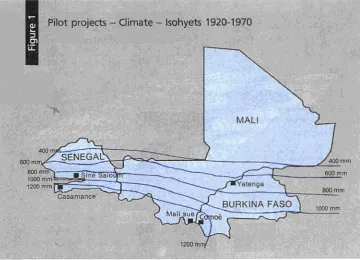
(16) Development of bottomlands in the Sahel by Jean Albergel & JeanMarie Lamachère (ORSTOM), Bruno Lidon (CIRAD), François Gadelle (CIEH) et al. (FSAGx, UAW, ISRA, 1ER, and INERA). I. Drought, soil deterioration and an expanding population have forced farmers in the Sahel to look for new land to bring under crop and more and more use is being made of the bottomlands, lowlying seasonal wetlands where the chemical makeup of the soil is good and there is water available. They are a sound economic alternative for farmers, who can grow safetynet or cash crops (sorghum, maize and rice) there in the rainy season and graze their animals in the dry season, when there are also good opportunities for market gardening and growing offseason vegetables and fruit trees.. A CIEHcoordinated re. technical methods which the farmers used. search programme designed to. were also investigated. Agricultural experi. find out more about the natural. ments both on station and on the farmers'. functioning of bottomlands, look. plots were an opportunity to see how. at problems encountered in de. agricultural output in the bottomlands. veloping them and test the instal. might be improved and diversified.. lations and relevant techniques. I. was carried out at five represen. tative sites in the Sahel — in Yatenga and Comoë in B urkina Faso, in the Sikasso. region of Mali and in the SinéSaloum and Casamance regions of Senegal.. Climatic problems combined with. The research was carried out. under the aegis of the CORAF R3S net work Developing these lands for agri culture is one answer to the present crisis of traditional production systems, but going about it efficiently means having water engineering installations to provide flood protection and store and distribute the irrigation water. These facilities have to be technically reliable and manageable by the people who use them, for the bottomlands are fragile ecosystems which deteriorate easily.. 1. The research programme population. growth. and. de. teriorating land have completely altered. and various associates in North and. traditional farming in the Sahel over the. South joined forces to develop the meth. past t w o decades. With land less fertile and. ods and tools of research. The water. more and more mouths t o feed, African. balance, highwater levels and water table. farmers are coping by shortening the. of a number of catchment basins were. fallow periods, sometimes cutting them. analysed at each site and the cheminai. out altogether, and organic fertiliser is. properties of the water, sediment trans. beginning to be in general use. They are. port, agricultural potential of the soil, land. countering the water shortage by cultivat. structures, production systems and the 1. The programme has been supported by the second 'Science and Technology for Development' (STD2) programme run by DirectorateGeneral XII of the European Commission.. ing new varieties of plants, using their land differently. and. planting. their. crops. downstream of areas with drainage lines and runoff. The bottomlands, chemically fer tile tracts where surface water, drainage water and water tables meet (Raunet, 1985), are an increasingly attractive agri. Key to the. cultural and economic proposition for Sahel farmers. In places where these. abbreviations CIEH: Comité Interafricain d'Etudes Hydrologiques (InterAfrican Committee for Hydrologicai Studies), Ouagadougou CIRAD : Centre de Coopération Inter nationale de Recherche Agronomique pour le Développement (Centre for inter national cooperation on agricultural re search for development), (France) CORAF : Conférence des responsables de la Recherche Africains (Conference of African research leaders), (Dakar) FSAGx : Faculté des Sciences Agrono miques de Gembloux (Gembloux Faculty of Science), Belgium. sections of valley floor have always been 1ER: Institut d'Economie Rurale (Mali). used for crops, the demand for land has. INERA: Institut d'Etudes et de Recherches Agricoles (B urkina Faso). expanded and farming methods can no. ISRA: Institut Sénégalais de Recherches Agricoles ORSTOM : Institut français de recherche scientifique pour le développement en coopération (France). where they were not worked in the past, individuals and groups are more and more likely to be making spontaneous attempts to develop them. Rainfall is unpredictable,. R3S: Réseau de Recherche sur la Résist ance à la Sécheresse UAW: Université Agronomique de Wageningen (PaysB as). longer afford t o be too extensive. In places. but water engineering can improve sup plies to the crops and regulate highwater ■■. levels and this goes a long way towards making agricultural production reliable. "I. the Courier n° 144 · mardvapril 1994.
(17) a c ρ. investigated by remote sensing — and the main features of them and their environ. Pilot projects Climate Isohyets 19201970. ment change, from north t o south, with the climate zones. North of the 600 mm isohyet, millet is the basic crop and is grown on the sandy, windblown soil which covers part of the slopes and the plains. Livestock, an important aspect of traditional produc tion, are kept by nomadic and semi sedentary tribes, which migrate with their herds during the periods of transhumance grazing. In this semiarid environment, the. 400 mm. bottomlands offer the advantage of collec ting runoff during the rainy season. Their water tables are well replenished, someti mes w i t h more than three times the amounts. on. the. bestfed. of. slopes,. although this may still not be enough for drinking water throughout the more than eightmonth dry season (October to June). and encouraging farmers t o grow cash. This West African bottomland. The current period of drought, which has. crops. B ottomlands were often developed. development. programme confined its. been dogging West Africa for more than. in the Sahel w i t h o u t. conducting any. attentions t o the climate zone in one rainy. 20 years now, makes things in the more. surveys or analytical comparisons t o provi. season between isohyets 600 mm and 1600. underprivileged areas worse and bottom. de information which could be extrapola. mm. Five pilot sites covering this zone were. lands in this climate zone, which used to be. ted for use throughout the region, but. selected from t w o major geological areas. given over to livestock, are more and more. after the R3S Workshop in Ouagadougou. — crystalline formations (granite, gneiss. likely t o be under crop in the rainy season.. (Burkina Faso) in 1987, research workers. and migmatite) in the old West African. Here, sorghum is the most popular crop in. from various institutions in Africa and. shield, which is rarely above 500 m, and. places where the soil is not oversaturated. Europe realised what the problem was and. sedimentary marine formations in the. and where there is help from the water. mooted a combined research project on. SenegaleseMauritanian. table at the end of the cycle. In the dry. the Sahel bottomlands.. lower than 100 m.. basin, which is. season, vegetables are grown. brushwood fences in little gardens irriga. The project defined bottomlands as flat or concave valley floors and flat drainage paths (without definite, sizeable watercourses) which are submerged for. behind. ted from seepage pits dug in the bottom. Bottomlands in the West African countryside. land. Between the 600 mm and 1000 mm isohyets, the main food crops are. part of the year by water which then recedes. The soil is colluvial. The drainage. The bottomlands cover only a. millet and sorghum, grown on fairly sandy. basins vary in area from 100 t o 200 km 2 and. small part of Africa — 510% of the areas. soil. In the traditional system of agriculture,. the plots belong to a single village or a number of neighbouring villages. It takes a small or average amount of finance t o install water regulation facilities and much. Distribution of crops according to topograp bottomlands (Yatenga). of the work can be done by the peasant Nere, mangoes, guavas. farmers themselves. The existing social organisation is compatible with manage ment of the installations. The project was carried out by. Rice. various organisations in Europe (CIRAD,. / / / ,. FSAGx, ORSTOM and UAW) and Africa (CIEH, 1ER, INERA and ISRA), with the help. Limit of bottomland. of the Commission of the European Com munities, and the CIEH produced a sum. Rainfed. Highwater. Saturated area. Highwater. Rainfed. mary of the results in January 1993 (Albergel, Lamachère et al., 1993). the Courier n° 144 marchapril 1994. r.
(18) a c ρ livestock are present only in times of transhumance grazing in the dry season. The bottomlands in this region have. Morphology and pedology of the Keur Samba Diama bottomlands Profile Profile Profile A B C. virtually the same morphological and pedological properties as in the drier zones. The soil is sand and clay on colluvial/ alluvial material upstream of the bottom lands and heavy in clay and hydromorphic to pseudogleic downstream. Rice is often grown in the middle of the bottomlands, although, with rainfall of less than 1000 mm, the crop is not reliable. Most of the outflow of the drainage paths is runoff, which makes for short, intermittent spurts which increase in violence with the percen tage of the catchment basin which is under. Profile A. Depth 0 cm. crop without any special soil protection.. ::::::$:::::. Maize is grown on the edge of the bottomlands, to supplement the rice, in. SA. the rainy season. Vegetables are grown. 45 cm. near towns and villages in the dry season when there is enough surface or under. ■S. ground water. 90 rm. Forest galleries develop along the main rivers between the 1000 mm and. tables level up. This lateral feeding of. 1200 mm isohyets. Not so long ago, they. organic matter and nitrogen and very poor. were a breeding ground for the sandflies. in sodium and potassium. Food crops —. underground water into the bottomlands. which transmit onchocerciasis (river blind. millet and sorghum — are grown on the. also produces a leaching of the soil in the. ness). The bottomlands here have sand,. slopes and rice occupies most of the. bottomlands, where they get very sandy,. clay and alluvial soil upstream and clay. bottomlands themselves, together with. hydromorphic and grey. Underground. sand or sand downstream. Heterogeneity. vegetables, fruit trees and maize. If the. flow accounts for more than 40% of the. of texture is one of their main features.. catchment basins are fairly large (more. water supply to the floodprone areas over. Chemically and organically speaking, they. than 5 km 2 ), the channels are fed as early in. the year.. are more fertile than land on the valley. the year as August by underground flow. slopes. They have an average calcium and. down slopes, producing seepage at the. magnesium content, but they are poor in. edge of the bottomlands when the water. Above the 1200 mm isohyet, nature is very much as in the previous climate zone. We took a particular interest in this climate zone in areas near the Atlantic Ocean and bottomlands in tidal. Crop distribution by topography in Sudantype multicrop bottomlands (Peniasso). estuaries. The region we investigated, Casamance, was Senegal's rice bowl before the present period of drought. The plains. Dry season vegetables. and hillsides are covered with dry forest. Dry season vegetables. which the peasants tend t o clear to grow sorghum, groundnuts and manioc. Rice is grown on lowsalinity bottomlands. Tidal bottomlands have a specific kind of soil called mangrove soil, which deteriorated through emergence when the level of the water table dropped after the drought of. Fringe. Highwater flooding. Flooded from August. Channel. Flooded from August. Highwater flooding. Fringe. the past 20 years. This is a regional disaster which has rendered infertile much of the bottomlands on which rice was once grown by very elaborate traditional me thods.. Λ. the Courier n° 144 ■ marchapril 1994.
Figure

Related documents
These results show that the system exhibits broadband coherent modulation of the energy with a maximum value close to one just below λ ENZ , independently of the thickness and of
Table 6. Highest Qualification of Faculty Members in Iraqi Universities Table 8.. The purpose of the study is to advance understanding of
resistance with high diabetes prevalence and cardiovascular risk in South Asians. Insulin resistance syndrome (metabolic syndrome) and obesity
In 2015, Evans and Hampson ( 2015 ) found in a rela- tively large study (n = 176) that male participants responded generally faster in the Simon paradigm, and that the
(3) After any functional activity differences associated with speech production and perception difficulties were identified separately in PWS compared to controls, a
The destination string must be large enough to store the resulting string plus the NULL byte, and the two strings are not allowed to overlap.. The rst call to it modies name1
