*** * * * +
***
ISSN 1018-5593
European Commission
Community's research and development programme
on radioactive waste management and storage
Shared-cost action
(1990-94)
European Commission
Community's research and development programme
on radioactive waste management and storage
Shared-cost action
(1990-94)
Annual progress report, 1993
Directorate-General
Published by the EUROPEAN COMMISSION
Directorate-General XIII
Telecommunications, Information Market and Exploitation of Research L-2920 Luxembourg
LEGAL NOTICE
Neither the European Commission nor any person acting on behalf of the Commission is responsible for the use which might be made
of the following information
Cataloguing data can be found at the end of this publication
Luxembourg: Office for Official Publications of the European Communities, 1994 ISBN 92-826-8397-4
© ECSC-EC-EAEC, Brussels • Luxembourg, 1994
CONTENTS
FOREWORD V
THE MANAGEMENT AND COORDINATION
ADVISORY COMMITTEE VII
PROGRESS OF THE R&D WORK
PART A: WASTE MANAGEMENT AND ASSOCIATED
R&D PROJECTS 1
Al: STUDIES OF MANAGEMENT SYSTEMS 3
Task 1 "Studies of Management Systems" 3
A2: WASTE TREATMENT 121
Task 2 "Treatment of Radioactive Waste" 121
A3: SAFETY OF THE MULTI-BARRIER SYSTEM OF
GEOLOGICAL DISPOSAL 175 Task 3 "Characterisation and Qualification of
Waste Forms, Packages and their Environment" 175 Task 4 "Disposal of Radioactive Waste:
Research to Back up the Development of
Underground Repositories" 357 Task 5 "Method of Evaluating the Satefy of
Disposal Systems" 627
PART B: CONSTRUCTION AND/OR OPERATION OF UNDERGROUND FACILITIES OPEN TO
COMMUNITY JOINT ACTIVITIES 657
Project Bl "The Underground Facility in
the Asse Salt Mine (FRG)" 658
Project B2 "The Underground Facility HADES in the Argillaceous Layer under the
Mol Site (B)" 658
Project B4 "Underground Validation Facility
at Sellafield (UK)" 658
ANNEX: List of Organisms and Companies Participating
FOREWORD
This report covers the progress of research work and activities started and developed during 1993 in the framework of the five-year programme (1990-1994) of the European Atomic Energy Community on "Management and Storage of Radioactive Waste". This R&D programme has been adopted by decision 89/664/EURATOM of the Council of the Ministers of the European Union on 15 December 1989.
The Council Decision, together with the technical content and the indicative Community financial contributions for the individual sections of the programme, has been published in the Official Journal of the E.C., Nr. L395, 30.12.1989, p. 28-32.
The initial total amount of funding allocated to the programme of 79.6 million ECU over the five-year period, has been reduced to 76.5 million Ecu.
The programme is subdivided in :
Part A : Waste management and associated R & D projects
- Al: Studies of management systems (Task 1) - A2: Waste treatment (Task 2)
- A3: Safety of the multi-barrier system of geological disposal (Task 3, Task 4 and Task 5)
Part B : Construction and/or operation of underground facilities
A call for research proposals has been launched (O.J. of E.C. Nr. C55/4, 7 March 1990) to implement Part A of the programme through shared-cost research contracts with public organisations or private firms established in the Member States. Multipartner projects have been encouraged.
Contract negotiations for the selected research proposals lead to the signature of 115 contracts for both Part A and Part B of the Programme. The number of research projects running in 1993 are 100.
The European Commission is responsible for implementing and managing the programme and is assisted in this task by the Management and Coordination Advisory Committee "Nuclear Fission energy - Fuel cycle/processing and storage of waste" (see the annexed list of the Members of the Committee).
In addition to shared-cost research contracts, the programme also includes study contracts, awards of training and mobility grants, as well as international co-operation agreements with states outside the European Union.
The co-operation among various teams within the Member States has considerably been promoted by the numerous multi-partner research projects.
In order to provide a world wide information on the Community's activities in the field of the radioactive waste a biannual newsletter "EC-FOCUS" is edited.
In this report, the objectives, the working programme and a synopsis of progress and results obtained for each contract in 1993 are presented as prepared by the contractors, under the responsibility of the project leader(s).
The European Commission wishes to express its gratitude to all scientists who have contributed to this report.
The previous annual progress reports of the programme are : EUR-11089 (for 1986); EUR-11482 (for 1987); EUR-12141 (for 1988); EUR-12761/Vol. 1 and 2 (for 1989), EUR-14418 EN (for 1991) and EUR-15132 EN (for 1992). The overall results achieved including the progress of work for 1990 during the programme 1985-1989 have been presented and discussed at the third European Community Conference on Radioactive Waste Management and Disposal - Luxembourg, September 17-21, 1990 (Proceedings published under EUR-13389 - Elsevier Appl. Science Publisher).
N. CADELLI Head of the Programme
"Management and Storage of Radioactive Waste"
NUCLEAR FISSION ENERGY
FUEL CYCLE/PROCESSING AND STORAGF OF W A S T R I
BELGIUM DENMARK FRANCE GERMANY GREECE IRELAND ITALY LUXEMBOURG NETHERLANDS PORTUGAL SPAIN UNITED KINKDOM COMMISSION (during 1993) Th. G. K. S. J. P. M. H.G. S. C. F. G. F. C. H. J.W.A. A J. C. J. L. M. S.M. P.J. H.J. J. T. VAN RENTERGEM DEDEURWAERDER BRODERSEN HOE LEFEVRE RIEUTORD BLOSER R I O I T E
AMARANTOS HONE TURVEY GROSSI MORSELLI BACK CORNELISSEN
VAN ENST (Chairperson)
DA CONCEICAO SILVA RAMALHO CARLOS
ROJAS DE DIEGO RODRIGUEZ PARRA
STEARN HUBBARD
ALLGEIER VAN GEEL
Mc MENAMIN (Secretary)
This Committee was established by the Council Decision of 29 June 1984 dealing with structures and procedures for the management and coordination of Community research, development and demonstration activities (OJ N° L 177, 4.7.1984, p. 25).
VII-PART A
WASTE MANAGEMENT AND ASSOCIATED R&D PROJECTS
Al : STUDIES OF MANAGEMENT SYSTEMS
A 2 : WASTE TREATMENT
Al: STUDIES OF MANAGEMENT SYSTEMS
Taskl
"Studies of Management Systems"
* List of contract
* Introduction to Task 1
Topic 1 : System studies
Topic 2 : Harmonisation of radioactive waste management practises and policies
Topic 3 : Comparative assessment of disposal practices in various management schemes for toxic and radioactive waste
Topic 4 : Information
TASK 1 - LIST OF CONTRACTS
Topic 1 : System studies
Contract
FT2W-CT9O-0058 Treatment study of contaminated sodium with a view to
decommissioning of FBR.
FI2W-CT90-0067 Studies of minimising transport of spent fuel.
FI2W-CT92-0119 Study of the retrievability of radioactive waste from a deep underground disposal facility.
Topic 2 : Harmonisation of radioactive waste management practices and policies
FI2W-CT90-0060 Assessment and proposal for activity limits for release of very low-level radioactive waste to landfills.
FI2W-CT90-0066 Definition of reference level for exemption of wastes, suitable for incineration.
Topic 3 : Comparative assessment of disposal practices in various management schemes for toxic and radioactive waste.
FI2W-CT90-0042 Comparison of safety assessment methods for toxic and radioactive wastes.
FI2W-CT90-0045 Study concerning the evaluation of toxic elements present in nuclear wastes.
FI2W-CT90-0061 Disposal of radioactive waste and toxic waste in underground repositories.
FI2W-CT91-0110 Use of methods and programmes developed in nuclear field for treatment and disposal of toxic and hazardous wastes.
TASK 1 - LIST OF CONTRACTS
Topic 4 Information of the public
FI2W-CT90-0036
FI2W-CT90-0043
FI2W-CT90-0074
FI2W-CT91-0105
Study of a communication strategy aimed at achieving a possible better understanding of the consequence of radioactive waste management in a well defined group of public.
Information of the public in the field of decommissioning waste. Study of strategies and means for specific information.
The evolution and implementation of a public information strategy on radioactive waste management.
A public information campaign to support a proposed national deep repository for low and intermediate level radioactive waste.
Topic 5 Transmutation studies
FI2W-CT91-0103 Transmutation of long-lived radionuclides by advanced converters.
FI2W-CT91-0104 Participation in a CEC strategy study on nuclear waste transmutation.
FI2W-CT91-0106 Potentialities and costs of partition and transmutation of long-lived radionuclides.
5-INTRODUCTION TO TASK 1 - STUDIES OF MANAGEMENT SYSTEMS
A. Objective
The system studies concern the evaluation of various scenarios for the management of different types of waste. Harmonisation work mainly involves the development of common waste management criteria and schemes. Waste from dismantling operations and spent fuel where these are considered as waste are included as well as the development of analytical models for minimising transport of waste. An additional topic is the evaluation of the possibilities offered by transmutation to reduce the inventory of long-lived radionuclides. Information of the public in all fields of radioactive waste management and disposal is a further topic.
B. Research performed under previous programmes
System studies have been performed by comparing various management schemes for particular categories of wastes or groups of waste streams; the comparisons were based on evaluation of costs and radiological consequences to workers and the public. The management alternatives were studied for:
- solid plutonium contaminated waste,
- alkaline liquid wash waste from fuel reprocessing and zircaloy-hulls, - reactor waste (waste from normal operation of light-water reactors),
- waste management implications of direct spent fuel disposal and disposal after reprocessing.
Activities in the field of harmonisation of practises covered a review on "Objectives, standards and criteria of radioactive waste disposal in the European Community", the development of criteria for exemption from regulatory control for radioactive waste not linked to the nuclear fuel cycle, and first approaches to waste equivalence.
G Present programme (1990-1994)
Studies are performed under five headings corresponding to specific research topics.
Topic 1 : System studies
The system studies are based on the comparison of possible management schemes, with the definition of waste inventories at origin, an analysis of the subsequent steps in the possible management routes (treatment, transport, interim storage and disposal), evaluation of costs and determination of radiological consequences. The sensitivity of each scenario to modifications in waste quantities, release limits, and waste acceptance criteria is also evaluated.
Topic 2 : Harmonisation of radioactive waste management practices and policies
The main field of activity is the development of the scientific basis for developing criteria for exemption of particular waste streams from regulatory control. Particular disposal routed considered are incineration and disposal at industrial waste burial sites.
Topic 3 : Comparative assessment of disposal practices in various management schemes for toxic and radioactive waste
Studies are performed which compare radioactive waste management schemes to management practises for waste streams involving radioactive isotopes in material not linked to the nuclear fuel cycle and toxic waste mixed with radioactive elements. Particular attention is paid to disposal of toxic and mixed waste in salt formations.
Topic 4 : Information of the public
Studies on strategies allowing efficient information to be given to the public, and on how a good degree of penetration through various media may be reached are in progress. Development of information materials (booklets, visual, aids, etc.) is also part of the activities.
Topic 5 : Transmutation studies
After having established the inventory of long-lived radionuclides produced for a given reactor capacity in considering the spent fuel as a waste, the possibilities of reducing the inventory of long-lived actinides and fission products by partitioning and transmutation are calculated. The conventional routes are irradiation in thermal reactors with MOX-fuel and a mix of light-water-reactors and fast reactors, with long-lived radionuclides added in a homogeneous or heterogeneous way. Advanced possibilities considered are based on accelerator driven spallation devices.
Title : Treatment Study of Contaminated Sodium with a View to De-commissioning of FBR
Contractors : CEA - SIEMENS - FRAMATOME Contract N° : F12W - CT90-0058
Duration of the contract: from April 1991 to April 1993 Period covered : January 1993 - April 1993 Project Leader : C. Latge" (CEA - coordinator)
N. de Seroux (Framatome) H. Hanebeck (Siemens)
A. OBJECTIVE AND SCOPE
In the Fast Breeder Reactor (FBR) decommissioning studies, sodium management is a major problem. Sodium becomes an important waste which must be taken into account in the final process. To handle this specific topic, a cooperative working group has been for-med, with the French "Commissariat a l'Energie Atomique" (CEA), FRAMATOME and SIEMENS. CEA is the project leader.
The scope of work is based on a step by step approach, using available data and experi-mental results with regard to the sodium inventory, sodium purification and waste treat-ment.
The aim of this particular development program is to highlight optimized scenarios for sodium destruction and recycling, based on a technical and an economical approach. Mo-reover a Research & Development (R&D) orientation will be provided to improve the se-lected scenarios and to allow a better understanding of fundamental processes.
B. WORK PROGRAMME
To perform the above scope of work, five main stages were defined :
a : Inventory of the sodium needs :
The sodium balance, based on sodium needs for future FBR programs and existing wastes to be treated, is the starting point from which the problem is tackled and from which the scenarios to be highlighted later on are set.
b: Assessment of sodium behaviour and characteristics :
From an estimated contamination, provided by mathematical models which are validated using experimental data, predictions are established for the behaviour and characteristics of the sodium to be treated.
c: Sodium purification :
Purification processes are examined with regard to the predicted quantities of contaminated sodium and the associated storage and transportation techniques. The R&D needs are defi-ned, according to the required level of knowledge in the waste treatment domain.
d: Analysis of the scenarios and their main parameters :
e: Optimized scenarios:
These processes, having been defined as suitable scenarios for sodium treatment, are des-cribed. Further needs for R&D programs are highlighted, to improve the processes efficien-cy.
C. PROGRESS OF WORK AND OBTAINED RESULTS
C.I. STATE OF ADVANCEMENT
The cooperative working group was assigned in April 1991 the task of sodium manage-ment in the decommissioning studies environmanage-ment.
Four semestrial reports were published on November, 1991, /l/, on April, 1992, /2/, on September, 1992, /3/ and on May, 1993, /4/.
Two Annual Progress Report were published on 1991,151 and on 1992, /6/.
The Reference /4/ is the final part of the study and deals with the last point of the work programme. The different scenarios identified in the previous work were assessed and a comparison between themselves was established following the different hypotheses.
Finally, the conclusion recommends a scenario for each of the cases which have been identified.
CM. RECALLING OF THE SCENARIOS
The selected scenarios for the sodium treatments were defined in the previous work 161, either to reuse the sodium, or to dispose the sodium.
The scenarios were separated in two groups :
- one or several FBR are to fill up with sodium —> scenarios of sodium reuse and scenarios of sodium disposal + new sodium supply.
- no FBR are to fill up with sodium —> scenarios of sodium disposal or sodium sale in in-dustrial field when it is desactivated.
The possible scenarios are summarized and are identified with letters, in table I for pri-mary sodium and in table II for secondary sodium. The selected steps are : storage, purifi-cation, processing, final destination.
The basis hypotheses about radioactivity aspects are :
- sodium is considered non radioactive when its radioactivity is below 10 Bq/g,
- radioactivity of the contaminated sodium at the final shutdown of the reactor is given in table III,
- a radioactivity decade decreasing is obtained with one RVC filter for the caesium, and with one cold trap for the tritium,
- a radioactivity decade decreasing is obtained with about 8 to 9 years of storage for 22 Na.
C.m. COMPARISON CRITERIA FOR THE SCENARIOS
In the aim to compare the costs of the different scenarios for reuse or for dispose the sodium coming from the large Fast Breeder Reactors, criteria of comparaison have been identified and classified in several items.
a) Assessment items of the costs generated by the sodium reuse :
- purified sodium with radioactivity below 10 Bq/g : . purification system
. biological shielding addings for storage . storage and surveillance during 30 years
-. transport of the sodium to an other site, if necessary
- partly purified sodium : . purification system
. small biological shielding addings for transfer . low increasing of the operators number . controlled area in place 7 months early . low decontamination of the test equipment
. transport of the sodium to an other site, if necessary
- no purified sodium.
. biological shielding addings for transfer . increasing of the operators number . controlled area in place 7 months early . decontamination of the test equipment
. transport of the sodium to an other site, if necessary
b) Assessment items of the costs generated by the sodium disposal: . purification system
. supply of the sodium disposal loop
. biological shielding addings for transfer and storage, if necessary . low increasing of the operators number during transfer
. operation of the process
. decontamination of the sodium disposal loop . transport of the aqueous sodium hydroxide
c) Assessment items of the savings generated by the sodium reuse : . cost of new sodium
. shorter sodium supply timetable
. no transport of sodium if the new reactor is on the same site
d) Assessment items of the savings generated by the sodium disposal: . none
e) Comparison of the sodium reuse and the sodium disposal interests : The sodium reuse avoids :
- to buy new sodium,
- to supply loops for sodium contaminated disposal,
- to dispose it and to treat the sodium hydroxide from the disposal. It allows also to decrease sodium supply duration for the new plant.
The sodium disposal allows to treat contaminated sodium. Then new sodium can be used for new reactors and tests can be performed without contamination of the equipment and without controlled area.
CIV. DEFINITION OF THE COST ITEMS FOR THE SCENARIOS
Several items of the costs of the scenarios were identified and assessed. They are listed hereafter.
a) Sodium purification
The sodium purification was assessed taking into account: - 1 RVC filter is needed for 1 decade of purification of caesium - 1 cold trap is needed for 1 decade of purification of tritium
The treatment of each filter or trap is taken into account.
-b) Biological shielding addings of the storage tanks
They are quoted according to the purification level of the stored sodium.
c) Storage of the sodium
Two types of sodium storage are identified :
- short storage time : the sodium is stored in existing tanks of the plant with biological shielding addings. This storage is foreseen for 5 years. Then the sodium is reused or dispo-sed.
- long storage time : the sodium is stored in specific shielded tanks in a new building. This storage is foreseen for 30 years. Then the sodium radioactivity in 22 Na is below 10 Bq/g and the sodium can be reused without radiological constraints (caesium and tritium were previously purified down to 10 Bq/g).
d) Transport of the sodium It is composed of 2 parts :
- the mobile tanks : they are assessed taking into account the required biological shielding to comply with the transport regulations.
- the travels : they are quoted according to their number and an average distance of 500 km.
e) Transport of the sodium hydroxide It is composed of 2 parts:
- the mobile tanks are not specific and are supplied by the transport company.
- the travels : they are quoted according to their number and an average distance of 500 km.
f) New sodium
The new sodium cost was assessed with the informations from the "Mdtaux Speciaux -Pechiney" company in FRANCE, which provided sodium for PHENIX and CREYS-MAL-VILLE.
C.V. PROPOSITION OF SCENARIOS FOR THE TREATMENT OF PRIMARY SO-DIUM
The results of the assessment of scenarios for the treatment of the primary sodium is gi-ven on the table IV.
Scenarios were classified in the following categories hereafter :
- 1° category : Reuse of the sodium in a new plant which is on the same site than the old plant
- 2° category : Reuse of the sodium in a new plant which is on another site than the old plant
- 3° category : Contaminated sodium disposal of the old plant and new sodium supplying for the new plant
a) 1° category scenarios for the primary sodium
The scenario of contaminated sodium reuse in a new plant on the same site is adventa-geous, with a purification level of 90 % of caesium and tritium which allows to limit the constraints of the radioactivity. Storage sodium decay of 5 years is sufficient, unless the new plant is not ready.
Starting of sodium filling of the new plant can be delayed because this operation is ve-ry fast when the two plants are on the same site. So problems linked to works in controlled areas (due to radioactivated sodium presence) are limited.
Sodium purification in caesium and tritium with a purification level of 90% can be ea-sily realised and is not very expensive. This operation allows to reduce the dose rates to 50 fiGy/h (green area) at a distance of 3 m from the sodium pipes. Moreover, the
vity concentration of the sodium can be maintained at a normal level during the new plant operation because the decay half period is quite long.
b) 2° category scenarios for the primary sodium
In this case, the scenario of contaminated sodium reuse in an new plant on another site is also advantageous. Sodium purification level needs to be 98 % in caesium and tritium and the sodium has to be stored during 5 years to reduce the 22 Na radioactivity. Then, the sodium radioactivity is low enough to allow the transport in good conditions (19 tonnes of sodium can be transported at each travel by road).
To store the sodium longer than 5 years is not interesting because the caesium radioac-tivity begins dominating and decreases slowly.
c) 3° category scenarios for the primary sodium
In this case, the new plant is filled up with new sodium. The total cost of the scenario is the cost of the new sodium and the cost of the old sodium becoming.
The most interesting solution to reuse the sodium out of a new nuclear plant is in indus-trial field. Sodium purification level needs to be 99,99 % in caesium and tritium and the so-dium has to be stored during 30 years to reduce its own radioactivity. Then, the soso-dium ra-dioactivity below 10 Bq/g allows to reuse it with possible conditions. The economical inter-est is linked to the price level of sale. If the price of sodium below 10 Bq/g could be near of industrial sodium price, the purification cost should be covered by the sale. However, it is difficult to know if this project could be realized when the shutdown of a large plant will happen.
In case of no possibility of sodium reuse in industrial field, contaminated sodium can be disposed with the NOAH process. The analysis of the scenario including the sodium dis-posal on the site of the old plant and of the scenario including the sodium disdis-posal on the site of the NOAH process wastes treatment did not give any significant difference.
In this case, it is difficult to conclude for this category scenario because a lot of factors are unknown. However, sodium reuse in industrial field is more economical than sodium disposal but is uncertain.
dl Scenario selection results for the primary sodium
There is a new plant to fill up with the primary sodium of a shutdown plant. The re-sults of the selection are given hereafter. (1 MECU = 1 million of ECU)
Scenarios j Costs Reuse on the same site"than"theold plant --> scenario F 5,7 MECU Reuse_on'anothCT \ 10,75 MECU Sodium disposal +hew"sodium supply^--> scenaribs H and I ;26,65 to 27,15 MECU
New sodium needed to fill up a power plant as EFR (Europeen Fast Reactor) is about 2050 tonnes for the primary circuit. The cost of this sodium is about 16 MECU. Sodium reuse is largely more economical than sodium disposal, with a ratio of 30 % to 60 %.
C.VI. PROPOSITION OF SCENARIOS FOR THE TREATMENT OF SECONDARY SO-DIUM
The results of the assessment of scenarios for the treatment of the primary sodium is gi-ven on the table V.
Scenarios were classified in the same categories than for the primary sodium.
- 1° category : Reuse of the sodium in a new plant which is on the same site than the old plant
- 2° category : Reuse of the sodium in a new plant which is on another site than the old plant
- 3° category : Contaminated sodium disposal of the old plant and new sodium supplying for the new plant
a H " category scenarios for the secondary sodium
The solution of sodium reuse in a new plant is advantageous. When the two plants are on the same site, the sodium can be transfered directly, possibly via a buffer storage tank. However, the cost of the constraints for the draining, the transfer and the filling up of the new plant due to the contamination is higher than the sodium purification cost in tritium to obtain a radioactivity below 10 Bq/g. Then, it is preferable to purify to avoid these cons-traints, unless the available time for the process is too short. Furthermore, contamination of the test equipment in sodium is avoided.
b) 2° category scenarios for the secondary sodium
When the sodium has to be transported to an other site, the preferable solution is to pu-rify in tritium to obtain a radioactivity below 10 Bq/g to avoid constraints for the draining, the transport and the filling up of the new plant due to the contamination.
c) 3° category scenarios for the secondary sodium
The most interesting scenario remains to reuse the sodium in industrial field. Sodium purification level needs to be of 99,99 % of tritium and the sodium does not need storage period. Then, the sodium radioactivity is below 10 Bq/g to allow to be reused with specific conditions. However, as for the primary reuse, it is difficult to know if this project could be realized when the shutdown of a large plant will happen.
In case of no possibility of sodium reuse in industrial field, contaminated sodium can be disposed with the NOAH process but this solution is less economical.
d) Scenario selection results for the secondary sodium
There is a new plant to fill up with the secondary sodium of a shutdown plant. The re-sults of the selection are given hereafter.
Scenarios \ Couts Reuse on an other site than the old plant —> scenario M ; 2,25 MECU Reuse on the same site than the old plant —>' scenario N j 3 MECU Sodium disposal + new sodium supply —> scenario P I 13,75 MECU
New sodium to fill up a power plant as EFR is about 1050 tonnes for the secondary cir-cuit. The cost of this sodium is about 8,5 MECU. Sodium reuse seems largely more econo-mical than sodium disposal, with a ratio of 4.
Scenario M is less expensive than scenario N because the sodium is purified below 10 Bq/g what allows to avoid the specific constraints due to the sodium contamination.
-c.vn. CONCLUSION
This study allowed to verify that solutions can be proposed presently to treat large vo-lumes of contaminated sodium, whatever the becoming of the FBR could be in the future.
However, solutions that were presented in the study will need to be adapted in the fu-ture to take into account possible evolutions of knowledges and regulations that can signifi-cantly modify the results.
In all cases, sodium reuse in nuclear field was shown as the preferable solution compa-red with the sodium disposal. Sodium reuse in industrial field is also possible, mainly for the secondary sodium.
References :
HI CCE - Gestion et stockage des dechets radioactifs - Traitement du sodium containi-ng - Rapport semestriel N°l - FRAMATOME - NOVA X 005 807 000
HI CCE - Gestion et stockage des dechets radioactifs - Traitement du sodium containi-ng - Rapport semestriel N°2 - FRAMATOME - NOVA X 006 067 000
131 CCE - Gestion et stockage des dechets radioactifs - Traitement du sodium containi-ng - Rapport semestriel N°3 - FRAMATOME - NOVA X 006 123 000
141 CCE - Gestion et stockage des dechets radioactifs - Traitement du sodium contami-ng - Rapport semestriel N°4 - FRAMATOME - NVTMK DC 93.116
151 Treatment of contaminated sodium with a view to decommissioning of FBR - CCE - Community's research and development programme on radioactive waste mana-gement and storage - Annual Progress Report, 1991 - EUR 14418 EN
161 Treatment of contaminated sodium with a view to decommissioning of FBR - CCE - Community's research and development programme on radioactive waste mana-gement and storage - Annual Progress Report, 1992 - EUR 15132 EN
S
2
Q O to Q
12 < S <
OS
to
III
On. w «s
COo 2 < z
# o H <
i C/l
2 CO .. Q
' 2 D ►
►
Be
Q
Z
O)
TABLE IV
COSTS ASSESSMENTS OF THE SCENARIOS PRIMARY SODIUM
A NEW REACTOR IS TO FILL UP
Scenarios
E - Reuse of nonpurified sodium on the same site F - Reuse of purified sodium at 90 % on the same site B - Reuse of nonpurified sodium on an other site C - Reuse of purified sodium at 90 % on an other site D - Reuse of purified sodium at 98 % on an other site A - Reuse of non radioactive sodium in an other site Sodium cost for EFR primary circuit
(j - Reuse of nonradioactive sodium in industrial field I - Sodium disposal on the treatment site
H - Sodium disposal on the reactor site
Costs (MECU) 5 5,7 9.7 10,1 10,75 14,1 16,4 26,3 26,65 27,15
(1 MECU = 1 million of ECU)
NO NEW REACTOR
Scenarios
J - Reuse of nonradioactive sodium in industrial field L - Sodium disposal on sodium hydroxide treatment site K - Sodium disposal on reactor site
Costs (MECU) 9,9 10,25 10,65 TABLE V
COSTS ASSESSMENTS OF THE SCENARIOS SECONDARY SODIUM
A NEW REACTOR IS TO FILL UP
Scenarios
M - Reuse of non radioactive sodium in an other site N - Reuse ot nonpurified sodium on the same site Sodium cost tor EFR secondary circuit
P - Sodium disposal on the sodium hydroxide treatment site + new sodium cost
Costs (MECU) 2,25 3 8,4 13,75
NO NEW REACTOR
Scenarios
O - Reuse of non radioactive sodium in industrial field P - Sodium disposal on sodium hydroxide treatment site
Costs (MECU)
0,15 5,35
TABLE II
SCENARIOS FOR THE BECOMING OF THE CONTAMINATED SODIUM SECONDARY SODIUM
A NEW REACTOR IS TO FILL UP
SODIUM REUSE IN A FBR
NONRADIOACTIVE SODIUM
SODIUM PURIFIED AT 90%
NO NEW REACTOR
[image:26.825.486.778.110.542.2]NON RADIOACTIVE SODIUM INDUSTRIAL FIELD SODIUM PURIFIED AT 98% SODIUM DISPOSAL P TREATMENT SITE TABLE III
PREDICTED RADIOACTIVITY OF THE PRIMARY SODIUM OF CREYS-MALVILLE (3 300 T) AT THE FINAL SHUTDOWN Radionuclides
Na 22 (B*, gamma) 2,62 years Cs 134 (»-, gamma)
Cs 137 {R; gamma) Tritium (B) TTTT 2,1 years 30 years 12,3 years TOTAL Radioactivity (Bq/k"g7 1.33.107 1,25.107 8,95.107 3.35.107 15.107
Total radioactivity (Bq) 4,4.10'3
4.1.10'3
29.5.1013
11.1013
Title: Studies of Minimising Transport of Spent Fuel Contractor: BAeSEMA
Contract No: FI2W-CT90-0067
Duration of Contract: from 1st September 1991 to 31st May 1993 Period Covered: Jan 1st 1993 to May 31st 1993
Project Leaden Richard J Greathead
A. OBJECTIVES AND SCOPE
This study has been carried out within the framework of the European Commission's radioactive waste management research programme. The aim of the work is to establish a methodology and software tools for examining the implications for cost, environmental impact and safety of minimising the transport of spent nuclear fuel and associated materials using multi attribute analysis and linear programming techniques. This sets a number of general objectives:
to obtain realistic data and develop a model database of the overall setup for generating, storage, processing and disposal of irradiated spent fuel in Europe, as existing and postulated for the future, and to define a potential network of transport channels between the sites and facilities involved;
to generate a small number of realistic "basic" scenarios, founded on the overall setup, reflecting different options for the spent fuel management cycle, and suitable for testing and demonstrating the methodology and software tools developed;
to develop the software tools required to model the scenarios, including the linear programming model to minimise transport aspects and database tools to process and evaluate input and output;
to carry out illustrative analyses and sensitivity studies on the basic scenarios and variants, and report on the findings of the study.
B. WORK PROGRAMME
Task 1 - Formulation of the Problem
This considers and documents the high level conceptual design of the model and the general study strategy, including the financial and environmental/safety impacts to be taken into account, the basic scenarios to be studied, the constraints to apply (storage capacities, flask capacities, etc) and aspects of transport to be minimised (cost, dose, etc).
Task 2 - Data Requirements
A detailed documented definition of the data requirements.
Task 3 - Data Collection
The collection, collation, inclusion in a structured database and documentation of the best available data meeting the requirements identified above.
Task 4 - Model Development
The design and development of the software for the linear programming transport minimisation model and the supporting database programs which pre-process the input data defining a scenario to be studied and post process and evaluate the output from the linear program. This task also included testing and trials.
Task 5 - Illustrative Analyses
Performance of illustrative analyses and sensitivity studies on the basic scenarios and variants, and preparation of the final report.
C. PROGRESS ANDOBTAINED RESULTS
Statementofadvancement
All tasksarenowcompeted.Tasks 1,2,3andsomeof 4werecompleted priorto thestart of1993
and the restof Task 4 (Model Development) andTask 5 (Illustrative Analyses) were completed
successfully in1993.
ProgressandResults
1. Formulation andDataRequirement(Tasks1 and2)
InTask 1,"FormulationoftheProblem"andTask2"DataRequirements"thenatureandpurposeof thestudyaredefined,andthedatarequiredspecified(Refs 1,2).
OverviewofDefinition (Model Description)
Insummary,itwasproposedthatlinearprogramming techniquesbeused tominimisevarioustypes of"impact"(quantity,financialcost,occupationalcollectivedose,publiccollectivedose,accident risk,oranormalised andpossiblyweightedcombinationofthese"impacts")associatedwith transportofthevarious materialsarisingduringspentfuel management. Themaintypesof materialconsideredare:1
spent fuel;
conditioned spent fuel; vitrified highlevel waste;and lowandintermediatelevel wastes. Thesearetransportedbetween:
reactors;
storage facilities^ reprocessingplants;
plantsforconditioningofspentfuel fordirectdisposaland finaldisposal facilities.
Different modesoftransportmaybeavailable, i.e.mainly sea(requiringtheavailabilityof
specialisedships),mainlyrailormainlyroad,andavarietyofflasks maybeusedfortransportinga given material.
Oncethepermutationofmaterialflowswhichminimisestherequiredtransportimpacthasbeen determined (i.e.thequantityofspecific materials,ofaspecificage^,flowingbetween specific facilities, viaspecificroutes,inspecificcontainersandforeachtimestep)theeffect ofadoptingthis transportstrategy onotherstagesinthecycle,i.e.storage,processinganddisposal,canbe
evaluated. Thisisdonebycalculating thefinancial cost,doses,etcassociatedwiththeflow,and whereappropriatestock,ofeachmaterialateachfacility inthescenario(theflowsandstocks into/in facilitiesarealsocalculatedduringminimisation).
Themodelcanbeconstrained byputtingrealisticlimitsonthestorageandhandlingcapacitiesof thefacilities andlimitsonthequantity ofmaterial whichcanbecarriedviaspecificroutes. Minimumandmaximum agelimitsfordispatchingorreceivingmaterialsataspecific facility can beenforced andthecapacityoftheflasks canbevariedaccordingtotheageofthematerial(i.e.flask capacitycanbereduced,possibly tozero,formaterialswith higherthermalandradiationoutputs).
Themodelisalsoconstrained togenerateaminimum,timedependent,amountofnuclearenergyin eachnation. Thislevelissetusingpublished forecasts forinstalledcapacities(Ref 3). Individual reactorsareconstrained toperform withinlowerandupperlimits(load factors)andmayburn
1 HighlyActiveWasteLiquorisalsodefined inthemodel,butisneverinvolved inintersite
shipment. HighlyActiveWasteLiquormustbeincludedbecauseitsstoragerepresentsa delaybetween reprocessingandvitrification. Thisdelayisvariableandwillaffect thetime flowof materials.
9
^ Including HighlyActiveWasteLiquorTanksatreprocessing facilities.
■^ Timeafterdischargefrom thereactor.
-Uranium Oxide (UO) or Mixed -Uranium/Plutonium Oxide (MOX) fuels to different burnups. Within these limits, the model is free to determine the output from individual reactors which, in conjunction with other decision variables, leads to minimum transport impact.
This type of model allows a wide range of study options: study of siting policies for new facilities;
evaluation of the effect of removing or introducing trans-national border transport restrictions or changing the requirements to return waste to its country of origin;
comparison of localised versus centralised storage strategies;
examination of the cost benefits of delayed reprocessing, delayed disposal, etc (the model permits investment discounting);
comparison of direct disposal versus reprocessing management options; comparison of the influence of storage facility type or flask type;
examination of the effect of opting for higher burnups or burning mixed oxide fuels ; examination of choice of transport mode (sea, road or rail) studied; etc.
The model can be used in either a strategic capacity for evaluating spent fuel cycle options or in an operational mode for detailed transport planning. In this study, emphasis is placed on its potential application to strategic planning. Demonstration of its potential as an operational tool is limited by lack of detailed data for transport and current model size restrictions.
For this study, it was proposed that the main effort be directed at comparing two basic scenarios, namely a reprocessing orientated management route and a direct disposal orientated management route. It is assumed that waste must be either returned to its country of origin or its disposal permitted at the most favourable site in transport terms, i.e. the best technical, as opposed to political, solution. Variants on the basic scenarios and sensitivity studies are also examined, including the influence of siting of the facilities, flask sizes, choice of timestep, etc.
The original proposed scope of the model included the UK, Germany, France and Sweden (introduced because of that country's use of sea transport as the main transport mode). The data model was developed for these countries and published (Ref 3). However, limitations on the size of model which could be handled by the available versions of the linear programming software lead to reducing the final scope to:
inclusion of reactors, processing, storage and disposal facilities in Germany and the UK; use of French reprocessing facilities and disposal facilities; but
exclusion of French reactors and all Swedish facilities (although ships based on the Swedish vessel MS Sigyn are introduced).
The impacts originally specified included accident risk. However, obtaining a full and consistent set of accident risk data, for both transport and facilities, and introducing it into the code, presented budgetary difficulties and source data problems. In principle, treatment of accident risk (or other risk or dose parameters such as Maximum Individual Risk) is exactly the same as for other impacts already included in the model (financial cost, occupational collective dose, and short and long term public collective dose) and its exclusion does not invalidate the demonstration of the methodology or software.
The main development languages chosen are the FOXPRO database management language and the MAGIC/LAMPS matrix generating and linear programming language. The EXCEL spreadsheet package is available for producing charts. This software is mounted on DELL 486 DX 50 computers, or similar.
Summary of Data Requirements for Running Model
Once the purpose of the model and its functional specification were outlined, it was possible to define the data requirements. These are not specified in detail here, but include the following main categories.
Forecast nuclear power generating requirements for each country included in the model and (largely hypothetical) schedule of individual reactor power up/down dates, installed capacity and ranges of load factors which will permit these requirements to be met.
Fuel burnup data.
Siting of existing and proposed/hypothetical reactor, storage, processing and disposal facilities and the availability of local road, rail head and port facilities.
Storage capacities of stores (including At Reactor stores) and final disposal facilities, and how they depend on lime.
Initial slocks at stores.
Input and output handling capacities at all types of facility (storage At Reactor and Away From Reactor, processing and disposal), and how they depend on time.
Conversion coefficients between input and output materials during processing.
Flask capacity (as a function of material and its age), availability data and the ability of facilities to receive/dispatch different types of flask.
Ship capacity, availability arid joumcy frequency data. Connection capacity.
Unit generalised costs (financial, occupational collective dose, public collective dose, etc per unit of material transported, handled or stored) for transport channels and for each facility, according to material, flask type, etc.
2. Data Collection (Task 3)
Data were collected from many different sources, including small sub-contracts, private
communications, reports on earlier CEC contracts and the open literature. It was then collated into a self consistent data model of the nuclear power generation and spent fuel management scene in the countries of interest.
The data has been entered into a computer based "model database" managed by a purpose designed database management system written in the FOXPRO database language. FOXPRO'S report writing facilities have been used to directly generate a data report containing all the data on which the study is based (Ref 3).
The quality of data is variable and difficulties were encountered in determining the context in which reported values should be interpreted. The final objective with respect to data collection has therefore been to ensure self consistency, rather than absolute correctness, and to justify by reasoned argument the setting of relative values between data. These aspects are considered in detail in the data report (Ref 3).
Comprehensive referencing in the data report ensures traccability of all data used in the study back to source.
3. Model Development (Task 4)
The design specification of the computer model can be found at Ref 4. In summary, the model can be divided into four main components:
The database management system used to organise, maintain, report on, and edit the full-scale and scenario databases.
The pre-proccssor which uses a subset of the large model database to generate a refined data model of the particular scenario to be studied and converts the format into the lists and tables which are read into the minimisation stage. This component is written in the FOXPRO database management language.
The minimisation programs which use the MAGIC/LAMPS matrix generation facility and linear programming language to minimise the transport impact of interest.
The post-processor (cvaluator), which takes the flows and stocks, etc output during
minimisation and multiplies them by the appropriate generalised cost coefficients to evaluate the costs, doses, etc (impacts) for each facility. It also allows breakdown of the transport and facility impacts according to material, flask type, time, etc. This is written in the FOXPRO database management language.
During development, problems arose with the MAGIC matrix generator in connection with memory and processing time limits imposed by LAMPS. The solution tried was to "decompose" the model into smaller parts. However, initial runs using a decomposed version of the model indicated that whilst the memory problem was resolved it would typically take 100 hours to generate the networks and perhaps 100 hours to optimise. This is not considered practicable. Effort and time constraints did not permit further experimentation and it was decided to revert to the earlier formulation but using later versions of MAGIC/LAMPS with increased capacity. This will not permit solution of the full scale model for Germany, France, the UK and Sweden, and therefore smaller, idealised, but still realistic subsets of the full scale model are used.
A User Guide to the model has been prepared [ref 5].
4. Illustrative Analyses (Task 5)
A number of illustrative analyses have been run examining two basic scenarios. One basic scenario has a low total capacity for conditioning (-400 tonnes of spent fuel per year) whilst the other has a relatively high total capacity for conditioning (1000 tonnes of spent fuel per year). These are respectively referred to as the basic reprocessing orientated scenario and the basic direct disposal orientated scenario. A 40 year generating period is considered. Storage, processing and disposal facilities are available for up to 60 years beyond cessation of generation. For most scenarios (i.e. those in which the burnup of Uranium Oxide fuel in LWRs and AGRs is assumed to be 33 and 20 GWd/tHM respectively) 22,000 tHM of spent fuel are generated in the UK and 36,200 tHM in Germany. The rate of investment discounting applied in the majority of scenarios is 4%. It is considered that these scenarios provide recognisably realistic and feasible simulations of nuclear power generation and spent fuel management in Germany and the UK.
The ways in which the model can be used are numerous and some illustrations of the type of results which can be obtained are shown in Table 1. This indicates the scenario variations found with the lowest and highest cost and dose impacts for the complete spent fuel management cycle.
As can be seen, of the scenario variations studied, the cheapest turns out to be a direct disposal orientated scenario, minimised on transport cost, with a high UK flask storage capacity (for spent fuel, conditioned spent fuel and vitrified high level waste), costing 14,467 MECU^. This compares with the highest cost scenario found, which was a reprocessing orientated scenario costing 20,907 MECU for which transport Occupational Collective Dose was minimised. In this case, direct disposal is cheaper even though wastes are forced to be returned to their country of origin, which was not the case for the reprocessing orientated scenario. Generally, direct disposal was found to be significantly cheaper than reprocessing. The same direct disposal orientated scenario also performed well in terms of Occupational Collective Docs and Public Collective Dose for the complete spent fuel management cycle.
However, it performed badly in terms of the Long Term Public Collective Dose resulting from circulation of discharges from operating facilities and long term release of radionuclides from disposal facilities. This is due to the larger quantity of conditioned spent fuel disposed of in a deep repository situated in granite in the UK compared with other scenarios where more material is disposed of in a repositoriy situated in a German salt dome, which is predicted to have lower release rates.
In several cases, minimising transport impact, which generally forms only a small percentage of the overall impact, leads to a large increase in the impact for the complete spent fuel management cycle. For example, if transport doses, instead of transport costs, are minimised, the quantity of spent fuel disposed of directly decreases (due to the much greater number of transports of conditioned spent fuel needed, compared with vitrified high level waste, for the same amount of original spent fuel, and the relatively small effect decay has on reducing dose compared with the effect investment discounting has on reducing financial costs). This leads to an increase in cost for the complete cycle of more than 3,000MECU.
5. References
1) "Outline Requirements for Radioactive Waste Transport Minimisation Model - Discussion Paper", R Grcathead, BAeSEMA Document Reference C2148/TN.1, October 1991. 2) "Radioactive Waste Transport Minimisation Model: Definition and Data Requirements", R
Greathead, A R James, BAeSEMA Document Reference C2148/TR/1, April 1992. 3) "Radioactive Waste Transport Minimisation Model: Data", R Greathead, R Davies, A R
James, BAeSEMA Document Reference C2148/TR/2, January 1993.
4) "Radioactive Waste Transport Minimisation Model: Design Specification", R Greathead, A R James, BAeSEMA Document Reference C2148/TS/2, August 1992.
5) "Radioactive Waste Transport Minimisation Model: Users and Programmers Guide", R Davies, D Nichols, R Greathead, A R James, BAeSEMA Document Reference C2148/TU/1, June 1993.
6) "Radioactive Waste Transport Minimisation Model: Final Report", R Greathead, A R James, D Nichols, BAeSEMA Document Reference C2148/TR/3, November 1993.
1 MECU= 106ECU.
ro ro
51
S3 C Co
3' 3
3 c 3
I
&r>
Impact Type Lowest Cost for Complete Cycle
Highest Cost for Complete Cycle
Lowest Occupational Collective Dose for Complete Cycle
Highest Occupational Collective Dose for Complete Cycle
Lowest Public Collective Dose for Complete Cycle
Highest Public Collective Dose for Complete Cycle
Lowest Long Term Public
Collective Dose for Complete Cycle
Highest Long Term Public
Collective Dose for Complete Cycle
Lowest Normalised Total for Complete Cycle
Highest Normalise Total for Complete Cycle
Scenario
Direct Disposal Orientated: All materials returned to country of origin: High UK flask storage capacity: Scenario minimised on transport Cost
Reprocessing Orientated: Materials need not be returned to country of origin: Scenario minimised on transport Occupational Collective Dose
Direct Disposal Orientated: All materials returned to country of origin: High UK flask storage capacity: Scenario minimised on transport Cost
Reprocessing Orientated: All materials relumed to country of origin: Scenario minimised on transport Cost
Direct Disposal Orientated: All materials returned to country of origin: High UK flask storage capacity: Scenario minimised on transport Cost
Reprocessing Orientated: Materials need not be returned to country of origin: Scenario minimised on transport Occupational Collective Dose
Direct Disposal Orientated: Materials need not be relumed to country of origin: Scenario minimised on transport Occupational Collective Dose
Direct Disposal Orientated: All materials returned to country of origin: High UK flask storage capacity: Scenario minimised on transport Cost
Direct Disposal Orientated: Materials need not be returned to country of origin: Scenario minimised on transport Occupational Collective Dose
Reprocessing: Materials need not be returned to country of origin: Storage capacities of key stores unlimited: Scenario minimised on transport Cost
Total Impact 14,467 MECU
20,907 MECU
324.9 man Sv
478.6 man Sv
1181.0 mavSv
2712.2 man Sv
797,558 man Sv
9,740,233 man Sv
3.064
Titlej. Study of the retrievability of radioactive waste from a deep underground disposal facility
Contractor: ECN
Contract no: FI2W-CT92-0119 Duration of contract: July 1992 to March 1994
Period covered: January 1993 to December 1993 Project leader: J. Prij
OBJECTIVES AND SCOPE
Retrievability of radioactive waste emplaced in a deep repository in a geological formation has received increasing attention during recent years. Arguments in favour of keeping waste retrievable are that more suitable sites might be found, that technological advances and/or reduced fission material availability would give an incentive for extracting valuable materials from the waste, or that an economically feasible way could be found to transmute long-lived radionuclides to short-lived ones.
The Member States of the European Community have not, up to date, included provisions for retrievability in their regulatory framework or in recommendations for disposal of waste. Other countries, like the United States, ask for an access to conditioned waste to be guaranteed for some decades.
Two conditions govern the option to retrieve radioactive waste packages from a deep repository:
- the packages should not be damaged (by pressure from the host rock, or due to corrosion, or other processes)
- the position of the package and the nuclide inventory must be known, and this knowledge has to be kept alive.
As those two conditions can be met for a few centuries at the best, provisions for retrievability makes sense only for up to 300 years (a widely used design limit for corrosion resistance of over-packs). During these few centuries, retrievability may be realised by keeping the access to the waste packages open, by maintaining in operational condition the access shafts and the main galleries. A second possibility is to dispose the waste in a suitable overpack and abandon the repository after backfilling, closing and sealing. In this case the waste must be re-mined from the surface. Although this re-mining will be very costly it is obvious that there will be a point in time, where the cost of keeping the repository in operating condition will be higher than those of re-mining from the surface to reach the waste packages in a closed repository. By way of illustration this break-even point is represented in Figure 1.
-remining
sealing
disposal
break-even point
time >
Figure 1 Cost comparison for retrievable storage and re-mining after final disposal.
The objective of this study is to collect existing data on retrievability of heat-generating long-lived waste and to produce an un-biased set of data on implications in terms of cost when deciding adoption of a retrievability strategy.
B. WORK PROGRAMME
Present state of the retrievability option
Existing information on retrievability of radioactive waste will be collected in EC-Member States and other countries having a nuclear energy production programme. This review will include regulations, recommendations and even opinions as long as they have been expressed in open literature or in open working documents of national or international bodies. Attention will be paid to aspects of non-proliferation for direct disposal of spent fuel being declared as waste.
Overview of expected modifications because of opting for retrievability
This overview will examine aspects concerning design and fabrication of waste packages, design of the repository, operation and maintenance of the repository and associated equipment, surveillance and control of the installation, and maintaining a documentation system when changing from final disposal to retrievability.
For these factors an estimate of additional costs and occupational exposure will be attempted. Evaluations about radiation protection and long term safety to the environment will be made without carrying out detailed performance assessment calculations.
Detailed evaluations for a reference disposal scenario
A detailed evaluation under realistic conditions will be made in performing a comparison between the costs of retrieval of the waste from a suitable deep underground repository (including the annual costs of keeping the repository open) and the costs of re-mining the waste from a final deep underground repository (including the costs of closing and sealing).
The assumptions and boundary conditions are:
• The study is restricted to HAW (high level radioactive waste). The quantity of HAW is based on 20 GW installed nuclear power (in standard LWR NPP's) operating for a period of 30 years (scenario and data as in studies III and 111).
• Two types of waste management strategies will be considered: . direct disposal of all spent fuel
. disposal of the HAW from reprocessing all the spent fuel
• One loading sequence of the waste into the repository will be considered.
• The disposal concepts will be chosen based on current state of the mining and disposal techniques.
• Three types of host rock will be considered: clay, granite and rock salt. • One retrieving and one re-mining strategy will be selected.
The activities to be carried out are:
• select feasible final disposal and retrievable storage concepts for each of the three host rock formations,
• assess the feasibility of the selected options: concise safety evaluations will be performed with regard to radiation protection and long term safety to the environment,
• select a feasible retrieval and re-mining concept for each of the three host rock formations,
• assess the feasibility of retrieval for the concepts chosen with respect to maximum temperatures and stability of the mine-building after retrieval,
• determine the total costs of each option selected:
for the retrievable options the total costs are the annual costs to guarantee the retrievability, and the costs of the retrieval
for the final disposal concepts selected the total costs are the costs of closing and the costs of re-mining.
• evaluate the costs in present day value and determine for each of the host rocks the break-even point at which re-mining is more favourable from an economical point of view. This evaluation will be based on the present-day society and present day estimates of the economical parameters such as interest rates.
C. PROGRESS OF WORK AND OBTAINED RESULTS
State of advancement
An evaluation has been made of several methods for the actual retrieval of the waste from a closed and backfilled storage facility. Based on cost, proven technology, and safety for the environment and the personnel, a method of retrieval has been selected. For all three host rock types a detailed planning of the underground facilities has been made and estimates of the cost for each stage in the planning are being made. The complete break down of the planning has been produced as a set of computer worksheets, linked together to form an integrated and flexible tool. For the repository in rock salt the economical evaluation has been finished and the conversion of the worksheets to the repository in clay and granite is being carried out.
Progress and results
The method selected for the actual retrieval of the heavy waste container has been denoted as 'drilling and pulling'. This method comprises the following steps:
• Determine the exact position of the waste container using radar sonar or careful exploration drilling.
• Remove the backfill in front of the waste container by means of a continuous miner or road header.
Once the front of the container has been reached a small layer of backfill around the container is removed by drilling a series of holes around the container leaving only a small part below the container as a support.
• Pull the container on a transport vehicle by means of hydraulic rams attached to pulling lugs on the container or by means of an artificial clamping device.
This method has been selected mainly because it requires minimal unprotected labour in the vicinity of the hot container and all parts of the operation can be considered as proven technology.
Based on this retrieval method and on the concept of storage of the waste galleries the layout of the repository in the three host rock formations has been determined. The selected layout for the three cases is represented in Figure 2.
Granite Clay Rock salt
Figure 2 Lay-out of the different repository concepts
In granite and clay the repository consists of a system of main and cross galleries. From the cross galleries the disposal tunnels will be driven. In the salt mine the mined salt can be used directly as backfill medium and therefore in the salt option the emplacement of the waste will start during construction of the repository. In this way the salt mined in the latter phase of construction can be used as backfill in the earlier galleries and expensive shaft transport and surface storage is avoided. For this reasons underground storage rooms have been planned in the salt repository.
In the case of a repository in clay all underground rooms have to be concrete lined. This implies that underground room is expensive compared to granite and salt, and that special tunnelling machines have to be used, preferably operating from within a shield to avoid instability of the newly mined surface. The economics of this method of tunnelling requires long straight tunnels because crossings and angles are expensive. Therefore the repository in clay consists of main galleries only, from which long cross galleries will be driven in which the waste will be stored.
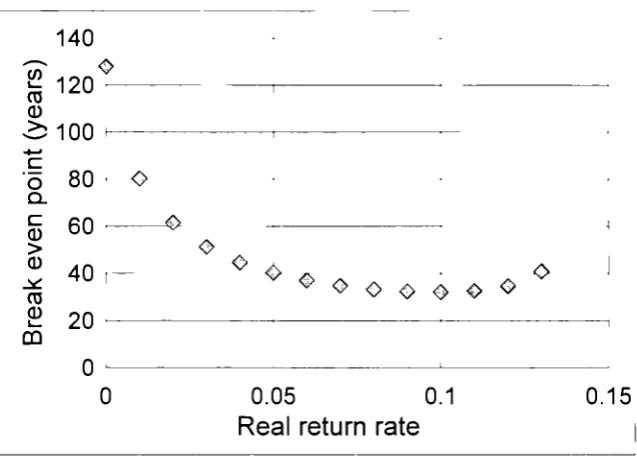
The economical evaluation of the results for a repository in clay shows that the position of break even point is very sensitive for the real return rate.
Therefore the preliminary results for a repository in rock salt are presented in Figure 3 as a graph giving the break-even year as a function of the real return rate.
140
120
yT -.0
nj
^ 100
o 80 • O
Q.
g
6 0. €>
> <3>
I
nj 4 0- * * * » < > o o * « *
CD 200
0 0.05 0.1 0.15
[image:38.570.152.471.50.280.2]Real return rate i
Figure 3 Break even year as a function of the real return rate.
References
III J. Malherbe: Management of radioactive waste from reprocessing including disposal aspects, EUR-13116 (1991), Office for Official Publications of the EC, Luxembourg.
Ill P. Ashton et al: Analysis of scenarios for the direct disposal of spent nuclear fuel-disposal conditions as expected in Germany, EUR-12953 (1990), Office for Official Publications of the EC, Luxembourg.
ASSESSMENT AND PROPOSAL FOR ACTIVITY LIMITS FOR RELEASE OF VERY LOW-LEVEL RADIOACTIVE WASTE TO LANDFILLS
Contractor : CEA/IPSN, France, and ONDRAF, Belgium Contract n° : FI2W-CT90-0060
Duration of contracts : April 1991 - June 1993
Additional program : June 1993 - December 1994
Period convered : 1 January 1993 - 31 December 1993 Project Leader : Ph. GUETAT (CEA/IPSN)
A. OBJECTIVES AND SCOPE
In the frame of studies dealing with low level wastes destinations, the project aims to establish acceptance criteria for municipal and industrial landfill.
Correspondances between levels of exposure and levels of radioactivity will be established.
From this work, it will be possible to derive activity concentration and surface activity levels for acceptance criteria to landfill disposal.
A complementary study will investigate the implications of disposal management in a specific landfill which receive only very low level radioactive waste, and will evaluate the economic aspects of this approach.
B. WORK PROGRAMME
The initial program included :
-Phase 1 : Analysis of landfill disposal practices of industrial and municipal waste. A particular attention will be paid to the regulatory context and to the conditions encountered in the different installations.
Phase 2 : Development of a radioprotection code CERISE, in order to establish the relations between exposure and radioactivity of waste, including a data bank of dose conversion factors.
Evaluation of the exposure of workers and public resulting from the water pathway using the code GEOLE (geosphere) and the code ABRICOT (biosphere).
Phase 3 : Establishment of the correspondance between exposure and activity concentration in the one hand or surface activity in the other hand.
Proposal of levels of radioactivity for the waste acceptance in the different types of landfill and for different dose criteria.
Final report.
The additional program includes :
-Review of the existing information of the volumes and radionuclides content in very low level radioactive waste,
-Review of operating data of a landfill including working conditions.
-Evaluation of radiological impact and determination of acceptance criteria in the case of landfill disposal of very low level radioactive waste,
-Economical investigation and determination of monitoring procedures
C.PROGRESS OF WORK AND OBTAINED RESULTS
State of advancement
The initial program is achieved and final report is definitely accepted by CEC.
The additional program is beginning but only few new data, concerning quantities and isotopic composition, have been get from fuel companies. Some preliminary calculations were performed.
Progress and results
Initial program.
The scenarios presented by the annual progress report 1993 have been selected for the calculation. In all cases the exposure parameters have been determined on the basis of practical operating procedures and measurements of dust concentration at different workplaces. Computer codes CERISE, GEOLE AND ABRICOT have been developped to assess the radiological impact of landfill sites.
The radioactivity concentration and the surface contamination derived for landfill disposal are given in tables 1 and 2 (for a selected number of radionuclides only). The results are also presented in figures 1 for the radioactivity concentration levels and in figures 2 for the surface contamination levels.
It is easy to see two groups of radionuclides for which the levels are lower :
- radionuclides with high gamma energy, such as Na22, Co60, Agl 10m ; the limiting scenarios are those involving external irradiation .
- alpha emitters, such as Pu239 and Am241 ; the limiting scenarios are those where inhalation is involved.
For the other radionuclides, the derived levels are very variable, and there is multiple dominant pathways.
The derived levels in terms of surface contamination are always higher than those in terms of radioactivity concentration (sometimes an order of magnitude).
The derived levels for Belgian and French landfills (water pathway not taken into account) are comparable, and in most cases differ from no more than a factor of 10.
The water pathway is not limiting for the Belgian landfill. For the french landfill, it only seems to be significant for tritium.
Additional program.
For the complementary program on specific landfill, the work carried out include : - Determination of dose limits to be taken into account for the calculation,
- Review of new scenarios to be considered ,
- Selection of input parameters to be used in computer codes. Some preliminary calculations have been carried out.
List of publications
Ph.GUETAT (CEA/IPSN), L.BAEKELANDT (ONDRAF)
CECcontract N° FI2W-CT90 00 60. Annual Progress Report 1992 (EUR 15132)
J.M.ASSELINEAU, Ph.GUETAT, Ph.RENAUD (CEA/IPSN), L.BAEKELANDT, B SKA (ONDRAF/NTRAS)
CECcontract N° FI2W-CT90 00 60.Final report. October 1993.