Rochester Institute of Technology
RIT Scholar Works
Theses Thesis/Dissertation Collections
8-18-2016
Improving the Performance of ProMOL by
Integrating Communal Database Access
Alexander Grier
Follow this and additional works at:http://scholarworks.rit.edu/theses
This Thesis is brought to you for free and open access by the Thesis/Dissertation Collections at RIT Scholar Works. It has been accepted for inclusion in Theses by an authorized administrator of RIT Scholar Works. For more information, please [email protected].
Recommended Citation
Communal Database Access
by
Alexander Grier
A Thesis Submitted in Partial Fulfillment of the Requirements for the Degree of
Master of Science in Bioinformatics
Thomas H. Gosnell School of Life Sciences
College of Science
Rochester Institute of Technology
Rochester, NY
Thesis Committee Members
Paul A. Craig
School of Chemistry & Material Science
Rochester Institute of Technology
Michael V. Osier
Thomas H. Gosnell School of Life Sciences
Rochester Institute of Technology
Gregory A. Babbitt
Abstract
The ability of structural genomics consortia to determine protein structures more quickly
than the proteins can be functionally annotated by conventional experimental means has
generated a significant bottleneck that inhibits the progress of certain areas of biological and
medical research. This issue is currently being addressed in part by the development of
computational resources, which can suggest functions for proteins of interest based on their
structure. ProMOL is such a resource, and the method that it employs is based on detecting, in
structures of unknown function, motifs of known function from a template library. Access to
ProMOL results has been limited, due to a number of factors including the computational
requirements for generating novel results and the format in which results have been stored. In
this project, a remote results database that can be shared by the ProMOL user community has
been implemented and integrated into the ProMOL client program. The introduction of database
features addresses several of the drawbacks ProMOL previously had, especially related to
efficiency, redundant computations, and the ability to maximize the potential utility of
accumulated analysis results. Using the database has no effect on performance in the worst case
scenario, and in the best case scenario it decreases runtime by >99%. Analyses of accumulated
results in the database facilitate better quantification of the accuracy and performance of
ProMOL, and suggest ways to improve the program. Finally, the database constitutes a novel
resource with a variety of potential avenues of investigation that have not been possible
Introduction
Structural motifs corresponding to enzyme active sites are often highly conserved within
evolutionarily related proteins, and can be very similar between unrelated proteins with similar
function. In cases where functional conservation is observed in association with these motifs,
such similarities can be the basis for inferring function from structure, and computational
structural analysis using this approach has become an active area of bioinformatics research in
response to an increasing need for high throughput analysis of the tremendous quantities of data
being generated by structural genomics consortia. This area of research is concerned with
predicting the function of proteins with known structure and unknown function, and with
contributing to a better understanding of the structural basis of enzyme activity.1 Numerous
software applications have been developed for these purposes.2 One such application is
ProMOL,3 a molecular visualization and analysis tool which functions as a plugin for the widely
used molecular graphics system PyMOL.4 ProMOL is a template-based motif identification
program being developed collaboratively and distributed freely as open source. The availability,
flexibility, and open source design philosophy of ProMOL are conducive to the implementation
of a crowdsourcing usage model via the integration of a communal results database. Such an
approach can be used to address several of the most significant technical and theoretical
weaknesses of the software while extending its capabilities and potential applications
substantially. This discussion constitutes a brief review of the biological basis and design
considerations of computational methods of protein structure analysis; a description of ProMOL
in its original form; an explanation of the rationale and design of improvements based on the
addition of database functions to the software and usage model; a summary of the effects of these
Broadly speaking, a protein motif is a recurrent element at the level of sequence or
structure.5 The recurrence of these elements is indicative of their significance, and is the result
of either evolutionary conservation in the case of homologs, or convergence in the case of
analogs.6 As protein homologs evolve, greater conservation occurs at the level of structural
motifs than sequence motifs, due to the direct correspondence between structure and function,
and the resulting relationship between structure, fitness, and selective pressures. Sequence is
conserved to a far lesser extent, and there are numerous examples of proteins which exhibit no
detectable trace of sequence similarity, but which adopt similar structures, contain identical or
related amino acid residues at their active sites, and have similar catalytic mechanisms.
Observations of such shared features are consistent with the notion that these proteins are either
homologous or are the product of functionally driven convergence of unrelated sequences. The
latter explanation supposes that the observed structural similarities are strictly required for these
proteins to perform the same or similar functions and evolved from entirely unrelated ancestors.5
(Note: convergence is meant here in the most general sense - the presence of common basic
chemical or structural properties in the absence of common ancestry; in other words, an
analogous relationship. For example, stabilizing disulfide bonds or utilization of the most
common catalytic residues.) However, these explanations are mutually exclusive, and
observations of common structural features known to be functionally relevant in certain
molecules do not allow a determination to be made as to whether the true relationship is one of
homology or analogy, if either; they are only consistent with the notion that one of these types of
relationships may exist. It is possible that common structural features can be explained by
genetic drift in the absence of functional conservation, or even by random chance, depending on
Regardless of a protein’s evolutionary history, the identification of structural motifs with
previously established function in a protein of unknown function may provide information about
the protein’s biochemical role and potentially indicate its cellular and physiological
significance.7 In the case that commonalities are a product of drift without functional
conservation, their presence is not informative with regard to function. Even so, in the absence
of evidence inconsistent with functional conservation, the presence of motifs known to be
functional in other molecules suggest the possibility that their corresponding function may be
present as well. Therefore, the detection of known functional motifs in structures of unknown
function may serve as a hypothesis generating mechanism for inferring potential function. The
basis of such functional inference is the extent to which a motif is conserved between proteins
with a common function.1 The most well-known example of the relationship between structural
motif similarity and common function is the Ser-His-Asp catalytic triads found in a variety of
phylogenetically related and unrelated hydrolases.8 Numerous analytical methods have
demonstrated the significance of this relationship by correctly inferring hydrolase function with
high accuracy and sensitivity for both homologous and analogous proteins based on the detection
of the catalytic triad motif.8-12 The predictive potential of this general approach has been
validated for a variety of functions and motifs, and serves as the theoretical basis for a multitude
of computational strategies for assigning function to structures predictively.2
As of December, 2013, there were more than 95,000 structures in the Protein Data Bank
(PDB), thousands of which are identified as having unknown function.13 These figures are
indicative of the large gap which exists between the ability of structural genomics initiatives to
resolve protein structures and the capacity to functionally annotate these structures. The
structural data to advance biological and medical research.14, 15 To address this issue,
computational methods have been developed for assigning protein function on the basis of
structural analyses. Various strategies have been employed, including evolutionary trace
methods, methods maximizing superposition, graph-theory based methods, functional template
matching, and machine learning techniques.2, 16-20 Specific approaches can be divided at a
general level into two categories: those which search a novel structure against a reference set of
predefined motif templates with known corresponding functions, and those which identify other
attributes of the structure that are known to be associated with a function in other proteins (e.g.
recurrence, residue propensity, conservation, etc...). The best representatives of the former
category, such as JESS16, are the most useful of any of these programs in terms of predictive
accuracy and sensitivity, and their relative performance is a function of the quality of the motif
templates and the algorithms used for detecting corresponding motifs in novel structures.
Torrence et al. provide a thorough assessment of these approaches. 2
ProMOL is a computational structural analysis program which uses a library of motif
template definitions to search a given structure for features known to correspond to functions in
previously annotated molecules.3 The components of ProMOL analysis are the target structure,
the motif template library, and the detection algorithm. ProMOL is a plugin for the molecular
visualization and analysis program PyMOL, and uses various functions available in PyMOL in
conjunction with its own distinct capabilities to perform analyses. Users specify target structures
with a PDB ID, and the corresponding PDB file is downloaded from the Protein Data Bank via
an FTP server at the time of analysis. The PDB file is loaded into PyMOL and the resulting
structural representation is the subject of subsequent steps in the analysis. The motif library
acid composition and relative spatial positions of the key catalytic residues associated with the
active site of a structure. Currently, motif templates are derived from three sources: JESS16
templates available from the Catalytic Site Atlas,17 a set of templates constructed by ProMOL
developers and made available for download from the source code repository used to distribute
ProMOL, and a set of user defined motifs. JESS templates are constructed programmatically by
converting the specifications available from the Catalytic Site Atlas into the format used by
ProMOL, and are included in the motif library that comes with ProMOL. These templates were
originally based on a representative motif for a given protein family, and were defined by
contributors to the Catalytic Site Atlas. The motifs defined by the ProMOL developers and
included in the template library are constructed using a “Motif Maker” function of ProMOL, and
are based on representative examples of motifs from various protein families. User defined
motifs are also constructed using the ProMOL Motif Maker, and the specifications of these
motifs are up to the user who creates them. The motif detection algorithm used by ProMOL
currently utilizes five parameters: the relative spatial relationships of the residues in the template
compared to the relative spatial relationships between potential matching residues in the target
structure; the root mean square distance (RMSD) between alpha carbons of the template residues
and the corresponding atoms in the potential matching set of residues in the target structure when
the template is optimally aligned; the RMSD between the corresponding alpha and beta carbons
of those same residues; the RMSD between all corresponding atoms in the residues; and the
Levenshtein distance between the template motif and the set of potentially matching residues in
the target structure.
The detection process used in ProMOL analysis proceeds sequentially for all motifs in
identification of potential matches in the target structure. In this phase, all residues in the target
structure that are also present in the motif template are identified, and their spatial positions
relative to one another are compared to the spatial positions of the residues in the template
relative to one another. At the time of the analysis, the user specifies a Precision Factor, which is
a threshold distance in Angstroms. Sets of residues with relative spatial positions matching those
of the relative positions of the template residues to within the Precision Factor are selected as
potential matches. Phase two of the analysis examines only these potential matches. The
Levenshtein distance between the potential match and the template is calculated as the number of
differences in component residue identities. Potential matches with Levenshtein distances below
a threshold value are identified as positive matches. Finally, phase three of the analysis
calculates the minimum RMSD between all atoms in the template and their counterparts in the
match. This final phase has been made optional due to the significant computational demands
and corresponding increase in runtime required to complete it, and it is possible to calculate these
values for individual matches after the initial results are generated. Results are presented as a list
of matches, their Levenshtein distances, and the RMSD of the alpha carbons only, the alpha and
beta carbons, and all constituent atoms. Additionally, results may be visualized individually as
the template motif optimally aligned with the matching structural feature of the query molecule
and superimposed in three dimensions.
The central motivation for the development of programs which make functional
assignments predictively based on structural analysis is to address the bottleneck resulting from
structural genomics initiatives generating structural data faster than it can be annotated by
traditional means.2 The rationale underlying this motivation is that computational functional
traditional laboratory techniques.20 This processing generates hypotheses about the functions of
unannotated structures which can be tested with conventional biochemical assays, thereby
providing rapid, low cost, narrowly focused direction for ongoing, resource intensive, in vitro
functional assignment efforts. With respect to this goal, ProMOL is deficient in that it requires an
unnecessarily large commitment of time and computational resources, to such an extent that
extremely large scale analysis - on the order of thousands of structures analyzed with template
libraries representing hundreds of motifs - is not practical using personal desktop computers.
This limitation can be attributed primarily to inefficiencies in the program design. Specifically, a
major weakness in computational efficiency in ProMOL is the result of redundant analyses being
common and difficult to avoid. ProMOL does not store results in a way that is accessible
programmatically at any point after the results are initially provided to the user or by any
instances of the program other than the one used to conduct the analysis at the time that it is done.
Results are stored in text format as a comma separated value (CSV) file and visualized in
ProMOL immediately after they are generated, and are inaccessible to the application thereafter.
The consequences of these limitations manifest when a motif template library is added to or
changed in any way; multiple users run analyses which include any of the same motif-structure
pair comparisons; and when a user wishes to visualize or regenerate output from previous
analyses. In each of these cases, detection computations for some number of template-target
pairs must be performed multiple times.
Any given iteration of the detection algorithm for a target structure and a motif template
requires substantial computation - on the order of seconds for medium to large size target
structures on a typical desktop computer, if RMSD values are calculated. This is a concern that
Spatial comparisons in three dimensions require significant calculations, and runtime is
dependent on the size of the target structure and the parameters used for template detection.
While the case of one template being run against one average size structure completes quickly,
the fact that useful template libraries contain hundreds or thousands of motifs and the PDB
contains tens of thousands of structures - thousands of which lack functional annotation - means
that analyzing a large portion of these structures would require thousands of hours. This issue is
exacerbated by the fact that thousands of new structures are added to the PDB annually, and new
motif templates are created and added to the ProMOL library regularly.
A second issue pertaining to ProMOL in its current form - and to other, comparable
programs - is that a large amount of results data is not only difficult to generate, but difficult to
work with and analyze computationally. ProMOL provides no means for programmatic analysis
of results that have been exported to CSV files, and CSV files for the analysis of even a single
target structure often consist of hundreds of cells containing values. This format is unworkable
on a large scale without some means of automated computational processing that is designed
with the ProMOL-specific result format in mind. A consequence of the current situation is that
statistical analysis of results on a substantial scale is not possible. As a result, the significance of
results cannot be easily quantified, and meta-analysis, which may yield useful information about
motifs, protein families, or detection parameters, cannot be performed. The inability to quantify
the statistical significance of results undermines their validity,1 and the inaccessibility of
metadata means the potential utility of large quantities of analysis data generated over time
cannot be realized.
Finally, at least two desirable applications of the data generated by ProMOL are currently
which a motif is conserved over a large number of structures cannot be addressed. Results
generated by ProMOL for a family of proteins contain quantitative measures of the variability of
a motif for each individual structure. Therefore the aggregate of these data indicates the
variability of a motif across the entire family. This is significant because the extent to which
functional motifs are conserved is the basis of the predictive power of template-based
computational structural analysis applications.2, 21 ProMOL results contain the information
necessary to quantify motif variability, but their format does not permit such analysis without the
development of additional software for processing ProMOL specific CSV file contents.
Secondly, the results contain the information necessary to add a quantitative component to
functional predictions, yet this is currently not a capability of the program. ProMOL and
comparable structural analysis programs currently infer a type of enzyme function, but do not
attempt to quantify the predicted activity. By comparing published measurements of the
activities of various enzymes in a family to the variability in the functional motif corresponding
to that activity, it would be possible to identify correlations between marginal structural
variations with variations in activity, if they exist. This type of analysis could be the basis for a
more detailed level of functional prediction and analysis,21 but requires analytical capabilities not
presently implemented in ProMOL.
Fortunately, the design of ProMOL lends itself to the straightforward extension of its
functionality to incorporate integrated access to a communal results database, which is conducive
to a model of usage that can address all of the weaknesses of the program discussed thus far.
The accessibility of ProMOL as free, open source software, the number of active developers, and
the flexibility of its design make it possible to address the computational demands of large scale
model based on a communal results database accessible by multiple instances of the client
program operated by a community of users. There are two core components to this strategy.
The first is that multiple users contribute to a database of results that is shared among the
community of users of which they are a part. This allows for the computational resource
requirements of analyzing many structures to be distributed over many independent instances of
the client program running on multiple computers, as opposed to a single user’s program running
on a single machine. The pooling of results from numerous sources makes the analysis of a
much larger number of results feasible by division of labor. The second component of this
strategy is to eliminate redundant computations. Instances of the client program will draw on
existing results in the communal database whenever possible, so that every individual
template-target pair will only be analyzed once. Marginal changes to the template library or the PDB will
require only that the resulting novel template-target combinations be analyzed. The combination
of these two improvements makes analysis of the entire PDB with a large template library
feasible with a relatively small number of contributing users. In addition, users will have much
faster access to results within the client application, and these can be readily visualized or further
analyzed in PyMOL.
The existence of a sizeable database of results accessible programmatically by the client
application, or directly by the user group operating the database, extends the functionality of
ProMOL to address the issues of statistical analysis of results and availability of metadata. Basic
database query functions can be used to easily quantify the statistical significance of results for
the entire program, individual motifs, and individual structures. Overall detection rates, false
positives, and false negatives can be calculated quickly and easily by comparing the contents of
for motifs, structures, and sets of structures can also be determined, further characterizing the
significance of results. Similar calculations could be applied to understand how the different
match detection parameters correlate to the quality of results, and to determine if certain
parameters are more informative under certain circumstances. These features would address a
major issue with the validity of ProMOL results which exists currently, and would provide a
rigorous method for prioritizing the expenditure of conventional laboratory resources on the
confirmation of ProMOL functional predictions. Standard database queries also provide a basis
for programmatic generation and analysis of other metadata that could be used to assess the
extent to which motifs are conserved, indicating their potential predictive capacity. The same
data could be used to determine the correlation between structural variations and variations in
enzyme activity, allowing for a quantitative component of functional inferences to be calculated.
Materials & Methods
ProMOL is an open source structural visualization and analysis software application
written in Python. It is currently available and under ongoing development. It is a plugin for the
widely used molecular graphics system PyMOL. Binaries, source code, and documentation are
available for both programs online,3, 4 for Windows, Mac, and Linux operating systems.
This project consists of the design and implementation of a MySQL database for use with
the ProMOL client application as well as modifications integrating database functionality into
the existing source code. There are six main modules of code associated with this work, all of
which are available as documented open source files online. Minor alterations to existing files in
the core ProMOL package were also made, and are included, with documentation, in the latest
integration into the client program are described here, and a model of usage is presented. All
database features are optional in the client program, so no connection to any database is required
for normal operation with non-database features. The database features must be turned on by the
user, and then are limited by the user’s access to the database they connect to, which they specify
when the database features are activated.
The database design itself is implemented as an SQL script, which generates a relational
database with the appropriate architecture. This was used by the ProMOL developers to
construct an instance of the database that all ProMOL users may draw results from automatically.
Initially, contributions and custom query access to this instance of the database is restricted to the
development team, in order to minimize vulnerabilities. Public access to query and contribution
features will be increased to whatever extent possible as integrity, stability, and security issues
are resolved. The development team works to maintain the database, updating it regularly to
include results for all PDB structures and all motifs in the default library. The contents of the
database are available separately with the rest of the ProMOL files for users who desire complete
access and their own copy of the data. Additionally, the script to construct the database may be
used by independent communities of users to create their own shared results database over which
they have complete control. As a default, the ProMOL client application draws results from the
database hosted by the developers when the database features are activated, and does not attempt
to contribute results generated by the client application unless credentials associated with known
developers are provided.
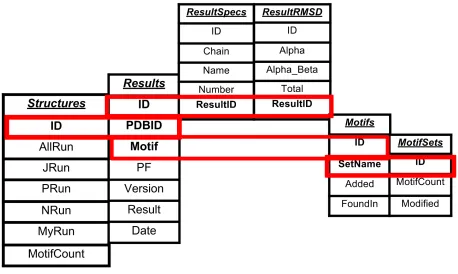
The database design consists of eight tables and stores information about users, active
details describing residue information, and specific result details describing RMSD information.
[image:18.612.76.534.128.402.2]The architecture is represented in Figure 1.
Figure 1b - The tables composing the administrative portion of the database. These tables are related to each other by account/user name, and are not related to any other tables in the database.
The credentials table (Figure 1b) contains usernames, passwords, and permission levels
AES implementation native to MySQL. The administrators of the database enter these values
manually. Credentials are used by the ProMOL daemon module to establish secure sessions.
Credentials are passed by the client with every request. The first request - consisting only of
credentials and a request to log in - is used to create a persistent unique identifier called a token
with a call to the Session Manager module. Tokens are created using the uuid4() method of the
uuid class in Python 2.7, which ensures that they are unique and unpredictable. The token is
passed back to the client and is included in all subsequent requests. Until the user logs out - or
the session expires - the token, username, and password, allow the client to have requests
processed by a Session object with functionality defined by the user’s permission level. User
names are primary keys in this table, meaning they must be unique and ensuring that a single
user has a single permission level and password. The Sessions table stores tokens, the username
associated with the token, and timestamps recording when the Session was created and when it
will expire. The expiration timestamp is used by the Session Manager to delete Sessions after an
appropriate period of time. The token is used to keep track of individual Session objects.
Tokens are primary keys in this table, and must be unique, and user names are foreign keys and
must exist in the Credentials table.
The Structures table contains entries for individual structures, and consists of a PDB ID,
the dates of the most recent analyses with various subsets of the motif library, and the total
number of distinct motifs detected in the structure. This information constitutes a portion of the
descriptive metadata contained in the database. None of the values are used in queries or
submissions by the client, and instead are intended to be used by directly accessing the database
with MySQL. The primary key is the PDB ID of each structure, assuring that each structure only
someone logs in and every time a submission is made to the database. The results table is
referenced in order to derive the values contained in this table.
The Results table contains entries for unique results of individual motif detection
analyses, and consists of a unique identifier, a structure ID, a motif ID, the precision factor used
in the analysis, the algorithm version used in the analysis, the result of the analysis as either a
Levenshtein distance or an indication that no match was found, and the date of the analysis. The
unique identifier is arbitrary and used to connect results in this table with their specific details in
the ResultSpecs and ResultRMSD tables. Entries are made by the client upon the completion of
novel computations, as long as the user has sufficient permissions. The combination of
parameters is the minimum set of details that defines a unique query. The unique identifier is the
primary key, and the motif and structure ID are foreign keys referencing the motif and structures
tables, and as such these values must be found in those tables at the time of submission. This is
one of three tables in the database containing primary data, and is the main table referenced or
updated during queries and submissions by the client.
The ResultsSpecs table contains entries for every residue from every result in the
database that was a match, and consists of an arbitrary identifier for each data entry, the residue
chain, name, and number, and the identifier of the corresponding result. These values are only
meaningful when associated with entries in the Results table, and as such the result ID is a
foreign key referencing the Results table. The contents of this table are the second portion of the
primary data contained within the database, and provide the information needed to reconstitute
and visualize positive results in the client.
The ResultRMSD table comprises the final portion of primary data, contains an entry for
the alpha and beta carbons, all atoms, and the identifier of the corresponding result. Like the
ResultSpecs table, the ID of the corresponding results are foreign keys referencing the Results
table. These values are provided to the client in cases in which RMSD calculation is requested.
The Motifs table contains an entry for every motif in the current library, and consists of
the motif ID, the name of the subset of motifs to which the motif belongs, the date the motif was
added to the library, and the number of structures the motif has been identified in. The motifs
present in this table are determined by the contents of two folders on the server: Motifs and
UserMotifs. The folders must be updated manually, and the Motifs table is updated by the
Database Manager whenever there is a submission or a log in. Results that are submitted must
only pertain to motifs which are present in this table, and as a consequence novel motifs created
by users and not submitted to the server by the database administrator cannot be a component of
any result submitted to the database. Presently, this is enforced at the level of motif names, and
unrecognized motif names will simply be passed over during the process of results submission.
The subset of motifs to which an entry in this table belongs is a foreign key referencing the
MotifSets table, and the motif IDs are unique primary keys.
The MotifSets table contains an entry for each subset of motifs in the motif library, and
contains entries for the subset ID, the number of motifs in the subset, and the date that the subset
was last modified. The subset IDs are unique primary keys. The values in this table are updated
at the time of login and result submission by the Database Manager. This table constitutes the
final portion of metadata contained in the database.
There is one module of code incorporated into the client program and four modules of
code operating on the server that are responsible for the functionality of the database. The client
and submit requests to the server and receive and process responses from the server. The Admin
Manager is made available globally within the client program, and calls to its functions are made
either directly via the graphical user interface (GUI) or indirectly as needed within the motif.py
module, which is responsible for analytical computations and is the primary functional
component of the client. The GUI has been modified to include a Database tab with four text
entry boxes and two buttons. The text boxes provide input for the uniform resource identifier
(URI), the database name, and the username and password. The URI and database name are
populated by default with the URI of the ProMOL server hosted at RIT
(https://oldmomtong.rit.edu/agrier/ProMOLHandler.py) and the ProMOL database on the
MySQL server. The values in the text boxes are used when the user clicks the button to activate
database access. The Admin Manager attempts to create a connection with the URI, and passes
the database name and credentials so that the module receiving this request on the server can log
into the MySQL database. The initial label and function of the button used to connect to the
database changes once a connection is established, and in its altered form the same button logs
out of the database and disconnects from the server. The second button associated with database
functionality uploads legacy data in the form of CSV files to the database, and is still
experimental and only available with administrator credentials. These two buttons are the only
direct operations on the database that the user has access two. All other functions of the Admin
Manager are used as needed by the analysis components of the client software. These functions
consist of submitting queries, submitting entries, and triggering updates in the database. In each
case, the relevant data being manipulated in the client as part of a normal analysis is converted
into XML format according to the Simple Object Access Protocol (SOAP), and is submitted
requests, even one way submissions, are designed to elicit a response either containing the
requested information or confirming successful receipt and processing of the request. All traffic
between the client and server are processed through the Secure Socket Layer (SSL)
cryptographic protocol to protect content. All data received by the Admin Manager is converted
from XML format into Python objects according to SOAP, and all expected object types are
enforced at the time of conversion to limit the potential of receiving unintended content.
The four modules of code on the server are designed hierarchically with simple
procedural functions at the top calling increasingly complicated functions and classes below
them. The highest level module is the ProMOLHandler. This is a single simple function which
dispatches requests to the ProMOL daemon. SSL and client-server connections are handled
directly by an Apache web server. The server is configured to run the ProMOLHandler for all
requests directed at a specified port. Via mod_python, the ProMOLHandler provides a link
between the Apache web server and the other Python modules associated with the ProMOL code.
All traffic passes directly through the ProMOLHandler and is dispatched to the ProMOL
daemon. This module consists of a set of functions called by the handler according to a specific
tag in an incoming request. It parses incoming requests and directly passes the relevant data to
the SessionManager or ProMOLSession modules as needed. It also passes the outgoing data
through the web server to the client. Requests are processed via one of five functions: login,
logout, query, submit, and update. Login passes credentials to the SessionManager which checks
the credentials, creates a session, and returns a token and permission level. The token and
permission level are passed back to the client to identify its session and define functionality.
Logout passes a token to the SessionManager, which deletes the corresponding session. Query,
Session object from the SessionManager, and then the data relevant to the desired operation are
passed to the Session object with a call to the appropriate function. The daemon also persistently
stores administrative credentials for the MySQL database, which it provides to the
SessionManager and Session objects as needed, though it does not interact with the database
directly at all.
The SessonManager is a class instantiated by the daemon and used to manage Session
objects. It creates sessions when users log in, provides the specific session instance to the
daemon when the specific client makes a request, and removes sessions when they expire or the
user logs out. Upon instantiation by the daemon, the session manager connects to the database
with administrative credentials, and it uses the Sessions and Credentials tables to keep track of
sessions and check the credentials and permissions associated with requests. The session
manager has three functions: requestSession, getSession, and retireSession. Requesting a session
causes the manager to generate a session by submitting session information to the database. It
returns the token and permissions associated with the session, and starts a timer to retire the
session after a finite period (24 - 240 hours depending on account type). Getting a session
confirms credentials and uses the identifying token to return a session object, which is used to
execute functions. Sessions are retired automatically at the predetermined time by deleting their
corresponding entry in the database. There is no theoretical limit on the number of concurrent
sessions that are possible, however the rate at which the server can process requests may be
limiting in practice if the number of concurrent users is very large.
Session objects are the primary functional components of the server-side program. They
are provided to the daemon, which calls functions and passes the necessary information from the
three classes: the primary Session class which provides the three primary functions, and a
resultsManager class and databaseManager class which provide the tools used by the three
primary functions. The three primary functions are query, entry, and update. Query uses
functions in the results manager to query the database for any results relevant to the current
analysis being performed by the client. Entry uses the results manager to submit novel results
generated by the client. Update uses the database manager to update metadata in the database
when a session is initiated at login and whenever submissions are made. The results and
database managers, as well as the session manager, employ the MySQLdb Python package to
interact directly with the MySQL server. Additional details related to the implementation and
purpose of these files may be found in the ProMOL source code and documentation. The series
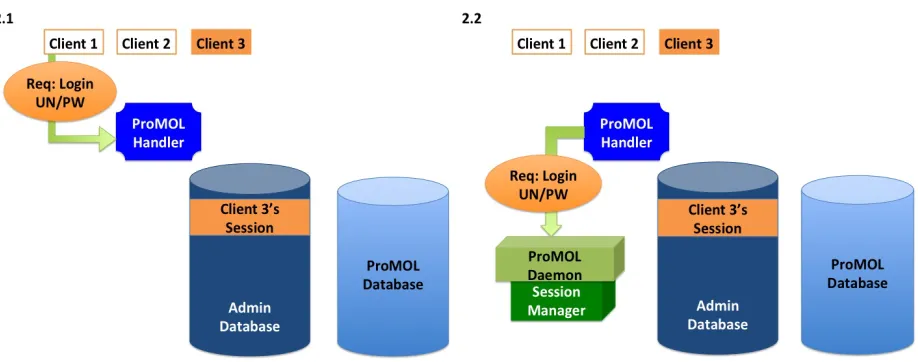
of panels in Figure 2 show how the various modules associated with the database functionality of
ProMOL interact with one another for a set of common operations being performed by multiple
[image:25.612.79.538.430.611.2]users.
In 2.3, the Session Manager checks the credentials against those stored in the administrative portion of the database, specifically, the Credentials table. Upon confirmation of valid
credentials, a session is created for Client 2 and input into the database, while at the same time a token and permissions information is passed back to the daemon. 2.4 shows the permissions and token data associated with Client 1’s session being passed back to the ProMOL Handler and ultimately through Apache.
In 2.5, the token and permissions data are passed, over the Internet by Apache via the handler, back to Client 1, which now has a session. 2.6 shows the beginning of how multiple
Multiple Daemons are spawned in 2.7 in response to the requests; the daemons store the data received with the request and create independent Session Manager objects. In 2.8, the Session Managers communicate with the administrative portion of the database. In the case of Client 2, a session is created. For Clients 1 and 3, the credentials and token are used to retrieve their
existing sessions.
with Clients 1 and 3 generate responses and pass them to the handler.
In 2.11, the Handler forwards the responses to Clients 1 and 3. 2.12 shows Client 1 passing a new request to the handler, which is a request to log out.
In 2.15, the Daemon generates a response and passes it to the Handler. It is forwarded to Client 1 in 2.16, which causes the admin manager in that client to change its state to reflect no longer being connected to the database.
2.17 shows the resting state of the modules after the above processes are completed.
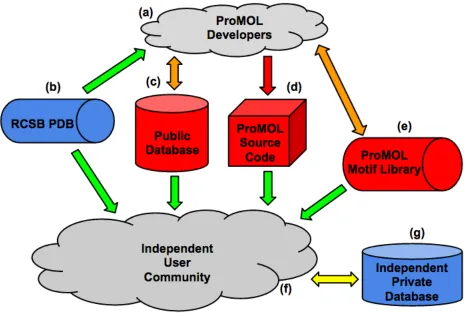
While above figure details the flow of processes and data specifically between the
various modules of code, Figure 3 provides a higher level view of the intended usage model of
Figure 3 - A representation of the intended model of usage for ProMOL with communal database functionality. Grey objects are user groups. Blue objects are data repositories
Results
ProMOL has been updated to include all database functionality described here. There are
two types of results associated with these changes: their effect on the performance and efficiency
of the traditional operation of ProMOL, and the novel applications that they make possible. In
terms of performance and efficiency, implementation of the database has decreased the runtime
in the best and average cases, had no discernable effect of the worst case, and decreased the
overall memory resources required by the ProMOL user community. Several novel applications
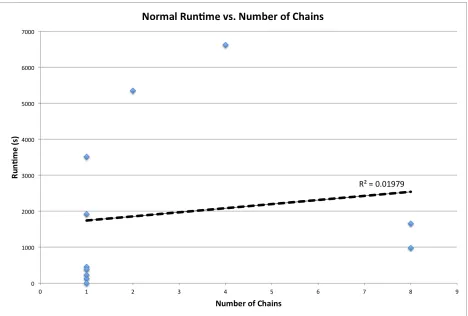
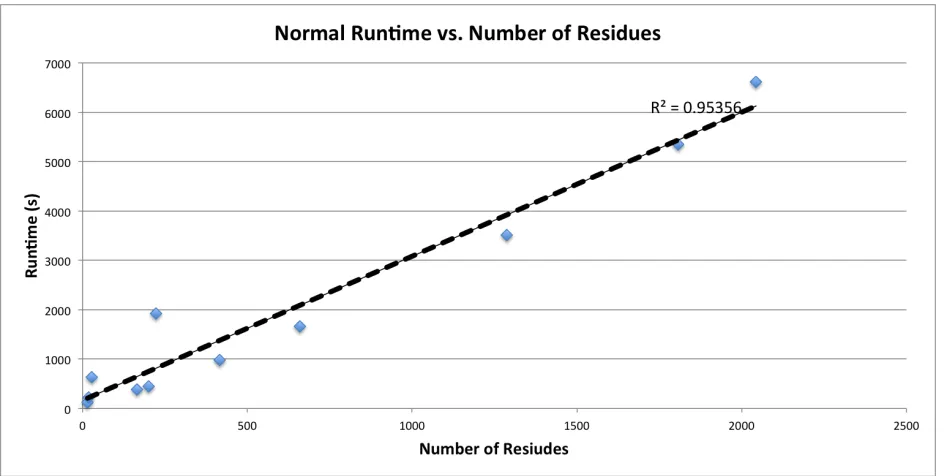
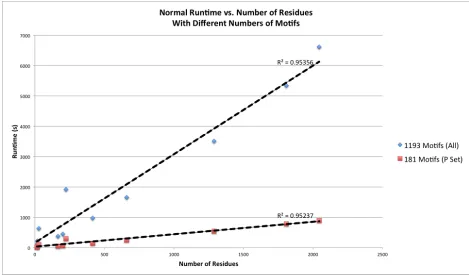
are considered. The factors contributing to the runtime of ProMOL without utilization of
[image:31.612.76.541.321.561.2]database figures are present in Figures 4-7.
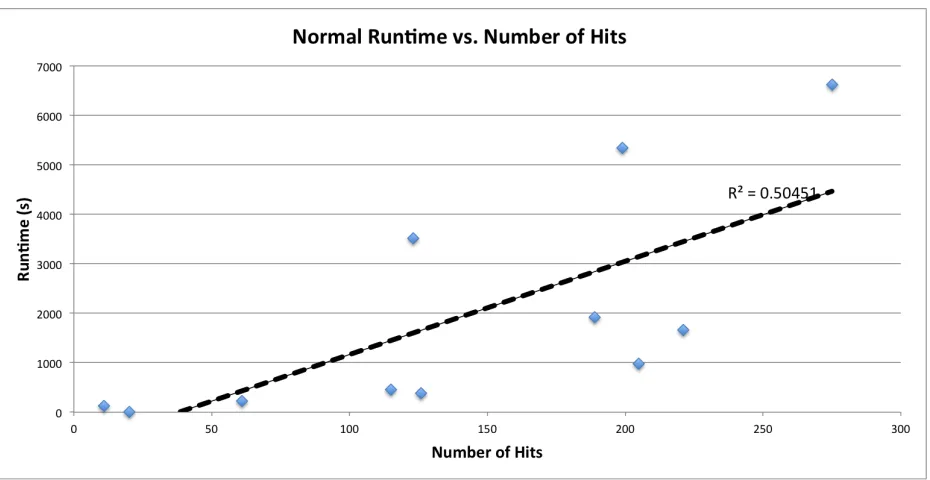
Figure 4 - A plot of the runtime of a standard analysis using the ProMOL client without database features activated, as a function of the number of positive hits identified. The complete current motif library of 1193 entries, consisting of available JESS templates, accepted ProMOL
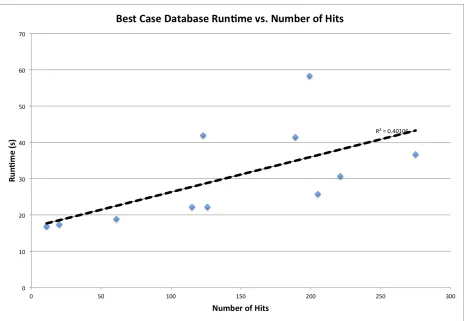
Figure 10 - A plot of the runtime of a standard analysis using the ProMOL client with database features activated as a function of the number of positive hits composing the result. The
Figure 11 - A plot of the runtime of a standard analysis using the ProMOL client with database features activated as a function of the number of chains composing the query structures. The complete current motif library of 1193 entries was used and RMSD values were requested. All relevant results were present in the database. Representative structures of various sizes with various numbers of hits were selected, and structures with one to eight chains were tested. A slight linear relationship is observed between the number of chains and the runtime,
Figure 13 - Runtime comparisons for several sets of structures of various sizes, positive hits, and component chains, when the analysis of the structures in a set was run in a batch or individually. All three sets were analyzed with all results available from the database, and the set of the
Figure 14 - The total memory requirements for user communities of between one and twelve individuals associated with representing the ProMOL analysis results of 100,000 typical PBD structures queried with the current complete library of 1193 motifs, including RMSD values, when the results are stored either on the communal database as described, or in CSV format locally for each user, as has been the practice. To store a single copy of these results in CSV format would require approximately 65 Gb of memory, estimated by multiplying the average size of these CSV files by the number of structures in the PDB. A single copy of the same results and all associated meta-data contained within the database would require approximately 200 Gb. The memory requirements when the data is stored in the database are constant
Motif P_1n7n_4_2_2_5
EC Number 4.2.2.5
Homologs 9
True Positives 7
False Positives 1
True Negatives 90
False Negatives 2
Total 100
Sensitivity 0.78
[image:42.612.154.456.69.318.2]Specificity 0.99
Table 1 - Using data accumulated in the database, the motif P_1n7n_4_2_2_5 was assessed for
Matching Structure EC Number Levenshtein Distance Total RMSD
1LY7 1.16.3.1 2 1.0138
1LXM 4.2.2.5 0 0.2353
1N7N 4.2.2.5 0 0
1C82 4.2.2.5 0 0.126
1F9G 4.2.2.5 0 0.0773
1I8Q 4.2.2.5 0 0.2584
1F1S 4.2.2.5 0 0.1545
[image:43.612.70.545.70.297.2]1EGU 4.2.2.5 0 0.0964
Table 2 - A detailed examination was made of the eight hits generated by the motif
Discussion
The ProMOL program is a plugin for the molecular visualization software package
PyMol. ProMOL’s primary purpose is to predict the function of enzymes based on their
structure, using computational analysis methods, in a way that requires less time and resources
than traditional laboratory techniques. ProMOL results constitute testable hypotheses about
enzyme function, which can then be verified via biochemical assays. ProMOL employs a
template based motif detection algorithm to achieve this goal, by attempting to identify motifs of
known function in enzymes of unknown function, thereby suggesting the function of the
unknown enzyme. Computational functional determination of enzymes is an active area of
research which is intended to address the bottleneck in functional genomics/proteomics between
structural determination and functional annotation, and the corresponding accumulation of
solved protein structures lacking functional assignment.
A substantial issue with ProMOL, as with all structure based function prediction
programs, is that the required analysis is computationally intensive. The large and ever growing
number of structures in the PDB makes analyzing all known protein structures virtually
impossible on a desktop computer, given that a typical structure takes several minutes and that
there are nearly 100,000 structures currently in the repository. This issue was addressed by the
implementation of a shared, remote database, which facilitates a crowdsourcing strategy to
analyze large numbers of structures and which eliminates the potential for unnecessarily
redundant analyses. ProMOL originally yielded results in the form of CSV files stored locally
on a user’s computer, which could not be reloaded in the application itself. This made large
scale analysis of results difficult, and lead to redundant computations whenever 1) motif libraries
3) or a user wanted to generate results that a another, independent user had generated at some
point prior. Implementation of the database provides a simple option for users of the client
program to connect to a common database of results and retrieve all results previously generated
by users connected to the database. This effectively eliminated redundant computations and in a
large and ever growing number of cases dramatically increased the speed with which results
could be loaded into the client.
The primary motivation for implementing the database features of ProMOL was to
improve access to results. To this end, decreasing runtime was a priority. In order to understand
primary factors which affected the runtime of the stand-alone ProMOL client program, a number
of tests were conducted using a set of PDB structures with diverse properties including size,
composition, and presence of known structural motifs. Test were also conducted with and
without requesting RMSD calculations, and with differing motif library sizes. The results of
these tests are shown in Figures 4 through 7. These results indicate that the primary factors
affecting runtime are the number of residues present in the query structure and the size of the
motif library used. There is a strong direct linear correlation between each of these parameters
and runtime across molecules of differing sizes, compositions, and structures. This is as
expected, as each motif must be analyzed sequentially against the structure, and each of those
analyses involves checking all residues in the structure. Number of chains exhibits no
relationship to runtime, and number of hits exhibits a weak positive correlation. Hits increase
runtime because they require alignments between the motif and structure and subsequent RMSD
calculations. Preliminary testing indicates that computing RMSDs in a single analysis as
this is highly variable depending on the number of positive hits for which the values must be
computed and the number atoms in the motif templates associated with the hits.
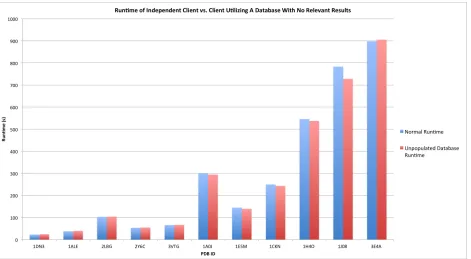
To determine the effect of the database on the runtime of the client, tests were conducted
under circumstances of differing favorability. The first test, the results of which are shown in
Figure 8, was to compare the runtimes of the client when database functionality was not
activated against the runtime when it was connected to and utilizing a database which did not
contain any results relevant to the analysis being performed. For structures of all shapes and
sizes, there was no discernable difference in performance between these two conditions. This
not surprising, because the database features are not computationally intensive; SQL queries are
fast, and the only other potentially significant expenditure of time is in transferring data over the
internet between the client and server. The quantities of data are small enough and packaged
efficiently enough that no situation was found in which these delays could be detected against
background variations in runtime do to extraneous system processes.
When more favorable conditions were tested, in which some or all relevant results were
available in the database, runtime was found to decrease substantially. These findings are
detailed in Figure 9. Where results were available for some or all of the motifs queried, runtimes
were deceased by 10-90%, varying according to the proportion of motifs for which results were
present and to the size of the structure. When the RMSD was available in the database in
addition to the basic results for some or all of the motifs, runtimes decreased by >99% in some
cases. There appears to be a lower limit on the runtimes with the database of about 10 seconds,
and no analyses with or without the database were ever observed to take less than that amount of
Figures 10 - 12 show how various properties of the query structure affect runtime when
the database is used in a best-case scenario. A weak but significant positive correlation is
observed between number of residues, number of chains, number of positive hits, and runtime.
Residues, chains, and number of hits are not independent variables and are positively correlated
with each other (a structure with more chains is likely to have more residues, making it more
likely to hit on more motif templates by chance), so quantifying the significance of their
relationships to runtime is difficult. Taken individually, any one of these variables accounts for
approximately half of the variation in runtime that is observed between structures, in the average
case, as indicated by the R2 values in Figured 10 - 12. This is likely due to the fact that all of
these features are associated with a greater quantity of results data. More residues almost always
corresponds to more positive hits, and for each hit its location and RMSD values are identified in
results data. More chains also increases the amount of data associated with positive results
because the location of hits must be specified for more than one chain. These overall minor
increases in the quantities of data associated with results mean that more data must be transferred
between the client and server, and processed at either end. It should be noted that while the
increases in runtime associated with these factors are real and observable in the test data, they
may be considered essentially functionally negligible. For example, one query structure with
1,000 more residues than another is likely to take only about 10-20 seconds longer in the best
case scenario with the database. This is as opposed to an expected difference in runtime of an
hour or more between the same two structures when the database is not used. The overwhelming
majority of the structures in the PDB have less than 1,200 residues, and the average structure
consists of less than 700. This means that in almost all cases, if the database contains the
Figure 13 shows that submitting queries for analysis when results are available in the
database as either batches or sequentially does not affect runtime in the average case, but that in
cases where the batches are large, sequential query submissions are preferable, and this left up to
the user. This is due to the packaging of the data transferred between the client and the server.
On either end, the information comprising the query and the information comprising the results
are processed into nested dictionaries and list structures in Python. These structures can
accommodate all possible types and quantities of query and results data, and are converted to
XML via SOAP for transmission over the internet and then back into Python objects again upon
receipt in an algorithmically consistent and robust way, but the quantity and complexity of the
XML data that must be generated, processed, and transmitted increases at a faster than linear rate
compared to the size and complexity of the Python data themselves. The effect of this on
runtime is noticeable with sufficiently large batch processes containing more than three or four
large query structures and hundreds of results.
In Figure 14, the memory requirements associated with storing a very large quantity of
ProMOL results data in a way that is accessible to multiple users using either the database or the
previous stand alone client output are compared. This is meant to be a consideration of the entire
ProMOL user community, and how much memory would be used if the entire PDB were
analyzed and the results were available to everyone. These values are theoretical extrapolations
of known values for smaller data sets. The memory used by a single shared copy of the results is
less than the memory used by any significant number of copies of those results possessed by
individual users. However, a single copy of this data on a single user’s computer is substantially
smaller than the representation of the database containing the same data on the server. This is
the database. In addition to the metadata described in this discussion that is specific to ProMOL
results, MySQL automatically generates functional metadata to facilitate operations such as fast
look ups and manipulations, features which CSV files do not have and which are vital to the
performance of a database which must serve multiple users quickly. The “break even” point at
which the total memory required for users to have access to complete analysis results is equal
between a centralized database and independent local data storage is three to four users.
These data demonstrate the capacity of the database to make results more accessible to
users by decreasing computational time and data storage requirements. The extent to which
these benefits are realized depends on usage of the database and the accumulation of results. As
ProMOL is used, and the database grows, the number of cases in which applicable results can be
found will increase, which will make the average run faster. When computing novel results, the
factors affecting runtime requirements are the number of residues in the structures being
analyzed, the number of motifs being used in the query, and the number of hits which must be
assessed and for which RMSD values must be computed. Runtimes when the database can be
used to access results are nearly constant and are orders of magnitude faster than computing
them from scratch, with some increases associated with the amount of data that must be retrieved,
which is a function of the number of motifs being used in the query and the number of hits.
These developments make analysis of the entire PDB feasible over a matter of days or weeks by
a small team of users with personal computers connected to the ProMOL database.
Another issue stemming from the storage of results as local CSV files is that
computational analysis of large numbers of results was difficult: custom scripts would have to be
written to answer fairly simple questions regarding things like motif accuracy or other metadata.
and limits the utility and value of the large quantities of data that can be generated with ProMOL.
Implementation of the results database resolves this issue by permitting straightforward and
efficient programmatic access to all results in the database via MySQL. This allows accuracy
statistics to be generated simply, in addition to permitting a wide variety of novel analyses to be
performed on the ProMOL results dataset. Tables 1 and 2 provide an example of the utilization
of these capabilities to both quantify the performance of a motif, and to suggest straightforward
criteria for evaluating the quality of a result. Table 1 simply quantifies the performance of a
single motif run against 100 structures of known function in terms of sensitivity, specificity, and
true and false positives and negatives. Table 2 examines the Levenshtein distance and RMSD
values for true and false positives for a single motif run against 100 structures of known function.
From these data, it is clear that while the false positive was indeed erroneously identified as a hit,
its Levenshtein distance and RMSD values were much different than any of the true positives.
This suggests that positive results could be scored based on Levenshtein distance and RMSD
values in order to identify results that are likely to be erroneous.
By being able to analyze the entire PDB and store the results in the database, the nature
of ProMOL is changed dramatically. The client program becomes more of a lookup service than
a computational engine. The accuracy of each motif template can be determined with a
statistically significant sample size, and the characteristics of what makes a motif accurate or not
can be determined using simple MySQL scripts, leading to better motif templates being
implemented. These capabilities will allow ProMOL results to be ranked, so that testing the
corresponding functional assignments can be prioritized with confidence. This further advances
Given the preliminary results presented here and the vast array of potential new avenues
of exploration using ProMOL, there are several promising directions for future work based on
the database. Perhaps the most pressing is the analysis of the entire PDB. Once complete, the
resulting dataset is expected to provide numerous novel avenues of investigation, in addition to
serving as the basis for improving the performance of ProMOL. Subsequent computational
analyses will only be necessary when marginal changes are made to the PDB and to the ProMOL
motif library, making upkeep of the comprehensive set of results fast and easy. Once that is
done, a results ranking system may be implemented, and better motifs may be developed.
Along similar lines as the implementation of a basic result ranking system based on
accuracy statistics for a given motif, as well as statistics quantifying the error rates of hits as a
function of Levenshtein distance and RMSD values, a more fundamental methodological
concern may be addressed. ProMOL fails to incorporate evolutionary information into its
calculations. The component of these of analyses that drives up the rate of false positives is the
frequency with which structural commonalities occur by chance or due to drift in the absence of
functional conservation. The ability to discriminate random, false hits from true positives is
fundamentally limited by the resolution of the molecular structures, the actual physical flexibility
of active sites, and the tolerance in terms of spatial alignment that the ProMOL algorithm uses
when identifying matches. The tolerance of ProMOL alignments can be controlled with the
Precision Factor parameter, and the resolution of molecular structures is a product of
technologies and experimental conditions beyond the scope of this project. The only ways for
ProMOL to address this issue of random chance matches is to utilize sufficient precision in
matching, quantify the false discovery rate of each motif, and to use motifs with sufficiently
occurring randomly). These factors may be addressed without major modifications to the core
algorithm in the form of a result scoring system. The other driver of false positives, drift, would
require substantial changes or additions to be made to the core ProMOL algorithm. Drift may be
addressed to some extent by incorporating phylogenetic information into ProMOL analyses.
Given sufficient information about the structures of evolutionarily related proteins, it may be
possible to control for features that are the product of drift and are not informative with regard to
function. Sequence data may contribute to this effort. A potential long-term goal may be to
modify ProMOL based on these ideas in order to reduce the rate of false positives.
Finally, a concern related to the implementation of the database may be addressed in the
future. ProMOL is freely available and open source, and the user community is expected to
represent a broad spectrum of technical knowledge and ability. The database features of
ProMOL require the installation of two fairly sophisticated Python packages with the client
program: PyXML and the Zolera Soap Interface (ZSI). These programs require compilation of
files written in C, and their installation is somewhat dependent on the specific configuration of a
user’s system. This can lead to some difficulty in the installation process, which is markedly
more involved with the database features than without. It is desirable that these packages or
some of their capabilities be better integrated in the ProMOL package, perhaps with an
automated installer, so that usage of the database is simple for users without significant technical
References
1. Torrence, J. et al. (2005). Using a Library of Structural Templates to Recognise Catalytic Sites and Explore their Evolution in Homologous Families. J. Mol. Biol., 347, 565-581.
2. Jones, S. & Thornton, J. (2004). Searching for functional sites in protein structures. Curr. Op. Chem. Biol.8, 3-7.
3. Hanson, B. et al. (2014). Estimation of Protein Function Using Template-Based Alignment of Enzyme Active Sites. BMC Bioinformatics.Forthcoming
(https://sourceforge.net/projects/sbevsl/)
4. "The PyMol Molecular Graphics System, Version 1.3-1.4, Schrodinger, LLC." (http://www.pymol.org/)
5. Petsko, G. & Ringe, D. (2004). Protein Structure and Function. London, UK: New Science Press.
6. Koonin, E. & Galperin, M. (2003). Sequence - Evolution - Function: Computational Approaches in Comparative Genomics. Boston, MA: Kluwer Academic.
7. Todd, A., Orengo, C., & Thornton, J. (2001). Evolution of Function in Protein Superfamilies from a Structural Perspective. J. Mol. Biol.307, 1113-1143.
8. Wallace, A., Laskowski, R. & Thornton, J. (1996). Derivation of 3D coordinate templates for searching structural databases: application to Ser-His-Asp catalytic triads in the serine
proteinases and lipases. Protein Sci.5, 1001-1013.
9. Cai, Y. et al. (2004).Identify catalytic triads for serine hydrolases by support vector machines.
J. Theor. Biol. 228, 551-557.
10. Yuzhen, Y., Tao, X. & Dafu, D. (2000). Protein functional-group 3D motif and its application. Chinese Sci. Bul.45, 2044-2052.
11. Chou, K. & Cai, Y. (2004). A Novel Approach to Predict Active Sites of Enzyme Molecules.
Proteins55, 77-82.
12. Artymiuk, P. et al. (1994). A Graph-theoretic Approach to the Identification of Three-dimensional Patterns of Amino Acid Side-chains in Protein Structures. J. Mol. Biol.243, 327-344.
13. Berman, H. et al. (2002). The Protein Data Bank. Acta. Crystallogr. D. Biol. Crystallogr.58, 899-907. (http://www.rcsb.org)
15. Chim, N. et al. (2011). The TB structural genomics consortium: a decade of progress.
Tuberculosis (Edinb)91, 155-172.
16. Barker, J. & Thornton, J. (2003). An algorithm for constraint-based structural template matching: application to 3D templates with statistical analysis. Bioinformatics 19, 1644-1649.
17. Porter, C., Bartlett, G., & Thornton, J. (2004). The Catalytic Site Atlas: a resource of catalytic sites and residues identified in enzymes using structural data. Nucleic Acids Res.32, 129-133.
18. Sleator, R. & Walsh, P. (2010). An Overview of In Silico Protein Function Prediction. Arch. Microbiol.192, 151-155.
19. Hasegawa, H. & Holm, L. (2009). Advances and Pitfalls of Protein Structural Alignment.
Curr. Opin. Struct. Biol.19, 341-348.
20. Lee, D., Redfern, O., & Orengo, C. (2007). Predicting Protein Function from Sequence and Structure. Nat. Rev. Mol. Cell Biol.8, 995-1005.