Functional Stability of a Ferromagnetic Polycrystalline Ni
2MnGa High Temperature
Shape Memory Alloy
M.A. Azeema,b,c,∗, N.G. Jonesa,d, S.L. Raghunathana,e, V.A. Vorontsova, D. Dyea,∗
aDept. Materials, Royal School of Mines, Imperial College, Prince Consort Road, South Kensington, London SW7 2BP, UK bSchool of Materials, The University of Manchester, Manchester M13 9PL, UK
cResearch Complex at Harwell, Harwell Science&Innovation Campus, Didcot OX11 0FA, UK
dDepartment of Materials Science and Metallurgy, University of Cambridge, 27 Charles Babbage Road, Cambridge, CB3 0FS, UK eCryogenic Ltd, Unit 6, Acton Park Estate, The Vale, Acton, London W3 7QE
Abstract
Electrocaloric Ni2MnGa is of interest for solid state refrigeration applications, as well as a high temperature thermal shape memory alloy. Here, polycrystalline Ni54Mn25Ga21is examined using in situ synchrotron X-ray diffraction. The initial martensite (Mf) and
austenite (Af) finish temperatures were found to be 232 ◦C and 298 ◦C respectively. Mf was observed to decline by 8 ◦C/cycle
and Af increased by 1 ◦C/cycle. Both below and surprisingly, above the Curie temperature, the application of an e.m.f. was
found to affect the lattice parameters measured. A change in the thermal expansion of the two phases was found around the Curie temperature.
Keywords: Ferromagnetic shape memory alloy; synchrotron radiation; thermal expansion; intermetallic compounds
Ferromagnetic shape memory alloys (fSMAs) based on the
1
Ni-Mn-Ga system [1] are of great interest both as actuators and
2
as magnetocaloric materials. Examples range from fast
actua-3
tion (using an applied magnetic field) in aerodynamic control
4
surfaces [2, 3] to magnetically operated solid-state heat pumps
5
offering coefficients of performance (COP) > 4 [4]. There
6
has also been interest in using the mechanically induced phase
7
transformation in conventional SMAs (e.g. NiTi) in a
simi-8
lar way [5, 6]. Large magnetic field induced strains (MFIS)
9
are widely reported in these alloys [7–11] and the underlying
10
mechanism is thought to be the magnetically induced mobility
11
of twin interfaces [8, 12].
12
Shape memory functionality was first observed in the
13
Hesuler compound Ni2MnGa [13] and the ferromagnetic phase
14
transformation was discovered almost a decade later in off
-15
stoichiometric Ni-Mn-Ga alloys [14]. The martensite
transfor-16
mation temperatures (Tm) are sensitive to deviations in
stoi-17
chiometry; Ni substitution for Ga result in changes of∼50 K
18
per at.% [1, 15, 16], but this results in only a modest change
19
in the Curie temperature (Tc) [1, 15]. It is observed that the Tm
20
increases linearly with the alloy electron concentration,i.e.,
in-21
creases in the electron per atom ratio (e/a)[16–18]. Therefore,
22
in developing high temperature Ni-Mn-Ga alloys, replacement
23
of Ga by Ni are generally preferred as Ni has the greatest
num-24
ber of valence electrons and since the Ni fraction is greatest. For
25
example, the Mf in a Ni54Mn24.7Ga21.3alloy (e/a=7.768) [15]
26
is ∼215 K higher than in near-stochiometric Ni50Mn25Ga25
27
(e/a=7.5) [7, 18–20].
28
∗
Corresponding author
Email address:[email protected],
[email protected](D. Dye)
Irrespective of composition, the austenite in Ni-Mn-Ga
al-29
loys is reported to be Fm¯3m but the martensite crystal
struc-30
ture varies with small changes in composition [15, 21]. Both
31
modulated and non-modulated martensites have been reported;
32
5M and 7M martensites are observed in alloys with Curie
tem-33
peratures (Tc) higher than Tm whilst non-modulated
marten-34
sites are observed in alloys where Tc <Tm [15]. In Mn-rich
35
alloys with∼20 at.% Ga, orthrhombic and tetragonal
marten-36
sites are observed, and for certain compositions both forms can
37
co-exist [21]. In the tetragonal martensite increases ine/a
in-38
creases the tetragonality, ct/at[19].
39
Single crystals have been used in most investigations of
Ni-40
Mn-Ga alloys, but single crystal fabrication will limit the range
41
of product forms that can be economically produced, so
poly-42
crystalline Ni-Mn-Ga alloys are highly desirable. In this
con-43
text, purely thermal high temperature Ni2MnGa actuators are
44
also of interest, as conventional NiTi-based SMAs are limited to
45
austenite finish temperatures of∼90◦C. Normally, SMAs show
46
significant functional fatigue, with the transformation
tempera-47
tures dropping with each cycle, and so practical actuators with
48
service lives of thousands of cycles remain difficult to produce.
49
Here, we focus on the characterisation of the thermal
trans-50
formation in polycrystalline off-stoichiometry Ni54Mn25Ga21
51
by synchrotron X-ray diffraction, with an emphasis on the
evo-52
lution of the unit cell parameters of the phases. This
particu-53
lar composition was chosen to satisfy the requirement that the
54
transformation be single step (cubic↔tetragonal) [22, 23] and
55
to obtain a high temperature shape memory candidate with Tm
56
in excess of 200◦C [22].
57
The alloy was prepared by vacuum arc melting pure
elemen-58
tal Ni, Mn and Ga in pure argon. The ingot was remelted four
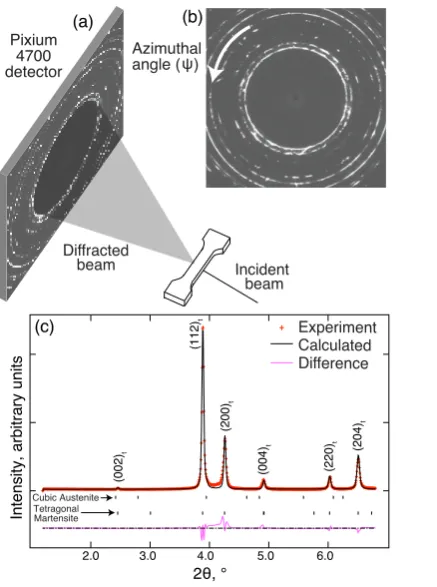
Azimuthal angle ( )ψ
Incident beam Pixium
4700 detector
(a) (b)
2.0 3.0 4.0 5.0 6.0 2θ, °
Experiment Calculated Difference Diffracted
beam
Intensity, arbitrary units
(c)
Tetragonal Martensite Cubic Austenite
(112)
t
(200)
t
(004)
t
(220)
t
(002)
t (204)
t
Figure 1: (a) Schematic of the synchrotron X-ray diffraction setup, (b)
Com-plete Debye-Scherrer rings from tetragonal martensite and (c) Diffraction
spec-tra after 360◦intensity integration across diffraction rings in (b)
times and inter-melt flipped to minimise elemental segregation.
60
The ≈60 g ingot was encapsulated in a quartz tube and then
61
homogenised at 900◦C for 24 h. The ingot was then packed
62
in Ti powder in a mild steel can and 80% hot rolled at 900◦C.
63
0.5×0.5×30 mm gauge length specimens were then
fabri-64
cated by grinding and electro-discharge machining. Diff
eren-65
tial scanning calorimetry using a Mettler Toledo DSC 822e
in-66
strument was used to obtain initial estimates of the
transforma-67
tion temperatures. The composition was also checked at this 68
stage by SEM-EDX and found to be within the measurement 69
error (∼ 0.5 at.%) of the target composition. Light element 70
pickup such as O was therefore not determined. The
speci-71
men was then thermally cycled at a rate of 2◦Cs−1at zero load
72
in an Instron5 kN resistance heating electro-thermal
mechan-73
ical testing machine (ETMT) at the ID15B powder diffraction
74
beamline at the ESRF, Grenoble France, Figure 1. The
sam-75
ple temperature was measured by using R-type thermocouple
76
mounted on the sample surface, within 0.1 mm of the scanned
77
volume. A wavelength of 0.1427 Å was used and the incident
78
beam was approx. 0.5×0.5 mm in size, giving a sampled vol-79
ume of 0.5×0.5×0.5 =0.125 mm3. A Thales Pixium 4700
80
detector [24] was used to collect complete Debeye-Scherrer
81
diffraction rings (Figure 1b) at a sample-detector distance of
82
1.228 m. A LaB6 calibration powder was used to determine
83
the instrument parameters. Phase fractions and lattice
param-84
eters were evaluated using the generalized structural analysis
85
package (GSAS) [26, 27] and the area detector analysis
pack-86
age Fit2D [28]. Whole-ring integrations were used; the analysis
87
was not found to be sensitive to orientation around the ring;i.e
88
there were no effects induced by,e.g. the rolling texture. This
89
issue has been examined in our previous work [29, 30].
90
The high temperature (austenite) phase in Ni54Mn25Ga21has
91
an F m 3 m crystal structure with Ni at (1/4,1/4,1/4), Mn
92
at (1/2,1/2,1/2) and Ga at (0,0,0) and ac = 5.8468±0.0003
93
at 320 ◦C. For thermal cycling in the absence of stress and
94
magnetic field, the martensite is tetragonal. The room
tem-95
perature lattice parameters of the martensite were found to be
96
at = 3.8391±0.0003, ct =6.650±0.001 and ct/at = 1.732.
97
Comparing these with the lattice parameters for Ni53Mn25Ga22
98
reported by Cong et. al. [23] of at = 3.865, ct = 6.596
99
and ct/at = 1.707, the increase in e/a achieved by
increas-100
ing Ni (at the expense of Ga) in the current alloy appears to
101
change the c/a ratio considerably. The main orientation
re-102
lationship in Ni53Mn25Ga22 is reported to be (111)ck(101))t,
103
[110])ck[111])t[1, 31].
104
The transformation sequence in the first thermal cycle is
105
shown in Figure 2. A large dilation in the d(200)interplanar
spac-106
ing in the tetragonal martensite was clearly visible on heating
107
and cooling. A new peak emerged in vicinity of the tetragonal
108
(200) peak during the initial stages of cooling, but apart from
109
this no additional peaks were observed elsewhere in the spectra.
110
Therefore it is difficult to confirm the existence of an
interme-111
diate martensite phase. A subtle yet visible shift in the (200)
112
tetragonal peak is observed (arrowed) on final cooling and
be-113
fore reheating began.
114
TheRietveld-refined lattice parameters and phase fractions
115
are shown in Figure 3. The transformation from tetragonal to
116
cubic begins on heating at around 213◦C with 80% of the cubic
117
phase appearing over a temperature range of 227−258◦C, after
118
which the transformation rate decreases with temperature
be-119
fore final completion at 286◦C. The measurement points occur
120
approximately every 5 ◦C, allowing the austenite and
marten-121
site start and finish temperatures (at 90%/10% phase fraction)
122
to be interpolated with an accuracy of around 3◦C, Table 1. The
123
fitted lattice parameters, Figure 3, show almost no shift between
124
successive thermal cycles, which is a good indicator of thermal
125
stability. For example, the change in at at 125 ◦C after four
126
thermal cycles was only 0.04% (Table 1). On initial heating, at
127
increased at a rate of≈77×10−6 ◦C−1and ctdecreases with a
128
thermal expansion coefficient of−69×10−6 ◦C−1. At≈160◦C
129
(near the Curie temperature estimated elsewhere [15, 23]), a
130
visible change in linearity is observed and the thermal
expan-131
sion/contraction appears to accelerate;i.e.,atthen dilates and
132
ct constricts at a more rapidly than before. These events are
133
schematically highlighted in the final subfigure in Figure 3. The
134
reverse behaviour is observed on cooling and again the
inflec-135
tion point is≈160 ◦C. One can speculate that this change in
136
thermal expansion is associated with a change in the magnetic 137
ordering in the material in the vicinity of the reported Curie 138
temperature; rationalisation of this result would benefit fromin
139
situmagnetic neutron diffraction measurements. 140
In the cubic high temperature phase, the corresponding
ther-141
mal expansion coefficient is measured to be 13×10−6 ◦C−1.
142
During transformation, contraction of ct initially ceases (at
[image:2.595.66.285.79.373.2]2θ, °
3.800 4.050 4.175 4.300
Heating
Cooling
Heating C2
2.152 2.069Interplanar spacing d, Å2.019 1.959 1.902
(112)
Tetragonal
3.925
(200)
Tetragonal
[image:3.595.306.558.76.506.2](220) Cubic
Figure 2: Evolution of (sections of the) diffraction pattern during the first
ther-mal cycle in Ni54Mn25Ga21. The e.m.f reversal regime during which a shift in
martensite lattice parameters was observed is indicated by arrows on the right.
≈ 235 ◦C), but during the final stages of transformation it
re-144
sumes; a similar behaviour in reverse is observed for at. During
145
cooling, at approximately 256 ◦C, indicated by arrow in
Fig-146
ure 3, there appears to be a rather large instantaneous jump in
147
both ct and the austenite lattice parameter. Remarkably, this
148
phenomenon is only observed during cooling and in case of
149
tetragonal martensite, it is only observed in the ct lattice
pa-150
rameter.
151
1.00
0.50
0.00
3.840 3.884 3.929
6.465 6.559 6.652
Temperature (˚C)
Volume Fraction of T
etra
at
, Å
1.646 1.689 1.733
ct
, Å
5.834 5.841 5.848
ac
, Å
50 200 350
98.01 98.91 99.81
c
t / a
t
V
t, Å
3
198.6 199.3 200.0
V
c, Å
3
50 200 350
6.465 6.559 6.652
c
t, Å
3.840 3.884 3.929
at
, Å
at ct
Heating Cooling C1 C2 C5
157 ˚C
165 ˚C
Figure 3: Tetragonal martensite and cubic austenite unit cell evolution evaluated as a function of sample temperature. Solid symbols are in thr single phase region and open symbols during transformation. ‘V’ is the unit cell volume and subscripts t and c signify the tetragonal and cubic phases, respectively. Cycles 1 (C1), 2 (C2) and 5 (C5) are shown.
Interestingly, a hysteresis is observed in the lattice
parame-152
ters in both the cubic and tetragonal phases, not associated with
153
the transformation itself. In the first thermal cycle (brown/dark
154
blue) which reversed at 345◦C the lattice parameters converge
155
at that point, whereas in subsequent cycles they converge at the
156
end point of 300◦C. This is a consequence of the resistance
157
heating method used, where the direct current applied produces
158
an e.m.f. which, in this ferromagnetic material, results in a
159
change in the lattice parameters. However, the Curie
tempera-160
ture in these alloys is widely reported to be≈110◦C [15]. This
161
observation therefore poses a new question such as to whether
162
these alloys shed their ferromagnetic properties completely, or
163
not.
164
The lattice parameters are shown for the first, second and
[image:3.595.67.267.81.607.2]Table 1: Lattice parameters ( Å) of tetragonal martensite on cooling and heating
(at 125◦C for martensite and at 270◦C for austenite), where, c and h
super-scripts are for cooling and heating, As, Af, Msand Mfare austenite start, finish,
martensite start and finish respectively.
Cycle 1 Cycle 5
ah
t 3.8653±0.0003 3.8667±0.0004
ac
t 3.8606±0.0004 3.8604±0.0003
ch
t 6.603±0.001 6.600±0.001
cc
t 6.611±0.001 6.612±0.001
ah
c 5.8433±0.0003 5.8425±0.0002
ac
c 5.8403±0.0003 5.8403±0.0002
Austenite start, As 226 227
Austenite finish, Af 298 258
Martensite start, Ms 267 268
Martensite finish, Mf 232 236
fifth thermal cycle applied. It is notable that, whilst the lattice
166
parameters at a given temperature are invariant with cycling,
167
the transformation temperatures do evolve, by∼8 K/cycle for
168
the austenite finish temperatureAf.
169
The evolution of the ETMT actuator position, along with the
170
ex-situ DSC data, are shown in Figure 4. For comparison, DSC
171
Heat Flow
25 155 285
Temperature (˚C)
50 250 350
25
13
0
Relative position,
μ
m
Heating
Cooling C1
C5
C1
C5 Heating
C1
Cooling
Ni50Ti35Hf15
Ni50Ti35Zr15
Binary NiTi
Ni54Mn25Ga21 (a)
(b)
Heating
Cooling
C1 C2 C3 C4 C5 C1 C2 C3 C4 C5
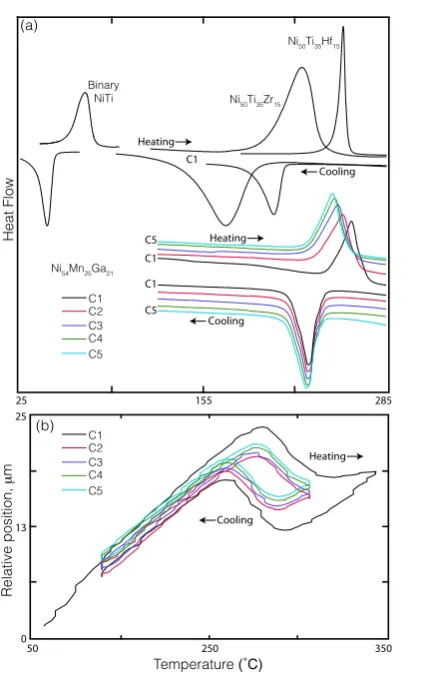
Figure 4: (a) Differential Scanning calorimeter (DSC) results obtained for five
heating and five cooling cycles of as-rolled Ni54Mn25Ga21are shown, in
com-parison with the first cycle results for binary NiTi and as-rolled high
temper-ature SMAs Ni50Ti35Hf15and Ni50Ti35Zr15alloys and (b) Dilation in
macro-scopic Ni54Mn25Ga21along the rolling direction during thermal cycling.
data for binary NiTi and two Ni50Ti35X15 (X=Hf or Zr) high
172
temperature shape memory alloys are also shown. The DSC
re-173
sults reproduce the observed transformation temperatures from
174
the diffraction measurements and show a hysteresis (Af-Mf) of
175
around of 22 K in cycle 5. The austenite finish temperature
176
gradually declines on cycling, but the martensite
transforma-177
tion temperatures remain constant, which is unusual compared
178
to NiTi SMAs. In addition, the ETMT actuator position, which
179
is in effect a dilatometry measurement over the entire sample
180
length (some of which remained cold and did not transform),
181
is shown. The transformation on heating results in a
contrac-182
tion of the sample which is reversed on cooling, but there is
183
an evolution in the end-point actuator positions with cycling
184
that indicates expansion of the sample from cycle 2 through 5.
185
Since this occurs for thefccaustenite as well as the martensite,
186
this cannot be due to the selection of preferred crystallographic
187
variants and therefore must be due to the accumulation of
plas-188
ticity,i.e. interface dislocations. By reference to conventional
189
NiTi SMAs[32, 33], this would also be the reason for the
grad-190
ual decline in the austenite transformation temperatures with
191
cycling.
192
In summary, polycrystalline Ni54Mn25Ga21 has been
pro-193
duced by a conventional ingot metallurgy and hot working
ap-194
proach. It is found to be a viable high temperature shape
mem-195
ory alloy material with Mf = 236 ◦C. The lattice parameters
196
measured in both phases were found to be affected by the
mag-197
netic fields induced in the specimen by the applied ohmic
heat-198
ing method used, even above the expected Curie temperature of
199
the alloy. Some functional fatigue was observed in the austenite
200
transformation temperatures on heating. The thermal expansion
201
/contraction of the tetragonal martensite atand ctcell
parame-202
ters were observed to accelerate above the expected Curie
tem-203
perature.
204
Acknowledgements
205
The authors gratefully acknowledge funding by Rolls Royce Plc.,
206
Imperial College and the UK-India Education and Research
Ini-207
tiative (UKIERI). DD acknowledges funding from EPSRC under
208
EP/H004882/1. The assistance provided by T. Buslaps is also
appreci-209
ated.
210
[1] V. A. Chernenko, E. Cesari, V. V. Kokorin, and I. N. Vitenko, “The
devel-211
opment of new ferromagnetic shape memory alloys in Ni-Mn-Ga system,”
212
Scripta Metallurgica et Materialia, vol. 33, pp. 1239–1244, 1995.
213
[2] D. J. Hartl and D. C. Lagoudas, “Aerospace applications of shape
mem-214
ory alloys,”Proceedings of the Institution of Mechanical Engineers G –
215
Journal of Aerospace Engineering, vol. 221, no. G4, pp. 535–552, 2007.
216
[3] N. T. Birch and J. R. Webster, “Gas turbine engine exhaust nozzle having
217
a noise attenuation device driven by shape memory material actuators,”
218
US Patent US6813877B2, 2004.
219
[4] Y. Li, D. Zhao and J. Liu, “Giant and reversible room-temperature
elas-220
tocaloric effect in a single-crystalline Ni-Fe-Ga magnetic shape memory
221
alloy,”Scientific Reports, vol. 6, 25500, 2016.
222
[5] H. Ossmer, F. Lambrecht, M. G¨ultig, C. Chluba, E. Quandt and M. Kohl,
223
“Evolution of temperature profiles in TiNi films for elastocaloric cooling,”
224
Acta Materialia, vol. 81, pp. 9–20, 2014.
225
[6] S. Qian, Y. Geng, Y. Wang and T.E. Pillsbury, Y. Hada, Y. Yamaguchi,
226
K. Fujimoto, Y. Hwang, R. Radermacher, J. Cui, Y. Yuki, K. Toyotake,
227
and I. Takeuchl, “Elastocaloric effect in CuAlZn and CuAlMn shape
228
memory alloys under compression”, Philosophical Transactions of the
229
Royal Society of London Avol. 374, 20150309, 2016.
230
[7] J.-h. Kim, F. Inaba, T. Fukuda, and T. Kakeshita, “Effect of magnetic field
231
on martensitic transformation temperature in Ni–Mn–Ga ferromagnetic
232
shape memory alloys,”Acta Materialia, vol. 54, pp. 493–499, Jan. 2006.
[image:4.595.65.282.364.705.2][8] A. Sozinov, A. A. Likhachev, N. Lanska, and K. Ullakko,
“Gi-234
ant magnetic-field-induced strain in NiMnGa seven-layered martensitic
235
phase,”Applied Physics Letters, vol. 80, no. 10, p. 1746, 2002.
236
[9] M. Chmielus, X. X. Zhang, C. Witherspoon, D. C. Dunand, and
237
P. M¨ullner, “Giant magnetic-field-induced strains in polycrystalline Ni–
238
Mn–Ga foams,”Nature Materials, vol. 8, pp. 863–866, Sept. 2009.
239
[10] C. A. Jenkins, R. Ramesh, M. Huth, T. Eichhorn, P. P¨orsch, H. J. Elmers,
240
and G. Jakob, “Growth and magnetic control of twinning structure in thin
241
films of Heusler shape memory compound Ni2MnGa,”Applied Physics
242
Letters, vol. 93, no. 23, p. 234101, 2008.
243
[11] S. Jeong, K. Inoue, S. Inoue, K. Koterazawa, M. Taya, and K. Inoue,
244
“Effect of magnetic field on martensite transformation in a polycrystalline
245
Ni2MnGa,”Materials Science and Engineering A, vol. 359, pp. 253–260,
246
Oct. 2003.
247
[12] S. J. Murray, M. A. Marioni, A. M. Kukla, J. Robinson, R. C. O’Handley,
248
and S. M. Allen, “Large field induced strain in single crystalline Ni–
249
Mn–Ga ferromagnetic shape memory alloy,”Journal of Applied Physics,
250
vol. 87, no. 9, p. 5774, 2000.
251
[13] P. J. Webster, K. R. A. Ziebeck, S. L. Town, and M. S. Peak, “Magnetic
252
Order and Phase-Transformation in Ni2MnGa,”Philosophical Magazine
253
B, vol. 49, no. 3, pp. 295–310, 1984.
254
[14] H. Xu, Y. Ma, and C. Jiang, “A high-temperature shape-memory alloy
255
Ni54Mn25Ga21,”Applied Physics Letters, vol. 82, no. 19, pp. 3206–3208,
256
2003.
257
[15] N. Lanska, O. Soderberg, A. Sozinov, Y. Ge, K. Ullakko, and V.K
Lin-258
droos, “Composition and temperature dependence of the crystal
struc-259
ture of Ni-Mn-Ga alloys,”Journal of Applied Physics, vol. 95, no. 12,
260
pp. 8074–8078, 2004.
261
[16] V. A. Chernenko, J. Pons, C. Seguı, and E. Cesari, “Premartensitic
phe-262
nomena and other phase transformations in Ni–Mn–Ga alloys studied by
263
dynamical mechanical analysis and electron diffraction,”Acta Materialia,
264
vol. 50, pp. 53–60, Jan. 2002.
265
[17] C. Jiang, G. Feng, S. Gong, and H. Xu, “Effect of Ni excess on phase
266
transformation temperatures of NiMnGa alloys,”Materials Science and
267
Engineering A, vol. 342, pp. 231–235, Feb. 2003.
268
[18] S. K. Wu and S. T. Yang, “Effect of composition on transformation
tem-269
peratures of Ni–Mn–Ga shape memory alloys,”Materials Letters, vol. 57,
270
pp. 4291–4296, 2003.
271
[19] J. Pons, V. Chernenko, R. Santamarta, and E. Cesari, “Crystal structure of
272
martensitic phases in Ni-Mn-Ga shape memory alloys,”Acta Materialia,
273
vol. 48, no. 12, pp. 3027–3038, 2000.
274
[20] P. J. Brown, J. Crangle, T. Kanomata, M. Matsmuoto, K. U. Neumann,
275
B. Ouladdiaf, and K. R. A. Ziebeck, “The crystal structure and phase
276
transitions of the magnetic shape memory compound Ni2MnGa,”Journal
277
of Physics – Condensed Matter, vol. 14, no. 43, pp. 10159–10171, 2002.
278
[21] M. Richard, J. Feuchtwanger, D. Schlagel, T. Lograsso, S.M Allen, and
279
R.C O’Handley, “Crystal structure and transformation behavior of
Ni-280
Mn-Ga martensites,”Scripta Materialia, vol. 54, no. 10, pp. 1797–1801,
281
2006.
282
[22] Y.Q Ma, C.B Jiang, G. Feng, and H.B Xu, “Thermal stability of the
283
Ni54Mn25Ga21 Heusler alloy with high temperature transformation,”
284
Scripta Materialia, vol. 48, no. 4, pp. 365–369, 2003.
285
[23] D. Y. Cong, P. Zetterstrom, Y. D. Wang, R. Delaplane, R. L. Peng,
286
X. Zhao, and L. Zuo, “Crystal structure and phase transformation in
287
Ni53Mn25Ga22 shape memory alloy from 20 K to 473 K,” Applied
288
Physics Letters, vol. 87, no. 11, 2005.
289
[24] J. E. Daniels and M. Drakopoulos, “High-energy X-ray diffraction using
290
the Pixium 4700 flat-panel detector,”Journal of Synchrotron Radiation,
291
vol. 16, no. 4, pp. 463–468, May 2009.
292
[25] H. M. Rietveld, “A profile refinement method for nuclear and magnetic
293
structures,”Journal of Applied Crystallography, vol. 2, no. 2, pp. 65–71,
294
June 1969.
295
[26] B. H. Toby, “EXPGUI, a graphical user interface for GSAS,”Journal of
296
Applied Crystallography, vol. 34, no. 2, pp. 210–213, 2001.
297
[27] A. C. Larson and R. B. Von Dreele, “GSAS: general structure analysis
298
system,”Los Alamos National Laboratory Report LAUR 86-748, 2004.
299
[28] A. P. Hammersley, S. O. Svensson, M. Hanfland, A. N. Fitch, and
300
D. Hausermann, “Two-dimensional detector software: From real detector
301
to idealised image or two-theta scan,”High Pressure Research, vol. 14,
302
no. 4-6, pp. 235–248, Jan. 1996.
303
[29] M. A. Azeem, and D. Dye, “In situ evaluation of the transformation
304
behaviour of NiTi-based high temperature shape memory alloys,”
Inter-305
metallics, vol. 46, pp. 222–230, 2014
306
[30] M. A. Azeem, and D. Dye, “Lattice instability during the martensitic
307
transformation in the high temperature shape memory alloy Zr (Cu 0.5
308
Co 0.25 Ni 0.25),”Journal of Alloys and Compounds, vol. 618, pp. 469–
309
474, 2015
310
[31] D. Y. Cong, Y. D. Zhang, Y. D. Wang, M. Humbert, X. Zhao, T. Watanabe,
311
L. Zuo, and C. Esling, “Experiment and theoretical prediction of
marten-312
sitic transformation crystallography in a Ni–Mn–Ga ferromagnetic shape
313
memory alloy,”Acta Materialia, vol. 55, no. 14, pp. 4731–4740, 2007.
314
[32] N.G.Jones, D. Dye. “Martensite evolution in a NiTi shape memory
al-315
loy when thermal cycling under an applied load,”Intermetallics, vol. 19,
316
pp. 1348–1358, 2011.
317
[33] I. Takeuchi, O. O. Famodu, J. C. Read, M. A. Aronova, K.-S. Chang,
318
C. Craiciunescu, S. E.Lofland, M. Wuttig, F. C. Wellstood, L. Knauss,
319
A. Orozco. “Identification of novel compositions of ferromagnetic
shape-320
memory alloys using composition spreads,” Nature Materials, vol. 2,
321
no. 3, pp. 180–184, 2003.