M E T H O D O L O G Y A R T I C L E
Open Access
An Eigenvalue test for spatial principal
component analysis
V. Montano
1*and T. Jombart
2Abstract
Background:The spatial Principal Component Analysis (sPCA, Jombart (Heredity 101:92-103, 2008) is designed to investigate non-random spatial distributions of genetic variation. Unfortunately, the associated tests used for assessing the existence of spatial patterns (global and local test; (Heredity 101:92-103, 2008) lack statistical power and may fail to reveal existing spatial patterns. Here, we present a non-parametric test for the significance of specific patterns recovered by sPCA.
Results:We compared the performance of this new test to the originalglobalandlocaltests using datasets simulated under classical population genetic models. Results show that our test outperforms the originalglobalandlocaltests, exhibiting improved statistical power while retaining similar, and reliable type I errors. Moreover, by allowing to test various sets of axes, it can be used to guide the selection of retained sPCA components.
Conclusions:As such, our test represents a valuable complement to the original analysis, and should prove useful for the investigation of spatial genetic patterns.
Keywords:Eigenvalues, sPCA, Spatial genetic patterns, Monte-Carlo
Background
The principal component analysis (PCA; [1, 2]) is one of the most common multivariate approaches in population genetics [3]. Although PCA is not explicitly accounting for spatial information, it has often been used for investi-gating spatial genetic patterns [4]. As a complement to PCA, the spatial principal component analysis [5] has been introduced to explicitly include spatial information in the analysis of genetic variation, and gain more power for investigating spatial genetic structures.
sPCA finds synthetic variables, the principal compo-nents (PCs), which maximise both the genetic variance and the spatial autocorrelation as measured by Moran’sI
[6]. As such, PCs can reveal two types of patterns:‘global’
structures, which correspond to positive autocorrelation typically observed in the presence of patches or clines, and‘local’structures, which correspond to negative auto-correlation, whereby neighboring individuals are more genetically distinct than expected at random (for a more detailed explanation on the meaning of global and local
structures see [5]). The global and local tests have been developed for detecting the presence of global and local patterns, respectively [5]. Unfortunately, while these tests have robust type I error, they also typically lack power, and can therefore fail to identify existing spatial genetic patterns [5]. Moreover, they can only be used to diagnose the presence or absence of spatial patterns, and are unable to test the significance of specific structures revealed by sPCA axes.
In this paper, we introduce an alternative statistical test which addresses these issues. This approach relies on computing the cumulative sum of a defined set of sPCA eigenvalues as a test statistic, and uses a Monte-Carlo pro-cedure to generate null distributions of the test statistics and approximatep-values. After describing our approach, we compare its performances to the global and local tests using simulated datasets, investigating several standard spatial population genetics models. Our approach is implemented as the functionspca_randtestin the package
adegenet[7, 8] for the R software [9].
* Correspondence:[email protected]
1School of Biology, University of St Andrews, Bute Building, St Andrews KY16
9TS, UK
Full list of author information is available at the end of the article
Methods
Test statistic
As in most multivariate analyses of genetic markers, our approach analyses a table of centred allele frequencies (i.e. set to a mean frequency of zero), in which rows represent individuals or populations, and columns correspond to alleles of various loci [3, 5, 10]. We note X the resulting matrix, and n the number of individuals analysed. In addition, the sPCA introduces spatial data in the form of a
n by n matrix of spatial weightsL, in which theith row contains weights reflecting the spatial proximity of all individuals to individual i. The PCs of sPCA are then found by the eigen-analysis of the symmetric matrix (Jombart et al. [5]):
1=ð ÞX2n T LTþLX
We noteλthe corresponding non-zero eigenvalues. We differentiate the r positive eigenvalues λ+, corresponding to global structures, and the ‘s’ negative eigenvalues λ−, corresponding to local structures, so that λ= {λ+,λ−}. Without loss of generality, we assume both sets of eigen-values are ordered by decreasing absolute value, so that λ1+ >λ2+ >…>λr+ and |λ1−| > |λ2−| >…> |λs−|. Simply put,
each eigenvalue quantifies the magnitude of the spatial genetic patterns in the corresponding PC: larger absolute values indicate stronger global (respectively local)
structures. We noteV+= {v1+,…,vr+} andV−= {v1−,…, vs−}
the sets of corresponding PCs.The most natural choice of test statistic to assess whether a given PC contains signifi-cant structure would seem to be the corresponding eigen-value. This would, however, not account for the dependence on previous PCs:vj+(respectivelyvj−) can only
be significant if all previous PCs {v1+,…,vj+-1} are also
sig-nificant. To account for this, we define the test statistic for
vj+as:
fiþ¼Σi¼1;…;jλiþ
and as:
fi−¼Σi¼1;…;jjλi−j
forvj−. fi
+
and fi− become larger in the presence of strong
global or local structures in the firstithglobal/local PCs. Therefore, they can be used as test statistics against the null hypotheses of absence of global or local structures in these PCs. The expected distribution of fi+and fi− in the
absence of spatial structure is not known analytically. Fortunately, it can be approximated using a Monte-Carlo procedure, in which at each permutation individual geno-types are shuffled to be assigned to a different pair of coordinates than in the observed original dataset and fi
+
andfi−are computed. Note that the original values of the
[image:2.595.50.539.419.665.2]test statistic are also included in these distributions, as the initial spatial configuration is by definition a possible random outcome. Thep-values are then computed as the relative frequencies of permuted statistics equal to or greater than the initial value offi
+
orfi−.
To guide the selection of global and local PCs to retain, the simulated values of each eigenvalue (from most positive to most negative), which make up the fi
+
and fi−statistics, are also recorded during the
permuta-tion procedure. In this way, if global or local structures are detected to be significant, an observed p-value for each observed eigenvalue can be estimated by compari-son with its simulated eigenvalue distribution. Note that the number of eigenvalues produced by an sPCA does not change between the observed and permuted data-sets, so each observed eigenvalue can be compared with the distribution of the corresponding simulated one. This testing procedure can be used with increasing num-bers of retained axes, testing the significance of a new axis as long as previous axes showed significant structure. As one test is performed per axis, we use Bonferroni correc-tion to avoid the inflacorrec-tion of type I error, so that the significance level for theithPC will beα/i, whereαis the target type I error. Hence, the correction implies that if the most positive (or negative) eigenvalue is significant in regards with the chosen p-value threshold, the second
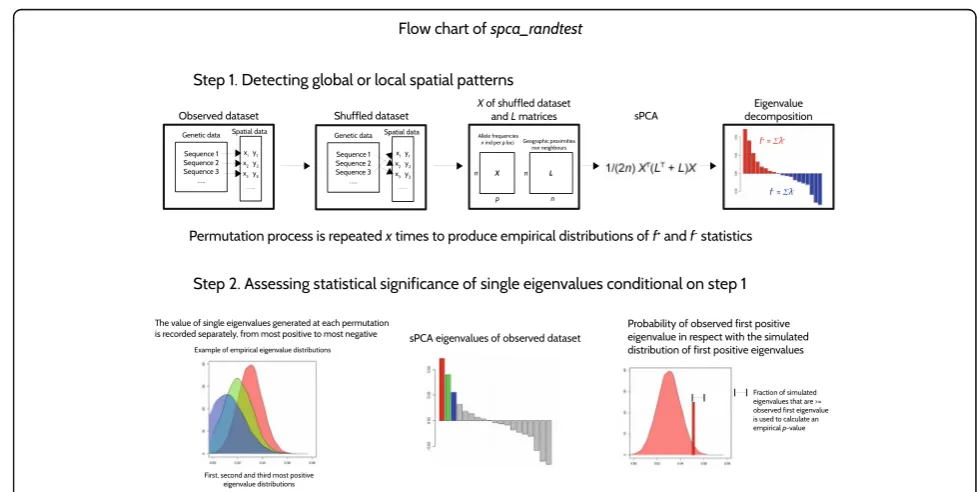
eigenvalue is tested for ap-value threshold that is the half of the previous and so on. The entire testing procedure is implemented in the functionspca_randtestin the package
adegenet[7, 8] for R [9]. A flow chart of the test procedure is shown in Fig. 1.
Simulation study
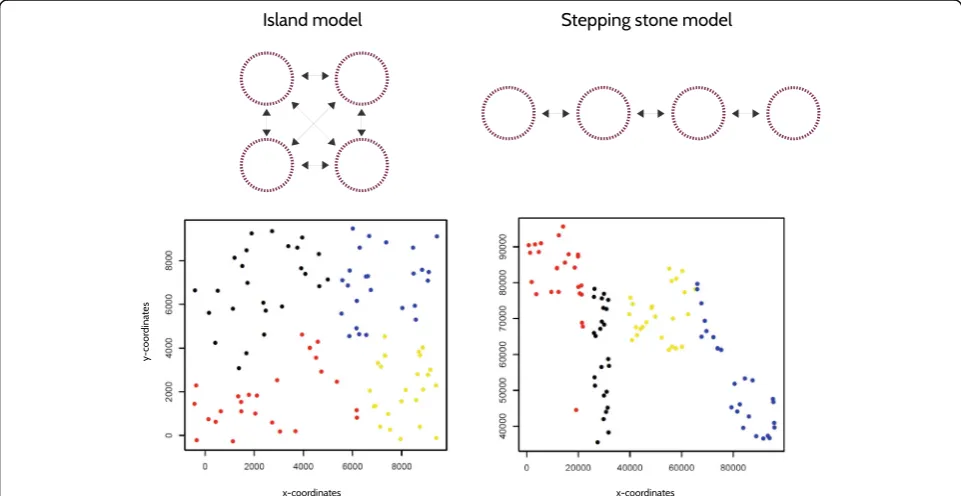
To assess the performance of our test, we simulated gen-etic data under three migration models: island (IS) and stepping stone (SS), using the software GenomePop 2.7 [11], and isolation by distance (IBD), using IBDSimV2.0
[12]. We simulated the IS and SS models with 4 popula-tions, each with 25 individuals, and a single population under IBD with 100 individuals. 200 unlinked biallelic diploid loci (or single nucleotide polymorphisms; SNPs) were simulated. Populations evolved under constant ef-fective population sizeθ= 20, and interchanged migrants at three different symmetric and homogeneous rates (0.005, 0.01, and 0.1). We performed 100 independent runs for each of the three migration rates, for a total of 300 simulated dataset per migration model. An example of input file for GenomePop 2.7 and IBDSimV2.0 are included as Additional files 1 and 2.
To quantify type I error rates for the spca_randtest, globaland local tests, we extracted 100 random coordi-nates from 10 square 2D grids, using the function
[image:3.595.57.538.415.663.2]spsamplefrom thespdeppackage [13]. In order to evalu-ate the revalu-ate of false negatives for global patterns, we manually generated 10 sets of 100 pairs of coordinates simulating gradients and/or patches from 2D grids. An example of simulated global patterns is presented in Fig. 2. To test for the rate of false negatives for local patterns, we perform a principal component analysis on 10 random datasets simulated under the SS model with 0.005 migration rate. We used the coordinates of the individuals on the first principal component and set the second coord-inate to zero for all individuals (1D). With the coordcoord-inates so produced, we used the functionchooseCNin adegenet to obtain 10 neighbouring graphs where the most genetically distinct individuals (falling in the upper quartile of the pair-wise genetic distances) are considered as neighbors, while the others are non-neighbors.
We tested 100 simulations each for all the 30 sets of geographic coordinates (random, positive and nega-tive), for each of the three migration rates (0.005, 0.01 and 0.1), for each of the three migration models (IS, SS, IBD; total of 9000 tests per migration model). We repeated all tests using a subset of 40 SNPs per individual, for a total of 18,000 tests in the absence of spatial structures, and and 36,000 tests in the pres-ence of global or local structures.
Results
Statistical power of the spca_randtest
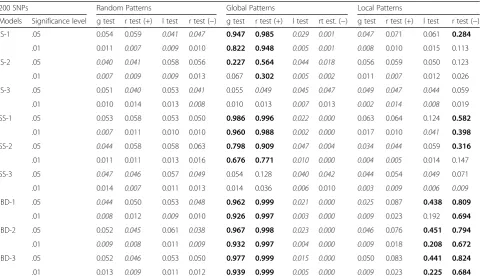
We compared the performances of thespca_randtest with theglobalandlocaltests in three settings: in the absence of spatial structure, and in the presence of global, and local structures. The results obtained in the absence of spatial structure show that all tests have reliable type I errors (Table 1 and 2). The spca_randtest exhibited consistently better performances for detecting existing structures in the data than both global andlocal tests (Table 1 and 2). Al-though our simulated local spatial patterns turned out more difficult to detect than global patterns, thespca_randtestis twice to five times more effective than thelocal test(Table 1 and 2). Generally, the underlying migration model, the migration rate and the number of loci affect the ability of all tests to detect non-random spatial patterns. Both spca_r-andtestandglobalandlocal testshave in fact a lower sensi-tivity in presence of island migratory schemes, while results for stepping stone and isolation by distance models are more satisfying (Table 1 and 2). Increasing migration rates lead to a higher rates of false negatives for all tests, which can be overcome using more loci (Table 1 and 2).
[image:4.595.58.539.435.714.2]Significant eigenvalues are assessed using a hierarchical Bonferroni correction which accounts for non-independence of eigenvalues and multiple testing (Fig. 2). Strong patterns
Table 1Significant results for global test(g test), local tests(l test), andspca_randtest(r test +/−) for random, global and local patterns using 200 loci per individual. IS, SS, IBD indicate the migration models (see Methods); different migration rates are coded by number: 1 = 0.005, 2 = 0.01 and 3 = 0.1
200 SNPs Random Patterns Global Patterns Local Patterns
Models Significance level g test r test (+) l test r test (−) g test r test (+) l test rt est. (−) g test r test (+) l test r test (−)
IS-1 .05 0.054 0.059 0.041 0.047 0.947 0.985 0.029 0.001 0.047 0.071 0.061 0.284
.01 0.011 0.007 0.009 0.010 0.822 0.948 0.005 0.001 0.008 0.010 0.015 0.113
IS-2 .05 0.040 0.041 0.058 0.056 0.227 0.564 0.044 0.018 0.056 0.059 0.050 0.123
.01 0.007 0.009 0.009 0.013 0.067 0.302 0.005 0.002 0.011 0.007 0.012 0.026
IS-3 .05 0.051 0.040 0.053 0.041 0.055 0.049 0.045 0.047 0.049 0.047 0.044 0.059
.01 0.010 0.014 0.013 0.008 0.010 0.013 0.007 0.013 0.002 0.014 0.008 0.019
SS-1 .05 0.053 0.058 0.053 0.050 0.986 0.996 0.022 0.000 0.063 0.064 0.124 0.582
.01 0.007 0.011 0.010 0.010 0.960 0.988 0.002 0.000 0.017 0.010 0.041 0.398
SS-2 .05 0.044 0.058 0.058 0.063 0.798 0.909 0.047 0.004 0.034 0.044 0.059 0.316
.01 0.011 0.011 0.013 0.016 0.676 0.771 0.010 0.000 0.004 0.005 0.014 0.147
SS-3 .05 0.047 0.046 0.057 0.049 0.054 0.128 0.040 0.042 0.044 0.054 0.049 0.071
.01 0.014 0.007 0.011 0.013 0.014 0.036 0.006 0.010 0.003 0.009 0.006 0.009
IBD-1 .05 0.044 0.050 0.053 0.048 0.962 0.999 0.021 0.000 0.025 0.087 0.438 0.809
.01 0.008 0.012 0.009 0.010 0.926 0.997 0.003 0.000 0.009 0.023 0.192 0.694
IBD-2 .05 0.052 0.045 0.061 0.038 0.967 0.998 0.023 0.000 0.046 0.076 0.451 0.794
.01 0.009 0.008 0.011 0.009 0.932 0.997 0.004 0.000 0.009 0.018 0.208 0.672
IBD-3 .05 0.052 0.046 0.053 0.050 0.977 0.999 0.015 0.000 0.050 0.083 0.441 0.824
.01 0.013 0.009 0.011 0.012 0.939 0.999 0.005 0.000 0.009 0.023 0.225 0.684
*p-valuesare in italic when non significant and in bold when the fraction of true positive is above 20%
(e.g. IBD) tend to produce a higher number of significant components than weak patterns (e.g. island models with high migration rates), which are otherwise captured by fewer to no components.
Application to real data
We have run the sPCA to compare the newspca_randtest
and previous tests to a real dataset of human mitochondrial DNA (mtDNA). We used a dataset of 85 populations from Central-Western Africa that spans a big portion of the African continent (from Gabon to Senegal; [14]). Previous analysis on these data detected a clear genetic structure from West to Central Africa with ongoing stepping stone migration movements. We therefore expected that this spatial distribution of genetic variation would be detected as significant. In the sPCA, populations were treated as units of the analysis, for which allele frequencies of mtDNA
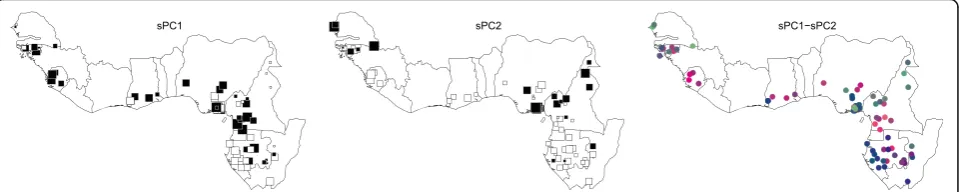
polymorphisms are calculated per population. The same approach was used in [14] to run a discriminant analysis of principal components (DAPC; [10]) and detect population genetic structure. The sPCA analysis is found non signifi-cant by global and local tests after 10,000 permutations (p-value >0.5), while the spca_randtest detects a signifi-cant global pattern already with 500 permutations, and with 10,000 permutations the p-value for global patterns is 0.005. The second step of the test on single eigenvalues finds the three most positive components to be significant after Bonferroni correction (Table 3). Significant axes can thus be plotted against the spatial network to give a biological interpretation to the results (Fig. 3).
Discussion
[image:5.595.58.539.98.378.2]We introduced a new statistical test associated to the sPCA to evaluate the statistical significance of global and
Table 2Results for the same simulations reported in Table 1 using a subset of 40 loci per individual
40 SNPs Random Patterns Global Patterns Local Patterns
Models Significance level g test r test (+) l test r test (−) g test r test (+) l test r test (−) g test r test (+) l test r test (−)
IS-1 .05 0.052 0.061 0.046 0.050 0.591 0.807 0.033 0.004 0.036 0.000 0.055 0.077
.01 0.016 0.013 0.010 0.007 0.393 0.592 0.005 0.000 0.004 0.000 0.015 0.022
IS-2 .05 0.053 0.047 0.038 0.042 0.103 0.226 0.046 0.020 0.073 0.000 0.057 0.038
.01 0.011 0.009 0.006 0.006 0.022 0.072 0.011 0.005 0.012 0.000 0.010 0.006
IS-3 .05 0.047 0.050 0.050 0.045 0.048 0.060 0.044 0.042 0.036 0.000 0.053 0.026
.01 0.009 0.011 0.008 0.007 0.009 0.011 0.011 0.011 0.002 0.000 0.013 0.001
SS-1 .05 0.052 0.054 0.039 0.049 0.898 0.949 0.017 0.000 0.050 0.001 0.067 0.169
.01 0.009 0.012 0.005 0.011 0.826 0.865 0.006 0.000 0.007 0.000 0.021 0.052
SS-2 .05 0.046 0.045 0.050 0.046 0.528 0.588 0.044 0.009 0.052 0.000 0.048 0.081
.01 0.013 0.010 0.010 0.015 0.377 0.370 0.016 0.000 0.005 0.000 0.011 0.014
SS-3 .05 0.068 0.040 0.050 0.048 0.066 0.055 0.053 0.033 0.026 0.000 0.047 0.023
.01 0.014 0.005 0.013 0.012 0.012 0.009 0.005 0.006 0.006 0.000 0.008 0.000
IBD-1 .05 0.049 0.053 0.052 0.057 0.822 0.883 0.027 0.002 0.034 0.055 0.124 0.480
.01 0.005 0.008 0.013 0.013 0.755 0.742 0.004 0.000 0.005 0.008 0.032 0.278
IBD-2 .05 0.043 0.054 0.060 0.049 0.835 0.880 0.028 0.001 0.043 0.051 0.111 0.458
.01 0.011 0.007 0.015 0.009 0.755 0.732 0.005 0.000 0.008 0.015 0.026 0.259
IBD-3 .05 0.043 0.042 0.051 0.050 0.844 0.899 0.026 0.002 0.048 0.058 0.115 0.465
.01 0.012 0.013 0.012 0.010 0.763 0.756 0.007 0.000 0.009 0.010 0.023 0.263
*p-valuesare in italic when non significant and in bold when the fraction of true positive is above 20%
Table 3Results of thespca_randtestwith 10,000 permutations on the human mtDNA dataset (Montano et al., [14])
Spatial patterns Observedp-value Decreasing Positive Eigenvalues Observedp-value Bonferroni corrected significant level
Global pattern 0.0058 3.4e-2 0.0105 0.05
Local pattern 0.8826 8.5e-3 0.0137 0.025
4.1e3 0.0136 0.016
1.6e-3 0.506 0.0125
The simulated distribution of thefi+andfi−statistics are compared to thefi+andfi−statistics observed for the original dataset. A significant global pattern (or
significantfi+observed statistics) is found with thespca_randtest(p-value <0.01). Thus, each positive eigenvalue is compared with its simulated distribution and
[image:5.595.56.539.628.697.2]local spatial patterns. Using simulated data, we show that this new approach outperforms previously implemented tests, having greater statistical power (lower type II errors) whilst retaining consistent type I errors. Our simulations also suggest that demographic settings and migratory models can substantially impact the ability to detect spatial patterns. Indeed, high migration rates, non-hierarchical mi-gration models, such as island model, and low amount of loci can hamper or worsen the performance of the test, pre-venting the detection of actual spatial patterns. In lack of previous information on the demographic history and/or the movement ecology of the population under study, it is certainly useful to exploit all the available genetic informa-tion. In this regards, our simulations show how an increased number of loci does improve the ability of the test to provide meaningful results.
The impact of specific factors such as the effective tion size or the number of individuals sampled per popula-tion remain to be investigated. A more extensive simulapopula-tion study, possibly comparing different non-model based methods such as sPCA, would clarify the extent of the spatial information that can be obtained with such methods without comparing explicit evolutionary hypotheses. In fact, the sPCA and the associated spca_randtest cannot distin-guish between explicit migration models. However, the possibility to detect which eigenvalues contain the spatial information provides the user with further information to interpret the biological meaning of the spatial structure, by focusing on few meaningful dimensions.
Our data application seems to confirm that the
spca_randtest is more effective than global or local
tests. We chose indeed a previously published dataset of human populations which span a subcontinental area of Africa and had been originally detected to be a highly structured dataset with a geographic cline of population differentiation (Montano et al. [14]). On the basis of the original results, we would have expected a spatial global structure to be present in the data and thus detected with
an sPCA. While theglobaltest failed to provide statistical significance, the spca_randtest did obtain significant results and pointed to the three first most positive compo-nents to be also significant after Bonferroni correction. In agreement with the original interpretation of the genetic structure within the samples, spatial component 1 (SP1) shows a clear differentiation of populations in the Gabon-Congo region, while SP2 detects differentiation of Central Nigerian and North Cameroonian populations, on one hand, and extreme Western populations of Senegal, on the other hand (Fig. 3). The colored combination of the first and second most positive component (Fig. 3) also correctly detects a more fragmented differentiation across Central forested areas (Cameroon, Gabon and Congo) compared to more homogeneous Central-Western popu-lations, which was the main result of the original publica-tion based on very different approaches [14]. We limited the analysis to these two component as the third did not add much information to the previous.
Conclusions
Our simulation approach coupled with a real data appli-cation well illustrates the informativeness of our new test to retrieve significant spatial patterns, being these global or local structures and highlights the usefulness of selecting a specific number of significant components to interpret the biological meaning of the results.
Additional files
Additional file 1:Example of GenomePop Input with a parameter setting to simulate an island model of migration. (TXT 363 kb)
Additional file 2:Example of IbdSettings for IBD_Sim with parameter setting to simulate an isolation by distance evolutionary model. (TXT 635 kb)
Additional file 3: Figure S1.Distributions of significant eigenvalues detected in the presence of global (blue bars) and local (green bars) spatial patterns after hierarchical Bonferroni correction, for 100 significantly positive and 100 significantly negative patterns. Black bars
[image:6.595.59.539.89.185.2]correspond to eigenvalues which are significant without Bonferroni correction. Bars’height indicates the frequency of observing a significant eigenvalue in a certain position (from most positive to most negative) over the 100 tested patterns. (PDF 1150 kb)
Acknowledgements
We thank two anonymous reviewers for insightful comments and feedback which greatly improved the original version of the manuscript.
Funding
No funds were used for this study.
Availability of data and materials
https://github.com/thibautjombart/adegenet/blob/master/R/spca_randtest.R
Author contributions
Test development: VM and TJ. Data analysis: VM. Wrote the manuscript: VM and TJ.
Ethics approval and consent to participate Not applicable
Consent for publication Not applicable
Competing interests
The authors declare no conflict of interest.
Author details
1School of Biology, University of St Andrews, Bute Building, St Andrews KY16
9TS, UK.2Department of Infectious Disease Epidemiology, MRC Centre for Outbreak Analysis and Modelling, Imperial College, St Mary’s Campus, Norfolk Place, London W2 1PG, UK.
Received: 1 July 2017 Accepted: 5 December 2017
References
1. Pearson K. On lines and planes of closest fit to systems of points in space. Philosophical Magazine Series. 1901;6:559–572.
2. Hotelling H. Analysis of a complex of statistical variables into principal components. J Ed Psychol. 1933;24:417.
3. Jombart T, Pontier D, Dufour AB. Genetic markers in the playground of multivariate analysis. Heredity. 2009;102:330–41.
4. Novembre J, Stephens M. Interpreting principal component analyses of spatial population genetic variation. Nat Genet. 2008;40:646–9.
5. Jombart T, Devillard S, Dufour AB, Pontier D. Revealing cryptic spatial patterns in genetic variability by a new multivariate method. Heredity. 2008;101:92–103. 6. Moran PAP. Notes on continuous stochastic phenomena. Biometrika. 1950;
37:17–23.
7. Jombart T. Adegenet: a R package for the multivariate analysis of genetic markers. Bioinformatics. 2008;24:1403–5.
8. Jombart T, Ahmed I. Adegenet 1.3-1: new tools for the analysis of genome-wide SNP data. Bioinformatics. 2011;27:3070–1.
9. R Core Team. R: A language and environment for statistical computing. R Foundation for Statistical Computing, Vienna, Austria. 2017. URL https:// www.R-project.org/.
10. Jombart T, Devillard S, Balloux F. Discriminant analysis of principal components: a new method for the analysis of genetically structured populations. BMC Genet. 2010;11:94.
11. Carvajal-Rodríguez A. GENOMEPOP: a program to simulate genomes in populations. BMC Bioinformatics. 2008;9:223.
12. Leblois R, Estoup A, Rousset F. IBDSim: a computer program to simulate genotypic data under isolation by distance. Mol Ecol Resour. 2009;9:107–9. 13. Bivand RS, Pebesma E, Gómez-Rubio V. Applied spatial data analysis with R.
New York: Springer; 2013. p. 378pp.
14. Montano V, Marcari V, Pavanello M, Anyaele O, Comas D, Destro-Bisol G, Batini C. The influence of habitats on female mobility in Central and Western Africa inferred from human mitochondrial variation. BMC Evol Biol. 2013;13,1:24.
15. South A. Rworldmap: a new R package for mapping global data. R J. 2011;3:35–43.
• We accept pre-submission inquiries
• Our selector tool helps you to find the most relevant journal
• We provide round the clock customer support
• Convenient online submission
• Thorough peer review
• Inclusion in PubMed and all major indexing services
• Maximum visibility for your research
Submit your manuscript at www.biomedcentral.com/submit
![Table 3 Results of the spca_randtest with 10,000 permutations on the human mtDNA dataset (Montano et al., [14])](https://thumb-us.123doks.com/thumbv2/123dok_us/8696440.380762/5.595.58.539.98.378/table-results-randtest-permutations-human-mtdna-dataset-montano.webp)