0022-538X/91/084216-10$02.00/0
Copyright ©1991, AmericanSociety forMicrobiology
Biologic
Properties
and
Nucleotide
Sequence Analysis
of Human
Papillomavirus
Type 51
OCTAVIAN LUNGU,1 CHRISTOPHERP. CRUM,2 AND SAUL
SILVERSTEIN'*
DepartmentofMicrobiology and Cancer Research Center, Columbia University, 701 West 168th Street,New York, New York 10032,1 and Department of Pathology, Brighamand WomensHospital, Boston, Massachusetts021152
Received 25 March 1991/Accepted16May 1991
Humanpapillomaviruses (HPVs) may be grouped accordingto the site from whichtheyareisolated andthe disease with which they are associated. We recently identified and cloned HPV type 51 (HPV-51) from a low-grade precancerous lesion (G. Nuovo, E. DeVilliers, R. Levine, S. Silverstein, and C. Crum. J. Virol. 62:1452-1455, 1988). Molecular epidemiologic analysis of cervical lesions, including condylomataand low- and high-grade precancers, revealed that HPV-51 was presentin about5% of the samplesweexamined. We have now determined the completenucleotide sequence of this virusandcomparedit withother sequencedHPVs. Ouranalysis revealsthat the7,808-bp genomeiscomposed ofeight open reading frameswhich are encoded on the same strand and that this virusismost closely relatedto HPV-31. Sequence comparisons placethis virus in the group of high-risk viruses (those with an increased risk ofprogressing to malignancy) along with HPV-16, -18, -31, and -33. Morphologic transformation experiments demonstrated that HPV-51 had transformation potential and that transformed cellscontainedRNAshomologoustoE6 and E7.
Human papillomaviruses (HPVs) are small icosahedral viruses that contain a double-stranded DNA genome of approximately 8 kbp. The genomes of more than 60 indepen-dent HPVs have been isolated as molecular clones. A new isolate is designated a novel strain if it is.50%homologous toanyotherknown HPV as determined by liquid hybridiza-tion analysis (13). The best criteria for the classificahybridiza-tion of novel isolates are direct DNA sequence analysis and com-parison of the amino acid coding potential of novel isolates with known oncogenic and benign strains. Members of this virusfamily are the causative agents for a variety of benign lesions that result from abnormal epithelial cell differentia-tion, and HPVs are frequently subgrouped according to their association with cutaneous or mucosal sites. Some of these viruses are associated with genital neoplasias which range in severity from mild dysplasia to frank carcinoma (7, 24, 27, 38, 70, 71). The ability of specific virus early gene products tointeractwithhost proteins such asp53and RB105 (25, 43,
54, 66)maybe the molecular basis that differentiates viruses with theability to cause malignant disease from those which causebenign papillomas.
We previously used Southern blot hybridization, in a molecularepidemiologic study, to correlate HPVs with their
segregation patterns according to the pathology of the le-sions atgenital sites (18). In this study several HPV DNAs with novel restriction endonuclease digestion profiles were detected. One of these DNAs, originally identified in a condyloma as an -8 kbpHindIIIfragment, was cloned and used to screen a panel of virus DNAs. Molecular hybridiza-tionanalysis revealed that this DNA genome represented a novelisolate which was designated HPV type 51 (HPV-51)
(47) The prevalence of HPV-51 in a small sampling of
biopsiesderived from patients with abnormal Papanicolaou smears wasexamined, and it was shown to be present in 7 of 127 samples derived from patients with condylomata, cervi-cal intraepithelial neoplasia, or carcinoma. A more recent prevalence study using polymerase chain reaction (PCR)
* Correspondingauthor.
analysis suggestedthatthis viruswaspresentinapercentage
(-3%) of thepopulation similarto thatof other virus types (e.g., HPV-6, -16, -18, -31, and -33) which were more frequently associatedwithgenitallesions (4).
We havedetermined thecomplete nucleotide sequence of HPV-51 and compared the arrangement and homologies of its open reading frames (ORFs) withthose of othergenital
isolates. Transfection of HPV-51 DNA into either the BALB 3T3 or the CREF rodent fibroblast cell line results in morphological transformation of these cells. The HPV-51-transformed lines express RNAs that have the potentialto encode the E6 andE7 oncoproteins.
MATERIALS ANDMETHODS
Cloning and sequence analysis. The HPV-51 genome as described in Nuovo etal (47) was excised fromvectorDNA
by digestion with HindIII, and the 7.6-kb virus band was purifiedfroma0.5% agarosegel by solubilizingthegel and
binding the DNA to glass powder (64). The DNA was cleaved withPstI, and the threePstI and the two HindIll-PstI fragments were subcloned into M13mpl8 and -19. Nucleotide sequence was determined by the dideoxy chain terminator method (53) both manually and by using an Applied Biosystems automated DNA sequencer. Where necessarythelengthoftheinsertwas pared with exonucle-ase III,and thefamilyof nested deletions that resultedwas sequenced. In several instances oligonucleotides that flanked regions for which no sequence information was availablewereprepared and used todetermine the
interven-ing sequence. Sequences were compiled and analyzed by usinga commercially available sequence analysis package,
DNASIS,from LKB.
The 232-bpHindIII fragmentwhich encodes the E6 ORF was cloned after amplification of DNA isolated from two
biopsies containing HPV-51 by using primers that flanked the HindIII site. Isolated DNA was heat denatured in the presence of thefollowing primers: 5'AAGTATAGAAGAA
CACCATGT, which is complementary to the anticoding
strand at positions 80 to 99, and 5'CTTTGACATCTATGA 4216
on November 10, 2019 by guest
http://jvi.asm.org/
0
1.0
2.0
3.0
4.0
5.0
6.0
7.0
7.8
I
I
I
I~
I
~ ~
Pv
HH
Spe
PRv
PM
Pv
Sph
Pv M BHcP
B
P
I I
I
I
I
I
I
I
111
1
I
I
FlW
F4
F3
F5
F2
I
Fl
24-1 19(PH)F4 19(PH)F4 19F3 18F3 19M PV6 P4PV5 118.1.2
18.-3.2
1'8F2
18-38 19F1-4-
---0-~~
- 44- 44 4 -44-4~24-2 19(P)F4T1 19(P)F4T3 18.4 19-4 18-2 PV5SH 181.1 18PM 19F2B 19F2 18Fi
*-
4-< 44-O
44 -*0
44--O
4419(P)f4SE F30 M30 18M 18F2C0
---.
-00 --op --o185-2 F303 F302 A50
-0 F- -F30N
F4QN F40 F30ON
4-0
19PM
14-19F5
2000 4000 6000
l E l
lL
ll
2
,II,,,2 | |||,
||T,I,,E2
||5|1|
||| ]|l
J
|l|
1l||||
2
3
L2
32000 4000 6000
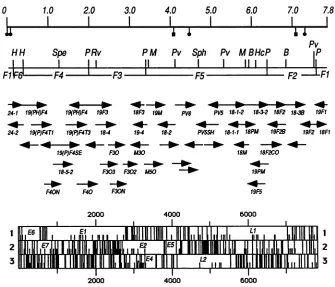
FIG. 1. Sequencingstrategyand ORFsof HPV-51. TheM13 clones thatwereusedtodetermine thesequenceof the HPV-51genome are
shown beneathalinear representation of thegenome. Arrowswithoutnamesrefertooligonucleotides thatwereusedasprimersto"walk" through regions of thesequenceforwhichnocloneswereavailable. Fragments FltoF6representPstI-PstIorPstI-HindIII subclones that were used to generate the various subclones in M13. The letters above the line referto restriction endonuclease sites for the following
enzymes:H, HindIII; Spe, SpeI; P, Pstl; Rv, EcoRv; M,MluI; Pv, PvuII; B, BamHI; and Hc, HincII. The circlesrepresentthe potentialor
verified E2 binding sites, and the squares representpotential polyadenylation sites. The lowerpartof the figure depicts the location and boundaries ofthe variousORFs of HPV-51. The distribution of termination codons (long vertical lines) and initiation codons (short vertical lines) is shown.
CACCT, which is complementary to the coding strand at
nucleotides419 to 400.ThisDNA wassubjected to 35 cycles
of denaturing, annealing,and extensionat95, 55, and72°C,
respectively, with Taq polymerase in aPerkin-Elmer-Cetus
Thermocycler. The resulting product was gel purified and clonedinto the filled-inBamHIsiteofpIBI31. The sequence was determined from double-stranded plasmid DNA by
usingtheprimerssynthesizedforamplificationand T7 DNA
polymerase.
Morphologic Transformation. Continuous rat embryo
fi-broblasts (CREF) (26) wereobtained fromPaul Fisher, and BALB 3T3 cells were obtained from Mitchell Goldfarb. These cells weremaintainedatsubconfluenceinDulbecco's
modificationof Eagle medium containing 5% fetal calf serum andplatedat7 x 105cells per 5-cmdish priortotransfection.
Eachdishofcellswastransfected with 3.3 ,ugof linearized
HPV-51 or -18 DNA and 6.7 ,ug of salmon sperm carrier DNA or with only 10 ,ug of salmon sperm DNA, as
previ-ously described(67). Twodaysposttransfectioneachdish of cellswassplit 1:3, and the cells were fed fresh medium every third day. After 21 days, foci of transformed cells were
photographed, cloned, and counted.
PCRamplificationand RNAanalysis. DNAsfrombiopsies, plasmids,ortransformed cellsweretestedfor HPVDNAby PCR amplification of the Li region with the MY09 and MY11 primers described by Manos et al. (37). These DNAs were examined for the presence of HPV DNA
ho-mologousto the E6ORFbyusing primerscomplementaryto the coding strand (RT primer) 5'GGGAATTCCTTCA CAGTCCATCGCCGTTG and anticoding strand (5' E6 and E7 primer) 5'GGGGGATCCAACACCATGTTCGAA GACAAG, respectively. These oligonucleotides hybridize to HPV-51 DNA at nucleotides 887 to 866 and 91 to 111. RNA synthesized in transformed cells was analyzed by primer extending 25 jig of RNA with the RT primer and subsequently isolatingthecDNAproductandsubjectingitto 35 cycles of amplification with the RT and 5' E6 and E7 primers. The product was extracted with phenol and chlo-roform-isoamyl alcohol and precipitated withethanol. One-fifth of the purified product wasthen electrophoresed on a 3% GTG agarose gel that consisted of 3:1 NuSieve to SeaPlaqueinTris-borate buffer. The resolvedproductswere isolatedfrom the gel as previously described (64) and ana-lyzed for the presence of sequenceshomologoustoE6orE7 by slot blot hybridizationwith32P-labeledprobes that were specific forone orthe other of these genes.
Nucleotidesequence accessionnumber.TheHPVsequence in this paper was assigned GenBank accession number M62877.
RESULTS ANDDISCUSSION
Nucleotide sequence of the HPV-51 genome. To further characterize the HPV-51 genome, a detailed restriction
on November 10, 2019 by guest
http://jvi.asm.org/
[image:2.612.138.473.75.362.2]AACAATTATC TTGTAAAAAC TAGGGTGTAA TCGAAGACAA GAGGGAAAGA CCACGAACGC
GGAATTATGT AGAGCAGATG TATATAATGT
TTTTATTCAA AAATTAGAGA GTATAGACGT GGTGTCATAG ATGTCAAAGA CCACTTGGGC
ATGCGCTAAT TGCTGGCAAC GTACACGACA
TTTAACACCA CAGACTGAAA TTGACTTGCA
AGACGGGCTG GACAGGCTAC GTGTTACAGA
GCGTTGTACA GCAGATGTTA ATGGGCGAAC GGGGCGGGGT GTAATGGGTG GTTTTTTGTT GATCTGATTT AATAAACTTT ATAGATAGTG
AAACAAAGAG GCTGTGCATC AGTTAAAACG AGTCAGGCAA ACGAGTCACA AGTTAAAAGG AGGTAGATGG GCAACATGGC GGTTCACAGA ACTAAACAGT ATATGTGAAG TATTAAAAAG
CGGGTGTTTA AAAGTGATAA AACATGTTGT CATTTTGCAT GTACTACCAT ATACAATGTT
TGCTAAGTGT TTAAGTACAT TAGTAAATAT
ACAGGCATAT CAAACATTAG CAATACATAT
TATCACAAAT GGTGCAATGG GCATTTGACC
AGCGTTTTTA AAGAGTAATT GCCAAGCAAA
GCCTGGATAA GGTATAGATG TGATAGAGCA
TTCAAATGTT TAAACAGTTT TTAAAAGGAA
AATGAAGTTT ATGCAAGGGT CCATTATTTC
GCTACGTATG GGTGTTGGAC ATATATTGAT
TAGTATGTCC ACCATTACTA ATAACGTCAA
TACATTTCCA TTTGATAACA ATGGGAATGC
GAGGAAGAGG ACAAAGAAAA TGGAGACCCT
GATCAAATTA ACTATTGGAC ATTGTTACGA
CAACAACAGT ATCAAAACAA AAGGCCTGTC
GCGGGAGACA TGTTATGAAC TATGGTGTGT
GCAATGGACT ATACAAGCTG GAAATTTATA
TAAATTCAAA AAAAGAATAT TATGTACAGT
CCGAAAAGGG TTATGACCGA AAACGGTGCA TATAAAAGTG CAGTGGTAAA AGTATAGAAG AACACCATGT TGCATGAATT ATGTGAAGCT TTGAACGTTT CTATGCACAA TATACAGGTA GTGTGTGTGT ATTGTAAAAA AGCATTTACT GAAATTAAGA TTGTATATAG GGATAATAAT CCATATGCAG TATGCAAACA ATGTTTACTG
TATAGCAGGT CTGTGTATGG TACTACATTA GAGGCAATTA CTAAAAAAAG CTTATATGAT TTATCGATAA CTGAAGAAAA GCAAAAATTG GTGGACGAAA AAAAAAGGTT CCATGAAATA GCGGGACGTT GGACGGGGCA ACGTAACGAA ACCCAAGTGT AATAAAGCCA TGCGTGGTAA TGTACCACAA TTAAAAGATG TAGTATTGCA ATGCTACGAG CAATTTGACA GCTCAGAGGA GGAGGATGAA GTAGATAATA TGCGTGACCA GCTACCAGAA ATTGAAGCTC CGTGTTGCAG GTGTTCAAGT GTAGTACAAC TGGCAGTGGA AAGCAGTGGA GACACCCTTC TAAGCCTGGT TTGCCCGTGT TGTGCGAACA ACTAGCAACG GCGATGGACT GTGAAGGTAC AGAGGATGAG GAAGCAATAG TAGAAAAAAA AACAGGAGAT AATGTTTCGG ATGATGAGGA TGAAAATGCA GATGATACAG
AAACTAGTAT TTGCAGTCAG GCGGAACAGG AGACAGCACG GGCGTTGTTT CAGGCCCAAG AATTACAGGC AAAGTTTCTA GTCAGCCCGC GAAGCAGCCC ATTAGGAGAC ATTACAAATC AAAACAACAC ACACAGCCAT AGATTACTGG ACAGTTATCC GGACAGCGGA TATGGCAATA CACAAGTGGA AACTGTGGAA GCAACGTTGC ACAGTGTGTG TAGTAGCGGG GGGGGCAGTG TTATGGATGT GGAAACAACA GAAAGCTGTG CAAATGTAGA CAGTAATGCA AAAGCAACGT TAATGGCAAA ATTTAAAGAG TTGTATGGTA TTAGTTATAA TGAGTTGGTA ATAGATTGGG TTTGTGCATT GTTTGGCGTT TCCCCAATGG TAGCAGAAAA TTTAAAAACA CTAATTAAGC TATCATGTGA TTGGGGCACC ATTGTATTAA TGCTAATTAG GTTTTCATGT GCAAAAAACA GAACAACAAT
CCCACAATCA CAAATGTTTA TAGAACCACC AAAATTACGT AGTACACCTG TGGCATTATA TTTTTATAGA GGAGAGACAC CTGAATGGAT TACACGACAA ACGCAACTAC AACATAGTTT TGAGGATAGT ACCTTTGAAT ATGAAGTATT AGATGATAGT GAAATAGCAT TTCATTATGC ACAATTAGCA GATATAGATA GTAATGCTGC
ATATGTAAAA GATTGTGGGA CCATGGCACG GCATTACAAA CGAGCACAAA GAAAATCATT ATCTATGTCA
AAGGATGGAG GCAACTGGAG AGAAATTGCT AAATTTTTAA GATATCAAGG TGTAAACTTT ATGTCCTTTA
CACCAAAACA CAATTGCATA GTCATATATG GCCCACCAAA CACAGGCAAG TCATTATTTG CAATGAGCCT
ATATGTAAAC TCTGGTAGTC ATTTTTGGTT ACAGCCACTA GAGGATGCTA AAATAGCATT GTTAGATGAT CAGTATTTAA GAAACTTTTT AGATGGTAAT CCATGTAGTA TAGATAGAAA ACATAGGAGT TTAATACAAT
ACATAAATCC ACAAGAGGAT GCAAACCTAA TGTATTTACA TACAAGGGTA ACAGTATTAA AGTTTTTAAA
TGTGTATACA TTGAATGATG AAAATTGGAA AAATTTTTTT TCCACCACAT GGTCCAGATT AGATTTGGAG
ATGCCACCGT TTAAATGTGT GCCAGGAGAA AATACTAGAC TGTTATGAAC TGGACAGTGA TAAATTAGTA
TATGAAGCTG CTATGTTTTA TGCAGCACGG GAAAGAAACT TACGAACAAT CAATCACCAG GTAGTACCAG
AAGCAATTGA AATGCACATG GCCTTACAAT CGCTTAACAA ATCAGACTAT AACATGGAAC CATGGACAAT
GGCTCCCAAG CAATGTTTCA AAAAGGGGGG CATAACTGTA ACAGTTATAT TTGATGGAAA TAAGGACAAT
TATATATATG ATAATGATAA GTGGGTAAAG ACAAATGGAA ATGTGGACTA TACGGGTATA TATTACACTG
TTAAAGATGA AGCCAAAATA TATGGGGCAC AACAGTGGGA GGTCTATATG TATGGTACTG TAATAACATG
3301 TCCTGAATAT GTATCTAGTA CCTGCAGCGA CGCGTTATCC ACTACTACAA CTGTTGAACA ACTATCAAAC ACCCCAACGA CCAATCCCCT TACCACCTGC
3401 GTGGGCGCCA AAGAAGCCCA GACACAACAG CGAAAACGAC AGCGACTTAC TGAGCCCGAC TCCTCCACAA TCTCCCCACT GTCCGTGGAC AATACAAACA
3501 ACCAAATACA CTGTGGAAGT GGAAGCACTA ACACTGGAGG GCACCAAAGT GCAACTCAGA CTGCGTTTAT AGTGCATTTA AAAGGTGATA CAAATTGTTT
3601 AAAATGTTTT AGATACAGAT TTACAAAACA CAAAGGGTTA TATAAAAACG TATCCTCAAC CTGGCATTGG ACCAGTAATA CTAAAACAGG CATTGTTACC
3701 ATTGTGTTTG ACAGTGCACA TCAACGGGAA ACATTTATAA AAACCATTAA AGTACCCCCA AGTGTAACAC TGTCATTGGG AATTATGACA CTGTAACTAG
3801 TGTAATATAT GTATTGTACA TATATACTGT CACAAGCCAA TATGTGCTGC TAATTGTATA GACATATTGT AACCATTGCA GTGTTTATTA TTTTGCTATT
3901 TGTGCTTTGC TTGTGTGTGT GTCTTGTGTT GTGTTGTTTG TTGCCGCTAC TGCTGTCCCA ATACGTGTTT GCAGCTGCCT TATTATTAAT TTTATGTTTT
4001 TGGTTTGTTG TTGCAACATC CCAATTAACT ACATTTTTTG TATATTTGAT TTTTTTTTAC TTACCTTGTT TACTTTTACA TCTATATACA TTTTTACTTT
4101 TGCAATAAAC TTGTTATATT TTTGTGATTA AATATGGTGG CTACACGTGC ACGGCGTCGG AAGCGAGCAT CTGTAACACA ATTATATTCT ACATGCAAAG
4201 CTGCTGGTAC ATGTCCTCCT GATGTTGTGA ATAAGGTTGA AGGTACTACA TTGGCCGATA AAATATTACA GTGGAGTGGG TTGGGTATAT TTTTGGGTGG
4301 CCTAGGTATT GGTACTGGGT CTGGATCTGG GGGGCGTACT GGATATATCC CTTTAGGTGG TGGGGGTCGC CCAGGCGTGG TGGATATTGC TCCTGCAAGG
4401 CCACCTATTA TAATTGACCT ATGGCACCAT ACTGAACCTT CTATAGTAAA TTTGGTTGAG GACTCTAGTA TTATTCAGTC TGGGTCTCCT ATACCTACCT
4501 TTACTGGTAC CGATGGCTTT GAAATTACTT CATCTTCCAC AACAACCCCT GCTGTGTTGG ACATCACCCC ATCTGCTGGT ACTGTACATG TTTCTAGTAC
4601 TAACATTGAA AATCCTTTAT ATATTGAACC TCCATCCATT GAGGCTCCAC AATCTGGAGA AGTGTCAGAT ATATATTTAC TAGTACACTA CTCTGGTACT
4701 CATGGGTATG AAGAAATACC TATGGAAGTG TTTGCATCCA ATGTCAGTAC TGGTACTGAA CCTATTAGCA GCACACCTAC TCCAGGGGTT AGTCGCATAG
4801 CTGCTCCCCG CTTGTATAGT AAGTCCTACA CACAGGTTAA AGTTACAAAT CCTGATTTTA TTAGTAAGCC ATCCACATTT GTTACATTTA ATAATCCTGC 4901 TTTTGAGCCT ATTGACACAT CCATAACTTT TGAGGAACCT GATGCTGTTG CACCTGATCC TGATTTTCTG GATATTATTA CACTGCACCG CCCTGCCCTT
5001 ACATCTCGTA GAGGCACAGT ACGCTTTAGT AGGTTAGGTC AAAAGGCCAC CATGCGCACT CGTAGTGGCA AACAAATTGG TGCTCGTGTA CATTATTATC
5101 ATGATATTAG TAGAATTGCA CCAGCTGATG AACTTGAAAT GCAGCCTTTA CTTTCACCTT CTAATAATTA TAGTTATGAC ATTTATGCTG ATTTAGATGA
5201 AGCTGAAACA GGTTTTATAC AGCCCACACA CACCACACCT ATGTCACACT CCTCTTTGTC TAGGCAGTTG CCCTCCTTAT CTTCATCTAT GTCTTCATCT
5301 TATGCAAATG TTACTATTCC ATTTTCAACT ACATATTCTG TTCCTATTCA TACAGGGCCT GATGTGGTAT TGCCCACATC TCCTACAGTA TGGCCTTATG
5401 TTCCCCACAC TTCCATTGAC ACCAAGCATT CTATTGTTAT ACTAGGTGGG GATTACTATT TGTGGCCCTA TACACATTTA CTACGCAAAC GCCGTAAACG
5501 TATACCCTAT TTTTTTACAG ATGGCATTGT GGCGCACTAA TGACAGCAAG GTGTATTTGC CACCTGCACC TGTGTCTCGA ATTGTGAATA CAGAAGAATA
5601 TATCACACGC ACCGGCATAT ATTACTATGC AGGCAGTTCC AGACTAATAA CATTAGGACA TCCCTATTTT CCAATACCTA AAACCTCAAC GCGTGCTGCT
5701 ATTCCTAAAG TATCTGCATT TCAATACAGG GTATTTAGGG TACAGTTACC AGATCCTAAC AAGTTTGGAC TCCCGGATCC AAATTTATAT AATCCAGACA
5801 CAGATAGGTT GGTGTGGGGT TGTGTGGGCG TTGAGGTGGG CAGAGGACAG CCCCTTGGTG TTGGCCTTAG TGGTCATCCC TTATTTAATA AATATGATGA
5901 CACAGAAAAT TCACGCATAG CAAATGGCAA TGCACAACAA GATGTTAGAG ATAACACATC TGTTGACAAC AAACAGACTC AGTTATGTAT AATAGGCTGT
6001 GCTCCACCTA TTGGGGAACA CTGGGGTATT GGCACTACAT GCAAAAACAC ACCTGTACCT CCAGGAGACT GCCCCCCCCT GGAACTTGTA TCCTCTGTCA
6101 TTCAGGATGG CGATATGATT GATACAGGGT TTGGAGCTAT GGATTTCGCT GCCCTACAGG CCACCAAATC AGACGTCCCT TTGGATATTT CACAGTCTGT
6201 TTGTAAATAT CCTGATTATT TAAAAATGTC TGCAGACACA TATGGTAATT CCATGTTTTT TCATTTACGC AGGGAGCAAA TCTTTGCTAG GCACTATTAT
6301 AATAAACTTG TAGGTGTTGG GGAAGACATT CCTAACGATT ATTATATTAA GGGTAGTGGT AATGGCCGTG ACCCTATAGA AAGTTATATA TACTCTGCTA
6401 CTCCCAGTGG GTCTATGATA ACATCTGATT CTCAAATTTT TAATAAGCCT TATTGGCTCC ACCGTGCGCA GGGTCACAAT AATGGCATTT GCTGGAACAA
6501 TCAGCTTTTT ATTACCTGTG TTGATACTAC CAGAAGTACA AATTTAACTA TTAGCACTGC CACTGCTGCG GTTTCCCCAA CATTTACTCC AAGTAACTTT
6601 AAGCAATATA TTAGGCATGG GGAAGAGTAT GAATTGCAAT TTATTTTTCA ATTATGTAAA ATTACTTTAA CTACAGAGGT AATGGCTTAT TTACACACAA
6701 TGGATCCTAC CATTCTTGAA CAGTGGAATT TTGGATTAAC ATTACCTCCG TCTGCTAGTT TGGAGGATGC ATATAGGTTT GTTAGAAATG CAGCTACTAG
6801 CTGTCAAAAG GACACCCCTC CACAGGCTAA GCCAGATCCT TTGGCCAAAT ATAAATTTTG GGATGTTGAT TTAAAGGAAC GATTTTCTTT AGATTTAGAC
6901 CAATTTGCAT TGGGTCGCAA GTTTTTGTTG CAGGTTGGCG TACAACGCAA GCCCAGACCA GGCCTTAAAC GCCCGGCCTC ATCGGCATCC TCTTCCTCTT
7001 CCTCTTCAGC CAAACGTAAA CGTGTTAAAA AGTAATGTAT GTTAGTTTTT GTATGCTTGT GCACACTGTT GTATGCCTGT ATGTATATGT TTGTGTATGT
7101 ACTGTATGTG TTTTTGTGTG TGTGTGTGTT GTTGTTCCTG TATGTATGAG TTATGTATGT TTATTATTAA TAAACTATGT GGTGTGTGTG TGTGTGTTTT
7201 TGCATGACTG CATTTGTATG ACATGTACGG GTGTATGTGG GTATTACATT ATCCCCGTAG GTCAAGGGTG GTGTTTCGGT GGCGTCCCTA TTGCCCTACC
7301 CATTTTTTGC AGCACAACAG TTTATATTTG TGCTATTTAG TTATACTTTG TAGCTTCCAT TTTGTTACAG CTGCAGCCAT TTTGAGTGCA ACCGATTTCG
7401 GTTCGTGTAC TTTTAGTATA TTTGCCAAGT TTTAAACCAC AACTGCCAGT TGTTTTTGGC ATAAACCATC ATTTTTTTAT GACATAGTGC ATACATCCGC
7501 CCGCCCACGC CTTGTACTTG GCGCGCCTTA CCGGCGCTAG TCATACAACC TATTAGTCAT TTGTACTTTA ACAATTGTTG GCACACTGTT TTCCGCCCTA
7601 TAATAATTTA ACTGCTTATA GGCATGTATT TTTTGGCATA TTTTATCTTA CTAATTGCAT AGTTGGCAGG TCAAATACTA TGTTTTTAGT GCCAAGTTTC
7701 TATCCTACTT ATAAACCATC TTACTCATAT GCAGGTGTGC TACACAAATG TGTTACCTAA CCGATTTGTG TTCTGCCTAT GCTTGCAACA TTTTTTCTTA
7801 TAACATTT
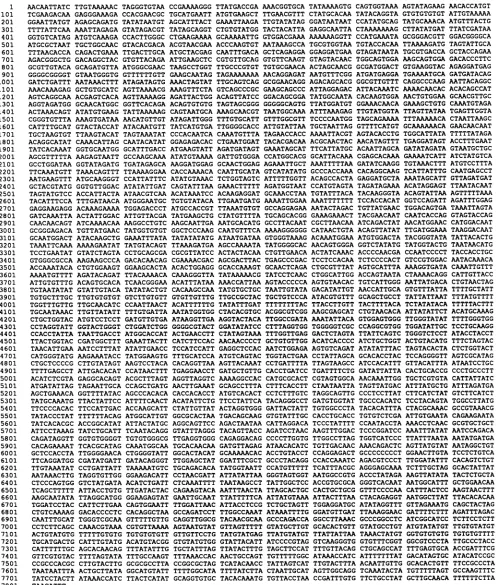
FIG. 2. Complete 7,808-bpsequence of the HPV-51genome. Theposition of nucleotide 1wasdetermined by alignment with HPV-16
DNA.
1 101 201 301 401 501 601 701 801 901
1001
1101 1201 1301 1401
1501 1601 1701
1801 1901 2001 2101
2201
2301 2401
2501
2601 2701 2801 2901 3001 3101
3201
on November 10, 2019 by guest
http://jvi.asm.org/
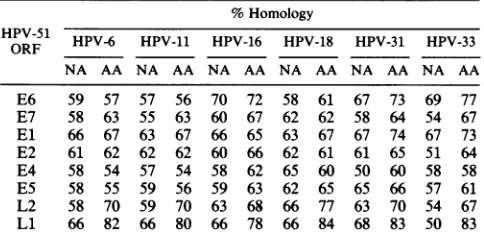
[image:3.612.70.567.96.681.2]TABLE 1. Homologies of HPV-51 and other HPV ORFsa
% Homology
HORFP1
HPV-6 HPV-11 HPV-16 HPV-18 HPV-31 HPV-33 NA AA NA AA NA AA NA AA NA AA NA AAE6 59 57 57 56 70 72 58 61 67 73 69 77 E7 58 63 55 63 60 67 62 62 58 64 54 67
El 66 67 63 67 66 65 63 67 67 74 67 73 E2 61 62 62 62 60 66 62 61 61 65 51 64 E4 58 54 57 54 58 62 65 60 50 60 58 58 E5 58 55 59 56 59 63 62 65 65 66 57 61 L2 58 70 59 70 63 68 66 77 63 70 54 67 Li 66 82 66 80 66 78 66 84 68 83 50 83
aSequenceswerealigned andcompared byusing theNeedleman-Wunsch algorithm(46) asimplementedby the DNASIS analysis package running on an MS-DOS-basedcomputer. NA, nucleic acid homology; AA, predicted amino acid homology withinthe ORF. Complete ORFs were used for comparison of thenucleicacids, andORFsbeginning with the firstin-frameATG codon were used for the amino acids, except for the E4 of HPV-16, -31, and -33 and the E5 ofHPV-16 and -51, which have noin-frame ATG; in these instances the complete ORFswereused.Onlythe E4AORFof HPV-6 and the3' ElORF ofHPV-16 were usedforcomparison.
endonuclease map of the original Hindlll fragment was prepared and each of the PstI-PstI and PstI-HindIII frag-ments was subcloned in both orientations in M13 vectors. These subclones were subjected to sequence analysis as described in Materials and Methods. Where the ability to read the sequence was exceeded by the length of the clone, thatpieceof DNA was subcloned or pared with exonuclease III, orspecificoligonucleotideprimers were synthesized and used to "walk" through the sequence. The sequencing strategy and clones analyzed are displayed in Fig. 1; more than95% of the sequence was determined in both
orienta-tions.The sequencesderivedfromtheoriginalHindlIl clone were assembled and aligned with the genomes of other HPVs. Thisanalysis revealedthatthe originalclone lacked the potential to encode anE6 protein. To determine if the
missingsequenceresulted fromisolation ofadefectivevirus or ifa small HindIII fragment had gone undetected in our original analysis, primers which flanked the single HindlIl
site weresynthesizedand usedtoamplifyDNAfromseveral HPV-51-containing lesions, including DNAfrom which the
original clonewasisolated. Each sample testedwas shown tocontain DNA that servedas atemplatefor thesynthesis of a 340-bp DNA which released a 232-bp fragment after digestion withHindlIl. The entire PCR-amplified fragment
wascloned and sequenced. Insertionof this informationinto the original compiled sequence resulted in
generation
ofa viralgenomeof7,808 bp.Thecomplete nucleotidesequenceoftheHPV-51genome
isshown inFig. 2.Thefirst nucleotide was
assigned
onthebasis ofhomologywith HPV-16 DNA. The G+C contentof
thisDNA is 39%. Alignment ofthe nucleotide sequence of HPV-51 with that of the other HPVs for which
complete
sequence information was available revealed that HPV-51 most closelyresembled HPV-31 (Table 1).
ORFs.The
pattern
of ORFswasdetermined and shownto be conserved with othersequencedHPVs. Allof theORFs,
with theexceptionof thatencodingtheE5homolog, contain an initiating methionine (Tables 1 and 2). A schematic
representation of the
major
ORFs is shown inFig.
1. Note that all of the major ORFs are derived as a result of translation of mRNAs that would be transcribed fromonly
one strand of the DNA.
Comparisons
of the amino acidsTABLE 2. ORFs ofHPV-51
Nucleotideposition No. of No. of
ORF bss amino
StartORF First ATG Stopcodon bases acids'
E6 85 97 550 465 151
E7 479 560 863 666 101
El 733 874 2776 2,043 634
E2 2690 2720 3794 1,104 358
E4 3294 3309 3570 276 87
E5 3854 4106 255 84
L2 4125 4134 5538 1,413 468
Ll 5443 5521 7033 1,590 504
a Number of aminoacid which wouldconstitute thepredictedproteinsif translation initiatesatthefirst ATG ofeachORF,exceptinthe caseofE5,
which does nothave an initiating ATG and therefore begins at the first in-frame amino acid.
encoded
by
these ORFs allowed us to localize them with respecttotheirhomologsinother HPVs. The firstnucleotideof each of the
major
ORFs along with thepositions
of the first ATG and stop codon is shown in Table 2. The numberof amino acids
composing
eachof thepresumptive
ORFs is alsopresented
in this table.The E6and E7 ORFsare
adjacent
but indifferentreading
frames, and the E6 stop codon is
separated
from the first ATG in E7by
10 nucleotides. E6from thehigh-risk
HPVsassociateswith
p53
and targets itfortheubiquitin-dependent
degradation pathway (54, 66).
The E6 ORF in HPV-51is151 amino acids and contains tworepeats ofaCys-X2-Cys-X29-Cys-X2-Cys
motifthatareseparated by
36aminoacids.The sequenceand arrangement of thismotif,
whichis involved incoordinating
Zn2+
(2, 29),
is conserved in allsequenced
HPVs(14). Cole and Danos
(14)
proposed
that theperiodic-ity
of these repeats and the presence of otherhighly
con-servedamino acidsat
regularly spaced
intervals suggest that E6 hasarisenas aresultofaduplication
event.Inadditionto the motifsthey
describewe notethat,
amongthehigh-risk
types
(HPV-16,
-18, -31,
-33 and-51),
there are additionalhighly
conserved blocks of amino acids at invariant dis-tancesfrom themetal-binding
domains(Table
3).
The role of theseamino acids isunknown; however,
theirconservationin the E6ORF may
potentiate
theironcogenicity
by
targeting
p53
fordegradation. Furthermore,
HPV-51,
like HPVsas-sociated with
anogenital
cancer and in contrast to thoseassociated with
benign
condylomata,
possessespotential
splice
donors atpositions
177 and 219 and a consensusacceptorat402 within E6
(57, 60,
61).
If the donorat177is used and iftranslationinitiates atthe same AUG codon asfor
E6,
then theresulting product
would bea43-amino-acid E6*-likeprotein
(58).
Use ofthe donorat219wouldrequire
internal initiation to maintain thereading
frame and there-fore would not conserve the amino terminus of the E6*protein.
The E7
proteins
fromhigh-risk
viruses associate withp105-RB
withhigh
affinity,
whereas those from low-riskgroups do not
(43).
Thisprotein family
sharessignificant
amino acid
homologies,
which include the conservedCys-X2-Cys-X29-Cys-X2-Cys
motif(14)
and astring
of sevenamino acids
(DLXC'EQ),
which in HPV-18areinvolved inbinding pRB-105.
Mutagenic
analysis
of thisregion
of the HPV-16 E7 ORFdemonstrated that the amino acids which compose thisstring
areimportant
inbinding
pRB-105
(43).
Analysis
of the E7ORF fromHPV-51reveals thatit encodes a 101-amino-acidprotein
with both theCys
motifand thebinding
domain for theproduct
of the retinoblastomagene.on November 10, 2019 by guest
http://jvi.asm.org/
[image:4.612.52.294.88.207.2]TABLE 3. Organization of E6 ORFs from high-risk HPVs
Sequencea
CVYCKLELCRADVYNVAFTEIKIVYRDNNEYAVCKQCLLEYaLIRFYRRY CVECKKPLQRSEYYDFAFADLTVVYREGNPFGICKLCLRELaKISEYRH_H CVYCKGQLTETEVLDFAFTDLTIVYRDDTPHGVCTKCLREY5KVSEFRWY CVYCKTVLELTEVFEFAFKDLFVVYRDSIPHAACHKCIDEYSRIRELRHY CVYCKQQLLRREvYDFAFRDLCIVYRDGNPYAVCDKCLKEY5KISEYRHY SRaVYGTTLEAITKKSLYDLSIRCHRCQ.RPLGPEEKQKLVAEKKRFHQIA NY8VYGNTLEQTVKKPLNEILIRCIICQRPLCPQEKKRHVDLNKRFHNIS RYaVYGTTLEKLTNKGICDLLIRCITCORPLCPEEKQRHLDKKKRFHNIG SDSVYGDILEKLTNTGLYNLLIRCLRCQRPLNPAEKLBHLNEKRREHNIA CYSLYGTTLEQQYNKPLCDLLIRCINCQBPLCPEEKQRHLDKKQRFHNIR
GRYTGQCANCW GRWAGRCAACW GRWTGRCIACW aHYRGQCHSCC aRWTGRCMSCC
aThe amino acidsequences of the E6 ORFs from these high risk HPVswerealignedasdescribed in Cole and Danos(14). Highlyconserved amino acids
previously noted by these authorsareinboldface. Those conserved amino acids whichweredetected inthismoreextensiveanalysis, whichincludedHPV-31 and-51,areunderlined.
The El ORF is thelargest foundinpapillomaviruses, and it encodes a protein which has been shown to dock to the virus-specified E2 DNA-binding protein when it interacts withsequencesintheupstreamregulatory region (URR)(6, 40). Phylogenetic analysis of this ORF in human viruses suggeststhat itmaybecomposedoftwodomains(14). The ElORF inHPV-51 hasthe potentialtoencode aprotein of
634 amino acids. There is considerable conservation of
sequence homology at boththe nucleotide and aminoacid levels betweenthe HPV-51 El ORF and othermembers of the HPVfamily (Table 1).
E2isadimericDNA-binding protein which recognizes the
sequence ACCN6GGT (1, 41) and has both activator and repressorfunctionsontheURR from bovine papillomavirus
(BPV). These functionscan beattributedtothepresenceof
two functional domains which are separated by a spacer
whose length is associated with the virus subgroup from which it is derived. Thus, viruses associated with epider-modysplasia verruciformis contain longer and more
hydro-philic spacers than those associated with infections of the
genital tract (36). The N- and C-terminal segments encode the transactivation and repressor-dimerization domains,
re-spectively. Repressor may be independently derived by
transcription fromaninternalpromoterincells infected with BPV (62, 68) or by alternative splicing as detected in transcriptional analyses of cells and biopsy samples contain-ingHPV-6, -11, or-16 (11, 22,52). Inthe genital
papilloma-viruses E2 bindsto twosites thatareproximal to transcrip-tional elements of the E6 promoter and represses
transcription (5, 51,63).The E2ORF of HPV-51canencode a 358-amino-acid protein that has the characteristic
three-domain structure ofother papillomaviruses (28). The 185-amino-acid N-terminaldomain is rich inarginine and lysine residuesandterminatesataconservedV-185.The
70-amino-acidC-terminaldomainwhich beginsatG-289is preceded by
a 104-amino-acid spacer. The relatively short size of the
middle segment and thepaucity of arginic and lysinic resi-dues distinguish this virus from those associated with epi-dermodysplasia verruciformis (36).
InHPVs the mRNA encodingthe E4 ORFis mostlikely derived by splicing fromadonor in Eltoanacceptorin E4 (11, 12,45), because the bulkof ElRNA, asdetected byin
situhybridization analysis,is found in the nucleus incervical intraepithelial neoplasms (19). The spliced mRNA can
en-codea functional E4gene product, and
immunohistochem-ical analysisofwartscontainingHPV-1 andearly neoplasias containing HPV-16revealsthatE4 is expressed principally
as a cytoplasmic protein in cells that stain positive for Li (16,20, 21).TheE4ORF in HPV-51 iscompletely contained within E2, asit is in other HPVs. Justupstream of the E4 ORF, atposition 3270, is apotential splice acceptorwhich could be usedto generate this species from any ofseveral potential donorsiteswithintheEl ORF. Demonstration of this spliced species will require the analysis of mRNAs expressedin lesionscontainingHPV-51orcell lines
express-ingthe virusgenome.
The E5 ORFfrom BPV has been studied in greatdetail. This 44-amino-acidproteinispresentintransformedcellsas a membrane-associated homodimer (55). The protein
con-tains ahydrophobiccore anda hydrophilic
carboxyl-termi-nal tail which defines a single functional domain that is
responsible for its ability to induce focus formation and stimulate cellular DNA synthesis (33, 59). Recently, this proteinwasshowntoactivate theendogenous P-type
recep-torfor theplatelet-derived growth factorintransformed cells (48).Althoughnoclearfunction has beenascribedtotheE5 ORFs in HPVs, the ESa ORF of HPV-6c was shown to transform 3T3 cells (10). The ES ORF in HPV-51 lacks an
initiator methionine and can encode a protein of 84 amino
acids witha predicted molecular weight of 9,764. As inthe otherHPVES ORFs there is aconservedCys-X-Cysin the
amino-terminal third of the protein, and there are three hydrophobicdomainswhich havebeen suggestedto consti-tuteamembrane spanning region (8).
The L2 and Li ORFswhich encode the minor and major capsid proteins, respectively, are the products of lategene
expression andare highly conserved betweenHPVs(Table 1). They are typically only expressed in well-differentiated
epithelium in the apical portion ofa lesion (17, 44). This
sequence conservation has formed the basis for the
devel-opment ofa sensitive PCR assay which uses primers that
specifically amplifythe Li ORFfor thedetection andtyping of HPV genomes(37). Amplification of viral DNAorDNA
from lesions containing HPV-51 with the MY09and MY11
HPV
HPV-51 HPV-33 HPV-31 HPV-18 HPV-16
HPV-51 HPV-33 HPV-31 HPV-18 HPV-16
HPV-51 HPV-33 HPV-31 HPV-18 HPV-16
on November 10, 2019 by guest
http://jvi.asm.org/
* N ,~\5 ~ ~ ~ G)\
a
~ ~ ~ ~ ~ 77
FIG. 3. Amplification of HPV DNAs. DNA was isolated from
biopsies containingHPVsequences, and the virus typewas deter-minedbytherestriction endonucleasedigestionpattern of the DNA after Southern blothybridization. (A) Theproducts of DNA from these samples were amplified with the MY09 and MY11 primers
described in Manosetal. (37). (B)Thetwopotential hybridization
sites within the Li region of HPV-51 DNAfor the MY09 primer; annealing at these sites results in generation of the two PCR
productsseeninpanelA.
primersdescribed by Manos et al. (37)generates two
prod-ucts (Fig. 3A): one of 452 bp is similar in size to what is
amplified in othergenital HPVs, andanother that is 272bp
which results from mispriming of the MY09 primer at
position 6718 to 6737 (Fig. 3B). The shorter amplification product can be eliminated if the annealing temperature is raised to 550C. The Li ORF in HPV-51 can encode a
504-amino-acid proteinwhich is approximately 80%
homol-ogous atthe amino acid level toLlsfrom other HPVs. The
L2 ORF consists of468 amino acids and contains the motif
T-T-P-A-V-L at position 148 along with clusters of basic residuesatthe amino andcarboxy termini(56);thecarboxy
terminus overlaps the amino terminus of Li by 6 amino acids. TheT-T-P-A-V-Lmotif ishighlyconservedamongthe mucosal HPVs,and its presencefurthercements the classi-fication of this virus among these members of the HPV
family (32).
Regulatory motifs in the HPV-51 genome. The URR of HPVsis operationallydefined as the sequencebetween the
C
FIG. 4. Transformation of CREF cells. Freshly plated CREF cells were transfected with HPV-51 (a), salmon sperm (b), or
HPV-18 DNA(c)as described in Materials and Methods. The cells
weresplit 1:3 after 24h, andthe mediumwaschangedevery third
day. Foci were photographed after 21 days by using a Nikon invertedmicroscopeand T-MAX 400film (Kodak).
laststopcodon of Li and theinitiator ATG in E6.
Computer-based searches ofHPV URRs and DNA-binding studies of
the URRfromHPV-16 have revealed that thegenitalHPVs
contain a glucocorticoid response element (GRE) and a keratinocyte-dependentenhancer(15). Inaddition,thereare
otheroverlapping cis-actingsequenceswhichrespondtoand
interact with general, tissue-specific, and virus-specified trans-actingproteins.Theseinclude sites forinteraction with
APi, NFI, TFIID, Spi, and the E2 activator-repressor
protein. The URR of HPV-51 is 869 bp and contains three
copies of the sequence ACCN6GGT, to which E2 is known
A
on November 10, 2019 by guest
http://jvi.asm.org/
[image:6.612.356.506.75.536.2] [image:6.612.50.287.78.425.2]TABLE 4. Location ofsequencemotifsin the HPV-51genome
Sequencemotif' Consensussequence Sequencein HPV-51 Locationb
Keratinocyte-dependent enhancer TTTGGCTT TTTcGgTT 7396-7403(+)
TTTGGCaT 7455-7462(+)
TTTatCTT 7402-7409(+)
TTTGgcTT 7765-7772(+)
TTTcGgTT 29-37(-)
E2binding site ACCN6GGT ACCGATTTCGGT 7391-7402(+)
ACCGAAAAGGGT 30-41(+)
46-57(+)
ACCTTTTACTGG 4497-4508(+)
NFI TTGGCA TTGGCA 7423-7428(-)
7456-7461(+) 7578-7583(+) 7633-7638 (+) 7563-7568(+) 7690-7695 (-)
Spl GGGCGG GGGCGG 7497-7502 (-)
7501-7506(-) 7593-7598(-)
TFIID ATATA ATATA 60 64(+)c
AP1 TGAcTCA TtAGTCA 53-59(+)
Oct-1 ATTTGCAT AaTGCAT 7653-7660(+)
GRE GGTACANNNTGTTCTCd GcTtcATTTtTTgT 7356-7372(+)
TGTACATTGTGTCATe TGTACATTaTtATCAT 5090-5105(+)
TCTACATTTTATACTf aCTACATTTTtTg_T 4030-4044(+)
AGAACATACTGTCCCf AcAttATACTGTCCC 3818-3833(+)
Poly(A)addition AATAAA AATAAA 4103-4109(+)
7169-7173 (+)
GT repeat GTGTGTGTGT GTGTGTGTGT 181-190(+)
3913-3922(+) 7116-7125 (+) 7186-7195(+)
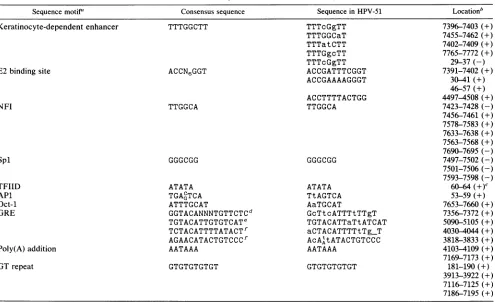
Sequencemotifsfor interaction withknowntranscription factorswere asdescribedinMitchellandTjian (39). b+, motifs that areinthe senseorientation; -, motifs in theantisense orientation.
There areadditional copies of thissequencethroughoutthegenome; only thesitein URRisshown here.
dThe GRE consensususedwasfrom Chanet al. (9).
eHPV-16 GRE.
fHPV-39 GRE (65).
to bind (1, 41). These sequences arelocated at nucleotides 7391, 30, and 46 within URR, and a fourth copy of this sequence motif is found at position 4497 within L2. A mobility shift gel electrophoresis assay with end-labeled
fragmentsfrom the HPV-51 URR (that contained the canon-ical E2binding site sequence) was used to demonstrate that recombinantE2from BPV would bind and alter the
electro-phoretic mobility of thosefragments which contained these sites (data not shown).
Nucleotide sequenceanalysis of the HPV-51 URR reveals the presence of the many tightly clustered and overlapping
regulatory elements; there is a homolog of the GRE, and therearesevencopies ofthe NFIbindingmotif. Inaddition,
there are single sites for AP1, Oct-1, Spl, and TFIID. The orientation and location of these sites is summarized in Table 4. Inaddition to the single GRE in URR there are four other
homologsof this sequence, three of which are clustered near the E5ORF and one which is in L2.
Poly(A) signals for mRNA termination are bipartite, con-sisting of a signal AATAAA followed at a distance of 20 to 30 nucleotides by a GT-rich sequence (50). Sequences homol-ogous to this termination signal are found in all HPVs. In HPV-51 there aresix copies of the AATAAA motif, and two ofthese, located at 4104 and 7169, are downstream of the
earlyandlate genes, respectively, and contain both compo-nents of the polyadenylation signal.
Finally, we notethe occurrence ofadecameric sequence
that is composed of alternating G T residues which is repeated fourtimes inthe virus genome.
Transforming activity of HPV-51DNA.Cloned DNAsfrom those HPVs which are associated with lesions that have a high risk for malignant progression have the capacity to transform rodent cells in culture (69) and to immortalize humankeratinocytes (23, 35, 49). Immortalization of kerati-nocytes results from cooperation between the E6 and E7 geneproducts (31). Sequence analysisrevealed that HPV-51 was more closely related to the oncogenic HPVs than to thoseassociated withbenignlesions. Toextend this associ-ation further, we next asked if DNA from HPV-51 would transform a continuous line of rat embryo fibroblasts. Be-cause the original clone of virus DNA was isolated as a HindIIIfragmentandlackedtheE6ORF,the intactgenome was reconstructed after cleavage with Hindlll and self-ligationtogenerateconcatamers. ThisDNA wasdigestedat theunique HincIIsite in theoriginalclone(47),downstream ofE7, and cloned intoaHindlIl- vector at auniqueHincIl site. The missing 232-bp Hindlll fragment (which encodes most ofE6)was then insertedatthe uniqueHindIII site in the virus genome.This DNAwasreleasedfrom the resulting
plasmid,and10,ug(each) of HPV-51 and HPV-18 DNAwas compared for their abilities to transform CREF cells. HPV-51 DNA induced transformed cells with a frequency
similar to that of HPV-18 DNA (30 CFU/,ug versus 20 CFU/,ug). Moreover, control transfections that included
on November 10, 2019 by guest
http://jvi.asm.org/
[image:7.612.73.568.84.386.2]97 549
1 E6
599 862
P97 E7 1
r01
0 622
527
404
309
F2
F3 242
217!
201 r
is
,160 147
F4
I
4F5F6
..
122 110
90
76
67
PCR Productsof DNA 5'E6,E7
5'E6 3'E6
I
1000bp
Size RT
- 796bp
F2
F4 Predicted PCR Products of cDNA
796bp
554bp 540bp 191bp
... 90bp 80bp Hybndization Probes
_
Probe
1--- --- Probe 2
F7 F8
F5
F6
FS
Probe1
[image:8.612.52.550.73.378.2]Probe2
FIG. 5. Analysis of RNA and DNA inacellline transformed with HPV-51DNA. (A)The productsofPCRamplificationof DNA derived
from purified plasmid (lanes 2 and 4)ortransformedcells(lanes3and 5) with primers that would amplify E6 and E7 (lanes 4 and 5)orE6
(lanes 2 and 3) along with the PCRamplification products of thecDNAs synthesizedwith theRTprimeronRNAisolatedfrom the same
transformed cell line(lane 6)wereanalyzed by electrophoresis in 3% GTGagarosegels. Lane 1 containsanMspIdigestof pBR322 DNAas
asizemarker. (B) Aschematic of the E6 and E7 regions of the HPV-51genomeis shown along with the positions of the primers usedfor amplification of E6 (5' E6 [nt 79to99] and 3' E6 [nt 399to419])and E6 and E7 DNA (5' E6 and E7 [nt 91to111] and RT[nt 866to887]) andforsynthesis of cDNA (RT [nt 866to887]) and its amplification. Thetheoretical spliced products with their potential donor andacceptor
sitesareindicatedalong with the predicted size of the amplification products. The probes usedtoanalyze the products of amplification of the cDNAs(panel A, lane 6), i.e., Fl, 780 bp; F2, 580 bp; F3, 220 bp; F4, 162 bp; F5, 135 bp; F6, 120 bp; F7, 88 bp; and F8, 80 bp, for thepresence
of E6(Probe1)orE7(Probe 2)sequences arealso shown. (C) Results ofhybridization of each of the amplified products of the cDNA reaction
to32P-labeledprobes specific for E6 (Probe 1) and E7 (Probe 2).
HPV-6, HPV-11, orplacental DNA gave rise to no
trans-formed colonies, whereas transfection with similaramounts
ofsrc DNAresulted in >500 CFU/ptg. Comparison of the morphologictransformation frequency of thesesameDNAs on BALB 3T3 cells resulted in too few transformants with either HPV-18 or HPV-51 DNAs to quantitate. A typical morphologically transformed CREF colonyisshown in Fig. 4. Several transformants were isolated and recloned twice.
The cloned colonies werethen expandedand examinedfor thepresenceofsequences homologoustoHPV-51 DNA by PCR amplification of the E6, E7, and Li regions of this virus. The transformed cells contained amplification prod-ucts ofthe appropriate size (Fig. 5A and B). Analysis of these products by digestion with restriction endonucleases demonstrated that they were derived from HPV-51 DNA
(data notshown).
Thestateof virus DNAinasingle PCR-positive clonewas
examined by Southern blot hybridization. Hybridization of transformed-cell DNA cleaved with Hincll (which should not cleave integrated virus DNA because the site is de-stroyedafterrelease of the insert from thevector) revealed
the presence ofa single 14-kb species; after digestion with
EcoRV(asingle cutter), twobandswere detected(datanot shown). This resultsuggeststhatonlyasinglecopyofvirus
DNAwasintegratedinto thegenomeof thetransformed cell. Because products of both E6 and E7 are required for
completemorphologictransformation(3, 30,31, 34, 42),we
next examined the RNAs present in a line oftransformed
cells that were homologous to virus sequences from these regionsof the HPV-51 chromosome. RNA isolated from the single-copy transformant was reverse transcribed with a
primer (RTprimer)that isdownstream of the E7 termination codon (Fig. SB). The resultingcDNAs werethen amplified with primers that flank these ORFs and examined by gel electrophoresis. Theelectrophoretic mobilities of the prod-ucts are shown in Fig. 5A. The slowest migrating band resulted from contamination of the RNA with virusDNA,as
judged by its appearance in the absence of any reverse
transcriptionand the fact thatitwasnotpresentif RNAwas
preselected for poly(A)-containing molecules (data not shown). Bands corresponding to products that might be derivedas aresult of utilization ofthevarioussplicedonors
A
1
2
3 4 5 6
B
R1 R2
C
N %Ft
4E_
t,
P1
F2
_gopm
P3 340bpF4
-_ F5
F6
F7
P8
ProbeI
Probe 2
"X
I.lb"I
oI"
on November 10, 2019 by guest
http://jvi.asm.org/
and acceptors in this region ofthe genome (Fig. 5B) were
excised from the gel and examined for the presence of
sequences homologous to either E6 or E7 by molecular hybridization by using probes that were specific for each ORF. Theresults ofthisanalysisare shown inFig. SC. The three slowest migrating bands contained amplimers that hybridized with both the E6 and E7probes, while the other products appeared to contain sequences thatwere
predom-inantly derived from E7. Because the E6 probe only
con-tained 30 bp of homology with the region upstream of the splicedonor atposition 177, itsability tohybridizewith E6
sequences is somewhat limited. We conclude from these
data that thereare splicedRNAs present in this transformed cell thatcan encode both the E6 and E7 proteins. Further characterization ofthe products of these reactions will be requiredtodetermine theutilization of donors andacceptors and theexactcoding potentialof each of the RNAs identified in thispreliminary analysis.
Insummary, wehave determined the nucleotidesequence
ofHPV-51. Analysisof thegenome sequence,inconjunction withassayof its transformation potential, placesthis isolate
amongthehigh-risk groupof HPVs.
ACKNOWLEDGMENTS
Studies in the authors' laboratories were supported by grants
CA23767(S.S.) and CA47676 (C.P.C.)from the National Institutes
of Health andSIG13 (S.S.) fromthe American CancerSociety. We
gratefully acknowledge the Perkin-Elmer Foundation forthe
dona-tion ofathermalcycler.
Wethank Rey Sia forperforming the E2binding assays, Elliott
Androphy foracloneexpressing BPVE2, and Li Hui forsomeof
theclones used indetermining thesequenceof HPV-51.
REFERENCES
1. Androphy, E.J., D. R. Lowy, andJ. T. Schiller. 1987. Bovine papillomavirus E2 trans-activating geneproduct binds to
spe-cific sites inpapillomavirus DNA. Nature(London) 325:70-73. 2. Barbosa, M. S., D. R. Lowy,andJ.T. Schiller. 1989. Papillo-mavirus polypeptides E6 and E7 are zinc-binding proteins. J.
Virol.63:1404-1407.
3. Barbosa, M. S., W. C. Vass, D. R. Lowy, and J. T. Schiller. 1991. Invitrobiologicalactivities of the E6 and E7genes vary
amonghumanpapillomavirusesof differentoncogenic potential. J. Virol.65:292-298.
4. Bauer, H. M., Y. Ting, C. E. Greer, J. C. Chambers, C. J. Tashiro, J. Chimera, A. Reingold, and M. M. Manos. 1991. Genital human papillomavirus infection in female university students as determined by aPCR-based method. JAMA 265:
472-477.
5. Bernard, B. A., C. Bailly, M.-C. Kebiur, M. Darmon, F.
Thierry,and M.Yaniv.1989. The humanpapillomavirustype18 (HPV18) E2geneproduct isa repressorof the HPV18
regula-toryregion in human keratinocytes. J. Virol. 63:4317-4324.
6. Blitz, I. L., and L. A. Laimins. 1991. The 68-kilodalton El
protein of bovine papillomoavirus is a DNA binding phos-phoprotein which associates with the E2 transcriptional
activa-torinvitro. J. Virol. 65:649-656.
7. Boshart, M., L. Gissman, H. Ikenberg, A. Kleinheinz, W.
Scheurlen, and H.zurHausen.1984. Anewtype of papilloma-virus DNA, itspresencein genital cancerbiopsies and in cell
linesderivedfrom cervicalcancer. EMBO J. 3:1151-1157.
8. Bubb, V., D. J. McCance,and R.Schlegel.1988. DNAsequence
ofthe HPV-16 E5 ORF and the structural conservation of its encodedprotein. Virology 163:243-246.
9. Chan, W.-K., T. Chong, H.-U. Bernard, and G. Klock. 1990.
Transcription of the transforminggenesof theoncogenic papil-lomavirus-16 is stimulated by tumorpromoters through AP1 binding sites. Nucleic Acids Res. 18:763-769.
10. Chen, S.-L.,andP. Mounts.1990.Transforming activityofE5a proteinofhumanpapillomavirustype6in NIH3T3and C127 cells. J. Virol. 64:3326-3233.
11. Chow,L. T., M. Nasseri,S. M. Wolinsky, and T. R. Broker. 1987. Human papillomavirus 6 and 11 mRNAs from genital
condylomataacuminata.J. Virol. 61:2581-2588.
12. Chow,L. T., S. S.Reilly, T. R. Broker,and L. B. Taichman. 1987.Identificationandmappingof humanpapillomavirustype 1 RNA transcripts recovered from plantar wartsand infected epithelialcellcultures. J. Virol. 61:1913-1918.
13. Coggin, J. R.,and H.zurHausen.1979. Workshopon
papillo-maviruses andcancer.CancerRes.39:545-546.
14. Cole, S. T., and 0. Danos. 1987. Nucleotide sequence and comparative analysis of the human papillomavirus type 18 genome. J. Mol. Biol. 193:599-608.
15. Cripe, T. P., T. H. Haugen, J. P. Turk, F. Tabatashi, P. G. Schmid, M. Durst, L. Gissman, A. Roman, andL. P. Turek. 1987.Transcriptionalregulationof the humanpapillomavirus-16
E6-E7 promoterbyakeratinocyte-dependent enhancer,andby
viral E2trans-activatorand repressor geneproducts:
implica-tionsforcervicalcarcinogenesis. EMBO J. 6:3745-3753. 16. Crum, C.P.,S.Barber,M. Symbula,K. Snyder,A. M.Saleh,
andJ.K. Roches. 1990.Coexpressionof thehuman
papilloma-virustype 16 E4 and Li openreadingframes inearlycervical neoplasia. Virology 178:238-246.17. Crum,C.P.,G.Friedman,G.Nuovo,andS.J.Silverstein.1987. Morphologicalcorrelates ofgenitalHPV infection: viral
repli-cation, transcription and gene expression, p. 355-369. In R.
Gallo,W.Haseltine,G.Klein,and H.zurHausen(ed.),Viruses andhumancancer.Alan R. Liss, Inc.,NewYork.
18. Crum, C.P., M.Mitao, R.U.Levine,and S. Silverstein. 1985. Cervicalpapillomavirusessegregatewithin
morphologically
dis-tinct precancerous lesions. J. Virol. 54:675-681.19. Crum,C.P.,G.Nuovo,D.Freidman,andS.J.Silverstein.1988. Accumulation of RNA homologous to human papillomavirus
type 16 open reading frames in genital precancers. J. Virol. 62:84-90.
20. Doorbar, J.,D.Campbell,R.J.A.Grand,and P.H.Gallimore. 1986. Identification ofthe human papilloma virus-la E4 gene products.EMBOJ. 5:355-362.
21. Doorbar, J., I.Coneron, and P. H. Gallimore. 1989. Sequence divergenceyet conservedphysicalcharacteristicsamongtheE4 proteins ofcutaneous human papillomaviruses. Virology 172: 51-62.
22. Doorbar, J., A. Parton, K. Hartley, L. Banks, T. Crook, M. Stanley, and L. Crawford. 1990. Detection of novel
splicing
patternsinaHPV-16containing keratinocytecellline.
Virology
178:254-262.
23. Durst, M., R. T. Dzarlieva-Petrusevska, P. Boukamp, N. E.
Fusenig, and L. Gissman. 1987. Molecular and
cytogenetic
analysisofimmortalizedhumanprimary keratinocytesobtained after transfection with human papillomavirus type 16 DNA.
Oncogene 1:251-256.
24. Durst, M. L., L. Gissman, H. Ikenberg, and H. zur Hausen.
1985. ApapillomavirusDNAfromacervicalcarcinomaand its
prevalenceincancerbiopsy samplesfrom different
geographic
regions.Proc. Natl. Acad. Sci. USA 82:3812-3815.
25. Dyson, N.,P. M.Howley,K.Munger,and E.Harlow.1989. The humanpapillomavirus-16E7oncoproteinis abletobindtothe retinoblastoma geneproduct. Science243:934-936.
26. Fisher,P.B.,L. E.Babiss,I. B.Weinstein,and H.S.Ginsberg.
1982.Analysisoftypeadenovirustransformationwithacloned
rat embryo cell line (CREF). Proc. Natl. Acad. Sci. USA 79:3527-3531.
27. Giri, I., and 0. Danos. 1986. Papillomavirus genomes: from sequence data to biological properties. Trends Genet. 2:227-232.
28. Giri, I.,0.Danos,andM. Yaniv.1985.Genomicstructureof the cottontailrabbit(Shope) papillomavirus.Proc.Natl.Acad. Sci. USA 82:1580-1584.
29. Grossman,S.R.,andL. A. Laimins.1989. E6proteinof human
papillomavirustype 18binds zinc. Oncogene9:1089-1093. 30. Halbert,C.L.,G.W.Demers,and D.A.Galloway.1991. The E7
on November 10, 2019 by guest
http://jvi.asm.org/
geneof human papillomavirus type 16 is sufficient for immor-talization of human epithelial cells. J. Virol.65:473-478. 31. Hawley-Nelson, P., K. H. Vousden, N. L. Hubbert, D. R. Lowy,
and J. T.Schiller.1989. HPV16 E6 and E7 proteins cooperate to immortalize human foreskin keratinocytes. EMBO J. 8:3905-3910.
32. Hirsch-Behnam, A., H. Delius, and E.-M. deVilliers. 1990. A comparative sequence analysis of two human papillomavirus (HPPV) types 2a and 57. Virus Res. 18:81-98.
33. Horwitz, B. H., A. C. Burkhardt, R. Schlegel, and D. DiMaio. 1988. 44-Amino acidE5 transforming protein of bovine papillo-mavirus type 1 requires a hydrophobic core and specific car-boxyl-terminal amino acids. Mol. Cel. Biol. 8:4071-4078. 34. Hudson, J. B., M. A. Bedell, D. J. McCance, and L. S. Laimins.
1990. Immortalization and altered differentiation of human ke-ratinocytes in vitro by the E6 and E7 open reading frames of human papillomavirus type 18. J. Virol. 64:519-526.
35. Kaur, P., and J. K. McDougall. 1988. Characterization of primary human keratinocytes transformed by human papilloma-virus type 18. J. Virol. 62:1917-1924.
36. Kiyono, T., A. Adachi, and M. Ishibashi. 1990.Genome organi-zation and taxonomic position of humanpapillomavirustype47 inferred from its DNA sequence. Virology 177:401-405. 37. Manos, M. M., Y. Ting, D. K. Wright, A. J. Lewis, T. R.Broker,
and S. M. Wolinsky. 1989. Use of polymerase chain reaction amplification for the detection of genital human papillomavi-ruses. Cancer Cells 7:209-214.
38. Meisels, A., and C. Morin. 1981. Human papillomavirus and cancer of the uterine cervix. Gynecol. Oncol. 12:111-123. 39. Mitchell, P. J., and R. Tjian. 1989. Transcriptional regulation in
mammalian cells by sequence-specific DNA binding proteins. Science 245:371-378.
40. Mohr, I. J., R. Clark, S. Sun, E. J. Androphy, P. MacPherson, and M. R. Botchan. 1990. TargetingtheElreplication protein to the papillomavirus origin ofreplication by complex formation with the E2 transactivator. Science250:1694-1699.
41. Moskaluak, C., and D. Bastia. 1987. The E2 "gene" ofbovine papillomavirus encodes an enhancer-binding protein. Proc. Natl. Acad. Sci. USA 84:1215-1218.
42. Munger, K., W. C. Phelps, V. Bubb, P. H. Howley, and R. Schlegel. 1989. The E6 and E7genesof thehuman papillomavi-rus type 16 together arenecessaryandsufficientfor transforma-tion of primary humankeratinocytes. J.Virol. 63:4417-4421. 43. Munger,K.,B.A.Werness, N.Dyson, W. C. Phelps, E. Harlow,
and P. M. Howley. 1989. Complexformation ofhuman papillo-mavirus E7 proteins with theretinoblastoma tumorsuppressor gene product. EMBO J. 8:4099-4105.
44. Nagai, N., G. Nuovo,D. Friedman, and C. Crum. 1987. Detec-tion of papillomavirus nucleic acids ingenital precancers with the in situ hybridization technique: a review. Int. J. Gynecol. Pathol. 6:366-379.
45. Nasseri, M., R. Hirochika, T. R.Broker,and L. T.Chow. 1987. A human papillomavirus type 11transcript encoding an E1E4 protein. Virology 159:433-439.
46. Needleman, S. B., and C. D. Wunsch. 1970. Ageneral method applicable to the search for similarities in the amino acid sequence of twoproteins. J. Mol. Biol. 48:443-453.
47. Nuovo, G., E.DeVilliers,R.Levine, S. Silverstein, and C. Crum. 1988. The isolation of a novel human papillomavirus (HPV 51) from acervicalcondyloma. J. Virol. 62:1452-1455.
48. Petti, L., L. Nilson, and D. DiMaio. 1991. Activation of the platelet-derived growth factor receptor by the bovine papillo-mavirusE5 transforming protein. EMBO J. 10:845-856. 49. Pirisi, L.,S. Yasumoto, M. Feller, J. Doniger, and J. DiPaolo.
1987. Transformation of human fibroblasts and keratinocytes with human papillomavirus type 16 DNA. J. Virol. 61:1061-1066.
50. Proudfoot, N. 1991. Poly(A) signals. Cell 64:671-674.
51. Romanczuk,H.,F. Thierry, and P. M. Howley. 1990. Mutational
analysisofcis elements involved in E2modulationof human papillomavirus type 16 P97andtype 18P105 promoters. J.Virol. 64:2849-2859.
52. Rotenberg, M. O., L. T. Chow, and T. R. Broker. 1989. Characterization of rare humanpapillomavirustype 11mRNAs coding for regulatory andstructuralproteins,usingthe polymer-ase chain reaction. Virology172:489-497.
53. Sanger, F., S. Nicklen, and A. R. Coulson. 1977. DNA sequenc-ing with chain-terminating inhibitors. Proc. Natl. Acad. Sci. USA 74:5463-5467.
54. Scheffner, M., B. A. Werness, J. M. Huibregtse, A.J. Levine, and P. M. Howley. 1990. The E6oncoproteinencodedbyhuman papillomavirustypes 16 and 18 promotes thedegradation ofp53. Cell 63:1129-1136.
55. Schlegel, R., M. Wade-Glass, M. S.Rabson, and Y. C. Yang. 1986. The E5 transforminggene ofbovine papillomavirus
en-codes a smallhydrophobicpolypeptide. Science233:464-467. 56. Schwarz, E., M. Durst, C. Demankowski, 0. Lattermann, R.
Zech, E.Wolfsperger,S.Suhai,and H.zurHausen.1983. DNA sequenceandgenomeorganization ofgenitalhuman papilloma-virus type6b. EMBOJ. 2:2341-2348.
57. Schwarz, E., U. K. Freese, L.Gissman, W.Mayer, B. Roggen-buck, A. Stremlau, and H. zur Hausen. 1985. Structure and transcription of human papillomavirus sequences in cervical carcinoma cells. Nature(London)314:111-114.
58. Schwarz, E., A. Schneider-Gadicke, andH. zurHausen. 1987. Human papillomavirus type-18 transcription in cervical carci-nomacell lines andinhumancellhybrids. Cancer Cells5:47-53. 59. Settleman, J., A. Fazeli, J. Malicki, B. H. Horwitz, and D.
DiMaio. 1989. Genetic evidence thatacute morphologic
trans-formation, induction of cellular DNA synthesis, and focus formation are mediated by a single activity of the bovine papillomavirus E5protein. Mol. Cell. Biol. 9:5563-5572. 60. Smotkin, D., H.Prokoph, and F.0.Wettstein. 1989.Oncogenic
andnononcogenichumangenitalpapillomaviruses generate the E7 mRNAby differentmechanisms. J. Virol. 63:1441-1447. 61. Smotkin, D., and F. 0. Wettstein. 1986.Transcriptionofhuman
papillomavirus type 16early genes ina cervical cancerand a
cancer-derived cell line and identification of the E7 protein. Proc. Natl. Acad. Sci. USA 83:4680-4684.
62. Stenlund, A., J. Zabielski, H. Ahola, J. Moreno-Lopez, and U. Pettersson. 1985.MessengerRNAsfromthetransforming region of bovine papilloma virustype 1. J. Mol. Biol. 182:541-544. 63. Thierry, F., and P. M. Howley. 1991. Functional analysis of
E2-mediated repression of the HPV18 p105 promoter. New Biol.3:90-100.
64. Vogelstein,B., andD.Gillespie.1979.Preparativeandanalytical
purificationofDNAfromagarose. Proc. Natl. Acad. Sci. USA 76:615-619.
65. Volpers, C., and R. E. Streeck. 1991. Genomeorganizationand nucleotidesequenceofhumanpapillomavirustype 39.Virology
181:419-423.
66. Werness, B., A. J.Levine, and P. M.Howley. 1990. Association ofhumanpapillomavirus types 16 and 18 E6proteins withp53. Science 248:76-79.
67. Wigler,M., A.Pellicer,S.Silverstein,R.Axel,G. Urlaub,and L.
Chasin. 1979. Transformation ofthe APRT locus inmammalian cells. Proc. Natl. Acad. Sci. USA76:1373-1376.
68. Yang, Y.-C., H. Okayama, and P. M. Howley. 1985. Bovine papillomavirus contains multiple transforming genes. Proc. Natl. Acad. Sci. USA82:1030-1034.
69. Yasumoto, S.,A. L. Burkhardt, J. Doniger, andJ. A. DiPaolo. 1986. Human papillomavirus type 16 DNA-induced malignant
transformation of NIH 3T3 cells. J. Virol. 57:572-577. 70. zur Hausen, H. 1977. Humanpapillomaviruses and their
possi-ble role in squamous cell carcinomas. Curr. Top. Microbiol. Immunol. 78:1-30.
71. zurHausen,H.1987. Papillomavirusesin humancancer. Cancer 59:1692-1696.